Blog

  • Two College of Arts and Sciences Professors Receive Jackson Award

    The positive impact Case Western Reserve University professors have on the lives of their students is recognized annually with the J. Bruce Jackson, M.D. Award for Excellence in Undergraduate Mentoring.

    The recognition honors outstanding advising and mentoring of undergraduate students. The Jackson Award celebrates those who have guided a student toward the discovery of academic and career paths; fostered the student’s long-term personal development; challenged the student to reflect, explore and grow as an individual; and supported and/or facilitated the student’s goals and life choices.

    This year’s recipients are William Deal and Renée M. Sentilles. Read more.

    William Deal, Severance Professor of the History of Religion, Department of Religious Studies
    Deal.jpg

    William Deal

    William Deal helps his students realize their full potential by tailoring his interaction with them to their needs.

    “Students need different things at different points in their academic career and lives,” said Deal, a first-time Jackson Award winner.

    A student nominator wrote that Deal “changes the lives of every person he meets. He challenges me to be a better scholar and a better person. Professor Deal inspired me to major in religious studies because of the opportunities available to change peoples’ view of the world. He started by changing mine.”

    Instead of viewing what he does as mentoring, Deal said his primary goal is to listen to his students in order to create a unique learning experience. Throughout his career, he has watched many of his students figure out the path in life they want to explore, an experience he described as “enormously gratifying.”

    A professor at Case Western Reserve for 21 years, Deal has taught courses on theory and interpretation in the academic study of religion, comparative religious ethics, and East Asian religious and ethical traditions. He holds a secondary appoint as professor of cognitive science. Outside of the classroom he is a faculty representative on the student-run Academic Integrity Board. He’s been nominated for several university awards, and was a recipient of the Zeta Psi Fraternity Faculty of the Year Award in 2000.

    The Jackson recognition comes at a significant point in his career. He is scheduled to be on sabbatical during the fall 2010 semester. “My teaching style has changed over the years. I’m reinventing my own intellectual interests,” he said. Deal, author of two books and dozens of articles, plans to write and conduct research during his sabbatical.

    Renée M. Sentilles, Associate Professor of History
    Sentilles.jpg

    Renée M. Sentilles

    Renée M. Sentilles grew up in a family of educators, so her desire to teach and mentor is natural.

    “I grew up believing students were important. Teaching is about being unselfishly interested in helping students figure out what they need to do,” Sentilles said.

    A Case Western Reserve faculty member for 10 years, she said history is a way to “open up people’s lives and help them understand the world. So much of the present is about the past.”

    Although she teaches about the past she’s helped many of her students maneuver their present and beyond.

    “Professor Sentilles completely changed my future,” a nominator wrote. Under the tutelage of Sentilles, the nominator co-founded a history club and discovered a passion for American women’s and gender history. “She has written countless recommendation letters for me for research programs and graduate school applications. After my first acceptance, she even took the time to send an email to my mother, saying she wanted to congratulate her ‘mom to mom.’ When I’m a professor I want to be a teacher, mentor and friend” like her, the nominator wrote.

    Sentilles is director of the history department’s undergraduate studies program and teaches courses in American history focused on culture, gender, women and children. She also is the faculty adviser for the university’s Feminist Majority Leadership Alliance. She has written a book and several articles and essays, and is the 2010 recipient of the Jessica Melton Perry Award for Distinguished Teaching in Disciplinary & Professional Writing.

    She is most proud of her work with students. “Mentoring is an important part of teaching. You get to watch students grow and become stronger. It’s like being a gardener,” Sentilles said of planting seeds of knowledge and then watching students blossom.

  • El Mercedes-Benz AMG SLS eléctrico llegará en 2013

    2011-mercedes-benz-sls-amg.jpg

    Poco a poco la tecnología eléctrica se va metiendo bajo la piel de las principales marcas y es innegable que la presencia de par motor constante es una clara ventaja para los futuros modelos eléctricos deportivos. El día de hoy, Mercedes-Benz llega con la novedad de que el espectacular AMG SLS tendrá su modelo eléctrico para el año 2013, dos años antes de lo planeado.

    No solamente es una idea a futuro, sino que los modelos prototipos (no se han dicho cuántos) ya han sido producidos o están muy cerca de ser terminados, a juzgar por lo que ha dicho Volker Mornhinweg, director de AMG. Al parecer el jefazo de AMG ya ha conducido los prototipos y promete que la experiencia del SLS eléctrico será inolvidable.

    Pero veamos qué es lo que promete Mercedes con este modelo. Los motores eléctricos serían cuatro, con una salida combinada de 400 Kw, lo que estaría equivaliendo a 536 caballos, junto con 649 Libras/pie de par motor. Si vamos a la comparación directa con el modelo con motor V8 a gasolina, el eléctrico casi estaría igualándose, ya que el motor de combustión le gana por unos 40 caballos. Sin embargo, en el torque es donde más se nota la diferencia del eléctrico a a su favor, con unas 170 libras más que el motor V8.

    A pesar de todo, el modelo eléctrico tiene una desventaja: pesaría bastante más que el modelo de gasolina, con 500 kilos agregados. Esta es una cifra que no se puede tomar a la ligera, ya que es demasiado peso sumado al coche, pero los técnicos de AMG no se han dado por vencidos; dicen que el peso se ve compensado con el par motor ya que el SLS eléctrico estaría llegando a los 100 km/h en menos de 4 segundos. Y hablando de números, termino con la velocidad máxima que calculan que tendrá este nuevo SLS, que se acerca a los 190 km/h, no tanto como el motor V8, pero es una buena velocidad para maximizar la autonomía de las baterías.

    Vía | Autopia


  • Let’s Be Honest, The GDP Report Was Terrible For This Point In The Cycle

    (This post originally appeared on the author’s blog.)

    The government reported that the economy grew by 3.2% for the first quarter. Normally, that’s not so bad but for coming out of a deep recession, it’s very unimpressive.

    Federal government spending, which includes remaining stimulus money, grew at an annualized rate of 1.4 percent in the first quarter of 2010. But this was more than offset by continued spending cuts from state and local governments, whose spending decreased 3.8 percent. It was the third quarter in a row in which state and local spending fell.

    “Government spending contracted, for all the ballyhoo about stimulus,” said John Ryding, chief economist at RDQ Economics. “This recovery is going to have to stand on the backs of private-sector demand, not on government demand, given all the current fiscal challenges.” Even though any pickup in business is welcome, modest improvement may not be enough to alleviate the pain caused by the so-called Great Recession, many economists say.

    The nation’s gross domestic product — a broad measure of goods and services produced in the country — is far below its potential, according to economists’ projections of where the economy would have been if it followed its long-term trend. Output would need to grow at least 5 percent annually for several years to get back on track — and perhaps more importantly, to lead to enough job creation to employ the 15 million Americans already out of work and the 100,000 new workers joining the labor force each month.

    Earlier this week, I took a stab at giving a letter name to this recovery. My guess for Q1 was pretty close but a tad too high (I had 3.5% instead of 3.2%). Here’s the up-to-date chart:

    GDP Grow Trend Apr30

    Thanks to several emailers, I’m going to call it an N-Shaped recovery.

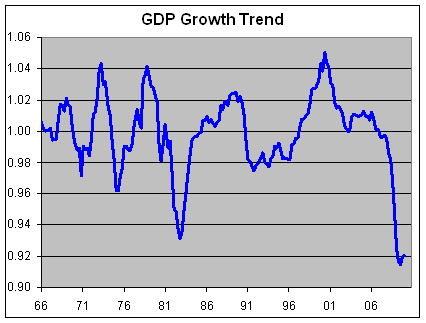
    Here’s a more sobering way to look at GDP. This chart shows real GDP divided by a trendline growing at 3.08% which is about the long-term rate of growth.

    image936.png

    In other words, this shows you how well GDP is doing compared with its historic growth rate. We’ve fallen off a cliff and are in the process of splatting.

    In previous recessions, the economy has snapped back sharply to its historic trendline (1.0 on the chart). By growing at 3.2% last quarter, the economy is barely making headway.

    At 0.92, we’re 8% below the trendline. This is what the NYT means by growing at 5% for a few years to get back on track. If the economy grew by 5% a year — 2% higher than the long-term trend — for four years, then we’d finally get back to something resembling normal.

    Join the conversation about this story »

  • Create Some Video Game Crossovers [PhotoshopContest]

    A hacked game lets you play the original Super Mario Bros with any number of old-school video game characters. But this idea could be taken so much further! Let’s combine games across consoles and eras, shall we? More »


  • Watch: Test Drive Unlimited 2 debut trailer

    You got a small taste of the Test Drive Unlimited 2 spec sheet (qjnet/news/german-mag-reveals-test-drive-unlimited-2-features-scans.html) a few days ago, but just like the cars you’ll be driving, you gotta see it in action when you’ve seen it

  • Survey Casts Doubt on Consumer Confidence Improvement

    In the continuing news trend that consumers are feeling more confident about the U.S. economy, the Reuters/University of Michigan consumer sentiment index rose in late April. It increased from 69.5 mid-month to 72.2 at the end of April. That beat expectations of a smaller rise to 71.0. This data point is an important revelation, because the index fell earlier this month. While the reversal appears to confirm other economic data points indicating better consumer spending, it remains something of an outlier.

    Earlier this week, we learned that the Conference Board’s consumer confidence reading jumped this month, so it was strange that the Reuters/U Michigan index was down in early April. Although it was positive in the month’s second half, overall, the index was ultimately lower over the entire month, moving from 73.6 in late March to 72.2 in late April. It also remains well below its long-term average in the high 80s.

    The Reuters/U Michigan index appears to contradict all of the other positive news about increasing consumer sentiment and spending. Yet as first quarter GDP clearly shows, consumers are definitely spending more, so their sentiment must be improving. But mixed measures can still be useful to consider. The disparity between this index and other readings likely indicates that the recovery isn’t likely to be a steep one. A clear, rapid recovery wouldn’t allow for any doubt. Certainly, some consumers are feeling more confident, but many remain pessimistic as they continue to struggle.

    The survey’s chief economist, Richard Curtin, explains this point:

    Consumers think the recovery is well underway, although most think it will be distressingly slow and have little immediate impact on their finances.

    Sentiment and spending increases face the prospect of a worrying plateau if the labor market recovery is too slow. If that happens, economic growth will be stagnant.


    Email this Article
    Add to digg
    Add to Reddit
    Add to Twitter
    Add to del.icio.us
    Add to StumbleUpon
    Add to Facebook


  • House Dems Call on Coal Industry to Quit Opposing Safety Reforms

    On Tuesday, Bruce Watzman, spokesman for the National Mining Association, appeared on Capitol Hill to implore lawmakers not to overreact (i.e., legislate) following the fatal mining accidents which, to that point, had taken 30 lives in West Virginia this month. The current rules, Watzman argued on behalf of the industry, are plenty tough enough to ensure miners’ safety underground.

    One day later, two more miners were killed after a roof collapsed in an underground coal mine in Western Kentucky.

    Reacting to the string of tragedies, several House Democratic leaders called on the mining industry this week to rethink its opposition to tougher safety measures.

    “In the coming weeks Congress will be working on reforms to the Mine Act to close enforcement loopholes, strengthen MSHA’s oversight and provide more federal resources to close the growing backlog of citation appeals,” Rep. George Miller (D-Calif.), chair of the House Education and Labor Committee, and Rep. Lynn Woolsey (D-Calif.), chair of the Workforce Protections Subcommittee, wrote to industry leaders Thursday. “We urge the mining industry to drop its historic record of opposing critical mine safety improvements and instead work with Congress and the Obama Administration to pass overdue reforms.”

    Miller is planning a hearing on mine safety, though the date and witness list have yet to be set.

    Miller and Woolsey are also requesting that all mine operators re-evaluate the safety of their projects; that non-union miners be given the opportunity to meet with management about safety concerns; and that all miners be given MSHA’s phone number so they can report safety hazards anonymously.

    Of course, all of these things rely on the willingness of the coal companies to comply voluntarily. And there’s nothing in the history of some of these companies to indicate that they’re ready to sacrifice efficiency for safety. As one former MSHA manager said recently, MSHA has been too soft in its approach to enforcing safety measures. “And you can’t do that with this industry,” the former official added. “You’ve got to use a big stick.”

    The full text of the Miller/Woolsey letter follows:

    April 29, 2010

    Open Letter to the Nation’s Mine Owners:

    During the past month our nation has witnessed four mine tragedies, including the Upper Big Branch mine explosion, which killed 29 miners, the death of one miner at the Beckley Pocahontas Mine, the death of a contract worker at M-Class Mining, and two deaths at the Dotiki Mine today.  Sadly, each of these tragedies was preventable.

    In the name of tens of thousands of miners and their families who put their lives on the line every day, we call on mine operators to make the safety and health of their workers their top priority.

    In addition to these recent tragedies, the number of mine citations for serious violations has skyrocketed, revealing a dangerous pattern of neglect and failure of commitment by too many operators to comply with the nation’s mine safety laws. Spot inspections just completed by the Mine Safety and Health Administration at 57 coal mines found 1,436 violations and resulted in a staggering 105 closure orders.

    The government does not have sufficient resources to be at every mine every day.  Mine operators must take responsibility for ensuring the safety of their employees.

    Today, we call on all of the country’s mine operators to take actions and responsibility immediately to ensure their operations are actively in compliance with all mine safety laws; that adequate resources are being allocated to mine safety; and that managers and employees have full confidence that they may report dangers internally or to regulators without any fear of retaliation or penalty.

    We request that non-union mines give their employees and their families an opportunity to meet with management to suggest additional safety measures and to report dangerous or potentially dangerous conditions. We request that union mine owners do the same with their unions, and work with them to monitor and develop additional safety procedures as needed.

    We also request that each mine employee be given a card in the next three days with MSHA’s toll free number so they can confidentially report potential hazards in the event they fear retaliation.

    In the coming weeks Congress will be working on reforms to the Mine Act to close enforcement loopholes, strengthen MSHA’s oversight and provide more federal resources to close the growing backlog of citation appeals.

    We urge the mining industry to drop its historic record of opposing critical mine safety improvements and instead work with Congress and the Obama Administration to pass overdue reforms.

    We look forward to hearing through the mine associations what specific actions each mine operator is taking in response to this letter.

    Sincerely,

    GEORGE MILLER
    Chair, House Education and Labor Committee

    LYNN WOOLSEY
    Chair, House Workforce Protections Subcommittee

  • MUST READ/SEE: Goldman Sachs Climate/World government Connection! Romanticpoet’s Weblog

    Article Tags: Edward Barnes, Glenn Beck, Headline Story, YouTube

    First, a post by me (Edward Barnes) on April 21, 2009: It is long, but connects the dots.Obama’s Climate Change Initiative (Cap and Trade) = Friends In High Places?

    Now a video lesson for those that are visual learners:

    Part 1: from Fox News: Click to see – The One Thing

    Part 2 below from YouTube:

    Source: romanticpoet.wordpress.com

    Read in full with comments »   


  • Here’s Why US GDP Growth Is Unsustainable

    flag balloon(This is a guest post from Credit Writedowns.)

    The US turned in a fairly robust quarter in Q1 2010, with real GDP growth meeting expectations at 3.2% annualized. This comes on the back of a very robust annualized 5.6% growth in the previous quarter. This is the best growth two-quarter growth we have seen since 2003.

    However, when one digs deeper, it is obvious this growth is unsustainable because it is predicated on a reduction in savings rates and a releveraging of the household sector. As a result, I expect weak GDP growth in the second half of 2010.

    The problem with the BEA reported numbers is the composition of GDP growth. The BEA says in its data release:

    Real gross domestic product — the output of goods and services produced by labor and property located in the United States — increased at an annual rate of 3.2 percent in the first quarter of 2010, (that is, from the fourth quarter to the first quarter), according to the “advance” estimate released by the Bureau of Economic Analysis. In the fourth quarter, real GDP increased 5.6 percent.

    The Bureau emphasized that the first-quarter advance estimate released today is based on source data that are incomplete or subject to further revision by the source agency (see the box on page 3). The “second” estimate for the first quarter, based on more complete data, will be released on May 27, 2010.

    The increase in real GDP in the first quarter primarily reflected positive contributions from personal consumption expenditures (PCE), private inventory investment, exports, and nonresidential fixed investment that were partly offset by decreases in state and local government spending and in residential fixed investment. Imports, which are a subtraction in the calculation of GDP, increased.

    The deceleration in real GDP in the first quarter primarily reflected decelerations in private inventory investment and in exports, a downturn in residential fixed investment, and a larger decrease in state and local government spending that were partly offset by an acceleration in PCE and a deceleration in imports.

    So the gain in GDP was due to consumption, while GDP decelerated from Q4 2009 due to inventory, exports, residential investment, and state and local government spending. 

    Translation: These numbers are entirely dependent on an increase in consumer spending. Everything else is becoming a drag on growth.

    In March, when I wrote “The mindset will not change; a depressionary relapse may be coming,” I noted:

    I expect the following to occur:

    1. Public pressure to withdraw monetary and fiscal stimulus will work and stimulus will be reduced quicker than many anticipate – beginning sometime in early 2010. The Fed has already said it will stop buying mortgages in March and the Obama Administration is now focused on deficit reduction as evidenced by the paltry jobs bill just passed.
    2. The fiscally weak state and local governments will therefore receive little aid from the federal government. This will result in budget cuts, tax increases, and layoffs by the end of Q2 2010.
    3. At the same time, the inventory cycle’s impact on GDP growth will attenuate. By the second half of 2010, inventories will not add considerably to GDP.
    4. Meanwhile, the reduction of Fed support for the mortgage market will reveal weaknesses there. Mortgage rates may increase, decreasing housing demand.
    5. Employment will be weak in this environment, leading to another spate of defaults and foreclosures.
    6. The foreclosures and weak housing demand will pressure house prices and weaken lender balance sheets, especially because of second-lien exposure. This will in turn reduce credit growth.

    Isn’t this exactly what is happening?

    1. Monetary and fiscal stimulus is being withdrawn. Do you notice the end of ZIRP? – FT Alphaville
    2. The state and local governments are already detracting from GDP growth as of the Q1 figures just reported.
    3. The inventory cycle did add to GDP growth in Q1 but was a major factor in the deceleration in GDP growth.
    4. The Fed has indeed withdrawn support from the mortgage market. Mortgage rates have been rising, and are near 8-month highs. They fell last week for the first time in five.
    5. We know that state and local governments are laying off workers in droves. And Jan Hatzius at Goldman is expecting a fairly weak 175,000 increase in non-farm payrolls when the April Data is released.  That is not going to get it done. Meanwhile, the only thing keeping foreclosure activity from renewed record highs is government intervention.
    6. House prices are not rising in the least.  The latest Case-Shiller data showed another decline in house prices. That’s five consecutive months of house price declines.

    So, the only thing standing between the US and renewed recession is the over-indebted American consumer. And consumer income is not increasing very much. Consumption is increasing much more.

    Here’s what the BEA said last month about the data. Note how the growth in personal consumption expenditures is outstripping the growth in personal income. This is clearly unsustainable:

    Personal income increased $1.2 billion, or less than 0.1 percent, and disposable personal income (DPI) increased $1.6 billion, or less than 0.1 percent, in February, according to the Bureau of Economic Analysis. Personal consumption expenditures (PCE) increased $34.7 billion, or 0.3 percent. In January, personal income increased $30.4 billion, or 0.3 percent, DPI decreased $26.0 billion, or 0.2 percent, and PCE increased $38.5 billion, or 0.4 percent, based on revised estimates.

    Real disposable income increased less than 0.1 percent in February, in contrast to a decrease of 0.4 percent in January. Real PCE increased 0.3 percent, compared with an increase of 0.2 percent.

    Bottom line: the government is removing the stimulus prop to GDP growth before the recovery has become self-sustaining. The inventory cycle is already starting to fade. That means weak 1 or 2% growth at best by Q4 2010. Unless job growth picks up tremendously by the second half of the year, this recovery is in trouble.

    Read more at Credit Writedowns –>

    Join the conversation about this story »

  • Rumor: LG Aloha becomes ‘Ally,’ expected this May

    LG Ally

    It seems like just yesterday I was saying that touchscreen bar phones were all the buzz and that QWERTY sliders had become few and far between.  Well, as usual, once you’re willing to let words like that slip out of your mouth, you better be ready to eat them.  AndroidandMe is now reporting that the phone once rumored to be the LG Aloha is now being called the Ally and might be making its way to Verizon this coming May.

    The Ally’s specs look to be a compilation of the reported features for the Aloha’s various rumored model numbers (C710, LG VS740, LU2300).  Strangely enough, when the LG VS740 popped up in Verizon’s system two weeks ago as the third potential model number for the Aloha, we put a list together of the specs for all the devices just for fun.  But now it appears we may not have been far off.  Here are the rumored specs for the LG Ally:

    • 3.5-inch AMOLED 800×480 touchscreen
    • 65,000 color display
    • Wi-Fi 802.11b/g/n
    • Android 2.1
    • 1 GHz Snapdragon processor
    • Sliding 4-row QWERTY keyboard
    • 5.0-megapixel camera
    • 720p HD DivX compatible playback
    • Wi-Fi, GPS

    If the rumors of the Ally coming to Verizon in May are accurate, Big Red will have a veritable monopoly on powerful Android smartphones.  The crazy thing is that tomorrow is May, so I imagine VZW wouldn’t launch the device until at least the end of the month, since there’s no way they’d take all the attention away from the most sought after Android device to date (HTC DROID Incredible), not this early.

    Any VZW QWERTY-slider takers?  Sound off in the comments!

    Update: As Phandroid pointed out earlier today, the LG Ally appears to have shown its face in an upcoming Iron Man 2 promotional video.  Check out the YouTube video below! 

    {Widget type=”youtube” id=”fZSFTJODYKU&” }

    Via AndroidandMe


  • BMW M5 2011, vídeo espía

    Os presento un vídeo espía del nuevo BMW M5. Este vídeo ha sido filmado mietras este nuevo modelo circulaba por el circuito de Nürburgring. Cabe recordar que si no ocurre ningún problema, será presentado en el Salón de París el próximo mes de Octubre.

    Sobre la motorización no podemos daros ningún dato en concreto ya que no hay nada confiramdo, todo lo que podais leer son meros rumores, aun así, suena con fuerza que contará con un motor V8 4.4 Twin-Turbo de 580 CV.

    A continuación os dejo con el vídeo:

    Related posts:

    1. Vídeo espía del BMW M5 2011
    2. Rolls-Royce Ghost, vídeo filtrado
    3. Foto y vídeo espía del Audi RS5
  • Apple’s Now the Biggest Phone Company in the US [Apple]

    With Motorola’s latest quarterly sales of 8.5 million, the former biggest phonemaker in the US lost its lead to Apple, who sold 8.8 million iPhones last quarter. A moment of reflection, please. [AppleInsider] More »


  • Officials Worry About World’s Expo In China

    The U.S. pavilion at World's Expo

    China says it’s an “opportunity to showcase great achievements and diverse cultures,” but the World’s Expo, which opens in Shanghai on Friday night, is also an opportunity for China to spy on Americans and even recruit new intelligence sources, according to current and former U.S. officials.

    “Are people who go to the Expo potential targets for espionage? I think you’d be a fool to think otherwise,” said one U.S. official, who asked not to be identified due to the sensitive nature of the topic.

    More than 70 million people from China and abroad, including some of the world’s most powerful businessmen, are expected to visit the Expo before it closes in six months. Nearly 200 countries have set up pavilions, displays and food stands representing their singular cultures and history, according to event organizers.

    “The event will be the first registered world exhibition held in a developing country, demonstrating the international community’s trust in China and its anticipation of the country’s future development,” said a video released by event organizers. “Expo shanghai provides an opportunity for China to see the world, and the world to see china.”

    But for years U.S. officials have worried that China might be able to see too much during the World’s Expo and similar global events.

    “These public venues are laden with opportunities for foreign collectors to interact with U.S. experts and glean information regarding dual-use and sensitive technologies,” said a 2008 report issued by the U.S. intelligence community to Congress. “Such events offer host-country intelligence agencies the opportunity to spot, assess, and even recruit new intelligence sources within the U.S. private sector and to gain electronic access to companies’ virtual networks and databases through technology brought to the events by corporate personnel.”

    The report, titled “Foreign Economic Collection and Industrial Espionage,” mentioned the World’s Expo specifically, noting that intelligence and information collection in such “open forums accounted for over four percent of reported suspicious incidents” in the previous year.

    A U.S. intelligence official said the threat environment has not changed much since then, pointing out that the offices of the Director of National Intelligence and National Counterintelligence Executive, which jointly issued the 2008 report, have not retracted it.

    “We continue to view certain countries such as China and Russia, with their efforts to acquire technologies, as a threat,” the intelligence official said.

    The sentiment was echoed by Marion “Spike” Bowman, a veteran of the intelligence community who as the nation’s Deputy National Counterintelligence Executive at the time helped draft the 2008 report.

    “The fact of the matter is that the United States, with about three percent of the world’s population, we spend 25 percent of all the world’s research and development dollars,” he said. “So we are the number one target in the world.”

    Before events like the World’s Expo or the 2008 Olympic Games in Beijing, the intelligence and law enforcement communities often try to teach business executives and others about the threats they face, Bowman said.

    Bowman said the largest threat is a country’s efforts to steal trade secrets and other sensitive technology information.

    Intelligence officials often urge travelling business executives to take a “throw away” cell phone instead of their “normal” devices, and to leave their laptops at home, or “at least let your IT folks scrub the hell out of them when you come back,” according to Bowman.

    “If you take your blackberry and you go back home and you sync it up to your internet and to your office files, the chances of you being penetrated by a bug that’s been planted in your blackberry are just too high to merit the risk,” Bowman said.

    In China, for example, a hotel maid could simply install a file on a guest’s computer. To make things “even easier,” a hotel employee could steal information through a guest’s use of the hotel’s internet service, according to Bowman.

    Before the Olympics in 2008, officials from the Director of National Intelligence’s office held private meetings with up to 30 Chief Executive Officers from the nation’s biggest companies, demonstrating to them “how easy it is” to hack into a cell phone or a laptop, Bowman said.

    U.S. intelligence officials successfully persuaded some key executives to leave their laptops behind and take disposable cell phones, according to Bowman.

    Bowman said he was unaware of any serious incidents or espionage activities during the Olympic Games in Beijing, which were also mentioned as a “high-threat environment” in the 2008 intelligence report to Congress.

    While Bowman said economic espionage is the greatest threat facing Americans who might travel to the World’s Expo, he said countries hosting global events may also try to recruit new spies.

    It’s unclear exactly how common it is for an American to be recruited or “assessed” while traveling overseas, but it has happened before.

    In November 2009, a former high-ranking State Department intelligence official and his wife, both in their early 70s, pleaded guilty to aiding the Cuban government for nearly 30 years. Three decades earlier, in December 1978, Walter Kendall Myers, then a State Department employee with an affinity for Cuba, visited the communist country for two weeks.

    That trip “provided [Cuban intelligence] with the opportunity to assess and or develop Kendall Myers as a Cuban agent,” according to court documents filed by the FBI.

    As for China, a federal law enforcement official who deals with intelligence matters said the nation “continues to pose a threat,” particularly an economic espionage threat, and a State Department official said the U.S. government has “concerns for all Americans traveling to China under all circumstances.”

    “Although the Expo may concentrate more business people together during a short time period, that does not change the risk,” said the State Department official, who spoke on the condition of anonymity.

    But, the official said, Americans from U.S. firms have likely taken precautions, since “most of those companies have been doing business in China for years and know the drill.”

    In addition, the State Department’s Overseas Advisory Council warns and educates private businesses about potential threats and methods for protecting sensitive information.

    China has spent $45 billion to host the World’s Expo, which opens Friday night with a ceremony and fireworks display.

    The United States has spent more than $60 million to participate and build a pavilion representing America, with financial support from several major U.S. companies, including Boeing, PepsiCo, General Electric, and Proctor and Gamble.

    In a letter to the American Chamber of Commerce in Shanghai, U.S. Secretary of State Hillary Clinton said it is “crucial for the United States to be present” and support the Expo’s environmental theme of “Better City, Better Life.”

    Meanwhile, the World Expo’s promotional video said China “loves international communication and world peace.”

    “Because China is undergoing a reform and opening process, it needs to expand exchanges and learn from the development experiences of other countries by hosting this successful and unforgettable World Expo,” the video said.

    In fact, China is likely to become the world’s second largest economy later this year, according the U.S. intelligence community’s annual threat assessment for 2010.

    Presenting the assessment to Congress in February, Director of National Intelligence Dennis Blair noted that China has played a “central role” in the response to the global economic crisis.

    “[China] has served as one of the key engines for global recovery, reinforcing perceptions of its increasing economic and diplomatic influence,” he said.

    Fox News requested comment for this article from the Chinese Embassy in Washington, but no response was provided.

  • Ex-Blagojevich aide Lon Monk enters new guilty plea

    From the Breaking News Center:

    One of former Gov. Rod
    Blagojevich’s former chiefs of staff who is expected to be a key witness
    in his corruption trial entered a new guilty plea in federal court this
    morning.


    Alonzo "Lon" Monk, 51, originally pleaded guilty in
    October and agreed to testify. Today, he pleaded guilty to a superceding
    indictment that was filed in the case in February.

    The new
    indictment was designed to head off any issues if the Supreme Court
    strikes down or limits the "honest services" fraud law. Monk’s plea was
    necessary before Blagojevich’s trial, set for June 3.

    Monk is expected to testify that
    Blagojevich and three of his closest friends – including Monk – schemed
    from the outset of his administration to enrich themselves by
    leveraging the powers of Blagojevich’s office.


    Monk is expected
    to tell the jury how the four — a group that also included key
    fundraisers Christopher Kelly and Antoin "Tony" Rezko — planned to
    bring in hundreds of thousands of dollars in campaign contributions they
    could split up when Blagojevich left office.

    Monk’s origninal
    plea was to a single count of mail fraud in exchange for two years in
    prison. Prosecutors dropped that count Friday and had Monk plead to one
    count of conspiracy to solicit a bribe.

    For more, please click here.

  • Owner Of West Virginia Coal Mine Plunging On Report Of FBI Criminal Investigation (MEE)

    massey energy chart

    The FBI is investigating Massey Energy (MEE) for criminal negligence in the West Virginia mine explosion that killed 29 miners, according to NPR News.

    NPR sources say the FBI is also looking into the possible bribery of officials at the Mine Safety and Health Administration.

    Massey shares are down sharply since the news came out at 10 a.m.

    Join the conversation about this story »

  • MA CEOs, VCs Launch “12×12″ Mentoring Program

    Wade Roush wrote:

    Prominent Massachusetts venture firms and CEOs have formally rolled out a mentoring program aimed at supporting “a new generation of technology entrepreneurs” in the state, in the words of an announcement this morning. Called 12×12, the initiative is supported by 12 local CEOs and 12 venture capital partners, and will match entrepreneurs with advisors for hands-on help launching 12 new companies. Michael Greeley, founder and general partner at Flybridge Capital Partners, debuted the idea (which was originally called “12 by 12 by 12 by 12 by 12″) in post for us in June 2009.

    According to today’s announcement, which was issued at the Nantucket Conference on Nantucket Island, the participating executives are Colin Angle of iRobot, Jim Baum of Netezza, Jeff Bennett of NameMedia, Joe Chung of Allurent, Helen Greiner of CyPhy Works, Brian Halligan of HubSpot, Tim Healy of EnerNOC, Diane Hessan of Communispace, Scott Savitz of ShoeBuy.com, Brian Shin of Visible Measures, Ram Sudireddy of CHiL Semiconductor, and Michael Weintraub of Humedica.

    The venture partners involved are Jon Auerbach, general partner at Charles River Ventures; Liam Donohue, general partner at .406 Ventures; Scott Friend, managing director at Bain Capital Ventures; Jamie Goldstein, general partner at North Bridge Venture Partners; Felda Hardymon, partner at Bessemer Venture Partners; Matt Harris, managing general partner at Village Ventures; Mike Hirshland, general partner at Polaris Venture Partners; Eric Hjerpe, partner at Kepha Partners; Bob Hower, general partner at Advanced Technology Ventures; Paul Maeder, general partner at Highland Capital Partners; Eric Paley, managing partner at Founder Collective; and Carl Stjernfeldt, general partner at Castile Ventures.

    UNDERWRITERS AND PARTNERS


  • Jian Ghomeshi at home in lofty house

    I’ve recently linked to two interviews by CBC Radio personality Jian Ghomeshi and I think Jian does some of the best interviews in Canada.

    Here is another cool TorStar video, “Jian Ghomeshi at home in lofty house“.

    Filed under: Canada, people, radio, Video

  • Euro safe from freefall unless crisis turns systemic

    The euro may be weaker due to the Greek crisis, but it has held up relatively well considering the beating Greece's bond markets have taken over the past couple of weeks, Adam Cole, global head of FX strategy at RBC Capital Markets says. 

    Unless the risk of default in Greece expands throughout the eurozone, chances are the European currency will continue to weather the storm.

    "The euro is not pricing in the worst outcome as there is an underlying expectation that Greece will not trigger a systemic crisis far beyond its
    borders." Mr. Cole said. "We will not see the euro in free fall unless the periphery risk turns systemic."

    Since April 12, Greek 10-year bond spreads over German bunds have risen from 350 basis points to a peak of 826 basis points after Standard & Poors downgraded the country's debt to junk status earlier this week.  

    Portuguese spreads have also almost doubled over the same period and Spain's yield spreads hit post European Union highs to reflect growing concerns in each of those two countries that has resulted in lesser downgrades to their credit ratings. 

    The euro, however, only lost 1.8% against the U.S. dollar since mid-month, dropping to US$1.31 on Tuesday from US$1.36.

    With bond spreads narrowing again and the euro rallying over the past two days, Mr. Cole offered two explanations for the relatively small drop in the currency.

    The first is that the euro has been quicker to price in disaster scenarios, having dropped significantly in late December, only to recover modestly and drop again from mid-January to late February. 

    "With EUR positioning already at record shorts, the sell-off over the past few weeks has been small in comparison," he wrote.  "This explanation would suggest that downside for EUR would be more limited going forward."

    The second explanation reflects the fact the eurozone is made up of 16 sovereign nations, each with its own bond markets, but just one common currency.  

    "Greece and Portugal combined are approximately 4.5% of eurozone GDP. Greece, Portugal and Spain are 16%," Mr. Cole noted. 

    "As long as Greece remains the only country with a serious risk of restructuring, Greek bonds sell off, but EUR reflects just a fraction of that. As long as the risk of default in Spain is remote, the Eurozone may cope with one errant state."

    David Pett

  • Energy Shares Hammered As Oil Crisis Worsens (RIG, BP, TTI, LUFK, HAL)

    oil spill

    Times are tough when your company is at the center of an oil spill that’s been dubbed “worse than the Exxon Valdez.”

    Shares of Transocean (RIG) are currently down 9.3% to $71.19 while BP (BP) is faring much better, down only 0.6% to $52.23 after taking a beating this week.

    As for the entire oil and gas services sector, it’s not looking good. Here’s some of the biggest losers:

    • Dril-Quip Inc (DRQ): $60.59 / -7.67%
    • TETRA Technologies Inc (TTI): $13.32 / -6.46%
    • Halliburton Company (HAL): $30.06 / -4.89%
    • Lufkin Industries Inc (LUFK): $86.18 / -2.82%
    • Schlumberger Limited (SLB): $71.62 / -2.09%

    Be sure to check out the amazing photos of the Deepwater Oil Explosion ->

    Join the conversation about this story »

  • Messenger Connect y Messenger para redes sociales

    Pantalla de Messenger

    ¿Cómo poner al día un servicio de mensajería instantánea en los tiempos de las redes sociales? Se lleva tiempo especulando sobre cómo sería la nueva versión del Live Messenger de Microsoft y lo que han mostrado, de momento, va incluso un poco más allá de lo que se podría esperar. El cliente en sí cambia completamente de foco, dando lugar a una especie de TweetDeck con esteroides: acceso a la mensajería instantánea, pero también al correo electrónico, a los archivos compartidos mediante Skydrive y a distintos servicios de redes sociales. La idea, básicamente, es la de convertir Windows Live Messenger en un cliente de todo tipo de comunicaciones con un algoritmo que aporte inteligencia al estilo de la portada de Facebook: prioridad a los usuarios con los que más se interactúa (o se marca como favoritos).

    A eso hay que sumar la presentación de Messenger Connect, que como su nombre indica, sigue la estela de Facebook Connect bajo los mismos parámetros: las webs que decidan integrar Messenger Connect no sólo tendrán un sistema de identificación, también podrán pedir a los usuarios que se traigan su “grafo social”, incorporar el chat directamente con el usuario de Messenger dentro de su web y, esto es algo que presumo, dar visibilidad a las acciones dentro de su web dentro del servicio de Microsoft. A sus ya preexistentes APIs de identificación añaden soporte a estándares como oAuth. Hay más información en windowsteamblog y en Microsoft.com (con vídeos incluidos, requiere Silverlight). También hay que añadir que lanzan cliente de Messenger para iPhone.

    Creo que estos movimientos están muy bien planteados como una estrategia defensiva: intentar que Messenger siga aportando valor en la era de las redes sociales, que han ido paulatinamente integrando integrando chat y robándole tiempo de uso por parte de los usuarios. Que vaya a recuperar esa relación de “ventana a las comunicaciones con los amigos” parece complicado, toda vez que la red social de turno – Facebook, Tuenti – ya se ha convertido en la primera opción y están accesibles desde el móvil.