Blog

  • US dollar decoupling from gold

    Those that follow the gold and currency markets know that the price of bullion and the U.S. dollar typically move in opposite directions. However, this negative correlation can turn positive from time to time and is happening now. 

    The correlation between weekly changes in the U.S. dollar and bullion has turned from -0.7 at the start of 2010 to +0.41. This is the biggest positive since 2007.

    During gold's biggest rally ever between 1978 and 1980, the U.S. dollar traded sideways. Back then, demand for bullion was being driven by fears of a collapsing global monetary system, and investors fled all paper currencies. These days, the situation isn't very different except that U.S. dollar reserves are being accumulated in large numbers.

    Sovereign debt concerns in Greece, Portugal and elsewhere in Europe continue to put pressure on the Euro currency as investments in gold and the U.S. dollar are in high demand from investors seeking safe havens.

    Historically, episodes of U.S. dollar appreciation coupled with rising gold prices tend to be fleeting, according to Stéfane Marion, chief economist and strategist at National Bank Financial.

    In a note to clients he wrote, "…we still think that the historical negative correlation between gold and the greenback will resume once the uncertainty is lifted about the introduction of credible loan programmes between eurozone partners to help certain members reduce their fiscal deficits."

    As Adam Kritzer of forexblog notes, at the moment the correct interpretation is that anything is preferable
    to the Euro since its sovereign debt problems are the most pressing.

    He also points out that many are betting that gold will eventually distance itself from the U.S. dollar if and when America's fiscal problems escalate to the level of a
    Greek-style crisis. "At this point, gold will start to trade as an
    alternative to the entire forex market!"

    According to Deutsche Bank, gold has decoupled from the dollar since at least
    the end of March. "If the correlation re-establishes itself before
    July, either the dollar must continue to decline or investment into
    bullion-backed funds must pick up in order to avoid erosion in gold
    prices," analysts at the investment bank said recently.

    Jonathan Ratner


  • Black HTC Desire due by end of next week say Orange

    Holding out for the black version of the HTC Desire?  Initially promised for the end of April by Orange UK, a combination of volcanic ash and firmware issues have seen the Android 2.1 smartphone delayed.  Now, Android Community tipster Chris has let us know that the black Desire is expected to arrive early next week.

    That’s come straight from Orange UK customer services, who told Chris that the limited edition Desire was expected to arrive in their warehouses sometime in the first week of May.  Actual shipments out to customers should take place from “middle to late next week”.

    Orange’s product page is here – it still says simply “coming soon – and the specifications for the handset are the same as the regular model we reviewed back in March.  The phone will be priced from free on new contracts.

    [Thanks Chris!]

  • Massive South Atlantic Current Discovered


    Again we are learning just how badly that the three dimensional ocean current structure needs to be both mapped in decent detail and also continuously monitored.  Variation must occur and we have no idea.


    I have already argued that a minor adjustment in the flow of warm surface water into the Arctic over the past fifty years is sufficient to account for everything we know about the past couple of decades of hemispheric warming, presently confused with global warming.


    We presently are unable to identify the mechanism behind this change.  It appears likely to be a simple yet subtle alteration in the subsea current geometry.  I am encouraged in this line by the reality of the Gulf Stream having been two degrees warmer during the Bronze Age.


    I notice that folks are now making the same linkage and recognizing that we possibly have it all backwards.  It is Arctic warming rather than global warming.


    Massive Southern Ocean current discovered

    Apr 27, 2010
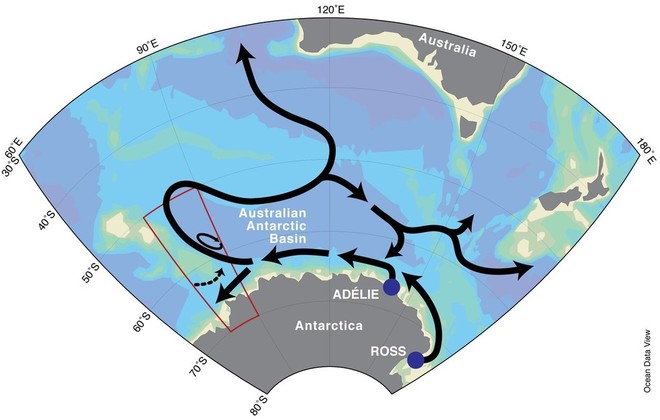
    In a paper published today in Nature Geoscience, the researchers described the current – more than three kilometres below the Ocean’s surface – as an important pathway in a global network of ocean currents that influence climate patterns.
    “The current carries dense, oxygen-rich water that sinks near Antarctica to the deep ocean basins further north,” says co-author Dr Steve Rintoul from the Antarctic Climate and Ecosystems CRC and CSIRO’s Wealth from Oceans Flagship.
    “Without this supply of Antarctic water, the deepest levels of the ocean would have little oxygen.
    “The ocean influences climate by storing and transporting heat and carbon dioxide – the more the ocean stores, the slower the rate of climate change. The deep current along the Kerguelen Plateau is part of a global system of ocean currents called the overturning circulation, which determines how much heat and carbon the ocean can soak up.”
    While earlier expeditions had detected evidence of the current system, they were not able to determine how much water the current carried. The joint Japanese–Australian experiment deployed current-meter moorings anchored to the sea floor at depths of up to 4500 m. Each mooring reached from the sea floor to a depth of 1000 m and measured current speed, temperature and salinity for a two-year period.
    “The continuous measurements provided by the moorings allow us, for the first time, to determine how much water the deep current carries to the north,” Dr Rintoul said. The current was found to carry more than 12 million cubic metres per second of Antarctic water colder than 0 °C (because of the salt dissolved in sea water, the ocean does not freeze until the temperature gets close to –2 °C).
    “It was a real surprise to see how strong the flow was at this location. With two-year average speeds of more than 20 cm per second, these are the strongest mean currents ever measured at depths three kilometres below the sea surface.
    “Mapping the deep current systems is an important step in understanding the global network of ocean currents that influence climate, now and in the future. Our results show that the deep currents near the Kerguelen Plateau make a large contribution to this global ocean circulation,” Dr Rintoul said.
    Antarctic waters carried northward by the deep currents eventually fill the deep layers of eastern Indian and Pacific Oceans.

    A deep ocean current with a volume equivalent to 40 Amazon Rivers has been discovered by Japanese and Australian scientists near the Kerguelen plateau, in the Indian Ocean sector of the Southern Ocean, 4,200 kilometres south-west of Perth. 
    In a paper published today in Nature Geoscience, the researchers described the current –more than three kilometres below the Ocean’s surface – as an important pathway in a global network of ocean currents that influence climate patterns.

    ‘The current carries dense, oxygen-rich water that sinks near Antarctica to the deep ocean basins further north,’ says co-author Dr Steve Rintoul from the Antarctic Climate and Ecosystems CRC and CSIRO’s Wealth from Oceans Flagship.

    ‘Without this supply of Antarctic water, the deepest levels of the ocean would have little oxygen.’

    ‘The ocean influences climate by storing and transporting heat and carbon dioxide – the more the ocean stores, the slower the rate of climate change. The deep current along the Kerguelen Plateau is part of a global system of ocean currents called the overturning circulation, which determines how much heat and carbon the ocean can soak up.’

    While earlier expeditions had detected evidence of the current system, they were not able to determine how much water the current carried. The joint Japanese-Australian experiment deployed current-meter moorings anchored to the sea floor at depths of up to 4500m. Each mooring reached from the sea floor to a depth of 1000m and measured current speed, temperature and salinity for a two-year period.

    ‘The continuous measurements provided by the moorings allow us, for the first time, to determine how much water the deep current carries to the north,’ Dr Rintoul said. The current was found to carry more than 12 million cubic metres per second of Antarctic water colder than 0 °C (because of the salt dissolved in sea water, the ocean does not freeze until the temperature gets close to -2 °C).

    ‘It was a real surprise to see how strong the flow was at this location. With two-year average speeds of more than 20cm per second, these are the strongest mean currents ever measured at depths three kilometres below the sea surface.’

    ‘Mapping the deep current systems is an important step in understanding the global network of ocean currents that influence climate, now and in the future. Our results show that the deep currents near the Kerguelen Plateau make a large contribution to this global ocean circulation,’ Dr Rintoul said.

    Antarctic waters carried northward by the deep currents eventually fill the deep layers of eastern Indian and Pacific Oceans.

    The research team included scientists from the Institute of Low Temperature Science (ILTS) at Hokkaido University in Japan, the Centre for Australian Weather and Climate Research, the Antarctic Climate and Ecosystems Cooperative Research Centre and the Wealth from Oceans National Research Flagship. Funding support was provided by the Australian Climate Change Science Program, the Cooperative Research Centre Program and logistics support from the Australian Antarctic Division. The lead author of the paper is Dr Yasushi Fukamachi, from the ILTS.


  • Axelrod denies Cornyn claim–with no evidence–of White House pressure on Giannoulias

    WASHINGTON — Admitting he had no evidence, Sen. John Cornyn, who runs the Senate GOP political operation, suggested Thursday that the White House may try to force Democratic U.S. Senate nominee Alexi Giannoulias out of the race — speculation that was flatly denied by White House Senior Advisor David Axelrod.

    When I asked Cornyn, a Texas Republican, why he thought the White House would do that, he said: “I don’t know. Giannoulias is a flawed candidate and they are realizing it and I think they are worried. . . . I hope they respect the choices of Democratic primary voters and don’t engage in some sort of back-room shenanigans.”

    A Giannoulias campaign spokeswoman said Cornyn’s comments were “ridiculous.”

    Cornyn’s comment came a day after President Obama, in Downstate Quincy, gave a shout-out to Giannoulias, calling him the “soon-to-be senator” in a remark I think was calculated to quiet talk about distancing himself from Giannoulias.

    “No one here is trying to ‘muscle’ him from the race. That should have been clear from the president’s comment yesterday,” White House senior adviser David Axelrod said Thursday. “Kind of ironic that on the day that Gov. [Charlie] Crist was forced out of the Florida Republican primary that Sen. Cornyn would be suggesting we would muscle someone out of a Senate race.”

    Crist, who is running for the U.S. Senate, announced Thursday he would drop out of the GOP primary and run as an independent.

    At a reporters breakfast sponsored by the Christian Science Monitor, Cornyn tried to inject an element of uncertainly about Giannoulias, who faces a tough race against GOP Senate nominee Rep. Mark Kirk for the seat Obama once held. Cornyn called the contest “one of our trophy races.”

    Giannoulias, the state treasurer, is in a rough patch because his family-owned Broadway Bank was seized last week. Giannoulias is a former bank officer.

    I asked Cornyn, chairman of the National Republican Senatorial Committee, to assess Kirk and about what kind of resources the NRSC was going to pour into Illinois. Cornyn was in Chicago on April 6 for a fund-raiser to benefit the NRSC and Kirk.

    “We will do whatever it takes to help Cong. Kirk win that Senate seat. I am not prepared to quantify that yet,” Cornyn said. “The choice could not be more stark; Mark Kirk the reformer and Alexi Giannoulias… with all of his manifold problems that he has.”

    What Cornyn said next was surprising:

    “I just hope that the Democrats in Illinois respect the rights of Democrat primary voters to select their nominee and we don’t see some backroom shenanigans that this White House has been very active in, in trying to force him out of the race and disrespect the vote of the Democratic primary voters there,” Cornyn said.

    Alexi campaign spokesman Kathleen Strand said Cornyn’s comments were “Ridiculous. With all evidence to the contrary including the President’s supportive words just yesterday, it sounds like Senator Cornyn is as out of touch with what’s happening in Illinois as Congressman Mark Kirk is. Next thing you know, he will be agreeing with Mark Kirk that unemployment isn’t a big issue.”

    Hari Sevugan, Democratic National Committee National Press Secretary said, “Rather than spending his time on something he has no evidence of, we think Senator Cornyn should be more focused on the hard reality of his hand-picked Republican Senate candidates being chased out his party – from Florida to Kentucky to Utah – just because they are willing to work in a bipartisan manner or won’t sign on to the far right’s purity test.”

    Maybe Cornyn was just stirring the pot. Said Cornyn, “I feel very confident that Mark Kirk will be the next United States senator from Illinois.”

  • Mozilla Labs Releases the Jetpack SDK 0.3

    Mozilla has announced the release of the third iteration of its nascent Jetpack Software Development Kit. With Jetpack SDK 0.3, the project gets a couple of new APIs that should prove pretty important if not crucial for add-on developers, the “context menu” and the “self” APIs. The platform is still in the early stages, but thing… (read more)

  • How Often Should A Stock Pay And Raise Dividends?

    In the U.S. and Canada, most companies pay dividends quarterly. In other parts of the world, it is not uncommon for companies to pay an annual or a semi-annual dividend. That is not to say that North American companies sometimes choose not to pay quarterly dividends. For many years McDonald’s (MCD) paid an annual dividend. Since 2000, Walt Disney Co. (DIS) has paid an annual dividend and Ruby Tuesday, Inc. (RT) pays a semi-annual dividend. Going in the other direction, Realty Income Corp. (O) and Alpine Total Dynamic Dividend Fund (AOD) pay monthly dividends.

    Though I prefer quarterly dividends, there is something more important than frequency — dividend increases. Below are several companies satisfying their shareholders desire for more cash by increasing their dividends:

    Travelers (TRV) is a leading provider of commercial property-liability and homeowners and auto insurance. April 23rd the company increased its quarterly dividend to $0.36/share. The dividend is payable June 30, 2010, to shareholders of record as of the close of business June 10, 2010. The ex-dividend date is June 8, 2010. The yield based on the new payout is 2.85%.

    Costco Wholesale (COST) operates about 565 membership warehouses in the U.S., Puerto Rico, Canada, the U.K., Taiwan, Japan, Korea, and Mexico. April 23rd the company raised its quarterly dividend 14% to $0.205/share. The dividend of $.205 per share is payable May 21, 2010, to shareholders of record at the close of business on May 7, 2010. The ex-dividend date is May 5, 2010. The yield based on the new payout is 1.39%.

    Holly Energy Partners (HEP) operates refined product pipeline and terminal facilities. April 23rd the partnership raised its quarterly distribution to $0.815/unit. The distribution will be paid May 14, 2010, to unitholders of record May 4, 2010. The ex-distribution date is April 30, 2010. The yield based on the new payout is 6.98%.

    International Paper (IP) is a leading worldwide producer and distributor of printing papers and packaging products. On April 26th the company increased its quarterly dividend to $0.125/share. The dividend is payable June 15, 2010 to shareholders of record on May 17, 2010. The ex-dividend date is May 13, 2010. The yield based on the new payout is 1.85%.

    Alliance Holdings GP, L.P. (AHGP) produces and markets coal primarily to utilities and industrial users in the U.S. It offers a range of steam coal with varying sulfur and heat contents. April 26th the partnership increased its quarterly distribution 2.8% to $0.465/unit. The distribution is payable on May 20, 2010, to AHGP’s unitholders of record as of the close of trading on May 13, 2010. The ex-dividend date is May 13, 2010. The yield based on the new payout is 5.49%.

    Community Bank System (CBU) provides financial services in upstate New York, and in northeastern Pennsylvania as First Liberty Bank & Trust. April 26th the company raised its quarterly dividend 9.1% to $0.24/share. The dividend is payable on July 9, 2010, to shareholders of record as of June 15, 2010. The ex-dividend date is June 11, 2010. CBU is a Dividend Achiever and has paid a higher dividend for 17 consecutive years. The yield based on the new payout is 3.89%.

    Inergy Holdings (NRGP) operates a retail and wholesale propane supply, marketing and distribution business. April 26th the company increases its quarterly distribution 3.7% to $0.975/unit. The distribution will be paid on May 14, 2010, to unitholders of record as of May 7, 2010. The ex distribution date is May 5, 2010. The yield based on the new payout is 5.31%.

    EarthLink (ELNK) is one of the largest U.S. Internet service providers, based on paying subscribers. April 27th the company increases it quarterly dividend to $0.16/share. This increase will be reflected in the next quarterly dividend to be paid on June 28, 2010 to shareholders of record on June 14, 2010. The ex-dividend date is June 12, 2010. The yield based on the new payout is 6.88%.

    Williams Partners (WPZ) engages in gathering, transporting, processing, and treating natural gas, as well as fractionating and storing natural gas liquids. April 27th the company increases its quarterly distribution 3.5% to $0.66/unit. The distribution is payable on May 14, 2010, to unitholders of record at the close of business on May 7, 2010. The yield based on the new payout is 6.31%.

    IBM (IBM) products and services include information technology services, software, computer hardware equipment, fundamental research, and related financing. April 27th the company raised its quarterly dividend 18% to $0.65/share. The dividend is payable June 10, 2010 to stockholders of record May 10, 2010. The ex-dividend date is May 6, 2010. This is the 15th year in a row that IBM has increased its quarterly cash dividend, and 7th year in a row of double-digit percent increases. With the payment of the June 10th dividend, this Dividend Achiever will have paid consecutive quarterly dividends every year since 1916. The yield based on the new payout is 2.02%.

    Sunoco Logistics Partners LP (SXL) owns and operates a group of refined product and crude oil pipelines and terminal facilities. April 27th the company increases its quarterly distribution 2.3% to $1.11/unit. The yield based on the new payout is 6.54%.

    WW Grainger (GWW) is the largest global distributor of industrial and commercial supplies such as hand tools, electric motors, light bulbs and janitorial items. April 28th the company raised its quarterly dividend 17% to $0.54/share. April 28th the company raised its quarterly dividend 17% to $0.54/share. The dividend is payable on June 1 to shareholders of record on May 10. The ex-dividend date is May 6. GWW is a Dividend Aristocrat and has paid a higher dividend for 39 consecutive years. The yield based on the new payout is 1.99%. See recent analysis.

    Exxon (XOM) is the world’s largest publicly owned integrated oil company. April 28th the company raised its quarterly dividend 4.8% to $0.44/share. The dividend is payable on June 10, 2010 to shareholders of record of Common Stock at the close of business on May 13, 2010. XOM is a Dividend Aristocrat and has paid a higher dividend for 28 consecutive years. The yield based on the new payout is 2.54%.

    Chevron (CVX) is a global integrated oil company that has interests in exploration, production, refining and marketing, and petrochemicals. April 28th the company increased its quarterly dividend 5.9% to $0.72/share. The dividend is payable June 10, 2010, to holders of common stock as shown on the transfer records of the Corporation at the close of business on May 19, 2010. The ex-dividend date is May 17. The amount represents a 5.9 percent increase in the company’s quarterly dividend. CVX is a Dividend Achiever and has paid a higher dividend for 23 consecutive years. The yield based on the new payout is 3.37%.

    Sturm, Ruger & Co. (RGR) designs, manufactures, and sells firearms to domestic customers; it offers products in four industry product categories: rifles, shotguns, pistols, and revolvers. April 28th the company raised its quarterly dividend 55% to $0.093/share. The dividend will be paid on May 28, 2010 to stockholders of record as of May 14, 2010. The ex-dividend date is May 12, 2010. The yield based on the new payout is 2.16%.

    TransAlta Corp. (TAC) is an independent power producer and wholesale marketing company owns a portfolio of generation assets in Canada, the United States, Mexico, and Australia. April 29th the company increased its quarterly dividend to $0.29/share. The dividend is payable July 1, 2010 to shareholders of record at the close of business June 1, 2010. The ex-dividend date is May 28, 2010. The yield based on the new payout is 5.59%.

    Cullen/Frost Bankers (CFR) is the largest multi-bank holding company headquartered in Texas, has more than 80 offices in various cities in the state. April 29th the company increases its quarterly dividend 4.7% to $0.45/share. The dividend is payable June 15, 2010 to shareholders of record on June 1, 2010. The ex-dividend date is May 28, 2010. CFR is a Dividend Achiever and has paid a higher dividend for 16 consecutive years. The yield based on the new payout is 3.02%.

    Duff & Phelps (DUF) is an independent financial advisory company operates worldwide in two segments, Financial Advisory and Investment Banking. April 29th the company raised its quarterly dividend by 20% to $0.06/share. The yield based on the new payout is 1.50%.

    Frequency of dividends increases is one of the most important things to consider when adopting a dividend growth investment strategy. For a list of stocks with a long string of consecutive cash dividend increases, see this list.

    Full Disclosure: Long MCD, AOD, CVX, O, PG, JNJ. See a list of all my income holdings here.

    (Photo Credit)

    Related Posts:

    Have future posts delivered to you for free! If you enjoyed this post, please bookmark or share it here:

    Print
    email
    Yahoo! Buzz
    Tipd
    Propeller
    StumbleUpon
    del.icio.us
    Digg
    Technorati
    Facebook
    Twitter
    LinkedIn
    NewsVine
    Google Bookmarks
    Reddit
    Live
    Yahoo! Bookmarks

  • Legal Analysis Of Italian Criminal Conviction Of Google Execs Says Judge Made A Big Legal Error

    We were among those amazed back in February, when an Italian court ruled that three Google execs were criminally liable for a video posted on Google Video, and were sentenced to six months suspended sentences. The video in question involved some kids taunting a mentally challenged boy and throwing a tissue box at him. Within hours of Google being alerted to the video, it was taken down. Part of the debate focused on whether or not Google should have known about problems with the video or whether or not Google had actually been informed earlier — but the only evidence that seemed to have been presented was that the comments on the video complained about the content. But it wasn’t clear that anyone at Google had read the comments. Still, when the decision came out, it was just the decision — not the full ruling by the judge, leading to some detailed legal guesses for the judge’s reasoning.

    However, it looks like the ruling has finally come out, and one Italian legal expert, after reading through it in detail, suggests the ruling was based on a pretty big legal interpretation error by the judge. The details are a bit complex, but basically, it seems the judge may have combined two separate parts of a law that were disconnected (and, the key part of the law wasn’t even brought up in the case itself) to suggest that Google’s big mistake was in not prominently telling users that they should not upload videos without the permission of everyone in the video. That information was in the Google Video’s terms of service, but the judge felt that wasn’t enough.

    The problem is that the law doesn’t actually say that Google had to make that information clear to users — and, even if Google didn’t satisfy that part of the law, not only was it not mentioned during the trial at all, it’s also not connected to the part of the law Google was actually charged under:


    The trouble with the ruling, said [Elvira] Berlingieri, is that Section 13 of the law was not mentioned in the case against the Google trio at all. One charge laid against them by prosecutors was to do with defamation, and that failed. The other was to do with privacy but that was based on a supposed data-processing violation of Section 167 of the law.

    Section 167 of the Act says that anyone who breaches particular Sections of the Act with a view to gain or with intent to cause harm shall be punished by imprisonment of between six and 24 months. The Sections to which it refers, though, do not include Section 13.

    “If you put together Section 13 and Section 167, that is how you get a sentence of six months,” she said. “The problem is that Section 167 does not talk about Section 13. In the charge written by the prosecutors, Article 13 is never mentioned.”

    This definitely seems like good news for Google in its planned appeal.

    Of course, even outside of the legal nuances of this, just from a common sense standpoint, this ruling is incredibly troubling. It’s difficult to see how anyone (outside of those with logic deficiencies) could defend the ruling. The video itself was actually helpful in punishing the kids responsible. If Google had actually stopped the video from being uploaded, they would have gotten away with the bullying. On top of that, making the sanctions criminal against individuals seems way over the top, especially for individuals who had absolutely no knowledge of the video in question whatsoever. The whole thing seems ridiculous on any level.

    Permalink | Comments | Email This Story


  • TIME Magazine 100 Least Influential People Of 2010

    On Thursday, TIME Magazine honored a number of Hollywood’s leading men and women have made their way onto The TIME 100, the magazine’s annual list of the year’s most influential people.

    Among them Lady Gaga, Robert Pattinson, and Conan O’Brien.

    In addition, TIME also released their list of the 100 people who least affect our world, otherwise known as “The Time Bum Hundred.” From Heidi Montag and Spencer Pratt to Jon Gosselin and Levi Johnston, CLICK HERE to explore the entire list of Tinseltown’s Biggest Bottom Feeders…..

    TIME Magazine rips Heidi Montag: “You used to be famous for being famous. Then you were famous for getting lots of plastic surgery and selling only 658 copies of your album in its first week. Now you’re not famous. That was fast.”


  • Palit mejora la GeForce GTX 470

    La empresa Palit anunció oficialmente la GeForce GTX 470 con un sistema de refrigeración alternativo.

    La placa cuenta con dos nuevos fans que hacen su tarea de una manera sorprendente al bajar 12 grados centígrados menos y a demás es alrededor de 4 dB más silencioso que el modelo referencia de NVIDIA, sin embargo, la tarjeta sigue funcionando con las frecuencias de referencia, 607 MHz núcleo, shader 1215 MHz y 3348 MHz para la memoria.

    La GTX 470 tiene 448 Stream Processors y 1280 MB de memoria GDDR5 con interfaz de 320 bits. Y en este caso Palit decidió ir tras las huellas de AMD al agregar un puerto DisplayPort mas 2 DVI y 1 HDMI.

    Vía benchmark.kz

  • Greece Sized Mat of Microbes


    ]Just is case biologists were ever in fear of running out of thesis material, we have this.  A billion different genera certainly taxes the imagination.
    Rather annoyingly we still get the almost obligatory pass on how little we know about the impact of global warming.  It would be more appropriate to simply state that we are now getting so much data it is physically impossible to classify and organize it.
    We already suspected this depth of speciation and sub ocean penetration.  It is now confirmed and surely provides all the feedstock needed to support oil manufacture.
    It is interesting that they are oxygenating the subsea environment.  The energy path will need to be clarified.

    Mat of microbes the size of Greece discovered on seafloor
    Apr 18, 2010
    Gargantuan whales and hefty cephalopods are typically thought of as the classic marine mammoths, but they might have to make way for the mighty microbes, which constitute 50 to 90 percent of the oceans’ total biomass, according to newly released data. 

    These tiny creatures can join together to create some of the largest masses of life on the planet, and researchers working on the decade-long Census of Marine Life project found one such seafloor mat off the Pacific coast of South America that is roughly the size of Greece.

    A single liter of seawater, once thought to contain about 100,000 microbes, can actually hold more than one billion microorganisms, the census scientists reported. But these small creatures don’t just live in the water column or on the seafloor. Large communities of microscopic animals have even been discovered more than one thousand meters beneath the seafloor. Some of these deep burrowers, such as loriciferans, are only a quarter of a millimeter long. 


    “Far from being a lifeless desert, the deep sea rivals such highly diverse ecosystems as tropical rainforests and coral reefs,” Pedro Martinez Arbizu, of the German Center for Marine Biodiversity Research and leader of the Census of the Diversity of Abyssal Marine Life, said in a prepared statement. 

    Thanks to high-throughput DNA sequencing, researchers have been able to vastly expand their catalogue of marine microbes. “Scientists are discovering and describing an astonishing new world of marine microbial diversity and abundance,” Mitch Sogin, of the Marine Biological Laboratory in Woods Hole and leader of the International Census of Marine Microbes, said in a prepared statement.

    This genetic data has revealed that there might be as many as 100 times more microbe genera than researchers had assumed. One study conducted in the English Channel landed 7,000 new genera alone. Current estimates place the number of marine microbial species at about a billion, according to a prepared statement by John Baross of the University of Washington and chair of the International Census of Marine Microbes’s scientific advisory council. 

    And research has yet to plumb the guts and surfaces of more macro ocean life, which, like humans, can play host to billions of microbial cells. The species living on and in “marine animals alone may account for hundreds of millions of microbial species,” Baross said. “This is a huge frontier for the next decade.”

    Despite their small individual size, microbes play a big role in the oceans—and the planet overall. Microbes help to turn atmospheric carbon dioxide into usable carbon, completing about 95 percent of all respiration in the Earth’s oceans. Even those deep in the seafloor, such as the deep-sea burrowers, “help oxygenate sediments and interact with microbes to cycle nutrients and carbon on the ocean floor,” Arbizu said. But little is known about these creatures’ susceptibility to the changes in ocean temperatures, dissolved gasses and acid levels that are predicted to occur with climate change. 


    “Tracking and visualizing such complex populations was impossible 10 years ago,” Baross said. “Sequencing allows us to give the equivalent of an Internet URL to millions of microbes, to which we can attach all kinds of other information, like their favorite temperature and amount of salt and light.” 

    The full findings of the census will be presented in October in London. For the coming decade Baross suggests a survey of marine viruses.

    Image of loricciferan Culexiregiloricus tricchisccalida, which was discovered off the coast of Africa some 4,100 meters below the surface last year through the census, courtesy of Gunnar Gad/Marco Buntzow/German Center for Marine Biodiversity Research/Census of Marine Life
  • Gutierrez White House immigration protest; expects arrest

    WASHINGTON — In the wake of a new Arizona law aimed at illegal immigrants, Rep. Luis Gutierrez (D-Ill.) on Saturday is going to join demonstrators at the White House who will likely be arrested for their protests.

    He expects to be booked and released. Gutierrez will be a guest on “Face The Nation” on CBS this Sunday morning

    Gutierrez — arrested twice in 2001 protesting the Navy’s use of the Puerton Rican island of Vieques for bombing practice — will take part in civil disobedience “to keep the pressure up on President Obama and the leaders of the Democratic party,” said Gutierrez spokesman Doug Rivlin.

    Gutierrez has been outspoken in his criticism of the White House for not moving faster on a comprehensive immigration bill. “When you don’t keep the pressure on and you sort of lose hope that we are going to have a bill this year, things like Arizona happen, and you are reminded why we need to keep moving forward,” Rivlin said.

    Last Sunday, Gutierrez was in Phoenix at a rally objecting to the new law that would allow police, in certain circumstances, to ask people for papers showing they are in the U.S. legally.

  • Conan O’Brien Lights Into Leno On “60 Minutes”

    In an interview on 60 Minutes airing this Sunday, late-night comic Conan O’Brien tells 60 Minutes if he was in Jay Leno’s position –ousted from primetime and looking at a return to late-night — he would have “Done something else, go someplace else. I mean, that’s just me.”

    O’Brien left NBC — with a $33 million settlement — after a bitter divorce from the network, which decided to reinstall Leno in its marquee late-night show after his primetime program, The Jay Leno Show, bombed. In the interview with Steve Kroft, Conan – whose new TBS late night series will debut in November – said had the roles been reversed, he would’ve handled things differently.

    “He went and took that show back and I think in a similar situation, if roles had been reversed, I know … I know me, I wouldn’t have done that,” O’Brien said. “If I had surrendered ‘The Tonight Show’ and handed it over to somebody publicly and wished them well and then … six months later, but that’s me, you know. Everyone’s got their own, you know, way of doing things.”


  • Opera Software Buys FastMail.FM

    Opera Software is one of the oldest browser manufacturers in the world, but, despite its best efforts and continually improving software, Opera on the desktop hasn’t managed to pick up any steam. Opera, the company, on the other hand, is doing pretty well, thanks in large part to its mobile browser. So well in fact that it’s made its second acquisitio… (read more)

  • Volkswagen shows production-ready folding two wheel EV Bik.e

    Dr. Ulrich Hackenberg rode the Bik.e onto the stage for the unveiling. Dr. Hackenberg is a...

    The concept of “last few mile mobility” is one which we’ll all grow accustomed to over the next decade as the world’s cities become more congested and non-polluting micro mobility concepts begin to supplement other forms of transport. In the last year alone we’ve seen Toyota’s Winglet, Honda’s U3-X, Nissan’s electric skis, and now Volkswagen has shown a micro mobility concept which it has dubbed the “Bik.e” – a folding electric bike with one of the most ingenious folding mechanisms we’ve seen. With a range of 20 kilometres (12.5 miles), the Bik.e has 20 inch wheels and folds to a footprint identical to that of a car spare tyre, enabling it to be stowed away easily. Whatsmore, the bik.e will definitely see production, and possibly even before the end of the year. VW’s choice of form factor is as fascinating as its choice of a recognisable name is inspired. The Bik.e could turn out to be as important to VW as the iPod has been to Apple…
    Continue Reading Volkswagen shows production-ready folding two wheel EV Bik.e

    Tags: ,
    ,
    ,

    Related Articles:


  • President Obama official schedule and guidance, April 30, 2010. Secret Service training center

    THE WHITE HOUSE
    Office of the Press Secretary
    _______________________________________________________________________________________
    FOR IMMEDIATE RELEASE
    April 29, 2010

    DAILY GUIDANCE AND PRESS SCHEDULE FOR
    FRIDAY, APRIL 30, 2010

    In the morning, the President will make a statement on the first quarter 2010 GDP numbers in the Rose Garden. He will be joined by representatives and workers from two U.S. manufacturers, Itron, a Washington state based manufacturer of smart energy meters, and A123 Systems, a Massachusetts based advanced battery manufacturer, that are expanding production and hiring as a result of Recovery Act investments in innovation and technology. This event is open press.

    In the afternoon, the President will travel to the James J. Rowley Training Center in Beltsville, Maryland. The President will tour the facility, observing the Secret Service’s training procedures and watching personnel taking part in some demonstration activities. He’ll also have the opportunity to thank some of the men and women who have worked so hard and made so many sacrifices to protect him and his family. The visit is closed press.

    In-Town Travel Pool
    Wires: AP, Reuters, Bloomberg
    Wire Photos: AP, Reuters, AFP
    TV Corr & Crew: NBC
    Print: BNA
    Radio: ABC

    EDT

    9:30AM Pool Call Time

    10:35AM THE PRESIDENT makes a statement on the first quarter 2010 GDP numbers
    Rose Garden
    Open Press (Pre-set 9:35AM – Final Gather 10:05AM – North Doors of the Palm Room)

    12:30PM THE PRESIDENT departs the White House en route Beltsville, Maryland
    South Lawn
    Open Press (Pre-set 12:00PM – Final Gather 12:15PM – North Doors of the Palm Room)

    12:45PM THE PRESIDENT arrives in Beltsville, Maryland and visits the James J. Rowley Training Center
    James J. Rowley Training Center, Beltsville, Maryland
    Closed Press (Travel Pool Gather Time 11:30AM – Stakeout Location)

    4:00PM THE PRESIDENT arrives at the White House
    South Lawn
    Open Press (Pre-set 3:30PM – Final Gather 3:45PM – North Doors of the Palm Room)

    ##

  • Opera 10.53 disponible para windows y mac os

    Uno de los navegadores mas rápidos, Opera, acaba de recibir su actualización numero 10.53 que sera automática para quienes ya tengan el navegador instalado. Si todavía no lo probaste lo puedes descargar desde su web opera.com o desde aquí.

    La actualización a esta versión es altamente recomendable ya que corrige un bug de seguridad que permitía correr código arbitrario a través del navegador.

    En el resto de los sistemas operativos tristemente seguimos con la versión 10.10.

  • Coal Country Lawmakers Stay Silent on Mine Safety Debate

    Senate Minority Leader Mitch McConnell (R-Ky.) has not addressed the need for mine safety reform in the wake of the Upper Big Branch explosion. (Zuma)

    Wednesday’s fatal collapse at a Western Kentucky coal mine is a stark reminder that mine safety is hardly an issue peculiar to one state or one company. But you’d never know it based on the reaction from a long list of coal-country lawmakers.

    Despite back-to-back-to-back fatal accidents at Appalachian coal mines this month, most regional lawmakers remain reluctant to enter the emerging debate over what’s gone wrong, to debate how to prevent the next disaster, and to consider whether Congress should step in with new laws to protect the nation’s miners.

    Image by: Matt Mahurin

    Image by: Matt Mahurin

    Their silence highlights the tremendous influence of coal companies in the Appalachian states, among the poorest in the country, where the industry supports tens-of-thousands of jobs and contributes hundreds-of-thousands of dollars to convince lawmakers that things like new safety measures are unnecessary. Indeed, throughout Kentucky and Virginia, the lawmakers most reluctant to weigh in on mine-safety policies this month are also those who’ve accepted the most money from the companies.

    That hesitancy to confront the industry — glaring in the wake of the deadly April 5 blast at Upper Big Branch, when West Virginia’s lawmakers were the lone Appalachian voices calling for reforms — remains on display this week, even after a roof fall at Kentucky’s Dotiki Mine killed two more miners Wednesday. Though the companies were different — Virginia-based Massey Energy owns the Upper Big Branch, and Alliance Resource Partners, based in Oklahoma, owns Dotiki — both projects have run up a long list of safety violations this year (see here and here).

    A third fatal accident — at a West Virginia mine owned by International Coal Group – occurred April 22. All told, Appalachian coal-mining accidents have claimed the lives of 32 miners in April alone.

    No matter.

    Although Sen. Mitch McConnell (R-Ky.) took to the chamber floor Thursday afternoon to offer condolences and prayers, there was nothing in his brief speech to indicate that the nation’s mine-safety policies might be failing miners, or that Congress has any responsibility to intervene. And his office, which had declined to answer questions along those lines in the wake of the UBB blast, went silent again Thursday.

    “For now, we can only hope that their efforts are successful,” McConnell said of the rescuers searching for a missing miner, who would later turn up dead. “I ask my colleagues and the American people to keep the miners, their families, and the rescue workers in their prayers.”

    The other members of Kentucky’s congressional delegation didn’t go even that far. Rep. Ed Whitfield (R), who represents Webster County, where this week’s roof collapse took place, has, as of this writing, no mention of the accident on his website (although it does contain a statement — issued just hours before Wednesday’s accident — attacking the Obama administration for being too tough on the coal industry). Whitfield’s office did not respond to requests for comment.

    McConnell and Whitfield are hardly alone. The offices of Sen. Jim Bunning (R-Ky.), Rep. Hal Rogers (R-Ky.) and Rep. Rick Boucher (D-Va.) have also declined repeated requests for comment on mine safety in the wake of the Upper Big Branch disaster — a silence that’s continued this week following the disaster in Webster County. All three lawmakers represent prominent coal-producing districts where mining companies have racked up thousands of safety violations this year alone.

    For example, Pike County, Ky., represented by Rogers, is home to Freedom Mine #1, a Massey-owned project that’s tallied more than 400 safety citations since Jan. 1. Among the violations are a number involving problems with mine ventilation systems and the accumulation of combustible materials — the same combination suspected to have caused the explosion at the Upper Big Branch. Dozens of those problems were deemed “significant and substantial,” indicating that they are “reasonably likely to result in a reasonably serious injury or illness.”

    Another example: Boucher represents Tazewell County, Va., which is home to the Tiller No. 1 Mine. That Massey-controlled project has been cited more than 70 times this year for safety infractions, including vent problems, accumulations of combustibles and a failure to maintain escapeways. Forty of those citations fell into the S&S category.

    And the list goes on.

    That the lawmakers representing these mines haven’t confronted the companies over their dubious safety records, critics argue, owes a great deal to the steady flow of money from the industry to those members. McConnell, for example, has accepted more than $486,000 from the coal mining industry over his career, according to the Center for Responsive Politics — far and away the most of any active Capitol Hill lawmaker. Rogers ranks second, with industry contributions totaling more than $241,000. Boucher stands fifth, having taken more than $186,000 from coal companies during his tenure on the Hill. And Whitfield’s career tally of more than $100,000 places him eighth among all active members in the House.

    Not that there aren’t exceptions to the reluctance of Appalachian lawmakers to discuss mine safety in recent weeks. Sen. Jim Webb (D-Va.), for example, though not a member of the Senate labor committee, submitted a statement to that panel when it met earlier this week to discuss mine safety. “We can — and must — do better by our miners,” Webb said, “when it comes to enforcing safety regulations and ensuring that companies don’t walk away from their responsibility to their workers.”

    Still, Big Coal’s influence, combined with the industry’s opposition to any new mine-safety regulations, means there will likely be a tough road ahead for the reform-minded lawmakers already pushing for stricter rules. Indeed, Bruce Watzman, spokesman for the National Mining Association, told Senate lawmakers Tuesday that no new legislation is required to prevent the next mining tragedy.

    Federal regulators, he said a day before the Dotiki tragedy, already have all the tools they need.

  • Christina Aguilera “Not Myself Tonight” Music VIDEO Premiere

    The official music video for Christina Aguilera’s eagerly-awaited single “Not Myself Tonight” — penned by Ester Dean and produced by Polow da Don — hit the Interwebs early Friday. The single appears on Aguilera’s upcoming album Bionic, due in stores June 4, but the track and video have kicked the longstanding rumors that Xtina is reinventing herself as the second coming of Lady Gaga into overdrive.

    Thoughts on this?


  • Windows Phone 7 – what Microsoft is doing right, wrong and how they can fix it

    cutandpastemockup I know many of our readers feel I am unnecessary and unfairly down on Microsoft’s new mobile OS, and harbour an unnatural love for Windows Mobile 6.

    The reasons are however simple – Microsoft has given long time fans of Windows Mobile precious little to love about Windows Phone 7, with each piece of news that gets dribbled out seemingly only making things worse.

    The latest is the revelation that the only way to get documents onto a Windows Phone 7 device is either to e-mail it to yourself or use some cloud-based solution such as Sharepoint or Skydrive. No mention of USB transfer or bluetooth FTP or even Activesync. In short again just another poor copy of the iPhone.

    Now this bad news is tempered somewhat by the not unexpected news that Windows Phone 7 will support multiple Exchange accounts, but as this seems to be a less than compelling feature that is hardly exciting.

    This has prompted to to write another editorial, hopefully giving Microsoft some idea of what would keep this long time Windows Mobile user happy.

    What Microsoft has done right is:

    1) New user interface developer tools

    This was a long time coming, and frankly something Microsoft should have made available years ago.

    2) Better minimum hardware specifications

    If Microsoft has specified a minimum of ARM7 processors and capacitive screens 18 months ago Windows Mobile would have been a lot more competitive.

    3) Multimedia improvements

    This is one of the biggest failures of Windows Mobile and Microsoft in general, and we frankly did not need a whole new OS to get an improved Windows Mobile player.

    4) Over the air updates

    This essential feature have been lurking in our phones since Windows Mobile 5, but has of course for some unfathomable reason never been used, not even when the widespread Daylight Savings Time issue presented the perfect opportunity.

    The list of what they have done wrong almost seems too long to list, but I shall give it a go in any case.

    1) The massive delay before the release of Windows Phone 7

    We understand Microsoft changed strategy half-way along the way and threw out all previous work, including the baby with the bath water, but this particular error may be the fatal one.

    2) Removing signature features such as cut and paste and multi-tasking.

    These are particularly ironic in the face of the iPhone adopting the same. And before anyone say the iPhone is using the same version of multi-tasking as Windows Phone 7, this is patently not true when the iPhone OS 4 will allow background GPS navigation while Windows Phone 7 will not.

    3) Removing all backward compatibility

    It is really a toss up whether this or the delay in release will be the killing blow for Windows Phone 7, but together with the above it means Microsoft starts at exactly 0, with no momentum of upgrading users and no existing ecosystem.

    4) A massive reliance on cloud services

    Cloud services means a data plan, which limits the market to those willing to pay 50% more to use their device. It is also slow and unreliable in most parts of the world, including many cities in USA.

    5) No synergies with desktop Windows

    This is another massive weakness. Possibly related to anti-trust fears, we have seen all Microsoft’s competitors leverage their strengths (Apple with ITunes and the iPod and Google with Search, Gmail and advertising).  Microsoft’s desktop dominance is not reflected in any way in their mobile OS.

    What can Microsoft do to rescue their new OS from almost certain market failure? I will go into specifics.

    1) There needs to be a common storage area on the device with USB Storage Mode access, File Explorer access, Bluetooth FTP access etc.

    I can accept not having root access to the application storage area and \Windows, but not being able to even browse \My Documents is a travesty. Not being able to enter USB mode and transfer a file rapidly is another.

    2) Windows Mobile software compatibility

    Even if only in an emulated environment like in WebOS, this would be much better than starting from zero, especially for business users.

    3) Proper multi-tasking for certified apps.

    Sure, not every application needs multi-tasking but some certainly do.  A simple example is a pedometer, which needs to run in the background constantly.  The OS obviously also needs a UI to enable better application switching, like the Pre or even iPhone OS 4.0.

    4) Give Windows 7 users a reason to run Windows Phone 7

    There is about 1000 ways Microsoft could make running both of their OS’s more desirable, but really simple ones could include simply being able to run your sidebar widgets on your phone, or being (easily) able to use your phone as a remote control for desktop Windows Media Player.

    5) A roadmap for the development of the OS.

    Microsoft could get away with shipping their current crippled implementation if they had a clear roadmap which promised when better features will come.  In its absence users who may have waited will simply defect.

    6) Be a fast follower

    At present Microsoft is doing a pretty good job of copying the iPhone. From 3 years ago that is. Microsoft is a massive company with 1000 people working on their new OS.  There is no reason why they can not implement interesting features which appeared on other platforms in their OS, and rapidly too. By reacting so slowly they do little to assuage their image as a slow and lumbering giant.

    7) Less reliance on partners

    Microsoft traditionally rely on partners to help them achieve their goal.  This is failing pretty badly for them, with HP for example most recently cancelling the Slate. Other examples are ideas such as the Spot watches and Sideshow. They need to take responsibility for bringing their own ideas to fruition. This means more first party software and hardware, more games created directly by Microsoft, more accessories made by them, and a more direct relationship with the consumer.

    Unless Microsoft takes all or at least some of these ideas on board they are destined to fail, even with consumers and the non-power users who many of our readers feel Windows Phone 7 is created for.

    Do our readers feel I judge Windows Phone 7 and Microsoft too harshly? Leave your comments below.