Blog

  • Eye-Fi Adds Hotspot Coverage, Special Mac Version

    The Eye-Fi is one of those simple yet incredibly useful gadgets. Pair an SD storage card, which is compatible with many cameras, with the ability to send images (and videos) over integrated Wi-Fi and you have the Eye-Fi. The Eye-Fi fits in compatible cameras and works as a typical SD card, but eliminates the need to pop the card out of the camera and plug it into the destination computer. You can shoot recorded images from the Eye-Fi to the destination without touching it.

    The folks behind the Eye-Fi have let us know they’ve expanded the hotspot partnerships to include Devicescape. This means Eye-Fi owners can transfer images over thousands more hotspots globally. By the end of May, Eye-Fi owners will have more functionality, such as these features (per Eye-Fi):

    • Eye-Fi users with a personal hotspot subscription to a Wi-Fi hotspot provider, such as Boingo, BT Openzone, T-Mobile, SFR, Orange and Vodafone, can add their existing credentials to their Eye-Fi account to upload in these supported locations, and potentially expand their hotspot upload coverage to millions of hotspots.
    • Eye-Fi users at schools and universities across the world can now add their campus Wi-Fi network credentials to their Eye-Fi account.
    • Eye-Fi users will be able to automatically upload through hundreds of thousands more open hotspots because the Eye-Fi card now navigates through splash screens.

    Mac owners should note that a new model of the Eye-Fi is coming just for you. The Eye-Fi Geo X2 will be sold exclusively through Apple, and will work with the Macs like no other Eye-Fi. Images recorded on the Eye-Fi Geo X2 can upload photos directly into MobileMe and iPhoto. Direct uploading is supporting on over 20 other online sites, too.

    The new Eye-Fi also supports geo-tagging photos, which is integrated with iPhoto ’09 to allow locating photos by places. The card also features auto-cleaning, freeing up storage space when photos are uploaded. It features Class 6 performance for fast uploads. The Eye-Fi Geo X2 will be available in a 4 GB capacity for $69.99 from Apple in May.

  • Details emerge on study of cancer near U.S. nuclear plants

    The Nuclear Regulatory Commission recently asked the National Academy of Sciences to study cancer risk for people living near nuclear power plants and other nuclear facilities, and details of that research were discussed at yesterday’s meeting of the Academy’s Nuclear and Radiation Studies Board.

    Share/Bookmark

    The research request came in response to “recurrent stakeholder concerns,” said Brian Sheron, director of NRC’s Office of Nuclear Regulatory Research.

    The study will look at nuclear power plants as well as nuclear fuel facilities. It comes as the Obama administration is encouraging the expansion of commercial nuclear power.

    The NRC currently relies on a 1991 study by the National Cancer Institute that found no link between nuclear plants and cancer. However, that study has been criticized for focusing on cancer deaths rather than cancer incidence. At the time the research was conducted, few states collected data on cancer incidence, which is why the NCI focused on mortality.

    In addition, the earlier study looked at data on the county level — an approach that could obscure health problems occurring closer to nuclear facilities. Sheron noted that advances in geographic information systems will allow researchers to pinpoint more relevant populations for study.

    Sheron said the research would occur in two phases. The first, set to be completed next summer, would review off-site radiation doses, evaluate cancer mortality and incidence data, pinpoint areas of study and determine how best to conduct the epidemiological research.

    The second phase, which would begin immediately after the first and last two to three years, would analyze incidence of and deaths from radiation-related cancers near nuclear facilities. Both phases would conclude with a written report to the public.

    At yesterday’s session to discuss the study, the NRSB heard from a number of stakeholders who urged that the research be carefully designed for maximum reliability.

    They included a representative from the office of Congressman Ed Markey (D-Mass.), who has raised concerns about recent studies documenting health problems near operating nuclear reactors.  Others who spoke included a representative from the office of U.S. Sen. James Inhofe (R-Okla.) — an advocate of the energy industry — and the industry’s own Nuclear Energy Institute.

    Arjun Makhijani, president of the Institute for Energy and Environmental Research and a nuclear power critic, urged the NRSB to look at what besides nuclear facilities might be located in study areas, since industrial installations tend to be clustered in certain communities. He pointed out that this raises environmental justice concerns, since the communities where polluting facilities are located tend to be rural, poorer and have higher concentrations of minorities.

    He specifically encouraged the NRSB to take a look at the Southern Company’s Plant Vogtle in Burke County, Ga. The plant is located near the Savannah River Site nuclear weapons facility, and concerns have already been raised about cancer in the surrounding area, where there is widespread radioactive pollution. The Southern Company has already secured $8.3 billion in taxpayer-backed federal loan guarantees to build two new reactors at the site, doubling its power output and thus increasing radioactive emissions.

    Also addressing the NRSB was Dr. Steve Wing, an epidemiologist at the University of North Carolina at Chapel Hill whose own research documented a rise in cancers near the Three Mile Island nuclear plant in Pennsylvania following the 1979 partial meltdown.

    “Knowledge about this topic can be most effectively advanced by studying childhood cancer incidence and in utero exposures,” he said. Developing fetuses are known to be especially sensitive to radiation, and focusing on children rather than adults will largely eliminate interference from occupational exposures.

    Wing also pointed out that a number of epidemiological studies carried out near nuclear facilities in the U.S. and abroad found elevated cancer rates, but the authors dismissed the possibility that they were related to the nuclear plants because the radiation doses were assumed to be too low.

    “The evidence produced was not believed,” Wing said. “Why conduct a study if the results cannot be interpreted as providing support for the hypothesis?”

    The meeting closed with an opportunity for public comments, and the first person to speak was Sarah Sauer, who was diagnosed with a malignant brain tumor nine years earlier to the day at the age of 7. At the time her family was living in Minooka, Ill. near Exelon’s Dresden nuclear power plant. They had never considered the possibility that the plant could be connected to Sarah’s illness until learning about numerous other cancer-stricken children in the area.

    They eventually discovered through records from the Illinois Department of Public Health that the infant mortality rate in surrounding Grundy County doubled from 1995 to 1999, while the rate of childhood cancers increased almost 400% during the same period. They also learned that the plant had leaked radioactive tritium into the environment — some of which had seeped into water supplies used by the Sauers and other area residents.

    “I hope in this study you will remember who you are doing this for,” Sarah said.

  • Kyrgyzstan interim government charges ousted president with murder

    [JURIST] Officials in Kyrgyzstan’s interim government said Tuesday that ousted former president Kurmanbek Bakiyev has been charged with mass murder, for which he will be tried in absentia. The charges stem from an April 7 incident in which police fired on a crowd of anti-government demonstrators, killing more than 85 people. The crowd eventually overwhelmed security forces, ultimately overtaking the Kyrgyz government and forcing Bakiyev into exile. Bakiyev maintains that police only shot at the protesters after the crowd began firing on Kyrgyz government headquarters. Interim leader Roza Otunbayeva has pledged to bring Bakiyev and other members of the former government to justice, but the government has so far succeeded in securing only the arrest of former defense minister Baktybek Kaliyev and the extradition Bakiyev’s interior minister from Russia. Officials in Belarus, where Bakiyev currently resides, have not said whether they plan to return him to Kyrgyz custody. Interim government officials maintain that Belarus is obligated by treaties between former Soviet states to extradite Bakiyev.
    Otunbayeva launched the new government after Bakiyev fled the capital earlier this month. Interim officials have had difficulty securing the nation in the wake of Bakiyev’s ouster, facing pro-Bakiyev protests and questions about the new administration’s legitimacy. Last week, Kyrgyzstan interim deputy leader Omurbek Tekebayev announced that the country will hold a referendum on a new constitution this summer. That same week, Human Rights Watch (HRW) urged the interim government to conduct an investigation into the violence that resulted in Bakiyev’s overthrow. UN Economic Commission for Europe (UNECE) Executive Director Jan Kubis said earlier this month that Kyrgyzstan needs international support in order to continue democratic reforms. The new government has received support from both the US and Russia.

  • Seems appropriate

    Saw this in the Make Magazine Facebook feed. Seemed like I should post it here.

  • Supreme Court To Hear Case About Constitutionality Of Anti-Violent Video Game Law

    Over the past few years, at least ten states (probably more, but we’ve lost track) have tried to pass laws banning the sales of violent video games to children. And every single one of them (yes, every last one) has been ruled unconstitutional, as a violation of the First Amendment. And yet, some states keep trying. In California, it’s particularly ironic, given that the main supporter of the bill is The Governator himself, Arnold Schwarzenegger, who became famous starring in violent movies that are quite similar to the violent video games he now seeks to attack. As with every other state, the original law was found to be unconstitutional in both the district court, and again on appeal. Not surprisingly, The Governator has continued to waste taxpayer money on legal costs fighting for this bill (despite the state being massively cash-strapped), and now it appears that the Supreme Court has agreed to hear the case.

    This could be a big deal. Since there’s been near unanimous agreement among district and appeals courts that these sorts of laws are unconstitutional, the fact that the Supreme Court is taking the case, despite the lack of a circuit split, could mean that it feels that all these courts decided incorrectly. Hopefully, that’s not the case, and the Supreme Court rules on this issue and finally closes the door on these questionable laws.

    Permalink | Comments | Email This Story


  • Energy and Global Warming News for April 27: US & Canada lose higher percentage of forests than Brazil; Business groups say climate impasse undermines clean energy

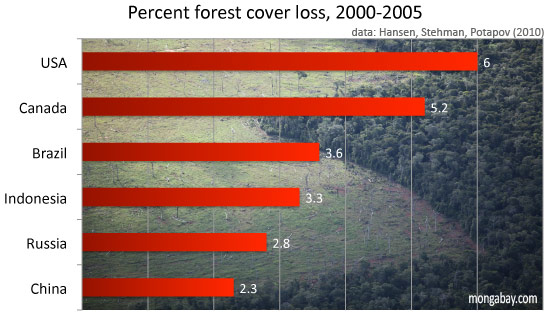
    http://photos.mongabay.com/10/0426_gfcl_percent.jpg

    US & Canada Lose Higher Percentage of Forests Than Brazil

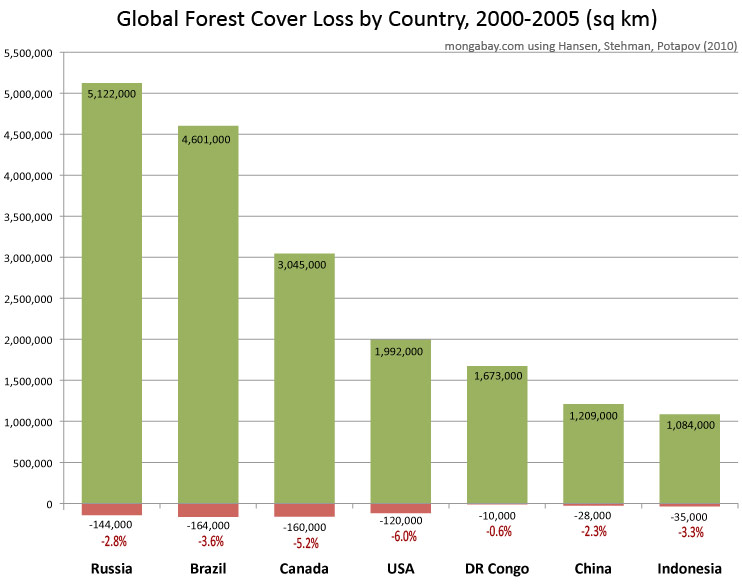
    All I can say is wow! Mongabay is highlighting a new study in the Proceedings of the National Academy of Sciences which reveals that between 2000 and 2005 over one million square kilometers of forest were chopped down worldwide, with both the United States and Canada losing a greater percentage of forest than the poster children of tree destruction, Brazil and Indonesia.

    Brazil Has Highest Area Loss, But Average Percentage

    There is a little bit of stats parsing going on here: Looking at the seven nations which have more than one million square kilometers of forest still remaining–that’s Brazil, Canada, China, Democratic Republic of Congo, Indonesia, Russia, and the United States–Brazil still led the pack in terms of area cleared, with about 33,000 square kilometers of both rainforest and tropical dry forest cleared per year, for a total of 165,000 square kilometers lost. That represents 3.6% of it’s total forest cover at the start of the period examined.

    However, though Canada and the United States lost less forest cover by area (160,000 and 120,000 square kilometers, respectively), in percentage terms Canada lost 5.2% of it’s total and the US lost 6% of total forest cover.

    Keep in mind, the global average for the time period was 3.5%.

    The main drivers of forest loss in the US during this time period were fire and better infestation in Alaska and the western states, “large-scale logging in the southeast, along the western coast, and in the Midwest.”

    US Southeast Among Highest Rates of Global Deforestation
    The report concludes,

    The often publicized phenomenon of forest conversion within the humid tropics is observed in our results, but significant [gross forest cover loss] is evident in all biomes. For example, rates of GFCL in regions such as the southeast United States are among the highest globally.

    Read more, about the distribution of forest loss by ecosystem: Mongabay

    Here’s the original paper: Quantification of global gross forest cover loss

    See also “Is human-caused climate change killing the great forests of the American West?

    Business Groups Say Climate Impasse Undermines Clean Energy

    The Capitol Hill politics bogging down a climate bill in the Senate are also hobbling investments in low-carbon energy and prompting calls from some business groups for action.

    President Barack Obama is scheduled to travel Tuesday to a Siemens Corp. wind turbine facility in Fort Madison, Iowa, Tuesday as part of the White House effort to tout the economic, environmental and national security benefits of clean energy investments. The company expanded the plant, adding more than 600 jobs with capital from the stimulus package and tax credits.

    Siemens, a unit of the German parent company Siemens AG, is representative of thousands of companies looking to capitalize on a carbon-constrained economy. It is building a range of products that would be attractive if there was a cost for emitting carbon. Besides efficient motors and generators, they are also developing technology to capture emissions from coal plants, have a retro-fitting business that installs energy-efficient equipment in buildings, and plan to expand their solar power unit in the U.S.

    Nearly every sector of the energy industry is in some way affected by Congressional deliberations on climate and energy policy, whether it is makers of wind turbines and solar plants, utilities planning nuclear power projects or companies that make natural-gas generators and clean-coal technology. While some want to see a carbon market that will create demand for their products, others say they want to get clarity on how the new emission rules will affect their plans.

    May the Trimmest Building Win

    The Environmental Protection Agency has announced an energy efficiency contest to help buildings around the nation trim their consumption.

    Called the National Building Competition, it is patterned after “The Biggest Loser,” an NBC show that spotlights overweight contestants trying to lose weight. The competitors include an office building in Midtown Manhattan, a department store in Southern California, a medical center in Cleveland and elementary schools in Colorado and New Jersey.

    “We came up with the idea that most everyone could relate to the idea of losing weight, and that having U.S. buildings try to shed their energy waste made sense,” Maura Beard, a spokeswoman for the E.P.A.’s Energy Star program, said in an e-mail message. “We felt people could follow the contestants, relate to their efforts and encourage similar changes in buildings across the country.”

    The 14 contestants, selected from among 200 applicants, will be encouraged to improve their efficiency by taking simple steps like turning off lights, unplugging power charges and switching to automated temperature controls.

    The New York City participant, a 23-story building built in 1896 at 522 Fifth Avenue, at 44th Street, is owned by Morgan Stanley.

    Cape Cod Project Is Crucial Step for U.S. Wind Industry

    More than 800 giant wind turbines spin off the coasts of Denmark, Britain and seven other European countries, generating enough electricity from strong ocean breezes to power hundreds of thousands of homes. China’s first offshore wind farm, a 102-megawatt venture near Shanghai, goes online this month, with more in the pipeline.

    But despite a decade of efforts, not a single offshore turbine has been built in the United States.

    Experts say progress has been slowed by a variety of factors, including poor economics, an uncertain regulatory framework and local opposition.

    When the Obama administration announces a decision this week on the most prominent project — Cape Wind, off the coast of Massachusetts — it could have implications from Long Island to Lake Erie. An approval from Interior Secretary Ken Salazar might well nudge the project to completion as the nation’s first offshore wind farm. On the other hand, some developers say a thumbs-down could gut America’s offshore wind industry before it ever really gets started.

    “It is imperative that Cape Wind gets built — we need the momentum,” said Peter Giller, chief executive of OffshoreMW, an upstart developer with ambitions to build two 700-megawatt projects off the shores of New Jersey and Massachusetts.

    At least half a dozen offshore wind projects that could provide electricity for hundreds of thousands of customers have already been proposed in the shallow waters off the East Coast and the Great Lakes. Even more are in the paper-napkin stage, including a project that would place a bank of turbines about 13 miles off the Rockaway peninsula in New York.

    Although offshore wind farms are roughly twice as expensive as land-based ones, developers and advocates say offshore projects have several advantages. Sea and lake breezes are typically stronger, steadier and more reliable than wind on land. Offshore turbines can also be located close to the power-hungry populations along the coasts, eliminating the need for new overland transmission lines. And if the turbines are built far enough from shore, they do not significantly alter the view — a major objection from many local opponents.

    The National Renewable Energy Laboratory has estimated that about 90,000 megawatts of electricity could be extracted from offshore winds in United States coastal waters less than 100 feet deep, the easiest and most cost-effective depths. Most of that potential lies in New England, the mid-Atlantic and the Great Lakes.

    If the handful of American projects on the drawing board are built as planned, they would produce some 2,500 megawatts, according to the American Wind Energy Association, or about as much as two midsize nuclear power plants.

    The Cape Wind project would place 130 turbines, each 440 feet tall, over 24 square miles of Nantucket Sound at a likely cost of more than $1 billion.

    Opponents have argued that the venture is too expensive and would interfere with local fishermen, intrude on the sacred rituals and submerged burial grounds of two local Indian tribes and destroy the view.

  • Kitchen island on wheels

    Materials: STENSTORP kitchen island NOK 3.250,-, 4 wheels ca. NOK 1200,-, drill, hammer

    Description: A couple of years ago I bought a STENSTORP kitchen island. Because we have little space, I wanted to have put wheels on it for more flexibility. We did the makeover this winter and it works so well!

    My sister is a handy woman and did most of the work. I took pictures, and chopped of the legs, actually sawed them!

    The item has shelves on one side (now called backside). On the reverse side there is an open space so you can use it as a bar, with stools (now called front side). The two parts are divided by a wall, which serves as the back of the shelves.

    First we took the top of the kitchen island.

    Then we sawed of the horizontal planks that are holding the front side legs. Then we shortened all legs.

    We took the legs from the front side and fasten it to the vertical plank that is holding the wall.

    Then we took horizontal planks and fasten it under the legs, and fasten the wheels in them.

    In the end we put the top back on!!!

    Voila! And good luck!

    ~ hildeovedia, Oslo, Norway


  • Sanyo Juno

    Carrier: Boost Mobile 
    Price: $99.99 online only 
    Hot Features: Full QWERTY, GPS, 1.3MP camera


  • Microsoft Imagine Cup 2010: Students Take On Big Problems With Tech [Ideas]

    The U.S. finals of Microsoft’s Imagine Cup, an annual competition that encourages students to tackle big problems with technology, were held yesterday. One winning solution: combining cameraphones and powerful software to detect diseases in developing areas of the world. More »


  • China gets golden LG Incite

    GT500s LG has launched another TD-SCDMA smartphone for the nascent Chinese market running Windows Mobile 6.5.

    The LG GT500s has a 3 inch WQVGA, 3 megapixel camera and the usual collection of GPS and FM-Radio, but lacks WIFI, a common restriction in China.

    The handset also features a striking gold shell and an improved styling to the similarly specified LG Incite.

    Via Mobile-Review.com


  • PIPE SCRAPERS KIT PATENTED BY RITMO for HDPE – PP – PVDF

    TURBO is the new pipe scrapers Kit patented by RITMO for pipes and fittings ranging from Ø 20 to 63 mm SDR 6 to 11. TURBO is simple and easy to use. This incredible pipe scraper can work in confined spaces substantially reducing working times, especially during repair operations.

    The rotating tool allows fast and precise scraping, without defects. Its blades also allow the perfect facing of the pipe ends which have been roughly cut due to a situation which makes the use of a pipe cutter difficult, like narrow spaces.

    Six different sizes of the TURBO are available, according to the pipe size. TURBO has to be used with a cordless driver.

    – Models:
    Turbo 20
    working range Ø 20 mm; scraping lenght 45 mm

    Turbo 25
    working range Ø 25 mm; scraping lenght 45 mm

    Turbo 32
    working range Ø 32 mm; scraping lenght 45 mm

    Turbo 40
    working range Ø 40 mm; scraping lenght 55 mm

    Turbo 50
    working range Ø 50 mm; scraping lenght 55 mm

    Turbo 63
    working range Ø 63 mm; scraping lenght 55 mm

    RITMO S.p.A.
    Via A. Volta, 7 35037 Bresseo di Teolo (PD) ITALY
    Ph. + 39 049 9901888 Fax: +39 049 9901993 www.ritmo.it – [email protected]

  • New universal swivel lifting ring of CODIPRO!

    CODIPRO enlarges its range by the new universal swivel lifting ring MegaDSS.

    Especially developed for heavy loads, the swivel shackle MegaDSS allows lifts and turnings of loads up to 50 tons per lifting ring.

    Thanks to its ergonomic design, it offers a high WLL by reduced place. Furthermore the swivel shackle MegaDSS has been developed to be used directly with the hook of the traveling crane. As all our swivel lifting rings the MegaDSS also has the safety factor 4, is in accordance with the directive on machinery 2006/42/EC and can be made to measure (thread and length of axis) within a short delivery time.

    Our sales team will be available for any further information: +352 26 81 54-1 or [email protected]

  • A further step towards “Expert of Solids”

    Granulation is one of the most important processes in the production of solid dosage forms. The Pharma Service at OYSTAR Hüttlin will therefore be focusing on this aspect during the second part of its “Expert of Solids” seminar series that is being held for the third time. The three-day seminar entitled “Granulation – From Powder To Tablet” will be taking place from May 4 in Schopfheim, Baden-Württemberg. The attendees will be familiarized with the theoretical basic principles and methods of the granulation process and will at the same time have the opportunity to gain knowledge of their practical application on the high shear mixer granulator and the fluid bed granulator in OYSTAR Hüttlin’s own experimental laboratory. The goal of the seminar is to assist the participants in dealing skillfully with various granulation technologies and to familiarize them with important process parameters.

    OYSTAR Hüttlin is holding the four-part “Expert of Solids” seminar series to provide in-depth process technology know-how and present the latest technologies. Participants attending all four seminars will gain the “Expert of Solids” qualification. It is, however, also possible to attend just individual events only. With two additional seminars on the subjects of “scale-up” and “Process Analytical Technology (PAT)”, attendees are also able to gain the “Master of Solids” qualification. The seminar series is open to all specialists involved with the development and production of solid dosage forms.

    The “Statistical Design Space Development” seminar was already held at the beginning of the year. The first part of the seminar series on “Validation of Cleaning” will be taking place in October, and part three on the subject of “Coating” will follow in November.

  • OYSTAR offers seminar series for “Experts of Solids”

    In order to make process technology know-how available, the Pharma Service at OYSTAR Hüttlin is holding a series of seminars. The series began with the seminar entitled “Statistical Design Space Development – From DoE To Granules”. Twenty attendees acquired theoretical knowledge on Design of Experiment (DoE) and subsequently had the opportunity to put this know-how immediately into practice in OYSTAR Hüttlin’s own laboratory, where the participants themselves performed and analyzed granulation trials.

    The goal of the seminar instructors was to assist the participants in dealing skillfully with the latest methods of Design of Experiment. Pascal Wehrlé, professor at the University of Strasbourg, thus first of all familiarized the participants with the basic concept of “Quality by Design” for quality assurance during the product and process design phase. Prof. Wehrlé then rounded off the subject with a talk on the theory of Design of Experiment. Marcus Knöll, head of Pharma Service at OYSTAR Hüttlin, used FMEA to provide a detailed overview of the influencing factors in fluid bed granulation. In preparation for the practical part of the seminar, Erik Johansson, senior application analyst at Umetrics, expounded the subject of “full factorial designs”. Then the seminar participants developed their own case studies with the help of the MODDE software and went directly into the laboratory with them for the practical implementation on the fluid bed granulator. Wehrlé began the second day of the seminar with an introduction to the SPC (Statistical Process Control) methodology for optimized process stability. Erik Johansson continued with the subject of “fractional factorial designs”. Afterwards, Andrea Hartung, a staff member of the Pharma Service at OYSTAR Hüttlin, presented real process data from a granulation of the angiotensin converting enzyme (ACE) inhibitor Enalapril obtained with the help of DoE.

    Following on from this first seminar, three further events will take place in 2010 to complete the series and will cover the areas of cleaning and validation as well as granulation and coating. Participants attending all four seminars will gain the “Expert of Solids” qualification. It is, however, also possible to attend just individual events only. With two additional seminars on the subjects of scale-up and Process Analytical Technology (PAT), attendees are also able to gain the “Master of Solids” qualification.

  • Bluetooth Controller from Zeemote Coming Soon?

    This would be totally cool, can you imagine playing all your games on your handset with a Bluetooth controller? Zeemote has just released an Android SDK for their JS1 controller. Most Android devices would benefit from this because it will be compatible with 1.6 and up. By the time developers integrate this remote into their games, most phones should have their update.

    These controllers will help bring a console like gaming experience to Android. the fact of the matter is, even the best games on Android are hard to control with the onscreen touch buttons or even the accelerometer. Developers can register for the new SDK on the Zeemote website.

    By integrating Zeemote SDKs into their existing and future applications, developers can:

    • provide a superior mobile gaming experience across multiple supported platforms (while maintaining compatibility with existing distribution channels)

    • deliver true analog game control ( makes games stand out)
    • enable multi-player mobile gaming (two controllers to one device)
    • turn a TV-out featured smart phone into a mobile game console

    Jim Adams, business development at Zeemote, said, “By adding the exciting Android SDK to our stable of supported platforms, we are able to give developers an excellent way in which to make their applications really stand out from the crowd. The Android community is proving itself to be wildly creative, pushing the boundaries of convention for mobile applications. When combined with the Zeemote JS1 Controller we expect to see some radical application creativity coming out of the Android community.”

  • Zong Collects $15M for Mobile Payments

    Here’s a company you should be paying attention to, if you’re not already: Zong, the mobile payments startup, said today it’s raised $15 million in a round led by Matrix Partners and is now fully spun off from Switzerland-based Echovox. Palo Alto, Calif.-based Zong enables mobile payments through both cell phone bills (it has hundreds of direct relationships with carriers) and direct charges to credit or debit cards (to avoid carrier feeds).


    Most notably, Zong is Facebook’s mobile payment provider of choice, an enviable position given the popularity of virtual goods on that massive platform. Along with the funding, Matrix General Partner Dana Stalder, a former PayPal exec who led PayPal Mobile as well as the company’s developer platform, will join Zong’s board.

    Competitor Boku raised $25 million in Series C funding from DAG Ventures, Benchmark Capital, Index Ventures and Khosla Ventures in January. And of course, there’s a certain eBay-owned company that scoffs at the notion of “PayPal killers.”

    Related research from GigaOM Pro (sub req’d):

    Report: Monetizing Digital Content

  • Screening of Likely MRSA Carriers Could Prevent Hospital Infections: Study

    A new study has found that certain types of hospital patients are far more likely to carry colonies of antibiotic-resistant bacteria in their noses than others, placing them at higher risk of contracting virulent hospital infections or passing it on to other patients. 

    The study, published online in the medical journal Infection Control and Hospital Epidemiology, was led by researchers from Rhode Island Hospital along with researchers from the Cleveland Clinic, Johns Hopkins Medical Institutions and other medical centers and universities.

    The study found that, overall, one in three individuals had colonies of methicillin-resistant Staphylococcus aureus (MRSA) in their nose, but certain groups, such as elderly nursing home residents, HIV patients and those undergoing kidney dialysis, were far more likely to carry the potentially deadly bacteria. Rhode Island Hospital announced the results of the study in a press release earlier this month.

    MRSA infections, also known as “superbug” infections, have been steadily growing in the U.S. over the last decade. According to the U.S. Centers for Disease Control and Prevention (CDC), there are more than 2 million hospital infections acquired each year, resulting in about 90,000 deaths annually. Another 1.5 million long term care and nursing home infections occur every year. MRSA, which resists treatment by many antibiotics, has accounted for more than 60 percent of hospital staph infections in recent years.

    In the most recent study, researchers took nose cultures from 2,055 patients at 13 different enrollment centers. About 444 of those cultures resulted in the growth of MRSA. Researchers found that 20% of long-term elder care patients carried MRSA colonies, as well as 16% of patients infected with HIV, and 14% and 15% of inpatient and outpatient hemodialysis patients, respectively.

    “Hospitals performing active surveillance for MRSA should consider such patient populations for screening cultures,” said Dr. Leonard Mermel, of Rhode Island Hospital. Mermel was the study’s lead author.

    Researchers also discovered that a variety of MRSA strains were found across different patient populations, including some strains which had not previously been detected in the United States.

    The findings of this latest study follow the release of the results earlier this month of another study conducted by Johns Hopkins that found that 6% of  children admitted to pediatric intensive care units (PICU) carry MRSA as well.

  • Capcom trademarks ‘Mega Man Universe’

    Good news, Mega Man fans. Capcom has filed trademarks for what may be the next Mega Man game.

  • 7 Stars of the 60s and How they Look Now

    In their heyday, they had it all: looks, fame, money, talent. Now, no one can take away their genius (however faded), often their purses have grown fat with royalties, and though their fame may have wavered at times, they’re still household names. As for their looks, well that’s another story. Rock n roll lifestyles, creeping neuroticism and band member conflicts have taken their toll, and while once these icons of 60s soared high in the stratosphere of stardom, today spring chickens they most certainly are not. So here are seven stars you might have trouble recognising, in view of their former glory.

    The Monkees

    The made-for-TV pop quartet of Micky Dolenz, Michael Nesmith, Peter Tork and Englishman Davy Jones may have spent the mid-60s monkeying around to their bubblegum tunes (then valiantly trying to deny their industry roots) but the ‘pre-fab four’ ain’t so sprightly anymore. After a string of reunions through the 80s and 90s, 2001 saw Dolenz, Jones and Tork tour the US – though the latter’s constant complaining soon got him fired by his band mates. Long gone are the cheeky comic book personae of these erstwhile pop primates, and false teeth and monkey peanuts don’t mix.

    Neil Sedaka

    Is that a senator smiling an elect-me-please smile? Close, it’s a shot of Neil Sedaka that accompanied a 2009 interview with the singer of “Breaking Up Is Hard to Do”, “Happy Birthday Sweet Sixteen” and other, erm, classics. Although Sedaka’s popularity had plummeted by the end of the 60s, the cunning multi-lingual crooner made a comeback in the 70s, working with Elton John and tour supporting the Carpenters, who later fired him – allegedly for stealing the show. Sedaka continues to perform today, and even after a career spanning 50 years that tan shows no signs of fading.

    Bigitte Bardot

    Arguably the 60s’ sexiest star, actress, singer, fashion model and, later, animal rights activist Bigitte Bardot was everything good about France, dressed in a bikini – the garment she helped popularise. Then, everyone loved Bigitte, and with good reason; though latterly matters have taken a turn for the worse. In 1989, she landed in hot water for castrating a neighbour’s donkey due to its “sexual harassment” of her own mare, and more recently for five counts of “inciting racial hatred”. Controversy aside, her looks bring to mind a prune in the sun, but she is 75 and doesn’t look like she’s been under the knife either.

    Crosby, Stills and Nash

    Folk rock supergroup Crosby, Stills and Nash may be legends, but behind those false teeth smiles and the band’s elaborate vocal harmonies lies a history of acrimonious discord. Born from the ashes of The Hollies and The Byrds, the sweet-sounding hippy activists with the suspect facial hair recorded their debut hit album in 1969, and went on to recruit Neil Young as a fourth member. Egos, bickering and substance abuse saw the band implode several times through the 70s and 80s, but the good old boys have been gigging again in recent years, including a 2009 show at Glastonbury Festival.

    The Troggs

    Most famous for their oft-covered hit single, “Wild Thing”, The Troggs formed in 1964, but had disbanded by ‘69, with major success eluding them. After largely fruitless attempts at reviving their career over the decades, peddling various versions of their most famous hit (one of them with notorious booze hound Oliver Reed), two of the original members passed way in 1992 and 2008 respectively. Still, these proto-punkers – never the greatest players – left a lasting legacy, and as pics show, grizzled lead guitarist Reg Presley can still rock the mic with the best of them on stage. Well, sorta.

    Ursula Andress

    In the light of that scene from Dr. No, where she emerges from the Caribbean Sea in a white bikini, sexiness personified as shell diver and Bond bed notch Honey Ryder, today Ursula Andress looks a bit scary. The movie entrance that made her the quintessential Bond girl – catapulting her to stardom and into the male fantasies of a generation – is often voted cinema’s sexiest moment. So hot was Andress in her day that the bikini she wore sold for £35,000 at auction in 2001. We’d definitely have bought it for our personal collection if it was fresh off her firm flesh in 1962, though maybe not nowadays.

    Simon and Garfunkel

    School chums turned folk songwriters Paul Simon and Art Garfunkel rose to stardom with “The Sounds of Silence”, and soon made noise as one of the most popular artists of the 60s. Success followed, but so too rising tensions, and the ironically titled album, Bridge Over Troubled Water signalled the duo’s second major breakup. Reunions occurred in the 80s and 90s, before the Noughties saw the old timers reunited for more touring and gigs. The singers with the choir boy voices may not have aged quite as well Mrs. Robinson, but they’re still proof that age is no barrier for partnership able to sing tunes like “I Am a Rock”.


  • The Jonas Brothers Demi Lovato Tour Dates 2010

    In news that will be music to the ears of teeners, The Jonas Brothers are hitting the road for a new three-continent world tour — and their bringing middle bro Joe’s cute-as-a button girlfriend Demi Lovato along as a special guest.

    The Jonas Brothers 2010 World Tour will coincide with the release of Camp Rock 2: The Final Jam, which will debut on The Disney Channel on Friday, Sept. 3. The musical adventure, which begins July 27 in Dallas, will make 45 stops in North America before hitting Latin America and Europe.

    “The tour will combine spectacular production with unrivaled performances of both artist’s hits as well as music from the Disney Channel Original Movie, Camp Rock, and its highly anticipated sequel. Adding to the excitement this summer, the tour will also feature appearances by their friends and co-stars from both Camp Rock movies,” according to an official announcement issued by LiveNation.com on Tuesday.

    Tickets go on sale May 15. Visit TeamJonas.com for a complete list of tour dates…..