Blog

  • Homeownership Declines to 10-Year Low

    Calculated Risk has a smart analysis — with graphs! — on the first-quarter housing and rental vacancy rates released by the Census Bureau this morning. The rate of homeownership fell to 67.1 percent, its lowest level in more than a decade.

    The homeowner vacancy rate (the percentage of total housing units that are for sale but have not found a buyer) declined to 2.6 percent; it averaged 2.85 percent in 2009. Calculated Risk notes, “A normal rate for recent years appears to be about 1.7 percent. This leaves the homeowner vacancy rate about 0.9 percent above normal. This data is not perfect, but based on the approximately 75 million homeowner occupied homes, we can estimate that there are close to 675 thousand excess vacant homes.” And the rental vacancy rate declined slightly to 10.6 percent, after averaging 10.63 percent last year. “It’s hard to define a ‘normal’ rental vacancy rate based on the historical series, but we can probably expect the rate to trend back towards 8 percent,” the blog says.

    The word “normal” is crucial there. It is difficult, if not impossible, to prescribe housing norms, because the housing bubble and its attending credit bubble distorted the economy so much, for so long. One might expect to see those statistics returning to their trend lines. But homeowners are defaulting at historically high and in some cases rising rates. Until the foreclosure crisis stops — and, again, there is no sign of that yet — there is no saying what “normal” is.

  • Where are the good fruit desserts?

    Market1Some dessert menus skew toward chocolate — a basic flavor pole around which the ancillary flavors of nuts, butterscotch and marshmallow revolve. If there is a fruit dessert, it will likely be something heavier, such as pear-caramel cake, or a chocolate and banana confab.

    I find these kinds of desserts easy to pass on after dinner. I love them, but really think such dense sweets taste better in the afternoon with a cup of coffee than following a big meal.

    But I am a sucker for fruit-based desserts. When I went to Market Buckhead recently to write up a burger of the week, I couldn’t resist this concoction. It’s a coconut flan with candied kumquats, lime whipped cream and toasted coconut. What an amazing combination of flavors! I particularly loved the way the barely sweetened cream flecked with lime zest added such a sparkly top note.

    True, it was pretty rich. I either resisted eating it all or thought about resisting it all, but this was one of the better desserts I’ve …

  • Beef with Curry – With some heated Stoat on the side

    I used to know Dr. Judith Curry pretty well — heck, she even gave me a jacket quote for Hell and High Water!  Now I obviously don’t.

    Everyone who follows climate science should read what is easily the most revealing interview I’ve ever seen a scientist give.  Be sure to read all the comments, since they are even more revealing.

    Curry 2.0 lumps Gavin Schmidt and Richard Lindzen together as basically two sides of the same coin — Not (see “Re-discredited climate denialists in denial“).  She calls the Wegman report — aka the “Independent” critique of Hockey Stick revealed as fatally flawed right-wing anti-science set up — a National Research Council report, which is a blatantly false statement she repeats a number of times.  In fact, Schmidt is to the real NRC report on the Hockey Stick what Lindzen is to the Wegman report (more on that in a later post).

    She labels my blog, RealClimate, and all others in blogger Keith Kloor’s blogroll “warmist sites.”  That actually is another untrue statement (he includes the anti-science website PlanetGore, for instance), but she’s annoyed he doesn’t link to the extremist anti-science site WattsUpWithThat!

    Curry 2.0 pigeonholes into the “warmist” tribe anybody who articulates the understanding of climate science that we have direct observations, basic physics, and the peer-reviewed literature.  But if she has a single disagreement with anyone in the anti-science tribe, she keeps it to herself.

    I interviewed Curry 1.0 a number of times and quoted her work on the hurricane-warming connection at length for my 2006 book, “Hell and High Water” (click on “Look Inside” for back jacket quote).  Later, I spent a day giving talks with her in various Florida cities.  She reviewed large parts of my book and heard my give a couple of talks and I’ve never once heard her dispute my characterization of the science.  A long time ago in a galaxy far, far away — well, 2007, anyway — she wrote a response to Bjorn Lomborg in the Washington Post that would appear to be at completely odds with her current warmist-skeptic spin.

    Since I’m a tad focused on dealing with the climate-bill blow up to do a point by point, I thought I’d reprint — with permission — the excellent dissection of Curry’s comments by former climate modeler William M. Connolley (aka Stoat) titled, simply, “Curry“:

    Eventually I decided to tone down the headline; Curry is wrong about a great many things, I think, but let’s be polite. So, all this is prompted by her Q+A for Keith Kloor. I fear I am going to have to read it. All of this segues into the “tribalist” stuff that I’m going to have to write sometime; but not now. Onwards.

    So, Curry said the Oxburgh investigation has little credibility in my opinion.… When KK tasks her on this, she backs off a bit: what she means is, it doesn’t cover the areas she is interested in. Well, tough. If she wants her own inquiry, with her own terms of reference, she should set one up. I don’t see any ack from her that we’ve had two inquiries so far that have found nothing worth the effort. The septics have nailed their colours to the mast over this – as far as they are concerned, inquiries finding nothing necessarily implies black helicopters. Hopefully Curry isn’t going to fall off that cliff, but she is teetering.

    Some of the stuff she says here shows evidence of failure to think. For example: Criticisms of the Oxburgh report that have been made include: bias of some of the members including the Chair – ah – she means that as an ex-Chair of Shell he is obviously pro-industry? Oh no, funnily enough that wasn’t what she meant (it is a shame that KK isn’t alert enough to push her on that one).

    The other whinge she has is shamelessly derived from the septics not examining the papers that are at the heart of the controversies. Well, that too is spiffy. Unfortunately the septics haven’t said what papers they would have liked to have included, and so Curry doesn’t know either. Hopefully they’ll let her know in a while and she can pass the ideas on [Update: I missed a bit: they did let her know, and she has added one of her own. See the updates].

    [JR:  For background on Oxburgh report, see “Climatic Research Unit scientists cleared (again).”]

    Corruptions to the IPCC process that I have seen discussed include. This seems to be the most deliberately provocative bit. What has she got to justify this? A repeat of the von S claim from 2005 that the IPCC folk writing the AR’s need to be independent of the work. I commented on Von S’s stuff a while ago… but that wasn’t the commentary I wanted. Oh well, I’ll repeat myself: I don’t think it is realistic to find a pile of independent experts to review this stuff. Anyone who knows it is involved.

    As for the rest: it is very thin, and noticeably free of actual examples. Again, I think KK should have pushed her on this. However, the septics won’t care, because they get to use “IPCC is currupt says Curry” in their headlines and they don’t care about the details. I care, because Curry is making vague brad-brush allegations and seems to feel no need to substantiate what she is saying.

    There is then some ranting about how the CRU inquiries didn’t cover Chapter 2.3 in the IPCC WG1 Third Assessment Report. Can Curry really have missed the NRC (and, less credibly, the Wegman) reports? Why does she want another one? The subtext here appears to be Curry-hates-Mann and wants people to keep having reports until one of them damm well convicts him of something, anything. She also doesn’t know what an “elephant in the room” is – the phrase means, something large and important that people aren’t prepared to talk about. And the MBH reconstruction is most certainly talked about.

    What else? Well, a senior leader at one of the big climate modeling institutions told me that climate modelers seem to be spending 80% of their time on the IPCC production runs, and 20% of their time developing better climate models. As it happens, a small stoat I met on the footpath told me the direct opposite, and I believe it. So we’re in stalemate. The only difference is I’m not spamming my scuttlebutt onto a blog. Oh, wait…

    And there is a huge rush of journal article submissions just before the IPCC deadlines. Bloody hell, really? Who would have guessed it, eh? It is also a fact that a large fraction of the scientific literature is derivative twaddle, of interest mostly to the people that need to push up their publication count. Everyone knows that too. But it keeps journals in business, and no-one can afford to step off the treadmill, so it keeps going. Never mind, people know to avoid the 80% that is dross, so (for those on the inside) it does no great harm, even if to those on the outside it looks bad. Just like the IPCC deadlines, really.

    some topics where I think the confidence levels in the IPCC are too high – this section is at least defensible. I think it is wrong, and I think it is again rather telling that she chooses to skip over the actual content too lightly, but fair enough: there is room for disagreement there. Were she actually to make a substantive arguement, there would be something to talk about. But she hasn’t, so there isn’t, yet.

    On speaking out JC: At the beginning, I… was very leery of getting misquoted by the media. WMC: “Ah, but now you have cast fear aside and show not the slightest regret for saying things that are very easy to misquote”. JC: “Gavin Schmidt and Richard Lindzen are saying, well, what you would expect them to say. I and a few others (e.g. Von Storch, Hulme) are trying to provoke reflection…” – ah, look at the casual careless lazy putting of people onto sides. GS is the opposite of RL. Meanwhile, thoughtful people like JC and von S are trying to think (mt picks up on this in the comments; it is an obvious point; again, I would have hoped that KK would have noticed).

    Summary: I congratulate KK for getting the interview done, and note his comment #21 (in his comments) that back-and-forth is difficult (but I still think he should have tried). The major feelingI have from all this is that Curry won’t go into detail, and it isn’t clear if she hasn’t really thought it through, or is lazy, or is too busy, or is afraid to commit herself, or what. If she actually cares about all this, and she says she does, then she really needs to write it down, carefully, with examples and documentation. Let me raise one obvious specific: she has attacked the Oxburgh report for looking at the wrong, or not enough, papers. Which important ones does she think were omitted?

    But… I hear you say, that was nothing but criticism. Shirley there was *something* good in what she wrote, or her fundamental premise? Who, after all, could disagree with calls for Integrity. Well, this as I said segues into the Tribalism stuff. And while we’re on Hidden Motives and other dark stuff, I do get the feeling that Curry is very Anti-Mann for reasons that she won’t articulate clearly. I think I’ll reserve any praise I might wish to offer Curry for later. At the moment I’m not that way inclined.

    Addendum: I’ve just noticed At the heart of this issue is how climate researchers deal with skeptics. I have served my time in the “trenches of the climate war” in the context of the debate on hurricanes and global warming over at Romm’s place. To take the last point first: has she? Where? [Update: Curry’s answer to this is comment 31] Also, I’ve just noticed http://curry.eas.gatech.edu/ climate/ towards_rebuilding_trust.html but not yet done more than skimmed it. I don’t think it answers my desire for more detail. On the first point: if that really *is* the heart of the issue… then why is she spending so much time on the periphery?

    [Updates: Curry doesn’t quite say “I don’t hate Mann” but she does assert (see comment #21, which may or may not be carefully phrased I’m not sure) that she has had little interaction with him.

    Also, (see comment 3) my snark about not proposing papers isn’t right: Curry *has* indeed parrotted the skeptics in proposing “Jones 1998 and Osborn and Briffa 2006”. I now need to see if these are interesting. That will first involve identifying the papers concerned; scholar proposes several Jones et al. 1998, but no Jones 1998, so I don’t know which one she means -W]

    [Update: guesses seem to be correct, see comment 24. Curry confirms via email that the papers she means are:

    1. Science 10 February 2006:
Vol. 311. no. 5762, pp. 841 - 844
DOI: 10.1126/science.1120514        Prev | Table of Contents | Next
    The Spatial Extent of 20th-Century Warmth in the Context of the Past 1200 Years
    Timothy J. Osborn* and Keith R. Briffa
    
    2. GEOPHYSICAL RESEARCH LETTERS, VOL. 30, NO. 15, 1820, doi:10.1029/2003GL017814, 2003
    Global surface temperatures over the past two millennia
    Michael E. Mann  and Philip D. Jones
    
    3. Jones, P. D., K. R. Briffa, T. P. Barnett, and S. F. B. Tett, High-resolution palaeclimatic records for the last millennium: Interpretation, integration and camparison with General Circulation Model control-run tempera- tures, The Holocene, 8, 455-471, 1998.

    I think #2 has been added now, and wasn’t one of the two listed earlier, but that is OK.

    -W]

    Since Curry doesn’t blog, and she hardly ever defines her terms, there really isn’t a lot more to go on to figure out what she believes.

    I will (try to) do another post on this later this week.

    Related Post:

  • Joule iPad Stand Review: Stylish But Expensive [Ipad]

    One month into the future, and I love my iPad more and more every day. I use it constantly, for pleasure and work. Lately, I keep it next to my computer on a Joule, a solid aluminum stand. More »


  • HTC Sense UI on the Nexus One — First Impressions

    Google may be steering potential Nexus One customers to the HTC Incredible, but that doesn’t mean the Nexus One is yesterday’s old news. Last night, I breathed new life in my Nexus One — as if the three-month old phone needed resuscitation – by installing HTC’s Sense UI on the device with these instructions. The process only took me about 20 minutes but the dramatic changes to the device will live on for months. Adding the HTC Sense UI has turned my Nexus One into a completely different device. It’s like I just took delivery of an entirely new phone.

    Although I’ve only spent a few waking hours with my refreshed handset, I’m already getting dozens of requests on Twitter and in email asking about the experience. I have enough hands-on time to offer up some basic first impressions at this point. Bear in mind that you can brick your device and you are voiding the warranty if you decide to put the Sense UI on your device — you’re on your own, and I’m not responsible if you follow me down the path.

    Interface — I’ve said before that Android focuses more on utility while the iPhone OS is more polished and refined. Simply put: the Sense UI levels the playing field when it comes to “fit and finish.” Both the HTC apps and widgets are extremely well designed. I’m generally not a fan of most Android widgets, but HTC takes it to another level and I’m adding quite a few to the home screens. Speaking of home screens, I now have seven, which is two more than the stock Nexus One. Tapping the Home button from the main screen zooms out and shows all seven, making it quick and easy to navigate. I also love the fact that I can cut and paste text from the web far easier than the stock Android method. Tapping text on a web page brings up a start and end pin that’s used to select text — sound familiar? ;)

    Performance — I don’t notice any performance degradation by using the Sense UI. In fact, some activities feel faster, but perhaps that just because the interface is dazzling me. ;) I’m not sure that every function works in this ROM — Bluetooth flakiness has been mentioned, but I haven’t tested it yet. I also can’t be sure that the auto-brightness feature is working with the display. The dialog box access the automatic option, but when I use it, I don’t see much of a difference in the brightness. It could just be that the lighting in my surroundings hasn’t varied enough.

    Customization — Android by itself allows decent customization, but the Sense UI takes it to an entirely new level. There are six pre-loaded “scenes,” each of which is like a theme, complete with wallpaper, widgets and shortcuts relevant to the theme. Social, for example, adds more of the messaging, communications and social networking widgets like HTC’s own FriendStream for Facebook. Normally, I don’t use the stock Facebook widget, but I am using FriendStream. Each of the scenes is simply a starting point — you can modify, add or delete anything on the seven screens in a scene and save it as your own.

    Extras — Sense UI isn’t the only feature in the ROM I used, found here. I also included the “extras” that Paul O’Brien from Modaco baked into the ROM. The biggest features for me are the two tethering applications — one for wired tethering and one for wireless use. With the application running, I created a 3G mobile hotpot with my Nexus One on T-Mobile’s network. From there, it was a snap for my iPad to use the HSPA hotspot over Wi-Fi. While I pay for monthly service on Verizon’s 3G network with my MiFi, the tethering ability provides me with a useful backup broadband solution. While you can install a ROM with just the Sense UI on a Nexus One, I strongly recommend considering the ROM with Paul’s extras.

    Stock or Sense UI — So is it worth the effort and minor risks to get the Sense UI on a Nexus One? Even with less than a day of usage, it is for me. The Nexus One was fun to use before thanks to the super specifications, but it’s even better with the Sense UI. Personally, I’d like to see HTC offer the Sense UI for aftermarket installation — even if they charged $10 or perhaps $20, it would be worth it for me.

    I’m sure that folks have additional questions on the whole experience, so drop ‘em in the comments and I’ll share my thoughts.

    Related research on GigaOM Pro (sub req’d):

    Google’s Mobile Strategy: Understanding the Nexus One

  • Magna to help VW build new mid-sized sedan in Chattanooga

    Sketch of Volkswagen's new mid-size sedan

    Magna Seating, an operating group of Magna International, and Hollingsworth Logistics, a leading provider of industrial supply chain management, said today that they have formed won contracts to supply Volkswagen Group of America with complete seat systems for the new mid-size sedan that will be built at Volkswagen’s new Chattanooga, Tennessee, plant.

    Click here to get prices on the 2010 Volkswagen CC.

    “This partnership is a great sign of things to come for everyone involved,” said Frank Fischer, President and CEO for Volkswagen in Chattanooga. “We are pleased that a minority-owned joint venture will be a part of our supplier team for the all-new mid-size sedan and that the addition of 120 jobs will continue to strengthen the economy here in the Tennessee Valley,” Fischer said.

    Volkswagen plans to kick off production of the new mid-size sedan at Chattanooga in 2011. The new model will replace the Passat in the United States and CEO Stefan Jacoby says that the company has plans to sell 100,000 units annually. There are also plans to export the U.S. built sedan.

    – By: Kap Shah


  • Internship Opportunities

    MSC.Software Jobs – Simulation Internship Program 2010 We have several internship opportunities! The internship is for enthusiastic students who have an interest in simulation, who love to work with the public, have excellent communication skills, and a flair for business. Experience with MSC’s software is not necessary but is definitely a plus. The work location will be our Ann Arbor, Michigan office To Apply, visit http://jobs.mscsoftware.com – Apply for Job #1315

  • Addition and Subtraction in the Second Grade

    Students will use basic addition and subtraction facts everyday for the rest of their lives, so it is extremely important they have a good foundation of knowledge on which to use and further build upon. Included below are books, online games, and other websites and resources available to enrich the learning experience of this crucial topic. The Virginia Standards of Learning covered include: 2.5 The student will recall addition facts with sums to 20 or less and the corresponding subtraction facts;  2.8 The student will create and solve one- and two-step addition and subtraction problems, using data from simple tables, picture graphs, and bar graphs, and 2.9 The student will recognize and describe the related facts that represent and describe the inverse relationship between addition and subtraction.

    • Book Suggestions:
    • Red Riding Hood’s Math Adventure
    • Written by Lalie Harcourt and Ricki Wortzman
    • Illustrated by Capucine Mazille
    • 61gada85n1l_ss500_.jpg
    • In this interactive math tale, the reader plays a role in choosing how many cookies Little Red Riding Hood gives to the fairy tale characters she meets on her way to Grandma’s house. On each page there is a wheel that the reader can turn to change the dialogue and number of cookies to be shared. Readers are encouraged to use copies of the dozen cookies Little Red Riding Hood starts out with to help keep track of the subtracted cookies so some will remain for Grandma!
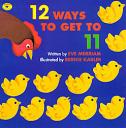
    • 12 Ways to Get to 11
    • Written by Eve Merriam
    • Illustrated by Bernie Karlin
    • 97806898089202.jpg
    • This story starts out by counting to twelve, with the number eleven missing from the list. Throughout the rest of the book, twelve different ways to add to eleven are showcased. Examples of the objects used in the number sentences include the pinecones and acorns on the forest floor, items found on a sailboat, babies, and a mother hen and her hatching chicks. Readers are exposed to a variety of number combinations that all add up to the missing number eleven.
    • Panda Math: Learning about Subtraction from Hua Mei and Mei Sheng
    • Written by Ann Whitehead Nagda
    • In collaboration with the San Diego Zoo
    • pandamathbig.gif
    • Real photographs of the panda cubs Hua Mei and Mei Sheng grace the pages of this informative non-fiction book. Readers have the option to read only the story of the baby panda cubs or they can learn more about pandas, and subtraction, as they explore the real life math issues on the left-side pages of the book. Some of the interesting math problems include how much less time pandas in the zoo spend eating bamboo compared with those in the wild or how much weight Hua Mei gained in three months. The adorable pictures and engaging facts will surely keep readers interested in both the life of the baby pandas and the math that goes along with it!
    • Lights Out!
    • Written by Recht Penner
    • Illustrated by Jerry Smath
    • 51p8nzvdnnl_sl500_aa300_.jpg
    • The narrator of this story is a little girl who not only has to go to bed before everyone in her family, but as she notices by the lights on in all of their windows, before everyone in the apartment building across the street. One night she convinces her parents to let her stay up until all of the thirty-two lights across the street have gone out. Throughout the night the narrator describes both some of the fun things she sees, a pillow fight and a parrot for example, as well as the steps she takes in subtracting the lights that go off, until one stubborn light remains.
    • Math Fables Too
    • Written by Greg Tang
    • Illustrated by Taia Morley
    • 9780439783514_xlg1.jpg
    • This beautifully and colorfully illustrated book provides readers with fun science facts as they read about different animals. The animals, ranging from one sea horse to ten seagulls, are described through playful rhymes that portray the animals’ behaviors done in smaller groups. By breaking down the larger number of each animal, readers are exposed to a variety of different addition facts that add up to the sums one through ten, as they also learn fun facts about a variety of creatures!
    • Web Suggestions:
    • A Day at the Beach Subtraction
    • In this activity, an ocean scene is the background for the demonstration of subtraction using colored balls. A group of the balls are crossed out and separated from the original group and students must choose which of the two number sentences provided matches the balls. After selecting it students are then prompted to answer the fact before moving on to the next sentence.  After about five of these, one beach-themed word problem is given, and at the end students can color in a fun beach scene.
    • Alien Addition
    • This game can be modified for ability levels by entering in the highest sum the facts provided will go to. In the game, students are instructed to use the cursor to move the laser beam that has the desired sum written on it below the UFO with the corresponding number sentence. They have one minute to get as many of the correct UFOs as possible before moving on to the next stage where the game continues to get harder.
    • Addition Chart Surprise
    • Students are directed to drag the given number to a spot on the chart where the row and column add up to the sum. When they drop the number in the correct spot, the entire diagonal of facts that add up to that sum is uncovered and pieces of a larger picture are shown, which can help students visualize addition patterns.
    • Number Jump
    • For this activity students use the calculator buttons, either to add or subtract, the number of spaces the green ball should jump to be able to smash the flies that are resting on a number. Students need to switch back and forth between the operations in order to get from one level of numbers to the next as they try to smash all of the flies in the least number of moves possible.
    • Ten Frame
    • Available from the National Council of Teachers of Mathematics, this online ten frame allows students to choose whether they want to use the manipulative to answer how many?, build, fill, or add and a variety of fun counters are available for the students to choose from. The ten frame lets students work in terms of fives and tens, two very important numbers in our number system, which can help them develop stronger addition and subtraction understanding and skills.
    • Additional Teacher Resources:
    • Grapher
    • This online grapher can be used within the classroom to create bar graphs which students can then analyze. It is a great way to get students involved and connected with the subtraction facts they are working on!
    • It’s a Fact!
    • This website provides teachers with a variety of different types of activities to teach students addition patterns including counting on, doubles, doubles plus one, fact families, and combining ten.  It has lists of the materials needed for each activity, including the PDF files for any forms or necessary worksheets, and step-by-step directions for each activity. There is also a list of books that go along with the topics being covered.
    • Numbers Away
    • Very similar to the addition site above, this website provides many ideas on how to teach subtraction throughout the year. It gives activity ideas for lessons that teach subtraction using a number line, subtracting from 10, subtracting doubles, and counting up. Included are downloadable forms, step-by-step instructions, background information for teachers, a related book list, and assessment ideas.
    • Manipulative Templates  
    • This site provides teachers with templates for a wide variety ofmanipulatives. There are printable base-ten block sets, cuisinaire rods, and colored tiles which would be very useful in the teaching of addition and subtraction.

  • Will the Gulf oil spill spark a movement like an earlier disaster? (video)

    birth_of_a_movement_horiz.pngOfficials are saying it could be months before they’re able to halt the flow of the approximately 42,000 gallons of oil a day that are now pouring into the Gulf of Mexico from BP’s sunken offshore drilling rig that exploded last week.

    Share/Bookmark

    While an effort is underway to try to activate the well’s blowout preventer and shut off the oil flow, the operation is complex and company officials warn it might not succeed. The alternative plan — drilling nearby relief wells — could take two to three months to stanch the flow.

    On Friday, the U.S. Coast Guard suspended its search for the missing workers, who are now presumed dead.

    “Our deepest sympathies and prayers go out to the families of these 11 crewmembers,” said Rear Adm. Mary Landry, commander of the Eighth Coast Guard District. “Suspending a search is one of the most difficult decisions a commander has to make.”

    The oil slick from the Transocean Deepwater Horizon drilling rig now covers 600 square miles and remains about 30 miles offshore. But states along the Gulf Coast have been warned to brace for impact, and Louisiana is already placing containment booms around sensitive coastal areas. There are particular concerns about the oil reaching the Chandeleur Islands off the Louisiana coast, key hatcheries for pelicans and other birds.

    It’s still not known what caused the explosion.

    The spill comes just weeks after President Obama announced plans to expand offshore drilling to untouched areas along the Southeast’s Atlantic Coast and off Alaska.

    While the White House has said the spill is no reason to give up drilling, some are warning that the disaster could spell trouble for those plans. Among them are New Orleans attorney Keith Hall of Stone Pigman, a law firm that represents some of the country’s largest oil companies, the Oil & Gas Financial Journal reports:

    “This week’s disaster could throw a monkey wrench into Obama administration’s recently announced plan to have the Minerals Management Service open up new areas for off-shore drilling on the Outer Continental Shelf,” he said. “An accident of this magnitude, involving some of the biggest players in the business, will unfortunately provide ammunition for those opposing any form of expanded energy exploration in the Gulf and other areas.”

    In addition to spawning litigation, the explosion is sure to incite a major government probe of what went wrong and what equipment components may have been behind the fiery blast. Hall notes that while oil spills are generally exempt from Superfund regulations, the Clean Water Act as well as the Oil Pollution Act, a federal law passed after the enormous Exxon Valdez spill in Alaska impose express liability for offshore oil spills, regardless of whether the oil reaches shore. “Under these laws, the federal government could impose fines, in addition to significant clean-up and emergency response costs,” Hall noted.

    But will the Gulf disaster spark a grassroots movement like the one that rose up following the catastrophic January 1969 blowout from a drilling platform off the coast of southern California near Santa Barbara? That watershed disaster — which came to be known as the “spill that was heard around the world” — resulted in crude oil covering 35 miles of the state’s coastline and the death of thousands of birds.

    The outrage and organizing that disaster inspired eventually led to the passage of the National Environmental Policy Act and helped inspire other key environmental laws.

    To learn more about the grassroots response to the 1969 disaster, check out this preview for “Birth of a Movement,” an upcoming documentary film about the Santa Barbara disaster that’s currently in production by Cage Free Productions and Spreading Solutions Productions.

    (Image above is a still from “Birth of a Movement.”)

  • A near thumbs-up for Joe Romm’s ‘Straight Up’

    by Ross Gelbspan

    Joe Romm is pissed off—and I’m delighted.

    His
    latest book, Straight Up, takes on the oil and coal
    companies, the skeptics, and the press. His unfailing sense of priorities shines
    through his startlingly thoughtful and brutally blunt writing.

    I
    have one problem with his book—but more about that later.   

    As
    an assistant secretary of energy during the Clinton administration, Romm
    developed expertise in the area of renewable energy technologies. As a climate blogger,
    his even greater asset is his intelligence.  

    Straight Up is a
    compilation of posts from Romm’s popular blog Climate Progress. And while one
    wishes Romm would have stitched the blog posts together into a more coherent
    narrative—and omitted a few that addressed transitory, fleeting events—his
    book is absolutely on point in its insistence that climate change long ago
    ceased to be a scientific issue and, instead, is most clearly a political one.

    Take
    the climate bills pending in Congress. Even though all the proposals on the
    legislative table are pitifully inadequate to the catastrophic threat of
    accelerating climate change, Romm’s book makes the subtext crystal clear.

    The
    conflict in Congress is not really about the science. “The conflict is actually
    a political one between those who believe in government-led solutions and those
    who don’t.” As Romm points out, a central reason that most political
    conservatives and libertarians deny the reality of human-induced climate change
    “is that they simply cannot stand the solution. So they attack both the
    solution and the science.”  I don’t
    recall reading that simple truth in The
    Washington Post, The New York Times,
    or any other major news outlet—virtually all of which treat the climate
    debate as though it actually had some legitimacy.

    Similarly,
    I share Romm’s critical take on the news media for their complicity in creating
    our gathering nightmare.

    Having
    spent 30 years as an editor and reporter at some of the country’s major
    newspapers, I don’t think the worst offenders in the hierarchy of climate
    villainy are the executives of Big Coal and Big Oil. They’re simply doing what
    they’re paid to do: bring us cheap and abundant energy—and defend their
    industries against the imperatives of the science and the onslaught of
    environmentalists.

    The
    larger villain, from my point of view, is the mainstream press that has
    consistently failed to prepare the public for the coming turbulence. The major
    U.S. news outlets have failed to prominently highlight major climate science
    findings. They have failed to mention the role of warming in the increasing
    frequency and intensity of extreme weather events. And they have failed, in the name of
    “journalistic balance,” to distinguish between legitimate, peer-reviewed
    scientific research and the deliberate obfuscation by a cadre of climate
    skeptics, many of whom have been funded by coal and oil companies.

    As
    a result, the public has no idea that we are already at a point of no return in
    terms of staving off climate chaos. 

    Citing
    the dire forecasts from the most recent IPCC report—which significantly underestimate
    the urgency of the situation—Romm blasts the media for treating climate
    skeptics “as if they had a scientifically or morally defensible position.”

    Moreover,
    because the media largely continues to report the climate controversy as though
    it had a middle ground, “they push us closer to the certain catastrophe of
    inaction,” as Romm writes.

    His
    chilling conclusion:  “It appears to me
    that today’s media simply can’t cover humanity’s self-destruction.”

    In
    a similar vein, Romm skewers the media for failing to connect the
    intensification of extreme weather events around the world to our burning of
    coal and oil.

    That
    connection was established as early as 1995, when Tom Karl, David Easterling,
    and other scientists at NOAA’s National Climatic Data Center concluded that as
    earth’s temperature increases, we will see more temperature extremes, more
    intense downpours, and more protracted droughts, among other consequences. Those
    findings were elaborated in a 1997 Scientific
    American articled titled “The Coming
    Climate
    .”

    Nevertheless,
    Romm points out that the coverage by the majority of the U.S. news outlets of
    last year’s hellish wildfires in Australia contained no mention of warming-driven
    heat waves and droughts. Romm cited a
    Reuters headline which read, “Australia Fires a
    Climate Wake-up Call: Experts
    .” 
    By contrast, ABC News anchor Charles Gibson called them “part natural
    disaster” and partly the product of arsonists. 
    ABC’s World News Tonight said
    not one word about the role of human-induced atmospheric warming in the long
    heat wave and drought that created such hospitable conditions for the
    wildfires.

    On
    the economic front, Romm is equally ruthless in his criticism. For one thing,
    the press and many economists have consistently overestimated the costs of
    mitigation, starting with the simplest of all remedies: efficiency. In Romm’s
    view, the U.S. is the “Saudi Arabia of energy waste.”

    While
    the press parrots the
    prevailing economic line
    that mitigation will be crushingly expensive. Romm notes
    that during his five-year stint at DOE, “I never saw a building or factory that
    couldn’t cut electricity consumption or greenhouse-gas emissions 25 to 50
    percent with rapid payback.”

    More
    to the point, Straight Up quotes Eric
    Pooley
    ,
    a former editor at Fortune and Time magazine: “The press misrepresented
    the economic debate over cap-and-trade. It failed to recognize … that cap and
    trade would have a marginal effect on economic growth and gave doomsday
    forecasts … The press allowed opponents of climate action to replicate the
    false debate over climate science in the realm of climate economics.” As
    Tufts University economist Frank Ackerman said recently,
    “It’s not the costs of mitigating climate change that worry me, it’s the costs
    of inaction.”

    I
    also share Romm’s impatience with policy analysts who continually call for more
    R&D to solve the climate crisis.  Right
    now we have all the technology we need to begin reducing emissions quickly and
    cheaply. Romm happens to favor both
    efficiency and concentrated solar thermal power. But, his technological preferences aside,
    he’s right on point when he describes the call for more R&D as a stalling
    tactic to avoid coming to grips with the threat. As Romm writes, “deployment
    completely trumps research.”

    Romm
    does overlook one critical point.  While
    renewable technologies may be relatively expensive at this point, that is not a
    function of economics. It is, first and foremost, a function of political will.
    Were the world’s political leaders to mobilize around the need to rewire the
    world with clean energy, the costs of solar panels, solar towers, wind turbines,
    appropriate hydroelectric facilities, and other technologies would drop
    dramatically as they were ramped up to mass production and economies of scale. (For
    one set of strategies to accomplish this, see here.) Recall,
    for instance, that prohibitively expensive early television sets and computers
    became quickly affordable when their production and marketing were scaled up.

    But
    for all the uncompromising wisdom in Straight
    Up, I still have a problem.

    Toward
    the end of his book, Romm wanders into the question of why climate advocates
    are so bad at “messaging.” It may be a
    valid question. Foundations have poured
    thousands of dollars into exploring how best to communicate the realities of
    climate change. George Lakoff, for one,
    has devoted a substantial amount of time to wrestling with this question. 

    But
    I’m afraid the issue of “messaging” is a swerve—a diversion from the real
    question facing all of us at this moment of history.

    We
    have already passed the point of no return. We are already beginning to see crop failures, water shortages,
    increasing extinctions, migrations of environmental refugees, and all manner of
    potential breakdowns in our social lives.

    Where
    Straight Up falls short is in its
    failure to deal with this reality head on. It is not a pretty scenario. When governments
    are confronted by collapse, they too often resort to totalitarian methods to
    keep order in the face of chaos. Given
    the increasingly precarious state of our climate, it is not hard to foresee
    governments resorting to permanent states of martial law. And it is not hard to imagine a short-term
    state of emergency morphing into a long-term state of siege.

    This
    is not at all to minimize the value of Romm’s book. To the contrary, if you think the most
    pressing task today is to limit the coming damage through a transition to
    non-carbon technologies, I can’t think of a better place to start than by
    reading Straight Up.

    But
    that transition can only be a start.

    Unfortunately,
    we have already passed a point of no return in terms of staving off massive
    disruptions. It is time to begin talking
    about how to preserve a coherent human community without a retreat into mass
    survivalism. It is time to start
    planning how we can endure in a world that will be far less stable and far more
    threatening than the one we grew up in.

    Perhaps
    this is an unfair knock on Romm. Perhaps it is not environmentalists—even
    extraordinarily intelligent ones like Romm—to whom we should be looking for
    these kinds of answers.

    The
    overriding threat to our collective future used to be an environmental one. Today it has grown into a global existential one.

    Environmentalists
    have done us a great service by identifying the problem. But the real challenge,
    I think, goes far beyond the reach and expertise of Joe Romm or, for that
    matter, any other environmentalist.

    The
    question of how to reorganize society in the face of impending collapse comes
    down to a choice between a radically more coordinated, cooperative global
    community and a scatter of fortressed, tribalized, and highly defended enclaves.

    That is the real question facing us today. It is a question that requires courage. It is
    a question that requires trust. Finally, it is a question that requires the
    very best thinking of people from every continent, every discipline, and every single
    walk of life.

    Related Links:

    Oil rig leak and the week in fossil-fuel industry disasters

    Obama blandly invokes ‘American Dream’ in tribute to miners who were denied it

    The good news about the very bad news (about climate change)


  • 2011 Ford Mustang V6 vs. 2010 Chevrolet Camaro RS – Comparison Tests

    Speedier Sixes: Can Camaro compete with Ford’s new V-6 Mustang?

    You’re forgiven if you feel you may have seen this movie before, because you probably have. Like Hamlet, or Macbeth,
    its core is a classic confrontation that never seems to get old, thanks to the arrival of new players and fresh productions, as one generation succeeds another.

    You may be thinking, “New? Don’t see no new here.” With little more than a year in Chevy showrooms, the Camaros roll into summer unchanged. And it takes the experienced eye of a longtime Mustang cognoscente to see the updates for these 2011 models. The dashboard surface is revised, softened to make impacts with one’s head a little less unpleasant. There are also suspension tweaks aplenty, but the real giveaway is a 5.0 badge on the flanks of GT models.

    Keep Reading: 2011 Ford Mustang V6 vs. 2010 Chevrolet Camaro RS – Comparison Tests

    Related posts:

    1. 2011 Ford Mustang GT 5.0 vs. 2010 Chevrolet Camaro SS – Comparison Tests
    2. 2010 Lingenfelter Chevrolet Camaro SS vs. 2010 Roush Ford Mustang Stage 3 – Comparison Tests
    3. 1999: Chevrolet Camaro Z28 vs. Ford Mustang GT – Archived Comparison
  • Watch: Sucker Punch turns Empire City into a ModNation Racers track

    As part of Sony’s ‘Play, Create, Share’ banner, ModNation Racers lets players create their own custom tracks. What happens if you hand a copy to inFamous developer Sucker Punch, though? You end up with an awesome Empire

  • Paypal Payment Option In Android Market

    Found under: Paypal, Android, Market, Google, Payment,

    Sooner rather than later there will be an alternative option to pay for applications you buy from the Android Market this alternative comes in the form of Paypal and I can be sure that many developers and consumers alike will be happy about this. Since Google opened the Android Market to paid applications Google Checkout was the exclusive payment system and many folks were not quite happy about that glad to see things are changing.What I understand is that Paypal made a deal with Goo

    Read More

    Read more in mobile format

  • Hussman: This Market Is Excruciating For Investors Who Take Valuations Seriously

    johnhussmanportrait.jpg

    Every week John Hussman speculates on why the market shouldn’t but does keep rising.

    (It shouldn’t because the price-to-normalization ratio is at extremes not seen since 2007 and 1929. It does because investors are stupid.)

    He says this is the kind of market that investors who take valuations seriously find excruciating:

    As of last week, the Market Climate in stocks remained characterized by an overvalued, overbought, overbullish, rising-yields syndrome that has historically produced periods of marginal new highs, slight declines, and yet further marginal highs, followed somewhat unpredictably by nearly vertical drops. I’ve often accompanied the description of this syndrome with the word “excruciating,” because the apparent resiliency of the market and the celebration of each fresh high, can make it difficult to maintain a defensive stance. Interestingly, the analysts at Nautilus Capital recently noted that the most closely correlated periods in market history to this one were the advances of 1929 and 2007. While exact replication of those advances would allow for a couple more weeks of further strength, we’ve generally found it dangerous to expect history to do more than rhyme. These hostile syndromes have a tendency to erase weeks of upside progress in a few days.

    Read the full letter at Hussman Funds –>

    Join the conversation about this story »

  • 2011 Ford Mustang GT 5.0 vs. 2010 Chevrolet Camaro SS – Comparison Tests

    Double Jeopardy: A classic confrontation that never seems to get old.

    You’re forgiven if you feel you may have seen this movie before, because you probably have. Like Hamlet, or Macbeth,
    its core is a classic confrontation that never seems to get old, thanks to the arrival of new players and fresh productions, as one generation succeeds another.

    You may be thinking, “New? Don’t see no new here.” With little more than a year in Chevy showrooms, the Camaros roll into summer unchanged. And it takes the experienced eye of a longtime Mustang cognoscente to see the updates for these 2011 models. The dashboard surface is revised, softened to make impacts with one’s head a little less unpleasant. There are also suspension tweaks aplenty, but the real giveaway is a 5.0 badge on the flanks of GT models.

    Keep Reading: 2011 Ford Mustang GT 5.0 vs. 2010 Chevrolet Camaro SS – Comparison Tests

    Related posts:

    1. 2011 Ford Mustang V6 vs. 2010 Chevrolet Camaro RS – Comparison Tests
    2. 2010 Lingenfelter Chevrolet Camaro SS vs. 2010 Roush Ford Mustang Stage 3 – Comparison Tests
    3. 1999: Chevrolet Camaro Z28 vs. Ford Mustang GT – Archived Comparison
  • Gap Jeans Promise The Impossible, To Fray And Tear Without Unraveling?

    Reader Nick would like to ask how Gap managed to design a pair of jeans that would fray and tear without unraveling, since that seems sort of impossible.

    Thought you guys would appreciate this: I bought these jeans over the weekend from a Gap here in San Francisco. They were a great deal (marked down from almost $90 to about $30), but check out the dueling labels.

    The top one says “they’re extra durable and designed to keep the fabric from unraveling.”

    The bottom one says “they’re intentionally designed to fray and tear.”

    Is it really possible to design a product to do BOTH those things?

    Hmmm. Merriam-Webster:

    Fray: 1 a : to wear (as an edge of cloth) by or as if by rubbing : fret b : to separate the threads at the edge of 2 : strain, irritate

    Unravel: 1 a : to disengage or separate the threads of : disentangle b : to cause to come apart by or as if by separating the threads of

    Sounds like a tall order. Glad I don’t design jeans.

    4-26-2010 1-17-26 PM.jpg

  • Master Plan for Governors Island Unveiled


    Dutch Landscape architecture firm West 8, working together with Diller Scofidio + Renfro and Rogers Marvel, has released the master plan for Governors Island, a 172-acre island off the southern tip of Manhattan. The first phase of the master plan details the roll-out of 2.2 miles of waterfront promenades and a new 40-acre park. The new design features artificially-created hills that focus attention on the park’s center, as well as a “hammock grove,” a grotto-like shelter, athletic fields and marshlands, writes the The New York Times. The New York City government has allocated more than $40 million in funds to the new plan, but will need to raise more than $220 million for future phases of development. Control of the island recently passed from New York state to the city, enabling Mayor Bloomberg’s plans for the island to move forward.

    The Governors Island master plan includes the development of a new ferry landing area and shaded lawn overlooking the Lower Manhattan skyline. According to Fast Company, a man-made canyon will also create framed views of the Statue of Liberty. The entire master plan call for a network of promenades to circle the entire island, but the first phase will cover only the northern half. Walking along the promenade, visitors will get views of everything from the Statue of Liberty to Brooklyn Heights.  

    In the future stages of development, pathways will lead further south through sloping lawns, leading to the hammock grove. Nicolai Ouroussoff, architecture critic for The New York Times, describes the area: “Scores of hammocks will be suspended in a forest of oak and birch trees. In a rendering that shows the hammocks sagging under the weight of people napping inside them, they bring to mind human-size cocoons.” Also, under development is a new cafe designed by Diller Scofidio + Renfro at the water’s edge. “A lawn expands out onto the building’s roof, where visitors will be able to climb down through a large hole into a grotto-like shelter open to the water.”


    The southern end of the island will feature man-made marshes and tidal basins. “A raised concrete walkway wraps around the marshes at the tip of the island, so that visitors should feel as if the edge of the land were dissolving around them. To add to the sensory experience, [Adriaan] Geuze [of West 8] plans to plant the area with strong-smelling plants, like sea asparagus and lavender.” The marshes may be designed as “green” or “soft” infrastructure, providing a natural system to accomodate sea level rises that threaten New York City. Geuze of West 8 seems very focused on climate change and incorporating adaptation schemes into his designs (see earlier post). 

    Ourrossoff says the site’s building plans are still in flux. New York University is exploring adding dormitories and classroom space. There’s also discussion about luxury hotels or a conference center.

    He also contends that while Mayor Bloomberg’s ambitious park plans are “democratic” and will benefit many New Yorkers, they also end up raising property values of buildings nearby, accelerating gentrification. “Sitting in the middle of the harbor, [Governors Island] ought to be accessible to working-class families from Staten Island and the Lower East Side of Manhattan, as well as to wealthier downtowners and Red Hook’s bourgeois bohemians. The nature of the developments that flank the park will be critical to determining whether the island feels as if it belongs to all of them, or just to those few who can afford to pay for its upkeep.”

    Despite the equity issues that will need to be addressed, Ouroussoff concludes that the new park, together with Michael Van Valkenburgh’s new set of parks along the Brooklyn waterfront (see earlier post), mean a “shift in the character of the city’s park system as a whole that is as revolutionary as Robert Moses’ early public works projects or Frederick Law Olmsted and Calvert Vaux’s Central Park.”

    Read the article and see a slideshow of renderings of the new Governors Island. Also, learn more about the upcoming changes to the Island’s governance with its move from New York State to city control.

    In other Governors Island news, Ann Ha and Behrang Behin’s “Living Pavilion” won the City of Dreams Pavilion competition sponsored by FIGMENT, the Emerging New York Architect Committee (ENYA) of the American Institute of Architects New York Chapter (AIANY), and the Structural Engineers Association of New York (SEAoNY). The winning project will be assembled on Governors Island this spring, and will be open to the public from June 6 through October 3. “Living Pavilion is a low‐tech, zero‐impact structure that employs reclaimed milk crates as the framework for growing a planted green wall surface.”

    Image credit: West 8; Rogers Marvel Architects; Diller Scofodio & Renfro; Mathews Nielsen; Urban Design +

  • Citroen DS High Rider Interior Images

    Citroen DS Hight Rider Concept 1

    The Citroen DS High Rider was present at the Geneva Auto Show last month but what was on the inside of the car wasn’t its final interior layout. It is now that the moniker has revealed the very fist mages of the interior which the commuter will finally arrive with. Even now, High Rider’s rear portion remains a mystery while on the inside it gets a bi-color dark brown and gold leather scheme along with the white cross stitching that covers the seat and the dash. The entire interior trim has been finished in Chrome while the door inserts get the Midas touch. The concept is just a preview of the upcoming Citroën DS4 which will likely be available by the beginning of 2011.


  • Giannoulias ad turns bank failure into Kirk attack

    Update by John Chase at 3:47 p.m., Giannoulias to go to Obama event; originally posted by John Chase at 12:25 p.m.

    Democratic Senate candidate Alexi Giannoulias today starts his first TV commercial of the general election campaign, turning the bad news of his family bank’s failure into an attack on Republican opponent Mark Kirk.

    The commercial, which aides say will air across Illinois, comes just three days after federal banking regulators seized control of Broadway Bank.


    In the ad, black and white photos of Broadway Bank and Giannoulias’ father are shown as the 34-year-old Democratic state treasurer says Broadway helped “thousands of people achieve the American dream.”


    Arguing that the bank was another example of a “family business” that has gone under with the recession, Giannoulias then slams Kirk, a North Shore congressman, for voting for policies backed by President George Bush that “got us into this mess.”


    Unlike other major political obstacles, the Broadway Bank seizure had been known for weeks, giving the Giannoulias camp plenty of time to put together a counter strategy.


    In addition to the commercial, Giannoulias was seeking to change the subject by conducting a campaign swing today near Carbondale and Champaign where he was scheduled to discuss mine safety and education. And on Wednesday he’s scheduled to attend a rally in Chicago to lend his support for President Obama’s Wall Street reform legislation.

    Giannoulias also plans to appear that same day with Obama, whom he considers a political mentor, in Quincy as part of the president’s Midwest tour to promote jobs. Giannoulias earlier said he didn’t plan to attend the president’s event, to which other statewide officials have also been invited. The White House has not embraced the Giannoulias candidacy, a potential problem for Democrats trying to keep a Senate seat that Obama once held.

    Broadway Bank went under after numerous problems, most notably suffering major losses on scores of commercial real estate loans. Federal regulators earlier this year cited the bank for unsound banking practices. Now run by Giannoulias’ brothers after their father died, Broadway Bank was unable to meet last week’s deadline to raise $85 million.


    Running for treasurer in 2006, Giannoulias used his bank experience as a major qualification for the job. After graduating from law school, he worked at Broadway from 2002 to 2006, serving as a senior loan officer from 2004 until he left.


    Four years ago, the bank was doing well financially. But in recent years it has become a political problem for the candidate as critics have questioned Giannoulias’ role in the bank’s failures and what role he played in making specific loans at Broadway, including to a pair of men with criminal records during his time as a senior loan officer.


    As part of Friday’s seizure, Broadway Bank was acquired by MB Financial Bank last week. In the hours after the announcement, Giannoulias held a press conference in which he said Broadway’s failures shows he and his family are also victims of the economy, just like many voters. It’s a theme he repeats in the new commercial.


    “People want someone…who’s been through tough times…someone who’s seen, looked at those problems in the face and continues to move on…and continues to fight and to struggle for people,” he says in the ad.