Your OS drives your whole PC experience, so it’s your job as an enthusiast to keep it in a high state of tune. Here’s how to do just that with Windows 7. More »
Article Tags: Joanne Nova
The Spectator gave me an unusual assignment. An open-ended request to gather thoughts over a couple of weeks and note them in a diary. It’s an interesting genre because it brings out messages that might not come to life otherwise. This was printed in the Australian Edition of The Spectator Magazine, out today
I glow. I find that I’ve made it to a select list of global sceptics touted by Oxfam. Apparently my ‘network’ influence is comparable to NASA (judging by the size of the balls). Hilarious! The consultancy that produced this is named — in a parody of itself — Unsimplify. They don’t seem to realise that any half-wit can ‘complexify’. But it’s high praise from my opponents about my apparent global political influence: ‘A small group of dedicated people… succeeded in accomplishing the most impressive PR coup of the 21st century.’ Shucks. The late nights feel worthwhile. I’m beaming.
Unfortunately, the global network chart itself is so meaningless it’s self-satire. Oxfam paid for this ‘research’. It’s a scandalous waste of donors’ money. Is the world in danger from anthropogenic climate change? We won’t find out by following ‘html link networks’. (The evidence, man, the evidence…) David and I laugh late into the night about it though.
Another day I post my reply to a professor who went out of his way to embarrass himself on ABC Unleashed. He claims he’s talking evidence, but instead talks about Ivan Milat, AIDS, the length of the IPCC report, and somehow he thinks that scoring lots of Google Scholar hits is a reason to set up a trillion dollar market. I’m thinking ‘delusional’. While I’m unmercilessly tough on his reasoning, 40,000 black ants have set up a six-lane highway in our dining room. But I don’t want to be too mean, so I block off the crack in the wall, and put down a sheet of paper with honey on it. I’m hoping they will congregate there for dessert, and I can move them outside with their free meal. It’s futile. Six ants order sweets and 40,000 ants start hunting for another exit. I laugh at the irony. I outwit a professor, but the ants outwit me.
Click source to read FULL article by Joanne Nova
Source: spectator.co.uk
2010 Ford Fiesta Sedan
Ford staged the global reveal of its all-new Ford Fiesta Sedan four-door at the 2008 Guangzhou Auto Show, delivering in full on the bold promise made by the Ford Verve Concept notchback last year.
The dynamic all-new Ford Fiesta Sedan features Ford’s signature kinetic design elements – introduced to China first on the exciting Ford Fiesta five-door hatchback at Auto China in Beijing in April – demonstrating the versatility of this unique design language and its consumer appeal in important global markets.
The Ford Fiesta Sedan will be launched in China within months of its global reveal. It will be built at Ford’s new, state-of-the-art manufacturing facility in Nanjing.
“This Fiesta writes the next chapter in our small car success story and builds on the widespread appeal of the Ford brand in China.
Style-aware Chinese consumers will appreciate the uniqueness of this car that expresses their individuality, style and aspirations,” said Robert Graziano, president and CEO, Ford Motor China.
The Ford Fiesta Sedan will be manufactured in China using the same advanced technologies as does its European counterpart.
The body structure is manufactured with extensive use of high- and ultra high-strength steels to significantly increase strength and rigidity, while also reducing weight and improving fuel efficiency.
These advanced steels also provide Fiesta with an increased measure of occupant protection.
The Ford Fiesta Sedan has been tailored to satisfy customer wants in China. Carrying out Fiesta’s global strategy, additional variations of the all-new Ford Fiesta Sedan will be available across Asia and North America from 2010 with production from Thailand and Mexico supplying these important markets.
However, Ford Fiesta Sedan will not be distributed in Europe.

2010 New Chevrolet Sail Small Car
Shanghai GM recently introduced the Chevrolet New Sail sedan, the first passenger car created in China by a Sino-foreign joint venture.
The new small car was developed by Shanghai GM and the Pan Asia Technical Automotive Center (PATAC), both GM-SAIC joint ventures. In addition to being sold in China, the New Sail will also be exported to other emerging markets.
The base model will be priced around RMB 60,000 (US$8,800), which marks a breakthrough in the under-RMB 70,000 small car segment where Chinese brands have traditionally been dominant.

2010 Porsche Panamera V6
Porsche has revealed the Panamer V6 which will debut at the Beijing Motor Show in April.
All New Porsche Panamera V6 and Panamera
Following the successful start of the Panamera into the market, Porsche is expanding the range of models available. Starting in May 2010, both the Panamera and the Panamera 4 will be at the dealership as the new entry-level versions leading into Porsche’s Gran Turismo model series.
Both models are powered by a brand-new 3.6-litre V6 featuring Direct Fuel Injection and developing maximum output of 300 bhp (220 kW) plus peak torque of 400 Nm/295 lb-ft.
Following Porsche’s nomenclature, the Panamera transmits its power to the road via the rear wheels, while the Panamera 4 comes as standard with active all-wheel drive. The Panamera and Panamera 4 will be making their world debut at the Beijing Motor Show as of 23 April 2010.
Both models will be entering the German market in May 2010 and are scheduled to enter the US market in June.


One of the biggest misconceptions users migrating to the Android platform have is that they
will be sacrificing security compared to their previous flavor of smartphone OS. This couldn’t be farther from the truth. Settle in with your favorite beverage, and follow along after the break and we’ll talk about Android’s security features, and what you need to know and do to keep things going smoothly.
The Nintendo Wii and DS have been holding up very strong on the Japanese sales charts, but they will have to bow to Sony for this week. On a more positive note, Just Dance 2 pulls a
The latest sector performance data from Morningstar shows that Consumer Goods companies hit an inflection point in the past week. They began to outperform in the last 5 days despite having underperformed during the last month. The chart below shows the relative outperformance or underperformance of each sector relative to the median performance for all twelve sectors. This show that momentum has just picked up for U.S. consumer goods names.

Join the conversation about this story »

One BlackBerry app I use every day is Tether for BlackBerry, and the folks at Tether hooked us up with 25 copies to giveaway for BBSync’s Birthday. Tether which usually retails for $49.95, allows you to connect your BlackBerry and use its existing data package as a modem for your computer on-the-go. I think that anyone who doesn’t have a copy of Tehter will love it! With that being said we’ve got 25 copies to giveaway… So leave a comment below and we will pick 25 winners (don’t forget your Happy Birthday message in the comment).
* This contest ends Sunday April 25, 2010 at 11PM EST. Winners will be contacted via email (left in comment form) by mid-next week. Limit one entry per person and email address. Anyone who posts duplicate comments will be disqualified.
You’re reading a story which originated at BlackBerrySync.com, Where you find BlackBerry News You Can Sync With…
This story is sponsored by the new BlackBerry Sync Mobile App Store. Grab your free copy today at www.GetAppStore.com from your BlackBerry.
Giveaway: 25 Copies of Tether for BlackBerry Up for Grabs!
Related posts:
 Five years ago, Taipei-born Malaysian British Tash Aw landed in the media spotlight with The Harmony Silk Factory, complete with public speculations about an allegedly enormous debut advance. Decorated with multiple important prizes, including Commonwealth and Whitbread first novel awards, Aw’s Factory earned him both fortune and fame.
Last May, Aw’s sophomore effort, Map of the Invisible World, arrived on British shelves, but took another eight months to cross the Pond. Without a doubt, as lauded as Aw’s debut was, Map is even better.
At its core, Map is a story about a family in search of home. Set mostly in Indonesia in 1964 during a tumultuous “Vivere Pericoloso … Year of Living Dangerously” as named by then-President Sukarno in his Indonesian Independence Day speech, the two-member de Willigen family comprised of father Karl and son Adam is torn apart by race and politics.
Although Indonesia declared independence in August 1945 after centuries of Dutch colonialism followed by Japanese occupation during World War II, the Netherlands did not acknowledge Indonesia’s sovereignty until 1949. Decades of turbulent transition followed for Indonesia’s citizens – both native and naturalized.
Born on a remote Indonesian island to Dutch parents, Karl desperately wishes (and almost believes) that he was his hired wet-nurse’s half-Indonesian son. His need to belong to the only home he’s ever known manifests in his longing for an Indonesian family: “’I want to have an Indonesian child. A boy. He’ll be my alter ego, except better, and happier.’”
Years later, Karl’s adoption of five-year-old native orphan Adam completes the de Willigen family. But for Adam, a new father means he must acknowledge he has forever lost his only other family, an older brother Johan he “cannot remember the slightest thing about … not even his face.”
“’My name is Adam and I have no surname,’” he used to announce to detach himself, but he eventually accepts that his “Present Life” permanently includes Karl. In their idyllic house by the sea on the “lost island” of Nusa Perdo, he settles into his new identity as Adam de Willigen, which “sounds just right.”
Refusing to acknowledge the growing xenophobia, Karl and Adam are caught unawares when Karl becomes one of thousands of Dutch Indonesians rounded up for forceful expulsion. One day, soldiers simply take Karl away – “no violence, hardly any drama” – as 16-year-old Adam helplessly watches.
Ten days later, Adam tracks down Margaret Bates, an Indonesian-born, U.S.-national, university professor long domiciled in Jakarta. Hers is the only name he finds repeated in his father’s personal papers and photos. “’I wasn’t prying, you understand, I was just looking for clues. I need to find my father,’” he explains to a bewildered Margaret.
And thus the search begins. Driven by decades-old memories of her 15-year-old-self, Margaret calls on an overly-complacent Australian journalist friend and an untrustworthy U.S. Embassy official in her desperate quest to find Karl – whom she finally admits to be her long lost love.
In the big city for the first time, Adam falls victim to Margaret’s enigmatic graduate student, Din, who hopes to one day write “a secret history of the Indonesian Islands … a history of our country written by an Indonesian.” His militant patriotism both repulses and fascinates wide-eyed Adam, while his promises to help Adam find his brother Johan lead the teenager towards grave danger.
With controlled elegance, Aw lays out a multi-layered puzzle whose pieces create a haunting portrait of a splintered family working towards reunion. The militant Din tells Margaret of his visions of a “lost world where everything remained true and authentic, away from the gaze of foreigners – a kind of invisible world, almost.” Din unmistakably refers to an Indonesia untouched, certainly uncontrolled by western colonialism.
Ironically, Din’s ‘lost world’ points specifically to the southeastern Indonesian islands, which include Buru where Karl was born, and the fictional Perdo where Karl has chosen to build his adult home. Only in Din’s lost world – which Karl refers to again and again as “paradise” – can Karl and Adam be ‘true and authentic’ as father and son. But their Edenic existence proves fleeting, and both Karl and Adam are separately cast out.
“Home was not necessarily where you were born, or even where you grew up, but something else entirely, something fragile that could exist anywhere in the world.” For Adam, home must be with Karl, with new hopes of being joined someday by Johan and even Margaret. To get there, these unlikely individuals must move beyond history, politics, skin color, barriers, and background … and find their way together, somewhere on that map of the invisible world.
Review: The Bloomsbury Review, Spring 2010
Readers: Adult
Published: 2010
Filed under: ..Adult Readers, .Fiction, British Asian, Malaysian Tagged: Adoption, Colonialism, Coming-of-age, Family, Father/son relationship, Identity, Love, Parent/child relationship, Politics, Race, Siblings 


Britain’s large virtual water footprint–their reliance on imported water–could become problematic, and potentially cause many parts of the country to not meet domestic water demand, a study says.
 Much of the imported water that contributes to Britain’s and other UK Countries’ large virtual water footprint comes from water-stressed countries, according to a report released Saturday by the Royal Academy of Engineering. The study shows that this dependency could compromise national security issues in the region.
Only one-third of Britain’s water usage is domestic, while the other two-thirds comes from imported goods such as agriculture and energy.
This reliance could result in a domino effect of problems for the country if a severe water shortage happens.
“If the water crisis becomes critical it will pose a serious threat to the UK’s future development because of the impact it would have on our access to vital resources. Food prices would sky-rocket and economic growth would suffer,” said Peter Guthrie, a professor of engineering for sustainable development at Cambridge University and chairman of the study group told the Guardian.
Guthrie argues that while importing so much virtual water into the country is problematic for issues of self-sustainability, and is also detrimental to the countries exporting the precious resource.
“We should ask whether it is right to import green beans – or even roses – from a water-stressed region like Kenya, for example. The burgeoning demand from developed countries is putting severe pressure on areas that are already short of water. Our virtual water footprint is critical and we need to give it far more attention,” Guthrie said, according to The Royal Academy of Engineering’s press release.
Last month, Britain’s chief scientific advisor, John Beddington, made similar predictions about the increasing need for food, energy and water. Beddington said that by 2030 the world will consume 30 percent more freshwater than current levels.
“If we don’t address this, we can expect major destabilization, an increase in rioting and potentially significant problems with international migration, as people move out to avoid food and water shortages,” he said.
However, there is no single way to secure freshwater reserves for the future because it’s a complex issue that crosses geographical boundaries and crosses other crucial areas, such as energy and food supplies, he added.
“To avoid the perfect storm requires a global response, with global policies and governance—backed up by forward-thinking action at a national level to meet individual countries’ requirements.”
Sources: The Royal Academy of Engineering, Guardian.
Square Enix and Sony already released a limited edition white-pink PS3 (qjnet/playstation-3/lightning-pink-final-fantasy-xiii-console-price-hike.html) for Final Fantasy XIII. This one’s running a little late, but here’s the white-pink controller that should go with it.
The project will be used to recharge local aquifers and provide clean drinking water.
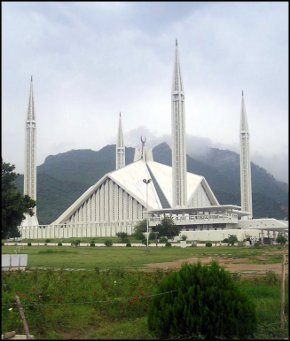
Pakistan’s first urban rainwater harvesting system has been installed in the capital city Islamabad, the Daily Times reports.
The collection tanks at the Faisal Mosque complex were funded by the city’s Capital Development Authority, and will provide clean drinking water while recharging the local water table for the city’s nearly 1 million residents.
Known as the Pilot Rainwater Harvesting Project, the initiative was developed in collaboration with the United Nations Development Program and the Pakistan Council of Research for Water Resources.
The CDA hopes to increase the number of rainwater harvesting systems in the capital. Meanwhile Islamabad’s building code has been amended to include design specifications for buildings with a footprint that is greater than 400 square yards, according to a press release from CDA chairman Imtiaz Inayat Elahi.
Rainwater harvesting projects are already in use in the eastern Thar and Cholistan deserts along the Indian border. Few rivers flow year-round in these areas, requiring residents to store water from the rainy season for use during the dry months.
One project in the Sindh Province coordinated by the Thardeep Rural Development Program, a local NGO, uses several methods to collect rainwater.
“At the moment, we have three types of projects, which include rain water harvesting at household levels, also known as cisterns or tankas,” Jhuman Lalchandani, the project manager, told IRIN.
“At hamlet level, ponds are used for saving water for the community, and at the village level we have delay action dams. Also, in low-lying areas, flood protection walls not only save houses from getting flooded but also allow for water to pool up and be used for other purposes,” Lalchandani said.
Across the border, rainwater harvesting in India is increasingly popular. In 18 of the country’s 28 states it is mandatory to include collection systems in new buildings. Cities such as Mumbai and Bangalore are using the small-scale technology to endure water shortages.
Source: Daily Times, IRIN
 Dell is readying a line of Android products, the computer maker said this week, which will include no fewer than four phones. The Android handsets will range from the budget-minded Aero to the Thunder superphone, which includes everything you’d expect in a high-end phone, plus a custom Hulu app. The Android line-up will also feature a 5-inch tablet dubbed the Streak. Dell plans to launch a larger model — the Looking Glass — with Nvidia Tegra 2 technology later in the year.
In the meantime, another 7-inch tablet running Android was unveiled. Due out in July, the Cruz Tablet , which is being produced by PC maker Velocity Micro, will have Android 2.1 running the show and a web browser with full Flash 10.1 support; memory expansion will be possible through USB and SD cards. While tablets running Android aren’t able to interact with the official Android Market, Velocity Micro says there will be a “Cruz Market” for distributing apps.
Also this week, an enterprising individual was able to install Android on the iPhone. The hacked device works as a regular Android phone, yet retains the ability to boot into the iPhone OS — though the Google OS on the Apple device was said to be “a bit buggy and unstable.”

With the web becoming such a big part of everyone’s life, the web browser is probably the most important piece of software in any computer or device. But, with great power comes great responsibility, browsers are constantly a target for nefarious individuals up to no good. Add to this the ‘unpredictability’ of web coding and buggy plugins and you have a recipe for disaster.
With so many potential points of failure, it’s up to the browser makers to ensure tha… (read more)
Article Tags: You could not make it up
Climate change ‘skeptics’ have been singing a victory song in recent months. Emboldened by this winter’s record snow, errors in the Intergovernmental Panel on Climate Change’s 2007 report, and the phony scandal they dubbed ‘ClimateGate,’ their growing clamor has taken a toll on public acceptance. According to a Gallup poll released last month, Americans are now about evenly split on whether the threat of global warming is exaggerated and whether scientists agree on its causes and dangers. This in the face of clear scientific consensus.
Ninety seven percent of climatologists agreed that climate change is real and largely man-made in a poll released last year. At least 60 major scientific organizations across the globe also concur, while not one of any repute holds an opposing opinion. (A few have not yet committed.) As to the list of 700 dissenting scientists that Senator Inhofe and other skeptics frequently cite, an analysis by the Center for Inquiry found that less than 10 percent of them were climate scientists, and only about 15 percent had ever been published in peer-reviewed climate science literature. Moreover, another four percent seemed to agree with the scientific consensus and so were, presumably, mistakenly included. One of the “scientists” turned out to be a Kentucky weatherman without a college degree..
Source: huffingtonpost.com
Article Tags: Opinion
Well, I survived Earth Day. But only just. Thanks to all the hot air and greenhouse gases being spewed into the atmosphere, especially from that nasty Icelandic volcano, the global temperature likely went up by at least a couple of degrees.
But here it was simply a lovely spring day, the kind that reminds us we live in one of the cleanest, most pollution-free cities on the planet (except, of course, when the potheads cloud it over during their annual toke-in).
Nevertheless, the relentless drive to make the Lower Mainland ever cleaner and greener continues to consume our province’s most creative minds.
The reason? There’s a lot of green in it, especially when you consider the hundreds of millions of dollars in grants and subsidies up for grabs by environmental insiders — and the excuse it gives government to grab those dollars back and more from regular taxpayers through various eco-levies.
Source: theprovince.com
 In a recent post on the official Skype blog, Jean-Jacques Sahel, the company’s European director of government & regulatory affairs, has shown his support for mobile Internet neutrality, as a response to the fact that more and more companies want to charge users for browsing the net when using mobile devices. Apparently, this action can … (read more)
Article Tags: Energy & Fuel
Americans are being inundated with claims about renewable and alternative energy. Advocates for these technologies say that if we jettison fossil fuels, we’ll breathe easier, stop global warming and revolutionize our economy. Yes, “green” energy has great emotional and political appeal. But before we wrap all our hopes — and subsidies — in it, let’s take a hard look at some common misconceptions about what “green” means.
1. Solar and wind power are the greenest of them all.
Unfortunately, solar and wind technologies require huge amounts of land to deliver relatively small amounts of energy, disrupting natural habitats. Even an aging natural gas well producing 60,000 cubic feet per day generates more than 20 times the watts per square meter of a wind turbine. A nuclear power plant cranks out about 56 watts per square meter, eight times as much as is derived from solar photovoltaic installations. The real estate that wind and solar energy demand led the Nature Conservancy to issue a report last year critical of “energy sprawl,” including tens of thousands of miles of high-voltage transmission lines needed to carry electricity from wind and solar installations to distant cities.
Nor does wind energy substantially reduce CO2 emissions. Since the wind doesn’t always blow, utilities must use gas- or coal-fired generators to offset wind’s unreliability. The result is minimal — or no — carbon dioxide reduction.
Source: washingtonpost.com
You know you like ’em big and real I’m talking about monsters of course. Lost Planet 2 has generous helpings of some of the biggest monsters you’ll ever get to slay in-game. Gametrailers caught a preview