
IEA Director of Government Relations Jim Reed calls on IEA members to contact their legislators to vote NO on SB 2494, a bill that would divert $100 million dollars in public money to private schools in Chicago.
A recall has been issued for the LIFEPAK 15 defibrillator by Physio-Control, Inc. after it was determined that the defibrillators could turn off and on by themselves, potentially resulting in injury or death.
The FDA issued a Lifepak 15 defibrillator recall alert this week, indicating that the action is a class 1 recall, meaning that there is a reasonable chance that the devices could cause serious injury or death. Class 1 recalls are the most serious type of medical device recall.
Physio-Control, Inc., a division of Medtronic, sent a letter to customers in March informing them that they should keep using the devices, but should test them according to operating instructions. The company also told customers that it was sending local representatives for service visits within 60 days. The company referred to the action as a “voluntary correction.” The FDA classified it as a Class 1 recall.
Physio-Control’s announcement says that the problem involves an internal component in the defibrillators, which could inadvertently contact the power printed circuit board assembly. This can cause the device to turn off and on by itself, or turn itself on and not respond to being turned back off. There have been no reported injuries associated with the defective LIFEPAK defibrillators.
The defibrillator recall affects certain LIFEPAK 15 Monitor/Defibrillators by Physio-Control Inc. that were manufactured between March 26, 2009 and December 15, 2009. The recall is limited to a specific set of serial numbers. Customers can perform a search for their device’s serial number on the company’s defibrillator recall announcement.
The company believes it has contacted all customers who purchased the affected devices and is scheduling service visits to repair the problem. Customers who experience the power problems should contact the company’s technical support at 1-800-442-1142.
The FDA requests that any health care professionals or consumers who experience problems with this device report the incident to FDA’s MedWatch Adverse Event Reporting program at www.fda.gov/medwatch.

Finally, SIRIUS XM says it will soon release a free Android app that will enable DROID and Nexus One owners – among others – to enjoy access to over 120 channels of sports, talk, entertainment, news, comedy and commercial-free music.
For now, you can only download apps for iPhone, iPod touch and BlackBerry smartphones.
The satellite radio broadcaster says it will release the Android app some time in May this year, and all users of the SIRIUS XM App will receive a 7-day free trial of the SIRIUS XM Premium Online service to boot.
Naturally, the app will be able to tap into channels over both cellular and WiFi networks.
The press release provides a laundry list of programming, but here are some of the goodies: MLB Network Radio, SIRIUS NFL Radio, NHL Home Ice, CNN, NPR, MSNBC, Oprah Radio aaaaand Playboy Radio.
During the 7-week trial of the premium service, users will also be able to listen to artist-branded music channels such as The Grateful Dead Channel, Eminem’s Shade 45, B.B. King’s Bluesville, Willie Nelson’s Willie’s Place and Elvis Radio.
Not included in the offering are Howard Stern, NFL and NASCAR programming.
The SIRIUS XM App for DROID and Nexus One will be available as a free download through the Android Market on the handset or by visiting this page.
Again, availability is scheduled for May, but you can already sign up to receive an email with a link to download the free app when it’s live.
The BMW History
Bayerische Motoren Werke AG or Bavarian Motor Works in English is commonly known throughout the world as just BMW. Another German luxury car conglomerate that has branched out over the decades into the manufacturer of high quality luxury-performance motorcycles and cars, including the subsidiaries of the ever poplar and unique MINI, and super luxury car brand Rolls Royce.

BMW has come a long way in maintaining a reputation of class and distinction that for a time no one could surpass and they were deemed as the ones to beat. They emerged in the early 1900’s when every other automobile manufacturer was also entering the race for the top.
The current headquarters of the company is in Munich, Germany, in an architectural masterpiece of a structure that stands with poise and prominence, very much like what BMW exudes.
BMW can officially trace its beginnings all the way back to the trailblazer days of the German air transportation all the way to 1913 and later became a public company in 1922.
The men from these initial days were accredited as being the “founding fathers”, Karl Rapp and Gustav Otto, but the actual men that were part of the founders party were the ones with it from the beginning: Max Friz, Josef Popp, and Camillo Castiglioni. They were the ones responsible for taking the company through many rough times in the beginning, and also the ones to take the company public too, finally forming “BMW AG”.
The logo of the company has been stagnant since the start of the business; the blue and white checkers were derived from and symbolizes the Bavarian flag, whereas the circular badge is somewhat taken from the logo of its forefather company “Rapp Motorenwerke”.
BMW first major endeavor was radio flyer engines, but their engines the BMW 132 and the BMW 801 both air cooled radial engines, and the innovative BMW 003 axial-flow turbojet were included into pre World War II and World War II aircrafts. They also began experimenting with a number of various products in the earlier years, but in 1923, BMW finally moved into the stream of major motorcycle manufacturing, and subsequently on to car production 6 years later.
BMW were having some trouble with the motorcycles and their engines with the unsuccessful Helios and Flink, but decided to push on with the development, ultimately securing their first distinguished motorcycle, the R32.
It had a “Boxer” twin engine with an ICCE cylinder sticking into the airflow from both sides of the engine. Up until 1980s, BMW basically kept to the same design effect with huge success, and the pattern is still used on some level today, which is clearly showcased in the R Series motorcycles.
Other motorcycles and engines that BMW has produced are: R75 (sidecar), K Series (water cooled with 3/ 4 cylinders running from front to back), F Series, G Series (both with parallel twin Rotax engines), R1100S (“hexhead” engine), R1200GS (“oilhead” engine), and the latest the K1200S. BMW also pioneered many safety features for motorcycle usage, both on the road and on the racetrack.
The production of BMW’s cars came with strong skepticism, and their own internal critics kept them an their toes at all times. BMW had a strong perception for potential and stature, and even their first set of automobiles were appealing to both the imagination and the eye example their BMW oldtimer, 319/1, 936 BMW Model 319 4- Window Cabriolet, and last but not least Model 507 roadster.
BMW created many, many cars and most of them were given the “e-code” branding (Entwicklung, meaning development or evolution), and BMW recently stated that the naming would switch over to an “F” for future models, starting with F01 7 Series.
The care and time BMW put into their vehicles allow for a personal connection with each one, and this kind of personalization goes a long way with the business’ public. BMW also made a couple James Bond cars; the Z3 M Coupe, and the Z8 roadster, becoming the first non-British car to ever be featured in the film franchise.
BMW has relationships with other companies besides its two subsidiaries Rolls Royce and MINI, which include but not limited to Glas, Isetta, Automobilwerk Eisenach, Land Rover, Wiesmann, AC Schnitzer, Bavaria Wirtschaftsagentur GmbH, Alpina, G-Power, Breyton, Hartge, MK-Motorsport, and Hamann Motorsport.
The partnerships and alliances with these companies have made BMW, a very resourceful entity, with situations covered from all angles. The Motorsport aspect of the BMW lineage has been essential over decades, as history shows that they have a definite stamp of approval in performance, and speed. Some of the motoring cars are the 3.0 CSL, M1, M3, M5, M6, M Roadster, Dixi (3/20, 303, 309, 315, 319, 320, 321, 325, 326, 327, 328, 329, 335), Isetta (600 700), 501, 502, 503, 507, 3200 CS, 2000 CS etc.
BMW also has its own wide range of Motorsport cars, and teams with the BMW Sauber F1 Team being their first ever Formula One racing team, but having many other partnerships with Williams F1, Brabham, and Arrows.
As BMW have won about 19 grand prix as engine builders, but not under their newly formed F1 racing team, but the company has risen to may heights in the racing arena, winning titles, championships, immense accolades over time, and has improved their technology especially in quality and performance. They also have done a lot for sponsoring with Formula BMW, a junior racing Formula category, and the Kumho BMW Championship.
They also have a rich history with Sports car racing, winning approximately 25 different tittles and races, also with their touring cars with strong drivers, and incredible performance since as far back as 1940.
They also have two major rallying cars in their records with RAC Rally race 1939 winner 328 sports car, and Paris Dakar Rally, which BMW motorcycles won about six times.
BMW models are put into Series format and with a lot of them still in production: the 1 Series, 3 Series, 5 Series with the M5 model, 6 Series with M6, 7 Series, X3, X5, X6, Z4, BMW M, M3, M5, M6, and Z4 M. And there are many more future models on the way, signaling the movement of the direction of the company in the right direction: Z10/ M10, X1, PAS, CS, X5 M etc.
BMW also has a number of prototypes and concept cars on the way as well, with their sights set on keeping the distinction and excellence throughout everything they put their name on. They are set on keeping that strong unshakable history stronger and the years roll by and technology becomes the main player, as they strive in the aspect of acceleration, majesticness, and safety all in one comfortable ride.
Source: BMW. Thank you

Michael Geist points our attention to the news that India has introduced a draft of proposed amendments to its copyright law, in an attempt to bring India’s copyright laws into alignment with those ever popular “international obligations” found in various (industry dominated) treaties. There were reports late last year that the proposals were likely to be draconian, as the negotiations had mainly been between the government and the recording industry with no input from the public. However, the actual proposal (pdf) is much more of a mixed bag — with lots of somewhat surprisingly good things included.
For example, it extends the concept of “fair dealing” to cover “private and personal use” and makes sure that anti-circumvention rules only apply when the circumvention is used to infringe on copyrights. The US anti-circumvention clause in the DMCA makes no such distinction (so even if you circumvent copy protection for a perfectly legal reason — such as to make a personal backup — it’s still infringement just to circumvent). Also, the new proposal would allow more access to copyrighted works by “physically challenged persons.” However, it appears that some feel that those provisions don’t go far enough. It allows for the conversion of copyrighted works into Braille without having to pay a fee, but many visually impaired point out that it does not cover converting the works to audio formats with e-reading software or audiobooks. Some political parties are threatening to boycott the proposal if this part isn’t fixed.
The part of the bill that’s getting the most attention in India is that it would create an additional right for content creators, which they would hold onto, rather than having the right transferred over to the producers and record labels. In other words, it seeks to make sure that the actual content creators don’t have their rights stripped from them by the industry. Not surprisingly, the record labels are up in arms about this, and find the whole thing to be terribly unfair. In their defense, it is a bit strange to set up a copyright where the rights are not transferable, even if the purpose is really to give more power to the content creators themselves.
That controversial clause does seem like a mixed bag itself. Decreasing the control the industry has over actual content creators is a good thing, but I’m not sure layering on another “right” is the way to do it. There are some other questionable aspects of the bill as well — including (of course) extending the length of copyright, in some cases, for no good reason. It also sets up new statutory compulsory rights. While those sometimes are useful in clearing up confusion, it creates a totally arbitrary system for setting payment rates, rather than letting the market figure it out.
Overall, it sounds like this is better than many of the proposed copyright law changes out there — and I’m sure that the entertainment industry, who had been pushing for India to put potential infringers in jail, won’t like this one bit — but it’s not that great either.
Permalink | Comments | Email This Story
Found under: Microsoft, Kin, Kin One, Kin Two, Windows Phone 7, Social Networking, Mobile,

Read more in mobile format
Environmental News Network: How good or how bad is a product from a green carbon footprint point of view? Several well known corporations like Airbus, Levi Strauss & Co., 3M, DuPont, and Kraft Foods are volunteering to road test a full life cycle greenhouse gas analysis on a wide range of products from blue jeans to manufactured steel.
 A life cycle analysis studies all the potential contributions to a carbon footprint and includes supplier, transportation, production and disposal. This concept is also related to environmental sustainability.
he Product Life Cycle Accounting and Reporting Standard and the Scope 3 (Corporate Value Chain) Accounting and Reporting Standard, provides innovative methods to measure a product’s full life cycle emissions is the planned method to be used. In all sixty corporations have been chosen to participate.
The standard was developed with a multi-stakeholder, consensus based process to develop greenhouse gas accounting and reporting standards with participation from businesses, government agencies, nongovernmental organizations, and academic institutions from around the world. This draft standard was developed between January and October 2009 by two technical working groups collectively comprised of over 70 members from a diversity of businesses, government agencies, NGOs, and academic institutions.
“We are encouraged by the overwhelming response from the private sector seeking to road test the new standards. There were more than 120 applications across a broad array of sectors and regions worldwide. The road testing will provide critical input in ensuring that the standards generate credible and meaningful data for business and government decision makers, while considering the practical challenges that businesses and programs will face during implementation,” said Jonathan Lash in a press release. Lash is president of the World Resources Institute, which developed the standards along with the World Business Council for Sustainable Development.
The new standards will also allow companies to look at the greenhouse gas emissions of their full corporate value chain, including supplier manufacturing, outsourced activities, and the products’ ultimate consumption.
Greenwire: If Ford’s new sustainability initiative goes as planned, the dealership where you buy a Fusion Hybrid will be as green as the car itself.At this month’s annual National Automobile Dealership Association convention in Orlando, Ford announced its “Go Green” dealer sustainability program, a voluntary project to push Ford, Mercury and Lincoln dealerships to be more energy efficient. Ford will partner with the Rocky Mountain Institute on the effort.
 Outside of three pilot projects, the program is entirely voluntary, and dealers can choose if and how much they will participate.
The program is part of a larger effort by dealerships across the country to put a more environmental face on an industry traditionally beset with environmental complaints. NADA has been working with U.S. EPA and dealerships across the country to reduce energy output.
While dealerships can take traditional, simple steps like installing more energy-efficient lighting, the complex design of dealerships poses problems in crafting any industry standards, said Doug Greenhaus, NADA’s director of environment, health and safety. For example, they have large lots that require vast lighting and the in-house service shops use a lot of power.
“You can have a huge office building with many offices, even the Empire State Building, and it’s basically one type of operation,” Greenhaus said. “We have office spaces, but we also have outdoor lighting and we also have service departments. It’s almost like we have another business.”
Dealerships electing to participate in the “Go Green” program would receive an energy assessment from a team of Ford engineers. Bill Allemon, the Ford manager of energy efficiency, said the team will then provide a series of improvements across all areas of the dealership.
“In the past, we were just changing the skin of the dealership,” Allemon said. “Now we’re improving the lighting and heating. We’ll provide a much more comfortable and relaxed environment.”
Dealers will be presented with a range of options, from adopting alternative energy sources to pursuing LEED certification, Allemon said.
“We want to help our dealers become more energy efficient, lower operating costs and lower their carbon footprint,” Allemon said. “It’s really about improving the cost-effectiveness of the dealership. They may have lowered hours or cut their head count; this is another way for them to be cost-efficient.”
While Ford has a plan for making dealerships more energy efficient, it is not the only automaker seeking a green showroom makeover. NADA, at its February convention, highlighted the ways dealers have invested more than $1 billion in eco-friendly changes.
Many took simple steps to get at the “low-hanging fruit,” Greenhaus said, by installing automatic switches in bathrooms or adjusting the temperature in the showroom. Others targeted showroom and lot lights by reducing the volume or changing out the bulbs for more efficient models. Other simple steps included replacing garage doors to improve sealing and keep in heat, or installing porous pavement on the vast storage lots to help with draining.
Some dealerships made a more significant investment by installing solar panels or wind turbines. Greenhaus said that one dealership in Vermont even created a small hydropower plant on a nearby river.
The Washington Times: Little noticed outside a small policy community, an issue has quietly arisen in recent years that, while seemingly technical, has the potential to derail the nation’s attempts to address the issues of energy security and the environment. The issue is how or whether to count the effects of “indirect” land use — including as far away as Southeast Asia or Brazil — in determining the total greenhouse gas emissions from renewable fuels like ethanol, the very fuels that will enable us to reduce our dependence on imported oil. The wrong answer to this question could severely affect the increased use of alternative fuels, aggravating our energy dependence.
 Some background: The 2007 Energy and Independence Security Act required that ethanol and other fuels with lower tailpipe emissions of greenhouse gases must also have fewer overall emissions of greenhouse gases over the entire “life cycle” of the fuel’s production, transportation and use than conventional fuels have. Most observers expected that the Environmental Protection Agency would reach this conclusion easily, and a just-published regulation from the EPA now does so. For instance, the life cycle emissions of corn ethanol result in a significantly lower emissions profile than that for gasoline, and they will only improve as new ethanol plants are matched with advanced technologies.
However, a 2008 paper in Science magazine by Timothy Searchinger argued that the increased use of corn ethanol as a fuel source would in fact increase total greenhouse gas emissions, because of the supposed aggressive conversion of both natural lands and forests to ethanol production.
Mr. Searchinger’s argument, however, is flat wrong. He assumes mass conversion of forest land (accounting for up to 36 percent of increased ethanol fuel production), when the opposite is the case. From 1990 to 2005, according to both the U.S. Agriculture Department and the EPA, U.S. forest stocks have been stable, not falling, despite increased use of corn for ethanol. There has been no net conversion of land from sustainable forests to biofuel production.
In fact, the current situation is even more positive. According to the government’s own Inventory of U.S. Greenhouse Gas Emissions and Sinks in 2007, carbon stocks in U.S. forests continue to grow at a rate of over 800 million metric tons of CO2 equivalents per year — about 10 percent of total annual greenhouse gas emissions in the U.S. No wonder that the EPA has long taken the correct position that increased use of biomass fuels is (at a minimum) “carbon neutral.”
In response to Mr. Searchinger, Jerome Dumortier and his colleagues at the Center for Agricultural and Rural Development at Iowa State produced a better model that analyzes the impacts of energy price increases and biofuel policy changes on land conversion. They demonstrate the sustainability of forest stocks even if energy prices rise significantly.
All this is important now because the EPA has just finished drafting a regulation to implement the Renewable Fuels Standard established in the 2007 bill. The agency has now adopted a more positive approach towards ethanol than it initially proposed, approving all current sources of ethanol for use under the statute. But the basic problem of the 2007 bill remains — requiring the EPA to take “indirect” (including foreign) land-use changes into account. In fact, contrary to what the 2007 energy bill suggests, it is simply too difficult to assume or measure a link between corn grown in the U.S. for ethanol production and deforestation or conversion of agricultural land abroad.
Fortunately, there has been positive action on the congressional front to redress the policy imbalance Mr. Searchinger’s article has caused. House Agriculture Committee Chairman Collin Peterson, Minnesota Democrat, and two bipartisan colleagues recently introduced a bill to amend the 2007 bill to preclude the EPA from calculating land-use changes in foreign countries for the purpose of influencing U.S. policy on renewable fuels, including biomass and ethanol.
The combination of sustainable forests, sustainable agriculture and greater use of biofuels is not merely a dream — it is today’s reality. In fact, the EPA deserves credit for recognizing a crucial point: that the protein byproduct of ethanol production is better feed for cattle than corn itself, thus maintaining the availability of feed for cattle while reducing their dangerous methane emissions at the same time.
Thanks to La Jolla for the image

Fifty countries produce over 100,000 barrels of oil per day. But most of them, from Timor-Leste to America, will run dry in the next 30 years.
Only a few true petro powers have enough oil to keep up production through the end of the century and beyond.
Endless oil has various negative consequences, known as the resource curse. Symptoms include distorted economies, inefficiency, and an autocratic regime that isn’t afraid thumb its nose at America. These countries will be able to keep up the act for longer than most.

Barrels per day: 797,000
Proved reserves: 15,210,000,000
Key figure: Abdullah bin Hamad al-Attiyah, OPEC oil minister
Outlook: Qatar does well with relatively low oil production. Everyone in the small country gets rich and they protect the relatively low oil reserves. If limited global supply causes prices to rise, however, the OPEC member is bound to increase production. Earlier this month, oil minister Abdullah bin Hamad al-Attiyah warded off fears of a supply shortage.

Barrels per day: 1,528,000
Proved reserves: 30,000,000,000
Key figure: President Nursultan Nazarbayev
Outlook: Drilling in the Caspian Sea oil fields could increase reserves by 40%. Development of long-delayed international contracts could increase production by 100%. Kazakhstan’s oil horizon may become shorter, but nonetheless, they’re in for a big, long boom.

Barrels per day: 1,875,000
Proved reserves: 43,660,000,000
Key figure: Muammar al-Gaddafi, dictator
Outlook: With Africa’s highest oil reserves and more in unexplored regions, Libya has plenty of oil. Gaddafi’s problem is production, as the unpredictable dictator has scared away foreign investors, and National Oil Company has been unable to meet its export targets.

Barrels per day: 10,780,000
Proved reserves: 266,700,000,000
Key figure: Ali al-Nuaimi, OPEC oil minister
Outlook: Saudi Arabia has the world’s greatest oil reserves, but a heavy responsibility. As OPEC’s swing producer, it exports enough to keep below $80 — though the price target has informally crept higher. Now the desert-bound country faces rising costs for its growing population. Riyadh’s solution is to invest in nuclear energy, freeing up more oil for export.

Barrels per day: 3,046,000
Proved reserves: 97,800,000,000
Key figure: Mohamed Al-Hamli, OPEC oil minister
Outlook: The only emirate that matters is Abu Dhabi, which holds 94% of proved reserves. All that oil is enough to fund theme parks and universities, as well as generous pensions, throughout the Emirates.

Barrels per day: 3,707,000
Proved reserves: 136,200,000,000
Key figure: President Mahmoud Ahmadinejad
Outlook: Despite embargoes aimed to halt nuclear development, Iran is finding buyers for oil and sellers to fill its current gasoline shortage. Soon enough it will have enough refineries to provide its own gasoline. When nuclear power comes online, Iran will have that much power oil to export.

Barrels per day: 2,643,000
Proved reserves: 99,380,000,000
Key figure: President Hugo Chavez, OPEC member
Outlook: Venezuela is by all measures a failed petro state with vast inflation and a nationalized oil company that can’t handle its own resources. But it has an incredible amount of oil — enough for Hugo Chavez to keep rattling his saber for the rest of his life.

Barrels per day: 2,274,000
Proved reserves: 104,000,000,000
Key figure: Ahmad Abdullah al-Sabah, OPEC oil minister
Outlook: Sheikh Ahmad recently reasserted his commitment to keeping oil between 75-90 dollars a barrel. With infrastructure on the way to increase production capacity to 4 million bbl/day, Kuwait will have no problem keeping oil cheap and ready. By the time they run out of black gold, the ruling family and 3.5 million citizens will have a fortune locked away in diversified investments.

Barrels per day: 2,420,000
Proved reserves: 115,000,000,000
Key figure: TBA
Outlook: Iraq has the world’s fourth largest oil reserves, and they’re relatively untouched thanks to years of war and turmoil. If Iraq settles down and starts production, it could match Saudi Arabia for exports.

Barrels per day: 3,350,000
Proved reserves: 178,100,000,000
Key figure: Ron Liepert, Alberta Energy Minister
Outlook: With oil reserves second only to Saudi Arabia, and a huge market just south of the border, Canada is set for life. The main obstacle is environmentalists that oppose drilling in the Alberta’s oil sands motherload. But assuming the Avatar movement fails, Canada is heading toward petro-state status, economic distortion, and a revenue windfall.

Join the conversation about this story »
I mentioned on Twitter yesterday that uber-cookers extraordinaire Cyanogen and Kmobs had gotten the 802.11n version of WiFi (think the fastest you can get right now) up and running on the Google Nexus One — notable because 802.11n initially was listed as a spec on the N1 but was later redacted. Above you see Kmobs’ blurry video proof, and we’ve done some testing on our own and can confirm. Let’s hope we see this in a new CyanogenMod build soonest (and hope that our battery life doesn’t take a huge hit because of it).

A tweet. A seemingly innocuous 140-character piece of data shared over Twitter. That’s what you see as a user, but inside, there’s much more. Raffi Krikorian has cracked open a tweet to show you all the data that can be inside, like your geolocation, bio, name, etc. And last week, along with their advertising initiatives, Twitter announced that they’re adding “annotations,” which will allow developers to add just about any kind of data inside a tweet. This could spark a lot of fun innovations, but anytime you’re opening up more data, there’s always the potential for abuse. In any event, it’s cool to check out a tweet under the hood:

Separate but equal. With a 9-3 and 9-5 on the left and a pair of C8s on the right, the layout of the Saab-Spyker booth in China seemed to suggest that neither of the newly formed company’s brands is more important than the other. (Okay, so the pretty ladies were concentrated on one side of the invisible fence, but this is in recognition of the cars’ equal billing.)
I would have preferred a yin-and-yang motif on the floor, but the black and white tile certainly served its delineating purpose.

Related posts:
BrisbaneTimes:
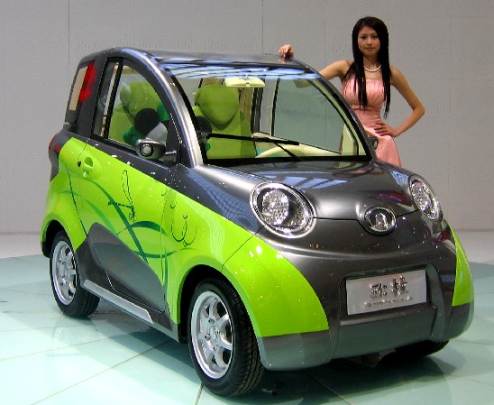
“$25k Chinese electric car for 2011
TOBY HAGON

Volkswagen acaba de dar a conocer nueva información sobre una de las versiones de bajo consumo más esperadas, el Golf BlueMotion. Además, desde hoy mismo se pueden realizar pedidos para asegurarte que el día de su lanzamiento tendrás tu unidad reservada.

Como bien decimos, el Volkswagen Golf BlueMotion es una versión de bajo consumo y prueba de ello son sus cifras, 3,8 litros por cada 100 km recorridos. Por otra parte, sus emisiones de CO2 son de 99 g/km.
Gracias a su motor su velocidad máxima está situada en los 195 km/h y puede acelerar de 0 a 100 km/h en 11,3 segundos. Para conseguir esas cifras de consumo, cuenta con el sistema de parada y arranque de motor para cuando el vehículo se detiene por ejemplo en un semáforo o en un atasco.
En el interior, son pocos los cambios con respecto al resto de la gama, lo más destacable es el tapizado de los asientos de tela y el borde cromado de los mandos de ajuste de los retrovisores. Su precio estará situado sobre los 21.000€.
Related posts:

Dear Energy Professional, Dear Power Plant Designer,
Thermal Power plant design software company offers a variety of training programs to suit your needs. Course content, schedules and registration forms are available on the linked pages. Scheduled week-long sessions covering all programs. Sessions are held at various locations around the world during the course of the year. Content designed to give attendees the necessary understanding to effectively use Thermoflow software in business activities. This course has been given over 150 times to more than 1000 attendees since the early 1990’s.
For more detailed information and registration please visit the web site at “Training Standard Schedule”
For demo CD and catalogue, please visit the FreeTrialRequest link.
Free trial package comes with working versions of all of our software with restrictions on only a few of the thousands of program inputs. If after reviewing the free trial, you want to analyze the software in even more detail, contact Thermoflow for a provisional trial license of the fully functional software suite. We have one trial CD and it includes all of our programs. You only need to submit one copy of this form, regardless of which program(s) you want to try.
In-house training and tailor-made courses can also be arranged at your company location, please ask for more information.
Best Regards
—
Haluk Direskeneli

Although 11 workers are still missing from the oil rig explosion off the coast of Louisiana, 115 others were saved because they were able to make it safely to special lifeboats. We’re live today at Anderson/Ryan, a company in Houston that makes lifeboats. Anderson/Ryan is not the company who supplied the lifeboats that were on the rig that had the explosion, but they have similar models. We were able to look inside several lifeboats, including one that can carry up to 65 people. The boats all have the same specs mandated by the government- they’re made of fire retardant material, have diesel engines that can go about 6 knots (about 7 miles an hour) and contain special sprinkler systems. They’re also self-righting. That means if a huge wave flips the craft over, it will come right back to where it needs to be.
You can see how all these things would be critically important by imagining how harrowing it would be moments after an explosion. Survivors of this week’s explosion said they had just 5-10 minutes to evacuate the rig. Rigs come equipped with enough lifeboats to evacuate the entire crew on both sides of the vessel. That’s so if the giant rig lists to one side or the other, everyone will still find a spot in a lifeboat. The lifeboats look like small orange submarines. Once everyone’s inside safely, the hatches are closed and a helmsman will lower the craft on two cables all the way down to the sea. That trip can be about 120 feet down. Imagine that with flames coming off the rig.
Once safely in the water, the lifeboats all meet at a predetermined spot. They have food for more than a week, plus diesel fuel to run for about 24 hours. They also have radio equipment and emergency beacons. Survivors of this week’s explosion say practice is what helped them get off the boat alive. Generally crews do a full run through of their evacuation, including lowering the lifeboats into the water (if conditions are right), about once a week.

The operation took 22 hours and 30 doctors, but the world’s first full facial transplant has been deemed “a success.” More »
Americans are still feeling pretty down about their financial situation, but their sentiment is improving, according to a new Gallup poll. The survey found that 41% describe their personal financial situation as excellent or good — the lowest Gallup has measured in the past decade. But separately, the pollster also found increasing optimism.
Here’s a chart Gallup provides to show that latter trend:

As you can see, optimism and pessimism have met for the first time since late 2007 — just before the start of the recession. This is an indication that the recovery has likely begun in the minds of consumers. Yet, the previous statistic — that showing Americans’ comfort with their financial situation at a decade low — indicates a strong recovery might be unlikely. Optimism is helpful, but can be choked by troubled personal finances. If consumers don’t have money to spend, then all the positive sentiment in the world won’t do much to revitalize the economy.
Gallup also grouped the results by income level:

Those top two rows are completely unsurprising. If you make more money, you feel better about your finances.
But the bottom two rows are interesting. They show more middle- and upper-class Americans feel their situations are getting better than those who believe things are getting worse. Respondents with lower incomes, however, have a much different view. There, only a tiny 30% see reason for optimism, while nearly 50% are pessimistic. These statistics lead to the troubling conclusion that the recession has been much harder on poorer Americans, and they anticipate that their suffering will be prolonged.
Fascinatingly enough, perception must affect sentiment nearly as much as reality. Another grouping shows the poll results by political party:

While Democrats and Republicans have pretty similar feelings of how their finances are doing, they vary greatly their views of where the economy is headed. Democrats — who have their President in office and strong majorities in both houses of Congress — overwhelmingly think things are getting better versus getting worse. For Republicans, the result is flipped. But Independents appear to agree with Republicans, which probably isn’t good news for Democrats in midterm elections this November. If they believe Washington isn’t improving their financial situations, they’ll be less likely to vote for the majority’s candidates.
A separate poll from Rasmussen, also released yesterday, implies that Americans are pretty cynical when it comes to how much positive change politicians can bring to the economy anyway, however. Just 32% of respondents were at least somewhat confident that policymakers know what they’re doing when addressing the current economic problems on Wall Street. That’s down from 36% a year ago.


Britney Spears’ overbearing father has banned the pop star from leaving her Los Angeles home without a bra, The Sun claimed in a report on Friday.

Former chef Jamie Spears – who has legal control over all Spears’ affairs – fears his troubled daughter is getting close to the brink again and has imposed a host of new rules on the “Womanizer” singer to help keep her in line. First order of business: “Put a bra on.”
Papa Spears is none to pleased about recent photographs of Britney — which almost always seem to feature guest appearances by her nipples — that have popped up on the blogosphere as of late. Jamie, 57, has allegedly threatened to fire one of the 28-year-old’s security guards who has let her be photographed bra-less several times in recent weeks.
“Jamie’s control over Britney’s life is incredible,” a chatty pal blabbed to the English rag. “He hates the pictures of her with her nipples all over the place so he has banned her from leaving the house without a bra. He wants her to put across the right impression.”