Blog

  • Racing Champions: Petrolicious

    Nissan GT-R

    Athletes and high performance automobiles go together like peanut butter and jelly. That’s why it should come as no surprise that professional downhill skateboarder Kevin Reimer drives a modified 1991 Nissan Skyline GT-R. Reimer tells us that he was drawn to the GT-R because it possesses the same key elements that he utilizes in downhill boarding; grip and control. Click through and check it out!

    Source: Petrolicious.com

  • Google will track I/O attendees’ every move

    Google Tracking
    Google’s annual Google I/O developer conference kicks off on Wednesday and Google is planning an interesting, and perhaps scary, experiment. During the conference, attendees’ every move will be tracked by a network of sensors wired throughout the Moscone center in San Francisco. The sensors will also track temperature, humidity, air quality and noise levels in an effort to build visualizations of the activity within Moscone during Google I/O. Data will be analyzed and visualizations will be displayed on screens all around the conference, and then all data collected will be open sourced and made available to all after the event is over.

  • “Food Porn” Busts ID Thieves At Steakhouse

    “Food porn” is rampant these days, especially on photo-sharing site Instagram; you’ve got an awesome meal in front of you, but what’s the point in eating it if you can’t share how awesome it is with everyone you know? At least, that’s the mindset of some. For two people in Florida, it was the thing that placed them in a certain steakhouse at a certain time, and connected them to a huge identity theft ring.

    Nathaniel Troy Maye and Tiwanna Tenise were so proud of their steak and mac-and-cheese dinner, they snapped a pic of it and posted it on Instagram. Because it placed them at Morton’s steakhouse during a big identity swipe affecting more than 50 people, they were placed under arrest.

    The couple had been followed by the feds for a while after a tipster told them that someone calling himself Troy had bragged about lifting thousands of identities.

    food porn busts

  • Samsung Galaxy Note III to ship with a 6-inch, non-flexible glass OLED display

    Samsung_Galaxy_Note_III_Leaked_Image

    While a handful of rumors regarding the hotly anticipated Samsung Galaxy Note III have been floating around the internet, the most speculation has been given to the device’s screen. Early rumors predicted that we’d see Samsung’s first flexible display, but with delays getting those to market it looks like that will not be the case. A report by an investment firm in South Korea says that the display on the Note III will be a 6-inch, non-flexible AMOLED screen, debunking other rumors that Samsung may introduce the world’s first plastic OLED display.

    In the report it is speculated that Samsung is not ready to mass produce flexible OLED displays and are currently only capable of manufacturing 24,000 screens a month. LG, who had also hinted at a flexible device by year’s end, is reportedly also having problems mass-producing their flexible display. 

    Aside from the display, the Note III is rumored to have an Exynos Octa-core processor clocked at 2GHz for the A15 processor and 1.7GHz  for the A7 processor, 3 GB of RAM, and runs Android 4.2.2. It is likely to be revealed at IFA 2013 in Berlin with a possible launch in the third quarter of this year.

    Source: OLED-Display
    Via: Phone Arena

    Come comment on this article: Samsung Galaxy Note III to ship with a 6-inch, non-flexible glass OLED display

  • Samsung Galaxy S 4 Mini specs leak, will feature high-powered Exynos 5210 chip

    Samsung_Galaxy_S_4_Mini_Specs

    Yesterday we showed you some leaked pictures of the Samsung Galaxy S 4 Mini, due for release at some point this month. We now have some more information on the device, as we now know that it will be run by the Exynos 5210 chip. This chip is a big.LITTLE architecture that combines the power-efficient Cortex A7 with the performance-driven Cortex A15.

    The leaked spreadsheet shows this information, which has been confirmed by Samsung, as well as some other specs about the phone that we already knew about. The phone should come with a 4.3-inch qHD display, and RAM will most likely depend on the market— 4G markets will most likely get 2GB, while 3G markets will most likely get 1GB.

    Some surprising information included on the spreadsheet is that it will launch with 32GB of internal storage— perhaps this is Samsung’s apology for the internal storage debacle with the Galaxy S 4. The spreadsheet also mentions that the Galaxy S 4 Mini will ship with Android 4.0 ICS on board, which is a bit confusing, considering the Galaxy S 4 is set to ship with 4.2. It could be a typo, but we’ll just have to wait and see.

    Source: Mobile Geeks

    Come comment on this article: Samsung Galaxy S 4 Mini specs leak, will feature high-powered Exynos 5210 chip

  • Bing To Add Klingon Language To Translator To Market ‘Star Trek Into Darkness’

    Bing is reportedly adding the Klingon language to Bing Translator as part of a marketing deal between Microsoft and Paramount, as the studio prepares to release Star Trek Into Darkness.

    While we’ve been unable to bring up the language in Bing Translator so far, The LA Times (via Engadget) reports that it is coming today:

    The Bing service will translate text written in any one of 41 supported languages — including English, French, Hebrew and Urdu — into Klingon. Fear not, native Klingon speakers: words or phrases written in that language can be translated into the more than three dozen available tongues.

    According to the report, Microsoft engineer helped develop the feature, has he apparently speaks Klingon. The LA Times shares a quote from Bing’s Craig Beilinson: “We have people who understand the deep science of linguistics and we also have people who are passionate about the ‘Star Trek’ franchise. This was a labor of love from a lot of different avenues.”

    This isn’t the first time we’ve seen the Klingon Language utilized by a major search engine. You can still see the Google Klingon homepage here.

    Star Trek Into Darkness releases in the U.S. on May 17th.

    Image: StarTrek.com

  • Nook Comics Comes To Nook For iOS

    Last week, internal documents revealed that Microsoft had offered to buy Nook Media from Barnes & Noble for $1 billion. Those same documents also revealed that Nook Media would start to focus more on its software app on other platforms instead of its own hardware. The first step to improving its apps may have come today with the latest update for iOS.

    Barnes & Noble announced a newly updated Nook app for iOS that allows customers to purchase and read comics on their iOS device. It’s a nice alternative for iOS device owners who may have found Comixology or the dedicated Marvel app lacking in options. The wide selection of graphic novels is also a nice bonus.

    Alongside the addition of comics, the new Nook for iOS app adds the “Zoom View” feature that allows readers to “focus in on individual panels in graphic novels and comics.” Anybody who has tried to read a comic on a tablet or smartphone before knows how painful it can be sometimes so the addition of this feature is welcome.

    Here are the other new features now available on Nook for iOS:

  • Animated page turns for Nook Books.
  • Ability to enlarge book illustrations for detailed imagery.
  • Improved organization for Nook Newsstand periodicals in customers’ libraries.
  • Updated improvements to PagePerfect/PDF titles for easier viewing.
  • “With our free, updated Nook for iOS application, we’re delivering to customers with iPad, iPhone and iPod Touch a great optimized reading experience, now with access to Nook Comics, one of the leading collections of digital comics and graphic novels available,” said Jamie Iannone, President of Digital Products at Nook Media LLC. “Using their iOS device, customers can enjoy Nook’s collection of more than 3 million digital books, magazines and newspapers, as well comics and graphic novels with the stunning Zoom View feature.”

    To celebrate the comic-centric update, Nook will be giving away a free Superman sampler to all those who upgrade their iOS app. The sampler includes excerpts from Superman: Last Son of Krypton, Superman: For Tomorrow, Superman: Earth One, and Justice League Volume 1: Origin. It’s no Free Comic Book Day, but it’s still a nice gesture.

    You can grab the newly updated Nook for iOS app here.

  • Joyce Brothers Dies: Psychologist Was 85

    Joyce Brothers, who became famous in the ’50s for her rise to stardom via a call-in radio program, has died of respiratory failure. She was 85 years old.

    Brothers was a wife and stay-at-home mom in the mid-1950′s and believed that being home with her child was the best way to parent. However, the hard reality soon set in that her husband, who was a fresh med-school graduate, couldn’t support them on his residency income. On a whim, Brothers decided to try her luck as a quiz show contestant. After memorizing 20 volumes of an encyclopedia set, she made her way onto “$64,000 Challenge” and stunned everyone when she became the first female to win the big cash prize.

    She found herself mixed up in a scandal, though, when the show’s producers were accused of giving the answers away to particular contestants. Brothers denied being involved in any cheating and was eventually cleared of any wrongdoing. But the scandal may have been the very thing to open doors for her; she was eventually offered a job as a sports interviewer, which led to appearances on talk shows, and in 1958 landed a job with an NBC show giving out advice to women on topics such as menopause and sex. She would go on to become one of the most highly sought-after psychologists of the day after hosting on a call-in radio show which dispensed a form of therapy to those in need.

    Although her methods were criticized, Brothers insisted she was just doling out common sense.

    “I don’t give advice. I just tell people, ‘This is what we know.’ ” she once said.

    Brothers had her own advice column for over forty years in Good Housekeeping and kept up her celebrity through the ’80s and ’90s by appearing on sitcoms and talk shows. She was also the author of several books, including “Ten Days To A Successful Memory” (1964), “Positive Plus: The Practical Plan for Liking Yourself Better” (1995) and “Widowed” (1992).

  • Quarterback Stabbing Arrest Made in Delaware

    This weekend, a quarterback for the University of Delaware was stabbed. Police say that Trevor Sasek was stabbed three times in the chest and abdomen early on Sunday morning.

    Now, police have made an arrest in the case.

    25-year-old Michael J. Creed (mugshot seen above) has been charged with 1st degree assault and possession of a deadly weapon during the commission of a felony. Surveillance video of the parking lot where Sasek was stabbed helped to identify Creed and the car he was using. Police say that Creed yelled at Sasek and others before leaning into a car and back out again. He then walked up to Sasek, grabbed his shoulder, and was seen “punching” toward Sasek. Creed then ran away as Sasek realizes he had been stabbed.

    After the stabbing, Sasek was taken to a local hospital where he underwent surgery. He is currently in stable condition.

  • NVIDIA’s $349 Handheld Shield Gaming System Will Ship In June, Pre-Orders Start Today

    shield

    Remember NVIDIA’s kooky Project SHIELD tablet? The one it unveiled to an unsuspecting public at back CES? Well, it’s officially not just a “project” anymore — it’s a full-fledged product, and NVIDIA is aiming to get the SHIELD out the door this June complete with a $349 price tag.

    To help manage demand for the curious gaming portable, NVIDIA is also preparing to take pre-orders. If you’ve been eagerly devouring what Shield details you could and have subscribed to the Shield newsletter, you’ll be able to lock down your unit starting today — the rest will have to wait until next Monday to get their pre-orders in.

    To help manage demand for the curious gaming portable, NVIDIA is also preparing to take pre-orders. If you’ve been eagerly devouring what Shield details you could and have subscribed to the Shield newsletter, you’ll be able to lock down your unit starting today — the rest will have to wait until next Monday to get their pre-orders in.

    In case you haven’t been keeping tabs on what the Shield has to offer, here’s a quick rundown on what to expect. The thing runs Android Jelly Bean MR1, and manages to cram NVIDIA’s speedy new Tegra 4 chipset, 2GB of RAM, a 5-inch multi-touch display running at 720p, 16GB of internal storage, and a microSD storage slot into a controller body that’s awfully reminiscent of the venerable Xbox 360 controller. Throw in the ability to stream certain PC games from a computer and you’ve got yourself a neat little gizmo.

    The Shield is an ambitious little gadget, and the ability for players to stream PC games to the thing is sure to win it some fans, but is this thing really going to sell? Let’s just consider the price tag for a moment: selling the Shield at $349 means it’s more expensive than buying an XBox 360 or a PlayStation 3. Granted, those consoles will soon be superseded by a new batch of hardware from Microsoft and Sony, but I suspect people would still rather get one of those more traditional consoles than an ambitious niche device like the Shield.

    That’s to say nothing of the fact that the Shield is a device meant for on-the-go gaming. These past few months have seen both Nintendo and Sony slash the prices of their respective handheld gaming consoles in an effort to life sales, maneuvers that seem to have succeeded for now. The market may not be ready for a $349 handheld, but that hasn’t stopped NVIDIA from trying — now we’ll just have to wait and see what happens.

  • The Great Netflix Doom-Avoidance Machine

    Reed Hastings has emerged from hiding. Well, maybe not hiding — he was still posting on Facebook and talking to the occasional magazine writer. But by his previous standards, the Netflix co-founder and CEO had been laying uncharacteristically low in the almost two years since the Great Qwikster Fiasco. It took a clear recovery from the company’s missteps, as evidenced by a blowout earnings report last month, to convince the Netflix PR team (and/or Hastings himself) that it was time to unleash him.

    First came a manifesto penned by Hastings that describes the competitive landscape in which Netflix finds itself and why Hastings thinks his company has what it takes to survive. Then Hastings talked to James B. Stewart at The New York Times about what he’d learned from his abortive effort to jettison Netflix’s DVD-rental business (lesson no. 1: don’t do things that “hurt people’s real love for Netflix”). And now, in the latest Bloomberg Businessweek, Ashlee Vance offers a fascinating cover-story look at how Netflix and Hastings work (complete with a visit to the glass cube atop Netflix’s HQ where Hastings goes for quiet time).

    Hastings’ return to the spotlight is excellent news for anyone interested in business. He is quite entertaining, as CEOs go. And more important, his company keeps posing such fascinating questions. Such as, how does it keep making money?

    Netflix competes in an industry where control of distribution channels was long key to success. If you owned the pipes, as it were, you owned the customers. Netflix piggybacks on distribution networks built by others. For DVD delivery, that distribution network is at least a neutral carrier: the U.S. Postal Service. For streaming, though, Netflix relies on internet service providers such as Comcast and AT&T, data centers owned by Amazon, and tablets and digital media receivers made by Apple (and Microsoft, and Samsung, and others) to get its movies and TV shows to customers. All these companies are much bigger than Netflix and are all direct or near-direct competitors. Yet it survives and, seemingly, thrives among them. According to BusinessWeek, Netflix now accounts for about a third of all downstream Internet traffic in North America on an average weeknight. It is becoming the mistletoe of the media business — a parasite (sort of) that is more prominent and beloved than its hosts.

    It’s fair to say that this continuing success has surprised a lot of people. Search on the phrase “Netflix doomed,” and you come across a bounty of dire predictions. Part of this must be psychological. While writing this post, I have repeatedly caught myself typing “Netscape” — an association that does Netflix no favors. But there have also been real reasons to be skeptical.

    In the DVD-rental business, Netflix faced content costs that weren’t appreciably different from those of bigger archrival Blockbuster, and had a much lower-cost delivery system. As venture capitalist Bill Gurley explained a couple of years ago, a 1908 Supreme Court ruling made it impossible to stop Netflix from buying and renting out any DVDs it wanted. So Netflix could exploit its advantages — a subscription-based business model, a huge catalog of titles, an ever-improving recommendation engine, and a super-efficient system for getting DVDs to your local post office — without having to fear that its reservoir of content would dry up.

    In streaming, Netflix has to cut deals with content owners for movies and TV shows, and as it has grown it has had to pay ever more. Last year, Netflix reported spending $30 million on DVDs — and $2.8 billion on streaming content. And it’s constantly losing content as licensing deals expire — forcing it to sign new deals at higher prices, and pay to develop its own shows.

    As a result, Netflix’s margins are much lower in the streaming business (21% in the most recent quarter) than in the DVD business (46%). But streaming is the future, DVDs are a declining business, and the last quarter was the first in which Netflix made more profit domestically from streaming than from DVDs.

    So how does Netflix stay profitable in streaming? One answer — probably the most important answer — is that it’s really good at software engineering. Hastings is a veteran software engineer, and Netflix pays its engineers more than the competition and sets them loose to solve interesting problems. Delivering its programming via tens of thousands of Amazon Web Services data centers and getting it to work seamlessly on myriad gaming consoles, tablets, smartphones, and other devices takes tons of code and some really smart design. “We’re using Amazon more efficiently than the retail arm of Amazon is,” Netflix’s cloud architect told Businessweek‘s Vance.

    Engineering is also key to figuring out what customers will like. Netflix’s recommendation engine has become a huge asset, driving 75% of viewing. Data on customer viewing habits is also increasingly driving Netflix’s decisions on which content to acquire and how much to pay for it.

    Netflix’s calculation is that if it can continue using its engineering prowess to keep its customers happy, and help it acquire new ones, its frenemies in the content and delivery business will decide that they can make much more money working with it than trying to thwart it. It’s also betting that once it has established itself as one of the big players in streaming, it won’t go away anytime soon. “Once a subscription video service has achieved profitability and scale in a market (20% to 30% of households),” Hastings writes in his “Long-Term View” manifesto, “it is very likely to be able to sustain that profit stream for many decades. At that percentage of households, our advantages in content acquisition and member acquisition are considerable.”

    This still feels a lot more tenuous than the competitive positions held by broadcast networks for decades, and the cable networks now. Quitting Netflix is easy; its subscriber churn rate is an estimated 40% to 50% a year. Holding on to customers will require continual upgrades in technology and content (not to mention avoiding Qwikster-like missteps).

    But upgrades are what software engineers do. Netflix has figured out how to succeed, for now at least, in a world where it doesn’t own the pipes and can never afford to stop improving. A lot of its would-be competitors really don’t.

  • Outlook.com now lets you chat with friends ‘stuck using Gmail’

    After nearly two months of using Microsoft’s services almost exclusively, I made the painful decision to switch back to Google for most of my web needs. I say “most” because I’m still using, and enjoying, Outlook.com.

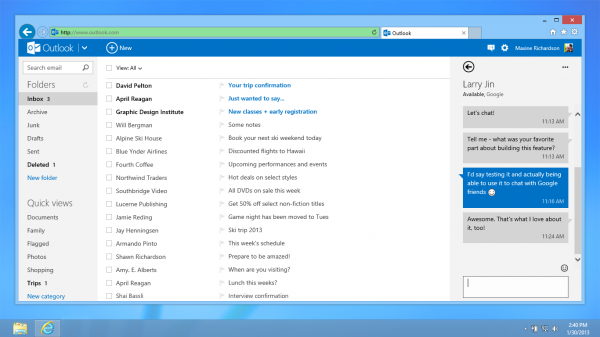
    My decision to stick with Microsoft’s webmail service seems well founded, as the company is adding more features all the time. It introduced Skype support two weeks ago, and from today is rolling out the ability to directly message your Gmail-using contacts. Or “friends stuck on Gmail” as Microsoft amusingly phrases it.

    When you receive an email from someone with a Gmail address, you’ll soon be able to reply by starting a chat. You’ll also be able to initiate a conversation through the contact list. The new addition is not exclusive to Outlook.com either. You’ll also be able to IM your Google contacts directly through SkyDrive — handy when collaborating on an Office document for example.

    Douglas Pearce, Group Program Manager, Connected Services at Microsoft says Google chat integration will be available to everyone worldwide in the next few days but warns that while it’s rolling out, you “might notice a few quirks if you’re jumping around between SkyDrive and Outlook.com, but that will be resolved as soon as the rollout is complete”.

    The service will likely appear first in SkyDrive and then your inbox and People page shortly afterwards.

    Photo credit: A1Stock/Shutterstock

  • NEC Launches SDN Application Center

    NEC Corporation of America announced the SDN Application Center, which includes software-defined networking solutions built upon customers’ top-of-mind network concerns. NEC will provide APIs to help organizations proactively and automatically manage, secure and optimize their networks through their SDN solutions.

    “Our new SDN Application Center will give our customers more choice on network visibility, security, load balancing and wide area networks (WAN) optimization,” said Don Clark, director of Business Development, IT Platform Technologies, NEC Corp. “Coupled with our previously announced comprehensive multi-vendor infrastructure support, NEC’s solutions offer both northbound and southbound APIs to cover the SDN architecture.”

    Vendors that are part of NEC’s SDN Application Center include Real Status (Management Applications); vArmour (Security Applications); A10 Networks and Silver Peak (Optimization Applications); and Red Hat (Cloud Orchestration Applications). The NEC ProgrammableFlow Networking suite is an OpenFlow-based technology that centralizes control of the network, monitors network traffic and redistributes accordingly, and can scale to manage everything from a single rack, or the entire data center. It includes both physical and virtual switches as well as an SDN controller and applications.

    “NEC’s ProgrammableFlow Network Suite allows cloud service providers to rapidly deploy new services for their customers while containing their operational cost and optimizing their cloud infrastructure resources,” said Craig Rowland, Chief Operating Officer at Real Status. “To define relevant optimization rules for their cloud, not only do they need a strong business understanding of their cost and revenues structure, but also complete visibility and permanent monitoring of what is used by whom and when in their cloud infrastructure. Coupling the automation offered by NEC software-defined networks with Real Status’ modeling and visualization solution, Hyperglance, gives cloud providers a significant competitive advantage and a solid foundation to rapidly grow their business.”

  • Sponsored post: Apple devices become business communications tools with ShoreTel Dock

    Apple has an ingenious knack for providing its customers with mobile devices they love. For its first fiscal quarter of 2013, the company announced iPhone sales of 47.8 million, up from 37 million in the year-ago quarter, and iPad sales of 22.9 million, compared to 15.4 million in the same quarter last year.

    Mobile devices from Apple, and from other manufacturers, are fast replacing PCs in the enterprise, as workers fuel the BYOD (bring-your-own device) phenomenon. “Smartphones and tablets will be the two most widely used devices for UC in 2013, passing traditional computers and desk phones,” Infonetics Research said in a recent report.

    It’s clear that workers want to use their favorite mobile devices in the workplace and they are asking IT managers to help them integrate them.

    Responding to this trend, ShoreTel has released a new solution, ShoreTel Dock, to turn Apple iPads and iPhones into desk phones, integrating the convenience of mobile devices with the power of a business communications system. The industry’s first business-grade device, ShoreTel Dock transforms iPhones and iPads into unified communications end points, so that workers can use their Apple handheld devices as their primary business communications tools.

    “ShoreTel Mobility is a game changer for companies with leaders who see effective communications as a competitive advantage and who are trying to win by leveraging the power of unified communications. The ShoreTel Dock is a natural extension providing the conveniences of a desk phone for iPhones and iPads,” said Kevin Gavin, ShoreTel’s chief marketing officer.

    http://jobs.gigaom.com/job/sales-manager-director-tri-state-bay-area-gigaom-ea871bffeb/?d=1&source=linkedin_share


  • BlackBerry Live 2013 Tuesday Morning Brief: What You Won’t Want to Miss Today [VIDEO]

    Each morning this week we’ll be providing a morning brief to keep you up to date on what you won’t want to miss at this year’s BlackBerry Live 2013 conference in Orlando. We’re committed to keeping a pulse on the event with videos, closer looks, inside perspectives, and breaking news. Check out the video below for the full scoop on today’s packed agenda, which includes the General Session keynote this morning and the BlackBerry Jam Americas keynote this afternoon:

    [ YouTube link for mobile viewing ]

    What are you most looking forward to today? Share in the comments below.

  • Gartner: Samsung crushed competitors in Q1, sold 64.7 million smartphones

    Samsung Smartphone Sales Q1 2013
    As we’ve mentioned before, Samsung is a force to be feared in the smartphone industry. The latest numbers from Gartner show that Samsung absolutely mowed down the competition in the first quarter of 2013 by selling 64.7 million smartphones, good for a 30.8% share of the global smartphone market and a 59% increase from the 40.6 million smartphones it sold in the first quarter of 2012. These numbers are particularly impressive because they came before Samsung launched its new flagship Galaxy S4 smartphone, so it’s likely that the company will further expand its lead over its rivals in the second quarter.

    Continue reading…

  • Cloudant snares $12M from Rackspace and others to build awareness for its cloudy database

    Cloudant which has been spreading its database layer across multiple clouds, just closed $12 million in Series B funding from investors including Fidelity-backed Devonshire Investors, Rackspace Hosting, and Toba Capital.

    Cloudant CEO Derek Schoettle

    Cloudant CEO Derek Schoettle

    The money will mostly flow to add staff and infrastructure partners.  ”First, we need to invest in operational expertise around the world — we’re building an office in San Francisco, we’re based in Boston, and now we have presence in the U.K. and will open one in Hong Kong probably in the next 120 days — we need to staff that,” Cloudant CEO Derek Schoettle said in an interview.

    Current staffing is at about 60 people, with plans to hit maybe 100 within the next year.

    Cloudant’s NoSQL database service runs on Rackspace, Softlayer, Joyent, Microsoft Azure, and Amazon cloud infrastructure so Rackspace’s stake could raise eyebrows although  Schoettle was quick to say that won’t make Rackspace the first among equals. “They see an advantage to partnering with us more closely than just reselling hardware to us. they’ll more tightly integrate our service with their infrastructure offerings,” he said.

    This is a case of the coopetition fever that’s gripping cloud companies. I. Another example is Dell and Intel took a stake in Mirantis, self-proclaimed vendor agnostic OpenStack integrator.

    While Rackspace now owns a piece of Cloudant, it also fields several database services. In February, for example, it bought a seat at the MongoDB table with its acquisition of ObjectRocket.

    Last month, Xeround, another database service provider, pulled the plug in a move that causes some to question whether there’s enough business for umpteen different players. Schoettle said Xeround’s woes were company specific. “Xeround had two issues. First, MySQL is not ideal for next-gen mobile web apps and that’s where the lion’s share of opportunity is. Second, it’s tough to start in 2005 with $30 million and then change course a number of times.”

    Cloudant has raised a total of about $16 million to date. Earlier investors including Avalon Ventures, In-Q-tel, and Samsung Venture Investment also participated in this round. How companies are adopting cloud services — including databases — will be on the agenda at next month’s Structure event in San Francisco.

    Related research and analysis from GigaOM Pro:
    Subscriber content. Sign up for a free trial.


  • Unlocking Phones Could Be Re-Legalized

    829_3919396

    If you bought a locked cell phone after January 26th, you cannot unlock it by your own means. While the Digital Millennium Copyright Act didn’t change, the Library of Congress clarified a provision in it. The effect: only your carrier can unlock your phone. The LoC rule essentially says that since alternatives to carrier-locked phones exist on the marketplace, consumers shouldn’t have the ability to unlock carrier-locked phones. It really sounds like hogwash.

    If you think it seems odd that phone unlocking falls under a copyright act, you’re not alone. For the most part, users don’t unlock their phones with the intent to infringe on copyright. They’re unlocking them for the purpose of using the phones on other networks. It appears at least one member of Congress has taken up that point.

    Rep. Zoe Lofgren (D-CA) yesterday proposed the Unlocking Technology Act of 2013. While there are a few provisions in it, the main one involves amending the first paragraph of the DCMA to say:

    “It shall not be a violation of this section to circumvent a technological measure in connection with a work protected under this title if the purpose of such circumvention is to engage in a use that is not an infringement of copyright under this title.”

    It seems reasonable, but that means little when big telecom has such a powerful lobbying force in DC. Big carriers prefer that users purchase phones from them, not because the carriers make much money from new phone purchases (they don’t), but because new phone purchases lock customers into two-year contracts. Additionally, customers will tend to unlock phones from major carriers and bring them to smaller carriers, usually on a prepaid basis.

    There is no timeline on when the House will vote on this bill, but I honestly wouldn’t expect much. It’s a noble effort that could crumble under pressure from DC insiders.

    Via Phone Scoop.

    The post Unlocking Phones Could Be Re-Legalized appeared first on MobileMoo.

  • Xara Web Designer 9 Premium review

    Not everyone is a web-coding whizz, or wants to learn the intricacies of HTML, CSS, PHP or other web-based programming languages. Xara Web Designer 9 is aimed squarely at those who prefer to design websites using desktop publishing tools, where what you see on-screen is what you expect to see with the finished design. Over recent years, Web Designer has built into a powerful, user-friendly tool that — a few quirks aside — makes designing websites as simple as putting together magazines, newsletters or brochures.

    At first glance it looks beginner-friendly: pick a template, import your text and graphics, and build your site page-by-page at a time. But that does Web Designer a disservice, because if you delve deeper, you’ll find it has all the tools you need to design more complex sites that are attractive to look at, easy to navigate and bursting with support for all the latest technologies, from Flash-based animations to interactive widgets.

    First steps

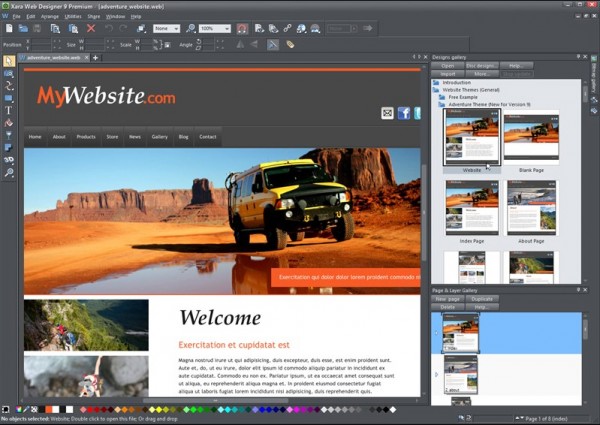
    Fire up Web Designer and you’re presented with the option of creating a page from scratch or using one of the design templates. While it’s tempting to opt for the latter, doing so creates a set of web pages based on the different page designs available within that template — up to 15 are provided with each template. A better option is to create a new, blank site, open the Designs Gallery, pick a template and then drag in individual pages to get started with.

    There are dozens of templates provided — over 20 have been added to version 9 — covering general, and web-presentation themes, all of which can be customized to your own tastes should — for example — you like the design, but detest the color scheme. You’ll also find a new Business-specific templates section, but sadly these don’t come free, costing $15 a pop, although by upgrading to Web Designer 9 Premium you’re given a voucher that lets you download one for free.

    From here, everything is drag and drop and anyone with experience with desktop publishing packages will soon discover just how powerful and versatile the tool is. You can simply replace existing page elements with your own text and graphics, or start crafting pages to your own more demanding specifications.

    It’s when you venture beyond the basics of taking a template and populating it with your own content that you start to appreciate just how clever Web Designer is. Drop in page elements from the various galleries (Web Designer is smart enough to match these to the overall design of the site — if you want it too, of course), then fine-tune them without ever having to type in any HTML or CSS code. This really is a designer’s web-building tool.

    And you’re not restricted to basic building blocks, either. Web Designer makes it easy to add all kinds of whizz-bang-pop elements like YouTube video, PayPal options and social-networking buttons to your site. There are tools for fine-tuning any images you import, plus all manner of shapes, shadows and other clever effects that can be applied to your pages, and all with just a few clicks of the mouse.

    Frustrations

    Web Designer is so good — on the whole — at making page design so straightforward that when it fails to support seemingly logical behavior, the frustration is acute. Why can’t you resize a photo within a frame, for example, or alternatively crop a photo and then apply a simple photo frame border to the cropped image?

    Then there are your attempts to duplicate existing objects in order to extend a page with new content using the existing layout. However we tried duplicating those objects — copy and paste, clone or duplicate, the end result was the same: an exact replica of the original objects, content and all. Change the images or text in one object, and the duplicate’s content changed to match. That’s fine for generating content that repeats over several pages, but where’s the simple option to just duplicate the basic frame, allowing you to change its content independently of the original? Alternatively, how about letting you create your own custom widgets and page elements for dragging and dropping into place?

    And that leads on to another issue: Xara Web Designer is very much a tool for building page-by-page websites, where the content on each page is individually put together. These days, more and more people are discovering the benefits of using Content Management Systems to separate design and content — if only Xara had such capabilities built-in, it would become irresistible. As it is, sadly, its appeal is limited to those whose demands don’t involve populating lots of similar content across a basic set of design templates.

    What’s new?

    If you’re a happy Web Designer MX 8 user, you may be wondering if upgrading is worth your time and money: the simple answer is yes, particularly if your PC has more than 4GB RAM and is running a 64-bit version of Windows. Xara Web Designer 9 Premium is the first build to ship with a dedicated 64-bit version that will take full advantage of any extra memory you can throw at it, helping boost performance.

    You’ll also want to upgrade if you’re looking to provide a site that looks gorgeous on Retina displays. Web Designer 9 automatically generates the high-resolution graphics required to make your sites shine on Apple’s high-res displays — helped immeasurably by its vastly improved compatibility with all the latest HTML5 standards. This ensures graphics load more quickly and scale better when required — your site even knows when to load Retina-friendly graphics and when to stick with the standard-resolution versions to boost page-loading times.
    Web Authoring improvements include direct support for Google Fonts — including a Google Font picker, which can be embedded in your site should the web standard options not appeal. A new “pull” option extends the automatic sizing of pages (and subsequent positioning of page elements) upwards as well as down, while we also love support for drag-and-drop navbar replacement.

    Creating web presentations is also more intuitive and quicker thanks to improvements that are overdue in hindsight: steps aren’t automatically deleted until the site is saved or exported, the current step is shown in the presentation bar (all steps above it are now hidden by default) and adding a new step automatically makes it the current one. Still, better late than never.

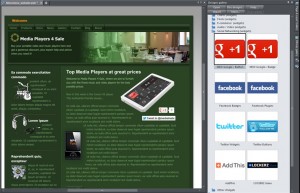
    Other new features include a new Google Analytics tab under the Web Properties screen, plus handy new widgets making it easy to embed Google Ads, Google+ buttons and basic tables into your site. Then there are minor — but notable improvements — the fly-out toolbar is less frustrating to navigate now it doesn’t disappear so readily, while JPEG and PNG images are handled just that little bit better too.

    There’s also compatibility with Windows 8 touch, but this will only benefit users with all-in-one PCs or multi-touch monitors as the version of Windows 8 (Windows RT) shipped with tablets can’t actually run any desktop applications, which includes Web Designer 9.

    Verdict

    It’s hard not to like Xara Web Designer 9 Premium. If you’re looking for a DTP-friendly approach to building page-driven websites then it’s got pretty much everything you need to design attractive, yet easy-to-navigate and quick-to-load websites. There are some niggles you may have to circumvent, and the lack of CMS-friendly tools will make it an impractical solution for more content-driven sites, but if your needs match its capabilities then this latest build is well worth taking for a spin.

  • Meet Lumia 925 Windows Phone

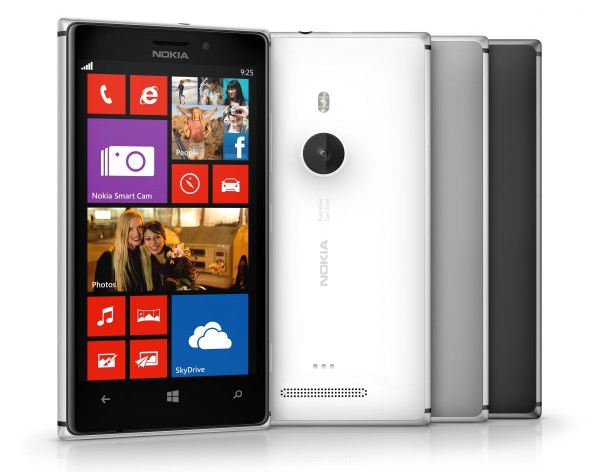
    On Tuesday, at an event held in London, Nokia announced the new Lumia 925 Windows Phone. The handset shares most of its specifications with the Verizon-exclusive Lumia 928, unveiled four days ago, and represents a slight evolution from the currently available Lumia 920.

    Available color choices for the Lumia 925 include black, gray and white. The handset sports a “metal design”, similar to its Verizon-exclusive sibling. A silver-colored frame, which works as an antenna, surrounds the edges of the device, while on the back a polycarbonate (plastic) cover, in either glossy or matte finish, is used. Nokia calls the design “stunning”, although from my point of view the Lumia 920 looks better.

    The Lumia 925 features a 4.5-inch AMOLED display with a resolution of 768 by 1280 and 334 ppi (pixels per inch) density, PureMotion HD+ and ClearBlack technology. The screen can be operated using gloves, similar to other Lumia devices. Power comes from a 1.5 GHz dual-core Qualcomm Snapdragon S4 processor, 1 GB of RAM and a 2,000 mAh battery. So far the specifications are on par with other Windows Phones like the Lumia 920 and Lumia 928.

    On the back here is an 8.7 MP camera, capable of 1080p video recording, with autofocus, dual LED flash, PureView technology and Carl Zeiss lens. On the front, the Lumia 925 sports a 1.2 MP “wide angle” camera that can shoot 720p video. During the London event, the Finnish maker emphasized that the smartphone will be able to take great shots in low-light and well-lit scenarios.

    The smartphone comes with 16 GB of non-expandable internal storage. There is also a 32 GB version, available exclusively at Vodafone. By contrast the Lumia 920 and the Lumia 928 both ship with the larger storage capacity storage out-of-the-box.

    With the Lumia 928, Nokia has addressed the size concerns constantly pointed out by many Lumia 920 reviewers. The former comes in at 129 x 70.6 x 8.5 mm and weighs 139 grams. By contrast the latter is taller, wider, thicker and heavier at 130.3 x 70.8 x 10.7 and 185 grams.

    Sadly, the Lumia 925 loses the wireless charging feature, which the Lumia 920 offers. The functionality is available, however only through the optional back covers which are sold separately, in black, red, yellow and white color trims. It seems that the lower footprint comes at a price.

    Other specifications include 4G LTE and HSPA+ cellular connectivity; Wi-Fi 802.11 a/b/g/n; NFC (Near Field Communication); USB 2.0; Bluetooth 3.0; GPS with Glonass support and the now-customary array of sensors including magnetometer and accelerometer. Nokia also lists an FM Radio as being available.

    In terms of software, on top of the currently available apps Nokia also offers the Smart Camera software which allows to shoot 10 photos and edit them afterwards using the Best Shot, Action Shot and Motion Focus features. The extra apps as well as the improved camera software will be available through a Nokia Lumia Amber firmware update, which arrives this Summer for the existing Lumia smartphone range.

    Nokia also announced that Oggl, an app made by Hipstamatic, is set to arrive on Lumia Windows Phones. It will allow folks to take pictures, add filters and share them to a number of social networks including Facebook, Flickr, Foursquare, Instagram, Tumblr and Twitter. Sadly, there is still no official Instagram app available on Windows Phone.

    The Lumia 925 is expected to be available starting next month in Italy, Germany, Spain and UK, from Vodafone and other mobile operators. The handset will also be offered by China Mobile and China Unicom in China and T-Mobile in the US. Other markets will follow, according to Nokia. Without any local taxes or carrier subsides, the Lumia 928 runs for EUR469.

    As a Lumia 920 owner, I am not overly keen on upgrading to the Lumia 925. Yes, it’s shorter, narrower, thinner and lighter, but the smartphone also sheds half its storage capacity and the wireless charging feature, both of which I thoroughly enjoy for obvious reasons.