Blog

  • Google Ramps Up Its Lobbying in Washington

    Google has been stepping up its lobbying game in Washington, according to documents filed with the Senate Office of Public Affairs, which tracks the behavior of lobbyists. A non-profit agency called Consumer Watchdog (formerly known as the Foundation for Taxpayer and Consumer Rights) noted the filing in a news release today, saying the company was relatively new to the “influence-peddling game” but that it is now “one of the highest rollers in Washington.” According to the group, Google boosted its spending in the first quarter by 57 percent over the previous year, to $1.3 million, and spent over $4 million in total on lobbying efforts last year.

    Google has been fighting a number of battles in Washington recently, including recent complaints to the FTC that Buzz, the social networking tool it launched in February, may have breached privacy laws. Google has also been struggling to overcome criticism of its proposed AdMob acquisition, which some believe could give the company too much market share in digital advertising. The Federal Trade Commission has been reviewing the $750 million acquisition deal for months.

    Related content from GigaOM Pro (sub req’d): Forget Twitter, the Real Firehose is Government

    Post and thumbnail photos courtesy of Flickr user Civil Rights

  • Aquent Announces its Latest New Product Offering – ReviewPad

    An inexpensive web-based solution to share designs and files, collect feedback, and manage approvals

    BOSTON, April 20 /CHICAGOPRESSRELEASE.COM/ — Aquent’s On Demand division has released ReviewPad, the latest addition to its suite of web-based tools for creative and marketing professionals.  ReviewPad (www.reviewpad.net) is a simple, easy-to-use online solution that allows its users to better manage the collaboration process, all the way from collecting feedback on design comps to managing feedback and the final signoff.  Like the other tools in the Aquent On Demand suite, RoboHead and MajorTom, ReviewPad is an affordable, easy-to-implement solution requiring no additional software.

    “When we launched our marketing project management solution RoboHead in 2004 and our digital asset management solution MajorTom in 2007, we knew that our work wasn’t done,” said Patrick Campbell, vice president of Aquent’s On Demand division.  ”ReviewPad helps those users that need a simpler, lower cost solution for managing their review and approval process.  In fact, we even offer a no-charge version of ReviewPad – not a 30 day free trial – it’s no charge forever.  Clients needing more storage and features can upgrade to a professional account for $9.95 per month with no commitment whatsoever.”

    Dan Perez, chief technical officer for Aquent On Demand said, “I’m probably most excited about some of the leading edge technologies we’ve been able to incorporate.  In addition to building the solution on a JavaScript foundation called Ext JS, which adheres to the latest web standards, we’re also running the application ‘in the cloud’ – meaning on the Amazon EC2 environment.  This gives us virtually unlimited scalability as well as redundancy.”

    About ReviewPad

    ReviewPad was designed for creative and marketing professionals who were looking for a simple, inexpensive way to share design comps and files, collect feedback, and manage the sign-off process.  Since ReviewPad is a 100% web-based solution that requires no software, participants can be a part of the process whenever and wherever they are on the internet.

    About RoboHead

    RoboHead is the industry-leading marketing project management tool that helps marketing and creative services organizations manage the full lifecycle of their projects, from intake through delivery.  This web-based solution not only tracks dates, deadlines, time, and resources, it also manages collaboration, approvals, notification, and finances.

    About MajorTom

    MajorTom is a web-based digital asset management solution that facilitates the storage, organization, and distribution of mission-critical brand assets.  In addition, these files can be tagged for quick retrieval, searched, viewed on-line, and securely distributed to recipients outside the organization.

    About Aquent

    For more than 20 years, Aquent has led the way in helping businesses master the ability to generate marketing and communications from within.  From its inception in 1986, this marketing services company has pioneered consulting, technology and staffing solutions that enable clients to build their internal marketing and communications capabilities.  Providing unmatched resources and expertise through its network of nearly 70 branches worldwide, Aquent today helps thousands of companies make the most of their people, processes and technology.  Aquent is headquartered in Boston, Mass.

    SOURCE Aquent

    http://aquent.us

    Distributed via Chicago Press Release Services


  • Ford’s Sync AppLink Will Debut In 2011’s Fiesta, With BlackBerry and Android Support [Ford]

    Hey now, BlackBerry users. Just because that Magnum hasn’t been found in a bar and leaked, doesn’t mean you can’t smile today. Though unless you aren’t in the market for a 2011 Ford Fiesta—you can resume frowning. More »


  • Has the Insane Clown Posse gone insane? | Gene Expression

    I’ve heard some buzz about some weird new video that the Insane Clown Posse came out with, but after watching this strange parody on SNL I had to check out the original. So first the parody:

    You can see the original video here. It’s actually pretty strange in and of itself. Here’s a more typical video from the group. Their stuff normally reminds me of the movie Gummo. I assume they’re mellowing since they’re pushing beyond their mid-30s and both have replicated (”Shaggy 2 Dope” up to replacement).

    Note: The videos are NSFW if you have the volume on. But really, if you’re at work you should have headphones on.

  • Missing Heat


    This piece is rather important, though the interpretation may be premature.  The real problem I have with it at present is a short baseline.  We have a model for estimating heat flow that does not have decades of comparisons behind it.  Our initial assumptions can be baldly wrong and then appear confirmed because the trend is maintained for a while.
    Yet we are talking about heat and we are also recognizing that the major player is the ocean rather than the atmosphere.
    All the evidence presented regarding the rotting away of the Arctic sea ice over the past fifty years supports an excess of heat flowing into the Arctic beginning sometime in the past thirty years.  The ice loss is real and continuing and has nothing to do with local temperature.
    So far I have seen no reason to think that this is impacting outside the Arctic and North Atlantic.  In fact I suspect the actual magnitude is fairly modest.  We could actually estimate the extra delivered calories by the loss of ice mass.  Then we could estimate just how much heat needs to be delivered by the Gulf Stream.  It could be a mere half a degree and we would never have noticed.
    We are still on track to lose all the ice in 2012.  The press is excited that it is covering more area this winter but I have no reason to think the mass recovery was any good.  Of course, Iceland is trying to help.
    They believe that the Earth is absorbing more heat than it should except it is not showing up.  Or it is showing up in places that are wrong.  It really suggests that they are relying on a model that is naïve and may have even been gamed by the programmers.  After all the satellite is not the only device here we need to question.  No one wants to hire top talent when it comes to programming and this is one problem that calls for it to avoid calculation drift.
    “Missing” heat may affect future climate change
    April 15, 2010
    BOULDER—Current observational tools cannot account for roughly half of the heat that is believed to have built up on Earth in recent years, according to a “Perspectives” article in this week’s issue of Science. Scientists at the National Center for Atmospheric Research (NCAR) warn in the new study that satellite sensors, ocean floats, and other instruments are inadequate to track this “missing” heat, which may be building up in the deep oceans or elsewhere in the climate system.

    “The heat will come back to haunt us sooner or later,” says NCAR scientist Kevin Trenberth, the lead author. “The reprieve we’ve had from warming temperatures in the last few years will not continue. It is critical to track the build-up of energy in our climate system so we can understand what is happening and predict our future climate.”

    The authors suggest that last year’s rapid onset of El Niño, the periodic event in which upper ocean waters across much of the tropical Pacific Ocean become significantly warmer, may be one way in which the solar energy has reappeared.

    The research was funded by the National Science Foundation, NCAR’s sponsor, and by NASA. A Science Perspectives piece is not formally peer-reviewed, but it is extensively reviewed by editors of the journal. Science had invited Trenberth to submit the article after an editor heard him discuss the research at a scientific conference.

    Trenberth and his co-author, NCAR scientist John Fasullo, focused on a central mystery of climate change. Whereas satellite instruments indicate that greenhouse gases are continuing to trap more solar energy, or heat, scientists since 2003 have been unable to determine where much of that heat is going.

    Either the satellite observations are incorrect, says Trenberth, or, more likely, large amounts of heat are penetrating to regions that are not adequately measured, such as the deepest parts of the oceans. Compounding the problem, Earth’s surface temperatures have largely leveled off in recent years. Yet melting glaciers and Arctic sea ice, along with rising sea levels, indicate that heat is continuing to have profound effects on the planet.
    Satellite sensors show that the amount of greenhouse-trapped solar energy, or heat, has risen over recent years. But in the past decade, there has been a growing divergence between the satellite readings and ocean observations that indicate the build-up of heat is slowing. This “missing” heat could, in part, be the result of instrument error or incorrect data processing, but much of it may be going into the deep ocean or elsewhere on Earth that is beyond the reach of current sensors. This graph shows simplified estimates of the measurements of heat. (CourtesyScience.)

    In their Perspectives article, Trenberth and Fasullo explain that it is imperative to better measure the flow of energy through Earth’s climate system. For example, any geoengineering plan to artificially alter the world’s climate to counter global warming could have inadvertent consequences, which may be difficult to analyze unless scientists can track heat around the globe. Improved analysis of energy in the atmosphere and oceans can also help researchers better understand and possibly even anticipate unusual weather patterns, such as the cold outbreaks across much of the United States, Europe, and Asia over the past winter.

    There’s more to climate change than warmer air

    As greenhouse gases accumulate in the atmosphere, satellite instruments show a growing imbalance between energy entering the atmosphere from the Sun and energy leaving from Earth’s surface. This imbalance is the source of long-term global warming.

    But tracking the growing amount of heat on Earth is far more complicated than measuring temperatures at the planet’s surface. The oceans absorb about 90 percent of the solar energy that is trapped by greenhouse gases. Additional amounts of heat go toward melting glaciers and sea ice, as well as warming the land and parts of the atmosphere. Only a tiny fraction warms the air at the planet’s surface.

    Satellite measurements indicate that the amount of greenhouse-trapped solar energy has risen over recent years while the increase in heat measured in the top 3,000 feet of the ocean has stalled. Although it is difficult to quantify the amount of solar energy with precision, Trenberth and Fasullo estimate that, based on satellite data, the amount of energy build-up appears to be about 1.0 watts per square meter or higher, while ocean instruments indicate a build-up of about 0.5 watts per square meter. That means about half the total amount of heat is unaccounted for.

    A percentage of the missing heat could be illusory, the result of imprecise measurements by satellites and surface sensors or incorrect processing of data from those sensors, the authors say. Until 2003, the measured heat increase was consistent with computer model expectations. But a new set of ocean monitors since then has shown a steady decrease in the rate of oceanic heating, even as the satellite-measured imbalance between incoming and outgoing energy continues to grow.

    Some of the missing heat appears to be going into the observed melting of ice sheets in Greenland and Antarctica, as well as Arctic sea ice, the authors say.

    Much of the missing heat may be in the ocean. Some heat increase can be detected between depths of 3,000 and 6,500 feet (about 1,000 to 2,000 meters), but more heat may be deeper still beyond the reach of ocean sensors.

    Trenberth and Fasullo call for additional ocean sensors, along with more systematic data analysis and new approaches to calibrating satellite instruments, to help resolve the mystery. The Argo profiling floats that researchers began deploying in 2000 to measure ocean temperatures, for example, are separated by about 185 miles (300 kilometers) and take readings only about once every 10 days from a depth of about 6,500 feet (2,000 meters) up to the surface. Plans are underway to have a subset of these floats go to greater depths.

    “Global warming at its heart is driven by an imbalance of energy: more solar energy is entering the atmosphere than leaving it,” Fasullo says. “Our concern is that we aren’t able to entirely monitor or understand the imbalance. This reveals a glaring hole in our ability to observe the build-up of heat in our climate system.”

    About the article
    Title: “Tracking Earth’s Energy”
    Authors: Kevin Trenberth and John Fasullo
    Publication: Science, April 16, 2010
  • Match-Fixing Scandal Hits South Korean Video Games

    Online gaming is massively popular in South Korea, so much so that its popularity among teens — and their propensity to stay up all night playing them — is seen as serious social problem. But the country’s professional gaming leagues have been hit by a match-fixing scandal in which players and officials have allegedly taken bribes (via the BBC) from gamblers to throw games of StarCraft. The incredible popularity of StarCraft, and other online games, in Korea has created enough interest to fuel illegal gambling sites that bet on the outcome of matches between the country’s 12 pro teams. The maker of StarCraft, Blizzard, has been trying to take a cut of the TV revenues generated from the matches, a move that wasn’t well received in Korea. It looks like that spat might get precluded by the crumbling of the pro league.

    Permalink | Comments | Email This Story


  • Accor: Demerger of the Two Businesses – Asset Contribution-Demerger Agreement Approved by the Board of Directors

    PARIS, April 20, 2010 /CHICAGOPRESSRELEASE.COM/ — As part of the project to
    demerge the Group’s Hotels and Services businesses, the Board of Directors of
    Accor SA met on April 19, 2010 and approved the asset contribution-demerger
    agreement (traite d’apport-scission) describing the terms and conditions of
    the demerger process, which will be submitted to shareholders approval at the
    June 29, 2010 Ordinary and Extraordinary Meeting of Accor SA Shareholders.

    Following on from the Board’s approval of the demerger terms and
    conditions on February 23, 2010, this latest decision is an important step in
    the transaction’s legal process.

    Demerger Process

    The agreement calls for Accor SA to contribute all of its Services
    business assets to New Services Holding SA, a Group-owned holding company
    whose new name will be announced in early June 2010.

    The shares issued in consideration for the contributed assets will be
    allocated to Accor SA shareholders on the basis of one New Services Holding
    SA share for each Accor SA share held.

    All of the bonds issued by Accor SA will remain at the level of Accor SA
    and the bondholders will be consulted in late May.

        Provisional demerger timetable
    
        - May 21, 2010 Publication of the notice of meeting for the
          Ordinary and Extraordinary Meeting of Accor SA Shareholders on June 29,
          2010
        - May 25, 2010 Consultation meeting with Accor SA bondholders
          (on first call)
        - June 29, 2010 Ordinary and Extraordinary Meeting of Accor SA
          Shareholders, which will vote on the proposed demerger
        - June 29, 2010 Ordinary and Extraordinary Meeting of New
          Services Holding SA Shareholders
        - July 2, 2010 Payment of the fiscal 2009 Accor SA dividend in cash and
          delivery of the New Services Holding SA shares the same day. The shares
          will simultaneously begin trading on the NYSE Euronext Paris stock
          exchange.
    

    As a regulated filing, the asset contribution-demerger agreement will be
    available in the regulated information section of the Accor website
    (http://www.accor.com/en/finance).

    Accor, a major global group and the European leader in hotels, as well as
    the global leader in services to corporate clients and public institutions,
    operates in nearly 100 countries with 150,000 employees.It offers its clients
    over 40 years of expertise in two core businesses:

        - Hotels, with the Sofitel, Pullman, MGallery, Novotel,
          Mercure, Suitehotel, Adagio, ibis, all seasons, Etap Hotel, Formule 1,
          hotelF1 and Motel 6 brands, representing 4,000 hotels and nearly
          500,000 rooms in 90 countries, as well as strategically related
          activities, such as Thalassa sea&spa, Lenotre and CWL.
        - Prepaid Services, with 32 million people in 40 countries
          benefiting from Accor Services products in employee and public
          benefits, rewards and motivation, and expense management.
    

    SOURCE Accor

    Distributed via Chicago Press Release Services


  • It’s back to the bowser in the race to the future

    The SMH reports the Australian government is turning its back on electric vehicles, preferring to remain tied to the oil industry instead – It’s back to the bowser in the race to the future.

    THE federal government has ruled out offering incentives for electric cars, preferring to support existing oil-based technology. Consumer subsidies such as those offered by overseas governments are crucial to ensuring Australian buyers can access the limited supply of electric cars, car companies say. …

    The federal government instead believes the future of the car industry lies in the development of existing technology across petrol, diesel and LPG engines. … Minister for Innovation, Industry, Science and Research Kim Carr said ”Over the next decade, the most rapid and cost-effective way of improving fuel economy and building more environmentally effective cars is to adapt technologies that are being deployed now.”

    The government will spend $1.3 billion over the next 10 years to increase production of cleaner, more efficient vehicles. But the money is going to manufacturers, such as Toyota, for the development of the hybrid Camry, rather than consumers in the form of rebates or tax incentives. …

    University of Technology Sydney researcher Chris Dunstan said electric cars offered health benefits in terms of local air pollution and, unless they were charged in Victoria, which used brown coal, they were no worse for the environment.

    Mr Dunstan, the research director at the university’s Institute for Sustainable Futures, said several major issues concerning electric cars were still to be addressed, including if owners would have to use green power and where and when they could charge their batteries. ”We need to make sure we are thinking about the energy supply infrastructure and how we manage it. It goes back to not just having the technology right but the incentives also,” he said.

    Mr Dunstan said 100 per cent renewable power was cheaper than petrol and the price of batteries was coming down. ”If Australia was to embrace this technology more, then there’s potential for us to be a significant player in what’s likely to be a multibillion-dollar industry in the next few years,” he said.

    Dr Peter Pudney, from the University of South Australia, said the more electric cars sold, the cheaper they would become. He is calling for a push towards renewable energy and the need for immediate action. He said incentives did not have to be financial but could be the introduction of low-emission parking spaces and traffic lanes.


  • XAuth frente a Facebook Connect

    Facebook digg

    Ayer se presentó XAtuth, una tecnología que algunos han calificado como la baza de la “web abierta” frente a Facebook Connect (R/W, Genbeta) en la lucha por la identidad online del usuario. En realidad lo que XAuth permite es que cualquier web pueda consultar qué “servicios sociales” utiliza el usuario que la está visitando. Así, si en Error500 implementara el Javascript para integrar XAuth, podría detectar de forma automática qué servicios de los que soporta XAuth utiliza cada visitante, algo que ahora no es posible puesto que, por seguridad, el navegador no permite acceso de mi web a cookies de otros.

    ¿Para qué puede servir esto? Básicamente para poder decidir en tiempo real qué botones para compartir se ofrecen a cada visitante: si es usuario de Twitter, Buzz y Menéame, mejor ofrecerles estos que la ristra de 30 servicios que cada vez es más típica en muchas webs y que, en la mayoría de los casos, sólo aporta ruido visual. ¿Es esto un movimiento frente a Facebook Connect? Yo no diría tanto, XAuth no aporta para nada lo que aporta Facebook Connect: identidad online, los contactos del usuario y acceso a su “newsfeed”. ¿Aporta valor? Al margen de que como está implementado ofrezca algunas dudas (consultas a un único punto centralizado, a priori no hay comprobación de que lo que responde el servicio es cierto, de hecho lo que les conviene es responder siempre “sí, es mi usuario”), lo cierto es que beneficia a los servicios con más usuarios. Si una web pregunta a XAuth si el usuario tiene cuenta en Google y si tiene cuenta en “nuevo-servicio-social-que-se-acaba-de-lanzar”, la respuesta será casi siempre que lo primero es cierto… y lo segundo no, por lo que mostrará el botón de Google y no el del nuevo. ¿Y después de pintar los botones para compartir, qué? Pues queda OAuth, estándar de identificación del que ya hemos hablado por aquí.

    Por cierto, como era de esperar, Facebook no forma parte de XAuth, en el que sí están Google, Microsoft, Meebo (impulsores del mismo), y Disqus


  • Peak Oil II Wakeup

    This is the second part of this article that I posted a couple of weeks back.
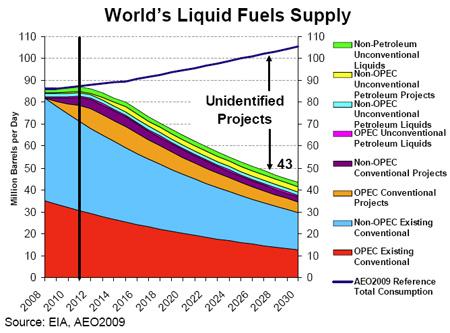
    The bottom line is that governments are now preparing for the implementation of oil rationing.  As this chart shows the unavoidable shortfall in production is going to be 10,000,000 barrels per day inside of five years.  We would need to drill out twenty Bakkens to make up that problem.  It is here folks and has been running flat for the past two or three years while disguised by the recession.
    It is now about to be exposed by the depression – pretend I did not say that.
    The oil industry itself simply cannot invest the capital needed to bring in enough fresh oil production.  The only prospect claiming the right numbers in terms of final production are in the contracts relating to the onset of Iraqi oil development.
    First of, I simply do not believe it at all.  It all looks like deus ex machina.  Then if it were all really possible we are asking for a logistical rollout comparable to moving a large army and the entire disturbance that goes with that.  Show me.
    There is actually plenty of great news developing in the energy business.  As I have posted before, the USA needs to exit the oil industry as a national priority over the next five to ten years.  That largely means displacing all non North American production which will also be rising strongly during this period.  This allows the rest of the world to sustain themselves as they will convert to better methods somewhat later.
    Rationing fuel to a hundred miles worth per day for most drivers is coming and will make electrics highly competitive.
    Officials Wake Up to Peak Oil, Part 2
    By Chris Nelder | Friday, April 16th, 2010
    In the first part of this series, I reviewed a series of reports from March supporting the peak oil view, and warning that world oil production very well may go into terminal decline by 2015 or sooner.
    The sources included the UK Industry Task Force on Peak Oil and Energy Security and officials within the British government; researchers within the College of Engineering and Petroleum at Kuwait University; researchers from Oxford University; and ConocoPhillips, the third-largest oil company in the U.S.
    On March 25, the U.S. Department of Energy (DoE) joined the officially worried, with a report in French newspaper Le Monde titled “Washington considers a decline of world oil production as of 2011.”
    The author had pestered Glen Sweetnam, director of the International, Economic and Greenhouse Gas division of the Energy Information Agency (EIA), for details about a presentation he had given at a semi-public DoE round-table with oil economists in April 2009. How he got wind of it, I don’t know, but I admire his persistence.
    The zinger was this chart:

    Source: Glen Sweetnam, “Meeting the World’s Demand for Liquid Fuels – A Roundtable Discussion,” EIA 2009 Energy Conference, April 7, 2009, Washington, DC
    The implication was obvious: The EIA has no idea how production could increase after 2012. In the absence of these “unidentified projects,” they expect global oil supply to decline by about 2% per year – from 87 million barrels per day (mbpd) in 2011 to 80 mbpd by 2015 – while demand rises to 90 mbpd.
    Within five years, then, there will be a 10 mbpd gap between supply and demand—roughly a Saudi Arabia‘s worth of production (currently 10.8 mbpd).
    (I should note that although Sweetnam’s chart gives the EIA’s Annual Energy Outlook 2009 as the source, I found no such chart, nor even the data that might produce it, in my copy of that publication. I am unable to explain that discrepancy.)
    The agency officially continues to lay any concerns about future supply at the feet of insufficient investment. In Sweetnam’s interview with Le Monde, he put it this way: “‘a chance exists that we may experience a decline’ of world liquid fuels production between 2011 and 2015 ‘if the investment is not there.’”
    It’s a weak position to take in the wake of the oil price blow-off of 2008. The world’s developed economies simply cannot tolerate the high prices that would entice that investment (see “‘Peak Oil Demand,’ Yes… But Not the Nice Kind“), and I’m sure the EIA knows it.
    You’d think the American media would have been all over the story, as it signaled a major about-face in the official U.S. position on peak oil. As recently as 2008, the EIA’s base case scenario was for oil supply to rise through 2030, and not decline until 2090!
    Yet five days later when I Googled it, there was not one story from a major domestic publication. Only blogs and the usual peak oil sites had picked it up.
    In my seasoned judgment, the American media blackout is deliberate.
    And speaking of media blackouts…
    Media Blackout at the World’s Biggest Energy Forum
    On March 30-31, the biennial International Energy Forum (IEF) summit took place in Cancun. Attendees at the world’s largest energy forum included ministers from 64 countries, members of the IEA and OPEC, and other dignitaries.
    In parallel, Cancun also hosted the International Energy Business Forum, attended by some 36 companies including the top executives of China National Petroleum Corp (CNPC), ExxonMobil and Royal Dutch Shell.
    In short, the twin conferences were a Very Big Deal.
    But when I searched Google News for stories containing the exact phrase “International Energy Forum” and published during the conference, it wasn’t until the seventh page of results that I found any stories from major American media outlets, and those stories were strictly focused on specific issues like oil and gas prices. They said not a word about peak oil.
    A journalist from the oil and gas media organization Platts explained what happened on his blog. All media were barred from the IEF conference room, and exiled to a press room where the presentations were shown on monitors with no sound. When reporters asked for sound, the monitors were turned off. All sessions were then declared to be private, and the reporters that had come from around the globe to cover the conference were simply shut out.
    According to journalist Matthew Wild, the presentations included one from PFC Energy titled “Unpacking Uncertainty: Investment Issues in the Petroleum Sector.”
    The document reviews three forecasts for oil supply: The IEA’s, which shows it reaching 109 mbpd by 2030; OPEC’s, which expects it to reach 111 mbpd; and PFC’s own, which expects supply to peak around 2020-2025 at 95 mbpd, then decline to 90 mbpd by 2030.
    Although it sees the decline of mature fields proceeding at a slower rate than the IEA, PFC Energy still believes it will be “rapid enough to produce a world energy picture that differs vastly from previous long-range energy assessments,” and goes on to explain:
    This is not a world of “peak oil” where global hydrocarbon potential is exhausted, but rather of peak production, where the petroleum industry’s ability to continue to increase-or even maintain-production of conventional oil (and eventually gas) is constrained. Exploitation of unconventional oil will provide additional liquids, but in all probability only at increasingly higher costs, and it will depend on significant investments to develop appropriate technologies to convert today’s resources into tomorrow’s reserves.
    The exact timing of both the plateau and onset of irreversible decline will be influenced by the factors that determine long-term changes in supply and demand. Nevertheless, the challenge is coming, and this emerging world of limited conventional production will require major adjustments on the part of both consumers and producers.
    The phrasing of the first statement is curious. Serious observers know that “peak oil” has never meant the exhaustion of hydrocarbon potential, and has always meant the peak of production flow rates. I covered a presentation by Michael Rodgers of PFC Energy at last year’s peak oil conference, so I must believe that PFC Energy knows better than to characterize peak oil that way and simply chose to do so for the appeasement of its IEF audience.
    In any case, we now know that the world’s top energy ministers have seen a serious presentation on peak oil, and heard the warning about its seriousness, albeit a somewhat soft-pedaled one.
    Most reports on the conference featured the theme that better data and transparency on reserves reporting is needed – a bell that peak oil mavens like Colin Campbell have been ringing for over a decade. Without it, the world is in the dark about the true future of oil supply.
    To reinforce that point, IEA head Nobuo Tanaka told the Financial Times at the conference that it has invited China to join the IEA because global oil demand has shifted to the East. “Our relevance is under question,” he worried, as the opacity of data on Chinese oil demand and inventory threatens to blind the agency to the true state of the world’s oil markets.
    Another key theme was an evident widespread concern about the volatility of oil prices. By the end of the conference, IEA, OPEC, and the IEF were expected to announce a “joint action plan” to control volatility and ensure that prices remain stable enough to encourage new production.
    While the IEF was under way, the chairman of the Intercontinental Exchange (ICE) told Reuters that blaming speculators for price spikes was a “crutch” used to avoid looking at the realities of oil supply and demand. As I explained in July 2009, traders have turned to the ICE to skirt the stricter position limits on the NYMEX. The Commodity Futures Trading Commission (CFTC) has now proposed new regulations to limit the influence of speculators in the energy markets, which are up for public comment until April 26.
    You (Still) Can’t Handle the Truth
    By any measure, March was a watershed month for the truth about peak oil.
    Estimates on the timing of the peak have narrowed dramatically, and now center on the 2012-2015 time frame. The range of estimates on the peak rate of production remain a bit broader and shrouded in caveats, but they are rapidly drawing closer to 90 mbpd. And the globally averaged, post-peak annual decline rates are settling in around 2%.
    In other words, industry and governments appear to be coming around to what my call has been all along: 2012, at 90 mbpd or less, then declining at about 2.5% per year.
    Now we know that the oil and gas industry, as well as the world’s governments, are not only aware of the peak oil threat… they too are deeply worried about it.
    Worried enough to huddle behind closed doors, away from the press. Worried enough to formulate plans to control price volatility. Worried enough to agitate for more transparent data. Worried enough to begin planning for a future of relentlessly declining energy.
    But not worried enough to tell the American people the truth… not just yet.
    Regards,

    Chris Nelder
  • Science in the Muslim world


    The one great theme sold forever about the Muslim world and its history is the idea that it somehow was a cradle of science as policy during a large part of its history.  I find the idea to be an exaggeration.  What is true is that science and mathematics progressed continuously from its initiation in the Greco Roman world through to the present.
    Until the advent of the the Scottish enlightenment in particular, this progress rested in the hands of a very few scholars who copied sources and assembled libraries and contributed new work
    These scholars were gifted individuals who attracted sponsorship from wealthy patrons.  When there was a shortage of wealthy patrons the scholarship was naturally diminished.  Thus under the Ottomans who were at heart a nomadic people without a scholarly tradition or natural respect, it becomes unsurprising that scholarship languished, though the tradition of patronage continued but in competition with a far more robust Western system.
    Salam, who is mentioned here, is merely a late example of such traditions.
    Islam captured the entire developed world of its time and place and controlled its wealth.  In the process they monopolized any form of patronage and thus the livelihoods of scholars.  Scholarship advanced largely in spite of this form of civilization rather than because of it.
    Great minds are scattered pretty evenly about.  Preparatory education and patrons are not.  Just how many great minds do you think survive the educational niceties of present Islamic education today?
    The real breakthrough came with the invention of the modern university concept in eighteenth century Scotland.
    Science in the Muslim world
    Apr 1, 2010 
    For hundreds of years, while Europe was mired in the Dark Ages, the medieval Islamic empire was at the forefront of science – in sad contrast to the state of many Muslim countries today. Jim Al-Khalili asks what has been impeding progress, and examines some projects that could herald a brighter future
    There are more than a billion Muslims in the world today – over a fifth of the world’s total population – spread over many more than the 57 member states of the Organization of the Islamic Conference (OIC) in which Islam is the official religion. These include some of the world’s wealthiest nations, such as Saudi Arabia and Kuwait, as well as some of the poorest, like Somalia and Sudan. The economies of some of these countries – such as the Gulf States, Iran, Turkey, Egypt, Morocco, Malaysia and Pakistan – have been growing steadily for a number of years, and yet, in comparison with the West, the Islamic world still appears somewhat disengaged from modern science.
    The leaders of many of these countries understand very well that their economic growth, military power and national security all rely heavily on technological advances. The rhetoric is therefore often heard that they require a concerted effort in scientific research and development to catch up with the rest of the world’s knowledge-based societies. Indeed, government funding for science and education has grown sharply in recent years in many of these countries and several have been overhauling and modernizing their national scientific infrastructures. So what do I mean when I say that most are still disengaged from science?
    Current state of research
    According to data from the United Nations Educational, Scientific and Cultural Organization (UNESCO) and the World Bank, a group of 20 representative OIC countries spent 0.34% of their overall gross domestic product on scientific research between 1996 and 2003 – just one-seventh of the global average of 2.36%. Muslim countries also have fewer than 10 scientists, engineers and technicians per 1000 of the population, compared with the world average of 40, and 140 for the developed world. Between them they contribute only about 1% of the world’s published scientific papers. Indeed, the Royal Society’s Atlas of Islamic-World Science and Innovation reveals that scientists in the Arab world (comprising 17 of the OIC countries) produced a total of 13 444 scientific publications in 2005 – some 2000 fewer than the 15 455 achieved by Harvard University alone.
    But it is the quality of basic scientific research in the Muslim world that is of more concern. One way of measuring the international prominence of a nation’s published scientific literature is via its relative citation index (RCI): this is the number of cited papers by a nation’s scientists as a fraction of all cited papers, divided by its own share of total papers published, with all citations of its own literature excluded to prevent bias. Thus, if a country produces 10% of the world’s scientific literature but receives only 5% of all citations in the rest of the world, its index will be 0.5. In a league table compiled in 2006 by the US National Science Board of the world’s top 45 nations ranked by their RCI in physics, only two OIC countries even register – Turkey with 0.344 and Iran with 0.484 – and only the latter shows a marked improvement between 1995 and 2003.
    These bald statistics reveal how far scientists in Muslim nations are languishing behind the rest of the world. But there have been some outstanding Muslim scientists, not least the Pakistani theoretical physicist Abdus Salam (1926–1996), who dreamed of a scientific renaissance in the Islamic world. One of the greatest scientists of the second half of the 20th century, Salam shared the 1979 Nobel Prize for Physics, with Sheldon Glashow and Steven Weinberg, for his part in developing the electroweak theory: one of the most powerful and beautiful theories in science, it describes how two of the four fundamental forces of nature (the electromagnetic force and the weak nuclear force) are connected.
    Although Salam was a pious Muslim, he was excommunicated by Pakistan in the 1970s because of his non-orthodox religious convictions and adherence to a relatively obscure Islamic sect called the Ahmadis (Physics World August 2009 pp32–35). Despite this, he remained loyal to his country and worked tirelessly to promote science in the Islamic world. But Salam’s dream was never realized and he left behind the following damning indictment: “Of all civilizations on this planet, science is weakest in the lands of Islam. The dangers of this weakness cannot be over-emphasized since the honourable survival of a society depends directly on its science and technology in the condition of the present age.”
    Obstructive attitudes
    One problem is that too many Muslims see modern science as a secular, even atheist, Western construct, and have forgotten the many wonderful contributions made by Muslim scholars during the height of a golden age that began in the first half of the 9th century and continued for several centuries. Brilliant advances were made in everything from mathematics, astronomy and medicine, to physics, chemistry, engineering and philosophy. It was an age epitomized by a spirit of rational enquiry at a time when most of Europe was stuck in the Dark Ages.
    But this freethinking, curiosity-driven quest for knowledge slowly went into decline. I should make it clear that this downturn took place several centuries later than many in the West think, for original advances in medicine, mathematics and astronomy continued to be made well into the 15th century. The gradual decline that nevertheless took place did so for a variety of reasons, mainly due to the political fragmentation of the Islamic empire and weaker rulers no longer being interested in patronage of scholarship and learning. All of this coincided with the Renaissance in Europe moving in the opposite direction, which triggered the scientific revolution of the 16th and 17th centuries. Add to this the later effects of colonialism that led to a kind of malaise and collective amnesia within the Muslim world about its own rich cultural heritage, and one can see the weakness and intellectual laziness of the argument that the decline should be blamed on an anti-science backlash from a more conservative Islam.
    Nevertheless, it is sad but true that today many religions around the world see modern scientific disciplines such as cosmology or evolution as undermining their belief systems. Compare their view with that of the great Persian polymath al-Biruni (973–1048): “The stubborn critic would say: ‘What is the benefit of these sciences?’ He does not know the virtue that distinguishes mankind from all the animals: it is knowledge, in general, which is pursued solely by man, and which is pursued for the sake of knowledge itself, because its acquisition is truly delightful, and is unlike the pleasures desirable from other pursuits. For the good cannot be brought forth, and evil cannot be avoided, except by knowledge. What benefit then is more vivid? What use is more abundant?” Thankfully, enough Muslims now reject the notion that science and Islam are incompatible. In fact, given the current climate of tension and polarization between the Islamic world and the West, it is not surprising that many Muslims feel indignant when accused of not being culturally or intellectually equipped to raise their game when it comes to scientific achievements.
    Reform required
    Far more telling than the argument that it is religious conservatism that impedes scientific progress in the Muslim world are the antiquated administrative and bureaucratic systems many OIC countries inherited long ago from their colonial masters that have still not been replaced. This is compounded by a lack of political will to reform, to tackle corruption and to overhaul failing educational systems, institutions and attitudes. Thankfully, things are changing fast.
    It is crucial that both Muslims and non-Muslims are reminded of a time when Islam and science were not at odds, albeit in a very different world. This is important not only for science to flourish once again in the Islamic world, but also as one of the many routes towards a future in which Muslims see the value of curiosity-driven scientific research, just as they did 1000 years ago.
    As for how this can be achieved, the obvious first step is serious financial investment. It has been shown time and time again that bigger science budgets encourage greater scientific activity, and many Muslim governments, from Malaysia to Nigeria, are currently investing quite astonishing sums of money in new and exciting projects in an attempt to create world-class research institutions. For instance, the rulers of several of the Gulf States are building new universities with labour imported from the West for both construction and staffing.
    But it is not simply a matter of throwing money at the problem. Even more important is having the political will to reform and to ensure real freedom of thinking. For example, Nader Fergany, lead author of the United Nations’ 2002 Arab Human Development Report, has stressed that what is needed above all else is a reform of scientific institutions, a respect for the freedoms of opinion and expression, ensuring high-quality education for all, and an accelerated transition to knowledge-based societies and the information age (Nature 444 33).


    Forward-looking projects
    Let us look briefly at the Middle East, where one can find a number of exciting new projects that have received considerable publicity within the region. The first is a new science park that opened in the spring of 2009 in a sprawling metropolis called Education City on the outskirts of Doha, the capital of Qatar, which is home to a number of branch campuses of some of the world’s leading universities, including Carnegie Mellon, Texas A&M and Northwestern. The Qatar Science and Technology Park, also based at Education City, hopes to be a hub for hi-tech companies from around the world that, one imagines, will try to emulate the success of California’s Silicon Valley.
    Just as ambitious is the new $10bn King Abdullah University of Science and Technology (KAUST), just completed on the west coast of Saudi Arabia near the city of Jeddah (Physics World November 2009 pp12–13). Incredibly, the vast campus of this international research university, complete with state-of-the-art labs and a $1.5bn budget for research facilities over its first five years, was built from scratch in less than three years. In a pioneering move, it is the first fully co-educational institution in Saudi Arabia, allowing women to sit alongside men in lecture halls rather than in separate rooms. The university promises to offer researchers the freedom to be creative and to embody the very highest international standards of research and education. The research programme has been tailored to support the country’s post-oil future in key areas such as exploiting solar energy and developing crops that can survive the country’s hot, dry climate. Many of the top universities in Europe and the US have been clamouring to be associated with it for – one hopes – scholarly rather than financial motives.
    The final example is a project called SESAME (Synchrotron-light for Experimental Science and Applications in the Middle East) (Physics World April 2008 pp16–17), which will be the region’s first major international research centre as a co-operative venture by scientists and governments in the region. When, in 1997, Germany decided to decommission its synchrotron research facility BESSY, it agreed to donate its components to the SESAME project, which was quickly developed under the auspices of UNESCO. It is now being built in Jordan, which had to fight off strong competition from other countries in the region. The research to be carried out at SESAME will include materials science, molecular biology, nanotechnology, X-ray imaging, archaeological analysis and clinical medical applications. Its current membership, along with the hosts, includes Israel, the Palestinian National Authority, Egypt, Turkey, Iran, Pakistan, Bahrain and Cyprus, and this group is likely to expand as several other countries join the collaboration. New science should start in 2012.
    Facing the future
    So, is there a brighter future ahead for science in the Islamic world? Of course scientific researchers require adequate financial resources, but to compete on the world stage requires more than just the latest, shiniest equipment. The whole infrastructure of the research environment needs to be addressed, from laboratory technicians who understand how to use and maintain the equipment to the exercise of real intellectual freedom on the part of the scientists, and a healthy scepticism and courage to question experimental results. This culture change will not happen overnight and requires not only political will, but also an understanding of the true meaning of both academic freedom and the scientific method itself. Sadly, this can often be somewhat lacking, even in the West.
    A cultural renaissance leading to a knowledge-based society is urgently required if the Muslim world is to accept and embrace not only the bricks and mortar of modern research labs along with the shiny particle accelerators and electron microscopes that they house, but also that spirit of curiosity that drives humankind to try to understand nature, whether it is to marvel at divine creation, or just to know how and why things are the way they are.
    A golden age of science
    The greatest period of sustained scientific advances during the 1500 years between the time of the Ancient Greeks and the European Renaissance took place in the great centres of learning across the medieval Islamic empire, such as Baghdad, Cairo, Cordoba and Samarkand. For instance, it is in Baghdad that we find the very first book on algebra (called Kitab al-Jebr, from which we derive the word “algebra”). It was unlike anything seen before, and a paradigm shift from the work of the Greek number theorist Diophantus. Written by the 9th-century mathematician al-Khwarizmi, it sparked many great advances in mathematics, all the way to the 15th-century Persian al-Kashi in Samerkand (who, among other achievements, calculated π to 16 decimal places), before the Europeans regained the lead in mathematics once again. The Abbasid caliph al-Ma’mun created a new academy in Baghdad – the House of Wisdom – and built observatories in Baghdad and Damascus. He sponsored huge science projects that made vast improvements on the astronomical and geographical works of Greek scholars such as Ptolemy, which the Muslim, Christian and Jewish scholars of the Baghdad academy had translated into Arabic.
    Advances in medicine and anatomy would lead to Arabic texts by scholars such as al-Razi (Razes) and Ibn Sina (Avicenna) replacing the Greek works of Galen and Hippocrates in the libraries of medieval Europe. The philosophical work of Ibn Sina and Ibn Rushd (Averroës) influenced later European scholars such as Roger Bacon and St Thomas Aquinas. The Cordoban physician al-Zahrawi (Abulcasis) invented more than 200 surgical instruments – many of which are still in use today, such as forceps and the surgical syringe. At about this time, we also witness the birth of industrial chemistry, with remarkably sophisticated scientific methods being employed over the haphazard practice of alchemy, and advances in fields such as optics by the likes of Ibn al-Haytham (Alhazen) that would not be matched until Newton. For a period spanning over half a millennium, the international language of science was Arabic.
    About the author
    Jim Al-Khalili is a theoretical nuclear physicist and holds a chair in the public engagement in science at the University of Surrey, UK. He is also a broadcaster and author of the book The House of Wisdom, which will be published in September by Penguin Press
  • Issuance by Accor SA of 1,985,428 New Shares as Consideration for the Contribution of Shares in Societe d’Exploitation et d’Investissement Hotelier (SEIH) S.a.r.l.

    PARIS, April 20, 2010 /CHICAGOPRESSRELEASE.COM/ –

    – This Press Release has Been Prepared in Compliance With Article 12 of
    AMF Instruction 2005-11 of December 13, 2005, as Amended

    On April 2, 2010, Accor entered into a Contribution Agreement with Paddel
    SCA, Mrs. Suzanne Pelisson, Mr. Gerard Pelisson and Mr. Paul Dubrule (the
    Contributors) concerning the contribution to Accor of all of the outstanding
    shares of Societe d’Exploitation et d’Investissement Hotelier (SEIH) (the
    Contribution).

    In accordance with article L. 225-38 of the French Commercial Code, the
    execution of the contribution agreement was previously authorized by Accor’s
    Board of Directors at its meeting on February 23, 2010.

    The value of the Accor shares held by SEIH was determined solely on the
    basis of the volume-weighted average closing share price over the three
    trading months ended on March 31, 2010, i.e. EUR37.703.

    In accordance with the opinion issued by an independent expert, the value
    of the SEIH shares was determined on the same basis as that of the Accor
    shares, less a 1.80% discount, i.e. EUR37.025. At the Annual Shareholders’
    General Meeting held on May 13, 2009, Accor shareholders authorized the Board
    of Directors to issue ordinary shares representing up to 10% of the share
    capital as consideration for equity securities contributed to the Company
    (28th resolution). On April 19, 2010, the Board decided to use this
    authorization to issue 1,985,428 new Accor shares (the Accor Share) to the
    Contributors and acknowledged the completion of the resulting capital
    increase.

    The Contributors made a firm and irrevocable undertaking not to sell the
    Accor Shares or the shares of the new Services company to be created by the
    demerger (provided that said demerger is approved by Accor shareholders) for
    a period of 12 months expiring April 19, 2011.

    The Board of Directors delegated to its Chairman full powers to dissolve
    without liquidation SEIH S.a.r.l, which results in the transfer of all SEIH
    assets and liabilities to Accor. Following the dissolution without
    liquidation of SEIH, Accor will hold 2,020,066 of its own shares, which will
    be deprived of their voting rights, dividend rights and the right to receive
    shares of the new Services company to be created as a result of by the
    demerger, provided that said demerger is approved by Accor shareholders.
    Furthermore, the Board will submit to shareholder approval a resolution
    authorizing it to reduce the Company’s share capital by canceling these
    2,020,066 treasury shares.

    The cancellation of the shares issued as consideration for the
    Contribution would allow the transaction, taken as a whole, not to be
    dilutive with respect to Accor’s shareholders.

    The main characteristics of the Contribution, its valuation and the
    related consideration are summarized below, in accordance with article 12 of
    AMF instruction 2005-11 of December 13, 2005, as amended.

        Contributors            - Mrs. Suzanne Pelisson, a citizen of
                                France, born December 30, 1933 in Lyon
                                and residing at 1, rue Gambetta, 77780
                                Bourron-Marlotte.
    
                                - Mr. Gerard Pelisson, a citizen of
                                France, born February 9, 1932 in Lyon
                                and residing at 1, rue Gambetta, 77780
                                Bourron-Marlotte.
    
                                - Mr. Paul Dubrule, a citizen of France,
                                born July 6, 1934 in Tourcoing and
                                residing at 107, route de Saconnex
                                d'Arve, 1228 Plan les Ouates
                                (Switzerland).
    
                                - Paddel, a societe en commandite par
                                actions with a share capital of
                                EUR57,168, whose registered office is
                                located at 8, rue Jean Goujon 75008
                                Paris registered with the Paris Trade
                                and Companies Register under number 354
                                083 529.
    
        Contributee             Accor, a societe anonyme with a share
                                capital of EUR676,453,095, whose
                                registered office is located at Immeuble
                                Odyssey, 110, avenue de France, 75210
                                Paris Cedex 13 registered with the Evry
                                Trade and Companies Register under
                                number 602 036 444.
    
        CHARACTERISTICS OF THE CONTRIBUTION AND ITS CONSIDERATION
    
        Purpose of the          The purpose of the Contribution is to
        Contribution            allow company founders Paul Dubrule and
                                Gerard Pelisson, who no longer exercise
                                any executive functions with Accor, to
                                separate their holdings in Accor's share
                                capital, which are held by SEIH, a
                                company whose only purpose is to hold
                                such shares. In addition, the
                                transaction will allow Accor to
                                streamline and stabilize its ownership
                                structure under fair financial
                                conditions.
    
        Legal and tax regime of The Contribution is governed by the
        the Contribution        standard legal provisions in France
                                concerning contributions in kind as
                                described in article L.225-147 of the
                                French Commercial Code.
    
                                It will be subject to the fixed EUR500
                                registration duty provided for in
                                article 810, I of the General Tax Code.
    
        Contributed assets      350,000 shares (the SEIH Shares) with a
                                par value of EUR16 each, all fully
                                paid-up and registered in their holders'
                                names, representing all of the issued
                                capital of Societe d'Exploitation et
                                d'Investissement Hotelier - SEIH, a
                                societe a responsabilite limitee with a
                                share capital of EUR5,600,000, whose
                                registered office is located at 8, rue
                                Jean Goujon, 75008 Paris,registered with
                                the Paris Trade and Companies Register
                                under number 334 270 279 (SEIH), and
                                which has no other purpose than to hold
                                2,020,066 Accor shares. The SEIH shares
                                will be contributed as follows:
    
                                - 87,500 SEIH Shares contributed by Mrs.
                                Suzanne Pelisson.
    
                                - 87,500 SEIH Shares contributed by Mr.
                                Gerard Pelisson.
    
                                - 87,500 SEIH Shares contributed by Mr.
                                Paul Dubrule.
    
                                - 87,500 SEIH Shares contributed by
                                Paddel SCA.
    
        Total value of the      The total value of the contributed
        contributed assets      assets amounts to EUR74,858,038.36,
                                representing EUR213.88 per SEIH Share.
    
                                The value of the Accor shares held by
                                SEIH was determined solely on the basis
                                of the volume-weighted average closing
                                share price over the three trading
                                months ended on March 31, 2010. The
                                value of each SEIH Share was determined
                                on the same basis as that of Accor
                                shares, less a 1.80% discount.
    
        Number of Accor shares  As consideration for the contribution in
        issued as consideration kind effected in connection with the
        contribution            Contribution, Accor will issue 1,985,428
                                new ordinary shares with a par value of
                                EUR3 each, all of the same class (the
                                Accor Shares), representing a capital
                                increase in a total nominal amount of
                                EUR5,956,284.
    
        Issuance and rights of  The issuance of the Accor shares was
        the shares              duly authorized by made Accor's Board of
                                Directors on April 19, 2010. The Accor
                                shares shall be fully assimilated with
                                the existing Accor shares and shall
                                benefit from all dividends approved or
                                paid after the date on which the
                                Contribution is completed.
    
        Contribution premium    The premium on the Accor Shares issued
                                as consideration for the Contribution
                                amounts to EUR68,901,754.36.
    
        Effective date of the   The definitive date of completion of the
        Contribution            Contribution is the date on which
                                Accor's Board of Directors' approved the
                                value attributed to the Contribution and
                                decided to complete a share capital
                                increase by issuing the Accor shares as
                                consideration therefore, pursuant to the
                                authorization granted by Accor's
                                shareholders at the Annual Shareholders'
                                General Meeting on May 13, 2009.
    
        AUDIT OF THE CONTRIBUTION
    
                                A report on the Contribution was issued
                                on April 7, 2010 by Jean-Jacques Dedouit
                                and Patrice Cousin, appointed by an
                                order of the President of the Evry
                                Commercial Court on November 27 2009.
                                The report, prepared in compliance with
                                article L225-147 of the Commercial Code,
                                was made available to Accor shareholders
                                at the registered office and filed with
                                the Evry Commercial Court within the
                                legal timeframe.
    
                                In addition, on February 22, 2010, a
                                fairness opinion, attesting to the
                                transaction's neutrality and fairness
                                for Accor shareholders, was issued by
                                Accuracy, represented by Bruno Husson.
    
        RESULTS OF THE CONTRIBUTION
    
        Accor's share capital   Further to the Contribution, the share
        after the Contribution  capital of Accor shall be
    
        Dilution                increased from EUR676,453,095
                                (represented by 225,484,365 shares
                                with a par value of EUR3 each) to
                                EUR682,409,379 (represented by
    
                                227,469,793 shares with a par value of
                                EUR3 each).
    
                                Based on a share capital comprised of
                                225,484,365 outstanding shares, the
                                equity interest of a shareholder holding
                                1% of Accor's share capital before the
                                issuance of the Accor Shares would be
                                reduced to 0.99% after completion of the
                                Contribution. Dilution will amount to
                                0.01%, as the issue of new shares will
                                be offset by cancellation of the
                                contributed shares
    

    Accor, a major global group and the European leader in hotels, as well as
    the global leader in services to corporate clients and public institutions,
    operates in nearly 100 countries with 150,000 employees.It offers its clients
    over 40 years of expertise in two core businesses:

        - Hotels, with the Sofitel, Pullman, MGallery, Novotel,
          Mercure, Suitehotel, Adagio, ibis, all seasons, Etap Hotel, Formule 1,
          hotelF1 and Motel 6 brands, representing 4,000 hotels and nearly
          500,000 rooms in 90 countries, as well as strategically related
          activities, such as Thalassa sea&spa, Lenotre and CWL.
        - Prepaid Services, with 32 million people in 40 countries
          benefiting from Accor Services products in employee and public
          benefits, rewards and motivation, and expense management.
    

    SOURCE Accor

    Distributed via Chicago Press Release Services


  • Microgrid Update

    John Robb has a micro-update on the microgrid concept – RC UPDATE: Microgrids.

    Three years ago, I wrote about the importance of smart electricity microgrids in Brave New War as platforms for networked resilient communities. As a reminder, here’s a short synopsis of what a microgrid is (the “smarts” are computer controls and data that allow people to see and manage the generation and use of electricity down to the device level through a simple Web interface):

    Microgrids are modern, small-scale versions of the centralized electricity system. They achieve specific local goals, such as reliability, carbon emission reduction, diversification of energy sources, and cost reduction, established by the community being served. Like the bulk power grid, smart microgrids generate, distribute, and regulate the flow of electricity to consumers, but do so locally. Smart microgrids are an ideal way to integrate renewable resources on the community level and allow for customer participation in the electricity enterprise.

    At the time when I first wrote about it, most of the interest in the topic was academic, and almost all of the implementations were very, very basic in design (hospitals and military bases, etc.). What a difference three years makes. Smart microgrids are now going mainstream with multiple software start-ups and big efforts underway at Siemens and Cisco. Given this pace of expansion, I suspect that this bottoms up approach will vastly outstrip and eventually curtail any efforts to build smarts into the larger utility grids (which is estimated to cost $165 b in the US alone, money that doesn’t exist). Also, with this level of interest, open source efforts are sure to follow.


  • BlackBerry Tour Owners: Check Your Wireless Update

    For those of you who have updated your Verizon Tour to OS 5.0, it appears that Verizon has pushed an update OTA for your phone. While it’s not OS 6.0, it appears to have upgraded the platform to .284. So please check and update your Tour. To check for a wireless update, go to Options/Advanced Options/Wireless Update, and click on check for wireless update. If you have one available, let us know what changes you noticed.

    You’re reading a story which originated at BlackBerrySync.com, Where you find BlackBerry News You Can Sync With…

    This story is sponsored by the new BlackBerry Sync Mobile App Store. Grab your free copy today at www.GetAppStore.com from your BlackBerry.

    BlackBerry Tour Owners: Check Your Wireless Update

    Related posts:

    1. Verizon releases OS 4.7.1.53 for BlackBerry Tour 9630 We just got word from Susan about the email…
    2. BlackBerry Tour 9630 shows up in Verizon Inventory… Looks like Verizon will jump on board with Bell…
    3. Verizon Gives It’s Tour Customers Push To Talk With The 5.0 Update PTT or Push To Talk, is a feature Verizon…
  • Renault Vel Satis at 2010 Paris show: Renault Safrane on its way?

    Samsung SM5

    The Renault Vel Satis heir could possibly be presented at the 2010 Paris motor show in October. Likely, it will be based on the Samsung SM5 and will be called the Renault Safrane, as reports German magazine Auto Bild.

    The Samsung SM5 is a classic sedan car, 490 cm long, which would be positioned above the Laguna in the Renault range. The green light has not yet been given, but if it is it would be the only French model in its segment, as the Peugeot 607 and Citroen C6 will not be substituted.

    Samsung SM5 Samsung SM5 Samsung SM5 Samsung SM5


  • The YouTube drug observatory

    An innovative new study has analysed YouTube videos of people tripping on a hallucinogenic plant called salvia to understand the behavioural effects of the ‘legal high’ that is still relatively new to science.

    Salvia divinorum is a strongly hallucinogenic plant that has been used by indigenous Mexican shamans for many centuries but has recently become popular as it is legal in many countries.

    Pharmacologically, it is fascinating as it seems to have its major effect on kappa opioid receptors. These are not the same opioid receptors that drugs like heroin and morphine work on, so the effects are very different, but it is a completely different mechanism to virtually all other hallucinogenic drugs (only ibogaine is known to have a similar effect on the brain).

    Especially at high doses it can have the effect of ‘switching off reality’ causing people to be disorientated and there are now thousands of videos on YouTube of people smoking salvia and experiencing the effects.

    However, we know only a little about the plant because it is relatively new to science so a research team at San Diego State University, led by psychologist James Lange, decided to analyse these videos to understand the behavioural effects of the drug.

    They created a systematic coding scheme which researchers used when watching the videos. This allowed them both to categorise the effects and check that each viewer was agreeing on what they saw.

    After watching 34 videos, each of which was selected to show an entire trip from the initial hit to when the effects wore off, the team categorised the effects into five main groups:

    (1) hypo-movement (e.g. slumping into a slouched position, limp hands, facial muscles slack or relaxed and falling down), (2) hyper-movement (e.g. uncontrolled laughter, restlessness, touching or rubbing the face without apparent reason or thought), (3) emotional effects included being visibly excited or afraid, (4) speech effects (unable to make sense, problems with diction, problems with fluency, inability to speak, and having problems recalling words) and finally (5) heating effects related to being hot or heated (e.g. flushed, or user makes a statement about being hot or sweating).

    They also noted that the effects of are very quick, starting within thirty seconds of the first hit and wearing off completely in about 8 minutes. They also noted that the environment had little influence on the trip but the number of hits was linked to the amount of speech impairment caused by the drug.

    In a previous Mind Hacks post about latah, a curious startle reflex localised to Malaysia and Indonesia, we noted that various videos of the phenomenon were available on YouTube, allowing for some ‘armchair anthropology’.

    This is another example of this approach and shows how funny videos uploaded to the net can contribute to the understanding of atypical mental states.

    pdf of full text of study.
    Link to PubMed entry for same.

  • Be Very Scared about Katla

    This is a strong introduction to what are some of the world’s scariest volcanoes.  Iceland can be thought of as mostly one very large strata volcano that has been built on successions of eruptions.  This week’s events are at best a warm up to months of activity.  The only positive spin that I can put on this is that this particular volcano is tending to been lazy.
    Read all this and become very scared.  The present threat is a monthly bombardment of Europe with ash clouds.  We will get better at working with the problem but there is not much meaning here in the word better.  It will likely perk a long for perhaps two years.
    It is still a mess.
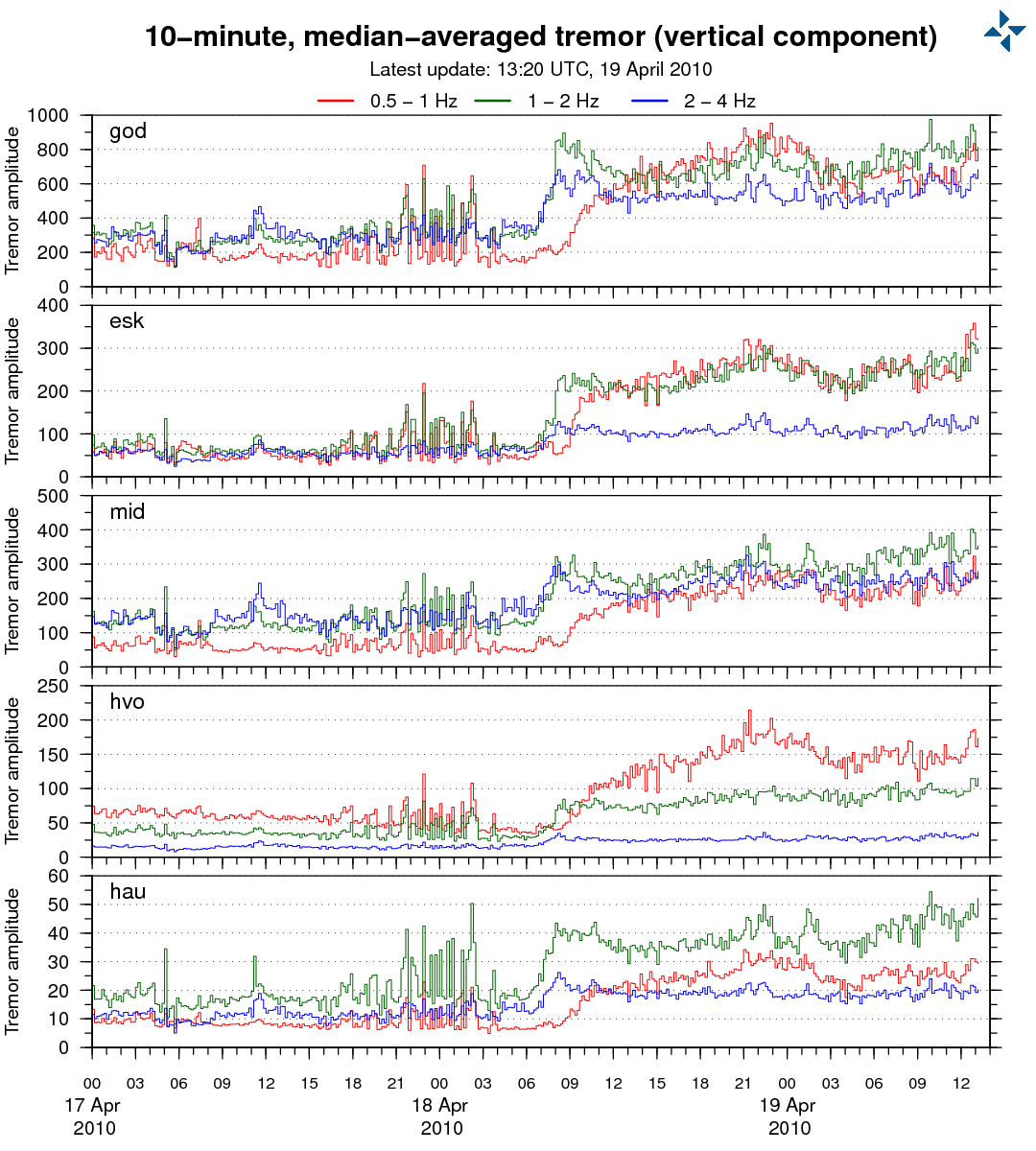
    The real problem is that nearby Katla has always apparently blown when this one went off.  That is the history no one is talking about.  These graphs show us activity has jumped in the past two days likely indicating movement of magma.
    And of course Katla is a big one able to blast two orders of magnitude larger.  That makes it in the same class as Hekla.  Hekla’s blast in 1159bce ended the Northern European Bronze Age and inflicted damage in the Middle East.  The tsunami knocked out Atlantis and its sea people culture.
    The real measure of the damage is that cropping was suspended for twenty years.  Imagine Europe and Russia without any harvests for twenty years.
    Volcanoes are the one event that is able to actually destroy civilizations.  We should never forget that.
    Posted: Sunday, April 18, 2010

    AWED, ALARMED BY MOTHER NATURE IN ICELAND
    By Chris Jansing, NBC News correspondent
    For almost 24 hours after the cloud cover had lifted, I’d been watching with awe as the volcanic plume over Eyjafjallajokull grew.  It was especially dramatic at night with bright white lightning strikes and bursts of energy glowing orange and red against the backdrop of that now enormous gray-black plume. But nothing prepared me for what it would be like to fly over the open mouth of the crater and watch a non-stop display of massive, heart-stopping eruptions.
    As the helicopter ascended to 5,000, then 6,000 feet – hovering right against the side of these eruptions – the view was unlike anything I could ever have imagined. The billowing mounds that appear largely benign from the ground; that seem to move only in shifting winds, were instead dramatically alive.  There were so many different kinds of eruptions – ferocious, riveting explosions – it was like watching multiple displays of Fourth of July fireworks at once, and at eye level. And they were so tantalizingly – and terrifyingly – close, I felt I could almost reach out and touch them. The door of the helicopter was wide open with the legs of my phenomenal videographer, Carlos, hanging out the side.  And me, simultaneously mesmerized by the awesome display and protectively grasping the strap of his camera from the back. 
    This is one time when I don’t think if I sat at my computer for days the words would come to describe what many of you may have already seen on Nightly News or TODAY. But suffice it to say that what a lens can’t begin to adequately capture is the sheer size and unbelievable force of that volcanic ice mixing with superheated magma: a mountain belching out tons of molten rock is a mind-blowing spectacle.
    Soon, we were circling around the mouth of the volcano, only occasionally catching a glimpse down into the crater as yet another blast would momentarily light the opening in the Earth. From every angle and every changing direction, the scene dazzled. Unlike those Independence Day celebrations, there were no breaks in the action, and no SOUND to be heard over the roaring of the helicopter blades and what I felt, but surely couldn’t actually hear:  the pounding of my heart.
    Eight miles and a swift ride away we descended more closely above the blindingly sunlit Katla. Eyafjalla is the fifth largest volcano of the 35 in Iceland, Katla the biggest.  Geologically, there is no link between the two, though physically they are close enough that the visual contrast between the glistening glacier blanketing Katla and the exploding glacier that had capped Eyafjalla was enough to leave even our University of Cambridge volcanologist temporarily speechless. I knew from earlier interviews that small earthquakes were rumbling beneath Eyafjalla, shifting the flow of magma and opening new pathways for its movements. It is entirely possible – some experts believe even likely  – that one of those seismic shifts will travel across the eight miles and spark Katla to blow. She’s about 40 years overdue, and if Katla goes, my new volcanologist friend finally told me, the force could be ONE HUNDRED TIMES what we’re seeing now. Given what I had just witnessed, I cannot begin to fathom the enormity of that kind of brilliant, destructive power. 
    After an hour in the air, astounded, shaken, and convinced that I would never see a display of Mother Nature quite like what I had just witnessed, we drove around the mountain through police roadblocks, cautiously aware of warnings about the unpredictable danger on the other side, and entered what I described in my story as hell. The wind had changed direction overnight, and the ever-growing cloud of ash was now blanketing farms along the southern edge of the volcano. At first, it looked like driving into a tornado. There were even small funnels of volcanic grit moving across open fields, like mini-twisters.  But again, the landscape would change in an instant and we went from daylight to darkness and back again in the course of 30 seconds. Our SUV was soon coated in fine ash and within moments of stepping out onto the desolate road, so were we.  I only had my mask off for a few minutes, but my throat and eyes were burning as I breathed in the miniscule shards of ice and rock blown apart by volcanic energy. A few cars, then trucks hauling horse trailers, rushed by – escaping the dark, enveloping cloud. I felt conflicted: wanting to escape myself from something so frightening and erratic, and yet completely captivated by those same forces. Wind gusts blew the camera over and nearly knocked me off my feet. A pair of birds, coated in ash, struggled with limited success to take flight. Then the clock made my stay-or-flee decision for me: we had to get back, write and edit, and set up for a liveshot. 
    After being calmed and cleansed by a hot shower and the brief quiet of my hotel room, we were back in the filthy car driving up a gravel road to a house in the shadow of Eyjafjalla. The cattle farm needed no adornment to look like a movie set: a corrugated metal barn door, a bale of hay, and a trailer hitch aglow in sea of television lights. It’s all so surreal I wonder for a fleeting moment if I really did see and experience so much in one day – or was it a creation for the cameras? In reality, no studio budget, however large, could concoct what unfolded before me or make me feel what it did.  I’ve been awed and alarmed by Mother Nature before – covering fires, floods, hurricanes and earthquakes  – but never, ever, quite like this.
  • Village officials ask to adopt plan to save ash trees

    Village officials asked trustees to support the new revised plan to save ash trees at a workshop meeting Monday.

    The new plan reduces the number of symptoms and signs that are indicative of the devastating insect Emerald Ash Borer (EAB) from four to two and eliminate the Ash Reduction Program.

    No motion was taken at the workshop meeting. The Village Board will revisit the plan May 10.

    The village has about 1,900 ash trees in its parkways. About 200 are scheduled to be removed due to EAB.

    Public Works Director Joe Caracci said if action is not taken all of village’s ash trees “at least within the next 10 years, will not be here.”

    Peggy Drescher, village forester, said Michigan lost more than 20 million ash trees due to EAB.

    Read the original article from MySuburbanLife.com.

    Distributed via Chicago Press Release Services


  • Michigan Approves Tax Incentives For Tech Companies

    Howard Lovy wrote:

    The state of Michigan is continuing its focus on using tax incentives to convince companies to locate here, or stick around, and a few technology companies are among the latest beneficiaries. The Michigan Economic Growth Authority recently approved tax breaks for the following tech companies.

    Ash Stevens: The Detroit-based life sciences research company will receive $710,019 in state tax credits over seven years. The company says it will spend $14.9 million to expand its facility in Riverview, MI, creating at least 60 new jobs.

    fortu PowerCell: The German-Swiss-based battery manufacturer plans to invest $623 million in a new battery-cell manufacturing plant in Muskegon, MI. The state approved tax credits valued at $12.6 million over 10 years to encourage the company to continue its Michigan expansion.

    Materialise USA: The subsidiary of a Belgium-based company, which specializes  in 3-D medical image processing, plans to invest $12.5 million in a Plymouth Township, MI, facility with help from a state tax credit valued at $563,000 over seven years.

    Oasis Advanced Engineering: The Auburn Hills, MI-based R&D company specializes in software and embedded electronics for combat vehicles. The company is looking to invest $7.5 million in an expansion. Oasis received a state tax credit valued at $1.4 million over seven years.

    UNDERWRITERS AND PARTNERS


  • Manpower Business Solutions’ New ‘Resume Response’ Offering Addresses Age-Old Recruiting Issue: How to Properly Qualify High Volumes of Resumes, Quickly

    New Solution Gets High Marks for Streamlining the Front-End of the Recruiting Workflow while Supporting a Positive Employer Branding

    MILWAUKEE, April 20 /CHICAGOPRESSRELEASE.COM/ — Manpower Business Solutions (MBS), the world leader in recruitment process outsourcing, today announced the launch of its newest offering, Resume Response, the first of its kind standalone front-end recruiting solution. MBS’ Resume Response is a reliable job candidate selection tool that efficiently identifies and helps screen high quality applicants through a proven, systematic, technology-driven process augmented by MBS’ recruiting expertise and best practices.

    (Logo:  http://www.newscom.com/cgi-bin/prnh/20060221/CGTU012LOGO)

    As a result of the recessionary economy, the ratio of candidates to job openings has spiked. Conversely, companies are under intense pressure to hire the right candidate the first time in order to recognize competitive advantages and control recruiting costs. With corporate recruiters already stretched thin, the task of reviewing hundreds – sometimes thousands – of resumes for a single opening is an unmanageable initiative. With this new, innovative solution, MBS’ Resume Response addresses this challenge for employers by presenting only qualified, interested and available applicants for review, while also solving a top frustration for candidates – a lack of communication.  

    “In addition to identifying high quality applicants, Resume Response ensures timely communication with all candidates,” said Kate Donovan, Managing Director, Manpower Business Solutions – RPO/BPO. “Promoting a positive candidate experience resonates with human resource professionals who recognize the importance of maintaining their employer brand with everyone who enters the hiring process.”

    How does Resume Response work?

    MBS’ Resume Response accelerates the recruiting process by evaluating, assessing and screening applicants according to the hiring company’s job requisition. This enables MBS recruiters to present employers with only qualified applicants. Resume Response promotes a positive employer brand experience by automatically sending letters to those candidates whose qualifications did not match the specific job requisition’s hiring criteria. To help build a talent community of future job seekers, MBS recruiters proactively continue to build relationships and foster communications with respondents to ensure high potential candidates remain engaged for further openings.

    MBS’ Resume Response is quick and easy to implement, working with a hiring company’s existing applicant tracking system or leveraging MBS’ technology. The offering is ideal for companies looking to manage a large number of applicants and ensure a positive employer brand as the economy returns.

    “Investing directly in all of the tools and resources that we make available through Resume Response would take a significant amount of research, time and budget,” said Donovan. “With Resume Response, MBS clients receive a comprehensive solution that helps solve one of the most common recruiting challenges.”

    MBS’ Resume Response is available now. For more information, please visit us.manpower.com/resume-response.

    About Manpower Business Solutions

    Manpower Business Solutions (MBS) is dedicated to the creation and delivery of integrated workforce management solutions worldwide. Part of the Manpower group of companies, MBS provides customized, scalable solutions for Recruitment Process Outsourcing (RPO) and Business Process Outsourcing (BPO) that fully leverage Manpower’s blend of global expertise and local knowledge. The complete suite of workforce management solutions, including its industry-leading Managed Service Provider (MSP) program offered through the TAPFIN brand, are instrumental in driving process, performance and productivity improvements across organizations of all sizes. As the trusted global advisor to some of the world’s most well-respected employers, Manpower Business Solutions is helping clients win in the ever-changing world of work. More information about Manpower Business Solutions is available at us.manpower.com/mbs.

    About Manpower

    Manpower Inc. is a world leader in workforce solutions; creating and delivering services that enable its clients to win in the changing world of work. In the United States, Manpower is more than its core of industrial, contact center and administrative recruiting, assessment and selection. Under the Manpower Professional brand, the company provides innovative project solutions and places temporary and permanent talent in areas such as information technology, scientific, engineering and finance verticals. Manpower leverages its expertise in staffing and consulting for the U.S. federal government through Manpower Public Sector, and provides clients with managed service programs, business and recruitment process outsourcing offerings, and other integrated solutions through Manpower Business Solutions. More information on Manpower is available at us.manpower.com.

    SOURCE Manpower

    http://www.us.manpower.com

    Distributed via Chicago Press Release Services