We still have no idea what David Jaffe is currently working on. He’s been very tight-lipped about it, and that just makes it all the more exciting. What we do have an idea of though is that
Blog
-
Central Pacific Financial Corp. Dedicates Senior Executive to Mortgage Banking
HONOLULU, April 19 /CHICAGOPRESSRELEASE.COM/ — Central Pacific Financial Corp. (NYSE: CPF), parent company of Central Pacific Bank (CPB), announced today that Blenn A. Fujimoto will dedicate full time to his role as the President and Chief Executive Officer of Central Pacific HomeLoans, Inc. (CPHL), a wholly owned mortgage banking subsidiary of CPB, in order to concentrate on further developing the company’s core business of the origination of home loans in Hawaii. The corporate positions of Vice Chairman of CPF and Vice Chairman, Hawaii Market, of CPB held by Fujimoto have been eliminated and he has resigned from those positions.
“As we move forward with a flatter and leaner management structure, I am counting on Blenn’s leadership and depth of industry experience being fully dedicated to a key component of our core business,” said John C. Dean, Executive Chairman of the Board of CPF and CPB. ”Supporting homeownership and small businesses in Hawaii continues to be our focus going forward.”
Fujimoto has over 29 years of experience in the banking industry and was responsible for establishing the CPHL subsidiary under CPB in August 2005, and has since continued to serve as its CEO. In 2009, CPHL originated over $1.9 billion in residential mortgages in Hawaii, topping all other Hawaii-based banks. Dean joined the company as Executive Chairman of CPF and CPB on March 16, 2010, pending formal regulatory approval, in conjunction with the launch of the company’s recovery plan announced last month.
About Central Pacific Financial Corp.
Central Pacific Financial Corp. is a Hawaii-based bank holding company with $4.9 billion in assets. Central Pacific Bank, its primary subsidiary, operates 37 branches and approximately 110 ATMs throughout the State of Hawaii. Central Pacific HomeLoans, a wholly owned subsidiary of Central Pacific Bank, operates from four locations on the islands of Oahu and Maui. For additional information, please visit the Company’s website at http://www.centralpacificbank.com.
Forward-Looking Statements
This document contains forward-looking statements concerning business plans, management changes, concerning plans and objectives of management for future operations, concerning future economic performance, or concerning any of the assumptions underlying or relating to any of the foregoing. Forward-looking statements can be identified by the fact that they do not relate strictly to historical or current facts, and may include the words “believes”, “plans”, “intends”, “expects”, “anticipates”, “forecasts” or words of similar meaning. While we believe that our forward-looking statements and the assumptions underlying them are reasonably based, such statements and assumptions are by their nature subject to risks and uncertainties, and thus could later prove to be inaccurate or incorrect. Accordingly, actual results could materially differ from projections for a variety of reasons, to include, but not limited to: the Company’s ability to successfully implement business plans, the impact of local, national, and international economies and events, including natural disasters, on the Company’s business and operations and on tourism, the military, and other major industries operating within the Hawaii market and any other markets in which the Company does business; the impact of regulatory actions on the Company including the Consent Order by the FDIC and the Hawaii Division of Financial Institutions; the impact of legislation affecting the banking industry including the Emergency Economic Stabilization Act of 2008; the impact of competitive products, services, pricing, and other competitive forces; movements in interest rates; loan delinquency rates and changes in asset quality generally; the price of the Company’s stock; volatility in the financial markets and uncertainties concerning the availability of debt or equity financing; and the impact of regulatory supervision. For further information on factors that could cause actual results to materially differ from projections, please see the Company’s publicly available Securities and Exchange Commission filings, including the Company’s Form 10-K for 2009. The Company does not update any of its forward-looking statements.
SOURCE Central Pacific Financial Corp.
http://www.centralpacificbank.com
Distributed via Chicago Press Release Services
-
Hands-On With The Sony Cyber-Shot DSC-TX7 Camera

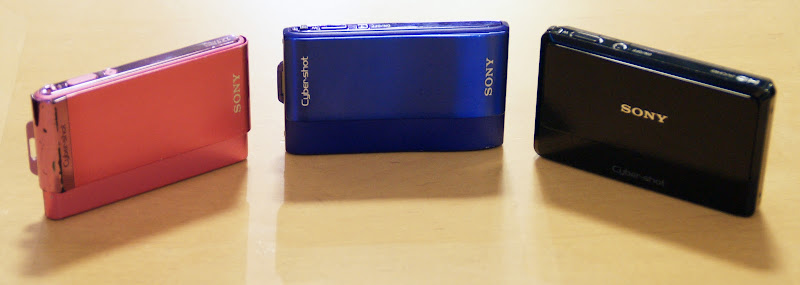
The Sony DSC-TX7 could possibly be one of the greatest point and shoot ultra slim cameras ever created. It truly is a pinnacle of Sony’s commitment to quality in its twenty five years of making Cyber-shot cameras. At $399, it also surprisingly faces stiff competition in the ultra slim category from giants such as Samsung, Canon, Nikon, and others.

What Sony brings to the table with the TX7 makes it a real player in comparison to anything else out there. Lets go over some of the basic features before we start our review – the TX7 has a 3.5″ touch screen, “Exmor R” sensor, iSweep Panorama Mode, 10fps at full 10.2 megapixels, Anti-Motion Blur / Hand-held Twilight, AVCHD Movie mode, Optical SteadyShot, and 4x optical zoom. And while that list may seem exhausting, that’s not even everything available on the TX7 – it’s merely the beginning.
When you first hold the TX7 you can most certainly sense that this isn’t some flimsy camera. It’s very well-built, and is very slim. The design of the camera is nearly unmatched in this category; only what I’ve seen from Nikon’s Coolpix line of cameras could even come close. It is available in three colors, ranging from Red, Silver, and Dark Blue. Turning on this T series Cyber-shot is as easy as its predecessors – you simply slide down the lens cover and away you go. The TX7 turns on very quickly, in a mere matter of seconds.


Buttons are few and far between and that’s how it should be for a touchscreen camera – the only things to push or move is the On/Off, Tele/Wide button, camera, and movie buttons. However, the Tele/Wide (aka zoom) button is on the upper right side of the camera, which seems something Sony integrated out of convienence, but could prove to be a challenging aspect in everyday usability. There is a slider on the bottom of the camera that allows access to the battery compartment and SD/MS Duo slots. Yes, you read that right – this TX7 can use Memory Stick Duo and SD cards.

A special note about the MS Duo slot – it also accepts the 8GB MS Duo TransferJet card MSJ-X8G, which is compatible with the TJS-1 TransferJet Station. We’ve covered TransferJet extensively in the past, but basically its a wireless technology that lets you to wirelessly share photos and videos with other TransferJet devices. So, take a picture with your DSC-TX7 with MSJ-X8G card, then put the camera on top of your TJS-1 and view pictures on whatever the TJS-1 is connected to (via USB, which can connect to computers, TV’s, photo frames, etc). It’s really cool technology that allows rapid transfer of pictures wirelessly. I’ve seen TransferJet in person and it is not slow whatsoever, and its short range transmissions doesn’t interfere with any other common wireless band (4GHz).
Don’t think the technology is vapor, either – it is backed by large consortium of companies such as Samsung, Canon, Nikon, Olympus, Toshiba, and so many more. You will be seeing TransferJet integrated into many new future consumer electronic products in the coming years. Unfortunately, new technology also brings a high price – the 8GB MS Duo TransferJet card MSJ-XG8 is $99, which the USB base station TJS-1 is $149. If you were to buy everything together for the optimal TransferJet experience, including the aforementioned accessories and the camera itself, it would run you more than $650. Time and ubiquity will bring these prices down, but it will be a considerable amount of time from now.

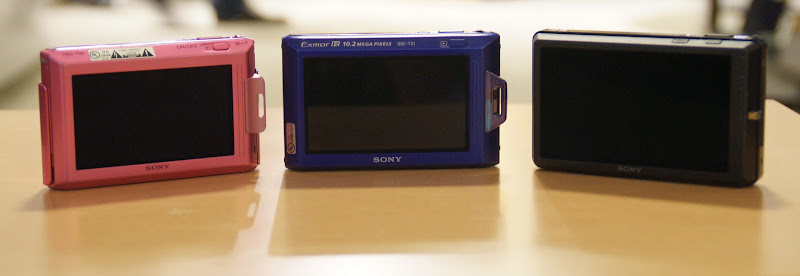
The back of the DSC-TX7 is home to a large 3.5″ touch screen LCD (921k pixels), that has TruBlack technology. Reviewing pictures looked very crisp – not OLED crisp as you would see in several of Samsung’s point and shoot cameras, but most certainly best in class. Sony display technology is usually great in small form factor devices. The touchscreen was very responsive and didn’t detract from usability whatsoever – it was very convenient to use. It also enables you to select the focus point with a simple touch, scroll through images by sliding your finger across the screen and one-touch access to the menu. We also appreciated the Ultra AR film coating, which noticeably reduced reflections and favorably increased contrast and brightness in bright situations. I remember in the days of old when it was annoying to review a picture you just took while outdoors, as I usually had to hold my hand over the top of the screen to see it properly.


The TX7 can take some truly amazing pictures (as seen above), and the reason for that is the 10.2 megapixel “Exmor R” CMOS image sensor that brings out the full power of the camera’s Carl Zeiss Vario-Tessar lens. Sony kept things pretty average with the optical zoom, which remains at 4x this year. The camera can deliver extremely fast speed, high resolution pictures, and stunning low-light sensitivity with improved image clarity and drastically reduced grain. A lot of that may seem like marketing speak, but if you can take one thing away and one thing only from reading this entire review, then understand that Sony’s 2010 camera line-up with the Exmor R CMOS image sensor makes a huge difference in low light situations. It really is a big change, and one that we are so happy to finally see. For so long it felt like we were in a megapixel race, but now as that has finally come to pass you’ll soon realize that this improvement is one of the most important features to hit point and shoot cameras in many years.
Unfortunately, I did notice that the placement of the lens may make it easy for people to accidentally put their finger in the picture, and will require people to hold the camera specifically to avert this that will be easy remembered after several uses.


Battery life is pretty great with the new super slim type of batteries Sony is using with this camera – the NP-BN1 Lithium-ion N Type rechargeable battery is capable of about 230 images per charge, or approximately 115 minutes of shooting still images as listed on SonyStyle. The TX7 also comes with a stand that has connectivity options such as DC In, USB, A/V Out (stereo), and HDMI out.

There are just so many smart aspects of this camera that really make sure you never miss the perfect shot. In some ways, the camera works overtime just for you to ensure this. For example, when the camera is set to Soft Snap, the Anti-blink function captures two images, recording only the photo with less squinting or blinking. If a blink is detected in other shooting modes, a warning will be displayed after you take the shot. The Self-Timer, pictured above, can do the routine 10 second wait, 2 second wait to take a picture, or take advantage of the facial detection and capture a picture when a person is detected, or two people. Now that is impressive. Sony’s Face Detection technology detects up to eight individual faces and adjusts flash, focus, exposure, and white balance to help deliver crisp, properly lit images of family and friends.
Here are some of the settings in the camera one may encounter:


The camera is also a bit of a quick shot, in two very special ways. The Handheld Twilight mode allows you to take six images in less than a second with the push of a button, and combines all six images together that results in great detail and low noise. This method is also present in the Anti-motion Blur mode, which also takes six images and combines them together to vastly decrease subject blur.
In addition to High Sensitivity Mode (ISO), you can select up to seven ISO settings (Auto, 125, 200, 400, 800, 1600, 3200) when shooting in Program Auto Mode to adjust sensitivity to your shooting conditions. This compliments the TX7’s motion detection features quite nicely, along with face motion detection, which adjusts ISO sensitivity and increases the shutter speed when movement is detected, reducing blur in moving subjects and faces. Also, the auto focus is ultra-quick and locks focus in as little as 0.3-sec.


Unlike traditional auto mode, the included Intelligent Auto (iAuto) mode thinks for you, recognizing scenes, lighting conditions, and faces, and adjusts settings resulting in clearer images, faces with more natural skin tone, and less blur. This is achieved by incorporating advanced features such as Intelligent Scene Recognition, Face Detection technology, and Optical SteadyShot image stabilization. Whether you’re shooting landscapes, capturing a beautiful flower, or taking pictures at an in-door birthday party or wedding shower, iAuto mode will optimize your camera’s settings to help ensure you come away with a great shot.
On top of iAuto, the TX7 also has Intelligent Scene Recognition (iSCN) Mode, which automatically detects nine different types of scenes and, within just 1/30th of a second, selects the appropriate camera settings: Backlight, Backlight Portrait, Twilight, Twilight Portrait, Twilight using a tripod, Portrait, Landscape, Macro, and Close Focus. iSCN has two modes: Auto and Advanced. In Auto Mode, the camera takes a single shot using the optimal settings. In Advanced Mode, the camera takes a photo with the optimal settings and, if in difficult lighting (low light or back light) immediately takes a second photo with another optimized setting so you can choose which to keep.
The DSC-TX7 features 12 convenient scene modes: High Sensitivity / Twilight / Twilight Portrait / Portrait / Landscape / Beach / Snow / Fireworks / High Speed Shutter / Underwater / Gourmet / Pet.

They also upgraded the popular Sweep Panorama mode this year to Intelligent Sweep Panorama Mode, which now shoots 258 degrees. Press shutter and sweep and the camera does the rest, continuously, shooting images and in one second stitching them together. In the picture above, captured with the TX7, you can see the technology is almost bulletproof. This model even detects faces and moving subjects to stitch intelligently different widths to help avoid subject distortion. However, in our further tests, we found that it couldn’t fix everything, as there was some object distortion in some of the products captured with our panoramic shot below within SonyStyle at Atlanta, GA.

A feature I’m hesitant to really gush on but felt the need to include was the expansion of some creative painting tools, which allows you to decorate photos with words, drawings, etc. This feature was truly popularized in the minds of some US consumers by Nikon’s commercials with Ashton Kutcher. Aside from a paint pen (your finger is the brush), there are more than 30 stamps and 15 types of picture frames you can color your picture with, but unfortunately it will downgrade the image quality to a maximum of five megapixels.
Lastly, the movie mode is very appealing – you can record movies in 1080i AVCHD at 60i (MTS files), or 720p MP4 movie mode where the camera shoots 1280 x 720 high definition movies at 30 fps. Just be warned however, those AVCHD MTS files are quite a burden on non dual core machines and you will fare much better with a newer generation computer. Movie recording is somewhat limited (29min segments for MP4 up to 12Mbps 1440×1080/30p) (and) (10 minute segments for AVCHD up to 16mbps 1920×1080/60i.) Pretty amazing it can do that type of AVCHD in a ultra slim point and shoot – its almost similar in specifications to their Handycam camcorders from two or three years ago. You can check out a AVCHD 17M FH / 1,920×1,080 / 60fps / 24.9MB video from the DSC-TX7 in pure .MTS file format here.
All things considered, we recommend the TX7 if you have the money to spend. There are many alternatives out there for less, but few bring this level of quality. I’ve looked at the competition and I truly believe Sony will be ranked very highly in point and shoot for 2010 sales, customer satisifaction, and so forth. And for those of you still reading, a special gallery of the DSC-T90, DSC-TX1, and DSC-TX7.



-
A Letter: Apple Wants Its Secret iPhone Back [Apple]

Well, how can I explain this? I got some interesting calls today. It was Apple. And they wanted their phone back. More »
-
Massey Energy Director Cedes To CtW Investment Group; Demands Lady Judge Resign From Massey Board
Statement of William Patterson, Executive Director of the CtW Investment Group
WASHINGTON, April 19 /CHICAGOPRESSRELEASE.COM/ — This evening, Massey Energy Company (NYSE: MEE) disclosed that Lady Barbara Thomas Judge had resigned from the Massey board of directors in the face of mounting shareholder anger over pervasive safety, risk oversight and other governance failures at the Company. The CtW Investment Group had called on the board to seek Lady Judge’s resignation and initiate additional board changes in a March 31, 2010 letter to Massey’s lead independent director, Admiral Bobby R. Inman, six days before the April 5 explosion at Massey’s Upper Big Branch mine, in which 29 miners lost their lives.
The board’s decision to reseat Lady Judge in 2009 despite majority shareholder opposition was symptomatic of an unaccountable board that failed to challenge Chairman and CEO Donald L. Blankenship’s confrontational approach to shareholders, workers and regulators. In our view, the explosion at the Upper Big Branch mine is the tragic and preventable consequence of this fundamental governance failure.
In a second letter to Admiral Inman on April 12, we called on the Massey board to immediately seek the resignation of Mr. Blankenship as Chairman and CEO. We also reiterated our opposition to the three directors standing for election at the company’s May 18, 2010 annual meeting: Richard M Gabrys, Dan R. Moore and Baxter F. Phillips, Jr., all of whom, like Lady Judge prior to her resignation, sit on the failed Safety, Environmental and Public Policy Committee.
Lady Judge’s resignation from the board – only three days after the company issued its 2010 proxy statement listing her as a director – acknowledges the pressure Massey’s directors feel in the wake of the recent tragedy, but will not deter continued shareholder calls for board and management changes.
The CtW Investment Group’s March 31, 2010 and April 12, 2010 letters to Admiral Inman are available at: http://ctwinvestmentgroup.com/.
** Note: For additional information or comment please contact Michael Garland at [email protected] or visit www.ctwinvestmentgroup.com. **
SOURCE Change to Win
http://www.changetowin.orghttp://www.ctwinvestmentgroup.com
Distributed via Chicago Press Release Services
-
RC DSLR BeetleCam Goes On Ground-Level Photo Safari [Photography]

Some photographers spend months immersed in muck to capture the perfect wildlife shot. The Burrard-Lucas brothers decided to let an RC car do the dirty work. Their BeetleCam came face-to-face with lions, elephants, and buffalo and captured these stunning shots: More »
-
Group Buying and Coupons: All Patented Up!
A startup called Groupon recently brought back some memories of the dot-com bubble when it announced that it had raised a $135 million round of financing, reportedly at a valuation of $1.35 billion. The company offers users in different cities the ability to join a group to buy coupons or discounts from a local business. If enough people join in, everybody gets the deal; if the magic number isn’t reached, nobody gets it. In addition to the VC round, the business model is straight out of the bubble, and is pretty close to one used by Mercata, a Paul Allen-backed company that failed back in 2001. Apparently, Mercata garnered a dozen patents based around group buying, and they’ve now been sold to a Groupon rival called Tippr. That company’s CEO told GigaOM that he plans to enforce the patents, but he believes “that patents are primarily a defensive weapon, not offensive.” It’s not entirely clear how those two statements can be reconciled, but he assures us that he’s not a patent troll. In any case, it’s hard to see how this situation really benefits anybody (apart from the lawyers), as it foreshadows a lot of money and other resources being devoted to a patent fight — resources that would be better spent elsewhere.
Permalink | Comments | Email This Story
-
Marvel vs. Capcom 3 revealed
Yes folks, you heard it right. According to reports, Capcom is all set to announced the latest installment of their highly successful fighting game series, Marvel vs. Capcom 3 this week..
-
U.S. House GOP whip acknowledges public anger toward Congress
Posted by Rick Pearson at 10:30 p.m.
U.S. Rep. Eric Cantor of Virginia, the House GOP whip, said today Republicans are poised to make strong gains in this year’s mid-term elections but they must find ways to combat a “very cynical electorate” unhappy with Democratic control of Congress today and transgressions that cost Republicans their majority in 2006.
Cantor, who met with the Tribune’s editorial board along with west suburban GOP Rep. Peter Roskam, maintained Republicans have straightened themselves out after losing a congressional majority. But, he said, voters are primarily interested in which party will do more to improve the economy and “get people back to work.”
“We as Republicans looking toward the November election are…presenting ourselves, I would say a counterbalance, if you will, to one-party rule that seems to be unfettered in Washington,” the five-term congressman said.
But Cantor said Republicans also have learned from their mistakes.
“Underlying all of this is a very cynical electorate because they feel that they’ve been duped by the current majority and they have memories now of what went on when we were fired,” Cantor said, citing the overspending and corruption problems under the GOP as well as “the lack of ability to execute perhaps in the way the public felt needed to be with the war, Katrina.”
Cantor said the “first and foremost priority right now is jobs in the minds of the public” and the “most compelling argument” that incumbent Republicans and GOP challengers to Democrats will try to make to voters is that an unpopular “Washington has grown too much.” -
Washington council OKs 2010-11 budget
One of the themes of former vice presidential candidate Sarah Palin’s speech Saturday at Five Points Washington was the importance of government living within its means.
The Washington City Council took that advice to heart Monday in its meeting at Five Points, approving a balanced budget of $21.1 million for the 2010-11 fiscal year that begins May 1.
Reflecting the tough economic times, the budget is 3.3 percent, or $716,500, lower than this year’s spending plan.
While most of the decrease is because of a nearly 11 percent drop in capital expenditures, the city will use $2.5 million in cash reserves to fund projects, including nearly $900,000 to expand the police station in the former city hall.
Council members praised City Administrator Bob Morris and other city staff members for putting together the austere budget.
“There are no staff layoffs. It seems like every day you read about a municipality having to lay off employees,” said Mayor Gary Manier. “We’re concerned about the governor’s plan to cut income tax funds to communities, but I think we can ride out that storm even if we do lose the projected $300,000.”
While there are no layoffs in the budget, three vacant positions won’t be filled unless financial conditions improve. The positions are a full-time police officer, full-time public services laborer and part-time administrative assistant.
In a list of budget highlights, Morris pointed out that the city’s annual income tax revenue has decreased about $250,000 since 2007-08, and annual sales tax revenue has declined by about $135,000 since 2008-09.
Morris is projecting no income or sales tax growth next year, so those numbers are unlikely to improve.
Unless revenue grows, Morris said, the city’s capital spending will decrease from $10.8 million next year to $3 million in 2011-12 and $1.4 million in 2012-13.
Morris said rising pension and commodity costs continue to put pressure on the city’s budget.
He said police pension costs have doubled since 2007-08, and the Illinois Municipal Retirement Fund employer rate increased 27.5 percent as of Jan. 1.
Commodity prices tell a similar story.
“While the rate of cost increases for commodities has abated somewhat, costs continue to escalate,” Morris said. “Our energy costs alone have increased by $309,000, or 74 percent, over the last five years. The costs of asphalt, road salt, softener salt, and chemicals have been increasing much faster than general inflation.”
Also Monday, council members:
– Approved 3 percent pay raises for full-time, and year-round part-time, non-union city staff, and 25 cents-per-hour increases for summer non-union public services personnel. The new hourly rates are $8.25 for first-year employees, $8.75 for second-year employees, and $9.25 for third-year and longer employees. The raises are effective with the pay period ending May 12. Union workers recently received a 3 percent pay hike for 2010-11, and a 3 1/2 percent pay increase for 2011-12.
– Learned from Manier that the fifth annual Take Pride in Washington litter clean-up Saturday attracted more than 250 volunteers, a record.
Steve Stein can be reached at 686-3114 or [email protected].
Read the original article from Journal Star.
Distributed via Chicago Press Release Services
-
Hysteresis
I lost the word “hysteresis” years ago, and I’ve been looking for it ever since.
It can be used to describe the common situation where a sustaining force is removed, but a dependent state persists — for a time …Hysteresis – Definition and More from the Free Merriam-Webster Dictionary
a retardation of an effect when the forces acting upon a body are changed (as if from viscosity or internal friction); especially : a lagging in the values of resulting magnetization in a magnetic material (as iron) due to a changing magnetizing force
I knew the concept, but Google refused to resolve my descriptions into the word. I had no choice but to wait until someone used it. That took years! I just saw it in a Sci Am article on how a newly frail antarctic ice mass responds to climate change.
I keep a short list of the handful of odd words I tend to lose (like gratuitous and vicarious), now hysteresis has a place of honor. -
Bob Evans Sausage Gravy Machine Is the Last Machine You’ll Need [Imagecache]

I know you’re all thinking what I’m thinking: Why bother with Step 1? Order today to get four cases of free gravy! [HTHackneyCo.com (PDF)] More »
-
Mathieu Hervais talks PS3 Hacking
The name may not sound familiar, but it’s legendary none the same. Mathieu Hervais or Math has been around the gaming scene for quite sometime and worked closely with Dark_Alex of PSP fame and more recently with GeoHot.
In a recent interview with MaxConsole via Threedog, he sheds light on quite a few things. Initially it focused just on the PSP, the state of the scene, and how all the original members are no longer working in that arena. Later however, it branched off into a discussion of the state of affairs with the PS3, with some extremely interesting details being brought to light. Below is a direct copy of the interview portion pertaining to the PS3 and it’s worth a careful read. The link is included, but as some avatars may be NSFW (not safe for work),the full interview is below:1: Members have seen you interacting with Geohot, Do you have any personal interest in the PS3 and if so can you tell us anything about your plans? Are you working with Geohot?
I’ve interacted with a lot of individuals in the past; Geohot is one of them, though one of the most interesting I encountered so far. Although he tends to work alone, we have been exchanging ideas, I helped him with a couple of things, he helped me with a couple of others and so on. He is someone that’s really skilled and I appreciate exchanging thoughts with people like that.
2: It has taken quite some time to find a way into the PS3, What do you think of Sonys achievements in security? Anything else you want to say about the PS3?
The playstation 3 security was more the work of IBM than sony’s the idea of using isolated spus as crypto engines in order to hide keys was brilliant, I do not think sony implemented such an idea properly though, as such their current architecture has a few security design flaws on its own that I noticed.
I believe it has pretty much been security through obfuscation all along.
3: What do you think of Sonys removal of Other OS as a preventative measure, Do you feel it is right to blame ‘hackers’ or ‘pirates’ for its removal?
I believe sony wanted a pretext to remove otheros and found one in Geohot’s hack. I do not believe this is the right approach, it would have paid off to talk with hackers and homebrew developers in the first place and give them compromises, in fact the playstation 3 remained unhacked until sony chose to release ps3 slim systems without the otheros feature in.
4: Assuming you choose to answer the above, Do you have a counter argument for Sonys statements? and do you think Sony could have fixed this without removing the feature?
Yes of course they could have, there are several existing ways to close this exploit effectively without removing the otheros feature, they wanted it removed and used it as another pretext to do so, pretty much like the phony one they used for the slim console pretexting that they would have to implement support for it on the new hardware (while it actually would have worked just fine on it, should they had enabled option to do it in the first place). The otheros feature did cause a few security concerns regarding the fact that you could pretty much cold boot the console and use otheros to dump lv2, this could easily be fixed by ensuring that the selected os option is only applied upon proper shutdown though.
5: How far along is development with the PS3? How much control do we really have? How much work is left for a system that is as ‘open’ as the PSP currently is? If you were to compare the PS3’s current development status to another device such as the PSP which stage would you compare it to?
We already have a lot, and that’s in a sense the problem because we have too much to work with, too much to reverse… These things take time.
A huge amount of work is required before we get to a level comparable to the one we have with the psp right now. I would say months at least, if not years of work may still be required.
6: Are you personally working on the PS3 and if so can you tell us what you are up to? Can you tell us of any personal objectives?
I am working on the ps3, so are countless of other skilled developers out there, as for my objective, that would be unrestricted homebrews on the device, either on top of lv2 or by the mean of a RTOS.
7: Member Milkyjoe asks, Why doesn’t Mathieulh release his lvl 1,2 and 3 dumps of the PS3 firmware.
Because that’s copyrighted data (there is no such thing as lv3 by the way) and I am certainly not putting that in the wild. The people that have a need for these either already have those dumps or the capacities to dump them. There is a certain site (which I wont name) that has been literally whining to various developers (including me) so that we “share” (read leak) the dumps in our possession. They claimed they would do wonders so long as they had the dumps in the first place. When someone finally dumped lv1 and released it in the wild, what did this site ever did with the dump ? Nothing. This is what happens when all the “devs” you have can’t use ida or reverse engineer and that the only thing they could ever do is look at strings with an hex editor.
On that note I will leave you to think about this.
8: Member Breakdown has asked multiple questions.
1. Now that you have dumps of the HV etc.. is there any reverse engineering going on and Is it possible to execute homebrew code on a retail machine if so are there any plans to give the public that ability?
Yes there are a few people reversing these dumps as we speak, things take time, when there is any development, you shall be kept posted.
2. If developers are capable of creating custom PUP’s would it be possible to patch future official firmwares to retain the Other OS feature for members that have already updated to 3.21?
No, because of the coreos revocation checks (among other things) this is for now not a possibility.
9: Will the Other OS/Playstation 3 hardware still be open to the same attacks when Geohot releases his planned method of upgrade?
Yes it will.
10: Do you have a rough ETA for when end-users will have something to play with for example homebrew such as a Quake 1 port?
No idea. You can already play Quake 1 on otheros using linux I believe. -
Green Giants
List of 10 large green opportunities …
… “Green technology essentially involves revamping the physical infrastructure of the modern world: replacing coal-fired power plants with wind turbines, building homes from materials concocted in chemistry laboratories, and swapping out engines for electric motors. ” …
Via Seeking Alpha: Top 10 Green Giants List
-
Children’s Center founder Makris dies
From its basement beginnings, the Children’s Center of Cicero and Berwyn has evolved into a network offering support and aid to area families.
Patricia Makris, founder and executive director of the center, died today as the result of cancer.
Ron Kiefer, a member and past president of the center’s Board of Directors, has known Makris since the 1960s.
“She was the one who got the community together and was behind getting this started,” he said.
Makris opened the Children’s Center in 1978 in a church basement. Now, the nonprofit has seven locations in both Cicero and Berwyn and provides educational programming, offers parenting resources and support to help improve children’s home lives.
An interim executive director had been appointed to the center while Makris — a former resident of Berwyn — received rehabilitation for cancer.
“We had hoped that she would be back,” said Kiefer.
When Kiefer was principal at Burnham School in Cicero, he would hear his teachers remark about how they could tell if a child had gone through the Children’s Center.
“The opportunities that the center provides for kids really does make a difference in their education,” he said.
The center’s interim director, Vickie Piet, said about 1,500 children and families participate in the center’s programs and services on an annual basis.
Site director Lurlean Chodora said Makris tried to remain involved with the center by working from home.
“But it was difficult when she was trying to rehabilitate herself to get well,” she said.
Chodora knew Makris as a woman concerned for the education of all the children in the community, not just those who attended the Children’s center.
Giving an example of how involved Makris was with the Children’s Center, Chodora said children who returned to the center for continued help would remember Makris, even as they got older. And Makris was always willing to listen or help those children, Chodora said.
Both Piet and Chodora were friends with Makris.
“She was a remarkable woman. No one will ever be able to fill her shoes.” said Piet.
“She had some pretty big shoes to fill,” said Chodora.
Read the original article from MySuburbanLife.com.
Distributed via Chicago Press Release Services
-
Six-Pack Abs: Are They Worth It?
Filed under: Advice, Happiness, Health, Fitness, Fit Family Guy
I’m too fond of drinking six-packs of beer to allow for six-pack abs.
This post is going to primarily address the male six-pack, but in the next post I’ll discuss the female’s quest for abdominal definition and why it’s really not such a good … Read more
-
Apple should sue Gizmodo over stolen iPhone prototype
By Joe Wilcox, Betanews
Gizmodo was wrong to acquire a lost iPhone prototype — quite likely a nearly finished version 4 design — let alone pay to obtain it. Perhaps this marks the distinction between bloggers and journalists. I would have contacted Apple about returning a device so obviously stolen. There is grave difference between obtaining secret information for the public good and what Gizmodo did: Obtain property containing trade secrets belonging to a public company. Gizmodo has violated the public trust and broken the law. Free speech isn’t a right to pay freely for something clearly stolen.
I typically reserve this kind of treatise on journalistic ethics for my Oddly Together blog, where in late March I posted “The Difference Between Blogging and Journalism.” Betanews founder Nate Mook asked me to write something here about the journalistic and legalistic ethicacy of Gizmodo’s actions. I simply couldn’t refuse.
Earlier today, long-time Mac journalist Jim Dalrymple and I discussed the story. I asserted then, as I will here, that Gizmodo broke the law by obtaining stolen property and, related, by paying for an unreleased Apple product that disclosed trade secrets. The latter violates good journalistic practice, at the least.
Gadget geeks’ desire to know doesn’t supplant a company’s right to protect millions of dollars invested in developing a product or preventing millions of dollars lost by the leakage of product designs or plans to competitors. Gizmodo did more than cross the line here. The blog lept a chasm no less wide than the Grand Canyon. The legal ramifications could, and quite probably should, be as deep.
The flow of events isn’t complicated to follow:
1. On March 18, someone left in a bar what later appeared to be a next-gen iPhone prototype or near-finished device.
2. Someone else stole the device. Stolen is appropriate description because the device had been left in a public place — presumably by accident — and clearly belonged to someone else.
3. Gizmodo obtained the stolen smartphone by paying cash for it; Gizmodo’s Jason Chen got access to the device around seven days before posting information about it.
4. Today, Gizmodo posted pics and videos and offered some device teardown that reveals to competitors much about Apple’s plans for the next-gen iPhone.
5. The phone’s seller sought to profit from the sale of the stolen property, while Gizmodo sought to profit from the pageviews that photos, videos and blog posts would generate.
[Editor’s Note: This post presumes that the iPhone prototype is the real thing and not a fake.]
A Clear Case of Theft
There are two primary questions regarding Gizmodo’s actions. Did it break the law and did it violate good journalistic prudence — assuming anyone would apply ethics to a new media blog. Let’s start with the trade secrets.
California’s “Uniform Trade Secrets Act” is unambiguous, partly defining “trade secret” as “information, including a formula, pattern, compilation, program, device, method, technique, or process.” The Act uses several definitions of “misappropriation,” of a trade secret with one being: “Acquisition of a trade secret of another by a person who knows or has reason to know that the trade secret was acquired by improper means.”
An unreleased phone accidentally left in a bar and sold to Gizmodo surely qualifies as acquisition “by improper means.” Proper means would be purchase of the device from Apple, following its public release. What about theft? According to Section 485 of the California Penal Code:
One who finds lost property under circumstances which give him knowledge of or means of inquiry as to the true owner, and who appropriates such property to his own use, or to the use of another person not entitled thereto, without first making reasonable and just efforts to find the owner and to restore the property to him, is guilty of theft.
There’s nothing unambiguous about that. According to Gizmodo, Apple software engineer Gray Powell accidentally left the iPhone on a bar stool. The person later obtaining the device sat next him. By my reading of the law, the finder is guilty of theft and likely so is Gizmodo by paying for the Apple smartphone. Estimates range between $5,000-$10,000, but who knows?
Yellow Blogging
Gizmodo is part of the Gawker family of, arguably quite successful, Weblogs. On his twitter page, Gawker publisher Nick Denton‘s bio reads: “Gossip merchant,” which says much about the news philosophy behind Gizmodo and other Gawker properties. In a Denton memo to employees last week, he wrote: “The staples of old yellow journalism are the staples of the new yellow journalism: sex; crime; and, even better, sex crime. Remember how Pulitzer got his start: http://en.wikipedia.org/wiki/Yellow_journalism.” I call its reincarnation “yellow blogging,” as gossip and rumor blogsites ruthlessly compete for pageviews — such as the well-publicized competition between Engadget and Gizmodo.
In the memo, Denton outlined eight attributes that drive pageviews: “Scandal sells”; “the pseudo exclusive”; “drama”; “visuals”; “explainers”; “don’t rubbish the headline”; “parody”; and “inside baseball.” So far, the stolen iPhone story has seven — eight, if I missed parody somewhere. Gizmodo has carefully unfolded the story, like today’s “How Apple Lost the Next iPhone,” over several posts, with supporting pics and videos. Clearly the goal is to maximize pageviews, which have topped 3 million perhaps on their way to 5 million or more.
In many ways, this post isn’t easy for me to write. I highly respect Denton for his success managing Gawker through the economic downturn and bringing back some of the drive to break stories. But there’s breaking news and breaking the law. It’s not like Gizmodo turned up a whistleblower revealing that iPhone causes brain cancer or that Apple uses 8 year-old boys on the manufacturing line. It’s the difference between what does and does not qualify as free speech or the free press.
According to the California Uniform Trade Secrets Act:
Nothing in this section shall be construed to limit, restrict, or otherwise impair, the capacity of persons employed by public entities to report improper government activity, as defined in Section 10542 of the Government Code, or the capacity of private persons to report improper activities of a private business.
Nowhere does the Act say that journalists may “misappropriate” trade secrets for personal or company gain.
An Ethics Lesson
Tech pundit Andy Ihnatko put the right ethical and legal response in the right perspective in a blog post earlier today:
I would have thought very hard and then gone with my first impulse: return the phone to Apple. If it’s been stolen, then Apple is the victim of a crime and the ethical answer is to side with the victim…If I was told that this phone had been found in a bar, I would have assumed that it had been stolen from Apple. Same result. And if the ‘finder’ wanted some sort of fee for this device, then I would have brought law enforcement into the discussion.
That kind of situation is so shady that no journalist with an ounce of sense would come anywhere near it. Even if you could get past the professional ethical dilemma and your ethical dilemma as a human being — look, smart people aren’t confused about how to react when someone tries to hand them a knife wrapped in a torn and bloody UPS uniform and asks them to hide it for a couple of weeks. I don’t mind these problems that you have to discuss with your editor. But I try to avoid the sort of problems that result in a conversation with a criminal defense attorney.
I wholeheartedly agree. But I fall on my ethics as a Roman might fall on his sword. I’m a lowly freelance journalist. Yellow blogging is where the money is. That said, justice may come in the form of Apple’s retribution. Today at TechCrunch, MG Siegler appropriately stated Gizmodo’s legal situation:
It may be the most high-profile hardware leak of all time from any company. If there has ever been anything that will draw the wrath of Apple’s legal team, this would seem to be it. And yet, if Gizmodo (or its parent, Gawker) have gotten a take-down notice, they haven’t let it be known yet. It’s possible, and likely even probable, that Apple is taking this as something worthy of action much more serious than the fairly common takedown notices the company sends from time to time.
Apple may have plenty of legal recourse. According to section 3426.3 of the California Uniform Trade Secrets Act:
A complainant may recover damages for the actual loss caused by misappropriation. A complainant also may recover for the unjust enrichment caused by misappropriation that is not taken into account in computing damages for actual loss.
Apple has sued over stolen trade secrets before, such as one lawsuit in 2004 against an “unknown individual” for leaks related to the Power Mac G4 Cube. In 2005, Apple sued several bloggers over release of trade secrets. The resulting settlement led to rumor site ThinkSecret’s closure. Surely, Apple would and should take action against the “most high-profile hardware leak of all time from any company.”
Denton is a new media mogul and cult personality in his own right. Steve Jobs and Apple may find Denton and Gawker to be formidable opponents. Perhaps that’s the win-win Denton sees. He gains scads of pageviews from the iPhone leak, while with a lawsuit opportunity to publish an ongoing blow-by-blow account about the Apple legal skirmish. If there was ever going to be a truly public Apple legal battle, Gawker would be it. Who says blogging doesn’t pay?
-
Piriformis Syndrome Followup: Four Ways To Release The Lower Back
Last week’s article on piriformis syndrome, Your Lower Back Pain Or Sciatica Might Actually Be Piriformis Syndrome, created quite a bit of interest from readers wanting to know more. Indeed, it seems many people who think they are suffering sciatica or other lower back pain ailments are actually feeling the side effects of a tightened piriformis muscle. And while many physicians are quick to throw drugs and surgery at such problems, many times the answer is as simple as releasing lower back muscular constriction, which is in large part due to piriformis syndrome.
Today’s article is a response to the many queries we received on this syndrome and exercises that will help. Below I would like to share with you four sets of therapeutic corrective exercises you can do on your own.
If you can manage to perform these three times per day, in just a few days you will begin to feel lasting relief. After just a few weeks the body will self-correct and imbalances in posture due to muscular-skeletal issues related to piriformis syndrome should be corrected. Let’s look at each exercise now.
1. Pelvic Tilting

The purpose of this exercise is to warm up the area of the lower back by bringing heat and blood into the lumbar and sacral areas. Begin by sitting on a firm chair, toward the front with feet planted firmly on the ground (fig. 1). Allow your body to slouch slowly by titling your pelvis forward. Allow around three seconds to tilt to full slouch then hold that position for three seconds (fig. 2). Next, tilt your pelvis backward, swaying your low back to lift your upper body upward. Allow three seconds to reach full height then hold that position for three seconds (fig. 3). Repeat this slouch-and-sway movement set continuously for a total of 30 repetitions.
2. Piriformis & Hip Flexor Stretches

This next set of stretches works on releasing tightness in the piriformis and gluteus muscles in an effort to release compression on the sciatic nerve. Begin by sitting on a firm chair, toward the front with feet planted firmly on the ground (fig. 4). Place the ankle of your right foot over the knee of your left foot. Many of you will have very tight hips and using your hands to hold the leg in place will help here (fig. 5). Allow your hips to relax in this position for 10 seconds before pulling your knee toward your chest with both hands (fig. 6). Hold this stretch position for 10 seconds then release the knee slowly to its former position. Next, press your right hand down on your right knee, holding for a count of 10 seconds (fig. 7). Release and relax for 10 seconds, then press again this time counter-pressing your right knee into your right palm for 10 seconds (fig. 8). Release the contraction and relax in position for 10 seconds. Lastly, rest your forearms on the thighs of their respective sides and bed forward from the waist (fig. 9). Hold the forward position for 10 seconds then slowly return to the starting position (fig. 4). Perform this sequence, slowly and steadily, for a total of three repetitions.
Remember to repeat with the opposite leg.
3. Balanced Squats

Now that the previous exercises have warmed up the body and loosened the hips, we can continue with these squats. Stand up straight with feet a shoulder’s-width apart, toes pointing forward and holding onto a steady chair or counter for balance (fig. 10). Slowly and steadily bend your knees and flex your hips to lower your buttocks toward the floor (fig. 11). It is important to keep your knees behind your toes while lowering for balance and also to avoid straining the knees (fig. 12). Hold the lowest position to can maintain without using the chair as a crutch (it is for balance, not resting on). Hold this lower position for five to 10 seconds (fig. 13), then slowly and steadily rise to the starting position (fig. 10). Relax in the upright position for 10 seconds then repeat the squat for a total of three to six times, as your ability allows.
4. Gravity Leg Hanging

Now that the muscles and tendons are looser and blood is moving we can move on to the final “stretch” exercise in this series. Begin by lying on your left side close to the edge of the sofa, with a pillow under your head for support (fig. 14). Create an X-shape by reaching back with your right hand to grab the cushions (or bed sheets) for balance. Slowly slide your right leg off the sofa, stretching the quadratus lumboratum (fig. 15). Allow the leg to drop as it will—do not strain—and allow gravity to work. Because this is a “passive” stretch, the muscles in the lower back will release quickly as your body will sense little threat to the position. Hold for one minute before slowly returning to the starting posture. Next, lie with your back facing out, grabbing a cushion (or sheets) for balance (fig. 16). Slowly allow your right leg to slide backward off the sofa, stretching the psoas muscles to balance the frontal stretch (fig. 17). Again, allow gravity to do its things as you relax in this position for one minute. Do this only once then change sides and repeat with the left leg.
As a rule, even though pain is felt in a specific area or a diagnosis for something has been given; other areas are also responsible for the imbalance. With regard to sciatica and lower back pain, piriformis syndrome is often the likely candidate.
However, stretching only the piriformis muscles will not in itself be the answer to the problem. Other muscles like the tensor fascia latte, quadratus lumboratum, gluteus medius and maximus and the psoas also play a role in creating imbalances. While it is the piriformis muscle that compresses the sciatic nerve, it does not become tight or in spasm on its own. The other muscles must also be released from spasm and returned to normal resting position to allow the piriformis to also relax. By taking 10-15 minutes to do the above simple stretches at least once, but ideally three times per day, you will feel relief in no time; without drugs and without surgery.
— Dr. Mark Wiley
-
Herbal Tea Can Help To Lower Blood Pressure
An herbal tea containing hibiscus can help lower your blood pressure, according to Tufts University in Boston. Study patients who drank hibiscus tea blends for six weeks lowered their systolic blood pressure—the top number—by an average of seven points. Overall, this can help you avoid the risk of stroke or heart attack. The good news is most commercial brands of herbal tea already contain this amazing ingredient.
-
Marisa Tomei’s Toning Tips, Marathon Facts and More
Filed under: Morning Scoop
Each morning, we dish out a few links we love.
Ever wondered why a marathon is 26.2 miles? Here’s the history behind this epic race, as well as some interesting marathon facts.
How does Marisa Tomei get her enviable figure? She’s the latest … Read more