Blog

  • Eric Sprott: We’re Very Concerned About China, And We’re “All In” On Precious Metals

    Eric Sprott of Sprott Asset Management was just on CNBC talking about how he doesn’t trust the current economic environment, and how he’s long precious metals.

    • 0:10 I haven’t bought into this equity rally, and I have serious concerns about the banking industry’s debts
    • 0:50 Very concerned about China and the potential cooling in lending there
    • 1:35 Not convinced the GDP growth in China is equal to the amount of stimulus that they have used
    • 3:30 Gold has been the investment of the decade, and it looks better today than it has ever looked due to sovereign risks
    • 4:20 Silver has great opportunity, and may ‘act’ better than gold; not optimistic about cyclical metals like copper
    • 5:45 We’re long precious metals, and oil and gas; most levered positions possible

    Join the conversation about this story »

  • Android Quick App: AutoResponder

    autoresponder

    Ever wish you could set your phone to an away status much like you can for many of your favorite instant messaging clients? Personally, I know there are periods of time where I have to walk away from my Droid (sad, yes I know it is a bit difficult each time it happens), and I know that people get extremely frustrated when phone calls go unanswered. Well, now instead of the person wondering if you were just ignoring, you were busy, didn’t hear the phone ring or what happened, you can set the phone to send them a SMS reply, and even customize the message. Let’s hop in and take a look at some of the features of this very useful and practical application — Auto Responder. [Market link]

    read more

  • Interview with Mia Lehrer on Revitalizing Communities

     
    Mia Lehrer, FASLA, is principal of Mia Lehrer + Associates.

    Mia Lehrer + Associates often works at the large scale creating master plans that integrate landscape and community infrastructure, creating major public spaces in the process. Why should cities and communities invest in these plans? What are the connections between open spaces and sustainability?

    Sustainable communities are about being able to offer people good places to live, jobs, transportation, and education.  However, sustainable communities are often communities within communities, because in large cities you’re really not creating one community, one place, it’s a series of spaces and places and smaller communities. This is especially true when you’re building in areas that are repurposed, using land that was originally industrial or commercial. You really have to start thinking of the big picture and how to knit these new developments into the community.

    Jeff Speck, co-author of The Smart Growth Manual, argues that it’s precisely the lack of planning that results in the “dreck of the suburban sprawlscape.”  Do you agree that there can never be too much planning if your aim is to create a sustainable community?

    I agree with that. It’s about planning, but it’s really important for there to be good collaboration and communication between public agencies, elected officials, and the private sector so that everybody understands the benefits of these projects.  People are starting to understand smart growth, but there’s always some mid-level politician or bureaucrat who make things hard to get accomplished. So, it’s really important for there to be really good cross-communication.

    In a recent interview, Andrea Cochran, FASLA, argues that urban planning needs to be “more adaptable and less prescriptive physically, encouraging adaptation over time. That’s a much more innovative approach when you’re working on a planning level.”  On the other side, how do you leave room for adaptation in sustainable community planning?

    When you’re doing a certain level of planning, you’re not getting into the level of detail that allows for adaptation. You have to be thinking of what the possibilities are for the next generation of designers. When you’re doing the kind of planning, for example, like we did on the Los Angeles River, you understand that these are big strokes. We were setting forward a vision. We created a series of 20 different typologies, and an approach to urban planning for the project.

    You have to take satisfaction that these large-scale planning efforts become a canvas for the next generation of designers. The end goal is not to design every inch of a large-scale project, but to allow for flexibility, educate, and communicate in a healthy way with your clients at these agencies about what the possibilities are.

    You recently won an ASLA professional award for the Los Angeles River Revitalization Master Plan, which aims to transform 32 miles of concrete-lined river into public green space, “an ecological and recreational corridor.” Please describe the project.  Why is it so central to Los Angele’s plans to become a more sustainable, less car-dependent city?

    The Los Angeles River Master Plan is 32 miles of a civic piece of infrastructure that has the opportunity to transform the city. It’s 32 miles in length, but the sphere of influence on either side of this river ends up being thousands of miles, and involves thousands of streetscapes and potential parks in potential new communities. Economic opportunities relate to new jobs. There’s also housing and alternative modes of transportation. People are already using the river, which is just this channel, as a bikeway. We found that people are using it to commute. The river overlay zone has the potential to change the face of the many communities that it traverses — 32 miles is many communities.

    The question is how to break that down into a really effective set of changes, and bring people from their schools and libraries down to the river. Another questoin is how do you actually make the area more connected. How can we use green streets and affect change across the whole overlay zone, not just with signs that say, the river’s down there, but actually make it a new kind of space within the city that has a different sense of place. We are proposing to plant thousands and thousands of Sycamore trees there. 

    The federal mandate is to deal with flood protection and water quality. There are huge fines coming down in the next decade. Starting in 2012, the Federal Government will issue guidelines on water quality, outlining quality standards for the water you’re emitting. Anything that eventually goes back to the ocean has to achieve a certain level of water quality. The motivation is to create projects that enable you to clean water, but at the same time provide other benefits. Instead of putting a filter at the end of a pipe, you can actually clean the water through a park with a higher benefit to the community. It’s a wonderful large-scale project, an infrastructure project that can have multi-benefits.


     A high speed rail project has been proposed for California. It happens to coincide downtown with areas that are considered very sensitive for the L.A. River. We now have this tension between high speed rail and river benefits. Ideally, there will be an opportunity to make sure these two projects make the best out of the situation. Whatever dollars there are to implement should actually benefit the community. Hopefully, it’s not an either/or situation but a plus, plus situation for the city.

    You also collaborated closely with Ken Smith on the Orange County Great Park, a massive 1,300 acre park now in development.  Most recently, you were involved in the Great Park’s Observation Balloon Preview Park, a 27 acre visitor’s center.  Ken Smith said the park is trying to build a clear connection between sustainable design and healthful, active living.  How do you make this connection clear for people in the design?

    A project of this scale develops over a long period of time. We are opening up 28-acre sites every year.  Every July, we have an opening. The first project was the Observation Balloon, which created areas that allow people to access the site. The site is an old Marine base with a lot of concrete. It’s very hot out there in the middle of the summer. We restored an old hangar, the visitor’s center, and some visitor servicing facilities, all of which created a destination. We have about 30 concerts and plays and dance performances that happen from May through October and they’re very thoughtfully sort of put together.

    When you get to the site, you basically see a 28-acre demonstration garden. We’ve tested benches, bioswales, low-water use grass, solar-powered garbage cans that actually compact the garbage. Our goal is to create a park that’s culturally and environmentally sustainable.  It happens to be in the heart of a county and connect the Cleveland National Forest with the Laguna Preserve. It’s an incredible opportunity for habitat connection, which we aim to celebrate. Of course, until we can do some of the bigger wildlife corridor connections, which are two and a half miles long, that’s going to be a little illusive, but by definition we’re recycling an old base and turning it into a healthful sort of new landscape.

    We’re also celebrating the culture of the place. Agriculture is a very important aspect in that part of the state. We have a community garden that was built this year, and a very active group of community gardeners who actually give classes. We have classes on bee keeping, carrot growing, ethnobotany, and ecology in the community garden under a shade structure. There was a bee keeping class and 200 people showed up. You have to understand this is right in the middle of nowhere, except that there’s an energy that’s building around the park now.

    People watch the balloon go up and down. The balloon is like a large observation tower. People going up and watching the park grow. The idea was to involve the community in the activities, that’s part of healthful living. We also have a lot of 5K and 10K runs on the site because it’s very navigable. We have had several donations of trees creating a nursery on the site. As of next spring, we are going to be opening up 200 acres of agricultural land, meaning that we’re land-banking 200 acres for produce. We’ve been producing an enormous amount already. We’ve all ended up with huge bags of onions from just a 10-acre parcel. We are also bringing school groups there and helping young people understand the process of growing food. That’s all part of turning the site over, and making sustainability tangible.

    You also lecture around the world discussing the public realm of landscape architecture.  What have been your experiences in developing world giants like Brazil, India, China? How do their approaches to planning public spaces differ?  Which cities or communities are doing the most interesting work in your mind?

    The difference between the way other countries do community participatory work is either they don’t do it all and it’s just a top- down decision. This is what you’re getting. Decisions are made at a professional level and there’s work involved in convincing people that what you’ve done is the right thing. In Korea, for example, that’s what they do. In South Korea, they get these billion dollar projects built every other day. They’re doing three major river projects: $19 billion worth of work in a five year period. It’s changing large areas of agricultural land. What they do is is probably really excellent landscape architecture — it relates to ecology, urban planning, water use, food production, and integrating these. But the outreach is explaining to people why they’re proposing to dislocate them from where they lived for 10 generations.

    There’s a longer history of landscape architects in Brazil. It’s probably a more organic and less autocratic process there. There’s poverty, but it’s not that level of desperation and agglomeration in the urban areas you see in India. It’s not the level of intensity. There are favelas, but as chaotic as life in a favela, it’s 100 percent better than some of the shanties in India I’ve studied.  So, there’s an opportunity to do more.

    I’m active in the International Federation of Landscape Architects (IFLA) with whom ASLA should be doing more work and more cross-pollination. It would be a great opportunity for both organizations because they’re doing really fabulous work in Brazil and in countries where landscape architecture is barely recognized. They need the support of educators from well-established institutions.

    On a very practical level, you interact with a range of stakeholders in all of your projects. What are the key obstacles to achieving community buy-in on projects? What are the usual holdups? What strategies do you use to overcome these challenges?

    I see the community outreach as an opportunity to help people understand landscape architecture, understand the process, and what it is we’re actually able to do. We can design, but we can’t necessarily deliver a project if the funding isn’t there. The politicians hold a lot of cards. As we start and educate people about choices, they need to understand that they have a choice between certain kinds of interventions. If it’s restoration work, we describe what it will look like so that they are not surprised. If you ask people what they expect their park to look like — even if we’re in an arid climate, everybody always expects Central Park, a verdant oasis with 200 year old trees and a lake. That’s not always possible so it’s really important to educate people about the realities, which involve economic, environmental, and political factors.

    If you ask people what they want and they give you a long list of ideas, it’s disingenuous to then leave the workshop and lead them to believe they’re going to be able to get everything they ask for. It’s about being good listeners because that’s part of what we do, but it’s also about being clear about what the expectations should be and give them tools to succeed.

    About 99 percent of the time I’m dealing with new immigrants, and they are learning how to communicate and deal with their elected officials. You can embolden people, allow them to feel comfortable that it’s their right to communicate, not necessarily demand, but be part of a dialogue. It’s education, creating a set of tools, and allowing people to understand they can be advocates for their own needs. However, each project isn’t going to be the solution for every one of their problems in the city they live. Many times you’ll show up and you’ll become a therapist. They’ll have a problem, and even though the project might be a park let’s say, they’ll start talking about how terrible the school is and their housing condition. I think that’s an interesting situation.

    I’m participating in a series of discussions with a foundation that’s starting to figure out how to get involved in urban planning projects and give funding. They’re trying to figure out who to give funding to and how and should they get funding for designers.  I’ve been giving this some thought and think that it’s really important neighborhood councils actually work at a neighborhood level with these groups to address issues. If there are other people at the table, you can take them on and be more effective. 

    One of the important things I’ve learned in community participatory is that allocating enough funds for enough meetings to work through the issues is really important. That’s about convincing your client, the agency, or the non-profit, that it’s important. There actually has to be time so these people can participate during the planning and construction phases. People need to stay engaged and understand their input is important. That way, they don’t become cynical and not participate in the future. Ideally, what you’re creating is a constituency that becomes interested in all the projects in their neighborhood. They become community leaders. That’s part of a healthy attitude toward your environment and becoming engaged.

    I didn’t grow up in the U.S. but my parents were community activists. We all don’t have a choice but to be engaged and educated about what the dire situation is that we’re all in. If we don’t have water, we can’t use a lot of water. We’re going to have parks that don’t have a lot of lawns, but that’s okay. We’re going to find a way of making them beautiful and going to understand why we did that as a group. We’re going to turn part of our parks into a community garden and we’re going to dedicate the area that might have been some fancy playground into a community garden because we’re all going to grow 100 pounds of food a week for ourselves. We’re going to find community members who want to participate in the maintenance of the park and the maintenance of the community garden. We’re entering a new era.

  • GM, NASA Sending ‘Robonaut’ to Space Station; GM Aims to Improve Manufacturing

    It’s a bit of a NASAriffic day in the next generation automobile world! First we heard about a burgeoning relationship between Chrysler and NASA, and today brings word that GM has also teamed with the space agency to work on building advanced robotics for both automobile manufacturing and future missions to space.

    (more…)

  • Bruce Willis Fragrance Debut July 1

    Bruce Willis — star of action flicks like Die Hard and Cop Out — is entering the heavily-saturated market of celebrity fragrances.

    Willis has inked a deal with cosmetics maker LR Health & Beauty Systems, and will by launching his first men’s scent on July 1, Women’s Wear Daily said Thursday. Celebrity fragrances have been on the rise of late, after having enjoyed a boom with starlets like Britney Spears, Mariah Carey, Sarah Jessica Parker, Halle Berry, and most recently Beyonce.

    We wonder what Bruce Willis’ signature scent will smell like?

  • Yes, I’m Alive

    This month has proven to be hellaciously swamped, but that’s no excuse for disappearing like that.

    I’m still on the hellaciously swamped clock until the end of April, however. One of the things on my checklist is a very short trip to NYC to speak at the Social Business Edge conference. My topic:

      Soylent Twitter: Why the Future is Made of People

    Now to figure out what that means…

    If you can’t make it to NYC, you can still follow the livestream of the Social Business Edge conference here. It’s a good set of speakers, and I’m really looking forward to hearing what everyone else has to say.

    I’ve also been asked to speak at the Activate Summit 2010, in London. It’s put on by The Guardian, and looks to be an effort to put together a UK-based TED-type event. It’s definitely a TED-class set of speakers on the roster this time around, so it should be quite fun.

    It turns out that I was in NYC a bit over a week ago, filming an interview for “Sci-Fi Science: Physics of the Impossible,” a show on the Science Channel in the US, and ITV in the UK. My bits won’t run until the Summer. It seems to be broadly similar to the “That’s Impossible” show I popped up in last year, only this one is hosted by an honest-to-goodness scientist: Michio Kaku.

    With Michio Kaku

    While Dr. Kaku didn’t conduct the interview, he was there for it, and he and I had an informal lunch afterwards. Let me say, talking about the Fermi Paradox, the origins of the universe, and boiling spacetime(!) with one of the leading thinkers in string theory was pretty damn cool.

  • Solis Goes After Massey for Pattern of Safety Violations

    This morning, it was President Obama blaming Massey Energy for not doing more to prevent last week’s deadly mining blast in West Virginia. This afternoon, it was Hilda Solis.

    In an interview with MSNBC, the Labor secretary said that while all mining companies have experienced safety violations, Massey’s record indicates a particularly egregious offender.

    “This particular mining group or operator has managed to kind of skirt the system and get away with making sure that they got off the bad list in time so that we would not have the ability to close them down,” Solis said. “This doesn’t typically happen in most of the other mines. There are other mines that operate with larger numbers of people and have a larger operation, but are not found in the same pattern of violation as this one mine — the Massey Upper Big Branch Mine.”

    Several investigative teams this week have launched probes into the blast, which killed 29 coal miners working about 30 miles south of Charleston.

    Congress is also poised to examine the nation’s mining safety laws, with lawmakers in both the House and Senate preparing hearings on the topic.

    Of note, Solis — a Democrat who represented California in the House before becoming Labor secretary — voted against the 2006 MINER Act, which was the last major mining safety reform bill to become law. Those reforms, Solis thought, were too weak to prevent accidents and protect miners.

  • Opponents of Derivatives Regulation, Redux

    Derivatives — traded contracts whose price is derived from something else, like a stock, commodity, or interest rate — are the biggest remaining battleground in the financial regulations bill due for a Senate vote by the end of the month. Off the Hill, the loudest objections to a plan crafted by Sen. Blanche Lincoln (D-Ark.) to trade them on exchanges comes from two sides. Here’s a distillation of who doesn’t like it.

    Dealers: The five biggest derivatives dealers — all big financial firms, like Goldman Sachs — made a whopping $28 billion in fees off of derivatives trading last year. These firms weren’t making bets, but were processing over-the-counter (that is, not exchange-traded) derivatives for their clients. Under regulations proposed by Lincoln and due to be unveiled later today, not only would dealers see those fees go down — they would be forced to wall off derivatives operations from the rest of their businesses.

    End Users: End users are non-financial firms that buy derivatives contracts. (For instance, if you were a shipping company, you might want to purchase an option to buy gasoline at a set price in the future, if you thought petroleum prices were on the rise.) Under the Senate bill, companies using derivatives to speculate need to put up collateral. But end users using certain kinds of derivatives to hedge do not. Non-financial firms are concerned that the regulations will be too restrictive — possibly out of concern that financial companies will squeeze through the end user loophole – and they will end up posting collateral, increasing the cost of derivatives.

    It is understandable that financial firms do not want to see their derivatives-trading profits disappear — but there is no way legislators will leave this multitrillion-dollar market unregulated just because lucrative companies do not want to see the end of one easy profit stream. (Besides, big Wall Street banks invest in derivatives exchanges and stand to profit from them.) And Lincoln, Sen. Chris Dodd (D-Conn.) and other negotiators do not seem likely to change the end user language.

  • Top 20 Passive Aggressive Library Signs

    It’s National Library Week and BuzzFeed has put together a list of the top 20 passive aggressive library signs. It’s hard to choose a favorite, but here are 3 we especially like.

    library1.jpg

    library2.jpg

    library3.jpg

    More over at BuzzFeed.

  • Residents Call For Change At Tax Day Tea Party

    Upset residents came to the Capitol Thursday to rally for change.

    They said they want less government, new leadership and more say.

    Thursday’s tax day “tea party” drew a crowd of about 1,200. They were an enthusiastic group. Some held American flags; other had yellow “Don’t tread on me” flags. They recited the Pledge of Allegiance loudly and proudly, and they were eager to talk about why they wanted to see changes in government.

    The Hartford tea party, organized by the Hartford Tea Party Patriots, was one of five tea parties scheduled in Connecticut Thursday — the last day to file taxes.

    Arthur Caisse Jr., of Wolcott, held a sign in one hand and a dog leash in the other.

    “We want to take America back,” he said as he navigated Fonze, his Maltese through the crowd.

    Like his owner, Fonze also had a sign. It read, “Remember November,” and it was stapled to his sweater.

    Nearby, Louiza and Jerry Martinez, of Winchester, stood quietly in the sun, surveying the crowd and listening to the speakers.

    “It’s regular people who just have had enough,” Jerry Martinez said.

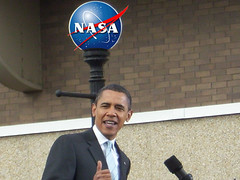
  • Obama lays out bold and visionary revised space policy | Bad Astronomy

    President Obama gave a speech at NASA’s Kennedy Space Center today to outline his new, revamped space policy.

    You may remember that his last revamping caused quite a stir, with people screaming that it would doom NASA. I disagree. Canceling Constellation still strikes me as the right thing to do, because it was becoming an albatross around NASA’s neck. Mind you, this was also the recommendation of the blue ribbon Augustine panel. You may also note that NASA astronauts are split over all this, with Buzz Aldrin, for example, supporting Obama, and Neil Armstrong and many others disagreeing.

    It’s a mess, and hard to disentangle what everyone’s saying. There’s been a huge amount of misinformation about it (with — shocking — Fox news leading the way; they spout so much disingenuousness, nonsense, self-contradiction, and outright stupidity that it makes me want to fly to their studios just to slap them). But Obama’s plan seems pretty clear.


    The New Space Policy Plan

    1) As before, NASA’s budget will be increased in the new plan. Let me repeat that: NASA’s overall budget will go up. And not just a little; we’re talking $6 billion over the next five years. A lot of that goes into scientific research. So far from it being doom and gloom, that’s good news.

    2) A new heavy-lift rocket will be developed. Let me repeat that as well: funding is provided for NASA to create a new heavy-lift vehicle. So yes, Constellation will be canceled, but a new system will be developed that (hopefully) will be within budget and time constraints.

    nasa_orion3) The Orion capsule, based on Apollo capsule legacy, will still be built. Initially it will be for space station operations as an escape module, but can be adapted later for crewed space missions.

    4) He wants NASA to plan manned missions to near-Earth asteroids in the 2020s, and to Mars in 2030s, but no return to the Moon.

    OK, so what do I think of all this?


    My opinion on the new space policy

    1) The increase in NASA’s budget is most welcome. Some of this goes to climate change studies (which the denialists will rant and scream about, but too bad). Some goes to science, some to education. All in all, given NASA’s minuscule budget, any increase rocks. And a lot of this goes into space science.


    2) This new rocket proposal makes me very happy. As I have stated repeatedly, NASA keeps going from one project to another without a clear goal or a streamlined system of attaining it. The Shuttle, as amazing as it is, was a terrible project once it was realized — hugely over budget, hobbled massively from what it should have been able to do, and unable to provide cheap and easy access to space with a fast turnaround. Ditto for the Space Station; it became a political pork barrel project and instead of a sleek engineering wonder it became another bloated project with no clear goal.

    Some people are complaining that we’ve already sunk $10 billion into Constellation, and we shouldn’t throw that money away. I think that’s a red herring. If Constellation was a waste of money, then we need to staunch that flow. I’m not saying it was, but I’m pointing out that you need to show me that the system was not a waste of money first before complaining that we can’t cancel it after spending that much.

    As Elon Musk, head of Space X, said in a press release:

    The President quite reasonably concluded that spending $50 billion to develop a vehicle that would cost 50% more to operate, but carry 50% less payload was perhaps not the best possible use of funds. To quote a member of the Augustine Commission, which was convened by the President to analyze Ares/Orion, “If Santa Claus brought us the system tomorrow, fully developed, and the budget didn’t change, our next action would have to be to cancel it,” because we can’t afford the annual operating costs.

    Mind you as well that this money already spent won’t be wasted. It’s not like we have a lot of rockets sitting around gathering dust. That money was spent on developing technology, knowledge, and experience that will go into any new system created.

    I’ll note that the cancellation of Constellation means a loss of many jobs. This new plan should restore a lot of them. I’d be interested in seeing a balance sheet for that.

    Another complaint with little or no merit (coming from a lot of folks, including the insipid talking heads on that Fox link above) is that once the Shuttle is over, we need to borrow a lift from the Russians to get to space. As much as I’d like to see us with our own, independent, and healthy space program, I don’t see riding with the Russians as entirely a bad thing. It’s cheaper than the Shuttle, by a large amount. The bad political decisions involving NASA for the past forty years have put us in this predicament, not anything Obama has done over the past 15 months.

    And I’ll remind you that this predicament really started rolling when the Bush Administration and NASA decided to stop the Shuttle program with no replacement possible for at least four to five years after the last Shuttle flight. Even if Obama had done nothing; we’d still need the Russians’ help to get into space.

    And it’s only temporary. Under Obama’s plan we’ll have a new rocket system around the same time Constellation would’ve gotten going anyway.

    As far as relying on private space, I have been clear about that: NASA should not be doing the routine, like going to low Earth orbit. Let private companies do that now that the technology has become attainable by them. NASA needs to innovate. And I’ll note that NASA has relied on private space venture — Boeing, Lockheed, and many others — for decades. This is hardly new.


    3) As an adjunct to everything I just wrote above, the Orion legacy capsule project will continue, underscoring my point. We’re taking the knowledge gained over the past few years and applying it to new technology. I rather like Orion, and I’m glad it’s not going away.


    4) Well, here’s where I think the new policy falls short. I strongly support missions to near-Earth asteroids. These rocks are areal threat to life on Earth, and the more we know about them the better. Getting to them via rocket is actually easier in many ways than getting to the Moon, so these kinds of missions are cost-effective, and we can learn vast amounts from them. And we would also gain critical experience in visiting asteroids that could come in handy if one has our name on it.

    I’m not as gung-ho on getting to Mars because I think the engineering and knowledge needed to put humans on such a long trip is not where it needs to be yet. So how do we get that knowledge? By going back to the Moon.

    Obama specifically downplayed a return to the Moon, and it seems he said that we won’t be doing that. I think that’s a huge mistake. Yes, we’ve been there before, but that was a totally different set of missions. That was a race to win, not to stay. A lot of science was planned and obtained for the Apollo missions, but it wasn’t sustainable. Stopping now — especially with a heavy-lift vehicle on the horizon — is a tremendous waste of an opportunity.

    Going to Mars depends critically on knowledge learned on going back to the Moon and staying there. So on this point I disagree with Obama’s new plan.


    Conclusion

    Obama has clearly been listening to both supporters and critics (imagine that!). It almost sounds like he’s been reading my blog (I wish). Bill Nelson, a Democratic Senator from Florida, was vocally opposed to Obama’s initial plan, but accompanied him to this speech. That indicates to me that they have been talking — certainly about the politics, but also about the nuts and bolts — about all this. Obama’s change in plans to continue Orion and more concrete plans for a heavy-lift vehicle clearly come from listening to his critics.

    Certainly, this revamped policy the right political move for him; Congresscritters from NASA centers were pretty unhappy about that first policy of privatization. But it’s also the right thing to do.

    Obama, in this speech, stated specifically he wants us to be the dominant world power in space. He says that under this new plan, we will actually be sending more astronauts into space in the next decade than we otherwise would have. If his plans are accepted by Congress, if they are funded at the levels requested, and if NASA can implement them, then I think the President is correct.

    My overarching desire: that NASA have a clear goal, an actual set of specific, visionary destinations that will inspire the public and make us proud of our space program once again. Part of that desire is for this to have political support and funding to make it possible. Too often, NASA has been told to go do something but not given the money to do it, and that’s a major factor that we’re where we are right now.

    Obama’s new policy, with one exception, will give NASA what it needs to be visionary again. That one exception — not returning to the Moon — is a strong one for me, and I will see what I can do to get it put back in. I’m just one guy, but I’ll talk to folks and see what trouble I can stir up.

    In the meantime, I’ll also caution that at this moment, these are just words from the President. Good words, and hopeful ones, but just words. It will take deeds to see this through: a clear plan by the White House, cooperation from Congress, and a commitment from NASA to see this policy through.

    If those things can happen, then for NASA, for America, and for humanity, then the sky is no longer the limit.

    Per ardua, ad astra.


  • ClimateGate Inquiry: No Scientific Misconduct From “Squeaky Clean” Researchers | 80beats

    Planet earthMonths after the hack heard ’round the world, the independent review is finished. A panel of 11 led by the University of Oxford’s Lord Oxburgh investigated the Climatic Research Unit at the University of East Anglia, whose researchers were accused of manipulating data based on information gleaned from thousands of stolen emails. The panel’s conclusion: The scientists did not intentionally distort the truth, though their statistical rigor leaves something to be desired.

    “We saw no evidence of any deliberate scientific malpractice in any of the work of the Climatic Research Unit and had it been there we believe that it is likely that we would have detected it,” says the Oxburgh report. “Rather we found a small group of dedicated if slightly disorganised researchers who were ill-prepared for being the focus of public attention” [Nature]. This conclusion came after interviewing people within the organization and combing through the data in 11 of the center’s peer-reviewed papers published over the span of 22 years.

    Oxburgh found the researchers “squeaky clean” in terms of their intentions—and that’s what this was, an investigation of the scientist’s integrity, not their results. But, the panel found their methods to be somewhat lacking. Specifically, the report says, “We cannot help remarking that it is very surprising that research in an area that depends so heavily on statistical methods has not been carried out in close collaboration with professional statisticians.” The university issued its own statement after the Oxburgh report’s release, including this response to the charge that they didn’t use the best statistical methods available:

    Specialists in many areas of research acquire and develop the statistical skills pertinent to their own particular data analysis requirements. However, we do see the sense in engaging more fully with the wider statistics community to ensure that the most effective and up-to-date statistical techniques are adopted and will now consider further how best to achieve this.

    Another area for suggested improvement is in the archiving of data and algorithms, and in recording exactly what was done. Although no-one predicted the import of this pioneering research when it started in the mid-1980’s, it is now clear that more effort needs to be put into this activity.

    However, some of the panelists noted, even adjusting for newer statistical models didn’t alter the conclusions. David Hand, who is the president of Britain’s Royal Statistical Society and sat on the Oxburgh panel, dug into the infamous “hockey stick” chart of global temperatures by Penn State’s Michael Mann during his investigations. Hand agrees with Mann: he too says that the hockey stick – showing an above-average rise in temperatures during the 20th century – is there. The upward incline is just shorter than Mann’s original graphic suggests. “More like a field-hockey stick than an ice-hockey stick” [New Scientist], he says.

    Related Content:
    DISCOVER: It’s Getting Hot In Here, our interview with climate rivals Michael Mann and Judith Curry
    80beats: Climatologist Steps Down As “ClimateGate” Furor Continues
    Cosmic Variance: ClimateGate, Sean Carroll on the controversy
    Bad Astronomy: The Global Warming E-mails Non-Event

    Image: iStockphoto


  • New HD video-out plug for phones in the works

    mobilehdmi

    Nokia Corporation, Samsung Electronics Co., Ltd., Silicon Image, Inc. , Sony Corporation  and Toshiba Corporation today announced the formation of the MHL™ (Mobile High-Definition Link) Consortium to develop a new mobile audio/video interface standard for directly connecting mobile phones and other portable consumer electronics (CE) devices to high-definition televisions (HDTVs) and displays. The MHL standard features a single-cable with a low pin-count (and therefore smaller) interface able to support up to 1080p high-definition (HD) video and digital audio while simultaneously providing power to the mobile device. The MHL Consortium is also announcing the availability of an abridged draft specification available for review at www.mhlconsortium.org.

    The MHL Consortium was established by the Mobile High-Definition Interface Working Group announced on September 28, 2009 and is responsible for developing, licensing and promoting the new mobile connectivity technology as an industry standard open to anyone desiring to become an adopter and enabling the development of compliant mobile and display products across a broad connectivity ecosystem. Products implementing MHL technology will feature:

    · HD Video and Digital Audio

    Consumers will be able to display HD video content with up to 1080p picture quality and digital audio from their mobile device on an HDTV.

    · Low Pin-Count Interface

    HD video and digital audio is transmitted via a low pin-count interface simultaneously providing data, control and power, which allows mobile devices to maintain their small form factor and keep implementation costs low.

    · Provision of Power to the Mobile Device

    Digital HD content can be output from the mobile device over a single cable while power is provided to the device.  For example, a mobile phone can play back a full-length movie on an HDTV without draining power, so when the playback is completed the mobile phone can continue to be used for other purposes, such as calls and emails.

    · Content Protection

    High-bandwidth Digital Content Protection (HDCP) technologies protect high-value digital motion pictures, television programs and audio against unauthorized interception and copying.

    Silicon Image had previously developed a physical connector on which the standard will be based, and importantly the connector was also compatible with the USB standard, making it useful as a general purpose connector rather than just a new mini-HDMI replacement.

    Now that microUSB is just catching on, do we really need another connector?  On the other hand, with our devices set to become particularly media-heavy, now may just be the right time. Let us know your thoughts below.

    Via Phonescoop.com


  • NEWS RELEASE: Building Sector in South Asia Benefits from Going Green

    “Green” building retrofits or new construction can protect the Asian real estate sector from increasing environmental risks emerging in the region, according to a new report released by the World Resources Institute (WRI) and HSBC’s Climate Change Centre of Excellence.

    The report, Surveying Risk, Building Opportunity, assesses the commercial building sector in India, Indonesia, Malaysia, the Philippines, Thailand and Vietnam and the financial impacts it could face from energy insecurity, water scarcity and climate change. The report finds that green building investments can alleviate these risks in addition to achieving a positive return for building owners in a few years.

    “The environmental challenges and resource constraints these countries have been experiencing will intensify and can result in increased utility, operating and construction costs for building owners,” said Shally Venugopal, an associate at WRI and lead author of the report. “Incorporating green features into design and construction can save real estate companies money, especially for energy use, and can increase occupancy rates and even rent premiums.”

    According to the report, electricity prices are expected to increase as demand continues to rise, particularly in cities with weak electricity infrastructure. Most of the energy used by commercial buildings in the region goes toward air conditioning and lighting. In India, for example, lighting accounts for 60 percent of the energy used in commercial buildings while 32 percent goes toward air conditioning.

    The region’s water constraints will also cause utility costs to rise. India, in particular, faces severe water availability and quality constraints in many areas. One estimate by the World Bank suggests that India will exhaust all available freshwater supplies by 2050.

    The other focus countries will see localized water scarcity near major cities due to population growth and changing rainfall patterns. In Vietnam, the amount of freshwater consumed has tripled and in Malaysia and India it has doubled in the last two decades. This will not only lead to increasing water costs but will also affect the electricity grid since power generation depends heavily on water resources.

    Major Indian cities already see power outages weekly. During peak season, Bangalore loses power an average of 1.5 hours a day while Kanpur loses power an average of 7 hours a day. In addition to losing power, the price of electricity will also increase.

    As part of the study, HSBC’s analysts conducted a case study on the Indian real estate sector and the materiality of environmental factors. They found that for a typical commercial building (300,000 square feet) in Mumbai, a 1 percent increase in electricity costs could increase annual operating costs by approximately Rs 2.8 million, or around USD 60,000.

    Building owners could protect themselves from energy price hikes by investing in energy efficient lighting, such as targeted task lighting, that could reduce energy demand by 20 to 25 percent. HSBC estimates that a 10 percent increase in energy costs would only increase operating costs in a green building by as little as only half as much compared to a typical building.

    As the region sees increased rains, flooding, storms and landslides, weather-related insurance premiums for buildings could also increase. Jakarta, where 40 percent of land is below sea level, is especially vulnerable. Flooding in 2007 caused building insurance premiums to increase by 25 percent in 2008.

    Building owners can protect themselves from damage caused by extreme weather events by examining climate risks for prospective sites even before purchasing land. Buildings can be designed to minimize damage from floods and storms by incorporating features such as flood vents and barriers, water-resistant flooring (e.g., tiles versus carpeting), and landscaping and exterior features that incorporate storm water management (e.g. rain gardens).

    “Green buildings can protect investors from volatile and increasing power prices,” said Nick Robins, head of HSBC’s Climate Change Centre of Excellence. Roshan Padamadan, a HSBC analyst at the Centre, said “Our analysis shows that the upfront investment can payoff in as little as 3 years.”

    Though green buildings are gaining momentum in the region, barriers to growth exist, such as the availability of local green building materials and expertise. The report recommends that governments create appropriate market incentives and institute stricter building codes to enable the green building movement to flourish in South and Southeast Asia.

    This is the last report in a three-part series. Weeding Risk, the first report, analyzes environmental trends on the food and beverage sector in South and Southeast Asia. The second report, Over Heating, analyzes the power sector in the region.

  • Preview of the Coming Tax Wars

    The Bush tax cuts are scheduled to expire at the end of the year. Barack Obama has repeatedly said he wants to extend the cuts for 98 percent of households, or those making less than $250,000. If he gets his wish, that’s just the beginning of the story.

    The White House is considering “limiting an extension of the popular middle-class tax cuts to a year or
    two,” according to the New York Times. Why? First, they want to shrink the deficit projections. Second, Democrats expect to overhaul the tax code before 2012.

    Both parties know that a showdown over tax law is brewing, and Washington lobbyists can smell the brew. In the short term, the battleground will be the Bush tax cuts. Republicans will argue that you can’t roll back tax cuts (that is, raise taxes) on upper-middle class earners during a slow recovery. Democrats will argue that we’re a safe distance from the recession, the federal coffers are starving for more revenue, and returning the top marginal rates to their 2000 levels to capture $678 billion of revenue until 2020 is a justifiable corrective at a time when the top five percent of earners take home the highest share of total income in more than five decades.

    Act One will be tax cut rollback. Act Two will be tax reform. What will that look like? Many experts expect a value-added tax might appear to help offset reductions in income, payroll or corporate taxes. Others expect broad, tax-neutral reform along the lines of the Wyden-Gregg tax simplification plan (read about some of its features here). The theme coming out of sensible liberal and conservative corners is that we should broaden the base of taxable income in exchange for lower tax rates. But what does that even mean? Let’s consider some examples.

    Take the interest you might pay on your mortgage. Currently, taxpayers can deduct mortgage interest and property taxes on their homes. But this is a troublesome tax subsidy for a few reasons. It’s regressive because most of the support goes to high-income households with valuable mortgage interests that are worth itemizing. It also encourages Americans to take on more debt, and we’ve seen where those kind of incentives can lead us. The Tax Policy Center analyzed what would happen if you eliminated the mortgage interest subsidy and cut all marginal tax rates by 1.8% to make it revenue-neutral. This chart explains how that base-broadening/rate-lowering swap would affect our after-tax income:

    Mortgage deduction tax swap.pngAlmost the entire top quintile sees less after-tax income, especially in the 90-99 percentiles. The bottom four quintiles would see their after-tax income rise. So despite cutting tax rates, broadening the tax base tends to be progressive, punishing the highest earners and benefiting the rest of us, right?

    Not so fast. TPC also considered what would happen if we eliminated the three most valuable income tax expenditures on health care (the exclusion of employer-supplied insurance (ESI) premiums and medical care, the deduction for self-employed health plans, and the itemized deduction for medical expenses). Offsetting the larger tax base was achieved by slashing all marginal rates by 2.48%. Here’s what the after-tax income picture looks like:

    health subsidy.png

    The outlook turns regressive. The folks in the second quintile get knocked the hardest. The top one percent wins out.

    To sum up, revenue neutral tax reform that eliminates the mortgage deduction helps the middle class at the expense of the rich. Revenue-neutral tax reform that eliminates the health care exclusion hurts the middle class and enriches the top percentiles.

    Why wade into these numbers anyway? It’s important to remember that if tax reform rides into Washington on the promise of broad revenue-neutrality, that doesn’t mean reform will be revenue-neutral for each quintile. Major tax reform that seeks to eliminate key deductions will benefit certain parts of society and cost others. In Act One, Republicans will holler about the ever-increasing tax burdens of the rich. In Act Two, it will get a lot more complicated.


    Email this Article
    Add to digg
    Add to Reddit
    Add to Twitter
    Add to del.icio.us
    Add to StumbleUpon
    Add to Facebook


  • Another Day, Another Rally: Here’s What You Need To Know

    Ash Cloud

    Of course the indices closed up today. Next stop? Dow 12,000, baby!

    DJIA: Up 21 points to 11,144.

    NASDAQ: Up 10 points to 2515.

    S&P 500: Up 1 points to 1211.

    Commodities:

    • Oil: Down 0.41% or $0.35 to $85.49 a barrel.
    • Gold: Up 0.01% or $0.10 to $1159.70 an ounce.
    • Silver: Up 0.05% or $0.01 to $18.43 an ounce.

    Now here’s what you need to know as you leave work today:

    • U.S. homebuilder sentiment rose in April as a result of buyers trying to take advantage of tax credits before they expire. The index jumped to its highest level since September 2009.
    • The Philadelphia Federal Reserve’s business activity index and the New York Federal Reserve’s “Empire State” manufacturing index both rose more than expected, with the New York index reaching a 6 month high.

    Join the conversation about this story »

  • IBM Helps Florida Predict Just How Delinquent Your Child’s Going To Be

    We’ve covered several different instances where the country has been taking baby steps toward the kind of precognitive crime prevention featured in the movie Minority Report — sans naked gibbering women floating in bathtubs. The most recent effort was courtesy of the Homeland Security Department, who is busily developing a body language analysis prediction system dubbed "Future Attribute Screening Technologies" (FAST) — which aims to detect "shifty" people who may be getting ready to commit a crime of some sort (or just drank way too much coffee).

    More common approaches simply involve software that analyzes a database of offenders and cherry picks out the most likely future offenders (very popular in the UK), or analyzes crime patterns to predict future criminal trends. Along those lines, it looks like the Florida Department of Juvenile Justice has decided to start using IBM predictive analytics software (via Gizmodo) to help them determine which of the 85,000 kids who enter their system each year poses the biggest future threat. IBM has this to say about the new system — which was an upgrade from Excel:

    "Predictive analytics gives government organizations worldwide a highly-sophisticated and intelligent source to create safer communities by identifying, predicting, responding to and preventing criminal activities. It gives the criminal justice system the ability to draw upon the wealth of data available to detect patterns, make reliable projections and then take the appropriate action in real time to combat crime and protect citizens."

    Of course many of these patterns simply become evident when people bother to pay attention and use their intellect, and these tools are often just an extension of that. When prediction technology is used, the technology will only be as good as the people using it (in this case to choose rehabilitation paths for kids). But you still have to wonder how accurate these kinds of systems are and how independently verifiable the evidence will be. Can kids who feel they were unfairly, preemptively declared to be bad asses in 2014 see the "reliable" source code?

    Permalink | Comments | Email This Story


  • MLB goes the green way

    baseball.jpegIn view of the policies adopted by certain clubs to use renewable energy, to recycle waste and to educate fans regarding environmental issues in collaboration with the NRDC, the MLB is going to collect data regarding various usage patterns from different venues and analyze it from an environmental point of view. The Boston Red Sox, Cincinnati Reds, Kansas City Royals, Philadelphia Phillies, and the Seattle Mariners are some of the clubs whose programs are selected for this purpose. The data collection scheme will focus on, calculating the total energy used, sources of energy, and amount of renewable energy used. Apart from this it will also calculate, the amount of the waste generated, the fraction of waste sent for recycling, and cost of disposal. The program will also look to quantify, the total amount of water used, the amount of water conserved and will suggest optimized usage patterns according to the cost. The data collection will also focus on the amount of paper required and the amount of recycled paper used.

    This data collection policy is a great way to conserve resources because monitoring is the first step in reducing.
    [environmentalleader]

  • Ferrari 250 GTO Series 1: Four Wheeled Magnificence


    Ferrari 250 GTO (Series 1)

    The above video reminds us of why the world is so enamored with Ferrari. Take the subject we see here – the Ferrari 250 GTO Series 1… Que Bella! Only 36 were ever made between 1962-1964 and because of this their prices are usually sent into the stratosphere when they come up for bid at auction. Its big V12 engine puts out a modest 300 HP. Keep in mind that these cars were race cars first and street cars second, that should give some insight into their real pedigree. If you can find one of these rare gems and have the green, by all means pick it up and enjoy one of the most desirable automotive creations ever built.