Blog

  • UT Knoxville’s Nuclear Engineering Graduate Program in Nation’s Top 10

    KNOXVILLE — The University of Tennessee, Knoxville’s nuclear engineering graduate program is now a top 10 program, according to the U.S. News and Word Report 2011 graduate rankings. The program was ranked ninth in the country, rising three spots from last year.

    UT’s law, education and logistics programs also were ranked among the best in the nation. Each spring, the magazine ranks graduate programs in a variety of academic disciplines among public and private colleges and universities in the United States.

    “Growing and enhancing our graduate programs is a top priority for the University of Tennessee, Knoxville,” said Chancellor Jimmy G. Cheek. “Along with these top-ranked programs, we seek to build upon our other graduate degree and professional programs. We’re improving our opportunities for fellowships and assistantships that will help us attract more graduate students which, in turn, will enhance our creative and scholarly activity and ultimately our economic impact on the local and state economy. Increasing the number of doctoral students we produce is a key element in our becoming a top 25 university.”

    College of Engineering Dean Wayne Davis said the college’s latest rankings will help recruit highly qualified candidates for the UT Knoxville-ORNL Graduate Fellowship Program, a new program designed to attract top graduate students in science and engineering.

    “In view of the resurgence of interest in the nuclear engineering field, I am pleased to see that our nuclear engineering graduate program was ranked ninth in the country by the U.S. News and World Report,” he said. “We are anticipating a renewed emphasis on graduate student recruiting throughout the College of Engineering with the new UT Knoxville-ORNL Graduate Fellowship Program, and the fact that our nuclear engineering program is one of the best in the country will be a definite asset in attracting high-caliber candidates to UT.”

    UT’s College of Engineering’s overall graduate program was ranked 43rd among public universities and 73rd nationally.

    UT’s College of Business Administration’s supply chain and logistics graduate program, which has been consistently ranked among the best by U.S. News, was ranked seventh among public universities and 12th nationally.

    The College of Law’s clinical training program was ranked seventh among public universities and 18th nationally. The overall law program ranked 29th among all public universities and 60th nationally.

    “Our clinical programs represent the best of what we do — training future attorneys through a unique connection between legal theory and practice,” said Douglas Blaze, dean of the College of Law. “We also are proud that the overall law program has been able to maintain its place among the best nationally despite challenges and budget constrictions. We will continue to build on our strengths to improve our standing as one of the best public institutions for training lawyers.”

    The College of Education, Health and Human Sciences’ overall graduate program ranked 33rd among public institutions and 47th nationally in the new 2011 report.

    Three additional College of Engineering specialty programs were ranked. The college’s civil engineering program ranked 39th among public universities and 58th nationally; the electrical engineering program ranked 38th among public universities and 66th nationally; and the mechanical engineering program ranked 39th among public universities and 67th nationally.

    Each year, U.S. News ranks graduate programs in the areas of business, education, engineering, law and medicine. These graduate rankings are based on two types of data: expert opinion about program quality and statistical indicators that measure the quality of a school’s faculty, research and students. For the rankings in all five areas, indicator and opinion data come from surveys of more than 1,500 programs and some 12,400 academics and other professionals that were conducted the previous year.

    Several other programs are ranked alternately, every four years. Other UT graduate programs that appear in the new report for their most recent rankings include:

    • The College of Veterinary Medicine’s graduate program ranked 11th among public universities and 14th nationally in 2007.
    • The College of Social Work’s graduate program ranked 15th among public universities and 26th nationally in 2008.
    • The School of Art’s MFA in printmaking ranked third among public universities and fourth nationally in 2008; the overall MFA program was ranked 24th among public universities and 50th nationally in 2008.
    • The College of Nursing’s graduate program ranked 48th among public universities and 72nd nationally in 2007.
    • The College of Allied Health Science’s graduate speech pathology program ranked 25th among public universities and 30th nationally in 2008.

    U.S. News ranked UT Knoxville 52nd among public universities and colleges in its list of best schools for undergraduate education in the 2010 report.

    The 2011 graduate rankings are now online. U.S. News also will feature the material in its annual America’s Best Graduate Schools guide book.

    C O N T A C T :

    Kristi Hintz, [email protected], (865) 974-3993

  • Bagram detainees allege torture at secret US prison in Afghanistan: BBC

    [JURIST] Nine Afghan witnesses have claimed that they were held and tortured in a secret US prison at the Bagram Air Base in Afghanistan, according to a BBC report Thursday. The witnesses say that they were allegedly captured by American forces and taken to a secret location where they were abused and interrogated, then later transported to an official detention facility in Parwan, a new prison recently opened at the edge of Bagram Air Base. Torture allegations include sleep deprivation, disorientation, beating, and humiliation tactics. The report comes a few weeks after US President Barack Obama made a surprise visit to the base in Afghanistan. The new US prison has room for 1,400 detainees, is part of the Obama administration’s wider efforts to improve its Afghan detainee system, and will eventually be controlled by the Afghan government later this year. Rights groups have previously called on the Obama administration to make sure its detention policy conforms to international law. Despite the alleged witness accounts of torture, the US government continues to deny the existence of secret prisons in Afghanistan.
    Alleged prisoner abuse linked to the war on terror in Afghanistan has received international attention. Last week, a retired Canadian military officer who served in Afghanistan said that Canadian soldiers believed that prisoners may have been abused after being transferred to prison facilities in Afghanistan. Human rights groups have also criticized military procedures in the country. Earlier this month, the American Civil Liberties Union (ACLU) filed habeas corpus petitions on behalf of four detainees held at Bagram Air Base, claiming that none of the men has engaged in hostile behavior directed at the US, nor are they members of groups that purport to do so. In January, the US Department of Defense released a list of names of 645 prisoners detained at Bagram in response to a Freedom Of Information Act lawsuit filed by the ACLU last September. Prisoners at Bagram have launched previous habeas corpus challenges in US courts but thus far have been less successful than those held at Guantanamo Bay.

  • Europe’s Newest Green Energy Sources: Pedestrians and Body Heat | Discoblog

    WATTRobinUtrechtEPA4It was a green idea that boogied straight off the dance floor and onto the city streets. Residents in the French city of Toulouse are testing out a special stretch of pavement in the city center that produces energy every time someone walks across it.

    The pavement is embedded with special sensors that convert energy from motion into electricity. It’s an idea that was first implemented in a Rotterdam nightclub by the Dutch company Sustainable Dance Club (SDC), where the company installed special modular dance floors that harvested the dancers’ energy.

    City authorities in Toulouse hope to replicate that system in the city center; as people walk across the special pavement, they’ll help generate between 50 and 60 watts of electricity. Energy captured during the day would be stored in a battery that could be used to power a nearby street lamp at night.

    French authorities are powering ahead with the testing despite concerns about the system’s high cost, and have already overcome several problems along the way. The Guardian reports:

    The prototype of the modules, said [City deputy mayor Alexandre] Marciel, was unsuitable for street use as “at that stage they only worked if you jumped on them like a kangaroo. So a model was developed on which you can walk normally and still produce enough energy to power the lights,” he said.

    Meanwhile, in Sweden, experts have figured out a way to harness body heat from morning commuters at the busy Stockholm station and transfer it to the heating system of a nearby building. It’s a system that is already in use at the Mall of America in Minneapolis, but the Swedes have worked out a way to move the heat between buildings.

    The station is toasty in the morning as more than 250,000 Swedes rush about getting to work; the station’s ventilation system traps their body heat, which is then used to warm water in underground tanks. That water is then pumped through pipes to a nearby 13-story building about 100 yards away and used to heat that building. In the long run, experts hope to lower energy costs in the new office building by at least 20 percent each year, all for an initial investment of just $30,000, writes Time magazine.

    Related Content:
    Discoblog: Copenhagen Hotel Lets Guests Pedal-Power Their Lightbulbs
    Discoblog: Musical, Fahrvergnügen-Inspired Staircase Makes Commuters Less Lazy
    80beats: New “Nanogenerator” Could Power Your iPod With Your Own Movements
    80beats: Green Makeover Aims to Cut Sears Tower Electricity Use by 80%
    80beats: Windmills on NYC Skyscrapers Sound Cool, but Wouldn’t Work

    Image: SDC


  • Way Too Early Look: Defensive Line (updated)

    Last season the defensive line was the anchor of the team, and one of the best (if not the best) units in the entire country. In 2010, the line will look to continue the dominance they established in 2009, but will be missing a few key players as well as a lot of quality depth.

    Luckily, there are also lots of young players in the pipeline itching to get on the field, giving Buckeye fans some competition to look forward to in the spring.

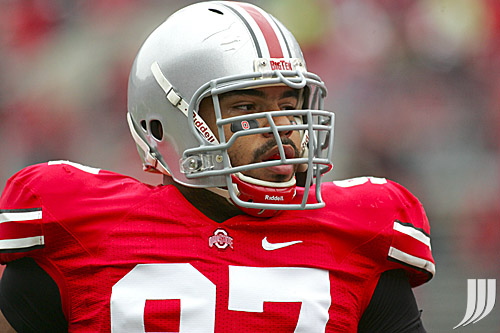
    Perhaps most importantly for the line, Cameron Heyward chose to pass up NFL dollars and is staying in Columbus for one last go around in scarlet and gray. Heyward was the best player on a great defensive line last year and his return is a huge steps towards continued excellence on defense.

    Best case scenario? Heyward pulls a Ndamukong Suh in his senior season.

    That is setting the bar pretty high, and I don’t really expect Heyward to be in the running for the Heisman, but a Suh-like level of domination is certainly within the realm of possibilities for him.

    Yeah, his decision to return is a pretty big deal.

    Outside of Heyward, Ohio State has a a few other players returning from the rotation last season, and a few young guys with a ton of potential looking to get on the field for the first time. Join me after the jump for an in depth look at each position along the defensive line and the players that will be playing them.

    I guess we will start with a quick breakdown of how the Ohio State defensive line is organized.

    Over time, the line has moved from a straight 4-3 style defense to a hybrid system where one of the defensive ends doubles as a pseudo-outside linebacker. This position, as far as I can tell, is known as the LEO.

    You could see this move towards a hybrid system as far back as 2002 with Will Smith dropping back into coverage from his end position. In 2005 Bobby Carpenter took the LEO position to a whole new level. He was the first player who was primarily a linebacker to be used in this role.

    The coaches seemed to like what Carpenter brought to the position, and since 2005 the hybrid end has become more and more a part of the defensive scheme for Ohio State.

    This move towards a hybrid system has resulted in two distinctly different defensive ends. On the strong side are your bigger, stronger defensive ends while on the LEO side you have smaller, quicker players that are primarily pass rushers and athletic enough to drop back into coverage.

    Now that we have that covered, time to move into the positions.

    Strong Side End


    Strong side end happens to be the primary position of the previously mentioned Cameron Heyward, so there is little question about who will be starting here.

    Last year, Heyward recorded 46 tackles, including 10 tackles for loss and 6.5 sacks. While those numbers might not be overwhelming, games like Penn State (11 tackles, 3 tfl, 2 sacks) showcase the level of dominance that he is capable of achieving.

    Heyward will be getting a lot of attention from apposing offenses next season and will most likely be the target of many double teams. At the same time, he has the versatility and size to play inside or outside along the line. Based on these two things, it will be interesting to see 1.) how effective Heyward is against double teams and 2.) if Ohio State can move him around on defense in a way that minimizes the ability of offenses to focus their blocking schemes around him.

    After Heyward, things get interesting. Long time members of the defensive line rotation Robert Rose and Lawrence Wilson are gone, leaving an opening for some young players to step in. The most likely candidates to back up the strong side are Keith Wells and Melvin Fellows.

    Wells will be a redshirt junior. He has been in the program for several years but has yet to see significant action in games.

    Fellows is a redshirt freshman who suffered an injury last season that cost him the entire year.

    Both are relatively unknown commodities at this point, so they are worth keeping an eye on during spring practice to see if either establishes themselves as a part of the line rotation. Also worth keeping an eye on is incoming freshman Darryl Baldwin.

    Baldwin has a huge frame at 6′7″ 250 lbs. which is the ideal size to be a strong side defensive end.

    That being said, unless something goes bad ahead of him, Baldwin will most likely redshirt, leaving the depth chart looking something like this.

    Year # Name Height Weight GP/GS Tackles TFL Sacks
    Senior 97 Cameron Heyward 6′6″ 288 lbs. 13/12 46 10 6.5
    Junior 94 Keith Wells 6′5″ 257 lbs. 1/0 0 0 0
    RS Freshman 91 Melvin Fellows 6′5″ 249 lbs. 0/0 0 0 0

    Update: the spring depth chart has Melvin Fellows listed ahead of Keith Wells.

    LEO


    As I mentioned, the LEO position features a smaller, quicker defensive end.

    Last year Thadeus Gibson played the LEO position and played it well. Following the season, Gibson decided to take his game to the next level, however, meaning that the Buckeyes will be looking to replace his 45 tackles, 13 tackles for loss, and 4 sacks this season.

    Replacing Gibson’s production at the LEO position is nothing to take lightly, but the Buckeyes have Nathan Williams waiting to do just that.

    Williams has been a consistent part of the line rotation since he (somewhat surprisingly) broke onto the scene as a true freshman in 2008. He had 18 tackles, 4 tackles for loss, and 2 sacks that year in only 9 games. Not too shabby.

    As a sophomore last season, Williams played in all thirteen games (including one start) and recorded 26 tackles, 8 tackles for loss, and 3.5 sacks. So while losing Gibson is a hit, Williams is primed to step in without much of a drop off.

    Williams has plenty of experience and is clearly the favorite to start at LEO next year, but like the strong side, the players looking to back him up do not have much game experience. The main contenders to back up Williams will be Solomon Thomas and Jonathan Newsome.

    Thomas is a redshirt junior who has played in 13 games over his career, including eight games last year. In those eight games, he recorded 6 tackles. So yeah, not exactly extensive experience, especially in terms of production, but not exactly green either.

    Newsome is a sophomore who played in 5 games last year as a true freshman and recorded 5 tackles. So once again, pretty inexperienced but not entirely.

    Also in the mix are some incoming freshman. J.T. Moore, David Durham, and Jamel Turner are all possible candidates for the LEO position.

    Before practice gets underway, it is safe to assume that the older guys will get the first crack at the position and the younger guys will redshirt (unless they really impress), leaving the depth chart at LEO looking something like this (which, of course, is subject to change once practice gets under way).

    Year # Names Height Weight GP/GS Tackles TFL Sacks
    Junior 43 Nathan Williams 6′4″ 245 lbs. 13/1 26 8 3.5
    RS Junior 98 Solomon Thomas 6′5″ 240 lbs. 8/0 6 0 0
    Sophomore 55 Jonathan Newsome 6′3″ 230 lbs. 5/0 5 0 0

    Update: Newsome hasn’t practiced all spring (probably due to academic issues) and is listed on the depth chart at strong side linebacker, replacing him on the LEO chart is Stewart Smith.

    DT


    Unlike the ends, there isn’t much of a destination to be made between the two tackle positions. Having said that, I would say that one tackle is used as more of a run stuffer in the middle (Dexter Larimore style) while the other plays further on the edge and takes on the roll of a 3-4 end when the LEO drops into coverage (Doug Worthington style).

    That may have been a scheme to fit the personnel, however, and with the graduation of Doug Worthington who knows what we will end up with this year.

    The two best players will be on the field, and the schemes will match the personnel. So a scheme designed for Worthington may be scrapped in favor of another scheme that fits the current players better.

    Another thing to consider when it comes to the defensive tackles is that they are one of the most rotated positions on the team. So while there are technically two ’starters’ who literally start the game, in reality there are 3 or 4 players who could be considered starters at tackle based on the playing time that they receive.

    So, because of these two factors, I am going to list the tackles on one combined chart rather than break it down into two separate positions.

    At the top of the chart is returning starter Dexter Larimore.

    Larimore has played in a lot of games so far in his Buckeye career. 35 games with 8 starts to be exact, including 9 games and 5 starts last year in a season cut in half by injury. His injury kept him out of 4 whole games in the middle of the year and limited his ability to contribute in several others.

    Larimore did return to start in the Rose Bowl, and he should be 100% for next year. So yeah, Larimore has been around the block in the Big Ten and he should be an anchor on the interior of the defensive line.

    After Larimore, the loss of long time contributors Doug Worthington and Todd Denlinger will be felt. Worthington was a multiple year starter while Denlinger was player 1A behind Larimore, and when Larimore was injured Denlinger was the starter in his place.

    Like defensive end, the experience of the backups is lacking, but there is no lack of talent.

    One player that isn’t lacking in experience is John Simon, who is the clear number two behind Larimore heading into the spring. Simon played in 12 games last season as a true freshman, recording 15 tackles, 4 tackles for loss, and 1.5 sacks. Simon is a monster in the weight room and as the year progressed became more and more of a monster on the field.

    Based on his performance as a true freshman, I think that Simon has the ability to be one of the best tackles Ohio State has had since 2002. That all depends on his ability to continue to improve however, so keep an eye on that.

    Garrett Goebel is the next guy in the rotation and probably the first guy off the bench this year. Goebel played in all 13 games last season, so he has been on the field. It will be interesting to see what he does this year, especially since he is the most natural fit to replace Worthington.

    The fourth spot is between redshirt freshman Adam Bellamy and true freshman Johnathon Hankins. For right now I will go with Belamy first since he has had a year in the system, leaving the depth chart looking something like this. However, the fact that Hankins is one of the few true run stuffing style tackles on the team means that he has a chance to move way up depending on how he does in practice.

    Year # Names Height Weight GP/GS Tackles TFL Sacks
    RS Senior 72 Dexter Larimore 6′2″ 300 lbs. 9/5 20 0 0
    Sophomore 54 John Simon 6′3″ 265 lbs. 12/0 15 4 1.5
    RS Sophomore 53 Garrett Goebel 6′5″ 280 lbs. 13/0 2 1 0
    RS Freshman 93 Adam Bellamy 6′4″ 280 lbs. 0/0 0 0 0
    Freshman ? Johnathon Hankins 6′3″ 320 lbs. 0/0 0 0 0

    Update: this matches the spring depth chart exactly, with Goebel listed behind Larimore and Bellamy behind Simon. Jon Lorenz, Dalton Britt, and Don Matheney are also listed.

    Conclusion


    I am confident that between Cameron Heyward, Dexter Larimore, Nathan Williams, and John Simon, the starting defensive line for Ohio State will be very good in 2010. On the other hand, behind these four are some serious question marks. Losing five guys from the line will create question marks, even at Ohio State.

    But this is Ohio State, and there are plenty of talented young players ready to prove themselves on the field, they just haven’t had a chance yet.

    The depth won’t be as good as last year, especially at the beginning of the season. How good the line will ultimately be is in the hands of the young players and how well they perform.

    The battles between the young guys will be something to keep on eye on throughout the spring. Hopefully some of them can emerge, and maybe there will even be a few surprises. The line will be good in 2010, but depth is a real concern… at least for now.

  • Way Too Early Look: Linebackers (updated)

    Long time readers (if there are any of you out there) know that linebacker is my favorite position, so this should be fun. Adding to the fun is the absolutely ridiculous amount of talent that the Buckeyes are packing in the linebacking corps right now.

    Ohio State has depth, experience, talent, youth, and probably a few other things at linebacker going in to next year.

    The only loss from last year is fifth year senior Austin Spitler.

    Spitler was a solid performer for the Buckeyes last season (38 tackles, 5 tfl, 1 sack), and he did have some great moments, but there are several players waiting in the wings to take his place, and if there is any drop off at all, it should be minimal.

    It can’t be overstated how much talent Ohio State has here. So rather than getting out a thesaurus and trying to find some creative adjectives, I will simply jump right in.

    Join me after the jump for an in depth look at the 2010 Buckeye linebackers.

    First, I want to say that out of all of the positions, linebacker is one of the more difficult ones to guess what the depth chart is actually going to look like next year. The two returning starters are pretty easy to place, but outside of that, the competition for the third spot as well as who will be the primary back ups is going to be intense this spring and will continue right up until the first game and probably beyond.

    The good news is that high levels of competition makes everyone better, the bad news is that it is hard to predict who will end up where (and that is just me being selfish, there isn’t really any bad news about that).

    Throwing an extra kink into the process is the willingness Ohio State’s coaches have shown to move each player from position to position until they think they have the absolute best group of players on the field.

    Exhibit A for this willingness to shuffle linebackers is Brian Rolle. Heading into the spring last year, no one predicted that Rolle would be playing middle linebacker all season, but the coaches experimented and tinkered, tried out different players at different positions, and 95 tackles later, I would say we found a pretty damn good middle linebacker.

    While I don’t anticipate anyone making a similar move this spring, especially considering we have two returning starters, it makes guessing the back ups quite difficult. So, I am going to make an educated guess, put everyone somewhere just so I can talk about them, and go from there.

    First up, the middle linebackers.

    Middle Linebacker (Mike)


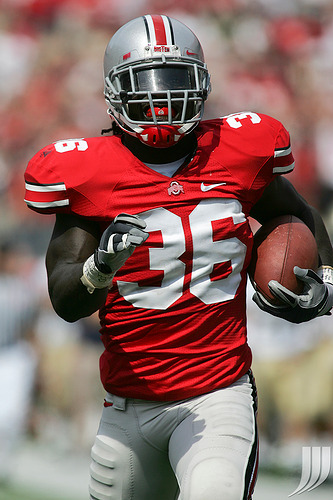
    Brian Rolle is the obvious starter here. As I mentioned, his move to the middle was pretty experimental last spring, but Rolle performed exceptionally well all season (95 tackles, 37 solo, 7 tfl, 1 int) and solidified himself as the starter.

    Rolle isn’t as big as your prototypical middle linebacker (5′11″ 221 lbs.), but he more than makes up for his lack of size with explosive quickness that allows him avoid blockers at the line of scrimmage and cover the field from sideline to sideline.

    I expect Rolle to be one of the best linebackers in the Big Ten, and the one thing that might hold him back from some serious national recognition is teammate Ross Homan (more on him later). The media will probably choose one or the other to gush over, so one may have to play the role of Bobby Carpenter to the others A.J. Hawk.

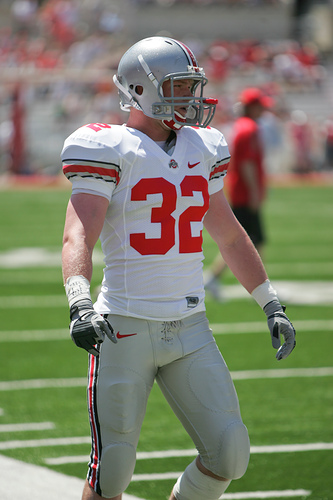
    As I mentioned, beyond the starters things probably won’t get settled for awhile. For now, I am going to put Storm Klein on the depth chart behind Rolle. Klein played in all 13 games last year as a true freshman and recorded 10 tackles.

    Klein has ideal size for a linebacker (6′2″ 230 lbs.) and the fact that the coaches put him on the field in every game as a true freshman says a lot about his ability. The future is bright for Klein, and even if it isn’t in the middle, he will see the field a lot next year.

    For the third slot (it’s probably going to be more like 2a and 2b in the spring) I will go with Dorian Bell.

    Bell was a 5 star recruit coming out of high school who was redshirted last season (sick ridiculous depth at LB and all that). His combination of size and speed is outstanding and I think he could end up being a slightly taller version of Rolle (which is why I put him in the middle).

    I think Bell will get a crack at the middle due to his similarities with Rolle. Regardless of where, it is hard to imagine Bell not getting on the field next season, and like all of the backups, he will most likely be shuffled around a lot until the coaches find a way to get him on the field the earliest.

    Year # Name Height Weight GP/GS Tackles Solo TFL Int
    Senior 36 Brian Rolle 5′11″ 221 lbs. 13/13 95 37 7 1
    Sophomore 32 Storm Klein 6′2″ 220 lbs. 13/0 10 7
    RS Freshman 11 Dorian Bell 6′1″ 220 lbs. 0/0

    Update: The spring depth chart has Jordan Whiting as the #3 guy in the middle and Dorian Bell is the #2 on the weak side behind Ross Homan. Even that is not set in stone at this point though.

    Weak Side Linebacker (Will)


    The other returning starter at linebacker is Ross Homan on the weak side. As I mentioned, Homan and Rolle will battle each other next year for media attention, and honestly, they both probably deserved more attention than they received in 2009.

    Just for fun, here are two stat lines.

    Tackles Solo TFL Sacks Int FF
    108 57 5 2 5 1
    115 53 8.5 4 5 3

    One is from James Laurinaitis‘ 2006 season, the other is from Ross Homan’s 2009 season. Not much of a difference… is there?

    Laurinaitis was a 1st Team All-American in 2006 and was named the best defensive player in college football, Homan wasn’t even 1st Team All-Big Ten.

    So ummm…. yeah, Homan had a pretty good year despite not receiving much media attention (and in all fairness, you can’t really argue with the players that were selected 1st Team Big Ten last season).

    Regardless, Homan is a tackling machine with a knack for the big play and will be looking to build off of an excellent season in 2009.

    The first person off the bench on the weak side will most likely be Andrew Sweat (update: Sweat is listed at #2 on the strong side on the spring depth chart).

    Sweat received playing time in the first seven games last season before an injury ended his year. In those seven games, he tallied 15 tackles, 1 tackle for loss, and 1 interception.

    Like all of the linebackers at Ohio State, Sweat is extremely talented and will see the field plenty next season.

    Finally, there is incoming freshman Scotty McVey. Even though it is extremely likely that McVey will redshirt next year, I am going to put him here because he is a natural fit for the weak side (great in space and a sure tackler) and it is probably where he will end up playing when he does see the field.

    Year # Name Height Weight GP/GS Tackles Solo TFL Int
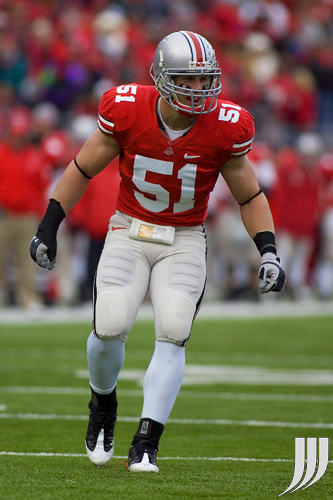
    RS Senior 51 Ross Homan 6′0″ 229 lbs. 13/13 108 57 5 5
    Junior 42 Andrew Sweat 6′2″ 220 lbs. 7/0 15 9 1 1
    Freshman ? Scotty McVey 5′11″ 215 lbs. 0/0

    Update: As I mentioned, I got this one pretty wrong. Sweat is listed at #2 on the strong side, Dorian Bell is listed at #2 here, and Jim Hastings is listed at #3 (even though McVey isn’t on campus yet, so it’s only natural that he’s not on the depth chart at this point).

    Strong Side Linebacker (Sam)


    This is the spot vacated by Spitler, so the competition to see who plays here will be fierce. I don’t want to rule out any of the linebackers from earning this spot because every single one of them will probably be given a shot here in the spring. At the same time, there is a pretty clear favorite heading into the start of practice.

    That favorite, as far as I’m concerned, is Etienne Sabino.

    Sabino is heading into his third season as a Buckeye, and hopefully he is ready to step into the starting lineup. By most accounts, he is an amazing athlete with all the tools necessary to be an outstanding linebacker. Unfortunately, the mental aspect of the game has apparently been holding him back.

    Many people thought that Sabino would play the Mike position when he came to Ohio State, but when Rolle earned the starting spot last season, Sabino moved to the strong side and was the back up for Spitler (who was also supposed to play Mike heading into the season but moved to the strong side as well).

    The Sam linebacker spends a lot of time close to the line of scrimmage and their primary role is to stop the run. Sabino is the ideal size for this roll (6′3″ 232 lbs.) but he also has the speed and athleticism to play in space if needed. This versatility is something that Spitler lacked for the most part last year so it should be interesting to see how the coaches utilize Sabino next season.

    Also in the mix on the strong side is Tyler Moeller.

    Update: wrong, Moeller is being used primarily at safety or star in the spring.

    Moeller’s season was over before it began last year due to some extremely unfortunate circumstances. Before the incident, he was a favorite to earn a starting spot and in the spring game he was by far the most impressive defensive player.

    He is a bit undersized (particularly for the strong side) but his tenacity against the run and as a pass rusher makes him a ideal for the position no matter how big he is. If Moeller is healthy enough to play (at this point I don’t see why he wouldn’t be, but head injuries are very serious and I wouldn’t want him to return if he is not completely cleared to do so) he will jump to the top of the list of linebackers looking for playing time.

    I am going to go out on a limb here and say that if Moeller does come back, he will very quickly become a fan favorite when he is on the field.

    Finally, there is Jordan Whiting.

    Whiting redshirted last season, so there isn’t much to talk about in the way of stats. But by most accounts, he has an outstanding attitude on and off the field and will compete no matter where he ends up at.

    Year # Name Height Weight GP/GS Tackles Solo TFL Int
    Junior 6 Etienne Sabino 6′3″ 232 lbs. 13/0 6 3 .5
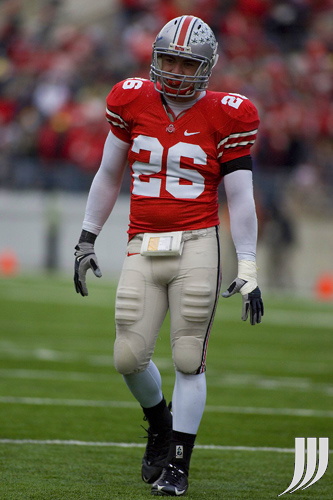
    RS Junior 26 Tyler Moeller 6′0″ 216 lbs. 0/0
    RS Freshman 39 Jordan Whiting 6′1″ 235 lbs. 0/0

    Update: Once again, I was wrong here outside of Sabino, who does look to have the starting spot locked down. Moeller is playing DB this spring, Whiting is listed at #3 in the middle.

    Andrew Sweat is listed at #2 on the strong side even though he has been limited by injuries so far, with Jon Newsome and Tony Jackson listed at #3 and #4.

    Conclusion


    So there you have it. This is one of the deepest and most talented linebacking corps in all of college football. If the defensive line can fill in some holes and continue what they started last year, Ohio State is looking at an outstanding front seven on defense.

    It should be fun to watch.

    Stay tuned for spring ball, these nine linebackers are going to be putting on a show to try and earn playing time.

  • Way Too Early Look: Defensive Backs (updated)

    The DBs were hit pretty hard this year with the graduation of Kurt Coleman and Anderson Russell.

    On the other hand, both starting corner’s return as well as Jermale Hines, who started at safety and the star position in a total of eleven games last season. So while the Buckeyes did lose some starters and some depth, things aren’t exactly bleak either.

    Speaking of Jermale Hines, he has the versatility to play either safety position as well as the star position (I will explain what that is more later), and he will probably start and play at multiple spots throughout the year. So yeah, I would just like to thank Mr. Hines right now for having the versatility to make the depth charts for DBs relatively meaningless right from the start.

    Despite the uncertainty of the depth charts heading into spring, I am still going to attempt to put them together, so stick with me and as more information comes out in the spring I will certainly adjust them.

    There is going to be a ton of experimentation here (particularly at safety), so I fully expect the actual depth charts to look nothing like the ones I put out there now.

    Update: there actually appears to be a lot less experimentation at safety then I expected, Jermale Hines at free and Orhian Johnson at strong appears to be pretty set, there is some experimentation going on with the star position though.

    Now that I have that covered, let’s move on to our in depth look at the 2010 defensive backs!

    I guess I will start with a basic overview of the relatively new position of “Star Back” and go from there.

    Star Back


    In order to counter the proliferation of spread offenses around the country, Ohio State has developed a hybrid linebacker/safety/cornerback position known as the star. The star comes on the field in place of the sam linebacker in most situations and is used in a similar fashion to a nickel back (a third cornerback).

    Unlike classic nickel backs, however, Ohio State is looking for a star back that can not only cover a third receiver in pass defense, but can also provide excellent run support like a linebacker. The ability of the star to defend against the pass as well as against the run is an excellent counter to the spread attack that many offenses have begun to utilize (Michigan, Oregon, ect.).

    The question then becomes, who has the versatility to play this position? Until recently, Ohio State hasn’t recruited players specifically to play the star (Chad Hagan is a nice example of a player that was probably recruited specifically to play star) so it is not always clear who will end up here.

    Fortunately for Ohio State, Jermale Hines has proven to be the perfect player for the star position the last few seasons. However, with the departure of both safeties, Hines may be will be spending most all of his time at safety next season rather than at the star, which leaves Ohio State in search of a player to fill the void.

    From early reports out of winter conditioning drills, one player Ohio State is considering for the star is Tyler Moeller. I previously discussed Moeller in my look at the linebackers, which is was his natural position. However, it appears that he has been working out with the safeties during drills, which means that the star position is most likely in his future.

    Based on the information out of winter conditioning, I am going to put Moeller as the starter here, with Hines as the primary backup (even though I am also going to put him as a starter at safety, versatility and all that), and throw incoming freshman Chad Hagan at the third spot just for kicks, which leaves us with a depth chart for spring that looks something like this.

    Update: I don’t have the depth chart saved from my original post, so I am just going to start over. While it still looks like Moeller will be in the running as the starter, Hines is completely out of the picture and in his place Nate Oliver and C.J. Barnett are competing.

    Safety

    Moving on to the safeties, Jermale Hines is once again the primary focus here. He started at free safety in eight games last season, so you have to think he is the favorite to start there again this year. Then again, he might move over to strong safety. For right now, we’ll just stick with free safety to keep things simple.

    At strong safety I am going to pencil in 5th year senior Aaron Gant as the starter for now. Gant’s career has been sidetracked year after year by injuries, but all indications are that he is focused and ready to contribute in his final season. I am going to put him as the starter based on seniority alone and wish him good luck.

    Update: it looks like my wishes of good luck weren’t enough, Gant is buried on the spring depth chart and doesn’t appear to be a factor for playing time.

    Behind Hines and Gant things get pretty crazy, so I am just going to throw some names out there and on the depth chart and wait until spring when things will become a little clearer.

    Nate Oliver, Orhian Johnson, Jamie Wood, and Zach Domicone are all in the running at either safety position. Making things even crazier, guys like Corey Brown or incoming freshman Bradley Roby could find their way into the discussion at safety as well.

    Lots of names, not a lot of information yet, so I am going to split up the players (based mostly on size) and throw them on to the depth chart (based mostly on seniority) and wait until spring before saying too much more about who will start where.

    In summation, the safety position is worth keeping an eye on in the spring because it will certainly be one of the places with the fiercest competition over starting time… but for right now there is not much to say, so just sit back and enjoy the show.

    Update: As I mentioned, Jermale Hines and Orhian Johnson appear to have the starting spots locked up. Zach Domicone and Tyler Moeller are listed as the primary backups, with guys like Nate Oliver and C.J. Barnett still in the mix but primarily competing for the star position.

    Cornerback


    Finally, it’s time to look at the cornerbacks. Heading into last season, who would play cornerback was probably the top concern right behind who would play left tackle. Thankfully, the question marks at cornerback were answered in a much more satisfying manner than the tackle situation.

    Returning at cornerback for next season are senior’s Chimdi Chekwa and Devon Torrence, who both stepped in as starters and played admirably well last year. So well, in fact, that you didn’t really hear anything about them, which is a good thing when it comes to cornerbacks.

    Having two senior returning starters at a position is pretty nice by itself, but toss in the fact that Torrence might not even be close to reaching his full potential (just recently began focusing on football after playing minor league baseball in the spring and summer his first two years at Ohio State) and you can’t help but feel pretty confident heading into next season.

    There will be a lot of competition to see who will be the primary backups next year with plenty of young players looking to see the field. Donnie Evege, Travis Howard, C.J. Barnett, Corey Brown, and Dominic Clarke are all in the pipeline, not to mention incoming freshman Christian Bryant and Bradley Robey.

    Like I said, plenty of young players here, so it will be interesting to see who separates themselves from the pack in the spring. Early reports from winter conditioning indicate the Dominic Clark has been working hard and is one to keep an eye on (which is enough to put him 4th on the depth chart for now).

    Update: Donnie Evege has also been getting rave reviews this spring and is listed as the primary backup for Torrence with Clarke at #3.

    Travis Howard and Corey Brown are listed as the primary backups for Chekwa on the other side.

    Summary


    So there you have it, the defensive backs heading into spring practice. The group has a nice mix of returning starters to go along with a group of talented youngsters that should be fun to watch in the spring.

    Losing Kurt Coleman and Anderson Russell were certainly hits in the leadership and experience departments, but this group has the potential to be excellent next year behind the leadership of Hines, Chekwa, and Torrence.

    There will be competition in the spring for starting spots and back up rolls, which will be enjoyable to see and read about once practice begins, but there is also plenty of experience here and with three returning starter there is no reason to expect anything less than continued excellence from the DBs in 2010.

  • Way Too Early Look: Offensive Line (updated)

    The offensive line is probably the most publicized position at the moment due to missing out on three prospects on signing day. Update: not so much anymore, but LT is still one of the most interesting position battles this spring.

    Those signing day disappointments also makes depth along the offensive line an area of concern for many Buckeye fans. Throw in the fact that Ohio State only loses one lineman (Jim Cordle) from 2009 and only gains one (Andrew Norwell) heading into 2010 and I would call the offensive line an ideal place to begin our look at next season.

    Oh yeah, and the line is going to be good next season, maybe really good.

    Many fans were disappointed to the point of calling  the 2010 recruiting class a bust due to the high profile recruiting misses last week. Well I am here, as always, to inject some optimism into the conversation for this season specifically, and for the future of the offensive line in general.

    First let’s talk about the 2010 season. Ohio State has four returning starters along the offensive line, which is nice by itself. These four helped pave the way for well over 200 yards rushing per game over the last five contests of the 2009 regular season, which is even nicer.

    Throw in the fact that the Buckeyes have quality young depth from the 2009 recruiting class and things look pretty good… at least to me… at least for the 2010 season.

    In fact, I would even say that the 2010 offensive line could be the best of the Tressel era. The best in the Big Ten? Possibly. The best in the country? We can only hope.

    The key to the offensive line achieving greatness? Two questions need to be answered. Who will play at left tackle? and can the line stay healthy?

    Left tackle has been a question mark since the beginning of last season. With an extra year of experience under their belts, hopefully the two main contenders to fill the position can solidify their spot in the starting lineup, extra bonus points if they solidify it early in the spring. Update: Mike Adams appears to be relatively solidified as the starter, but Miller is still getting reps with the ones.

    Health is the other major concern for the line. Last year injuries ravished the line early in the season, and the resurgence of the run game at the end of the year may have been simply due to the starting line returning to full strength.

    Can the line stay healthy in 2010 and continue the momentum they established at the end of last season?

    If they can… happy times.

    Join me after the jump for a closer look at the each position as well as a look at the depth situation and possible future recruiting targets. Update: I took out the recruiting update, there will be lots of posts focusing on the recruiting after the spring game, also, Ohio State signed four offensive lineman between the time I posted this and now.

    It all starts up front, and as cliche as it is, I will continue to say it because it is so true. Question number one for Ohio State in 2010 is who will start at left tackle? So let’s start there.

    Left Tackle


    Going back to last season, left tackle was a two man battle between redshirt junior Andrew Miller and sophomore Mike Adams. Both ended up starting a few games, but by the end of the year journeyman Jim Cordle had settled in as the starter for the last half of the season.

    With the graduation of Cordle and the lack of a certain all-everything high school talent in the mix, we are back to a two man battle between Miller and Adams heading into 2010.

    The more things change the more they stay the same.

    While the inability of either player to emerge as the clear cut starter over the course of last season is a cause for concern, it might not be as bad as it appears.

    For instance, a major factor that kept Miller on the sidelines for the last half of the season was a serious illness midway through the year that caused him to drop a significant amount of weight.

    Adams’ inability to crack the starting line up is a bit more difficult to understand. By most accounts, his physical gifts are unmatched, but there is something else that is going on that is keeping him from reaching his potential. Whatever it is, the two game suspension at the beginning of last season was probably a result of his off the field issues.

    Additionally, Adams suffered a knee injury in the middle of the year that kept him out for three games, cutting any chance of him returning to the starting line up short. By the time he recovered, Ohio State had a pretty good thing going with Cordle, keeping Adams on the sidelines.

    Will Adams finally be able to get over the injuries that have limited his game time two years in a row? and if he can stay healthy will he be able to overcome his apparent off the field issues?

    According to this article from the Dispatch (which is a really good read on the left tackle situation) he has been “doing a lot of extra work” so that is a good sign. Being the optimist that I am, I will go ahead and predict that Adams will be able to finally break through and earn the starting spot early on and keep it.

    Update: There has been lots of additional indications that Adams is in the best shape of his life and is ready to go at LT. Happy times if true.

    Backing up Adams will be Andrew Miller. While Miller lacks the athleticism of his counterpart, he performed well at the beginning of last season before illness sidelined him. At the very least Miller provides solid depth at the position, and if Adams falters for whatever reason, I am confident that Miller will be able to step in without too much drop off.

    Also in the mix at left tackle is sophomore Marcus Hall (more on him later) and incoming freshman Andrew Norwell. Ultimately I think that Hall will stay on the right side and Norwell will probably redshirt. Based on that, I am going to throw redshirt senior Josh Kerr in as the third string LT right now due to his experience.

    We will find out a lot during spring practice, and like I said, hopefully someone locks down the position early and keeps it. With the returning talent along the line, establishing continuity and familiarity among all five offensive linemen could lead to great things.

    Fingers crossed on that one. Here’s a nifty table with my guess at what the depth chart will be at left tackle for next season.

    Disclaimer: I am allowed to change these depth chart tables at any time for any reason and you aren’t allowed to remind me if I was wrong… deal? Okay good.

    Year # Name Height Weight GP/GS
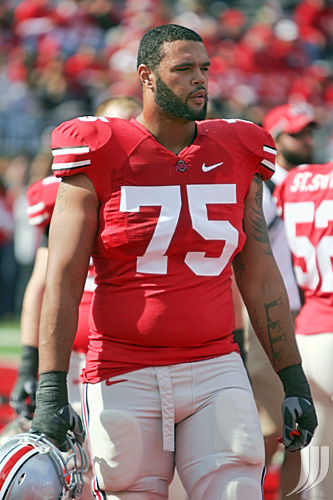
    Junior 75 Mike Adams 6′8″ 322 lbs. 6/4
    RS Senior 55 Andrew Miller 6′7″ 295 lbs. 10/4
    RS Senior 73 Josh Kerr 6′4″ 286 lbs. 3/0

    Update: The spring chart has Sam Longo listed as the #3 LT with Kerr as the #3 RT.

    Right Tackle


    Right tackle was a question mark heading into last season… not so much anymore.

    J.B. Shugarts emerged as the starter over the course of the season in 2009 and never looked back. He is a punishing run blocker but could use some more work in pass protection. If he is able to continue to improve Shugarts is going to be very good.

    Pushing for the starting spot will be  Marcus Hall. Hall logged significant playing minutes last year as a true freshman and even started against Iowa due to an injury to Shugarts.

    The amount of playing time Hall received as a true freshman is a testament to his talent and he is definitely one to keep an eye on.

    Ultimately I think Hall will slide down and play guard once Bryant Browning graduates. I think this because when you have two guys as talented as Hall and Shugarts, it doesn’t make sense to keep them both at the same position with one not being on the field. It will be interesting to see if Hall gets any playing time at guard this year because of this.

    Between Shugarts and Hall, it is pretty safe to say the right tackle is in good hands for the 2010 season.

    Also in the mix is incoming freshman Andrew Norwell. I think that Norwell will probably redshirt, but I am going to throw him onto the depth chart because I am not sure who else to put there (possibly Jack Mewhort).

    Year # Name Height Weight GP/GS
    Junior 76 J.B. Shugarts 6′8″ 298 lbs. 12/9
    Sophomore 78 Marcus Hall 6′5″ 300 lbs. 9/1
    Freshman ? Andrew Norwell 6′7″ 280 lbs. 0/0

    Update: As mentioned, Josh Kerr is listed as the #3 RT, but Norwell isn’t on campus yet.

    Left Guard


    Left guard is in solid hands this year with returning starter Justin Boren. Boren was the best lineman on the team last year, and he has a chance to be one of the best in the conference and possibly the entire country in 2010. He is a tenacious run blocker with a mean streak, and honestly he scares me a little bit (look at his picture)… but that is a good thing for an offensive lineman.

    While Boren is the unquestioned starter here, who is behind him on the depth chart gets a little hazy.

    Corey Linsley received a lot of good reviews during practice last year but did not see any game time due to being redshirted. He will probably get some time at guard this year.

    Also in the mix is Andrew Miller. Miller has played guard in several games throughout his career, and if he is not starting at tackle, he will provide depth for both positions. I am not going to put Miller on the depth chart here since he already is on one, but he is definitely in the mix, particularly if there is an injury (knock on wood).

    Guys like Scott Sika (RS Senior) and Even Blankenship (RS Junior)  will also get a shot at both guard positions, and I will put Sika on the depth chart here because of seniority and the fact that he played in five games last year to Blankenship’s one.

    Year # Name Height Weight GP/GS
    RS Senior 65 Justin Boren 6′3″ 315 lbs. 12/12
    RS Freshman 71 Corey Linsley 6′4″ 275 lbs. 0/0
    RS Senior 72 Scott Sika 6′2″ 280 lbs. 5/0

    Update: I mixed up the sides on this one. Connor Smith is listed at #2 here while Linsley is listed at #2 on the right side. Also, Chris Malone is listed as the #3 LG.

    Right Guard


    Right guard is also in good hands this year with returning starter Bryant Browning. In 2008 Browning struggled mightily on the edge at tackle. Fortunately, his transition to guard last year was a resounding success. His weaknesses in pass protection are diminished on the inside, and his strength as a run blocker is easier to appreciate when he is not a turnstile for pass rushers.

    If Browning builds off of his performance last season, an All-Big Ten type of year is not out of the question.

    Backing up Browning will be Connor Smith. Smith came to Ohio State as one of the best offensive linemen in the Midwest, but he has failed to live up to expectations, possibly due to injuries. Smith played in eight straight games at the end of last season, including the Rose Bowl.

    Will Smith challenge for the starting position? probably not, but if he can stay healthy he provides quality depth.

    Finding a third guard is pretty tough. Once again there is Evan Blankenship available, but the fact that he only logged minutes in one game last season doesn’t give me much confidence in his ability to contribute. So instead I will go with Sam Longo.

    Longo, like all of the other lineman from the ‘09 recruiting class, performed well in practice last year while being redshirted, so I am going to give him the nod for the third spot, due to his size, Longo could also be a candidate to get time at one of the tackle positions as well.

    Year # Name Height Weight GP/GS
    RS Senior 70 Bryant Browning 6′4″ 312 lbs. 13/13
    RS Senior 77 Connor Smith 6′4″ 321 lbs. 8/0
    RS Freshman 59 Sam Longo 6′6″ 280 lbs. 0/0

    Update: I was right about Longo at tackle, and mixed up the sides with Linsley and Smith for the #2 spots at guard. Listed at #3 behind Browning and Linsley is Jack Mewhort and Evan Blankenship (who has also been getting time at DT).

    Center

    Returning at center is Mike Brewster. Brewster started every game at center for the Buckeyes in 2009, and started a significant number of games during the 2008 season as well, making him one of the most experienced Buckeyes along the line.

    That is important for several reason, mostly because the center is the leader of the offensive line and the player responsible for making adjustments to the  blocking schemes. With so much experience at the position, hopefully Brewster has mastered this art, and situations like the Purdue game can be avoided.

    Brewster played most of the 2009 season with a bum ankle, and trouble with signals aside, he performed admirably well all things considered. A healthy Brewster in 2010 is yet another reason to be optimistic about the potential of this offensive line and yet another lineman that has the potential to earn All-Big Ten honors.

    Backing up Brewster will be Jack Mewhort. Mewhort has the versatility to play almost any position along the line, so you could pencil him in on most of these depth charts. I put him here because he has experience at center, but he might log minutes at a number of positions.

    The third spot is once again tough to come up with. Long time backup Andrew Moses has finally graduated, meaning that beyond Brewster and Mewhort, there aren’t many lineman with experience at center. For the purposes of the three person depth chart, I am going to throw in Chris Malone mostly because of seniority.

    Year # Name Height Weight GP/GS
    Junior 50 Mike Brewster 6′5″ 296 lbs. 13/13
    RS Freshman 74 Jack Mewhort 6′7″ 290 lbs. 0/0
    RS Senior 57 Chris Malone 6′1″ 268 lbs. 1/0

    Update: I was right about Brewster and Mewhort at #1 and #2, Corey Linsley is listed at #3, and Scott Sika is listed at #4 (mixed him and Malone up on positions, but I was still pretty close).

    Conclusion


    Like I said, this has the potential to be the best offensive line in the Tressel era as well as in the Big Ten and possibly the country for next season. With four returning starters on the line and a backfield that is absolutely loaded, you can’t help but get excited.

    Once again, the difference between a good line and a great line will be left tackle (and staying healthy). If Mike Adams (or Andrew Miller for that matter)  comes into spring practice and kicks some ass, things will be looking great.

    With the versatility of some of the younger players, it should be interesting to see where everyone ends up on the depth chart once spring practice gets underway, but as long as the five starters are locked in place by the spring game (locking at you left tackle), I will be happy.

  • Un 22% de conductores habla por teléfono mientras conduce sin hacer uso del manos libres

    moivl

    Si hace nada criticábamos a la DGT por no hacer todo lo posible para mejorar la seguridad vial, hoy debemos hacer autocrítica, según una encuesta realizada por,Dekra un 22% de los conductores habla por teléfono mientras conduce sin utilizar el manos libres manos libres.

    Esto implica que uno de cada cada conductores utiliza el teléfono móvil mientras conduce, sin hacer uso del manos libres. De los encuestados, el 90% dice conocer los peligros que acarrea esta práctica.Y si conocen los riesgos, ¿Por qué lo hacen? Es una práctica peligrosa para todos, no sólo para el que la práctica si no para cualquier ciudadano que se cruce en su camino.

    La distracción que tiene el conductor, especialmente al mirar el teléfono para marcar, invalida hasta el uso de manos libres, dado que si no se tiene un sistema de marcación por voz se ha de manipular el móvil cuando se está conduciendo. Hay estudios que aseguran que usar el teléfono móvil mientras se conduce nos impide percibir un 50% de la información de la carretera lo que implica un aumento considerable del riesgo de accidentes.

    Si bien a finales de los años 80 y durante parte de los 90, el uso del móvil tuvo incluso un efecto salvavidas en los accidentes de peatones y de tráfico, hoy en día, debido a la cantidad masiva de teléfonos móviles, la tendencia ha cambiado y está convirtiendo al teléfono móvil en una causa cada vez más frecuente de accidentes.

    Encuesta | Dekra


  • Way Too Early Look: QB, WR, RB (updated)

    I actually don’t enjoy writing about the quarterbacks, running backs and receivers as much as I enjoy writing about other positions (which is why I have been putting it off until last). This is mostly due to the large amount of coverage already heaped on these players. It becomes difficult to say something that hasn’t already been said… over and over.

    At the same time, when you think ahead to next season, what jumps into most people’s minds are visions of Terrelle Pryor decimating defenses in the air and on the ground, Boom Herron and Brandon Saine bursting through the line for big gains, DeVier Posey and Duron Carter hauling in deep bombs over helpless defenders, and a host of other exciting offensive plays that make for sweet highlight reels.

    So while I don’t necessarily enjoy writing about these positions as much as I do others for fear of being unoriginal, I do think I have some interesting things to say (so read it anyways!).

    And I have to admit, even for a “the games are won in the trenches” devotee like myself, the skill positions should be pretty damn exciting to watch next year.

    So join me after the jump for an in depth look at the offensive skill positions!

    The obvious place to start here is at quarterback, so that’s what I will do.

    QB


    Terrelle Pryor.

    This is one of those situations in which it is difficult to write something that hasn’t already been said.

    I will say that last season was quite a roller coaster ride for the Ohio State offense in general and Pryor specifically. Many, including myself, expected great things from Pryor early and often last year, and that didn’t quite happen.

    The early season roller coaster ride hit absolute rock bottom in West Lafeyette, a game that all of us would like to forget (so I am not even going to talk about it beyond that). Fortunately, Ohio State bounced back, established the run game over the last half of the season, took a little bit of pressure off of Pryor’s shoulders and bam! Rose Bowl MVP.

    The Rose Bowl game was obviously the highlight of Pryor’s young career, and if it is even possible, the pressure on Pryor will be even greater next season as people everywhere will expect him to duplicate his efforts in the Rose Bowl every game next season.

    How well Pryor builds off of last season is obviously a huge question mark going into next year, and I am sure it will be written about… over and over.

    While the Rose Bowl leaves a nice memory in everyone’s mind and gives us all a ton of optimism for next year, I would like to return to the early season struggles briefly to suggest something that I think is relatively original.

    Many like to place the success or failure of Pryor as a quarterback on Pryor himself and the coaches. And while that is certainly a large part of the equation, something that I think a lot of people forget is that Ohio State had a brand new receiving corps at the beginning of the 2009 season.

    Pryor struggled at times as a true freshman QB, but that is to be expected. One thing that masked his struggles was Beanie Wells in the backfield and two extremely experienced NFL caliber receivers to throw to in Brian Robiskie and Brian Hartline.

    All three of these players were gone in 2009, along with their ability to mask some of Pryor’s deficiencies (or at least inexperience) as a QB.

    What is the point? Simply that an inexperienced receiving corps may have contributed to Pryor’s early season struggles more than anyone originally thought. Running the wrong routes, not being exactly where the quarterback expects you to be, not reading the defenses correctly are all things that a young receiving corps might have done to seriously limit Pryor’s effectiveness early in the season.

    Pryor certainly progressed as a passer as the year went on, ultimately leading to the MVP performance in the Rose Bowl, there is no doubt about that. But perhaps the progression of his receivers throughout the season and the cohesion that was developed between the person throwing the ball and the people catching it was more important to the passing game than Pryor’s development as an individual.

    That being said, I am optimistic that Pryor’s development over the course of last season (his decision making and footwork in the pocket in particular) will pay huge dividends over the course of this season. He has been through the fire, he has been under the lights and he has performed, and that has to give him confidence that he didn’t have at the beginning of last season, and that is good.

    Update: Pryor is looking good, you can probably keep up with him without my help.

    WR


    And since we are talking about the receivers, might as well do them next.

    Ohio State losses are minimal here (Ray Small, who’s contributions were occasional anyways) and the returning talent is significant.

    Throw in the year of additional experience between the guys catching the ball and the guy throwing it to them and anything less than a large improvement in the passing game in 2010 would be a disappointment.

    The headliner at receiver is DeVier Posey and like Pryor, his game in the Rose Bowl was one of the better performances of his young career (8 receptions, 101 yards, 1 TD) and a reason for optimism heading into 2010.

    Posey’s route running and awareness on the field obviously improved over the course of last season, and if he can continue to develop as Pryor’s go-to target, a big year in 2010 could be in the making.

    Behind Posey is quintessential slot receiver Dane Sanzenbacher, who runs great routes and isn’t afraid to go across the middle. He also boasts surprising, if not elite speed, and if teams decide to focus on Posey Sanzenbacher has the ability to do a lot of damage. He is reliable, experienced, and should be one of the leaders on the offense.

    Battling for the third spot will be Duron Carter and Taurian Washington. Both of their stories are summed up nicely in two articles from theozone.net. The story of Carter’s academic troubles at the end of last season and his response is covered nicely in this article while Washington’s struggles to get on the field and his rededication to contributing in his senior season are covered in detail here.

    Beyond these four is a lot of unproven talent, maybe in the spring someone will jump out and turn some heads, but that would just be icing on the cake.

    Posey, Sanzenbacher, Carter, and Washington make for a good to great group of receivers so the Buckeyes are in excellent shape here for 2010. And with an extra year of experience and work with their QB under their belts, who knows how good they can ultimately end up being.

    Update: Carter hasn’t practiced, Chris Fields and Grant Schwartz have been impressive.

    RB


    The final piece of the skill position equation is the running backs. The headliners here are the pair of Brandon Saine and Daniel “Boom” Herron.

    While neither player emerged as a true workhorse in the backfield last season (Herron battled ankle injuries for several games), between the two of them they put up 1339 yards and 11 TDs, so the run game turned out to be relatively strong, especially in the final half of the season.

    I expect Saine to be option 1A heading into the spring with Herron being option 1B. If both can stay healthy, the two will be one of the best one two punches in the Big Ten (throw in what Pryor brings to the running game and have fun with that Big Ten defenses).

    While the pair of Herron and Saine will be getting the majority of the action this season, the real story may be in the spare (Tressel goes with a pair and a spare at running back, get it?).

    The Buckeyes boast an obscene amount of talent all competing to be the spare. As of right now, Jordan Hall has the inside track due to the experience he got last season. Right behind him is Berry, who very well could have switched places with Hall last season if he wasn’t battling a nagging hamstring injury the entire year.

    Hall and Berry are smaller, quicker backs. Is that not your thing? Good news, we also have early enrollee Carlos Hyde in the mix who spent the fall getting his grades in order at Fork Union Military Academy.

    Is five deep still not enough at RB for you? Alright, incoming freshman Roderick Smith is in the mix at RB as well. Smith is a smooth, long striding big man who reminds me a lot of a certain RB that played for the Bucks back in the mid 90’s.

    Still not enough for you? Throw in Jermil Martin who smashed through Minnesota last year and you’ve got one more option.

    So what does that leave us at? Seven deep at running back (not even counting Archie Griffin’s son  Adam who could play RB along with multiple other positions) and you have a backfield to be envied.

    Oh yeah, and just real quickly, at FB you have Zach Boren, who’s improvement in run blocking can be directly correlated with the increased success of the running game in the second half of last season. He will only be a sophomore and will be smashing open holes for these running backs for a long time.

    There really isn’t much more to say, it is embarrassing how much talent Ohio State has at RB and the competition for playing time will be intense this spring which gives us fans one more thing to get excited about in spring practice.

    Update: A lot of backs have been battling minor injuries throughout the spring, but if anything that just highlights the depth and talent at the position with players filling in seemlessly.

    Summary


    Everyone is coming back. Everyone has a year of experience under their belts. The running backs are ridiculous behind an offensive line with four returning starters. The offense should be good, really good

    Update: Oh yeah, tight ends. Reports from practice indicate that Jake Stoneburner has been impressive, whether or not that translates to games remains to be seen. The primary backup is Reid Fragel, who has the size to play tackle.

    I like the combination of Fragel’s blocking with Stoneburner’s ability to stretch the field.

    We will see if anything comes of it.

  • Key senator gears Congress for a long fight to reform the FCC

    By Scott M. Fulton, III, Betanews

    Sen. Jay Rockefeller (D - W. V.)A long-planned hearing on Capitol Hill to discuss the Federal Communications Commission’s Broadband Plan took on new meaning yesterday, a week after the DC Circuit Court ruled the Commission lacked the authority to implement net neutrality regulations. With a coalition of Internet business interests pleading with the FCC to declare itself the “cop-on-the-beat” for net neutrality under a different provision of US telecom law than it had been using, now Sen. Jay Rockefeller (D – WV), chairman of the Senate Commerce Committee, says the FCC may not need to take that step.

    In his remarks yesterday, Sen. Rockefeller told his committee he’s ready to begin the long, and undoubtedly arduous, process of changing the law to give the FCC the authority that the Broadband Plan assumed it had to begin with.

    “No doubt, this ruling adds to the complexities of the FCC’s task, but for me, two things are clear. First, in the near-term, I want the agency to use all of its existing authority to protect consumers and pursue the broad objectives of the broadband plan. Second, in the long-term, if there is a need to rewrite the law to provide consumers, the FCC, and industry with a new framework, I will take that task on,” stated Rockefeller.

    The FCC had been acting on what it thought was the mandate of Title I of the Telecommunications Act, last amended in 1996. Prior chairpersons of the Commission had concluded that it had ancillary authority under Title I, which covers information services, to regulate Internet practices. Title II covers telecommunications services, like telephone networks; and since the Clinton administration, all FCC leaders up to and including the current Julius Genachowski had distinguished Internet service from telecommunications service.

    Last week’s DC Circuit ruling stated that the FCC failed to prove its Title I case when ordering Comcast not to throttle BitTorrent traffic. Not waiting for the Commerce Committee chairman to make his case, Ranking Member Sen. Kay Bailey Hutchison (R – Texas) yesterday drew a line in the sand, warning the Commission that Republicans would take action if it were to suddenly jump tracks from I to II.

    “In my judgment, if the FCC were to take the action Chairman Genachowski and his colleagues appear to be considering, reclassifying broadband without a directive from Congress and a thorough analysis of the facts and the potential consequences to investment, the legitimacy of the agency would be seriously compromised,” remarked Sen. Hutchison yesterday. “I hope that we can take a step back to consider the consequences of such a decision and whether there are alternatives we can work together on to clarify the authority of the FCC while preserving an environment that encourages investment. I am confident we can find common ground, but that will not happen if the FCC takes this action.”

    For his part, Chairman Genachowski yesterday proceeded with his prepared remarks, emphasizing the Plan’s goals for building out broadband, and underscoring the US’ lagging success toward those goals compared to other countries. One of the Plan’s key goals concerns retooling the existing Universal Service Fund — created in 1996 to fund the expansion of telephone service to rural areas and small schools and libraries — for building out broadband as well. Once again, the FCC could only shift those priorities if it had existing authority, granted by Congress, to do so — something the Comcast ruling asserted it might not have.

    That fact forced the Chairman to add a footnote to his prepared remarks, though he lavishly embellished that footnote with every impending danger imaginable, including from terrorism and natural disaster: “Notwithstanding the decision last week in the Comcast case, I am confident that the Commission has the authority it needs to implement the broadband plan. Whatever flaws may have existed in the specific actions and reasoning before the court in that case, I believe that the Communications Act — as amended in 1996 — enables the Commission to, for example, reform universal service to connect everyone to broadband communications, including in rural areas and Native American communities; help connect schools and rural health clinics to broadband; take steps to ensure that we lead the world in mobile; promote competition; support robust use of broadband by small businesses to drive productivity, growth, job creation and ongoing innovation; protect and empower all consumers of broadband communications, including thorough transparency and disclosure to help make the market work; safeguard consumer privacy; work to increase broadband adoption in all communities and ensure fair access for people with disabilities; help protect broadband communications networks against cyber-attack and other disasters; and ensure that all broadband users can reach 911 in an emergency.”

    Apparently, the Chairman wrote his remarks without any idea beforehand of what Sen. Rockefeller would say in his. So he ended up being pre-empted by Rockefeller’s assertion that the Broadband Plan was long on goals, but short on methods.

    “The report has over 200 recommendations. But it takes no action. It is long on vision, but short on tactics,” the Commerce Committee chairman said. “So I am going to challenge the FCC. I am going to challenge the FCC to make the hard choices that will help bring broadband to every corner of this country. Putting ideas on paper is not enough. Just seeking comment on a slew of issues is not enough. It’s action that counts.”

    Copyright Betanews, Inc. 2010


    Add to digg
    Add to Google
    Add to Slashdot
    Add to Twitter
    Add to del.icio.us
    Add to Facebook
    Add to Technorati


  • What If The Very Theory That Underlies Why We Need Patents Is Wrong?

    Scott Walker points us to a fascinating paper by Carliss Y. Baldwin and Eric von Hippel, suggesting that some of the most basic theories on which the patent system is based are wrong, and because of that, the patent system might hinder innovation. Obviously, we’ve pointed to numerous other research papers and case studies that suggest that the patent system quite frequently hinders innovation, but this one approaches it from a different angle than ones we’ve seen before, and is actually quite convincing. It looks at the putative theory that innovation comes from a direct profit motive of a single corporation looking to sell the good in market, and for that to work, the company needs to take the initial invention and get temporary monopoly protection to keep out competitors in order to recoup the cost of research and development.

    The problem is that while this is certainly true sometimes, in many, many, many other cases — it’s not the way it works at all. Instead, the paper goes through a whole bunch of studies suggesting that quite frequently innovation happens through a very different process: either individuals or companies directly trying to solve a problem they themselves have (i.e., the initial motive is not to profit directly from sales, but to help them in something they were doing) or through a much more collaborative process, whereby multiple parties all contribute to the process of innovation, somewhat openly, recognizing that as each contributes some, everyone benefits. As the report notes:


    This result hinges on the fact that the innovative design itself is a
    non-rival good: each participant in a collaborative effort gets the value of the whole design, but
    incurs only a fraction of the design cost.

    But, of course, patents are designed to make that sort of thing more difficult, because it assumes that the initial act of invention is the key point, rather than all the incremental innovations built on top of it that all parties can benefit from. In fact, the report points to numerous studies that show, when given the chance, many companies freely share their ideas with others, recognizing the direct benefit they get. This flies in the face of (unsubstantiated) claims by patent system supporters that the patent system is needed to disclose and share inventions. In fact, the evidence suggests that in many cases, firms will willingly share that information anyway (for a variety of reasons detailed in the report) without requiring the “prize” of a monopoly right to do so.

    Even more importantly, the paper finds that due to technological advances and the ability to more rapidly and easily communicate and collaborate widely, these forms of innovation (innovation for direct use as well as collaborative innovation) are becoming more and more viable across a variety of industries, which in the past may have relied more on the old way of innovating (single company innovative for the profit of selling that product). And, in fact, because of the ease of communication and collaboration these days, there’s tremendous incentive for those companies that innovate for their own use to collaborate with others, since the benefit from others improving as well help improve their own uses. Thus, the overall incentives are to move much more to a collaborative form of innovation in the market. That has huge implications for a patent system designed to help the “old model” of innovation (producer inventing for the market) and not the increasingly regular one (collaborative innovation for usage).

    Of course, no one is saying that producer-based innovation (company inventing to sell on the market) doesn’t occur or won’t continue to occur. But it is an open policy question as to whether or not our innovation policies should favor that model over other models — when evidence suggests that a significant amount of innovation occurs in these other ways — and that amount is growing rapidly.

    The paper points out that the “devil’s bargain” of granting monopoly rights in order to create incentives for producer-driven innovation makes less and less sense:


    The work in this paper and that of many others, suggests that this traditionally-struck
    ‘devil’s bargain’ may not be beneficial. First, there is increasing evidence that intellectual
    property protection does not increase innovation. As we saw in section 2.2, studies carried out
    over 40 years do not find that firm managers are inclined to increase their innovation
    investments due to the availability of patent grant protections. There are also many examples in
    which strong intellectual property rights may have impeded subsequent progress (Dosi,
    Marengo and Pasquali, 2006; Merges and Nelson, 1994). Indeed, recent empirical work has
    actually shown a negative relationship between patenting and subsequent progress in both
    biotechnology (Murray and Stern 2007) and software (Bessen and Meurer 2008). Second, the
    ascendent user and open collaborative innovation models that we have discussed in this paper
    mean that alternatives that are open by participants’ free choice — and to the economic benefit of
    those participants — are now ascendent alternatives to the traditional, closed producer
    innovation model. And openness, as we noted above, increases social welfare, other things
    equal.

    The paper concludes with some policy recommendations, seeking to have the government look for ways to encourage more collaborative and open innovation, such as by supporting more open licensing programs directly (such as open source licenses), though I’m not sure what specific support the government really needs to do there. It also suggests that net neutrality actually plays into this as well — as one of the reasons why there is greater collaboration is that a neutral network infrastructure made that possible. Removing network neutrality could limit the ability to collaborate, and because of that, the social benefit found from such collaborative projects. Again, I’m not convinced that any ISP would go so far as to restrict communication to that level, but it is an interesting note.

    Either way, it’s yet another study that suggests our patent system is tremendously obsolete in terms of actually promoting the progress, and is set up in a way that favors a concept of innovation and invention that may not be how the world actually works.

    Permalink | Comments | Email This Story


  • Unit Leader – AmeriCorps NCCC

    Below is a position available with AmeriCorps National Civilian Community Corps (NCCC) – a residential, team-based, community service-learning program for 18-24 year olds. AmeriCorps NCCC is a program of the Corporation for National & Community Service (CNCS), a federal agency who strives to improve lives, strengthen communities, and foster civic engagement through service and volunteering.

    More information on CNCS & NCCC can be found at www.nationalservice.org

    • The Unit Leader is responsible for the supervision of seven subordinate teams composed of twelve Corps members each, who provide service through a team-based, residential program.
    • Service learning projects are typically performed at geographically dispersed locations for extended periods of time and focused in the areas of natural and other disasters, infrastructure improvement, environmental stewardship and conservation, energy conservation and urban and rural development.
    • Responsible for the development of the team leaders as well as the day-to-day management and supervision of the team leaders in the performance of their duties in the execution of service learning projects and development of Corps Members.
    • The Unit Leader works with the Program Office to ensure project implementation to include logistical planning.
    • Must collaborate effectively with other Unit Leaders in maintaining consistency in the application of policies and procedures across the entire Corps.
    • Provides leadership to 7-8 Team Leaders in the development, delivery, and execution of service learning projects for 70-85 Corps members.
    • Coordinates planning and accomplishment of in-service training, safety, and project logistics.
    • Provides instruction or conducts workshops with Corps members to address team building, interpersonal communications, assertiveness training, and conflict resolution and group dynamics.
    • Works with the Program Department to develop and implement team-based service learning plans.
    • Conducts outreach to community organizations and potential project sponsors.
    • Evaluates, guides and counsels team leaders.
    • Reviews all team leader reports, project portfolios and team publications.
    • Works closely with project sponsors to oversee progress and quality of work and the achievement of service learning objectives.
    • Oversees the conduct of the units’ physical training program.
    • Verifies direct and indirect service hours performed by Corps members.
    • Takes appropriate action in adverse situations involving injury, health or safety of personnel.
    • Provides guidance on standards of conduct to be followed by Corps members.
    • Oversees disciplinary procedures and actions to ensure compliance with campus as well as national standards and requirements.

    Salary: 57,408.00 – 62,408.00 USD/year

    To apply (or for more information). please visit:
    http://ow.ly/1xEJn

    You must apply online.

  • Massey’s Blankenship: Past Mining Violations Shouldn’t Be Relevant to Deadly Blast

    The Charleston Daily Mail had a long sit-down interview with Don Blankenship, the head of Virginia-based Massey Energy, which owns the Upper Big Branch Mine where 29 miners were killed in an explosion last week. Massey has been the focus of much attention because of the long history of safety violations the company has racked up at its projects in recent months and years — including ventilation problems discovered at the Upper Big Branch just days before the blast.

    Blankenship, though, basically dismissed that record, telling the Daily Mail that, “This particular mine I don’t think is very abnormal in terms of total violations.”

    When somebody says, ‘Did the violations have anything to do with the accident?’ They should not, because every violation is abated and agreed to by everyone before there is any further mining. So you would not think that any violation of the past had any relevance.

    Maybe not. But abatement is different than prevention. And a company with such a history of violations also has the obligation to explain why it’s not doing more to prevent those unsafe conditions from repeatedly surfacing to begin with. (It’s almost like they’re putting profits above safety.)

    In the words of Celeste Monforton, a former mining safety official who’s now at George Washington University: “If they find these [violations] when they know the inspectors are coming, what happens the rest of the time?”

    It’s a question that Mr. Blankenship will likely have to answer to lawmakers sometime soon.

  • Sony launching 3D PS3 games, 3D TV this June

    The first wave of 3D titles for the PS3 will launch in June, Sony UK has announced. They’re not totally new, but you do get them for free if you buy their HX803 3D TV (and if

  • Twitter Chirp: Places, Annotations, Twitter for Android and Twee.tt

    Finally revealing how many people use Twitter and how big the third-party ecosystem is is nice, but most people expected Twitter to announce some new technology or feature at its first developer conference, Chirp. And Twitter delivered, with a couple of quite interesting, new features it plans to launch in the future, Places and A… (read more)

  • Report: Ford becomes top-selling brand in Europe

    Filed under: , , , ,


    2010 Ford Fiesta (Euro Spec) – Click above for high-res image gallery

    Ford has been making some real progress here in North America, with sales up 37 percent in the first quarter. That’s good news to be sure, and new reports indicate that Blue Oval may be experiencing as much success across The Pond. The Detroit Free Press reports that Ford is now the number-one selling brand in the ultra-competitive Europe market after March sales in the top 19 Euro countries outpaced the industry with a 11.5 percent sales gain. Ford’s sales boost during March boosted the company’s overall market share to 10.4 percent, up .4 percent versus the year ago period.

    The big reason for Ford’s sales dominance in Europe is the new Fiesta. The Fiesta accounted for 68,000 of the company’s 192,500 sales for the month, up 28.6 percent versus last March. The Fiesta appears to be picking up sales momentum in Europe, even after finishing 2009 as the second highest-selling vehicle in Europe behind the Volkswagen Golf. The Fiesta, which was launched late in 2008 in Europe, arrives in U.S. dealerships this summer.

    [Source: Detroit Free Press]

    Report: Ford becomes top-selling brand in Europe originally appeared on Autoblog on Thu, 15 Apr 2010 10:38:00 EST. Please see our terms for use of feeds.

    Read | Permalink | Email this | Comments

  • UT Researchers Compete on National Mall for EPA P3 Award

    Lab-scale Anaerobic Digester

    KNOXVILLE — A team of researchers from the University of Tennessee, Knoxville, will be showcasing technology they developed to improve the quality of life for rural residents on April 24-25 on the National Mall in Washington, D.C.

    The demonstration is for the National Sustainable Design Expo, which brings together professional scientists, engineers and business leaders to view innovations designed to advance economic growth while reducing environmental impact. The researchers’ work is also a contender in the Environmental Protection Agency’s People, Prosperity and the Planet (P3) award competition, which is part of the expo and offers winnings up to $75,000.

    Qiang He, a civil and environmental engineering assistant professor, Shawn Hawkins, a biosystems engineering and soil sciences assistant professor, and Chris Cox, a civil and environmental engineering professor, will be demonstrating their solution to environmental hazards caused by animal agriculture waste.

    He, the project’s principal investigator, notes that animal agriculture produces 13 trillion pounds of waste every year in the U.S., which represents more than 300 times more waste than the amount of domestic wastewater processed in U.S. municipal wastewater treatment plants.

    “The large amount of animal waste from farms with livestock and dairy production operations poses one of America’s most serious pollution problems because the natural decomposition of livestock manures releases large quantities of pathogens, excess nutrients, organic matter, solids, methane, ammonia and odorants to the environment,” He said, adding that this can contaminate surface and ground water and contribute to global climate change.

    To mitigate this problem, the researchers have designed technology that would reduce waste while producing a source for energy.

    Called “anaerobic co-digestion,” the waste treatment technology uses microorganisms that do not need oxygen to break down the waste, thus emitting biogas instead of environmentally harmful carbon dioxide. Biogas is a renewable source of green energy that can combusted for heating and cooling, generation of electricity and potentially converted in liquid transportation fuel.

    He said this technology provides a solution to sustainable development in rural communities with the ability to reduce environmental pollution and produce green energy.

    “The implementation of the anaerobic co-digestion design concept will contribute to the improvement of quality of life for residents through the reduction of environmental pollutants,” He said. “And due to the fact that green energy is highly desirable, electricity generated from biogas could greatly improve the economics of livestock operation, while at the same time cutting greenhouse gas emission.”

    The researchers plan to build pilot-scale anaerobic digesters to be used as educational tools in local communities. They also are in the process of garnering support to build a full-scale anaerobic digester at a local dairy farm. The goal is to implement their technology in larger scales in communities across the U.S. Winnings from the EPA’s P3 Award competition would help them do this.

    Now in its sixth year, the competition consists of two phases. The first phase began at the start of the academic year when the researchers received $10,000 grants to do their projects. In this second phase, a panel of judges from the American Association for the Advancement of Science (AAAS) will evaluate the 42 teams’ project reports and National Sustainable Design Expo exhibits. Based on the judges’ scores, the AAAS will make recommendations to the EPA about which teams should receive the EPA’s P3 Awards and the opportunity for more funding.

    Up to $75,000 is given to the best student designs to be used to further the projects, implement them in the field and move them to the marketplace.

    The UT Knoxville researchers are hopeful their project will win.

    “This will be an important contribution to sustainable development of not only our local communities, but also communities throughout the country and around the globe,” He said.

    Undergraduate civil and environmental engineering students Reese Deblois, David Jacobs, Caroline Sneed and Tim Stephens; graduate students Estaban Zamudio-Canas, Yan Zhang and Zhenwei Zhu; and Farragut High School students Edward Ko, Michael Hsueh and Julia Hsu also are contributing to the project.

    C O N T A C T :

    Whitney Holmes (865-974-5460, [email protected])

  • Chatroulette Game

    Want to get chicks to show their tits? Well, you could seduce them. Or… you could take the quick and dirty route and blackmail them with a snake, a bird, and Chatroulette.

    Gizmodo has the story. One of the commenters tried emotional blackmail game.

    So….

    In the name of science ;o)

    I tried this for about 2 hours last night.

    I got a group of girls to freak out [and] show their boobs..
    but since it’s a vid clip – the bird got eaten anyways .. then they all freaked out more and one of them started to cry.

    8 girls ask[ed] me to save the bird, but then when I told them the price they said “eh.. let it die”

    20 girls just clicked next the min they saw the snake/bird.

    and a shit load of guys who wanted to see the bird get eaten.

    :lol:

    My guess: the girls who freaked out and showed their boobs to save the little bird would fall hard for assholes running vulnerability game. The eight girls who decided, when push came to shove, that bird murder was preferable to flashing their tits are Obama voters. The twenty girls who clicked next right away to leave the bird to its doom are lawyers. The guys are guys — tits, snake eating a bird, it’s all quality entertainment.

    Filed under: Funny/Lolblogs

  • Steve Carell Tina Fey Reteam For “Mail Order Groom”

    Tina Fey and Steve Carell are already eyeing a second joint venture, Mail-Order Groom, on the heels of the success of their new comedy Date Night.

    Warner Bros. is developing the silver screen side-splitter — co-written by Fey’s real-life husband, 30 Rock co-executive producer Jeff Richmond — about a lonely American woman who orders an Eastern European soldier as her new mate.

  • GM and Geely will fight hard for limelight in Beijing

    At the 2010 Beijing Motor Show next week, two automakers will fight really hard to steal the limelight – General Motors and a young domestic Chinese player – Zhejiang Geely Holding Group Co. (which recently purchased Volvo from FoMoCo).

    Both companies will put far more on the show floor than other automakers. For example, Geely has plans to display 39 models while GM has plans to show 28 models. They will also show more new models than any other automakers at the show.

    Click here to get prices on the 2010 Cadillac SRX.

    Geely says it will show eleven new vehicles on the stage in Beijing, meanwhile, GM has announced that it will show six new models to the Chinese audience for the first time. GM’s lineup will consist of the Chevrolet Volt, Cadillac Converj Concept, Cadillac XTS Concept, Chevrolet Aveo RS Concept, the Chevy New Sail and the new Chevy Spark.

    Both companies have already held numerous events in Beijing prior to the auto show next week.

    – By: Stephen Calogera

    Source: Automotive News (Subscription Required)