Blog

  • iPad Price Gouging? Not Quite

    iSuppli, the market research and analysis firm, came out with its final report on how much it costs Apple to make an iPad, and the magic number turns out to be about $260 for the baseline 16GB model, which sells for $500 at retail. Apple haters are surely whining that Apple is gouging customers with these prices while getting away with huge margins.

    The reality is different. Apple wouldn’t make any money if it just charged slightly higher than the manufacturing costs. Apple has to pay for both hardware and software development, plus the costs of launching a completely new product. It also has to pay its employees, both at the Apple retail stores and at Cupertino itself. With these extra costs in mind, the price of the iPad doesn’t seem as high (many Apple analysts were actually predicting that the iPad would cost $1,000 or more). Apple’s margins are actually far less than other commodities like CDs, which cost about $1 to manufacture, yet are sold for around $10 at retail.

    Apple gets these margins for each version of the iPad:

    Model Retail Price Hardware Cost Margin
    iPad 16GB $500 $260 52%
    iPad 32GB $600 $290 48%
    iPad 64GB $700 $350 50%

    As you can see, the margins stay about the same as the hardware costs go up. Apple’s margins for new products have historically been around these numbers as well, so if you are being gouged (and you’re really not), at least you should be used to it by now.

  • Did Google Just Kill Ogg Theora?

    Ever since we broke the news earlier this week that Google is going to open source its VP8 video codec at its Google i/O event next month, speculations have been abounded as to what this means for Ogg Theora, the video codec of choice of open source advocates and free software developers alike.

    Theora is currently supported by the Mozilla foundation, whose Firefox browser utilizes the format instead of H.246 for HTML5 video playback, and the Wikimedia foundation, which is planing to use the codec for its upcoming Wikipedia video roll-out. However, Google and others have been skeptical of Theora. So is Google going to kill Ogg Theora by open sourcing a superior video codec?

    Talk about Theora and VP8, and there’s no way to avoid a little lesson in video codec genealogy: Ogg Theora is based on an erstwhile proprietary video codec called VP3.2, which was developed by a little company called On2 Technologies. On2 introduced VP3.2 in August of 2000, originally with the idea in mind to optimize TV quality video broadcasts for users with as little bandwidth as 200kbps. On2 released a successor dubbed VP4 less than a year later and announced in August of 2001 to open source VP3.2. It took a little more back and forth between open source advocates and the company, but eventually, VP3.2 became Ogg Theora. On2 meanwhile continued to develop new codecs, reaching its 8th generation with VP8, which was announced in September of 2008.

    Long story short: VP8 came out eight years after VP3.2, eight years in which much happened in the online video world. Consumers got increasingly faster broadband connections, video hosting sites moved towards HD, and codec developers figured out a whole lotta tricks to improve things like HD streaming. That’s why some have been concerned that Theora isn’t up to competing with H.264 for online video. One of the most prominent skeptics is Google’s Open Source Programs Manager Chris DiBona, who said last year that it would need “substantive codec improvements” before Theora could power a site like YouTube.

    Others have been more optimistic about Theora. Wikipedia has started to host Theora files, and Wikimedia Foundation head of Communication Jay Walsh told me in January that the site plans a wider roll-out of video based on the format in the near future. I caught up with him this week to see how these plans are affected by Google open sourcing VP8, and he said that his organization would be open to host multiple open video formats, just as it is now supporting a number of patent-free image formats. “Ultimately this isn’t so much about switching formats as it is about making more options available for more web users”, he added.

    Ben Moskowitz from the Open Video Alliance echoed this sentiment, proclaiming: “Theora is here to stay.” He added that Firefox and Chrome would likely support VP8 as well as Theora, but was also enthusiastic about VP8’s potential. “A royalty-free codec that’s indisputably superior to H.264 will be very disruptive,” Moskowitz said.

    The most revealing answer I received about Theora’s future came however from Christopher “Monty” Montgomery, the founder of the Xiph.org Foundation, which is the driving force behind Theora. Montgomery told me that he couldn’t specifically comment on our article, only to state: “I think it’s important to repeat that we think open sourcing VP8 is a great thing, a big deal,
    and we’re all for it.” And asked by someone on a Xiph.org mailing list whether the news meant “an end for Theora,” Montgomery replied: “Maybe. Unlikely.”

    Montgomery is right. It’s unlikely that open sourcing VP8 is going to kill Theora. There will still be a small but dedicated community supporting the format, and there are going to be cases when it actually makes sense to use Theora and not VP8. What it will kill however, is the notion that Theora could one day become the standard of the HTML5 video web. For that, it would need to be a codec that’s superior to existing commercial solutions, and Theora just never was up to that challenge.

    Image courtesy of (CC-BY SA) Flickr user llimllib.

    Related content on GigaOM Pro: What Does the Future Hold For Browsers? (subscription required)

  • Women’s Track Team Competes In Chicagoland Outdoor Championship

    Harper’s Women’s Track and Field team competed in the Chicagoland Outdoor Championship at the University of Chicago on April 9-10. The team took 22nd place with the following individual results:

    Heptathlon         De’ Larissa Morris       7 th place  3234 points

                            Karoline Banasik          13th place 2722 points

     200m   Lindsey Weinberg         29.68  pr

     800m  Karoline Banasik           2:38.76  pr NQ

     1500m Chelsea McPherson      5:42.52  pr

     10k      Elisse Rene Lorenc       49:48.72  pr  NQ

     Discus  Robin Bingham 35.48  116’ 5” pr

     Hammer  Anne Craigen            34.30  112’ 6 pr

  • PSN EU PlayStation Store update 04/15

    Heads up for our European readers, this is what you’ll be looking at on today’s Store update. Highlights include the PSOne Classic Oddworld: Abe’s Odyssee, the two-in-one Final Fight: Double Impact, and Gravity Crash is joining this

  • Zipcar CEO on How the IPO Hopeful Has Weathered the Recession

    Zipcar has long billed its car-sharing service as a money saver for consumers, rolling the cost of insurance, gas, maintenance and car payments into subscription and hourly rental fees. So at the tail end of a recession, has Zipcar — which has told us it aims to “cross over to profitability” in 2010, and eventually go public — seen consumers flock to its service?

    According to CEO Scott Griffith, who spoke on a panel today at the Fortune Brainstorm Green conference, Zipcar saw a drop-off in what he calls discretionary trips — weekend getaways to wine country or the ski slopes, for example. “Some of that is coming back this year,” Griffith said, but the recession took a bite out of longer trips. On average, he said subscribers rent Zipcar vehicles for four hours, and drive about six miles for every hour they have the car checked out.

    Still, Griffith said that 10-year-old Zipcar’s membership grew by about 25 percent last year, excluding membership in cities where Zipcar launched new fleets during the year. Those newer cities will offer a real test for whether Zipcar can sustain a much larger footprint nationally and internationally, or if its user base is limited to more niche markets including the cities and university campuses where it has already found success.

    According to forecasts from research firm Frost & Sullivan, the number of drivers using car-sharing networks increased 117 percent between 2007 and 2009 in North America. Within five years, the firm expects to see 4.4 million people in North America and 5.5 million people in Europe (where Zipcar hopes to expand  its presence beyond London) sign up for car-sharing programs, more than tripling membership from 2009.

    In addition to general growth, Griffith noted another shift in Zipcar’s user base: It’s getting older. After trending upward every year for the last five years, he said the average age of a Zipcar member is now over 30 years. About two-thirds of the company’s 360,000 active users are under age 35, according to Griffith, but the company is bringing in “more and more second-car users.”

    In other words, it’s not just college students using the Zipcar vehicles that are available for a discount on campus, but also families that occasionally want access to a different car (something larger for hauling kids or furniture, for example, or a sportier model than the family minivan — Griffith said the Mini Cooper is the most frequently requested model).

    “Lots of people sell or don’t buy cars as a result of our business,” Griffith said. “Or we become their second car, their fractional second car,” since users only pay to “own” a Zipcar vehicle for a fraction of the time they’d pay to buy or lease a personal vehicle.

    It’s that reduction in vehicles on the road (about 20 for every car in the fleet) that forms the basis for car sharing as a greener transportation option, said Griffith. The Toyota Prius is a popular model among users, said Griffith, and Frost & Sullivan anticipates plug-in vehicles will make up one in every five new vehicle purchases for car-share fleets by 2016. But the most important factor in the “net sustainable benefit,” of car sharing, said Griffith, is reducing personal vehicle ownership. It matters less whether it’s an SUV or a hybrid that consumers borrow for a few hours, and more that the car is eliminating the need for 20 additional cars.

    Economically, it works out to be a good deal, said Griffith, since most Americans’ cars end up sitting unused “for 90 percent of the time or more.” Citing census data, he said households with Zipcar membership spend only about 5 percent of their income on transportation, compared to as much as 19 percent in a typical U.S. household.

    The company may not have seen the last of the recession’s effects, however. New costs could arise as major partners wrestle to balance their budgets. That’s on the table in Washington, D.C., at least, where the 2011 budget proposal submitted by Mayor Adrian Fenty this month includes $275,000 in new fees for Zipcar to use parking spaces on district streets.

    Photo courtesy of Zipcar

  • Vodafone 845 Android 2.1 smartphone leaks

    Details on a new, ultra-compact Android 2.1 smartphone have emerged, the Vodafone 845.  As the name suggests, the handset is apparently headed to European carrier Vodafone, but going by the:unwired’s anonymous tipster it’s actually the handiwork of Huawei and is known elsewhere as the Joy.

    As well as triband GSM/GPRS/EDGE and dualband UMTS/HSPA, the Vodafone 845 packs WiFi b/g, Bluetooth 2.1 and a 3.2-megapixel camera.  We weren’t joking when we said it was small, either; with a 2.8-inch QVGA touchscreen and dimensions of 100 x 55 x 13 mm it’s actually a little smaller than the HTC Tattoo.

    Hardware controls include an optical joystick and a number of physical buttons, which should please those less enamoured with touch-sensitive keys, and apparently Vodafone’s 360 networking and app platform is preloaded along with the usual “Google Experience” apps.  There’s talk of a Q2 2010 launch in Europe, but no word on pricing at this stage.


  • Win Tickets to the Great American Pie Festival!

    Great American Pie Festival!

    The Great American Pie Festival is being held next weekend, April 24-25, in Celebration, Florida and it is the place to be for pie lovers. The event is a huge one, held annually, and draws visitors from all over the country who love pie. The event has a couple of highlights. One of these is the Never-Ending Pie Buffet, featuring more than 50,000 slices of award-winning pies in a variety of flavors, as well as ice creams, toppings and beverages to pair with them.The other big draw is the Crisco® 2010 National Pie Championships. This pie contest typically draws almost 200 entries in three categories, junior, amateur and professional, and covering a huge range of pie flavors, from classic apple to decadent peanut butter. Best of Show winners in the amateur and professional divisions will each win $5,000, a new Sears Kenmore range and a Crisco gift basket, while the top winner in the Junior Chef division receive a $2000 college scholarship and a Crisco gift basket. There is also a commercial division where ribbons and bragging rights will be awarded. I’m going to be judging the amateur division this year and, as a big pie fan, I can’t wait.

    If you live in or around the Orlando, Florida area, I have a 4-pack of free tickets to the Great American Pie Festival to give away! It’s a great chance to eat some (really good) pie and have a fun, food-filled day out. I’ll give the tickets out to a random winner, chosen from the comments below on Monday April 19th. If you want a chance to enter, simply name your favorite pie flavor and make sure that you either live in the area or want to take a little road trip down there that weekend! Don’t forget to include your e-mail in the comment form so that I can contact the winner.

    Note: Flights/Accommodations are not included, just a 4 pack of tickets to the event.

  • János Kornai receives the highest Hungarian state decoration

    János Kornai, the Allie S. Freed Professor of Economics Emeritus at Harvard, on March 15 was presented with Hungary’s highest state decoration, the Grand Cross Order of Merit of the Republic of Hungary. The Hungarian president, László Sólyom, presented Kornai with the award as part of the celebration of Hungary’s national holiday, National Day. By tradition, the Hungarian president awards state decorations at the Hungarian Parliament on the holiday.

    Kornai, who was appointed professor of economics at Harvard in 1986, is also a Permanent Fellow Emeritus of Collegium Budapest, and divided his time between Cambridge, Mass., and Budapest, Hungary, until his retirement in 2002.

    The official announcement emphasizes “his life achievement and internationally acknowledged results in researching the theory and performance of economic systems.”

  • Making a material difference

    When Cherry A. Murray, dean of the Harvard’s School of Engineering and Applied Sciences (SEAS), visited the School for her first meet-and-greet in April 2009, she delivered a tribute to materials. The future, she argued, was right below our feet.

    The audience responded warmly, but with puzzlement. What about the grand promise of engineering solutions to energy and global health concerns? What about pushing the frontiers of computing and biology? What about cool concepts such as flying cars, time travel, and robots?

    After exploring the work of David Clarke, appointed Gordon McKay Professor of Materials in January 2009, her due deference to the elements becomes clearer.

    Echoing the ads for chemical giant BASF, while Clarke may not make novel gadgets or rewrite the laws of physics, he does help researchers make the things that they do … better.

    British by birth and education, the materials scientist began his career by working on measurement standards at the National Physical Laboratory. While pursuing his Ph.D., he discovered ceramics.

    “The word ceramics is often a misleading one, because people think of ‘white wears,’” said Clarke, referring to the ghostly molds lining the shelves of paint-your-own-pottery stores. “I’m interested in high-temperature oxide materials, or compounds that are similar to many minerals. Ceramics are really a materials class of their own, even though their name is not so exciting.”

    The ceramics that Clarke deals with can withstand extremely high temperatures, and some varieties even exhibit excellent electrical conductivity akin to metals such as copper.

    He points out that such materials are the basis for solid oxide fuels cells, a technology that could transform how automobiles are powered. In fact, many past and present advances in ceramics stem from a desire to improve the efficiency of moving people and information from place to place.

    Clarke’s decision to cross the Atlantic to experience a different research environment in the United States may be a prescient example. By looking out the plane’s window at the turbines, he could have seen his future humming back at him.

    After a postdoctoral fellowship at the University of California, Berkeley, he ended up at Rockwell International, the aviation and rocket giant.

    Clarke and fellow researchers discovered that the hard ceramic with a high-temperature tolerance was ideal for the blades inside aircraft engines because of its featherlike weight and durability.

    Materials laid the path, again, for his next venture, as he switched from aviation to information. He landed at IBM Research in the 1970s.

    Clarke then left the industrial research sector, going first to Massachusetts Institute of Technology and then to the University of California, Santa Barbara.

    He decided to come to SEAS in large part for the opportunity to be amid a small, dedicated community of researchers. The aim now, as Murray pointed out during her initial SEAS visit, is to build on what is already known. For example, the p-n junction (the gap that led to the transistor) discovered in 1939 is still paying dividends. The same approach, said Clarke, also will help to tackle “big problems” such as energy.

    “We know a lot about the elements and the bindings of materials. But when we get into the really complex materials, we know very little. This is really the frontier of research,” said Clarke.

    To encourage surprises, he teaches a freshman seminar called “Materials, Energy, and Society,” a lab course focused on the nature of materials. He asks students to consider hulking wind turbine towers. Performance and efficiency depend on the size of the blades, which in turn depend on their composition. To have sufficiently large and stiff blades requires composite materials.

    The first blades used to capture wind energy were made of basic, lightweight balsa wood. You have everything you need right here, he hints to his students, to make a more efficient turbine. With ingenuity, he suggests, you can transform the way the blade — and hence the world — go round.

  • Want A Happy Relationship? Make Sure Your Woman Never Rises Above Your Status

    What happens when a woman’s social status leapfrogs her man’s status? Breakups.

    In the past dozen years, nearly every woman to win the Academy Award for Best Actress has broken up with her husband, boyfriend or lover — some just months after thanking them from the award show stage.

    Status is interesting when applied to women. For women, their status in the sexual market — the fundamental market that underlies all other markets — is locked up in their beauty. Women barter their looks status for high male social status, where male social status loosely defined indicates the man’s ability to provide resources for the woman and any future children. But women can also earn male-centric social and financial status. When a woman jumps up the social status ladder higher than most men, tremors rattle the normally smooth functioning of the dating market. Women with very high social status, regardless of their beauty, perceive themselves “better catches” than they really are. (If the woman is ugly, her self-perceived boost to her image will be smaller than if she is beautiful.) Women loathe dating down with lower status men, so a woman at the pinnacle of social status has, through forces acting upon her beyond her scope of influence or even conscious recognition, locked out a much larger dating pool of men than if she had never risen higher in social status. If she was already in a relationship with a man when her social status climbed above his, the relationship will suffer a buffeting of hypergamous winds that is hardly ameliorated by the fact of their longtime loving commitment.

    This is what has happened to those Oscar winning actresses. They rose in status, and their lovers consequently dropped in relative status. Thus putting the brakes on the tingle train.

    The line of breakup causality goes both ways. Men are subconsciously aware of the threat to their reproductive success that high female social status brings. This is why men are skittish about dating women with better educational credentials or career prospects. It’s nothing to do with being “scared” or “intimidated” by “strong women”. Men just prefer the pussy path of least resistance, and make calculated decisions which quarry is worth pursuing and which is a waste of time. Men, being the more realistic sex when considering their place in the sexual market, are apt to be better than women at streamlining dating operations for maximum return on investment. This means avoiding women with higher social status than their own, correctly figuring that such women, no matter how superficially enthusiastic about the courtship, will put up a bigger fight before putting out, if ever.

    Women don’t want to date down and men don’t want to date women who don’t admire them on some level. Unfortunately, in a relationship where the higher social status woman truly does love her lower status man, (as may have been the case for the Oscar winning actresses in the above article), the tragedy of unintended breakup still occurs, for the lower status man will grow resentful of his fame-riding lover (and with good sociobiological reason) and act in ways which sabotage the love she still feels for him. You may think this is stupid of the man, but generally when we do the bidding of our DNA dictates what’s seemingly stupid for us is the right thing for our genes. At some point in the not too distant future, those loving high status actresses will begin to lash out at their lower status hubbies with the spite of a thousand harridans. Those are the regrettable odds. And who wants to be around for that? Especially with so many cute, lower status waitresses and tattoo artists to happily spelunk?

    My advice for men who have a fetish about dating higher social status doctors and Fortune 500 executives and don’t much care about love: Marry them. In the inevitable divorce, you might walk away with more moolah than you brought.

    Filed under: Status Is King

  • Peabody awarded NEH grant

    The Peabody Museum of Archaeology and Ethnology will soon put thousands of one-of-a-kind ethnographic and archaeological photos from around the world online for the public and researchers, thanks to a new $215,000 grant from the National Endowment for the Humanities (NEH). The museum’s photographic archive is a treasure trove of late 19th to early 20th century photography, and features indigenous peoples and world cultures. Over time, the photographic collections have developed into a premier resource for national and international research.

    “This grant gives us the ability to complete the preservation and access of the museum’s core negative collection,” says India Spartz, senior archivist at the Peabody Museum. “It includes our oldest and most fragile images.”

    The grant enables the Peabody Museum to begin the second phase of its long-term goal to preserve and make its entire photo archive publicly accessible. One year ago, the museum completed a three-year NEH Preservation and Access grant that allowed more than 30,000 images from the museum’s core negative collection to be digitized, cataloged, and uploaded to the Web, ending the first phase of scanning the Peabody’s photo archive.

    The new grant will fund the scanning of the more than 25,000 remaining core negatives, a process that will include rehousing and cataloging the negatives, and mounting the images online. Completing this work will reduce the need for handling the originals.

    To search the core negatives from the project, visit the Peabody Museum’s Collections Online database.

  • Harvard Neighbors Gallery calls all artists

    The Harvard Neighbors Gallery, located at Loeb House (17 Quincy St.), provides an opportunity for Harvard-affiliated artists to show off their artistic talents. This year, artists will be selected for four-week exhibitions (solo or group shows) between September 2010 and May 2011. To be eligible, you must be an active or retired staff member, a faculty member, or spouse/partner. Temporary employees are not eligible.

    Interested artists should submit a portfolio on CD with 10 digital images, an artist’s statement, and contact information by the recently extended May 1 deadline (submissions must be postmarked by the deadline). For more information, visit neighbors.harvard.edu or call 617.495.4313.

  • Easter at Memorial Church

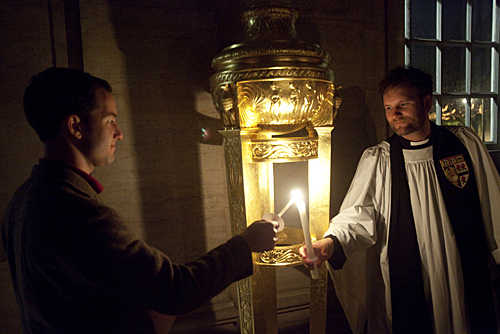
    The Great Vigil of Easter at the Memorial Church, which celebrates the resurrection of Jesus, is a time for new beginnings in the Christian faith, including baptisms. Its spiritual meanings are illuminated through the window of experience that the participants have shared.

    Marina Connelly ’12 said, “It is a miraculous point of beginning and regeneration, a ritual that extends far beyond the bounds of the Yard.”

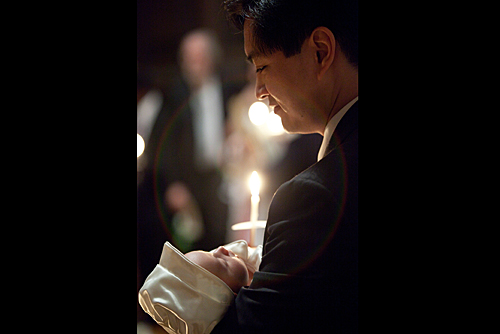
    Recounting the joy of presenting his daughter for baptism during the vigil, Alexis Goltra ’92 said, “My wife and I wanted to baptize Josephine at Harvard because we feel so connected to Memorial Church. I know of no other ministry that can simultaneously challenge and inspire one’s faith so profoundly.”

    Diana Eck, professor of comparative religion and Indian studies and a member of the Divinity School faculty, said, “To me, the Great Vigil of Easter is the most dramatic liturgy of the Christian year. I love it both as a Christian and as a historian of religion. There we are, midnight, outside the darkened church. The fire is kindled, we light our candles and enter the sanctuary as the story of creation from Genesis is read, then the crossing of the Red Sea, and on to the rest of the great narrative, right to the empty tomb. Symbolically, it’s a return to the beginning.”

    Lighting the way

    Lighting the way

    Dorothy Austin (from left), Sedgwick Associate Minister in the Memorial Church; Peter J. Gomes, Plummer Professor of Christian Morals and Pusey Minister in the Memorial Church; and Martin Wallner ’11, verger, light candles from a bonfire during “The Great Vigil of Easter” at the Memorial Church.

    Vigilant observers

    Vigilant observers

    Eck, who is also the Fredric Wertham Professor of Law and Psychiatry in Society, and Marina Connelly ’12, a member of the Harvard University Choir, witness the lighting of the Easter bonfire.

    Sharing the light

    Sharing the light

    Walter Klyce ’10 (from left) and Rob Mark, McDonald Fellow at the Memorial Church, light a candle during the vigil.

    Father and son

    Father and son

    Michael Sun ’97 holds his son, Michael James Sun Jr., before the baby is baptized.

    Easter vigil

    Easter vigil

    The congregation and procession are illuminated by candlelight.

    A family affair

    A family affair

    Jonathan Page, Epps Fellow and assistant chaplain at the Memorial Church, baptizes Josephine Zoe Goltra while family members Josie Amery (from left, wearing pearls), Alexis Goltra ’92 (father of Josephine), and Lynne Goltra (mother of Josephine) watch attentively.

    Photo slideshow: The Great Vigil of Easter

    Kris Snibbe/Harvard Staff Photographer

  • Bringing men’s lax back

    It’s been quite a few years since the Harvard men’s lacrosse team put together winning seasons. Nine, to be exact.

    But the Crimson are on the rise again, thanks to improving players and third-year head coach John Tillman. The former Ithaca College and Navy assistant coach, after going 6-8 in his first season at Harvard, helped the Crimson in 2009 record their best record (8-5; 3-3 Ivy League) in more than a decade. Last season’s first win, a 9-6 road upset in the season opener over fifth-ranked Duke, now stands as one of the biggest wins in program history, and a turning point.

    “The Duke win was important for us for a lot of reasons,” said Tillman. “To get that win against one of the premier programs in college lacrosse and certainly a group we have a lot of respect for [was a big moment].”

    Fast forward to this season. Despite consecutive losses to No. 5 Duke and No. 10 Cornell after a 5-2 start, Harvard is still ranked 20th in the nation and saw 13,285 fans come to Harvard Stadium to watch the Crimson face Duke — the largest Harvard lacrosse crowd ever.

    “We had hoped to do things like that when we first came in. And to have those things start to happen, even after just 30 months, just makes you step back and think: If we keep working at this, the possibilities are endless. … We could lead the country in attendance. We could have an elite program up here.”

    Tillman’s philosophy is simple. For Tillman, a one-time fleet support officer in the U.S. Navy and a former professional lacrosse player, one of the most important values is for his players to look at the team more like a family.

    “During practices, we’re going to challenge each other and get after it. But as soon as the whistle blows, we walk off and we do anything to look out for each other,” said Tillman. “Whether it’s a guy’s injured, he needs a summer job, he needs academic help, whatever it is, we have to be there for each other, and that’s something that’s nonnegotiable. We always have to be there for each other.”

    His players have bought into the program and the family environment, and increasingly recruits have too. This off-season Tillman recruited the third-ranked class in the country after pulling in a strong class a season ago.

    “Harvard is unique in a lot of ways. Number one, the education you can offer a young man, and the experience that it can offer, is unmatched. To be able to go to the most recognized school in the world and get the best education in the world is a just a special thing to offer. On top of it, the environment that they’re put in, because of the great job the admissions people do, there’s so much personal growth here.”

    As Tillman emphasizes individual growth, he offers a reminder to his players that, for them, Harvard is more than just lacrosse. “On top of being great athletes here, I want them to be very strong students here, great members of the Harvard community, and make sure they remember we’re members of the Harvard community.”

    After the recent two-game skid against top teams, the next three games will be critical for the Crimson if they want to hold on to their hopes not only to put together back-to-back winning seasons, but also to stay within striking distance of their first NCAA tournament appearance since 2006 and just their second since 1996.

    That will be tough for the Crimson, who after taking on last-place Penn will face No. 6 Princeton and No. 16 Yale to close out the regular season. But this team, which traveled to UMass earlier this season to top the Minutemen (now ranked 12th in the nation) by a score of 13-12, is no longer afraid of a top-ranked challenger. The Crimson will be ready now, and likely for years to come.

    “We’re still scratching the surface here, we’re still learning about Harvard … you can’t learn it all in 30 months, but we’re certainly trying to get there. We believe in this place,” Tillman said, “and I think that’s one thing that when recruits come up, they can sense from us.”

  • When cost-cutting backfires

    As efforts to contain rising health care costs intensify, a new Harvard study suggests that shifting costs onto chronically ill elderly patients can backfire and result in higher overall costs through increased hospitalizations.

    The research, conducted by Amitabh Chandra, a professor of public policy at the Harvard Kennedy School, examined patients’ health care utilization after copayment increases for office visits and prescription drugs in the California Public Employees Retirement System (CalPERS), the program that covers state and local government retirees there.

    Chandra, who conducted the study with Jonathan Gruber of the Massachusetts Institute of Technology and Robin McKnight of Wellesley College, said the study doesn’t simply say copayments are bad or good, but rather has a more complex message for those making health system changes. Though the copayment increases were counterproductive for elderly patients with a chronic disease like diabetes or hypertension, the study showed that copayments worked as desired for those not chronically ill. Those patients reduced office visits and prescription drug utilization with no negative effects on their health.

    Those broader results indicate that copayments can be effective cost-sharing mechanisms that prompt patients to consider whether they really need care, Chandra said. And the results show that most patients do a good job of deciding what care to cut out and what to maintain.

    More attention needs to be paid, however, to those who are chronically ill, Chandra said. For the subset of patients who are fighting diseases such as diabetes, high blood pressure, arthritis, and Alzheimer’s disease, the cost shift backfired. Patients with those conditions cut back on prescription drugs and delayed office visits enough to warrant increased hospitalization, more than offsetting any cost savings recognized from their copayments.

    “That’s a disaster because not only is care more expensive, their health is much worse,” Chandra said.

    For those patients, other interventions should be designed that encourage them to get the maintenance care critical to their health, Chandra said. Eliminating copayments, tying copayments to the therapeutic value of the drug, or even establishing a “negative copay” that pays them for taking their medications and making office visits could effectively keep them healthy and costs lower.

    The key, Chandra said, is tailoring the health care system in a way that wrings out costly unneeded aid while encouraging care that is effective at improving patients’ health.

    “In general, people get it right in cutting back,” Chandra said. “The question we’re all interested in is how do you design a system where patients don’t just get less care, but get more valuable care.”

    Understanding health care utilization by the elderly is critical because people over age 65 use 36 percent of health care in the United States, although they make up just 13 percent of the population. In addition, with an aging population, health care costs for America’s elderly promise to rise.

    The study, published in the March issue of the American Economic Review, fills a knowledge gap left by a seminal study conducted 30 years ago. That study, the RAND Health Insurance Experiment, excluded elderly patients and concluded that shifting costs to patients would reduce utilization without a corresponding decline in patient health. In the decades since, Chandra said, the U.S. health system has changed dramatically, and care for the elderly has become a major concern.

    The work of Chandra and his colleagues also highlighted a quirk in the U.S. system that allocates overall savings differentially to insurers involved in patient care. Because Medicare pays for hospital stays and private supplemental insurers provide prescription drug coverage, all the financial benefits of reduced prescription drug use went to the supplemental insurer. Offsetting hospitalization costs from patients not taking their medication, however, were borne not by the supplemental insurer, but by Medicare, which pays for hospitalization. That shift not only costs the government money, but argues for a system where a single insurer pays for all of a patient’s care so that unintentionally created perverse incentives do not wind up undermining a patient’s health.

  • GSD names Krzysztof Wodiczko professor in residence

    The Harvard Graduate School of Design has appointed Krzysztof Wodiczko as professor in residence of art, design, and the public domain, effective July 1, said Dean Mohsen Mostafavi, the Alexander and Victoria Wiley Professor of Design.

    Wodiczko is currently a professor and head of the Interrogative Design Group in the Center for Advanced Visual Studies at the Massachusetts Institute of Technology.

    Wodiczko is renowned for his large-scale slide and video projections on architectural façades and monuments. He has prepared more than 80 such public projections for Australia, Austria, Canada, England, Germany, Holland, Ireland, Israel, Italy, Mexico, Poland, Spain, Switzerland, and the United States. Since the late 1980s, his projections have involved participation by marginalized and estranged city residents. Simultaneously, he has designed and helped to create a series of nomadic instruments and vehicles with homeless, immigrant, and war veteran operators, for their aid and communication.

    Since 1985, he has held major retrospectives at such institutions as the Walker Art Center, Minneapolis; Museum Sztuki, Lodz; Fundació Tàpies, Barcelona; Wadsworth Athenaeum, Hartford; La Jolla Museum of Contemporary Art, San Diego; Contemporary Art Center, Warsaw; de Appel, Amsterdam; and the Zacheta National Gallery of Art, Warsaw.

    His work has been exhibited in Documenta, Paris Biennale, Sydney Biennale, Lyon Biennale, Venice Biennale, Whitney Biennial, Kyoto Biennale, Yokohama Triennale, and in many other major international art festivals and exhibitions. He and architect Julian Bonder have designed the Memorial to the Abolition of Slavery in Nantes, France, which is under construction.

    Wodiczko was awarded the Hiroshima Prize in 1998 for his contribution as an artist to world peace. He also has received the Skowhegan Medal for Sculpture, the Gyorgy Kepes Award, the Katarzyna Kobro Prize, and the “Gloria Artis” Golden Medal from the Polish Ministry of Culture. In 2009 he represented Poland in the Venice Biennale, developed the War Veteran Projection Vehicle in Liverpool, the Veterans’ Flame project at Governors Island in New York, and presented the “Veteran Project” (an interior video-projection installation) at the ICA in Boston. He is currently developing public art projects in Poland and France.

    The work of Wodiczko has been the subject of numerous publications, including “Critical Vehicles: Writings, Projects, Interviews” (1999), “Krzysztof Wodiczko: Guests” (2009), and “City of Refuge: A 9/11 Memorial” (2010).

  • Boston shines 2010

    For the eighth consecutive year, Harvard University is joining with Allston neighbors and local businesses to participate in the city of Boston’s citywide neighborhood cleanup event in Allston on April 23 from 8 a.m. to noon.

    Harvard employees and students have the opportunity to give back to one of Harvard’s host communities by volunteering with cleanup projects in the neighborhood’s parks, streets, schools, and other community locations. Activities will include raking, weeding, and cleaning up brush, painting projects such as benches, fences, and buildings, planting flowers, and other landscape projects. Last year, more than 70 Harvard employees across multiple departments participated.

    The event is set to kick off at 9 a.m., and check-in for volunteers will be at the Brighton Mills Shopping Plaza (400 Western Ave. in Allston), where projects will be assigned and coffee and donuts will be provided. Following the project tasks at approximately noon, lunch will be provided at Brighton Mills for all volunteers.

    Shuttle service will be available from Holyoke Center at 8:30 a.m. and 8:45 a.m., with return service at 12:30 p.m. and 12:45 p.m. Pickup for the shuttle bus will be on the Mount Auburn Street side of Holyoke Center across from University Health Services.
    To sign up to volunteer for a one-hour or three-hour time, visit zoomerang.com/Survey/WEB22AFM2BC7Y9. For more information, call 617.495.3525.

  • Lukas Prize Project Awards announced for 2010

    The Nieman Foundation at Harvard and the Columbia University Graduate School of Journalism recently announced this year’s recipients of the J. Anthony Lukas Prize Project Awards for exceptional nonfiction.

    The Lukas Prizes, established in 1998 and selected by committee members from Harvard and Columbia, recognize excellence in nonfiction writing that exemplifies the literary grace and commitment to serious research and social concern that characterized the work of the awards’ Pulitzer Prize-winning namesake J. Anthony Lukas, who died in 1997.

    Winners for 2010 include David Finkel, for his up-close examination of the human costs of making war; James Davidson, for his study of the homoerotic culture of ancient Greece; and Jonathan Schuppe, for his account of life in inner-city Newark, N.J., which focused on the efforts of an ex-con and former drug dealer to help impoverished children in the city’s most depressed neighborhood.

    To read the full story, visit the Neiman Foundation Web site.

  • From lab trash to treasure

    Harvard’s used and surplus lab equipment is finding new life in laboratories in the developing world through the efforts of a former graduate student and two groups of current students who collect, organize, and ship beakers, centrifuges, and other items to where they’re needed.

    The effort, undertaken by the students and fellows at Harvard’s Longwood and Cambridge campuses, diverts equipment that would otherwise find its way into the waste stream. Instead, it is collected, cleaned, cataloged, and then sent through a nonprofit organization begun several years ago by a Harvard grad student to underequipped labs in developing nations.

    “I started working in a lab my freshman year, and I didn’t realize how much I took for granted,” said Denise Ye, a Harvard College senior, molecular and cellular biology concentrator, and a founder of the Harvard College student group. “[Disposable] pipette tips — I’d throw out a box of them a day — I didn’t know that labs in Africa reuse them.”

    Ye and fellow senior Xun Zhou, a chemistry concentrator, started the undergraduate student group during their sophomore year, modeling their organization after a similar one operating on Harvard’s Longwood Campus. Both groups work closely with Seeding Labs, a nonprofit launched by then doctoral student Nina Dudnik, who began collecting surplus lab equipment while studying molecular biology in the Graduate School of Arts and Sciences.

    Dudnik said she became aware of the desperate needs in overseas labs when she worked as a Fulbright Fellow in the Ivory Coast before coming to Harvard in 2001. While in Africa, she worked on agricultural development in a lab that was so poorly supplied that it was common practice to wash, dry, and reuse “disposable” plastic test tubes for as long as three months.

    She suffered a case of laboratory culture shock when she came to Harvard, and she recalls walking the halls at night seeing discarded equipment left outside the lab doors to be picked up for disposal.

    “It’s a waste stream at most universities, and it’s not a waste stream that anyone is paying attention to,” Dudnik said. “People are buying new equipment all the time.”

    Robert Gogan, associate manager of recycling services for the University’s Facilities Maintenance Operations, said the students’ efforts, together with Seeding Labs, provide a second life for equipment.

    “Seeding Labs is a wonderful example of a group that has succeeded in recovering resources that aren’t state of the art for use at Harvard, but are still useful to others,” Gogan said. “Nina tells me that the used microscopes, centrifuges, and freezers we have picked up from Harvard laboratories are extremely helpful in the South American and African labs to which they have been shipped.”

    To aid the effort, the University provides storage space in Allston and Longwood, and the equipment is shipped several times a year. Gogan expressed gratitude to the Allston Development Group of Harvard Real Estate Services and Harvard Habitat for Humanity, which let the student organizations use their warehouse in Allston.

    The equipment — 140,000 pounds shipped so far — is most often used but still serviceable. Often it is being replaced by newer and faster models, or, in the case of something like pipette tips, was overordered and is sitting unused in supply closets. Older equipment is a welcome addition to faraway labs.

    “The equipment that is most commonly used, it’s most likely to be surplus, but it’s also most likely to be needed overseas,” said Amanda Nottke, a graduate student in Harvard Medical School’s departments of Genetics and Pathology and an organizer of the Longwood effort.

    Though there is a constant stream of donated equipment coming in from working labs, Nottke said more arrives when a laboratory moves or closes and discards equipment it no longer needs. In those cases, working labs get first dibs on equipment, but there is often plenty left over and unwanted. Seeding Labs maintains an online database and allows overseas institutions to build a “wish list” for equipment they particularly need, Nottke said.

    Seeding Labs does charge a small fee for the equipment, about a tenth of what it would cost to purchase, Dudnik said, which augments funding from foundations and individuals for the nonprofit’s operations. Though Dudnik has reached out to other universities, Harvard’s many laboratories in Cambridge and Longwood still provide the bulk of material sent overseas.

    Though giving a second life to lab equipment is the heart of the effort, relationships established along the way are leading to scientific and cultural exchanges as well, Nottke said. In the fall, Harvard Medical School’s Genetics Department and Massachusetts General Hospital’s Molecular Biology Department will sponsor student “ambassadors” who will travel to Kenyatta University in Kenya for several weeks as part of an exchange that will promote cultural as well as scientific understanding.

    Nottke said the ambassadors, who haven’t been named yet, would be asked to blog about their experiences and make presentations upon their return.

  • Boulders that bowl over

    Some rocks — as small as pebbles or as big as houses — are called “erratics,” since they were scattered over continents thousands of years ago by receding glaciers or rafts of ice. They look different than the native rock they come to rest on, and so they seem random and strange.

    Those same qualities, over time, were turned to artistic purposes. Landscape painters of the 19th century used erratics to illustrate the strange majesty of nature. By 1857, when surveys began for what would become Central Park in Manhattan, erratics already on the site were incorporated into the design.

    The science of geology — erratics and all — was a required subject in the nation’s first formal training program in landscape architecture, started at Harvard in 1900.

    “New Englanders hated a boulder. They blew them up,” declared Harvard geologist Nathanial Slater in a lecture that year. “But the modern landscape architect does not do this. In general, we are to appreciate rock surfaces.”

    That appreciation has taken some strange turns, from modest public fountains to faux cliffs to monumental fiberglass “rocks” lit from within. Many examples are on view at “Erratics: A Genealogy of Rock Landscape,” an exhibit at the Harvard Graduate School of Design’s (GSD) Gund Hall through May 12.

    You get a sense of the past from the cases of drawings, photos, manuscripts, and rock specimens on display, all from Harvard collections. Included are recent offerings such as Harvey Fite’s “Opus 40” (1935-76); Michael Heizer’s spooky pile “Adjacent, Against, Upon” (1976); and James Pierce’s long, winding “Stone Serpent” (1979).

    The exhibit’s extensive wall display of photos, diagrams, plans, and text provides a sense of the present as well as the future. Rock and other landscape elements, it seems, can be playful and plastic.

    One section, “Erratics in Practice,“ looks at projects by GSD faculty and affiliated practitioners. “The title simply means built projects that use rocks or the form of erratic boulders as a central element,” said exhibit curator Jane Hutton, a GSD lecturer in landscape architecture.

    Of immediate interest is the Tanner Fountain in front of the Science Center, a 1988 installation comprising 159 erratics, each around 4 feet wide, gathered from western Massachusetts. At dusk, it is a “cool white mass” that reflects light, the notes say, and after a rain “the center of the fountain glows like a warm cloud.”

    “Stock-Pile” (2009) is a more recent Harvard addition to the tradition of rock in landscape architecture. Conical piles of stone, aggregate, sand, and soil — designed and installed in seven days — are “poised to subside,” the notes say. A year after the installation, the points have softened.

    Most of the examples, though, point up rock’s near permanence. An erratic is displayed in a spare open house in China; tall volcanic rocks loom like giant tombstones in California; a walkway of basalt is set into an ancient streambed in the United Kingdom.

    On fullest display is the work of Canadian landscape architect Claude Cormier, a 1994 GSD graduate. His whimsical work includes explicit use of rocks. “Sugar Beach/Jarvis Slip,” an urban beach being built on Toronto’s industrial waterfront, plays off a nearby sugar factory. A large erratic will be candy-striped in red and white.

    A short essay on Cormier appears on one wall, written by the chair of GSD’s department of landscape architecture, Charles Waldheim, the John E. Irving Professor of Landscape Architecture. “In an era when the discipline of landscape architecture has shifted its attention away from a concern with the visual in favor of landscape’s operational potentials,” he writes, “Cormier’s work offers a counterproposal: that landscape is itself historically inseparable from questions of visual perception.”

    Other work by Cormier takes our perception of landscape a step further, creating works that mimic the real thing. “Lipstick Forest” (1999-2002) is a forest of large artificial trees — glossy and pink — in Montreal’s Convention Center.

    “Blue Stick Garden” (2000) used scans of blue poppies to create a bed of blue sticks that are now on permanent display in Montreal, “not as a contemporary installation in a garden,” Cormier’s Web site says, “but a garden itself.”

    Using rocks in landscape architecture has created whimsy too, as in the Nishi Harima Science Garden City in Japan (1994). Monumental fiberglass rocks there “glow like giant lanterns,” according to the exhibit card.

    The “Roof Garden” (2005) at the Museum of Modern Art is a rock garden with few real rocks. Hollow plastic shapes of white and black, eerily uniform, are bolted to runners and set off by beds of crushed glass, shredded tires, and white stone.

    Perhaps the future will echo Waldheim’s view of Cormier’s creations as “constant preoccupation with games of visual perception.”

    Electric blue

    Electric blue

    While looking like something biological — DNA or coral, even — this is actually artificial tree branches stretching into an equally blue sky. Once a diseased tree in Napa Valley, Cormier gave it new life — with 75,000 Christmas balls.

    Lipstick forest

    Lipstick forest

    Artist Claude Cormier avoided using live plants, which he said he would fight to keep alive against the unforgiving local climate. Here, 52 concrete trees, painted lipstick-pink to celebrate the city’s flourishing cosmetic industry, are not your average houseplant.

    My blue heaven

    My blue heaven

    Created in 2000 for the inaugural season of the Métis International Garden Festival in Quebec, one of Cormier’s inspirations was the Himalayan blue poppy, which was painstakingly adapted to the region’s microclimate. Here, folks stroll through the reeds. A real garden, indeed.

    D'Youville

    D’Youville

    Once the site of Canada’s Parliament, D’Youville’s sidewalks have been overlaid with wood, concrete, granite, and limestone, and jet between access points for the city museum, offices, restaurants, and residences on adjacent street facades.

    Photo slideshow: ‘Erratics: A Genealogy of Rock Landscape’ at Gund Hall