Blog

  • Bret Michaels Released From Hospital After Emergency Appendectomy

    Former Poison frontman Bret Michaels is resting comfortably at home after being released from the hospital following an emergency surgery to remove his appendix on Monday, The San Antonio Business Journal reports.

    Michaels underwent an emergency appendectomy in a San Antonio hospital this week after a scan showed his appendix was ready to burst — just moments before a big concert no less! The rocker was kept under doctors’ supervision for fear of complications after his temperature fluctuated following the surgery, which can sometimes be a sign of infection.

    Eventually, Bret’s condition improved and doctors gave him the all-clear to continue his recovery at home.

  • AAMCO’s iGAAUGE Now Available

    AAMCO has just announced that their popular  iGAAUGE application is now available for Android handsets.  The free tool provides users with access to car repair information, nearby fueling spots  and traffic information  For those of you who have trouble keeping up with all the care that goes along with owning a car,  iGAAUGE offers a preventive maintenance schedule to ease your worried mind.  Finally, there are special offers provided by AAMCO that are only available to iGAAUGE users.

    Might We Suggest…

    • Twitter Working on Official Android App
      Not much to say here that isn’t already in the title.  Business Insider is reporting tonight that twitter CEO Evan Williams claims and Android app is on the way and “it’s going to be awesome”.  As to …


  • 3 Takeaways from the Tax Day Tea Party Poll

    Public opinion polling is something between a dark art and a Rorschach test. Sometimes it can reveal significant and real trends. But too often the questions are leading, offer false choices or ask respondents to make enormous statements while withholding information or context. Consider that disclosure for this and all public polling analysis.

    This New York Times poll comparing the Tea Party movement to the general public is timed for Tax Day, but the main lessons have little to do with taxes. They have to do with spending, and how Americans — all of us — understand and misunderstand spending. Here are three takeaways from the poll.

    1. The Tea Partiers don’t appear to be as uniformly anti-tax as I painted them yesterday. Despite the “Taxed Enough Already” signs and the many vague and often contradictory allusions to their gratuitous tax burden, the poll suggests that half of Tea Party supporters thinks that their taxes are fair. Their insistence on reform falls mostly on the spending side: they’re against the stimulus, against the bailouts, against more packages aimed at job creation. Ninety-two percent call for a smaller government with fewer services.

    2. The whole country (but the Tea Party, in particular) struggles and will increasingly struggle to reconcile our desire for small government with our affection for entitlement programs. Three-fourths of the country and 62% of Tea Partiers think that Medicare and Social Security are “worth the costs.” In 2010, those programs will account for about 40% of government spending. Defense is 20%. Almost another 10% percent is mandatory interest on the debt. You tag 70% of the budget as untouchable and suddenly the prospect of delivering a smaller government becomes a lot more challenging.

    3. Is the stimulus failing, politically? Forget the tea partiers. More than 60% of the general public thinks the stimulus did nothing, or hurt. This is extraordinary. In the quarter when the stimulus passed, the economy was falling by 6% annualized and analysts were worried the stock market could hit 5000. In the last quarter of 2009, GDP was growing by 5.6%, and the stock market recently topped 11,000. So why do six out of ten Americans think the stimulus did nothing? It’s got to be the jobs.

    This highlights an important point that Marc Ambinder made. It’s interesting that Americans feel so down the economy while journalists feel so high on the recovery. Substantively, it’s up for debate. Politically, it just is. Americans think that the central tenant of the Obama administration’s economic policy is not working or worse. Democrats can’t debate that feeling. They just need to fix it, or hope the economy fixes it for them.


    Email this Article
    Add to digg
    Add to Reddit
    Add to Twitter
    Add to del.icio.us
    Add to StumbleUpon
    Add to Facebook


  • Bento for iPad

    Bento for iPad is based on Bento for iPhone with enhancements to make the most of the big iPad screen, and with support for new iPad gestures. In landscape, a split screen view shows both a complete records list and a single record’s details simultaneously. Rotate the iPad to portrait to focus on one record at a time. Plus, Bento for iPad includes background themes with coordinated fonts designed specifically for iPad to make your data look better than ever on the larger screen.

    More info…

  • Sony’s 3DTVs Will Be Available June In UK, Come With Goodies [3dTv]

    While the actual price of the set hasn’t been revealed, the HX803 will be Europe’s first Sony 3DTV, coming bundled with Blu-rays and games aplenty. More »


  • Genzyme Adds Whitworth to Board, Agrees to Add One More Director to Activist’s Liking

    Luke Timmerman wrote:

    Genzyme (NASDAQ: GENZ]), the Cambridge, MA-based biotech giant, said today it has added Ralph Whitworth of Relational Investors in San Diego to its board, confirming a report from last night by the Wall Street Journal.

    Whitworth, who oversees a $6 billion fund that is one of Genzyme’s largest shareholders, will now have inside access to push for change at Genzyme. He will chair a new Genzyme board committee on strategic planning and capital spending, and he will join committees on compensation and nominating and governance, which are responsible for CEO pay and CEO succession, Genzyme said. The company also agreed to nominate one more independent director with “substantial expertise” in the biotech industry, with the consent of Whitworth, Genzyme said. In return, Whitworth has agreed to support the company’s proposals and director nominees at the annual meeting scheduled for June 16, Genzyme said. The company’s board has now grown to 10 members with the addition of Whitworth. He will stand for election again at the annual meeting, along with all nine other directors.

    “I am looking forward to working with the board to further our agenda for creating shareholder value at Genzyme,” Whitworth said in a company statement. “As long-term shareholders, we believe the company has great potential.”

    This new deal with Whitworth is an update to a “mutual cooperation” agreement he reached with Genzyme back in January. Under that deal, Whitworth agreed to support the biotech’s slate of directors at the 2010 annual meeting on June 16, but if the company’s choices didn’t meet with Whitworth’s approval, Genzyme said it would name him to the board this fall. Whitworth shared his goals for changing things at Genzyme in this interview in January with Xconomy San Diego editor Bruce Bigelow.

    The move to add Whitworth and one more director could make the going tougher for another activist investor, billionaire Carl Icahn, to exert his own influence over the direction of Genzyme. Icahn nominated four candidates to the Genzyme board back in February, including himself. The shareholder angst stems in large part from manufacturing troubles that hit Genzyme last June, which eroded sales of its big-selling enzyme replacement therapies imiglucerase (Cerezyme) and agalsidase (Fabrazyme). Genzyme’s stock fell 26 percent in 2009.

    UNDERWRITERS AND PARTNERS


  • A few thoughts on Tax Day

    1) Dems have ripped the Bush tax cuts yet want to keep 95 percent of them.

    2) Even the middle class ones may only be extended through the 2012 election by Congress. That will make for a nice presidential campaign issue!

    3) New research shows that raising taxes on rich may now cost more revenue than it produces. We are on the wrong side of the Laffer Curve, people.

    4) If WH thinks Americans consume too much and save too little, why do they want to raise taxes on savings and investment?

    5) Why raise taxes on capital when the first quarter of 2010 saw the lowest commitments to venture capital since 1993.

    6) These tax hikes (letting the Bush tax hikes expire on the so-called wealthy) would hit the bulk of small biz profits.

  • Chrysler e a Nasa compartilharão tecnologia

    Chrysler Nasa logotipos

    Com o objetivo de compartilhar e desenvolver novas tecnologias, a Nasa (Administração Nacional do Espaço e da Aeronáutica) e a companhia de automóveis Chrysler, firmaram uma parceria com duração de três anos, de acordo com um comunicado emitido pela fabricante de automóveis.

    Dessa forma, a companhia poderá se beneficiar de toda a tecnologia empregada pela Nasa em seus foguetes e em seus demais sofisticados equipamentos. Já a Chrysler contribuirá com a Nasa fornecendo detalhes técnicos no desenvolvimento e construção de seus carros, principalmente das áreas de engenharia, robótica, sistema de baterias e radares.

    De acordo com a Chrysler, essa não é a primeira vez que ambas tem um relação comercial, onde ela teria construído os foguetes de impulsão da nave espacial Mercury, que teve destaque ao colocar pela primeira vez um piloto americano em orbita no planeta Terra, no longínquo ano de 1961.

    Segundo as palavras de Scott Kunseman, vice-presidente do departamento de engenharia da Chrysler: “É uma ótima oportunidade para compartilhar conhecimentos e dados em áreas onde tanto a Chrysler como a NASA têm interesse”.

    Fonte: Autoportal


  • Namco Bandai to publish Demon’s Souls in Europe

    Developed by From Software and the SCE Japan Studio, Demon’s Souls was published by Atlus in North America. Despite being owned by Sony, this title has only been published by SCE in Japan. So who’s doing it

  • Electronics Brain Trust to Create New Mobile HD Plug [Guts]

    This summer, Nokia, Samsung, Silcon Image, Sony and Toshiba have set aside differences to team up and create the most awesome mobile HD plug known to man. It’s like the trailer for a really lame action movie. More »


  • Framework and Matrix: The Five Ways Companies Organize for Social Business

    Yesterday’s webinar, you can view all slides (including these graphics below, and recording) on getting your company ready for social included a section on organizational models. I wanted to share more in the usual web strategy matrix style as 5 minutes on a webinar isn’t really enough to do a complicated topic justice. Interestingly enough, I’m often called into companies that are moving out of organic and into coordinated, or dandelion model as a central team needs help working with various business units and setting up the internal program. I plan to do a detailed research report on this topic in Q3, to find out how companies are organizing. First, let’s take a look at the different models that exist to provide blanked education to the market:


    Frameworks: Organic, Centralized, Coordinated, “Dandelion”, and “Honeycomb”

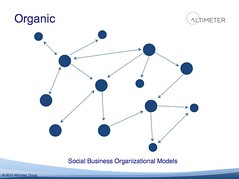
    Organic
    Organic: Notice that the dots (those using social tools) are inconsistent in size and one set of employees are not directly connected to others.

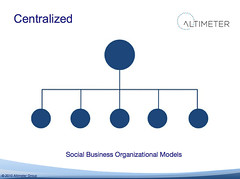
    Centralized
    Centralized: Notice that a central group initiates and represents business units, funneling up the social strategy to one group.

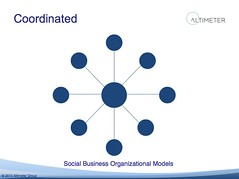
    Coordinated
    Coordinated: Notice how a central group will help to provide an equal experience to other business units.

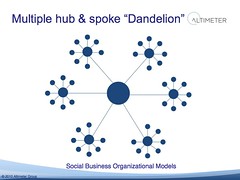
    Multiple hub & spoke "Dandelion"
    Multiple hub & spoke “Dandelion” notice how each business unit may have semi-autonomy with an over arching tie back to a central group.

    Holistic "Honeycomb"
    Holistic “Honeycomb” notice how each individual in the organization is social enabled, yet in a consistent, organized pattern.


    Analysis: Pros and Cons of Each Social Business Model

    Description Advantages Drawbacks What No One Tells You
    Organic Social efforts bubble up from the edges of the company, much like Sun Micrososystems encourage a blogging culture for all employees. Looks authentic and therefore trusted as multiple conversations appear closer to products and customers. Inconsistent experience to customers, one side of the company has no idea what the other side is doing, and multiple enterprise software deployments. Later, a nightmare for IT data management and marketing. This model is typical in large companies where control is difficult to enforce and often in software based companies. Mostly, I see companies transitioning out of this model.
    Centralized One department (Usually corporate communications) controls all social efforts. See how Ford has deployed their efforts to engage in the tough discussions while staying on brand. Great for consistent customer experience, coordinated resources, and rapid response May appear very inauthentic as press releases are rehashed on blog posts or videos by stiff executives. Great for regulated industries or brands over scrutiny, yet make sure you bring forth the employee voices –not just faceless logos, notice how Ford’s Scott Monty is front and center.
    Coordinated A cross-functional team sits in centralized position and helps various nodes such as business units, product teams, or geographies be successful through training, education, support. See how the Red Cross keeps various chapters organized, especially during life-threatening crises. The central group is aware of what each node is doing and provides a holistic experience to customers with centralized resources Costly. Executive support required, program management, and cross-departmental buy in. I see most companies headed this route, in order to provide safe autonomy to business units. Tip: the hub should be an enabler –not social police.
    Multiple Hub & Spoke “Dandelion” Often seen in large multi national companies where ‘companies within companies’ act nearly autonomously from each other under a common brand. Companies with multiple products like HP and IBM may naturally gravitate this direction. Business units are given individual freedom to deploy as they see fit, yet a common experience is shared amongst all units Requires constant communication from all teams to be coordinated which can result in excessive internal noise. Requires considerable cultural and executive buy in, as well as dedicated staff. Most suited for large multi-national corporations with multiple product lines. Look closely, the lines connecting the multiple hubs may be severed. Tip: provide way for spokes to connect to each other, not just be funneled through a central group.
    Holistic “Honeycomb” Everyone is in customer service and support and any employee who wants to be social is enabled. Dell and Zappos fit the bill. Tapping into your entire workforce (Best Buy’s Twelpforce is an example) to support and help customers Requires executives that are ready to let go to gain more, a mature cultural ethos, and executives that walk the talk. Very few companies will ever achieve this as it stems from internal culture, don’t ever force this, be true to your self. Tip: provide training classes on culture, social readiness, and a hotline for help for any employee

    Conduct Internal Analysis Of Your Company
    We focus on providing pragmatic advice to our clients, and it shouldn’t stop with this blog. This blog post should be shared with internal teams and then undergo this discussion:

    • First, identify which organizational model you’re in. Companies should forward this post to the internal teams to have a discussion on which model they think they are in. What’s interesting is that I often ask internal teams to vote on which model they think they are, and most often not everyone agrees, savvy executives should just observe. The dialog that ensues afterwards is most key.
    • Next, discuss which model is your company’s desired state. Companies must evolve to respond to the social customer, yet their current state may be different than the desired needs.  This decision can’t be made in a vacuum various business units, geographical locations, product teams and support and service groups must be considered –this isn’t about marketing alone, instead, put your customer’s experience first.
    • Recognize this isn’t an org chart, it’s a cultural change. Executives and their employees must realize the social web is forcing companies to undergo a cultural change as customers connect directly to each other bypassing companies. As a result, don’t expect these changes to happen quickly or without change management programs.

    Thanks to Richard Binhammer at Dell who recently at 2010 SXSW shared with me Dell’s “enlightened” state of organic, and Christine Tran, Altimeter Researcher for aid in these graphics.

  • Rogers officially launches the Xperia X10

    Rogers launches Sony Ericsson Xperia X10

    Canada’s Rogers network officially launched the Sony Ericsson Xperia X10 this morning ($149 with the Canadian-standard 3-year deal), and they made a nice little video to show it off. (Not unlike our nice little hands-on and hardware videos.) Their favorite feature — Timescape — happens to be my least favorite. And Rogers emphasizes that even though the X10 currently runs Android 1.6, it will be getting an update. Eventually. Peep the Rogers video with @RogersMiranda after the break. [Rogers]

    read more

  • “Snabba Cash” Coke Dealer Role For “HSM” Star Zac Efron

    Zac Efron will play a scheming cocaine smuggler in a new box office thriller!

    The actor – who rose to fame in Disney’s popular High School Musical films – is stepping away from the teen roles that made him a star to play a runner for a coke dealer in Warner Bros.’ Snabba Cash — translated Easy Money — an American remake of a Swedish film based on the 2006 novel by Jens Lapidus.

    Snabba was a major hit in its home country this year. The film follows three interconnected storylines involving drugs and organized crime, with the main character a young man (played in the original by Joel Kinnaman) who hopes to strike it rich by becoming a runner for a coke dealer.

  • What Will the Next Iran Intelligence Estimate Say?

    I covered Eric Holder’s Senate Judiciary Committee testimony yesterday, so I was unable to cover a fascinating and near-simultaneous hearing on Iran in the Armed Services committee. A host of senior military officers, Pentagon officials and intelligence analysts testified, and from this New York Times write-up, it sounds like the next National Intelligence Estimate on Iran will be rather hedged:

    In one curious moment in the testimony, General Burgess [the director of the Defense Intelligence Agency] noted that information made public by international nuclear inspectors suggested that Iran had not yet used its thousands of centrifuges at the Natanz nuclear site to make highly enriched uranium, the kind needed to produce a nuclear weapon.

    But when asked whether that was also the assessment of American intelligence agencies, General Burgess hesitated, and then told the senators that “any further discussion on that” should be held in a classified session.

    The generals offered a number of significant caveats about their assessment of Iran’s capabilities. When asked, for example, how long it would take Iran to convert its current supplies of low-enriched uranium into bomb-grade material, General Burgess said, “The general consensus — not knowing again the exact number of centrifuges that we actually have visibility into — is we’re talking one year.”

    That answer seemed to suggest that intelligence agencies believed that other enrichment sites, like the one discovered last year outside the holy city of Qum, might also be operating.

    According to the Times, consensus at the hearing was that it would still take significant effort and time to convert that bomb-ready uranium into a bomb, apparently at least a year’s worth. In his last round of testimony to the committee, Gen. David Petraeus, the commander of U.S. forces in the Middle East and South Asia, said he did not expect Iran to possess a nuclear weapon this year.

  • Ukraine urged to ensure accountability for human rights violations

    [JURIST] The Ukrainian government must ensure accountability for human rights violations, Amnesty International (AI) urged in a report Wednesday. AI addressed newly-elected President Viktor Yanukovych, calling on him to bring Ukrainian laws and practices in line with international human rights standards. Among the recommendations are establishing an investigatory agency to look into complaints of human rights violations against police officers as well as unannounced visits to prisons to deter improper treatment of prisoners. AI also urged Ukraine to record and monitor incidents of racially motivated crimes and to create a fair asylum system. The Ukrainian government responded Thursday that it would follow the recommendations. Deputy head of Ukraine’s presidential administration Anna German assured AI that the president was in control of “the promotion and unconditional protection of human rights.”
    Yanukovych was inaugurated in February after former prime minister Yulia Tymoshenko dropped a lawsuit contesting the election results, in which she alleged widespread voter fraud. AI has recently urged other countries to investigate human rights abuses. Last month, AI issued a report alleging that Kazakhstan’s government was failing to curb torture by law enforcement officers. The group also joined other human rights organizations in calling for an inquiry into the UK role in torture during the war on terror.

  • Twitter Chirp: Twitter Ready to Take On Facebook Connect with @anywhere

    The first day of the Twitter Chirp developer conference wasn’t just about boasting of the service’s impressive stats, there were a couple of launches as well. One feature that should have a great impact on how you interact with Twitter is the @anywhere platform. Announced last month, the platform is now available … (read more)

  • What Is Awesome?

    Note:  If you are having trouble viewing this, please click here.

    "The butterfly counts not months but moments, and has time enough." ~ Rabindranath Tagore

    A W E S O M E !!

    Rain hair.

    Getting grass stains.

    The smell of crayons.

    Picking up a q and u at the same time when playing Scrabble.

    A W E S O M E !!

    Those little things in life that happen and we don't even really think about all that much.  You know what I mean?  Like dangling your feet in the water.  Or maybe…jumping in and doing a perfect cannonball!  In the grand scheme of things, these are really pretty small moments in our life.  Still, are they not what makes this life we are living grand?

    I've been reading a book that is filled with all sorts of these examples!!  And what a FUN book to read! 

    The Book of Awesome.

    And reading this book is all sorts of AWESOME!

    It all had its simple beginnings as a website – created by a super great guy, Neil Pasricha.  His website, 1000 Awesome Things, begin as this list of those moments we have in life that really are awesome…and at the same time, they are just simple things that could happen any day. 

    Simple things, small moments…that are simply AWESOME!

    And today he is releasing a book  that chronicles these and more!

    The Book of Awesome.

    As I paged through this book, I just couldn't put it down!  Reading it brought up all sorts of great memories, and found me shaking my head in agreement!  AWESOME is all around us!  And there are all sorts of moments we all have that really are all of that – AWESOME!

    This book is such a feel-good read!  And even more than that – it's a reminder to me of just how cool those little things are that we sometimes just take for granted…

    Like popping bubble wrap!!!!!

    A W E S O M E !!

  • Report: MI towing co. files $750k lawsuit against student over Facebook page [w/video]

    Filed under: , ,

    T&J Towing suing Michigan student for $750,000 – Click above to watch the video

    Where does reporting the facts end and libel begin? That’s what a court in Michigan will probably be deciding when it takes on the case of T&J Towing vs. Justin Kurtz. According to WoodTV.com, Back in February, Kurtz began a Facebook page called Kalamazoo (Michigan) Residents Against T&J Towing for the purpose of letting people tell their stories about encounters with T&J. Seems no one has anything good to say about T&J’s towing practices, and the company wants all that bad press to stop. Somehow they think that will happen by suing Kurtz, a Western Michigan University student, for $750,000.

    In the video available after the jump, a legal professor weighs in on the suit and questions how T&J expects to win its case when Kurtz hasn’t lied about the company or even written the stories. But, of course, anyone with a few bucks and a free hour can file a lawsuit. We wish everyone involved the best of luck and a speedy resolution. Hat tip to Chris VH!

    [Sources: WoodTV.com, Facebook]

    Continue reading Report: MI towing co. files $750k lawsuit against student over Facebook page [w/video]

    Report: MI towing co. files $750k lawsuit against student over Facebook page [w/video] originally appeared on Autoblog on Thu, 15 Apr 2010 08:32:00 EST. Please see our terms for use of feeds.

    Read | Permalink | Email this | Comments

  • FCC Slowly Realizing Science And Data Are Kind Of Important

    Once upon a time, FCC Commissioners were engineers, thinkers and experts across a variety of fields. These days the well-lobbied agency’s stable of Commissioners is populated exclusively with lawyers, politicians and revolving-door lobbyists, and as you might expect — its primary product (no matter which party is in control) is quite often partisan bickering and broken policy. The nation’s recently unveiled first-ever national broadband plan is only the latest example of the kind of product the agency now creates, paying lip service to a myriad of industry problems but doing very little about the state of competition in the sector. Granted, to some, the plan looks good — focusing on feel-good efforts like "digital eduction" — but there’s very little in the plan that really challenges the status quo.

    The majority of bad FCC policies are unsurprisingly driven by bad data. The agency has made huge broadband industry policy decisions over the last decade using completely useless data that overestimated the volume of competition in the market. The rosy picture painted by the FCC was in part thanks to the confidential, unverifiable data provided by carriers, who have a vested interest in data that doesn’t try very hard to highlight limited coverage, slow speeds, or high prices. The FCC is only just now getting around to actually collecting comprehensive broadband price data or mapping broadband availability, though in many states this latter job was simply doled out to friends of the phone companies.

    While the FCC is still pushing into territory that may be better suited to the FTC, there’s at least a few signs the FCC is trying to fulfill their recent promises that they’ll be a more data-driven agency. In a post over at the FCC blog, the FCC’s Dave Vorhaus notes that the agency has picked UK speedtest firm SamKnows to help them test the real-world speeds obtained by home users. SamKnows does similar testing for British regulator Ofcom, and it helps the regulator determine if a consumer is getting what they pay for. While normal speedtests will illustrate whether a user is getting full speed, SamKnows uses in-home residential routers with modified firmware to specifically determine why. According to Vorhaus, the FCC is looking for volunteers to help them collect data:


    In a couple of weeks, we will be asking for consumers from across the country to voluntarily install hardware in their homes (on an opt-in basis) that is capable of measuring broadband performance. The measurements will give us results across a broad swath of providers, service tiers and geographic areas. More details on how to volunteer will follow in the coming weeks. We are tremendously excited about this announcement, the next step in the process of increasing transparency and competition in the broadband market and better informing consumers about their broadband service.

    While the selection of a UK firm might raise the hackles of those who think that job should have been given to a U.S. company (a Wall Street Journal blog headline makes a jab about stimulating the British economy), SamKnows is among the best in the telecom sector at this particular job, and is also used by UK ISPs to assess their own network performance. Of course quality data won’t mean anything if the FCC doesn’t use it to make smart policy choices (like realizing that fixing competition helps fix things like network neutrality without additional regulation). You also have to wonder if the FCC’s going to have a lot of free time, given the recent Comcast ruling all but ensures the agency is going to spend the next two years bogged down in a bare-knuckled fight with carrier lobbyists.

    Permalink | Comments | Email This Story


  • Singapore Takes Double-Barreled Action Against Inflation

    Lee Hsien Loong singapore(This is a guest post from the author’s blog.)

    China may be dominating the headlines, but my current nation of residence, Singapore, made some news of their own last night. After an off-the-charts 32.1% Q1 GDP number, the Monetary Authority of Singapore (MAS) came out swinging against inflation by announcing a one-off revaluation of the Sing Dollar (SGD), along with a move to an appreciation bias against the basket. Nizam Idris, a strategist at UBS, noted:

    “The double-barrel monetary tightening was an uber- aggressive move. It tells me that the economy is expected to do very well and there are concerns about long-term inflation and asset- price inflation, which argues for a much stronger currency.”

    Now you may be asking yourself what these actions actually mean, and for that matter, who the MAS even is. The MAS is the effective central bank of Singapore and they control monetary policy a little differently than we’re used to in the U.S.

    The Singapore Dollar (SGD) is allowed to trade in a band against a ‘basket of currencies’ whose composition is undisclosed. It’s different from a currency that’s just pegged (like the CNY) as the MAS also lets the SGD float around the targeted midpoint in a band of a few percent. Most banks create some model based on size of trading partners to try to replicate the MAS basket to forecast moves in the SGD.

    Let’s say on a particular day the USD and JPY are both appreciating against most other currencies, based on their weight in the basket, the MAS will let the SGD appreciate a certain amount as well. It’s when the currency starts being pressed against the outer reaches of the ‘band’ that the MAS will make its presence known. It was always fascinating when all the major ccy’s were volatile and the SGD was following suit, and suddenly the MAS would absolutely shut down currency movement with massive orders. They do this 24 hours a day to maintain the integrity of the currency band, and as a trader, you knew when it was time to step back.

    Now that is how they monitor the band on a daily basis, but what did their policy actions yesterday actually do? As mentioned above, there is an effective midpoint of the band around which they allow fluctuation. Their action of a “one-off revaluation” was significant because they moved that midpoint or central target, making the SGD effectively stronger against the basket. It would be the same as if China revalued the Yuan from the current 6.83 to 6.53 in one shot, but with the SGD it’s against a basket as opposed to just the USD.

    The second, and slightly more complicated aspect, was the move to an “appreciation bias”. Based on inflation expectations, for each policy meeting, the MAS will decree either a “bias” that will slowly let the midpoint either strengthen, weaken, or remain stable against the basket. The MAS announced a switch from the neutral bias, to the new “appreciation bias”. The midpoint around which they let the currency fluctuate will now slowly be allowed to appreciate against the basket over time. This allows for a very gradual intrinsic appreciation of the currency to help fight inflation.

    Whether or not my mechanical explanation above makes any sense, what is important is that this is the first time in 39 years that the MAS took the “double-barreled” action of a one-off reval plus a change in the bias. This should be significant for Southeast Asian growth expectations along with regional currency views. Whether this is a prelude to a China move remains to be seen, but what can’t be denied is, with an absurd 32.1% GDP growth number in Q1, Singapore is getting serious about fighting inflation.

    Join the conversation about this story »