Blog

  • BlackBerry Sync Superstore Deals Of The Day

    I have the deals of the day for our readers from our BlackBerry Sync Superstore. There are three deals today. One for the online store, and the mobile Superstore’s deals of the daily app, game, and theme. We’ll be announcing them daily so take advantage of them while you can. So what are the deals today?

    The Online Deal today is: miPhone 3G v1.0.5 theme by loopSpin Inc. Regularly $4.49, but today it’s only $2.24.

    The description is as follows:

    Show off your Blackberry® with a theme that is smooth with the look of an iPhone®! This theme provides you with a sliding home screen (not available on some Blackberry’s), and a vibrant background as well as the popular high level screen transitions (OS4.7 or greater)! Move away from the boring themes and into something exiting!

    (Sliding homescreen available on BlackBerry Storm 1 and 2 only)
    (Screen transitions are only available on Blackberry’s with OS 4.7 or greater)

    Features are:

    • Sliding home screen
    • Screen transitions OS(4.7 or greater)
    • Custom icons
    • Custom menus and dialogs
    • Custom backgrounds
    • Customizable home screen icons

    Grab your copy of miPhone 3G on sale today for $2.24 from the BlackBerry Sync App Store here

    Today’s mobile Superstore App Deal of the Day: ReplyGuard v1.1.0 by Eclypse IT Solutions. Regularly $2.95, it’s on sale today for only $1.47.

    Description is as follows:

    Protect yourself from accidental, embarassing and potentially career-ending ‘Reply All’ accidents! ReplyGuard is a “must-have” application for any BlackBerry user. Gain peace of mind instantly with this ReplyGuard, knowing that you’ll never have to worry about making the mistake of clicking “Reply All” before it’s too late. When you send an email to multiple recipients, ReplyGuard will stop the sending process and alert you to let you choose whether to continue and send the message or not.

    Features include:

    • Receive popup confirmations when you are about to send email to multiple recipients.
    • User configurable confirmation settings.
    • Runs quietly in the background.
    • There when you need it most!
    • A “must-have” app for any BlackBerry user!
    • Fully functional, FREE 3-day trial!

    Grab your copy of ReplyGuard from the BlackBerry Sync Store or mobile Superstore today for only $1.47

    The Game Deal of the Day is: Spin & Set which comes in two versions, Spin & Set (Beauty) and Spin & Set (Avatar) both by iMobLife. Both are normally $5.99 but are both available for only $2.99 today.

    The descriptions are as follows: Beauty-

    Get the cool puzzle game of Spin and Set on your BlackBerry, unveil a set of beautiful girls’ pictures and lots of fun!

    Game Instruction:
    Each image is cut into 24 pieces, and each piece is randomly rotated. Players need to spin the pieces correctly to reproduce the original image in a limited timeframe. Simply tap on the pieces to spin it to the right direction. Player who recovers the image quicker gets higher scores.

    The images are pretty, and the game is tons of fun! So start playing now!

    Details:

    • 10-stage puzzles to unveil images of beautiful girls
    • Delicately designed user interface with beautiful fonts and stylish background
    • Relaxing background music while playing the game
    • Fully support touch screen for an extremely fun experience (currently only available for the Storm™ & Storm2™)

    Grab your copy of Spin & Set (Beauty) today for only $2.99 from the BlackBerry Sync Store or the Mobile Superstore here

    Avatar-

    Spin and Set (Avatar) – A cool puzzle game for James Cameron’s 3D movie Avatar

    Get the cool puzzle game of the latest Avatar movie on your BlackBerry, with a set of beautiful pictures in the 3D Avatar movie and lots of fun!

    This puzzle game was specially designed to capture the visual appearance of the Avatar movie while players can fully enjoy the great fun when spinning and setting puzzles.

    Game Instruction:
    Each image is cut into 24 pieces, and each piece is randomly rotated. Players need to spin the pieces correctly to reproduce the original image in a limited timeframe. Simply tap on the pieces to spin it to the right direction. Players who recover the image quicker get higher scores.

    The images are amazing, and the game is tons of fun! So start playing now!

    Features include:

    • 10-stage puzzles with amazing pictures in the Avatar movie
    • Delicately designed user interface with beautiful fonts and stylish background
    • Fair-sounding background music while playing the game
    • Fully support touch screen for an extremely fun experience (currently only available for the Storm™ & Storm2™)

    Grab your copy today of Spin & Set (Avatar) from the BlackBerry Sync App Store or Mobile Superstore for only $2.99 here

    You’re reading a story which originated at BlackBerrySync.com, Where you find BlackBerry News You Can Sync With…

    This story is sponsored by the new BlackBerry Sync Mobile App Store. Grab your free copy today at www.GetAppStore.com from your BlackBerry.

    BlackBerry Sync Superstore Deals Of The Day

    Related posts:

    1. Introducing BBSync’s new App Superstore! Download, Enter to Win + 20% off all apps! We’ve got great news to kick off Tuesday March…
    2. Don’t Mean To Burst Your Bubble, But There’s A Free Game: Bubble Popper Our store has a wide selection of software available,…
    3. HOT! Get the BlackBerry Sync Mobile App Store for BlackBerry Now! Huge news for our readers this morning! The BlackBerry…

  • Who loses if California’s climate law is halted?

    by Rachel Morello-Frosch

    Co-authored by Manuel Pastor. Cross-posted from The Huffington Post.

    No doubt you’ve heard the warnings—the melting ice caps and rising sea levels, the extinct polar bears and extreme weather conditions.  From pop culture movies like The Day After Tomorrow, to the tireless work of advocates like Al Gore, the discussion around climate change has often focused on environmental catastrophe and what the future may hold if humans don’t change their carbon-emitting ways.

    These are, of course, serious concerns and we need to address them to secure our planet’s future. But what’s been missing from the conversation is how climate change is affecting us here at the local level, in our communities, and that climate change policy—done right—could result in cleaner air for many American families today.

    Last year, we released research about the “climate gap”—the fact that people of color and the poor in the United States may suffer more from the economic and health consequences of climate change than other Americans. Our newest study, Minding the Climate Gap: What’s at Stake if California’s Climate Law isn’t Done Right and Right Away, builds on that work to show that people of color and the poor have the most to lose if efforts to confront climate change are delayed. However, they also have the most to gain if we implement climate policies that deliver immediate public health benefits for everyone.

    In California, for example, communities of color are more likely to live near major green house gas emitting facilities, such as refineries, power plants, and cement kilns, which also spew toxic air pollution.  This inequality in pollution emissions persists even after accounting for income differences across neighborhoods.  In the case of particulate matter, which affects respiratory health, we find that, on average, communities of color face a pollution emission burden that is 70 percent higher than for whites. This trend makes clear that getting climate change policies right and right away is important for all of us, but it’s particularly essential for these overburdened communities.

    What’s astonishing is that despite the real threat that climate change poses—and the immediate benefits from enacting climate change policy—some politicians and big oil corporations are saying that we need to put the climate change law “on hold” in California. Whether or not millions of us will soon be breathing cleaner air may now hinge on a California ballot initiative, a statewide referendum that has once again become a proxy war for national policy debate.

    Recent news has revealed that Texas oil companies Valero and Tesoro are major contributors to a campaign—to the tune of $600,000—to prevent implementation of California’s climate law (known by its legislative name AB 32).  These same companies are big contributors to air pollution. Our research indicates that all four of Valero and Tesoro’s major refineries in California are major contributors to public health risks from air pollution. We also found that Valero and Tesoro’s refineries are among the worst facilities in the state for disproportionately emitting pollutants in communities of color.

    California’s climate law was put into place years ago and now it’s time to implement it.  Allowing out-of-state oil companies to stop its implementation will not save jobs. Economic research on this issue shows that green job growth is a more likely result of climate policy and California is well-positioned for gains in that sector. If the oil companies win, it will just delay the immediate opportunity for cleaner air and better public health.

    Implementing the climate law in the “right way” is also not that complicated. We suggest incentives should be structured to reduce greenhouse gases in neighborhoods suffering from the dirtiest air. Facilities responsible for the greatest estimated health impacts—could be prohibited from paying a fee or trading emissions credits in lieu of cleaning up their operations. Revenues generated from polluter fees could also feed into a “Climate Gap Neighborhood Protection Fund” to improve air quality in these communities and enhance the ability of disadvantaged Californians to adapt to climate change impacts.

    The enormous potential for cleaner air as a result of California’s climate law hasn’t even been a part of the debate yet, but last week a Field poll found that 58 percent of Californians support the policy. As more people realize that supporting smart climate policies will also give them cleaner air to breathe, that number could increase significantly. That’s good news for those seeking to protect California’s climate law and public health against the misguided anti-AB 32 campaign.

    Whether the goal is protecting the environment or re-building America’s workforce, preventing climate change is not just about reaping some future returns. Real climate solutions will give us cleaner air to breathe—and this is an immediate benefit for everyone, especially for communities of color and the poor who are currently suffering from the dirtiest air.

    Rachel Morello-Frosch is an associate professor in the Department of Environmental Science, Policy, and Management and in the School of Public Health at the University of California, Berkeley. She is also a Grist board member.

    Manuel Pastor is Professor of Geography and American Studies &
    Ethnicity at the University of Southern California.

    Related Links:

    Justice Stevens’ pro-environmental legacy embodies a simple approach:  follow the law

    The hazards of using toxic coal ash for land development

    Solar PV in Los Angeles: The emperor has no clothes, says UCLA


  • IBM requiring suppliers to track and report environmental data

    ibm

    IBM has made a significant step in cleaning up its global operations.  It’s now requiring all of its suppliers in 90 different countries to install management systems to track environmental data like energy use, greenhouse gas emissions, and waste and recycling levels.  All suppliers must set environmental goals and publicly report their progress.

    For large global companies like IBM, turning over a greener leaf starts with gathering environmental data on all parts of your supply chain.  Once armed with that information, IBM will know where and how to make changes.

    IBM is also requiring any subcontractors of their suppliers to track the same data if they’re a significant part of the supply chain.  The company says their goal with this project is to systematize environmental management and sustainability so that all of its global partners are working with the same type of information and are easily able to set and reach environmental goals.

    All suppliers will need to have these systems installed by early 2011.  If they don’t comply, IBM says it will no longer do business with them.

    via NY Times

  • Watch Films On iPad? Might As Well Use 480p [Ipad]

    The iPad’s screen is relatively low resolution, just 1,024 x 768 pixels. If you’re watching a moves in widescreen with letterboxing, these screenshots from the A-Team trailer from Apple.com make it clear there’s little difference. When zoomed in, however… More »


  • Follow Finder, busca a quien seguir en twitter

    Follow Finder es un nuevo servicio de google que mediante el ingreso de nuestra cuenta busca un par personas o empresas a la cual te recomienda seguir segun los seguidores que ya tienes, lo que publicas, etc.

    La interfaz es muy simple nada mas agregar tu cuenta, buscar y seguir, así que no van a tener problemas. En mi caso me aparecen cuentas que ya sigo, por mas que actualice me las sigue recomendando..

    Via Google blog

  • GM adds head doctor to board of directors

    Filed under: ,

    General Motors has officially added a 13th seat to its board of directors just for Cynthia A. Telles. If you live in the greater L.A. area, there’s a good chance that name sounds familiar. She spent a lengthy 13 years as a Los Angeles commissioner, and has background steeped in ethics and equality. But while you’d expect Telles to have some connection to manufacturing or the automotive industry, as far as we can tell, she doesn’t.

    Telles has her Ph.D. in Clinical Psychology from Boston University, and currently serves as the director of the UCLA Neuropsychiatric Institute Spanish-Speaking Psychosocial Clinic. Try fitting that on a business card. According to the GM press release, she’s also had quite a bit of work published in the mental health field, which means that eventually, Telles may provide us with the answer behind what GM was thinking with cars like the Pontiac Aztec.

    She is quite accomplished in the business world, though. Telles has sat on a number of boards in her time, including slots on the Kaiser Foundation Health Plan and Hospitals, Americas United Bank and Sanwa Bank California, among others. What impact will Telles have on GM? It’s hard to say just yet, but we’ll keep our eyes peeled.

    [Source: General Motors]

    Continue reading GM adds head doctor to board of directors

    GM adds head doctor to board of directors originally appeared on Autoblog on Wed, 14 Apr 2010 17:39:00 EST. Please see our terms for use of feeds.

    Permalink | Email this | Comments

  • What to do about the Pope? | Cosmic Variance

    When it comes to religion, I’m more interested in scientific and philosophical questions — Does God exist? Can science say anything about the supernatural? — than in sociological or political ones — Is religion good and or evil?, etc. So there was not much temptation to wade in on Pope Benedict’s recent troubles, or the wider issue of sex scandals in the Catholic Church.

    Now, happily, that temptation has dipped to zero, since Phil Plait has done such a good job. Read the whole thing, as they say. Roughly, Phil notes that the Pope seems to be responsible for some very bad things; that he should be brought to justice for any wrong-doings; that there is some relevance to concerns of the skeptical community, insofar as the Church invokes supernatural explanations; but finally, that the strategy should not be simply one of proclaiming superiority and tarring religion as evil and demanding heads on plates. Catholics and other believers, whether we disagree with them or not, are human beings who will understandably be upset and troubled at the recent news. We don’t help to convert them to atheism or naturalism or skepticism by shoving the shortcomings of their leaders in their faces in the midst of a crisis; reason and rational discourse should be more our style. It’s a nuanced argument, which means it’s guaranteed to be misunderstood and caricatured, since even God can’t control the natural impulses of the internet.

    Let’s be clear: I want religion to vanish. I think that religious beliefs are wrong, and that the world would be a better place if everyone accepted the real world for what it is. And I believe that many of the actions of the Church when it comes to pedophilia certainly deserve the label “evil,” whatever one might think of the people who perpetrated them.

    So the question is, how to bring about the rationalist utopia in which people’s actions are based on reason and reflection rather than faith and hierarchy? I agree with Phil’s answers, as I’ve argued in other contexts. One of the primary tenets of a rationalist philosophy should be that we should be especially skeptical about claims that we want to be true. Our personal preferences don’t have any effect on the truth, so we need to guard against confirmation bias and lazy acceptance of ideas that make us happy. One great example is the idea that we’re going to make the world a better and more rational place by telling everyone how much smarter we are than everyone else, and how evil and stupid our enemies are. The Pope’s recent actions, it seems clear, are some combination of evil and stupid. But now is just not the time for patting ourselves on the back. A lot of people have been deeply hurt, directly or indirectly, and we should be able to show just a modicum of restraint. Not giving up or keeping quiet, but picking our spots. After all, we don’t have to win by being obnoxious — we can win by being right.


  • Social Travel App “Where I’ve Been” Gets Funded

    Where I’ve Been, a company whose Facebook application lets users chart their travel plans and discuss them with friends, has gotten an additional round of funding from the co-founders of Groupon, a group-buying service that reportedly just closed its own round of funding valuing the company at $1.2 billion. The money raised by Chicago-based Where I’ve Been is somewhat smaller than that, however, at $750,000. The company — which was widely rumored to have been acquired by TripAdvisor for $3 million in 2007, in a report that turned out to be false — raised $1 million in 2008 from Chicago-based Sink or Swim, which was acquired last year by TD Ameritrade.

    The latest round of financing came from an entity called Lightbank, a recently formed investment vehicle created by Groupon founders Eric Lefkofsky and Brad Keywell. Where I’ve Been says that it will use the money to “aggressively expand” its current user base of 9 million registered users, who the company says have shared close to 500 million “travel intents” or travel plans on the application’s interactive map. Users can share either trips they have taken or plan to take, then discuss them with their friends and other Facebook users. Lefkofsky said that Where I’ve Been “has enormous potential to change the landscape of the travel industry.”

    According to the company’s release, Groupon President and COO Rob Solomon sits on the Where I’ve Been advisory board, and was formerly a partner at Technology Crossover Ventures, as well as president and CEO of SideStep and a senior VP at Yahoo.

    Related content from GigaOM Pro (sub req’d):

    Social Advertising Models Go Back to the Future

    Post and thumbnail photos courtesy of Flickr user Dunechaser

  • Fishing Fees Cut For Season That Starts Saturday; Hikes In Motor Vehicle Fees, Including Seat Belt Violations

    With fishing season starting on Saturday, the state Senate unanimously granted final legislative approval Wednesday to reduce hunting and fishing fees that were hiked last year because of the state’s ongoing budget crisis.

    Republican Gov. M. Jodi Rell, who crafted many of the ideas in the multi-pronged fiscal bill, immediately signed the measure early Wednesday evening – days before the fishing season starts.

    The bipartisan, consensus bill that cuts the fees was originally passed 147 to 1 in the state House of Representatives on Tuesday night. Shortly after 5:45 p.m. Wednesday, the state Senate voted 36 to 0 to approve the bill that reduces 47 different hunting and fishing fees while raising 15 different motor vehicle fees to pay for it. About 180,000 people pay the hunting and fishing fees each year.

    Some lawmakers were stunned that Senate Democrats and Republicans – after disagreeing for the past 18 months on many budget issues – had voted unanimously for a budget bill.

    “We should take a picture for posterity purposes of that vote on the board,” said Senate Majority Leader Martin Looney, a New Haven Democrat.

    The cuts in the sporting fees would only be for future payments. If someone, for example, bought a fishing license last week, they would not be able to get the fee reduced retroactively, officials said.

    Overall, the sporting fees statewide would drop by $5.35 million, but the legislature would raise other fees and make moves to cover that exact amount.

    Some of the most common motor vehicle fines would be increasing under the bill. For example, the fine for failing to wear a seat belt would jump to $50, up from the current level of $15. The seat-belt fines had been low because they have not been changed since 1985.

    In addition, the minimum fee for speeding would increase to $50, up from $35. Those failing to carry their registration or insurance card in their car would pay a $50 fine, up from the current $35.

    Sen. John Kissel, an Enfield Republican who pushed for the fee cuts, said it was a positive move that a hunting license for a Connecticut resident would be going down from the current $28 to $19.

    “I know that the hunters, sportsmen and campers in my neck of the woods are going to be happy when they read what we did,” said Kissel. “I would like to have seen this happen months and months and months ago, but I’m reasonable enough to know that half a loaf of bread is better than nothing at all.”

    He also praised Sen. Donald DeFronzo of New Britain, who has been pushing for the proposal since December 2009.

    “This is a wonderful step in the right direction,” said Sen. L. Scott Frantz, a Greenwich Republican. “Mick Jagger hit it all wrong. Time is not on our side when we are facing large deficits. … We have to keep in mind that Connecticut lags the national economy by 12 to 18 months to come out of the recession. … The important thing is this sets the tone for moving forward.”

    The bill also capped camping and state parks fees, which were benchmarked back to April 1, 2009 before any changes could be made.

    In the House, state Rep. Karen Jarmoc, an Enfield Democrat, was among those pushing for the rollback of the fees, and she organized a meeting with various sportsmen’s organizations to obtain feedback on the fees.

    The deficit-mitigation debate, including the fee cuts, started in the Senate at 4:45 p.m. Wednesday in an effort to wipe out the projected deficit of about $350 million in the current fiscal year that ends on June 30. The legislature wanted to act before the fiscal year had ended so that lawmakers would not be forced to borrow money to cover the deficit.

    The bill includes about $139.3 million in spending cuts and balances the budget without any tax increases. Republicans and Democrats have clashed sharply over proposed changes in the estate tax and creating a new gross receipts tax on hospitals, but those debates were put off for another day.

    “We shouldn’t pat ourselves on the back too hard. This was the easy part,” said Sen. Leonard Fasano, a North Haven Republican. “Our obligation is much, much more than 2010. We have an over $700 million deficit in 2011. We waited until April 14 to tackle 2010’s problem. Before we get too jubilant and excited about doing our job, we have a big deficit ahead of us.”

    Fasano told his colleagues on the Senate floor that Connecticut needs to change its image that it is not a “business-friendly” state. One of the problems, he said, is that the tax-writing finance committee has continued talking about the “unitary” tax that is strongly opposed by major corporations and the Connecticut Business & Industry Association.

    “The policies that we put out there tells people what we’re thinking,” Fasano said.

    “I stand today in support of this bill and stand here very pleased that we have been able to come together … on spending cuts, rather than taxes,” said Sen. Dan Debicella, a Shelton Republican who often votes against Democratic budgets. “This is not slash-and-burn cutting. … I’m very pleased that the hospital tax and the estate tax are gone. I hope they are gone for good.”

    Sen. Edward Meyer, a Guilford Democrat who has become a key swing voter on budget issues, said that school transportation, biomedical research, and school-based health centers were preserved as lawmakers used  “a surgical knife” to make the cuts Wednesday.

    Looney said the deficit-cutting measure was a judicious package of improvements that closes the gap for the current fiscal year.

    Both Republicans and Democrats rhetorically slapped each other on the back for a bipartisan plan that came in marked contrast to previous budget battles over taxing and spending.

    “It certainly is a new day from when we last met at 5:30 in the morning,” said Sen. Toni Boucher, a Wilton Republican who referred to the major battle on the morning of March 27 in which the Senate approved a budget-mitigation bill that was never approved by the House after Rell vowed to veto that bill.

    “After that painful night, Gov. Rell stepped forward with her own program,” said Senate GOP leader John McKinney of Southport. “That has to be the momentum we take forward in the next few weeks. … There are tough decisions to be made. … I’m happy that we are here with a bipartisan solution.”

    Senate President Pro Donald Williams, the highest-ranking senator, said plenty of work was done behind the scenes in recent weeks to find savings in the state budget.

    “It is a milestone,” Williams said late Wednesday afternoon. “Three weeks ago, people would have been surprised if they were told that there would be an agreement” that was supported by Republicans, Democrats, and Rell.

    In other matters, the Senate voted 24 to 11 to approve a minor reform in the new campaign finance reform law that had been previously approved Tuesday by the House. The law currently says that if a court found the new law to be unconstitutional, the legislature would have only seven days to respond.

    The bill was immediately sent to Rell, who signed it Wednesday.

    The fix to the law would allow the state to have 30 days to act, rather than seven.

    “We need more than seven days to digest an opinion” and make proper changes, said Sen. Gayle S. Slossberg, the co-chairwoman of the legislative committee that oversees elections.

    Currently, the state is waiting for a ruling by the U.S. District Court for the Second Circuit, which is among the most powerful appeals courts in the nation.

    Fasano, a deputy Republican leader, said the legislature has avoided making any decision since the original federal court ruling last year by Judge Stefan Underhill. He noted that McKinney had successfully predicted that the bill would be ruled unconstitutional.

    “This decision has been here since August, and we have done nothing,” said Fasano, a North Haven attorney.

    The rules, Fasano said, should apply to the “Green Party, yellow party, Working Families, whatever.”

    Fasano and Sen. Edith Prague, a liberal Democrat who often disagrees with the Republicans, said they would not accept public financing for their campaigns.

    “I believe in my heart of hearts that we need this money for other things,” Prague said on the Senate floor.

    Williams, of Brooklyn, said the law is designed to “eradicate the influence of special interests” in state politics. The rules for minor parties were modeled on the presidential public financing system that has been upheld in the courts, he said.

  • Obama taps Darryl McPherson to be Chicago based U.S. Marshal

    MEXICO CITY–President Obama tapped Darryl McPherson to be U.S. Marshal for the Chicago-based Northern District of Illinois federal court. McPherson was the lead deputy Marshall for Judge Joan Lefkow after her husband was killed.

    below, from the White House….

    Darryl K. McPherson: Nominee for United States Marshal, Northern District of Illinois

    Darryl McPherson is currently employed by the Department of Justice working for the U.S. Marshals Service in Chicago as Judicial Security Inspector. He has been with the Marshals Service since 1997. Mr. McPherson started as Deputy U.S. Marshal out of the Mobile, Alabama office until 1999 when he was promoted to his current position in Chicago. Mr. McPherson received his Bachelor of Science in Political Science from Spring Hill College in 1997.

    The White House
    Office of the Press Secretary
    For Immediate Release
    April 14, 2010

    President Obama Names Six to Serve as U.S. Marshals

    WASHINGTON- Today, President Obama nominated Arthur Baylor, Michael R. Bladel, Kevin Carr, Kevin C. Harrison, Darryl K. McPherson and Henry L. Whitehorn Sr. to serve as U.S. Marshals.

    “I am proud to nominate these outstanding public servants to serve as U.S. Marshals,” said President Obama. “Throughout their careers, they have demonstrated an unwavering commitment to justice, and I appreciate their continued willingness to serve and protect the American people.”

    Arthur Baylor: Nominee for United States Marshal, Middle District of Alabama

    Arthur Baylor is the Chief of Police of the Montgomery Police Department in Alabama. From 1998-2004, Mr. Baylor also worked for the Unified Judicial System as a Judicial Security Coordinator where he was the Deputy Marshal. He received his Bachelor of Science degree in Criminal Justice in 1977 and a Master of Science degree in Criminal Justice in 1990 from Troy State University.

    Michael R. Bladel: Nominee for United States Marshal, Southern District of Iowa

    Michael Bladel is the Law Enforcement Coordinator for the U.S. Attorney’s Office in the Southern District of Iowa. He served as the Chief of Police in Davenport, Iowa, from 2000-2007, and was a Police Officer there from 1971-1993. From 1993-2000, Mr. Bladel was the Sheriff of Scott County, Iowa. He served in the U.S. Army from 1968-1971 and earned a Bronze Star. Mr. Bladel received a Bachelor of Arts degree in criminal justice from St. Ambrose University in 1991. He earned an Associate’s degree from the Muscatine Community College in 1974.

    Kevin Carr: Nominee for United States Marshal, Eastern District of Wisconsin

    Kevin Carr currently works for the Milwaukee County Sheriff’s Office. Mr. Carr joined the Sheriff’s office in 1980, rising through the ranks from Deputy Sheriff to his current position as Inspector. He received his bachelor’s degree in Criminal Justice Management from Concordia University, Wisconsin in 1997.

    Kevin C. Harrison: Nominee for United States Marshal, Middle District of Louisiana

    Kevin Harrison is currently working for the U.S. Drug Enforcement Administration as the Assistant Special Agent in Charge. Prior to his employment with the DEA, Mr. Harrison worked as a trooper for the Louisiana State Police, from 1979-1986. In 1984, he was the Chief Deputy at Assumption Parish Sheriff’s Office in Louisiana. Mr. Harrison received his Bachelor of Arts degree from Nicholls State University in 1976.

    Darryl K. McPherson: Nominee for United States Marshal, Northern District of Illinois

    Darryl McPherson is currently employed by the Department of Justice working for the U.S. Marshals Service in Chicago as Judicial Security Inspector. He has been with the Marshals Service since 1997. Mr. McPherson started as Deputy U.S. Marshal out of the Mobile, Alabama office until 1999 when he was promoted to his current position in Chicago. Mr. McPherson received his Bachelor of Science in Political Science from Spring Hill College in 1997.

    Henry L. Whitehorn, Sr.: Nominee for United States Marshal, Western District of Louisiana

    Henry Whitehorn, Sr., is the Chief of Police in Shreveport, Louisiana, a position he has held since 2007. He joined the Louisiana State Police in 1978, rising through the ranks to serve as Deputy Secretary for Public Safety Services and Louisiana State Police Superintendent. Mr. Whitehorn was a Patrolman with the St. Louis, Missouri, Police Department from 1977 to 1978. He also served as a sergeant with the U.S. Air Force from 1973 to 1977. In addition to professional training, Mr. Whitehorn earned a master’s degree in criminal justice from Grambling State University in 1989, and a bachelor’s degree from Louisiana State University – Shreveport in 1986.

    ###

  • But can you dance and chew gum at the same time?

    by Jen Harper

    Photo: KIMTI wore a purple lamé dress to my junior prom, which I
    attended with my best friend, Jessica, because we were both too dorky to
    actually have dates. (Sorry, Jessica, I should just speak for myself. I was too dorky, and Jessica was my faithful best
    friend. Thank you, Jessica. And thanks for driving us in your mom’s car.)
    Anyway, I’m stoked to see that shiny fabric is still in for prom—wait just a minute. That’s not fabric. It’s a gum wrapper. A shitload of gum
    wrappers.

    Yep, high
    school junior and proud Iowan Elizabeth Rasmuson
    , inspired by all the duct-tape prom
    creations
    , did a little extreme DIY-ing and created her prom dress and her
    adoring (see picture for just how adoring), shaggy-haired date’s vest out of 5—the brand, not the number—gum
    wrappers. Though I was a bit disappointed to hear that she’d sealed the whole
    recycled deal with a vinyl topcoat (Umbra would be even more
    bummed
    ), I’m proud of her for daring to be different and also believing in
    another of the three R’s—reuse…of the word “like.”

    “We started collecting, like, the specific colors, like,
    at the very beginning of the year,” says Elizabeth.

    ——————————————————————————————————————————————————————————————————————————-

    Like what you see? Sign up to receive The Grist List, our email roundup of pun-usual green news just like this, sent out every Friday.

    Related Links:

    Everybody poops…for a price

    Insane posse of climate deniers?

    Wal-Mart stores are littered with wasteful products this month


  • Could a Rain of Dead, Poisoned Toads Save an Australian Marsupial? | 80beats

    2666684689In 1935, Australia introduced the cane toad to its sugar cane fields to battle beetle infestations–and the ecosystem has never been the same. The toxic toads took a liking to Australia and began spreading through the northeast, killing the native predators like crocodiles, snakes, and lizards that dined on them. A small cat-like marsupial, the quoll, was no exception. In the decades after the toads’ introduction, quoll populations in northern Australia have dipped precipitously. This year, ahead of the toads’ march into the quolls’ last stronghold, the Kimberly region, scientists have found a clever way to save the endangered marsupial: training it to detest the taste of toad so it won’t get poisoned [Los Angeles Times]. And the success of the experiment has suggested a bizarre conservation campaign.

    In their research, scientists from the University of Sydney found that other predators like crocodiles and snakes can learn to avoid trouble, because one experience of snacking on a sickening poison toad is usually enough to teach them a lesson. But because the smaller quoll will die from eating a single large toad, it never learns to make that association. So the researchers decided to train the marsupials to avoid the toads using a method known as conditioned taste aversion.

    In their experiments, quolls in the lab were fed small dead toads laced with a nausea-inducing drug. The animals would gobble up the toads and then feel mildly sick. After a while, they began to associate sickness with eating the toads and started avoiding them, according to results published in the Journal of Applied Ecology. The scientists speculated that the memory of the stomach-churning snack would stick with the marsupials, just as bad experiences with food can stick with humans for years [Los Angeles Times].

    The researchers later released 31 “toad-smart” quolls and 31 “toad-naive” quolls into the wild and soon found that the conditioned female quolls survived nearly twice as long as their unconditioned counterparts and the conditioned male quolls lived five times longer than the clueless ones [Los Angeles Times]. Jonathan Webb, an ecologist at the University of Sydney, who led the study, remarked: “If you can teach a predator that cane toads make you sick, then that predator will leave them alone afterwards. As a result, animals like quolls can survive in the wild even in a toad infested landscape” [Times Online].

    The researchers suggest that, if the quoll’s learned aversion to the toads proves to be long-lasting, the next step might be to bring the lessons to toads in the wild–via aerial toad-bombing exercises. Study coauthor Rick Shine says they may want “to refine our delivery methods – for example, perhaps wildlife agencies could aerially deploy ‘toad baits’ ahead of the cane toad invasion front to educate quolls to avoid attacking cane toads before the toads invade” [LiveScience].

    Related Content:
    Discoblog: The Humane Way to Kill Invasive Cane Toads: Skull Smashing?
    80beats: Finally, a Predator to Control the Notorious Cane Toad: Meat Ants?
    80beats: What Can Stop the Cane Toad’s Onslaught in Australia? A Cold Snap.
    DISCOVER: Humans vs Animals: Our Fiercest Battles With Invasive Species (photo gallery)

    Image: Perth Zoo


  • Council balks at massage parlor ordinance

    Posted by Hal Dardick and John Byrne at 5:30 p.m.

    Facing opposition from licensed massage therapists and business interests, the City Council today balked at approving a measure that would have prevented the opening of massage establishments on blocks that are mostly residential.


    Ald. Ray Suarez, 31st, had proposed the ordinance, citing his concern over prostitution businesses masquerading as massage establishments. He said he had trouble with such a situation in his ward.


    Ald. Joe Moore, 49th, however, said he had heard from many massage therapists opposed to the ordinance.


    “This is a legitimate business, and they have a right to operate a legitimate business without going through undo hurdles,” Moore said, saying the proposed ordinance was too broad. “I think it’s like swatting a mosquito with a fly sledgehammer….There are enough regulations on business in this city.”


    Ald. Mary Ann Smith, 48th, said she supported delaying a final vote on the ordinance because it would create a burden for the physical therapy businesses that are proliferating in her North Side ward.


    "Perhaps it’s an indication of the fact our population is aging that suddenly we have a physical therapy operations in our neighborhood that are very, very highly recommended," Smith said.


    Smith termed the proposed ordinance "ridiculous."


    The Lincoln Park Chamber of Commerce, the Illinois Chapter of the American Massage Therapy Association and the nationwide Massage Envy chain all opposed the ordinance, saying it would damage the livelihood of licensed massage therapists.


    “It’s effect will be to jeopardize a licensed element of Chicago’s business community that provides quality, well-paying jobs and a sought-after service in almost all of Chicago’s 50 wards,” said Tracy Smodilla of the Massage Therapy Association.


    A better approach, she said, would be to have all massage establishments to submit proof they have state licenses. She also said the ordinance will affect businesses like salons that offer massage therapy as an added service.


    “Not only is this ordinance unnecessary, but it does not specifically address one of the key issues it is set out to stop,” said Kim Schilf, president and CEO of the Lincoln Park chamber. “Massage parlors are licensed, taxpaying businesses in Chicago and deserve the support of the community.”


    The proposed ordinance would ban massage parlors in confined business districts that essentially serve the surrounding neighborhoods. They will be allowed in areas that have more commercial development. A council committee had recommended approval.

  • Analyst roundtable reunion: The last remake of Palm

    By Scott M. Fulton, III, Betanews

    Though the news is relatively fresh that Palm Inc. has been negotiating with China’s Huawei Technologies about a possible buyout, the word from Investors’ Business Daily sources is that these negotiations have actually been ongoing for at least two months. That nothing has come of them since February may be the most important, and potentially distressing, news of all.

    In light of that realization, Palm is suddenly in need of yet another comprehensive makeover to save its flagging image. Suggestions from the field include relatively simple ones from Betanews contributor Carmi Levy — that it should keep its Pre Plus and Pixi Plus hardware, and focus on building up its applications base — and the completely opposite suggestion from widely respected industry analyst Dr. Gerry Purdy, who has published his viewpoints on mobile technologies in what’s now called the MobileTrax newsletter, since 1986.

    In a stunner of a report this morning, Dr. Purdy suggested that Palm’s next comeback include dumping its platform’s current form factors, in favor of one with a wider screen and keyboard, and with a very familiar brand:
    “Drop Pre. Bring back Treo. It’s a known brand. It represents everything good that Palm did for years to lead the SmartPhone market,” he wrote. “With this branding, we could all then say that the ‘Pre’ was the ‘Precursor’ to the return of Treo. Plus there’s a new definition for the three key service elements in Treo: 1) phone, 2) apps, and 3) services such as social networking.”

    Dr. Purdy went on to suggest that Palm partner with a major player in the field, one of Lenovo’s or Motorola’s or Nokia’s standing. Then it could wipe the slate clean for its renewed Treo brand, purge the webOS from its systems, and deploy a remodeled form of MeeGo, the Linux derivative formed from the merger of Intel’s Moblin with Nokia’s maemo. Using that as a launching pad, he suggested Palm then launch an apps store for MeeGo apps to compete against Apple — something which Intel has said MeeGo would permit individual vendors to do.

    “There are a lot of excellent assets at Palm. They have a great team (investors, board, management, staff & partners). They have a successful history,” the MobileTrax analyst concluded. “To many, they still represent the notion of ease-of-use that enabled the Treo to succeed so well in the market. These assets need to be preserved before they slip away.”

    The precedent for some of what Dr. Purdy suggests was set in September 2005. At that time, in its biggest attempt to date to remake itself and to rediscover relevance against the surge of BlackBerry devices, Palm found a partner in Microsoft. It would build Windows Mobile 5 devices under the Treo brand. Up to that point in time, Treo had been the vehicle for the Palm OS that the company had just sold off to a browser maker in Japan called Access.

    On the week of that announcement, I covered the story for Tom’s Hardware with an analysts’ roundup. Anyone who knows that old publication, as well as Betanews, knows all the participants. First to proclaim the imminent death of Palm OS as a result of the Microsoft deal, was a certain Info-Tech Research analyst.

    Carmi Levy, September 27, 2005: The most obvious early casualty of the Microsoft/Palm and Intel/RIM announcements is clearly the Palm OS. PalmSource, which stumbled in delivering version 6, now finds itself fighting an uphill battle to convince its former owners — and the mobile/wireless market in general — that Palm OS will remain relevant in the middle of these powerful new hardware/software/carrier alliances. Frankly, I don’t see that happening. The market has already voted with its feet: Palm OS-based devices are in freefall, and the conditions are such that this trend will not be reversed.

    Palm OS as we know it is dead. PalmSource has announced plans to base future revisions on a Linux core. While this may help the firm carve out a low-end niche, its long-held hope of appealing to the enterprise market is now history. IT’s needs are being — and will be — nicely met by the remaining players.

    Speaking with Betanews today, Carmi essentially said Palm’s problem now is a magnification of Palm’s problem then. The hardware isn’t the tarnished part, but the brand.

    “Palm’s salvation will not be new and improved hardware because success in this market is no longer decided by who has the best phone. Palm could introduce the world’s best mobile phone tomorrow and it still wouldn’t change the company’s fate,” Levy told us. “Encouraging the company to built a successor to Apple’s App Store is like telling an on-the-ropes automaker like Chrysler to build a hybrid that delivers better mileage than Toyota’s Prius and a more engaging driving experience than a BMW. Palm can’t simply conjure up a magically successful online app store — indeed, its initial effort has been a dismal failure because developers won’t commit to a platform with a questionable future. Palm is out of options in this regard.”

    Disagreeing directly with Carmi in 2005 was none other than Dr. Gerry Purdy, who made the case that selling off PalmSource to Access was necessary for the Palm OS’ survival:

    Dr. Gerry Purdy, September 27, 2005: I don’t think that Palm is getting squeezed out. I do think that PalmSource will migrate itself to become a value added services layer on top of Linux which will become the dominant OS in the 3G phone market. What happened is that the OS has become less relevant in the wireless handheld world but value added services has become more valuable. It was actually very wise for PalmSource to acquire China MobileSoft as that gets them into the Linux game and then Access was smart to buy PalmSource because it allows their browser technology to expand outside of Japan into the Linux world as well.

    What does all this mean? I think you’ll see Palm become a major handset manufacturer in the wireless handheld space using Access as their supplier of Linux and the value added services (such as user interface, core applications, file management system, Web access browser, content delivery, etc.) for their broad 3G offerings that will work on multiple carriers.

    Next: Ross Rubin weighs in…and where was Joe?

    Warning us in 2005 that the problem before PalmSource was distinguishing Palm OS from being just “good enough” to being outstanding, in the face of new competition from the Treo, was a certain Jupiter Research analyst:

    Joe Wilcox, September 27, 2005: I wouldn’t say the Treo is exceptional, but it crosses the “good enough” threshold for many people. Another distinguishing feature is the PalmSource software. It’s a different operating system than some of the Windows stuff out there — looks different, feels different. Now we have this Palm device running Windows Mobile software, and there are going to be a lot of devices out there running Windows Mobile software, and as we saw in the Windows space, as demonstrated [there], we may see greater difficulty to differentiate over time.

    Most of the devices that Palm ships run PalmSource software. So I think it would be way, way premature to write PalmSource off here. These two companies were one at one time, and they have a long-standing relationship. Just the fact that the Windows Mobile was announced for one device says something about the extent of the commitment. Yes, Palm is licensing Windows Mobile, but it’s toe-in-the-water stuff. PalmSource has a whole leg in the water, at least. PalmSource has to make its future clearer now. We just had the acquisition, and then right afterwards, we had the major partner going with a rival’s software. So it’s now up to PalmSource to really articulate a clear road map for its products, and to begin delivering on some new capabilities as soon as possible. At the least, it wants to hold on to its major licensee, and in the best-case scenario, extend its software to other devices.

    Writing for us a few weeks ago, Wilcox suggested the first layer of Palm’s problem is one of perception — a kind of self-fulfilling prophecy that keeps folks from investing in the platform because so many other analysts suggest it’s not worth investing in.

    “There could be more positive perceptions about Palm, if anyone really looked,” Wilcox wrote. “WebOS is simply one of the best smartphone operating systems ever developed. Palm marketing is aggressive and compelling. Then there are the carrier deals, which keep coming with the bad news. Today, Palm announced that AT&T will distribute Palm Pre and Pixi. That puts three of the four major US carriers in Palm’s palm. But who is going to buy a Palm smartphone with all the negative crap being said about the company’s future? Who wants to buy a product today from a company that might not be around tomorrow?”

    Forseeing a convergence in mobile phone operating systems around Linux — or perhaps an emerging brand in the Linux space — was NPD analyst Ross Rubin, now the company’s executive director of industry analysis for consumer technology. In 2005, Rubin suggested that brands start finding ways to distinguish themselves through applications and functionality, to introduce themselves to the consumer as something of unique value in themselves, as an alternative to dumping themselves onto a collective platform as PC manufacturers did in the 1990s.

    Ross Rubin, September 27, 2005: Having Windows Mobile is probably of more interest to enterprises than consumers, but unless there are other benefits that come with that, such as greater stability. I think the difference is getting back to this set of capabilities that many of these operating systems can provide. Unlike in the PC world, where you really had Office driving a lot of Windows sales, because those are the applications people wanted to use, you haven’t really gotten that “killer app” for cell phones. To the extent that there are compelling applications, there are a number of ways that those could be brought to the platform. It’s not as simple as just having an application on top of an operating system. In the PC world, you have things like Brew, Java. New applications could be delivered over the air. So in some ways, it’s a more dynamic environment where the operating system and the application are not as strongly tied together in the real world as they are on the desktop.

    Carriers have a vested interest in having a broad portfolio of handsets, with different features. I think also that the nature of mobile phones is that they’re more personal than a lot of PC devices are, and again, why do we purchase PCs? It’s really to run different applications…I think one way of looking at it is, maybe the best comparison is not necessarily to the PC itself, which has a certain set of features driven by volume in the marketplace, that certain components tend to win out, but really more sort of like the Web. No two Web experiences are really identical. No two Web sites are really identical. I think in many ways, what carriers are looking to do is take that kind of diversity and make it available to consumers through different kinds of applications, and optimizing different kinds of handsets. Carriers certainly have an interest in keeping healthy competition alive among different handset manufacturers.

    Speaking with Betanews today, Rubin said much the same thing: He believes the task before Palm is to continue to distinguish itself, to define a clear set of functions and actions that define what a consumer can do with a Palm phone — to brand the function, not just the device.

    Responding to Dr. Purdy’s suggestion this morning, Rubin told Betanews, “Yes, Palm could do any number of things to improve the product; a larger screen device would help show off webOS, but the company instead chose to go for a smaller, more comfortable device with a Zen aesthetic resulting in greater differentiation. Palm’s enemy is not so much Apple, Google, or Microsoft as it is the clock. As [Palm CEO] Jon Rubinstein has noted, the company needs to reach the scale of large manufacturers to achieve ultimate profitability. It is launching now on multiple carriers, which will help deliver scale, but it is not happening fast enough. This is why so many of the rumored acquirers are large-scale manufacturers — either in the handset space such as Motorola, RIM, Nokia, or HTC, or primarily outside (Lenovo and Dell). Making changes such as merging webOS with MeeGo — itself a recently merged operating system with very low volume — would require a luxury of time and attention Palm doesn’t have at the moment.”

    And responding to my contention that perhaps Sprint may not have been the optimum platform, from a consumer standpoint, on which to launch the new Pre in 2009, Rubin said, “There’s little use to Palm in looking back at Sprint in hindsight. Palm played the best hand available to it, and Sprint did support the Pre with extensive promotion. It now has its handsets on the top three of four carriers in the US as well as in Europe, and needs to educate and explain its advantages to the consumer while continuing to court the developer.”

    Copyright Betanews, Inc. 2010


    Add to digg
    Add to Google
    Add to Slashdot
    Add to Twitter
    Add to del.icio.us
    Add to Facebook
    Add to Technorati


  • First program for the Palm Pre / Pixi

    EatRight is my first program for the the Palm Pre / Pixi. It’s a simple way to track your caloric intake on a daily basis. Look for it to be available in PreWare in the near future.

    EatRight for the Palm WebOS

    EatRight for the Palm WebOS

  • Mel Gibson Oksana Grigorieva Breakup

    It’s all over for OctoMel and his latest baby mama, Russian musician Oksana Grigorieva. The couple have called time on their controversial romance after one year, celebrity tipsters told PEOPLE on Wednesday.

    Oksana – who gave birth to Mel’s daughter, Lucia, in October – had been pushing for a wedding with the Oscar winner after the collapse of his 29-year marriage to estranged wife Robin, but eventually the lover simply “drifted apart.” Gibson, a devout Catholic, caused a stir when he ditched Robin last April and went public with his romance with Grigorieva, who he met on the set of the movie Edge of Darkness.

    A pal says that Mel and Oksana Grigorieva ended their relationship “months ago,” but remain devoted to successfully “co-parenting” their five-month-old daughter.

    “No one dumped anyone,” the source says. “It’s all very friendly.”

  • Care for the elderly and disabled

    Stricter regulations could cripple good adult family homes

    Editor, The Times:

    As parents of a 50-year-old disabled woman living in an adult home, we are 100 percent in favor of stricter licensing regulations to protect seniors and the disabled. [“DSHS seeks crackdown on adult-family homes,” page one, April 9.] However, our concern is that the already established, fine adult homes will be needlessly punished in the sweep.

    Our daughter resides in a small adult home with six residents, where she receives loving, caring support for which we are extremely grateful. But we are aware that the new restrictions and raised monthly fees will bring hardship to those who strictly follow the rules and give more than 100 percent of their time and effort to caring for those who cannot do for themselves.

    Monthly funds have already been cut back, making it even harder for them to function. Do not throw the baby out with the bathwater, Department of Social and Health Services, or the backlash could prove a death knell for the good homes.

    — Joan & Ray Jensen, Redmond

  • Honda unveils EV-neo, promises Japanese sales in 2010

    Filed under: , , ,

    Honda EV-neo electric scooter – Click above for high-res image gallery

    Honda has announced plans to introduce its first electric scooter in its home market of Japan before the end of the year. The opening salvo in the round of electrified two wheelers will be a production version of the EV-neo Concept, which was first seen at the Tokyo Motor Show late last year. We wish it were the electric Cub instead, but sadly nobody asked for our opinion.

    Honda sees the EV-neo primarily as a means for delivery people to get around busy urban areas, but it will sell the vehicle to anyone for both business and personal use. A lithium ion battery of unknown capacity will be supplied by Toshiba and will reportedly allow the EV-neo a range of up to 30 kilometers (18 miles) on a flat road.

    A depleted battery can be fully recharged in about four hours. Performance is said to be roughly equivalent to a 50cc gas-powered scooter, so you can probably expect speeds of well under 30 miles per hour from the machine’s brushless motor. There isn’t much more detail as of yet, but what little there is can be found in the official press release after the break.

    [Source: Honda]

    Continue reading Honda unveils EV-neo, promises Japanese sales in 2010

    Honda unveils EV-neo, promises Japanese sales in 2010 originally appeared on Autoblog on Wed, 14 Apr 2010 17:19:00 EST. Please see our terms for use of feeds.

    Permalink | Email this | Comments

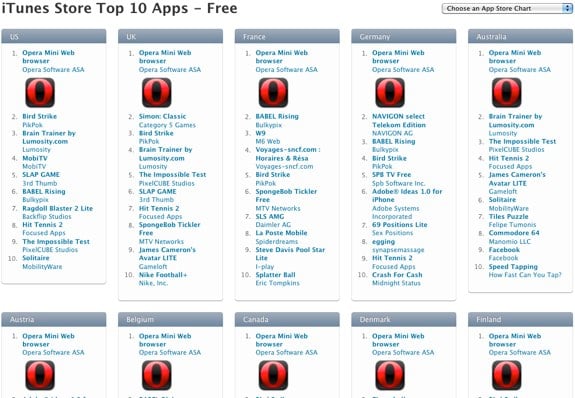
  • Opera Mini is top free app in all App Store regions

    Opera Mini top app

    Surprise, surprise – looks like and iPod touch users the world over are downloading the recently-approved Opera Mini app, a free Safari web browser alternative. In fact, it’s so popular, that it’s the number one free download in all 22 App Store regions. Have you tried it?


    Tags:
    ,
    ,
    ,
    ,
    ,

    Opera Mini is top free app in all App Store regions originally appeared on AppTapper on Wed, April 14, 2010 – 2:18:18


  • Temporary business tax to boost essential-services funding

    Why no tax for service providers?

    Like Jerome Chroman [“Support temporary business tax surcharge,” Northwest Voices, April 10], I also support the temporary increase in the business-and-occupation tax from 1.5 percent to 1.8 percent and doubling the small-business tax credit —which could make it a nonissue for businesses that gross under a certain amount —and for taxing nonessentials such as candy, soda pop, water, gum and beer to support essential services for those less well off.

    I am glad the state Senate passed this bill on Monday and it is heading to Gov. Chris Gregoire for her signature.

    However, I would go one step further and urge our lawmakers to ask why our sales tax does not apply to Washington state service providers such as myself. Like my contractor clients, I add value to my clients’ small businesses or home finances. Why should my services be excluded?

    If you need my services or those of an accountant, attorney or other service provider, you could pay your fair share of taxes.

    — Keith Gormezano, Seattle

    ‘Temporary’ means ‘keep forever’

    In response to Jerome Chroman’s comment to supporting a temporary tax to fix a deficit caused by bad fiscal planning, temporary in this state is nonsense.

    I have lived in this state for the better part of my life and when the politicians say “temporary,” temporary really means “keep forever.” When this state needs to get money they go after the sinners —those who smoke, drink, chew gum, drink water, etc. You see, these people are the easy targets. Politicians do not go after all the citizens who should be paying their fair share of taxes.

    First of all, this deficit was not brought about by the taxpayers. The problem with this state is it is too ultraconservative in its thinking. When we had a chance to legalize gambling, which could have brought in a lot of revenue, the conservatives shot it down. When a state income tax is brought up, it is shot down.

    But if the state needs revenue, lets tax the sinners. When the small business start to lose revenue, think of that temporary tax.

    This is how the 520 bridge and the Alaskan Way Viaduct will get its funding.

    — Gary Todd, Duvall