Blog

  • TalkAndroid Daily Dose for May 9, 2013

    TalkAndroid_Daily_Dose

    With hectic schedules, it can be hard to keep track of everything in your news feed. That’s why we created the TalkAndroid Daily Dose. This is where we recap the day’s hottest stories so you can get yourself up to speed in quick fashion. Happy reading!!

    Apps

    New Google Translate update allows users to take Phrasebook on the go and brings camera-to-translate function to 16 new languages

    Flipboard updates app to enable user created magazines, interaction with desktop web version

    Apex Launcher v2.0 available, new features for both free and pro versions, integrates Apex Notifier

    ITV Player updated, now exclusive for Samsung users through August 31st

    Carriers

    AT&T launches a new bring-your-own-phone pre-paid service called AIO Wireless

    Google

    Portland tech startup Instrument teams up with Google to create Map Diving, a realistic skydiving simulator

    Google TV

    Google TV gets free access to Hulu, ABC, NBC, CBS, and more via PlayOn for a limited time

    Phones

    Amazon’s Alphabet Projects, including 3D smartphone screen, could be sign of major hardware push

    Google abandons X Phone project according to analyst

    Two UK retailers mysteriously pull the Nexus 4 from shelves one week before Google I/O

    Samsung, LG and HTC rumored to have flagships in the works primed for Fall launch

    New Samsung video provides walk-through of SideSync features, allows for connection between PC and a Galaxy phone

    Tablets

    ASUS releases “We Transform” teaser video in preparation for Computex 2013, more to come

    Miscellaneous

    Ouya gets $15 million in new funding and delays launch by 3 weeks

    Recent Samsung patent filings reveal how flexible displays will work

    BlueStacks jumps into gaming console market with GamePop device

    Huawei CEO says company not linked to US cyber threats

    Come comment on this article: TalkAndroid Daily Dose for May 9, 2013

  • Portland tech startup Instrument teams up with Google to create Map Diving, a realistic skydiving simulator

    Map_Dive_Demo

    Google I/O is always a place for innovation and next week’s event will be no different. Those lucky enough to attend will get treated to some of the greatest breakthroughs in technology at Google’s annual event, including a lifelike skydiving simulator based on Google Maps. Using data gathered over the years by Google’s Maps and Earth teams, Instrument has created an extremely advanced skydiving simulator game.

    Unfortunately it appears that I/O is the only place Map Diving can be experienced for now, but Instruments has hinted at a possible slimmed down take-home version in the near future. Video demos after the break.

    Click here to view the embedded video.

    Click here to view the embedded video.

    Source: TheVerge

    Come comment on this article: Portland tech startup Instrument teams up with Google to create Map Diving, a realistic skydiving simulator

  • AT&T launches a new bring-your-own-phone pre-paid service called AIO Wireless

    AIO_Wireless

    AT&T just joined the likes of T-Mobile and Straight Talk by launching AIO Wireless, a new bring-your-own-pre-paid phone service. Customers can purchase any compatible GSM phone and AIO Wireless will provide a SIM card upon purchase of one of their three plans. AIO offers two options for smartphone users priced at $40 and $70 and a tablet plan for $15. All plans include unlimited data, throttled slightly around 4 megabits. The $40 plan data is throttled even more after 250 MB, while the $70 plan allows a comfortable 7 GB before slowing down the connection. For just $10 more customers can purchase an extra 1 GB of high speed data.

    AIO also provides a few phones for purchase directly from their website including the Samsung Galaxy Express for $250, the Samsung Galaxy Amp for $100 and the ZTE Prelude for $50. While nothing special, these are excellent prices for decent smartphones.

    Don’t rush to sign up just yet as AIO is currently still running trials in Houston, Tampa and Atlanta, though you can expect to see it expand to other markets in the coming months. For now, hit the source to check out AIO’s website and check back for more news on the service as we get it.

    Source: AIO Wireless

    Come comment on this article: AT&T launches a new bring-your-own-phone pre-paid service called AIO Wireless

  • 78,000 To Live On Mars: Mars One Colony Filling Fast

    When Mars One announced that they were opening up applications for permanent residency in their proposed permanent colony, they expected to generate some interest. After all, they’re shooting for a half million applicants. What they did not expect, according to Mars One co-founder and CEO Bas Lansdorp, was a rush of over 78,000 applications in just two weeks.

    Lansdorp told Business Insider that his organization had expected “a slow start,” that would eventually build toward their 500,000 applicant goal by the August 31st deadline. Instead they got nearly a sixth of their goal in a fraction of the expected time. According to Lansdorp, many applicants say that they have been following the project since before the application process began.

    According to information released by Mars One on Tuesday, applicants come from more than 120 countries, and have a variety of backgrounds. The countries contributing the most applicants are, as you might expect, the United States with 17,324, China with 10,241, and the United Kingdom with 3,581.

    The application deadline is August 31st. Once applications are closed, Mars One will begin the process of selecting the best candidates. While you might think that scientists and engineers would be the most desirable, Lansdorp says that the program isn’t that picky about applicants’ backgrounds. According to Dr. Norbert Kraft, the program’s chief medical officer, the key qualities they look for in applicants are commitment, creativity, and resiliency.

    The selection process will consist of four rounds and will seek to identify the 28-40 most qualified candidates. Those candidates will then undergo seven years of training before the final team will be chosen to go to Mars.

    The initial Mars One expedition will be a four-person mission designed to establish a foothold on Mars. This team will begin laying the groundwork for a full permanent settlement on Mars.

    Many of the Mars One applicants have submitted videos discussing their qualifications and their motivations for applying. You can check out some of the videos and even apply yourself (if leaving the planet forever is your thing) at applicants.mars-one.com.

  • Huawei CEO breaks silence, claims company isn’t a threat to U.S. security

    Huawei: U.S. spying allegations
    Huawei founder and CEO Ren Zhengfei made a rare public appearance on Thursday to deny allegations that his company’s telecommunications equipment poses a threat to U.S. national security. According to Reuters, it was the first time in more than 25 years that the executive has spoken with the media. It has been alleged that Huawei is in cahoots with the Chinese government, which has left countries such as the U.S., Canada and Australia hesitant to use the company’s equipment.

    Continue reading…

  • Two UK retailers mysteriously pull the Nexus 4 from shelves one week before Google I/O

    Nexus_4_TA_Back_Top_Right_Corner

    Two British retailers (Carphone Warehouse and Phones4U) have mysteriously stopped selling the Nexus 4 just a week before the big Google I/O convention. While you can still purchase the handset directly from Google, the timing has caused some extreme speculation. While many believe we may see the hotly anticipated “Nexus 5″ with Key Lime Pie at I/O, it is far more likely that LG will roll out an updated Nexus 4 with 32 GB of storage and an LTE-capable radio.

    Whatever is happening next week is exciting with Google only presenting one keynote. We will be there so check out the schedule and check back constantly for up to date news.

    Source: Tech Radar

    Come comment on this article: Two UK retailers mysteriously pull the Nexus 4 from shelves one week before Google I/O

  • Amazon’s Alphabet Projects, including 3D smartphone screen, could be sign of major hardware push

    Amazon_Smartphone

    Sources in a WSJ article indicate Amazon has several hardware projects in the works that are collectively referred to as the Alphabet Projects. Perhaps most intriguing among them is a smartphone that reportedly will have a screen that can produce 3D images without the use of special glasses. Combined with complex eye-tracking software, the phone’s screen will produce the 3D images at almost any angle, producing a holographic image effect with items seeming to float above the screen. Another benefit of the technology will be the ability for users to navigate content on their phone using just their eyes. The high-end phone is just one of several devices that may signal a new strategy for Amazon in getting content into the hands of consumers.

    Joining the high end phone is another smartphone device that is a step or more down from being a top-tier phone, a set-top box for streaming content, and an audio-only device. The set-top box would be similar to units from Roku or even the Xbox 360, both of which enable users to stream content from Amazon’s library. If Amazon can expand its footprint in the living room with a device that heavily favors its own content, it would help the company compete with Netflix, Hulu, and other streaming video services.

    Meanwhile, the audio-only device would provide another entry point for people to access the content in Amazon’s music library. This could open the door to Amazon competing with subscription services like Pandora or Spotify, but with a device users could hook into their home audio systems instead of tying up their smartphone for that purpose.

    Although the mobile device landscape is largely dominated by Apple and Google, Amazon continues to hang in as a solid performer. To succeed in improving its position relative to top performers, Amazon will have to battle with incumbents on several different fronts. Still, Amazon has built up a considerable portfolio of digital content from books to music to movies and television. Much like Google sees hardware running its Android operation system as a means to an end, the end being more people accessing their services, Amazon may be poised to do the same thing. This would be consistent to some extent with the model Amazon already uses for its Kindle devices, where the hardware is sold at cost and Amazon makes its money on the content sales.

    source: WSJ

    Come comment on this article: Amazon’s Alphabet Projects, including 3D smartphone screen, could be sign of major hardware push

  • Age old questions answered: Star Wars beats Star Trek, engineers like beer

    You have to hand it to Zend. That company has its priorities straight. It asks its constituency of PHP developers really important questions like: What’s your favorite sci-fi show/movie? And the results are in.

    Of the 4,809 PHP developers surveyed in the Developer Pulse, Star Wars was top dog; followed by (gasp) Avatar; then Star Trek.

    Here’s the data:

    SciFi

    Previous Developer Pulse results showed beer to be the preferred adult beverage for developers — 29 percent of whom said they “live for it” last year. And in 2011, we learned that Metallica reigned supreme among musical choices. On the flip side, respondents that year showed a strong resistance to Bieber fever as well as a pronounced ambivalence about Lady Gaga.

    Feature photo courtesy of Flickr user Eva Rinaldi Celebrity and Live Music Photographer

    Related research and analysis from GigaOM Pro:
    Subscriber content. Sign up for a free trial.


  • Natural gas van maker, backed by T. Boone Pickens and U.S. government, shuts down

    Fisker isn’t the only auto startup to struggle after receiving a loan from the Department of Energy’s auto program. Vehicle Production Group, or VPG, which was making natural gas-powered vans for disabled passengers, has shut down and has yet to pay back any of its $50 million loan, according to USA Today.

    The CEO of VPG, John Walsh, tells the paper that the company quietly stopped production last October after making 2,500 of its MV-1 vans, and was forced to lay off all of its staff, and shut its offices after running out of funds. The company raised around $400 million from investors including T. Boone Pickens, natural gas distributor Clean Energy Fuel Corp., Perseus, and Three Seasons Capital.

    VPG MV-1 in SF

    VPG was the last of five companies to receive funds from the Department of Energy’s Advanced Technology Vehicle Manufacturing Program; the company won the conditional loan in November 2010. The other auto loan winners included Nissan, Ford, Tesla and Fisker. Fisker has struggled heavily in recent months, and the DOE seized funds from a reserve account in anticipation that Fisker would default on its first loan payment.

    The ATVM program was created in 2007 and funded by Congress in 2008 and offered loans for companies making vehicles in the U.S. that had better mileage or reduced dependency on foreign oil. The ATVM program has now essentially been frozen for a couple years, and the DOE says that despite the fact that it has $16.6 billion remaining in the fund and seven applications pending, it will not award any more loans.

    VPG MV-1 rear view

    Founded in 2006, VPG had been producing both gas-powered and natural gas-powered versions of a wheel-chair accessible six-passenger van that featured a door that can open 36 inches wide and an interior height of nearly 60 inches. The company sold the van for taxi and company fleets. The base model that runs on gasoline started at $39,000, and the natural gas version came in around $48,000.

    The company seemed to be scaling in early 2012, when we covered them, but Walsh tells USA Today that the company needed more money to continue operations and was unable to raise it. The struggles of Fisker, Solyndra and others have made the environment for fund raising for alternative transportation and clean power difficult.

    At one point VPG had planned to make 22,000 vans a year, and create 900 jobs.Walsh tells the paper that the company has not declared bankruptcy yet and is in discussions with two potential acquirers.

    Related research and analysis from GigaOM Pro:
    Subscriber content. Sign up for a free trial.


  • From communism to the threat of cats: This week’s TED Conversations

    TED-Conversation-generic-imageTED Conversations is a unique space where any member of this community can get feedback on an idea, pose an interesting question, or start a debate with their fellow TEDizens from around the globe. This week, dozens of new conversations were started. Many of them were about issues brought up in our first television special, TED Talks Education, while others were unrelated, spanning topics from the merits of communism to whether cats threaten biodiversity. Here, a sampling of the highlights from this week:

    First, a thought-provoking question from Ye-Jin Ahn:  If communism was working the way its progenitors wanted it to, would it be better than capitalism?

    The main reason why communism was made was people wanted to be equal without getting restricted by their environment, but nowadays communism is abused by some dictators such as North Korean leaders. Besides, capitalism also has its own problem. There are so many people who didn’t have opportunities to try what they really wanted to do due to their poverty or else.

    If communism was working as it was intended, would it be better than capitalism?

    Yubal Masalker responds:

    I think it would. The problem was that there was a huge gap between the theory and its practice. The communism theory was an outcry for change in the reality of severe injustice of those times. It had noble ideals. But as it usually occurs in the mankind’s history, the great ideals fell victim to basic human nature — the human nature of greed and selfishness. This means, whoever gains the power in the name of any ideals, exploit those ideals only for the benefit of himself and his close group. Communism was not exception of this basic human nature, as well as the Capitalism and many countless other man-made systems of diverse ideals.

    So I think that instead of looking for the BIG answers from the failure of Communism (like dictatorships, organizing labor differently, the Chinese interpretation of communism or whatever) it would be much better for the all mankind to look for more seemingly minor answers, which are actually the real true answers. Because these answers are common to perhaps all the mankind’s ideological failures in the history and not just for the failure of the communism — for example, also the latest economic crisis due to the failure of the Capitalism.

    While John Moonstroller reminds us that:

    First we need to find a country that practices communisim without dictators to determine an answer to this question.

    And Heather White adds:

    The current problem capitalism has is the same problem communism had — its utopian ideology was infiltrated by psychopaths. I’m serious.

    People with psychopathic tendencies are attracted to power and prestige — they climb the greasy pole, by whatever means, and when they get power or influence they use it for their own gratification, glorification and empowerment. They lobby for the relaxation of regulation, and once they achieve this they exploit it ruthlessly. You cannot expect a psychopath to have self restraint or feelings of remorse — they are relentless — they want it all.

    Corporation directorships, government departments and politics, are disproportionally represented by psychopaths. In the population as a whole they make up 1%, within the halls of corporate and political power it is estimated that they make up to 4% (source: Jon Ronson’s TED Talk).

    With 221 comments and five days remaining, there’s plenty of time to get involved in the debate!

    Also this week:  The latest in our TEDinClass series, from University of Oregon student Jon Cox:  Cats pose a serious threat to biodiversity: Why do we accept it? What should be done?

    According to the ASPCA, there are around 90 million owned domestic cats (Felis catus) in the U.S., and taking into account strays and feral cats, the total number is estimated to be as high as 160 million (1).Loss et al. (2013) estimates that cats roaming outdoors kill 1.4-­3.7 BILLION birds and 6.9­-20.7 BILLION mammals in the U.S. annually (2). Reptiles and amphibians such as snakes, lizards, frogs, etc., are also frequently killed by cats.

    Cats are even more popular New Zealand, where they are contributing to declines of endemic birds such as the critically endangered kakapo (3), which have evolved in the absence of predators. Businessman/philanthropist Gareth Morgan is trying to gather support for legislation that would aggressively deal with stray and feral cats and potentially eliminate cats from New Zealand to take pressure off of threatened species (4 & 5). With Morgan’s plan, in addition to regulation that would reduce cat populations and increase owner accountability, residents would be encouraged to not replace their cats. As of now the majority of New Zealanders surveyed are in opposition to Morgan’s initiative.

    Would a proposition like Morgan’s meet similar resistance in the U.S.? Probably, but is he on the right track? Would you personally support something like it for your state or country?

    Mario R responded:

    I found an interesting article that highlighted the effects of reducing predatory effects in ecosystems. The article was talking about predatory chains and how the elimination of a top, or superpredator, might open the door for a different predator, or mesopredator, to take the original predator’s place. This would in fact lead to the extinction of the prey. The example they looked at was an endemic bird population, and the superpredator were feral domestic cats.

    This got me to thinking about the effects of suppressing cats’ activities outdoors. If something was done to regulate cats’ outdoor liberties, would there be increases in predatory activity of a different species on the same prey?

    And Erik Parker replied:

    Great point as usual, Mario.

    That was exactly the same line of thought that I was mulling over. For as long as there have been modern urban and suburban areas there have been cats present, really. So I think it makes sense to think about it as though those environments and cats have co-evolved in a way. That means we have no real way of knowing what will happen if cats are eliminated from an area all together. Sure we can speculate that maybe those species preyed upon by the cats in those environments will recover greatly, but what’s to say that some other species wouldn’t come in to fill that niche vacated by the cats? The reality is that we really don’t know what will happen until it does, and this unpredictability is why removal experiments are often so dangerous.

    The article Mario linked to makes the good point that other predators often move in to such situations quickly, and in particular uses the example of rodents coming in to prey on the eggs of birds usually targeted by feral cats. I was able to find some more articles that addressed this phenomena of top predator removal harming an ecosystem overall, and I think they would be valuable to take a look at as it is a really counterintuitive but interesting viewpoint:

    1. http://rspb.royalsocietypublishing.org/content/276/1671/3249.short
    2. http://www.sciencedirect.com/science/article/pii/S0169534701021942

    While Phoebe Cone added:

    I find it pretty ironic to call for the elimination of cats as pets because of their effect on bird biodiversity, when humans are directly causing the loss of so many other species. You could argue that legislation to limit the population of humans in the US should be implemented, because “it is for the greater good and humans are just too destructive to justify”, but of course most people would not support that. Similarly, the majority of people will never support a decision to make cat ownership illegal. There has to be a balance. I do not think it is reasonable to force people to give up pets, a major source of enjoyment and entertainment (a provider of “cultural services”, if you will) to protect other species that the general population, to be honest, probably doesn’t care all that much about.

    I think the focus should be on public education and on feral cat population control. The people who are most likely to want to donate their time and resources to organizations that advocate things such as the protection of bird biodiversity are probably animal lovers, and therefore are likely to keep pets themselves. If we increased public education that let people know that regulating their cats’ outdoor activities could lead to more beautiful birds gracing their feeders and yards, I think people would be much more receptive to the idea that cats harm bird biodiversity. As another person mentioned, putting bells on cat collars is a great idea … It’s not perfect, but it’s a much more balanced and reasonable approach to this issue.

    This conversation has ended, but be sure to check out the rest of the 198 comments here!

  • Sony Xperia A pictures, specs appear on FCC website

    Sony Xperia A Pictures Specs
    Sony has had surprising early success with its Xperia Z smartphone so it shouldn’t be much of a shock that the company wants to keep the momentum going by releasing yet another high-end device by the end of the year. Engadget notes that both specifications and pictures of Sony’s upcoming Xperia A have been posted on the Federal Communications Commission’s website and show that the new device will feature a 5-inch 1080p HD display, a 2,300mAh battery, a 13-megapixel camera and 16GB of storage. Given these specs, the Xperia A sounds more like an updated version of the Xperia Z rather than the full-blown monster 6.44-inch Xperia phablet that the company has been working on.

  • Better late than never — Microsoft to fix Pwn2Own flaw

    Patch Tuesday approaches quickly. That time of the month when Microsoft deems it appropriate to fix the myriad security flaws that rear their ugly heads during the preceding time frame. As is custom, the company gives advance notice of what to expect, but no details regarding actual flaws — a nod to not allowing (more) hackers to take advantage of the issues discovered.


    May 14th is the next scheduled update of your Windows computer, and it will carry along 10 bulletins with it. A couple of these patch much publicized holes in Internet Explorer, one of which the company just released a “Fix it” tool designed to temporarily mend.

    Another mends the highly publicized Pwn2Own flaw discovered and exploited at the CanSecWest conference back in March. For the record, Chrome and Firefox also went down in the competition.

    The remaining critical patches will fix a denial of service hole within Windows, fix a spoofing issue in that as well as the .NET framework, patch a remote code execution bug in Lync, two remote code execution flaws and one information disclosure problem in Office, an information disclosure vulnerability in Windows Essentials, and an elevation of privilege defect in Windows. Take a deep breath now.

    Microsoft also plans to host a webcast to address customer questions on the security bulletins on May 15, 2013, at 11:00 AM Pacific Time. While all of these updates are important — critical one might say — the fact it took this long to fix the pwn2own flaw is a bit troubling — Chrome and Firefox did so within days of the competition.

    Photo Credit: Kheng Guan Toh/Shutterstock

  • Meet the three new TEDGlobal speakers, and a few others making the news

    We are excited to introduce you to three new speakers who’ve been added to the program for TEDGlobal 2013, themed “Think Again.”

    First, jazz-pop singer Jamie Cullum will take the stage to perform during session 10, “Imagined Beauty.” Just last week, Cullum released this nerdily adorable video — shot in one continuous Steadicam take — for the song “Everything You Didn’t Do.” Check it out above and marvel at the incredibly quick scene changes.

    Photographer Fabian Oefner has also been added to the TEDGlobal program. Oefner brings together science and art in his stunning visualizations, which are meant to give us a sense of awe at the natural forces at work around us each and every day. In March, Oefner wowed us with the project “Black Hole,” which used the centripetal force of a spinning drill to splatter acrylic paint in the most beautiful patterns – all captured in millisecond through a unique sensor rig. See the images and how they were created on his website.

    Finally, sustainability expert Johan Rockström is rounding out the program, taking the stage during session 8 “State of Nations.” Rockström recently published the book Bankrupting Nature: Denying Our Planetary Boundaries about the deep denial our culture is in about the magnitude of environmental challenges ahead. At TEDGlobal, he’ll speak about how this impending crisis may be an opportunity to spur innovative thinking.

    Check out the full lineup of TEDGlobal 2013 speakers here, and read their detailed bios. Below, a few other speakers who made the news this week:

    • As we read the news that U.S. beekeepers lost 1 in 3 of honeybee this winter – due to a deadly combination of pesticides, fungicides, parasites, viruses and malnutrition – we couldn’t help but think of bee scholar Marla Spivak, who’ll speak during the session “Listening to Nature.” Her talk will no doubt be poignant given this recent development. She tells the TED Blog: “It’s good that the complexity of the bee issue to coming to light:  Bees are dying from multiple, interacting causes. Sometimes one factor is the driver (e.g., parasitic mites or viruses), sometimes poor nutrition, sometimes drought, sometimes pesticides, but in the end, all these factors interact to weaken bees.  Our bees, all of our bees (honey bees and all the thousands of species of wild bee pollinators) need help. While scientists figure out causes and solutions to the pathogens, parasites and pesticide problems, everyone can help by planting flowers and keeping them clean of pesticides.”
      .
    • In this great profile of frequent TED speaker Marco Tempest in Wired, Apollo Robbins — the so-called “gentleman thief” and session 4 speaker — stops by his loft and discusses the differences in their magic. Says Robbins, “Marco approaches the craft through his passion for innovation and technology. I approach the craft through the study of applied deception.”

    In other news, we’ll be paying particular attention to session two, “Those Flying Things,” which focuses on debate about drones. While the session will feature fascinating demonstrations of how drones can be used to great end, we also can’t forget their potential to be used in war. Jody Williams, who gave the talk “A realistic vision for world peace” at TEDWomen, recently launched a campaign against robot warfare. She tells the TED Blog, “While we in the Campaign to Stop Killer Robots follow work on drones, we are not addressing them in the Campaign. We are seeking a pre-emptive ban on lethal robotic weapons on the land, in the sea and in the air that would be able to target and kill human beings on their own. With no human involvement. Terrifying.”

  • The YouTube free ride is OVER

    YouTube opened to the public in November 2005, and Google paid $1.6 billion for the service 11 months later. The video-sharing site is the quintessential freebee. No longer. Today Google announced the launch of the first pay-for channels, which is rather strange coming from the company which business model is about profiting from valuable content given away free wrapped with search keywords and advertising. Welcome to the new Internet, with paywalls rising everywhere. To play, you must pay.

    In a statement Google says there are “1 million channels generating revenue on YouTube, and one of the most frequent requests we hear from these creators behind them is for more flexibility in monetizing and distributing content”. That revenue largely comes from the in-video advertisements. Now you’ll pay, too — as little as 99 cents per month. Here’s something: From the sampling I made today, subscription liberates you from advertising, which is something to cheer about.

    Standard Definition

    YouTube lists 53 paid channels, none of which I have ever watched. Some of the programs that might interest me are available elsewhere (e.g., Netflix). Google spotlights Sesame Street and UFC in its announcement, but the kids channel isn’t available from the official list. The PBS program will stream full episodes; the other channel offers classic fights. UFC is $5.99 per month. Uh-oh, I only see 480p in my browser. What the frak?

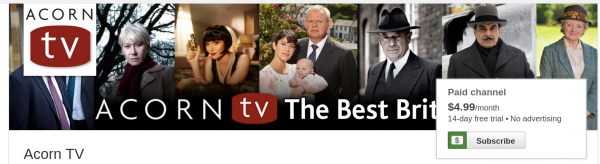
    British TV is a personal fav. Acorn offers a smidgen of shows for $4.99 per month. I wouldn’t pay for the current selection, which includes some programs already available as part of my Netflix subscription. But that might change as the channel adds more shows. BigStar Movies is another channel, also $4.99 a month or $34.99 per year. Neither channel is HD in my browser test.

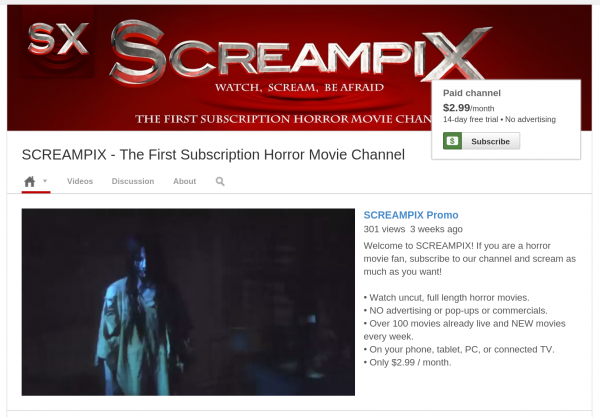
    HereTV offers some HD content, and you pay to get it: $7.99/month, or $67.99 per year. Pets.TV is a more modest $1.99 monthly, but again no HD that I see, just 480p like the first two. The channel is also available with six others for $9.99/month. PrimeZone Sports isn’t available in my country. Yours? SCREAMPIX delivers horror movies for $2.99 a month — at least the price isn’t too scary. I love the sections. Who wouldn’t want to watch a flick from “Students Making Bad Decisions”, eh? Sigh, more 480p.

    Do you know how much quality, free HD content there is on YouTube?

    Bad Formats

    I tried to bring up the channels on Google TV, but couldn’t easily find them, which means I didn’t. All the pay-fors are available as 14-day trials. What the hell, I signed up for Acorn. That put the channel in my YouTube “Subscriptions” list on Google TV, but frak me, trying to watch brought up “playback error, unsupported video format”. Oh, yeah? Hey, I still have Nexus Q hanging about, so I accessed YouTube on my HTC One and tried to watch any program. Oh my. Phone displayed “error while playing the video on Nexus Q”, while on the telly I saw “unsupported video format”.

    Well, that kind of blows my real interest in the paid channels: Cutting the cord — ditching AT&T U-verse (cable for most people). But right now YouTube won’t play paid on my TV and chokes up 480p on yea ol Chromebook. The programs do look damn good on the Android phone using the YouTube app, though. Still, I’ll use the 14-day Acorn trial to watch, if nothing else, three-part program “The Norman Conquests”. The trial is worth your time just for that. Based on a play that during its theater run people watched for three nights, TV adaption of “The Norman Conquests” is a riot. I can’t believe Acorn carries it (Netflix doesn’t).

    I want to be enthusiastic about YouTube pay channels, because they represent the model I want: A la carte, pay for what you want to watch. But no-HD and no-TV are deal breakers for me. Besides, I worry that some of the best content available for free now will go pay sometime soon. If there’s too much competing paid a la carte content — from services you never heard of before — people won’t pay because it’s too much trouble managing all the subscriptions.

    Fierce Debate

    The whole concept generated lively and long debate in our newsroom late today.

    “I’m reluctant actually”, Mihaita Bamburic says. “YouTube is known for providing free to watch videos. This creates a mental dilemma for me, and likely I am not the only one”. As newspapers and magazines have learned, charging for something once free isn’t easy. YouTube is all about free content. Will people actually pay?

    “But they will still offer the other stuff, same as always”, Alan Buckingham says of YouTube. Mihaita stands by his contention about confusion. I agree there.

    Still, “I assume this is great news for content creators”, Mihaita asserts. “Definitely a shift on how we define pay per view content, usually associated with TV channels in my mind”.

    I told them both: “If content is better and can replace cable, sign me up. I’d rather give money directly to content providers I choose than those the cable company picks”. But YouTube paid isn’t there yet.

  • Nokia breaks away from Microsoft with new $99 Asha phone

    Nokia Asha 501 release date, specs
    Failing to drive down the price on its Windows Phone devices, Nokia on Thursday announced a refresh of its Asha mobile operating system and the affordable Asha 501 phone. The handset is equipped with a 3-inch display, a 3.2-megapixel rear camera and either a single-SIM or dual-SIM configuration. The new Asha 501 is remarkably efficient, with Nokia promising a whopping 48 days of standby battery life for the single-SIM model and 26 days for the dual-SIM option.

    Continue reading…

  • Salesforce acquires visual web clipping service Clipboard

    Visual organizer and web content clipper service Clipboard announced Thursday that it’s been acquired by Salesforce and will be shutting down the current operation. AllThingsD is reporting that the company was acquired for somewhere between $10 and $20 million.

    The company explained its decision in a blog post on the site:

    “We have some bittersweet news. We are extremely happy to announce that salesforce.com has signed an agreement to acquire Clipboard, allowing us to pursue our mission of saving and sharing the Web on a much larger scale. But at the same time we’re also sad to see this stage of our adventure come to an end, especially since it means that our relationship with you, our users, will irreversibly change. As a result of this news, the Clipboard service at clipboard.com will be discontinued on June 30, 2013.”

    I wrote about Clipboard back in September 2012 when it launched its iPhone app and new desktop design. At the time, I noted the similarities between the service and Pinterest, in that they both allow you to save items from across the web and organize that content into “boards.” The Clipboard service allowed you to save links in a way that made them private and fairly useful because of the amount of content that came embedded in clipped material.

    “Anyone who’s used Pinterest before will feel immediately familiar with Clipboard — the design is almost identical to the Pinterest layout, with the option of grabbing material from across the web, saving that material to “boards,” and liking other people’s posts.

    But Clipboard doesn’t seem like a site for wedding daydreams or fashion photos in the way Pinterest does. Clipboard posts, or “clips,” default to private, and unlike Pinterest’s static photos, Clipboard clips retain almost all of their original web functionality, making them seem more like helpful notes-to-self in the vein of Instapaper or Evernote.”

    In the company’s closing post, it reported that the service only gathered 140,000 users who created about 3 million clips. By comparison, last August Evernote had 40 million users, up from 25 milion in May 2012.

    Related research and analysis from GigaOM Pro:
    Subscriber content. Sign up for a free trial.


  • Is it the best of times or the worst of times for journalism? Yes

    If you’re convinced this is the worst possible time to be a journalist, there’s plenty of evidence to support you: just this week, there have been cutbacks at the New York Post and news of cuts at the venerable Village Voice, not to mention periodic bankruptcies and printing-press shutdowns. But if you believe this is the best time to be in media, there’s plenty of evidence to support that as well, as Ann Friedman outlined in a recent piece for the Columbia Journalism Review.

    Friedman is no stranger to the vicissitudes of modern media — she was laid off as the editor of GOOD magazine last year, after the publication decided to pivot and become a kind of social network for user-generated content. But in her CJR piece, she describes how on a recent speaking tour she grew frustrated with the numbers of people complaining about a lack of jobs, a lack of money and the rise of short-attention-span media like Twitter:

    “Again and again, I found myself playing the role of cheerleader, trying to convince tired and broke journalists to get excited about the future of media.”

    There is far more good than bad

    Newspaper fortune teller; newspapers' future; newspapers' fate; fate of newspapers

    As the CJR columnist acknowledges, it can be hard to motivate journalists — or anyone in the field of media — when reports from research outfits like the Pew Center lay out in bald detail how the business model for much of what we think of as the mainstream media is rapidly disintegrating, with nothing obvious to take its place, and when the number of journalists employed in newsrooms is lower than it has been at any time since the 1950s.

    But Friedman argues — I think fairly persuasively — that there are far more benefits available to journalists now than there have ever been, if they choose to see and make use of them. Among other things, she lists:

    Reporters have more access to sources: Thanks to the web, social media and other tools, “it’s never been easier to find and reach out to anyone.” This is unequivocally true, especially with the number of potential sources who have their own blogs, Facebook pages, Twitter accounts, etc.

    Consumers have access to more media: Your job may have been more secure in the past, Friedman says, but now if you have something to say you have the ability to reach a much larger group of readers, and they have much more choice (this is also one argument against paywalls, she says).

    Journalists get more engagement: Reporters used to work for years with little or no response from or engagement with readers (which some no doubt preferred), but now you get more feedback than you could ever want. Says Friedman: “I know a lot of journalists hate this, but it’s a good thing.”

    Chaos promotes creativity: When traditional paths to professional success are closed, Friedman argues, “those of us who love journalism so much we’d never give up are forced to redefine success – and our methods of seeking it.” And there are more routes to success than ever before.

    Disruption also produces opportunity

    change

    To some, this may all have a certain Pollyanna-ish feel to it, but I think Friedman is right — and in many ways she is saying something similar to what Matt Yglesias at Slate argued recently, when he responded to the Pew Center report and said that in his view news consumers were better off than they had ever been (although many disagreed). Jay Rosen made a similar case for why the internet is good for journalism in a debate hosted by the Economist in 2011.

    Yes, much of the traditional media business is in turmoil, and the road to profitability — or even survival, for some — is far from clear. And it’s easy to look at the chaos of social media and “citizen journalism” during something like the Boston bombings or Hurricane Sandy and assume that we are much worse off, both as journalists and as news consumers (an argument I have tried to counter). And there is no question that many bad things come with the good.

    But as Friedman argues, that same chaotic environment is what produces new things, many of which may grow to become powerful and positive tools for journalism — in some cases better than the ones we have. It’s easy to succumb to the gloom, but the reality is that while disruption of the kind the media world is experiencing creates great upheaval, it also creates great opportunity.

    Post and thumbnail photos courtesy of Flickr user George Kelly and Shutterstock / Feng Yu

    Related research and analysis from GigaOM Pro:
    Subscriber content. Sign up for a free trial.


    • Two UCLA faculty elected to National Academy of Sciences

      Two professors from the David Geffen School of Medicine at UCLA have been elected by their peers to the prestigious National Academy of Sciences in recognition of their distinguished and continuing achievements in original research.
       
      Election to the academy is considered one of the highest honors presented to scientists in the U.S.; its membership includes Albert Einstein, Robert Oppenheimer, Thomas Edison, Orville Wright and Alexander Graham Bell. 
       
      The UCLA professors are among 84 new members of the academy from across the U.S. and 21 foreign associates from 14 countries. Their election brings the number of current UCLA academy members to 43. The new UCLA members are:
       
      Dr. Edward De Robertis, Norman Sprague Professor of Biological Chemistry and a Howard Hughes Medical Institute investigator. De Robertis is a member of the Pontifical Academy of Sciences and the Latin American Academy of Sciences, as well as a fellow of the American Academy of Arts and Sciences. His research focuses on the way that cells communicate with each other. 
       
      De Robertis’ isolation of genes that control head-to-tail and back-to-belly patterning in early frog and mouse embryos led to the discovery that all animals’ development is controlled by an ancient genetic toolkit. In particular, he carried out the molecular dissection of the process of embryonic induction, in which groups of cells called “organizers” control tissue differentiation. This work is aimed at understanding cell signaling, a fundamental problem in stem cell biology and cancer. De Robertis has been a member of the Jonsson Comprehensive Cancer Center at UCLA since 1985. 
       
      Ernest Wright, distinguished professor of physiology and Sherman M. Mellinkoff Distinguished Professor in Medicine. Wright was named a fellow of the British Royal Society in 2005, an honor considered one of the highest accolades a scientist can achieve next to the Nobel Prize, and in 2006 he was elected to the German Academy of Sciences Leopoldina. His research focuses on the structure, function and genetics of membrane transport proteins, which act as the gatekeepers for the body by carrying essential molecules in and out of cells.
       
      Research in Wright’s laboratory on the cloning and function of glucose transporters has already led to the development of new drugs to control diabetes. 
       
      The National Academy of Sciences rolls currently list 2,179 active academy members, and 437 foreign associates.
       
      The National Academy of Sciences was established in 1863 by a congressional act of incorporation signed by Abraham Lincoln that calls on the academy to act as an official adviser to the federal government, upon request, in any matter of science or technology. The academy is a private organization of scientists and engineers dedicated to the advancement of science and its use for the general welfare. 
       
      The David Geffen School of Medicine at UCLA has more than 2,000 full-time faculty members, almost 1,300 residents, more than 750 medical students, and almost 400 Ph.D. candidates, and ranks in the top tier of research institutions funded by the National Institutes of Health.
       
      For more news, visit the UCLA Newsroom and follow us on Twitter

    • Abercrombie & Fitch Controversy: “Are We Exclusionary? Absolutely”

      The CEO of cool-kid retailer Abercrombie & Fitch is dealing with some backlash this week after it was noted that he doesn’t want his stores selling size XL and above.

      The store has garnered quite a bit of negative attention lately after a Florida man started a petition on Change.org to get the retailer to carry bigger sizes. 18-year old Benjamin O’Keefe says, “In a world where teens are constantly under pressure to fit the societal norms of beauty, we should be building them up and helping them love themselves.”

      With so much focus on body image in today’s youth culture, many stores have branched out in their sizing options to ensure that all their customers are happy, but A&F CEO Mike Jeffries has said in the past that he doesn’t want to go the way his competitors have.

      “In every school there are the cool and popular kids, and then there are the not-so-cool kids. Candidly, we go after the cool kids. We go after the attractive all-American kid with a great attitude and a lot of friends. A lot of people don’t belong [in our clothes], and they can’t belong. Are we exclusionary? Absolutely….”That’s why we hire good-looking people in our stores. Because good-looking people attract other good-looking people, and we want to market to cool, good-looking people. We don’t market to anyone other than that,” Jeffries told Salon in 2006.

      That may have been seven years ago, but Jeffries doesn’t appear to have changed his mind. The company has been in hot water before over his decisions to use young, sexed-up models and his hiring practices inside the stores, but the company hasn’t changed much. The difference between now and then, however, is that many more young people are taking a stand against exclusionary practices.

    • The secrets of TED’s (award-winning!) design

      stage

      This is how speakers stay focused as they give TED Talks: a “confidence” monitor onstage, shown here at TED2011. Slide design: WORKSHOP/staff. Photograph: James Duncan Davidson.

      It is, indeed, a monumental day here at TED Towers. We’re winners! Or, as June Cohen, executive producer of TED Media, described this morning’s news of our winning the 2013 National Design Award for corporate and institutional achievement: “We’re thrilled!”

      “Design and design thinking has always been core to TED’s mission. After all, it’s the ‘D’ in TED,” she continued. “That’s reflected in everything we do, from staging and hosting our conferences, to filming and publishing our speakers’ talks, to building TED.com and our apps, to creating TED-Ed animations, to helping TEDx organizers put on independent events. We’re so grateful to the network of talented designers we partner with — as well as our in-house team — for their tireless efforts in moving TED’s mission forward.”

      turere

      Stage design is a big part of the TED conference experience. Here, young African innovator Richard Turere tells his story at TED2013. Photograph: James Duncan Davidson.

      The field of corporate design has evolved since its romantic heyday, when hero designers such as Paul Rand or Massimo Vignelli created iconic visual systems for companies such as IBM, UPS or American Airlines. These days, a company’s identity needs to be able to work in many different contexts, to adapt to the ever-changing needs and demands of a digitally driven universe even as it holds true to the principles at its core. This is especially true as TED’s list of initiatives is always growing.

      739b55b27157c42a04ae84734d4e518f

      The TED branding works in many different contexts. Here, at right is a print program guide designed by Albertson Design, with TEDActive programs and dogtags designed by WORKSHOP.

      Mike Femia, TED’s director of design services, explains how he and the team work across the company’s many extensions. The key? To focus on the mission statement of “ideas worth spreading.”

      “We want a certain simplicity to be the basis of everything we do, so that TED can be a platform for ideas. We don’t want to overshadow them or impose unnecessary branding flourishes,” he said. “At the same time, we are very open to new design directions, and we work with many outside studios and designers who have unique viewpoints. The fundamental question: how can we use design to help encourage the spread of ideas? Our best work comes about when we bring all of these elements together.”

      The theme of the conference is the basis of print pieces produced for attendees. Here, the cover of the program guide for TED2010, designed by Paper Plane Studio.

      The theme of the conference is the basis of print pieces produced for attendees. Here, the cover of the program guide for TED2010, designed by Paper Plane Studio. Photograph: Marla Aufmuth.

      Thaniya Keereepart, TED’s product development director, echoes the importance of remaining focused, a task that anyone who’s ever had anything to do with modern life knows is easier said than done. “Design should be simple. Quiet. It should bring to light the content and enhance the experience of content consumption,” she explained. “If you go to a website and the first thing you see is the design, that’s not TED.”

      Both Keereepart and Femia are quick to share any credit for TED’s award with their many collaborators, both internal and external, and it’s safe to say we’re thrilled. Last word to the Cooper-Hewitt’s acting director, Caroline Baumann, who said this morning, “TED draws an enormous and varied audience who find inspiration and ideas from the conference, as do the speakers themselves. TED is an invaluable resource and experience for designers in all industries.”

      TED playlists are "collections for curious minds".

      TED playlists are “collections for curious minds.” Just added to the site this year, it puts new spin on TED’s classic page design.