Blog

  • “Shrek” VMAN Photo Spread Stirring Up Controversy At DreamWorks

    Bosses at DreamWorks Studios — a division of Paramount — are none too pleased with the latest adventure of Shrek and his friends. Celebrity photog Ellen von Unwerth snapped Fiona, Donkey, Puss in Boots and the rest of the inhabitants of Far Far Away on location at The Standard New York for the upcoming summer issue of VMAN Magazine.

    This year’s V Model/Ford Models search winner Emma Dumont is featured scantily-clad and snuggled up Shrek characters in the bizarre shoot. The green ogre and his castmates will be featured in the summer edition of VMAN. The 144-page glossy magazine goes on sale April 20, a day before the third installment of the hugely-successful franchise — Shrek Forever After – premieres at the Tribeca Film Festival in New York City.

    However, DreamWorks is now concerned that the images — which featured Fiona lounging with bare-chested male models and Puss being fed grapes by a well-sculpted hunk — may be too racy for the family-friendly characters.

    What do you expect when Nicola Formichetti, best known as Lady Gaga’s stylist, was largely responsible for creating the theme?

    “While we do respect VMAN’s creative vision, the shoot did not turn out the way originally envisioned when the idea was first presented by the magazine,” a Paramount spokesperson said Tuesday. “In hindsight, we would have declined to include the Shrek characters in such a magazine spread.”

    According to The Hollywood Reporter, DreamWorks Animation was expecting a less provocative shoot because VMAN editors promised that the spread would be similar in nature to the one Harper’s Bazaar put together of the characters from TV’s The Simpsons in 2008.

    The Reporter writes: “VMAN initially offered its cover to Shrek, but Paramount declined that treatment. When the magazine’s editors came back suggesting an inside spread, Paramount executives — with visions of a successful “Simpsons”-like marketing ploy dancing in their collective heads — gave VMAN the OK.”

  • FMO photo gallery relaunched

    uganda-photo-albumWe are pleased to announce that the ‘photo gallery’ section of Forced Migration Online has been re-launched. In addition to enjoying an improved layout when browsing individual albums, users will also be able to search our full database of photographs.

    There are now over 600 photographs in the FMO image database, including a new album of photos on the topic of “Self-Settled and Settlement Refugees in Uganda” (© Ayla Bonfiglio, 2008).

    Uganda is one of the few countries to allow refugees to either settle themselves within the national population, or to live in a refugee settlement. This collection of photographs was taken during a comparative study on self-reliance among refugees from these two settlement contexts.

    If you have a collection of photographs relating to forced migration and are interested in submitting them for inclusion on FMO please visit our submissions page.

  • Music Downloads and Streams In Cold, Hard Dollars [Music]

    Just how much moolah do musicians earn from online downloads and streams? For the artist to earn the US minimum wage ($1,160/month), they need 12,339 iTunes downloads or 849,817 streams on Rhapsody. More »


  • Failed Mining Reform Bill Might Have Prevented Tragedy

    George Miller

    Rep. George Miller (D-Calif.) (Zuma Press)

    In 2006, after Congress passed the most significant mining reforms in three decades, a small group of Democrats offered a terse warning: The legislation, they said, didn’t go nearly far enough to prevent accidents and protect miners.

    Image by: Matt Mahurin

    Image by: Matt Mahurin

    “Much more remains to be done to keep the nation’s miners safe,” Rep. George Miller said at the time. The California Democrat was urging additional measures designed to prevent explosions and make it easier for federal regulators to close mines when safety violations became persistent. His proposal eventually passed the House but was dropped in the Senate due, at least in part, to opposition from coal-country lawmakers, including Sen. Jay Rockefeller (D-W.Va.).

    Four years later, as West Virginia is burying 29 of its coal miners following last week’s horrific Montcoal explosion, the calls for additional safety measures appear to be prophetic. Though the cause of that disaster might not be discovered for weeks, experts suspect that an accumulation of methane — combined with high levels of combustible coal dust — is the likely culprit. Massey Energy, the Virginia-based coal giant that owns the mine, had racked up 124 safety violations this year alone, including dozens of citations indicating problems with ventilation and the accumulation of combustibles.

    Now, as investigators launch their probe into the cause of the blast — and congressional leaders are mulling their own legislative response — some lawmakers, worker advocates and mine-safety experts say they know a good place for Congress to start: Miller’s failed bill. Some even suggest that the proposal, dubbed the S-Miner Act, just might have prevented the West Virginia disaster altogether.

    Rep. Earl Blumenauer (D-Ore.) — who, like Miller, opposed the 2006 reforms for being too weak — said through a spokeswoman Tuesday that Congress’ failure to pass the stronger safety measures represented “a tragic missed opportunity.”

    Added Phil Smith, spokesman for the United Mine Workers of America: “If S-Miner had been passed, [federal officials] would have had the authority to close this mine down.”

    It wasn’t supposed to happen this way.

    After a string of deadly coal mining accidents ravaged Appalachia in 2006, Congress stepped in to install new safety measures that were sold as the most sweeping mining-industry reforms since 1977. The bill — the 2006 Miner Act — hiked the maximum penalty for safety violations; forced mine operators to build emergency underground shelters stocked with food, water and oxygen; required installation of updated communication devices; and created stricter flammability requirements for heavy equipment and lifelines.

    Yet those provisions are aimed largely at making it easier for workers to survive accidents after they occur.

    “There is next to nothing in that legislation that does anything to address keeping incidents from happening in the first place,” Cecil Roberts, president of the United Mine Workers of America, said in a statement endorsing further reforms.

    Enter Miller’s S-Miner Act. That proposal would have hiked the penalties for safety violations further; strengthened the requirements for sealing mined-out chambers to prevent methane from leaking into active sections; required that metal screening be installed on all mine roofs to prevent roof falls, which can spark explosions; required studies into the effectiveness of efforts to curb the combustibility of coal dust; and, perhaps most significantly, empowered the Mining Safety and Health Administration, a branch of the Labor Department, to close problem mines more easily when patterns of safety violations are found.

    In short, supporters say, it was aimed at preventing mining accidents from happening at all. And after last week’s West Virginia tragedy, “almost everything in the S-Miner Act is still needed,” said Peter Galvin, a former Education and Labor staffer who helped write the legislation.

    Galvin noted another weakness in the current law: It requires MSHA officials to consider the size of the mine operator when determining fines to ensure that the penalties won’t bankrupt smaller businesses — a consideration the S-Miner Act would eliminate. “If you can’t comply with the law, you shouldn’t be in this business,” said Galvin, who was an MSHA official before joining the Education and Labor panel.

    Although House Democrats passed the S-Miner bill in January 2008, the legislation never got far in the Senate, where a series of factors conspired to kill it. President Bush, for example, was waving a veto threat over the proposal, arguing that it would undermine the reforms of two years earlier. The mining industry was lobbying furiously to kill the bill. And the Senate’s lead sponsor — Sen. Edward Kennedy (D-Mass.) — had been newly diagnosed with the terminal brain cancer that would eventually kill him.

    But there was another reason that bill didn’t move far in the Senate: The opposition of some powerful coal-country lawmakers. Indeed, Senate Minority Leader Mitch McConnell (R), representing the coal-laden state of Kentucky, was opposed. And while Sen. Robert Byrd (D-W.Va.) had officially endorsed the proposal, West Virginia’s other institutional Senate Democrat — Jay Rockefeller — rejected it.

    “I’m not sure that what you do is try to pass another bill, add some more things on,” Rockefeller told the Beckley, W.Va., Register-Herald at the time, adding that the problem lies more with the failure of the MSHA to enforce the laws than with the laws themselves. “I don’t need a federal law to tell me to do my best every day,” he said.

    Despite clear signs that MSHA could do more on the enforcement side of things, Rockefeller has also changed his tune in the wake of last week’s disaster. On Tuesday, he took to the Senate floor to say that enforcement alone might not be enough to prevent the next tragedy.

    “Right now, what we do know is that we need to enforce aggressively the provisions of the Miner Act at all mines,” he said. “And where they are needed, we must put new laws in place.”

    The saga is emblematic of the pattern that’s dictated the country’s mining policies for decades: New safety measures often follow in the wake of the biggest disasters, but rarely have lawmakers acted to anticipate those tragedies.

    “It’s unfortunate, but every mine safety law we have on the books today was written in the blood of coal miners,” Rep. Nick Rahall (D-W.Va.) said last week.

    Not that even the most ardent supporters of the S-Miner Act see it as a cure-all to the nation’s mining-safety gaps. Indeed, the bill does nothing to address the tremendous backlog of violation appeals that mining operators have filed in recent years in order to delay fines and prevent MSHA from establishing the “pattern of violations” required to close entire projects.

    Lawmakers will have plenty of opportunity to examine the nation’s mining safety laws. Both Miller, who chairs the House Education and Labor Committee, and Sen. Tom Harkin (D-Iowa), who heads the Senate labor panel, have vowed to hold hearings on mine safety shortly. Harkin’s office said Tuesday that the Senate gathering, scheduled for April 27, will “not attempt to explore the specific causes of the recent disaster” because the White House investigation will still be ongoing. Instead, the hearing “will examine the weaknesses in our laws that provide incentives for companies to ignore health and safety — such as inadequate penalties and the excessive delays that employers can create in challenging citations.”

    No dates have been set for the House hearing, Miller’s office said Tuesday.

    Meanwhile, a number of journalists and government watchdog groups are urging the Obama administration to open up the investigation to the public — a step the Bush administration was criticized for refusing to take.

    It’s worth noting that the S-Miner bill would have required such a public investigation.

  • CEO of Microsoft Germany to become Microsoft Vice President of Mobile Communications

    Achim Berg, Vorsitzender der Geschäftsführung Microsoft Deutschland und Vice President International In an interesting move Achim Berg (46), previously CEO of Microsoft Germany, is moving to Redmond to become Corporate Vice President of Mobile Communications Business & Marketing, a newly created position. He will be responsible for all marketing and business development activities for Windows phones worldwide and report to Andy Lees, senior vice President of Mobile Communications.

    "Achim Berg will be excellent addition, and brings his excellent management style and his practical sales and marketing experience in the Mobile Communications Business Team (MCB) . His experience at Deutsche Telekom, Fujitsu / Siemens and Dell gives a comprehensive view of our business. Achim will be a major asset to the Leadership Team and will contribute to the Mobility business and MCB to help the team succeed with the important Launch of our Windows 7 Phone, "said Andy Lees.

    "The wireless market is essential for Microsoft. Already more smartphones are sold worldwide than PCs. Mobile Internet access has become the standard and is more important than the simple network with other devices. I see a huge opportunity for Microsoft in this innovative market, "said Berg.

    Germany has been one of the stronger markets for Windows Mobile, with the Microsoft OS holding a 19.9% market share there, only after Symbian and iPhone and well ahead of RIM’s 5.4%, according to recent Comscore numbers.

    Via MSMobiles.com


  • Pay for Parking with Your Cell Phone

    I’ve had more than my fair share of parking issues since moving to DC, mostly because DC meters (in my humble opinion) are absurdly expensive and I rarely have a fist full of quarters in my change purse. (What do I have at all times? Spare bobby pins and a Hanson guitar pick- the ultimate conversation piece.) 

    A few hefty tickets later, I am thrilled to hear that DC has implemented a pilot program which lets drivers pay for their parking meters via cell phone.

    In fact, you can even get text messages to update you when your time is about to expire.

     To be able to do this, you register online, create an account that is linked to your credit card and when you park, you enter the meter number and indicate the amount of time you need.

    Brilliant!

    This is a great example of government using technology to make life easier, and I’m very excited to try it out.

    What kind of government web 2.0 are you using? What is available in your area, or would you like to see put to use?


  • Greece Spreads Are Widening Again, But Who Cares, Stocks Are Heading Higher Once Again

    There’s never been any evidence that the ructions in Greece are impacting US equity markets.

    So far the only possible domestic repercussions have had to do with Treasuries, and Greece has been a net plus, pushing cash into safe US government assets.

    So here we are, and there’s another morning of Greek spreads widening (despite the umpteenth bailout), according to Markit, and futures are headed up once again.

    Behold, the can’t-lose market.

    chart

    Join the conversation about this story »

  • Climategate Petition: Fire Michael “Hockey Stick” Mann

    Article Tags: ClimateGate

    Pennsylvania State University’s Young Americans for Freedom (YAF) has launched an online petition urging Penn State to preserve academic integrity and order an independent investigation of Mann and his role in climategate.

    Jordan Marks, YAF Executive Director, said, “Students are held to a high level of academic integrity on a daily basis and when the academic code of honesty is broken universities go to great lengths to investigate and administer justice.” Marks continued, “The cover up of Professor Mann’s suppression of climate data because he is one of the faculty’s own is a disgrace to the academic community and an insult to the students who buy into the system of integrity and honesty. The fact that Mann falsified data to promote his personal agenda should be cause for him to stripped of his PhD and removed from his position as a Professor.”

    To sign the PSU YAF online petition urging Penn State preserve academic integrity and order an independent investigation of Professor Mann, please go to PSU YAF Petitions for Independent Inquiry to Turn Up the Heat on Penn State Climategate Professor.

    Source: mensnewsdaily.com

    Read in full with comments »   


  • We’ve Still Got Debt Coming Out Of Our Ears

    From Neil Irwin at the WaPo: Economic data don’t point to boom times just yet

    “There have always been Wall Street economists wanting to cheerlead the recovery, and quick to jump on any piece of news showing a great boom is around the corner,” said Kenneth Rogoff, a Harvard economist. “The data so far are more consistent with a very moderate recovery.”

    There are a number of reasons that would be the case. American households are trying to reduce debt to stabilize finances. But they are doing so slowly, with total household debt at 94 percent of gross domestic product in the fourth quarter down just slightly from 96 percent when the recession began in late 2007…

    “When you have a recession that’s amplified by a deep financial crisis, the recovery is slower and more painful, much akin to recovering from a heart attack,” said Rogoff … “It just takes time. If you look at a typical recovery, we would be growing at 7 or 8 percent by now given the depth of our fall.”

    Household Debt as Percent of GDP Click on graph for larger image.

    This graph, based on the Federal Reserve Flow of Funds data, shows household debt as a percent of GDP through Q4 2009 (note: I removed a few non-profit categories).

    Note that the household debt problem is mostly a mortgage debt problem. Mortgage debt as a percent of GDP started really picking up in 2001 and 2002 and continued to increase sharply through 2006.

    There was also a sharp increase in mortgage debt in the late ’80s. That was partially associated with Tax Reform Act of 1986 that only allowed mortgage debt to be tax deductible, and excluded interest on all personal loans including credit card debt. There was also a smaller housing bubble in the late ’80s that was associated with the increase in mortgage debt.

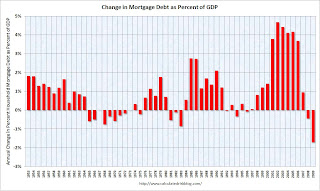
    Change in Household Mortgage DebtThe second graph shows the annual change in the percent of household mortgage debt.

    There was some increase in the late ’90s associated with the booming economy and stock bubble wealth effect. But the real boom in mortgage debt started in the 2nd half of 2001 – and continued through 2006. This rapid increase in mortgage debt should have been a red flag for regulators.

    Finally, on Rogoff’s comment about “Wall Street economists wanting to cheerlead the recovery”, there is an old saying on Wall Street for analysts: Bearish equals unemployed. Of course they are cheerleading!

    Reprinted from Calculated Risk.

    Join the conversation about this story »

  • Sun blamed for Europe’s colder winters

    Article Tags: Headline Story, Solar News, World Temperatures

    When the Sun’s magnetic output is low, winters in Europe tend to be cooler than average – whereas higher output corresponds to warmer winters. That is the conclusion of a new study by physicists in the UK and Germany that looked at the relationship between winter temperatures in England and the strength of the Sun’s magnetic emissions over the last 350 years. The group predicts that, global warming notwithstanding, Europe is likely to continue to experience cold winters for many years to come.

    The possibility of a link between European winter temperatures and solar activity can be seen in historical records from the second half of the seventeenth century. For about 50 years the Sun remained free of sunspots (in contrast to its normal 11-year cycle of sunspot highs and lows) and at this time Europe experienced a number of harsh winters. Motivated by the fact that the relatively cold winters of the past few years have come at a time when solar activity fell to the lowest values for 100 years, Mike Lockwood of the University of Reading and colleagues set out to establish whether or not there is a strong connection.

    Lockwood and colleagues used data from the Central England Temperature record. This provides monthly temperature data from several monitoring stations in central England all the way back to 1659 – the world’s longest instrumental temperature record. The researchers first removed the estimated contribution from the warming recorded in the northern hemisphere as a whole over the past century – which is widely believed to have been caused by increasing levels of manmade carbon dioxide in the atmosphere. Hemispheric temperature records data back to 1850; to extend the analysis back to 1659 they used data from a number of different proxy sources, such as tree rings, isotope concentrations in stalagmites, sediment depths, lake heights and documentary evidence.

    Click source to read FULL report

    Source: physicsworld.com

    Read in full with comments »   


  • Sue Sylvester Madonna “Vogue” VIDEO Homage!

    Luvs it! Watch Jane Lynch’s cheerleading spitfire Sue Sylvester channel her inner Material Girl in this video homage to Madonna’s 1990 hit “Vogue” that premiered on the spring premiere of Glee on Tuesday night.

    Also be sure to mark your calendars for next week’s eagerly-awaited episode, “The Power of Madonna.” The musical special — which airs Tuesday, April 20 @ 9 PM — will feature many of Madge’s greatest hits, including “Express Yourself” and “Like a Prayer.”

  • ‘Climategate’ panel set to report by Roger Harrabin, BBC news

    Article Tags: BBC, ClimateGate

    The second of three reviews into hacked climate e-mails from the University of East Anglia (UEA) is set to be released later.

    It has examined scientific papers published over 20 years by the Climatic Research Unit (CRU) at the heart of the e-mail controversy.

    The panel was nominated by the Royal Society, and climate sceptics forecast it would defend establishment science.

    But the BBC understands the panel has taken a hard look at CRU methodology.

    It is thought to have focued on statistical methods used by the CRU and the way uncertainties inherent in climate science may have been down-played by government bodies.

    Source: news.bbc.co.uk

    Read in full with comments »   


  • Bit.ly Celebrates Its Biggest Month Yet with 3.4 Billion Links Clicked

    Despite the recent troubles, it’s still a pretty great time to build a service based on or catering to Twitter. A great example of this is bit.ly, Twitter’s ‘official’ URL shortener. The service just keeps on growing and posted record numbers again in March. And the service is about to get even better… (read more)

  • The Cheapest iPad Holder Yet [Ipad]

    You can stick your fancy-schmancy $100 dock…back in its box, as the New York Times’ Multimedia Editor Andrew Devigal has found the cheapest solution yet: a 69 cent business card holder from Office Depot. More »


  • Robert Pattinson Slammed For “Freezing Out” Family

    There’s one in every family: Robert Pattinson’s busy body aunt is lighting into the hunk, who she accuses of turning his back on relatives since his meteoric rise to fame in the hit Twilight movies.

    Diane Nutley insists superstardom has gone to Pattz’s head.

    “It looks like we’re being frozen out. It’s funny how fame affects people. Never in a million years did I think this would happen,” Nutley reveals in the new issue of Star Magazine.

    (That’s Golddigger Speak for “I Want Money From My Famous Family Member And They Refuse To Return My Phone Calls….”)

    This is not the first Nutley has gotten loose-lipped about her superstar nephew’s closely-guarded personal life. Lasy year, she claimed Rob had introduced his Twilight co-star Kristen Stewart to his parents as his “girlfriend.”

  • Goldman: All The Good Earnings Are Fully Priced In, And Investors Will Sell The News

    (This guest post previously appeared at the author’s blog)

    Goldman Sachs says the recent surge in equity prices is fully discounting the positive earnings season that began two days ago.  As can be seen in the accompanying chart, Goldman says investors have begun to catch onto the “better than expected” trend in earnings and have been front running the last few earnings seasons.  Each earnings season has subsequently resulted in weaker equity performance as investors look to “sell the news”.  When the market bottomed in March 2009 investor sentiment with regards to earnings was extremely negative (something our Expectation Ratio was way ahead of the curve on – see here). 

    The two quarters following this extreme negativity resulted in significant upside surprises.  By Q3 ‘09 the trend was well in place and it was clear that corporate profit margins were expanding and resulting in stronger than expected earnings.  Each of the past two earnings season were front-run by investors who had noticed this trend and were hoping for performance that was similar to the prior earnings seasons.  Neither Q3 nor Q4 resulted in significant gains and the Q4 earnings season coincided with the largest sell-off of 2010.  The current rally into earnings is the largest since the quarter after the March 2009 bottom:

    chart

    Source: Goldman Sachs


    Read more market commentary at The Pragmatic Capitalist >

    Join the conversation about this story »

  • Morin’ Crunch Crumbs: Sarah Palin’s $12 Million Richer; Long Arm Of The Law In Hot Pursuit Of The Quaids; Can Spanking Lead To Agressive Behavior In Kids?

    -Check out teen heartthrob Justin Bieber and his bowtie in the May issue of Teen Vogue….

    -The cast of Desperate Housewives is standing behind boss Marc Cherry despite his legal battle with Nicollette Sheridan….

    -The Kardashian Girls nude for Dash Miami ad….

    -Andy Dick’s misbehaving again…..

    Sex And The City headed to E! & The Style Network….

    -Kate Gosselin escapes the axe on DWTS….

    -Sarah Palin has earned at least $12 million since leaving the Governor’s Mansion in Alaska….

    -Someone added some creative doodles to this poster for JLo’s The Back-Up Plan….

    -Randy and Evi Quaid are on the run again after skipping out on yet another court date….

    -Lauren Hutton hasn’t owned a TV since 1964?

    -SJP gets “carried away” in the May issue of Vogue….

    -Accused tax cheat Pamela Anderson sued for copyright infringement over Muse clothing line….

    -Kelis’ “Milkshake” brings all the boys to the yard and rapes their wallets without Vaseline!

    -Eighties teen star Rick Schroder turns 40!

    American Idol musical director Rickey Minor will replace bandleader Kevin Eubanks on The Tonight Show with Jay Leno….

    -Heidi & Spencer have adopted another dog….

    -Is Michael Bolton dating Marla Maples?

    -Seth Myers will host the 2010 ESPYs…..

    -Word is hip-hop producer Swizz Beatz — who looks a whole lot like an anteater, if you ask me– is accused of cheating on both his estranged wife, singer Mashonda, and his mistress, hitmaker Alicia Keys, with a Russian singer, who is now raising Swizz’s lovechild….

    -Another blow for Toyota: US auto safety officials are warning car buyers to stay away from the Lexus GX 460 after the SVU failed a battery of safety tests due to rollover concerns…

    -First Lady Michelle Obama and Jill Biden have made a surprise missionary trip to Haiti….

    -WWE Friday Night Smackdown moves to Syfy….

    – Children who are spanked frequently are more likely to be aggressive when they’re older, a new study claims….

  • At Least 400 Dead In Chinese Earthquake

    A 7.1 magnitude earthquake has stuck in rural northwest China, killing at least 400.

    —–

    AP: Chinese state television says that the death toll from a strong earthquake in a western province has climbed to 400.

    CTTV quoted emergency official Pubucairen as saying Wednesday that the number of injured has risen to more than 10,000 as rescue workers struggle to dig trapped people out in Qinghai province. The U.S. Geological Survey said the quake measured a magnitude of 6.9.

    The main quake sent residents fleeing as it toppled houses made of mud and wood, said Karsum Nyima, the Yushu county television station’s deputy head of news, speaking by phone with broadcaster CCTV.

    “In a flash, the houses went down. It was a terrible earthquake,” he said. “In a small park, there is a Buddhist tower and the top of the tower fell off. … Everybody is out on the streets, standing in front of their houses, trying to find their family members.”

    The quake hit the county of Yushu, a Tibetan area in Qinghai’s south, said the China Earthquake Networks Center, which measured the quake’s magnitude at 7.1. A local government Web site put the county’s population in 2005 at 89,300, a community of mostly herders and farmers.

    State broadcaster CCTV said the death toll had risen to about 300, with an additional 8,000 people injured.

    The China Earthquake Administration said phone lines were down, hindering rescue efforts, while workers were racing to release water from a reservoir where a crack had formed after the quake.

    In Jiegu, a township near the epicenter, more than 85 percent of houses had collapsed, while large cracks have appeared on buildings still standing, the official Xinhua News Agency cited Zhuohuaxia, a local publicity official, as saying.

    “The streets in Jiegu are thronged with panic and full of injured people, with many of them bleeding from their injuries,” he said.

    There were also students buried under the debris of a collapsed vocational school, Zhuohuaxia said.

    State television showed footage of paramilitary police using shovels to dig around a house with a collapsed wooden roof. A local military official, Shi Huajie, told state broadcaster CCTV rescuers were working with limited equipment.

    “The difficulty we face is that we don’t have any excavators. Many of the people have been buried and our soldiers are trying to pull them out with human labor,” Shi said. “It is very difficult to save people with our bare hands.”

    Five thousand tents and 100,000 thick, cotton coats and heavy blankets were being sent to help survivors cope with strong winds and near-freezing temperatures of around 43 degrees Fahrenheit (6 degrees C), the Qinghai provincial government said in a statement.

    Wu Yong, a local military chief, said medical workers also were urgently needed but that roads leading to the airport had been badly damaged by the quake, creating difficulties for people and supplies to be flown in. He said rescue efforts were hindered by frequent aftershocks and strong winds.

    The epicenter of the first quake was located 235 miles (380 kilometers) south-southeast of Golmud, a large city in Qinghai, at a depth of six miles (10 kilometers), the USGS said.

    Ten minutes later, the area was hit by a magnitude 5.3 quake, which was followed after two minutes by a temblor measuring 5.2, according to the U.S. agency. Both the subsequent earthquakes were measured at a depth of 6 miles (10 kilometers). Another quake, measuring 5.8, was recorded at 9:25 a.m.

    Xinhua cited officials at the China Earthquake Networks Center as saying at least 18 aftershocks have been reported and that more temblors exceeding magnitude 6 were likely to occur in the coming days.

    In 2008, a magnitude-7.9 quake in Sichuan province left almost 90,000 people dead or missing.

    Join the conversation about this story »

  • Chevrolet Cruze RS by Irmscher for European market

    Irmscher Chevrolet Cruze RS

    In a bid for more market appeal of the Chevrolet Cruze in Europe, General Motors has teamed up with Irmscher tuning to produce the Irmscher Cruze RS. Under the Irmscher tuning, the Cruze RS gets a 25-mm lowered suspension, rear spoiler and 18-inch alloy wheels in turbine style. A new exhaust system provides an extra 36 hp for the 2.0-litre turbodiesel engine, bringing the total to 186 hp.

    The Irmscher Cruze RS is especially destined for German customers, with the model available for order directly from Chevrolet dealers. It may not lure many locals away from their beloved German brands, but it’s definitely something to think about when trying to jazz-up foreign brands and give them some added selling points.

    Irmscher Chevrolet Cruze RS Irmscher Chevrolet Cruze RS Irmscher Chevrolet Cruze RS Irmscher Chevrolet Cruze RS

    Source | CarScoop via Autoblog.com