Blog

  • Body Weight: Is it Predestined by Genetics?

    Filed under: , , , ,

    Some people believe they are doomed to be overweight. They think that no matter what they do, they can’t permanently keep the pounds off because they are predestined to exist at a certain genetic body weight set point.

    This is also known as “poor me syndrome.”

    I can’t wait to see the hate mail.

    There is a common myth that 95 percent of people who lose weight end up gaining it all back, which has contributed to the idea of a body weight set point, but in reality we don’t have any accurate numbers as to what percentage of people gain the weight back. My guess is that it is considerably less than percent.

    The more important question is not how many people gain the weight back, but why. Does a person’s body really have a set point?

    Answer: No, it doesn’t. It has an infinite number of set points based on current activity and caloric intake levels.

    Find out more after the jump

    Continue reading Body Weight: Is it Predestined by Genetics?

    Permalink | Email this | Comments

  • Halo sweatband headphones for active music-lovers

    The Halo Headphones pump out the tunes and soak up the sweat

    Like your music on-the-go but equally admire that John McEnroe look? Try the Halo Headphones that come in a headband. The manufacturers say they consist of specially designed high fidelity speakers that can be inserted into a comfortable headband – so comfortable in fact that they say you can wear them while sleeping…
    Continue Reading Halo sweatband headphones for active music-lovers

    Tags: ,

    Related Articles:


  • Expansion of Supreme Council of Antiquities

    Heritage Key (Ann Wuyts)

    Egypt’s Supreme Council of Antiquities is to expand, with the addition of a new department for archaeological collections. Among its duties will be the registration of privately owned artefacts, as well as supervising the transfers of ownership on these items. The Archaeological Collections Administration is established to facilitate the execution of the newly amended Antiquities Protection Law. The announcement comes only days after Egypt held its first conference on the repatriation of artefacts, showing that Egypt’s focus is not just on retrieving looting antiquities from foreign collections, but mapping and saveguarding those ‘at home’ as well.

    Farouk Hosni, Egypt’s Minister of Culture, announced the establishment of the first department for archaeological collections, the Archaeological Collections Administration (ACA), as a part of the Supreme Council of Antiquities (SCA). The new division will be responsible for determining the archaeological status of transferred individual or institutional collections in accordance with the recently amended Antiquities Protection Law.

    Those amendments lead to tougher punishments for theft and smuggling of ancient treasures, as well as cancelling the percentage of movable antiquities that were previously granted to ‘outstanding’ foreign excavation missions who discovered then.

  • Book Review: Hatshepsut: From Queen to Pharaoh

    Art Museum Journal (Stan Parchin)

    With photos

    Roehrig, Catherine H. with René Dreyfus and Cathleen A. Keller (eds.), et al.
    Hatshepsut: From Queen to Pharaoh (exh. cat.).
    New York and New Haven: The Metropolitan Museum of Art and Yale University Press, 2005.

    Queens seldom played decisive roles in the known course of antiquity. A handful distinguished themselves, sometimes due to their notoriety. Only recently has the skillful scholarship of art historians and archaeologists allowed their personalities to emerge and take their rightful places in the historical record. Nefertiti (ca. 1352-1336 B.C.), the beguilingly beautiful consort of ancient Egypt’s monotheistic “heretic pharaoh” Akhenaten, and the highly romanticized Cleopatra (r. 51-30 B.C.) number amongst these women. Not one distinguished herself for her accomplishments as did Hatshepsut. Indeed, in a time of relative peace and prosperity in Egypt, she fostered a cultural renaissance rarely seen in the ancient world.

    Hatshepsut: From Queen to Pharaoh is the catalogue published in conjunction with the popular special exhibition at the M.H. de Young Museum, The Metropolitan Museum of Art and the Kimbell Art Museum in 2005-06.

  • Difra Thinks Different about House Design and Construction

    Difra cottage design
    Eva Regårdh wrote:

    Wouldn’t it be great to design and build your own personal house, real cheap? It may sound like a dream, but not for much longer. Difra, a Cambridge, MA, company co-founded by graduates of MIT, is working hard to fulfill this ambition.

    Their idea is to use computer-aided design and manufacturing software (CAD-CAM) to model new houses in 3D, then translate the designs into kits containing all the flat 2D components needed to build them—in this case, engineered wood boards that interlock via so-called “friction joints.”

    “To transform 3D to 2D for a typical, average-sized house of 1,600 square feet consisting of several thousands individual components is a very demanding task if done manually,” says Difra co-founder Morris Cox. But automation cuts the cost and the complication down to size.

    Difra will sell its system directly to individual home buyers—and it already has some clients lined up. “Although our aim is to provide ordinary people with personalized homes, we will initially build more luxury homes, to show what can be done and gain acceptance among a broader audience,” says  Cox.

    “My dream is to enable people, even on limited budgets, to personalize their homes, to allow freedom in design,” adds Cox’s co-founder Lynwood Walker. “Light and color, form and feeling, we let people have it the way they want it.”

    A model of Difra's prototype cottageThe team dug into a CAD system called Rhino—chosen for its ability to model surfaces and export data as CAM files that can be used in fabrication machines—and wrote algorithms that translate designs into practical plans that can be built using friction joints, which fit together using only glue.

    Once a Rhino model is transformed into drawings of the fundamental 2D components, the 2D files are fed to a laser cutting machine. Pieces are cut and numbered by the machine. All the pieces are neatly packed and sent to the construction site, together with assembly instructions.

    “Building a home is like laying out a giant 3D-puzzle”, says Cox. “It is the perfect community project. Most of it can be done by ordinary people. We see it as a rewarding and socially enriching project for neighbors, relatives or other groups.”

    Cox estimates that a small house or cottage can be put together in no more than …Next Page »

    UNDERWRITERS AND PARTNERS


  • From madhouse to mainstream

    It’s not often that historians are described as kicking ass, but the latest issue of the The Lancet has a barnstorming piece by Andrew Scull that gives an uncompromising history of psychiatry from the mad house to Big Pharma.

    It must be said that the article is oriented more toward American psychiatry. Although similar influences have been present in European psychiatry, it has been much less subject to, shall we say, the mood swings that have tended to pull the American psychiatric community from one extreme to the other over the last century.

    Nonetheless, it is a rollicking read from one of the most respected historians in the field. This is where Scull discusses the rise of neurobiology:

    The US National Institute of Mental Health proclaimed the 1990s “the decade of the brain”. A simplistic biological reductionism increasingly ruled the psychiatric roost. Patients and their families learned to attribute mental illness to faulty brain biochemistry, defects of dopamine, or a shortage of seratonin. It was biobabble as deeply misleading and unscientific as the psychobabble it replaced, but as marketing copy it was priceless. Meantime, the psychiatric profession was seduced and bought off with boatloads of research funding. Where once shrinks had been the most marginal of medical men, existing in a twilight zone on the margins of professional respectability, now they were the darlings of medical school deans, the millions upon millions of their grants and indirect cost recoveries helping to finance the expansion of the medical-industrial complex.

    One of the best articles on the history of psychiatry I’ve read for a very long time. No stone is left unscorned.

    Link to Lancet article ‘A psychiatric revolution’.
    Link to PubMed entry for same.

  • Barnum Museum mummy suffered from dental disease

    Stamford Advocate

    An expert in forensic dentistry at the University of Connecticut School of Dental Medicine in Farmington said that Pa-Ib, the 4,000-year-old Egyptian mummy at the Barnum Museum, suffered greatly from dental disease in the last years of her life.

    But the expert, Dr. Alan G. Lurie, DDS, said that whether that was the actual cause of her death would be impossible to tell because of damage to the skull that was caused during the mummification process.

    But he said that she suffered from “very dangerous lesions” at the roots of the lower canines that can lead to infections of the sinuses, and ultimately, abscesses of the brain.

  • How Midnight Toilet Trips Can Kill You, Hail Hazards and More

    Filed under:

    Each morning, we dish out a few links we love.

    If you feel the call of nature in the ‘wee’ hours of the morning, you should avoid turning the lights on — studies have found that sudden exposure to bright lights can cause cancer.

    Here’s a reason to turn that frown upside down — studies show that smiling can help you live longer.

    Going running this spring? Check the weather report before you go — as one runner reports (gross photo alert!), hail can be a real hazard.

    It’s almost sandal season — get your feet ready to take the spotlight again with these tips.

    Did you know that April is National Stress Awareness Month? Maybe you should book a day at the spa to celebrate.

    Permalink | Email this | Comments

  • More re low terahertz radiation scanning of mummies

    The National (David Crossland)

    Scientists in Germany and Switzerland have pioneered a new method of examining ancient mummies by using technology employed in airport body scanners.

    The pilot project, conducted at the University of Freiburg in south-western Germany, could revolutionise the way in which the secrets of mummies such as Egypt’s King Tutankhamun are unlocked in future.

    The low-level terahertz radiation used in new screening equipment currently being installed at airports around the world is particularly suited to scrutinising ancient tissue because it is far more gentle than X-ray scanning, the scientists said. Until now, researchers have resorted to X-raying mummies with CT scans, which can destroy DNA remnants because the rays can break apart molecules.

  • Hemiunu to be loaned for opening of the Grand Egyptian Museum

    Earth Times

    A German museum confirmed Sunday plans to lend its greatest treasure, the seated statue of Hemiunu, to Egypt for the 2013 opening of the Grand Egyptian Museum at Giza near Cairo.

    Doubts over the loan cropped up after Zahi Hawass, the flamboyant chief of the Egyptian Supreme Council of Antiquities who visited Germany last month, called for the statue and other Pharaonic treasures to return to Egyptian permanently.

    Hemiunu is believed to have been the architect of the Great Pyramid of Cheops at Giza. The life-size statue, depicting him in nothing but a loin cloth, is the top draw at the Roman and Pelizaeus Museum in Hildesheim, Germany.


    Bikya Masr

    Egypt’s top archaeologist Zahi Hawass is feeling good today, after the German museum housing a famous seated statue of Hemiunu has agreed to lend Egypt the statue for the 2013 opening of the Grand Egyptian Museum in Giza, near the pyramids. It continues Hawass’ push to have all Egyptian artifacts taken from the country returned to Egypt.

    This is just a loan, but a Supreme Council of Antiquities (SCA) official said that they fully expect Germany to allow the statue to remain in Egypt upon the end of the agreement.

    “We would not have agreed to only a loan if there were not discussions in the works that could see the statue return to its rightful home for good,” said the official, who was not authorized to speak to the media.

    The statue is one of the top pieces at the Roman and Pelizaeus Museum in Hildesheim and doubts over the weekend of the possible loan deal had emerged after Hawass, the outspoken and often controversial figure, had called for the statue and other ancient Egyptian pieces to be returned to Egypt permanently.

    The museum, however, did confirm they would loan the statue for the opening of the museum, but said upon the end of the deal, the statue would return to Germany.

  • Changes to the Downtown area of Cairo

    The National (Ursula Lindsey)

    Downtown – Wust al Balad in Arabic – is Cairo’s 150-year-old central district. With its mix of Belle Époque, neo-Islamic and Art Deco apartment buildings, its roundabouts ornamented with statues, its glittering cafes and elegant shops, the area was once known as “Paris on the Nile”. But in recent decades the neighbourhood has lost its upper-class cachet, and its architecture has been damaged by misuse and neglect.

    It has become common to lament Downtown’s decline – in the press and in Egyptian literature, whose development is deeply linked to the area. Now private investors and government authorities are putting in motion plans to protect and renovate the neighbourhood.

    Karim Shafei fell in love with the area when he attended an art festival there in 2001. “I thought: Downtown is going to happen again, the same way it happened in Paris, New York, Istanbul,” he says. Shafei is the chief executive of Al Ismaelia Company for Real Estate Investments, a new venture that is dedicated to buying and renovating Downtown properties – and possibly returning the area to its glory days.

  • Eat More Good Fats: Erika’s 30-Day Challenge

    Filed under: , ,

    Erika is a 39-year-old office administrator and receptionist who quit smoking cold turkey on January 1, 2000 and wishes she could apply the same willpower to her diet and exercise.

    I asked Erika to give me a snapshot of her eating habits and in return I gave her some tips and ideas on how she could modify her diet during That’s Fit.ca’s 30-Day Nutrition Challenge. If you missed our other posts and want to follow the challenge here are some resources to get you started:

    Benefits of eliminating gluten, dairy, sugar, caffeine, alcohol and processed foods.
    What you can and cannot eat
    Getting started and getting off coffee
    Recipe ideas and resources

    Healthy Foodie: What do you normally have for breakfast?

    Erika: It varies. I’m big on having egg whites though!

    HF – Breakfast can be a tricky one but I’m fond of recommending smoothies. Add some fruits and veggies to a blender with water and you’ve got yourself breakfast. Throw in rice protein, a greens supplement like chlorella or spirulina and some flax seed oil and you have yourself a superfood breakfast.

    Eggs are a good breakfast too, as is porridge made of grains like quinoa or gluten-free oats. One thing about eggs, though: Eat the whole thing!. The media has done a great job of convincing us that eggs are bad for us, but they are not. I always recommend eating whole foods and that includes whole eggs! The yolk of the egg contains almost all of the nutrition including the essential fats, vitamin A, B12, D, E, K and folate. Don’t be scared of yolks.

    HF: And what about your average lunch?

    Continue reading Eat More Good Fats: Erika’s 30-Day Challenge

    Permalink | Email this | Comments

  • In Defense of the Pope


    As is clear, the Catholic Church is grasping the nettle of sexual abuse today and struggling with discovering effective strategies to overcome the problem.  The easy part is the procedural.  Priests can be and have been shunted into other duties that eliminate the risk and now we are going to see some of them been forced to confront civil authority at least in the developed world.
    The hard part is to understand that institutions dealing with vulnerable children are targeted by individuals driven by aberrant sexual needs.  That has been true with the Boy Scouts and the educational system and the foster care system.  It will also continue to be true unfortunately.
    At least now they will not be able to hide behind the culture of general denial that has operated everywhere in the past.
    I suspect that the most vulnerable children and thus likely the most abused are those children passing through the government run foster care systems.  The children themselves effectively have no protector.
    The Catholic Church is at least capable of actually solving the problem better than just about anybody else.  They are a hierarchical system of administration that can implement globally corrective systems.  So if the underlying problem is solvable they should be up to it.
    The good news I suppose is that the actual hard numbers of aberrant individuals appears to be low.  Except that their individual ability to cause damage is huge.  A hundred victims is almost common.  Yet out of thousands we have a couple here and there causing all the agony.  One teacher in our system created a serious scandal some years back, yet that appears to be the only serious case in a large school system
    Because these folks strike at the core of society’s framework of trust, society reacts heavily.  I do not myself excuse the damage caused or think that individuals can be cured, so must class myself as intolerant.  Yet the reality is that the perpetrators are victims of their biological urges however wrongly directed.  It begs a cure rather than forgiveness.
    In short it is ultimately a scientific problem.
    I do find offensive that some of the press give free rein to any number of creeps who want to take advantage of the situation to attack the Pope.  The Church is a bureaucracy that is naturally behaving like a bureaucracy and Pope Benedict is where the buck stops.  He had already made key corrections to repair what was clearly not working.  That alone may be sufficient to cut of any internal escape routes for problem priests.  What remains is the creation of an open reporting system that is self corrective on the ground.  That done and it will be almost immune to the problem.
    In the meantime, the church will have to isolate all perpetrators who have any history and allow them mostly to die out.  Again this will take careful judgment calls because of the insidious nature of the problem.  Some will call for witch hunts and victims have to be addressed and helped.  This can be organized.  I suspect though that hunting up victims in order for them to recount their traumas is often simply extending the abuse with another form of abuse.
    This article outlines a lot of what the church has done and where it now goes. I have little doubt that this will be solved.
    The bigger problem remains with the foster care system operated by governments throughout the world.  It is likely a whole order of magnitude greater.  Moves to correct the problem there have been generally implemented at least to the point of awareness.  Yet the institutional structure is still quite vulnerable and no one really knows how to fix it.   Things may have changed while my information from many interviews is decades old but I cannot see how.
    In Defense of the Pope
    Posted by Alan M. Dershowitz on Apr 13th, 2010 and filed under FrontPage
    Having criticized particular Catholic cardinals for blaming everything–including the Church’s sex scandal–on “the Jews”, let me now come to the defense of the Pope and of the Church itself on this issue.  To begin with, this is an extraordinarily complex problem, because the Church has at least five important traditions that make it difficult to move quickly and aggressively in response to complaints of abuse.
    The first tradition involves confidentiality, particularly not exclusively the confidentiality of the priest with regard to the penitent.  But there is also a wider spread tradition of confidentiality within the Church hierarchy itself.
    Second, there is the tradition of forgiveness.  Those of us outside the Church often think, perhaps, that the Church goes too far in forgiving.  I was shocked when the previous Pope immediately forgave the man who tried to assassinate him.  But this episode and other demonstrate that the tradition of forgiveness is all too real.
    Third, there is the tradition of the Church regarding itself as a state.  The Vatican is, after all, a nation state.  The Catholic Church is not big on the separation of church and state, as are various Protestant denominations.  The Catholic Church, like Orthodox Judaism, believes that matters affecting the faithful should generally be dealt within the church, without recourse to secular authorities.
    Fourth, the Vatican prides itself on moving slowly and in seeing the time frame of life quite differently than the quick pace at which secular societies respond to the crisis of the day.
    Fifth, the Catholic Church has long had a tradition of internal due process.  Cannon Law provides for scrupulous methods of proof.  The concept of the “devil’s advocate” derives from the Church’s effort to be certain that every “t” is crossed and every “I” is dotted, even when it comes to selecting saints.
    None of these explanations completely justify the long inaction of the Church in coming to grips with a serious problem.  But they do help to explain how good people could have allowed bad things to happen for so long a period of time.  Nor is the Catholic Church the only institution that has faced problems of sexual abuse.  Every hierarchical body, especially but not exclusively religious ones, has faced similar problems, though perhaps on not so large a scale.
    The problem of hierarchical sex abuse has only recently emerged from the shadows.  Singling out the Catholic Church, and for stereotyping all priests is simply wrong.
    Pope Benedict, both before he became Pope and since, has done a great deal to confront the issue.  He changed the policy that kept allegations of abuse within the authority of local bishops, and he acknowledged that the local option had encouraged shifting abusive priests from parish to parish, thereby hiding their sins from potential new victims.  He also met with abuse victims and recognized their victimization.  Nor has he tried, as other members of the Vatican hierarchy have, to publicly blame the problem on “the Jews”, “the media,” and others.
    It is obvious that despite Pope Benedict’s good efforts, more must be done, and not only by the Catholic Church but by all institutions that have experienced hierarchical sexual exploitation.  They must create structures that assure prompt reporting, a zero tolerance policy and quick action, so long as these processes are consistent with due process and fairness, not only to alleged victims but to the accused as well.  It’s easy to forget, in the face of real victims with real complaints, that there have also been false accusations as well.  Processes must be put in place that distinguish true complaints from false ones.
    Most important, this tragedy should not be used as an excuse to attack a large and revered institution that does much good throughout the world.  Blame must be placed with precision and praise should be given with precision as well.  The eleventh Commandment, Thou Shalt Not Stereotype, must never be forgotten.
  • Gluten-Free Foods: Bread Recipe with Pumpkin Seeds

    Filed under: ,

    Many people dismiss healthy eating as consisting solely of salads aka rabbit food. Even I remember a time when I ate only salads for an entire year thinking that was the only “healthy” food available. Boy did that ever backfire as I was nutritionally-deficient and hormonally-imbalanced, not to mention totally bored. Fast forward 10 years and one holistic nutrition degree later and I can tell you that while salads are most definitely part of a healthy diet, eating the same foods all the time denies not only your tastebuds, but your body of essential vitamins and minerals.

    These days I am lucky to have friends who can not only cook, but who know how to cook delicious and healthy meals. Enter Candice, my neighbour and foodie extraordinaire. Candice and her boyfriend are so enamoured by food that she writes a blog (www.therealdishto.com) about all their Toronto restaurant adventures. Knowing my penchant for gluten-free recipes, Candice emailed recently to say she had a bread recipe that I just had to try. I must admit that I was at first hesitant because mastering the art of gluten-free bread can be a challenge (when I was a teenager my boyfriend’s dad had celiac disease and ate a bread that had the texture and weight of cement). The verdict: It was very moist and the most delicious gluten-free bread I’ve ever had.

    Gluten-free recipe after the jump

    Continue reading Gluten-Free Foods: Bread Recipe with Pumpkin Seeds

    Permalink | Email this | Comments

  • Book Review: Thutmose III

    Strategy Page (A.A. Nofi)

    Thutmose III: The Military Biography of Egypt’s Greatest Warrior King
    By Richard A. Gabriel
    Washington: Potomac Books, 2009.

    Largely due to his extensive propaganda, most historians cite the megalomaniacal Ramses II as Egypt’ s “greatest” warrior king. But a better case can be made for Thutmose III , who ruled more than a century earlier. And Prof. Gabriel (Royal Military College of Canada), author of quite a number of works on ancient warfare, makes that case very convincingly.

    Gabriel opens with a short, but concise introduction to Egyptian history to set Thutmose’s life and campaigns within the framework of the political, economic, diplomatic, and, of course, military practice of his times.

  • Ron Paul Introduces Bill to “End the Mandate”

    Congressman Paul has officially introduced his legislation to repeal the federal health insurance mandate. The bill is titled “End the Mandate” and the bill number is HR 4995. The bill’s text will be available shortly.

    In a recent Fox News interview Ron Paul described his bill as follows

    Ron Paul: “I want to get rid of one item to concentrate on, because I think it’s the worst part. And that is the mandate saying that you don’t have a choice anymore. They’re driving everybody into the system. […] I want to key in on the one issue, to legalize freedom of choice, legalize the private option without taking on the whole mess that’s been created. […] In a free society you have to at least allow people the freedom to opt out of a compulsory system that is imposed on you by government.”

    Share/Bookmark

    Related posts:

    1. Repeal Obama’s Healthcare Mandate Ron Paul talks about his strong showing in the SRLC…
    2. Executive Orders are Unconstitutional; We Need a Private Option in Healthcare Executive orders are unconstitutional and it’s a shame the American…
  • Ya se trabaja en el coche conectado con el hogar

    audi_a8_google_earth.jpg
    Los sueños más lejanos de algunos amantes de la tecnología empiezan a fraguarse en la mente de otros que tienen los medios para intentar hacerlos realidad. Con esta pomposa frase introducimos al Centro Tecnológico de Galicia, Telefónica y Ericsson y a su idea de conectar los coches con nuestra unidad familiar.

    La idea es que que podamos acceder a nuestros datos independientemente del lugar donde nos encontremos, el coche, nuestra casa o caminando por la calle en el móvil. A través de un módem 3G integrado se busca que podamos acceder a nuestra red casera para intercambiar y recibir datos.

    Vídeos, fotografías y canciones podrían estar almacenadas en nuestro PC de sobremesa tranquilamente y ser reproducidas en el coche mientras hacemos un desplazamiento largo. Además se intenta aprovechar para recibir información en tiempo real sobre tráfico, accidentes, carreteras cortadas y demás elementos generadores de tráfico.

    La mala noticia es la posibilidad de centralizar estos datos con el gobierno y poder recibir multas automáticamente. Vamos a pensar en positivo y decir que nos pondríamos alarmas en el PC para que nos avise de los cambios de aceite, nos revise los testigos del motor… que pensar en la DGT conectada a mi coche me da grima.

    Vía | Gizig


  • Poll: What is President Obama?

    Ron Paul recently made the headlines when he claimed that President Obama is not a socialist, but a corporatist:

    Ron Paul: “The question has been raised whether or not our president is a socialist. And I’m sure there are some people here [at the SRLC] who believe it and I know this conference has talked about that already and I think that is very important, he deserves a lot of criticism. But you know, in the technical sense, in the economic definition of a socialist, no, he’s not a socialist. What he is is a corporatist and unfortunately, we have corporatists in the Republican party and that means you take care of corporations and corporations take over and run the country. We see that in the financial institution, we see it in the military-industrial complex, and now we see it in the medical-industrial complex who runs medicine.”

    Do you agree or disagree with Ron Paul? What is the president all about? Participate in our latest poll and make your opinion heard. You can select up to 3 options.

    Note: There is a poll embedded within this post, please visit the site to participate in this post’s poll. Share/Bookmark

    Related posts:

    1. Poll: Ron Paul’s VP in 2012 If Ron Paul runs for President in 2012, who should…
    2. Obama Is Preparing Us For Perpetual War Channel: Fox Business Date: 12/02/2009 Transcript News Anchor: In…
    3. Ron Paul Responds to Michael Moore: It’s Corporatism, Not Capitalism Ron Paul: “I probably dislike [the current system] as much…
  • WES 2010 For BlackBerry Is April 27th Through April 29th In Orlando, Florida

    The WES 2010 for BlackBerry, and it has all the information you need from hotels, registration fees, packages, pricing, special offers, training, keynotes, everything you want or need to know to go, including registering. You have until April 25th to register, so hurry. There’ll be training, speakers, hands on labs, entertainment, and it’s in Florida!

    For more information and to sign up, here’s the WES 2010 site

    You’re reading a story which originated at BlackBerrySync.com, Where you find BlackBerry News You Can Sync With…

    This story is sponsored by the new BlackBerry Sync Mobile App Store. Grab your free copy today at www.GetAppStore.com from your BlackBerry.

    WES 2010 For BlackBerry Is April 27th Through April 29th In Orlando, Florida

    Related posts:

    1. RIM Presenting New Webcast For Developers Tuesday, April 13th RIM is presenting their latest webcast for developers Tuesday, April…
    2. The WES 2010 Entertainment Has Been Announced! This is exciting, and it sounds like the entertainment…
    3. BlackBerry Storm2 9550 Heading to Bell on April 13th Recently Bell decided it was finally time to pull the…

  • Banks Blowing up the Economy


    What this all means is awful.  The last chart shows us that the assets of the top four banks now represent half of the US economy. Now this also reflects that these banks are themselves not anchored in the US economy.  They absorb US dollar deposits worldwide and also lend globally.  It is no longer possible for the USA economy by itself to backstop these particular banks.  They likely need to be cut free and their deposit base transferred to smaller institutions.
    The simple removal of the fed guarantee should change everything in a hurry. 
    My point is that these banks are actually bigger than the government itself.
    We now need a global financial regulatory scheme that is able to manage these entities and drive down the ratios.  Having depositors caring about your ratios also works wonderfully.   Ending the government back stop should cause that.
    Perhaps the banks that are beyond a certain size will need to automatically lose deposit insurance.  It would certainly encourage a huge and healthy second tier.
    Banks Blowing Up the Economy
    By Morgan Housel  April 13, 2010 | 
    I read two interesting thoughts last weekend. The first is from legendary 18th-century economic god Adam Smith — father of free-market thinking — who wrote this on the topic of regulating banks:
    “exertions of the natural liberty of a few individuals, which might endanger the security of the whole society, are, and ought to be, restrained by the laws of all governments, of the most free as well as of the most despotical. The obligation of building party walls, in order to prevent the communication of fire, is a violation of natural liberty exactly of the same kind with the regulations of the banking trade which are here proposed.”
    The second came from JPMorgan Chase (NYSE: JPM) CEO Jamie Dimon’s annual letter to shareholders, which says a skill he strives for is the “Ability to face facts.”
    Amen to both 

    The outcome of banking gone wild is now well-known. Less obvious are the dramatic changes banks underwent since the 1980s that concluded with the collapse of 2008.
    By looking back over the past 25 years, it’s easy to highlight Smith’s point of banks running roughshod over everyone else. And we can show this with cold, hard facts Dimon appreciates.
    The three facts that put our current financial system in perspective are charts of profit growth, compensation growth, and relative size of today’s biggest banks. I owe credit for the inspiration of these charts to a presentation in March by former International Monetary Fund chief economist Simon Johnson. Let’s look at each.
    1. Money for nothin’ 

    Every business, every corporation, and every consumer relies on banking in one way or another. That makes it a special industry, and it’s why banks receive special treatment like backing from the Federal Deposit Insurance Corp. It also makes it an industry that should be at least somewhat anchored to the rest of the economy. When the economy does well, banking does well; when the economy does poorly, so do banks.
    That’s roughly how it worked for most of the post-World War II period until the early 1980s — profit growth among banks hugged close to the businesses they lent to. Then something strange happened:

    Source: Bureau of Economic Analysis, author’s calculations.
    Let me explain this chart a little more. The Bureau of Economic Analysis tracks total corporate profits by industry going back to 1947. I took total financial profits, and total profits from all other industries, and calibrated both groups to “1” in 1947. So what this chart shows is the relative profit growth of banks compared with everyone else.
    From 1947 until the mid-’80s, financial profits and all other profits were fairly correlated. Then in the mid ’80s … snap! … financial-sector profits left everyone else in the dust.
    There are two explanations for this. One, we’ve had consistently falling interest rates since the ’80s, which is great for most businesses, but banks especially. Two, the ’80s were deregulation central. As Simon Johnson and James Kwak explain in the book 13 Bankers:
    [A broad] deregulatory trend begun in the administration of Jimmy Carter … transformed into a crusade by Ronald Reagan. The eventual result was an out-of-balance financial system that still enjoyed the backing of the federal government — what president would allow the financial system to collapse on his watch? — without the regulatory oversight necessary to prevent excessive risk-taking.
    Two big innovations that came from this were an explosion of derivatives, and the securitization of debt. As the past two years taught us, both products can be great in moderation yet deadly when used in excess — which they usually are.
    The reason excess within financial products became standard is simple: Bankers were getting fat and happy off these things even when clients lost money. That brings up chart No. 2.
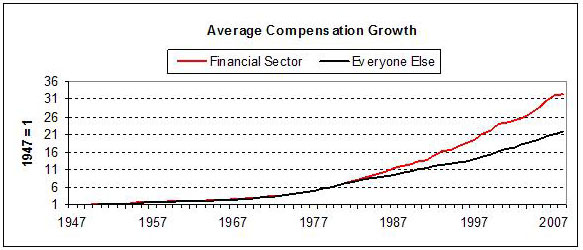
    2. Lifestyles of the rich and fortunate

    There was nothing glamorous about banking for most of the post- World War II period. The leaders made fortunes and gained power — as leaders of all industries do — yet the lower workers were just average Joes making average wages.
    As with profits, that changed abruptly in the ’80s:

    Source: Bureau of Economic Analysis, author’s calculations.
    In 1959, the average finance employee made $4,880 a year, while the average in all other sectors made $4,560. By 2006, the average finance worker made $82,200 compared with $52,800 for everyone else. Nice.
    The practice of paying bankers ungodly sums just for showing up isn’t the historic norm. It’s really something that sprung up in the ’80s with the advent of financial engineering and the outburst of subsidized profits.
    Another thing we’ve become accustomed to that isn’t historically ordinary is the size of the largest banks. That brings up chart No.  3.
    3. What too big to fail looks like


    Source: Capital IQ (a division of Standard & Poor’s), measuringworth.org, author’s calculations.
    This is the combined total assets of the four big commercial banks — Citigroup (NYSE: C),Bank of America (NYSE: BAC), Wells Fargo (NYSE: WFC), and JPMorgan Chase — as a percentage of gross domestic product. In 1992, the combined assets of these four banks amounted to 5.2% of GDP. By 2009, that number had increased tenfold, to 52% of GDP. The big jump came in the late ’90s with the repeal of the Glass-Steagall Act, which allowed commercial banks to merge with investment banks. A second surge came in 2008 after surviving banks purchased their fallen neighbors.
    This chart is particularly revealing because it thoroughly wrecks the claim — made mostly by bank CEOs — that megabanks must not be broken up because large companies like Appleand ExxonMobil absolutely need banks of today’s size to conduct business. Eyeball the chart for three seconds and you realize how ludicrous this idea is. Big companies didn’t struggle to raise capital in 1992. Or 1995. Or 2000. Or 2006. In fact, they thrived like never before. To suggest that reducing the size of big banks relative to GDP to where they were in, say, 1998, would somehow asphyxiate big businesses is comically refutable.
    Don’t shoot the messenger

    These three charts don’t tell the whole story, of course. You can gab away about how the Fed, Fannie and Freddie, China, the Democrats, the Republicans, the media, and whoever else you detest created the financial collapse. And please do.
    What I hope they do is provide perspective. There’s a growing group, without naming names, that acts like even the slightest smidge of financial reform will send us into a Socialist Stone Age. But when you see how dramatically and quickly the financial system skewed, you see how even significant reform would simply revert it back to where it was only a handful of years ago — a time that was demonstrably more stable, produced higher growth, and, to the irony of all, represented the “old America” so many reform opponents want back.
    Some say banks are making lots of money and paying themselves accordingly, but that’s their right. That’s capitalism. We encourage it. We cherish it. But as Adam Smith mentioned more than 200 years ago, it isn’t capitalism if the misbehavior of a few bankers “endanger the security of the whole society.” And that’s exactly what happened in 2008.It wasn’t capitalism. It was banks blowing up the economy. And a few of us are praying it’ll soon end.