Blog

  • Twitter’s Advertising Scheme is Delightfully Boring – Just As It Should Be

    Why do people care how Twitter will make money? “We won’t know where we, the users, fit in — until they tell us how they’re going to make money,” Dave Winer wrote a year ago this week, “And when they tell us, we may not like it.” That’s one reason why people care how Twitter makes money.

    Whether you’re a person concerned that the popular social network you’re investing your time and energy in might monetize in an anti-social way, or you’re a skeptic who refuses to believe that the world-changing potential of Twitter is real until it proves itself economically viable – you probably heard that Twitter announced tonight it’s got a plan for advertisements. You can breathe a sigh of relief; the plan is downright boring, just as it should be.

    Sponsor

    Advertisements will begin in search, with keywords being bid on and a single advertisement appearing with frequency dependent on its performance. Then the ads will be extended to 3rd party applications like TweetDeck and others. It’s unclear who will use it, Tweetie got bought by Twitter last week and Twitterific has its own ads, but other apps will come and go, hopefully given the option (not the requirement) to show Twitter ads to their users.

    Finally, ads will begin to appear on Twitter.com, tailored to the interests of users, as easily observed by their messages published and received.

    This is great: it’s relatively non-invasive, nothing too crazy, nothing terribly exploitive. Some people who insist on reading every Tweet in their stream will probably be annoyed once they find ads in it, but there are already lots of unofficial ads being published on Twitter and maybe this will break those people of the habit of obsessing over every little message.

    This is surely not the intention behind the plan, Twitter HQ itself is full of people who spend time carefully pruning their streams. Twitter’s new head of PR Sean Garrett, for example, quit following NBC’s @newmediajim and media analyst Shelly Palmer last week, something it’s hard to imagine him doing for any reason other than concern about signal-to-noise ratio and an unhealthy concern with reading every one of the Tweets in his stream.

    But the point is this: it appears that no baby animals will be hurt in the making of the Twitter.

    Along with the big search deals with Google, Microsoft and Yahoo, and the forthcoming availability of power Commercial Accounts, Twitter seems to have found relatively non-violent ways to monetize. As long as the firehose of user activity data is in fact made more widely available and not kept from small innovators, and as long as regular accounts aren’t handicapped in order to make commercial accounts more appealing – then these three plans together look pretty good.

    It’s not banner ads, it’s not sales of data to direct marketers, it’s not licensing access to Direct Messages to the CIA. Twitter is at its best when it keeps things simple, when it stays out of the way and acts like a dumb, if textured, pipe. Put a contextual ad up to keep the lights on, what do I care?

    It’s entirely predictable, shouldn’t hurt too much and might even work. As Liz Gannes said so well in her headline at Gigaom tonight: “The Twitter Ad Model Revealed (What Were You Expecting, a Pony?)”

    Update: Twitter’s Biz Stone posted to the company’s blog about this at one minute after midnight. He didn’t say much that was new but he did title the post “Hello World,” implying that this is in some ways the real beginning for Twitter.

    Discuss


  • Hitachi Working On Glasses-Less 3D LCD [3dTv]

    Another company has fallen down the glasses-less 3DTV route. Hitachi’s going to use Sharp’s parallax barrier technology (supposedly used in the Nintendo 3DS and that mysterious StreamTV panel) on some mean LCDs, hopefully just as slim as their previous models. More »


  • Google Searches For Key To Energy Savings

    National Geographic has an article on Google's power meter and initiatives to make smart meter data visible to end users –
    Google Searches For Key To Energy Savings

    Deep in the dark of the Minnesota night, some appliance was kicking on to rob Ed Kohler of hard-earned cash. He'd look later and see nighttime energy spikes reported by PowerMeter, Google software that monitors home electrical use.

    “All the lights were out, but something's cycling,” said the 36-year-old Kohler, marketing manager at a Minneapolis web-development firm. “So I think about it and, aha, figure out it's the refrigerator.”

    A 19-year-old refrigerator, a real energy hog by today's standards. It was easy to calculate that a new, energy-efficient model would pay for itself.

    Kohler’s revelation is typical of “Aha!” moments that consumers enjoy when they can monitor their energy use, say Google executives. PowerMeter is an early hint at how new technology can give home dwellers more control over their energy use. It was developed by the search giant’s charitable arm, Google.org, which has made energy one of its prime areas of focus. And PowerMeter is free, easy to use and available to anyone worldwide to install.

    If only it were that simple.

    As software, PowerMeter can’t provide the homeowner with energy use data unless it is linked to the home's electrical power system—and that requires a piece of hardware. But it will take the utilities that deliver electricity to homes years–maybe a decade–to blanket the country with new “smart” meters that can gather and transmit useful data. Then, the power companies must decide how to transmit that data to customers–perhaps through software like Google's that is being tested by several utilities in the United States and Europe, or perhaps through software and hardware being developed by other companies, like Microsoft, Intel, and a number of start-ups.

    Utilities cautious on smart meters

    From the standpoint of the utilities, the meters raise a myriad of technical questions, not the least of which is just making sure the darn things are accurate. So they are moving forward cautiously. Too cautiously, in the view of Google and 45 companies and organizations that sent a letter to President Obama this week urging that the administration set a goal of giving every U.S. household and business access to “timely, useful and actionable” information on their energy use.

    “By giving people the ability to monitor and manage their energy consumption, for instance, via their computers, phones or other devices, we can unleash the forces of innovation in homes and businesses,” the letter said.

    The smart meter advocates say if U.S. households saved 15 percent on their energy use by 2020, the greenhouse gas savings would be equivalent to taking 35 million cars off the road and would save consumers $46 billion on their energy bills.


  • Motorola puts a new Twist on Android phone form factors

    The Motorola Twist.

    Our friend John from DroidDog leaked some photos of an unknown Motorola Android phone this weekend which were quickly pulled down (hint: they are real). Not much was known about the device till Android-France spotted the specs for a Motorola prototype which matches up nicely with the leaked pics.

    Codenamed the Motorola Twist, this Android phone features a 2.8 inch QVGA display, 700 MHz TI OMAP 3410 processor, and a square form factor. The leaked pics look similar to the Motorola Backflip, but in a more compact size. The device could feature the same reverse-flip keyboard design of the Backflip, but the Twist name suggest something similar to the Nokia Twist.

    Even though the phone comes in compressed form (67 x 67 x 15.8 mm), it should still pack quite a punch with its Texas Instruments OMAP 3410 processor. This CPU is similar to what was used in the Droid (ARM Cortex-A8), but it lacks the dedicated PowerVR graphics processor. The Droid’s OMAP3430 was underclocked at 550 MHz (600 default) whereas the Twist’s OMAP3410 is overclocked to 700 MHz (also 600 default). The major benefit of using an ARM Cortex-A8 based processor is the ability to run Adobe’s upcoming Flash 10.1.

    The Twist is slated for a June release and the leaked documents indicate it will support AT&T 3G bands. AT&T already took a chance on an odd form factor with the Backflip, so they should have no issues bringing us another unique Android phone.

    Leaked specs of the Motorola Twist.

    Related Posts

  • Blotto: Space Miner! [Blotto]

    HOW GOOD IS SPACE MINER. The answer is INCREDIBLE GOOD. It’s probably the best original game to hit the iPhone. Imagine Nintendo made Asteroids, adding a mild upgrade path on top of extremely gratifying space flyingabout. IT IS FIVE SPACE DOLLARS and worth every penny, but there is a “LITE” version that will give you ample time to gauge your own proclivity towards shooting rotating rocks and watching them explode. [iTunes] More »


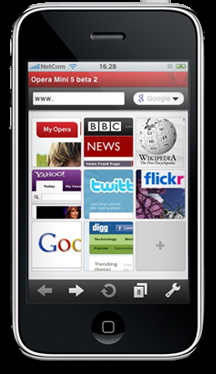
  • Opera Mini arrives on iPhone at last

    By Tim Conneally, Betanews

    Opera Mini iPhoneWay back in 2008, Opera Software’s CEO Jon Stephenson von Tetzchner said the company’s popular Opera Mini mobile browser was ported to the iPhone, but it could not be released because it competed with the iPhone’s built-in Safari browser.

    Then, last February, Opera Software actually started showing off its version the popular browser for iPhone OS as a run-up to its submission to Apple for App store review in March.

    Tonight, Opera announced that Opera Mini for iPhone was finally approved for distribution in the iTunes app store.

    Some have expressed surprise that the app finally passed Apple’s notoriously strict approval process, but really it was anything but a surprise.

    “We wholeheartedly believed Opera Mini would be approved. We knew we stood a good chance and were pleased to see it happen. The only surprise was the exact time the approval came. But we were confident the approval would come,” Opera’s Thomas Ford told us this evening.

    Now that it’s been approved (and downloaded thousands of times already), the iPhone can now begin to affect Opera’s comprehensive tallies of international mobile browsing habits which it releases as the State of the mobile Web every month.

    “I wouldn’t expect to see it this month, for instance, because we will be reporting March numbers. So when we report April numbers (in May), that would be the first time the iPhone would have a chance of being listed,” Thomas told us.

    Opera Mini for iPhone arrives alongside Windows Mobile, Android, BlackBerry, and S60.

    Here’s a quick look at Opera Mini on an iPod Touch alongside Opera Mini 5 Beta on a Motorola Droid.

    Copyright Betanews, Inc. 2010


    Add to digg
    Add to Google
    Add to Slashdot
    Add to Twitter
    Add to del.icio.us
    Add to Facebook
    Add to Technorati


  • BMW’s hydrogen fuel cell hybrid vehicle spied

    bmw 1 series_4

    Eco Factor: Concept car designed to be powered by a hydrogen hybrid engine.

    BMW’s much anticipated hydrogen hybrid vehicle has been spied, which is believed to be undergoing testing. The system combines a conventional front-drive powertrain along with a hydrogen fuel cell, supercapacitors and an electrically driven rear axle. The technology will allow the vehicle to travel emissions-free in city centers.

    (more…)

  • NASA Stennis Space Center Awards Construction Contract

    04.11.10 08:00 PM

    NASA’s Stennis Space Center near Bay St. Louis, Miss., has awarded an indefinite delivery, indefinite quantity contract to M&D Mechanical Contractors, Inc. of Decator, Ala., to provide general construction services at the center.

    http://www.nasa.gov/home/hqnews/2010…struction.html

  • President Obama to Deliver Remarks at Kennedy Space Center

    04.11.10 08:00 PM

    On the afternoon of Thursday, April 15 President Barack Obama will visit Cape Canaveral, Florida and deliver remarks on the bold new course the Administration is charting for NASA and the future of U.S. leadership in human space flight.

    http://www.nasa.gov/home/hqnews/2010…ma_at_KSC.html

  • Your Lower Back Pain Or Sciatica Might Actually Be Piriformis*Syndrome

    04.12.10 07:01 PM

    How often do you hear yourself saying things like: “I have hip pain,” “My lower back hurts,” “Pain is shooting down my leg,” “There’s numbness and/or tingling on the top of my foot,” “I have sciatica,” and so on…

    Well, you’re not alone. In fact, these are frequently recited phrases in doctors’ offices, physical therapy clinics and healing centers the world over. When patients present their symptoms to me they offer many of those descriptions and curative measures they’ve been instructed to carry out. Their physician has told them to take anti-inflammatory drugs, such as ibuprophen, or to use ice. Sometime the doctor recommends physical therapy, wherein the therapist designs a series of strengthening exercises to solve the problem.

    By the time the problem reaches my office, the patient has already swallowed the over-the-counter pills and gone through a lengthy course of physical therapy or chiropractic care… all with little lasting effects. Sometimes the problem has become worse.

    When I hear phrases like those mentioned above, I already know what the person has “tried” prior to seeing me. I also know that they will tell me the problem is not “fixed.” If it was they would not be here. The first thing I do is perform a series of orthopedic tests on their piriformis, a muscle largely overlooked by the mainstream medical community.

    The piriformis muscle originates at the front of the sacrum (the part of the spinal column that is directly connected with or forms a part of the pelvis). It passes out of the pelvis through the greater sciatic foramen. It inserts into the upper border of the greater trunchanter (ball) of the femoral shaft (thigh bone). It is used to rotate the thigh laterally when such a motion is called for.

    What this means is that this one muscle, if dysfunctional, has the ability to negatively affect a number of places on the hip, low back, legs and feet. Since the piriformis attaches the femur to the sacrum, if it is hypertonic (tight, contracted, in spasm) it can cause the foot to splay. That is, the foot of one or both legs will tend to point outward when walking. And this causes pain in the hip.

    If the piriformis is contracted it can compress the sciatic nerve, thus causing what is described as “shooting leg pain.” Often, those who are diagnosed with sciatica actually have piriformis syndrome. Sure their X-rays may show some disc herniation, and the doctors will tell the patient that is the cause and recommend surgery. But this is not necessarily the case.

    People live the entire lives with disc herniations and have no pain from them. So the presence of herniation uncovered by magnetic resonance imaging (MRI) when sciatica is present is a correlation and not necessary a cause and effect situation.

    When the piriformis tightens it can also cause the hips to rotate either to one side or diagonally, thus causing the pelvis to be askew, which can be a cause of both lower back pain and hip pain.

    On the other hand, if the piriformis is too loose or flexible (hypotonic), it will cause slack in the connection of bones and allow play to occur. This can irritate nerves and muscles and cause severe pain.

    So how does the piriformis become too tight or too loose? Well, the most common cause is sitting for prolonged periods of time. The human body was designed to stand and walk, not sit with 90-degree flexion at the hips and knees. When sitting, the muscles, tendons and ligaments in the front of the pelvis become hypertonic (shortened), and those on the rear become hypotonic (elongated). Elongated muscles tend to contract naturally as a defense against poor posture and this results in spasms.

    Sitting for prolonged periods at a desk or while driving a car also reduces the amount of blood and body fluids moving through the contracted areas of the waist. In Chinese medicine we call this “stasis” or blockage of blood, fluids and energy. And where there is no free flow there is pain. Conversely, where there is free flow there is no pain. If you want to get rid of the pain you need to release the tension and allow flow.

    I see hypotonic (hyperextended) piriformis in some yoga practitioners who are either too eager in the stretching exercises or are under the misguidance of an unqualified teacher. Muscles should be stretched only within their normal range of motion. When stretched too far they can become torn or slack and this causes pain and injury.

    And while strengthening exercises such as those used in physical therapy are good, strengthening a muscle that is hypertonic is asking too much of it while in its dysfunctional state. It is better to go through a regimen of stretching, Thai yoga massage, muscle energy technique or tui-na Chinese bodywork to first work out the hyper tonicity before strengthening the muscle.

    The next time your low back, hip, buttocks, leg, shin or foot is bothering you, ask your physician/healer/therapist about the possibility of the piriformis being the culprit. It just might be, and getting a jump on it early on will shorten the healing process and prevent the problem from becoming chronic.

    — Dr. Mark Wiley

    http://www.personalliberty.com/healt…ormissyndrome/

  • CHP Start Smart Program

    04.11.10 09:00 PM

    Date: 4/12/2010Driver Safety Education Class
    Saturday, May 1 2010

    Granada Hills Charter…

  • The Second Assassination of Imam Luqman Ameen Abdullah

    The Second Assassination of Imam Luqman Ameen Abdullah

    Community anger grows over assassination while corporate media attempts to slander martyred Muslim leader

    By Abayomi Azikiwe
    Editor, Pan-African News Wire

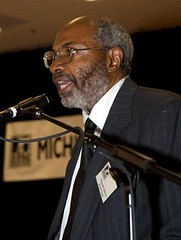
    On March 27 a community meeting was held to announce the launching of an independent investigation into the assassination of Detroit Imam Luqman Ameen Abdullah. The event was held at the Historic New Bethel Baptist Church on the city’s west side, just several blocks east of the location of the Masjid al-Haqq where Imam Abdullah served as leader for over two decades.

    Imam Abdullah was shot 20 times by FBI agents on October 28, 2009 during a series of raids carried out by a multi-jurisdictional law enforcement task force that consisted also of police from Dearborn and Detroit. The Masjid al-Haqq had been infiltrated by the FBI for over two years where informants sought unsuccessfully to encourage illegal activities among the members.

    Abdullah and several of his members were lured to a warehouse in neighboring Dearborn under the guise of assisting in the unloading of merchandise. When they arrived the FBI sent in a dog that attacked the imam who was later killed in a hail of bullets.

    The rally on March 27 was attended by several hundred local activists and religious leaders from both the Muslim and Christian communities. This event was co-sponsored by the Council on American-Islamic Relations of Michigan (CAIR) and the Detroit Coalition Against Police Brutality (DCAPB), with endorsements from the Michigan Emergency Committee Against War & Injustice (MECAWI) and the Moratorium NOW! Coalition to Stop Foreclosures, Evictions and Utility Shut-offs.

    Ron Scott, spokesperson for the DCAPB chaired the meeting and presentations were made by the Nation of Islam, Delta Sigma Theta Sorority, the Detroit Chapter of the NAACP, CAIR, Congressman John Conyers and MECAWI. Appeals were made for the defense fund to cover legal costs in the cases of 10 others members of the Masjid al-Haqq who are still facing felony charges stemming from the raids of October 28.

    Imam Dawud Walid, the executive director of CAIR in Michigan, spoke on the problems associated with having the evidence gathered by law enforcement released to the Abdullah family and the general public. The Wayne County Medical Examiner’s report on Imam Abdullah was not issued until February 1 at the request of Dearborn Police Chief Ronald Haddad.

    Imam Walid addressed the efforts to have the 75 autopsy photographs released by the medical examiner which were also held up at the behest of the Dearborn Police. A request for a review of the assassination by the Justice Department has gone unanswered by the United States Attorney General Eric Holder.

    A number of local and national organizations have demanded a Justice Department review of the actions by the FBI including the use of informants in religious organizations. Detroit Congressman John Conyers, the Chair of the House Judiciary Committee, wrote a letter in February to Eric Holder requesting such an investigation.

    Corporate Media Slander on Eve of Release of Photographs

    The much anticipated release of the autopsy and crime scene photographs took place on April 8. There were five photos made public by CAIR that illustrated the brutal nature of the assassination.

    However, just one day prior to the release of the photos, the Detroit News published a front page story that attempted to undermine the growing community support for the Masjid al-Haqq members and the family of Imam Abdullah. The article claimed that in 1980, a 22-year-old Abdullah attempted to grab the revolver of a Livonia police officer during a routine traffic stop. (Detroit News, April 7)

    This April 7 article claims that, “Christopher Thomas, who later became Imam Luqman Ameen Abdullah, struggled with the officer for control of the gun, according to a report prepared soon after the Dec. 5, 1980 arrest by Livonia Police Officer Robert Stevenson, now the city’s police chief. Only after a second officer arrived was Abdullah disarmed, reports show.”

    The article continues saying “The Livonia police reports detail the incident that led to Abdullah’s 1981 conviction for felonious assault on a police officer, for which he served 26 days in jail. They provide another view of the man some supporters have described as a peaceful observer of Islam but a criminal complaint describes as a radical separatist intent on killing police officers.”

    However, it is unlikely that an African-American youth accused and convicted of felonious assault against a suburban Detroit police officer in 1980 would have only served 26 days in jail. Atty. Nabih Ayad, a Canton Township lawyer who is representing the Abdullah family was quoted in the same article as saying that this incident, which is three decades old, has no real bearing on the death of Imam Abdullah.

    Ayad said that the incident was “extremely far-fetched and without any credibility to somehow make a relation between that incident” and what transpired on October 28 when the imam died from multiple gunshot wounds in Dearborn.

    One of the photographs released by CAIR shows the imam handcuffed, lying face down and riddled with bullets. This photograph was published by the local newspapers, however, other more graphic pictures were not printed in the corporate press.

    At a community meeting held by the Detroit Coalition Against Police Brutality on April 11 at the St. Peter’s Episcopal Church downtown, Imam Walid of CAIR presented two other photographs that show deep lacerations to the face of Abdullah from the apparent dog bites.

    The Detroit Free Press stated in an editorial on April 8 that “Efforts to manage community sentiments by withholding information always fail—and often backfire. With many lingering questions about how Abdullah died, Abdullah has become a national and even international figure—and in some circles, a martyr. Meanwhile, law enforcement agencies have lost credibility with many of the Muslim-American groups they are trying to build relationships with in the post 9/11 era.” (Detroit Free Press, April 8)

    CAIR executive director Dawud Walid was quoted in the same Free Press editorial saying “This isn’t going to go away until there are answers.” Numerous organizations have issued letters and passed resolutions decrying the assassination and demanding justice in the case.

    These groups include the NAACP, the Democratic Party 14th District Caucus, MECAWI, the Detroit Board of Police Commissioners, the Congress of Arab-American Organizations, the Michigan Coalition for Human Rights, among others.

    In an interview with the son of Imam Abdullah, Mujahid Carswell, a well-known hip-hop artist, who is also a defendant in the Detroit 10 case, told this writer that the claims made against his father in regard to the purported incident in Livonia in 1980 were unlikely. Mujahid, who is known in the recording world as “Mu”, said that the authorities are attempting to take attention away from the gross injustice done to his father, his family and his followers.

    Both Mujahid and Abdullah’s other son, Omar Regan, who is also a well-known stage and television performer in California, have expressed their appreciation for the work of MECAWI in organizing three demonstrations. The first in response to the assassination, the second during the appearance of Attorney General Holder in Detroit last November and the third after the delayed release of the autopsy report on February 1.

  • The WA gas supply war

    The Business Spectator has a look at the latest salvoes between domestic Australian natural gas users and LNG exporters in WA   – The WA gas supply war.

    Neither side will take a backward step in the battle over domestic gas supply in the Golden West.

    In one corner we have the DomGas Alliance, speaking for big consumers, complaining that Western Australia “has the most anti-competitive gas market in the country” and in the other the upstream petroleum producers arguing, in the words of a recent newspaper headline, “we can’t afford to hand the industrial giants a free ride.”

    Belinda Robinson, chief executive of the Australian Petroleum Production & Exploration Association, is hammering away at DomGas in response to the Alliance’s warning that a domestic gas shortage will last until at least 2020 – while the gas producers pursue international LNG markets – and that the prices being asked will preclude development of “a lot” of future mine projects.

    From APPEA’s perspective, the problem is that large energy-using companies receiving international market prices for their products do not want to pay global parity rates for their gas. Don’t ask our industry to subsidise the input costs of other businesses, argues Robinson.

    Tony Petersen, chairman of the DomGas Alliance, wants the WA government to “give teeth” to a policy to reserve offshore gas for domestic use, claiming a 300 per cent increase in North-West Shelf Joint Venture prices to distributor Alinta. Petersen argues that WA customers are being forced to pay premiums to producers in excess of any obtainable by the gas suppliers from overseas customers.

    Not dealing with the issue, he says, will lead to thousands of job losses among industrial users of gas because, at existing prices, major resource processing and gas-fired generation will not be sustainable.

    Robinson retorts that, if the Alliance gets its way, every WA householder and small business will bear the consequences, forecasting that gas production investment will falter, supply will shrink and prices will rise still further.

    Gas is a bigger deal in the west than it is on the eastern seaboard. It provides half of the State’s energy and fuels 60 per cent of its electricity generation. ACIL Tasman say gas prices in the State have risen four-fold in a decade and may keep rising until adequate supply becomes available.


  • UCLA police release sketch of suspect in sexual assaults

    UCLA police on Monday released a sketch of a man suspected of sexually assaulting female students in a string of attacks in recent weeks.UCLA sexual assault suspect.


    The attacker appears to wait in the path of women who are using their cellphones or are otherwise distracted and then grabs them, the UCLA Police Department said.


    Police said five assaults have occurred on or near campus between March 8 and April 6. All the victims were students.


    The suspect is described as a Latino between 5 foot 3 and 5 foot 6 and weighing between 150 and 180 pounds. He has a dark complexion, brown eyes and a pot belly, and wears hats, including baseball caps, police said. The suspect is between 40 and 60 years old.


    Authorities said that students can use the campus escort service between dusk and 1 a.m. by calling (310) 794-WALK.


    Anyone with information regarding the attacks is asked to call detectives at (310) 825-9371.

    –Robert Lopez

    Photo: Sketch of the suspect. Credit: UCLA Police Department.

  • Acting President Jonathan Meets Obama to Discuss Oil and Security

    Acting President Jonathan Meets Obama to Discuss Oil and Security

    By Abayomi Azikiwe
    Editor, Pan-African News Wire
    News Analysis

    Acting Nigerian President Goodluck Jonathan met with President Barack Obama on April 11 at the White House as a prelude to the Nuclear Security Summit held in Washington, D.C. Jonathan was appointed by the Nigerian Senate to take over in the absence of President Umaru Yar’Adua, who has been seriously ill for several months.

    The new head of state’s visit comes amid a pivotal point in the country’s history and its relations with the United States. Nigeria still claims to be the leading exporter of crude oil to the U.S. from the African continent, although reports last year indicated that the Southern African nation of Angola had surpassed the West African state in total barrels traded.

    ThisDay newspaper published in Nigeria said that the discussions between Jonathan and Obama centered around efforts to stabilize the political situation in the oil producing region of the Niger Delta and the legislative plans underway to restructure the oil industry inside the country. (ThisDay, April 12)

    ThisDay newspaper noted that “The US is Nigeria’s biggest customer in the international crude oil market and much of its energy security is directly affected by militant activities in the Niger Delta.” In regard to the plans to reshape the oil industry the same article continues that “Multinational oil companies have expressed worries over the revised fiscal regimes which they claim are unfavorable to their operations.”

    The debate surrounding the Petroleum Industry Bill (PIB) has been described as the most extensive overhaul of the petroleum sector since national independence from Britain in 1960. Nigeria’s oil industry has been dominated since 1956 by British, U.S. and European firms who contribute virtually nothing to the development of the country.

    In a April 7 Financial Times article it states that in this debate over the future of oil in Nigeria, Africa’s most populous state, the character of relations with the U.S. will be determined. “The Financial Times says that “At stake are tens of billions of dollars of potential investments, and reforms that could breathe new life into an industry that provides 80 percent of the government’s income and one in eight barrels of crude that the US imports.” (Financial Times, April 7)

    After the ascendancy of Acting President Jonathan, a new cabinet was appointed where some of the ministers under Yar’Adua were reappointed to different portfolios. Diezani Allison-Madueke was reshuffled to the oil ministry where she will be responsible for handling the PIB.

    The Financial Times quotes Osten Olorunsola, Shell’s regional vice-president for gas, in the same above-mentioned article saying that “The PIB is definitely unlikely to pass [through the national assembly] in its current form before the elections (2011). Not passing anything would magnify the overall level of uncertainty.”

    Oil minister Allison-Madueke is a former employee of Royal Dutch Shell where she spent 14 years and rose to become its director of external relations. The Financial Times says that “Some industry groups are said to have lobbied for her appointment, reasoning that her background would make her sympathetic to oil companies’ claims that the bill’s tougher terms would jeopardize $50bn of planned investment.”

    Prior to the visit of Jonathan to the U.S., the two countries signed a Bi-national Commission Agreement, the first of its kind with Africa under the Obama administration. The two states have extensive economic relations in the oil industry.

    In a French Press Agency report it states that “The State Department said bilateral US-Nigerian trade was valued at more than $42 billion dollars in 2008. Nigeria is the United States’largest trading partner in sub-Saharan Africa, thanks in large part to its petroleum industry.

    “Nigerian oil comprises eight percent of US imports, while about half of the oil produced in Nigeria goes to the United States. The United States also is the largest foreign investor in Nigeria, including in the offshore oil and gas industries by Exxon-Mobil and Chevron.” (AFP, April 5)

    Nigeria and U.S. Security Concerns

    Another major item on the agenda during the meeting between Obama and Jonathan was the question of the U.S.’s so-called war on terrorism. Nigeria has been targeted recently because of an incident involving a 23-year-old passenger aboard an airline flight traveling from Amsterdam to Detroit on December 25.

    Umar Farouk Abdulmuttalab was arrested aboard the flight and charged with attempting to ignite explosives on his person. The corporate media reported that Abdulmuttalab had links with al-Qaeda and had traveled to Yemen for meetings and training in explosives.

    Yet Abdulmuttalab’s father had warned the U.S. embassy in Nigeria in regard to concerns involving his son’s behavior. Nonetheless, the former Nigerian student who studied in England, did not have his multiple-entry visa revoked.

    Umaru Abdul-Muttalab, the father of Umar Farouk, is a well-known banker and former high-ranking Nigerian governmental official. According to Nigeria ThisDay, Jonathan met with Umaru Abdul-Muttalab prior to his departure for the United States.

    “Muttalab was believed to have discussed his earlier trip to the U.S. with Jonathan. During that trip, he met with American security officials regarding his son’s failed terror attack and for which the young man is being prosecuted.” (ThisDay, April 9)

    In response to the December 25 incident in Detroit, Nigeria along with numerous other states around the world were targeted by the U.S. for special scrutiny at airports inside the country and those bound for it. There has been strong objections against the listing of Nigerians as possible security threats to the U.S.

    Behind the Nuclear Security Summit

    The meeting held by the Obama administration and representatives of 47 nations is taking place in the aftermath of the signing of a new agreement with Russia. During the signing, Obama made special mention of both Iran and the Democratic People’s Republic of Korea as states posing possible threats to international security resulting from their nuclear programs.

    Iran has maintained that its nuclear programs are strictly for civilian purposes. The DPRK is reported to have developed a limited nuclear weapons capability and has also tested missiles that have drawn protest from the United States and the United Nations Security Council.

    However, the State of Israel, which has been reported to possess nuclear weapons capability, has not been questioned or pressured by the U.S. and other imperialist states about its military intentions. The Prime Minister of Israel Benjamin Netanyahu announced that he would not attend the Nuclear Security Summit due to the intentions of Egypt and Turkey to question the Zionist state over its reported possession of a nuclear arsenal.

    The summit represents another effort on the part of the United States to dictate the terms of nuclear weapons capability. Those states that are allied with the U.S., such as Pakistan and India, are allowed to possess nuclear weapons, whereas nations that take a political line independent of imperialism, are threatened with sanctions and military actions.

  • Around the world in a giant bio-diesel fueled RV

    ecoroamer_1

    Eco Factor: Low-emission RV powered by bio-diesel.

    Designed by Jay Shaprio, the EcoRoamer is one big machine that will be used to go around the world without polluting the ecosystem much. The gigantic RV will be a mobile home for Shaprio, his wife, their two kids and two cats as the family treks from Alaska to the southernmost tip of South America before hopping a boat to Africa. Once there, they’ll cross the Strait of Gibraltar into Europe before crossing Russia and Asia.

    (more…)

  • Something New under the Sun in Oddities of Science (Feb, 1934)

    Something New under the Sun in Oddities of Science

    by Nick Sprank

    On the surface many odd facts that seem to defy natural law are easily understandable when the physical conditions back of the phenomena are known. Here are two pages illustrating facts that appear fallacious at a casual glance, but which are quite natural when all conditions surrounding them are considered. Remember Nic Sprank pays One Dollar for all scientific oddities acceptable to Modern Mechanix editors. What have you to offer for Nic Sprank’s pages of oddities?

    These strange (acts of science may bring to mind some of the things which on every hand refute some of the accepted notions about nature. ONE DOLLAR will be paid you by Nic Sprank for every Oddity he considers good enough for these pages. Try your luck! Send in something new—don’t re-hash the obvious, and your chances of getting a dollar bill are as good as the next man’s. Address Nic Sprank, care Modern Mechanix, 529 South 7th Street, Minneapolis, Minn.


  • Everybody a Builder! (Jan, 1929)

    Everybody a Builder!

    ONE OF THE fundamental urges in the soul of every man is the urge for self expression.

    In some men it is music which touches a responsive chord, and these men find satisfaction in playing a musical instrument. In others, sports afford an outlet for self expression. Still others turn to mechanics and science as a means for satisfying the urge to create.

    In this latter group of creative men are scientists, mechanics, machinists, and mechanically minded men and boys of all ages. It is a noticeable fact that in men with mechanical trends of mind creative ability exists to a marked degree.

    Men who possess this faculty of being able to turn the “stuff that dreams are made of” into tangible realities are the men who will be the leaders of the nation tomorrow. History is replete with instances of young men, who, puttering in an attic, discovered a mechanical means for making life easier for untold millions.

    Take the classical case of Thomas Edison, whose name is a synonym for invention. When a youth, working on railroad trains, Edison became engrossed with the mysteries of electricity. He rigged up a workshop and by training his mind in the study of electricity, found that in later years he had stored up a wealth of data on experimenting which enabled him to put his finger on exactly the hook-ups he needed to prove the theories his shop-trained mind had evolved. As a result of his experimenting and building, think of the untold millions of human beings who are able to enjoy operatic music because of the phonograph! Think of the benefit mankind has received because of the fireless instantaneous light shed by Dame Mazda! Behind these achievements is the training of mind and hand which was given Edison by his early workshop “puttering.”

    Napoleon was considered queer in his cadet days because he preferred to play with toy soldiers, marshalling them in different formations to work out theories in military tactics. Ostracized, believed even to be feeble-minded by his military school confreres, he was in later years able to so effectively place a single gun at the mouth of a besieged harbor that he kept the entire British Navy at bay. This stratagem baffled and chagrined Lord Nelson to his dying day, and restored French confidence in Napoleon’s brilliance at a crucial time. Behind this incident was the training given Napoleon by his “puttering” of early years.

    It is the aim of the Editors to present the kind of amateur building projects which not only delight the spirit of play which is in every mother’s son of us, but which are at the same time mature enough projects to teach us things which will mold our abilities to analyze, to plan, and to execute.

    Get a workshop! Build that idea for a motor you’ve had in mind! The dividends resulting from self expression in the building of things mechanical are incalculable! You will find you are a part of a vast army of “putterers,” the excellence of whose output is astonishing; an army which will graduate men from the school of hard knocks who will tomorrow be reaping the rewards that come to men who guide the destinies of the nation!

    Everybody a Builder!


  • Surgilance One-Step Safety Lancets


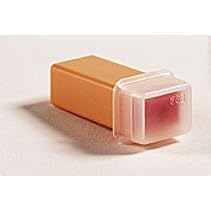
    Blue, 2.3mm depth [Additional Info]: Surgilance One-Step Lancets Combine Safety and Simplicity. These one-step blood sampling lancets offer safety for the clinician and greater comfort for the patient.

    View Surgilance One-Step Safety Lancets details

  • LG Android phone appears in Verizon’s system

    We don’t know what to call it yet, but LG could finally offer an Android phone in the United States thanks to Verizon. Phone Arena has spotted a device in Verizon’s system labeled the LG VS740 and it is a Google-powered phone.

    A lot of codenames and model numbers have been tossed around, but the LG VS740 could be the Snapdragon slider we saw earlier this month. Phone Arena claims the Wi-Fi certificate of the VS740 matches that of the LG Aloha (LG C710) and they believe it is also the same device as the LG Eclipse (LU2300) which is headed for Korea.

    The LG VS740 has already been spied on the FCC’s site and the LG Eclipse was expected to hit Korea in May. If these devices turn out to be the same, the U.S.  could finally see a 1 GHz Android phone with full QWERTY keyboard this summer.

    Any takers?

    Will we finally get a Snapdragon slider?

    Related Posts