Blog

  • The Twitter Ad Model Revealed (What Were You Expecting, a Pony?)

    If you don’t care about Twitter news, you may as well rejoin us next week. Over next few days Twitter is going to dominate the airwaves. And it starts tonight. In advance of his keynote at the Ad Age conference on Tuesday (not to mention Twitter’s own Chirp conference on Wednesday), COO Dick Costolo shared details of the company’s highly anticipated new ad platform, Promoted Tweets, with a couple of news outlets.

    In the most basic implementation, advertisers will be able to bid on keywords to have their tweets featured in search results. But Twitter says also may eventually include the paid tweets in users’ regular tweet streams too, something that will surely be more controversial. Costolo said the company expects to decide whether to take that step before the end of the year. Here are some of the promoted tweets implementation details, per stories in Ad Age and the New York Times

    • Promoted tweets show up based on how large a CPM an advertiser pays.
    • Twitter is developing a “resonance” metric (which is apparently not done yet which makes you wonder what have they been doing these last few months!) that would also take into account how well a tweet fosters engagement and click-throughs.
    • Twitter is limiting advertising to only one sponsored tweet per page.
    • After the promoted tweets launch on its site Twitter plans to start syndicating them to Twitter clients.
    • Launch advertisers include previously tweeting companies Best Buy, Virgin America, Starbucks and Bravo.
    • The actual promoted tweets will disclose that they are ads, and will turn yellow when moused over. But they won’t be separated out on the margins from the other tweets.
    • Twitter is considering using targeting factors like subject matter, followers’ interests, and geographic locations to target ads in users’ streams, if they do launch.

     Costolo told Ad Age that search volume on Twitter is “huge” but wouldn’t give actual numbers. Promoted Tweets is quite similar to TweetUp, the tweet marketplace launched by Bill Gross on Monday. It is going to be hard for TweetUp to spin this development into a good thing. It also follows other recent moves by Twitter to compete with developers using its platform, for instance buying the maker of Tweetie last week.

    Related content from GigaOM Pro (sub req’d):

    Social Advertising Models Go Back to the Future

  • Mitsubishi announces 2010 line-up of 3D DLP TVs with screen sizes up to 82-inches

    Mitsubishi's 2010 line up of 3D DLP Home Cinema TVs available in sizes ranging from 60 to ...

    3D TVs using LCD or plasma technology might have collected the lion’s share of press this year, but for those looking for some 3D goodness on an even larger scale Mitsubishi Digital Electronics America (MDEA) has announced its 2010 line up of 3D DLP Home Cinema TVs available in sizes up to a whopping 82-inches. The large screen TVs utilize the same core Digital Light Processing (DLP) technology used in 3D movie theaters which MDEA says is up to 1,000 times faster than LCD technology, providing for a more realistic, sharper 2D and 3D viewing experience…
    Continue Reading Mitsubishi announces 2010 line-up of 3D DLP TVs with screen sizes up to 82-inches

    Tags: ,

    Related Articles:


  • Somalia Fighting Leaves 19 Dead

    Somalia fighting leaves 19 dead

    At least 19 people, many of them civilians, have been killed in an outburst of fighting in the divided Somali capital Mogadishu.

    Thirteen people died when African Union peacekeepers and government forces hit back after a militant attack on a military ceremony.

    Reports say the AU forces used heavy artillery in densely populated areas in what was the worst shelling in months.

    Another six people were killed by roadside bombs near Mogadishu airport.

    “It was indiscriminate shelling,” Ali Muse, head of Mogadishu’s ambulance services, told AFP news agency.

    “Our teams collected the bodies of 16 civilians, while 55 others were injured in the shelling. Several children are among the dead.”

    The shelling started in the afternoon when Islamist fighters fired mortars at the presidential palace and airport during a ceremony commemorating the 50th anniversary of the country’s national army.

    Government troops backed by the AU reportedly responded with heavy artillery fire.

    At the airport, a blast hit a military vehicle, killing two soldiers, said eyewitness Haji Dahir Igale.

    “Afterward local residents and some other government officials rushed to the scene to help the injured and as they gathered the second explosion went off, killing four civilians.”

    Somalia has not had a functioning government in decades and the Islamist rebels control large parts of its territory.

    Story from BBC NEWS:
    http://news.bbc.co.uk/go/pr/fr/-/2/hi/africa/8616861.stm
    Published: 2010/04/13 03:16:32 GMT

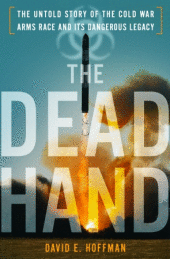
  • The Dead Hand

    Wow. David Hoffman’s The Dead Hand: The Untold Story of the Cold War Arms Race and Its Dangerous Legacy has won the 2010 Pulitzer Prize in the category of general nonfiction. To win in that catch-all category, it had to beat out works on such modest and inconsequential themes as the origins of financial catastrophe and the history of belief in the Almighty.

    (John Lennon, wherever you are, eat your heart out.)

    We’re actually living through the Golden Age of well-researched and highly readable nuclear- or WMD-themed books. Bob Drogin’s Curveball: Spies, Lies and the Con Man Who Caused a War, Michael Dobbs’s One Minute to Midnight: Kennedy, Khrushchev, and Castro on the Brink of Nuclear War, and Mike Chinoy’s Meltdown: The Inside Story of the North Korean Nuclear Crisis all rate a mention. I’m particularly fond of Curveball and The Dead Hand, but they should all be on your shelf.

    (Here’s where I confess that I simply haven’t gotten to Richard Rhodes’s Arsenals of Folly yet. It’s on the list, OK?)

    Between these guys and Hoffman, you’ll notice there are three (ex-)newspapermen with some time on their hands, so yes, there is a silver lining to the harrowing of the papers at the hands of the Internet. But never mind. Hoffman, for one, is on a roll these days, producing an outpouring of articles at foreignpolicy.com that frame current events through little-known episodes from the Cold War and its aftermath — testimony to the sort of intellectual capital one builds up by spending years researching a book. Here’s his latest, on the significance of the fissile material cleanout plan. This past Sunday, too, he had an op-ed in the Post on counterforce and overkill, plus a news story about the recent removal of HEU from Chile. The guy keeps busy.

    Congratulations, David!

  • Another Infinty Ward programmer leaves

    The mass exodus continues. Yet another member of the Infinity Ward dev team has thrown in the towel and has bid the company goodbye amidst the ongoing controversy with Activision.


  • Top 10 YouTube Videos About Facebook

    youtube_logo.jpgFacebook runs a website that gets a quarter of a trillion page views per month. The culture around Facebook has led to many popular videos. Some of the most viewed videos about Facebook are simply music videos and many of those didn’t make our list.

    While we did consider the number of views in our selection, we primarily focused on videos that illustrate all the ways Facebook has changed our lives. From Farmville, to warnings about losing privacy to what people don’t like about Facebook, this list of videos shows society’s reaction to Facebook’s sudden rise in popularity. Also included are two 60 Minutes interviews with Facebook founder Mark Zuckerberg. They’re from 2008, back when Facebook only had 10% of the users they have today.

    Sponsor

    1. Facebook Anthem

    2. 5,214,732 views

    3. Facebook Song

    4. 4,540,600 views

    5. FaceBook In Reality – idiotsofants.com

    6. 2,968,410 views

    7. JULIAN SMITH – 25 Things I Hate About Facebook

    8. 1,605,944 views

    9. FARMVILLE Commercial!! (Facebook Parody #1)

    10. 1,585,745 views

    11. What Facebook Is For

    12. 1,021,595 views

    13. The Truth about Facebook!

    14. 652,634 views

    15. Man in the Box – Facebook Abuse

    16. 564,245 views

    17. Facebook on 60 Minutes 01-13-08 (Part 1)

    18. 521,585 views

    19. Facebook on 60 Minutes 01-13-08 (Part 2)

    20. 211,273 views

    Discuss


  • The Green Pod – ideal parking for your bike?

    The Penny Farthing Green Pod

    There’s probably a lot of people out there who would ride their bike to work, but… there’s nowhere to park it outside, they’re not allowed to bring it inside, their workplace doesn’t have a shower, and/or there’s nowhere to leave their riding clothes during the day. Any of that sound familiar? Penny Farthing, an Australian company that specializes in bicycle parking solutions, is attempting to address all of those problems with something they call the Green Pod…
    Continue Reading The Green Pod – ideal parking for your bike?

    Tags: ,
    ,

    Related Articles:


  • Sudan Extends National Elections for Two Days

    Sudan extends voting for two days after delays

    KHARTOUM, SUDAN Apr 12 2010 17:49

    Sudan’s elections commission on Monday announced a two-day extension to voting until April 16, after many voters experienced delays across Africa’s largest country in the first open elections in 24 years.

    “There is a two-day extension throughout the whole country,” Sudan’s National Elections Commission secretary general Jalal Mohamed Ahmed told Reuters.

    “It is to give more time to the voters,” he added.

    South Sudan’s main party on Sunday asked for a four-day extension in the south, where a mostly illiterate population was grappling with 12 ballot papers and where decades of civil war had devastated infrastructure.

    The complex presidential, legislative and gubernatorial polls, which began on Sunday, are aimed at transforming Sudan from a nation emerging from decades of multiple civil wars to a democracy.

    After a boycott by the main opposition in the north, the vote now looks likely to confirm the 21-year rule of President Omar al-Bashir — the only sitting head of state wanted for war crimes by the International Criminal Court, which alleges he was behind mass murder and rape in Darfur.

    Across the country — even in the capital, Khartoum — voting materials were not delivered to stations, the wrong ballots arrived at many centres and opposition and independent candidates said their names or symbols were either missing or incorrect.

    Many had complained and asked for an extension to the voting to compensate for the delays and resolve the problems. — Reuters

    Source: Mail & Guardian Online
    Web Address: http://www.mg.co.za/article/2010-04-12-sudan-extends-voting-for-two-days-after-delays

  • Even More on Legal Action Against the Pope: It Looks Like It Will Happen

    by Julian Ku

    Another day, another chance for folks in the UK to make threats about bringing legal action against the Pope during his upcoming September visit to the UK.  The latest attack comes from noted atheists Richard Dawkins and Christopher Hitchens. It looks like the focus will be on breaking down the Pope’s head-of-state immunity defense, rather than trying to fit the sex abuse into the category of crimes against humanity. I think even this argument is very shaky, and wouldn’t fly in the U.S. because courts would give absolute deference to the executive branch’s decision to recognize the Vatican as a state, and the Pope as the head of state. But these UK lawyers are serious, they have real money behind them, so legal action will likely happen. Will the Pope take the chance and visit anyway?

    Richard Dawkins and Christopher Hitchens are paying lawyers to investigate whether Pope Benedict XVI should be arrested when he visits Britain in September.

    Mr Dawkins and Mr Hitchens believe the Pope should face charges for the alleged cover-up of sex abuse in the Catholic Church, The Guardian reports.

    Mark Stephens, a lawyer for Mr Dawkins and Mr Hitchens, says only those with UN protection are safe.

    “The Vatican is not recognised as a state in international law. People assume that it has existed for time immemorial but it was a construct of [Italian wartime leader Benito] Mussolini and, when the Vatican first applied to become a member of the UN, the US said no,” Mr Stephens told The Guardian.

    “[Fellow lawyer Geoffrey Robertson] and I have both come to the view that the Vatican is not actually a state in international law. It is not recognised by the UN, it does not have borders that are policed and its relations are not of a full diplomatic nature.”

  • Memristor breakthrough could enable computers that work like human brains

    An image of a circuit with 17 memristors, each composed of two layers of titanium dioxide ...

    The team at HP Labs responsible for building the world’s first memristor in 2008 have discovered their creation has more capabilities than was previously thought. In addition to retaining a history of the information it has acquired making it useful for memory storage devices, the team has found it can perform logic, that could change the way computer systems are designed and enable faster more efficient computers “that would compute like human brains.”..
    Continue Reading Memristor breakthrough could enable computers that work like human brains

    Tags: ,
    ,

    Related Articles:


  • SpaceClaim Captures $5 Million Series D Funding to “Democratize” 3D Modeling

    SpaceClaim Logo
    Wade Roush wrote:

    Concord, MA-based SpaceClaim has raised an additional $5 million in Series D funding, bringing its total venture pot to just over $30 million, president and CEO Chris Randles told Xconomy yesterday. The four-year-old startup sells 3D modeling software for non-engineers, and has been enjoying explosive growth over the past year, according to Randles.

    The funds came from SpaceClaim’s existing coterie of investors, with North Bridge Venture Partners and Kodiak Ventures in the lead and Borealis Ventures and Needham Capital Partners also on board. Randles says SpaceClaim, which experienced a 2.5-fold increase in sales in 2009 and even faster growth in the first quarter of 2010, has moved solidly beyond the R&D phase and needed the new funds to invest in sales and marketing support. “Our big investment is in customer-facing technical staff who can help existing and prospective customers solve problems, as well as sales staff,” says Randles.

    SpaceClaim is part of a major cluster of engineering software companies with headquarters or major outposts in New England, from established giants such as Autodesk, Dassault Systèmes (which owns Concord-based SolidWorks), and PTC, better known as Parametric Technology Corporation. In fact, both Randles and SpaceClaim co-founder Daniel Dean spent time at PTC. “It’s an overlooked asset in this area,” says Randles.

    PTC largely invented parametric modeling, the dominant paradigm in 3D mechanical design, in the mid-1980s. To hear Randles tell it, there hasn’t been any fundamental innovation in the computer-aided design (CAD) field since then, though he says SolidWorks and other companies have improved on the idea. SpaceClaim’s innovation, which the company calls “direct modeling,” is to give engineers simple tools that allow them to experiment with design concepts by moving, stretching, combining, and re-using shapes onscreen.

    “People who use CAD tend to be people who are specialists in CAD—if you want a parallel, think of the database specialists before the days of Microsoft Access,” says Randles. “We are democratizing 3D by bringing powerful but very easy-to-use 3D modeling tools to engineers who have never really used CAD.”

    Randles says SpaceClaim’s business is split roughly equally between the Americas, Asia, and Europe. Automotive manufacturers and suppliers were the biggest customers in 2009, followed by aerospace and defense, consumer goods, and medical device companies.

    SpaceClaim’s software is in demand because it helps companies’ product designers experiment with new designs without having to involve CAD specialists at every step. “3D modeling technology is changing working practices and moving things to market quicker,” Randles says. “In an odd way the global recession has also helped us—it’s made companies come to terms with some of their inefficiencies. When things are good, you tend to put off radical rethinking or reengineering.”

    UNDERWRITERS AND PARTNERS


  • ANC, COSATU Resume Talks in South Africa

    ANC, Cosatu resume talks

    JOHANNESBURG, SOUTH AFRICA Apr 12 2010 14:54

    The African National Congress (ANC) and its alliance partner, the Congress of South African Trade Unions (Cosatu), resumed bilateral talks on Monday after they were put on hold last week.

    ANC spokesperson Ishmael Mnisi said talks were suspended on Friday after both organisations agreed to do so.

    He denied reports that some top ANC members had snubbed the meeting — with Cosatu sending a delegation of about 30 members and the ANC represented by only five, including secretary general Gwede Mantashe.

    The Sunday Independent reported that Cosatu was upset by this because it felt it was not being taken seriously.

    “There is no such thing,” Mnisi said. “The ANC always wanted to meet with Cosatu … to discuss relations and pursue the programme of action outlined by our election manifesto.”

    The ANC leadership called for an end to public spats in the alliance with the trade union federation and the South African Communist Party after verbal sparring between Cosatu secretary general Zwelinzima Vavi and the ANC.

    ‘Crass materialism’

    Last month Vavi cautioned there were plans to oust ANC president Jacob Zuma and Mantashe before their terms ended in 2012. He sounded a warning over what he termed “crass materialism” and “tender entrepreneurs”, which endangered the ruling party.

    He repeated calls for lifestyle audits of public figures, including politicians not in government. This irked the ANC, which felt its members should not be targeted.

    Vavi charged that materialists and tender entrepreneurs were behind a “small right-wing tendency” in the ANC which, although not supported by most of its leaders, appeared to be silencing them.

    It had been reported that ANC Youth League president Julius Malema held directorships in companies that had benefited from state tenders.

    Cosatu was also frustrated at Zuma’s State of the Nation address, Finance Minister Pravin Gordhan’s budget speech and the approval of Eskom tariff increases.

    The ANC in turn accused Vavi of “grandstanding” and said it felt Cosatu was “veering toward oppositional politics”.

    The ANC’s leadership then met and called for an end to public disputes, the trading of insults and personal attacks.

    An alliance summit scheduled to take place at the beginning of April was postponed for the bilateral talks between the ANC and Cosatu. — Sapa

    Source: Mail & Guardian Online
    Web Address: http://www.mg.co.za/article/2010-04-12-anc-cosatu-resume-talks

  • Ninja Theory working on new Devil May Cry?

    News has it that Ninja Theory is working on a secret game. Could it be the next Devil May Cry iteration? According to Game Informer, yes, that would be it.


  • Dev variant Kin has a cooler color scheme


    I just popped into a local pub and ran smack into into a variant of the just-announced (but long-rumored) Kin 2 being tested by a Microsoft associate of mine. It’s not really major news, but I have to say that I think it looks a lot better with this red-and-white keyboard — it helps set it apart from all the other sliders out there. I don’t know, maybe it attracts dirt or something, so they went all-black.

    Although I grilled the man, he had nothing to add RE secret specs and unannounced features. Curse you, Microsoft, and your corporate compartmentalization!


  • Soaking Grains, Beans and Legumes: Top 5 Reader Questions Answered

    soaked lentils

    Grains, beans, legumes, nuts and seeds can all add great value and variety to the diet, yet they contain antinutrients – particularly phytates and enzyme inhibitors – which detract from their nutritive value.  Traditionally, these foods were prepared in a manner to maximize nutrient density by mitigating the effects of these antinutrients.  Soaking these foods overnight seems to be an effective, traditional method of enhancing the nutrient profile of these foods, and it is one method consistently used among peoples who adhered to time-honored, traditional methods of preparing native, unprocessed foods.

    Focusing exclusively on traditional foods, all of the recipes featuring grains, beans and legumes at Nourished Kitchen call for either souring, soaking or sprouting. A few recipes consistently pop up.  How do you effectively soak grains, beans and legumes?  Do you need to soak almond flour? How do you find time to soak grains? Does phytic acid fight cancer?  Do you need to rinse your grains after soaking?

    1. How do I effectively soak grains, beans and legumes?

    Grains, beans and legumes contain phytic acid – an antinutrient which binds up minerals preventing your body from fully absorbing them. Phytic acid can be effectively mitigate through three different traditional processes: 1) sprouting, 2) soaking and 3) souring.  To effectively soak grains, beans and legumes you need four components: 1) liquid, 2) acidity, 3) warmth and 4) time.  Each different grain, legume and bean contains a different level of phytic acid, and also a different level of phytase (an enzyme that neutralizes phytic acid), for this reason they all require different amounts of soaking time; however, I don’t believe that cooking ought to be scientific or painstakingly methodical and, instead, believe that simple methods should suffice in most kitchens and for most people.(…)
    Click here to read the rest of Soaking Grains, Beans and Legumes: Top 5 Reader Questions Answered (819 words)


    Wondering where your full feed went? Click here to learn why The Nourished Kitchenmoved to summary feeds. Don’t forget to find Nourished Kitchen on Facebook, Twitter, Flickr and
    © Jenny for The Nourished Kitchen, 2010. |
    Permalink |

    Post tags:

  • USDA Solicitations – April 2010

    usdaUSDA Announces Funding to Enhance Market-based Approaches to Conservation: Conservation Innovation Grants Pre-proposals Due April 26, 2010

    (USDA, April 7, 2010) The U.S. Department of Agriculture today announced the availability of approximately $25 million in fiscal year 2010 to fund projects designed to stimulate the development and adoption of innovative conservation approaches and technologies through its Conservation Innovation Grants (CIG) in fiscal year 2010.  “USDA’s investment in these grants will advance our goal of producing long-term dividends in environmental enhancement and protection,” Agriculture Secretary Tom Vilsack said. “The grants will assist producers in using market-based approaches to conservation and innovative technologies that can put conservation on the land.”

    USDA will use these competitive grants to seek creative solutions to assist producers with emerging and traditional agricultural and natural resource issues. In addition to market-based approaches to conservation, emerging issues include energy conservation, specialty crops, and new methods of tackling climate change. The grants also will fund solutions to improve water, soil and air quality, improve nutrient management, and enhance wildlife habitat and pollinator populations. The USDA Natural Resources Conservation Service (NRCS) administers CIG.

    CIG, a component of NRCS’s Environmental Quality Incentives Program (EQIP), provides competitive grants to federally-recognized Indian tribes, state and local units of governments, non-governmental organizations and individuals. CIG funds one-to-three year projects that targets innovative on-the-ground conservation, including pilot projects and field demonstrations. The maximum federal contribution for each project is $1 million.

    The $25 million in CIG funding will be divided into three categories:

    National – Approximately $15 million will be available for proposals that address specific CIG resource concerns nationwide such as energy conservation and climate change.

    Mississippi River Basin – About $5 million will be used to address resource concerns in the Mississippi River Basin. This funding will help USDA further advance its recently announced Mississippi River Basin Healthy Watersheds Initiative for 12 Midwest and Southern states.

    Chesapeake Bay Watershed – Up to $5 million will be available for proposals that address natural resource concerns in the 64,000 square-mile watershed, which includes Maryland, Virginia, Delaware, Pennsylvania, West Virginia, New York and the District of Columbia.

    USDA encourages beginning farmers and ranchers, limited resource farmers or ranchers, Indian tribes or community-based organizations that service these groups to apply for grants. Ten percent of the total funding is being set aside for this purpose.

    USDA will use a two-phased approach to award CIGs this fiscal year. Applicants must submit pre-proposals to NRCS’s National Headquarters in Washington, D.C. by close of business on Monday, April 26, 2010. Applications will be accepted from the 50 states, Caribbean Area (Puerto Rico and the Virgin Islands) and the Pacific Islands Area (Guam, American Samoa and the Commonwealth of the Northern Mariana Islands). Full applications for selected pre-proposals must be submitted by June 4, 2010. All CIG projects must include agricultural producers who meet EQIP eligibility requirements. For more information about the EQIP eligibility requirements, please visit www.nrcs.usda.gov/programs/eqip.

    Information about the CIG Announcement of Program Funding can be found at www.grants.gov where applicants can apply electronically, and at the CIG Web page at www.nrcs.usda.gov/technical/cig/index.html.

    Solicitation Posting

    ————————————————————————————–

    Renewable Resources Extension Act – National Focus Fund Projects – NIFA announces the availability of grant funds and requests applications for the Renewable Resources Extension Act-National Focus Fund Projects for fiscal year (FY) 2010 to provide for expanded and comprehensive extension programs for forest and rangeland renewable resources at a national, regional, or multi-institutional level.  The purpose of the grant program for FY 2010 is to provide funds for pilot projects that: (1) Address emerging forest and rangeland resource issues, (2) Have national or regional relevancy, and (3) Develop new and innovative projects that can be replicated at other institutions.  The goal of the Pilot Projects for Emergent Issues is to enhance the sustainability of the nation’s forest and rangeland resources and to enable landowners and managers to achieve their desired goals and objectives. These projects must provide opportunities for the Cooperative Extension System to maximize its impact and demonstrate capacity and relevance by either indirectly or directly working across state boundaries to bring expertise to bear on common problems.  Applications are being solicited for the RREA-NFF under the following areas: 1) Forest Continuity and 2) Rangelands, Drought and Climate Change.  Total Funding: $275K.  Eligibility: 1862 and 1890 Land Grant Institutions.  Application Due Date: June 8, 2010.

    Posted Date: April 8, 2010

    Funding Opportunity Number: USDA-NIFA-OP-003116

  • NSF Solicitations – April 2010

    nsf11Opportunities for Promoting Understanding through Synthesis  (OPUS) – All four clusters within the Division of Environmental Biology (Population and Community Ecology, Ecosystem Science, Evolutionary Processes and Systematic Biology and Biodiversity Inventories) encourage the submission of proposals aimed at synthesizing a body of related research projects conducted by a single individual or a group of investigators over an extended period. OPUS proposals will often be appropriately submitted in mid-to-late career, but will also be appropriate early enough in a career to produce unique, integrated insight useful both to the scientific community and to the development of the investigator’s future work. In cases where multiple scientists have worked collaboratively, an OPUS award will provide support for collaboration on a synthesis. Full Proposal Deadline Date:  July 7, 2010, July 7, Annually Thereafter; January 7, 2011, January 7, Annually Thereafter.

    Posted Date: April 12, 2010

    Solicitation Number: 10-557

    ————————————————————————————–

    Dear Colleague Letter: Supplemental Opportunity for Translational Research in the Academic Community (TRAC) – The goal of fundamental research in science and engineering is the discovery of new knowledge.  At the same time, there is an expectation that some of these discoveries will lay the foundation for new innovations that may eventually be used to develop new products and processes.  However, for a discovery to be successfully translated into a new product or process and attract the sponsorship of or additional support from the commercial/government practitioner communities, the champions of the technology must be able to identify and communicate a development plan linking the concepts at the fundamental level with feasible application scenarios.  Often this means additional research in the form of prototyping, proof of concept tests and/or scale-up or implementation.   To facilitate this objective, the TRAC program provides targeted resources to researchers aimed at translating fundamental research into commercial applications.  Existing NSF GOALI grantees whose research results have commercial potential can compete for support to help position their technology for translation. Funds will be provided for product or process definition, design, and testing.

    Posted Date: April 8, 2010

    Funding Opportunity Number: PD-10-044

    ————————————————————————————–

    Math and Science Partnership (MSP) – The MSP program is a major research and development effort that supports innovative partnerships to improve K-12 student achievement in mathematics and science. MSP projects are expected to raise the achievement levels of all students and significantly reduce achievement gaps in the mathematics and science performance of diverse student populations. In order to improve the mathematics and science achievement of the Nation’s students, MSP projects contribute to what is known in mathematics and science education and serve as models that have a sufficiently strong evidence/research base to improve the mathematics and science education outcomes for all students. NSF’s MSP program coordinates its effort with programs of the U.S. Department of Education in the expectation that effective innovations in mathematics and science education will be disseminated into wider practice.  Through this solicitation, NSF seeks to support five types of awards: 1) Targeted Partnerships; 2) Institute Partnerships; 3) MSP-Start Partnerships; 4) Phase II Partnerships; 5) Research, Evaluation and Technical Assistance (RETA) Projects.  Total Funding: $42M.  Eligibility: Universities, Colleges, Non-Profit.  Full Proposal Deadline: July 8, 2010 (Institute Partnerships, MSP-Start Partnerships, Phase II Partnerships, RETA Projects); October 14, 2010 (Targeted Partnerships).

    Posted Date: April 8, 2010

    Funding Opportunity Number: NSF 10-556

    ————————————————————————————–

    Macrosystems Biology: Research on Biological Systems at Regional to Continental Scales – The NSF invites proposals from interdisciplinary teams of scientists to conduct innovative, integrated, systems-oriented “macrosystems biology” research to detect, understand and forecast the consequences of climate and land use change and invasive species on the biosphere at regional to continental scales. Proposals should address the scales where the ecological research challenges are the greatest and where research has the greatest potential to transform the field of ecology by addressing scaling issues that have long hindered development of large-scale ecology. Projects should strive to provide a mechanistic understanding of how multiple scale dynamics contribute to the structure, functioning, and change of the biosphere, and lead to the development of a more predictive understanding of ecological change. Proposals should be well grounded in theory, include novel approaches that will result in a theoretical framework for a predictive understanding of macroscale biology, and shows great promise for enhancing basic theoretical understandings.  Total Funding: $20M.  Eligibility: Non-Profit, FFRDCs, and Universities and Colleges.  Full Proposal Deadlines: September 16, 2010, April 4, 2011, First Monday in April, Annually Thereafter.

    Posted Date: April 8, 2010

    Funding Opportunity Number: NSF 10-555

    ————————————————————————————–

    NSF-NRI Graduate Student and Postdoctoral Fellow Supplements to NSF Centers in Nanoelectronics – The National Science Foundation (NSF) has undertaken a cooperative effort with the Semiconductor Industry Association (SIA) through the industry’s Nanoelectronics Research Initiative (NRI) to provide supplemental funding opportunities to NSF centers involved in long-term nanoelectronics research. The supplemental funding supports additional graduate students and postdoctoral fellows to work in collaborative efforts with participating NRI company assignees on exploring new concepts beyond the scaling limits of CMOS (Complementary Metal Oxide Semiconductor) technology. Such efforts are intended to enhance nanoelectronics research and education, strengthen industry linkages with NSF centers, and develop future cadres of industry and faculty researchers to help drive the field. The supplement research topics must be consistent with the goals of the NSF centers and must also align with the goals of NRI to find a novel, non-FET based logic switch as a successor to CMOS technology. NRI is focused primarily on research on devices utilizing new computational state variables other than the control of electronic charge by a potential barrier utilized in current FET technology. For this supplement opportunity, NRI is particularly interested in three areas: Circuit architectures for doing computation with non-FET devices; directed self-assembly and bottoms-up fabrication of specific non-FET device structures; and nano-engineering of phonon flow in non-FET devices and circuits to control heat and enable non-equilibrium behavior.  Supplement Deadline Date: May 10, 2010.

    Posted Date: April 1, 2010

    Funding Opportunity Number: NSF 10-031

    ————————————————————————————–

    EarthScope – EarthScope is an Earth science program to explore the 4-dimensional structure of the North American continent.  The EarthScope Program provides a framework for broad, integrated studies across the Earth sciences, including research on fault properties and the earthquake process, strain transfer, magmatic and hydrous fluids in the crust and mantle, plate boundary processes, large-scale continental deformation, continental structure and evolution, and composition and structure of the deep-Earth. In addition, EarthScope offers a centralized forum for Earth science education at all levels and an excellent opportunity to develop cyber infrastructure to integrate, distribute, and analyze diverse data sets.  The EarthScope facilities, consisting of the Plate Boundary Observatory (PBO), the San Andreas Fault Observatory at Depth (SAFOD), and the US Array, are a multi-purpose array of instruments and observatories that greatly expands the observational capabilities of the Earth Sciences and permits us to advance our understanding of the structure, evolution and dynamics of the North American continent.  This Solicitation calls for single or collaborative proposals to conduct scientific research associated with the EarthScope Facility and support activities that further the scientific and educational goals of EarthScope. Total Funding: $12M.  Eligibility: All.  Proposal Due Date: July 16, 2010; July 16 annually thereafter.

    Originally Posted: February 10, 2009

    Re-posted: April 1, 2010

    Funding Opportunity Number: NSF 09-535

  • Venture Activity Report Charts Surge in Energy and Cleantech Investments, Smaller-Sized Deal

    Quarterly Trend Chart 1
    Bruce V. Bigelow wrote:

    Venture investments continued to improve during the first three months of 2010, led by a strong comeback in both dollars and deals involving startups focused on energy and utilities, according to a report released today by CB Insights, the New York firm previously known as ChubbyBrain.

    Venture firms sank $5.9 billion in 731 deals nationwide during the first quarter, according to the CB Insights Venture Capital Activity Report. Those numbers look especially strong—more than 50 percent higher—in comparison to the same quarter of 2009, when VC investments of $3.9 billion in 483 companies hit an 11-year low.

    The results also are stronger sequentially. The $5.9 billion is a nearly 7.3 percent gain over the $5.5 billion that was invested during the fourth quarter of 2009. The analysts at CB Insights suggest that both VC investors and entrepreneurs are gaining confidence about their prospects in the wake of the financial crisis that took the U.S. economy over a cliff in late 2008, according to the analysts at CB Insights.

    Q1 2010 CB Top 10 Cities

    Healthcare remained the single largest sector for venture money, although less VC money was invested in more deals than the previous quarter. Venture activity in Massachusetts and New York also gained against California, although the Golden State still claims the lions’ share of both dollars and deals.

    In its 32-page report, CB Insights says, “While $5.9B remains far below quarterly levels seen before the …Next Page »


  • “Unveiling” Iran’s New Centrifuge

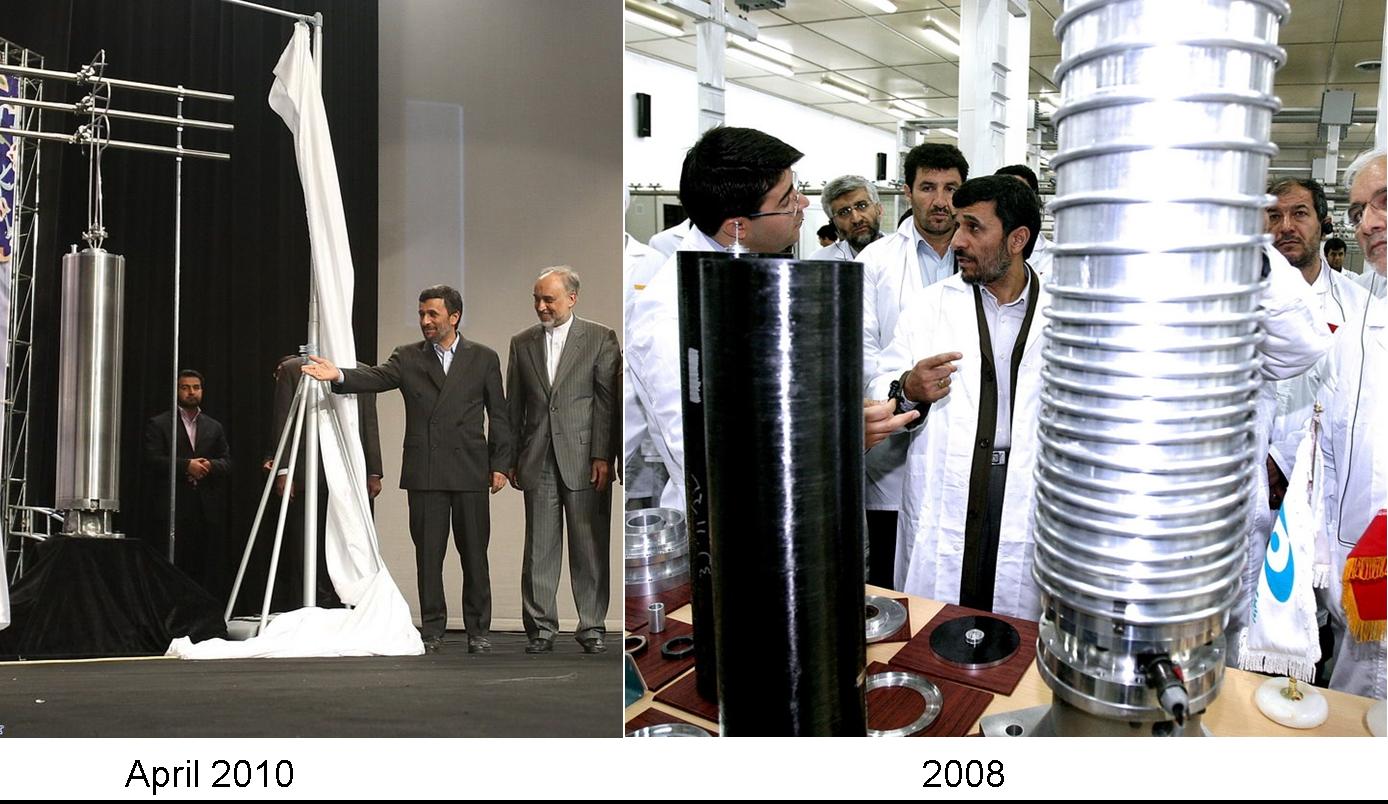
    click on the image for a larger version

    Iranian president Ahmadinejad unveiled the new IR-2 centrifuge on 11 April 2010 after having viewed it during its development stage in 2008.

    Unveiling is in quotes because we have, of course, seen these centrifuges before: President Ahmadinejad viewed them in April 2008; during the 2nd Nuclear Festival Day. These were the IR-2 centrifuges and an initial test batch was installed at the Pilot Fuel Enrichment Facility at Natanz in January 2008. At that time, there were 11 such machines undergoing testing. Ten were arranged in a cascade and one was operating on its own.

    The IR-2 is said to be based on the second generation Pakistani machine, the P-2, but with a carbon fiber rotor instead of the maraging rotor Pakistan used. As we have discussed before, Iran does have considerable academic and practical experience with carbon fiber forms. I won’t even begin to try to guess the enrichment capacity of this machine; we have had so many discussions on the capacity of the IR-1 and arrived at so many different numbers that it hardly seems worthwhile. For all you fellow timeline addicts, I would say that this announcement does seem to set an upper limit for how long it takes Iran to run the final development tests at about 27 months. It’s not clear if that includes production run tests or not but I would guess that it does. Of course, it’s very likely that these tests were finished before this and that the Iranian president waited until the Fourth Nuclear Festival Day to announce them. But that’s why 27 months is an upper limit!

    It is also important to keep in mind that these machines were tested at Natanz. That is where Iran’s experts at setting up centrifuges work. When and if we see new centrifuge designs being developed at other sites—such as the facility near Qom—we will know that Iran has reproduced its centrifuge operational expertise at other facilities. That will be an important proliferation milestone!

  • Install Ubuntu 10.04 Lucid Lynx Beta 2 using Wubi

    Just couple of days ago, Canonical had announced the release of the second beta of Ubuntu Linux. I wanted to try out the second beta ( I haven’t tried the 10.04 series yet) – but being a beta version I thought I’ll do a Wubi install, instead of a traditional install. Once I mounted the ISO file and launched Wubi, I ran into a roadblock.

    Wubi on the beta ISO proceeded to download the current stable version,i.e., Ubuntu 9.10 Karmic Koala, instead of proceeding to install Lucid. I thought I had downloaded the wrong ISO image, so I went back to the releases page, and just as I was about to redownload the ISO, I spotted at the very end of the page, a link to wubi.exe. Feeling curious to try it out, I proceeded to download, and voilà! Wubi install of Lucid was underway.

    Bad news, however is that if you’ve already downloaded Lucid CD image, Wubi will proceed to re-download the ISO image. I tried putting my downloaded ISO image in wubi\install folder, and tried to start Wubi install. That, however, resulted in Wubi asking me to uninstall the existing version. In the end, I had to download the CD image again.

    If you want to know more about Wubi and how to do a dual boot Windows and Linux install, do refer to our previous guide on dual booting Ubuntu and Windows using Wubi.


    Announcement: Missing Mobile News in the Main RSS Feed? We have decided to remove the mobile content from the main feed, please subscribe to our dedicated Mobile News RSS Feed at http://feeds.techie-buzz.com/techiemobile. Thank you for your understanding.

    Install Ubuntu 10.04 Lucid Lynx Beta 2 using Wubi originally appeared on Techie Buzz written by Sathya Bhat on Tuesday 13th April 2010 12:03:04 AM. Please read the Terms of Use for fair usage guidance.

    Don’t miss these Related Posts:

    Join Techie Buzz on Your Favorite Social Networking Sites