Wedbush Morgan analyst Michael Pachter believes that the new deal Vince Zampella and Jason West signed with EA is “the ultimate screw you” to Activision. Oh, and to EA too.
Blog
-
Hands-On with Microsoft Kin One and Kin Two
The launch party for Microsoft’s new Kin phones – two of ’em, set to hit Verizon in the US next month – is wrapping up here at Mighty in San Francisco. I just got some hands-on time with both devices, so look for videos soon.
What I really like about Kin is the extent to which Microsoft is really trying to revamp themselves. The Kin UI continues the much more visual approach that Microsoft is taking towards their new mobile products, as evidenced by Zune and Windows Phone 7. Kin’s UI is kind of like WinPhone 7 with a healthy dash of “youthfulness,” if youthfulness means color, irregularly-sized shapes, and a generally amped-up take on WP7’s bold, panning, and highly typographic look at feel.

Kin will come in two flavors when it launches, both featuring toucshcreens, full QWERTY boards and the same software. Kin One is what was leaked as “Turtle,” a vertical slider looks kind of like a slimmer, wider, shorter Palm Pre with a weird double-chin sort of design that leaves the sliding display flanked by the bottom half of the phone on top and bottom (See photo, it describes the design way better than my words do). The device will pack a five megapixel camera with SD video capture and flash, backed by 4GB of internal memory.

Kin Two is a more traditional-looking horizontal slider that steps up the multimedia specs with an 8MP cam, 720p HD video capture, and 8GB of internal memory. Both phones will feature WiFi in addition to 3G connectivity via Verizon’s EV-DO network. Both devices also are compatible with Zune Pass, as they’re the first phones to feature Microsoft’s Zune Experience.
I got a brief hands-on with both devices and came away both impressed and concerned. I also got a look at Kin Studio, an Web destination that promises to both provide automatic wireless sync of Kin users’ data (photos, videos, feeds, contacts, etc) while also displaying them in a highly graphic, timeline-based format accessible from any Web browser. Think of the Studio as a combination backup service and personal microblog.
Kin One isn’t for me, based solely on the form factor. That’s mainly a personal thing, as I prefer Kin Two’s horizontal slider design, but is also an opinion informed by the experience of trying to navigate Kin’s UI on One’s smaller, square-shaped display. I had an easier time making sense of “The Loop” – Kin’s MotoBlur-esque home screen that’s chock full of status updates and RSS feed headlines – on Two’s widescreen-style screen. I also like the layout of Two’s QWERTY board better, mostly because it fit my hands a bit better.
Both devices feature multitouch capacitive displays that support pinch-to-zoom photo and Web browsing, and also recognize two-finger taps. I saw the two-finger gesture used to select photos for editing, and was told that it’s pervasive throughout other UI elements on the devices. Very cool – makes me wonder how else the gesture is implemented across the OS. The displays were bright and responsive, and given how visual and gesture oriented the entirety of the Kin experience seems to be, the integration of the touchscreen to UI elements and software performance will likely be pretty key to customer satisfaction when the phones hit store shelves.
My concern lies mainly with the business of the Kin UI. The Loop and features like “The Spot” – a system-wide drag-and-drop system for sharing status updates, Web clippings, photos and virtually anything else you like with contacts and social networks – are timely and look pretty well thought-out, but they rely heavily on Kin’s hyper-caffeinated user interface. I didn’t get enough time to really form a strong opinion, but I wonder if swiping and dragging through a heavily visual UI will prove more fun or more annoying than clicking through conventional text-and-icon menus on a regular basis. I’m not saying they won’t be Awesome, Man!, I’m just saying that a few weeks with a Kin as your daily driver will tell you much more about its daily usefulness than watching a six minute demo can.
Still, the Kin launch was more exciting than I thought it’d be, and not just because I got to hit a nightclub on Monday morning. Microsoft is to be applauded for seriously making over their mobile offerings this year. Once Kin One and Two (and, later this year, the first WP7 devices) arrive, we’ll be able to tell much more about the success of those efforts.
-
Nuclear-Security Summit Vox Pops: Worthless, I Say!
The Washington Post is touting a poll showing “muted expectations” amongst the public for what President Obama’s nuclear-security summit will achieve.
Overall, 40 percent of those polled are convinced the negotiations will result in tighter controls, and 56 percent are not so or not at all confident. Moreover, four times as many express zero confidence in the summit than are sure of its success.
And the purpose of polling on this is… what, exactly? It’s cost-free to express skepticism to a pollster about the future achievements of diplomatic summits. The summit itself is supposed to create increased national commitments to secure plutonium and highly-enriched uranium, and to focus international attention around the goal of securing all such material in four years. In other words, the sort of thing that’s easy to be skeptical about and which won’t be immediately measurable. If anything, the most surprising result from this poll is that four in ten are convinced in the summit’s success. But why poll on this at all?
-
MasterCard Opens Online Store, Uses Predictive Software To Guess What You’ll Buy

MasterCard has decided to expand into online retailing, so it’s opened a store that’s sort of Amazon lite. Well, Amazon several design iterations ago. Actually the site looks like one of those themed mini-stores eBay keeps promoting these days, but the merchandise is all new and tailored to your shopping patterns. And by “tailored,” I mean that the card issuer is using special customer behavior software to predict the things you’re most likely to buy, which it then shows to you.
A third-party company called Next Jump provides the behavioral targeting service, which the New York Times says is already in use on Yahoo’s shopping site and on an earlier MasterCard rewards site. Be prepared to guard your credit card closely if you check it out; Next Jump says its software is accurate enough to convert 1 out of every 11 browsers into buyers.
“MasterCard Set to Open an Online Shopping Mall” [New York Times]
-
Apple Reminds Everybody That It Controls The iPhone Ecosystem
Last week, when Apple announced version 4.0 of the iPhone OS, it also made a significant change to the license agreement for its iPhone developer program. One section of the agreement was changed to say that iPhone “Applications must be originally written in Objective-C, C, C++, or JavaScript as executed by the iPhone OS WebKit engine” — a move that blocks developers from using cross-platform development tools and third-party development environments. So, for instance, if a developer already had an app written in .NET, they can no longer use something like Monotouch to port it to the iPhone. There has been a lot of speculation that this was just the latest step in the ongoing spat between Apple and Adobe, since the latter company will soon release a Flash-to-iPhone compiler, triggering a “go screw yourself Apple” from an Adobe employee.
But this move is actually bigger than that: it’s Apple’s attempt to lock developers in solely to the iPhone. Steve Jobs claims “intermediate layers between the platform and the developer ultimately produces sub-standard apps and hinders the progress of the platform”, and they do — from Apple’s perspective. By requiring developers to use Apple’s tools and follow its rules, the hope is that developers will follow along blindly and develop first for the iPhone, since it’s currently the best monetized channel to market for them, and then will develop for other platforms later, if at all. The issue for Apple, though, is that it’s not competing in a vacuum. Everybody and their mother are opening app stores, with other major smartphone platforms like Android and BlackBerry building theirs into viable competitors for the Apple channel. And as the App Store continues to get flooded with apps and becomes more competitive (and it becomes more difficult for developers to earn a living there), its position at the top of the pile is far from assured. At that point, heavy restrictions on developers and the closed ecosystem becomes a real burden for the company, not a benefit.
Permalink | Comments | Email This Story
-
Netflix on the hunt for an ‘Android video playback expert’

The headline is pretty clear, Netflix has posted a job opening seeking an Android Video Playback Expert, which can only mean that it is looking to finally venture into the Android market. Netflix is nothing new in the world of smartphones. Heck, our friends over at WMExperts have been covering Netflix for WindowsMobile for a while now, and over at TiPB they have been boasting about Netflix for the iPhone, iTouch and iPad now. It’s long overdue for an Android application for such a vastly popular service, but hey, better late then never right? While we have no real information, as its rather clear development is in the earlier stages from the job opening shown, we can hope development is quick and easy, and we see the Netflix for Android application show up in the marketplace soon! [via Engadget]
-
Buick Targets A Younger Audience

Good news for GM: it’s not just the Chinese who like Buick. Per GM’s own market research, the average age of a Buick buyer has dropped from 72 to 65. The reason is cars like the new LaCrosse, which has Lexus squarely in its sights.
The demographic for LaCrosse buyers is even more promising, with thirty three percent falling into the “under 55” category. This is double the number of younger buyers than the outgoing Buick Regal was able to draw in, and GM is taking this into consideration when designing new models. If the upcoming Regal GS hits the right marks for performance, features and pricing, Buick may be able to pull in buyers who never envisioned themselves in a Buick.
I’ve driven the 2010 LaCrosse, and was suitably impressed at the build quality and features. The interior workmanship was certainly the equal of anything from Lexus or BMW, and the electronics are clearly aimed to draw in younger buyers. How many 65 year olds, for example, will use a built in flash drive to upload music?
Where Buick still suffers, in my opinion, is handling. No one expects the LaCrosse to handle like an M5; on the other hand, it should be firm enough to be on par with a Lexus ES. While I haven’t driven the two side by side, my initial impression is that the Buick is still tuned for comfort at the expense of handling. Buyers in the 65 and older demographic may like this, but those of us in the under 55 demographic still want a sedan that handles.
Reference: Buick’s average buyer age drops from 72 to 65
-
Australia refloats Barrier Reef oil-spill ship
by Agence France-Presse
The Shen Neng 1 ship has been refloated after a nearly devastating oil spill at the Great Barrier Reef.Photo: Australian Maritime Safety Authority
SYDNEY—Australian authorities refloated a huge Chinese ship on Monday that had been stranded on the Great Barrier Reef for over a week after running aground, averting a potential environmental crisis.
Emergency workers successfully moved the 750-foot Shen Neng 1 coal carrier without adding to the two-ton oil spill that spread a two-mile slick after the ship crashed on April 3.
The general manager of Marine Safety Queensland, Patrick Quirk, confirmed that no more oil had been lost and said the ship was being towed to an area east of Great Keppel Island, Australian news agency AAP reported.
“The refloat was a success. Salvors spent an hour and a half assessing the vessel’s stability and watching for any evidence of further oil spills,” he said. “Our intention has always been to keep oil loss to a minimum so we could take it to safe anchorage.”
Emergency workers had pumped most of the 970 tons of heavy fuel oil from the vessel before they were forced to rush the after-dark refloating due to approaching stormy weather and high seas. Once the ship has been safely anchored, divers will inspect its hull so that a decision can be made on its future movement, Quirk said.
Australia’s transport minister has accused the ship’s crew of taking an illegal route at the heritage-listed Great Barrier Reef, by far the world’s biggest, and said prosecutors would be “throwing the book” at those responsible. The ship strayed about 15 nautical miles from the recognized shipping lane before ploughing into Douglas Shoal at full speed, sustaining heavy damage.
Australian officials immediately promised to investigate allegations that ships were taking shortcuts through the giant reef, which sprawls along 1,800 miles of coast and is a major tourist attraction.
On Monday, three crew members from another large carrier appeared in court on charges of entering a restricted part of the reef without permission, and were bailed to reappear on Friday. South Korean Gang Chun Han, the 63-year-old master of the Panama-flagged MV Mimosa, and Vietnam’s Tran Tan Thanh and Nguyen Van Sang face maximum fines of $205,000.
Conservationists say the incidents highlight the risk to Australia’s environment posed by rocketing resource exports to Asia, which are fuelling a strong recovery from the global financial crisis.
The reef, which is visible from space and is one of the world’s foremost ecological treasures, has already come under pressure from rising sea temperatures and pollution.
The government of the northeastern state of Queensland on Monday announced dramatically increased penalties for oil spills on the Great Barrier Reef, including fines of up to $10 million.
The accident comes after a ruptured cargo ship leaked 70,000 gallons onto Queensland beaches last March. In August, a well platform caught fire, dumping 28,000 barrels of oil into the seas off northern Australia.
Related Links:
Bolivia’s alternative climate conference to kick off next week
U.N. climate talks in Bonn wrap up after fresh fights
What the John Paul Stevens retirement means for energy progress
-
Check Out This Cool Interactive Map Of The State Pension Crisis
According to a report by the American Enterprise Institute, public pensions are underfunded by more than $3 trillion. Following is a state-by-state interactive map I put together from the report. Note: Please give the map a few extra seconds to load.

Click on any of the circles to select a state and see all of the public pension plans for that state. Illinois is amazingly bad. Click on an ocean or a portion of the map without circles to deselect.
The interactive map is based on Table 2. Market valued funding ratios and unfunded liabilities on page 42 of An Options Pricing Method for Calculating the Market Price of Public Sector Pension Liabilities by Andrew G. Biggs at the American Enterprise Institute.
Note: The AEI total and the total on the map are off by a tiny bit. I double checked the map totals against the report and they are correct. Most likely the discrepancy is a rounding error.
Thanks to Ellie Fields and Ross Perez at Tableau Software for help with the map.
Public Pension Plans Less Than 30% Funded
Illinois SERS – 23%
Indiana Teachers – 26%
Connecticut SERS – 27%
Oklahoma Teachers – 27%
Rhode Island ERS – 29%
West Virginia Teachers – 29%
Illinois Universities – 30%
Kentucky ERS – 30%Other Pension Estimates
The March 15 cover of Barrons talks about The $2 Trillion Hole. However, the body of the article contains estimates of at least $2 trillion and another at $3 trillion.
Hedge-fund manager Orin Kramer, who is also chairman of the badly underfunded New Jersey retirement system, insists the gap is at least $2 trillion, if assets were recorded at market value and other pension-accounting practices common in Corporate America were adopted.
Finance professors Robert Novy-Marx at the University of Chicago and Joshua Rauh of Northwestern University asserted in a recent paper that the funding gap for state pension plans alone might exceed $3 trillion, in part because state funds are using an unrealistic long-term annual investment return of 8% to compute the present value of future payments to retirees, as is permitted in government standards for pension-fund accounting.
California’s $500-Billion Pension Time Bomb
The L.A. Times is commenting on California’s $500-Billion Pension Time Bomb
The state of California’s real unfunded pension debt clocks in at more than $500 billion, nearly eight times greater than officially reported.
That’s the finding from a study released Monday by Stanford University’s public policy program, confirming a recent report with similar, stunning findings from Northwestern University and the University of Chicago.
To put that number in perspective, it’s almost seven times greater than all the outstanding voter-approved state general obligation bonds in California.
Stanford Study
Inquiring minds are digging into the Stanford Study Going For Broke: Reforming California’s Public Employee Pension Systems.
Adjusting the discount rate used on liabilities to a risk-free rate, we estimate the combined funding shortfall of CalPERS, CalSTRS, and UCRS prior to the 2008/2009 recession at $425.2 billion (see Table 2).
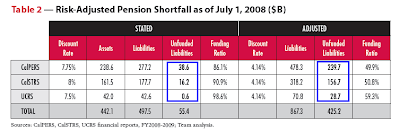
click on chart for sharper image
At the time of this writing, the funds have not released more recent financial reports, but due to the previously mentioned $109.7 billion loss the three funds collectively sustained, we estimate the current shortfall at more than half a trillion dollars.
The American Enterprise Institute report (Click on CA in the interactive map) and the Stanford Study independently arrived at similar values for California pension plan unfunded liabilities.
Note that the Stanford study has the unfunded liability of CalPERS $239.7 billion, the AEI report has it at $234 billion (labeled as California PERF), while CalPERS claims the unfunded liability is only$38.6 billion
Similarly, the Stanford study has the unfunded liability of CalSTRS at $156.7, the AEI report has it at $165 Billion (labeled as California Teachers), while CalSTRS claims the unfunded liability is only $16.2 billion.
Even if Stanford and AEI are off by 50%, the discrepancy is enormous. Whatever the sad state of affairs is, taxpayers are on the hook for the difference.
The time to stop public defined benefit pension plans was 20 years ago. Unfortunately, it is too late for that now. Nonetheless, it is imperative for states to stop compounding the error by switching to defined contribution plans immediately.
Mike “Mish” Shedlock
http://globaleconomicanalysis.blogspot.com
Click Here To Scroll Thru My Recent Post ListJoin the conversation about this story »
-
WaMu’s Failure Reveals Regulator Bumbling
A new Treasury investigation will conclude that the FDIC and Office of Thrift Supervision (OTS) are both to blame for failing to properly supervise Washington Mutual (WaMu) prior to its spectacular failure, according the New York Times. The newspaper managed to secure a draft the report early, so the document’s precise findings remain unclear at this time. But according to the Times, the regulators often clashed over the bank before its major inadequacies became apparent.
Overall, OTS did a poor job evaluating the bank. The NY Times reports:
Although regulators found problems with the quality of the mortgages it had originated and with the wholesale loans it bought through outside brokers and banks, the office consistently deemed WaMu “fundamentally sound,” giving it a rating of 2, the second-highest on a five-point scale used to assess a bank’s condition, from 2001-7. Moreover, the office relied on WaMu’s own tracking system to follow up on regulators’ findings.
The office did not lower the rating to 3 (“exhibits some degree of supervisory concern”) until February 2008, and to 4 (“unsafe and unsound”) until September 2008, days before WaMu collapsed. “It is difficult to understand how O.T.S. continued to assign WaMu a composite 2 rating year after year,” the report found.
The FDIC recognized some of the problems the OTS overlooked, but failed to act:
But the report also leveled unexpectedly sharp criticism at the F.D.I.C., which by July 2008 concluded that the bank needed $5 billion in capital to withstand future potential losses. The report said the F.D.I.C., which had questioned the Office of Thrift Supervision’s assessments of the bank’s soundness, could have stepped in earlier and acted as the primary regulator, but decided “it was easier to use moral suasion to attempt to convince the O.T.S. to change its rating.”
So much for the benefits of regulator coordination? That pressure on the part of the FDIC obviously failed to do the trick quickly enough. When the bank eventually did run into trouble, the OTS wanted to rehabilitate it, while the FDIC wanted a more aggressive effort to reduce the cost of WaMu’s potential failure.
Ultimately, the report concludes that the FDIC should make its own risk assessments of systemically risky banks going forward, says the Times. That seems sensible, given this lesson courtesy of Wamu.
But this incident also could have some broader consequences for the financial reform push in Congress right now. The legislation seeks to eliminate some bank regulator overlap. This incident indicates that is probably a good idea. Moreover, both the House and Senate versions of regulation would abolish the OTS. The WaMu debacle would support this move as well.
Yet would the FDIC have acted if it was the bank’s sole regulator? Then it wouldn’t have needed to pressure OTS to revise its ratings. Maybe, maybe not. If the FDIC was so certain that WaMu’s situation demanded more aggressive action, then it’s hard to imagine why it would have sat back and waited for OTS to get its act together. Instead, it probably just did not want to appear to be too aggressive of a regulator. That problem could persist even if overlap is eliminated. A lesson from the crisis is not only that regulators need to pay more attention, but that they must enforce the consequences of their findings. Observation isn’t enough to avoid another crisis if paired with inaction.


-
Blog Posts Back Shortly
Just taking a short break from blog posts. Back shortly.
Call for Authors: If you are interested in writing an article or series of articles for this blog please write to the e-mail address below. Copyright can be retained. Index: An index of the site can be found here. The page contains links to all of the articles in the blog in chronological order. Twitter: You can follow ‘The Amazing World of Psychiatry’ Twitter by clicking on this link. Podcast: You can listen to this post on Odiogo by clicking on this link (there may be a small delay between publishing of the blog article and the availability of the podcast). It is available for a limited period. TAWOP Channel: You can follow the TAWOP Channel on YouTube by clicking on this link. Responses: If you have any comments, you can leave them below or alternatively e-mail [email protected]. Disclaimer: The comments made here represent the opinions of the author and do not represent the profession or any body/organisation. The comments made here are not meant as a source of medical advice and those seeking medical advice are advised to consult with their own doctor. The author is not responsible for the contents of any external sites that are linked to in this blog.

-
V6 Throwdown: Motor Trend pits Hyundai Genesis against 2011 Mustang, 2010 Camaro and Challenger
Filed under: Coupe, Budget, Performance, Chevrolet, Chrysler, Dodge, Ford, GM, Hyundai, By the Numbers
 Hyundai Genesis 3.8 Track – Click above for high-res image gallery
By now, we’ve all read the various incarnations of the muscle car shoot-out, which means that had the crew from Motor Trend decided to simply line up the V6 versions of the 2010 Dodge Challenger, 2010 Chevrolet Camaro and 2011 Ford Mustang against one another, odds are you could have picked the podium without breaking a sweat (or reading the article). And that’s why we’re guessing the editors decided to throw in the Hyundai Genesis Coupe for spice.
At first glance, this feels like the easiest game of “which one doesn’t belong” ever played, but on closer inspection, the Genesis 3.8 looks right at home among Michigan’s Neapolitan pack of muscle cars. The Hyundai boasts 305 horsepower from its sizable V6, which is more than any of the big domestics. How does it fair against the entry Mopar, Bowtie and Blue Oval? We’ll go ahead and spoil it for you by saying that MT didn’t just invite the Korean coupe to the dance. It named it belle of the ball, too.
Why did the Genesis Coupe take the gold, even ahead of re-powered 2011 Mustang? According to MT, the Hyundai simply feels more like a sports car than the rest of the suspects. Funny – we thought they were testing muscle cars…
Gallery: First Drive: 2011 Ford Mustang V6


[Source: MT]
V6 Throwdown: Motor Trend pits Hyundai Genesis against 2011 Mustang, 2010 Camaro and Challenger originally appeared on Autoblog on Mon, 12 Apr 2010 13:26:00 EST. Please see our terms for use of feeds.
-
Partner
Los Angeles, CA, Audrey Golden Associates
Up and coming AmLaw 200 national full-service firm with top rated real estate, natural resources, litigation and lobbying practices seeks renewable energy/project finance partner with portable business to join LA office one of five in California and 12 in the US.
-
Tiger Woods Loses Cool During 2010 Masters: “You Suck!”
CBS mics picked up a frustrated Tiger Woods saying things he’d probably prefer we didn’t hear during The Masters in Augusta on Saturday. The womanizing sportsman finished fourth in the coveted tournament on Sunday.
-
Bob Murphy coming to Iowa
By Matt Hawes
We’re pleased to announce today that Bob Murphy, adjunct scholar for the Ludwig von Mises Institute, C4L contributor, and the author of The Politically Incorrect Guide to Capitalism, The Human Action Study Guide, The Man, Economy, and State Study Guide, and The Politically Incorrect Guide to the Great Depression and the New Deal will be joining us in Des Moines for our Iowa Regional Conference!
We have also secured a special discounted rate at the Embassy Suites on the River – where our Conference is located – for our members. But this offer is for a limited time only.
Dr. Murphy will be speaking as part of our open to the public Forum on the Future of Conservatism in America on Saturday, May 15. We will also have a private reception, where you will get a chance to meet and spend personal time with Dr. Murphy and our other speakers.
Stayed tuned for more announcements! Be sure to check out our Iowa Regional Conference page for more information.
-
Another way to reduce e-waste-Motherboard coasters

We have seen PCBs being recycled into chessboards, capacitors and other wasted computer spares being turned into attractive sculptures, and other such innovations to reduce the growing amount of e-waste, which constitutes almost 25% of the total waste generated. Here we have another one of such attempts-Motherboard coasters. These coasters are made from recycled motherboards and are 4 inches in diameter.At $12.99 for a pack of six, these coasters are great way to ‘geek-up’ your beverages while doing your part in preserving Mother Nature.
[walyou] -
U.N. climate talks in Bonn wrap up after fresh fights
by Agence France-Presse
BONN, Germany—Three days of talks aimed at putting a new gloss on U.N. climate talks ended here late Sunday after new textual trench warfare, less than four months after a stormy summit in Copenhagen.
Countries wrangled for hours beyond the scheduled close over the work schedule under the U.N. Framework Convention on Climate Change (UNFCCC) and what blueprint to adopt for further negotiations.
“The negotiations were very tense. There is a lot of mistrust,” said French chief negotiator Paul Watkinson. “Some delegates don’t seem to have taken onboard what happened in Copenhagen and the need to gain quick, concrete results.”
As the 194-nation forum struggled with a sour mood, UNFCCC Executive Secretary Yvo de Boer warned that the process would be dealt a crippling blow if it failed to deliver a breakthrough at a Nov. 29-Dec. 10 meeting in Cancun, Mexico. Cancun had to yield a “functioning architecture” on big questions, including curbs on carbon emissions and aid for poor countries, de Boer said in an interview with AFP.
“We reached an agreement in Bali [in 2007] that we would conclude negotiations two years later in Copenhagen, and we didn’t,” he said. “The finishing line has now been moved to Cancun, and I wouldn’t be surprised if the final finishing line in terms of a legally binding treaty ends up being moved to South Africa,” at the end of 2011.
“Copenhagen was the last get-out-of-jail-free card and we cannot afford another failure in Cancun,” de Boer said. “If we see another failure in Cancun, that will cause a serious loss of confidence in the ability of this process to deliver.”
The Bonn talks exposed a rift between developed and developing countries over whether to pursue or quietly bury Copenhagen’s main outcome. This is the so-called Copenhagen Accord, brokered by a couple of dozen countries in frenzied late-night haggling as the summit faced collapse. It sets a general goal of limiting warming to 2 degrees C (3.6 degrees F), earmarks some $30 billion in fast-track aid from 2010 to 2012, and sketches a target of mustering $100 billion annually by 2020.
But the agreement came under fire from countries excluded from the small drafting group and failed to gain the endorsement of a 194-nation plenary. Around two-thirds of UNFCCC members have now signed up to it, though.
Some of the faultlines opened up again in Bonn.
The United States and the European Union said the Copenhagen Accord, despite its flaws, should be included in draft text for negotiations. “We need a different paradigm and that’s what emerges from Copenhagen,” said top U.S. delegate Jonathan Pershing to journalists.
Other countries were not keen about incorporating the Copenhagen Accord in the negotiating blueprint, reflecting concern about the document’s purely voluntary emissions pledges and the way the deal was brokered. Left-led nations in the Caribbean and Latin America attacked the Accord as undemocratic and a betrayal of U.N. principles. They called for negotiations to resume on the basis of a draft that was put on hold halfway through the Copenhagen meeting, delegates said.
After hours of debate, delegates agreed to give the chairwoman of the main working group, Margaret Mukahanana-Sangarwe, latitude to draw up a negotiating text. The Copenhagen Accord was not specifically mentioned in this mandate, but Mukahanana-Sangarwe said orally it would be taken into account, along with other documents.
Two extra rounds of talks will take place before Cancun, the conference agreed.
Wounds of Copenhagen still fester
The three days of talks in Bonn at times resembled the movie “Groundhog Day,” where a grumpy skeptic is doomed to live the same events over and over again.
Almost as if the shock of Copenhagen had never happened, delegates squabbled afresh over the minutiae of the UNFCCC’s work schedule, over which bits of draft text to use as a blueprint for negotiation, and over the fate of a document widely dismissed as a threadbare compromise.
“Old habits die hard,” Greenpeace observed acidly. “Too many of the negotiators present chose to focus on divergence and problems.”
“There’s still strong disagreements about how to move this process forward … to demonstrate that the UNFCCC can deliver in the end, because there is a lot of debate in the public about that right now,” admitted E.U. negotiator Artur Runge-Metzer.
Developing nations barely masked their mistrust of rich countries, which many suspected of seeking to ditch the carbon-curbing Kyoto Protocol after 2012 and replace the benchmark treaty with a wishy-washy voluntary deal.
The United States and other rich countries, for their part, at times struggled to hold back exasperation at a consensus-driven negotiation format that, in their view, had dangerously slowed progress. They lobbied for Copenhagen’s one semi-success, the Copenhagen Accord, to be given life rather than cast into limbo.
“Some delegates don’t seem to have taken onboard what happened in Copenhagen and the need to swiftly gain concrete results,” said French chief negotiator Paul Watkinson.
The latest talks at least showed unity in one area: the realization that dealing with climate change is going to be a grinding and very long-winded business indeed. No one is holding out any guarantee that the post-2012 pact will be wrapped up in Cancun.
A better chance lies with the 2011 get-together in South Africa, but only after patient and cautious progress, said de Boer, who himself will soon be leaving the UNFCCC to pursue a career in the private sector. “It is important to bear in mind that this quest to address climate change is a long journey, that generally achieving perfection takes practice, that the scientific community is telling us we need to achieve huge emissions reductions by the end of the century,” he said.
Overladen, fiendishly complex, and apparently unreformable, the UNFCCC roadshow will crawl on, but there is now a growing interest in smaller, nimbler fora, gathering major emitters, donors, or key countries fighting carbon emissions from deforestation.
“We will continue to take advantage of venues that promote candid and constructive dialogue,” said Pershing, carefully stressing that the work would only be “complementing” the UNFCCC process.
“There is still momentum in the U.N. process, but it is fragmenting,” commented Annie Petsonk of the U.S. green group Environmental Defense Fund.
Related Links:
Bolivia’s alternative climate conference to kick off next week
Australia refloats Barrier Reef oil-spill ship
Bonn to Cancun … negotiators agree to continue efforts on international global warming
-
Magnetic Turtle Vacuums Up Pins Better Than a Dyson [Magnets]

A cutesie magnetic turtle that collects pins and paperclips. You remember what those are, right? Like your Firefox bookmarks, but ten years’ ago. More »
-
End of the road: Original iPhone won’t support OS 4?

Apparently, Steve Jobs is responding to e-mail. On a regular basis. In addition to responses regarding the iPhone Developer Agreement, he responded to a fan’s question about OS 4 compatibility on the original iPhone with a short “sorry, no.”
Though it appears to be an official e-mail from Jobs, the company hasn’t commented just yet, so anything could change between now and then. On one hand, I understand, as the phone is three years old. On the other hand, it could be done (perhaps in paid form, like the iPod touch updates). For those that still own and use your ($400) 2G iPhone on a regular basis, how do you feel?
Via Engadget
-
A Brave New Epoch? by Doug L. Hoffman
Article Tags: Doug L. Hoffman
[Thanks to Gabriel Rychert of ClimateRealists.com for pointing out the ES&T article to me. You were right, it is my sort of thing.]
Once again, scientists have proposed that planet Earth has been so altered by human activity that we are entering a new geological time period—the Anthropocene. A viewpoint article by some stratigraphic heavy hitters, just published in the journal Environmental Science & Technology, has proclaimed a new age caused by anthropogenic global warming and man’s savaging of the environment. According to these experts, the effects of human activity have become so pervasive that Earth has been transformed and the 11,000 year old Holocene epoch is now a “lost world.” Is this really the start of a brave new epoch, one of our own making?
The name Anthropocene is not new. Nobel Prize-winner Paul Crutzen, a co-author of the ES&T paper “The New World of the Anthropocene,” first proposed it a decade ago it was not immediately accepted, but periodically the term seems to resurface. Crutzen’s intention was to call attention to the “unprecedented” changes humans have inflicted on the planet in the +200 years since the industrial revolution began. Indeed, the term has been picked up by some practicing scientists to denote the current interval of time dominated by human activity. Here is how the authors described the quest for mankind’s own epoch:
The notion that humankind has changed the world is not new. Over a century ago, terms such as the Anthropozoic, Psychozoic, and Noosphere were conceived to denote the idea of humans as a new global forcing agent. These ideas received short shrift in the geological community, seeming absurd when set aside the vastness (newly realized, also) of geological time. Moreover, the scarring of the landscape associated with industrialization may appear as transformation, but the vicissitudes of the geological past—meteorite strikes, extraordinary volcanic outbursts, colliding continents, and disappearing oceans—seemed of an epic scale beyond the largest factories and most populous cities.
Click source to read FULL report from Doug L. Hoffman
Source: theresilientearth.com


