Blog

  • Teaching Earth Science with Children’s Literature: Don’t Know Much About the Solar System

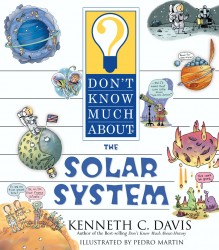
    dkmaksolarsystem-219×250.jpg


    Don’t Know Much About the Solar System, written by  Kenneth C. Davis and illustrated by Pedro Martin, is an informative children’s book filled with interesting facts and cartoonlike pictures.  Motivated middle and upper elementary students might read this book from cover to cover while others might choose to explore only the pages that are most interesting to them.   Each two-page spread contains a title and then several related questions.  Each question is followed by an answer and explanation.  Some of the questions and answers are humorous.  The pages are generally lighthearted but factual.  Topics covered include galaxies, solar system, gravity, planets, stars, meteors, space exploration, and an introduction to a few of the scientists who have contributed to our space knowledge.

    Curriculum Connections

    This book can be used to teach about the solar system and the planets in Fourth Grade (SOL 4.7).  The pictures show the orbits of the planets in the solar system.  Most of the planets are described within a two-page spread complete with illustrations.

    Additional Resources

    For audio learners, listen to the planet rap song.

    Allow students to explore kid friendly websites for additional solar system facts.

    Create a solar system simulation in your classroom.

    General Information

    Book:  Don’t Know Much About the Solar System
    Author:  Kenneth C. Davis
    Illustrator:  Pedro Martin
    Publisher:  Scholastic, Inc.
    Publication Date:  2001
    Pages:  47
    Grade Range:  3rd-6th
    ISBN:  0-439-43852-7

  • Obama Killed The Johnsen Nomination, Not Ben Nelson Nor The GOP

    Former OLC candidate Dawn Johnsen

    It strikes me as necessary to follow up a bit on the death of the Dawn Johnsen nomination to lead the Office of Legal Counsel at the Department of Justice. Specifically, it needs to be clear the conventional wisdom of the main media, and even a surprising number of normally more clear headed progressive bloggers, that the nomination failed because of opposition from Republican obstruction coupled with opposition by Ben Nelson, is completely and patently false.

    The false meme was already in play with the first substantive reporting by Sam Stein at Huffington Post as I noted yesterday. It is being propagated by the Washington Post (Republicans and “moderate lawmakers”), the New York Times (conservatives and two Democrats), even progressive stalwarts like Glenn Greenwald and McJoan at DKos have discussed the effects of the Republicans and Ben Nelson on the torpedoed nomination (although, to be fair, neither ascribes full blame on the GOP and Nelson).

    Perhaps the best example of purveying the false wisdom comes from Jake Tapper at ABC. Tapper, in an article supposedly about the Obama White House not having the stomach for a fight on Johnsen, nevertheless proceeds to regurgitate the usual suspects:

    Senate Republicans opposed her nomination overwhelmingly, meaning Senate Majority Leader Harry Reid, D-Nev., needed 60 votes to bring her nomination to the floor of the Senate for a vote.

    The White House put all the blame on the Republican minority — White House spokesman Ben LaBolt said, “Senate Republicans will not allow her to be confirmed” — but it was a bit more complicated than that.

    A Senate Democratic leadership source said that throughout 2009 two Democrats said they would vote against her — Sen. Ben Nelson, D-Neb., and Sen. Arlen Specter, D-Pa. The only Republican of the 40-member GOP caucus who said he would vote for her was her fellow Hoosier, Sen. Dick Lugar, R-Ind.
    …..
    Specter remained opposed to Johnsen’s nomination even after he switched parties in April 2009, but his primary opponent Rep. Joe Sestak, D-Pa., began to attack Specter for his opposition to her nomination.

    Johnsen’s nomination expired at the end of 2009, but in January 2010 Specter said he’d vote for her.

    This is a bunch of bunk. I have previously written extensively on why there were at least 60 votes for Johnson’s confirmation for the entire second half of last year after Al Franken was sworn in, and why there still were 60 votes for her confirmation this year upon Obama’s renomination, even after the Scott Brown victory in Massachusetts. If you have any question, please click through and refer to those articles; for now though, I want to revisit the false light being painted on Ben Nelson and Arlen Specter on the nomination’s failure.

    To date, the only journalist I have seen to even come close to being accurate about Ben Nelson’s status on Johnsen’s nomination is Charlie Savage at the New York Times, who yesterday briefly noted:

    And it was not clear whether Mr. Nelson would join Republicans in trying to block a vote on Ms. Johnsen with a filibuster.

    And that is the only germane question. It matters not whether Ben Nelson likes Johnsen, nor even if he would vote for her on the floor; the only salient issue is whether Nelson would vote for cloture and permit a floor vote. Ben Nelson never said he would block cloture. Never. And when questioned by the Indianapolis Star, he said the WH had never even discussed the subject with him.

    Nelson said Wednesday that he doubted Johnsen’s nomination would be brought to a vote.

    “We have to let the administration decide what they want to do,” Nelson said. Asked if he has told the administration whether he’d vote for Johnsen, Nelson said he hasn’t been asked.

    There is no evidence whatsoever Nelson would have voted against allowing the nominee of Barack Obama, the sitting President of his own party, to have an up or down vote. None. How Nelson would have voted on the up or down floor vote is irrelevant as there were far more than the 51 votes for confirmation in an up or down vote. Ben Nelson was not the problem.

    Arlen Specter was not the problem either. Specter’s office directly confirmed to me that he was, and has been, willing to allow cloture on the up or down floor vote for Johnsen, and likely willing to support her in said up or down vote, ever since his second face to face meeting with Johnsen on May 12, 2009 and Specter confirmed the same to Marcy Wheeler in late February. The failure of the Johnsen nomination cannot be laid at the feet of Arlen Specter.

    Oh, and one other thing should also be kept in mind, there is a very good chance that, if it ever came down to them, either or both of the Maine twins, Olympia Snowe and Susan Collins, would have permitted cloture on a floor vote too. They have a record of not blocking votes on Democratic Presidential nominees going back to the Clinton era and leading Maine women’s groups were very optimistic they would allow it on Johnsen if it came down to them (which I also separately confirmed with the groups).

    So, it was not Ben Nelson who killed the nomination of Dawn Johnsen, nor was it Arlen Specter or Senate Republicans. No, the sole reason Dawn Johnsen is not leading the OLC is that Barack Obama and his coterie of advisors did not want Dawn Johnsen leading the OLC. The Obama Administration cravenly hung their own nominee out to dry, and the reason is almost certainly that she was not compatible with the Administration’s determination to maintain, if not expand, the Bush/Cheney positions on unbridled executive power, indefinite detention without due process as well as warrantless wiretapping and other Fourth Amendment invasions.

    You want to know why the Obama White House killed their own nomination of Dawn Johnsen? Glenn Greenwald put it so well that I cannot improve on it and will just adopt and incorporate his spot on words:

    virtually everything that Dawn Johnsen said about executive power, secrecy, the rule of law and accountability for past crimes made her an excellent fit for what Candidate Obama said he would do, but an awful fit for what President Obama has done. To see how true that is, one can see the post I wrote last January detailing and praising her past writings, but all one really has to do is to read the last paragraph of her March, 2008 Slate article — entitled “Restoring Our Nation’s Honor” — in which she outlines what the next President must do in the wake of Bush lawlessness:

    The question how we restore our nation’s honor takes on new urgency and promise as we approach the end of this administration. We must resist Bush administration efforts to hide evidence of its wrongdoing through demands for retroactive immunity, assertions of state privilege, and implausible claims that openness will empower terrorists. . . .

    Here is a partial answer to my own question of how should we behave, directed especially to the next president and members of his or her administration but also to all of use who will be relieved by the change: We must avoid any temptation simply to move on. We must instead be honest with ourselves and the world as we condemn our nation’s past transgressions and reject Bush’s corruption of our American ideals. Our constitutional democracy cannot survive with a government shrouded in secrecy, nor can our nation’s honor be restored without full disclosure.

    What Johnsen insists must not be done reads like a manual of what Barack Obama ended up doing and continues to do — from supporting retroactive immunity to terminate FISA litigations to endless assertions of “state secrecy” in order to block courts from adjudicating Bush crimes to suppressing torture photos on the ground that “opennees will empower terrorists” to the overarching Obama dictate that we “simply move on.” Could she have described any more perfectly what Obama would end up doing when she wrote, in March, 2008, what the next President “must not do”?

    I find it virtually impossible to imagine Dawn Johnsen opining that the President has the legal authority to order American citizens assassinated with no due process or to detain people indefinitely with no charges. I find it hard to believe that the Dawn Johnsen who wrote in 2008 that “we must regain our ability to feel outrage whenever our government acts lawlessly and devises bogus constitutional arguments for outlandishly expansive presidential power” would stand by quietly and watch the Obama administration adopt the core Bush/Cheney approach to civil liberties and Terrorism. I find it impossible to envision her sanctioning the ongoing refusal of the DOJ to withdraw the January, 2006 Bush/Cheney White Paper that justified illegal surveillance with obscenely broad theories of executive power. I don’t know why her nomination was left to die, but I do know that her beliefs are quite antithetical to what this administration is doing.

    There is your answer. In brutal black and white. And progressives better wake up and start paying attention, because what you see here is extremely telling about the mindset and backbone, or severe lack thereof, the Obama White House has for the coming nomination and confirmation battle to replace Justice Stevens. If past is prologue, we are on the cusp of shifting the ideological balance of the Supreme Court severely to the right – under a Democratic “liberal” President.

  • Seeing Harvard from all sides

    Bill Lee has seen Harvard from many vantage points: He attended the College, has taught at the Law School, served as an Overseer and has been a proud Harvard parent – twice. As he prepared to join the Corporation, Lee, co-managing partner of the law firm WilmerHale, sat down with the Gazette to share his perspective on an institution that has been part of his life for four decades.

    Gazette: Do you have a memory that crystallizes your experience as a Harvard undergrad?

    Lee: I do.  I came from a small public high school.  My parents were immigrants from China.  My dad had a Ph.D. in physics, but he was nevertheless an immigrant from China.  And I was the first person from my high school ever to get in and come to Harvard.  I arrived and I thought, I have to be a mistake. There are all these smart, talented people.  I’m just not quite sure what I’m doing here. Years later, when I was elected the Board of Overseers and I arrived at my first meeting, I looked around the room at this phenomenally talented group of people and thought, oh my God, it’s happening again! What am I doing here?

    There’s another story, too. The day that my dad dropped me off at Harvard, he helped me move my belongings into Pennypacker and then we took a walk down Mass Ave. He said to me, “so you’re going to be scientist.”  And I said, “I am. I’m going to be an engineer, just like you.”  We walked two or three more steps, and he said, “Well, if you’re going to be a scientist, you need to be a deep thinker.”  I said, “Yeah.”  We walked two or three more steps, and we stopped right across from the Hong Kong restaurant. My father looked me right in the eyes and said, “Well, you’re not.  Change your major, do something different.  It will work out.”  And then he got in his car and he left! I changed my major.

    Both of my brothers are professors at the Medical School. Both of them are younger, and both of them majored in science.  They obviously didn’t get the same talk!

    Gazette: How did you see the University when you returned as a visiting professor at the Law School?

    Lee: I had a very different perspective. I didn’t go to Harvard Law School, so being able to teach at Harvard Law School was just a wonderful opportunity, and an intimidating opportunity.  The faculty was very welcoming, and the kids were just so smart.  They were just so smart.  The course that we just finished teaching was an extraordinary experience. It was designed to address the question: What is a law school education missing? And Dean Kagan and Dean Minow decided that law school was missing the type of education that taught you judgment, leadership, relationship building, and teamwork, and we designed a course based upon business school-type case studies that are focused on legal issues. I actually helped design one about two and a half years ago.  It was great for several reasons: We were doing something that was wholly different for law schools, a wholly different type of education. The class I taught had to do everything in teams of 16 students. They did reports in teams, they had to write in teams, they had to do their analysis in teams.  It’s very common across the river, but not very common up at the Law School.  It was also great because, in a very nontraditional way, the seven of us who were teaching the case to different groups met every day and talked about what worked, what didn’t work, what we would try, what we didn’t try.  It’s just a great experience.

    Gazette: How did your Harvard experiences inform your work on the Board of Overseers?

    Lee: By the time I joined the Board of Overseers, I had been educated about Harvard in a couple different ways. I had been at the College for four years, and what I learned with the passage of time is that the most extraordinary part of the Harvard experience is your contemporaries. Two or three decades after you graduate, when you examine your relationship with your contemporaries, it is really more than you could have imagined at the age of 18 or 19. I’ll give you an example: Our firm is a merged firm between Wilmer Cutler & Pickering [based in Washington] and Hale and Dorr [based in Boston].  Part of the reason that merger was successful is that my college classmate, [former Deputy Attorney General and former Harvard Overseer] Jamie Gorelick, and [former Solicitor General and current Harvard Overseer] Seth Waxman, who was a year behind me, were at Wilmer.  So when we decided to explore the possibility of a merger, I was sitting down talking to people I’d known since I was 18 or 19. That crystallized one of the great advantages Harvard has, which is it just attracts the most innovative, creative, dynamic people.

    I also had the benefit of being around Boston, and being part of a law firm that has a large number of Harvard people. I had the experience of teaching.  And then I had the best experience – I had been a parent. That just allowed me to see things from a whole variety of different perspectives – student, parent of student, faculty member, basically the consumer of what Harvard produces, the beneficiary of everything that Harvard can deliver.

    Gazette: The University is emerging from a particularly challenging stretch. From your point of view, how have President Faust and the University handled this period, and how do you think things are lining up for the future?

    Lee: I was on the search committee that selected President Faust. From the time I first met her in that process, I’ve been extraordinarily impressed with the type of leadership she brings, her personality, her vision, and her ability to get things done.  She came into office during a time of some turmoil in the community. She did a pretty unbelievable job of taking her very calm, very thorough manner of addressing issues, and actually imposing that personality on the University.  It was a change that I think was a wonderful example of great leadership.  Now, I don’t know of any Civil War historian who thought that they were going to have to understand interest rate swaps.  But having done a wonderful job of restoring calm and confidence, she moved into another tumultuous time, and I think has done a very good job of moving us through that process.

    One of the challenges at Harvard is, it’s a paradox.  It’s the most creative, innovative place in the world.  Yet, it probably has more inertia than any place in the world. Part of the task is taking that institution, which is known for innovation and creativity, and then moving it forward and overcoming the inertia.  That requires incremental steps, one by one.  As I read her message to the community at the beginning of this school year, it said we’re coming into a different time, which we are.  It’s going to require that we set priorities, which we will have to.  And it’s going to require everybody to pull together and share both the rewards and the sacrifice of achieving those priorities.  And I think that everybody will.

    Gazette: One of the aspects of the Harvard experience that President Faust has been emphasizing is the commitment to public service. You were part of Lawrence Walsh’s team during the Iran-Contra investigation. You’ve done a lot of work advising the federal courts.  Does your experience give you a sense of how Harvard’s mission intersects with public service?

    Lee: I don’t know if you’ve heard David Gergen speak about my generation’s failure of leadership in the public arena. He does it sort of mournfully, because we’re the generation that went to college during the Vietnam era, and in some ways we should have been the generation that was most motivated.  He talks a great deal about, as a consequence, how it’s critically important for institutions like Harvard to instill that public service commitment and mentality in the next generation. I agree with him 100%, and I agree that it’s a big part of what Harvard has to do.

    Harvard not only has an obligation to train people in the arena; it also needs to help fight the economic and institutional barriers that block people who want to go in that direction. And it has to help reinforce the proposition that public service is a great thing, and it’s really terrifically rewarding.  I think Harvard is one of a few universities that has the ability to make a critically important difference.

    Gazette: You are known as one of the top intellectual property litigators in the country. I always think that someone who rises to the top of their field must really love what they do…

    Lee: Yeah.

    Gazette: So what is it that you love best about your work?

    Lee: Well, you have to have in mind my father’s story about my technical background. He always thought it was a riot that this is what I was doing! I’ll go from the narrow to the broad: I like trial work.  I’ve probably done 200 trials in my lifetime.  I’ve argued 100 appeals. I love the crucible of a trial, and I love cross-examination in particular. This area of law has allowed me to really be involved in cases that are at the cutting edge of commerce and technology. It’s allowed me to be in a very intellectually interesting area.  And the field attracts interesting folks, and that’s been a great part of it as well.

    Gazette: What do you do when you’re not in the office?  Do you sail? Do you play soccer?

    Lee: I used to play soccer until I was 50, and I got clobbered at it! I played over-30 soccer for years. I was playing in a game and someone beat our sweeper back.  I was a midfielder.  I beat the striker to the ball, and instead of just carrying the ball out, I got cute.  I stepped over it and I flicked it with my heel. The other guy didn’t expect it.  He ran me over.  I fell down, he fell – his knee hit me and fractured four of my ribs, and one of them broke in half and went through the side of my lung. I ended up at the Brigham and Women’s Hospital for a week, and my wife said, “No more.”

    Now I run a lot.  I’m an avid runner, 25 or 35 miles a week.  I’ve run the Marathon once.  Now and again, I get to sneak out and play for the firm’s coed soccer team, which is fun.  I’m a fan of the Harvard men’s soccer team, which was really great this year.  On Saturdays and Sundays in the fall, I go out to watch the games.  I still follow the Harvard women’s swimming team because my daughter Catie was the captain of the team.  Most of the rest of the time is devoted to my family.  We’re very fortunate, we’re all still here. There are eight grandchildren; they’re all pretty much around here.  We’re all very close.

    For the last 15 years or so, the combination of practicing law, being the managing partner here, having us grow into the firm we’ve become, and doing what I’ve done over at the Law School is – it’s been about as much as I want to do.

    Gazette: I can imagine.

    Lee: But it’s been great.  It’s great.

    Gazette: What do you want the Harvard community to know about how you’ll approach your new responsibilities on the Corporation?

    Lee: Remember what I said about when I first arrived at Harvard? I have sort of the same humble reaction as I approach this position.  It’s interesting and enticing to come in at a challenging time, because in some sense, in a challenging time you can contribute more.  I think that the president is a great president, with not only a vision of where she wants the University to go, but an understanding of the incremental steps that have to be taken to get there.  I’m just hoping I can help.
  • Obamacare Provides A Room To Pump Breast Milk In

    Whether you are a proponent of breastfeeding or not, the reality is that working mothers who do nurse their children need a place to pump during the workday, and the bathroom just might not do. Luckily for them, the new health care bill signed by President Obama includes provisions for nursing women in the workplace.

    It requires employers to provide “a place, other than a bathroom, that is shielded from view and free from intrusion from co-workers and the public, which may be used by an employee to express breast milk.”

    There are already laws on the books in 44 states allowing nursing mothers to breastfeed their children anywhere, public or private, something Ikea and Babies “R” Us have experienced first hand. In addition, 24 states already include legislation on workplace breastfeeding.

    Ellen Galinsky, president and co-founder of the nonprofit research organization Families and Work Institute, tells CNN she’s pleased as punch over this new development. She says:

    It reflects both a shifting attitude, a shifting reality, and also the impact of research that shows that it’s healthier for the kids, and therefore good for the company, good for the family.

    Companies with 50 or less employees can opt out by claiming that such a room would be an undue hardship.

    Breastfeeding rooms hidden in health care law [CNN]

    Breastfeeding State Laws [NCSL]

  • Smart LED Bulbs

    GE readies its 9 watt Energy Smart LED bulb for market, which will replace 40-watt general service incandescent bulbs. The new LED lighting will arrive on store shelves later this year or in early 2011 and the retail pricing is expected to be in the range of $40 to $50. …

    … “The new GE Energy Smart LED bulb is expected to outperform currently available products that may be underwhelming consumers right now. GE scientists and engineers designed the bulb to better direct light downward on the intended surface and all around, not just out the top of a lampshade, as most current LED bulbs are prone to do. The new GE LED bulb offers 450 lumens — the Energy Star threshold to be considered a 40-watt incandescent replacement. Currently available LED bulbs produce 350 lumens or less. GE has filed multiple patent applications for the bulb and expects it will be an ENERGY STAR qualified LED omnidirectional light bulb. ” …

    Via GE: Future of LED Lighting

  • Samsung Galaxy S hanging out at the FCC

    This is good news and bad news. The Galaxy S is one of the most powerful Android handsets to be released in the near future. It will most likely be the phone to have for gaming, as it stands it has the best GPU out of all the current Androids and every other handset. Time for the bad news, it passed through the FCC with AT&T 3G bands.

    This device features an AMOLED display with 800 x 480 resolution, 1GHz processor, 5 megapixel rear-facing camera with support for 720p HD video recording at 30fps, front-facing VGA camera, Swype keyboard, HSDPA connectivity, GPS, Bluetooth 2.1+EDR, Wi-Fi, microSD expansion (16GB included, up to 32GB supported), and Android 2.1. The main highlight is the Hummingbird GPU that is capable of producing graphics that can rival those found on an XBOX 360 PS3.

    We all would love to see this thing come stateside but for any carrier other than AT&T. They have a track record of locking down their Android devices and replacing some of Google’s apps with their own bloatware. Hopefully they will leave this device as is, most likely they are going to mess this device up also.

    [via BGR]

  • Investigators seek clues in death of woman found in Alhambra park

    Sheriff’s investigators were searching for clues Sunday in the death of a woman whose body was found by a passerby in an Alhambra park.

    The woman was identified as Shi Donglei, 31, of San Gabriel. Donglei’s body was discovered near a flood control channel in Story Park on Chapel Avenue at about 4:30 a.m. Saturday. She was pronounced dead at the scene.

    The cause of death had not been determined pending the results of an autopsy, the Los Angeles County Coroner’s office said.

    Anyone with information was urged to contact Los Angeles County sheriff’s homicide detectives at (323) 890-5500.

    — Carla Rivera

  • Next-gen offshore wind turbines

    GE makes sigificant European wind energy investment with offshore wind turbine manufacturing located in the United Kingdom. …

    … “At the core of GE’s European expansion plans is the development of GE’s next generation wind turbine, a 4-megawatt machine designed specifically for offshore deployment. As the largest wind turbine in GE’s fleet, it will incorporate advanced drive train and control technologies gained through GE’s acquisition of ScanWind. The 4-megawatt wind turbine will feature GE’s innovative technology that eliminates the need for gearboxes. This technology is already being demonstrated at a test site in Hundhammerfjellet, Norway, where the first ScanWind direct drive unit has been operating for more than five years. ” …

    Via GE: European Offshore Wind Expansion

  • Konami’s Saw game is getting a sequel

    Konami has announced that their Saw videogame is getting a sequel simply called Saw 2. Despite the name, it’s not based on the events in the second Saw movie.

  • What are your favorite climate and energy soundbites?

    Cover image of Joe Romm's book, Straight Up: America's Fiercest Climate Blogger Takes on the Status Quo Media, Politicians, and Clean Energy SolutionsI will be testifying in front of Congress this week.  And my book, Straight Up, is coming out the following week (click here to buy it).

    That means I’ll be doing a lot of media and trying to hone a simple, effective message for a far broader audience than Climate Progress readers.  I have my own favorite phrases but I’d like to hear from you what you think works both in terms of sound-bites and overall framing.

    Note:  I’m not trying to persuade the unpersuadable.  And the energy message is, I think pretty well understood (see “Messaging 101: ‘Green’ jobs are out, ‘clean energy’ jobs are in“).

    You might take a look at this new messaging report, Climate Communications and Behavior Change:  A Guide for Practitioners just out from The Climate Leadership Initiative.   I don’t agree with everything in it, but it is pretty good, much better than those efforts to try to get people to stop talking about global warming (see EcoAmerica’s phrase ‘our deteriorating atmosphere’ isn’t going to replace ‘global warming’ — and that’s a good thing.)

    We’ve already had a big CP discussion about what is the best phrase to use, given the flaws in both “global warming” and “climate change” (see Is “Global Weirding” here?).  This report floats:

    1. “Rapid climate shift”
    2. “Climate disruption”
    3. “Climate shock”
    4. “Climate breakdown”
    5. “Climate failure”

    Let’s drop the last two, but #1 and #3 have merit.  I’ll probably stick with using many different phrases, including GW and CC.  The report does have some good suggestions for how to phrase basic talking points:

    Carbon dioxide and other pollutants collect in the atmosphere like a thickening blanket, trapping the sun’s heat and causing the planet to warm up.

    What are you thoughts for sound-bites and framing?

    Related Posts:

  • Nuevos Drivers Intel Express serie 4 para windows vista/7

    Intel acaba de lanzar nuevos controladores para toda su linea de chips y procesadores que integran los gráficos Intel Express Serie 4 (Intel® GMA X4500).-

    Estos se encuentran integrados en los siguientes procesadores y chips:

    * Intel Pentium G6950 Processor
    * Intel Core i3 Processor
    * Intel Core  i5 Processor
    * Intel Core i3 Mobile Processor
    * Intel  Core  i5 Mobile Processor
    * Intel Core  i7 Mobile Processor
    * Intel B43 Express Chipset
    * Intel G41 Express Chipset
    * Intel G43 Express Chipset
    * Intel G45 Express Chipset
    * Intel Q43 Express Chipset
    * Intel Q45 Express Chipset
    * Mobile Intel GL40 Express Chipset
    * Mobile Intel GM45 Express Chipset
    * Mobile Intel GS40 Express Chipset
    * Mobile Intel GS45 Express Chipset

    Para descargarlos pueden dirijirse centro de descarga de intel, seleccionando su sistema opetativo ya sea de 32 o 64bits o siguiendo los siguientes enlaces:

    32 Bits
    Intel® Graphics Driver for Windows 7* and Windows Vista* (zip) 15.17.3.2104
    Intel® Graphics Driver for Windows 7* and Windows Vista* (exe) 15.17.3.2104

    64 Bits
    Intel® Graphics Driver for Windows 7* 64 and Windows Vista* 64 (zip) 15.17.3.64.2104
    Intel® Graphics Driver for Windows 7* 64 and Windows Vista* 64 (exe) 15.17.3.64.2104

    También se encuentran disponibles las notas versión del driver de 32 y 64bits, donde se dan a conocer los errores corregidos.-

    Nota: Para instalar estos drivers es recomendable previamente desinstalar los que tengamos en la maquina.

  • NEWSFLASH: There’s Still No Greece Bailout, Just A Big Heaping Of Moral Hazard

    european commission

    The European Commission has done a very weird thing.

    It has explicitly announced that Greece has an implicit guarantee of all its debt.

    Despite what you may have read, Greece hasn’t technically been bailed out yet. Instead, EU finance ministers, along with the IMF have announced most of the terms of a bail out, should a bail out be needed.

    Why would Greece need a bail out? That’s not clear, but presumably it would require some kind of failed auction or default.

    Why would Greece have a failed auction? That’s not clear either — after all, why would you not lend to Greece, knowing that the terms of its bailout have already been announced.

    Basically the EU and the IMF hope they can jawbone a bailout without actually having to pay anything out.

    It might work.

    It’s not wildly different than what the Treasury did the dark days of our financial crisis, except that in addition to implicitly promising that there would never be a nationalization of any major bank — that, not default was the big fear — the US central bank printed mad amounts of money so that it could brute force return the banks to financial health.

    The ECB has no such brute force mechanism at its disposal. Greece’s only path to health will involve an economic rebound, slashing spending and raising taxes (painful).

    As for the details themselves, the country will get about $40 billion, two-thirds of which will come from the ECB, and one-third from the IMF.

    If it’s needed.

    Join the conversation about this story »

  • Apple Removing "Rate On Delete" Feature from iPhone OS [IPhone OS]

    The “rate on delete” iPhone prompt that greets users every time they remove an app from their iPhone is getting deleted. More »


  • Mountain roads to be closed as rain threatens

    Roads in the Angeles National Forest and in mudslide-prone foothill communities affected by the Station fire will be closed beginning early Monday due to the threat of heavy rains from a late-winter storm approaching Southern California, authorities said.

    Angeles Forest Highway from Aliso Canyon Road to Angeles Crest Highway, Big Tujunga Canyon Road from Vogel Flats to Angeles Forest Highway, and Upper Big Tujunga Canyon Road from Angeles Forest Highway to Angeles Crest Highway will be closed to all traffic except emergency vehicles.

    The closures will take effect at 12:01 a.m. Monday. Residents in the burn areas will not be able to use the roads until the closures are lifted, the Los Angeles County Department of Public Works said. The roads will reopen after the threat of rain has passed and safety inspections are conducted.

    Parking also will be restricted on posted streets in La Cañada Flintridge and La Crescenta until the rains have passed, authorities said.

    The National Weather Services said the unseasonably strong storm could dump up to 3 inches of rain on south-facing mountains and foothills, with the heaviest rains across the burn areas expected between midnight and 6 a.m. Monday.

    — Carla Rivera

  • Mysterious MotoBlur device comes from the wood ward?

    We’ve been watching this one for signs of life since it first appeared (and now has been pulled). DroidDog was given an image an unknown square Motorola device running Android 2.1 and MotoBlur. The story goes that it was from someone’s brother’s best friend’s sister’s, cousin’s roommate (or something like that) who was lent this device to use, and didn’t realize they weren’t supposed to send pictures to people on the internet. Either way, real, fake, specs, who knows, there is no information, and the original post was removed at the original leaker’s request.

    But now that it has been leaked, odd’s are people with further information will come forward about it, and hopefully we can get some factual information about the device, and some better pictures. If you happen to have them, feel free to use that "Tip Us" feature above! [via DroidDog]

  • Does TV’s Dr. Oz Really Know How To Fix What Ails You?

    It’s easy these days to turn to the Internet to try to self-diagnose what ails you, especially with the glut of information provided by authority figures like Dr. Mehmet Oz – better known as Oprah Winfrey-certified Dr. Oz – one of the most recognizable names in the media when it comes to comes medicine. But a new report by the Chicago Tribune is calling his wide-ranging advice into question.

    Dr. Oz is a cardiac surgeon who, through his TV show, health guides, magazine columns and Web site, gives information on a plethora of health topics. However, a number of medical experts are criticizing his methods, saying that some of what he offers up is not supported by science.

    Specifically questioned is his view that the rotavirus vaccine is “optional” and could cause intussusception, a complicated intestinal infection in infants. But according to the American Academy of Pediatrics, the Centers for Disease Control and Prevention, and the World Health Organization, which all recommend the vaccines, data have proven that intussusception is not linked to the vaccine.

    Dr. Oz’s spokespeople told the Chicago Tribune that his mission is to give his audience information from multiple perspectives.

    “The purpose of the site is to provide users with as much information as possible and allow the users to differentiate between what they find helpful and what they do not,” Dr. Oz’s team wrote in response to questions asked by the paper.

    His critics say that that approach might not be the best, when it comes to promoting medicine with a basis in scientific research.

    Gary Scwhitzer, University of Minnesota professor and publisher of HealthNewsReview.org, which rates medical news reports, weighed in for the Chicago Tribune‘s article. He says:

    We have this population that is thirsty for a little sip of a drink … and we are gushing them every day with this powerful fire hose”It is ineffective and it can be dangerous.

    Others question his inclusion of entries on his Web site by a doctor who has supported controversial autism treatments. Also called into question is information from a man Dr. Oz calls a “highly esteemed pioneer” in alternative medicine, Dr. Joseph Mercola, who has been warned by the FDA about health claims he’s attributed to certain products he sells. Dr. Mercola also has circulated the idea that cancer is a fungus treatable with baking soda.

    “For it to be a fair discussion, we must include a multitude of voices and opinions, even those that may be controversial,” Oz’s spokespeople wrote, with the senior medical producer of The Dr. Oz Show, Susan Wagner adding that the show aims to “have a conversation with America about health and wellness, in a way that we have never done on TV before.”

    Read the entire article on the Dr. Oz debate at the Chicago Tribune.

    Dr. Oz: Critics find fault with Dr. Oz’s approach to health advice [Chicago Tribune]

  • Mercedes refutes Schumacher retirement talk

    Filed under: , ,

    Michael Schumacher

    It’s pretty safe to say that Michael Schumacher isn’t quite back up to vintage form. After winning seven World Championships, Schumi spent three years on the sidelines before leaving retirement to take the wheel at the newly-rechristened Mercedes-Benz GP team, headed by his longtime collaborator and strategic mastermind, Ross Brawn. But in the three grands prix so far this season, the world’s most accomplished driver has been consistently outperformed by his younger teammate Nico Rosberg. In fact, Schumi’s one of only two drivers – along with Renault rookie Vitaly Petrov – to be out-qualified by his wingman in all three races, reinforcing the adage that an F1 driver’s teammate is his chief rival.

    His lackluster performance has left pundits wondering whether Michael’s return was ill-conceived. There’s even speculation that even though his contract with Mercedes extends through 2012, Schumacher could bow out by the end of this season.

    The top brass at Mercedes, however, have been quick to defend their star driver, blaming themselves before blaming Schumi. Motorsport chief Norbert Haug says Michael is “highly motivated [towards] the long term”, with team CEO Nick Fry warning not to “underestimate” Schumacher’s potential for a comeback. With sixteen races left to go this season, there’s plenty of time to see who’ll turn out right.

    [Sources: Top Gear, ESPN F1]

    Mercedes refutes Schumacher retirement talk originally appeared on Autoblog on Sun, 11 Apr 2010 13:36:00 EST. Please see our terms for use of feeds.

    Read | Permalink | Email this | Comments

  • Pop Culture Cred | Cosmic Variance

    Even enigmatic eclipsing binaries are thrilled to appear in Beetle Bailey. Sinatra would have killed to appear in Beetle Bailey, am I right?

    Epsilon Aurigae in Beetle Bailey


  • Equilibrium Prevents Humans from Heating the Atmosphere by Gary Novak

    Article Tags: Gary Novak, [email protected]

    Equilibrium Prevents Humans from Heating the Atmosphere

    There has been a lot of talk about equilibrium lately–Richard Lindzen pointing out the difference (again) between weather and climate and concluding that therefore, there is no equilibrium. And Roy Spencer saying that it is dis-equilibrium that adds the heat. Well, there is a lot more to equilibrium than they have been saying.

    If there were no long term equilibrium, there would be nothing controlling temperature of the atmosphere, and it would go to one extreme or the other. The tendency to move toward some temperature is an equilibrium process, even though it is a slow process in the atmosphere. But alarmists are only talking about the slow process. An eight year cooling period doesn’t phase them.

    Climate physicists totally agree. Based on the Stephan-Boltzmann constant, which says how much radiation leaves any surface at any temperature, they determined that the 235 watts per square meter of energy entering the earth from the sun must be balanced by 235 W/m² exiting earth into space; and this amount of radiation leaves from a surface which is -19°C. The atmosphere is -19°C at about a height of 5 kilometers. So climatologists claim there is a zone at that height from which 235 W/m² of radiation exits into space. Global warming then occurs when heat is trapped near the surface and pushes that zone up higher in the atmosphere.

    Read in full with comments »   


  • Rick Santorum on the Bush Era: “Conservatism Didn’t Fail”

    At the Southern Strategy Republican Leadership Conference in New Orleans, the Frothy Mixture offered up a favorite wingnut talking point.

    We let America down. I say that conservatism didn’t fail America. Conservatives failed conservatism,” he said.

    See, here’s where I’m confused. Just how did Bush Republicans fail conservatism?

    Gigantic tax cuts for the rich, check. Gutting regulations, check. Huge increases in defense spending? Check. Bombing/invading countries? Check. Right-wing ideologues appointed to the Supreme Court? Double check. Declaring war on science? Check. Erosion of the middle class? Check. Giving Big Oil and Wall Street everything they want? Check. Rewarding polluters? Check. Weakening gun laws? Check. Demonizing teh gays and brown people? Check and check. Etc., etc., etc.

    Sure, the size of government grew under Bush/Cheney. As it did under St. Reagan of California, Poppy, Ford, Nixon and Ike. Are they all conservative failures too?

    Unless “conservatism” is now a one-issue ideology, it’s undoubtedly the case that conservatives like Bush and Cheney served conservatism very loyally.

    Meaning, they royally screwed the country.