With the passage of health care reform, and the shift of the medical profession away from private practice and toward large institutions already, I wanted to revisit some data about the political orientation of medical students and recent graduates surveyed in the mid-aughts. One of the major issues among American elites has been a bifurcation politically between liberal and conservative elites, with the former concentrated in the professions which are often affiliated with the managerial state, and the latter within the business sector. Until recently I had assumed that medical doctors were an example of a profession which tended toward conservatism because of the bias toward private practice and the general lack of direct state involvement (as opposed to regulation) in their occupation, but this seems an older model. Political Self-characterization of U.S. Medical Students shows that medical students actually tend toward liberalism vis-a-vis the general population, and even young adults in their primary age group. No doubt this may change as they age, but I am skeptical of this because it looks as if medicine is going to resemble a public sector occupation more, not less, as we proceed. I reformatted table one, removing a few rows which I felt were extraneous. Additionally, I added columns which show the proportions of medical students by ethnicity and religion (where they received close to 100% response) and the general population ~2008 (from the American Community Survey & Religious Landscape Survey).
N
Conserv. %
Mod. %
Lib. %
Students %
Population %
Total
4918
26
33
41
Female
2260
18
32
49
46
Male
2654
33
34
33
54
Mother’s ed.
No HS diploma
81
17
43
40
HS diploma
240
27
35
38
Some college
284
33
34
33
College
625
28
38
35
Grad school
549
20
35
46
Med school
60
17
38
45
Father’s ed.
No HS diploma
79
22
40
38
HS diploma
178
22
36
42
Some college
163
23
40
36
College
420
30
34
35
Grad school
696
25
34
41
Med school
296
23
39
38
Ethnicity
Asian
932
17
41
42
19
4
Black
388
9
33
58
8
12
Hispanic
201
15
32
53
4
15
Native/Other
242
23
40
37
5
–
White
3141
32
31
38
64
66
Religion
Atheist/None
879
9
29
63
18
16
Buddhist
78
9
42
49
2
1
Hindu
231
8
41
51
5
0.5
Muslim
119
21
43
36
2
1
Catholic
1105
30
35
35
22
24
Jewish
323
17
26
58
7
2
Other Christian
814
31
41
28
17
–
Protestant
1102
45
30
26
22
50
Other
235
9
30
61
5
–
Ever married
Yes
1002
39
31
30
20
No
3885
23
34
43
79
Specialty
Primary care
1423
25
33
43
Emergency
338
25
34
41
Family med
477
31
28
41
General internal
366
24
35
41
Ob/gyn
268
16
24
60
Pediatrics
537
21
36
43
Psychiatry
116
17
27
56
Surgery
647
34
37
29
Other
437
27
31
42
There were a few religion categories which don’t seem to map well between what was asked in the survey of medical students and the general population, so I omitted them. Specifically, it seems that many medical students are nominal Christians who simply selected “Other Christian,” while in the general population this class consists mostly of heterodox groups such as Mormons, Jehovah’s Witnesses and Christian scientists. The “Other” religious segment also seems inordinately large, and I suspect that they would be “Unaffiliated” in the Pew survey (if the question is asked so that “Atheist” is part of the category that will scare away a substantial subset of those who aren’t members of organized religions but have some vague supernatural beliefs). Finally, it seems strange to me that they clumped “Native” and “Other” races together in the medical student survey, as it seems likely that many who didn’t want to respond or were mixed-race are in this group, so I didn’t compare it to anything in general population.
No great surprise that pediatricians are more liberal than surgeons. Perhaps I’m employing stereotypes that people may find scurrilous, but I don’t particularly care. Some of the trends among specialties are confounded with the fact that there are differences in sex ratio across them; specialists or those who wish to be specialists are more likely to be male than female, and females are more likely to be liberal than male. Correlations are not necessarily transitive, but I think that’s what you’re seeing here. The liberalism of Asian Americans is not that surprising, but notice that Hindus and Buddhists are even more liberal. The majority of young Asian Americans are now of non-Christian religions, or irreligious, but a significant minority are Christians, and often conservative ones at that. The higher proportion of conservatives among the whole Asian American group is probably a function of the fact that Christians are more comfortable with the conservative movement than non-Christians. If you are a racial minority being a non-Christian makes it very difficult to identify with the modern Republican movement; being a white person at least allows for racial solidarity, while being a conservative Christian allows for ideological solidarity.
Interestingly, non-Hispanic whites are represented in proportion to their numbers in the general population among young doctors and medical students, though a bit overrepresented in proportion to their age bracket. As older individuals are more likely to need medical care, and these are more often non-Hispanic white, it will be common for non-white doctors to interact with older patients who grew up at a time when America was an explicitly biracial, and implicitly white, country. I have talked to young Asian American friends who recount experiences with very elderly patients whereby it is difficult for these individuals to grok that they were born and raised in the United States because these patients have an image of America which is derived from their youth.
The prominence of ethnically Asian software engineers, or in scientific institutes, is a well known feature of the American landscape. But these are not occupations which require a great deal of interface with the general American public. Professions like medicine do require that interface, that is one reason that there is focus on getting underrepresented minorities into medicine, so that they can better serve their communities. When it comes to elderly white patients who are going through chronic illnesses at the end of their lives I think it is probably not practical or appropriate to expect too much consciousness raising in regards intercultural dynamics and sensitivity. Rather, I think the onus is going to be on young Asian American doctors to try and understand the perspectives of their patients and the America from which they came, an America which they and their parents have changed in fundamental ways by their very presence.
Last week, a federal appeals court rejected luxury goods retailer Tiffany’s claim that eBay should be liable for trademark violations on its site based on general knowledge that such infringement is happening (but no specific knowledge of a specific infringement). The ruling is a victory for online service providers, eBay sellers, and consumers alike.
As we noted in our amicus brief, Tiffany’s arguments would have resulted in over-policing by intermediaries like eBay. If eBay had to worry about potential trademark lawsuits and liability for every one dollar auction, you can be sure that it would move to reduce risk by blocking even potentially lawful uses of trademarks. What intermediary wants to take a big legal risk for a little customer? That’s the question that translates legal liability for intermediaries into a “clearance culture” that squelches lawful content protected by fair use or other speech-protecting doctrines.
So it’s good that eBay prevailed in last week’s ruling. But the decision highlights a growing problem in trademark enforcement: the lack of avenues for “put back” when a trademark owner makes an improper infringement claim. One key to eBay’s legal success was its rapid notice-and-takedown system, known as VeRO, which has helped the company position itself as a sympathetic actor, responding expeditiously to trademark complaints. Savvy intermediaries are likely to adopt similar processes, if they have not already done so.
Unfortunately, intermediaries have little incentive to give equal respect to users. Unlike in the copyright area, where Congress created a “counternotice” procedure that allows a citizen to get lawful content restored after a bogus takedown notice, trademark law provides no such safeguards. The DMCA’s counternotice process relieves a service provider (e.g., YouTube, MySpace, Blogger, etc) from having to make judgment calls about whether something is or is not infringing. Without a similar simple process for service providers in the trademark realm, the cards are stacked against users. Unless the service provider has a free lawyer, the cost of doing a fair use analysis and defending a lawsuit—even if the service provider knows it will win—is almost certainly more than a service provider is charging any individual customer, or even a whole bunch of customers. Thus, even if a user explains that her use is protected by nominative fair use or other trademark doctrines, service providers have little motivation to put content back up unless and until the trademark owner withdraws its complaint. And that is not likely to happen unless the target can recruit legal representation to help persuade the trademark owner to see reason.
So we are not as optimistic about the impact of this ruling as we’d like to be. The decision was good for consumers and free speech, but we still have a long way to go to protect against trademark misuse.
Since Apple’s iPad launch just over two days ago, frustrated users have packed Apple’s iPad support forum with complaints of weak and unreliable Wi-Fi connections. The problem has even affected two Betanews staffers who got iPads on the device’s launch day.
Some users have speculated that Wi-Fi issues are related to chassis shielding, antenna placement, or software problems, but there has not yet been any concrete evidence to support any of those guesses.
Apple posted a support article yesterday called “iPad: Does not automatically rejoin known Wi-Fi networks,” which suggests that users with simultaneous dual-band wireless routers take additional measures to simplify the iPad’s connection process. Apple suggests that users label their different Wi-Fi networks according to whether they’re 802.11b/g or 802.11n, equip them with the same type of security, and make sure the router’s firmware is up to date.
But we’ve seen troubles like this with other Apple products in the past, with similar knowledge base suggestions, so we began to investigate the Wi-Fi module inside the iPad.
According to iFixit’s recent teardown, the wireless radio inside the iPad is the Broadcom BCM4329, which the chipmaker says is its “smallest and lowest cost dual-band 802.11n solution.” The tiny IC has a complete 802.11 a/b/g/n system (MAC/baseband/radio), Bluetooth 2.1 with Enhanced Data Rate, and an FM radio transciever on a single die with a single antenna.
It’s true that Wi-Fi connection problems are most often stem from router compatibility issues, but when both of Apple’s products using the 4329 chip are having the same issue, we wonder if Apple hasn’t chosen a wireless module that is too light duty.
We repeatedly attempted to communicate with Broadcom about the wireless module to find out what other devices have been equipped with the BCM4329, and what the ideal usage scenario for it would be. Unfortunately, the company was not interested in commenting.
This by no means implicates Broadcom’s chip in the iPad’s connectivity problems, nor is there any indication that this is a widespread problem. However, it does look like Wi-Fi issues are a trend among the three devices known to use the tiny, low-power unit.
Three years ago we reviewed Martha Stewart’s women’s lifestyle website, marthastewart.com. At that time, April 2007, the site had just undergone a web 2.0 facelift. Martha Stewart 2.0 included more videos, blogging and general community features such as recipe swap functionality and message boards. It planned to add further personalization and community features over 2007.
We thought it would be interesting to take another look at Martha Stewart’s website, to get an indication of how mainstream websites have evolved over the past 3 years.
Sponsor
The design of marthastewart.com hasn’t changed much since we last checked. It has the same pastel green color scheme and is organized in much the same way, around lifestyle categories: Food, Entertaining, Holidays, Weddings, Crafts, Home & Garden, Pets, Whole Living, Community.
However if we look more closely, several things have taken more prominence on the site compared to 2007.
Martha’s Blog
The first is an increased focus on Martha’s personal blog. In 2010 Martha has a daily updated blog, called The Martha Blog, with the tagline "up close and personal." This marks a change from 2007, when the main blog was called Bluelines and was written by the editors of company magazine Blueprint. The Bluelines blog was shuttered in July 2008.
The Martha Blog was started in August 2007 and began to be regularly updated in October 2007. The content on the blog appears to be written by Martha herself, although one can never be sure with celebrities. Regardless, it showcases the power of blogging – which allows average people and celebrities alike to speak in a personal voice to the world.
Martha’s Twitter account has nearly 2 million followers (1,909,707 as of today, including this author now). She seems to be a regular Tweeter, which is great to see. Many of the tweets are promotions of her TV show, but then we’re all guilty of self-promotion (ahem). You can see that the tweets are genuine though, for example this one about a late guest on her show: "who could this person be?- so irresponsible when he/she knows the show is live at ten!!! it’s 9:39 we are all apprehensive!!!! oh my."
TV Show Promotion
Another change from 2007 that we noticed was an increased tie-in with Martha’s TV show. It is given prime real estate on the homepage of marthastewart.com, with previews of the latest show and links to the archive.
Despite the TV show being a big focus, the website doesn’t have a lot of multimedia content on it. The videos that are on the site are largely promotional.
This section includes ‘how-to’ articles that complement the TV show, for example this article on how to make a Tie-Dye-Effect Scarf (as featured on a recent TV episode).
Evolution of Martha’s Website
Martha Stewart’s website is clearly meant to be a complement to her main media businesses, the TV show and magazines. So you won’t find much ground-breaking use of the Internet – there’s little or no original video produced specifically for the website, for example.
There also wasn’t a lot of personalization, which was promised in 2007. The community functionality in 2010 seems much the same as in 2007: message boards and the blogs. Although, Twitter and Facebook are both being used to enhance community.
It’d be nice to see more Web native content and personalization. The Web isn’t Martha’s main media presence, so we can understand why those features are lacking. However traffic seems to be on the decline, so perhaps Martha’s web team should consider upgrading again.
In the 1920s and 1930s, censorship of movies was often governed by local boards, and achieved by snipping the scenes from the film reels. It won’t surprise anyone that those clipped film segments were sometimes saved. Here a number of them have been assembled into a montage, which was submitted to the 2007 72 Hour Film Festival in Frederick, Maryland.
What I find most interesting about this montage is — as in any censorship — how much what was deemed too racy for the general public reveals about the censor making those decisions.
Individuals who don’t purchase health insurance may lose their tax refunds according to IRS Commissioner Doug Shulman. After acknowledging the recently passed health-care bill limits the agency’s options for enforcing the individual mandate, Shulman told reporters that the most likely way to penalize individuals that don’t comply is by reducing or confiscating their tax refunds.
Speaking at the National Press Club on Monday, Shulman downplayed the IRS’s role in enforcing the recent overhaul of the health insurance industry by claiming the agency would not aggressively target individuals who don’t purchase coverage. He noted that the health-care bill expressly forbids the agency from freezing bank accounts, seizing assets or pursuing criminal charges, but when pressed said the IRS would most likely use tax refund offsets to penalize those that don’t comply with the mandate. The IRS uses refund offsets to collect from individuals that owe the federal government a delinquent debt. [emphasis added]
So when rationally uninsured Americans refuse to comply with the mandate and purchase health care policies it may be comforting to know instead of “freezing your bank accounts, seizing assets or pursuing criminal charges” they’ll just steal your tax refund.
2010 Ford Mustang GT – Click above for high-res image gallery
Ford has some good news if you’ve been eying its products and happen to drive a vehicle from another manufacturer. The company’s “Swap Your Ride” campaign is back in full swing, and will run wide open until the end of next month. All you have to do to qualify for zero-percent financing and a $1,000 trade-in bonus is simply hand over the keys to your old set of wheels.
As you might expect, the offer doesn’t apply to the Blue Oval’s really fun or efficient toys. You can forget picking up any of the company’s hybrids, a Shelby GT500 or an F-150 SVT Raptor under the campaign. The fine print doesn’t say anything about the 2010 Mustang, though, so you could be doing doughnuts in an all-American muscle car before you know it.
Expect to see a new slew of ads featuring Mike Rowe on your television promoting the incentives soon.
Congressman Paul recently appeared on Judge Napolitano’s Freedom Watch to discuss the health care legislation passed by Congress, including its individual mandate and the repercussions we can expect on our economy.
Yuji Fujimura has taken the bicycle design manual and thrown it to the wind with his concept Electric Bike Version 2. Ditching the popular and familiar diamond frame design, Fujimura has opted for a flat solid box on wheels where the handlebars, seat and pedals fold away flat to help squeeze the bike into tiny parking spaces…
Humans have travelled all over the planet but many uncharted regions of the globe still hide unknown animal species waiting to be discovered. With someexceptions, these new finds are largely small creatures that are hard to spot amid the bustle of a tropical forest. So imagine Luke Welton’s surprise when he came across an entirely new species of giant monitor lizard in the forests of northern Philippines.
At two metres in length, it’s not quite as large as its close relative the Komodo dragon, but it’s hardly inconspicuous either. It’s also brightly and beautifully coloured with intricate golden spots running down its otherwise black back. As is often the case, the lizard may be new to science but the local tribespeople – the Agta and Ilongot – have known about it for centuries. It’s actually one of their main sources of protein. Their name for the monitor, bitatawa, is now part of its official species name – Varanus bitatawa
Rafe Brown, who leads Welton’s group, says, “Clues to its existence had filtered in over the last ten years.” Photos of the mysterious animal had been circulating since 2001, but the clincher came when Welton and another student, Cameron Siler, salvaged a specimen that had been brought to them by a hunter. “They knew it was something special, either a rare colour pattern or a new species,” says Brown.
The dead lizard went on a round-the world trip from the Philippines to Kansas. There, Brown’s team counted its scales, examined its internal organs and sequenced its DNA. Their meticulous examination revealed that the animal was closely related to the Gray’s monitor (Varanus olivaceus), which also lives on the same island. But it was distinct enough to count as a species in its own right. “The team in the field were very celebratory,” says Brown.
V.bitatawa has an unusual habit that separates it from all but two other monitor species – it mostly eats fruit. Even before the animal had been discovered, the field team had suspected that a fruit-eating monitor lizard was prowling the forests, based on scratch marks all over the local fruiting Pandanus trees. The final bit of evidence came when Welton opened up the stomach of the specimen he recovered. Inside, he found Pandanus fruits, figs and pili nut fruit, with no trace of a single insect, rodent or bird. Snail shells were the only sign that the lizard occasionally eats other animals.
So far, the team have recovered three specimens of the new lizard and it seems that V.bitawawa only lives in a small band of mountainous forests in the Philippine island of Luzon. It shares the island with the Gray’s monitor, but the two animals are separated by over 150km that includes three river valleys. They’re unlikely to mingle.
How could such a large and conspicuous animal have gone unnoticed by the many biologists who have studied the northern Philippines? Welton admits that it’s an “astonishing set of circumstances”. He suggests that few scientists have tried to survey the reptile life of the area. And if the new species is anything like the Gray’s monitor, it is a secretive animal that almost never leaves the forests to cross open areas.
You get the feeling that we’ve only just started scratching the surface of the islands’ wildlife secrets. Indeed, if the northern and southern parts of Luzon could harbour two distinct species of monitors, separated by physical barriers, there will probably be other pairs of sister species waiting to be found.
Sadly, as with many new discoveries, the animal’s future is being called into question just as it is unveiled to the world at large. Luzon Island has a thriving human population who have cut down much of its forests. The Gray’s monitor is classified as vulnerable due to the loss of its habitat, and V.bitawawa may be similarly endangered. Welton hopes that the new animal will be beautiful and charismatic enough to act as a “flagship species” for the local area, promoting the need to conserve this most bountiful of habitats.
Back before you young whippersnappers had your video games, game geeks played board games. You know, with physical pieces and paper for keeping score? And Geek Chic makes incredible custom tables for people still into those old-school games. More »
In the sixth installment of Heart of Dryness, author James G. Workman explores the traditional wisdom that has kept the Bushmen alive despite incredibly water-scarce conditions and how the national government threatened their existence. And as recent news indicates, the indigenous peoples continue to struggle for their land rights as Botswana’s government allows safari lodges to be built on the Central Kalahari Game Reserve.
In the sixth installment of James G. Workman’s book, we see the legacy of the legal battle between the Bushmen and Botswana’s national government unfold. Baobab image courtesy of Makgadikgadi Pans.
By James G. Workman
Special to Circle of Blue
Within weeks of the court ruling, forty evicted Bushmen sneaked back into the Kalahari, ignoring President Mogae’s attempts to make them stay out. By April 2006, two hundred had returned. Despite dual pressures mounting against them—an increasingly hot sun and vehemently hostile officials—they reinhabited the core of a waterless Reserve at the center of a landlocked country within an increasingly arid subcontinent. For every Bushman caught, accused, arrested and roughed up, several others sneaked in to gather or hunt, prefering to live freely without official help, without water that had strings attached.
Two of Qoroxloo’s grandsons were the first ones back home inside, where they remain to this day. “As usual the government is doing everything it can to see to it that we resist from going home,” Galmomphete recently wrote me, in a note about life in the Kalahari that understandably took some time to reach the outside world, “but that’s not a surprise. We will keep fighting.”
“The old,” said Moloreng. “They know.” He fell silent for so long I wasn’t sure he would continue. Then he added in a quiet voice, “They know how to live without the water.”
In the note he described a recent hunt with his brothers. The three young poachers were joined by Mongwegi, Kalakala and Tshokodiso—the men who tracked down and recovered Qoroxloo’s body and who dug her grave—and by Mohame Belesa, her husband. “As it is our custom,” he wrote, “we went hunting thinking of the people in Metsiamenong because we felt we had to do something for them.”
The hunters chased down and killed two gemsboks and distributed the meat. Bushmen ate the flesh from one of the Kalahari’s most desert-adapted antelope, a beast that survived by digging up the moisture embedded in roots and tubers and leaves. The feast and reunion and dance in the night helped close the circle once more, reconnecting those returning home with those who never left. It re-knit the complex ties of a society that had been interrupted for five years. It felt good to be back home, wrote Galomphete, “after such long time having been denied the opportunity by the government. We really enjoyed that moment.”
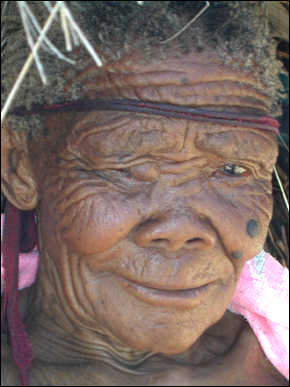
Portrait of Nxwaxebe Sakuu, returning to Kikao. In August 2009 Bushmen who reside on the Kikao settlement filed a case with the country’s High Court requesting the government supply them with potable water.
I had been invited, and would have very much liked to join them. Over seven years in southern Africa I had grown fond both of the Kalahari and of Botswana’s predominantly decent people. To Botswana I had dragged my girlfriend, where we conceived a child, become engaged and raised our daughter. When work ended and my family moved home to America, I left an off-road vehicle and camping equipment behind, with plans to visit again and again. Then, one day, return became impossible.
After four decades as the exceptional shining example of African democracy, citizens became anxious their country was “heading for a dictatorship.” Even the jovial best-selling writer Alexander McCall Smith, creator of Precious Ramotswe, spoke up against Botswana’s policies in the Kalahari. In response the government began to label its critics as “enemies of the state.” Church leaders grew “afraid of making public comments for fear of being accused of being members of opposition parties.” President Mogae expelled a University lecturer as “a rogue” because he questioned the Bushmen evictions. Eventually, Mogae targeted 17 critical academics, human rights activists, and journalists from the UK, the U.S., Australia and Canada, and on that blacklist I found my own misspelled name. Until that list is revoked, I am left with the last memories of these defiant people.*
One evening at dusk several of us walked a quarter mile to pay respects before three unmarked piles of sand. The sky blazed orange and purple against thin distant clouds. Moving from one to another in turn, Mongwegi pointed out where Moeti, Gaoberekwe, and Qoroxloo lay buried. No animals had disturbed her grave over the last twelve months. The elements had smoothed the sand surface, but thorn branches still arced across it as a barrier to scavengers.
Jumanda shook his head. “In here are these three graves from five years,” he said. “And during that time, how many dozens of young men and women have we buried outside the Reserve? How many died out there and were unable to come home?”
Suddenly Mongwegi closed his eyes, threw back his head and cried out “to the spirits of these ancestors” to “continue to guide the living. To give strength to us. To show us the way when we become confused and have doubts.”
We turned in the silence and walked slowly back toward the fires and the laughter of Metsiamenong.
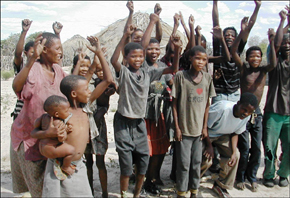
On that same trip, I spent a night in the eviction camp, Kaudwane, outside the Reserve. Hundreds still lingered there in purgatory, hating the place but too fearful of government threats to leave. I arrived there with Roy Sesana and the FPK legal team, who reassured the Bushmen that the High Court had ruled on five counts that they had been wrongfully, illegally, and unconstitutionally forced from the Kalahari and deprived of their livelihoods and homeland. They were free to return to the place they still called home. At this news the Bushmen jumped up and danced and clapped excitedly, and their wide eyes shone in disbelief.
Later, as the initial joy subsided and reality set in, a few asked if the government would again provide them water inside.
The Bushmen attorney, Gordon Bennett, slowly shook his head and looked down. On that count, he conceded, the High Court had ruled termination and destruction of water was legal and constitutional. Botswana would not restore it. But he planned to negotiate a compromise with them.
Upon translation, the Bushmen fell silent.
An hour after hearing the legal decision, two dozen Bushmen gathered beneath a shade tree, squatting on their haunches. As each spoke, the others listened. Some gestured, shook their heads, or drew in the sand with sticks.
I sat near a young Bushman named Kelejetseeing Moloreng. His family raised him in Mothomelo, but he left the Reserve as a teenager after officials destroyed the borehole. He now had a wife and child, and wanted to bring them to what he still considered to be home in the heart of the Kalahari. I pointed to the discussion and made a questioning face.
“The men, they are talking,” he said in the halting English he had picked up outside the Kalahari, “about water, how to get the water.”
ABOUT THE AUTHOR:
James G. Workman is an award-winning journalist and has served as an environmental consultant to U.S.-cabinet members.
Two of his friends elaborated. Men were debating distances, the limits of mobility into the Reserve, how much water they could carry and what the government might allow. Women worried about the status and distribution of the wild food growing inside.
“Some we eat,” explained Moloreng, “others we drink. They are divided. The food has water inside it.” I asked the men if they planned to return home. They vigorously nodded their heads, but their eyes left room for doubt. Some had previously been beaten for hunting. Most had been dependent on government services all their lives. “When it doesn’t rain, it is a problem,” said one.
“We grew up with it provided,” added another, “and here was always a tap.”
“But some of your people have never left the Reserve,” I observed.
“Yes,” said Moloreng, looking away for a moment, and then back at me. “They are strong. We are young. We go in during the wet season, when it is green. But during the dry season –” his voice trailed off.
I scribbled his words down into a yellow pad. He watched my chicken-scratch, smiled, and asked what I was doing. For decades out in the Kalahari, Bushmen had grown accustomed to anthropologists and wildlife researchers working on dissertations, but in recent years the foreigners with cameras, recorders and notepads grew increasingly rare. Perhaps the romantic mystique and novelty was wearing off, and evicted Bushmen were becoming just like 40 million other deracinated people. I explained that I wrote about drought and the struggle over water, and how what unfolded here may foretell what occurs in nations beyond Botswana’s borders.
The connection to people far away seemed to cheer him. “Yes,” he said. “Put this into a book, so the world can know about us and what was done to us. And we can tell the story to our children.”
“Where will you tell it to them? Here in Kaudwane?”
“No,” he answered. “Inside. In the Reserve. In our home.”
“How will you live there?”
“The old,” said Moloreng. “They know.” He fell silent for so long I wasn’t sure he would continue. Then he added in a quiet voice, “They know how to live without the water.”*
The old may know but they are dying faster than the vast wild places that forged their existence, taking with them strategies about how to adapt to a hot, dry, and unforgiving world.
A picture of Kgaga bringing supplies to her hut–the Bushmen continue their way of life despite the extremely limited water resources.
The rarity of the last free and autonomous Kalahari Bushmen can make them seem precious; it can lead us to romanticize them as Rousseau’s ‘noble savage.’ Yet that, I think, would diminish Qoroxloo’s life and death. She was neither savage nor superwoman but rather a pragmatist who knew exactly where she was and thus who she was. She knew how to live and when to die. She successfully resisted eviction armed with nothing more than the intimate knowledge of her community and her place. And her nobility emerged when the stress from nature’s finite limits was compounded by official force, whereupon she did what any mother would do in such circumstances. Cut off from water, confined to a small perimeter, she denied herself week after week so that her family could endure. During her defiant existence Qoroxloo left a legacy as rich and potent as the rock art of her ancestors. Through perpetual drought and a protracted siege she revealed glimpses of a pragmatic Bushmen code of conduct.
Every society lives by a social contract, from religious authoritarian “thou shalt not” laws of the Ten Commandments or the Koran, to the secular democratic “government shalt not” protection of liberties under America’s Bill of Rights. Perhaps because theirs remained unwritten, the Bushmen’s code of conduct had the distinct advantage of being simple, durable, flexible and adaptable to aridity. Then again, it had to be. Without any hierarchical police enforcement, their lives were governed by voluntary and egalitarian interactions and by the authority vested by in the Kalahari itself.
In seeking out Bushmen to unlock a secure path through the age of permanent drought, I first had to get past barriers of lingering mythology and ideology. I am not immune to romantic sentiment. I want to believe, like Rousseau, that dissidents like Qoroxloo and indigenous people on every continent are innately one with nature, that they are more ethical than the rest of us, that they have a built-in tendency toward restraint which somehow made Bushmen, as one colleague put it “the original conservationists.” By this reasoning the Kalahari Bushmen would not squander opportunity or trust. They would avoid the stupid, selfish, reckless, destructive, wasteful, divisive, and shortsighted mistakes that the rest make outside the reserve, especially regarding something so fragile and magical as water.
My inner skeptic has persuaded me otherwise. I hope my lost naïveté reveals less a cynical pessimism than realistic hope based on universal egalitarianism. In any case the unvarnished anthropological record of human nature shows our species’ behavior does not vary by race or ethnicity, only by externally imposed social, ethical, political, and physical constraints. With no such limitations, each of us looks out for his or her personal interest—using others or exploiting the environment—until power corrupts us absolutely.
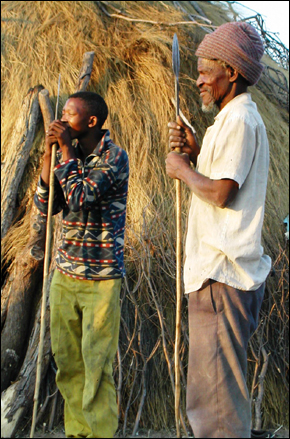
Nyare Bapalo and his grandnephew Moagi sharpening spears before a hunt.
By now it should be all too clear that in a dry, hot world, water equals power.
So, given unlimited access to borehole technology and unlimited fuel to pump and deliver water, Bushmen would likely invite upon themselves levels of trouble, depletion, and exploitation from which they would most likely never recover. Just like us.
If our competitive demand for scarce water drives us apart and escalates tensions, this same finite supply of freshwater is also itself what ultimately drags us back and binds us together. We may not like the rule of increasingly scarce water, but at the same time we cannot escape it. And Qoroxloo’s band demonstrated how to embrace that reality. Her fundamental rule of adaptation was not to organize and mobilize physical resources to meet expanding human wants, but rather to organize human behavior and society around constraints imposed by diminishing physical resources.
To restate the reality of mitigation: We don’t govern water; water governs us. *
What did that mean in practice, for Qoroxloo’s band, and for us? We have seen how the scarcity of water governed all vital decisions: who and why to trust; where and when to disperse; what to eat; how much to consume; which plants were burned for fuel, used for construction, or gathered to drink. A water-secure diet emphasized diversified, nutritious, drought-resistant, and moisture-rich permaculture over tastier, storable, transportable bulk food, and was harvested nearby at peak water-ripeness. Since tastier feedlot cattle could not survive droughts, hunting favored desert-adapted game species whose juicy meat concentrated metabolic water. Health, sanitation, and medical decisions adroitly embraced aridity to convert waste into fertilizer, establish a buffer zone from disease vectors, and provide treatments from the concentrated oils of plants.
Unrestricted liberty allowed dispersal to more abundant water resources, reducing ecological pressure and political stress; and rewarded each individual for drawing on his or her unique knowledge of water extraction from a diversified portfolio of strategies.
Creation was not vertically ranked or segregated by species but rather shared the increasingly arid landscape while competing for its water resources. Manufacture of luxurious vanity items encouraged competition and reserved water for more urgent needs. Trained from childhood to avoid evaporation and leaks, Qoroxloo’s band developed their technology in the service of water, sealing it from the hungry sand and sheltering it from the thirsty sun. Rivalry over scarce water resources has always existed, but against primal instincts toward zero-sum violence our interdependence encouraged voluntary exchanges among networks that efficiently spread out risks while rewarding conservation both within and between bands. Conservatives call these informal markets while liberals see a reciprocal system of egalitarian barter.
The Bushmen celebrate upon hearing from attorney’s that the court ruled in favor of their land rights.
Regardless of ideology, such exchanges emerge only when a society collaboratively agrees to define and defend a water resource that could be divested. Rain belongs to everyone and everything, but Bushmen honored long-standing individual and group rights to water resources: a sip-well, a pan, a buried and labeled water canteen, a field of tsama melons, a grassy hunting territory favored by eland or gemsbok, a wild cluster of fruit or water-filled trees growing along a seep line. Extending rights beyond kin to strangers not only reduced short-term hostility and resentment, but also helped expand an informal safety net of grateful recipients — a reliable form of drought insurance.
The principles or collective code that worked for Bushmen can be adapted outside their reserve. After all, whether it pulses between a competing heart and brain, sinks down in the shared aquifer beneath our fenced-off private property, or flows in the common currents that run along or across our walled-off borders, water is quite literally the connective tissue that links and rules our fates. Only this magical glue makes us collaborate to endure drought conditions at every level.
If we are to prevent dehydration, domestic strife, or degeneration into the ruthless Hobbesian/Darwinian scenario—recall those baboons around a waterhole or those first colonists at Roanoke or Jamestown—and if we are to avoid testing the nightmare hypothesis of a trans-national water war, then we need to derive a system like that which for millennia sustained people in the Kalahari.
Two-minute video “preview/trailer” of Heart of Dryness
Read more excerpts from Workman’s book featured on Circle of Blue here.
_____
* Footnotes
Dikarabo Ramadubu, “Professor Good Gone for Good,” Botswana Guardian, July 29, 2005.
Keto Sewai, “Government Slaps Visa Restrictions on Critics,” Mmegi, March 29, 2007; “The 17 affected individuals are: Steven Corry, Mirriam Ross, Fiona Watson, Jonathan Mazower, Janie Workman, Jonathan Reed, David White, John Walsh, Oliver Duff, Karin Goodwin, Carol Midgley, and Jonathan Simpson – all from the UK. The listed Americans are: Rupert Isaacson, Eric Grossberg and Tom Price; while Ian Taylor is an Australian and Daniella Stor is Canadian. At press time, Mmegi had been able to establish that four of the Britons – Corry, Ross, Watson and Mazower are all from Survival International (SI), government’s well-known nemesis in the CKGR saga.
Seven of the people in the list are journalists. They include Simpson, the respected world affairs editor with the British Broadcasting Corporation (BBC); Financial Times of London’s South African correspondent, Reed and its African editor, White; Price, a highly respected American freelance journalist who often contributes to major publications such as the Los Angeles Times. Other journalists are: Duff (Independent – UK), Goodwin (Sunday Times – Scotland), and Midgley (The Times – UK).
Taylor is an Australian academic who previously worked as a lecturer on African Affairs at the University of Botswana. He co-authored a critical paper entitled “Presidential Succession in Botswana: No model for Africa” with Professor Kenneth Good. Speculation is rife that that paper, which Good was unable to present, led to his unceremonious deportation from Botswana. American Isaacson is known to be with the Indigenous Land Rights Fund, while Grossberg is suspected to be associated with an organisation that deals with conflict-free diamond issues. At the time of going to press, Mmegi had not yet established what Stor, Workman and Walsh do.
EPILOGUE: WHAT WOULD BUSHMEN DO?
In a seminal chapter of A Sand County Almanac called ‘The Land Ethic,’ Aldo Leopold eloquently argued how the “extension of ethics is actually a process in ecological evolution.” The evolving process or “ethical sequence” rippled outward, more inclusively with time, from: 1) personal conduct codes like the Ten Commandments, which guide relationships between individuals; to 2) social conduct codes like the Golden Rule or US Constitution which guide and govern the relationships between people and society; to 3) natural conduct codes, still emerging and undefined, which integrate humans with our complex life support system. Leopold focused his analysis toward this third category: An ethic, ecologically, is a limitation on freedom of action in the struggle for existence. An ethic, philosophically, is a differentiation of social from anti-social conduct. These are two definitions of one thing. The thing has its origin in the tendency of interdependent individuals or groups to evolve modes of co-operation. The ecologist calls these symbioses. Politics and economics are advanced symbioses in which the original free-for-all competition has been replaced, in part, by co-operative mechanisms with an ethical content.
Matt Ridley, “Ecology as Religion” in The Origins of Virture.
Sometimes ownership rights bore marks as obvious as a notched arrow or a labeled water canteen; more often than not, the ownership information was conveyed orally among those who asked permission.
Well, sort of: The mag bases its praise on the city’s 10-year, $240-million bike master plan, which is intended to triple the number of journeys made by bike and add 450 miles of bike paths. But that lovely plan is currently underfunded by nearly $165 million, or 70 percent. While the local media caught the discrepancy, Bicycling Magazine didn’t, and Seattle is once again praised based on its promises, not its actions.
I haven’t fact-checked the rest of the bike-friendly list, but suffice to say, this sort of coverage encourages politicians to make grand pledges without following through. Roger Valdez proposes the term “sustainability gap” for the troublesome gulf between what politicians say and what they actually do to sustain-ify their cities, states, nations, school districts, etc.
Another pertinent example: The Seattle City Council recently adopted a goal to become carbon neutral. At the very same meeting, a council member tried to greenlight a massive, $4.2 billion downtown tunnel that includes no space for transit lines, only roads.
“[It’s] like John F. Kennedy telling Congress in 1961 that we would land a man on the moon before the end of the decade, and then signing legislation defunding NASA,” writes Valdez, a researcher at Northwest sustainability policy shop Sightline.
Even when they are hollow, however, splashy promises from civic and business leaders amount to invitations to accountability. They are tools that citizen watchdogs can use to leverage change—as long as they pay more attention to performance than promises.
If you’re a Sprint subscriber and you live in an area of spotty cell service, you’re probably familiar with the AIRAVE, the company’s CDMA femtocell. If so, you’re also probably familiar with the gadget’s limitations, namely its lack of 3G and VoIP support.
We’ve been expecting updated hardware to come down the pike for some time now, and a tipster has recently made us wise to the fact that a refresh to the popular device is neigh, citing an internal Sprint email that’s being sent around picturing a revamped AIRAVE boasting VoIP landline and EV-DO support. Corroborating this tip is a FCC filing recently dug up by the folks over at Engadget.
We’re still digging around for the details on pricing and availability, but it’s probably safe to assume that it’ll be priced similarly to the current offering (free for some, $99 for others, with monthly fees starting at $10). As far as availability, when draft manuals start getting emailed to employees and filings bubble up on the FCC’s website, you can assume that it will be "soon".
Current AIRAVE users: are the upcoming enhancements enough to warrant an upgrade for you?
What’s plastic, sings songs, and sits in boiling water? No, it’s not Britney Spears at a cannibal colony, it’s the BeepEgg! This little gizmo lives in the fridge, with your eggs, then rides along into the saucepan when you’re boiling them. Its internal thermostat continuously measures the water temperature, calculates the inner temperature of the eggs, then lets you know what level of hardness they’re at by playing one of three different tunes…
Original: One piece of the Nexus One puzzle that’s been missing for a bit has been the car dock, which we saw teased in the making-of videos back in early February. But now it has a proper place in Google’s Nexus One help articles. And from it we learn:
The dock has a built-in speaker and volume controls. (We’d like to see an FM transmitter, but we’re not holding our breath.)
The Car Home app loads automatically (we assume that means "launches") when the phone’s inserted.
There’s a proper 12V charger to keep you juiced up and navigating.
What’s still missing: Price and actual availability, though it sure looks like we could see it any day now. Keep your eyes peeled, people. [Google via Android and Me]
This post is part of the Entrepreneurship series – sponsored by AcceptPay from American Express, a new online solution that lets you electronically invoice customers and accept online payments-all in one place. Offer more payment options, manage your cash flow and get paid faster with AcceptPay. Learn more here.
Of course, the content of this post consists entirely of the thoughts and opinions of the author.
Over the past few years, the review site Yelp has been no stranger to controversies regarding its treatment of comments and criticisms aimed at local businesses. Negative reviews on Yelp have spurred variouslawsuits, accusing Yelp of unfair business practices that have been called “Extortion 2.0” — referring to the accusation that Yelp salespeople put pressure on companies to pay up for better ratings to appear more prominently on Yelp (and to remove the bad reviews that coincidentally seem to appear on the site when these salespeople allegedly suggest that better ratings could be bought).
In response, Yelp has explained (over and over again) that its algorithms are optimized to display the most “trustworthy” reviews of local businesses — in a way that’s completely unrelated to its sales efforts. Trying to put a friendly wrapping around its umpteenth explanation, Yelp has even created a cartoon to help educate everyone on its methods:
However, no matter how simply these explanations are conveyed, they have not been particularly convincing to small businesses who feel punished by bad reviews and see Yelp’s services as a veiled threat to their livelihood. So Yelp has taken another step by announcing some changes to its services to avoid further confusion:
Businesses can no longer buy a “Favorite Review” like they could before — so that there’s no confusion over businesses being able to influence reviews by paying Yelp. This sounds like a pretty big step towards making it clear that companies can’t just buy better reviews, but what does this mean for companies that formerly bought “Favorite Reviews?” Those companies are being penalized with the unexpected removal of this service, and there’s still no guarantee that ratings can’t be manipulated by cunning business owners or competitors. Though, the conspiracy theorists may never actually be satisfied on this point, and gaming online rating systems will likely always be a nagging concern.
Yelp is still keeping its review filtering algorithms a secret, but it will now display reviews that have been removed by its automated filters in an effort to allow users to see a bit of the reviews that Yelp deems suspicious or untrustworthy. However, Yelp is not exactly highlighting these filtered-out reviews — just making them available to be viewed in case anyone is curious to see what kind of reviews are tossed out on a regular basis.
Yelp is adding video ads as a service for businesses — presumably to offset the loss of its “Favorite Review” feature.
Yelp says it’s created a Small Business Advisory Council for companies to give feedback to Yelp management. This is an interesting development, but it’s not exactly easy to find out more information on how this council works. Granted, it was just announced, but its announcement seems to lack a bit of commitment when there aren’t any obvious links about it on yelp.com (yet?).
Yelp proudly states that it’s increasing transparency with these changes, allowing businesses and users to peek into what its algorithms are filtering out behind the scenes. But it’s not clear that anyone really asked for that feature — and getting that look at the filtered reviews isn’t going to ease the concerns that Yelp’s algorithms are inherently weighted against small businesses who don’t pay up for advertising space on Yelp.
The more significant change seems to be that Yelp is shifting away from a “Pay for Placement” business model with its reviews. Replacing its “Favorite Reviews” with video ads seems a bit odd, though — but apparently video ads were a top request from merchants. So at least Yelp is listening to its customers and responding — and if Yelp really wants to increase transparency, maybe we’ll see how Yelp actually handles feedback someday. But since Yelp doesn’t allow commenting on its own blog, chime in here and tell us what you think Yelp is doing wrong or right with its approach.
If you plan to visit Los Angeles and want to stay at the W Hollywood, don’t expect to get to see the rooftop pool. The hotel contracted the running and maintenance of its pool out to a Las Vegas promotion company, and now it’s been turned into an exclusive club and is off-limits to paying customers of the hotel.
Gadling’s blogger Jason Cochran was a guest at the W Hollywood last month and discovered this new rule first hand, when a bouncer doorman turned him away and said that members of the “general public” weren’t allowed in the pool. Apparently paying $230 a night for a room at the hotel makes you a member of the general public as far as pool privileges go.



 Another change from 2007 that we noticed was an increased tie-in with


 Humans have travelled all over the planet but many uncharted regions of the globe still hide unknown animal species waiting to be discovered. With
  V.bitatawa has an unusual habit that separates it from all but two other monitor species – it mostly eats fruit. Even before the animal had been discovered, the field team had suspected that a fruit-eating monitor lizard was prowling the forests, based on scratch marks all over the local fruiting
  So far, the team have recovered three specimens of the new lizard and it seems that V.bitawawa only lives in a small band of mountainous forests in the Philippine island of Luzon. It shares the island with the Gray’s monitor, but the two animals are separated by over 150km that includes three river valleys. They’re unlikely to mingle.