Blog

  • Fire ants, poison ivy, deer ticks: Global warming’s big winners

    by Miles Grant

    HEAR the buzz of dread! FEEL the rash of terror! SEE the creatures of despair!

    WATCH … They Came From Climate Change!

    The National Wildlife Federation created the Climate Invaders report and accompanying video to bring attention to a very real problem—global warming giving a boost to some very unsavory critters, helping them settle into areas where once they were unable to survive. Some are creeping up from lower elevations and into warmer areas, while others are finding it easier to invade from foreign soil.

    As climate change causes winters to warm and seasons to shift, a host of exotic invasives and destructive natives are marching their way into our lives at an ever increasing rate. These climate invaders will continue to spread disease, destroy valuable natural resources and push out the native plants and wildlife Americans cherish if global warming continues unabated.

    According to the report:

    Milder winters are projected to increase the range of deer
    tick
    populations by 68 percent in North America by later this
    century. 
    Within the lifespan of a child born today, the range of the red
    imported fire ant
    in the United States could expand northward
    by about 80 miles and expand in total area by 21 percent as climate
    change makes new areas suitable for their survival.
    Poison ivy is expected to become more “toxic” as a
    result of increased levels of CO2 in the atmosphere.
    If summer precipitation declines significantly, this could expand
    the amount of suitable land for cheatgrass by up to 45
    percent, bringing increased wildfire risks with it.
    Several species of the water-hogging salt cedar shrub
    are poised to take full advantage of a changing climate in the western
    United States, where water is already scarce.
    Absent the severe winter cold which kills over-wintering beetle
    larvae, pine bark beetle populations have exploded to
    unprecedented levels across the Western United States, killing billions
    of trees.
    Climate change is likely to aid further range expansion northward
    in the United States of the Asian tiger mosquito,
    increasing disease transmission potential.

    But it’s not too late to stop the invasion. “To meet the challenge before us, Congress must pass climate
    legislation
     that includes a significant dedicated investment to protect
    and restore the rivers, coasts, forests, and wild lands threatened by
    climate change,” says NWF’s Derek Brockbank.

    Related Links:

    The future of freezing

    Without affordable clean alternatives, South Africa turns to coal

    Revkin: “The idea that we’re going to fix the climate change problem or solve global warming has alw


  • Comcast vs FCC: In Battle For Net Neutrality, Did the Courts Hand Comcast a Pyrrhic Victory?

    The U.S. Court of Appeals for the District of Columbia handed Comcast a victory against the Federal Communication’ Commissions today, but in winning its appeal, Comcast may have just set off a war — one it could wind up losing. As we noted, a three-judge panel took issue with the FCC’s attempts to regulate cable’s ability to manage its networks, not simply because there wasn’t a formal rule-making process in place, but because the FCC appears to have overstepped its bounds when it tried to regulate how a cable company managed its network.

    Stifel Nicolaus, an investment bank, lays it out well in a research note:

    Today’s ruling is destabilizing as it could effectively free broadband providers from FCC regulation over broadband, including net neutrality, rules requiring transparency letting customers know what actual speeds they are receiving, the ability to prioritize emergency communications, consumer privacy protections (though these could presumably be imposed to a certain degree by the FTC). But it could lead the FCC to reclassify broadband services as the more heavily regulated “telecommunications service” under the traditional Title II – which the Bells, cable, and wireless companies (e.g., T, VZ, CMCSA) strongly oppose.

    So while this decision does throw the FCC’s current network neutrality rule-making into disarray, it also could affect the agency’s attempts to regulate a wide variety of broadband issues, including how broadband providers tell consumers what their true Internet speeds are, as well as how the agency can enact universal service fund reform and set privacy rules on the Internet.

    What the FCC needs to figure out is whether or not it should assert its authority narrowly for each issue it is trying to address, and risk its authority being challenged each time (possibly in court) or if Congress needs to step in to grant the FCC more power. Already several consumer organizations have issued statements about the ruling, such as Gigi Sohn of Public Knowledge:

    “The FCC should immediately start a proceeding bringing Internet access service back under some common carrier regulation similar to that used for decades. Some parts of the Communications Act, which prohibit unjust and unreasonable discrimination, could be applied here. The Commission would not have to impose a heavy regulatory burden on the telephone and cable companies, yet consumers could once again have the benefit of legal protections and the Broadband Plan could go forward.”

    The FCC itself is being coy on the reclassification issue, saying:

    “The FCC is firmly committed to promoting an open Internet and to policies that will bring the enormous benefits of broadband to all Americans. It will rest these policies — all of which will be designed to foster innovation and investment while protecting and empowering consumers — on a solid legal foundation. Today’s court decision invalidated the prior Commission’s approach to preserving an open Internet. But the Court in no way disagreed with the importance of preserving a free and open Internet; nor did it close the door to other methods for achieving this important end.”

    Apparently everyone — even Comcast, which originally sued the agency — is in favor of a “free and open Internet.” Comcast, which declared itself vindicated, was careful to point out that it was in favor of the open Internet principles, despite its original P2P blocking efforts:

    Comcast remains committed to the FCC’s existing open Internet principles, and we will continue to work constructively with this FCC as it determines how best to increase broadband adoption and preserve an open and vibrant Internet.

    Other major ISPs have also been quick to favor the existing broadband principles (notably those do not include network neutrality provisions on wireless networks and require ISPs to be transparent about any network management). AT&T, in what looks to be a bid for self-regulation by ISPs, suggested that the FCC’s censuring of Comcast wasn’t needed because Comcast had stopped the throttling on its own (although it did lie about what it was doing, pack hearings on the topic in its favor and behave poorly throughout the process). AT&T attributed its statement to Jim Cicconi, senior executive vice president of external and legislative affairs:

    “If, after assessing its options under Title I, the FCC feels it needs to clarify its jurisdiction as a result of today’s decision, we hope the issue would be referred to the U.S. Congress which alone confers the Commission’s legal authority. In any circumstance, AT&T pledges to work constructively with the FCC as it considers these questions.”

    Verizon’s statement — attributed to Randal S. Milch, executive VP and general counsel — doesn’t emphasize the need for Congress to get involved, despite one of its top policy wonks calling for Congress to figure out new ways to regulate broadband last month:

    “The court recognized that the FCC does have Title I ancillary authority over Internet access. In this case, the FCC simply failed to link its actions to its statutory responsibilities. The FCC’s authority supplements the various other consumer protection and competition laws that apply to all members of the Internet ecosystem.”

    As this devolves into a fight between lawyers, it’s important to realize what’s at stake amid all of the fancy language, namely the ability for content to pass relatively unimpeded over the pipes that provide your broadband access. At stake as well is who gets to make the rules that govern those pipes, no matter if the ISP is a telco, a cable company or even Google.

    Post and thumbnail photos courtesy of Flickr user Steakpinball

  • New Element Discovered! But Don’t Ask About Its Name | 80beats

    element-117-279x300A little square that has been left blank on the periodic table for all these years might finally be filled in. A team of American and Russian scientists have just reported the synthesis of a brand new element–element 117. Says study coauthor Dawn Shaughnessy: “For a chemist, it’s so fundamentally cool” to fill a square in that table [The New York Times].

    If other scientists confirm the discovery, the still-unnamed element will take its place between elements 116 and 118, both of which have already been tracked down. A paper about element 117 will soon be published in Physical Review Letters, and scientists say the new element appears to point the way toward a brew of still more massive elements with chemical properties no one can predict [The New York Times].

    Element 117 was born in a particle accelerator in Russia, where the scientists smashed together calcium-48 — an isotope with 20 protons and 28 neutrons — and berkelium-249, which has 97 protons and 152 neutrons. The collisions spit out either three or four neutrons, creating two different isotopes of an element with 117 protons [Science News].

    The new element 117, takes it place between two superheavy elements that scientists know to be very radioactive and that decay almost instantly. But many researchers think it is possible that even heavier elements may occupy an “island of stability” in which superheavy atoms stick around for a while [Science News]. If this theory holds up, scientists say, the work could generate an array of strange new materials with as yet unimagined scientific and practical uses [New York Times].

    The excitement continues for the scientists who toiled to synthesize the new element, as they wait to hear what it will be named. Usually, a new element is named after someone or someplace involved in the research. The element berekelium, which was used in the experiment, was named after the University of California at Berkeley, where it was first synthesized, while element 112 was just recently named Copernicium in honor of the 16th century scientist Nicholas Copernicus.

    So far, the scientists have been exceptionally mum about what the element might be called. Yuri Oganessian, a nuclear physicist at the Joint Institute for Nuclear Research in Dubna, Russia and the lead author on the paper, said in an e-mail message: “Naming elements is a serious question; in fact…This takes years” [New York Times]. His silence is reinforced by team member Shaughnessy, who was equally cagey about possible names for the new element: “We’ve never discussed names because it’s sort of like bad karma…It’s like talking about a no hitter during the no hitter. We’ve never spoken of it aloud” [New York Times].

    Till the element is confirmed and it takes its formal place on the periodic table, scientists say it shall simply be referred to as element 117–or by the Latin reference to its number, ununseptium.

    Related Content:
    80beats: Zinc + Lead = New, Superheavy Addition to the Periodic Table
    DISCOVER: Physicists Extend the Periodic Table
    DISCOVER: 19: Two New Elements Discovered
    DISCOVER: 10 Obscure Elements That Are More Important Than You’d Think

    Image:Wikimedia


  • Should Microsoft franchise its retail stores?

    By Joe Wilcox, Betanews

    If you believe Mid-March job postings, Microsoft is preparing to launch two new retail stores, in Denver and San Diego, bringing the count to four. That’s not exactly rapid expansion, given two other stores opened in October — Mission Viejo, Calif. and Scottsdale, Arizona. Microsoft has to move more aggressively into retail, if it’s going to rebuild its brand image and establish an appealing digital lifestyle for the twenty-tens.

    The company has an image problem that smart marketing and savvy retailing can repair. Yesterday, at MSNBC, Bill Briggs called Apple “fresh” and Microsoft “frumpy”. The nut graph: “Microsoft, to some, appears a tad flabby in the middle — a Chrysler Town & Country driver with a 9 p.m. bedtime. Apple, in some eyes, looks sleeker and younger — a hipster in ragtop Beemer packed with chic friends sporting mobile toys.”

    Microsoft is getting the marketing part down. Bing and Windows 7 TV commercials are remarkably good (I love the French one, by the way). But marketing alone won’t fix Microsoft’s image problems. All successful brands sell a lifestyle, something companies like Apple, IKEA, Pepsico and even Walmart excel at. Retailing is the other part of the solution. Like Apple and Sony, Microsoft needs retail stores to hawk its products, improve customer satisfaction and sell a lifestyle. That’s not going to happen with a few stores opening every year.

    So why not franchise? Apple wouldn’t do it. But franchising is highly congruous with Microsoft’s long-loving channel ways. Rather than compete with retailers and resellers, Microsoft should make some of them part of the family. The company already has robust channel programs in place. Surely Microsoft could create from that foundation a franchise program faster than the time needed to build 20 or 30 new stores on its own.

    I’m not talking authorized dealers, but real Microsoft Stores. Malls are filled with, say, AT&T or T-Mobile stores and their authorized dealers. They confuse consumers, and the approach is not a clear, clean way to build a lifestyle brand. Like other franchises, the stores would conform to design and operational standards set by the franchiser. Like McDonalds franchises, these Microsoft Stores would be indistinguishable from company-owned shops. Although a smart Microsoft would give franchisees some pricing latitude and perhaps opportunity to offer additional services.

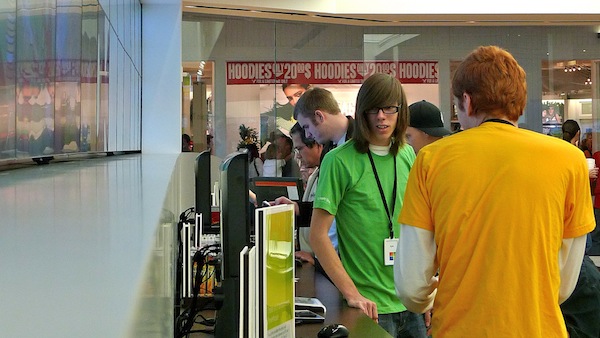
    Microsoft Store Geeks

    Timing is excellent:

    • There is plenty of available retail space — even in shopping malls — presumably for more reasonable prices than, say, two years ago.
    • The Obama Administration is looking for ways to stimulate small business growth; franchising could be good PR as much as good retailing.
    • Microsoft’s financing arm could help worthy franchise applicants to secure financing in these tough-borrowing times, which, again, would be good PR.

    Franchises would offer many benefits to Microsoft:

    1) They would generate additional revenue, in the upfront franchise cost and any cut Microsoft might choose to take from the stores.

    2) Microsoft could rapidly build up its retail presence, assuming there are businesses looking to buy the franchises (Surely there would be).

    3) The company could more rapidly learn what does and what does not work in retailing and apply those lessons to its operations. Microsoft CEO Steve Ballmer claims that running Yahoo search provides scale for improving search queries. The same scale principle can be applied to improving the retail experience.

    Microsoft could (and should) continue building its own stores even as franchisees open others. My advice: Set a target for what number of stores would have enough geographic reach, then end the franchising program. Ideally, Microsoft should want more company stores than franchises. They are but a means to end — scaling the retail operation faster. Microsoft could inform potential franchisees from the start that the program would eventually end. Those folks buying in early could get something not available later on. That would be incentive for them to participate.

    The other option is for Microsoft to build retail stores faster. But at present pace, Microsoft isn’t moving fast enough.

    Copyright Betanews, Inc. 2010


    Add to digg
    Add to Google
    Add to Slashdot
    Add to Twitter
    Add to del.icio.us
    Add to Facebook
    Add to Technorati


  • EFF Hires New International Rights Director

    EFF is pleased to announce the hire of our newest staff member – International Rights Director Katitza Rodriguez. Katitza will be working on international privacy issues, an area in which she is widely recognized as one of the world’s leading experts, with special emphasis on law enforcement, government surveillance, and cross-border data flows. Katitza will also be focusing on cybersecurity issues at the intersection of privacy, freedom of expression, and copyright enforcement.

    Before joining EFF, Katitza was Director of the international privacy program at the Electronic Privacy Information Center in Washington D.C., where amongst other things, she served as the Research Director of The Privacy and Human Rights Report, an international survey of privacy law and developments in 78 countries. Katitza is well known to many in global civil society and in international policy venues for her work at the U.N. Internet Governance Forum and her pivotal role in the creation and ongoing success of the Civil Society Information Society Advisory Council at the Organisation for Economic Co-operation and Development, for which Katitza served as the civil society liaison from 2009 to March 2010.

    Katitza joins Gwen Hinze, EFF International Director, and Eddan Katz, EFF International Affairs Director, in EFF’s International Team. The Internet is global, and so are threats to individuals’ digital rights and freedoms. That’s why EFF created an international program in 2004. With the welcome addition of Katitza, we’re looking forward to strengthening our capacity to engage in policy analysis and international advocacy on the growing range of issues involving privacy, trans-border data flows, and cybersecurity.

    For continuing developments, read our Deeplinks blog and follow EFF!

  • Durbin: Unfair to blame Giannoulias for all of family bank’s woes

    Posted by Rick Pearson at 5:27 p.m.


    Illinois Sen. Dick Durbin says it’s not fair to hold Democratic U.S. Senate nominee Alexi Giannoulias responsible for every decision at his family’s troubled bank and contends voters are more concerned about jobs and the economy than the fate of the Broadway Bank.


    Still, Durbin, the state’s senior senator and the chairman of Giannoulias’ campaign, said it is fair to ask the Democratic nominee what responsibility he bears for the problems facing the bank. Giannoulias worked at his family bank prior to being elected state treasurer in November 2006. Federal regulators have asked family members who own the bank to recapitalize it or risk closure later this month.


    “If it’s in trouble today, how much can you blame him?” Durbin told the Tribune’s editorial board this afternoon. “What responsibility does he bear for it? I think that is a fair question and he’s the only one who could answer that. I can’t.”


    Giannoulias’ main opponent in the Senate race, five-term Republican North Shore Rep. Mark Kirk, has used the bank’s problems to criticize Giannoulias’ qualifications.

    Durbin, the second-ranking Democrat in Senate leadership, said Giannoulias told him that he had nothing to do with “over 90 percent” of the loans made at Broadway Bank, where Giannoulias previously served as a loan officer. And Durbin said Giannoulias told him “he did not play a personal or major role” in $20 million in loans given to two reputed organized crime figures during Giannoulias’ tenure at the bank.

    Meeting with the Tribune editorial board last month, Giannoulias said he
    accepted "my share of the responsibility" for the bank’s problems but
    did not discuss specific lending decisions, citing the privacy of bank
    customers.

    Durbin said today that campaign focus groups show that instead of expressing concern about Broadway Bank, voters are asking, “What about my job? What is going on in terms of the economy and moving forward?” in the contest against Kirk.


    “I think at the end of the day, the overriding issue is going to be the state of the economy and whether it’s turned around — whether Mr. Kirk’s position on economic issues is better for the state or Mr. Giannoulias’,” Durbin said.

    Asked whether Giannoulias inflated his role at the bank in selling his banking experience to voters during the 2006 state treasurer campaign, Durbin said he didn’t “know enough about banking” to say where the Senate candidate fit on the pecking order at Broadway Bank.

    Durbin also said Giannoulias has done a good job as treasurer. Giannoulias came under fire after significant losses in the state’s Bright Start college savings fund used by parents. Durbin said that the fund that lost money was “one of 20 funds there” but “by and large, I think he ran that program well.”

    Durbin also credited Giannoulias for getting two longstanding controversial hotel loan properties off the state’s books and for refusing banking related contributions for his campaign.

    “He brings more than that personal resume to the campaign. He brings a dramatically different position on major issues than Cong. Kirk,” Durbin said. “I would say to the voters of this state: You can have a lot more experience (with Kirk) and come up with an approach to things that doesn’t work very well for us—and I think that’s the economic philosophy that brought us this recession.”

  • Dodge slithers out new 2010 Viper Final Edition models

    Filed under: , , , , ,

    2010 Dodge Viper Final Edition Roadster, ACR and Coupe – Click above for high-res image gallery

    The current Dodge Viper that we’ve all come to know and love is heading to that faraway automotive graveyard in the sky. Fret not – we have it on good authority that all supercars go to heaven. To commemorate the occasion, Chrysler has announced that it will build a limited production run of 50 Viper SRT10 Final Edition models.

    Dodge will build 20 Final Edition Coupes, 18 Roadsters and just 12 ACRs, each dipped in a bath of Graphite Clear Coat with a black center stripe that’s outlined in red. Coupes and ACRs will also get a black windshield surround that the Roadster does without. Capping off the exterior are anthracite six-spoke wheels for the Coupe and Roadster and black Sidewinder wheels for the ACR.

    Inside, each car will get side sill badges along with red accent stitching on the black surfaces, plus red painted halo surrounds on the gauge cluster and bright stainless steel screws in center stack bezel. A numbered plaque will be featured on the shifter bezel and the updates will be finished off with Viper Final Edition floor mats.

    The well-known V10 powerplant goes unchanged, but with 600 horsepower and 560 pound-feet of torque it’s not as if the Viper was ever lacking for power. Pricing is unknown, but Dodge says the cars will be available starting this summer. Hit the jump for the official press release.

    [Source: Chrysler]

    Continue reading Dodge slithers out new 2010 Viper Final Edition models

    Dodge slithers out new 2010 Viper Final Edition models originally appeared on Autoblog on Tue, 06 Apr 2010 17:28:00 EST. Please see our terms for use of feeds.

    Permalink | Email this | Comments

  • World’s largest rice scoop

    Image of World's largest rice scoop located in Miyajima, Japan | World's largest rice scoop
Miyajima, Japan

    World’s largest rice scoop

    This enormous “shamoji” means more to the people of Miyajima than just a way getting rice onto a plate

    Located in the Omotesando shopping street in Miyajima is what is said to be the largest wooden rice scoop in the world. Some 7.7 meters long, 2.7 meters thick and 2.5 tonnes it is said to be made from 270 year old Zelkova tree. The scoop took almost three years to construct and went on display in 1996 to commemorate the designation of Itsukushima Shrine as a World Heritage Site.
    However, as in the case with many of the “world’s largest,” the largeness of the scoop is less interesting than that it represents a kind of collective pride by the people of Miyajima in an object that has helped put their island on the map.
    As the legend goes, between the 1790s and 1800s a Buddhist monk named Seishin lived and worked in the Tokidera Temple. One night he dreamed of a deity known as Benzaiten, the Japanese name for the Indian goddess Saraswati, whose myth arrived in Japan via the Chinese and began being worshiped in the 6th century. She held a traditional Japanese lute which the monk saw as a kind of spoon. Upon awakening he showed the people of Miyajima how to make this magical rice scoop or “shamoji” he had dreamed of.
    In Japan, Miyajima is quite famous for its rice scoops, and though now the scoops sold on the island are made with foreign timber (Miyajima has little native wood) the scoops still come with a stamp with the Chinese characters for ‘Miyajima’. These days most of the practical shamoji sold are made from white plastic or cheap plywood, the island sells many higher grade shamoji to tourists who keep them as spiritual and good luck items.

    Read more about World’s largest rice scoop on Atlas Obscura…

    Category: Unusual Monuments
    Location: Miyajima, Japan
    Edited by: spinkk, Dylan

  • LA Unified leaves permit policy mostly in place — for now

    Under pressure from parents and members of the Los
    Angeles Board of Education, Supt. Ramon C. Cortines said Tuesday that
    most students who attend schools outside the district can continue to
    do so next year. But he said he will go back to the board in September with a policy to deal with the 2011-12 school year and beyond.

    In February, Cortines moved to limit the types of permits issued to families seeking
    attendance in other districts, allowing exemptions only for students
    whose parents work within the boundaries of the other district
    and for students who would complete fifth, eighth or 12th grades next
    year.

    Last year, L.A. Unified granted permission to more than
    12,200 students to enroll in 99 other districts, including those in Torrance,
    Culver City and Santa Monica-Malibu. Cortines estimates that the
    district is losing $51 million in state per-pupil funding, money that
    could help to close a $640-million budget shortfall.

    But many families mounted an aggressive campaign to persuade L.A. Unified to scuttle or modify the policy change. Parents held a rally outside school district headquarters Tuesday before the school board met to discuss the permit issue for the first time.

    Board members Steve
    Zimmer and Tamar Galatzan support the superintendent’s plan to allow
    students in the fifth and eighth grades to continue at their schools,
    but the board members had proposed that that all high school students
    remain in their schools of choice until graduation.

    Cortines said he has consulted with numerous other officials, lawyers and parents and decided to allow most students to retain their permits next year. Board members asked that the new policy to be discussed in September take into account concerns raised over the last few weeks.

    –Carla Rivera

  • Nexus One Car Dock On Its Way!


    Nexus One Car Dock

    Hope It Sticks!

    We have heard several stories over the last couple of weeks about new things appearing on theGoogle phone store, but each time the page is quickly returned to normal.

    Today one of our readers spotted the highly anticipated official car dock listed for $55, but he was unable to order it because the item was listed as temporarily unavailable. He did manage to grab the link to the Car Dock help page so it appears this item is coming soon.

    The car dock uses bluetooth to communicate with the Nexus One and automatically establishes a connection when the phone is inserted. The Car Home application is then launched with allows the user easy access to Maps and Navigation, Contacts, and Voice Search. Built-in speakers provide music playback and calls using the speakerphone.

    From Google:  The Nexus One Car Dock is the perfect place to put your phone when you’re in the car. In addition to holding your Nexus One, the car dock also charges your phone’s battery, lets you use your phone handsfree, and provides easier access to voice and navigation apps.

    The dock’s built-in speakers and volume controls also enhance the in-car music and media experience. And the Car Home app, which loads automatically, makes it easy to access Maps and Navigation, Voice Search, Contacts, and Music.

    You can mount the dock on the windshield or dashboard, and it ships with an adhesive disc that lets you attach it to a textured surface as well. The dock comes with a charger to fit into your car’s 12V utility socket, and the holder can rotate for flexible orientation.

    N1Guide

    Thanks to Nexus One Help and AndroidAndMe for the info!

    Might We Suggest…


  • Jim Carrey Jenny McCarthy Breakup — McCarthy Carrey Split After Five Years

    We’re sad to report that Jim Carrey and Jenny McCarthy have called it quits after five years of dating!

    “Jim and Jenny have recently decided to end their five year relationship. They are grateful for the many blessings they have shared and wish each other the very best,” a rep for the former Playboy model and TV personality-turned-autism activist said in a statement issued Tuesday.

    Jim confirmed the split on his Twitter shortly after, writing: “Jenny and I have just ended our 5yr relationship. I’m grateful 4 the many blessings we’ve shared and I wish her the very best! S’okay! ?;^>”

    Jenny addressed her parting of the ways with the funnyman on her JennyFromMTV handle on Twitter shortly after, adding, “Im so grateful for the years Jim and I had together. I will stay committed to Jane and will always keep Jim as a leading man in my heart.”

    No reason has been given for the breakup, but it comes at an interesting time for the blonde bombshell: Jenny is currently penning a book on cheating and has launched a campaign to gather her fans’ Infidelity stories via her Twitter.

    Love, Lust, & Faking It arrives on booksellers’ shelves this September.


  • Woman sentenced to seven years in prison for selling bogus art

    A La Cañada Flintridge woman has been sentenced to seven years in prison for selling thousands of works of fake art — including pieces ostensibly by Picasso, Dali and Chagall — in rigged television auctions.

    Kristine Eubanks, 52, was sentenced Monday after pleading guilty in 2007 to filing a false tax return, transporting stolen property and federal fraud. Prosecutors said she operated an art auction television show called the "Fine Art Treasures Gallery," which aired on Friday and Saturday nights on DirecTV and the Dish Network and claimed to sell art found at “estate liquidations all over the world.”

    In 2007, Eubanks and her husband, Gerald Sullivan, admitted to selling the bogus works of art — including purported Picasso lithographs — with forged signatures and manipulating the auctions of legitimate pieces in a scam that ran from 2002 to 2006.

    “If they had legitimate pieces, they would have phones ringing in the background just to drive up the price, when no one had actually called,” Assistant U.S. Atty. James Bowman said of the major frauds section.

    The scam brought in more than $20 million and duped more than 10,000 collectors across the country, prosecutors said. Eubanks and Sullivan were arrested in 2006, when investigators seized $3.8 million and nearly 1,000 pieces of art.

    The government is still notifying thousands of collectors who may have bought forgeries.

    At Monday’s sentencing, U.S. District Court Judge Gary A. Feess called the scheme “audacious in its scope” and “blatantly illegal,” prosecutors said.

    Sullivan, 54, the company’s accountant, is scheduled to be sentenced next month and faces a maximum of six years in prison on similar charges.

    –Tony Barboza

  • The Most Magnetic Material Yet [Magnets]

    Iron cobalt was the most magnetic material on Earth until physicists created what’s in this man’s hands. It’s an iron and nitrogen compound which is 18 percent more magnetic and potentially disproves theories about how magnetic a material can be. More »


  • Methane Gas Explosion Blamed for West Virginia Coal Mining Accident | 80beats

    coalmethaneThe West Virginia coal mining accident yesterday killed at least 25, and hope is starting to fade for finding the four missing miners alive. It’s the deadliest mining accident in the United States in more than a quarter-century.

    A methane explosion appears to be the cause. Normally when DISCOVER covers methane scares, it has to do with the potent greenhouse gas leaking from permafrost or the ocean. But for coal miners, methane represents a more clear and present danger: Underground mines can fill up with the flammable gas, and a stray spark can light it and cause an explosion. As a result, mines are required to have giant fans that blow methane out of the working area.

    Methane not only appears to have caused the accident, it also held up the rescue effort. Operations had to be suspended because of a build-up of methane in the mine. It’s hoped that they can resume later today — but it will require drilling about 1,000 feet, through two coal seams, to get to where the men might have been able to find shelter [NPR].

    Methane is ubiquitous in coal mines. The gas, like coal, is a molecule made of hydrogen and carbon, and it is produced from the same raw material as coal, ancient piles of biological material, by the same processes. Much of the natural gas sold in the United States is drawn from coal seams. In undisturbed coal deposits, the methane is kept loosely attached to the coal molecules by compression; when the area is opened up by miners, the pressure is reduced and the methane bubbles out [The New York Times].

    Coal mining is an unavoidably dangerous occupation, but it seems Massey Energy, owner of the mine, was far behind where it should have been in safety compliance. The U.S. Mine Safety and Health Administration cited the mine for 1,342 safety violations from 2005 through Monday for a total of $1.89 million in proposed fines, according to federal records. The company has contested 422 of those violations [Washington Post]. The citations at West Virginia’s Upper Big Branch mine included some for the improper ventilation of methane.

    Just why Upper Big Branch suffered such a catastrophe at this particular time remains unknown. After the incident, geologists noticed that there had been two recent episodes of small seismic activities in the area—a 3.4 magnitude earthquake on Sunday and some surface blasting on Saturday that initially registered as a 2.9 quake. USGS geophysicist Julie Dutton says that the 3.4 quake could have been strong enough to dislodge methane pockets and contribute to the accident—but only if it were closer than its distance of 100 miles. “There’s the definite possibility that that’s what could have happened, but not from this earthquake,” Dutton said. “This one was too far away and days separated. That makes a big difference” [FoxNews.com].

    And from the other side of the world, some slightly better news. Yesterday rescuers saved 115 people trapped underground for eight days at the Wangjialing mine in China. The rescue was rare good news for China’s mining industry, the deadliest in the world, where accidents killed 2,631 coal miners last year. That’s down from 6,995 deaths in 2002, the most dangerous year on record [AP]. However, 32 remain stuck underground, and gas buildups are hindering the operations there, too.

    Related Content:
    80beats: Isn’t It Ironic: Green Tech Relies on Dirty Mining in China
    80beats: New EPA Rules Clamp Down on Mountaintop Removal Coal Mining
    80beats: After Massive Tennessee Ash Spill, Authorities Try to Assess the Damage
    80beats: Obama & Chu Push Ahead with Clean Coal Projects Despite the Cost

    Image: flickr / NIOSH


  • IT and acid

    Something of a match made in heaven. Get psychedelic and start grooving on a motherboard’s layout.

    Here’s some music to help the journey.

  • Blandin eNews April 2010

    Here’s the news from our latest newsletter. It’s mostly a compilation of Minnesota-related stories from the blog in the last month – but sometimes it’s nice to have it compiled.

    Blandin Awarded $4.7 million
    The Blandin Foundation is pleased to report that their ARRA broadband application to the NITA was successful. http://tinyurl.com/yd82d9d The NTIA awarded Blandin and their 19 partners $4.7 million for broadband adoption, focused in 11 communities but creating networks that will serve the entire state. The local and national response has been humbling. http://tinyurl.com/yfznde3  

    Minnesota ARRA Broadband Funding Recipients
    The following Minnesota initiatives also received ARRA funding in March:

    • Mission Economic Development Agency received $3.7 million for public computer centers in several states, including Minneapolis, Minnesota. http://tinyurl.com/yg8jc69  
    • Northeast Service Cooperative received a $21,749,110 loan and a $21,749,110 grant to provide middle-mile, dark fiber, wavelength services to private-sector providers. It will pass through the following counties: St. Louis, Lake, Cook, Koochiching, Carlton, Pine, Itasca and Aitkin. http://tinyurl.com/yk9baaa  
    • Minnesota Valley Television Improvement Corporation received a $562,776 loan, a $562,776 grant, and $281,388 of private investment to provide a two-way broadband internet network to unserved and underserved areas of west central and south central Minnesota including the following counties: Pope, Swift, Kandiyohi, Meeker, Stearns, Blue Earth, Brown, Cottonwood, Jackson, Lyon, Martin, McLeod, Murray, Nicollet, Nobles, Redwood, Renville, Sibley, Watonwan, Lac qui Parle, Lincoln and Yellow Medicine. http://tinyurl.com/yk9baaa  
    • Halstad Telephone Company received a $3,277,500 loan and a $3,277,500 grant to provide FTTP broadband in five towns in Norman and Polk Counties using 320 miles of fiber optic cable and providing those locations with broadband capability up to 100 Mbps. http://tinyurl.com/yahokvw  

    Minnesota Broadband Bill
    The Minnesota Broadband Bill has been making its way through the legislature. http://tinyurl.com/yg63rxz It draws from highlights of the Minnesota Ultra High-Speed Task Force recommendations http://tinyurl.com/yl3zs3t. The bill has passed in the House and is expected to come up in the Senate this week.

    Minnesota Telecommunications Bill
    The Senate is currently discussing a bill that as introduced would have made it easier for local governments to provide telecommunications services by requiring only a simple, not super majority vote of approval from the community. http://tinyurl.com/yl3k78b The bill has been changed significantly since being introduced; stipulations have been added to the simple majority requirement. http://tinyurl.com/yfy2dof  

    Klobuchar introduces Broadband Consumer Protection Bill
    Senator Amy Klobuchar filed the Broadband Service Consumer Protection Act, a bill requiring Internet Service Providers to accurately advertise their delivered broadband speeds. http://tinyurl.com/yfe4jzx  

    Minnesota Cable Bill
    Rep. Sheldon Johnson has sponsored a bill that would make it easier for telephone companies to offer “triple-play” services — voice, video and Internet — by letting cities grant cable franchises to companies that already provide phone services. http://tinyurl.com/yh6qcjm  

    National Broadband Plan
    The FCC unveiled the National Broadband Plan in mid-March. It includes six major goals starting with 100 million U.S. homes with actual download speeds of at least 100 Mbps and actual upload speeds of at least 50 Mbps. http://tinyurl.com/yh3tcmj.  

    Google Fiber Communities
    Google invited local governments and residents to express their interest in being a part of Google’s fiber optic trial. At least ten Minnesota communities applied http://tinyurl.com/yj3ca4m; Duluth/Twin Ports was one of the earliest communities in the US to decide to participate and received great notoriety for their efforts. http://tinyurl.com/yhpk5sn

    Libraries Help Bridge Gap
    Research indicates that public libraries provide broadband services to a wide range of patrons. Patrons come even when they have broadband at home because of improved access and technical support provided at the library. http://tinyurl.com/ygxwcuc

    Local Minnesota News

    Apple Valley
    Applies to participate in Google’s Fiber Community program. http://tinyurl.com/yj3ca4m  

    Austin
    Applies to participate in Google’s Fiber Community program. http://tinyurl.com/yfocsup  

    Bemidji
    Bemidji local newspaper supports the National Broadband Plan. http://tinyurl.com/yfe87tt  

    Blaine
    Blaine opted out of a countywide ARRA broadband application in Anoka when the City Council voted down the option to participate in the proposal. http://tinyurl.com/ylpwjzj

    Burnsville
    Applies to participate in Google’s Fiber Community program. http://tinyurl.com/yj3ca4m  

    Dakota County
    Applies to participate in Google’s Fiber Community program. http://tinyurl.com/yj3ca4m

    Duluth/Twin Ports
    Applies to participate in Google’s Fiber Community program. http://tinyurl.com/yhpk5sn   

    Eagan
    Applies to participate in Google’s Fiber Community program. http://tinyurl.com/yj3ca4m  

    Grand Rapids
    Senator Amy Klobuchar visited with Blandin Foundation staff to talk about the Minnesota Intelligent Rural Communities (MIRC) projected recently awarded $4.7 million by the NTIA. http://tinyurl.com/ykw4gm8  

    Falcon Heights
    Applies to participate in Google’s Fiber Community program. http://tinyurl.com/yj3ca4m  

    North St Paul
    Applies to participate in Google’s Fiber Community program. http://tinyurl.com/yj3ca4m  

    Northfield
    Applies to participate in Google’s Fiber Community program. http://tinyurl.com/yj3ca4m  

    Ramsey County
    Ramsey County made ID Insight’s Fastest 25 Broadband List, which ranks cities in the US. http://tinyurl.com/yglx6cv

    Red Wing
    Applies to participate in Google’s Fiber Community program. http://tinyurl.com/yj3ca4m  

    St Paul
    The St Paul City Council authorized the Office of Technology and Communications to submit an ARRA NTIA Broadband Technology Opportunities Program grant request. http://shorl.com/dragrahistydrydo

    (Many stories are gathered from local online newspaper. Unfortunately each newspaper has a different policy in regards to archive news and therefore we cannot guarantee access to all articles cited.)

    Coleman’s Corner

    Receiving word from NTIA that the Blandin Foundation BTOP grant had been approved was an exciting moment. As you can imagine, the reality of the commitment quickly begins to set in and you ask yourself and your team, “How are we going to implement this project so it makes a real difference now and into the future?”

    Blandin Foundation’s operational theory of change is “Framing x Social Capital x Mobilization = Healthy Community.” This formula seems especially relevant to our Demonstration Community project component. We are asking:

    How can we infuse the broadband discussion with local relevance? 

    How can we identify and recruit the right blend of the local social capital? 

    How do we mobilize the community with a bias towards action rather than excessive deliberation?

    To be successful, our NTIA BTOP broadband project must spur increased broadband adoption and enable new and improved useful applications of technology that will enhance greater Minnesota as a place to live and do business.

  • Sprint branded Samsung Moment 2 poses for blurrycam

    Hot on the heels of the news that Android 2.1 is undergoing internal testing on the original Samsung Moment comes a not so steady snapshot of the Samsung Moment 2 for Sprint with a fresh coat of Android 2.1 on it.

    This device certainly has a lot of the original Moment in it, but it has picked up a search key to go along with the menu, back, and home keys (interesting that Samsung is adding keys on some while dropping them on others). The only other change apparent in the photo is some slight tweaking of the keyboard layout.

    Details are light on the specs, but what is being reported so far is:

    • Android 2.1 (Yay!)
    • Touchwiz 3.0 (Meh)
    • Full Qwerty (Yay!)
    • No Super AMOLED (BOO!)

    There are enough QWERTY fans out there that if this just slots in at the $99 price point held by the original Moment it could certainly sell well for those that don’t want to pony up for whatever the Evo is going to run when it releases this Summer.


    Related Posts

  • The internet is a bit less free …

    … and a bit more corporate (at least for now) after this appeals court ruling.

    From the link:

    A federal appeals court on Tuesday dealt a sharp blow to the efforts of the Federal Communications Commission to set the rules of the road for the Internet, ruling that the agency lacks the authority to require broadband providers to give equal treatment to all Internet traffic flowing over their networks.

    The decision, by the United States Court of Appeals for the District of Columbia Circuit, specifically concerned the efforts of Comcast, the nation’s largest cable provider, to slow down customers’ access to a service called BitTorrent, which is used to exchange large video files, most often pirated copies of movies.

  • Nexus One Car Dock Pictured; Still Not Available

    If you’re the proud owner of a Nexus One, then you’ve probably been eagerly anticipating the moment you can finally order your car dock. We’d love to tell you that moment is right now, but unfortunately, that’s not the case. But, we do have a really nice picture! And, that’s got to count for something, right? Right.

    Don’t be too dismayed, we’ve also got a few pieces of information that you might like. Along with the suction cup that’s going to make your Nexus One all handy while you’re driving, and the adjustable arm that’ll put it somewhere easy to reach you’ll also get: built-in speakers, the ability to charge your Nexus One while it’s docked, and volume controls for when that lady robot gets too loud for you. (What, she doesn’t yell at you, too, when you go the wrong way?) Unfortunately, there’s no word on a release date yet, so stow your chosen payment method for now. It willcost you $55, though, so maybe you should really think it over.

    [via SlashGear]

  • Please relax, Drew Stubbs owners. He’ll play

    http://a323.yahoofs.com/ymg/ept_sports_fantasy_experts__26/ept_sports_fantasy_experts-447290280-1270590992.jpg?ymQIU8CDOktYYaugDrew Stubbs(notes) managed to hit eight homers and steal 10 bases in just 42 games with Cincinnati last season, and he followed that performance with a solid spring (.300 AVG, 5 HR, 3 SB in 60 at-bats). He made nearly everyone’s sleeper list for 2010. We promised you 40-steal speed and a hint of power. Stubbs was going to hit leadoff, ahead of Joey Votto(notes) and Brandon Phillips(notes). The setup was excellent, we said.

    And you bought it.

    And then on opening day, Chris Dickerson(notes) was playing centerfield for the Reds and batting first. Stubbs had the little "x" next to his name on your team page, not the expected ^.

    The reason, his manager later explained, was simply that Dickerson had experienced a (very) small measure of success against Chris Carpenter(notes), the pitcher who opposed the Reds on Monday. This from the team’s Website:

    This does not mean it’s going to be a platoon situation in center field, according to Baker.

    "It’s mostly Carpenter," Baker said. "There are other matchups, too. Some pitchers get righties out better than lefties. Some get lefties out better than righties. Dickerson is the about the only one – him and Joey [Votto] – that hit Carpenter."

    Prior to opening day, Dickerson was 5-for-10 against Carpenter (all singles). "I’ve gotten lucky," Dickerson told MLB.com. "I haven’t hit him too hard." He is now 5-for-13 against Carpenter, so the luck may have run out.

    Anyway, the important takeaway here is that Stubbs may occasionally sit, but he’s not in a strict platoon. Dusty did you a favor on Monday, considering the opponent. Stubbs entered the game late and went 2-for-2 with a run scored and an RBI. Don’t panic. Everyone likes to make transactions, but please try to remain calm.

    Photo via AP Images