Early voting begins Monday, April 5, and runs through Friday, April 9, in a number of primary runoff elections being held in Texas State House races. The actual special election date is Tuesday, April 13. Information about candidate ratings and endorsements by your NRA Political Victory Fund in these contests can be found at http://www.nrapvf.org. Please vote early or go to the polls next Tuesday, April 13, and support the candidates who support our Second Amendment rights. Information on who to contact for a list of early voting locations in your area can be found at http://www.sos.state.tx.us/elections/voter/county.shtml.
Tomorrow, at 1 p.m. the Maryland House Judiciary Committee is scheduled to hear Senate Bill 411, sponsored by State Senator Mac Middleton (D-28). SB411 would provide civil immunity from damages when force, including deadly force, is used and reasonable under the circumstances to repel an attack in the persons dwelling or place of business.
Rajendra Pachauri , chairman of the Intergovernmental Panel on Climate Change (IPCC), responded to the errors exposed in the IPCC report saying that Scientists are demonised because of one error in 3000 pages of evidence. Truth be told, there were several errors uncovered in the report including questionable sources in the assessment of mountain ice reduction in the Andes, Alps and Africa as well as acknowledged overstating crop loss in Africa, Amazon rain forest depletion, sea level increases in the Netherlands. But Pachauri only acknowledges that the Himalayan glaciers will melt by 2035 or sooner was speculative at best. The reality is the IPCC reports have significant flaws; they simply arent picked up by the mainstream media.
Take the hockey stick theory, for instance. The theory is best explained by a <ahref="http://1.bp.blogspot.com/_gLv0n3B4neg/SXPGuKiXflI/AAAAAAAAF1c/W8dVYzVAIWs/s400/Hockey_stick_chart_ipcc_large.jpg">graph that shows a time-series of global temperatures with current and future temperatures increasing at such rapid rates that it resembles the blade of a hockey stick. The <ahref="http://1.bp.blogspot.com/_gLv0n3B4neg/SXPGuKiXflI/AAAAAAAAF1c/W8dVYzVAIWs/s400/Hockey_stick_chart_ipcc_large.jpg">graph appeared six times in the IPCCs 2001 report. Andrew Montfords new book, The Hockey Stick Illusion, reveals that the problems with the hockey stick theory go back much further than Climategate. In a review of the book, the Prospect Magazine’s Matt Ridley <ahref="http://www.prospectmagazine.co.uk/2010/03/the-case-against-the-hockey-stick/">writes:
The emails that were l<ahref="http://www.prospectmagazine.co.uk/2010/02/too-hot-to-handle/">eaked from the University of East Anglia late last year are not proof of this; they are merely the icing on the lake, proof that some of the scientists closest to the hockey stick knew all along that it was problematic. Andrew Montfords book, despite its subtitle, is not about the emails, which are tagged on as a last chapter. It is instead built around the long, lonely struggle of one man Stephen McIntyreto understand how the hockey stick was made, with what data and what programs. A retired mining entrepreneur with a mathematical bent, McIntyre asked the senior author of the hockey stick graph, Michael Mann, for the data and the programs in 2003, so he could check it himself. This was five years after the graph had been published, but Mann had never been asked for them before. McIntyre quickly found errors: mislocated series, infilled gaps, truncated records, old data extrapolated forwards where new was available, and so on.
<spanid="more-30596"></span>
Not all the data showed a 20th century uptick either. In fact just 20 series out of 159 did, and these were nearly all based on tree rings. In some cases, the same tree ring sets had been used in different series. In the end the entire graph got its shape from a few bristlecone and foxtail pines in the western United States; a messy tree-ring data set from the Gaspé Peninsula in Canada; another Canadian set that had been truncated 17 years too early called, splendidly, Twisted Tree Heartrot Hill; and a superseded series from Siberian larch trees. There were problems with all these series: for example, the bristlecone pines were probably growing faster in the 20th century because of more carbon dioxide in the air, or recovery after strip bark damage, not because of temperature change.
This was bad enough; worse was to come. Mann soon stopped cooperating, yet, after a long struggle, McIntyre found out enough about Manns programs to work out what he had done. The result was shocking. He had standardised the data by short-centering themessentially subtracting them from a 20th century average rather than an average of the whole period. This meant that the principal component analysis mined the data for anything with a 20th century uptick, and gave it vastly more weight than data indicating, say, a medieval warm spell.
Ridleys book isnt the only evidence. Fred Singer recently published an 800 page report entitled, <ahref="http://www.nipccreport.org/">Climate Change Reconsidered that questions and debunks many of the conclusions found by the IPCC report. An article written last year by Kesten C. Green, J. Scott Armstrong and scientist Willie Soon write that scientists in many respects are being paid to make, at best, guesses or projections of how climate change actually works and what temperatures will be like in the future. They <ahref="http://rationalargumentator.com/issue230/forecastsuseless.html">say, The models employed by James Hansen and the IPCC are not based on scientific forecasting principles. There is no empirical evidence that they provide long-term forecasts that are as accurate as forecasting that global average temperatures won’t change. Hansen’s, and the IPCC’s, forecasts, and the recommendations based on them, should be ignored.
This especially includes costly regulations on carbon dioxide and other greenhouse gases our government is willing to impose because the IPCC recommends CO2 is a threat to our health and environment.
<ahref="http://blog.heritage.org/wp-content/uploads/defspend1.jpg"></p>In 2008, the United States spent $607 billion on our military. Far more than any other country as British author <ahref="http://www.davidmccandless.com/bio.htm">David McCandless illustrates in the graphic to the right. But as McCandless goes on to show in the rest of this <ahref="http://www.guardian.co.uk/news/datablog/2010/apr/01/information-is-beautiful-military-spending">Datablog post, focusing on spending totals alone doe not provide an accurate context to judge U.S. military spending by. The U.S. is a wealthy country with a larger Gross Domestic Product (GDP) than Japan, Germany, and China combined. McCandless compensated for this fact and you can see the result after the jump:<spanid="more-30583"></span>
<ahref="http://blog.heritage.org/wp-content/uploads/defspendgdp.jpg">
At 4% of GDP U.S. spending on defense is tied for 8th world wide. And in a <ahref="http://www.heritage.org/budgetchartbook/Defense-Spending-on-the-Decline-Despite-War-on-Terror.aspx">historical context it is far below average. Throughout the 1960s the U.S. spent almost 9% of GDP on defense and even during President Ronald Reagan’s defense build up, military spending topped out at 6%. Considering that the U.S. is actively fighting two wars, if anything this amount is too low. Heritage fellow Mackenzie Eaglen details how President Barack Obama’s most recent budget proposals fail to protect the core defense budget <ahref="http://beta.heritage.org/Research/Reports/2010/02/President-Obamas-2011-Budget-How-Congress-Can-Reform-Defense-Spending-and-Address-Shortfalls">here.
<ahref="http://blog.heritage.org/wp-content/uploads/OffShoreOil.jpg"></p><ahref="http://views.washingtonpost.com/climate-change/panelists/ben_lieberman/2010/04/declaring_indpendence_from_energy_independence_min dset.html">The Washington Post asks: “What does it mean for a nation to be energy independent? Is it realistic and if so how should that be achieved?”
Energy Independence is a mixed bag — both good and bad energy policy ideas are promoted under its banner. The bad outweighs the good, and in any event energy independence shouldn’t supplant free markets as the overarching principle for sound energy policy.
Among the few good ideas spurred by the desire to achieve energy independence is expanding domestic energy production. As it is, the great majority of energy-rich federal lands and offshore areas have not been leased for oil exploration and drilling. The President has recently paid lip service to expanded access, but in reality his Department of the Interior spent its first year rolling out an unprecedented crackdown on energy leasing. Granted, increased domestic drilling will not end oil imports, but it would lead to greater supplies of oil and lower prices as well as thousands of new energy industry jobs. It is well worth pursuing for those reasons.<spanid="more-30575"></span>
Among the bad energy independence ideas is the mandate for domestic renewable fuels, chiefly corn-based ethanol. Thanks to a Bush-era law, 12 billion gallons of it must be added to the gasoline supply in 2010. Ethanol raises the cost of driving – which is why proponents needed a law forcing the rest of us to use it – and the diversion of nearly a third of the corn crop from food to fuel use has raised food prices as well. The real losers are American consumers, not the Saudi oil sheikhs, Iran’s regime, or Hugo Chavez.
Perhaps worst of all is costly global warming policy. Cap and trade and other measures were not selling as environmental policy — the public has shown little concern about global warming – so they have been repackaged by supporters as energy independence policy (as well as jobs policy, hence all the green jobs rhetoric). It may make for an improved sales pitch but it doesn’t add up. The main target of global warming legislation is coal, the one energy source America has in overwhelming abundance. Oil imports would not be reduced very much, but U.S. electric rates would, in the words of President Obama, “necessarily skyrocket.”
Most of the energy independence agenda is a policy boomerang – it is supposed to hurt the oil rich enemies of America but ends up hurting Americans instead. There are better ways of dealing with such regimes – and certainly better ways of meeting our nation’s energy needs.
<ahref="http://views.washingtonpost.com/climate-change/panelists/ben_lieberman/2010/04/declaring_indpendence_from_energy_independence_min dset.html">Cross-posted at <ahref="http://views.washingtonpost.com/climate-change/">The Washington Post’s Planet Panel.
<ahref="http://blog.heritage.org/wp-content/uploads/START100405.jpg"><imgsrc="http://blog.heritage.org/wp-content/uploads/START100405.jpg" alt="Obama and Medvedev" title="START100405" width="350" height="300" class="alignnone size-full wp-image-30570" /></p>Treaties are just words. Deeds matter more. We were supposed to have learned that lesson from the fallout after World War I.
That global conflict was billed as “the war to end all wars.” The Versailles Treaty was meant to seal the deal. But its words couldn’t stop the German military.
The treaty aimed to prevent Germany from producing cutting-edge weaponry. The Kaiser’s U-boats, for example, had taken a dreadful toll during the war.
So the treaty forbid all future “construction and purchase of all underwater vessels, even for commercial purposes … in Germany.” The Germans consequently used foreign dummy corporations to build and test their new and improved U-boat designs while Karl Doenitz developed the “wolf pack” tactics that would make Nazi submarines the scourge of the Atlantic during World War II.<spanid="more-30567"></span>
The treaty also placed great restrictions on German air forces. It said nothing, however, about rockets or missiles. Wernher Von Braun brought that loophole to the attention of the German high command. In turn, it bankrolled development of the world’s first military missile — the A4. During World War II, 3,000 of them rained down on Britain.
Measuring intentions is an important part of negotiating any treaty. Yet this basic tenet of foreign policy seems to elude our current administration. Case in point: the new arms control treaty the president plans to sign.
President Obama believes that reducing nuclear arms in concert with Moscow is the first step on the “road to zero.” Unfortunately, the Russians don’t.
Moscow sees its nuclear weapons as the cornerstone of its defense. Moreover, its unspoken threat of nuclear attack is central to the success of its foreign policy. Significantly diminishing those resources is the last thing Russia plans on doing.
Moscow does, however, want to see the U.S. nuclear deterrent reduced to an equal footing with its mediocre might. It also wants U.S. conventional strike capabilities and missile defense to be on the table.
As the U.S. deterrent shrinks, others will step up — not down. The president arms control “road” is more likely to lead to a new arms race, rather than to “zero.”
Our Iran policy looks much the same. The White House offered to negotiate with Tehran, believing Iran could be talked out of building nuclear weapons. But the mullahs want nuclear weapons, desperately.
Put aside the fact that their leaders shout for “death to Israel” and speak of a “world without America.” They have other reasons to go “nuclear.”
Tehran wants to be the pre-eminent power in the Middle East. As a nuclear state, it could dictate to its neighbors and Europe as well.
Nuclear weapons would also boost the mullahs’ bent for internal repression. Nuclear powers do not mess in the internal affairs of other nuclear powers. Witness Tiananmen Square. The ayatollahs believe that, when they have the bomb, they can crush the freedom-loving opposition with total impunity. They are counting the days.
The White House seems averse to confronting enemies like Iran or competitors like Russia. (Though it criticizes our friends readily enough.) Instead, it prefers to assume “shared interest” where none exists.
Engagement must be based on reality, not assumptions or simple hope. When it comes to keeping the peace, negotiated words are never enough.
<divid="TixyyLink">Cross-Posted at the <ahref="http://www.washingtonexaminer.com/">Washington Examiner <ahref="http://www.washingtonexaminer.com/opinion/columns/Foreign-thinking-missing-in-foreign-policy-89874752.html#ixzz0kEqKPiRB">here.</div>
<ahref="http://blog.heritage.org/tag/side-effects/"></p>Despite <ahref="http://voices.washingtonpost.com/ezra-klein/2009/11/cbo_estimates_that_senate_heal.html">all <ahref="http://www.speaker.gov/newsroom/legislation?id=0361">the <ahref="http://www.barackobama.com/pdf/issues/HealthCareFullPlan.pdf">talk about how Obamacare would lower health care costs, its already becoming clear that it just wont be the case.
<ahref="http://www.indystar.com/article/20100330/BUSINESS03/3300336/Insurance-premiums-outrun-reform">The Indianapolis Star reports that companies can expect employee health insurance costs to rise even faster. Driven by worries about the economy and possibly the effects of health-care reform, [health insurers] are raising rates this year for family coverage through employer-sponsored plans from 8 percent to 21 percent, which is considerably higher than the 5 percent increase the Kaiser Family Foundation reported in 2009.<spanid="more-30559"></span>
Employers will undoubtedly pass the price hikes on to their employees or switch to less expensive plans with higher deductibles, lesser coverage or both.* Those outcomes arent exactly hallmarks of successful health care reform.
The Obamacare legislation <ahref="http://blog.heritage.org/wp-content/uploads/timeline_chart3-26final.pdf">contained numerous reforms (PDF)*that cant help but escalate costs or lower benefits for those who get their health coverage through their jobs. In addition to the new taxes on high-value Cadillac health insurance plans, there are increases in the Medicare Part A hospital insurance tax for high earners.* And there are broad fees on the pharmaceutical and insurance industries that will be passed on to consumers at all income levels.
During his final push to win passage of the health bill, President Obama <ahref="http://www.americanthinker.com/blog/2010/03/obama_you_will_see_premiums_fa.html">told a crowd in Strongsville, Ohio, that premiums would fall by as much as 3,000 percent under his plan. The evidence rolling in shows that the President not only misspoke, he got the entire direction of premium costs under Obamacare exactly wrong.
Heritage has long promoted putting health coverage decisions in the hands of patients, not government bureaucrats.* To learn more on how to do that, <ahref="http://www.heritage.org/Research/Reports/2009/10/Health-Care-Reform-Rational-Alternatives-to-the-Congressional-Leadership-Bills">click here.
WASHINGTON–President Obama, a diehard White Sox fan, wore a Nationals windbreaker when he walked out on the field on Monday, to throw out the ceremonial first pitch at the home opener. When he put on a White Sox cap, the crowd booed.
Obama threw the pitch–he deemed it a “little high and outside” and motorcaded back to the White House, making the trip from Nationals Park–about a mile south of the Capitol– in a remarkable seven minutes.
FASHION NOTE: Obama wore khaki pants to the Nationals mound; he wore jeans–criticized as nerdy and frumpy–when he tossed out the first pitch at the All Stars game last year, wearing a White Sox jacket.
For the pool report, click below…..
Pool report
by Sam Youngman
The Hill
White House correspondent
“A little high and outside” — POTUS
POTUS, dressed in khakis and a Nats windbreaker, emerged from the Nats dugout a
few minutes after 1. From on the field, sounded like a good mix of boos and
applause. He shook hands with a group of wounded warriors (names coming).
POTUS drew a healthy round of boos when he donned a White Sox hat when he took
the mound. It should be noted that before 44 came out, the park showed on on
montage of former presidents throwing out first pitch. While Grover Cleveland
got a pass from the crowd, 43 drew audible contempt from the crowd (it is DC and
Philly).
POTUS wound up before delivering his pitch to Nats favorite Ryan Zimmerman. With
all due respect to POTUS, his pitch was more than just a little high and outside
though he did clear the plate.
After the pitch, potus came over to some school kids near the pool where he said
his pitch was “a little high and outside.”
Spotted in the crowd: DC Mayor Adrien Fenty, George Will and Miss America
Caressa Cameron — a former Nat Packer.
Pool is holding outside the stadium, clad in Nats caps and eating hotdogs.
Something was different in the DISCOVER office this morning. A strange feeling (other than the unseasonable early April heat) hung in the air. When we found the box that showed up over the weekend, everything was illuminated: our iPad had arrived.
Now that we’ve crossed the threshold of the magical Apple product opening ceremony, we could give you a rundown of its neat little tricks. But as Apple sold 300,000 iPad on the first day, the Web has become super-saturated with iPad reviews since the first ones came out this weekend. The New York Times‘ is one of the best, reviewing the product first for tech nerds and then for everyone else.
For techies:
When the iPad is upright, typing on the on-screen keyboard is a horrible experience; when the iPad is turned 90 degrees, the keyboard is just barely usable (because it’s bigger).
And,
The iPad can’t play Flash video. Apple has this thing against Flash, the Web’s most popular video format; says it’s buggy, it’s not secure and depletes the battery. Well, fine, but meanwhile, thousands of Web sites show up with empty white squares on the iPad — places where videos or animations are supposed to play.
But for everyone else:
The simple act of making the multitouch screen bigger changes the whole experience. Maps become real maps, like the paper ones. Scrabble shows the whole board, without your having to zoom in and out. You see your e-mail inbox and the open message simultaneously.
While some reviewers have scoffed at the early iPad as not much more than an oversized iPhone, The Big Money points out that some of the early apps, like Pandora, Netflix, and Kindle, that will be key to the product’s early success. But what’s missing so far? The ridiculous. Here at DISCOVER we’ve been faithful chroniclers of the absurd apps for the iPhone, but thus far the pickings on the iPad are far more buttoned-down. There’s no iPad version of iFart Mobile, Koi Pond, iBeer or Bubble Wrap — yet. These simple, time-wasting apps are among the most popular programs for the iPhone and iPad Touch, but there’s no sign of anything like them in the top downloads section of the App Store [Washington Post].
Frankly, the iPad would be a much more inspired product if it contained the apps in our April Fools’ Day review. Or, if you could multitask—the initial iPad won’t let you run apps simultaneously, so as many reviewers pointed out, you couldn’t listen to Pandora while doing something else. This is a backbreaker. If this is supposed to be a replacement for netbooks, how can it possibly not have multitasking [Gizmodo]?
As iPad mania comes down a notch and more of the machine’s shortcomings become clear, competitors now stand poised to fill the gap. HP, for one, continues to leak video teasing the talents of its tablet PC, including one just released to try to steal some attention from Apple. HP’s Slate is likely to have a built-in camera, video-recording capability, USB port and a SD card reader — all features pointedly aimed at the iPad, which lacks all three [Wired.com]. Its added features ought to appeal to those looking for more than an expensive new toy or e-reader: As much as the community at large has debated the value of the iPad as a business tool–Apple failed to hold up its end. Apple was so focused on building a consumer gadget that it left off critical elements that could have let the iPad not just be used as a business tool–but dominate as a business tool [PC World].
Jason Heyward(notes) wasted no time at all demonstrating why he’s the best hitting prospect in baseball. In his first major league at-bat, the 20-year-old hit a three-run bomb off Cubs’ starter Carlos Zambrano(notes) – and we definitely mean bomb. The ball landed deep in the Atlanta bullpen in right-center. You’ll find the video here.
Zambrano fell behind Heyward 2-0, then threw him a sinker that didn’t sink nearly enough. When Heyward made contact, there was no doubt whatsoever about the result. The crowd’s reaction was of course fantastic. That’s Chipper Jones(notes) pictured above waiting to hug Heyward, looking like your grandma greeting you at the door.
Seattle-based Recruiting.com has been acquired by Boston-area-based talent management firm Zapoint for an undisclosed sum. I confirmed the acquisition this afternoon with Kate Gerber, director of sales and marketing for Recruiting.com, formerly called Jobster, which makes online software for recruiters and search tools for job seekers. The news was reported earlier today by TechCrunch and TechFlash, the latter of which has comments from Jeff Seely of Recruiting.com and Chris Twyman of Zapoint.
Gerber declined to comment on how many employees at Recruiting.com are affected by the acquisition. She said only that further plans for Recruiting.com have not been disclosed yet. Gerber said she has been on the job for about six months. I have heard elsewhere that the firm is down to about 10 people, after a series of layoffs. (The company had about 25 employees as of November 2008.)
Recruiting.com changed its name from Jobster last year. The company, founded in 2004, had previously raised more than $50 million in venture capital from investors including Ignition Partners, Trinity Ventures, Reed Elsevier Ventures, and Mayfield Fund—so it’s hard to imagine how this company could have generated anything close to a positive return on investment. But several former Jobster alums have gone on to do productive things, founding startups around Seattle and beyond, including Urbanspoon (now owned by IAC), Socialmedian (now owned by Xing), and Bacon Salt (still making everything taste like bacon).
Zapoint was founded in 2007 and makes online software and tools to help employers and job seekers find each other and manage their careers. The company raised a Series A round in 2008, led by HFF Investments.
The impetus for this new series is my interview today (below) of Jigar Shah, the uber-innovative clean energy financing guru who founded Sun Edison and now heads the new nonprofit, the Carbon War Room. The objective of CWR, founded by entrepreneurs like Sir Richard Branson, is to “ensure a prosperous future for all on the planet by developing a post-carbon economy.” The operational approach is to “bring together successful entrepreneurs in collaboration with the most respected institutions, scientists, national security experts, and business leaders to implement the change required to avoid catastrophic climate change.”
The Carbon War Room has “identified 25 battles across 7 theaters that are material to winning the war against climate change. Each battle accounts for over 1 billion tons (or more than 2%) of global anthropogenic CO2e emissions annually.” The figure above represents CWR’s “Theaters and Battles,” with filled in green circles representing an “Op in Progress” and the dotted circles a developing Op. For instance, one area CWR has already start on is shipping, a too-neglected sector that has huge emissions and but only medium-sized market barriers, which they are addressing with Operation Rock The Boat“:
The CWR notes that
Currently available technologies can substantially reduce CO2e. Efficiency gains could translate into an annual CO2e reduction of upwards of 250 million tons annually consumption by 2020.
Here is Shah talking about CWR and the barriers and opportunities in shipping:
You may have wondered, why don’t they put sails on big shipping vessels? Well, Skysails have shown “average fuel savings of up to 30%, according to company data from seatrials,” and they are one of the innovative technologies that the CWR is working to accelerate into the market.
The technologies and strategies we need to make the necessary emissions reductions by 2020 to stay below 450 ppm are at hand. Yes, national and global climate action that sets a shrinking cap and a rising price on carbon dioxide are crucial. But so many strategies are cost-effective today, and they require barrier-busting at every level.
Double kudos to the Carbon War Room for understanding the serious nature of the problem and pursuing an innovative approach to addressing it.
The Chinese market has always had a penchant for stretched-wheelbase versions of luxury sedans, adding a bit of wheelbase to everything from Buicks and Volvos to BMWs and Audis. The most recent vehicle to go on the rack is the 2010 Mercedes-Benz E-Class. Apparently the Benz is lagging a bit in the sales department, trailing even Audi, a company it usually bests handily.
For that reason, China Car Times is reporting that Mercedes is planning on giving the E-Class some “Chinese characteristics.” Beijing-Benz is said to be readying a Chinese-built E300L, pictured here. Audi has had a lot of success in China with its recently introduced A4L and A6L, while BMW has already released a lengthened 5 Series and is said to be planning a similarly elongated 3 in the near future. Being chauffeur driven is a sign of wealth in China, so having a mini limo shows status, hence the longer-wheelbase versions of luxury sedans being so popular. But just like the A4L and stretched 5er, there’s no chance that the E-Class L will make it to the States.
“We are the People of Lava. A Swedish company with a global vision. We are here to give you a window to the world.”
What is that window to the world? It’s called Scandinavia – the World’s first Android-based TV. The reports of a “Google TV” have been increasing, but this is the first time we have an official product with specs to look at.
The first model to ship will be a 42-inch configuration that costs around $2,500, followed by 47” and 55” units. Powering each device will be an ARM Cortex-A8 based processor, which puts it in line with several second generation Android phones. We know it is enough power to run Flash 10.1 so streaming full HD will be no problem.
The Scandinavia will ship with Android 1.5 and it can be upgraded through the internet. Some Google apps will be included with the TV (YouTube, Google Maps ,Weather, Time, Calendar, Internet Browser), but it looks like People of Lava will run their own app store.
Google does not support apps for TV sized displays (or even officially announced Android for TVs) so that is likely the reason for the alternative store. People of Lava say the open source community will provide the apps along with partners like Facebook and Twitter.
Each Scandinavia TV will be made of a unique blend of natural materials (such as stone and other materials) that will give it a ceramic finish that is “hard as a rock”.
No release date has been announced, but if they have already settled on Android 1.5 it can’t be that far around the corner. Chances are you might see one at a premium hotel before one ever shows up in your local Best Buy.
Hardware specs include:
42“ / 47″ / 55″ MediaTV
Full-HD 1920*1080 pixels
Backlight LED
Processor: SOPC100 (Cortex A8) 833MHz
Wireless keyboard
Optional USB periphials
Operating voltage: 100-240V AC, 50-60Hz
Software
Built-in Android platform
Out of the box applications: YouTube, Google Maps, Weather, Time, Calendar, Internet Browser
Free downloadable applications: Facebook, Twitter, Mail… (With more coming on App Store)
OS: Android 1,5 Cupcake (upgradable through Internet)
The United States is seeking the maximum civil penalty of $16.375 million against Toyota for failing to notify safety regulators of its “sticky pedal” defect for at least four months, Transportation Secretary Ray LaHood announced Monday….
Law enforcement sources told The Times that detectives are skeptical about some of the accounts given by witnesses at the restaurant and are still not sure whether there was one or two gunmen.
Detectives aren’t sure how many people were at the restaurant at the time because some customers apparently fled before police arrived.
The sources, who spoke to The Times on the condition that they not be named because it was an ongoing investigation, said they believed the shooting was tied to Armenian or Eurosian organized crime but are unsure of the motive.
Investigators are hoping that shell casings recovered from the walls of the Hot Spot Cafe will provide a clearer account of exactly what happened Saturday afternoon.
LAPD Capt. Kevin McClure said the large number of gunshots fired during the attack suggest more than one gunman, but detectives aren’t sure.
“We are looking for anyone who knows about this shooting to come forward,” he said. A security video from the restaurant, McClure said, “did not provide the identity of the suspect or suspects because it didn’t show the inside.”
A spotty description of what happened at the Middle Eastern eatery emerged Monday. One or two gunmen entered the business about 4 p.m. and approached a table where at least six men were dining, opening fire. Three of the diners were killed almost instantly and another died at a hospital.
Photo: A crime scene cleaning response crew takes photographs of bullet holes
marking the wall of the Hot Spot Cafe in Valley Village, where a
shooting Saturday afternoon left four men dead and two in critical
condition. (Francine
Orr / Los Angeles Times / April 4, 2010)
This leaked HP internal memo at Engadget shows the HP Slate‘s got a 1.6GHz Intel Atom Z530 processor and five-plus hours of battery life. That’s in-line with what we’d heard already, but the memo’s also a great tale-of-the-tape iPad comparison. More »
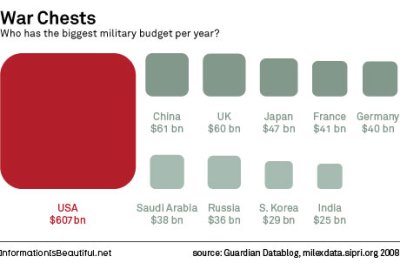 </p>In 2008, the United States spent $607 billion on our military. Far more than any other country as British author <ahref="http://www.davidmccandless.com/bio.htm">David McCandless illustrates in the graphic to the right. But as McCandless goes on to show in the rest of this <ahref="http://www.guardian.co.uk/news/datablog/2010/apr/01/information-is-beautiful-military-spending">Datablog post, focusing on spending totals alone doe not provide an accurate context to judge U.S. military spending by. The U.S. is a wealthy country with a larger Gross Domestic Product (GDP) than Japan, Germany, and China combined. McCandless compensated for this fact and you can see the result after the jump:<spanid="more-30583"></span>
 </p><ahref="http://views.washingtonpost.com/climate-change/panelists/ben_lieberman/2010/04/declaring_indpendence_from_energy_independence_min dset.html">The Washington Post asks: “What does it mean for a nation to be energy independent? Is it realistic and if so how should that be achieved?”
 </p>Despite <ahref="http://voices.washingtonpost.com/ezra-klein/2009/11/cbo_estimates_that_senate_heal.html">all <ahref="http://www.speaker.gov/newsroom/legislation?id=0361">the <ahref="http://www.barackobama.com/pdf/issues/HealthCareFullPlan.pdf">talk about how Obamacare would lower health care costs, its already becoming clear that it just wont be the case.
 Something was different in the DISCOVER office this morning. A strange feeling (other than the unseasonable early April heat) hung in the air. When we found the box that showed up over the weekend, everything was illuminated: our iPad had arrived.


