
The 204th Security Forces Squadron, a geographically separated unit of the 149th Fighter Wing, has won 2009 Air Force Outstanding Security Forces Unit Award…
The 204th Security Forces Squadron, a geographically separated unit of the 149th Fighter Wing, has won 2009 Air Force Outstanding Security Forces Unit Award…

The Louisiana National Guard participated in the annual Christmas tree drop at the Bayou Sauvage Wildlife Refuge in eastern New Orleans March 30…
Air National Guardsmen from the 129th Rescue Wing based here completed a four-day rescue mission last night for an injured sailor about 650 miles off the coast of Baja, Calif…
 Dividend fever is gripping America.
From Starbucks to Two Harbors Investment to Earthlink, offering a killer dividend is a great way to garner positive press and woo investors to your company.
The reason?
Companies have big wads of cash, and actually investing in the business seems unnecessary.
A recent report from Citigroup (C) lists 15 highly underleveraged companies that could, theoretically, pay a monster one-time dividend, were they to borrow money and dump it out. Note they’re not saying this is definitely going to happen — it mainly gives you an idea of who some of the most underleveraged companies are.
In each, we’ve provided the potential size of the payout, along with a few choice financial datapoints.
See Also:

Cash balance: $905.4 million
Market cap: $3,522.3 million
TEV/EBITDA*: 3.8x
*Total enterprise value over earnings before interest taxes depreciation and amortization.

Cash balance: $2.04 billion
Market cap: $2,568.3 million
TEV/EBITDA: 5.3x

Image: Healthspring
Cash balance: $462.3 million
Market cap: $1,048.4 million
TEV/EBITDA: 3.3x

Cash balance: $644.3 million
Market cap: $653 million
TEV/EBITDA: 4.3x

Image: US Air Force
Cash balance: $33.9 million
Market cap: $693.8 million
TEV/EBITDA: 4.4x

Cash balance: $784.3 million
Market cap: $3,427.2 million
TEV/EBITDA: 3.7x

Cash balance: $157.7 million
Market cap: $1,376.8 million
TEV/EBITDA: 3.6x

Cash balance: $98.3 million
Market cap: $1,112.0 million
TEV/EBITDA: 9.9x

Cash balance: $1.08 billion
Market cap: $17,331.8 million
TEV/EBITDA: 6.0x

Cash balance: $190.8 million
Market cap: $604.6 million
TEV/EBITDA: 1.7x

Cash balance: $1.19 billion
Market cap: $1,492 million
TEV/EBITDA: 4.4x

Cash balance: $123.1 million
Market cap: $760.3 million
TEV/EBITDA: 3.6x

Cash balance: $7.80 billion
Market cap: $8,339.8 million
TEV/EBITDA: 4.5x

Cash balance: $2.30 billion
Market cap: $5,510.5 million
TEV/EBITDA: 3.7x

Cash balance: $147 million
Market cap: $2,761.4 million
TEV/EBITDA: 2.5x
Join the conversation about this story »
Tiger Woods returns to golf in Augusta, Georgia, this week, making the normally huge crowds for the Masters tournament even larger. Woods returns to tournament play after a sexual scandal rocked his family and nearly ruined his career. The world’s number one golfer and four-time Masters champion played an 18-hole practice round this morning. This week marks the first time he has played in a tournament since he admitted to numerous affairs with several women.
The national and international interest in what Woods will say to reporters and how he will play this week has brought a crush of media, curious on-lookers and entrepreneurs to Georgia. The golf icon is scheduled to hold an afternoon press conference on Monday where he will answer questions, a change in strategy from a refusal to answer reporter questions at a press conference earlier this year.
This normally quiet city of about 200,000 people along the Savannah River in Georgia is bursting at the seams as “Tiger-Mania” grips this year’s tournament. Hotel rooms are hard to find while the few that are empty rent for nearly four times the typical rate. Businesses like restaurants, churches, gas stations and even transmission shops near Augusta National Golf Club are selling parking spaces at premium prices. Wait times for a table at restaurants in and around the city during the dinner rush can be up to two hours.
The crush of cars and pedestrians into The Augusta National Club began early this morning on the first day of practice rounds. Washington Road, the four lane street that runs in front of the famed golfing mecca, was jammed with lines of cars and crowded with a sea of pedestrians making their way to the front gate. Decked out in visors, brightly colored shirts and plaid bermuda shorts, many of these devoted golf fans make the annual trek here to watch the “best of the best” on the links. But the interest in Tiger’s return to the game is obviously overshadowing who will win the coveted Green Jacket this year.
A few protestors carry signs among the crowds in front of the club this morning, evidence that some are still not happy with the details about Tiger’s admitted affairs with other women. But the crowds here seem to be largely in favor of Woods, who has been working hard to repair his image and save his lucrative golf career.
Many feel he has already paid the price for his misgivings, and feel the issue is now a personal matter between him and his family. The crowds of golf fans feel this week should be about getting back to the game that has made Augusta, Georgia the only place to be…at least for this week.

Now that the iPad is no longer a mystery, Apple is sparking up its magic machine to get people talking and rumoring again.
In classic fashion, Apple has sent out invitations to an event it will be holding this week, which contain only a little detail but a lot of room for speculation and excitement.
So this Thursday, April 8th at 10:00am, Apple will give the world a “sneak peek of the next generation of iPhone OS software.”

Attention residents of France: the Palm Pre Plus and Palm Pixi Plus are due to launch soon on SFR, and they’re celebrating by giving away ten of each. The contest merely requires your name, email address, and birth date, and even if you don’t win, you’re still entered to be notified of when the phones are available.
The contest’s fine print possibly has revealed two things. One: the launch date. The contest ends on May 31, 2010, which we can assume is close to, if not the exact, launch date. The date is also a a week over four months past the launch of the Pre Plus and Pixi Plus on Verizon.
The second is off-contract pricing. Operating on the assumption that the phone will be available off-contract, the value declared by the contest is €479 for the Pre Plus and €349 for the Pixi Plus. The phones awarded by the contest will be of the locked variety (they’re not going to give away something you can use on a competitor’s network). The on-contract pricing of €99 for the Pre Plus and €49 for the Pixi Plus was already revealed in an earlier survey.
So, our French friends longing for some webOS action, head on over to SFR’s contest website and enter for yourself. Vive Palm!
Thanks to Adam for the tip!
If you’ve been checking the magazine’s website at least once a week, as a Good Domer should, you know we’ve expanded our reach to movie reviews, a comic strip, up-to-date discussions of topical issues, personal looks at campus events and people, and an ever-expanding and changing array of informative and entertaining features.
How tuned to the website are you? We take you back to your college days with our pop quiz. And here we provide links to the answers.
Why is Professor Jim Mole the most unusual Notre Dame faculty member of all time? The inside scoop.
What is the connection between the 1964 movie The Pink Panther and the Winter Olympics? Winter Olympics, past and present.
Can you read Notre Dame Magazine safely while driving your car? Soon you will be able to listen to Notre Dame students reading articles from the current issue for a magazine podcast. Watch the home page for an announcement of when this is available.
After 9/11 are we any safer? After 9/11, are we any safer?.
Who played ND alumnus John Crowley ’92J.D. in the film Extraordinary Measures? Movie review: Extraordinary Measures.
What did Pope Benedict XVI say at the University of Regensberg that generated a worldwide uproar, and how was he misunderstood? Muslim-Christian relations.
What famous writer said, “Even today if I see a pen lying discarded on the ground I pick it up and take it home like an abandoned puppy”? ??? at Notre Dame.
Who is “the fat lady for whom one should shine one’s shoes”? Detachment, Buddy.
What 80-year-old pop cult phenom has emerged as the “hippest grandmother a college kid could want”? The ??? phenomenon.
Who said, “Don’t tell me there isn’t enough love in the world to care for all the unwanted babies”? ??? and abortion.
Apple isn’t wasting any time. Right on the heels of the iPad launch and all the hoopla surrounding it, the Cupertino company sent out the following invitations today for an event taking place at 10 am PST on April 8, three days from now:

Bucking its previous announcement trend — in which new operating system updates were unveiled annually in June — the company is rushing full steam ahead with a very early glimpse of its upcoming software.
Will there be true multitasking? New notifications, universal inbox and other long-desired features? Could there even be some inkling of carrier partnerships? (It’s a long shot, but you never know.) Or will it only offer minor updates, except packaged in an over-hyped media event?
Three days, and (hopefully) many questions will be answered. In the mean time, leave your guesses below.
Via: Gizmodo

In this industry, leaked order forms are the equivalent of gold. On that note, Sprint’s order forms have materialized, and they contain a few new devices for your viewing pleasure.
The upcoming BlackBerry (Bold) 9650 appears on the page, along with the Pearl Flip 8230 (it’s about time – I was wondering when it would come to Sprint). As the successor to the Tour 9630, the 9650 offers Wi-Fi connectivity, RIM’s new trackpad, and OS 5.0. The mystical Palm C40 also makes an appearance, along with the Motorola ES400. Though the ES400 was originally thought to be a a Windows Mobile handset, BGR thinks that it will launch with Android (makes sense, given Motorola’s commitment to the OS).
Do the devices above appeal to you, or are you waiting for the HTC EVO 4G?
Via PhoneArena, BGR

 The first Android-based television set has been unearthed and it comes from an unknown Swedish hardware maker. The company is called People of Lava and the TV will be in beta testing later this summer. Available in 42, 47, and 55-inch models, the sets will be internet-connected and loaded with apps like YouTube, Google Maps, Weather, Time, Calendar, and of course an web browser. There’s no word yet as to whether or not we’ll see Google certifying the TV’s with Android Market access. Side loading apps from alternate sources could be a real pain in the butt and may not be worth the cost. With prices starting at $2,700 a piece, these Android-based TV’s are more than a little expensive.
For more information, check out the People of Lava website and press release.
You may recall that, at the end of March, Warner Bros. studios did a new deal with Blockbuster that seemed likely to confuse the hell out of consumers. That’s because Warner Bros., in its backwards-looking wisdom, had already done deals with both Netflix and Redbox to not make new release movies available to rent until 28 days after their release. There is no good reason for this, other than it pisses off customers all around, and makes them less interested or inclined to bother watching Warner Bros. movies (hint to WB: you have competitors).
But the Blockbuster deal seemed confusing — because most consumers wouldn’t be following these silly deals and wouldn’t understand why a movie had been “released” but wasn’t available via their favorite rental service. Apparently, Blockbuster’s answer to all this is to mock Netflix and Redbox for not carrying new releases. Seriously. Reader Daylyn sends in the following ad he recently saw that points out that Netflix and Redbox don’t carry this movie:

Permalink | Comments | Email This Story

One of the best definitions of science I’ve heard was offered by an archaeologist, Lew Binford. Science, he would say, is the most reliable way of diminishing ignorance about the natural world. This is really quite diplomatic: it can satisfy those who believe that there is nothing besides the natural world, but it leaves room for those who believe there is something —a realm, a force, whatever — that is beyond nature, that is supernatural, a place where science cannot go. And wherever science does get to, some new bit of ignorance that lies beyond the old one pops up and calls out for diminishment.
Take the autumnal turning of the leaves, one of the most attractive sights in nature and also one of the most commonplace. Surely scientists know all about it by now — after all, we have had a half-millennium of what can be called modern scientific inquiry since Signore Gallilei. We do know that some combination of temperature, moisture and perhaps day-length may all be involved in when a deciduous tree’s leaves (such as those of an elm) begin to lose their green color. The green is a pigment called chlorophyll and as it disappears it reveals the other pigment in the leaf that chlorophyll has overshadowed — yellow.
But some other trees, sugar maples for example, turn red. The maple leaves start, at this rather late point in their careers, to produce a red pigment called anthocyanin, which was not previously present. Why does the maple tree go to all the trouble and expense of producing a new pigment in its leaves when they are so close in time to floating to the ground and dying altogether?
Several explanations have been offered but there is no agreement as of now. It might have something to do with helping the amino acids in the leaves to slip back into the woody parts of the tree as a protection of the tree against the cold, or it might protect the tree against insects that feed on those very same amino acids. And it might be something else.
So when it comes to red leaves we remain in the dark.
Since there are so many more pressing matters — so many more urgent ignorances for scientists to dispel — we may not learn the answer to red leaves in our lifetimes. Here then are some more unknowns.
Despite a prediction by physicists that it does exist and is a major player in the dance of particles, and that it will explain the very nature of matter, we are yet to find what is called with remarkable specificity the Higgs boson. This is perhaps only the result of the failure of the Large Hadron Collider in Europe to function as planned, but we are left at this time not knowing for sure that the Higgs boson exists.
Indeed, it has been suggested by actual physicists that the Higgs boson itself is sabotaging the Large Hadron Collider. How is it doing that? Among the many alleged properties of the Higgs boson is the capacity to turn back in time. So, it is said, the boson just turns back through time and stops the collider from ever making one. Now that is a really eerie bit of ignorance
Less eerie and more frightful is our ignorance about where to put our radioactive wastes while they expend their lethality over half-life after half-life after half-life. Given the restless nature of the planet we live on, seismicity and all that, something is almost certain to go haywire any place and every place on the earth during the next several thousand years. These effluents now accumulate in barrels here and there around the country which, one hopes, people have been assigned to watch closely, but that seems a bit haphazard. The wastes must be contained, and how exactly to do this for millennia is an ignorance worth diminishing at the earliest possible moment.
Prioritizing ignorances is something that should be done from time to time, even though gaining a list of priorities to which we can all subscribe would seem pretty hard to do. I for one do not care a whit if intelligent life — or even unintelligent life — exists elsewhere in our galaxy and even more remote places. It would be nice to know, I suppose, but our history of traveling around our own planet and introducing lethal diseases to unsuspecting tribal people suggests that wherever we all are galaxy-wise we should simply stay put.
We don’t know how one of our few exclusively human talents came about — language. No other creature known has anything like our language. Apes, dolphins, dogs, parrots — all sorts of animals can perform one or another “linguistic” feat either to our delight or dismay, but none of them can discuss the future or compose poetry or design a bridge.
Plenty of theories exist to explain how language came about. It started with gestures. No, it started with music, with singing. No, with dancing. No, it started when mothers needed to let their babies know they were still nearby, having put them down on the ground to use both hands to gather berries, so they invented “Motherese.” Or could it have been a side effect of the explosion of neurons in the brain caused by an increasingly complex hand-brain continuum involved in making complicated tools? Did it come about all at once with a random genetic mutation?
In the late 19th century, a French academy forbade its members from discussing the origin of language since it caused such bitter argumentation and occasionally physical violence. As H.L. Mencken said, “For every complex problem there is a solution that is simple, neat and wrong.”
Why do all humans pass through the decade (more or less) when they are what we call teenagers? This never happens to a non-human species, so far as we know. Chimpanzees don’t go through a time when they are surly with their parent (the mother), or get the chimp version of acne, or can’t wake up in the morning, or simply flat-out rebel. Some say adolescence is a kind of reproductive apprenticeship. Others say it evolved a few hundred thousand years ago followed quickly by a huge increase in the size of the human brain, so it must be important. The linkage there, however, remains unexplained.
On the other hand, science has determined what most parents intuited long ago — that the adolescent brain undergoes a wholesale reorganization. Teens are not, we can all be relieved to know, taken over temporarily by aliens. This reorganization, it is opined, lets them learn to negotiate the complicated social world into which they will emerge as adults. Well, sure, but this seems vague at best if not wholly vapid. Why, for example, girls experience a growth spurt earlier than boys, which in some cases is now occurring not in the teens but the tweens, remains a bit of a mystery.
However tumultuous the teen years appear to be (at least in Western cultures), there are more serious ignorances about the human condition. Why are so many people so often nasty to one another? Why are some people altruistic? What makes a sociopath? And why do some sociopaths go on to become mass-murderers? There is a single gene that appears to be involved in altruism. Called AVPR1, people with it are more altruistic and generous. Is there a sociopath gene? What on earth will we do if there is such a gene?
We do not know how many species of plants and animals live on the earth, and we do not know how many are disappearing without ever having been taken note of by humans. Most scientists who deal with such matters are of the opinion that we are facing another mass extinction of life forms, this one occurring practically overnight, and caused mostly by humans hogging everyone else’s habitat. To have destroyed so much of the cathedral of life is something the human race will one day be ashamed of and deeply regret.
Apparently we don’t know enough about what is called, in a reified sort of way, the economy to have predicted its latest collapse. According to a friend, the British economist Adrian Wood of Oxford, the Queen of England asked why economists had failed to predict it. The British Academy promptly met, pondered and came up with a wholly unconvincing answer. Indeed, Wood told me, the only thing that all the participants in this global horror story universally agree upon is the statement: “It wasn’t my fault.”
And there are more elusive matters. When it comes to issues such as the survivability of the spirit, I am slightly surprised to find myself of an open mind. Scientists and most fans of science (which I am) tend to believe — indeed, to know — there is no such thing. On the other hand, it is famously difficult to prove a negative. Aside from logic and all that, I have, thanks in large part to my wife, Susanne, experienced things that defy scientific explanation even by our friend Ken Frazier, the ever-resourceful editor of The Skeptical Inquirer, a magazine devoted to debunking all paranormal claims.
One such event occurred on the Hopi Reservation in northern Arizona. We were staying in the motel called the Hopi Cultural Center, which has flat roofs like most of the homes and other buildings there. It had snowed during the day and stopped at dark. Later, we were awakened by a loud crash that sounded like a large rock thrown onto the roof. In the dark we listened, and in a few minutes another crash resounded. We heard smaller rocks skipping across the roof. I turned on the lamp next to the bed, and on the third crash the lampshade shook. The racket continued at about five-minute intervals until the sun peeked over the eastern horizon.
I went outside and climbed up onto the roof. The snow was pristine, totally undisturbed. Back on the ground, I saw two men come out of a room near ours. They asked me if I had heard all the banging and crashing and I said, yes, perhaps it was the roof contracting in the cold. It turned out that the two men were roofers hired from off-reservation to repair roofs in one of the villages. “We know roofs, man,” one of them said, “and that was no roof making that noise.”
Later, the Hopi manager of the motel told us that the racket was the work of spirits of teenagers who over the years had died and for various reasons had been unable to leave the area. Every January, he said, they act up like that. The same racket occurred for the next two nights, and we discovered that it could be heard only inside the motel, but not if you walked outside.
Later I had the chance to recount the events in detail to Ken Frazier. The only explanation he could come up with was the possibility that jet fighters from a base in Utah were flying over, causing sonic booms. I asked him if he had ever heard of Air Force maneuvers taking planes over the Hopi reservation approximately every five minutes throughout the night, silently unless you were indoors. He smiled and shrugged.
On another occasion, Susanne and I were in a Washington, D.C., restaurant finishing dinner with a noted anthropologist and friend, Paul Bohannan. That afternoon he had told us about how he, a nonbeliever in such things of course, had handled stories of African witchcraft and spirit activity when he was in the field there. At dinner he was upset because his son was not interested in pursuing a doctoral degree in something scientific but instead wanted to get a degree in sports writing. He went on a bit about his disappointment and even exasperation.
At this point, Susanne felt a forceful shove on her back and a voice, loud in her mind, said “Margaret!” Susanne had friends who were British sensitives, and she knew that it was crucial never to volunteer information about such communications, but she asked Bohannan’s permission and went ahead and asked if he had someone in his family named Margaret. He said Margaret was his sister, but Susanne said, no, she’s older, she had long braids wrapped around her head, lived on a farm and was churning butter.
Greatly surprised, Bohannan said that it was his grandmother, also named Margaret, who had indeed lived on a farm. He told us about her, pointing out that she used to take young Paul out into the fields to slide down haystacks with her. She was a woman who always seemed to have a great deal of fun in life. He asked if anyone else was there and Susanne reported that she heard the name Louis. Louis, Bohannan reported, was his youngest uncle who had died early. Bohannan’s father had said that he wished that he, himself, had died instead of his younger brother because Louis always found such joy in life.
Then dinner was over, Bohannan went to his hotel in Washington, and Susanne and I, neither of whom had ever heard of either Margaret or Louis, drove home.
The next morning Bohannan called Susanne and told her that what had happened at dinner would change his way of teaching forever. It was unmistakably clear to him, he said, that his grandmother and uncle had come to remind him that one should pursue what makes one happy, that it was fine if his son wanted to be a sportswriter.
As a science editor and writer but also as a chronicler of Hopi and Navajo ways and worldviews, not to mention as husband of Susanne, I have had no alternative but to maintain an open mind about this astonishing world about which we have so much more to discover. After all, if a Higgs boson can reverse the passage of time, wrecking a very expensive and large machine in order to hide from us, who knows what is really going on in this universe of ours.
Meanwhile, on a more prosaic level, I fear that we are severely threatened by another ignorance, the widespread and debilitating ignorance of much of the U.S. public. Polls show that a majority of Americans believe the earth and the human race came into existence 10,000 years ago. At least one member of the U.S. Senate believes that the mountain of evidence showing the climate is undergoing rapid change largely because of the greenhouse effect is all a hoax perpetrated by environmental extremists.
Scientific ignorance is extremely widespread for a country like ours that relies so heavily on technological innovation, but scientific ignorance is merely part of the problem. Polls have also shown that a majority of Americans cannot name the three branches of government, and there are apparently many retired people who don’t know (or aren’t sure) that Medicare is a government-run program.
Such sorry statistics of appalling ignorance regularly appear. One wonders how many Americans could pass the exam administered to immigrants before they can become citizens of the United States. Could all our legislators?
Such ignorance is a shame but it is also profoundly perilous. The writers of the Constitution knew that creating the world’s first full-bore democracy was a dangerous undertaking, and its success would depend in great part on an educated citizenry that could understand and seriously discuss important public issues. They created the Senate in part as a hedge against too direct a democracy. But we hear that the United States is falling behind in all sorts of categories — math, science, history, engineers, teachers, book readers — and may soon be out-competed economically and technically by Asian and European countries.
But suppose some enormous calamity were to take place, something sudden and global in nature, a heretofore unknown climatic tipping point, for example, an irreversible event calling for an informed, intelligent, quick response to a wholly unprecedented cascade of catastrophes. The U.S. military has recently announced that the chaos of rapid global climate change could seriously threaten our national security in any number of ways — resource wars, pandemics, mass migrations, and so forth: catastrophes cascading around the world. This is not the stuff of thriller fiction. It could happen — not tomorrow but easily enough when my grandchildren’s generation is in charge of coping.
Would a large, noisy and ignorant fraction of the American electorate be able to comprehend what was needed in such a circumstance, or would they be captivated by the demagogues who always sprout like nettles in troubled times? Would an unwieldy and super-partisan and financially suborned legislative branch and a bureaucratically clogged and widely beholden executive branch be able to overcome ignorance and demagoguery and act wisely and decisively?
Could we, as presently constituted, keep the trains running on time? Do we know for sure that our democracy would survive?
Jake Page and his wife, Susanne, a photographer, produced the lavishly illustrated book HOPI in 1982, representing the first general photography allowed on the reservation since 1910. A 25th anniversary edition is now available.
Photo of sugar maple:
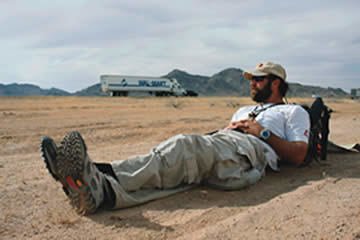
One evening in October 2008, Rory Fanning ’01 was sitting on top of an Appalachian mountain in Georgia eating a container of ramen noodles he’d just cooked over a fire.
A black bear padded up.
“He wasn’t more than 15 feet away,” says Fanning, 32. “We were both sort of stunned. He ran down the mountain when I went to get my camera, sort of unimpressed by my fare.”
Another person might have figured it was time to walk down to civilization.
Fanning, however, had recently left full-time work as a mortgage broker in Chicago partially for moments like this. “I didn’t want to wake up at age 65 with no memories save the weekends,” he says.
In May 2009, Fanning completed a walk from the Atlantic Ocean to the Pacific. His preparation took only three weeks, though the roots of the walk were much deeper.
When the United States decided to invade Afghanistan after the 9/11 attacks, Fanning joined the military. Although he considered himself a pacifist, he says, “If you’re part of a society, you’re culpable for the decisions of leadership regardless of what they are.”
During training at Georgia’s Fort Benning with the U.S. Army Rangers, he met Patrick Tillman. Tillman had made national headlines in May 2002 when he turned down a $3.6 million contract from the Arizona Cardinals football team and instead joined the military. In April 2004, Tillman was accidentally killed by fire from U.S. troops while in Afghanistan.
Fanning completed his tour, returned to Chicago and found work as a mortgage broker. By summer of 2008, he was ready for a change. “I was getting frustrated with the greed and selfishness and direction of the leadership of the country at the time,” he says. “You can’t be a real advocate against greed if you’re not a living example.”
With only one rule — no rides forward — Fanning started walking west from Norfolk, Virginia, on September 17, 2008.
Resembling a modern-day patriarch, he carried a wooden staff and a 49-pound backpack with a sign on the back that read “Rory Fanning, who served with Pat Tillman in the 2nd Army Ranger Battalion, is walking from the Atlantic to the Pacific to raise money and awareness for the Pat Tillman Foundation. Visit walkforpat.org for more info.”
During the first month, Fanning says, “I just tried to avoid attention.” But after he was asked to speak at a high school near Huntsville, Alabama, Fanning decided he enjoyed it. He then spoke to high schools, colleges, prisons, NFL alumni associations and corporations. He also received media attention, taking part in 75 interviews, including Fox News and Good Morning America.
Fanning says he never knew where he would sleep each night. About a quarter of the time he slept in Hampton Inns or people offered him a bed. Mostly he slept outside, sometimes in people’s backyards. That didn’t always work well.
“One guy in Texas caught me sleeping on his property once,” Fanning says. That guy had a shotgun. “He was really uninterested in any reason I might be on his property. Another guy in Alabama pulled out a gun, but he ended up giving me food.”
During the day, he’d do about 45 minutes of brokering by cell phone and would sometimes listen to audio books on his BlackBerry. He’d update his blog in the evenings.
For the most part, he observed. “Every 20 miles there was something new, a different landscape, a different plant,” Fanning says. “When you . . . let your imagination generate steam, you see details you don’t normally see.”
In Arkansas, he accepted a ride from a man who took him to a resort community, where Fanning took a shower while the man went door-to-door, collecting $1,700 for the Tillman Foundation. The man happened to be the Arkansas state tourism director, and he took the bearded, casually dressed Fanning to meet Governor Mike Beebe. Today an Arkansas Traveler’s Certificate given to him by the governor hangs over Fanning’s desk at his Chicago home.
He continued to walk.
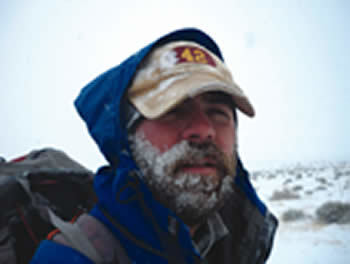
He walked through a blizzard in the Rocky Mountains and 110-degree temperatures in Arizona. In Charlotte, North Carolina, he walked 80 miles though a histamine disorder that caused his hands and feet to swell. “It was pretty miserable; it was walking on rolling pins.”
Walking near the Mexican border in California, he was pulled over 15 times by border patrol agents. “I would see teenage boys in the middle of nowhere staring at me, who had just run across the border,” Fanning says.
On May 15, 2009, Fanning arrived at the Pacific Ocean in San Diego. He had taken about three million steps, wore out five pairs of shoes and lost 30 pounds in the course of walking 3,100 miles across 13 states.
“I just learned to be present,” Fanning says. “I learned that the people in this country have a good side to them. When you can follow a personal passion . . . you enthusiastically bring joy to your own life and the lives of others.”
Mark Lawton is a general assignment report for a chain of community newspapers outside Chicago.
The Long Yearning’s End: Stories of Sacrament and Incarnation, Patrick Hannon, CSC, ’88M.Div. (ACTA Publications). The 21 stories here, three for each of the seven sacraments — baptism, reconciliation, eucharist, confirmation, matrimony, holy orders and the anointing of the sick — demonstrate how God is present wherever humanity finds itself. Through such stories as “Hustled by a Holy Man,” “Christ in Pigtails” and “Big Mac Sauce and Other Lessons on Love,” the author shows the presence of God’s grace in everyday life.
Brother Andre: Friend of the Suffering, Apostle of Saint Joseph, Jean-Guy Dubuc (Ave Maria Press). A revised and updated edition of the biography of Andre Bessette, CSC, (1845-1937). This year, the “Miracle Man of Montreal” will become the first saint of the Congregation of Holy Cross, the order that founded Notre Dame. Although Brother Andre left nothing in writing, his friends and co-workers did, and the author draws upon their stories and on newspaper accounts to show the contemporary relevance of a humble man.
Forget-Her-Nots, Amy Brecount White ’85 (Greenwillow Books). In this young adult novel, 14-year-old Laurel discovers she can use flowers to help friends pass pop quizzes — or to make people fall in love. Does an ancient family secret account for her new-found power? Publisher’s Weekly says, “A delicate sense of magical possibility and reverence for the natural world help elevate White’s story from a typical prep-school drama into something more memorable.”
Beyond Blue: Surviving Depression & Anxiety and Making the Most of Bad Genes, Therese J. Borchard ’94M.A. (Center Street). “I’m a manic-depressive, an alcoholic, and the adult child of an alcoholic,” the author says as she takes readers on a tour of her often dysfunctional life. With practical advice, humor and encouragement, she offers hope to readers struggling with depression. Her popular blog “Beyond Blue” is at beliefnet.com.
The Handbook for Catholic Moms: Nurturing Your Heart, Mind, Body, and Soul, Lisa M. Hendy ’85 (Ave Maria Press). The creator of the CatholicMom.com website coaches Catholic mothers on how to care for themselves so “we have the energy, spirit, and peaceful souls to help take care of those who fill our homes and our lives.” She ends each chapter with suggested self-help tips, called “Mom’s Homework.”
The Farthest Home Is in an Empire of Fire: A Tejano Elegy, John Phillip Santos ’79 (Viking). The National Book Award finalist travels from South Texas to New York to Spain to the Middle East as he attempts to recover the missing chronicles of his mother’s family. This memoir is a companion to Places Left Unfinished at the Time of Creation, in which Santos told the story of his father’s family, set within the larger story of Mexico itself.
Sin: A History, Gary A. Anderson (Yale University Press). Attempting to answer the age-old question, “What is sin?” Anderson explores the history of sin and how it has shaped the Christian church. The book received the 2010 Christianity Today book award in the Biblical Studies category. The author is a professor of Old Testament/Hebrew Bible studies at Notre Dame.
The Diet Joke: A Reprogramming Guide for Perpetual Consumers, Lisa Pedace ’85 (Big Shot Press). “Who says losing weight has to be so serious?” the author asks. She proceeds to offer advice on how to lighten up without letting it get you down, with a mix of humor, games and common sense. You can break bad habits, she writes, as she cuts through the confusion of food pyramids, diet programs and mixed messages from advertisers.
Quotidiana, Patrick Madden ’93 (University of Nebraska Press). The engaging essayist takes on everything from the joys and woes of fatherhood to the origins of human language to common actions that illuminate the wonders of everyday existence in a book one reviewer called, “a truly creative creative nonfiction book . . . a remarkable achievement of complex simplicity and elegant confusion.”
A Lifetime of Making Art: Brother Mel, Anne Brown (The Arts Company Press). Over a 50-year period, Brother Mel Meyer, S.M., ’60MFA, has produced work ranging from found-object sculptures to bold abstract watercolors. The book addresses his spiritual commitment as well as his time spent studying with famed sculptor and Notre Dame Professor Ivan Mestrovic, and presents a portfolio of selected images from his thousands of works.

Here is my Sophomore Literary Festival moment.
I am in the old Pay Caf, also known years ago as the Oak Room in the South Dining Hall. High ceilings, beautiful woodwork, those familiar, distinctive aromas.
I am having coffee with Barry Lopez and Edward Abbey. They are two lions of 20th century American nature writing. For prominence and message they would be considered descendants of Whitman and Thoreau; they’d be on the short list with Aldo Leopold, Wendell Berry, Annie Dillard, Edward Hoagland and John Muir as the literary shapers of America’s environmental consciousness. And I am sitting here, sipping morning coffee and listening to these giants talk about wilderness preservation and water rights, native cultures, wildlife and the role of federal government.
Sage-like even in 1983, Lopez, a 1966 Notre Dame graduate, had gained acclaim for Of Wolves and Men. He speaks quietly, thoughtfully. Abbey — always the rebel, the renegade, “the desert anarchist” — is sharper tongued, irreverent and direct. He looks like he stepped right out of the Southwest backcountry: rumply dressed, ample beard, slick hair spearing from beneath his stained and worn-out hat. He’s delightfully out of place at Collegiate Gothic Notre Dame.
Still, Abbey has published his classic beauty Desert Solitaire and his subversive The Monkey Wrench Gang, and two of his novels have been made into movies, Lonely Are the Brave and Fire on the Mountain. By the time he died in 1989, he had become an American icon.
The moment was a refreshing infusion of elan vital in my workaday world. But it would be a typical encounter in the life of the Sophomore Literary Festival, a colorful Notre Dame spring tradition launched in 1967 to bring such literary champions to South Bend, Indiana. Its run lasted more than three decades before fading out of the campus scene.
The cool thing about the Soph Lit Festival is that it was begun by students and was run by students. Students — sophomores — extended the invitations to those authors, poets and playwrights they wanted to hear from and be with. Sophomores made the travel arrangements, met the planes and escorted the writers from hotel to reading to reception. And the writers — at least in the SLF’s heyday — stuck around. They not only did readings, gave talks and made pleasant conversation at post-event receptions. They also spoke to classes, put on workshops, visited with each other and with students, attended wine parties in faculty homes and . . . hung out, usually over the course of a few days. So opportunities for morning coffee or late-night wine were there. It was a week-long festival, it was fun (with some groggy mornings-after).
Gwendolyn Brooks, Chaim Potok and Arthur Miller came my junior year. Joyce Carol Oates and Isaac Bashevis Singer came when I was a senior. Susan Sontag came in 1983, the year Lopez and Abbey were here, as did Richard Brautigan, famous for his period piece Trout Fishing in America. It was Brautigan’s final reading prior to committing suicide.
The impressive list of participants includes Edward Albee, Tom Stoppard and Jorges Luis Borges. Larry McMurtry. Ann Beattie and Margaret Atwood. Jerzy Kosinski. Allen Ginsberg and Ken Kesey came more than once.
Many of the leading poets of the late 20th century read, coached and talked shop with students and faculty alike, a list that includes Galway Kinnell, Kenneth Rexroth, Robert Bly, Lawrence Ferlinghetti, Seamus Heaney, Howard Nemerov, Stephen Spender, Denise Levertov and Sam Hazo, a 1949 ND graduate. The Polish poet Czeslaw Milosz came in 1982, two years after winning the Nobel Prize for literature.
The festival also brought to campus many of the period’s most influential black voices. Claude Brown came in 1970, five years after Manchild in a Promised Land drew intense critical acclaim for its depiction of his growing up in Harlem and his take on American society. The SLF also attracted Ralph Ellison, whose The Invisible Man won him a National Book Award in 1953.
The festival’s leitmotif and cast of characters often translated into edgy, eccentric and unpredictable moments. In 1977 Tennessee Williams opened his presentation on the stage of Washington Hall by pouring himself a glass of wine and toasting Our Lady atop the Dome and then “Notre Dame’s homosexual community.”
In 1985, John Irving reportedly responded to his invitation by saying that the Catholic university may not want him; he was writing a novel that dealt with abortion. He was encouraged to come anyway. That year’s chairman, Greg Miller, told The Scholastic: “We weren’t going to deny the tradition of the literary festival or hold back an author just because he was going to read about abortion, which if you can’t do at a university, you really can’t do it anywhere.”
The SLF was clearly a product of the times, written into a chapter in the life of Notre Dame and American history when the day’s institutional, literary and intellectual currents were embraced in a freewheeling conversation. It was a reflection of the students’ creative, cultural and educational aspirations. In fact, its prime movers openly stated that one of their purposes was to dispel Notre Dame’s reputation as a mere football school.
The year was 1967 and a visionary, entrepreneurial sophomore from Mississippi named J. Richard Rossie put together a conference to honor the Magnolia State’s William Faulkner. The following year John E. Mroz of Osterville, Massachusetts, created a festival celebrated in the Saturday Review and The New York Times. The 1968 lineup included the dean of literary critics Granville Hicks, who penned a post-festival feature for the Review, Norman Mailer, Ralph Ellison, Kurt Vonnegut, Joseph Heller, William Buckley Jr. and Wright Morris, who had won two National Book awards.
Mroz had to patch together funding for the festival. He got a nice boost from Charles Sheedy, CSC, dean of the College of Arts and Letters, who admired Heller’s Catch-22. Heller said he’d come if he could get an autographed football for a family member.
The 1968 festival attracted overflow crowds and was rocked by a series of nationally historic moments. It opened March 31, the day President Lyndon Johnson announced he would not seek re-election. Before the festival ended Martin Luther King would be assassinated. In between Buckley would pepper his talks with barbs slung at presidential candidate Bobby Kennedy. The day after Buckley graced the Stepan Center stage, Kennedy appeared at the same venue, drew enthusiastic applause and replied: “This must be the warmest reception anyone has had in this auditorium since William Buckley spoke here last evening.”
Don Costello, longtime faculty member and informal festival adviser, would say of the festival’s birth years later: “Of course, it couldn’t be done. That’s the beauty of naïve sophomores. They were too naïve to know it couldn’t work.” But over its first two years alone it would bring to campus Tom Wolfe, George Plimpton, John Knowles, John Barth, Peter DeVries, Gary Snyder, Ishmael Reed and LeRoi Jones.
In time the national literary scene changed, and authors expected more for personal appearances. By the mid-1990s the festival had pretty much run its course. It was a product of the times. But what good times they were.
Kerry Temple is editor of Notre Dame Magazine.
Pat Toomey Has Big 1st Quarter. Senator Arlen Specter and Congressman Joe Sestak “Still Counting”
Conservative Republican Pat Toomey raised $2.3 million in the 1st quarter of 2010, marking his U.S. Senate campaign’s most successful fundraising quarter to date. That leaves the former congressman with over $4 million cash in hand.
“I have been the number one fundraiser among all senate challenger candidates in the country.” Toomey told Fox News. “We have been able to preserve our resources, I think that Arlen Specter and Joe Sestak are about to unload a whole lot of money in what will probably be a very nasty democratic primary that’s about to unfold.”
Toomey is running for the U.S. senate seat currently occupied by Senator Arlen Specter (D) and does not have any serious competition in the Republican primary.
Specter’s campaign has not released 2010 1st quarter fundraising numbers yet, with aides telling Fox news they are still counting up the receipts.
“We are very pleased with where our fundraising is. We have a Democratic primary to deal with first, then we will turn our attention to Mr. Toomey.” Said Specter Campaign Manager Christopher Nicholas.
Specter enjoys the support of the White House, which will be on display again today when Specter attends opening day at Nationals Park in Washington with President Obama. Specter defected to the Democratic Party last year citing, in part, a difficult battle in the Pennsylvania 2010 GOP primary race.
Specter’s democratic challenger Congressman Joe Sestak is also yet to release his latest fundraising numbers. “We ended last year with more than $5 million cash in hand, more than any other senate challenger. We’re in a very strong position to do what we need to do.” Said Sestak Campaign Spokesman Jonathon Dworkin.
The Pennsylvania Democratic Senatorial Primary is only six weeks away, so many political experts and players in Pennsylvania expect Sestak to take his message to the television airwaves very soon.
The latest polls show Toomey leading the field, and Specter with a commanding lead over Sestak.
A Franklin and Marshall survey conducted from March 15 – 21 shows Toomey leading Specter 33% to 29% and Specter over Sestak 32% to 12%. The Franklin and Marshall College poll included 1,119 adult Pennsylvania residents and has a margin of error of +/- 2.9%
If Arlen Specter wins the Democratic primary, it will not be the first time he has faced Pat Toomey. The two squared off in 2004 for the Pennsylvania Senatorial GOP primary, with Specter edging Toomey by less than 2%.
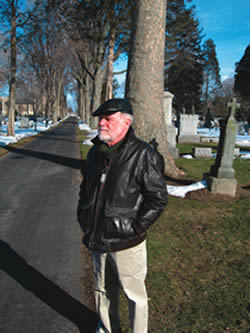
Ralph McInerny, whose body we buried there in February, liked to go for walks in Cedar Grove, too. He used to say of the cemetery a few hundred yards south of Notre Dame’s Main Building that when he walked there he felt as if he were attending a posthumous faculty meeting.
Although I was a mere 4-year-old when Ralph arrived at Notre Dame, I’m catching up with him. It won’t be long before I have as many colleagues and friends, Ralph himself among them, in Cedar Grove.
It’s a pleasant place to visit, and I do so more and more often. Despite its proximity to the busiest part of the campus, Cedar Grove is agreeably quiet, and its big solemn trees — most of which are oaks, maples and sycamores, belying the name — are fine to look at in any weather. The grounds are exhaustively gardened and manicured, and the older monuments feature unique and wonderful combinations of Victorian and immigrant Catholic styles. Because it is a well-trafficked cemetery, vigil lights, freshly placed flowers and other assorted mementi mori abound. In warmer weather, you sometimes see people picnicking among the graves.
From time to time, I picnic there, too, taking a carry-out sandwich and some coffee to an old friend’s graveside. For those of us who adore the incarnate God, keeping company with the dead is another way to revere life. To say so may seem cavalier, but death is no less fearful a thing for us than for others. “It’s always other people who die,” said Marcel Duchamp. We know better.
At the grave of my friend, I remember being with him when he died six years ago, surrounding his deathbed with his family and other friends in the cold blue fluorescence of a Manhattan hospital room, all of us, whether we’d read them or not, learning exactly what W.H. Auden meant when he wrote the lines:
The stars are not wanted now: put out every one;
Pack up the moon and dismantle the sun;
Pour away the ocean and sweep up the wood;
For nothing now can ever come to any good.
I sit where his bones are buried now and toss a few leftover Fritos to a brown squirrel emboldened by my stillness. I’m saying a prayer as I sit by that marble slab, knowing that I’m not praying alone, knowing that my friend and I are both praying to a God who knows exactly what Auden’s despair and our own feels like. A God with flesh like ours, who once longed and feared and died as my friend did; as I will.
Some women who visited another grave one morning were startled by angels who asked “Why do you seek the living among the dead?” If similarly accosted just now, I think I’d push back a little. What do incorporeal angels know about real flesh, the flesh that God and I and my dead friend all share? I seek the living here because my God himself is a man who was once as dead as my friend is and as I will be. I’ll seek the living where I please, and just now it pleases me to seek them right here in Cedar Grove.
In the earliest days of the church, in the catacomb of Callixtus in Rome, an anonymous Christian carved a few words over and over again on and around the tomb of a woman he loved. At times when I walk in Cedar Grove, that grieving Roman’s graffiti seems far less ancient. His wound, his longing, his hope and his faith become as palpable as the lump rising in my throat:
Sofronia, vivas cum tuis. Sofronia, may you live with your dear ones.
Sofronia, vivas in Domino. Sofronia, may you live in the Lord.
Sofronia dulcis, semper vives in Deo. Sweet Sofronia, you will live forever in God.
Sofronia, vives. Yes, Sofronia, you will live.
My friends, and I, too, live and will live. Forever. The day is coming when these graves will be empty.
Michael Garvey is Notre Dame’s assistant director of public information and communication.
Prison is a young man’s world, a world of physical violence and posturing, a world of brute strength and primal, unfocused rage. It is not a place to grow old, although more and more of us are doing just that: growing old in prison.
When I entered the system, I was a young man. I spent my days lifting weights and worrying about my status among peers. I rarely considered the significance or the magnitude of my predicament. In fact, the only lesson prison imparted to me, at least to that younger me, was how to be a prisoner.
I found out how to exist with another angry young man packed into a concrete box too small to be a bathroom anywhere else. I learned to become an accomplished thief, an exceptional liar and a proficient hand-to-hand combatant. The state wouldn’t provide for my desires so I stole to satisfy them. Truth is often viewed as a form of weakness inside, by prisoners and guards alike; I figured out early that the big, well-told lie was superior to the mundane and pedestrian nature of mere facts.
And in the joint — in a world where violence is king, perpetuated by us against us, by us against them, and by them against us in a dizzying choreography of pre-emptive attacks and retaliatory strikes do-si-do-ing around sneaky backstabbers and goonish thugs with battery-filled socks still dripping blood and lead-gray brains in their baggy pants — I came to the no-shit-Sherlock conclusion that I had best become as dangerous as possible. So I did.
All of this living at a high-revved pitch, expending all my strength to meet the challenges in this branch of Hades, wore me down to a cinder mote. This is the common experience of those who spend their youth in such concretized suffering. The accumulated weight of years lived pushing against the immovable yields a premature decrepitude. Long-term prisoners, particularly those of us who threw ourselves into the scrum as young men and never managed to slip back past the buzzing electric fences, age at a rate out of synch with the chronograph of time.
Struggling to maintain the battlements I constructed in the frenzy of youth, the hinges and choke points began to fail — gradually but inexorably. My wrists can never forgive the thousands of tons of rusty pig iron I balanced, or the poorly executed angles I threw as I smashed fists into leather heavy bags. My knees were clicking and popping while I still struggled to hoist weight bars into narrow slots, well before I began the 10,000-mile trek on tight oval tracks as a prisoner of the state. Hair and teeth vacated follicles and sockets, blonde locks disappeared, and vigor succumbed to weariness in the infernal contest to keep upright in this maelstrom.
Before long, an old man stands before all of us, his once bulging muscles and steady hands drooping and shaky. Around this old man the frantic and pointless swirl still heaves its poison in blackened chunks of dissipation and frustrated longing. The rough currents gouge fissures from our weathered hides, all battered into smaller visions of our means-to-an-end existence untethered by wrongs or rights: Before you screw me I will screw you. While almost inevitably we will end up screwing ourselves . . . or at least watching impassively as we are banged into tightly compacted knots of self-immolating futility.
Prisons are madly violent places. Even in the absence of manifest violence, even without the constant stream of broken bodies exiting horizontally, or the rifle fire and clanging, shrieking alarms hounding our beings like dangerous pitchmen hawking insanity, in even the less glaringly violent prisons, violence is always a part of the experience. Every encounter is tinged with the musk of incipient, barely restrained outbreaks of violence.
Prison is that part of the developed world least altered by civilization, by modernity, by the growth of any consciousness of peaceful interaction. In here, the old scourges hold sway in epidemic proportions. Racism, tribalism, all the old “isms” are still vital and dominant, still driving behavior and ruining lives. In a sense, the prisons are society’s dustbins, the dumps into which are swept not only the various miscreants but also the various felonious ideas no longer acceptable in polite company.
Perhaps at this more basic level, the prison is a literal repository of society’s most feared ideas and people. The trouble for those of us growing old in prison, we of the broken body and wounded, drained spirit, is that free society’s fears far outlive our fearsomeness. To that society I will forever be judged by the wail of a police siren long silenced by time’s passage and the ghoulish 8-by-10 photos of the man I killed in another lifetime. In the collective mind on the other side of the chasm between here and there, between some kind of death and some kind of life, I am still a merciless marauder with bloodied hands.
The type of man who endured when life was still “nasty, brutish and short,” who survived the primitive war of all against all, passed down to me his foul temperament and inclinations. But he is as dead in me now as the endless steppe. In his place stands this me of today. Immeasurably wiser, and indeed better, the me of today recalls the wild man of his youth as a sort of fictional character, a mythic being who did not know fear or infirmity, who had no concept remotely connected to mortality. Neither did this barely recalled me grasp the more fundamental concepts of right and wrong, of what it is a young man ought to do in the course of a day’s turning. I now know all of these necessary truths — the truths of wisdom earned by the accumulation of scars.
For many of my age group who remain buried in these places, particularly those serving uniquely American sentences that stretch beyond the horizon of life expectancy, there is a willful juvenilization. It is a function of remorse’s soul-etching acid bath. We desire to regress back to the time before our fall, before we tattooed the black letter of shame onto our foreheads, back to when possibility resided in our lives as a presence and not a barely recalled ideal.
Our resistance to maturity is also closely tied to the milieu of prison itself. The life we live is that of a child. Devoid of responsibility and cursed by the smallest of expectations, it is not the life of an adult. The program is geared to the lowest common denominator, to the erratic twists and emotional dysfunction of an out-of-control teenager. It is designed for who I was, not who I am. And this acts as a potent retardant.
Days for a prisoner grown old devolve to a fruitless struggle to be an adult in a world of juvenile delinquents while navigating the painful straits of physical and emotional decline. In this army of outcasts, one can never exceed the rank of buck private. It is a life of forever proving your Stygian bona fides to the human conveyor belt of newer but always the same damaged souls sleeping in the bunk above or below yours. It is convincing the next doctor, the new young guard, the latest whoever that you are not the irredeemable thug your tattoos claim you to be or that their dehumanizing training has preconditioned them to expect.
It is a series of maddening struggles that leave you drained and embittered — angry at the new prisoners around you who won’t see the wisdom of your experience and demand to spend themselves on the same unwinnable battles; angry at the new guards who refuse to see you as a reformed human being and daily treat you with brutal disdain; angry at the world, at the nature of unreasonable fate, at God himself.
At the root of it all, down in the darkest recesses of your mind, your greatest anger is at the rotten mother——— who put you in this place in the first place. Your most pointed anger is directed at that younger you, that unthinking, unrepentant and irrational you.
The problem is, no matter what the rest of the world believes, that younger me, the me who crashed into and out of my life and left such a chaotic path of destruction, he no longer exists. He is a ghost unaffected by punishment and pain, but his presence continues to define my life. When I look in the mirror at the old man looking back at me I cannot see even a trace of the brute who stole lives, my own included. It would probably be easier if I too could still see the younger me, but I cannot.
Growing old in prison is a horrific existence of dashed hopes and sclerotic veins, of unrealized longings and arthritic knees. It is a withering away from life into the out-of-focus backdrop of a bad movie. It is a fate worse than death’s frozen silence because it is all too cacophonous and all too desperate. I cannot imagine departed prisoners clamoring to rejoin this tormented existence. No one would wish to resume a life of seeing respite just out beyond the fence line, beckoning, shimmering right there in full view but always out of reach.
Kenneth E. Hartman, sentenced to life without the possibility of parole, has served more than 30 continuous years in the California Department of Corrections and Rehabilitation. The award-winning writer and prison reform activist is the author of Mother California: A Story of Redemption Behind Bars (Atlas & Co.). Email him at kennethehartman@hotmail or see kennethehartman.com.
I have taken to saying that my wife and I are at the grandparent stage of life. I don’t before now recall using the metaphor “stage” to describe any other segment or portion of my life. The notion of stages of life has been around for a long while, of course, and doesn’t look to be going away.
The popular journalist Gail Sheehy wrote a book called Passages, but her passages are little different than stages. The psychoanalyst Erik Erikson was in his day best known for his “stages of development,” in which human beings, properly developed, are able to grasp more and more complex realms of experience. In On Death and Dying, Elisabeth Kubler-Ross even spoke of the five stages of grief (denial, anger, bargaining, depression and resignation). Difficult, it seems, to get away from that metaphor of the stage.
“Yes,” I say, “my wife and I are at the grandparent stage,” and then pause and ask the person to whom I’ve just said it if he or she knows that the reason grandparents and grandchildren get on so well is that they share a common enemy. All the world, like the man said, is a stage.
Infancy, childhood, youth, the long stretch of adulthood, ending (if one is lucky) with mild decrepitude and (if one is really lucky) easeful death — such are the traditional stages of life on which most of us would agree. Some people cut it a lot finer. For some, marrying is a major stage of life, with having children no less — perhaps more — major still. Some click off stages of their lives by decades: 30, 40, 50, each turning into a great psychodrama of life slipping past, usually too quickly. For some the death of one’s parents marks a sobering stage of life; it puts one, after all, next in line for entrance into the room where someone awaits with a garrote, which Pascal famously describes as la condition humaine.
Everyone, surely, will have his or her own demarcations for important stages in his or her life. Some may seem quite trivial. Getting a driver’s license at 15, the legal age in the Chicago in which I grew up, was a big item for me and my friends, for having the use of a father’s car gave us freedom to explore the grand city outside our neighborhood. I grew up a frustrated athlete — frustrated, that is to say, by abilities that came nowhere near matching my fantasies of athletic glory, especially in basketball. In this connection I can recall, sometime in my early 30s, walking under a glass backboard and newly netted hoop, and not ever bothering to look up to imagine myself making some acrobatic lay-up. Ah, I thought, all basketball fantasies are officially gone, finished, kaput — I have entered a new stage of life.
A crucial element in this matter of stages of life can be how important the question of being, staying or at least seeming youthful is to a person. I was spared this by being born in 1937, a time when not staying young but growing up into adulthood as quickly as possible seemed the ideal. The English poet Philip Larkin, though older than I, captured this spirit nicely when he said he first had his doubts about Christianity when he read that in heaven one would return to the state of a child. This was not a good idea for him, who longed to be an adult with a lot of keys, long-play records, drinks and beautiful women to chase after.
Staying young as a way of life kicked in in a serious way in the late 1960s, when, you will recall the cliché, no one over 30 was to be trusted. Many who grew up under this rigid requirement have stayed at the game of remaining young, some would say with all too naturally diminishing returns: consider only all those men now in their 60s and beyond with their sad, dirty gray ponytails.
For those for whom youthfulness is all, perhaps there are only two stages to life: young and not young, with the latter being a kind of death unto itself. One thing for certain, in the consideration of stages, taking on biology is a no-win proposition. In a recent short story of mine called “The Love Song of A. Jerome Minkoff,” a man named Maury Gordon, who is 85, is told that he has pancreatic cancer: ‘“When you get to my age,’ Maury said [to his doctor], ‘you’re just waiting to hear that your time is up. All this crap about 60 being the new 40, 70 being the new 50, well, I have some friends who’ve reached 90, and let me tell you, Doc, 90 looks to me like the new 112.’”
“Married, single,” an old joke goes, “neither is a solution.” I don’t happen to believe that, being happily married to a superior woman, but it does point up the paradox offered by the question of when one enters various of life’s stages. My generation, wishing to grow up quickly, tended to marry young and have children early. I had two sons by the time I was 25. Is it better to have children young, when one’s energy is greater but one’s attentions are often fixed on attempting to make good on one’s ambitions? Or is it better to have children when one is older, when one’s ambitions have tended to have had their run, but one’s energy is less, though one can pay proper attention to the chaotic miracle that is the early life of one’s children? Neither, once again, is a solution.
A solution implies a problem, and whether or not one has viewed one’s life as a problem will have much to do with how one views the stages of one’s life. Saddest of all — next, of course, only to early death — is to arrive at the close of one’s life and see all that has gone before as a series of wrong roads taken, opportunities missed, courage wanted. Shouldn’t have gone into this line of work . . . Shouldn’t have married so late . . . Shouldn’t of, shouldn’t of, shouldn’t of . . . In another short story of mine, this one called “The Philosopher and the Check-Out Girl,” the main character, a retired academic, claims to be suffering, fatally, from what he calls “a late-life crisis, the one that occurs when, in the face of approaching death, a person realizes that his regrets greatly outweigh his achievements and there isn’t enough time left to do anything about them.”
Luckiest among us are those who feel they’ve had a good run, and can look back and feel that even their mistakes made sense. I have had serious setbacks and have known profound sadness, yet I hope that I do not sound nauseatingly smug when I say that I think of myself as such a lucky person. My personal regrets, such as they are, reside in the small-change department. I wish I had learned how to play piano, if only so that I could play for myself the enchanting melodies of Maurice Ravel. I wish I had learned ancient Greek, so that I could read many of the writers I love in their own language.
My life has never been about money-making, but I nonetheless wish I had been able to accumulate enough money early in life so as not to have to think about it, a condition I am clearly not likely to arrive at at this point. I even, first time round, married the wrong woman, yet this (one would think) grave mistake resulted in talented and thoughtful children and grandchildren.
Much of my good luck has had to do with when and where I was born. I have lived my life through decades of unexampled prosperity in the richest country in the world. Although I served two years in the Army, the year of my birth put me in the fortunate position of not being called up to fight in any wars: I was too young for Korea and too old for Vietnam. Any man — and now women, too — who fought in a war, who were actually fired upon, would have to count the experience as among the crucial stages in his life, as, surely, did those who fought in World War II or in Vietnam, and soon the same will be true of those who fought in Iraq and Afghanistan.
I was also lucky going through my adolescence in the early years of the 1950s, when there were plenty of ways to get into trouble but at least the deadly alternative of drugs was mostly absent. Of all the stages of my life — and I’ve yet to figure out how many there have been apart from the conventional one I mentioned earlier — my four years in a public high school in Chicago have been the most unrelievedly happy ones. These were years in which I enjoyed neither athletic glory nor the least hint of academic distinction. I came to school each day not for learning but for laughter: riotous, raucous, unremitting laughter among friends. I still see some of these friends, and now, more than 50 years later, we continue to wring pleasure out of the old jokes, incidents, anecdotes of those charming days.
Once again the luck of history was on my side. Owing to the Depression, my generation had one of the lowest populations attending colleges, which took off the enormous — I would even say hideous — pressure that now haunts the young who want to get into the colleges of their choice. In my day, the University of Illinois had to take any student who graduated from a high school within the state, even if he finished last in his class. It was, in effect and in fact, open enrollment. I finished just above the bottom quarter of my graduating class, went to Illinois, and after a year there transferred to the University of Chicago, then, unlike now, not so difficult to get into, though fairly tough to get out of. Luck of the draw.
Not all stages of life are marked by chronology, biology or culture. How one recounts the stages of one’s life has a good deal to do with the time in which one was young, adult, old. Some generations, of course, have been marked by a single historical event: the Depression, World War II, the Sixties. Then there are the stages of one’s career: an old joke invoked the five stages of Joseph Epstein (supply your own name here): 1. Who is Joseph Epstein? 2. This is a job, clearly, for Joseph Epstein. 3. We ought to get someone like Joseph Epstein for this job. 4. This job calls for a younger Joseph Epstein, and 5. Who is Joseph Epstein?
Politics can mark yet another set of stages in the lives of men and women who take them seriously. The standard cliché on this subject is that when young one is liberal-leftish, turning more conservative (“Mugged by reality,” in Irving Kristol’s famous phrase) with the passing years. But many people retain their youthful politics all their lives. For a notable example, William Hazlitt, the great English essayist, never gave up in his belief in the glories of the French Revolution and later in Napoleon, upon whom he wasted his later years writing a wretched book.
For some, politics are much more important than for others; for most of us, politics tend to take a diminishing importance the older we get. I feel this in my own life, quite content to assume that all politicians of both parties are frauds and swine, unless proven otherwise. For the old-line American radicals of the 1920s and ’30s, key stages in their lives would include when they joined the American Communist Party and when they left it.
From this rough sketch, one gets at least a glimpse of the complexity of the notion of stages in a person’s life. One also gets a sense of the subtle tyranny of stage-thinking. Recall that still active cliché of masculine life, the midlife crisis. The way the midlife crisis is supposed to have worked is that a married man, sometime in his early 40s through late 40s, decides that the conventional (by which is generally meant middle-class) married life does not fulfill him; what does is a much younger woman than he (and his wife), preferably one seated in a newly purchased red convertible with him at the wheel. And so in a fine triumph of random desire, not to say idiocy, over good sense, he gives up family and everything else he has worked for to begin this new fantasy life.
The problem with the cliché of the midlife crisis is that it apparently has had immense attraction, for to this day a disproportionately large number of American couples end their marriages when the man is in his early to mid-40s. Which is what I mean by the tyranny that thinking about our lives in stages can have upon us.
The midlife crisis, I’m pleased to report, seemed to float right by me. I hadn’t the time, the money, the leisure or (sad truth to tell) the attractiveness to women to bring the operation off. I have even enjoyed going beyond midlife and understanding that I have passed the stage of being of sexual interest to anyone except my wife. I find myself from time to time, in fact, telling a young check-out clerk or saleswoman that she has beautiful eyes or lovely hands, and they seem to understand that I am not, in the phrase of the day, hitting on them but taking up the prerogative of an older gent to pay simple homage to female beauty.
A midlife crisis would not have done for me. I have never been one to believe he can make dramatic shifts in his own life, upsetting all the standard stages and plans. I have instead believed in living the prosaic life, going at things day by day, and hoping to evade such unexpected thunderbolts as serious illness, economic disaster and early death, my own or that of those dearest to me. Not everyone shares this general view. Although I was a wild young boy, somewhere along the way I chose to live the quiet life, and I have not regretted it.
Some years ago I read a brilliant essay called “Prosaics,” by Gary Saul Morson, a teacher of Russian literature at Northwestern University, in which he showed how Tolstoy believed in the prosaic life and Dostoyevsky in the dramatic.
Things happen to Tolstoy’s characters — they go to war, have vastly disruptive love affairs, suffer unexpected deaths — but they are most interesting in their ordinariness: a strong case in point is Natasha’s family, the Rostovs, in War and Peace. Her brother and father and mother, with their rich but normal passions, appetites and family loves, are people who gain moral stature through an endless series of small acts.
In Dostoyevsky, on the other hand, nothing is ordinary: passions turn into obsessions; gambling addicts and epileptics are at the center of things; men are beating horses to death on the Nevsky Prospect; poverty has wrenched people’s lives into little hells on earth. The question isn’t really who — Tolstoy or Dostoyevsky — is the greater novelist, for both are great, but which shows life as it is more truly is.
As Professor Morson puts it: “Dostoyevsky believed that lives are decided at critical moments, and he therefore described the world as driven by sudden eruptions from the unconscious. By contrast, Tolstoy insisted that although we may imagine our lives are decided at important and intense moments of choice, in fact our choices are shaped by the whole climate of our minds, which themselves result from countless small decisions at ordinary moments.” At some point in life, I think, one has to decide if one is, in one’s belief in the shape of his or her life, a Dostoyevskian or a Tolstoyian.
In the end, of course, it is the final stage of life that is of the greatest interest. Learning to die well, it has been said many times, is the true point of philosophy. Yet what a blessing it is that we do not know the precise or even rough date of our death. It says a great deal about the paradox of life itself that this is no doubt the most important piece of information about our lives and yet we are probably better off without being in possession of it.
On this subject of the final stage of life, the philosopher George Santayana, who lived to the age of 89, thought it made good sense to assume, unless told otherwise by a physician, that one always had another 10 years to live. The wisest man I have known, Edward Shils, who died at 85, used to continue to buy kitchen gadgets and plateware and such things in his early 80s; it gave him, he once told me, “a sense of futurity,” the feeling that the game was not yet over, however actuarial thinking might insist otherwise.
The tough question is whether one is oneself in the final stage of his or her own life. I have just turned 73, and part of me would like to think that I have yet another stage to play through: older I indubitably am but surely not elderly. Yet lots of evidence suggests this might be wishful thinking. Henry James said that when he reached the age of 50, someone he knew died every week. I find the same is true for me at the age of 70: if it is not someone I know closely or even personally (the editor of a friend, for example, or the former wife of one’s publisher), the body count, as I read the morning New York Times’ obituary section, you might brutally say, piles up.
Then at a certain age — for me it kicked in around 60 — one begins to notice the ages of the dead, and how many of the newly dead are of one’s own generation. Not always the best way, perhaps, to begin one’s day, with this gentle reminder of one’s own mortality, but once begun difficult to stop.
Santayana, who was very smart on the subject of the end of life, remarked that one of the reasons older people often grow grumpy about the world is that they, with the presentiment of their own death, can’t see what good it can be without them in it. One hopes of course to fight off this grumpiness; one hopes not to purvey fantasies about the purity of life when one was young as opposed to life now with all its corruptions.
In the last stage of life, even with the cheeriest outlook, it isn’t easy to keep thoughts of death at bay. Consider, though, the advice of the Greek philosopher Epicurus (341-270 B.C.), who lent his name to the school of Epicureanism but who was, in my reading of him, the world’s first shrink. Epicureanism is generally understood to be about indulging fleshly pleasures, especially those of food and drink, but it is, I think, more correctly understood as the search for serenity.
Epicurus, who met with friends (disciples, really) in his garden in Athens, devised a program to rid the world of anxiety. His method, like most methods of personal reform, had set steps, in this case four such steps. Here they are:
Step One: Do not believe in God, or in the gods. They most likely do not exist, and even if they did, it is preposterous to believe that they could possibly care, that they are watching over you and keeping a strict accounting of your behavior.
Step Two: Don’t worry about death. Death, be assured, is oblivion, a condition not different from your life before you were born: an utter blank. Forget about heaven, forget about hell; neither exists — after death there is only the Big O (oblivion) and the Big N (nullity), nothing, nada, zilch. Get your mind off it.
Step Three: Forget, as best you are able, about pain. Pain is either brief, and will therefore soon enough diminish and be gone; or, if it doesn’t disappear, if it lingers and intensifies, death cannot be far away, and so your worries are over here, too, for death, as we know, also presents no problem, being nothing more than eternal dark, dreamless sleep.
Step Four: Do not waste your time attempting to acquire exactious luxuries, whose pleasures are sure to be incommensurate with the effort required to gain them. From this it follows that ambition generally — for things, money, fame, power — should also be foresworn. The effort required to obtain them is too great; the game isn’t worth the candle.
To summarize, then: forget about God, death, pain and acquisition, and your worries are over. There you have it, Epicurus’ Four-Step Program to eliminate anxiety and attain serenity. I’ve not kitchen-tested it myself, but my guess is that, if one could bring it off, this program really would work.
But the real question is, even if it did work, would such utter detachment from life, from its large questions and daily dramas, constitute a life rich and complex enough to be worth living? Many people would say yes. I am myself not among them.
Joseph Epstein is formerly the editor of The American Scholar. He taught for 30 years in the English department of Northwestern University and has written more than 20 books on such subjects as snobbery, friendship, Alexis de Tocqueville and Fred Astaire. A new book of his short stories, The Love Song of A. Jerome Minkoff, will be published in spring 2010 by Houghton Mifflin Harcourt.


