Blog

  • Jerusalem Power

    holy fireTo spend the past few days in the crowded, narrow streets of Jerusalem’s Old City, among the multilingual throngs marking Passover or Easter, was to get an unforgettable sense of the power this place has over the minds of millions. It also gives an insight into some of the ways Jerusalem, and control of access to its holy sites, plays into global power politics.

    For the majority of Palestinians who are Muslim, as well as for the Islamic world beyond, the Jewish state of Israel’s hold on the city since its capture from Jordan in the 1967 war is a deep grievance. Sporadic violence around the Dome of the Rock and al-Aqsa mosque has flared again this year.

    But with the confluence this year of the Easter calendars of both Western and Eastern churches, as well as the Jewish Passover celebrations, it was the issue of Christian access and the competing claims of different Christian denominations to the holy sites of Jerusalem, that was particularly in focus this past week. And if it was American-accented English that dominated among the visiting Jewish families crowding towards prayers at the Western Wall and which served as a reminder of the powerful alliance Israel enjoys, despite current turbulence, with the United States, it was the Russian spoken by many of the Christian pilgrims which indicated one of the main trends changing the balance of power within that fractured religious community.

    The Israeli state insists on its commitment to free access to the Old City for all religion. Complaints over Easter from the Palestinian Christian minority have been met by Israeli assurances that permission to enter Jerusalem is granted where possible and by pleas for understanding of security concerns in a city blighted by violence. There are also concerns about crowd control. Some Israelis also point out that, under Jordanian control from 1948 to 1967, Jews had virtually no access. Local Christians in the, predominantly Greek Orthodox, Christian Quarter and in the Armenian Quarter now complain however, like their neighbours in the Old City’s Muslim Quarter, of encroachment on territory by Jewish groups seeking property. Israel says its laws are fair to all. Some among the Old City’s Christian minority, notably clergy, complain of intimidation by Jewish radicals, including spitting on them in the street.

    The treatment of minority Christians by Jerusalem’s rulers has long been an issue in diplomacy. In the 19th century, it was the Muslim Turks who found themselves on the receiving end of pressure from the Christian powers of Europe. Even today, codes regulating relations among the Christian denominations are the product of Ottoman attempts to appease international pressure or to keep the peace among the different churches competing for a slice of hallowed ground around the traditional tomb of Jesus.

    Standing amid the rumbustious and noisy sectarian jostling at the Holy Sepulchre on Easter Saturday, as the Eastern churches took part in the millennium-old ritual of the Holy Fire, it was this competition among the Christians that was most visible, and also the subject of plenty of conversation in the hours of waiting before the Greek Orthodox Patriarch, followed by a senior Armenian cleric, emerged from the tomb at the heart of the church bearing flaming torches symbolic of the resurrection. Essentially, local Armenians and Greek Orthodox worshipers were asking “Will the Russians take over?”

    During the centuries of Ottoman control, as subjects of the sultan, the Greeks had favoured access to Jerusalem while Western churches were left out in the cold. Armenians, too, had insiders’ rights within the Ottoman empire. But as the sultans’ grip weakened, Roman Catholics and Protestants, backed by the rising European imperial powers, staked their claims in the city in the second half of the 19th century. Russia, repeatedly at war with the Turks during that time, was a relative latecomer, however.

    putinAnd by the time Russia then abandoned Christianity after the Bolshevik revolution of 1917, virtually simultaneous with the fall of Jerusalem to British forces and the collapse of the Ottoman empire, the “status quo” agreement that allocated rights over the Holy Sepulchre to the Greeks, Armenians and Catholics, with no role for the Russian church, remained in place. It has done so through the succeeding periods of British, Jordanian and, now, Israeli rule. But, today, with the huge upsurge in Russian religious observance since the fall of Communism two decades ago, and an intimate relationship between the Russian Orthodox Church and the state and economic power structures there, some in Jerusalem are wondering if that status quo can survive. The future balance of power among the Christians of the city, in terms of property rights and access to the Sepulchre and other key religious sites, could, as under the Ottomans, again be determined by the interests of the city’s, non-Christian, masters.

    Those churches with international backing that can influence Israel may do better. The weakness of some denominations, like the Egyptian Copts, the Syriac church, Ethiopians and others, was demonstrated again on Saturday by their marginal roles at the Holy Fire ceremony (despite their noisy efforts to parade their clergy). Catholics, who with the Greeks and Armenians are the third power over the Holy Sepulchre but eschew the Holy Fire tradition, can count to some extent, like the Protestant churches, on the European Union and Americans to press their case with the Israeli government. The Greek Orthodox and Armenian churches, with perhaps the biggest shares to lose, have less certain international power behind them. The Greek state’s current economic woes were  much cited this Easter as a reason for fewer Greek pilgrims.

    And the Russians? Well, they have numbers on their side, both in terms of people and money. One Russian businessman standing near me in a prime spot in the Sepulchre church on Saturday confided to paying $700 for a pass from a member of one of the shrinking local Christian communities allocated some of the few thousand spaces for the Holy Fire ceremony. Thousands of Israeli police around the Old City, including dozens inside the church itself, ensured no one could take part without their permission.

    Israel has a complex but essential diplomatic relationship with Moscow, which in Soviet days favoured its Arab enemies. And so it has plenty of reason to use what one Christian observer called a “free pass” — its control of access to Jerusalem and its holy sites — to secure diplomatic benefits, including from Russia. (Though control of occupied East Jerusalem, and especially the Old City and the holy sites, forms a core element of peace negotiations with the Palestinians, few see an early end to Israel’s gatekeeper role.) Israel is seeking Russian cooperation in a multitude of foreign policy spheres, not least in curbing a hostile Iran, to which Russia has hitherto been planning to provide armaments and nuclear technology. Among goodwill gestures to Moscow, the previous Israeli government moved to return a piece of prime real estate in west Jerusalem that once formed part of a major Russian Orthodox pilgrimage centre. And the most visible development of late, not least over Easter, has been the Russian influx on the streets. With a million citizens who are recent immigrants from the Soviet Union, including the foreign minister and tourism minister, Israel has seen the economic potential of  those ties, notably in the form of mass Christian pilgrimage. It has scrapped visa requirements for Russians, who now form the the second-biggest contingent of visitors (after Americans) to Israel, a country for which tourism accounts for 6 percent of national income.

    As one Armenian worshiper at the Holy Sepulchre put it on Saturday as he surveyed the massed ranks of pious Russians (and the not so pious, with their video cameras running): “The political stakes are rising because of this Russian involvement. In 20 years, we may see a change in the old ‘status quo’ among the Christians.”

    PICTURES:

    Worshippers hold candles as they take part in the Christian Orthodox Holy Fire ceremony at the Church of the Holy Sepulchre in Jerusalem’s Old City April 3, 2010.
    Credit: REUTERS/Baz Ratner

    Russia’s Prime Minister Vladimir Putin attends the crowning ceremony of New Orthodox Patriarch Kirill as the 16th Patriarch of Moscow and all Russia in Moscow’s Christ the Saviour Cathedral, February 1, 2009. REUTERS/RIA Novosti/Pool/Alexei Druzhinin

  • The Light Green Option: Energy Investor Funds To Build Gas/Solar Hybrid Power Plants

    Energy Investors Funds has formed a joint venture with Saint Augustine, Fla., -based NTE Energy to build and operate hybrid power generation facilities in the U.S.

    The plants will use a combination of natural gas-fired a facility and renewable sources like solar or biomass.

    According to the joint release, the two companies will announce projects in Florida, South Carolina, and Alabama in the near future. The two companies did not provide financial details.

    EIF is veteran energy investors with a diversified portfolio of natural gas power generation and some renewable assets, including solar and biomass power plants. Less is known about NTE Energy. Its barebones Website does not list any projects and Seth Shortlidge, CEO, is the only listed executive.  We’ve called both companies for more details on the venture and the expected project pipeline.

    Is hybrid the way to go and in particular is natural gas what the future of green energy looks like? Coal is likely to remain cheap for the foreseeable future. However, it’s also dirty and can be a political liability. That’s why, a few weeks ago, the Blackstone Group opted to convert a coal-fired project in Nevada into an 800 megawatts hybrid natural-gas/ solar power plant.

    BP Chief Executive Tony Hayward and others in the “traditional” energy sector maintain that natural gas — over solar or wind generation — is the real game changer that will help turn energy into a greener, cleaner business. The ongoing issues with renewables is consistency or the ability to generate electricity at all times, something that wind or solar farm can hardly do right now.  The hybrid process could be the beginning of a solution.

    Over the past year BP and competitors like Total or Exxon Mobil have all purchased natural gas developers with large shale resources. These unconventional reserves, like the Marcellus Shale gas field, could significantly bolster long-term U.S. supply, and ensure that natural gas stays competitive compared to coal.

    Natural gas, and in particular how unconventional reserves, like the Marcellus Shale are developed is controversial. They point out that getting to these unconventional reserves using hydraulic fracturing, in which large quantities of water, sand and chemicals are injected into the shale, hurts the environment.  Some oilfield service companies are trying to remedy this by using greener chemicals, according to the Wall Street Journal.

  • A unique position to help

    haitidocs

    Sister Esta Joseph, C.J., baked a cake and a pizza whenever she knew Emil Hofman was coming.

    Over the past six years, Sister turned out a lot of cakes and pizzas. Hofman made a point of visiting her at Saint Rose of Lima parish school every time he visited Léogâne, Haiti.

    The legendary Notre Dame chemistry professor guesses he’s traveled to Haiti a dozen times during that span, leading his “Hofman Reconnaissance Trips,” mostly for groups of experienced doctors who share one thing in common. They are Hofman’s former students. Many are men and women he taught 20, 30, 40 years ago. Today they are medical school professors, surgeons, ER physicians, anesthesiologists, pediatricians, urologists, research biologists. To Hofman, they’re all “my freshmen.”

    “I never stay more than a week,” Hofman recently said. Saint Rose of Lima is one of several priorities on his itinerary. The idea, he explained, is to give the doctors an overview, “so they can see whether they want to come back at some other time to practice their specialty. And most of them do.”

    So a few times a year Hofman and these Notre Dame docs stepped out on the verandah above the schoolyard at Saint Rose of Lima, where the girls, smiling and beautiful in their sky-blue gingham uniforms, typically began the rites of hospitality with school songs and an a cappella rendition of the Haitian national anthem. Their guests responded with the Notre Dame alma mater and the fight song.

    Hofman began 2010 with one such trip. Though the group was smaller and included Hofman’s grandson, Colin, a Notre Dame senior, the routine was no different — except that Hofman, 88, took ill. An infection was attacking his kidneys, and with great difficulty the professor boarded a plane on January 8 and returned to the United States.

    Before her guest left, Sister Esta Joseph pressed a note into Hofman’s hand, thanking him for the gift he’d left in her care as principal the last time he’d visited. It was his custom. This time the money had financed sanitation and hygiene improvements at the school, and Sister, who had dictated the note to a translator, blessed him. “All the school say thank you and wish you 12 months of blessings, 52 weeks of happiness, 365 days of health and 8,760 hours of love,” it read.

    One month later, over lunch in the Corby Hall dining room, Hofman shared the note with Father Thomas Streit, CSC, and a guest. His hand trembled as he held a photograph taken of the schoolgirls, bunched together and laughing as a nun tried to restore order.

    Hofman’s voice broke as he remembered saying goodbye to the holy woman who had become his friend. “She was killed in the damn earthquake,” he sobbed.

    “She was a saint,” Streit affirmed, placing his hand on his old professor’s shoulder.

    A biology professor and director of the Notre Dame Haiti Program, “Pere Tom” has called Saint Rose of Lima home for much of the last 17 years while conducting tropical disease research in Haiti, where healthcare has long lagged badly even behind other poor nations.

    “The sister in the picture was killed, too,” Streit said. So were two others. “Hopefully the students were not, because that was the morning group. The afternoon group, about 150 kids were killed.”

    Hope crumbles

    According to government estimates, the “damn earthquake” of January 12 claimed the lives of some 230,000 Haitians. While frequent tremors terrified survivors in the month after the disaster, an estimated 300,000 received treatment for injuries. Tens of thousands more face a perilous future that promises battles with infected injuries and disease aggravated by dehydration, malnutrition, heavy spring rains and the merciless sun.

    The devastation also directly hit the Notre Dame family. Emmanuel Guillaume, a Haitian seminarian of the Congregation of Holy Cross — which has served Haiti since 1944 — died instantly. John Kloos ’74 lost his son, Ryan, 24, and rushed to the hospital in Miami where his daughter, Emily, 26, was admitted with life-threatening injuries. The siblings were serving in Haiti with Friends of the Orphans, an international children’s aid organization.

    The disaster destroyed nearly everything in a relatively small area of the country that happens to be its most populous. Look at a map of Haiti and imagine it as an outstretched hand, thumb in the north and palm in the south. Léogâne, the small, coastal city closest to the epicenter of the 7.0 quake, rests in the palm’s inner curve, about 18 miles west of the capital, Port-au-Prince.

    Two of the very few buildings left standing in Léogâne house the Haiti Program, where Father Streit ’80, ’85M.Div., ’94Ph.D. and his staff of 35 labor with realistic hope of ridding the country of lymphatic filariasis (LF), a mosquito-borne, parasitic disease that can cause the grotesque swelling of the legs, female breasts and male genitals known as elephantiasis. Though rarely fatal, the deformation often leaves victims debilitated and ostracized.

    The evening the earthquake struck, Streit and several members of his staff were in Port-au-Prince attending a conference of Notre Dame’s partners in the fight against LF at the Hotel Montana. The tone was upbeat. Participants outlined plans to treat preventatively half of Haiti’s nine million people by the end of the year and eradicate the disease later in the decade. Relaxing after an early adjournment, Streit, Sarah Craig ’98MSA, Logan Anderson and Marie-Denise Milord, a Haitian doctor and public health official studying at Notre Dame on a Fulbright scholarship, survived the hotel’s instant collapse. Streit made phone contact with Notre Dame and then lost touch for several days.

    In Léogâne , program acting director Jean-Marc Brissau’s sense of isolation deepened. Initially forgotten as international relief organizations rushed to the broken capital, Léogâne had no airport to receive supply planes. With no cell phone service or Internet connection at Residence Filariose, the two-story house where community leaders had gathered for LF information meetings and Hofman and other guests had stayed during visits, Brissau ’08LLM watched as thousands of homeless neighbors gathered in tents and makeshift shelters outside the compound in search of food, water and medical assistance.

    Brissau mobilized the staff, offered what he could to the refugees and worked to re-establish communication. When by the weekend it came time to find a place for relief planes to land, he identified a stretch of road he remembered drug runners using as a runway for cocaine drops. He contacted U.N. officials, who dispatched troops to provide security escorts and crowd control.

    That is how, when help finally arrived in Léogâne six days after the quake, Notre Dame found itself in a unique position to support the relief effort. To the doctors who flew in with food and medicine on single-engine planes, the ND haven seemed nothing short of providential.

    The summons

    Ralph Pennino ’75 had been there before. So had Kevin Olehnik ’78, Marty Dineen ’74 and several other doctors who responded to Pennino’s summons in the weeks after the earthquake.

    Pennino, a plastic and reconstructive surgeon, is founder and president of InterVol, a Rochester, New York-based network of healthcare providers and volunteers that coordinates and delivers medical care, supplies and professional support to places around the globe in need of it. He led three missions to Haiti in the 1990s and returned again in 2008 with Emil Hofman.

    After his 2007 Hofman trip, Olehnik had stepped out of his orthopedic specialty to draft teams of urologists who, like Dineen, perform hydrocele surgeries on male victims of elephantiasis. He was among the first to respond to Pennino’s call for a team of surgeons and anesthesiologists, including Daniel Towle ’77, who could relieve the agony building up outside the Notre Dame compound.

    While InterVol volunteers packed supplies and medicines donated by Rochester General Hospital and contacts around the country, the doctors petitioned their own networks for medicine and equipment. The response was overwhelming. A Rochester wine distributor, Constellation Brands, offered its corporate jets to shuttle the volunteers and their supplies to the staging airport in Haiti’s neighbor, the Dominican Republic.

    Pennino arranged for another donation of air transport from the DR with Tradewind Aviation, a charter flight company, enabling doctors on Léogâne Team I to arrive in Haiti nine days after the earthquake. Landing on the highway outside town, the plane was rushed by locals desperate for food and water. Surrounded by armed U.N. soldiers, the doctors and flight crew hastily loaded 3,000 pounds of supplies and food onto trucks for the 15-minute trip into town.

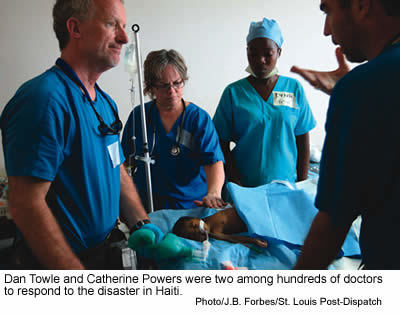
    “We traveled in silence, basically because the moment we hit the city I think everybody was just absolutely horrified and in awe of what they were seeing,” said anesthesiologist Towle, a 25-year veteran of international medical work. “Nothing prepared you for this.”

    People were still trapped inside the pancaked buildings. Signs lined the road: “Please America, help us.” “Welcome America.” “Welcome Marines.” Inside the compound, Pennino’s group found that other teams of physicians had set up operations in the nursing school adjacent to Residence Filariose. They could hear the screams of patients enduring amputations performed without anesthesia.

    Pennino and Olehnik scrubbed up to help with a complicated hand crush surgery, and Towle’s medical partner Catherine Powers provided the anesthetic. Towle claimed some “reserved” vacant rooms and began tearing open boxes and throwing supplies around to establish turf. The team pulled tables together and set up operating rooms for its first full day of surgery.

    The first InterVol team performed 120 surgeries over the next 10 days. Until Towle found a local supplier, he and Powers anesthetized patients without benefit of oxygen. Electricity was limited to a few hours a day. Temperatures soared to the high 100s. The rudimentary sterilization procedures available to the Haitian nurses who stayed to help rather than leaving to find their families were undone by sweat and dust and the fans that drew air in through vents 15 feet away from the tent city growing outside the OR walls.

    When the tremors shook — three or four times each day — dogs began to howl. Mothers cried for their children. Those who had roofs were afraid to sleep under them. But at 4 o’clock every morning, the doctors heard hymns of praise rise up outside the gate. “It’s a Catholic country,” Towle said. “Some sort of leader would show up, and people would gather. We laughed about it the day it didn’t start until 4:30, wondering, was he late?”

    Between the dogs and the roosters, sleep was hard to find. The doctors rose by 6 in air that hung like wet wool. At daylight, patients arrived. Families carried their wounded on blankets and tree limbs. Some made their own way on homemade crutches. Others came in the arms or Humvees of U.S. Marines, or the trucks that circulated through nearby villages to pick up the sick and wounded. In the field hospital that a medical team from Iowa set up in the ND yard, doctors treated a steady flow of 300 outpatients per day.

    The surgeons, through translators, had to console their patients several times before they could operate. “We had patients who said, ‘No. You’re going to cut off my foot. I’d rather go home and die,’” Towle recalled. The team kept them around until they relaxed and learned to trust. Towle took a picture of one fearful woman’s repaired feet to show her when she awoke after surgery. “We both burst into tears,” he said.

    At night, the doctors gathered around a fire of burning trash with their colleagues from World Wide Villages, Save the Children and the Children’s Nutrition Program. They drank hot Haitian beer and traded stories and ideas.

    The first surgical team at “Léogâne Shock Trauma Hospital,” as its staff came to call it, performed only two limb amputations. They pronounced three deaths; one was a 100-year-old woman whose body couldn’t handle the antibiotic fighting her infection. They delivered babies, many premature, the mothers’ bodies unable to withstand the fatigue, stress and hunger. Most made it. Some didn’t. The ones who did were balm. “I loved it,” Towle said. “Amidst all the death and tragedy, a baby was being born. Hopefully into a decent world. Who knows?”

    When Team II flew into “Léogâne International Airport” — the name another instance of field humor — Towle and Olehnik stayed behind a day to orient the new team. The weather cooled. As the disaster neared one month, demand for trauma care began to subside at the ND compound and the other field hospitals operating in town. “Our biggest concern is post-op healing,” Pennino wrote in one of his regular email dispatches. “We have no inpatient capability and patients are sent back home — aka refugee camp — to return for post-op wound checks.”

    Ricocheting between Rochester and Léogâne, Pennino continued to recruit doctors and donors via InterVol. At Notre Dame, valedictorian Brennan Bollman ’09 had taken leave from her first year at Harvard Medical School to coordinate offers of medical help through the Haiti Program office. Word of the response effort — and of Notre Dame’s role in it — was spreading through informal networks as well as such established channels as the Tom Dooley Society.

    Five weeks after the earthquake, Léogâne Shock Trauma Hospital shifted operations to an improved field hospital provided by a World Wide Village donor. Pennino reported 7,000 patients treated and 250 operations performed. “Incredible,” he wrote,” is an understatement!”

    Hope endures

    The ND campus responded to the crisis with creativity and determination, beginning with a well-attended Mass for Haiti on January 18. The University raised nearly a quarter of a million dollars in donations, gate receipts and concessions revenue at the men’s and women’s basketball games the following weekend.

    Students took up a collection at a faculty panel on Haiti. Others put together a benefit concert, a tent-and-tarp collection in conjunction with South Bend-area Boy Scouts, and a “Polar Bear Plunge” in which 100 undergrads dipped into the 40-degree waters of Saint Joseph Lake. Senior Jeffrey Lakusta secured commitments from wineries to donate a cut of their sales to relief agencies.

    Much of this money supported immediate relief efforts. But the University had already begun to think about its long-term role in Haiti, where the disaster crumpled hospitals, schools and churches as indiscriminately as people’s homes.

    No longer a missionary effort, Holy Cross’ presence in Haiti is native-born and growing fast. The pain of seminarian Guillaume’s death was compounded for his religious brothers and sisters by the destruction of the provincial house. Many of the eight parishes and 10 schools the order serves were badly damaged.

    Hope and vision at Residence Filariose are as strong and tall as walls that withstood the January 12 quake, thanks to Father Streit’s consultations with ND civil engineering Professor Yahya Kurama earlier in the decade. For now, Haiti Program staff have become relief workers. Like their partners in the Haitian government and a cluster of cooperating organizations, they recognize that fractures and flesh wounds come before LF treatments, deworming and iodine deficiency in the triage line.

    Still, Streit believes the program can press its effort outside the West Department, the district that encompasses the nation’s worst structural damage. Even the Port-au-Prince warehouse where the program subsidizes the production and sale of salt fortified with iodine and the antiparasitic drug that fights LF is structurally sound and operable. With support, Streit thinks Haiti Program clinicians could add critical services like bednets, malaria drugs, Vitamin A and iron.

    He is sensitive to the impact relief efforts can have on Haitian institutions. Hôpital Sainte Croix, his lead research partner in Léogâne, was already struggling before the disaster. Once it rebuilds, it may have to compete with sturdier relief organizations just to stay open for that day when the last foreign medical teams depart. The competition extends to personnel. Streit himself lost two recent hires to Doctors Without Borders, “but I’m happy that they’re working to help get us out of this situation,” he said.

    He trusts that experienced agencies share the ethic of “building local capacity” — training and employing Haitians to do most of the work, a key component of the Haiti Program’s success to date. It’s important, he says, to make sure Haitians are prepared to build a future in which healthcare, education, business and government function radically better than they did in the pre-January 12 past.

    Once Haiti’s emergency needs lessen, capable volunteers are welcome. Notre Dame Professor Karen Richman has posted Creole language course materials at the University’s open courseware site, ocw.nd.edu, for cooperative self-starters ready to do anything from dropping a well to building homes and churches to comforting orphaned children. Streit likes the idea of something like a Hofman trip for non-medical personnel so people can think about how to plug in.

    Hofman himself yearns to return. “I’m 88 years old, and I want to do with the rest of my life what is worthwhile,” he said in February, sitting in his blue ND parka and sipping soup in Corby Hall. “I found what is worthwhile, and it’s what we were doing there. Very, very much so.”


    John Nagy is an associate editor of this magazine.


  • One Life for Many

    veatchteaching

    Jose Bautista treasures the moment when the teacher reached out to him, helping him pivot away from gangs and trouble.

    Ramon Castillejo remembers the magic the teacher worked upon a boy named Hector, a recent arrival from Mexico whose tense struggle to adapt was eased by the teacher’s story about the noble hero of the Trojan War whose name he shared. And he tells how the teacher’s stories of the partnership of John and Abigail Adams spoke powerfully to students raised in a culture of machismo.

    Cristina Galvez recalls the magical transformation of history class, from the dry distribution of fact that she had known in previous classrooms to an encounter with dramatic figures who reshaped the world.

    Jose, Ramon and Cristina were students of Chauncey Veatch ’75 J.D., who retired from the Army as a lieutenant colonel in 1995 and launched a second career as a teacher. For his success in the classroom, Veatch, now 62, was named the National Teacher of the Year in 2002. He received the award in a White House ceremony.

    The significance of Veatch’s work derives in part because of where he teaches. The Coachella Valley, about 60 miles north of the Mexican border, is an intense, concentrated expression of the demographic and cultural upheaval that a wave of Mexican immigration began in California four decades ago and that is now sweeping the country. Most of his students are immigrants or the children of immigrants who came to work in the valley’s vast fields of grapes, citrus and vegetables.

    The valley is best known for Palm Springs, the affluent city that lies on its western edge, set tight against the jagged peaks of the San Jacinto Mountains, just south of the San Andreas fault. Nearby, 4,000 windmills fill the San Gorgonio Pass like massive metallic wildflowers. Their turbines spin electricity from winds brewed when hot air rising from the desert to the east sucks in the cool air from the Pacific Ocean.

    Palm Springs got its start as a sanatorium but developed celebrity cache when Frank Sinatra partied here with his Rat Pack and Bob Hope, a local resident, hosted the Desert Classic golf tournament.

    A few miles to the east is Indian Wells, one of the wealthiest communities in the world, whose residents live in palatial homes along golf courses sheltered from annoyance by perimeter walls and guarded by a sophisticated private security force. Part-time resident Bill Gates was once reprimanded for teeing up in a T-shirt, rather than the required golf attire.

    The Toscana Country Club’s marketing boasts that Indian Wells “began as an exclusive retreat for Hollywood’s elite, captains of industry, and American presidents.” That snob appeal is part of a pitch that offers “a place to indulge in life’s exquisite pleasures" — in exchange for a $150,000 membership.

    The other Coachella Valley

    Two miles down the road from the lavishly landscaped splendor of the Greg Norman-designed PGA West course lies Coachella Valley High. The neat campus, swelling with portable classrooms, looks southward across irrigated farm fields toward a horizon drawn by mountain peaks and a stately line of date palm trees bent eastward by the wind.

    Ninety-eight percent of the school’s 2,700 students are Latino. They are part of the big change in California since 1962, when it passed New York as the most populous state in the union.

    Back then, about 83 percent of the state’s 17 million residents were non-Hispanic whites. Since then the population has doubled. As journalist Peter Schrag noted, 85 percent of the newcomers are “something other than white Anglos.”

    They come from many countries, but Mexico is by far the largest source. “Currently, in public school enrollment, Latinos are already close to a majority. Anglos compose barely a third,” wrote Schrag in a book provocatively titled California, America’s High-Stakes Experiment.

    The future of the United States is tied as never before to the future of immigrant children, particularly young Latinos.

    That is why Veatch tells his students they are “children of destiny.” That is why he is determined to prepare them for the leadership roles that will beckon.

    He brings into his classroom a passionate mind in love with learning. He also brings an extraordinary ability to connect with students and to enlarge their field of vision.

    Several years ago, a researcher surveyed Veatch’s students to gauge their opinions of him. In order of frequency, the responses were 1) He cares about us; 2) He is fair; 3) He doesn’t say bad words; 4) He keeps his promises; 5) He knows a lot.

    Nita Grantham, who visited Veatch’s world history class while working for the Riverside County Department of Education before Veatch received the teacher of the year honor, recalls the experience vividly.

    It was a portable classroom, jammed with kids. Grantham was thrilled at its energy.

    “I was in awe at how engaged those kids were and at the quality of the learning that was going on,’’ she says. “Chauncey would take a word that was part of the history curriculum, and he would show that its origins went back to Latin. Then he would take it on to Spanish and back to English. It helped them get a grasp of the word and made the word relevant.”

    That sense of excitement, of joint exploration with his students, lies at the core of Veatch’s genius in the classroom.

    “I tell my students that our class is like a wagon train heading out across this great expanse of learning to reach our goal — an education,” he wrote in an essay on his teaching philosophy. “No one will be thrown overboard; no one will be left behind. Together, we are all going to get there.”

    A world without limits

    Veatch is undaunted by discouraging data about Latino dropout rates that for decades have hovered at around 50 percent. A generation ago author Earl Shorris described the stakes, warning that “the multiplier effect of dropouts marrying dropouts and producing children who will drop out promises a 21st century Latino underclass of enormous size.”

    Veatch shuns the litany of immigrant-community woe, which also includes the menace of gangs and high rates of out-of-wedlock births, and which some teachers cite as the reason for classroom failure. He refuses to be cowed by the educational deficits many students bring to school, difficulties sometimes compounded by the shadow of their families’ illegal immigrant status.

    “I say ‘Get over it,’” Veatch says, blue eyes flashing. “That’s making excuses. That’s giving yourself permission to fail. My job is to move my students as far as I can in the course of the year. I don’t mean remediate. I mean accelerate, I mean do everything I can to help the student achieve the maximum.”

    Veatch has developed a lexicon of aspiration. It conveys his conviction that his students can raise their sights from the flatlands, that they can be fired by a sense of possibility.

    “A teacher’s job is to be a dream maker, not dream breaker,” he says. “I want to show my students a world without limits. I want them to understand the power of democracy, dreams and destiny.”

    As he explained his teaching philosophy in an essay that was part of the National Teacher of the Year competition, Veatch wrote:

    “There are two words that are frequently repeated during my instructional day: literacy and dreams. Literacy leads to success in school, success in a career, and success in life. A literate person will have more options in life. A literate person has a greater likelihood of becoming a lifetime learner.”

    One concise formulation of the Veatch persona comes from Ramon Castillejo: “He’s an aggressive person. He’s a person who is assertive. But he’s also a humble person.”

    Veatch hasn’t been content to make his classroom for those students who already are headed for success, who were oriented toward college and career and, most likely, out of Coachella Valley. He actively sought out those who were quivering at the edge of premature failure.

    At the turn of the millennium, Jose Herrera was on a course for that burgeoning underclass that worried Earl Shorris. He was an angry 15-year-old, surly with resentment and tempted by the gang life that can lead to drug dealing and a dead-end — in prison or worse.

    “I started hanging out with the wrong crowd, and I made some bad decisions,” Jose says. “Then the teachers and school administrators started labeling me as a troublemaker. I was getting harassed right and left, even when I was walking down the hallway. I started holding a lot of anger, and when a teacher would try to talk with me, I was like, ‘Get away from me!’”

    It was a time pulsating with danger for Jose. He was close to a vortex that sucks its victims into a brutal subculture fed by the nihilism of the Latino gangster rap songs known as narcocorridos. These ballads glamorize drug traffickers whose lives spin inevitably toward doom. They often celebrate a certain type — el valiente, the outlaw who is tough and rich and generous and cruel. And certain to die a violent death.

    It was in a Coachella Valley bar that the legend of narco balladeer Chalino Sanchez was made in 1992. As he sang on the bar’s stage, an unemployed mechanic shot him. Instead of going down, Sanchez pulled his own gun and chased his assailant through the nightclub. A few months after that, after a performance in the Mexican state of Sinaloa, he was seized and murdered, and the killers dumped his body on a highway.

    Dead at 32, Chalino Sanchez became an idol, a Latino James Dean.

    Los Angeles Times reporter Sam Quinones, perhaps the best journalistic chronicler of the Mexican immigrant experience, wrote: “Chalino’s corridos are about the only two figures in Mexican popular culture [who, in times of economic crisis] can consistently claim economic success: the drug smuggler and the immigrant; usually, in his songs, the same person.”

    Says Jose, “When I was in high school everybody wanted to be like Chalino.” Jose wonders what could have happened to him. “All it takes is one wrong move to fall into that well so deep that you never come back. But Mr. Veatch intervened in my life at the perfect time for me.”

    Nearly a decade later, Jose clearly remembers that moment.

    “I was at a football game, walking up the bleachers, and Mr. Veatch was walking down. He shook my hand, and we started talking. He approached me in a completely different way. He treated me more like a young adult. He totally flipped me around.”

    “If young people feel no connection,” wrote historian and social critic Christopher Lasch, “their dislocation is a measure of our failure, not theirs.” Jose Herrera’s success is a measure of Chauncey Veatch’s genius as a teacher.

    Jose enrolled in Veatch’s history class and a financial literacy class that introduced him to the world of checking accounts and savings accounts. His grades shot to a 4.0. His world expanded as he grew interested in American history and government and became convinced that he could find a useful place in U.S. society. His surliness evaporated in the blazing heat of newly found self-respect and ambition.

    Jose became a leader in the Cadet Corps, which Veatch established along the lines of an ROTC program. There he worked on community service projects and taught younger students how to march. After graduation in 2002 he became a Marine.

    Now, seven years later, Jose is a manager-in-training for Wells Fargo Bank. He traces his interest in banking to the financial literacy class. And he aspires to teach at the Wells Fargo training center because Mr. Veatch showed him the excitement of being a teacher.

    “I model my life after him,” says Jose. “He gave me the life I have now.”

    An early connection

    Veatch says there’s a simple explanation for the connection he feels to migrant families. He was once a migrant himself, moving continuously in a youth that was defined by the astonishing frequency of moves required by his father’s military career.

    “I grew up just about everywhere,” he says, running down a travelogue that included kindergarten in Germany, first grade in France, and second-grade classrooms in five states: Kansas, Texas, Missouri, Alabama and California.

    “My dad was going to all these different schools for training. He was a helicopter pilot, and they had lots of eight-week schools. If my father went somewhere, my mother took us. We stayed intact as a family. That was very important to us.”

    Veatch’s connection to Mexican migrants began when his family was living at Fort Ord, near Salinas, California, the home of John Steinbeck, whose Grapes of Wrath captured the Okies’ epic migration to California. Once the Okies left the fields, they were replaced by Mexicans. The young Chauncey did volunteer work in migrant camps.

    In 1968, when he was enrolled at the University of the Pacific, Veatch was inspired by Cesar Chavez, the charismatic Mexican-American labor organizer who — with a dignity and spirituality that often drew comparisons to Gandhi — challenged the power of California growers as he built a movement that became the United Farm Workers of America.

    When Chavez endorsed Robert F. Kennedy’s 1968 campaign for the presidency, Veatch joined the effort. On behalf of the union, he traveled widely to register new voters. At a rally in Salinas, Veatch marveled at the exchange of energy between the polyglot crowd and Kennedy. As Theodore White wrote of RFK in his book about the 1968 campaign, “The grabbing, pulling, screaming ecstasy made him feel alive.”

    Veatch remembers an ecstatic surge of humanity around Kennedy — mostly Latino, but also blacks, whites and Filipinos. “His sleeves and coat were shredded from people just grabbing out to touch him. His security detail was struggling to keep him upright. It was an amazing sight.”

    Veatch watched in awe.

    “I remember thinking: this is a man who doesn’t share their culture, their race or their background, and yet he was able to reach out to them, to make contact with them in such a powerful way. I don’t think I’ve seen anything in my life more powerful than that. It was a huge inspiration for me. There was such power and grace. It confirmed what I had believed for a long time. It celebrated the ability to bridge gaps and differences.”

    A confirmation of a different sort shaped his decision to go to Notre Dame. It grew from his experiences in Germany, where as a high school student he made several trips to Paris.

    “Every time we went I would break off from the group to spend some quiet time at the Notre Dame Cathedral. Our Lady was especially important to me,” he says. “From the time of those visits, I thought I wanted to attend Notre Dame at some point in my life.”

    In 1972, already in the Army, Veatch entered law school at Notre Dame. When he was elected president of the law school student body, he completed a personal, political trifecta that also included the student body presidencies at Frankfurt and at Pacific. Such political energy probably speaks to the hunger for connection that grows in someone who had been uprooted so many times in his youth.

    One of the highlights of Veatch’s military career was his service in Panama, where the Army conducted nation-building operations aimed at restoring democracy in the aftermath of the 1989 U.S. invasion that overturned dictator Manuel Noriega.

    The Army had prepared Veatch for the his role in that effort — dubbed “Fuertes Caminos” or “Strong Paths” — by sending him for Spanish-language training at the Defense Language Institute in California. Ironically, he spent much of his time in Panama working in isolated areas with indigenous people who spoke little Spanish. Often commuting to work in helicopters, he was part of a unit that built schools and clinics, and repaired roads and bridges.

    Veatch was stationed at California’s Fort Ord in 1994 when a powerful earthquake wrecked buildings and crippled highways, killing 55, injuring nearly 5,000, and forcing thousands to camp in parks or seek refuge in shelters. Part of the relief effort involved providing linguistic support for work among the region’s ethnic communities, which included large numbers whose first language was Spanish, Russian, Armenian or one of several Chinese dialects.

    Veatch had shown his talent at coordinating logistically complicated events 13 years earlier, where he was a military liaison officer for the committee planning the inauguration of President Ronald Reagan.

    He took two indelible memories from that January 1981 week. The first involved an event where Air Force brigadier general and Hollywood legend Jimmy Stewart introduced five-star general and military legend Omar Bradley, who died three months later. The second involved an announcement Reagan made about the Americans who had been held hostage in Iran for more than a year, after the seizure of the U.S. embassy that dogged the presidency of Jimmy Carter.

    “I was on the reviewing stand with the president and his guests,’’ Veatch recalls, “and in the midst of the parade President Reagan turned around to face us and said, ‘The hostages are out of Iranian air space.’ I remember thinking it was amazing to be there at that moment in history.”

    Into the classroom

    After he left the Army, Veatch started his teaching career with modest expectations. He thought he’d be fortunate to work as a substitute teacher while earning his teaching credential and sizing up the field. But a California district that had been hemorrhaging teachers asked him to report the next day. Veatch, divorced and without children, jumped right in with a full-time job. He taught math, science, social studies and language arts for four years, picking up the proper credential at night.

    Then he was recruited to Coachella Valley High, where he began teaching in 1999. Two years later, he was district teacher of the year, then Riverside County teacher of the year, then California teacher of the year. In April 2002, after a battery of classroom visits and interviews and essays, came the big moment in the White House where President George W. Bush hailed Veatch’s influence on students who moved from the detention to the honor role, abandoned gangs to learn military discipline in a Cadet Corps, and developed a passion for learning because of a teacher whose unrelenting belief in them stirred and nurtured a hunger for accomplishment.

    One of the students who accompanied him to Washington was Ramon Castillejo, who had been a migrant worker himself before winning multiple scholarships to college. Ramon still delights in the lessons Veatch taught about John and Abigail Adams.

    “He put a lot of emphasis on the fact that John Adams’s wife influenced him a lot, that she was very important to what he became,” Ramon says. “It meant a lot for us to learn that, because in our culture machismo is still very strong and a lot of the girls are a little scared to go to their parents and say, ‘I’m going to go to school; I’m going to do something you’re not expecting me to do.’ I could see that Mr. Veatch was teaching us about a great leader in our country, but he was also teaching a lesson in life.”

    Ramon relishes the story of Hector, who came to class feeling awkward in his new surroundings and struggling with a new language. “Mr. Veatch knew that Hector was having a hard time, so he started talking about how people’s names are connected to people in history. He said Hector’s name went back to a great warrior. You could see how that made him feel, that it picked him up. I think it was great that Mr. Veatch did that.”

    Veatch has a name for that teaching device. He says he brings his students “ennobling intimacies” with an important figure of history or literature.

    Such encounters provide an uplift that generates a hunger to learn more. Now Ramon is himself dedicated to creating classroom magic that can inspire and transform lives. He teaches classes for Los Angeles County, training laid-off workers to reorient themselves in the job market.

    ‘Definitely our angel’

    Cristina Galvez says Veatch inspired her to want to make a difference in the lives of immigrant families, many of whom bring little education from desperately poor communities in Latin American hinterlands. “When he taught us about the people who changed things,’’ she says, “he taught us that we hold the power to make change, that we can go out there and make a difference.”

    Cristina earned a master’s degree in marriage and family therapy and then went to work with Latino immigrant families in Orange County. There she helped start a program called From Cradle to College, which sought to instill a sense of greater possibilities to families that had known generations of peasant labor in Mexico.

    Mexican scholar Luis Rubio has written that Mexico “has become a nest of privileges,” where only the privileged few learn to dream. “The rest have virtually no possibility of envisioning opportunities different from those that their social origin imposed upon them.”

    From Cradle to College was an effort to widen the immigrants’ sense of possibility, notes Cristina. “The idea was that you start to achieve success in the cradle, you start with the idea that this child will go to college, instead of ‘maybe’ or ‘I don’t know.’”

    Cristina is now married to Jesus Cano, who as a student helped Veatch drill the Cadet Corps color guard into a squared-away unit that repeatedly won drill competitions across Southern California. Jesus, who once thought that his future was the same field work of his parents, served with the Marines in Iraq and is now attending college on the G.I. bill and aiming for a career in the California Highway Patrol.

    In late 2009, Veatch joined Cristina and Jesus at a Mexican restaurant a few miles from Coachella Valley High. Sitting beneath paintings of Mexican village life, they traded stories of their time together and Veatch talked of his hopes for all his students. “I want to contribute to the impetus for them to be constructively, actively engaged citizens.”

    Cristina nodded in enthusiastic affirmation of the mission.

    Like a number of former Veatch students, Anabel Vasquez and Maribel Cardenas are now teachers themselves. Both aspire to duplicate the energy and dedication they saw in Veatch. “We look up to Mr. Veatch as a role model,” says Cardenas, “because we saw how much he cared, not just about our education but about us. He was dedicated to us.”

    Because of his being National Teacher of the Year, Veatch was able to send two young women to the International Space Camp in Alabama, representing the United States in an international celebration of space exploration. “We were proud to be representing our country, and we were proud to represent Mr. Veatch,’’ says Vasquez. “He’s definitely our angel. We wouldn’t be where we are without Mr. Veatch.”

    Echoing a sentiment that is widely held in Coachella Valley, Cardenas adds, “I can’t imagine my life without Mr. Veatch.”


    Jerry Kammer is a senior research fellow with the Center for Immigration Studies in Washington, D.C. He is a former Northern Mexico correspondent for the Arizona Republic, and he wrote about immigration and U.S.-Mexico relations as a reporter in the Washington Bureau of Copley News Service. In 1989 he won the Robert F. Kennedy journalism award for his reporting from the border.
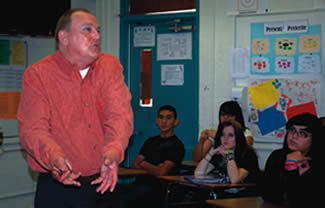
    Classroom photo of Chauncey Veatch by Cindy Soria.


  • The Goldilocks Zone

    I first learned about our body’s electron transport chain (ETC) while working in a biochemistry lab. This complicated process, which uses digested sugars to create an ion gradient that acts like a hydroelectric station for producing cellular fuel, has more belts and levers than a Rube Goldberg machine and can twist the mind like an M.C. Escher print.

    Given the genius way ETC utilizes electrons, for days I couldn’t believe I was actually walking around. One of the lab’s doctoral students concurred. A practicing Catholic, Brenda told me that the more she learned about how our bodies work, the more awed she was by God’s creation.

    It turns out that the electron transport chain is just the mystifying tip of an improbability iceberg so enormous as to be nearly ineffable. This biochemical process depends on atoms and ions. Physicists tell us these items, once created, cannot be changed or destroyed (except under the extreme conditions of stars and black holes). At a more basic level, this means that the atoms that compose our bodies, which swirl and spin and flow through us to give us energy and make us who we are in tens of thousands of different ways, have been around for billions of years. Compared to the relatively short time our consciousness occupies one of their creations, the elements always have been and always will be.

    To be conscious, we need cobalt, which gives glass a radiant blue color. Part of vitamin B12, cobalt helps ensure we produce red blood cells to carry oxygen to muscles, organs and bones. It also helps form the myelin sheaths protecting our nerve cells. Without cobalt, we would suffer from anemia and our bodies would tingle with pins and needles. Perhaps more frightening, our brains would fog over, and we would forget who we are.

    From the heavens

    This indispensable mineral comes from the heavens. In fact, cobalt is part of the dust left over from stellar explosions known as supernovas. For solitary stars nine or more times more massive than our sun, life ends with what is the most powerful and spectacular explosion in the known universe. If one of our neighboring stars were to go supernova, the starburst would be visible during daylight and outshine the moon at night, no doubt inspiring myths, poems and songs.

    Supernovas occur after a star has burned up its fuel, which the star needs to create enough energy to combat its own gravity. In other words, when the fuel is gone, gravity kicks in. The force that pulls apples to the earth also pulls the star into itself. In a matter of seconds, the outer surface — which may be large enough to encompass the entire orbit of Mars — is yanked inward. All those atoms smash into each other and create so much pressure that the small atoms merge into larger ones. Temperatures spike to over 100 billion degrees C (180 billion F). The pressure and heat blasts the new atoms into the cosmos.

    Only supernovas pack the energetic punch necessary to create elements more massive than iron, like selenium, gold, mercury, tungsten and cobalt. For most of the lighter elements, a regular star does the trick.

    Oxygen is one of these elements. Given our relationship to it and its role as a metaphor for purity and life, it is strange to think that it was born in the violence of stellar furnaces. That cool breeze on a summer day, that deep breath to calm us down, that crisp feeling in an alpine forest — all conjure the binary molecule that enables the electron transport chain and the life-sustaining masks of emergency rooms and surgery theaters.

    Together with hydrogen, oxygen forms water, which is fundamental to not just our existence but to life in general. In fact, many scientists believe that life, let alone intelligent life, is impossible without water. But unlike oxygen, hydrogen has an exotic and still poorly understood origin: the Big Bang.

    One theory says that before there was anything, there was a void — no matter, no space, no time. It was the state of things before the God of Abraham said: “Let there be light.” Using complicated mathematics, physicists turned this void into the chaos that birthed the Greek gods, an infinitely creative vacancy, swirling with particles and infinitesimal universes.

    For every spontaneous appearance, a companion particle or universe pops into being. But the companion is an exact opposite. Since opposites attract, an instant after a companion springs to life, the particle and its companion race toward each other and their energies cancel and they cease to exist. In this timeless and spaceless abyss, chance eventually cranks out a particle the size of our current universe that somehow breaks from its opposite and erupts into life.

    After 380,000 years or so, the elementary particles condense into neutral hydrogen and helium — the same hydrogen that imbues all aspects of our life. Every time we take a drink, breathe out or set the electron transport train in motion, we utilize atoms that have been around since creation.

    Which happened nearly 14 billion years ago. Physicist Leonard Susskind argues that the human mind is not wired to consider such a large number. Because of the financial crisis, however, today many of us probably have a better understanding of what a billion means than we did a few years ago. A billion dollars is two space shuttle launches or enough to run Minneapolis schools for two years. A billion grains of sand fill a cube with edges just over 4 feet in length.

    Still, when it comes to time, perspective is more difficult. A billion seconds ago Jimmy Carter was in the White House. A billion minutes ago, Romans fed Christians to the lions. A billion hours ago, early modern humans had spread over Africa and possibly to Southeast Asia, but not yet to Europe. A billion days ago, mammals were making their move and taking over the planet. A billion years ago it was multicellular organisms that were oozing through the muck to stake their claims.

    Hydrogen and helium soared into space nearly 14 billion years ago. They then collected in massive clouds that contracted into stars. Many went supernova, jetting heavier elements into galaxies and nebulae. Roughly 4.5 billion years ago, the nebula that eventually formed our sun captured these star-produced elements in its gravity and coalesced them into balls of solid matter. On one of these balls, oxygen and hydrogen burned to form water. Minerals from stars and supernovae continued to rain down on Earth and blended with the water to establish the primordial soup needed to create life.

    Kickstart

    Around a billion years after our planet formed, a bolt of lightning kicked the soup into gear, forming molecules that laid the foundations for self-replication. These bumped into each other tens of trillions of times, exchanging elements and building more and more complex structures. This led to RNA, DNA, lipid membranes and, eventually, rudimentary life. Over the next 3.5 billion years, minerals and bases and proteins created prokaryotes, then eukaryotes, then fish, amphibians, reptiles, rodents, prosimians, apes and homo erectus. Finally, homo sapiens stretched its back and grabbed its tools to hunt for prehistoric wildebeest and gather berries and wild tubers.

    Given ideal environmental conditions like those found on Earth, astrobiologist Andrew Watson puts the odds at 10,000-to-1 against life appearing.

    But what are the chances of those conditions occurring? First the sun has to be in just the right spot. Any closer to the center of the galaxy and the radiation would burn through molecules attempting to form life. Any further out and there would not have been enough of the heavier elements to support life. Astronomer Donald Brownlee and paleontologist Peter Ward call this the Goldilocks zone, because it is “just right” for sustaining life.

    It doesn’t end with the sun. Our solar system contains a Goldilocks planet: Jupiter. Because of its size it has the gravity to clean out all the asteroids that would have otherwise crashed into us. We also have a Goldilocks moon to stabilize our orbit, which is thankfully circular: an elliptical orbit would make our climate too variable for life. Our planet is also a Goldilocks size, just big enough to have the gravity to hold in the atmosphere but not so big that it flattens it against the surface.

    All told, the chance of these multiple Goldilocks Zones aligning in just the right way is not a million-to-one or a billion-to-one or even tens-of-trillions-to-one, but something much higher. Attempting to compute the probabilities of each zone and apply them to Earth comes with so many assumptions that cosmologists have yet to settle on an answer. They do agree, however, that the odds are remote at best and near impossible at worst.

    Still, for all practical purposes, the observable universe is essentially infinite. Current estimates give it at least 125 billion galaxies. Most galaxies have between 300 and 800 billion stars (with some having more than a trillion). Given those numbers, some of those stars will be the right distance from the center of their galaxies and have planets of the right size with the right orbits at the right distance from their suns. These just-right planets will have big sister planets to keep out the asteroids and little brother moons to keep them stable. After the planets cool, water could form and at some point life will crawl onto land and perhaps, just perhaps, evolve like it did on Earth.

    Even if this is true, we are not out there. We are not a warlike alternative life form with a scaled head and an appetite for honor or a peaceful, wide-eyed botanist who uses musical notes to communicate. We are here, in the outer spiral arm of the Milky Way on 21st century Earth. So even if life is likely in the universe, this life isn’t. We don’t need to leave the planet to see that the possibilities are still mind-boggling.

    Assuming natural events hadn’t nudged evolution in another direction or that historical events hadn’t unfolded differently, we could have ended up doing backbreaking labor among the first farmers in the Fertile Crescent. We could have lived in dire poverty at the edge of the Roman Empire before being sold into slavery and killed by Nero for ladling the soup wrong. We could have been burned in a Wicker Man or slaughtered by Genghis Khan or executed by an English monarch trying to stamp out Catholicism. And today we could have been born in war-torn Sudan, earthquake-stricken Haiti, genocide-suffering Rwanda, Taliban-ruled Afghanistan — when you consider all the possibilities of where we might have been given life, the chance to be alive today, in the developed world, in a land of relative plenty, is nothing short of miraculous.

    Reverence

    When looking at the grandeur of the cosmos and marveling at how it led to life, the issue of whether there is a creator may be beside the point. Most of us believe great works of art should be maintained for no other reason than that they are beautiful. We do not need to know who painted the Sistine chapel or designed Notre Dame Cathedral to be awed and comforted by their magnificence. The same applies to life. As we venerate it, admire it, and stand in awe of its engineering and aesthetics, we must also take every opportunity to preserve it and share its blessings.

    I do not know if life is a gift from God, a turn of the karma wheel or just pure chance (I prefer the first but suspect the last). But I share my former lab colleague’s reverence, particularly in light of all we’ve learned from cosmologists and biologists.

    This means actively polishing our spirits and thus the spirits of others. By the time we reach our 30s, most of us have read enough philosophy and spiritual tracts, heard enough homilies or sermons, seen enough morality plays disguised as sitcoms, and meditated and prayed enough to know how to do this. In some cases, it may be nothing more than a kind word to a troubled cashier. In others it may be volunteering at the food bank. In still others, it may mean putting policies in place that protect the less fortunate or supporting international aid organizations through career choices or donations.

    Of course it is hard. And we all know that getting cut off in traffic or waiting in a long line at the grocery store are trivialities compared to the suffering in the world. Yet they bring out the worst in us. (This is why the eponymous devil in C.S. Lewis’ Screwtape Letters advises his nephew to tempt people with these little things.) We also have our own context-specific pain to deal with, like breakups, losses, death, clinical depression, economic hardships, troubled children — you name it. This is why we need to keep studying and listening and meditating on the world around us.

    Reflecting on the immensity of the universe can be part of that. The abyss may unnerve us when it stares back, but it still helps smash self-importance by placing our own unlikely being against that of others and that of creation as a whole. It humbles the ego and releases the spirit, allowing it to stand in awe at infinity, which can actually make it easier to wait in lines and handle close relationships while reducing hate, spite, jealousy and whining to energy-wasting indulgences. It helps remind us of our good fortune and that we also have the luxury to realize it.

    By embracing the majesty of creation and acknowledging the miracle of our own blessed existence — including all the material struggles and emotional and psychological trials — we help ourselves and others sparkle like the stardust we are.


    Mark Yates lives and works in the Czech Republic, where he has generated a drawer full of unpublished novels.


  • Enter Notre Dame, patron of the arts

    rfkplay

    Anna M. Thompson decided to read one last email before calling it a day.

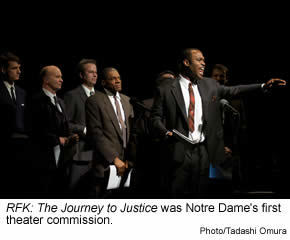
    It was nearly 11 p.m. when the executive director of Notre Dame’s Marie P. DeBartolo Center for the Performing Arts (DPAC) clicked on the message from Greg Phillips ’66. Phillips had been in the Decio Mainstage Theatre audience a few hours earlier for the L.A. Theatre Works’ world premiere performance of RFK: The Journey to Justice.

    “Keep up the good work of bringing all types of works here and continue to push the envelope of making us think instead of just sitting and being entertained.”

    The line that ended that impromptu thank-you note has kept Thompson smiling for weeks. “That’s exactly what we’re trying to do,” she says. “Exactly.”

    When Thompson arrived on campus in the summer of 2007, the University made a commitment not only to showcase some of the world’s top performing artists but also to help them cultivate new works to bring to the DPAC’s five stages.

    “There’s a trust that we’re building not only with performing artists but with our own patrons,” Thompson says. “We know if they go home and talk about something for a week they’re not only going to come back they’re going to be more willing to try something else.”

    Since the 2008-09 Visiting Artist Series, the University has showcased eight new commissioned works by such artists as the Kronos Quartet and Wu Man, the Richard Alston Dance Company and Tim Robbins’ The Actors’ Gang. The University has already commissioned at least six more works for the 2010-11 and 2011-12 seasons — most notably The Actors’ Gang’s anticipated stage adaptation of author Howard Zinn’s A People’s History of the United States — in a growing effort to establish the University as a leader in the creation of new works in music, dance and theater.

    “What if we had no more new music?” Thompson says. “What if we had stopped with Bach? What if we said, ‘Okay, nobody’s going to do better than that. Let’s stop now.’ If that happened the world wouldn’t have gotten to hear Mozart or Stravinsky. Can you image a world where nothing new was being created? I feel it’s our responsibility to make sure that doesn’t happen. I think it’s one of the most important things we’re doing right now. There’s a cultural legacy that we have to leave.”

    Formerly the executive director of fine arts programming at the College of Saint Benedict and Saint John’s University in Minnesota, Thompson has long been an advocate for investing in the creation of new performance works, especially in the world of dance. She often likens such commitment to the arts as being as important to higher education as funding research in the sciences — both allow new discoveries and exploration of ideas.

    The response to January’s RFK: The Journey to Justice, the University’s first theater commission, seems to echo that sentiment.

    The performances cross classic theater with old-time radio shows, featuring actors with scripts in hand delivering their lines into microphones placed around the stage. Written by playwrights Murray Horwitz and Jonathan Estrin, the production examines the Civil Rights movement through the lens of Robert F. Kennedy’s political life, showing his evolution from ambivalence to passionate race-relations crusader from 1960 to ’68.

    Notre Dame served as lead commissioner on the project, with Stanford University, the University of Maryland and the University of Richmond also contributing.

    “Notre Dame did what any good commissioner does,” says Susan Loewenberg, the founder and producing director for L.A. Theatre Works. “They gave us the money and left us alone. They trusted us to come up with something that was good. What they were able to do on their end was to put together discussions, a matinee performance just for students and professors; I even did a class about the politics of the play. It’s a wonderful way of exposing how you can use the arts in all kinds of ways.”

    The addition of such educational opportunities across the University community, Thompson says, also can provide rare firsthand examinations into the creative process that can be applied in multiple disciplines.

    “We can’t talk to Beethoven or Mozart,” Thompson says. “But to be able to sit down and have a conversation with [British choreographer] Richard Alston about a new dance piece is a very different experience, maybe a once-in-a-lifetime experience, for faculty members and students.”

    Although the 2008-09 season was Thompson’s second as executive director, it introduced her first year of artistic programming. With the support of grants, donors and budget reallocations, Thompson was able to commission works by dance troupes Diavolo and Spectrum Dance Theater as well as the world premiere performance of a Terry Riley composition by the Kronos Quartet, a San Franscisco-based ensemble, with soloist and pipa player Wu Man. Since most of the money came out of a fund to pay visiting artists’ fees, Thompson says she had to be more selective in the performers she brought to the University’s stages.

    “It may have shifted the way our season looked,” Thompson says “but it certainly didn’t affect the quality of artists we could bring to Notre Dame. The Kronos Quartet has now performed that work all over the country, and in every program it says ‘commissioned by the University of Notre Dame.’ That brings equity to the University, and it brings equity for a performing arts center that’s only six years old.”

    Although Thompson doesn’t dictate the subject matter for commissions, she does seek out artists who will develop complex projects that fit the University’s mission. In addition to civil rights, a subject closely tied to the University through the work of former University president Rev. Theodore Hesburgh, CSC, Tim Robbins’ group presented The Trial of the Catonsville Nine. The play follows the trial of nine Catholic activists, most notably brothers and priests Philip and Daniel Berrigan, who entered the Selective Service offices in Catonsville, Maryland, on May 17, 1968, removed 378 draft records and burned them in the parking lot.

    Loewenberg of L.A. Theatre Works says being commissioned by a university often provides a much greater chance for such works to be seen.

    “It’s become very popular for foundations to commission playwrights, but 97 percent of them are never performed,” Loewenberg says. “They may do readings and workshops, and that’s that. If they aren’t sure they can make money off of it, especially in this environment, they won’t put it on.”

    Thompson understands that.

    “If I were a community theater looking right at the bottom line, I’m not going to be doing a play like RFK,” she says. “I’m going to do Bye Bye Birdie.”

    Creating original works can take anywhere from 18 months to two-and-a-half years to produce, and can cost anywhere from $5,000 to $50,000. Thompson says her goal is to have between two to six commissions and at least one world premiere performance at the University per academic year. She also says that she hasn’t come close to spending $50,000 on a commission since arriving at Notre Dame — but she hopes to.

    “We’re not there quite yet,” she says, “but we’re working on it.”


    Jeremy D. Bonfiglio is a South Bend-based freelance writer and the staff features writer for The Herald-Palladium of St. Joseph, Michigan.


  • Haiti: What can we do?

    haitiwater

    Reports filtered back to campus in January and February of alumni who made financial and professional sacrifices to join the relief effort in Haiti after the January 12 earthquake.

    In addition to the InterVol-ND teams, physicians volunteered under the auspices of numerous nongovernmental organizations in Port-au-Prince and other towns. William Devir ’73 led a group of federal disaster responders as part of a U.S. Department of Health and Human Services effort that treated nearly 30,000 patients in the first month.

    As vice president of overseas operations for Catholic Relief Services (CRS), Annemarie Reilly ’88 coordinated the $95 million outreach of the U.S. Catholic Church as underwritten by the donations and volunteer hours flooding in from thousands of parishes — and many ND alumni clubs — around the country.

    Reilly says CRS, which has served more than 50 years in Haiti, views the recovery as a 5-to-10-year project. CRS encourages all people to help Haiti through prayer, education and action. As the international aid arm of the U.S. bishops, CRS is developing policy positions regarding federal aid, refugees and related concerns.

    The University is working to strengthen the Notre Dame Haiti Program’s determined fight against lymphatic filariasis (LF) and to rebuild Holy Cross ministries damaged by the quake. “What can people do?” asks Haiti Program director Father Tom Streit, CSC. “Well, I would say, what are your skills? What is your passion? If you’re patient and flexible, you’ll find a way to help because the list of needs is endless.”

    Learn more about the Haiti Program and LF at haiti.nd.edu. Eyewitness accounts and information about the recovery effort are available at haitidisaster.nd.edu and Notre Dame Magazine’s website. To make a contribution to Notre Dame initiatives, call 574-631-9385 or visit supporting.nd.edu/haiti


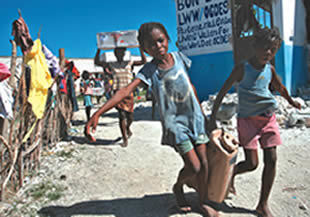
    Photo of Haitian girls with water jug by J.B. Forbes/St. Louis Post-Dispatch.


  • Apple Holding Special Event To Preview iPhone OS 4 This Thursday

    Apple has just sent out invites to press inviting them to a special event where they’ll “Get a sneak peek into the future of iPhone OS”.
    The event, which obviously comes just after the launch of the iPad, will showcase the new features coming with the latest release of the iPhone/iPad operating system, giving developers time to plan for and integrate the new features into their apps. There have been rumors for months that this new update will include the ability for certain third party apps to run in the background.

    Apple has been holding these developer preview events since before the App Store launched — there was one in March 2008 where the iPhone SDK was announced. And last March Apple gave a preview of the iPhone 3.0 software update. Historically (by which I mean, the last two years) these updates have been released alongside new iPhones in the summer (the iPhone 3G came out July 11 2008; the 3GS was released June 19 2009).


  • Seen & heard on campus

    Springsteen concerts aren’t the only performances selling out in 12 minutes these days. The Keenan Revue’s long tradition of entertaining, shocking and ridiculing audiences continued this year before three nights of packed houses at Saint Mary’s O’Laughlin Auditorium. The 2010 theme, “Keenan RevueS.A. vs. RevueS.S.R. . . . A Cold War Revue,” provided a backdrop of patriotism and thick accents amid lots of red. The revue featured student musical performances and jabbed at a recent former Notre Dame quarterback in the skit “Going Professional.” Audiences groaned at several “too soon” moments, such as cracks at Tiger Woods and a reference to “The Jackson Four,” complete with a sobbing Jermaine and an absent Michael. After more than 30 years of hosting Keenan’s shenanigans, however, Saint Mary’s decided not to renew its contract with the revue, citing incompatibility with the college’s mission statement. Revue organizers have begun their search for a new venue. . . .

    bessette

    The Congregation of Holy Cross will soon boast its first saint in the 173-year history of the order that founded the University. Born in 1845, Blessed Brother André Bessette, CSC, was a simple but prayerful laborer with a devotion to Saint Joseph who joined the congregation in his youth and served much of his life washing clothes, cutting students’ hair and greeting visitors at the College of Notre Dame in Montreal, Canada. Thousands of miraculous healings that occurred during his 91 years were popularly attributed to the intercession of the “Miracle Man of Montreal.” He will be canonized in Rome on October 17. . . . “The Big Dog” is turning pro. Bengal Bouts legend Mike Lee ’09 signed a contract to box for fight promoter Top Rank during a Joyce Center press conference attended by former Top Rank fighter Tom Zbikowski ’07, who put his boxing career on hold with a 1-0 record to play safety for the NFL’s Baltimore Ravens. Lee enters his professional career with an undefeated amateur record of his own and a reputation for throwing punches so fast his opponents can’t see them. His modest goal? A championship belt. And he’s pledged to donate a percentage of his fight and sponsorship proceeds to the bouts’ longtime charity, the Congregation of Holy Cross in Bangladesh. . . . “Shall I compare thee to a Summer’s day?” The opening line of Shakespeare’s Sonnet 18 was especially lovely and temperate as uttered by anthropology Professor Agustin Fuentes on a chilly morning in February. Fuentes and dozens of Notre Dame personalities from University Provost Thomas Burish to former Observer columnist Katherine Khorey, a senior, warmed the air inside O’Shaughnessy’s Great Hall with their readings of all 154 of The Bard’s famous 14-liners in early celebration of Valentine’s Day. The new event, dubbed SonnetFest, is part of the year-round festivities and performances of the Shakespeare at Notre Dame program. . . . Scott Malpass ’84, the University’s chief investment officer for more than two decades, has earned widespread accolades as the wizard behind Notre Dame’s admirable endowment performance in good times and bad. Less well known to Domers outside the Mendoza College of Business is the Applied Investment Management course he founded in 1995. In 15 years, the class has trained more than 700 top ND finance students by giving them the opportunity to manage a live, multimillion dollar stock portfolio using fundamental research techniques, and it has become a model for other leading business programs. As more economists tentatively forecast an imminent end to the current recession, about half of those AIM alumni will reconvene on campus in June to network and discuss urgent issues in contemporary global capital markets. . . . Football Saturdays received a major hospitality overhaul in preparation for the 2009 season, with changes affecting every aspect of the weekend from parking to pep rallies to the creation of the personalized weekend-planning website, gameday.nd.edu. Those efforts earned recognition as an industry best practice by the Stadium Managers Association, which represents officials at professional and collegiate outdoor stadiums around the country. Notre Dame’s Game Day guru, associate vice president for events and protocol Michael Seamon ’92, presented the ND model during the group’s annual conference in February. . . . Veterans of Innsbruck gasped a collective “Achtung!” at the January announcement that their beloved study-abroad program would soon exist only in their memories. Citing a dearth of applicants to the once-thriving German language and culture program, launched 45 years ago as the University’s maiden voyage into overseas study, the University shifted from the charming capital of the Austrian Alps that twice hosted the Winter Olympics to its growing presence in Berlin, Germany. . . . The University’s nondiscrimination clause received an extra measure of attention after the January 13 publication of a cartoon in The Observer that made light of violence against homosexuals. The strip prompted weeks of angry letters to the paper’s opinion pages and the resignation of the duty editor. Campus gay and lesbian activists and their allies, who have annually submitted petitions requesting the inclusion of sexual orientation in the official statement, rallied against the cartoon two weeks later and marched to the Golden Dome to deliver a letter to University President Rev. John I. Jenkins, CSC, ’76, ’78M.A., again decrying its absence in the policy. Administrators have said that an explicit inclusion of sexual orientation in the policy would compromise the University’s ability as a private, Catholic institution to maintain a distinction between sexual orientation and practice according to Catholic doctrine on human sexuality. . . . Student Film Festival devotees may now feed their fixation on iTunesU, Apple’s educational media sharing service. The 21st annual fest is free in its entirety via iTunes.nd.edu, and the festival’s founder, Professor Ted Mandell, is also posting “Best Of” collections from past shows. . . . The 600 Club welcomed women’s basketball coach Muffet McGraw after the team’s 78-60 victory over Louisville on January 16. It’s an exclusive group — only 18 other Division I women’s basketball coaches belong. McGraw’s Lehigh teams earned her first 88 victories. She came to Notre Dame in 1987. . . . Explicit support for Catholic teaching on the sanctity of all human life in a policy statement was the first of the preliminary recommendations presented at the beginning of the semester by the ND Task Force on Supporting the Choice for Life. The panel, co-chaired by law Professor Margaret Brinig and theology department chair John Cavadini, also counseled policy statements on charitable gifts and investments, better publicity for the University’s supportive stance toward pregnant students, and various forms of encouragement for pro-life witness among students and alumni. Students cheered the presence of Father Jenkins and nearly three dozen members of the faculty at the January 22 March for Life in Washington, D.C., marking the 37th anniversary of the U.S. Supreme Court’s Roe v. Wade decision. In all, eight buses carrying 400 marchers left from Notre Dame for the event. . . . The alarming discovery of a femur by maintenance workers digging under Lewis Hall in February briefly promised a sensation for campus mystery lovers. But the cold-case file trawl and CSI summons never materialized. A speedy forensic investigation confirmed that the long thigh bone came not from a human but from a cow. . . Grief twice spared the Leary family of Erie, Pennsylvania, when this winter’s deadly earthquakes struck Haiti and Chile. Son Joey ’09, volunteering for both the medical relief organization InterVol and the Notre Dame Haiti Program, wrote of his harrowing brush with a violent Port-au-Prince street protest right before the 7.0-magnitude quake hit on January 12. Carolyn, a ND junior, was among 27 students and staff in Chile at the time of the 8.8 earthquake on February 27. All were reported safe, along with members of the Holy Cross community serving in the South American country. The University does not currently send students to Haiti; at press time, no decision had been made to bring the Chile students back to the United States.


    Photo of statue of Blessed Brother Andre Bessette, CSC, by Matt Cashore.


  • Engineers savor clean new home

    cleanroom

    Rising four stories above Notre Dame Avenue, Stinson-Remick Hall may well be unique among Collegiate Gothic buildings for housing a high-end cleanroom for nanoelectronics research. This union of institutional tradition and scholarly vision, say the new building’s gladdened inhabitants from the College of Engineering, is but one way it captures what is best about Notre Dame, past and future.

    Professor Patrick Fay ’91 is one of these happy occupants. His research on next-generation semiconductors and high-performance electronic devices is an example of the pioneering work ND engineers and scientists may now perform with greater confidence and productivity because of the cleanroom’s dust-free environment and the research-minded designs of the building’s other labs and workspaces.

    “The former dean of engineering, Frank Incropera, used to say that we were doing first-rate science in third-rate facilities,” Fay says while narrating his lab’s move-in-progress from Fitzpatrick Hall to Stinson-Remick, which opened in January. “This basically gets rid of the third-rate part. We were doing a lot of stuff to work around the limitations of the facility. That will not be the case anymore.”

    Several Stinson-Remick labs will operate synergistically with the cleanroom as key components of NDNano, the University’s Center for Nano Science and Technology. Together they’ll support the multidisciplinary labors of electrical and chemical engineers, computer scientists, chemists, physicists and others on materials and processes one million times smaller than the head of a pin.

    Stinson-Remick exterior

    Empowered by the new facilities, NDNano researchers will accelerate their leadership of a young, industry-funded consortium of university, government and industry partners called the Midwest Institute of Nanoelectronics Discovery. MIND’s quest, in conjunction with three similar regional research hubs elsewhere in the United States, is to map out and move toward the smaller and faster future of the computer chip. Many expect this research to seed substantial, long-term economic growth in South Bend.

    Along with NDNano, the new hall will house two additional recipients of multimillion dollar strategic research investments that the University announced in 2008. One is Professor Paul Bohn’s Advanced Diagnostics & Therapeutics initiative. Another is the Integrated Imaging Facility, a unique collection of powerful microscopes that will allow dozens of ND scientists and engineers — and visiting scholars — to better see the objects of their study.

    The building’s two other major research programs target the future of energy. Directed by Professor Joan Brennecke, the ND Energy Center is already making major contributions in clean coal technology, carbon sequestration, safe nuclear waste storage, renewable energy resources and related matters. And last fall, Professor Peter Burns secured an $18.5 million U.S. Department of Energy grant to establish a federal Energy Frontier Research Center. Burns and his colleagues will study actinides — key elemental ingredients for tomorrow’s nuclear energy solutions — at the nanoscale.

    The building itself will teach students about energy efficiency. General Electric has donated a 200-panel solar array, and natural gas provider NiSource installed a microturbine. These sources will meet a small fraction of the building’s energy demand and will trim costs, but their primary value is the downloadable data they will provide to students learning firsthand about energy efficiency. Stinson-Remick’s low-flow toilets and reuse of exhaust heat to warm incoming air are two among dozens of features that architects hope will earn the building LEED certification — a designation of environmental sustainability — later this year.

    For the average visitor, though, the cleanroom is Stinson-Remick’s showpiece.

    The nanofabrication facility that Fay directed in Fitzpatrick wasn’t “clean,” which for engineers means devoid of the microscopic aerial debris that can spoil research on all things tiny — like the delicate transistor circuits of which high-speed electronics consist.

    “In a circuit, every transistor has to work,” Fay explains. “If a piece of dust lands on one of them, the whole circuit’s finished.”

    Here, clean can be quantified. The cubic foot of air from which you’re now drawing breath likely contains millions of tiny particles mostly innocuous to everyday life, and even to much valuable scientific research. Stinson-Remick’s three cleanroom bays shave that down into mere thousands per cubic foot — or even fewer than 100 in the amber-lighted space where researchers will use leading edge photolithography instruments to fabricate and manipulate semiconductor chips finer and faster than they could before.

    Fay, of course, won’t be the only one to make use of the cleanroom. He recently tallied 139 professors, postdocs and graduate students whose research needs in fields directly tied to NDNano — high performance electronic devices, optical electronic processes, microelectromechanical systems and nanomagnetics — as well as in microfluidics, will benefit.

    That number doesn’t account for undergraduate research apprentices or the grant-funded, visiting summer students seeking research experience. Nor for the hundreds of undergrads in the college’s five departments who may observe the cleanroom at any time through the glass walls that separate it from Stinson-Remick’s sun-flooded student commons.

    The close proximity of pathbreaking research to the McCourtney Learning Center, located on the building’s first and second floors, may be what most excites Peter Kilpatrick, the McCloskey dean of the College of Engineering.

    “What we anticipate is that undergraduate students will frequently be bumping into the best researchers — both faculty and graduate students — in the college. And that’s exciting. We want undergraduates to be intrigued by, curious about and motivated to do research,” he says.

    Kilpatrick cites Notre Dame’s traditional difficulty with spurring students toward graduate study while explaining the rationale behind the building’s dual research-teaching purpose. He wants graduate school to become an attractive path on day one.

    “If every day when they come over for their freshman learning lab experience they see researchers behind the glass in the cleanroom working away, I think they’re naturally going to get curious,” he reasons. “What’s going on in there? Why are they dressed up in bunny suits? What’s that all about?”

    Students had an active hand in designing the building’s common spaces, the Kitz Kafé coffee shop and the learning center, which facilitates students’ work on hands-on project assignments. The labs, project rooms, study nooks and computer clusters that comprise the center quadruple the space formerly set aside for them in Cushing Hall.

    The learning center’s old digs were like a one-room schoolhouse for undergraduate engineers. The management knots that created for Natalie Gedde, the center’s manager, were constant. During the day, she says, the numerically dominant freshmen habitually floated into the senior electrical engineers’ workspace. Aerospace engineers worried about their airplane models. Everyone vied for computer time and storage.

    Now undergrads will have bioengineering and chemical engineering labs in separate rooms down the hall and around the corner from the workshop where their peers in civil and mechanical engineering are sawing into wood and PVC. One perk of the extra elbow room, Gedde expects, is that more professors from across the college will think about incorporating the center’s resources into their courses, rather than writing them off as the domain of the undeclared First Year.

    Kilpatrick hopes Stinson-Remick’s Holy Cross Chapel will more clearly align the college with Notre Dame’s Catholic mission and forge bonds among students, who traditionally identify with each other by department. To his knowledge, it’s the only chapel inside an engineering building in the country, and the only chapel on campus dedicated to the religious community that built Notre Dame. Its four stained glass windows depict, left to right from the pews, Saint Joseph, Our Lady of Sorrows, Father Basil Moreau, CSC, and Brother Andre Bessette, CSC, on backgrounds illustrating the four seasons.

    Stinson-Remick Hall was named for lead benefactors Kenneth Stinson ’64 and John Remick ’59. Together with a third engineering alumnus, Ted McCourtney ’60, their contributions covered well over half of the building’s $70 million design and construction costs. BSA LifeStructures of Indianapolis was the architect and engineer of record. RFD of San Diego and Abbie Gregg Inc. led various aspects of cleanroom and lab design.

    Now that the new building is up, Kilpatrick says the next step is to rehabilitate Cushing and Fitzpatrick Halls and reassign vacated spaces to meet his college’s dynamic needs.


    John Nagy is an associate editor of Notre Dame Magazine.

    Clean room and Stinson-Remick Hall photos by Matt Cashore.


  • A century of memories

    savage

    The fact that Dick Savage celebrated his 102nd birthday this past January is in itself remarkable, but his age isn’t what makes Savage so fascinating. It’s . . . well, it’s Savage himself. Because for him, 102 is the new 50.

    Although Richard J. Savage graduated from Notre Dame in 1930, don’t try to find him listed in the 1930 Dome. Oh, his photo is in there, but the caption calls him “Frank Savage,” which perplexes him to this day. “Frank left school before the spring semester,” Dick says. “I don’t think he even had his photo taken.” Worse yet, one of Dick’s good friends was on the Dome staff and responsible for selecting the images. “How he didn’t catch that mistake is beyond me,” says Dick, revealing the slip of paper he has tucked into the yearbook with a note, lest he ever forget why he’s not listed.

    Upon graduation, Dick Savage earned a Ph.B. — that’s bachelor’s of philosophy in commerce, a degree no longer offered that roughly translates into today’s B.A. in accounting. He has long served as secretary for his class — now the oldest living class notes secretary. He still contributes a column to each issue of this magazine, even though he has no classmates to write about. Savage’s columns these days are full of his own memories and musings, and they’re always entertaining and full of captivating details.

    While most class secretaries email their notes to me, Savage sends his by postal mail. They’re always on time, and they’re always handwritten in an ornately elaborate cursive that resembles artwork more than penmanship. It’s not that he’s computer illiterate — he had an email account, but he grew annoyed with responding to all the messages that filled his in-box.

    Savage, probably the oldest living alumnus (although it’s difficult to verify), regularly attends the annual alumni reunions each June. Something of a celebrity these days, he draws applause, pats on the back and handshakes from dozens of other alums in awe of his longevity. While he accepts the attention with gracious modesty, I know he secretly enjoys all the fuss.

    I first met Savage three years ago when I became the alumni editor at Notre Dame. I manage the class notes section of this magazine and work closely with all the class secretaries, whose loyalty and diligence bring much to this publication and to the bonds of the Notre Dame family.

    I finally had the chance to visit Savage in his Chicago home this past January. His living room is exactly as I had imagined: cozy and layered in memories. A baby grand piano displays dozens of family photos, various honorary citations and a framed copy of his summer 2009 class notes column, “because it’s on the same page as a photograph of Father Jenkins and President Obama,” Savage tells me.

    There are photos of a young Savage, Notre Dame memorabilia and a copy of the congratulatory letter the ND Alumni Association sent him two years ago to honor his 100th birthday. “That meant more to me than anything else, including the birthday wishes I received from the mayor of Chicago,” he says.

    Stacks of books surround him. Despite his severely compromised eyesight, a result of 20 radiation treatments he received for an eye-related cancer that was diagnosed in 2007, he remains an avid reader, thanks to the trusty magnifying glasses he keeps close by.

    Savage is ensconced in what I assume is his favorite spot on the couch. As I glance over the books on the coffee table in front of him, I detect a theme: old Dome yearbooks; Do You Know the Notre Dame Fighting Irish?; Notre Dame trivia. Then there’s a book about bridge. Savage loves playing bridge. A member of the American Contract Bridge League, he used to play five days a week and participate regularly in tournaments. Lately he’s been playing once a week, though with a younger crowd. His partner is 70.

    Games to remember

    The first thing Savage wants to talk about is Charles Goren, a world-champion bridge player and bestselling author who contributed significantly to the development of the game. Savage tells me he used to play with Goren, and the book on his coffee table is a worn copy of Goren’s book Goren Settles the Bridge Arguments.

    “I can quote every word in it,” Savage says. “Charles was a great teacher.”

    Savage talks on about his regular bridge game and about one of his bridge partners, who is a good friend of President Obama. “He admires my bridge skills,” Savage, with a smile, says of his bridge partner. “I’m his idol.”

    Another favorite topic is the Chicago Cubs. Savage was 10 months old the last time the Cubs won a World Series, using his 102 years to stress how long it’s been since the Cubs reached the game’s pinnacle. He can recall, though, when his father, Walter, took him to Game Three of the 1918 World Series.

    “I remember it like it was yesterday,” Savage says of the matchup between the Cubs and the Boston Red Sox. Because of its larger seating capacity, the game took place at Comiskey Park — the home field for the crosstown rival White Sox — instead of the Cubs’ own Weeghman Park (later named Wrigley Field). Although Boston’s Babe Ruth did not pitch in that game, the Red Sox did beat the Cubs — a disappointment Savage still feels.

    Savage rummages through his books and produces a tiny black-and-white photo of Cubs shortstop Charlie Hollocher preserved in Plexiglas. “They gave this out at the ballpark at that game,” he says, “though I have no idea how they got it in the plastic.”

    A few years ago Savage was featured in an ESPN video documenting storied Cubs fans, but says he’s a bigger Notre Dame fan. Since his undergraduate days, ND football is Savage’s passion. He makes it a point to attend at least one game every season, usually the designated “Senior Alumni Game.” Like Reunion, his track record for Senior Game attendance spans decades.

    Party time

    Savage makes the two-hour trip from Chicago to South Bend with one of his daughters, Florence, age 78, and his “baby brother,” Don, age 92. Like most Irish fans, Savage and company take part in the widely recognized game-day tradition of tailgating prior to kickoff, something he says is a natural part of the experience. Despite his compromised eyesight, Savage is still a watchful and wise football connoisseur.

    As with most Notre Dame fans, Savage has a favorite coach. His is Knute Rockne. But while most choose Rockne based on the lore and movie-worthy quotes, Savage’s reason is different — he knew Rockne. During his junior year Savage lived in a University-owned house on Notre Dame Avenue, not too far from the Rockne family. “I’d pass him on the street every day walking to and from campus.” Savage smiles as he remembers. “And without fail, anytime I was with my friends, Coach Rockne would always greet us the same way, ‘Hi, men.’ That amused me because, you know, obviously we were only boys.”

    As for the famed Gipper pep talk Rockne delivered to his weary players during the 1928 Notre Dame-Army game in Yankee Stadium? Savage was at that game. “I had a friend who lived in Brooklyn, so he said I could stay at his place for free,” Savage says. “So I just jumped on the train with the football team and headed east.”

    While the locker-room speech is the most famous event that came out of that matchup, Savage remembers it for an entirely different reason: He got in trouble when he returned to campus. “I had to skip some classes to make the train to get out to New York,” he says. “I missed a test.” His parents weren’t amused by his stunt, even though he was eventually allowed to take the exam.

    Two loves

    Savage hadn’t originally planned to attend Notre Dame. “I was supposed to go to a different college, but my cousin, Bob, was about a half year behind me in high school, and our dads wanted us to go to college together,” he says. “Bob was going to Notre Dame, so that’s where I went, too. We were roommates our freshman year in Howard Hall.”

    In 1926, the year Savage entered Notre Dame, there were no application requirements. “All I did was show them my high school diploma and pony up the cash, and I was in.” He estimates his tuition, room and board totaled about $1,000 for the year — including spending money.

    Between his sophomore and junior year, Savage attended a back-to-school party thrown by a friend in Chicago. At the party he was introduced to a young woman named Eleanore. “It was love at first sight,” he says. “At least it was for me.”

    Eleanore, a talented pianist, attended a Chicago-area music school. She and Savage corresponded by mail to fill in the gaps between holidays when Savage would return home. Immediately after he graduated, they were married.

    The couple built a long and happy life together. Dick earned a living as an accountant specializing in tax work, and Eleanore stayed home to raise their seven children, six daughters and one son. The Savages were married for 60 years before Eleanore died in 1990. Savage has never remarried, though he says he’d consider it if I said “yes.” (I haven’t ruled it out.)

    Savage lives in the same Chicago home he’s owned for 61 years. He lives alone, though his daughter, Florence, spends time with him each day. When she leaves for the evening, Savage speaks with her via cell phone until she’s safe inside her house, which is a few minutes from his own.

    When he isn’t playing bridge or writing his class notes column, Savage works crossword puzzles and watches ESPN. Most nights, he is up until midnight, and he tends to sleep late in the mornings. That’s about as bad as his “bad” habits get. “I suppose I live a life of moderation,” he says.

    Our conversation eventually turns to his longevity. “I never thought I’d make it to this age,” he says simply.

    Maybe that’s because Savage was diagnosed with the flu in 1918 — the year the Spanish flu took 50 million lives, including two of his aunts and two cousins. “I was just a little kid, and I can remember my mom and dad standing at the foot of my bed talking with the doctor,” Savage says. “I thought I was a goner. But apparently the good Lord wanted to keep me around.”

    “Obviously He wanted us to meet,” I tell him.

    “Obviously,” he agrees.

    “Any other secrets to living a long life?” I ask him.

    “There’s a formula,” he declares. “It’s one-third genes, one-third lifestyle and one-third luck.”

    “Anything else?”

    “Yes. Take naps.”


    Angela Sienko is the alumni editor for this magazine and the Notre Dame Alumni Association.


  • Deaths in the family

    They thrived on the four-year cycle of students — the excitement and fears of freshmen, the bittersweet farewells of seniors. This past winter, Notre Dame had to bid farewell to six who helped lead students through that cycle of intellectual and personal growth; six who helped mold the university; six who could call Notre Dame “home.”

    While here we present only highlights of their careers at the University, see the related articles for more personal remembrances: the words of those who shared in the joy of their companionship, the sorrow of their departure.

    Frederick J. Crosson ’56Ph.D., the John J. Cavanaugh professor emeritus of humanities, died December 9 at age 83. A member of the faculty since 1953, Crosson directed the Program of Liberal Studies from 1964 to ’68, when he became the first lay dean of the College of Arts and Letters. In 1975 he returned to full-time teaching. He led Notre Dame’s Center for Philosophy of Religion from its founding in 1976 to ’84, and from 1976 to ’82 he also served as editor of Notre Dame’s Review of Politics.

    Retired Air Force Colonel Frank A. Yeandel ’66Ph.D. died January 9 at age 90. Yeandel taught ROTC at Notre Dame from 1963 to ’66 and was then stationed in Germany for two years. He returned to campus in 1969, where he served as assistant dean in the College of Business Administration, helped establish the MBA program and taught business management classes. From 1977 until his retirement in 1989, he taught business classes at Saint Mary’s College. For 10 years he served as a docent at the Basilica of Sacred Heart.

    Ralph McInerny, the Michael P. Grace professor of medieval studies and professor of philosophy emeritus, died January 29 at age 80. He was a member of the University’s faculty from 1955 to 2009. McInerny directed the University’s Medieval Institute from 1978 to ’85 and its Jacques Maritain Center from 1979 to 2006. The founder of Crisis magazine, he also wrote numerous scholarly books and papers and was an internationally known Thomist scholar. McInerny also wrote poetry and mystery novels, including the popular Father Dowling series.

    Elizabeth Christman, an associate professor emerita of American studies, died February 4 at age 96. She worked at a literary agency for 23 years, until at midlife she switched directions to teaching. In 1968 she began to teach English and creative writing at DePauw University. For six summers between semesters at DePauw, she taught writing to Notre Dame graduate students, finally joining the Notre Dame faculty full time in 1976. Christman wrote numerous short stories and novels, including Ruined for Life and A Nice Italian Girl.

    Robert E. Burns, professor emeritus of history, died February 5 at age 82. A member of the faculty from 1957 to ’95, he also served in a variety of administrative roles: acting editor of Review of Politics from 1967 to ’68; dean of the summer session from 1969 to ’71; associate dean of the College of Arts and Letters from 1971 to ’81, and acting dean from 1981 to ’83. As a dean, he initiated the London program for juniors in arts and letters. He was the author of the two-volume Being Catholic, Being American: The Notre Dame Story.

    Gail Walton, director of music at the Basilica of the Sacred Heart, died February 24 at age 55. She had served as director of music in the basilica since 1988, directing the Notre Dame Liturgical Choir as well as the Basilica Schola, which she founded in 1989. She also taught organ at Goshen College. Walton performed throughout the midwestern United States and frequently played dual recitals with her husband, organist and ND music Professor Craig Cramer.


  • Sensorly Crowdsources Worldwide Cellular Coverage Maps

    Ever needed to know how strong you cell signal is or will be while on the go? Sensory, a French company that gathers and shares network coverage data, recently added more than 600,000  Verizon Wireless data points to its free service. This data is in addition to 5 million informational bits previously captured around the world on various GSM networks — and inclusion of Sprint’s network is coming soon as well.

    Crowdsourcing cellular data isn’t exactly new — I recently examined a similar service offered by Root Wireless. There are a few key differences between the approaches of Root Wireless and Sensorly, however. While Root Wireless offers similar software for handsets, you can’t yet view data within the app — coverage maps are only available through a web site. After spending time with the Sensorly application on my Google Nexus One, I find that viewing network coverage in the same app that collects data is far more desirable than switching to a clunky mobile browser. Sensorly leverages the mapping service on my phone, making it easier to navigate, pan and zoom.

    And Sensory beats Root Wireless in coverage areas since the latter is limited to U.S. networks at the moment — Sensorly’s data, meanwhile, currently covers networks in nine different countries. One other nice touch is Sensorly’s reporting on Wi-Fi networks in addition to cellular voice and data.

    Sensorly is only supported on Android phones, but an iPhone application and possibly one for Microsoft Windows Mobile devices are forthcoming. Additional maps for other countries and networks will be added as the crowd continues to feed coverage data to the service.

    Images courtesy of Sensorly

    Related research on GigaOM Pro (sub req’d):

    Everybody Hertz: The Looming Spectrum Crisis

  • Domers in the news

    But for the fact that Andy McKenna ’79 and Dan Hynes ’90 apparently lost their respective primaries in February by paper-thin margins, it might have been an All-Domer gubernatorial election in Illinois come November. McKenna, the former Illinois Republican Party state chairman, came in third among Republicans, just 1 percent behind the leader. Hynes, meanwhile, lost on the Democratic side by .8 percent. . . . In Minnesota, meanwhile, St. Paul businessman Rob Hahn ’91 is the Independence Party’s candidate for governor. Hahn publishes two niche newspapers, Midwest Wine Connection and Minnesota Prep Sports. Previously he was a producer at WCCO-AM and is the author of a mystery novel. . . . Although none of the contestants knew the answer, author Tom Coyne ’97, ’99MFA had the honor of being featured in the $400 question on a recent episode of the iconic quiz show Jeopardy!. The hint was: The title of Tom Coyne’s golf memoir “Paper” this pays homage to George Plimpton’s “Paper Lion.” The answer: What is Paper Tiger? . . . The Hanging Tree, the second mystery novel by Wall Street Journal Chicago bureau chief Bryan Gruley ’79 will be published in August. His first novel, Starvation Lake, published last year, was nominated for the Mystery Writers of America Edgar Award for best first novel by an American author. . . . Tom Bettag ’66 has joined CNN Worldwide as senior executive producer of the shows State of the Union with Candy Crowley and Reliable Sources. In that capacity, Bettag oversees the cable network’s Sunday public affairs programming. During his long career in TV journalism Bettag has served as executive producer of the CBS Evening News with Dan Rather and ABC’s Nightline with Ted Koppel. . . . Michael Cotter ’71, ’77 J.D. was recently sworn in as Montana’s U.S. Attorney. He is married to Montana Supreme Court Justice Patricia Cotter ’77J.D. . . . The architectural firm of Nolanda Bearden ’90, NHB Group LLC, was chosen as part of the design team for a $530 million domed stadium to be built in Birmingham, Alabama. . . . Chris Rohrs ’71, president of the Television Bureau of Advertising, recently was honored at the Library of American Broadcasting Seventh Annual Giants of Broadcasting Awards ceremony. . . . Brian T. Moynihan ’84J.D. has been named CEO of Bank of America. . . . Andrew Gurtis ’88 is the Daytona International Speedway’s new vice president of operations. As such, Gurtis oversees the operations department of the 480-acre speedway, which includes maintenance, security and emergency services. . . . Matt Knott ’92 is now senior vice president for strategic planning and performance management with Feeding America, the nation’s largest hunger relief organization. Previously Knott was vice president of marketing for Gatorade at PepsiCo . . . . Joseph Cosgrove ’79, a well-known Pennsylvania criminal defense attorney, was appointed a judge by Governor Ed Rendell in the Luzerne County Court of Common Pleas. As a student Cosgrove served as the ND Leprechaun mascot. . . . Avant garde artist Aldo Tambelini ’58MFA, who studied at Notre Dame under the legendary sculptor Ivan Mestrovic, recently received a lifetime achievement award from Syracuse University, which he attended as an undergraduate. Tambelini also has been awarded the key to the city of Cambridge, Massachusetts, where he has lived after leaving MIT as a fellow at the Center for Advanced Visual Studies. . . . At age 71, Ed Ricciuti ’59 passed his test for a second degree black belt and second-level instructor in the martial art of combat hapkido. Ricciuti is at work on a book about the martial arts and self-defense for senior citizens.


  • California Inventor who sued Apple over the iPhone sues over the iPad

    By Tim Conneally, Betanews

    In October 2008, Californian Elliot Gottfurcht was granted a patent for
    “Apparatus and method of manipulating a region on a wireless device screen for viewing, zooming and scrolling internet content.”

    One month later he sued Apple for infringing on that patent.

    The complaint was over 76 different ways that Apple’s iPhone displays Internet content. According to Gottfurcht’s attorneys, the patent claims include the way HTML is reformatted to XML on mobile devices, and the way the iPhone browser zooms and scrolls.

    That case is still open in the District Court, Eastern District of Texas, but Gottfurcht’s company, EMG Technology LLC, announced today that it will expand the suit to include the iPad, along with the iTunes Store, iPhone, iPod Touch, and Apple TV.

    “Apple refuses to pay reasonable royalties for its use of EMG’s patents relating to navigating Internet mobile websites and applications, which were filed in 1999, several years before Apple’s mobile patents were filed,” Gottfurcht said in a statement today. “Perhaps the reason lies in a statement Steve Jobs made in the 1996 documentary called Triumph of the Nerds, “We have always been shameless about stealing great ideas.”

    The trial date is set for September 12, 2011.

    Copyright Betanews, Inc. 2010


    Add to digg
    Add to Google
    Add to Slashdot
    Add to Twitter
    Add to del.icio.us
    Add to Facebook
    Add to Technorati


  • Cars Of Barrett-Jackson, Palm Beach

    1966 Chevelle SS

    1966 Chevelle SS, sold at $29,700

    If you’re a motor head of any kind, you owe it to yourself to make the pilgrimage to a Barrett-Jackson auction. Part auto auction, part theater, part state fair, there truly is something for everyone, including some outstanding bargains to be had on classic cars. Whether you’re in the market for an unrestored bargain or a concours winning classic, you’ll find it at Barrett-Jackson; their online auction catalog (with lot descriptions and post-auction pricing) is a great source of information. Want to track how 1967 Pontiac GTO’s have increased in price? The Barrett-Jackson catalog from past auctions is a good starting point.

    I saw some truly impressive sheetmetal cross the block this weekend, and the amount of money spent ($8.8 million in the first two days of the show) bodes well for the economy. It’s a good time to be a buyer, as a lot of collections are paring down their cars to fund operational expenses or new acquisitions. As with real estate, quality cars are still selling at respectable prices, though the market seems to have decreased quite a bit from its pre-crash peak.

    In no particular order, here are some of the cars and the prices they sold at this weekend:

    1960 Nash Metropolitan Convertible

    1960 Nash Metropolitan Convertible, sold at $13,750

    1967 Corvette 427 Convertible

    1967 Corvette 427 Roadster, sold at $165,000

    1970 Plymouth Superbird

    1970 Plymouth Superbird clone, sold at $77,000

    1969 Pontiac GTO

    1969 Pontiac GTO, sold at $22,550

    1981 Alfa Romeo Spyder

    1981 Alfa Romeo Spyder, sold at $9,350

    1991 Corvette ZR-1

    1991 Corvette ZR-1, sold at $33,000

    1966 Dodge Coronet

    1966 Dodge Coronet Convertible, sold at $36,300

    1967 Camaro RS

    1967 Camaro RS, sold at $46,200

    1969 Camaro RS/SS

    1969 Camaro RS/SS Indy Pace Car Replica, sold at $47,300

    1970 Buick GSX Stage 1

    1970 Buick GSX Stage 1, sold at $128,700

    1971 Dodge Hemi Challenger

    1971 Dodge Hemi Challenger R/T, sold at $95,700 (steal of the show)

    1953 REO Speedwagon F-20

    1953 REO Speedwagon Rescue Truck, sold at $33,600


  • iPhone OS 4.0 To Be Unveiled On April 8th

    Now that the launch is out of the way, Apple needs to get the next generation of out on the blocks as it has already been so long since the iPhone OS received a serious boost.

    iPhone 4.0 Event Invitation

    There have been rumors of the iPhone 4G along with several fake iPhone 4G images cropping up on the Internet, along with an interesting but most likely fake video of iPhone HD.

    However, it looks like there might be some good news from Apple, since BGR is reporting that Apple has sent out press invites to get a sneak peak at their next generation of iPhone OS, most likely iPhone OS 4.0.

    With April 8th just a few days away, this will definitely send the rumors mills into high drive. We will be here covering the event live for you, so stay tuned and follow our RSS feeds to get the latest updates.


    Announcement: Missing Mobile News in the Main RSS Feed? We have decided to remove the mobile content from the main feed, please subscribe to our dedicated Mobile News RSS Feed at http://feeds.techie-buzz.com/techiemobile. Thank you for your understanding.

    iPhone OS 4.0 To Be Unveiled On April 8th originally appeared on Techie Buzz written by Keith Dsouza on Monday 5th April 2010 12:30:32 PM. Please read the Terms of Use for fair usage guidance.

    Don’t miss these Related Posts:

    Join Techie Buzz on Your Favorite Social Networking Sites


  • Who eats the risk?

    From the Asilomar geoengineering conference, via WorldChanging:

    Lesson two: Nobody has any clear idea how to resolve the inequalities inherent in geoengineering. One of the most quoted remarks at the conference came from Pablo Suarez, the associate director of programs with the Red Cross/Red Crescent Climate Centre, who asked during one plenary session, “Who eats the risk?” In Suarez’s view, geoengineering is all about shifting the risk of global warming from rich nations — i.e., those who can afford the technologies to manipulate the climate — to poor nations. Suarez admitted that one way to resolve this might be for rich nations to pay poor nations for the damage caused by, say, shifting precipitation patterns. But that conjured up visions of Bangladeshi farmers suing Chinese geoengineers for ruining their rice crop — a legalistic can of worms that nobody was willing to openly explore.

    If geoengineering is a for-profit operation, it presumably also involves the public bearing the risk of private acts, because investors aren’t likely to have an appetite for the essentially unlimited liability.

  • Bond Market: “It’s Safer to Lend to Buffett than Obama”

    (This is a guest post by Chris Wood from Casey Research.)

    A few weeks ago, the Federal Reserve released the new Z.1 Flow of Funds document, which covers flows and outstandings through the fourth quarter of 2009.

    What does the document reveal?

    You guessed it – more of the same reckless behavior that got us into this mess in the first place. While households and businesses were able to shed debt across the board, increases in local, state, and federal debt outstanding were enough to bring total debt outstanding to a new all-time high, over $34.7 trillion, if you can believe it.

    Consider some of the salient statistics from the Z.1 document:

    • Total household debt outstanding shrank by an annualized 1.2% in the fourth quarter, while total business debt outstanding declined at a 3.1% annualized clip.
    • Combined, total household and business debt outstanding fell to $24.535 trillion, reflecting an annualized decline in the fourth quarter of 2.1%.
    • State and local government debt outstanding climbed by an annualized 4.7% in the fourth quarter, while federal government debt outstanding increased at an annualized rate of 12.6%.
    • Combined, state, local, and federal government debt outstanding grew to a record-breaking $10.168 trillion, reflecting an annualized increase in the fourth quarter of 10.7%.

    So, while consumers and businesses are acting at least somewhat more responsibly, governments at all levels grow more reckless every day. And don’t think this has gone unnoticed by others.

    At the federal level, we can see that the bond market is growing increasingly wary of the government’s spendthrift and “kick the can” attitude.

    A March 22 article from Bloomberg titled “Obama Pays More Than Buffett as U.S. Risks AAA Rating” reveals that two-year notes sold in February by Warren Buffett’s Berkshire Hathaway yield 3.5 basis points less than Treasuries of similar maturity.

    While 3.5 basis points is not a huge amount (100 basis points equals one percentage point), the simple fact that the bond market is saying that it’s safer to lend to Warren Buffett than Barack Obama is telling.

    And Buffett is not the only one enjoying this safer than “risk free” rate on his notes. Procter & Gamble Co., Johnson & Johnson, and Lowe’s Cos. debt also traded at lower yields than Treasuries of similar maturity in recent weeks, a situation former Lehman Brothers Holdings Inc. chief fixed-income strategist Jack Malvey called an “exceedingly rare” event in the history of the bond market.

    Rare as this situation may be in historical terms, we expect to see lots more of it in the future.

    When conventional investments are not the safe haven anymore they used to be, gold is the way to go. Being a traditional inflation hedge, gold’s value has never gone to zero. Learn all about where to buy physical gold and how to store it – plus prudent, gold-related investments that can give you up to 4:1 leverage – by clicking here.

    Join the conversation about this story »

  • Report: Nissan offering 2010 “model version up” kit to older JDM GT-R owners

    Filed under: , , ,

    2010 Nissan GT-R – Click above for high-res image gallery

    If you live in Japan, own a 2007-2009 Nissan GT-R and want all of the goodies the ’10 model boasts, you’re in luck. Select Nissan dealers in the Land of the Rising Sun will reportedly be more than happy to supply you with a “2010 Model Version Up Kit.” For a little scratch, you can get a reworked set of brake calipers, an upgraded navigation system and a Spec V spoiler to help your car keep pace with the new wave of Godzillas hitting the streets.

    While the navigation system will get a software update, it will also feature new USB functionality to allow it to be compatible with the NISMO datalogging kit (sold separately). That’s cool and all, but not quite so slick as what’s going on with those stoppers.

    The original equipment calipers were dipped in a gold paint that would turn brown after a few hard laps, and featured brake pad springs that would fatigue over time. The model version up kit will provide owners with a new coat of heat-resistant gold paint, complete with a prominent Brembo logo and a tougher pad spring.

    At current exchange rates, the navi upgrade will set you back $7,335. Throw in the brakes, and you’re looking at a final tab closer to $8,669. That special carbon-fiber rear spoiler carries a price tag of $6,668, too. Oddly enough, Nissan will sell you the navigation update as a stand alone, but if you want those fancy calipers, you’ve got to nab the whole package.

    [Source: GTR Blog]

    Report: Nissan offering 2010 “model version up” kit to older JDM GT-R owners originally appeared on Autoblog on Mon, 05 Apr 2010 11:28:00 EST. Please see our terms for use of feeds.

    Permalink | Email this | Comments