Blog

  • Sorry Microsoft, I’m switching back to Google (but not entirely)

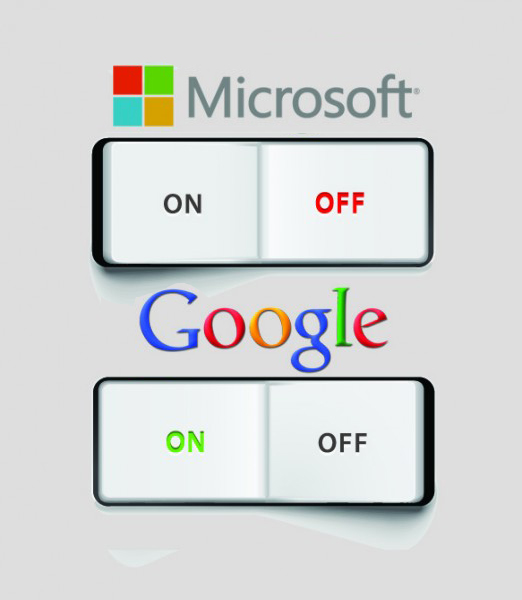
    Fifth in a series. Nearly two months ago I gave up Google and switched to Microsoft. Although I tried not to have any preconceptions, I’ll be honest and say I thought (based on past experience), I’d be swapping a set of mostly superb products and services for a collection of inferior alternatives and hate every moment I was away from Google.

    That turned out not to be the case. Now my experiment is over, I find myself impressed with some elements of Microsoft’s offerings, but frustrated with others. So here’s a summary of my overall experience.

    Configuring everything took a little while, and there were hiccups along the way, but that’s to be expected — I’ve been using Google’s services for years and while Microsoft’s versions are understandably similar, they aren’t (for the most part) exact clones.

    I’ve covered my experience with Bing previously, and while I like Microsoft’s search site, it’s too much of a compromise for me to use permanently. In order to get the most from it I need to change my country from the UK (where I live) to the US (where I don’t). I don’t understand why Microsoft has decided to create a pretty decent search site with lots of cool features, and then only made a fraction of those features available outside of America. I assume it’s a money thing — the company wants to put all of the available resources into its largest market — but even so it’s frustrating.

    So as much as I like Bing, I have no real choice but to switch back to Google. For now at least.

    I say “for now” because that could well change in the future. I recently chatted with Bill Hankes, Director of Bing Public Relations at Microsoft (you’ll be able to read the full interview on Monday) and he told me that Bing is looking to expand its offerings globally and will announce more details when available. Which all sounds very positive.

    Goodbye Gmail

    I’ve written about my experience with Outlook.com, and I’m still enjoying using the service, so I’m going to stick with it for now. But I’ll be honest, there are some things about it that frustrate me.

    While I still get the occasional piece of spam in my inbox, far worse is when clearly genuine mail — filtered by Gmail beforehand — gets junked. SmartScreen still seems pretty dumb at times, but it has got better over the two months I’ve been using it and I’m confident it will eventually get as good as Google’s spam detection. Or nearly as good anyway.

    Even though I’m not a massive Skype user, the integration of the chat service into Outlook.com gives me a further incentive to stay. (As an aside, I find it interesting that while most of Bing’s best features are currently American-only, Skype for Outlook.com was rolled out in the UK first).

    IE10 — Better Than Expected

    Internet Explorer has a reputation for being the best browser… for downloading other browsers with. That’s unfair. Once you’ve configured it how you like it, it’s actually not a bad program. There are some elements I really like, such as the tab implementation, and security and privacy tools. Its HTML5 and CSS3 support is very good, and the browser is obviously integral to Windows 8. But IE is simply not for me. Although I appreciate the ability to pin sites to the Windows 8 Start screen, I can’t use the Modern UI version because that’s not how I work. I’ve currently got 15 browser tabs open at the moment, and that’s very light for me. I usually have a crazy amount of tabs on the go.

    Although I had no real problems with using the desktop version of IE on a daily basis, the truth is I miss the extensions I take for granted on Chrome so I’m switching back to Google’s browser.

    Summing Up

    My experience over these past months has taught me that Microsoft’s services aren’t bad. In fact they are mostly pretty good, and you could easily switch to using them full time if you’re prepared to overlook a few problems here and there. My swap was never about boycotting Google as part of some grand gesture, so I have no problem with going back to using its browser and search services once more.

    Although Google’s recent actions, like closing Reader and making all roads lead to Google+, are irritating as hell, the search giant gets away with it because it produces mostly excellent products and services for free.

    I’d certainly understand if any readers did decide that enough was enough and choose to make the break away from Google. To those people I’d say the transition is easier than you might think. Outlook.com and Bing are good straight trades and Internet Explorer is a decent browser — provided you use Windows 8 and don’t require any extensions that aren’t available (although you could just use Firefox).

    The interesting thing for me now will be whether, once I’ve gone back to Google, I start missing Microsoft…

    Photo Credit: Pixotico /Shutterstock

  • Dutch cyber cops could be licensed to hack

    The Dutch government  has revealed plans to give the police extra powers to fight cybercrime. Under the proposed new law officers would be given the right to hack into computers, read emails, install spyware and delete files. They could also be authorised to tap VoIP calls and break into servers located outside the country if they were being used to host DDoS attacks.

    The country’s Justice Minister Ivo Opstelten says that the powers would be used under strict control and that the approval of a judge would be needed before the police could carry out these actions.

    Terrorism and child pornography are areas of special concern in the bill but it would also introduce penalties for the publication of stolen data. In addition the bill would make it a crime for a suspect to refuse to decipher encrypted files or hand over passwords during an investigation by police.

    Digital rights group Bits of Freedom  is opposed to the new law saying that it sets a bad precedent and that its preparation has been rushed.

    The bill is set to undergo revisions before being put to parliament at the end of the year. If it’s passed then no doubt other governments will be looking at how they too can kick down the doors of suspects’ computers.

    Photo Credit: Ivonne Wierink/Shutterstock

  • Innovate For America Campaign Highlights Companies With Immigrant Founders

    Scott Sandell and several of his New Enterprise Associates colleagues unveiled Innovate for America, a campaign to encourage American companies with at least one immigrant founder to publicize the number of people they have hired in the United States. So far, 38 companies are involved and more than 3,700 jobs recorded. Companies that participate can place an Innovate for America widget on their Web pages.

    The start of the campaign was covered by The Economist here and described by an NEA blog post here. The effort, the brainchild of General Partner Sandell, has its own Website here.


    The post Innovate For America Campaign Highlights Companies With Immigrant Founders appeared first on peHUB.

  • The sneaky thing about Google Glass

    Remember when Bluetooth phone headsets came along and suddenly there were all these people loudly talking to themselves in public? Schizoid behavior became, if not cool, at least somewhat tolerable. Well expect the same experience now that Google Glass is hitting the street, because contrary to nearly any picture you can find of the thing, when you actually use it most of your time is spent looking up and to the right, where the data is. I call it the Google Gaze.

    Only time will tell how traffic courts will come to view Google Glass, but having finally tried one I suspect it may end up on that list of things we’re supposed to drive without.

    Another suspicion I have on the basis of five minutes wearing the device is that it will be a huge success for Google. That doesn’t mean Google will sell millions, because I don’t think that’s the idea. I expect we’ll see compatible devices shortly from nearly all Android vendors and the real market impact will be from units across a broad range of brands at a wide range of prices.

    And that’s fine with Google, because their plan, I’m sure, is to make money on the data, not the device.

    I didn’t think much of the gadget until I tried it and then I instantly realized that it would create a whole new class of apps that I’d call sneaky. A sneaky app is one that quietly provides contextual information the way I imagine a brilliant assistant (if I ever had one) would slip me a note with some key piece of data concerning my meeting, talk, class, phone call, negotiation, argument, etc., just at the moment I most need it.

    Google Glass and a bunch of sneaky apps will change my mandate from being prepared to being ready, because you can’t prepare for everything but if you can react quickly enough you can be ready for anything.

    But there’s still that mindless stare up and to the right, a telltale giveaway that sneaky things are afoot.

    Reprinted with permission

  • Jolla swaps out its CEO yet again, this time bringing in a logistics veteran

    Jolla, the Finnish company that hopes to make big things out of the also-ran MeeGo operating system, has just announced its second change of CEO in just seven months.

    When I first sat down with Jolla in September of last year, I was talking to CEO Jussi Hurmola. A month later, Hurmola was out, moving to a strategic role around Sailfish, Jolla’s MeeGo-derived OS. He was replaced by Marc Dillon, who went on to lead the official unveiling of Sailfish OS.

    As of Monday, Dillon will be Jolla’s new head of software development (a role he was already carrying out, anyway). The new CEO, Tomi Pienimäki, was previously CTO then CIO at Itella Corporation, a Finnish logistics outfit.

    At first glance, it looks like Jolla has opted to go for a more business-centric leader – Dillon is quite a developer evangelist type – now that it’s signed serious deals with the likes of Chinese handset distributor D.Phone and Finnish carrier DNA, and is preparing to reveal its handset later this month.

    Here’s what Pienimäki said in a statement on Friday:

    “Jolla is a great company with an exciting and promising future. I truly believe we can make a difference and bring something unique to the consumers. My task is to listen very closely to our customers and further build the collaboration network. I also want to ensure that our team can fully concentrate on the most important task: bringing the first device to the market this year.”

    Jolla Chairman Antti Saarnio thanked Dillon for his “inspirational leadership in the CEO role during the past months” and Dillon himself said he was excited to “be able to give 100 percent attention to what I love – working on the product with the Jolla team.”

    Related research and analysis from GigaOM Pro:
    Subscriber content. Sign up for a free trial.


  • Many plastic surgeons view social media as important tool for promoting their practice

    Social media has revolutionized the way in which people and businesses interact, and it is taking on a growing role in the health care industry. A new UCLA study looking at the use of social media among plastic surgeons found that roughly half of these specialists use social media tools.
     
    Plastic surgeons have been leaders among medical specialists in the development of interactive websites to promote their practices and educate patients, said the study’s principal investigator and senior author, Dr. Reza Jarrahy, an associate clinical professor of plastic and reconstructive surgery at Ronald Reagan UCLA Medical Center. But until now, there there had been surprisingly little information on whether and how they are using social media.
     
    In the study, published in the May issue of Plastic and Reconstructive Surgery, the official medical journal of the American Society of Plastic Surgeons (ASPS), approximately 50 percent of plastic surgeons polled said they use Facebook, Twitter and other social media platforms to help market their professional practice.
     
    “Social media platforms represent a dynamic and powerful tool to educate, engage, market to and directly communicate with patients and professional colleagues,” said Jarrahy, who is a member of ASPS and vice president of communications for the American Society of Maxillofacial Surgeons. “However, for plastic surgeons, the potential benefits associated with using this tool must be balanced against its potential pitfalls.”
     
    The researchers sent an anonymous survey to more than 5,000 ASPS member surgeons. Responses from 500 of them provided information on their use of social media in their plastic surgery practice, their reasons for using it and the perceived benefits and risks.
     
    Just more than half said they regularly use social media for their professional practice. Facebook was by far the most popular platform, followed by LinkedIn, Twitter and YouTube. The poll also showed that surgeons who primarily perform cosmetic plastic surgery and who are in private practice were more likely to use social media.
     
    When asked their reasons for using these tools, most responded that incorporating social media into medical practice was inevitable. About half said that social media was an effective marketing tool and a useful forum for patient education.
     
    About one-third of plastic surgeons saw positive effects from using social media, saying they felt it provided an effective, low-cost means of advertising and increased the exposure of their practice. Roughly half believed that engaging in social media led to increased patient referrals and positive feedback.
     
    A small proportion of plastic surgeons (1.5 percent) reported that using social media had a negative effect on their practice. Yet while some surgeons had received criticism or negative commentary from patients via social media, most thought these criticisms had not harmed their practice.
     
    Those plastic surgeons who didn’t use social media cited a number of reasons why, including a desire to maintain a sense of professionalism, protecting patient confidentiality and concerns about becoming too accessible.
     
    Approximately one-fourth of respondents felt that ASPS and other governing bodies should provide some oversight and monitoring of plastic surgeons’ use of social medial to ensure ethical online behavior.
     
    The new study shows that many plastic surgeons have joined the social media revolution and believe it has benefited their practice in various ways. However, they also perceive a need for standards of practice and oversight to ensure appropriate and ethical use.
     
    “Because of our current level of engagement with existing online content, plastic surgeons are uniquely poised to become leaders in developing the future of social media architecture to the maximum benefit of practitioners and patients alike,” Jarrahy said.
     
    Additional study authors, all from UCLA, included Dr. Andrew J. Vardanian, Nicholas Kusnezov, Dr. Daniel D. Im and James C. Lee.
     
    The study was funded in part by the Annenberg Fund for Craniofacial Surgery and Research at UCLA.
     
    The authors have no financial ties to disclose. Jarrahy participates in oversight of the ASMS website and social media development.
     
    For more information on the American Society of Plastic Surgeons, visit at www.plasticsurgery.org.
     
    For more information on the division of plastic and reconstructive surgery at Ronald Reagan UCLA Medical Center, visit www.plasticsurgery.ucla.edu.
     
    For more news, visit the UCLA Newsroom and follow us on Twitter.

  • Vimeo on demand will exclusively distribute new Kristen Bell movie

    Kristen Bell, online movie pioneer? Hot on the heels of the crowdfunded Veronica Mars movie comes the news that Some Girl(s), an indie film starring Bell, will exclusively be distributed via Vimeo (hat tip to Deadline Hollywood). Some Girl(s) will debut on Vimeo’s VOD platform, which was unveiled at SXSW, on June 28 — the same day it will be released in theaters.

    Neil LaBute’s Some Girl(s) is following a writer, played by Adam Brody, who visits his ex-girlfriends on the eve of his wedding, with one of them being Bell. The movie debuted at SXSW as well, and its production company Leeden Media made a point of emphasizing that it had turned down traditional distribution offers in a press release announcing the move to Vimeo on demand.

    Vimeo’s on-demand platform is one of a growing number of ways for filmmakers to directly sell their wares to consumers, with others including VHX and Chill. The video site’s big advantage is that it already has a built-in audience, as well as apps on a variety of platforms to deliver the movie to mobile and TV screens. And for filmmakers, there’s another interesting incentive: Vimeo only keeps 10% of a movie’s revenue.

    Related research and analysis from GigaOM Pro:
    Subscriber content. Sign up for a free trial.


    • Podio introduces real-time chat, facelift in newest update

      Cloud workspace platform Podio introduced another round of fresh updates on Thursday, bringing exciting new functionality to the quickly evolving SaaS offering. Hot on the heels of a major UI facelift that was released back in late April, the newest refresh brings much requested real-time chat capability with online members of your various workspaces. For my company that uses Podio on a daily basis, these additions are definitely appreciated.

      For those unfamiliar with the service, I provided a mostly positive in-depth review back in December of last year. For those who have never given Podio a spin, placing a label on what it “is” definitely takes a little effort since it is almost anything you want it to be. The product fills the gap of online task, project, and customer management that is much cheaper and flexible than any other mainstream CRM offering. It also correctly introduces the aspect of “professional social”, something which Yammer forces down your throat — but Podio makes feel like a natural fit.

      Design Tweaks bring Subtle, Meaningful Changes to Podio

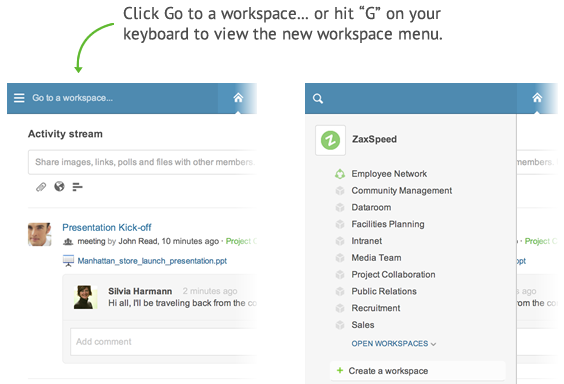
      Podio has always had a fairly fluid online interface, but it was bugged by one large problem: the Workspace menu on the left-hand side took up nearly a quarter of the entire screen. While it may be useful to have a visual reference as to what workspace you are in at any given time, your intuition takes over after a certain point.

      So Podio took the liberty to get rid of this throbbing nuisance and introduced a sliding, animated left-hand drop menu. This was a much needed change to the overall design of Podio, since working within workspaces requires more screen real estate, especially when you start working with very complex, data driven apps. Getting back a full quarter of screen real estate is the equivalent of buying a larger monitor just to see the same amount of information at once.

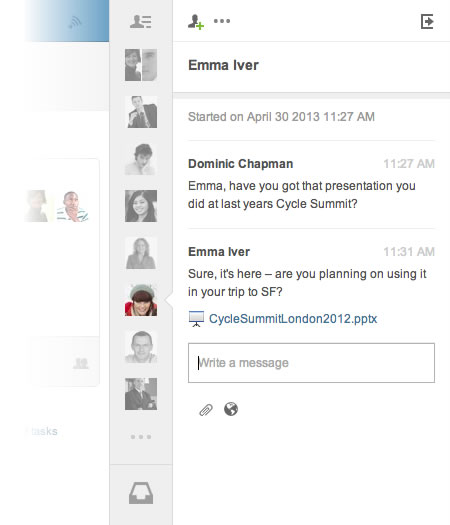
      The Podio team also introduced some smaller, but also noticeable, UI tweaks to a few other aspects of the main screen. For one, the top blue nav bar is now host to an inbox shortcut (also called notifications) towards the right hand side of the screen instead of where it used to sit oddly towards the center. Much of this was changed intuitively to likely coincide with the introduction of the new Chat feature, which hugs the right hand side of the screen starting Thursday.

      Search has also gotten some nice boosts, including some smart predictive search technology (straight out of Google’s playbook) that also presents results in real time without the need to go to different screens. For multitasking hogs like me, this is a small but timesaving UI improvement.

      If Social is Where it’s at, then Live Chat is King

      By far easily the biggest new feature added to Podio in the last six months has to be the introduction of live chat turned on yesterday. For someone that is dug into a few different Gmail chat windows each day for work purposes, this is exciting to try out. As my team continues to spend more time organizing projects and customer workflow in Podio, the fact that we can establish chats not only with eachother, but with invited customers, is a monumental change for the way we do daily business.

      The new chat feature is not only 1-on-1, but you can have team chats with colleagues, or better yet — full blown project team chats with customers and people from your company at the same time. If the users are a part of your workspaces, then you can use Podio as a full blown integrated chat platform built around the way you do work in the cloud. This is where Yammer falls short against Podio: in bringing external colleagues or customers into the conversation.

      Chat brings with it some finer points as well. Conversations can continue onward even after you finish your most immediate chat, because Podio treats them as free-flowing ongoing thread instead of a separated, disparate phone call. And Podio’s extremely powerful search capability is present even for chats, so you can look back and find nuggets of information from previous chats as easily as if they happened yesterday.

      You can watch a short informative intro on Podio chat on YouTube.

      Coming this Summer: Integrated Audio/Video Chat

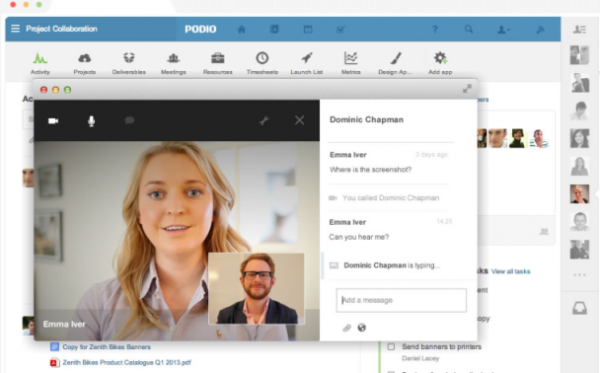
      If real time text chat doesn’t suit your fancy, Podio is working away on introducing full blown audio and video chat within the product that should break down the communication barriers even further. Not much is yet known about the extent of the capabilities of these new rich multimedia features, but judging from first screenshots, the changes are going to turn Podio into a full fledged presence heavy online workspace platform.

      Could Google Hangouts or even Lync be getting a run for their money from Podio? It’s too early to say, but I like what I am seeing. As a dedicated Podio customer building out most of my business processes on the platform, it’s reassuring to see that newfound owner Citrix did not give the Podio team the forgotten child treatment. As soon as Podio rolls out its planned rich multimedia functionality, I hope to present a revised review of the product focusing squarely on real time collaboration capabilities — something which I don’t think has been this drastically changed since the rise of Google Docs.

      Podio is a SaaS powered workspace platform that runs 100% in the cloud, and is completely free for companies or organizations up to five people in size. External colleagues or customers you invite to join your workspaces are also completely free. For organizations over five people, the cost is only $9 USD/person. Pricing includes full access to the platform for internal workspaces and comes with access to the Android and iOS apps for mobile access. You can learn more over at Podio’s website.

      Derrick Wlodarz is an IT Specialist that owns Park Ridge, IL (USA) based technology consulting & service company FireLogic, with over 8+ years of IT experience in the private and public sectors. He holds numerous technical credentials from Microsoft, Google, and CompTIA and specializes in consulting customers on growing hot technologies such as Office 365, Google Apps, cloud hosted VoIP, among others. Derrick is an active member of CompTIA’s Subject Matter Expert Technical Advisory Council that shapes the future of CompTIA exams across the world. You can reach him at derrick at wlodarz dot net.

    • Even as alpha build, GTKRawGallery impresses

      Most digital cameras will by default save photos as JPEG files, and it’s easy to see why: they’re small, can be saved and reloaded quickly, and are supported by just about every graphics package available.

      Switching to your camera’s RAW format (if it has one) can be worthwhile, though: you’ll get minimally processed images containing all the data from your camera sensor, giving you much more precise control over how the final photo will look. RAW images are also huge, and can’t be opened by nearly as many tools, but there are still some great free options available — and even though it’s only in alpha, the open sourceGTKRawGallery is already a promising contender.

      The program opens with a fairly conventional photo manager. A thumbnail browser helps you navigate your image library. You can organise your photos into custom libraries. There’s a basic search tool, a tag editor (EXIF, IPTC and XMP), batch file renamer and more. And this isn’t just for RAW files — the program can work with all the more standard formats, too.

      Double-clicking an image opens it in a new window for processing. This doesn’t work so well for viewing, as its toolbar is way too small, and there seems to be a distinct lack of keyboard and mouse shortcuts (don’t expect to use the “+” and “-” keys or the mouse wheel to zoom in and out, for instance – you have to use the toolbar buttons). But if you just want to get on with processing your photo then the news is better, with GTKRawGallery organising a host of functions into eight tabs: “Exif”, “Keywords”, “Dcraw”, “Enhance”, “Transform”, “Effects”, “History” and “Metadata”.

      Experienced photographers might start with the Dcraw panel, where they’ll find tweaks for white balance, gamma, black point, saturation, brightness and more. There are denoise and media filters, along with a chromatic aberration tool and color management options. You can save your preferred settings as presets, too, making it easier to reapply them consistently on future images.

      Clicking the Enhance tab reveals plenty of additional options, including controls for temperature, levels, curves, highlights, shadows, exposure and more.

      But if this is all just a little too complicated, the Transform tab has more straightforward tools: flip, rotate, resize and crop, red eye removal and so on.

      A fairly standard (although well implemented) list of effects ranges from the practical (sharpen, unsharp mask, reduce noise) to the more artistic (oil paint, charcoal, sketch). All of these can be configured in various ways to customise the results.

      And when you’re happy, any selected images can be burned to disc, emailed, or uploaded to Facebook, Flickr, Picasa or Facebook.

      GTKRawGallery has some issues. The interface doesn’t always work as you might expect, for instance, and its performance isn’t always the best. That’s no surprise for an alpha, though, and the program already has some very impressive features and functionality. If you’re looking for a powerful and free photo processing tool then this is one project you’ll want to watch.

      Photo Credit: NLshop/Shutterstock

    • Motorola XFON leaks, shows AT&T apps installed

      motorola xfon

      Motorola’s fabled X Phone is easily one of the most speculated about devices today. It seems like every week, a new rumor pops up, and it usually conflicts with the rumor we heard the week before. Google and Motorola have effectively kept this phone a secret by leaking out tons of mismatched information.

      Today, though, we have more concrete X Phone information. As in, evleaks has kindly released some pictures of a phone, running Android on AT&T’s network with the model XFON on the back. Normally, these rumors are pretty hazy, but that’s pretty clear. The phone itself doesn’t really get too friendly with the camera, as it’s boxed in some kind of case, but the picture below shows a carbon fiber backplate with a model of XFON ATT, which suggests that it definitely won’t be a Verizon exclusive. The phone shows the AT&T SIM name in the status bar, as well as AT&T’s LTE icon, and a My AT&T app in the app drawer. Aside from that, the software seems pretty bone stock, which we would naturally expect from a phone co-developed by Google.

      It’s also worth mentioning that this does appear to be three different devices, as noted by the differing Motorola logos on the top of the phone. If the phone is showing up in leaks like this, hopefully we won’t have to wait too much longer for an official announcement from Motorola or Google.

      source: evleaks
      motorola xfon
      xfon back

      Come comment on this article: Motorola XFON leaks, shows AT&T apps installed

    • Gmail gets better Google Calendar integration

      If Google does not already rule your internet world, then it is still aiming to do so. Gmail, Calendar, Drive, Docs — the company aims to offer you everything. Now it looks at integrating more of these features to make things a bit easier for customers, adding better Calendar options right into the email app.

      “If you do a lot of scheduling over email, it’s now a little bit easier to create events directly from your Gmail. Now available: dates and times within emails are lightly underlined: click them to schedule that conference call or lunch date without ever leaving Gmail” says Google product manager Boris Khvostichenko.

      Dates in email will now feature an underline — click on it to preview your schedule for the day as well as change the title, date or time of the event. Users can then click a new “Add to Calendar” feature to integrate the appointment or meeting right into their schedule. The company points out that customers can add the event to his or her calendar, and for added convenience, the calendar event will include a link back to the original message in Gmail.

      This new feature will roll out over the next week to customers of the English language. Google will then begin adding other languages as well, and promises that those will follow this release closely.

      Photo Credit: xc/Shutterstock

    • Barnes & Noble integrating Google Play into Nook HD and Nook HD+ tablets

      Barnes & Noble is adding Google Play’s full complement of videos, music and apps (and ebooks) to its Nook HD and HD+ tablets. The tablets will also include Google services like Gmail, Google Maps, YouTube and the Chrome browser.

      The end result is that Nook HD users will have access to a broader media ecosystem, but the move seems a bit odd for a company that has a strategic partnership with Microsoft. However, Jim Hilt, B&N’s VP of ebooks, said the move only shows that Barnes & Noble remains committed to the Android platform. The company has done a “tremendous amount of work with Windows 8,” he said, and the decision to further integrate with Google is “consistent with our business, which has always been to bring the Nook reading or content service to all the platforms available.”

      Google Play also sells ebooks and digital magazines, but Hilt said that B&N isn’t worried about that: “We’re incredibly confident that when people pick up a Nook device, they’re going to use the Nook shopping experience.”

      Nook Video, which sells movies and TV shows à la carte, will continue, the company said.

      Current Nook HD owners will receive an over-the-air update to their devices.

      Related research and analysis from GigaOM Pro:
      Subscriber content. Sign up for a free trial.


    • West Wing Week: 05/03/13 or “Nobody Does It Better”

      This week, President Obama spoke at the Planned Parenthood conference and the White House Correspondents’ Association Dinner, met with the King of Jordan, made five personnel announcements, celebrated the sciences and the Joining Forces Initiative, and embarked on a trip to Mexico and Costa Rica.


      read more

    • When a defense contractor gets hacked repeatedly, you know cybersecurity is a problem

      QinetiQ North America, a prominent defense contractor to the U.S. government, endured extensive on-again-off-again hacks in 2007-2010 from spies in China, resulting in the loss of many terabytes of sensitive data, including more than 10,000 passwords, chip architecture for military robots and weapon information, according to an article from Bloomberg Thursday.

      The hackers accessed confidential data across multiple facilities from laptops and servers alike, the article stated. To avoid being observed on a company network, in one instance the hackers siphoned out data in small quantities. And QinetiQ’s own employees apparently removed software put on their computers to detect malware after becoming frustrated with how it impacted the performance of their computers: with the IT department’s permission.

      Depite the known hacks, the federal government awarded a cybersecurity contract to QinetiQ in 2012, according to the article. QinetiQ sells two cybersecurity products, the Knowledge Discovery Appliance and the Social Engineering Protection Appliance among other offerings, although the article noted that many defense contractors have also suffered from cyberattacks.

      While federal agencies have investigated the hacks, QinetiQ retains its ability to work with military technology, according to the Bloomberg report, even though hacks have resurfaced many times over a several-year period, and even when it’s in the government’s best interest to shut down what has effectively served as a back door into federal networks. The article reported that “the State Department lacks the computer forensics expertise to evaluate the losses.” That’s pretty bad — and the problem might only get worse as the the federal government looks at ways to consolidate its IT footprint.

      Following on a string of cyberattacks on companies earlier this year, the news of the QinetiQ hacks is another example of the need for better security protections for businesses and other organizations. It also calls into question whether the feds can do more to prevent cyberattacks.

      And it points to an opportunity. If this is the golden age of enterprise IT, brought on by big disruptions such as cloud computing and the bring-your-own-device trend, security could become an even hotter space over the next few years for VCs to back.

      Feature image courtesy of Shutterstock user alexskopje.

      Related research and analysis from GigaOM Pro:
      Subscriber content. Sign up for a free trial.


    • Curved Apple batteries could pave way for thinner iPhones, iWatch

      Apple Curved Battery Patent
      In Apple’s seemingly endless quest to make its products lighter and thinner, the company may have come up with a clever way to save space in future versions of the iPhone and iPad: by using curved batteries that nestle more comfortably into its devices’ contours. AppleInsider has found a pair of Apple patent filings that describe “curved battery cells for portable electronic devices” and “non-rectangular batteries for portable electronic devices” that the publication speculates could be used in future iPads and iPhones.

      Continue reading…

    • Games meet brains: the new immersive tech of gaming

      From joysticks to gamepads and now gesture recognition, gaming has been downsizing the gadgets over the decades, and it is getting close to tapping into the ultimate controller: your brain. About 300 people gathered to learn about and test the latest neurogaming tech at the eponymously named conference and expo in San Francisco this week, and many an attendee was outfitted like they belonged to the Borg. Besides the “neuro” side of the tech offerings, haptics technology — involving devices that stimulate the touch or body sense — was also well-represented.

      The majority of exhibitors were peddling tech to monitor brain waves, and it seemed like EEG (electroencephalography) headsets were available in every color, shape, and size, from sleek Google Glass-like headbands to traditional electrode-laden caps. Since the measured waves represent the activity of the whole brain, it’s not possible for the devices to literally read your mind; you can’t, for example, move left or right in a game just by thinking it (yet). However, because some wave activity is associated with alertness, games like Intific’s NeuroStorm can incorporate the user’s extra focus into gameplay. Sustained concentration can also be used to launch and fly Puzzlebox’s Orbit helicopter. If you want to stimulate your brain rather than just read it, Foc.us has a headband that supposedly increases focus while playing.

      Electroactive polymers — perhaps the base material for future shapeshifting phones — are being used to deliver enhanced touch and feel to gaming in Bayer MaterialScience’s Vivitouch technology. The thin film can minutely expand and contract, so that when attached to a gamepad the player can feel blasts and receive force-feedback. Vivitouch will be launching a new product at E3 in June. Tactile Haptics’ Reactive Grip is like a Wiimote on steroids that lets you feel like you’re really gripping, firing, or wielding weapons, but it’s still a tethered device.

      Noticeably absent were offerings in the augmented reality or facial tracking space. Predictions about where neurogaming is headed from a few of the conference’s speakers included integrating data from wearable and smartphone sensors to enhance gameplay, and artificial intelligence-modulated games that could, for example, level the playing field between beginners and grandmasters in chess.

      For mass adoption, of course, the “tech” can’t be too technical. That’s why smell and sound-driven game experiences are under development, to appeal to the limbic brain in all of us.

      Image via NeuroGaming Conference and Expo 

      Related research and analysis from GigaOM Pro:
      Subscriber content. Sign up for a free trial.


    • People can’t stop playing online games, mobile devices are to blame

      Online Gaming Stats
      A new report has found that the number of gamers playing games online has continued to increase over the past year. According to NPD Group, 72% of U.S. gamers play online, up from 67% in 2012. Not only are more gamers connecting to the Internet, but they are also spending more time playing games in general. The average amount of time spent each week on gaming has gone up 9%, and for online play, it has increased 6%.

      Continue reading…

    • Here’s how smartphones, tablets and huge databases will upend market research

      If you’re tired of those annoying 8 p.m. phone calls asking questions about where you shop, or of carrying an Arbitron sensor to provide radio ratings, your omnipresent smartphone or tablet might well turn out to be your savior. And all you have to do is give up a little privacy.

      Our mobile devices are amazing at capturing real-world data — location, temperature, movement, sound — that just goes to waste if we don’t put it to use. It’s easy enough to get a personalized experience on the web, but these types of data might make it possible to get one in traditionally more-static places such as retail and radio as well. At the least, perhaps we can expect content, price tags and experiences that cater more to our actual tastes than those of station programmers and a fashion designer’s idea of what people should be willing to pay.

      Location is the key to everything

      Retailers already have a pretty good sense of what people are buying and even how they’re moving through stores, but they don’t really know where customers are going once they leave. This knowledge could be very useful, however: If you want to improve your store or figure out how to market your company, knowing what else your customers are up to could go a long way. This type of data is starting to become available thanks in part to a Seattle-based startup called Placed.

      We’ve been covering Placed for about a year, since it launched its first product targeting developers interested in learning where users were accessing their applications and mobile sites. The company has since expanded its operations to include a Panels service that lets the company track around the clock, on behalf of paying businesses, the physical location of customers who have downloaded the app (usually in exchange for a small monetary reward). It also has its own Panels app, unaffiliated with commercial customers, that allows Placed to provide market data on the physical movements of some 70,000 consumers.

      This week, the company released a report highlighting some national findings from the first quarter, including, for example, what departments stores are most popular with what demographics, what business categories experienced the most increases in traffic, and what businesses have the highest and lowest affinities (i.e., people who visit one also visit, or don’t visit, the other). If you’re willing to pay, Placed will tell you pretty much anything you want to know, founder and CEO David Shim told me, broken down by geographic region, business type, demographic, you name it.

      affinity

      Shim noted a couple of actual users and potential users that I think highlight why this type of data is so valuable. One is a high-end retail business that found out that while female millenials enter its stores a lot, they don’t buy a lot. Rather, the stores they visit next are usually discount retailers such as Burlington Coat Factory and Ross. The suggestion is clear: These shoppers want to see what’s hot and then buy a reasonable facsimile at a lower price.

      He also noted that some Las Vegas casinos are interested in running their own Placed panels to figure out what restaurants their guests are eating at once they leave the casino grounds. Now, if casinos can figure out where else on the Strip people are spending their money, they can make better choices when it comes time to swap out their own restaurants and shops.

      In both cases, it’s possible the answer to the question of how to get more of these customers’ money is to drop prices. If a 10 percent price reduction leads to a 14 percent increase in sales, that’s a win-win situation.

      Rethinking radio

      Location data becomes even more valuable when combined with other data, though, such as sound. Consider the implications of knowing not just what radio stations people are hearing — which is essentially how the Arbitron ratings work — but what songs they’re actually listening to. Just because you hear the Latino station for an hour at the taco shop during lunchtime or the top 40 station at the gym, that doesn’t mean you’re listening to them or like listening to them.

      But the songs you choose to listen to in your car, for example, probably tell a lot about what you actually like. And the technology exists to determine that. Last month, I wrote about how Gracenote is able to use the internal microphones on tablets and smartphones to recognize the songs playing on people’s televisions or stereos. It can also detect reactions such as cheering or booing, and likely whether someone turns up the volume.

      Arbitron's Portable People Meter

      Arbitron’s Portable People Meter

      Now, all of a sudden, one can envision a world in which programming managers at radio stations can figure out on a song-by-song (or artist-by-artist) basis what people are actually listening to, and when and where they’re listening. If all it involves is someone downloading an app, they can presumably do it at a larger scale than requiring people to wear special additional sensors or fill out a diary. Broadcast radio can never be as personalized as something like Pandora, but it could start sounding a lot more like what listeners would choose if left to their own devices.

      Digital radio could get downright great, even better than what Pandora can currently offer. I might never add Disney theme songs or the Sesame Street favorites to my preferences list, but if that’s all I listen to when I’m in my car between 4:30 p.m. and 5 p.m. — and it is — maybe a service could hook me up with some new songs every day. If I’ve turned up the volume on a Taylor Swift song three times this week while I was at home, maybe I actually like it and want to hear more even if I won’t admit it.

      Not just data, but good data

      As great as all this might sound (it does to me), it’s the advent of big data that makes it all possible. Placed’s analytics are so accurate because it has special algorithms to determine where a person actually is — even if there are numerous options within a small area — and its models are constantly being trained. Shim said his company gets 15,000 responses a day to surveys asking Panels users whether it had them at the right location, and it has already validated 3.5 million of the the 13 billion locations in its database.

      Gracenote, for its part, has audio and metadata for millions of songs that it keeps in memory so it can access them in a hurry for the sake of real-time recognition. It can group music into dozens of categories based on genre, artist, geography or even just how the songs sound. It wants to build an in-car system that can change songs based on driving conditions fed to the stereo from the car itself.

      I acknowledge this all sounds a little creepy, but, ironically, it also sounds like the beginning of the end for some concerns over privacy. Heck, Shim said, about 500,000 people have already downloaded the Placed Panels app.

      aws recReally, it all comes down to value. If handing over a little bit of data actually provides value in return — in the form something better than just targeted ads — it appears people will be willing to do so. People tell Amazon about their purchases, let Google Now access their email and tell Placed which store they’re at out of five possibilities because they think they’re getting a worthwhile service in exchange.

      The data-collection genie is already out of the bottle. Now it’s just a matter of making it work for us instead of at our expense.

      Feature image courtesy of Shutterstock user Vadim Georgiev.

      Related research and analysis from GigaOM Pro:
      Subscriber content. Sign up for a free trial.


    • Three variants of the LG Optimus G2 show up in benchmark results

      LG_Optimus_G2_AnTuTu

      Only six months after LG released the Optimus G to the masses, a successor has been spotted in benchmarks and at the Bluetooth SIG getting its Bluetooth certification.

      As you can see in the picture above, it looks like there will be three variations of the LG-F320, or what we will call the Optimus G2. The F320L and F340L variations both run the latest Android 4.2.2 and are backed by a 2.0GHz processor (presumably the Qualcomm Snapdragon 800). The F320K variation has a 1.5GHz processor and runs on Android 4.1.2. All three variations are rumored to have a 13 megapixel rear camera, 2.1 megapixel front camera and a 5-inch 1920 x 1080 resolution display.

      Oddly enough, the F320K outperformed both of the other variations in AnTuTu benchmark scores, even though it’s clocked at 1.5GHz (as opposed to the other’s 2.0GHz). Nothing else is known at this time about the G2, but hopefully LG will change that soon.

      Source: GSMArena


      Come comment on this article: Three variants of the LG Optimus G2 show up in benchmark results