Blog

  • Google invests in big South African solar project

    Google is taking its strategy of investing millions of dollars into clean power projects in the U.S. and focusing it on Africa for the first time. On Thursday, the search engine giant announced that it’s invested $12 million into a large — 96 MW — solar panel farm in South Africa.

    When built, the solar project, called Jasper Power Project, will be able to deliver enough clean power for the equivalent of 30,000 South African homes and will be built in the Northern Cape province near the town of Kimberly. California-based solar developer SolarReserve is working with South African clean power companies Intikon Energy and Kensani Group to build the project.

    solarpanelThe Jasper solar farm will cost $260 million, and the developers have closed on the financing, including other investments from Public Investment Corporation, Development Bank of South Africa and the PEACE Humansrus Trust. The same developer group was also able to raise $586 million for two other solar panel projects in South Africa. South African state-owned utility Eskom will buy the solar power from the Jasper project, as well as the two other solar projects.

    WindGoogleLadyAs Google explains in its blog post this morning, South Africa had the highest growth in clean energy investment in the world in 2012, thanks to its swift creation of incentives for clean power, following a severe energy shortage in the country. These clean power projects are also creating jobs for South Africans, and the Jasper project is supposed to offer 300 construction jobs and 50 operational jobs when completed.

    SolarReserve not only develops solar projects, it also makes solar thermal technology, which uses the suns heat to produce power (solar panels convert sun light into electricity). But in recent years, because of the massive drop in the price of solar panels, solar thermal farms have become less competitive with solar panel farms.

    Google has invested over a billion dollars into a Hoover’s Dam worth (2 GW) of clean power projects, from wind farms, to solar thermal and solar panel installations. It’s also doing more experimental things — for example, its lab Google X recently bought up the high altitude wind startup Makani Power.

    Google is interested in clean power because the company consumes a ton of energy for its data centers every year. Google wants to move more and more of that energy onto clean power in order to reduce its carbon footprint, but also to better manage the source of its energy generation. However, Google has long said that it has been making these billion dollars of investment into clean power projects, mostly as a way to make money. It isn’t directly using the clean energy from most of these investments.

    Related research and analysis from GigaOM Pro:
    Subscriber content. Sign up for a free trial.

  • HTC One with stock Android confirmed by Android boss

    HTC One Stock Android Release Date
    While speaking on stage at the D11 conference in San Francisco, Google’s Android and Chrome boss Sundar Pichai confirmed that HTC will soon launch a new version of the HTC One that features a stock build of Android. The handset will be available unlocked for $599 beginning June 26th just like the stock edition of Samsung’s Galaxy S4, and it will work on both AT&T and T-Mobile’s networks, including 4G LTE support. The new One will initially only be available in the U.S., and it will ship with 32GB of internal storage.

  • TEDGlobal newsmakers: May El-Khalil on the meaning of marathons

    This weekend, the Beirut Marathon hosted its first-ever all-female event. Many runners wore pink. Photo: courtesy of the Beirut Marathon

    This weekend, the Beirut Marathon hosted its first-ever all-female event. Many runners wore pink. Photo: courtesy of the Beirut Marathon

    On Sunday, May 26, two rockets soared over Beirut, Lebanon, hitting a Shi’ite Muslim area in the southern part of the city. The rockets raised fears that Beirut could become embroiled in the civil war raging in nearby Syria. And yet, these bombs did not stop women throughout the city from lacing up their running sneakers and taking to the streets to run their hearts out. May 26 was also the day of the Beirut Marathon’s first all-female event, the 10K Women’s Challenge. About four thousand woman participated, even as news of the bombing spread.

    The Beirut Marathon was founded by May El-Khalil, who will speak at TEDGlobal 2013 on June 12 during the session “World on Its Head.” With the 10K Challenge shining a spotlight on the courage and strength of Beirut’s women, and with so many questions still out there about why two bombers targeted the finish line of the Boston Marathon in April, the TED Blog wanted to ask El-Khalil a few questions about the meaning of marathons.

    First, I’m curious — how did you discover your love of running?

    Ever since I was young, I always felt that I had an excess of energy within me. I was a nature lover as well, so I started running in the outdoors. When I moved to Nigeria after getting married, my enthusiasm for exercise and fitness went with me and I became an aerobics instructor — but still liked running the best. I used to run around our neighborhood, and it helped me better understand and connect to living in Lagos. Sometimes, the children of street vendors would accompany me for a few kilometers. Running has been with me from my youth.

    You founded the Beirut marathon in 2003 to bridge sectarianism in Lebanon. What is the symbolism of marathons?

    I think that, at its core, a marathon symbolizes endurance and commitment. A marathon is something that people aspire to achieve; it is a high goal that once reached can change a person’s life forever. It’s a long-distance race that not only requires physical fitness, but mental fitness as well. People who run marathons are an elite type of athlete. They are the ones who can overcome obstacles and go all the way. International marathons are the gathering places for distance-running enthusiasts from all corners of the world and from all walks of life — they compete against themselves first and foremost, and against each other for the glory of the win. The Beirut International Marathon is one of those events that embodies the spirit of perseverance and stamina, in that it takes place in a city that has itself been able to keep running and survive in spite of all types of calamities. It is a marathon that really showcases the stamina and the thirst for life of the Lebanese people — and their willingness to move forward even when all around them is falling apart.

    This is something I found myself asking a lot after the bombing that occurred during the Boston Marathon—why target that specific event?

    They were trying to directly injure the human spirit. When we heard about the Boston Marathon, we immediately sent them a letter of support — in solidarity with their race, their team and the people of Boston. It was a horrible act of violence, but as we have seen, Boston — as well as Beirut — stands resilient. No one can break our spirit.

    On the morning [of the 10K Women’s Challenge], we woke up to the news that rockets had been fired into a suburb of Beirut. Despite all that, four thousand women showed up to run. We even had a group of women come all the way down from Tripoli, a city in the north of Lebanon, where there is currently heavy fighting and gunfire. I was so inspired by their determination.

    A promo shot for the Beirut Marathon's 10K Challenge. Photo: courtesy of the Beirut marathon

    A promo shot for the Beirut Marathon’s 10K Women’s Challenge. Photo: courtesy of the Beirut marathon

    Tell us more about the 10K Women’s Challenge. How did it go?

    The energy of the day was truly inspirational. A great success on all levels. Women from all ages and all walks of life came together with joy to do what women do most: bring life forward. The atmosphere was festive and strong at the same time, and the city streets filled with determined women running each for her own reason. Some ran for fitness, some for fun, some for causes, some for the challenge itself. The men also had a very strong presence as supporters and cheerleaders. It was an image of the beautiful world we wish we could create every day — of women feeling empowered and happy and of men feeling supportive and positive.

    What felt different about having all women in the race?

    The feel of an all-women’s race is different! The female energy is exuberant, beautiful, joyful. Cooperation among women is more prevalent than competition, and this was obvious in this race. The ladies came together for their causes and for charities, to help others and to improve their own living conditions. Having a race exclusive to women is never organized with the intent of marginalizing men, but to give women a space to inspire and encourage each other to reach goals.

    A few women really inspired me on race day. There is a lady who participates in all of our races to push her quadriplegic son who enjoys racing. There are the two participants Rita and Lilian — one is blind and one is paralyzed — and they run together as a team, as each other’s eyes and legs. Also, Lebanese journalist and television news anchor May Chidiac survived an assassination attempt that took her hand and part of her leg, and she showed up to support other survivors and run the 5K course in her wheelchair.  There is also the Ethiopian domestic worker who trains in her spare time and who managed to win third place overall in the 10K run. Last but not least, I was impressed that the Lebanese First Lady, Mrs. Wafaa Suleiman, got so excited about the race that she actually participated in the 5K run.

    Make sure to see May El-Khalil’s talk during TEDGlobal 2013, taking place June 10-14 in Edinburgh, Scotland. Check out information about attending or watching from home with TED Live »

    And stay tuned to the TED Blog, where we’ll be covering the conference live, and running articles about each talk about an hour after they are given.

    Participants gather for the start of the 2012 Beirut Marathon Photo: Anwar Amro/AFP/Getty Images

    Participants gather for the start of the 2012 Beirut Marathon Photo: Anwar Amro/AFP/Getty Images

  • LinkedIn Lets You Add Photos, Presentations to Updates

    LinkedIn has just taken a significant step in making the homepage stream much more interesting. Today, they’ve announced the addition of photos, documents, and presentations to updates.

    “Whether it’s a thought provoking presentation about the future of big data or it’s a picture of an inspirational quote, or perhaps it’s an infographic showing the top trends impacting your industry, the possibilities are endless for what you can share on LinkedIn to add a richer and more visual component to your professional discussions.”

    Yes, your stream is about to fill up with photos:

    Earlier this month, LinkedIn began to allow users to adds photos, videos, and other rich media to their profiles, but this is the first time that it’s come to the homepage.

    LinkedIn says that the new sharing feature will begin to roll out globally today and will complete in the next few weeks. Once you gain access to the new functionality, you should see a little dialog box at the upper right-hand corner of your share box that asks you to “add a little something to your update.”

    “We also introduced the ability to directly upload images and files to 2.9 million Company Page admins, so you can expect to see richer and more engaging visual content flowing across your LinkedIn experience. In the meantime, we look forward to seeing what you have to share and say about your professional universe through pictures, slides and more,” says LinkedIn.

  • Google’s Sundar Pichai Announces HTC One Google Edition, Available June 26 For $599

    HTC_One_Google-FEATURED

    Google will make another mobile phone available with stock Android soon. Sundar Pichai, SVP of Android, Chrome, and Apps, announced at the D11 Conference that the company will sell the HTC One Google Edition for $599 on the Google Play store, beginning June 26.

    Google has previously announced the availability of the Samsung Galaxy S4 with stock Android through the Play Store, which will retail for $649. That device was announced during I/O, with availability also set for June 26.

    “We’re developing a user experience that scales across the world[…],” Pichai said, explaining why the Google Edition devices are now a priority for the company. “We’re making Android the operating system that is consistent across all of these devices.”

    “The challenge is related to what is great about Android […] The scale and scope of Android is pretty breathtaking,” Pichai explained further. “From a Google perspective, we care about how users use Android and the user experience.”

    HTC has already offered a similar device through its own online retail store, the HTC One Developer Edition. The Developer Edition is a $649.99 device that has 64GB of onboard storage, plus an unlocked bootloader. The new Google Play version of the One will differ in that it will also offer stock Android, and updates that arrive in time with those issued for Nexus devices and the Play version of the Galaxy S4. The Developer Edition also ships with Jelly Bean 4.1, but the HTC One Google Edition will ship with Jelly Bean 4.2.2. Also, the Google version will carry 32GB of internal storage instead of the 64 from the dev model. The Google HTC One works with GSM cellular networks.

    HTC says it will continue to offer the Developer Edition direct from its own website, but the $599 Google Edition, with its GSM network support and initial U.S.-only availability, is probably the better buy for developers looking to not only try out the hardware but also stay up-to-date on the very latest from Google’s OS.

    The HTC One has already been well-received by critics, and offering it with a stock Android experience is sure to be a hit with a specific audience. It’s also impressive that it will cost $50 less than the competition from Samsung. But now that Google is clearly interested in expanding the so-called “Nexus Experience” beyond its own line of co-branded devices like the Nexus 4 from manufacturer LG, it’ll be interesting to see what role those “blessed” handsets will have in the future, or whether “Nexus” becomes more of a designation than a specific device line.

  • Netflix wants to spend up to 15 percent of its content cash on originals

    Netflix wants to spend up to 15 of its entire licensing budget on the production of original content within the next few years, according to Netflix Chief Content Officer Ted Sarandos, who said Thursday at the Nomura 3rd Annual U.S. Media & Telecom Summit in New York that the company is going to keep growing its original content output over the next few years, with the goal of roughly doubling the number of titles within the next 18 months.

    The company is currently spending around five percent of its content money on originals like House of Cards, Hemlock Grove and the new season of Arrested Development. Asked about that show, Sarandos said that the company had extremely high expectations about the initial viewership of the show. “And it met our expectations, and we are thrilled,” he said.

    He added that the viewers also seem to love the show, despite a few early bad reviews. 80 percent of the viewers who watched the show within the first 24 hours rated it four or five stars, Sarandos revealed.

    Sarandos also had a to answer a few questions about the company’s decision not to renew its deal with Viacom, which has led to the company removing popular kids shows like Dora, Spongebob and Blue’s Clues. Sarandos defended the move, pointing to some of the other kids content that Netflix has added recently and saying: “I feel like that was the right trade-off.”

    Sarandos said that slate deals like the previous agreement with Viacom, which force Netflix to buy a wide breadth of content, often simply aren’t worth the money, especially if the same content is available elsewhere as well. “We value that content for sure. We just disagreed on the value of the content,” he said.

    However, Netflix executives have stated in the past that they’d be willing to license some of Viacom’s more popular shows individually, and Sarandos said Thursday that this option is still on the table: “These discussions are ongoing,” he explained.

    Related research and analysis from GigaOM Pro:
    Subscriber content. Sign up for a free trial.

  • Johnny Depp: Whitey Bulger Film A No-Go After Pay Cut

    Johnny Depp is reportedly dropping out of “Black Mass”, a film about gangster Whitey Bulger, after the movie’s producers failed to get the financing they needed and asked him to cut his salary in half.

    Depp is used to pulling in about $20 million per picture and told producers he couldn’t do it for less than that after they didn’t get as much as they needed for the budget at Cannes this year. The film will be directed by Barry Levinson if it moves on without Depp.

    The star is about to see his pet project, “The Lone Ranger”, released this summer and is currently shooting a sci-fi film called “Transcendence”.

    Depp took inspiration from his Lone Ranger character, Tonto, from a painting of a warrior and based his costume and makeup on the image.

    “I looked at the face of this warrior and thought: That’s it,” Depp said. “The stripes down the face and across the eyes . . . it seemed to me like you could almost see the separate sections of the individual, if you know what I mean.”

    His portrayal of the iconic character might not go over well with some, but Depp says he put a lot of thought into what he could bring to the film. “The Lone Ranger” opens in July.

  • Google Offers Webmasters Tools To Get Content In Knowledge Graph, Google Now

    Google has launched two new tools for webmasters to provide the search engine with structured data from their sites.

    For one, Google’s Data Highlighter now supports eight types of structured data, including: events, products, local businesses, articles, software applications, movies, restaurants, and TV episodes.

    “With Data Highlighter, webmasters don’t even need to change their site’s HTML,” explains product manager Justin Boyan. “Instead, they can just point and click with their mouse to ‘tag’ the key fields on a few sample pages of their site. Google learns the pattern of the fields and applies it to similar pages on the site, so all their information can be understood.”

    More on Data Highlighter here.

    The other tool is the Structured Data Markup Helper.

    “As with Data Highlighter, one simply points and clicks on a sample web page to indicate its key data fields,” says Boyan. “Structured Data Markup Helper then shows exactly what microdata annotations to add to the page’s HTML code. We hope this helps give HTML authors a running start with adding structured data to their sites, in turn making search results more meaningful.”

    These tools should help webmasters stay current with the evolution of Google into products like Knowledge Graph and Google Now, while also potentially improving these Google offerings themselves.

    “When Google understands a website’s content in a structured way, we can present that content more accurately and more attractively in search,” says Boyan “For example, our algorithms can enhance search results with ‘rich snippets’ when we understand that a page contains an event, recipe, product, review, or similar. We can also feature a page’s data as part of answers in search from the Knowledge Graph or in Google Now cards, helping you find the right information at just the right time.”

    You might also be interested in this recent Google talk about integrating Google’s Knowledge Graph data into your own apps.

  • IBM Robot Maps Data Center Temperature and Humidity

    Data center managers need to measure temperature and humidity in a data center, and now they can use small robot by IBM to perform that function. This 1:38 minute video shows the IBM robot and what it can do the data center. The data from the robot is used to develop an efficiency map, which shows temperature differences in the data center and can guide you in making your data center airflow more efficient.

    For additional video, check out our DCK video archive and the Data Center Videos channel on YouTube.

  • Microsoft Confirms The Return Of The Start Button In Windows 8.1

    A leaked screen from yesterday indicated that Microsoft would be bringing back the Start button in Windows 8.1. Now the company has gone ahead and confirmed its return alongside a number of other additions to the updated operating systems.

    In a blog post on the official Windows blog, Microsoft’s Antoine Leblond confirmed many of the details leaked in yesterday’s report. For starters, the Start button is indeed back in Windows 8.1. Here’s how he describes it:

    We’ve improved the way you navigate to Start with the mouse by changing the Start “tip” to be the familiar Windows logo. The new tip appears anytime you move the mouse to the bottom left corner of the screen, and is always visible on the taskbar when on the desktop.

    Leblond also says that there are options to “boot into alternate screens.” He doesn’t come right out and say that there is a boot to desktop option, but it’s pretty much a guarantee that it will be there.

    As for customization, Leblond confirms that Windows 8.1 users will be able to use their own custom backgrounds on the Start screen. Microsoft is also adding support for live wallpapers for those who want a little motion in their backgrounds.

    That about covers all of the stuff leaked from yesterday. Is there anything new in today’s post regarding Windows 8.1? Of course, there is. The first is an update to Search via Bing on Windows 8.1. You can read more on that here.

    Microsoft is also improving apps and the Windows Store in the newest version of the OS. All the built in apps will receive upgrades. Microsoft includes two examples from the Photos and Music app. The Photos app will include editing tools right in the apps so users won’t have to leave the app to crop and adjust photos. As for music, the app “has been completely redesigned to help pick and play music from your collection.”

    Finally, Windows 8.1 is bringing updates to SkyDrive, PC Settings and Internet Explorer. For SkyDrive, Microsoft is making it so that users can access all of their SkyDrive files across any and all devices as well as when they’re offline.

    PC Settings will be accessible outside of Control Panel for the first time. Users will be able to adjust their resolution, set power options and more from the new PC Settings menu.

    As previous rumors reported, Internet Explorer will be upgraded to IE11 on Windows 8.1. Microsoft says it will improve upon all the features and improvements that finally made Internet Explorer 10 a worthy contender in the browser wars. For now, Microsoft says that IE11 will be faster, feature support for unlimited tabs and feature tab syncing across devices.

    All of this and more will be available in the Windows 8.1 public preview on June 26. The release version will be made available as a free update to all Windows 8 users later this year.

  • 12-year-old Lelia Fowler Stabbing Suspect Denies Murder Charge

    Earlier this month, 8-year-old Lelia Fowler of Valley Springs, California was found stabbed to death in her home. She was left in the care of her 12-year-old brother while her parents were at a little league game.

    The brother told police that he found Lelia stabbed, and saw an intruder fleeing from the house. The boy’s story kicked off a massive door-to-door manhunt that turned up no leads. The 12-year old was arrested weeks later for the murder of his sister.

    According to a report from CBS News in Sacramento, the boy, identified as Isaiah Fowler, yesterday pleaded not guilty to a charge of second-degree murder. His attorneys have stated that the boy may have lied about seeing someone flee from the house, but that there is no clear evidence he stabbed his sister.

    Isaiah Fowler is currently being held in a juvenile detention center.

  • Apple looks to make the iPhone more flexible

    Apple iPhone Flexible Display
    Flexible displays are set to become the next big thing in the mobile industry. Big name companies such as LG and Samsung are exploring the idea of making smartphones with bendable and unbreakable screens that could debut early next year. Now, a recently published patent application dug up by AppleInsider suggests that Apple is also exploring the idea of incorporating a flexible display into future iPhone models, however it would do so in a different way than competitors.

    Continue reading…

  • Why Intel thinks data democratization is a good bet

    Intel doesn’t see money in the blending of personal data with publicly available data sets, not yet, anyway. But the chip maker does suspect that a market could form around that sort of behavior down the line. That’s why the company has been backing several initiatives around data lately, from wethedata.org to the upcoming National Day of Civic Hacking. It also introduced its own version of Hadoop. Much of these projects are targeted at democratizing data, a major goal of which is to make data easily accessible for large swaths of people.

    Brandon Barnett

    Brandon Barnett

    Perhaps it’s not surprising that a big company like Intel retains ethnographers, anthropologists and other social scientists on staff. Those people, who work inside Intel’s Interaction and Experience Research Lab, study how people around the world use technology and how technology affects cultures.

    Lately, the researchers have been exploring the implications of the changing role of data in the computing ecosystem. The idea is to figure out how the growing openness of data from companies and governments could present business opportunities for Intel, said Brandon Barnett, director of business innovation at Intel.

    It’s only natural that this is a bit amorphous — Intel doesn’t know exactly what will come out of it all. But as it throws support behind data-democratization efforts, the company has in mind a few use cases that hint at where commercialization could come in to play.

    • An Intel researcher has built an application on top of multiple publicly available data sets depicting the trees and their pollen activity in Portland, Ore. The idea is for people to be able to find routes around the city that avoid trees that could cause allergy attacks. Without the application, people who move to town with allergies but no tech savvy might have a hard time commuting.
    • High school students looking at colleges should be able to plug in information about their academic performance and non-accredited extracurricular activities and get recommendations for schools they should check out, based on demographic data, grant availability and workforce demand. While the data might be out there, it’s not all navigable in one place, and it’s not interactive. (This is one area that Intel wants people to work on.)
    • Intel let Londoners look at their home energy consumption and compare it with others in the same age bracket or type of home. The trick here was to open up the data that’s relevant to certain users and to display it in a simple way. (Opower can do something related — compare people’s energy consumption with that of their neighbors.)
    • It could be possible to suggest better public-transit routes by crossing people’s transit habits with data on lateness of buses based on traffic. That sort of data can otherwise remain in a silo and never get shown to people who could actually benefit from alerts based on it.
    • A next-generation music application might be able to watch what music a person listens to, and then offer a ticket to see a preferred band when it stops by a local venue on a day the person has some free time. Such a service would take personal data and run with it by removing the hassle of identifying a band, checking out the tour schedule, finding a date that works and scoring a ticket.

    It’s nice to see that Intel has ordinary people in mind, at least for now. It’s interested in constructing applications for lots of people to understand their own data and put it in context with outside data that’s narrowly tailored, “so we don’t end up with a bunch of hackers across the country coming up with better visualization tools,” Barnett said.

    Of course, more public-private data mixing and analyzing could bring about the need for more computing power, and Intel wants to be ready if and when that situation arises. Currently available chips might be up for the job, or maybe a new model will be warranted. Intel has shown willingness to make custom chips for a single webscale company, Facebook, so delivering special equipment to fit a growing use case might not be unthinkable, assuming the scale is there.

    Feature image courtesy of Shutterstock user Andrea Danti.

    Related research and analysis from GigaOM Pro:
    Subscriber content. Sign up for a free trial.

  • Samsung confirms it: The S 4 mini is a mid-sized phone with a mid-range punch

    Not waiting for its big launch event in June, Samsung has revealed the details of its latest smartphone, the Galaxy S 4 mini. As my colleague Kevin Tofel suggested on Wednesday, the name is a bit deceiving. The mini isn’t a tiny powerhouse – rather it’s a mid-tier phone designed to attract customers unwilling to pay for Samsung’s full-featured flagship device.

    The mini is smaller than the standard S 4 — the display of which measured a full 5 inches – but at 4.3 inches the device is by no means miniscule. The specs, however, are much more representative of a current-generation mid-range device. It sports a 1.7 GHz dual-core processor, 1.5 GB of RAM, 8 GB of internal memory, an 8 megapixel main camera and a 1.9 megapixel front-facing camera.

    The mini lacks some of the full-fledged S 4’s fancier environmental sensors and pedometer, though it contains the usual complement of motion, bearing and light sensors. The 16:9 display uses Samsung’s Super AMOLED technology, but it uses a lower quarter-HD resolution. The smartphone will ship with Android 4.2.2 (Jelly Bean) installed. The gadget will also contain many of the new software features released with the original S 4.

    The market variations of the mini are all based on connectivity. In its blog, Samsung said it would make LTE, HSPA+ and 3G dual-SIM versions of the device. It mentioned nothing of CDMA, though it would have to create an LTE-CDMA variant if it hopes to sell the device on Verizon Wireless and Sprint’s networks.

    The mini lacks the high-powered 802.11ac Wi-Fi connectivity of the full-fledged S4, but it will include Bluetooth Low Energy, infrared and, in the case of the LTE models, near field communications (NFC) connectivity.

    Samsung GALAXY S4 mini specs

    Related research and analysis from GigaOM Pro:
    Subscriber content. Sign up for a free trial.

  • Pre-order Verizon BlackBerry Q10 in black or white, and get it for June 6

    Touchscreen phones are just about the default choice these days, but there are still some users for whom a real QWERTY keyboard is an absolute must.

    If you’re one of these people, get ready to smile — Verizon is now accepting pre-orders for the BlackBerry Q10.

    The phone packs a 3.1-inch Super AMOLED touch display, dual-core Qualcomm CPU and 2GB of RAM, and if you order it now you could have it in a week’s time. Anyone happy to sign up for a two year contract can snap up the phone for $199.99, but commitment-phobes will have to part with $599.99 for the month-to-month option.

    Not put off by the price? Whizz over to the Verizon website to place your pre-order and get your hands on it by June 6.

  • Michele Bachmann Retiring from Congress, Announces Via YouTube

    Minnesota Republican Michele Bachmann will not seek a fifth term in Congress representing the state’s 6th district, as she made an official announcement in YouTube video.

    “After a great deal of thought and deliberation, I have decided next year, I will not seek a fifth congressional term to represent the wonderful people of the 6th district of Minnesota. After serious consideration, I am confident that this is the right decision,” she said.

    Bachmann also said that in her opinion, the 8-year term limit for the U.S. President makes sense for members of Congress as well. She claims that the decision had nothing to do with concerns about possibly losing her next bid.

    “I’ve always in the past defeated candidates that are capable, qualified, and well-funded. And I have every confidence that if I ran, I would again defeat the individual who I defeated last year, who recently announced that he is once again running.”

    Bachmann also denies that the decision was influenced by the recent inquiries being made into campaign spending during her failed presidential campaign.

    “I fully anticipate the mainstream liberal media to put a detrimental spin on my decision not to seek a fifth term,” she said. “They always seemed to attempt to find a dishonest way to disparage me. But I take being the focus of their attention and disparagement as a true compliment of my public service effectiveness.”

    While Bachmann is using YouTube to sign out, other politicians are using it to sign in. Last week, Twitter-troubled former Congressman Anthony Weiner announced his run for Mayor of New York City in a YouTube video.

  • How do you find the best mobile health apps? HealthTap gets doctors to weigh in

    With an estimated 40,000 mobile apps for iOS and Android that want to help you lose weight, track your fitness, manage chronic disease and address other health issues, separating the truly useful from the trash can be a tough challenge.

    Sure, user reviews can be helpful. But the average user could very easily give a high rating to an app that’s not scientifically sound or that doesn’t follow medical guidelines. And as studies and reports continue to show, there’s a good likelihood of that happening, considering the number of apps that claim to treat medical problems but lack clinical evidence.

    To give people a little more clarity on the apps that could best address their health needs, HealthTap on Thursday is launching an app directory featuring doctor recommendations and written reviews. Called AppRx, the company said the directory enables patients to filter health and wellness apps with more granularity than what they’d find in app stores managed by Apple and Google. And, more importantly, it gives users a window into the apps that physicians actually find valuable.

    “This whole notion of apps being integrated into the process of care is something we’re going to see more and more as these apps mature,” said HealthTap co-founder and CEO Ron Gutman. “One of the things we saw as a huge opportunity is the discoverability of apps, which came from our own frustration of going to the app store and drowning in a sea of apps.”

    HealthTap - AppRx2While any of the 40,000 physicians on HealthTap can recommend and review an app, Gutman said they’re asked to consider three key guidelines: the medical soundness of the app, the app’s utility (in supporting health or healthy living goals) and the app’s usability. Given the site’s wide network of physicians and consumer-focused orientation, AppRx is a smart way to get physicians more deeply involved with the site and patients more interested in spending time with the service. At launch, the company said its directory will include 21,900 apps in 30 different categories, but it declined to share how many apps will include reviews or recommendations.

    While the Food & Drug Administration is expected to hand down final guidance on the regulation of mobile health apps, the agency has said its oversight will only apply to a small subset of “mobile medical apps.” Services like HealthTap’s AppRx could help give more insight into apps not covered by the FDA.

    For the past few years, Happtique, a company founded by the Greater New York Hospital Association’s for-profit arm GNYHA Ventures, has been focused on building a kind of mobile health app store of its own. And it’s spent a good deal of time finalizing standards for content, technical performance, privacy and security, as well as creating a certification process for health app developers. But its primary focus is on hospitals and enterprise app distribution, not consumers. The independent website iMedicalApps offers app reviews written by doctors and medical school students, but its target audience is also mostly the medical community.

    Related research and analysis from GigaOM Pro:
    Subscriber content. Sign up for a free trial.

  • In Big Companies, Lean Is Only One Piece of the Puzzle

    In 2010, one of us was sitting in a room at the Harvard Business School with Eric Ries and a number of budding entrepreneurs. They were pitching their ideas and plans to Eric and their peers; once the pitch was complete, the group would then brainstorm. One of these young entrepreneurs in particular stood out. He was not your standard internet entrepreneur — the student presenting was pitching a project to increase sub-Saharan farm income, by helping farmers shift from traditional crops to rubber trees. He had developed an extensive plan, and had the promise of grant money behind him. The problem with the effort, of course, was that building both the necessary African infrastructure and the logistics network needed to transport the non-indigenous crops was going to be a very expensive proposition indeed.

    Eric sat patiently and listened, jotting down a handful of notes. After some reflection, he jumped in with a set of questions. Each question focused on an underlying assumption of the business plan. Because the model relied on providing long-term loans, Eric asked questions about repayment and cultural bias. He asked how significant the education costs would be to sign up additional farmers. He asked exactly how big the income increases would be for the farmers who opted into the program. The student presenter acknowledged the risks and simply stated, “Well, we won’t know any of that for a long time… rubber trees take years to mature.”

    Silence.

    Eric looked back at the student and said, “Couldn’t you take some of that grant money and haul in some mature trees to test your assumptions?” It wasn’t profitable, or scalable, but it was a brilliant way to learn what the business would really need. To us, there are few better examples at demonstrating the power of the Lean Startup. It’s not about price, or code, or agile development. Instead, “Lean” is a mindset that can be applied in any situation — even those that are extremely capital intensive — to test as efficiently as possible, and iterate accordingly.

    For that reason, the “Lean” mentality is one of the most powerful tools in the innovator’s arsenal — in startups and mature corporations alike. But like disruption before it, the zeitgeist around lean has in some ways grown apart from the power and purpose of the idea. The language has been widely adopted, and that includes some folks who haven’t yet had the chance to read Ries’ work or digest the ideas behind it. That has resulted in some misconceptions that can be counterproductive in the quest for innovation.

    Perhaps the greatest of these misconceptions: The notion that, particularly in big organizations, the lean methodology alone will be enough to allow innovation to flourish. The more time we have spent around corporate intrapreneurs, the more we’ve come to realize that this can be a trap; and of all the corporate intrapreneurs that we’ve had the pleasure of learning from, one more than any other really drove this point home to us: George Kliavkoff.

    George is one of the most thoughtful people you will ever meet. He is currently creating new businesses inside the Hearst Corporation, where he’s been driving the development of Manilla.com for almost 2 years. Previously, he launched Hulu.com from inside of NBC, and was on the founding team of MLB Advanced Media, the five billion dollar digital media company collectively owned by the Major League Baseball team owners. If anyone knows how to succeed in intrapreneurship, it’s George. He has caught lightning in a bottle… three times.

    If you ever ask George about the seemingly insurmountable task of building a growth business inside of a multinational conglomerate, he always responds with the same three requirements; each extremely foundational in nature. Namely, George stresses the importance of:

    • An executive mandate;
    • A creative structure; and
    • Patient capital.

    In a good start-up, these characteristics are not hard to find. A good management team will be dedicated to creating product market fit, otherwise the business will flounder. Investors are involved for the long haul, understanding that startup managers will have to experiment and fail along the way to a successful IPO. And the natural independence of start-ups allows leaders to strike deals and hire talent that might otherwise be impossible in the context of a large company.

    But to simply assume that these are present inside a large organization would be a mistake. Anyone who has operated inside a big corporate will tell you that for any project, you might have an executive mandate… or you might not. Even with such a mandate, it’s tough to drag the people you want away from their existing (and safe, and profitable) projects to work on a new venture. And, as for funding, it can be just as hard to get a check for ten thousand dollars as it is to get a check for one hundred thousand dollars. No longer is the organization relying on gut instinct and a shared sense of purpose around delivering product value; instead, most large organizations rely on process controls to standardize operations.

    And so many would-be corporate innovators find themselves lacking the mandate, the capital, and the organizational structure to run iterative tests to validate their ideas in an uncertain world — the very core of “lean”. This, in turn, derails them in one of two ways: they have to commit wholeheartedly to “fat” innovation — promising their senior executives a pathway forward and a certain amount of revenue, before they have tested their hypotheses, in exchange for funding. Alternatively, they attempt to innovate in a lean fashion, but they are slowed immensely by numerous requests for budget, little tolerance for failure, and a general disregard for “experimentation.”

    This is where a startup’s lack of profitable operations would have worked to their advantage. By not having achieved product-market fit anywhere, and never having developed strong processes to ensure standardized operations, a startup in many senses resembles a speedboat. Though the CEO may be driving, anyone sitting on the bow can get a direct line to the captain to suggest a change of direction. The boat can turn on a dime. Larger companies, on the other hand, are more like tankers. If you happen to be a crewman on the average tanker with a great idea for a change of direction, the odds of getting your captain to change course are substantially less likely. It doesn’t matter if you have come up with the perfect course, using a precision GPS (like the “Lean” framework); the ship is being driven by the instruments and individuals on the bridge. That is where the budget is determined, and the processes decided upon. Between your idea and the helm, there are legal departments, finance departments, marketing departments, other business units, channel partners, and sometimes even your customers. They can — and will — all get in the way of your ability to experiment and adapt.

    And that is why, in the world of corporate innovation, a rag-tag group of innovators can only get so far on learning alone. Without the right foundation in place, lean can almost be a trap for intrapreneurs: underlying it is the assumption that if you can successfully develop something that someone, somewhere wants and is willing to (profitably) pay for, you’ll ultimately be successful.

    The realities of operating in large companies mean that this is far from always true.
    So, before you commit yourself to the path of iteration, you need to work on creating a foundation for innovation.

    But you how do you get there? You can’t just ask for it. You’ve got to work to build it. What follows are some of the ways in which you can build that basis for you and your team to innovate inside the confines of a more mature organization — to secure an executive mandate, to give yourself the space to be structurally creative in your intrapreneurial endeavor, and to ensure that your capital is patient.

    Develop a shared innovation philosophy. Some incremental innovation simply doesn’t require change to the status quo. As Clay Christensen often points out, successful companies are designed to capitalize on sustaining innovations that jibe with their existing business models. However, in order to get the mandate from the top to break away from the normal process for incremental innovation, you need to establish why you’re doing things so differently.

    That involves educating executives as to why the innovation you’re pursuing is different. You need to give them the language to discuss what you’re pursuing and the theory to help them understand why you’ll need your unique process to get there. For instance, Google thinks about disruption and the timeline related to investments in disruptive innovation very differently than they think about incremental product innovation. Eric Schmidt, Google’s chairman, has even gone on record to suggest that maintaining this perspective on innovation is what keeps Google growing.

    A shared innovation philosophy can power the communication between you and your managers — it will help you position the need for a different process, what your project will demand, and secure that executive mandate to pursue the different sort of innovation you’re after.

    Go high enough. One of the most common mistakes potential innovators make inside large corporations is failing to look high enough for internal support in their pursuit of new businesses. We’ve seen this problem across a range of businesses: a business development group at a large biotech firm; inside a digital group at a large grocer; within a new product development group at one of the United State’s largest pharmacies; and in many instances inside technology companies.

    Regardless of sector, the bigger your idea, the higher you need to go to get buy in. A mid-level manager can’t possibly approve the new pricing schemes and legal structures often required to pursue business model or disruptive innovation. And though they can say yes to your working on a project, they can’t promise you that you won’t end up spinning your wheels pointlessly for a year. Before asking for sign off on your project, first, ask yourself: what does your new organization need to look like to be successful? Could it need a new sales channel? What about a novel technology partnership? A different sort of pricing scheme? Only after you’ve answered questions like these, can you figure out who you really need to get on board for your project.

    Whatever you do, do not fall into the trap of believing that your relative position in the organization should determine who it is you need to get to sign off. Unless you sit towards the top of your organization, your own manager will rarely be senior enough. And if you don’t go high enough, you’ll never ensure you get the creative structure needed to innovate.

    Maximize autonomy. If you get the right people on board and appropriately represent why you will need a different process and a different structure than the rest of the organization, the last step is getting that patient capital. To do this, you’ll need to create as much autonomy as you can as soon as you all come to an agreement on some sort of definition of success. Without autonomy to spend your funds, experiment, and ultimately grow a business in the right way, neither a mandate nor creative structure will get you very far.

    If you are adhering to the lean methodology, this is particularly relevant: because innovating in this way will result in you trying and failing and learning for some time in pursuit of your goal. Unless you’re keen to being sucked back into the mothership and suffocated at the first mention of uncertainty or failure, you need to ensure your project is as autonomous as possible — from the beginning. More than just funding for product experimentation, you should ensure you have the freedom to experiment with different paths to commercialization, non-traditional partnerships, and procurement from different supply channels. Getting this autonomy might require you to be creative — for example, giving your group a corporate identity distinct from your parent, so there’s less chance that your probable failures will be associated with your risk-averse parent corporation.

    No one wants to go down in history like the team at PARC. They developed much of the underlying technology for the personal computer, and then were subjected to perhaps the cruelest form of torture an intrepreneur can suffer: they had to watch their work wither inside the poor, forced, commercialization process of their company. Eventually, though, they were vindicated — when an entrepreneurial outsider came along, and used their work as the basis from which to create what is now one of the most valuable companies in the world.

    It’s not a fate that you would wish on your most dogged competitor. So, before you use lean to build the next product that could go on to change the world, make sure you’ve established a solid foundation for intrapreneurial success inside your own company.

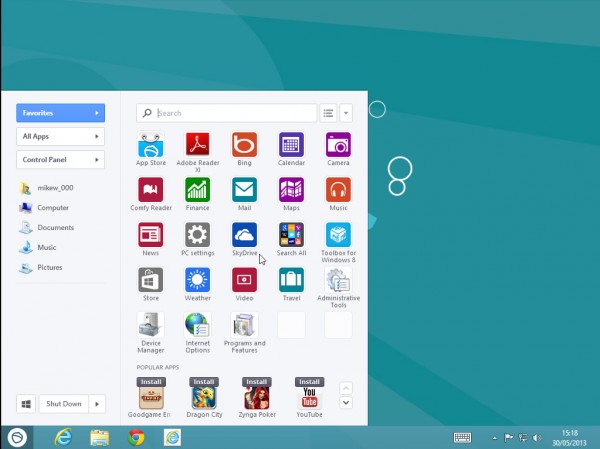
  • Start menu replacement Pokki now fully touch-enabled

    SweetLabs Inc has just released a new version of Pokki, its ambitious Start Menu replacement and app framework. There are few visual changes — and not even that many in total — but the release does deliver some high value improvements which should make a real difference to the product.

    Full touch support for Pokki apps and menu will help make the program far more usable to a tablet audience, for instance.

    If, as is rumored, we finally see Windows 8 tablets released with Retina-type displays, then Pokki will be ready: both the apps and the menu now come with high DPI display support.

    Pokki has been held back a little by the lack of quality apps, but this release provides a few more goodies to developers in an effort to help. In particular, compatibility with the Unity 4 rendering engine should help bring a host of new games to the platform, while support for WebRTC introduces all kinds of real-time communication and audio/video capturing possibilities.

    And the official release notes detail some very significant bug fixes (although of course it’s not exactly encouraging that these bugs existed in the first place). Boot-time slowdowns, critical crashes, and several issues which could prevent the Pokki menu appearing at all have each been resolved.

    There’s no single killer new feature here, then, and if you just want a clone of the old Start Menu then there are simpler and more lightweight options elsewhere. This latest build does make welcome progress in a number of areas, though, and if you’re a Pokki fan — or liked the idea, tried it before and ran into one of those annoying bugs — then the new release has to be worth a try.

  • Disneyland Explosion: Arrested Man in Court Today

    The man who was arrested for an explosion that went off Tuesday evening at Disneyland in Los Angeles is due in court today. 22-year-old Christian Barnes (pictured) was arrested Tuesday for suspicion of possessing a destructive device.

    Barnes was working as a Disney “cast member” (employee) at the time of the explosion, selling soda and water from a mobile cart. Police believe Barnes placed dry ice into a plastic bottle, then placed it in the Toontown-area trashcan where it later exploded. The area was evacuated, and police brought in a bomb squad to investigate. Barnes was eventually identified as a suspect using surveillance camera footage.

    No injuries or property damage resulted from the explosion, but Anaheim police are treating the incident seriously. Anaheim police Sergeant Bob Dunn told L.A.’s KTLA network that, while it is possible the explosion was just a prank, the police are treating it as a crime.

    “The message that we would want to send to any individual who decides to do something like this is that, first of all, these may just seem like dry ice in a plastic bottle – it is very dangerous,” said Dunn. “You could be injured. You could injure others. Some people could even die.”