Blog

  • Jack Vance Dies: Sci-Fi & Fantasy Writer Was 96

    John Holbrook Vance, better known to the literary world as Jack Vance, has died. He was 96.

    Vance, a prolific author who penned more than 60 books in his more than 60-year career, wrote across multiple genres including mystery, sci-fi, and fantasy. Most of his work was penned under the name Jack Vance, but he also had multiple pseudonyms inducing Ellery Queen, Alan Wade, Peter Held, and John van See.

    Friends and family, who manage Jack Vance’s site, have posted a message about the author’s passing:

    “Jack Vance passed away at home on the evening of Sunday May 26, 2013, ending a long, rich and productive life. Recognized most widely as an author, family and friends also knew a generous, large-hearted, rugged, congenial, hard-working, optimistic and unpretentious individual whose curiosity, sense of wonder and sheer love of life were an inspiration in themselves. Author, friend, father and grandfather – there will never be another like Jack Vance.”

    Vance won Hugo Awards for his 1963 work The Dragon Masters, as well as 1967′s The Last Castle. He also won for his 2010 memoir This Is Me, Jack Vance!. He also won a Nebula Award, an Edgar, a Jupiter Award, and a World Fantasy Award for his writing. He was inducted into the Science Fiction Hall of Fame in 2001.

  • Preliminary list of HTC devices set to receive the Android 4.3 update is unleashed in the wild

    htc-43update-main


    Google hasn’t quite announced its next Android version just yet, but that isn’t stopping big-name manufacturers from working behind the scenes to ensure which of its devices will likely make the cut and get the next coveted update. Thanks to the leaked preliminary list you see above, it’s looking like HTC already has an idea of which of its devices will see which of its devices will see Android 4.3 and others that well… won’t see Android 4.3. For the most part, it looks like owners many of the flagship devices released in the last 15 or so months should expect to see the next version of Android. This means that all of you HTC One X, One X+, HTC Butterfly (Droid DNA) and of course HTC One owners can go ahead and breathe a sigh of relief.

    On the flipside, HTC One S and Verizon Desire owners are probably going to be out of luck— though there’s a chance that HTC will possibly update its guidance and figure that the those devices can handle Android 4.3 after all.

    source: Technos Amigos
    via: Phone Arena

    Come comment on this article: Preliminary list of HTC devices set to receive the Android 4.3 update is unleashed in the wild

  • The Evolution of the IT Professional – Understanding the Cloud’s Demands

    A staff member in an Equinix facility.

    A staff member in an Equinix facility.

    The technology landscape has truly evolved over the past few years – and with that evolution comes a new demand for the future of IT administration.

    IT managers and engineers are tasked with knowing more, understanding further components within their own environments and must have the ability to truly be creative. The old days of IT saw engineering dedicated to one process. Rare interaction between teams was seen as an exception rather than norm. Cross-IT team collaboration would be usually done at the management level, and even then it wasn’t always successful.

    There is a new breed of engineers being born from the era of cloud computing. New job titles are being created with demands being placed on engineers who are unique and have the ability to communicate. In this post, we’ll outline some of the traits which are in high demand from this new type of IT professional.

    Among many new traits and personality qualities that an engineer may have, the following are beginning to emerge as truly defining characteristics of the new IT pro:

    • Communication. There is a misconception and even a stereotype that IT people are quiet, introverted and often times don’t communicate well. Although in some cases this may be true, many successful IT professionals have broken out of that shell. Communication is crucial to the success of any IT person. The new technological environment calls for people who can not only walk the walk – but explain what route they took. Furthermore, this oftentimes will mean explaining various technology objectives to both end-uses and executive staff.
    • Leadership. Administrators and engineers must take more of a leadership role if they wish to progress in their careers. Usually, this means saying ‘no’ to things. However, a real leader won’t only know when to say ‘no’, but also how to say it. Effectively challenging ideas and collaborating to help evolve solutions is much better than flat out saying ‘no’ to things.
    • Drive. Complacency in IT has always had detrimental effects. With all of these new technologies being released on a seemingly daily basis – being complacent now is worse than ever. IT pros must have the drive to keep pushing forward, learning new things and expanding their horizons.
    • “Thinking outside of the data center.” Cloud computing and distributed infrastructures have created a new line of thinking. IT folks, both young and seasoned, must know how to see the big picture whenever they’re working with a large corporate environment, including a thorough understanding of business goals and objectives. Cloud computing has truly created a new breed of architects who have to incorporate various technologies to establish sound solutions. We’ll get into this in the next blog!
    • Collaboration. The ability to work with various teams and to collaborate on projects – even as a junior engineer – is truly important. Sharing ideas for the sake of best practices and collaboration will help ensure a good deployment. Even more important, it’ll enhance team work!

    The ability to think on your feet and go far beyond simple troubleshooting within an organization can mean the difference between a desk-job and sought after career advancement. Outside of the common “cloud” computing technology what else is driving this type of demand in today’s business IT world?

    The reality is that the logical progression of technologies has not only created the need for articulate engineers and architects – organizations now seek folks who can speak the language of many different technologies. As the data center advances, cloud and data center architects will have to learn about the various components that make up a solid data center infrastructure. This means understanding some of the following technologies:

    • Unified, converged and high-density computing.
    • Various types of network and WAN connection best practices.
    • End-user management and security.
    • IT consumerization and BYOD controls.
    • Data management, replication and even analytics.
    • Understanding around various cloud models, APIs, and deployment strategies.
    • Disaster recovery, business continuity, and backup.
    • Global server and traffic management.
    • Data center design best practices and efficiencies.

    The modern data center, in reality, can be considered the home of the cloud. We can no longer think of the data center as stand-alone physical unit. These data warehouses and processing centers are creating massive connectivity points for an ever-expanding Internet and cloud environment. Today’s data center is really a logical connection point to many other data centers and the services that they may be running.

    Cloud and data center architects of tomorrow need to understand how this vast environment all functions together and how it affects the end-user. One of the biggest challenges for the new breed of engineers is designing an environment around one very important business and technology aspect: mobility. The ability to be agile, very mobile and provide on-demand services are becoming standard requirements for many data center providers.

    Not only will engineers and architects need to have the ability to communicate, they will need to know about many different technologies which directly affect the modern data center. These IT professionals will often act as the liaison between numerous different, still very important, business stakeholders. This means translating user and executive needs into direct IT solutions. For those professionals that can do this – there will be a need for them, both now and in the future.

  • 7 Dead In Upstate N.Y. After Car Trailer Disconnects

    A truck hauling crushed cars through Truxton, New York lost its trailer on Wednesday night after it became disconnected, causing a devastating crash that killed seven people inside a minivan.

    The van was carrying people from two families, including four children under the age of ten. Authorities say they don’t know what caused the trailer to disconnect from the truck; the weight of the transport sent it careening into the van, tearing it apart.

    Cortland County Coroner Whitney Meeker said there was one survivor in the deadly crash who was taken to Upstate University Hospital in Syracuse, but the identities of those involved haven’t been released. The two people inside the truck were unharmed.

    The fire commissioner, Douglas Randall, said he was directing traffic around the site of the crash when he saw family members arrive at the horrific scene.

    “They were all meeting down the road at a family member’s house,” he said. “They were all hysterical.”

    There were reportedly storms–including some with hail–in the area yesterday, but officials haven’t commented on whether that was a factor in the accident.

  • LG Optimus G Pro arrives in Asia

    After launching the smartphone in its home market, on Thursday, South Korean manufacturer LG announces that the Optimus G Pro, the company’s Android flagship, will finally be available in remaining Asian markets starting next month.

    “Asian customers are leading many of today’s technology trends and we’re confident Optimus G Pro will find a large following in this region”, says LG’ Jong-seok Park. The handset, labeled indirectly as a phablet by the company, will be launched in Hong Kong first, followed by other local markets like Taiwan, Singapore, Thailand, India, Indonesia, Philippine, Vietnam and Malaysia throughout June.

    The highlights of the Optimus G Pro include 5.5-inch display with a resolution of 1080 by 1920 and a 440 ppi (pixels per inch) density; 1.7 GHz quad-core Qualcomm Snapdragon 600 processor; Adreno 320 GPU (Graphics Processing Unit); 2 GB of RAM; 3,140 mAh battery; 13 MP back-facing camera; 2.1 MP shooter on the front; 16 GB of internal storage; microSD card slot and Android 4.1.2 Jelly Bean.

    The Optimus G Pro is already available in the US and other markets like Japan and South Korea, but has yet to make a global appearance. The fragmented launch strategy adopted by LG can only harm its handset sales and, therefore, the chance to better compete against rival makers Samsung and Apple. The South Korean company is currently the third-largest smartphone manufacturer.

  • Car goes airborne after blowing shock!

    Car Crash

    If you’ve ever witnessed a car accident, and I mean a REALLY bad accident then you know that it can be both a terrifying and traumatizing experience. Seeing people get hurt, or worse, makes one think twice about a few things. In this case, it’s simple automotive maintenance. The video you are about to see is frightening, as it shows what happens when a car blows a shock, loses control and goes airborne. Kinda’ makes you think twice about doing a regular service to your car doesn’t it?

    Source: Youtube.com

  • BlackBerry Live 2013 Panel Recap: Built for Mobile in Emerging Markets

    Lseries_SA_121211-604_BG_Q-w600

    The fastest adopters of mobile innovation are not just infrastructure-rich markets. It’s in regions like Africa and Asia where peoples’ first experience of the Internet is mobile. Smartphone uptake is exploding in emerging markets due to rising wealth, brand desire, access to education and need for key services in health, welfare, education and finance. In many ways, they are further advanced in mobile service innovation, as many businesses are built first from a mobile perspective.

    Across emerging markets, mobile is consistently an engine of growth, but as technology evolves, the mobile industry will need to play an active part in helping governments address socio-economic challenges, enable progress and build sustainable mobile ecosystems for the future. To discuss some of these challenges, we held a panel at BlackBerry Live 2013 with industry leaders, analysts, and developers to exchange insights on BlackBerry innovation in emerging markets around the world.

    Participants in the panel included: Robert Bose and Wes Nicol, BlackBerry’s Regional Marketing Directors for Europe, Middle East and Africa (EMEA) and Latin America (LATAM) respectively; Leandro Melo de Sales, Professor at Institute of Computing (IC) at Federal University of Alagoas (UFAL) and Principal at BlackBerry Tech Center, Brazil; Alexander Rusli, CEO of Indosat, one of Indonesia’s largest telecommunication networks and service providers; Leon van Dyk, BlackBerry apps lab manager in South Africa; and Victor Dibia, developer and founder of denvycom in Nigeria.

    Read more at the Inside BlackBerry Biz blog »

  • Can the Moto X compete with Apple’s iPhone 5S and Samsung’s Galaxy Note III?

    Moto X Release Date
    Motorola boss Dennis Woodside on Thursday finally confirmed the existence of the Moto X, the first Motorola smartphone that will launch with heavy influence from Google. Few details were shared by the executive while on stage at the D11 conference, but the tidbits he did offer were very intriguing. Woodside said the phone will be manufactured in the United States in a Fort Worth, Texas facility that used to build Nokia handsets. He also said the Moto X will feature two processors and numerous sensors that help the handset respond to context. For example, it will know when the user is driving a car, or when the phone is taken out of a pocket. Finally, he said the Moto X will launch by October and will be available across several carriers. As great as all this sounds, will any of it matter?

    Continue reading…

  • Waze Update Adds Facebook Event Integration & More as Acquisition Rumors Swirl

    With 49 million daily users, Waze has been the topic of some acquisition rumor drama over the past couple of weeks. Rumors that Facebook was in serious talks to buy the Israel-based navigation company have swirled since early May – but recent reports indicate that those have fallen apart. It appears that Google and a few other unspecified companies are also in the mix, however.

    Acquisition rumors aside, Waze is still working on making their app better. Today, they’ve released v3.7 which brings a bunch of new features including Facebook event integration and more.

    Now, if you have Facebook connected to Waze, your Facebook events will automatically appear in your Waze navigation lists in the hours before the event is supposed to begin. That way, you can just tap the event when you’re ready to go and get to navigating – no hassle.

    “Our vision is to create a completely seamless experience when meeting colleagues, family or friends,” said Yael Elish, VP of Product & Marketing, Waze. “Waze frees you from the hassle of dealing with addresses or coordinating meeting places. One-tap navigation to Facebook Events is only the start…drivers will enjoy much more in upcoming versions soon.”

    Waze also added a feature that will show you when your friends are on the way to the same destination that you are. They’ll appear on a new bar on the right-hand side of the map, one which will show you who’s going to get there first.

    Here’s Waze’s full list of updates to 3.7:

    • Real time and offline “beep beeps” at friends.
    • Exclusive moods for map editors – T. Rex, robot and 8-bit.
    • Redesigned, sleeker pop-up alerts.
    • Inbox has moved to the main menu.
    • New 3-state mute button in the main menu (mute, alerts only & on).
    • Foursquare check in available from report menu.
    • Lock up north added to settings.
    • Support for JVC App Link Mode” for compatible in-dash car audio receivers.
    • Multiple fixes and optimization and more!

  • Digital Realty Trust Acquires Six Austin Data Centers

    Digital Realty Trust acquired a six-building portfolio in Austin, Texas for $31.9 million. The portfolio is located at the MetCenter Business Park and consists of 337,000 square feet of operating data centers and flex space.

    The overall portfolio is 90 percent leased to a variety of companies, with two of the six buildings total approximately 100,000 net rentable square feet fully leased to three tenants.

    This move continues Digital’s recent streak of acquiring fully leased properties for income, plus adds some new development space for upside.

    “The acquisition of this portfolio achieves several key objectives for us,” said Scott Peterson, Chief Acquisitions Officer at Digital Realty. “It expands our existing data center footprint in the Austin market, while providing stable cash flow immediately at an attractive going-in cap rate. Second, it provides near-term opportunity to add value by lease existing vacant space. And third, it offers the option to convert a portion of the property to data center space over the longer term as leases expire.”

    The six buildings are located adjacent to Digital Realty’s data center at 7500 Metro Center Drive, approximately five miles southeast of the Austin central business district, and nearby Austin-Bergstrom International Airport.

    “This acquisition adds inventory to a market where we have already seen substantial absorption at our existing facilities, as well as strong demand from enterprise customers,” said Michael Foust, Chief Executive Officer at Digital Realty. “It is a continuation of our strategy of growing a world class data center portfolio in markets where our customers want to be located.”

    Where are the customers wanting to be located? Just this year, the company has acquired facilities in Dallas, Phoenix , Minnesota, Toronto, Paris,  and Sydney. All of these acquisitions were in markets where the company says it saw very positive demand, and most of these properties were fully leased at time of acquisition. It also launched its own DCIM, announced it was seeking out tier certification for 20 facilities, and is building dark fiber connecting its key internet gateways. It upgraded its POD infrastructure to offer up to 1.2 megawatts in each data hall, up from 1.125. The company has kept busy.

  • Keep your passwords secure with Dashlane for Windows, Mac and Android

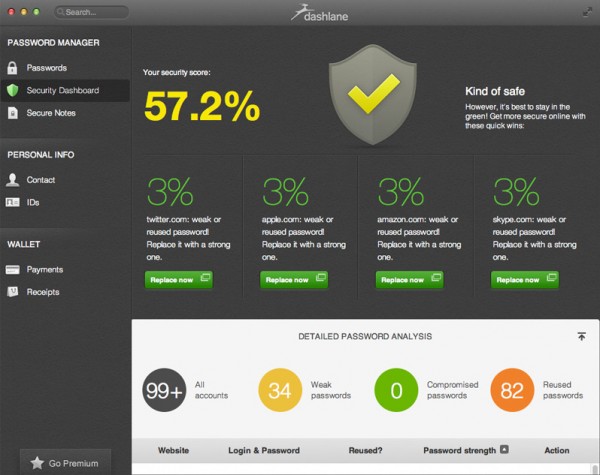
    Dashlane, Inc has launched Dashlane 2.0 for desktop and Dashlane for Android 2.0.1, major new updates of its secure password management tool that allows users to securely store sensitive personal details such as online passwords and credit card information via free desktop and mobile apps.

    Both builds gain a complete new user interface, the promise of a “massive jump” in product quality and support for two-factor authentication via Google Authenticator. In addition the desktop build gains a new Security Dashboard feature, while the Android version expands support for tablets and adds in-app browsing.

    The Dashlane 2.0 app for Windows and Mac opens with a brand new redesign with new color schemes and contrast levels designed to improve readability as well as the app’s overall look. It also comes with a brand new Security Dashboard feature offering a Security Score, which rates the user’s overall security based on the strength and variety of passwords used. Users also gain a simple list of steps to follow in order to improve the quality of their passwords to boost this Security Score.

    Version 2.0 also promises much more intuitive use through support for two-step and three-field login screens as well as improving the overall auto-login and autofill process. In addition to these features, the desktop also adds another optional layer of security with support for Google Authenticator, allowing users to add two-factor authentication when logging into Dashlane to retrieve sensitive personal information.

    Sadly there are still issues with version 2.0, most notably when attempting to import passwords from other sources, such as browser password managers and competing services such as LastPass and KeePass. These issues have been long a source of frustration for users, and in our experience have yet to be properly resolved as we struggled to migrate our LastPass passwords into Dashlane, eventually succeeding only by using Firefox as an intermediary using the Mac desktop app.

    In the meantime, Dashlane for Android 2.0.1 introduces a number of major improvements and new features. It includes an in-app browser for the first time, allowing users to benefit from the same auto-login and autofill feature set found when using Dashlane on the desktop platform.

    The app also adds full support for tablets and all screen sizes from a single universal app, while the UI has been completely overhauled using the Android Holo Interface. Support for two-factor authentication via Google Authenticator has also been implemented, which requires setting up via the desktop version before it can be used in the Android app.

    All product features are completely free to use, but additional benefits, including support for auto-synchronization between devices, web access to logins and passwords, plus unlimited backup of encrypted data, can be purchased via a Premium license, which costs $19.99 annually.

    Dashlane 2.0 is available as a freeware download for Windows and Mac, while Dashlane for Android 2.0.1 is also available free for phones and tablets running Android 2.3.3 or later. Also available is Dashlane 2.3.1 for iPhone.

  • Samsung Galaxy Tab 3 8.0 and 10.1 tablets unofficially outed

    Samsung_Galaxy_Tab_3


    Those of you Sammy stans out there will be excited at the fact that the newest additions to the Galaxy Tab family have been outed for your viewing pleasure. Thanks to the studs at Moveplayer, we now know what the Galaxy Tab 3 8.0 and Galaxy Tab 3 10.1 will look like, as well as some additional details regarding the specs of each device. According to the site, the Galaxy Tab 3 8.0 will come with an 8-inch WXGA (1280 x 800) TFT-LCD display and dual-core 1.5Ghz processor, 1.5GB of RAM and Android 4.2.2 on-board; the Galaxy Tab 3 10.1 on the other hand, will likely feature a similar spec sheet— while also addition the expectation of coming in no less than 3 variants and will measure in at 243.1 x 176.1 x 7.95 mm.

    Samsung hasn’t come out and addressed the latest leak just yet, but all indications point to for formal unveiling and launch of the tablets at a June 20th event.

    source: Moveplayer
    via: SamMobile 

    Come comment on this article: Samsung Galaxy Tab 3 8.0 and 10.1 tablets unofficially outed

  • Woman Killed by Police at Virginia Costco

    A Virginia woman was shot and killed this week after threatening police with a knife at a Costco in a Washington D.C.-area suburb.

    According to a statement from the Loudoun County Sheriff’s Office, officers responded to a report of a disorderly woman at a Costco in Sterling, Virginia. The woman, later identified as 38-year-old Mhai Scott, was reportedly threatening store employees with a knife and scissors.

    Two deputies arrived at the store and attempted to subdue the woman with a Taser. According to the Sheriff’s office statement, the Taser was “ineffective” at stopping the woman. The deputy who was not using the Taser then fired multiple shots at the woman.

    The woman died in the Costco and one deputy was taken to a nearby hospital for unnamed injuries sustained during the incident. The deputy is now in good condition.

    According to an NBC 4 report, Scott was working at the Costco at the time of her death, handing out pizza samples to customers. Witnesses described Scott as making strange comments about the pizza.

    View more videos at: http://nbcwashington.com.

  • Woman Killed At Costco After Waving Knife At Customers

    A Virginia woman was shot and killed on Wednesday after she stopped handing out samples and began waving a knife around in a threatening manner.

    The woman, identified as 38-year old Mhai Scott, reportedly began acting strangely and was saying odd things as she neared the end of her shift. Her supervisor became frightened and called police. When they got there, they found Scott erratically waving a knife and a pair of scissors around in a threatening way, so they tried to subdue her with a stun gun. When that didn’t work–and she came at a deputy with the weapons–they opened fire.

    “Everyone was running out of the building not knowing what was going on,” customer Robert Krause said. ”I was a little scared so I got out of there pretty quick.”

    One of the officers was wounded after a bullet ricocheted and hit him in the leg, but he is expected to recover. Police say they have no clues as to why the woman suddenly became agitated.

    “It’s a tragic situation,” Sheriff Michael Chapman said. “I feel for everybody involved.”

    Scott reportedly worked for Club Demonstration Services and was in charge of food prep and sampling at the store.

  • Don’t Let Mobile Apps Get Pushy

    Americans are addicted to their smartphones. A recent report by Flurry Analytics revealed that Americans spend about 2 hours and 38 minutes a day glued to their mobile devices, with 80% of that time spent in/on mobile apps. With over 700,000 apps available for download in both Google Play and the Apple App Store, it is safe to say that apps have reached critical mass.

    With this intense competition, brands and mobile app developers are forced to reevaluate tactics for growing user retention and engagement rates, which is increasingly difficult. Some brands — like ESPN and Yahoo — are embracing the philosophy of “less is more” by consolidating their overall portfolios of mobile apps and redesigning their “everyday” apps to appeal to overloaded users. But many other are embracing push notifications, which are proven to quadruple mobile engagement rates and double retention rates compared to apps without them.

    The New York Times and the Wall Street Journal leverage push notifications as tools to break important news. Retailers like Sephora and Gilt use them to support time-sensitive flash deals. Airlines like United use them to keep travelers up-to-date with flight statuses.

    While push notifications can be incredibly useful, many mobile app developers and brands have resorted to using them as a cheat to achieve coveted retention and engagement. In some cases, it’s starting to backfire. We’re beginning to see a tidal wave of push notifications from mobile apps that alert users of every mundane activity, irrelevant sales promotion, or social network update. Essentially, these push notifications just add more digital noise and drive users to tune out or even delete certain mobile apps from their devices. Just yesterday, I received a last-minute Ticketmaster alert to purchase concert tickets for a band that I don’t like for a concert in a city that I don’t live in. On other days, the activity in my Facebook life causes my phone to constantly buzz. But then again, Facebook’s aggressive use of push notifications is well documented.

    Evaluating the value of push notifications against the noise that they create is a slippery slope. Given the proven success of these alerts and with strong retention and engagement rates viewed as the Holy Grail, we need to find a palatable solution for future app development.

    Here are some guidelines that brands and mobile app developers need to consider:

    1. First decide if the mobile app is brand appropriate. Does your brand have a proper mobile channel strategy in place that fits into your brand’s overall business objectives? How does this mobile app fit into that strategy?

    2. Does the mobile app legitimately create value for your consumers? If not, then don’t build it.

    3. Focus your mobile app — don’t water it down. What are the one or two features that will help drive mobile app engagement and retention?

    4. Create social engagement layers for your mobile app that encourage users to come back. Why would they care and what would move them to share your mobile app?

    5. Use push notifications only when necessary and make sure the content in your push notification is relevant and personalized. Create a push strategy the same you would create an email strategy. Push notifications should not equal SPAM.

    6. Deliver the notification at the right time to the right audience in the right context. Segment. Push content to specific groups based on their individual profiles and behaviors. Push notifications should be geo-targeted, audience targeted, and time-sensitive.

    7. Use analytics and social listening to continuously improve your app by tracking what consumers care about. Your app is a work in progress. Analytic services like Parse are helping brands and agencies best determine if push notifications are working.

    Average users have 41 apps on their mobile devices — and that number continues to rise. Utilize push notifications appropriately to help bring attention of your mobile app. Don’t let your mobile app’s greatest asset for driving retention and engagement become it`s greatest nuisance as well.

  • Samsung Galaxy S4 Mini A Reality, Launches Later This Year

    Before the Galaxy S 4 tore up the sales charts, it was rumored that Samsung would be releasing a mini-version of the device for the more cost conscious consumer market. Those rumors were right on the money as Samsung announced such a device today.

    The Galaxy S4 Mini is indeed real, and it’s said to bring “the sleek design of the Galaxy S4 in a portable chic and compact design.” Of course, it’s not only the reduced size, but the reduced cost as well that will make the S4 Mini an attractive option for consumers not interested in 5-inch smartphones that cost hundreds of dollars.

    The S4 Mini is equipped with a 4.3-inch qHD Super AMOLED display, a 1.7GHz processor, 8MP back camera, 1.9MP front camera, 1.5GB of RAM and 8GB of internal memory. As expected, it will ship with Android 4.2 and supports LTE bands. It also supports many of the same software features that shipped with the Galaxy S4, like S Translator and S Health.

    “Demand for the Galaxy S4 has been phenomenal since it launched in April and we hope to build on this success with the Galaxy S4 Mini,” said Simon Stanford, Vice President of IT & Mobile Division, Samsung Electronics UK & Ireland. “This new handset is the ideal smartphone companion for anyone who wants a compact device packed with innovation.”

    So, when will you be able to get your hands on the S4 Mini? Samsung isn’t saying at the moment. A separate press release out of UK-based Phones 4U says the device will be out in the UK this July. There’s been nothing said regarding a U.S. release, but I wouldn’t be surprised if it launched around the same time as it does in the UK.

  • Spotify Discover Now Available to All Via Web Player

    Last December, Spotify announced a brand new “discovery” feature that harnessed the streaming music company’s data on your past streaming habits and various recommendation engines to give users suggestions on what to listen to next. Today, Spotify is making the Discover tab available to all users via the web player.

    “With the Discover page, we’re making good on our promise of helping you choose what to listen to when faced with millions of songs,” says Gustav Söderström, Chief Product Officer, at Spotify. “We’ve made your listening experience more personal, more social and more current.”

    The Discover tab features a bunch of different ways to find new music as well as more information on music you currently love. Personalized recommendations suggest artists and tracks based on what you’ve listened to and who you’ve followed. You’ll also see the music and playlists shared by your Spotify friends. And a related music feature also gives you suggestions on what to play next, based on the song you’re currently listening to.

    Spotify harnesses the power of Pitchfork, Songkick, and Tunigo (which they just purchased) for these recommendations. According to the company, it’s now available for everyone on the web and will continue to roll out to Spotify’s desktop and mobile apps in the coming weeks.

    Check it out today over at play.spotify.com/discover.

  • Details on Additional Connect America Fund subsidies: $485 Million to Expand Broadband Access Across Underserved Rural Areas

    Connected Nation recently put out a  press release on the additional round of Phase I Connect America Fund subsidies for larger (“price cap”) local telephone companies. Here are some highlights…

    2013 Connect America Fund Phase I Program

    Largely speaking, this funding opportunity is structured similarly to the Connect American Fund Phase I program of 2012, but there are several important changes in its implementation. Specific program details include:

    Areas Eligible for Phase I Subsidies – For the 2013 round of Phase I subsidies, eligible areas now include areas traditionally served by these 13 price cap carriers that do not have access to fixed broadband service of at least 3 Mbps download/768 Kbps upload speeds, according to the National Broadband Map. Last year, eligible areas included only those unserved by fixed broadband service at speeds of only 768 Kbps download/200 Kbps upload. This new definition nearly triples the number of areas eligible for Phase I subsidies in 2013 than were eligible in 2012.

    BTOP and BIP Areas Excluded – The FCC will not award Phase I subsidies in areas where the federal government has already allocated subsidies for broadband build-out through the BTOP or BIP programs.

    Build-Out Requirements – A provider that accepts the one-time Phase I funding for a census block will have 3 years to build-out broadband at speeds of at least 4 Mbps down/1 Mbps up in that census block.

    Use of the National Broadband Map – The FCC will be using the National Broadband Map to identify eligible areas for these subsidies. It will use the version of the Map currently online based on broadband inventory estimates for June 2012.

    Subsidy Amounts per Location Served – Under this program the FCC is offering subsidies on a per-location-passed basis with two separate benchmarks. For areas that do not have access to fixed broadband at 768 kbps download/200 kbps upload, the FCC is offering a one-time subsidy of $775 per location passed to fund the upgrade. To upgrade areas that have access 768 kbps/200 kbps fixed broadband but which do not have access to the FCC’s benchmark of 3 Mbps download/768 Kbps upload, the FCC will provide a one-time subsidy of $550 per location.

    Allocation of Subsidies Across Price Cap Carriers – The FCC will make up to $485 million available in this program, allocated among the 13 price cap providers. In this Order it sets an initial allocation of $300 million as follows:

    ntia

    These amounts are not, however, a cap for funding available under this program for each provider. Recognizing that the subsidies offered to each provider may not be accepted (as was the case in 2012 Phase I program), the FCC is introducing a mechanism by which the providers can request funds beyond this allocated amount. In particular, each provider can submit subsidy requests for 2013 up to $300 million. If the program is oversubscribed, the FCC will allocate up to $485 million in subsidies based on the proportions of the allocation above.

    The allocation, then, is perhaps best thought of as a guarantee for a minimum amount of subsidies if the subsidy recipients agree to make the associated build-out commitments. Providers like PRTC and Cincinnati Bell that do not have an initial allocation may identify areas to which it would make a build-out commitment in exchange for Phase I funds, and those requests may be accepted if all $485 million is not claimed by all other providers.

    Process and Mapping Challenges – The FCC is establishing a 60-day challenge process to resolve disputes as to whether the National Broadband Map accurately reflects the availability of broadband in areas eligible for Phase I funding. After price cap providers make their build-out commitments, the FCC will make those areas public and invite comment from the public within 30 days, with another 30 days reserved for rebuttal. In this way, parties will be able to challenge eligibility of the subsidy if, for example, they can prove that a given area is already served. By insisting that these disputes be raised publicly and in a targeted manner, this process represents a significant improvement over prior efforts by the FCC to resolve this category of disputes.

  • Apple unveils new 16GB iPod touch

    Before Apple rolls out a new product the company usually announces it with much fan-fare at special events and issues bombastic press releases before the big launch. But that’s no longer the case with the 16GB iPod touch which arrives quietly with its tail between its legs. It’s almost like the Cupertino, Calif.-based corporation doesn’t want folks to rush into ordering one.

    The 16 GB model bears an uncanny resemblance to the current iPod touch lineup, featuring the same elongated design (first seen on Apple’s iPhone 5) and low physical footprint. But there are some differences.

    The latest model ditches the 5 MP iSight back-facing camera and iPod touch loop (lanyard hook), has a lower price and is only available in a single color trim with less internal storage. Unsurprisingly, Apple lists it as an individual product, separated from the company’s current iPod touch lineup.

    The 16 GB iPod touch runs for $229, $70 cheaper than the 32 GB model (available for $299) which comes with a back-facing camera and, obviously, twice the storage capacity. Battery life is the same, with Apple touting 40 hours and eight hours of audio and video playback, respectively.

    Specifications for the 16 GB iPod touch include: 4-inch multitouch Retina display with a resolution of 640 by 1136 and a 326 ppi (pixels per inch) density; dual-core A5 processor; 1.2 MP FaceTime HD camera capable of 720p video recording; Wi-Fi 802.11 a/b/g/n and Bluetooth 4.0. The device comes in at 123.4 x 58.6 x 6.1 mm and 86 grams.

  • Samsung builds on Galaxy S4′s momentum with new Galaxy S4 mini

    Samsung Galaxy S4 Mini Specs
    Samsung on Thursday announced preliminary details surrounding an upcoming new version of its popular Galaxy S4 smartphone, the Galaxy S4 mini. The S4 mini is a mid-range variant of the wildly successful flagship phone, and it features much more manageable sizing. Key specs include a 4.3-inch qHD Super AMOLED display, a 1.7GHz dual-core processor, an 8-megapixel rear camera, available 4G LTE and Android Jelly Bean. No launch details or pricing have been announced, but Samsung will reveal additional information during a press conference on June 20th. Samsung’s press release follows below.

    Continue reading…