 |
Two new studies published in the journal Environmental Science & Technology confirm that the average home is filled with toxic flame retardant chemicals that may cause anything from cancer to hormonal problems to birth defects. In the first study, researchers from… |
Blog
-
Your home is filled with toxic flame retardants
-
Research: Low vitmain D levels found in chronically depressed people

The most recent study that supports an association of mental health and vitamin D was conducted in Amsterdam, Netherlands. It’s focus was chronic depression. It was entitled “The association between low vitamin D and depressive disorders,” was published in the April… -
Crazy scientists develop implantable microchip that supposedly induces appetite suppression

Pretty soon every bodily function will be capable of regulation and control by futuristic, man-made technologies, and this bionic insurgence is apparently starting with the human appetite. As reported by BBC News, U.K.-based scientists have developed an implantable microchip… -
Eat these six delicious healing foods high in fiber to regulate your digestion

Fibers are considered an important part of our daily diet. Yet, there are no nutrients taken into our bodies from fiber, and fiber content is not even digestible. So what’s the point? Fiber functions primarily to ensure proper and complete digestion of the nutrients… -
Forty percent of parents still giving kids dangerous medication that harms children

Despite years of warnings from the medical establishment about the dangers over-the-counter medications pose for young children, it is alarming to know that as many as 40 percent of parents are still giving their kids these harmful substances. The latest University… -
Doctors walk out of national Obamacare implementation meeting

According to live tweets and images sent from ophthalmologist Dr. Kris Held, nearly all doctors had walked out in protest and disgust of Obamacare implementation talks at a prominent national health care meeting. Typically, The American Society of Cataract and Refractive… -
Government paranoia: Teacher suspended after showing students garden tools

The intemperate, extreme nature of today’s education establishment just keeps getting more and more absurd, as evidenced by details of a recently filed lawsuit surrounding claims that a teacher was suspended after bringing garden-variety tools to class. Attorneys… -
Seven really effective ways to get unstuck

Getting stuck is nothing to worry about. It happens to us all. In fact, getting stuck mentally and emotionally is unavoidable. If you think you should never be at a loss for what to do or lack motivation in life, then your expectations are impossibly high. The real… -
The fight against Monsanto – Seattle natural grocer supporting GMO labeling

Seattle natural grocer PCC Natural Markets is ready to stand up against Monsanto and other genetically modified organism (GMO) food producers. PCC has joined the fight to force food companies to label products that include genetically modified organisms, a practice found… -
Ministry of Truth makes Boston bombing suspect disappear

The boy. Abdul Rahman Alharbi. He was here, then he wasn’t. He was featured in major stories, then he wasn’t. The Ministry of Truth (controlled media) has no further concerns. For a few hours, Alharbi was the prime suspect in the Boston bombing. Then he was… -
Official EU research verifies bee holocaust caused by dangerous man-made poisons, Big Ag and Big Government do nothing

A class of insecticide chemicals commonly applied to rapeseed, also known as canola here in the U.S., as well as sugar beets, corn, and various other crops is killing off bee populations across the globe, and a prominent environmental watchdog group is now demanding… -
Facts about the elusive morel mushroom

Springtime is here, singing loud and clear, with bird’s song and a green brushstroke awakening yards and trees to a new rhythm. As beauty colors in the landscape, wild varieties of plants, herbs, and mushrooms begin to appear. One of the most mysterious species coming… -
Martial law is real: Americans now being forced out of their homes at gunpoint

If you ever wanted to see what a police state looks like up close and personal, look no further than Boston in the aftermath of the marathon terrorist attack. New video footage released online following last week’s lock-down and the house-to-house searches for a lone… -
U.S. lawmakers secretly negotiating to exempt themselves from Obamacare

Top lawmakers on Capitol Hill are negotiating a secret deal to exempt themselves from Obamacare. The Obamacare mandate is a total nightmare, of course, and it doubles health insurance rates while providing nothing resembling actual “health” care. It’s such a nightmare… -
If Congress passes Internet sales tax legislation, you lose

It’s almost as if some in Congress forget that we’ve been down this path before. Garbage legislation, now under the moniker of the Marketplace Fairness Act, has been discussed in various guises and masks over the last 20 years or so. Streamlined Sales Tax. Remote Sales Tax. Distant Sales Tax. They’ve been tried, debated and debunked each time before.
But it’s funny how larger than ever state budget deficits perk up the ears of slimy congressmen on the umpteenth attempt at an Internet sales tax. While proponents like J Marra, writing for BetaNews this week, are in favor of this bill, I stand tall against it, without hesitation.
Speaking from Experience
As a small business owner myself, already reeling in yearly time wasted in wading red tape, I have full right to be fired up about this new effort. Even though my business only does taxable commerce in Illinois, I have numerous colleagues in the IT industry who would be affected by this legislation. Any time government tries to impose new taxes and says that it is merely filling in the gaps is cause for alarm.
Remember when big government lied to us and claimed that Obamacare would save money for everyone across the board? It’s the same flawed thinking that leads some to estimate costs rising for individual plan claims up to 32 percent under the massive legislation. Rule of thumb: the more government gets involved, the worse off we generally are.
Just about 20 years ago, the Supreme Court made a landmark ruling in Quill v. North Dakota that set an important precedent in today’s debates. In that case, the court said, rightfully so, that obligating businesses to collect taxes on behalf of jurisdictions which they have no presence was too burdensome to enforce and expect of them.
Yes, you can say that the case was pitted in the discussion surrounding mail order catalogs and their sales across state lines, but the basis for argument is the same. Should businesses large and small be held liable for collecting taxes on any number of items they may sell to any person online in the vast United States?
Small Business Nightmare
If this junk legislation passes, it means that businesses with online sales across state lines will be liable for tax collection across roughly 9,600 different jurisdictions in the country. As if small business owners didn’t have enough paperwork and red tape to wade through already to keep their businesses legal.
Proponents of this smelly pile refute the tax liability mess by claiming simplified “tax calculation software” will be available to affected merchants in efforts to simplify tax liabilities. Reality to Congress: QuickBooks has been around for over 20 years now, and taxes have not gotten any easier for US small businesses. I’m not sure how another band aid to a broken, over-complicated tax system is going to make life any easier or the burden any less troublesome.
One of the bills sponsors, web giant Amazon, has come out in favor of the legislation. Not surprisingly, Amazon already has the vast, expensive technical infrastructure in place to handle such broad tax collections. So much so that it’s even offering expertise in the form of tax compliance services to other businesses. The online retailer has got more to gain financially from this bill passing than just “leveling the playing field” as it claims publicly.
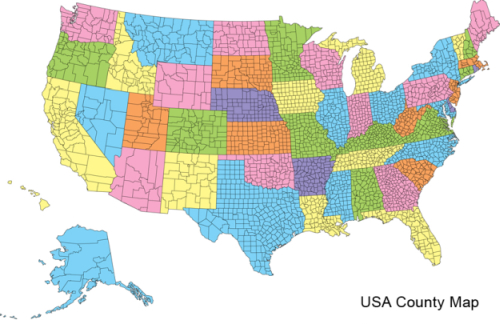
The 3,007 counties of the USA, as shown above, are just a sliver of the jurisdictions that small businesses would be liable in collecting taxes if this legislation passed. All because they survive by selling across state lines. Whatever politicians calls the legislation, it’s the same tax increase that has failed time and time again in congress. (Image courtesy of: mapsfordesign.com)
It’s also interesting to note that this bill has zero language addressing how States would force brick and mortars to collect taxes for purchases made in person by out-of-town residents. After all, the name of this bill is the Marketplace Fairness Act, and in the interest of fairness, shouldn’t brick and mortars be held to the same legislation that is burdening their out-of-state competitors?
Five states do not collect any form of state sales tax, including Alaska, Delaware, Montana, New Hampshire, and Oregon. So if I were a Washington resident I could make the short trek into Oregon and get away without paying any sales taxes. Yet sitting back in my recliner, ordering from the same vendor in the comfort of my home, would yield a fully taxable purchase. That’s fairness? Depends on who you ask, I guess.
Bill sponsors claim that the reason brick and mortars cannot be held to the same standard is because, presumably, it would be too difficult to impose questions upon each buyer about what state and county they come from. But hypocritically, they agree, that imposing the same burden on online retailers is justifiable because they can wrangle in some legal language providing cost-effective tax calculation software that will make the process seamless.
No Silver Bullet
If there’s one thing I know as a small business owner, it’s that nothing surrounding government legislation is as easy as it’s portrayed. I don’t care how much software you toss my way.
Here’s a suggestion to a Congress hell-bent on raising taxes: how about focusing efforts on cleaning up our broken tax code instead? It’s already been proven that Americans as a whole waste 6.1 billion hours annually merely complying with federal tax laws. That’s the equivalent labor time of 2.1 million full time workers! Talk about waste to the nth degree.
While there has been no silver bullet plan as of yet, the attention Herman Cain received for his (flawed, but commendable) 9-9-9 flat tax plan was a step in the right direction, at least as food for thought. If Congress was discussing ways to reduce tax loopholes and administrative overhead/complexity, we wouldn’t have talk about ways to raise taxes on Americans to fill budget deficits.
While the Senate tries its best to ram through the Marketplace Fairness Act as fast as possible, I urge all commonsense Americans to not only sign the public eBay petition against this grimy monstrosity, but also reach out to their representatives and tell them why you are opposed to any new tax increases of this nature.
Legislation supporters claim this is out of fairness to the mom and pops losing money due to online retailers, yet the very ones that will be hurt most are the small-timers selling on the web who will be burdened with more red tape, overhead, and administrative waste.
Fix the glaring mess we already have, Congress — then perhaps we can discuss just cause for more taxation.
Photo Credit: Jane0606/Shutterstock
-
CCleaner 4.01 freshens up your browser

Piriform has released CCleaner 4.01 and CCleaner Portable 4.01, a minor update to its popular Windows freeware system cleaning tool. Version 4.01 is the first release since version 4.0 split users into free and paid-for camps by restricting product features to Pro license holders only.Most of version 4.01’s tweaks are available to both free and paid-for users, and revolve around improving existing tools and adding cleaning support to several new applications.
Improvements in CCleaner 4.01 revolve around better support for existing browsers: there’s improved cleaning for Google Chrome’s History along with better compatibility with Internet Explorer 10 and later builds of Firefox (version 19 and upward).
Windows 8 users should benefit from improved Registry cleaning thanks to an optimized cleaning algorithm, while both new tools introduced in version 4.0 – the Duplicate File Finder and Pro-only System and Browser Monitoring feature — also gain unspecified enhancements and optimizations.
Application-specific cleaning has been further developed too: added in version 4.01 are support for Adobe Acrobat XI, VSO Blu-ray and DVD Converter Ultimate, Oxygen XML Editor 1.4 and Connectify Hotspot, while two tools already supported — Mailwasher Pro and Google Earth — both gain improved cleaning.
The update is rounded off with the usual minor tweaks and bug fixes. CCleaner 4.01.4093 and CCleaner Portable 4.01.4093 are both available as free-for-personal-use downloads for PCs running Windows XP or later. Pro licenses are currently available for $24.95, a saving of $8 on the MSRP.
Photo Credit: Liv friis-larsen/Shutterstock
-
AT&T launches its internet of things effort and it’s pretty big
AT&T is finally ready to unveil its home automation and security product, and it’s a pretty big deal. The product is built on AT&T’s acquisition of Xamboo in 2010, and it will put AT&t in competition with security giants such as ADT as well as a variety of startups building out routers, hubs and “http://gigaom.com/2013/04/18/zonoff-gets-3-8m-to-connect-the-smart-home-with-super-software/”>software for the connected home.
It’s also AT&T’s first foray into an over the top service. The company will offer the service in all areas where it provides wireless service, which may not seem like a big deal, except that the system will connect to both the AT&t wireless network as well as the wireline broadband inside a home. Looks like Ma Bell is ready to make some money on other people’s pipes.
![DLC_whiteAntena[1]](http://gigaom2.files.wordpress.com/2013/04/dlc_whiteantena1.jpg?w=708&h=472)
What’s inside Digital Life
As for the service, it’s pretty compelling for the average person who’s evaluating a home automation or security system, especially if AT&t does open up the platform later as it promises it will. There are two basic packages. The cheaper entry-level package costs $29.99 a month plus $149.99 for equipment and installation. It includes 24/7 home monitoring, a wireless keypad, a remote some sensors and an indoor siren. The more expensive package includes all of that plus three more sensors of the owner’s choice for $39.99 a month and $249.99 for the gear and installation.
AT&T also has a slew of add-on devices including water leakage sensors, wireless cameras and thermostats that a consumer can buy and add to the plan for a monthly fee. AT&T has staffed two call centers around the clock in the U.S. and has provided a battery with the system to ensure that the product is reliable and online all the time. The wireline broadband and AT&T wireless provide redundancy for the connectivity.
Glen Lurie, the president of emerging enterprises and partnerships at AT&T, explained that the whole plan behind the system is for it to be secure and easy for customers to use. That’s why for example, you can’t just bring any old connected device onto the Digital Life network. Much like AT&T’s wireless network, the AT&T wants to test the devices before it will allow them on your home network. Lurie declined to tell me when AT&T would bring on additional partners. He also declined to tell me what companies AT&T is partnering with at launch.
And yet …
However, AT&T’s plan is pretty darn basic at the entry-level and adding standard components for really useful automation and security can bring the total installation and gear cost to about $600 and the monthly service fees to about $55 a month if you add the security camera ($200 installed) and energy management ($150 installed) packages. Remote door locks, water shut-off valves and other tweaks are extra.
That’s not crazy considering you get an integrated app that’s actually quite nice to use for controlling everything, but it’s still a significant investment: especially given the closed nature of the ecosystem.

I’m currently contemplating a $210 set of connected door locks (the non-connected locks are about $85) and so I know that adding connected gadgets to your home isn’t cheap. Because for some of these devices, like thermostats or door locks are also installed into the home, you had better hope you like the overall service. Of course, that’s great for AT&T, because it presumably reduces churn. My colleague Kevin Tofel and I had a good discussion of how to choose a home automation system this week on the internet of things podcast.
And once I have those locks I’ll have to wait for a system such as MobiPlug or SmartThings to support those locks if I want to integrate them into my existing home network. Or maybe I’d have to hope my locks are supported by a software vendor such as Zosoff. Plus, I’d have to do the equivalent of programming scenes that AT&T already has its app. The Leave Home scene will turn down your air, turn off the lights and lock your doors, for example.
Lurie claimed that AT&T is ahead of its competitors by about two to three years, noting that many of the home security products from companies such as Comcast or Time Warner Cable are provided by outside vendors and don’t have an integrated ecosystem like what AT&T is offering.
I think the integration is wonderful, but I do think it will be more powerful when I can bring in some of my existing connected devices onto the AT&T Digital Life network. While the hub that comes with the service supports Wi-Fi, 915 Mhz and other radios, the devices connect in a proprietary mesh that AT&T uses because it ensures security. It also ensures I can’t bring my own devices into the Digital Life family just yet.
But for those without my own particular hangups, the product is certainly worth a look. It launches in 15 markets on Friday including Atlanta, Austin, Texas; Boulder, Colo.; Chicago, Dallas, Denver, Houston, Los Angeles, Miami, Philadelphia, Riverside, Calif.; San Francisco, Seattle, St. Louis and select areas of the New York and New Jersey areas.It will be in 50 markets by the end of 2013, available for purchase online and for testing at AT&T wireless stores.

Related research and analysis from GigaOM Pro:
Subscriber content. Sign up for a free trial.- A look back at mobile in Q1
- Report: The Ongoing Battle for the Digital Home
- What the shift to the cloud means for the future EPG


-
Google exec wants search to have ‘emotional intelligence’ and be more ‘loving’

-
TalkAndroid Daily Dose for April 25, 2013

With hectic schedules, it can be hard to keep track of everything in your news feed. That’s why we created the TalkAndroid Daily Dose. This is where we recap the day’s hottest stories so you can get yourself up to speed in quick fashion. Happy reading!!
Apps
Iron Man 3 game hits Android devices, gives all gamers a chance to be their inner Tony Stark
Carriers
T-Mobile, Washington State AG agree to settlement on claims of deceptive no-contract advertising
Google Glass
Next iteration of Google Glass may look like traditional sunglasses with two see-through displays
Smart glasses like Google Glass expected to ship 9 million units by 2016
Phones
HTC makes statement regarding injunction, will transition to improved microphones
LG will show off a smartphone with a flexible OLED display this year
LG Optimus G Pro for AT&T render surfaces on Twitter
Samsung to delay the launch of its security software for Galaxy smartphones
Miscellaneous
Huawei announces departure from U.S. market, then reverses course
Updates
T-Mobile HTC One S gets Jelly Bean
Come comment on this article: TalkAndroid Daily Dose for April 25, 2013
Visit TalkAndroid for Android news, Android guides, and much more! -
Study shows major generational divide on online privacy attitudes

![DLC_whiteAntena[1]](http://gigaom2.files.wordpress.com/2013/04/dlc_whiteantena1.jpg)
