Blog

  • T-Mobile, Washington State AG agree to settlement on claims of deceptive no-contract advertising

    T-Mobile

    T-Mobile launched new “no-contract” service plans last month in an effort to differentiate themselves in the U.S. market. As we noted when examining the plans, the new hardware financing options could lead consumers to pay an even greater amount to get out of the non-existent contract than what they would have paid under the old system that used early termination fees. That possibility led Washington’s Attorney General Bob Ferguson to pursue an agreement to get T-Mobile to disclose these new terms in their advertising and offer customers a chance to cancel with no penalty if they were an early adopter of the new plans.

    T-Mobile’s new no-contract terms offer consumers several options to obtain hardware to use with their new plan. One could use a device they had purchased elsewhere that is compatible with the T-Mobile network or they could pay the full retail price for a device up front. Many consumers will opt for a third option which is a plan that finances their hardware purchase over a set term, typically 24 months. According to T-Mobile’s terms, a consumer is only eligible for a financing plan if they have a valid T-Mobile service contract in place. If service is canceled, consumers are on the hook to make a balloon payment to pay off the remaining balance for their hardware. That could be a large amount if done during the first part of the 24 month financing period.

    In entering into the new agreement that will apply nationwide, Ferguson noted “T-Mobile was failing to adequately disclose a critical component of their new plan to consumers, and we acted quickly to stop this practice and protect consumers across the country from harm.” T-Mobile and the attorney general filed an Assurance of Discontinuance today in which T-Mobile agrees to:

    • Not misrepresent consumers’ obligations under its contracts, including those contracts that have not restrictions or limitations;
    • Not fail to adequately disclose that customers who terminate their T-Mobile wireless service before their device is paid off will have to pay the balance due on the phone at the time of cancellation;
    • Not misrepresent customers’ true obligations under the terms of its contracts for the sale of service or equipment;
    • Make clear the consequences of cancelling T-Mobile service, including restrictions or limitations on cancellation; fees and costs; and early termination fees;
    • More clearly state in all advertisements the true cost of telephone equipment, including the requirement the customer carry a wireless service agreement for the life of the 24-month financing plan;
    • Instruct representatives to fully disclose obligations under the terms of its contracts, including developing a “Frequently Asked Questions” page; and
    • Train customer service representatives to comply with the settlement within 21 days of signing.

    Along with the above actions going forward, T-Mobile agreed to allow customers who entered into one of the new agreements between March 26 and April 25, 2013 the opportunity to cancel without penalty if they do so pursuant to the terms of their agreement and return their hardware to T-Mobile. T-Mobile also agreed to pay attorney’s fees in the amount of $26,046 to the state of Washington. T-Mobile will be contacting via email buyers who entered into one of the new agreements to advise them of their rights and options pursuant to this action.

    source: Washington State Office of the Attorney General
    via: phoneArena

    Come comment on this article: T-Mobile, Washington State AG agree to settlement on claims of deceptive no-contract advertising

  • Google offers to promote rivals’ services to appease EU antitrust officials

    Google EU Antitrust Settlement
    Google may wind up settling with antitrust officials in the European Union but it likely won’t get away virtually scot-free like it did in the United States. The Associated Press reports that Google is offering some more concessions to European antitrust regulators, including an agreement to “display links to three rival specialized search services close to its own services, in a place that is clearly visible to users.” In other words, whenever Google shows sponsored search results for its own services, it must also display links to rivals’ services nearby. Previously, Google had agreed to clearly label its own services in searches as sponsored results in an attempt to satisfy critics who claimed that the company is pushing down rivals’ products to promote its own.

  • Missed out on a WWDC ticket? Try an alternative conference, one block away

    Some Apple developers might be bummed if they didn’t score tickets to the Worldwide Developers Conference in San Francisco, which sold out Thursday in record time — less than five minutes. But there is an alternative.

    Targeting Apple developers and designers and other interested people, regardless of whether they are card-carrying iOS or Mac developers, the second-ever AltWWDC will go down on June 10-14 at San Francisco State University’s downtown campus. That’s a block away from Moscone West, the site of the official Apple event. The schedule is in flux, although the event does have a few speakers locked in, including Victor Agreda Jr. of the Unofficial Apple Weblog and Mac developers Mike Lee, Saul Mora and Brent Simmons.

    The conference will go beyond code and design to also include business and legal issues and lifestyle topics, said an organizer, Rob Elkin. Still, organizers will display live blogs from bloggers covering the official conference keynote for all to see.

    The first AltWWDC event was held last year, after Elkin wanted a place to work and talk with people while he was in San Francisco around the time of last year’s conference, even without a ticket to the official show. He and a friend, Judy Chen, put on the event, which attracted 70-80 people at the busiest times, Elkin said. It happened to be one of a few events going on at the same time as the official Apple conference. This year the alternative efforts, including IndieDevLab, are joining forces. Elkin expects many more people this time around. “As you can imagine, it’s a little bit hectic right now,” he said.

    This year’s AltWWDC attendees won’t be there in person to see Apple folks reveal the nitty-gritty coding details about future platforms that could be announced, such as iOS 7 and OS X 10.9. But there will be talks and plenty of like-minded people to mingle with. Lunch and working space will be available, too, on a first-come, first-serve basis.

    And it’s free! That sure beats WWDC’s $1,599 sticker price.

    Related research and analysis from GigaOM Pro:
    Subscriber content. Sign up for a free trial.


  • Would you like some storage in your storage?

    A new type of memory device that will allow for much greater miniaturization and efficiency than current RAM has proved to have a surprising property. German researchers reported in a recent issue of Nature Communications that ReRAM (resistive memory cells) has a battery-type effect in which the devices actually store charge. This helps explain some anomalous behavior in memristors, the class of circuit elements that subsumes ReRAM.
    Resistive memory cells (ReRAM or RRAM) have the potential to become a front-runner technology among nonvolatile memories. First developed by HP in 2008, ReRAM exhibits fast switching times and is suitable for low-power applications, because it requires less voltage. ReRAM differs from conventional computer memory by using ions (charged atoms) for storing data, rather than electrons, which owing to their tinier size are harder to control, impacting both data storage density and energy use.

    ReRAM

    The new research study reports that the ions in ReRAM behave like a battery. The data storage function in ReRAM is realized by the movement of ions between the memory cell’s two electrodes, silver or copper on the active end, and platinum, for example, on the inert end. A positive voltage leads to metal depositing at the counter electrode, which eventually forms a filament that short circuits the cell by connecting the two ends. This corresponds to the cell’s “on” state, while the “off” state can be restored by applying an oppositely polarized voltage.

    A byproduct of this switching is the generation of an electric voltage, meaning the ReRAM cells act like tiny batteries. This finding has an impact not just for potentially improving data readout (an idea that the research team has patented), but also has theoretical implications. ReRAM, with active electrochemical components, violates the definition of memristors as passive circuit elements. The researchers argue that their finding means the memristor concept needs to be expanded, and that ReRAM cells are real memristors, something memristor pioneer Leon Chua has also argued.

    Image via Jülich Aachen Research Alliance

    Related research and analysis from GigaOM Pro:
    Subscriber content. Sign up for a free trial.


  • EA reportedly lays off 10% of its workforce

    EA Layoffs
    Gaming giant Electronic Arts has laid off 10% of its entire workforce, according to a report from Kotaku. While EA itself didn’t reveal how many workers it laid off on Thursday, it did acknowledge an unspecified number of staff reductions that it said were part of “hard but essential changes” needed to help the company “focus on delivering great games and showing players around the world why to spend their time with us.” The layoffs at EA come after its former CEO John Riccitiello resigned last month and the company has made several high-profile public relations mistakes recently, including its notoriously botched launch of the new SimCity game.

  • Twitter’s Vine video sharing app coming soon to Android

    Vine Android release date
    Vine co-founder Dom Hofmann has confirmed to The Verge that the popular video sharing application is coming to Android. Twitter released Vine for the iPhone in January and since then it has become one of the most downloaded applications in Apple’s App Store. Vine allows users to create short video clips with a maximum length of six seconds that can be shared with friends across different social networks. Android users have been asking when, if ever, Vine would be released for their devices and while Hofmann didn’t give a specific date, he said Vine will be coming “soon” to Android devices.

  • Marco Arment on Instapaper’s sale and the “big” market for read-it-later apps

    Marco Arment, Instapaper founder and the former CTO of Tumblr, announced Thursday evening that Betaworks is acquiring his popular read-it-later app. We caught up with Arment to ask him a few questions about the sale and what’s next. Here’s a slightly edited transcript of our conversation.

    Q. Why is now the right time to sell Instapaper?

    A. “The biggest reason I did it is because I just haven’t been able to keep up. It’s not that I’m having trouble keeping up with competitors or Apple or anything like that. The service has gotten so big now that I’m having trouble just keeping it functioning, fresh and up to date. I knew probably six months ago that I should be starting down this road and it took me awhile to admit to myself… The product has seen incredible growth and has a very loyal dedicated customer base, and I couldn’t address their needs fast enough. It needs a staff, no question.”

    Q. What types of features do you hope that Betaworks will add?

    A. “I have a lot of half-done major features that Betaworks is going to take to completion. I want to have a fresh new design on the app, new sidebars…so many things I got partially through or didn’t have the time to start. The service has always been about doing the basics really well, not about having a million different features. That’s what I’m looking forward to, going forward — a staff that can keep up with a lot of that stuff.”

    Q. What’s next for you? How is The Magazine [the iPad-only magazine that Arment founded in 2012] doing?

    A. “I’ve been working on Instapaper for five years so far. I would love the chance to try new stuff out. This has been the only major app I’ve done in the entire iOS App Store…Now I will have time to explore more things beyond just that.

    The Magazine is still kind of finding its way. We do experiment a lot with it, and it has a healthy number of subscribers. [But] that’s really not much of a technical project. The app is effectively done. That’s an editorial challenge, so most of the work on that is actually not on me.

    [As for my next project], I have nothing to share at this time. I’m going to try a few things, but haven’t quite finalized which of those things will become a product.”

    Q. A lot of read-it-later services have popped up in the years since you launched Instapaper. What do you think about the future of the space?

    A. ”There’s a new one every few months. The fact is, it really isn’t that hard to make the basics of something that saves links and serves links back to you. It took me one night to be the first person who did that. The challenge with these tools is in all the other features that go along with that — the level of detail and the level of quality that goes with that.

    Pocket is one. Readability was on the way, but it doesn’t seem like they’ve been very busy recently. Evernote is making a big entry in this market with almost every feature it adds these days.

    Having competition is nothing new, really. What I see hapening in this market is that there are going to be three or four players that make it big, and the rest are just going to be little, lesser-used tools. I don’t really care. Instapaper’s customers choose to use Instapaper because they like it better. The potential for this market is so big, almost everybody who reads on the web can use these tools. You don’t really need to capture a majority of [the market], or even a plurality of it, to succeed.”

    Related research and analysis from GigaOM Pro:
    Subscriber content. Sign up for a free trial.


    • Google reports that government censorship requests have surged

      Google Government Censorship Requests
      Depressing but true: Google’s decision to publish details on government takedown requests hasn’t slowed governments’ zeal for removing content from the Internet. As a matter of fact, it seems that just the opposite has happened over the past three years. Google this week reported that government content removal requests surged from 1,811 in the first half of 2012 to 2,285 in the second half of 2012. 39% of all takedown requests were related to cases of alleged defamation, Google said, while only 18% of requests were related to privacy and security concerns. Among other things, Google said it received “a request to remove a YouTube video that allegedly defames the President” of Argentina “by depicting her in a compromising position”; a “request from legal representatives of a member of the executive branch” of Israel’s government “to remove two YouTube videos for alleged defamation”; and a “request to remove a YouTube video that allegedly defamed a presidential candidate” in South Korea.

    • Last night at TED headquarters: a salon on life hacks

      Charles-Duhigg-at-TED@250

      Charles Duhigg talks about the incredible staying power of habits at TED@250 “A Better You.” Photo: Ryan Lash

      Last night in the TED office, we held a salon all about spring cleaning — for your life. Themed ”A Better You,” the event featured four speakers with ideas on how to make a better, happier, more productive self.

      First to speak was The Power of Habit author Charles Duhigg, a reporter for The New York Times who won a Pulitzer Prize last week for his series The iEconomy. Duhigg began his talk describing a habit he just couldn’t kick: Every day at around 3 pm, he would leave his desk and go to the cafeteria for a chocolate chip cookie. As a result he gained 8 pounds, and his wife was starting to make pointed comments. As he looked more closely at this habit, he realized why it was so hard to break — because habits become part of tightly wound behavior loops. Habits are extremely powerful: Bad ones can be harmful, he said, while good ones can improve all aspects of your life. He capped his talk with an unexpected example — Starbucks, which endows its employees with good conflict resolution habits in order to provide the customer service they are known for.

      Jill-Duffy-at-TED@250

      Tech writer Jill Duffy shares tips for taming one’s email inbox. Photo: Ryan Lash

      Tech reporter Jill Duffy spoke next, giving nine useful tips on how to conquer email before it conquers you. Among them: Keep your unread emails to about a page, save canned responses or email templates so you don’t always end up typing the same thing, and don’t be afraid to delete emails — and let go of the obligations that they represent.

      Jay-Silver-TED@250

      Jay Silver shows how a cat can take photos of itself — using a bowl of water and the Photo Booth program on a computer. Photo: Ryan Lash

      You see a banana for eating; Jay Silver sees a yellow edible space bar for his keyboard. Silver, an MIT Media Lab Maker, brought in a bag of tricks to demonstrate how to hack everyday objects. He connected his laptop to two slices of pizza to use as a clicker to advance his slides, and painted a streak of ketchup — then played it like a piano. See more uses from his invention kit, MaKey MaKey »

      Amy-Webb-at-TED@250

      Amy Webb concluded the program, giving a hilarious and heartbreaking talk about how she gamed the online dating system. Photo: Ryan Lash

      Finally, author Amy Webb closed the night with a lesson in love, explaining how she reverse engineered online dating sites to find her perfect mate. Webb, drew from her new book, Data: A Love Story, to explain what she did when she found herself frustrated with her online dating prospects. Since she’s a digital strategist, she naturally turned to data analysis. She devised a point system by which to rate all her prospects, only to realize that she had left out one important element from the equation: the competition. In this incredibly honest talk, she explained why she created 10 fake male accounts to scrape data about successful female candidates and how they presented information about themselves. (Note: optimistic language and photos with just enough skin.) Webb’s story has a happy ending. She is now married to Brian Woolf, who she met as a result of her data gathering. Sitting next to me in the audience, last night was the first time he heard her tell the story.

      “A Better You” was part of TED@250, a new series of salons held at our New York headquarters at 250 Hudson Street. Since our main conferences are only twice a year, TED@250 is an opportunity for talks that rethink headlines and  respond to conversation happening in real time. It’s also a place for speakers with the kind of personal stories that simply work better on the small scale. Stay tuned. Some of these talks may be coming to TED.com.

    • President Obama Honors Those Lost and Injured in West, Texas Explosion

      Today, President Obama traveled to Waco, Texas to speak at a memorial service for those lost and injured in last week’s deadly explosion at a fertilizer plant in nearby West, Texas.

      The President honored the first responders and volunteers from the tight-knit community who rushed to the scene as soon as the fire alarm sounded, “farmers and car salesmen; and welders and funeral home directors; the city secretary and the mayor… folks who are tough enough and selfless enough to put in a full day’s work and then be ready for more.”

      And together, you answered the call. You dropped your schoolwork, left your families, jumped in fire trucks, and rushed to the flames. And when you got to the scene, you forgot fear and you fought that blaze as hard as you could, knowing the danger, buying time so others could escape. And then, about 20 minutes after the first alarm, the earth shook, and the sky went dark — and West changed forever.

      “Today our prayers are with the families of all who we’ve lost — the proud sons and daughters of West whose memories will live on in our hearts,” President Obama said. “Our thoughts are with those who face a long road — the wounded, the heartbroken, the families who lost their homes and possessions in an instant.”

      read more

    • It’s not always about ads, as data researchers use Facebook likes to gauge public health

      Facebook “likes” don’t just give marketers a sense of whom to target with advertising, they’re increasingly giving public health officials valuable clues into the country’s wellbeing.

      Recently, researchers at the Children’s Hospital in Boston analyzed aggregated data on users’ Facebook activity and interests to examine the connection between online social environments and obesity prevalence. They found that areas with higher percentages of people with interests related to healthy activities and fitness had lower obesity rates, while populations with a greater percentage of people who had liked or commented on television was an indicator of higher obesity rates.

      Interestingly, the study found that social data about sports in general was not correlated with obesity because people may be merely watching sports or following it, not taking an active role in it.

      The researchers, who published their findings in the journal PLOS ONE, not only determined that Facebook data could track obesity prevalence, they suggested that social networks could be used to explore additional conditions and deliver health interventions and public health campaigns.

      “I’d hope that people would look to this data source to understand how it can improve our understanding of chronic diseases and population-level conditions,” Rumi Chunara, an instructor at Harvard Medical School and an author of the study, told me.

      Chunara’s study isn’t the only one to test Facebook’s value as a tool for public health research. A study published earlier this year found that hospitals with more Facebook “likes” have lower mortality rates and higher patient satisfaction scores. And, citing a search for the word “Facebook” on PubMed (a public database of life sciences research), a recent Wired article reported that there have been about 400 academic papers published in the last four years that include the social networking giant.

      Traditional public health research often consists of phone surveys that can require considerable amounts of money and time, but Chunara said a major advantage of using Facebook data is that you can reach a wide swath of people quickly and at a low cost. Facebook also enables researchers to drill down to specific neighborhoods and that kind of fine-grained data can be difficult to come by, she added.

      Additionally, Facebook can provide real-time data, as well as the opportunity to explore how interactions with friends and contacts and health messaging could influence user behavior, the study said.

      Still, despite Facebook’s advantages when it comes to public health research, it’s important to bear in mind the limitations of web and social data. As a February Nature article on the flaws in Google’s flu-tracking techniques highlighted, social data doesn’t always mean what we think it does. For example, some researchers think that media hype about the flu this past season could have led to a volume of web searches for flu-related terms that was disproportionate to the actual threat.

      But Chunara pointed out that there can be biases and issues with more traditional data sets as well. “Every data set has challenges and you have to definitely approach [them] carefully [so as] not be misled,” she said.

      Related research and analysis from GigaOM Pro:
      Subscriber content. Sign up for a free trial.


    • The New York Times Releases Its Headline-Reading Google Glass App

      nyt-glass2

      Google’s ambitious Glass display is still a ways off from its public release, but it looks like those newly minted Glass Explorers now have something else to do besides taking first-person photos. The New York Times just pulled back the curtain on its own Glass-friendly app today, which makes it the first installable third-party app available for the ambitious headset (Path was technically the first third-party app, but it’s preloaded on early versions of the device).

      It’s no surprise to see the Grey Lady embrace Glass so enthusiastically — Google developer advocate Timothy Jordan first showed off an early version of the New York Times Glass app at SXSW 2013 in Austin (you can see his full talk here), which pipes new news and headlines to the head-mounted display at regular intervals. Navigating through that stream of news seemed easy enough: a quick tilt of the head would allow the user to sift through photos and full articles, as well.

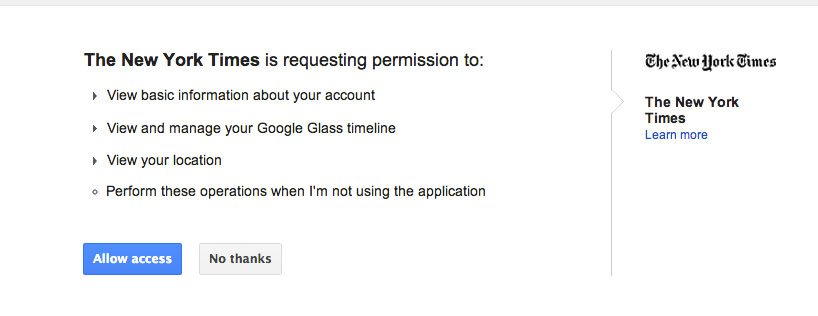
      Setting up the app is a simple process — clicking on the link above asks for access to your Google account:

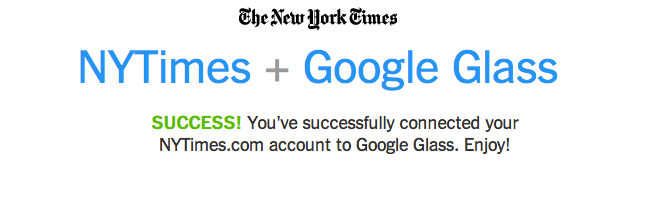
      Once that’s all done, Glass can occasionally chime in by reading headlines in your ear, but the app is also capable of reading off brief article summaries too. All told it seems like a very neat, (if strangely intrusive way) to consume your daily dose of news, and other companies have already pledged to craft their own Glass experiences — Path and the New York Times are a given, but Evernote and supposedly even Twitter are working on apps for Google’s daring device.

    • Betaworks acquires Marco Arment’s read-it-later platform Instapaper

      New media incubator and venture firm Betaworks has acquired Marco Arment’s read-it-later platform Instapaper, the companies announced Thursday evening. Other Betaworks companies and projects include bit.ly, Chartbeat and Done Not Done. The firm acquired Digg for a reported $500,000 last year.

      Unlike Digg at the time it was acquired, however, Instapaper has a business model: It’s a paid product. The iPhone and iPad apps are $3.99, and the Android app is $2.99. Users can also install a bookmarklet to save articles.

      Betaworks’ acquisition of Instapaper fits with the firm’s strategy of investing in both short and long-form content. Betaworks CEO John Borthwick said at the paidContent conference last week that companies shouldn’t favor one over the other: They need to invest in both. Digg is planning to launch a Google Reader replacement, and Instapaper’s technology could possibly be put to work on that project.

      Here’s a video of Borthwick talking to Om Malik at paidContent Live:

      Related research and analysis from GigaOM Pro:
      Subscriber content. Sign up for a free trial.


    • LG confirms plans to release a flexible OLED smartphone in Q4

      LG Flexible OLED Smartphone
      2013 is shaping up to be the year LG finds its voice in the mobile industry. The company recently shipped a record 10.3 million smartphones in the first quarter and is expecting that number to increase throughout the year. Handsets such as the Optimus G, Nexus 4 and Optimus G Pro have won over consumers, however LG believes it has the next big thing coming later this year. Yoon Bu-hyun, vice president of LG’s mobile business, confirmed on the company’s earnings call this week that it plans to launch a smartphone with a flexible OLED display before the end of 2013, The Wall Street Journal reported. Although it is unlikely that the handset will be truly flexible due to limitations with other components, it will be the first consumer device to include a wraparound display. LG plans to release the flexible OLED smartphone sometime in the fourth quarter.

    • Unmanned aircraft system proposal takes flight

      A consortium of Washington-based organizations will soon submit the final section of a proposal to site an unmanned aircraft system research and testing facility in central Washington. If successful, the proposal to the Federal Aviation Administration will result in the FAA naming the Pacific Northwest Unmanned Aerial Systems Flight Center as one of six U.S. testing facilities later this year.

      Innovate Washington, the lead agency of the state of Washington focused on fostering growth of the state’s innovation sectors, and the U.S. Department of Energy’s Pacific Northwest National Laboratory in Richland are working with ten other state, county and private industry partners to be selected as one of six locations nationwide to conduct critical research that will safely accelerate the integration of civil unmanned aircraft systems into the national airspace system.

      “Our testing and proving facilities include all elements industry will need to safely conduct sophisticated research and development activities,” said Steve Stein, PNNL project manager. “Our proposal offers essentially a turn-key option from complete ground support operations for fueling, maintenance, and emergency response, to the existing control tower with regional radar systems, ample hangar space, conference rooms and advanced communications networks.”

      The proposal identifies Grant County International Airport in Moses Lake, Wash., as the location of the flight center’s principal office and facilities. In addition, the proposal identifies several locations in central and western Washington where a broad range of testing may occur. For example, the proposal provides a testing range over the Pacific Ocean near Grays Harbor for those developers needing “blue water” testing capability. To evaluate the next generation of aircraft traffic control systems, a testing area that simulates an active airport environment—similar to activity experienced daily at a metro airport— is also included. A map of the testing facilities is below.

      Consortium members possess technical research and development capabilities in areas such as advanced navigation, collision avoidance, and alternative fuel system development. Through research and test flights in its test ranges, located over remote and sparsely populated areas in Washington, the consortium says it can advance the application of unmanned aircraft use in search and rescue, weather data acquisition, agriculture crop management, avalanche control and snow pack analysis.

      “Siting a new flight center in central Washington will allow the state to build off of the established strengths of its thriving aerospace industry,” said Bart Phillips, vice president for economic development for Innovate Washington. “The Flight Center supports the commercial growth of the UAS sector, attracting and additional aerospace research and development dollars, providing users with cost-effective, safe, flight testing facilities and fostering the development of more companies and high quality jobs in Washington.”

      The consortium members include Pacific Northwest National Laboratory, Innovate Washington, the Ports of Moses Lake and Grays Harbor, Washington State University, University of Washington, Washington Army National Guard, the Center of Excellence for Aerospace and Advanced Materials Manufacturing at Everett Community College, the Governor’s Office of Aerospace, Washington State Department of Commerce and economic development agencies in Klickitat and Grays Harbor counties.

      The FAA Modernization and Reform Act of 2012 enacted by Congress calls for establishing six unmanned aircraft system research and testing sites in the U.S. The final proposal submittals are due to the FAA by May 6, with decisions on siting the flight centers scheduled to be made before December 31, 2013.

    • West Wing Week: 04/26/13 or “This Stuff’s Really Cool”

      This week, the Vice President traveled to Boston for a memorial for Officer Collier, and the President memorialized the victims of the West Texas explosion. The President also hosted the Amir of Qatar, the Teacher of the Year, the 3rd White House Science Fair, and visited Dallas with the First Lady for the dedication of the George W. Bush Presidential Center.

      read more

    • Samsung CEO defends decision to use two different CPUs for Galaxy S4

      Samsung CEO defends decision to use two different CPUs
      Samsung’s Galaxy S4 smartphone will be available from more than 100 carriers in the coming weeks. The flagship handset will be available in two different flavors: a model with a 1.6Ghz eight-core Exynos 5 Octa processor and another with a 1.9GHz quad-core Snapdragon 600 processor. After the initial announcement, some people were upset with the company’s decision, especially now that the Exynos CPU supports LTE networks.

      Continue reading…

    • Iron Man 3 game hits Android devices, gives all gamers a chance to be their inner Tony Stark

      Iron_man_3


      Admit it— sure it’s going to be fun watching the upcoming Iron Man 3, but you probably have one heck of an itch to be like him, right? Well Gameloft is giving all gamers the chance to live out the fantasy of being Tony Stark by unleashing the official Iron Man 3 video game in the Play Store. The game features non-stop action and places players right into the action which includes fighting against the deadly A.I.M. forces and fighting arch-enemies such as Crimson Dynamo— all across tons of missions and the ability to customize your character with items such as up to 18 different suits or upgrading your armor. Oh and best of all— smooth and easy-to-use swipe controls, so all gamers should be able to pick up and play right away.

      The game is available for all Gingerbread+ users in the Play Store— you you’ll want to ensure you have some precious real estate on your device’s memory as it requires a hefty 795MB to operate. If you’re OK with that and are ready to get in on the action, head on down to the Play Store and grab the game today.


      Iron_man_3_QR_code

      Play Store Download link

      Come comment on this article: Iron Man 3 game hits Android devices, gives all gamers a chance to be their inner Tony Stark

    • Facebook acquires mobile development platform Parse

      Facebook has acquired Parse, the company that provides tools for developers building mobile apps, the startup announced in a blog post Thursday. The company went through the Y Combinator incubator program and raised a $5.5 million Series A from Ignition Partners back in 2011.

      Facebook said the addition of Parse is an acquisition, not a talent deal, and the company would not disclose financial terms.

      From the Parse blog post:

      “Parse has agreed to be acquired by Facebook. We expect the transaction to close shortly. Rest assured, Parse is not going away. It’s going to get better.

      We’ve worked with Facebook for some time, and together we will continue offering our products and services. Check outFacebook’s blog post for more on this.

      Combining forces with a partner like Facebook makes a lot of sense. In a short amount of time, we’ve built up a core technology and a great community of developers. Bringing that to Facebook allows us to work with their incredible talent and resources to build the ideal platform for developers.”

      My colleague Barb Darrow wrote about Parse back in May 2012 when it added a new JavaScript SDK, explaining what the new technology would allow and why it would be an interesting addition to the market:

      “Mobile app developers hate dealing with server-side programming, but most need to do some of it. Those server-squeamish developers are the target market for Parse’s new JavaScript SDK, downloadable as of Wednesday.

      The promise of the new SDK is that these developers can now build a secure JavaScript application with a backend without having to provision or write code for servers, said James Yu, founder of San Francisco-based Parse.”

      In a blog post of his own, Facebook’s Doug Purdy explained why the company wants Parse:

      “By making Parse a part of Facebook Platform, we want to enable developers to rapidly build apps that span mobile platforms and devices. Parse makes this possible by allowing developers to work with native objects that provide backend services for data storage, notifications, user management, and more. This removes the need to manage servers and a complex infrastructure, so you can simply focus on building great user experiences.”

      To be sure, one of Facebook’s vulnerabilities has been a perceived lack of mobile skills. Parse could help address that.

      Related research and analysis from GigaOM Pro:
      Subscriber content. Sign up for a free trial.


    • This Hublot LaFerrari Watch Looks Perfect For Cobra Commander

      Hublot-La-Ferrari-2

      While I’m not a big fan of ostentatious watches that cost too much and are aimed at buyers with more money than sense (in short, most of the Hublot line) I will give this odd-looking watch a moment of reflection. It is the MP-05 LaFerrari, a tourbillon watch with a 50-day power reserve, a number almost unheard of in the watch world, and a unique styling that is reminiscent of a certain Arashikage ninja.

      The watch itself has a custom HUB9005.H1.6 movement and displays the time in a series of vertical registers. There is a visible tourbillon (essentially a rotating balance wheel AKA the little wheel that “spins” in your average mechanical watch) on the bottom of the watch as well as a winding port on the top. To wind it you use this little power drill. Seriously.

      A power reserve indicator tells you how long you have to go before you whip out your little drill gun and the entire thing is designed to look like the cowling on the $1.3 million LaFerrari or, more precisely, Cobra Commander’s codpiece. The watch is completely handmade and you can see more photos here. It comes in a limited edition of 50 and you can expect to pay $300,000 for the privilege of strapping it to your wrist.