Blog

  • Booker Raises $27.5M From Bain, Revolution, Grotech, Others

    Booker, formerly GramercyOne, said it raised $27.5 million in Series B funding in a deal led by Bain Capital Ventures and joined by existing investors Revolution Ventures, Grotech Ventures, TDF Ventures, and Vital Financial. The company will use this money to scale its product and sales staffs.

    PRESS RELEASE

    BOOKER RAISES $27.5 MILLION LED BY BAIN CAPITAL VENTURES

    Growth Funding to Help Accelerate the Enablement of SMBs and Multi-Location Enterprises With Leading Cloud-Based Service Management Platform

    NEW YORK—April 16th, 2013—Booker (formerly GramercyOne), the leading service management platform (SMP) that helps small to medium-sized businesses (SMBs) and multi-location enterprises unify operations and automate marketing on a single cloud-based system, has secured $27.5 million in Series B financing led by Bain Capital Ventures. Booker’s Series A investors, Revolution Ventures, Grotech Ventures, TDF Ventures, and Vital Financial, also participated in the financing round. Booker will use this funding to aggressively scale its product and sales teams focused on developing and delivering enterprise-class technology to multiple vertical markets in an affordable and intuitive system.

    “We give local service businesses the technology they need to succeed,” said Josh McCarter, CEO of Booker. “Our technology helps these businesses connect consumers with services as seamlessly as Amazon connects buyers to products. And this round of financing, along with adding Bain Capital Ventures to our team, will ensure we continue empowering our clients to grow in ways they never could before.”

    Unlike the many disconnected point solutions on the market today, Booker’s unified platform is the system of record, providing all the tools necessary to run a successful service business, including: scheduling, point of sale, CRM, employee management, marketing and loyalty programs, and comprehensive reporting.  Over 60,000 service professionals use Booker’s products across multiple verticals, including: health, wellness, beauty, home improvement, and professional services.

    “We’ve been closely tracking the adoption of SaaS (Software-as-a-Service) by SMBs.  Service businesses are the backbone of our economy, and Booker’s platform revolutionizes the way that these businesses operate on a daily basis by providing tools that directly grow revenues, increase productivity, better manage data, and lower costs,” said Deepak Sindwani, Partner at Bain Capital Ventures and the newest member of the Booker board of directors. “Booker’s impressive growth trajectory, team, and multi-vertical strategy were key drivers for our investment.”

    Booker’s platform facilitates and captures the entire purchase cycle and customer history from promotion to sale. As a result, owners get detailed, unique insights into their businesses’ performance, which they leverage to make informed business decisions.  Booker also generates new customers by distributing real-time appointment availability online and automating specials at optimal price points, bringing yield management technology to SMBs.

    Booker recently announced the launch of its mobile and tablet apps on Apple iOS and Android devices, empowering business owners and their staff to manage operations anytime, from anywhere.

    Booker is coming off of an impressive 2012, achieving triple-digit revenue growth for the fourth consecutive year and doubling its annual transaction volume to nearly $1 billion.  The company has also expanded its team substantially, growing from 65 to 200 employees to support the growing demand for its SaaS product.

    Solidifying its position as New York City’s breakout startup, Booker recently won the first annual Take the H.E.L.M. Competition in the “Expanding in Lower Manhattan” category. In addition to the recognition, the company also received a cash prize of $260,000, which Booker is giving back to its local community by providing a one-year license of its software (a $2,000 value) to over 100 beauty and wellness-related small businesses in Lower Manhattan.

    Connect with Booker
    Booker company video: booker.com/b
    Booker blog: booker.com/company/blog
    Company website: booker.com
    Twitter: @getbooker
    ——————-
    About Booker

    Booker helps small and multi-location businesses run and grow successfully by replacing everything from manual methods to disconnected software with a unified web-based platform, accessible from any device. Booker also enables service businesses to sell their services online, through their website and a network of partner sites and apps, creating a seamless online booking experience for consumers. Booker processes over one million appointments each month across 73 countries in 11 languages. Headquartered in New York City, Booker’s customers include thousands of local service businesses as well as Fortune 500 companies. For more information, visit www.booker.com.

    About Bain Capital Ventures

    Bain Capital Ventures is the venture arm within Bain Capital, which has approximately $70 billion of assets under management worldwide. The firm’s history of investing in early stage companies dates back to 1984 with over 125 venture investments since inception. Bain Capital Ventures manages over $2 billion of assets, has over 70 active portfolio companies, and has offices in Boston, New York, and Palo Alto. The firm has helped steer many ideas to success by working in partnership with management teams, pairing talented and passionate entrepreneurs with industry experts, opening doors to customers, and collaborating on long-term strategies. For more information, please visit www.baincapitalventures.com.

    The post Booker Raises $27.5M From Bain, Revolution, Grotech, Others appeared first on peHUB.
  • Consumer Reports Annual Car Survey – What It Looks Like

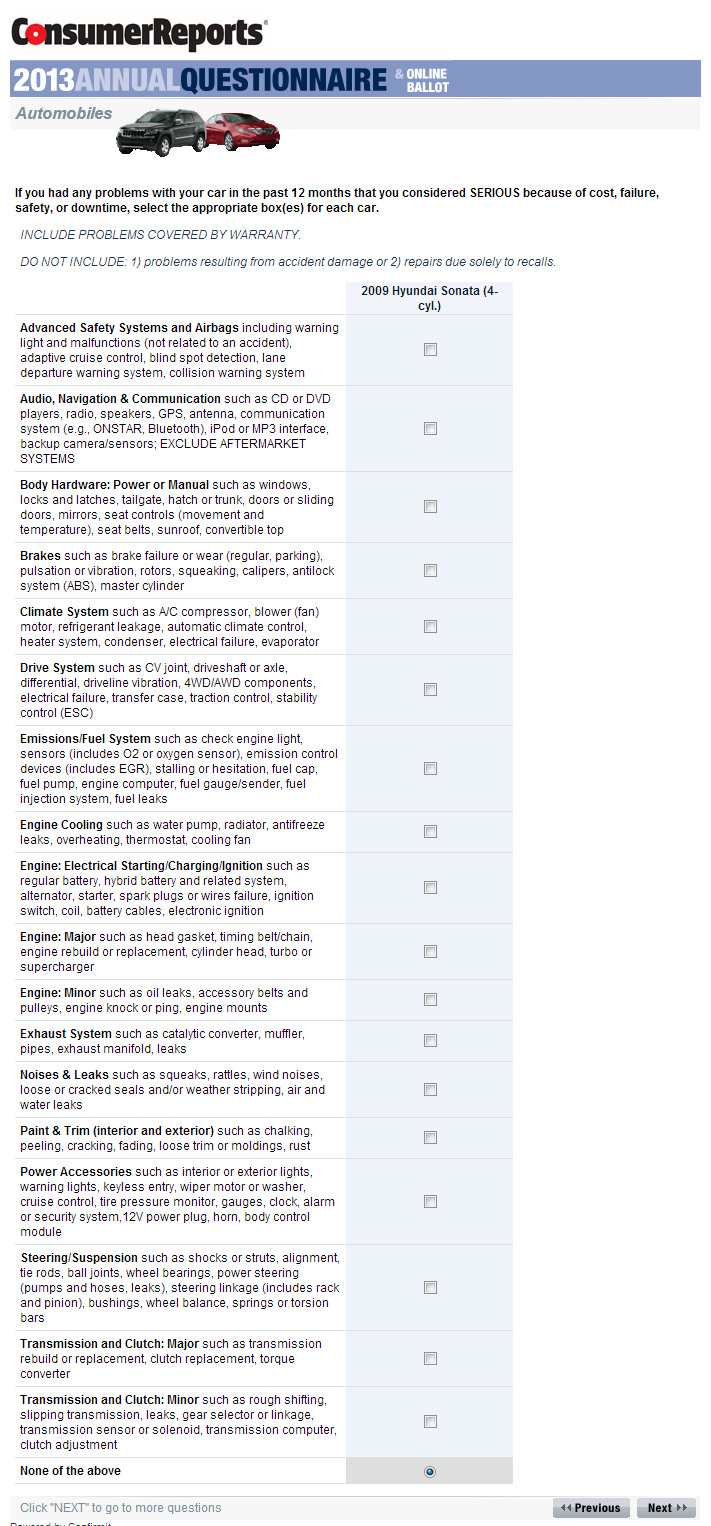
    As a Consumer Reports subscriber, I received an email asking for my input on vehicles. Here’s what Consumer Reports asked and how this particular survey might come up short.

    Can You Say “Complicated”?

    Surveying people with accuracy is difficult. First of all, many questions are open to interpretation. Second, the method for collecting answers is often imperfect. Finally, not every survey response offers the same amount of diligence and effort.

    NOTE: If you need proof that surveys are problematic, think about all those political survey results we hear…more than half the time, these scientific surveys are patently incorrect.

    In my opinion, the biggest flaw in the survey I received from Consumer Reports is that it’s too damn complicated. Take a look at this survey page (click for a larger view):

    Consumer Reports annual car survey sample

    Here’s a nice long list of serious problems that Consumer Reports wants to know about. How many people read this list completely and carefully?

    Did you read each and every line of that survey? Me neither. Quite frankly, I can’t imagine that most people read this list carefully. Instead, they problem skim the headings like “steering/suspension,” and then click if/when they think they’ve had an applicable issue. I have three problems with this:

    1) Some of the headings – like “Drive System” – are incredibly ambiguous. If I asked a random man or woman on the street about problems with their vehicle’s “drive system,” who knows what kind of response I might get. Granted, the survey offers some examples, but there are a few sub-headings here that just aren’t descriptive enough.

    2) This detailed list requires the respondent to make some fairly nuanced distinctions. For example: Let’s say your vehicle had a manual transmission with a grinding noise caused by worn synchros. Which category would you mark this down under?

    • Transmission and Clutch: Major?
    • Transmission and Clutch: Minor?
    • Noises and Leaks?
    • Drive System?

    If you review things carefully, you’d probably pick the second item on my list. OR, you might get annoyed, close the survey, and move on…which brings me to my third problem.

    3) This survey requires a fair amount of effort on behalf of the respondent. Therefore, you’re more likely to get responses from people who are either really angry, really happy, and or really excited about contributing to Consumer Reports.

    For all these reasons, I’d argue the results from the Consumer Reports surveys are anything but definitive.

    Is the Consumer Reports Survey Worthless?

    Of course not. Imperfect survey data is better than no survey data, and while the length, detail, and ambiguity of the survey undoubtedly leads to erroneous conclusions, the survey data is likely good enough to spot trends.

    If (for example) very few Lexus owners report problems compared to BMW owners, it’s likely that Lexus is more reliable than BMW…especially if this trend holds for a period of years. Likewise, if a greater percentage of Chrysler owners report problems compared to the average, it’s likely that Chrysler products are below-average in terms of quality.

    Yet it would be foolhardy to trust Consumer Reports data exclusively. In fact, the best approach would be to consult data from Consumer Reports alongside data from JD Power, reviews from trusted entities like Edmunds.com, and of course market data (resale value), which is arguably the economic expression of a vehicle’s quality and reliability relative to competing models. Looking at historical trends would also be wise, at least in the case of JD Power and Consumer Reports.

    The point? Consumer Reports survey data is imperfect. Don’t buy a car just because Consumer Reports says so.

    The post Consumer Reports Annual Car Survey – What It Looks Like appeared first on Tundra Headquarters Blog.

  • Tengram Capital Collects $173 Mln for Fund I

    Tengram Capital Partners has collected $173 million for its first institutional fund. Fund I’s target was $150 million, according to a statement. Mt. Vernon Group and Triple A Partners were placement agents for the pool while White & Case was fund counsel. Founded in 2010, Westport, Conn.-based  Tengram targets middle market consumer and retail companies.

    PRESS RELEASE

    Tengram Capital
    Partners LLC (“TCP” or “Tengram”), a private equity firm that invests
    in leading middle-market consumer companies that own strong,
    recognizable brands, has completed the fundraising of it first
    institutional fund. The fund closed with $173 million of commitments,
    exceeding its target fund size of $150 million.

    TCP received commitments from a broad array of institutional and
    individual investors, including endowments, pension plans, alternative
    asset managers, and large family offices. Matthew Eby, Co- Founder and
    Managing Partner, commented, “The team at Tengram is thrilled to have
    the trust and support of a strong group of long-term investors. We
    value their partnership and look forward to working on their behalf.”

    Tengram was founded in 2010 by William Sweedler and Matthew Eby.
    Richard Gersten joined as a Partner in 2011. Together, they have spent
    almost 50 years operating and investing in branded consumer businesses.
    TCP’s brand-focused strategy has led to current fund investments in
    Robert Graham, Sequential Brands Group, NEST Fragrances, and Laura
    Geller Beauty. William Sweedler, Co-Founder and Managing Partner, said,
    “Rich, Matt and I have unique, complementary backgrounds that together
    bring a collective expertise that differentiates our partnership from
    many consumer investors. Tengram’s core philosophy is that brands are
    the most vital and valuable part of the consumer experience. The
    partners, along with our consumer focused investment team, will
    continue to attract unique and proprietary investment opportunities in
    our areas of expertise, including apparel, home, sporting goods,
    retail, health and beauty, and food and beverage.”

    Tengram partners with exceptional entrepreneurs and operators,
    providing the strategic guidance and resources required to effectively
    activate and grow their brands. As Richard Gersten, Partner, explained,
    “We work closely with our management teams and strive to create strong
    partnerships founded on a basis of trust. Our partnership approach
    resonates with many founder and family-led businesses that are seeking
    the operating expertise and intellectual capital to help grow their
    businesses.”

    Tengram used Mt. Vernon Group and Triple A Partners as placement agents
    and White & Case as fund counsel.

    ABOUT TENGRAM CAPITAL PARTNERS:

    Tengram Capital Partners, LLC is a private equity firm that focuses
    exclusively on leading middle-market consumer and retail companies that
    own strong recognizable brands. The team has a diverse background of
    consumer investing and operating expertise that assists and guides
    company management to unlock the true potential of their brand. Tengram
    invests in both traditional “growth” and “restructuring/turnaround”
    situations in either the public or private sectors. Previous and
    current investments for Tengram and its predecessor investment entity,
    Windsong Brands, LLC, include Laura Geller Beauty, NEST Fragrances,
    Sequential Brands Group, Robert Graham, Joe Boxer, Joe’s Jeans, Field &
    Stream, Design Within Reach, and Cloudveil. Tengram’s website is
    (www.tengramcapital.com ).

    The post Tengram Capital Collects $173 Mln for Fund I appeared first on peHUB.

  • Microsoft updates Skype for Windows Phone 8, strips away preview label

    Microsoft has updated Skype for Windows Phone 8, dropping the preview label associated with the app. Among the most noteworthy improvements, the stable version of the popular voice, video and text chatting application brings a change in message notifications and a number of bug fixes meant to improve the stability and overall functionality.

    Skype for Windows Phone 8, which is now at version 2.5, introduces a new default setting for message notifications. After Microsoft announced that Messenger will be dropped and replaced with Skype, message notifications for Messenger friends are now enabled straight off the bat, likely to ensure a smooth transition to the new service.

    The latest version of Skype for Windows Phone 8 also fixes a number of bugs related to calling, notifications, stability and video chatting. The app now enables the video call button right after accepting a contact request and message notifications should display contact names correctly at all times.

    Skype is also stable upon starting and signing in using a Microsoft account and received video calls and local video previews are displayed correctly.

    There is also a known issue related to the HTC Windows Phone 8X. The microphone is muted during voice calls for users who have yet to update their smartphone to the latest available software.

    Skype 2.5 is available to download from the Windows Phone Store.

  • Podcast: How Joey Coleman crowdfunded his work as a hyper-local reporter

    We’ve written about projects like Matter, which used Kickstarter to fund the creation of a new magazine for science writing, and high-profile bloggers like Andrew Sullivan who go directly to readers for financial support — but could a relative unknown in a small town use crowdfunding to build a business covering city hall and other local news?

    Joey Coleman says yes. He has done not one but two successful Indiegogo campaigns to raise money to cover his home town of Hamilton in Canada, where he writes about everything from the local elections to fires and other breaking news.

    In a multi-part podcast series leading up to our paidContent Live conference on April 17 in New York, we’ve been talking to people who are doing innovative things in media, and Joey Coleman is definitely one of those. He doesn’t have a background as a journalist — he is just a tech-savvy resident of a town where he believes that not enough is being done to cover local stories. After starting a blog and having a number of readers offer to pay him for his reporting, he decided to do some crowdfunding.

    In our podcast interview, Coleman told me that he hopes to turn his crowdfunding efforts into a regular subscription model, and potentially even hire other reporters and photographers to help with the job of covering the news, streaming local council meetings, etc. — but unlike some of those with paywalls (including the major media outlets in his home town), Coleman says his content will always be free to the public. For more on Joey and his project, please have a listen.

    Download this show

    Subscribe to GigaOM Podcasts via RSS

    iTunes

    Stitcher Radio

    Previous paidContent Podcasts:
    Who’s afraid of podcasts? Not Earwolf

    How Hugh Howey’s Wool became a self-published smash hit

    How Indie Game stayed indie and became a hit

    Post and thumbnail photos courtesy of Shutterstock / wellphoto

    Related research and analysis from GigaOM Pro:
    Subscriber content. Sign up for a free trial.


    • BlackBerry Q10 now available to pre-order on Vodafone

      UK dwellers keen to get their hands on BlackBerry’s new Q10 smartphone will have to wait until the end of the month when it goes on sale officially, but they can start pre-ordering it today.

      Vodafone, which describes the new handset as a “classic in the making” has opened its pre-order page so you can choose a tariff and place your order.

      The handset is available in any color — so long as it’s black or white — and as always there’s a choice of plans to pick from. If you don’t want to shell out anything upfront, you can sign up for a 24-month Vodafone Red contract which will cost you £37 a month and give you unlimited texts and calls, as well as 1GB of data.

      While the phone’s stable mate, the Z10, comes with a 4.2-inch touchscreen display, the BlackBerry Q10 has a 3.1-inch touchscreen and the traditional BlackBerry physical keyboard.

      Specs-wise, the Q10 rocks a 1.5GHz dual-core processor with 2GB of RAM, and a rear-facing 8-Megapixel camera.

    • SugarSync gets a big redesign for iOS

      SugarSync, Inc has released SugarSync for iOS 4.0, a major new release for iPad and iPhone owners wishing access to their SugarSync cloud storage on the move. Version 4.0 features a major redesign designed to simplify syncing and sharing, plus integrates with other apps through the “Open in” feature.

      The update also adds support for Device Filtering, a feature recently introduced in the SugarSync 2.0.9 desktop app for Windows and Mac, along with Cloud Search, and promises future support for folder labels.

      The redesign in SugarSync 4.0 mirrors that found in the desktop and Android apps that were released in February. The aim is to streamline the app’s look and make it easier to navigate. In particular, the design is geared towards simplifying access to recently synced content from other devices, plus makes it easier to both share and view shared content from others thanks to new Shared by Me and Shared with Me tabs.

      The iOS app also introduces support for the recently implemented Device Filter, which allows users to sync only specific folders to the cloud from their devices. This feature allows users to view all synced folders or restrict browsing to those shared with a specific computer or mobile.

      The new feature has also inspired the Cloud Search tool, which makes it possible for users to search across their entire online storage, not just those folders synced with the iPad or iPhone. From here users can then choose to sync, share or view individual files.

      SugarSync now fully supports the iOS “Open in” feature, which allows users to save content to their SugarSync storage from other apps such as Mail or Pages, plus open documents already stored on SugarSync’s servers in compatible apps on the iPad or iPhone.


      The desktop update introduced folder labels, and support for this feature is promised in a future version. SugarSync for iOS 4.0.0 is available now as a free download, as are SugarSync 2.0.9 for Windows and Mac, and SugarSync for Android 4.0.1. SugarSync offers a free 5GB storage plan, as well as paid-for plans, with prices starting from $7.49 a month ($74.99 a year) for 60GB.

    • Reuters – SEC Charges Businessman in Tracinda-Linked Insider Trading Plan

      U.S. securities regulators on Monday charged a Denver businessman with reaping “substantial” profits using inside information from the former chief executive of Delta Petroleum Corp about an impending investment in the company, Reuters reported. Scott Reiman, founder and president of investment firm Hexagon Inc, agreed to pay nearly $900,000 to settle the civil case brought by the Securities and Exchange Commission, the agency said. The case against Reiman comes five months after the SEC charged Delta’s former chief executive, Roger Parker, with leaking the news that Beverly Hills-based private investment firm Tracinda Corp had agreed to buy a 35 percent stake in Delta for $684 million.

      (Reuters) – U.S. securities regulators on Monday charged a Denver businessman with reaping “substantial” profits using inside information from the former chief executive of Delta Petroleum Corp about an impending investment in the company.

      Scott Reiman, founder and president of investment firm Hexagon Inc, agreed to pay nearly $900,000 to settle the civil case brought by the Securities and Exchange Commission, the agency said.

      The case against Reiman comes five months after the SEC charged Delta’s former chief executive, Roger Parker, with leaking the news that Beverly Hills-based private investment firm Tracinda Corp had agreed to buy a 35 percent stake in Delta for $684 million.

      In October, the SEC also charged Parker’s friend, insurance executive Michael Van Gilder, with trading based on tips he received from Parker.

      Van Gilder is also facing a parallel criminal case. He has pleaded not guilty to five counts of insider trading.

      Attorneys for Parker and Van Gilder were not immediately available for comment on Monday evening.

      As part of his settlement, Reiman neither admitted nor denied wrongdoing. He will be barred from the securities industry and from acting as an officer or a director of a publicly traded company for a minimum of five years.

      “It takes time and money to fight the government, and that detracts from the other goals that Scott wanted to accomplish,” said his lawyer, Cliff Stricklin. “He decided to use his energy in a positive way instead of getting involved in a lengthy battle.”

      He agreed to pay $398,000 in disgorgement, $93,567 in interest and $398,000 in penalties.

      According to the SEC, Reiman bought Delta stock or option contracts on three occasions in late 2007, each time shortly after speaking with Parker.

      In November, the Van Gilder Insurance Corp announced that Van Gilder was taking an “indefinite leave of absence.” He also stepped down as CEO of the company.

      The post Reuters – SEC Charges Businessman in Tracinda-Linked Insider Trading Plan appeared first on peHUB.

    • Google reveals Glass specs and releases companion app

      Google has changed many aspects of our mundane digital lives including how we search online, use an email service, communicate with folks around the world, and interact with our mobile devices. Now the company even wants to change how we talk about glasses.

      Who could have imagined that in 2013 we would be discussing the hardware specifications of a pair of spectacles? Before Google Glass this was unimaginable, but as the search giant has just released the specs of its specs, things just got real. So what is the search giant’s forthcoming device packing?

      Let’s talk about the display first. Google Glass comes with a high resolution panel which the company says is the “equivalent of a 25 inch high definition screen from eight feet away”.

      The device features a 5 MP camera that is capable of 720p video recording and sports adjustable nosepads and a durable frame that is designed to fit “any face”. There are also “extra nosepads in two sizes”.

      Google Glass comes with 16 GB of internal storage, 12 GB of which are user-accessible and “synced with Google cloud storage”. Presumably that means owners can access and upload files from the cloud using their smart glasses.

      In terms of audio, Google Glass features a “bone conduction transducer”, which basically means that sound is conducted to the inner ear through the bones of the skull. This is certainly not your run of the mill pair of glasses, that’s for certain.

      On the connectivity front, Google Glass packs Wi-Fi 802.11 b/g and Bluetooth. It is worth noting that the former implies speeds of up to 54 Mbps, nowhere near as fast as the chipset inside a modern day smartphone, tablet or laptop, for instance.

      The battery should last around an entire day with typical usage, but Google says that using Hangouts or recording video might sip more power and make the battery life significantly shorter. To top things off, Google Glass comes with a microUSB cable and adjacent charger.

      On the subject of charging Google Glass, the company says: “While there are thousands of Micro USB chargers out there, Glass is designed and tested with the included charger in mind. Use it and preserve long and prosperous Glass use”.

      You might imagine a smart device like this needs some sort of app to control it. And it does. The companion app is called MyGlass and is available to download from Google Play now.

      MyGlass allows users to “configure and manage your Glass device” through a Google Now-like UI (User Interface). Judging by the provided screenshots, the app works with Google+ and Gmail, as well as other Google services.

      Google is testing its sense of humor with the description of MyGlass. The company says: “If you don’t have Glass, then downloading this will be a waste of time. Sorry about that. But if you swipe the screenshots to the right you’ll see there’s a picture of a puppy in pajamas. So not a total waste of time after all”.

    • Reuters – Vintage Capital Offers to Buy Anaren

      Investment firm Vintage Capital Group LLC offered to buy Anaren Inc for $23 per share in a deal that values the telecommunication components maker at about $300 million. The offer represents a premium of 17 percent to Anaren’s Monday close of $19.61 on the Nasdaq. Anaren shares rose 10 percent in extended trading. Vintage Capital holds 12.8 percent in East Syracuse, New York-based Anaren.

      (Reuters) – Investment firm Vintage Capital Group LLC offered to buy Anaren Inc for $23 per share in a deal that values the telecommunication components maker at about $300 million.

      The offer represents a premium of 17 percent to Anaren’s Monday close of $19.61 on the Nasdaq. Anaren shares rose 10 percent in extended trading.

      Vintage Capital holds 12.8 percent in East Syracuse, New York-based Anaren.

      Private equity firm Discovery Equity Partners, which holds a 5.9 percent stake in Anaren, urged the company’s board last week to solicit offers from “certain parties”.

      The post Reuters – Vintage Capital Offers to Buy Anaren appeared first on peHUB.

    • Logitech Turns To Smartphone Apps To Assist Latest Generation Of Harmony Remotes

      HarmonyUltimate__BTY2_Black (1)

      The TV remote control will not die. And that’s a good thing. Try as they might, startups have yet to provide a true remote control replacement. A dedicated remote is like a trusty pickup truck: It might not be the best looking vehicle but it gets the job done with little fuss. But even though dedicated remotes probably won’t be replaced, that doesn’t mean smartphone apps can’t supplement their existence.

      Harmony Ultimate, packs the standard Logitech’s Harmony brand has long turned out some of the very best universal remote controls. Their latest, the affair of hardware including a multitude of buttons, touchscreens, and easy setup through Harmony’s web-based interface. However Logitech also made this $349 system compatible with its Logitech Harmony Smartphone apps, allowing smartphones to fill in when the remote control inevitably goes AWOL.

      Or, if you just prefer to use a smartphone altogether, the company also just announced the $129 Logitech Harmony Smart Control, a system that puts the smartphone as the primary controller (like the old Harmony Link) but also includes a small physical remote for backup (below left).

      Both systems are compatible with nearly every home entertainment device ever made including game systems and the Philips Hue lighting system. Using IR blasters and your home’s WiFi network, devices can be controlled from the remote or smartphone even when they’re packed away out of sight.

      With the rise of the smartphone, many technology pundits put the venerable remote on death watch. But it’s still here. Many smart TVs can now be controlled through a smartphone, but most cable boxes and entertainment systems require extra hardware like the Harmony Smart Control or Griffin’s Beacon.

      I’ve owned and tested about a dozen high-end universal remote controls starting with an original Harmony before the company was purchased by Logitech. I’ve also tried most of the iOS remotes but find using my smartphone (or tablet) clunky and not nearly as intuitive as a physical remote. A remote control, while often a mind-boggling mess of buttons, is still the best way to control a complex home entertainment system and mindlessly channel surf on lonely Saturday nights.

      The Harmony Ultimate will hit stores in the U.S. and Europe this month for $349. The Harmony Smart Control will drop in May for $129.

    • Egyptology News 15th and 16th April

      Copied from Twitter @egyptologynews.   

      I’ve tried a new layout to make navigating the stream of links more manageable. 

      Painted ceiling, Coptic Monastery of St Simeon, Aswan
      (7th Century AD)

      Fieldwork

      Ian Shaw’s email re the postponement of the 2013 season of the Gurob Harem Palace Project posted on Egyptology News blog at

      Vast Kushite royal palace (5000 sq m) found on Nile betwn 3rd & 4th cataracts in Sonijat, Tergis, Sudan. Archaiologia
      Looting and the black market

      Young Egyptians start “Stop the heritage drain” campaign to prevent loss of Egypt’s heritage. Daily News Egypt

      Egyptian authorities seized 5 AE coffins, 63 statues and c.5000 coins in Beni Suef governorate. Xinhuanet via MENA  
      Museums
      Hixenbaugh Ancient Art Presents Recently Acquired Royal Ushabti of the Viceroy of Kush, Hori. With photo. SFGate
      Egypt’s Minister of Antiquities, Mohamed Ibrahim, inaugurated Assiut’s first national museum. allafrica .com
      HMNS Ancient Egypt Hall has partnered with multiple museums to create “permanently changing” display. culturemap  
      Will a museum studies degree help you get a job in a museum? UCL Museums and Collections  
      Research
      Mummy of an AE woman, believed to be at least 2,500 years old, has been scanned in Ohio. Columbus Dispatch  

      More re Nature article: Mummy genetics study may enable widespread genome mapping of Ancient Egyptians. Huff Post

      What links the evolution of language to the collection of baboon figurines at the Petrie Museum of Egyptology? UCL  
      The digital Gurob Ship-Cart Model, an open access digital supplement to Shelley Wachsmann’s book. vizin .org  
      Biblical Blame Shift – Is the Egyptologist Jan Assmann Fueling Anti-Semitism? Chronicle of Higher Education
      Essay on Margaret Benson, first woman to gain right to excavate in Egypt, in 1895:
      Tourism

      Egypt lifts ban on Luxor ballooning, although company that owned crashed balloon still grounded. IOL News  

      Strike in front of the Karnak temple in Luxor has ended after officers heard the strikers’ demands. Daily News Egypt

    • Prospect Partners Backs Velocity Aerospace Group

      Prospect Partners has invested in Velocity Aerospace Group, a provider of aviation aftermarket services. Velocity Aerospace Group provides aviation maintenance, repair, and overhaul services to a global customer base of commercial air transports, corporate business aircraft, regional airlines, and helicopters.

      PRESS RELEASE

      Prospect Partners, a leading private equity firm investing in smaller lower- middle-market companies, today announced that it has invested in Velocity Aerospace Group, Inc., a global provider of aviation aftermarket services.
      Velocity Aerospace Group provides aviation maintenance, repair, and overhaul (MRO) services to a global customer base of commercial air transports, corporate business aircraft, regional airlines, and helicopters. The company, which operates FAA-certified repair stations in California and Florida, is known for its strong management, highly-skilled avionics technicians, dedicated customer service, modern facilities, and broad range of test, repair, and overhaul capabilities.
      “Velocity Aerospace Group is a niche market leader with exceptional potential for continued growth,” said Maneesh Chawla, a Principal at the Chicago, Ill.-based Prospect Partners. “We look forward to supporting management in building a larger aviation MRO services company that leverages Velocity Aerospace’s unique capabilities in avionics and in electronic instrumentation.”
      Serving on the board of the holding company, Velocity Aerospace Holding Group, Inc., from Prospect Partners are Mr. Chawla, as Chairman, and Prospect Partners’ Vice President Brad O’Dell, as a Director.
      About Prospect Partners, LLC Prospect Partners is a leading private equity firm investing in smaller lower-middle-market companies, managing $470 million across three funds. A highly experienced and active investor, Prospect Partners focuses exclusively on management-led leveraged recapitalizations and acquisitions of niche market leaders with revenues typically under $75 million. Since 1998, Prospect Partners has invested opportunistically nationwide in 100 companies in a broad range of niche manufacturing, distribution, and specialty service markets. Based in Chicago, Prospect Partners also has an office in Menlo Park, Calif.

      The post Prospect Partners Backs Velocity Aerospace Group appeared first on peHUB.

    • H.I.G. Europe’s Haltermann Acquires PCL

      Haltermann Holding GmbH has acquired Petrochem Carless Holdings Ltd, a UK-based refiner and producer of hydrocarbon chemicals. Haltermann is a portfolio company of H.I.G. Europe, the European arm of global private equity firm H.I.G. Capital.

      PRESS RELEASE

      H.I.G. Europe, the European arm of global private equity firm H.I.G. Capital, today announced that its portfolio company Haltermann Holding GmbH (“Haltermann”) has acquired Petrochem Carless Holdings Ltd (“PCL”), a leading UK-based refiner and producer of hydrocarbon chemicals with 2012 revenues of over £350m.
      PCL has developed a strong reputation in refining niche hydrocarbon streams which it takes in as the condensate by-product from North Sea oil and gas producers as well as from other global suppliers. Its products are used in industries as diverse as downstream chemicals, agrochemicals, oil and gas, consumer goods, printing, and automotive. It has established itself as a pivotal and trusted supplier into these industries and has grown substantially during the past years.
      Haltermann is a German based producer of specialty hydrocarbons with a particular focus on pentanes, high purity hydrocarbons and test and reference fuels. Together, Haltermann and PCL will form a significant player in the European hydrocarbon speciality landscape.
      Following the acquisition, Haltermann Holding will be renamed H·C·S Group (“HCS”) and will serve as the Holding company of PCL and Haltermann. For 2012, HCS had sales of approximately €650m and operates out of four state-of-the-art production sites in the UK and Germany. Customers will benefit from the highly synergistic transaction through increased supply chain security, wider product offerings and stronger support for global partnerships. As a larger pan European speciality oil and chemicals group, HCS will target organic growth in the wider global chemicals marketplace.
      Paul Canning, Managing Director at H.I.G. Europe, commented: “With this milestone follow-on investment, H.I.G. Europe brings together two strong players in the European speciality hydrocarbon landscape. It is our goal to ensure that both companies continue their growth trajectory. This investment underlines H.I.G.’s investment strategy which focuses on supporting its portfolio companies to drive significant value creation through various growth and efficiency improvement initiatives.”
      PCL and Haltermann are an almost perfect fit. With their common technology and raw material markets, and yet complementary sales patterns with regard to products and regions, they together will have a significantly enlarged product offering and regional coverage which we intend to leverage to
      generate strong growth and better serve our customers.”
      Dr. Uwe Nickel, CEO of H·C·S Group, said: “This is a strong sign of trust from H.I.G. Europe in our development and in the growth prospects of the combined group. HCS aims to be a global partner for its customers. In building a true European player, we will use the best practices from both companies. The management teams and I are excited about the opportunities that this transaction offers to our companies.”
      The acquisition of PCL is a follow-on investment for Haltermann which H.I.G. Europe acquired from Dow Chemical in July 2011. The H.I.G. deal team for this acquisition consisted of Paul Canning, Wolfgang Biedermann, Johannes Natterer, Alastair Mills, and Amer Khatoun.
      —Ends—
      About Petrochem Carless Holdings Limited
      The company was founded in 1859 as Carless and quickly won its place in history by developing a new volatile substance which it sold under the name “petrol”. Today, PCL is a speciality oil and chemicals company running a specialist refinery in Harwich (UK) and blending sites in Gunness (UK) and Ghent (Belgium). PCL supplies condensate products like naphtha, kerosene and white spirit, it produces aromatic solvents, drilling fluids, process oils, performance fuels as well as antifreeze and brakefluid products. Its products find use in industries as diverse as downstream chemicals, agrochemicals, oil and gas, consumer goods, printing, and automotive. PCL enjoys longstanding and trusted relationships with global blue chip customers. www.petrochemcarless.com
      About Haltermann
      The company was founded more than 100 years ago as Johann Haltermann Mineralöl AG in the harbour of Hamburg. Today, Haltermann is one of the leading providers of specialty refinery products for use in the automotive, pharmaceutical, cosmetic as well as in the printing, laboratory chemicals and electronics industry and in plastics processing. Haltermann is a long-established brand for test and specialty fuels for the automotive industry, specialty hydrocarbons for use in pharmaceuticals and electronics and high-purity pentanes that are used as blowing agents for the production of polyurethane foams. Haltermann enjoys long and mutually successful customer relationships with leaders in their respective industries. Haltermann operates from two state-of-the-art production sites with excellent logistics in Speyer and Hamburg, Germany. www.haltermann.com
      About H.I.G. Capital
      H.I.G. Capital is a leading global private equity investment firm with more than €8.5 billion of equity capital under management and a team of more than 225 investment professionals.
      Based in Miami, and with offices in Atlanta, Boston, Chicago, Dallas, New York, and San Francisco in the U.S., as well as international affiliate offices in London, Hamburg, Madrid, Paris and Rio de Janeiro, H.I.G. specialises in providing capital to small and medium-sized companies with attractive growth potential. H.I.G. invests in management-led buyouts and recapitalizations of profitable and well managed businesses. Since its founding in 1993, H.I.G. invested in and managed more than 200 companies worldwide. The firm’s current portfolio includes more than 80 companies with combined revenues in excess of €20 billion. www.higeurope.com
      Media Contacts:
      MHP Communications
      Lucinda Kemeny T +44 (0) 203 128 8758 [email protected]
      Rory King T +44 (0) 203 128 8564 [email protected]

      The post H.I.G. Europe’s Haltermann Acquires PCL appeared first on peHUB.

    • Why I love Windows 8

      Fourth in a series. It seems to be fashionable at the moment to be negative about Windows 8. People like to whine about how the Modern UI gets in the way and how the rest of it is just Windows 7 with some of the furniture rearranged. Some analysts are even blaming Windows 8 for poor PC sales.

      Well, I’m sorry Windows 8 deniers, you’re wrong. I’ve used every major version of Windows since 3.1, I’ve been using Windows 8 since the Developer Preview versions and I think it’s Microsoft’s best effort yet.

      If you move beyond the culture shock of its different look, there are just so many things that Windows 8 does well. The first is how quickly it manages to boot up your PC. When I initially loaded the Developer Preview on the humble Intel Atom-powered machine I use as a test box I was startled to find it booted in less than half the time taken by my Windows 7 laptop with Pentium power and 50 percent more RAM. Okay, so this is down to a little conjuring trick which saves the system state on shutdown and allows the system to reload without starting core components one by one, but it’s still impressive.

      Another feature that makes me a fan of Windows 8 is its reliability. When your day job involves the constant round of installs and uninstalls that comes with reviewing software and hardware you become no stranger to the blue screen of death. Not in Windows 8, in almost a year of use I haven’t seen the BSOD once. This is due to Windows 8’s ability to allow individual programs to crash without taking down the whole OS.

      Some people bemoan the lack of a desktop Start button, but the Charms bar combined with the powerful search function more than compensates. I’m now reaching the point where using an older version of Windows feels quite alien and I automatically go to the bottom right corner of the screen expecting something to happen.

      Which brings us to the controversial Modern UI. Yes it’s designed for touch screens and it works best with one. But it’s still perfectly usable on an old-fashioned mouse and keyboard setup. The apps look good, they work well and if you want a conventional desktop it’s only a click away. Honestly, I don’t understand why people have a problem with it.

      I could go on about improved multi-monitor support, easy syncing of settings between machines, the quality of the built-in security, the ability to reset the system and more. There are many reasons why I love Windows 8, so let me end with an appeal. Don’t take my word for it, set aside your prejudices, curb your Luddite tendencies and take a fresh look, this really is a good operating system.

    • Samsung Galaxy S4 available at AT&T for pre-order, ships April 30

      Little under three weeks ago, AT&T revealed that it would be offering the Galaxy S4 for pre-order starting April 16. And today Samsung’s latest Android flagship is indeed available at the US mobile operator for those who wish to purchase the smartphone before the official sales start.

      What’s the damage? Similar to its predecessor, on a two-year contract with “qualifying voice and data plans”, the Galaxy S4 in 16 GB storage trim can be pre-ordered for $199.99. Should you choose to go with AT&T’s one-year contract, the same smartphone runs for $449.99, again with “qualifying voice and data plans”.

      AT&T also offers the 16GB Galaxy S4 on a “month to month” plan for $639.99. Available color options, for all plans, include White Frost and Black Mist. AT&T says that the smartphone ships on April 30, presumably the date when sales officially start.

      At the time of writing this article the 32GB Galaxy S4 is not yet available for pre-order. AT&T said this model runs for $249.99 on a two-year contract, $50 more than the 16GB version.

      According to the results of the BetaNews poll, 20.77 percent of respondents say they will pre-order the Galaxy S4. A whopping 56.37 percent of the voters in the poll answered that they will also purchase the smartphone after it is available, a number not including those who will pre-order the Galaxy S4.

      By contrast, only 14.7 percent of respondents answered that they will not purchase the Galaxy S4 and even fewer, 8.15 percent, are on the fence concerning the acquisition.

    • Twitter forces Flattr to stop letting users tip ‘favorited’ tweets

      Less than a month after Flattr made it possible to leave virtual tips for tweeters by favoriting tweets, Twitter has told the Swedish micropayments company to cut it out.

      Flattr, co-founded by The Pirate Bay’s Peter Sunde, is quite a simple system. The user signs up to donate a certain amount – $5 for example – each month, and then “flattrs” people for their content, with the recipient getting an amount equal to the monthly pot divided by the number of flattrs the user has made. It was originally for tipping bloggers who had Flattr buttons on their sites, but last month the company expanded the functionality to allow the automatic tipping of people posting on Twitter, SoundCloud, Instagram and other sites.

      However, Flattr has now removed the Twitter functionality after Twitter asked it to desist. As Flattr co-founder Linus Olsson explained in a blog post on Tuesday:

      “Recently Twitter contacted us and told us that we are violating their API terms citing the second part of a clause (IV. Commercial Use, 2C. Advertising Around Twitter Content) saying ‘Your advertisements cannot resemble or reasonably be confused by users as a Tweet. For example, ads cannot have Tweet actions like follow, retweet, favorite, and reply. And you cannot sell or receive compensation for Tweet actions or the placement of Tweet actions on your Service.’

      “This is a quite logical clause as it would stop companies to sell e.g. retweets and followers. It’s an understandable rule to keep the Twitter network clean but in this case the rule is strangely stomping out innovation on their platform.”

      Now, Flattr is a for-profit firm that takes a 10 percent cut of payments carried out over its system. But even after Flattr offered to forego that cut in the case of flattred tweets, Twitter apparently said no. So, from today, favoriting tweets won’t result in the tweeter getting money – although those using the Flattr browser extension can still flattr tweeters through this alternative mechanism.

      I’ve asked Twitter whether it sees another way in which Flattr can operate on its platform, but am yet to receive a response.

      On the face of it, this action of Twitter’s seems to tally with its recent shutting-down of Ribbon’s service, which used Twitter’s Cards technology to allow full-on payments to take place within tweets themselves. However, Ribbon and Flattr appear to have broken two different rules – in Ribbon’s case, it looks like the company wasn’t making the right kind of Cards access request, and in Flattr’s it was the contravention of the tweet action regulation.

      It’s probably too early to tell whether Twitter has an ulterior motive here, but Olsson suspects it does. As he told me:

      “I would speculate that they want to control all the ways that money is changing hands on Twitter – if they control that, they can control the flow and in future get a cut of it. That would be a logical business model for Twitter – if you use Twitter to sell something you need to pay Twitter for it. I’m just speculating here, of course.”

      Flattr will now put this theory to the test, Olsson added, by building a system “where you can send a flattr to someone on Twitter by tweeting them instead”. In the meantime, the service continues to expand its reach by adding YouTube to the roster of services through which flattrs can be made.

      I should probably add by way of disclosure that, since signing up for Flattr a month ago, I have received two flattrs for tweets of mine: one for €3 ($3.92 – I’m guessing the user didn’t favorite many tweets that month) and the other for €0.16. After Flattr took its cut, the remainder was €2.84, which is just less than the €3 that I have set as my monthly budget for flattring others.

      Related research and analysis from GigaOM Pro:
      Subscriber content. Sign up for a free trial.


    • Reuters – Energy Future Proposes Prepackaged Bankruptcy

      Texas power company Energy Future Holdings, formerly known as TXU Corp, has proposed a prepackaged bankruptcy that would restructure $32 billion of debt, but no deal has been reached, writes Reuters. The company is trying to restructure more than $30 billion in debt it was saddled with after the buyout by a consortium including KKR & Co, TPG Capital Management and Goldman Sachs Group Inc‘s private equity arm, writes Reuters.

      Reuters – Texas power company Energy Future Holdings, formerly known as TXU Corp, has proposed a prepackaged bankruptcy that would restructure $32 billion of debt, but no deal has been reached, the company said on Monday.

      Energy Future, taken private in 2007 in the largest-ever leveraged buyout, said in a U.S. Securities & Exchange Commission filing that it has proposed a restructuring deal to creditors that would exchange secured creditors’ claims for a combination of equity and new debt.

      “The principals of the companies and the creditors are currently not engaged in ongoing negotiations,” Energy Future said.

      It noted, however, that creditors have conveyed they would consider the restructuring if it increased distributions and better compensated them for the risk of taking on equity.

      Energy Future is trying to restructure more than $30 billion in debt it was saddled with after the buyout by a consortium including KKR & Co, TPG Capital Management and Goldman Sachs Group Inc’s private equity arm. The $45 billion TXU buyout, which loaded the company with debt, is viewed as one of the most spectacular failures of the last decade’s buyout boom.

      The company has a large and complex capital structure, and industry experts have speculated about which entities may be headed for bankruptcy and which could be spared.

      Most of Energy Future’s debt sits on the unregulated side, at Texas Competitive Electric Holdings (TCEH), the holding company for its unregulated retail business, TXU Energy, and its unregulated merchant power unit, Luminant.

      The company has ringfenced Oncor, its regulated power delivery business, in hopes of keeping it solvent, and the restructuring proposal revealed on Monday would not have included that unit or the holding company that owns its equity.

      The proposed restructuring would have allowed TCEH creditors to trade in their senior claims for a combination of equity at the Energy Future parent and a share of $5 billion in cash or new TCEH debt. Under the company’s proposed restructuring, TCEH would pick up $3 billion of new loans and another $5 billion of long-term debt.

      The company’s private equity backers proposed a restructuring in which the buyout firms and other equity holders would retain 15 percent of the equity in the reorganized company and creditors would end up with the remaining 85 percent, according to the filing.

      The private equity firms also suggested that they could provide additional capital to Energy Future in exchange for a larger share of the company, the filing said.

      But according to Monday’s SEC filing, creditors told Energy Future that they believe the company needs to address debt structure issues at its parent as well as at the holding company for ringfenced Oncor.

      They said they would not accept the proposed prepackaged bankruptcy unless, among other things, it achieved “a sustainable debt capital structure” for the parent company and Oncor’s holding company “without reliance on TCEH’s cash flows.”

      Some of Energy Future’s largest creditors include Apollo Global Management, Oaktree Capital Management, Centerbridge Partners, Fidelity Investments and Franklin Resources, according to a source close to the matter.

      Energy Future is not necessarily up against the clock. Although it has about $270 million in interest payments due on May 1, it can easily afford to make them. It has around $2.7 billion in liquidity – plenty for it to survive on, at least until a $3.85 billion bank loan matures in October 2014, a U.S. regulatory filing from January shows.

      The TXU takeover was built on hopes that natural gas prices would stay high. Instead, they dropped sharply and are still down 45 percent from February 2007 levels.

      Energy Future Holdings is the largest power generator in Texas. Its merchant power unit, Luminant, owns more than 15,000 megawatts of nuclear, coal and gas-fired power plants.

      KKR and TPG declined to comment on the matter. Goldman Sachs could not be immediately reached for comment.

      The post Reuters – Energy Future Proposes Prepackaged Bankruptcy appeared first on peHUB.

    • Reuters – China’s Suntech Considers Italian Assets Sale

      Struggling Chinese solar panel maker Suntech Power Holdings could offload its solar power generation assets in Italy, writes Reuters. The former green tech poster child, with a New York Stock Exchange listing and a market value of $16 billion at its peak, last month defaulted on $541 million of its dollar-denominated bonds and said its biggest subsidiary was bankrupt, writes Reuters.

      Reuters – Suntech Power Holdings Co Ltd could offload its solar power generation assets in Italy, a company spokesman said on Tuesday, as the struggling Chinese solar panel maker scrambles to trim debts of more than $2 billion.

      The former green tech poster child, with a New York Stock Exchange listing and a market value of $16 billion at its peak, last month defaulted on $541 million of its dollar-denominated bonds and said its biggest subsidiary was bankrupt.

      A source with direct knowledge of Suntech’s search for a cash infusion said last week it might consider selling its 88.15 percent stake in Global Solar Fund Sicar (GSF Sicar), a Luxembourg-based fund specialising in the development of solar power projects mainly in Italy.

      “We intend to operate GSF for the time being and will consider all options to maximize the value for our stakeholders,” a Suntech spokesman said in emailed reply to Reuters.

      Asked how it planned to use the proceeds of a sale and whether it had received any interest in the assets, he said Suntech would update investors “in the coming months”.

      It is the first time Suntech has publicly acknowledged it could sell the GSF Sicar stake since its announcement last month that its biggest subsidiary, Wuxi Suntech, was bankrupt and would undergo a government-led restructuring.

      By some estimates, the fund carries an enterprise value of up to $800 million, including more than $600 million in loans from China Development Bank, analysts say.

      Suntech, one of the world’s largest solar panel manufacturers by capacity, is seeking to sell some assets and bring in a strategic investor to repay debt and revitalise the company, the source with knowledge of the matter told Reuters last week.

      Even if Suntech disposes of the stake in GSF Sicar, proceeds would not nearly be enough to repay creditors, analysts say.

      Creditors would still have to accept a debt restructuring in which they might undertake a loss, convert some debt into equity stakes in Suntech or extend the maturities of parts of their debts.

      Shares is Suntech, which peaked at $90 on the New York Stock Exchange in 2008, fell to 58 cents on Monday.

      DISTRESSED ASSET

      Analysts say the recent settlement of a dispute between Suntech and its former partner in the fund, GSF Capital, may have paved the way for a sale, which in theory could generate hundreds of millions of dollars in cash.

      Suntech said in November that it had contributed 156 million euros to the fund. Suntech’s founder and former chairman Shi Zhengrong, who holds the remaining 11.85 percent, had contributed 19 million euros.

      But any potential buyer would seek to drive a hard bargain given that Suntech is under pressure to sell.

      Suntech was struggling with a net debt-to-equity of around 200 percent and total debts of about $2.2 billion at the end of March 2002.

      That included loans from the International Finance Corp (IFC), the private sector arm of the World Bank, and Chinese lenders including Industrial and Commercial Bank of China , Agricultural Bank of China and Bank of China .

      “I put a big question mark on whether Suntech can sell off its stake in GSF soon,” said Glenn Gu, a China-based analyst for business information provider IHS. “It will not be a surprise if the stake in GSF is sold at a big discount at the end of the day.”

      Suntech said last month it had settled a dispute with GSF Capital Pte Ltd, which sold its 10 percent stake in GSF Sicar to Suntech and a company owned by Shi as part of the settlement.

      GSF Sicar owns 142-megawatt solar projects in Italy, 141 MW of which are now connected to the grid — including 118-MW capacity that has obtained Italy’s feed-in tariffs, the Suntech spokesman said.

      Feed-in tariffs are government-subsidised power prices as incentives for clean energy development. The euro zone debt crisis has led to the world’s biggest solar power producers such as Germany and Italy slashing subsidies for renewable power, triggering a plunge in solar panel prices in the last two years.

      There are no signs of recovery in demand for solar panels this year, according to top executives at several Chinese solar panel makers interviewed by Reuters this week. Chinese solar panel makers are also bracing for a decision to be made by the European Union in June on whether to slap anti-dumping duties on their products.

      The post Reuters – China’s Suntech Considers Italian Assets Sale appeared first on peHUB.

    • Panasonic Hires Merrill Lynch to Sell Healthcare Unit Stake

      Japan’s Panasonic Corp has hired Bank of America Merrill Lynch to sell a part of its healthcare unit in a deal that could raise as much as $1 billion writes Reuters. Merrill Lynch will begin providing information on the sale to potential bidders by May, including private equity funds Bain Capital and Carlyle Group, writes Reuters.

      Reuters – Japan’s Panasonic Corp has hired Bank of America Merrill Lynch to sell a part of its healthcare unit in a deal that could raise as much as $1 billion for the sprawling electronics conglomerate, two financial sources familiar with the deal said.

      Merrill Lynch will begin providing information on the sale to potential bidders by May, including private equity funds Bain Capital and Carlyle Group, the sources said on condition they were not identified.

      Panasonic’s president, Kazuhiro Tsuga last month said he would seek a partner “with medical knowledge and skills and capital for future growth” to invest in the healthcare unit as part of a wider company revamp to bolster profitability and shift Panasonic away from consumer electronics to supplying components and devices to other companies.

      He did not say how big of a stake in the healthcare unit he planned to sell. Before the announcement analysts had expected Panasonic to announce the outright sale of the business, which makes blood-sugar monitoring devices and medical chart systems.

      To maintain its cashflow, Panasonic is selling assets, including last month a Tokyo office tower for around $500 million. Tsuga last month also announced the sale of a majority stake in a logistics subsidiary to Nippon Express Co, Japan’s largest transportation company.

      The post Panasonic Hires Merrill Lynch to Sell Healthcare Unit Stake appeared first on peHUB.