
Blog

  • Egyptology News – 8th to 10th April

    Copied from Twitter @egyptologynews.  Nice to see a bit of sunshine today!


    Naqada II pottery vessel in the form of a fish. Ashmolean Museum.


    Brooklyn exhib: Divine Felines – Cats of Ancient Egypt. Roles of felines in mythology, kingship, everyday life. BWW  
    The remnants of Fort Babylon in Old Cairo: Often overlooked by tourists and neglected by guides. Daily News Egypt  
    Via @Amesemi
    Postcards from Rosetta: A day where the Nile meets the sea  
    Treasures of Cairo – Downtown Edition. The Palace of Prince Said Halim, grandson of Mohamed Ali Pasha. Cairo Kitchen  
    Suez Canal Authority building to become international museum to showcase the history of the Canal. Daily News Egypt  
    Criticism for Egypt’s dollar-a-night proposal for fund-raising to complete Grand Egyptian Museum. Daily News Egypt  
    1000 years of Pottery at Bubastis from Late Period til Late Antique Times. 5 wks of field work. Tell Basta Project  
    Egyptian wedding certificate key to authenticating controversial Biblical text. PhysOrg  
    Un mapa pionero busca descifrar los misterios que rodean a la necrópolis de Tebas. 20minutos.es  
    Egyptian Artifact Authenticates Controversial Biblical Text. Laboratory Equipment  
    Book review: Mireille Hadas-Lebel, Philo of Alexandria: A Thinker in the Jewish Diaspora, Brill 2012 BMCR  
    More re sunken Thonis-Heracleion, gateway to Egypt in 1st millennium BC, topic at recent conference. Science Daily  
    RIC Archaeologist Lobban and Team Discover Lost Temple. Rhode Island College  
    Sahara Went from Green to Desert in a Flash (the studies quoted are from 2012, but of ongoing interest). Live Science  
    More re 4 new 17th Dynasty Dra Abu el-Nagar burials found by Djehuty project, with photos and video. Past Horizons

  • IDC: Windows 8 has actually made PCs ‘a less attractive alternative to tablets’

    Windows 8 PC Shipments
    While Microsoft’s (MSFT) launch of Windows 8 was supposed to be the big change that the company needed to help personal computers keep pace with touch-based devices such as tablets and smartphones, new research from IDC suggests it has so far had the opposite effect. According to IDC’s latest numbers, PC shipments posted their “steepest decline ever in a single quarter” in Q1 2013, as the 76.3 million PCs shipped represented a 13.9% decline from Q1 2012. To make matters worse, IDC analyst Bob O’Donnell says that Windows 8 bears at least some of the blame for the accelerated decline in PC shipments.

    Continue reading…

  • TPH Partners Launches Principle Petroleum

    TPH Partners, the private equity arm of Tudor, Pickering, Holt & Co., has formed Principle Petroleum Partners. Dallas-based Principle is an upstream company focused on the acquisition and development of oil and gas properties in the Rockies, with a primary focus on the Big Horn Basin in Wyoming. TPH would not disclose how much it was committing to Principle. Scott Dobson, the former COO of Nimin Energy, is Principle’s president and COO while Scott Gladden is the EVP of Land and Business Development.

    PRESS RELEASE
    TPH Partners II, L.P., the middle-market energy private equity fund, is pleased to announce the formation of Principle Petroleum Partners LLC, an independent upstream company headquartered in Dallas, Texas. Principle focuses on the acquisition and development of oil and gas properties in the Rockies, with a primary focus on the Big Horn Basin in Wyoming.

    Principle is led by an experienced management team with an established track record of success in their focus area. Company President and CEO, Scott Dobson, has spent a significant portion of his career focused in the Rockies, starting at Merit Energy Company and most recently as the Chief Operating Officer at Nimin Energy Corporation, where he led the development and sale of Nimin’s Big Horn Basin assets in 2012. Mr. Dobson is joined by Scott Gladden, EVP of Land and Business Development at Principle. Mr. Gladden has 11 years of experience in the oil and gas business, including 7 years with Merit Energy Company, where he served as General Counsel and Director of the Land Department.

    “We are very happy to be in partnership with these two accomplished upstream veterans, Scott Dobson and Scott Gladden of Principle,” said George McCormick, Managing Partner of TPH Partners. “We look forward to spudding the first well this summer on Principle’s initial asset, and to adding more assets from its robust pipeline of potential transactions. These guys are strongly focused on a basin where their own experience, expertise and relationships should translate into great opportunities for attractive returns.”

    “The company is well positioned to exploit an exciting opportunity set in the Big Horn Basin and continue pursuit of additional opportunities throughout the Rockies. We believe that our partnership with TPH Partners will provide us with considerable support toward the growth of Principle,” said Scott Dobson, President and CEO of Principle. “TPH Partners’ technical expertise, relationships and market knowledge will be accretive in the execution of Principle’s business plan, and we are extremely pleased to have the opportunity to work with this team.”

    About TPH Partners II, L.P.

    TPH Partners, based in Houston, Texas, is the private equity arm of Tudor, Pickering, Holt & Co., LLC, an integrated energy investment and merchant bank. TPH Partners makes private investments in the upstream, oilfield service and midstream subsectors of the energy industry. For more information on TPH Partners, please visit www.tphpartners.com.

    About Principle Petroleum LLC

    Principle Petroleum Partners LLC is an independent upstream company based in Dallas, Texas.

    The post TPH Partners Launches Principle Petroleum appeared first on peHUB.

  • The enterprise will never embrace Apple

    First in a series. If there is one company that clearly doesn’t care about the corporate world, it is Apple. As iOS continues to forge flagship status as Apple’s core offering, OS X gets second-class-citizen treatment in every possible way from the Cupertino, Calif.-based company. While the enterprise reluctantly builds out BYOD (bring your own device) initiatives to support usage of Apple devices at the workplace, this is a far stretch from openly embracing iOS or OS X as viable corporate platforms. Apple’s presence in the boardroom is due to bottom-up organic acceptance as opposed to top-down purposeful planning.

    By even conservative estimates, the enterprise IT market is massive, and growing steadily as the recession continues to recede. IDC recently pinned US corporate IT spending for 2013 at $474 billion, a 6 percent increase over the previous year. And globally, Gartner says that this figure is closer to $2.679 trillion, which represents a 2.5 percent year over year bump. Yet while Apple’s sales in phones and tablets continues to stay consistently solid, the  company’s attitude towards enterprise hasn’t changed one bit. For lack of a better description, top Apple executives just “don’t care”.

    Even as iPads and iPhones grace boardrooms around the globe, let’s not mistake the true meaning behind this. BYOD programs were put in place to foster a sense of openness and acceptance for technologies that corporate IT refused to support for a bevy of reasons (many of which I’ll outline later.) But those who clamor for a sea of Windows devices to be replaced by Macs and iDevices will wait quite a while. You may love to hate Microsoft, but the company represent everything that corporate IT loves: stability, long term product support, flexibility, and standards.

    Apple and enterprise IT have had a public hate-hate relationship for some time now. Here’s my honest take on the duo’s sad state of affairs.

    Jobs’ Vision for Technology: We Know Best

    Steve Jobs is no doubt Apple’s greatest (now passed) intellectual asset, and likewise, the biggest obstacle to overcome. Jobs’ entire philosophical drive surrounding technology innovation was guided by a tunnel vision mentality that placed form on such a high pedestal, that function always had to take a backseat. You can see it on almost every Apple product today. It’s symbolized in Apple’s reluctance to use phone connectors on standardized micro USB ports. It’s the same reason why you can’t buy an Apple notebook that supports a native docking station port. And also the same reason why users can’t benefit from self-replaceable batteries in their iDevices.

    The enterprise market, and the business world at large, have always tended to embrace technologies that have transparency in repair, port selection, upgrade path, and support options, to name a few. Apple represents the epitome of everything opposite what corporate IT looks for. It’s no surprise, then, that Apple’s Retina Macbook Pro was labeled the “least repairable laptop ever” by tear-down website iFixit. Apple has a no-compromise viewpoint on form and style, and this overtakes a majority of the devices  introduced to market.

    It’s not like Steve Jobs himself didn’t allude to his distaste for big business’ IT needs. Before his passing, Jobs shared frank thoughts with the Wall Street Journal:

    What I love about the consumer market, that I always hated about the enterprise market, is that we come up with a product, we try to tell everybody about it, and every person votes for themselves. They go ‘yes’ or ‘no’, and if enough of them say ‘yes,’ we get to come to work tomorrow… With the enterprise market, it’s not so simple. The people that use the products don’t decide for themselves, and the people that make those decisions sometimes are confused.

    While I agree with Jobs that many C-level execs make decisions that are questionable regarding tech direction, I don’t think many CIOs or CTOs would level with that statement. The enterprise market demands many things that Apple just refuses to bow down to: timeframes, consistency, support paths, lifecycles, etc. In fact, if Apple had to develop around being more consistent with these ideals, it would probably tarnish what it represents in the consumer sector today. We all know that is something the company would never dare to touch.

    Even Google, the mighty trial-by-fire innovator in the cloud arena, understood these very basic facets of competing in enterprise IT when it went primetime with Google Apps for Business. From its public Status Dashboard on Apps’ uptime, to its delivery of two separate (Rapid and Scheduled) release tracks for new features, Google gets corporate IT right for the email platform. Until Apple concedes to corporate missteps, it will likely never gain the trust of business IT management in the short term.

    What does Business IT think of Apple?

    I definitely don’t stand alone in my thoughts on Apple. Industry magazine InformationWeek, which caters to the folks keeping enterprise IT running, ran a great story a few months ago on Apple in the big business sector. It covered a summary of the results that they found in a formal Apple Outlook Survey, which dove into where Apple’s acceptance in the business world currently sits and where it’s headed.

    What kind of things did BW discover? Here are some of the most important points culled from 331 IT decision makers, and the results shouldn’t be too surprising:

    • 64 percent have no Apple servers being used in their organizations
    • 47 percent believe Apple’s products are too expensive for the value provided
    • Only 11 percent rate Apple’s product value as “excellent”
    • 39 percent say that Apple is making no efforts to improve enterprise support
    • Only 11 percent spend more than 20 percent of their IT budgets on Apple gear
    • 35 percent dislike the difficulty of integrating Apple gear with existing infrastructure

    In Apple’s defense, however, more than 90 percent of the same respondents already have support for iPhones/iPads or are planning to do so. And over 80 percent have the same attitude towards Mac laptops and desktops. So again, while the organizations themselves are not rushing to internally purchase and support these devices at large, employees use their BYOD freedoms to introduce Apple into the workplace. While I definitely have no issue with users wishing to use technologies they like, at the same time, the folks that maintain the infrastructures (such as myself) are placed with the burden of wrangling these free-spirited devices into a safe and secure environment. And from my own experience, it’s definitely easier said than done.

    Another glaring hole with Apple’s approach to the enterprise has long been reluctance to natively support Active Directory like its Windows brethren (specifically, Group Policies). Most large businesses today rely deeply on AD to provide basic security and organizational needs surrounding deployed technologies, and Apple’s efforts to help OS X-based products to fit into this mold is pathetic at best. Face value support for Active Directory does little to cater to this basic need this day in age.
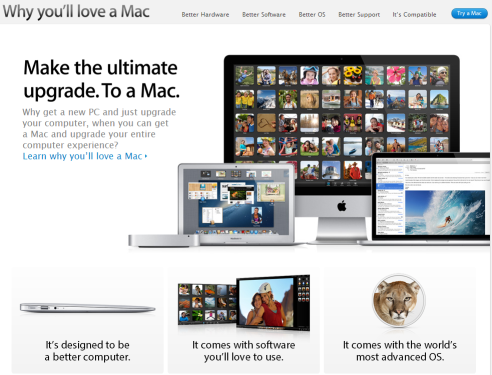
    Even Apple’s official “Why Mac?” website has zero reference as to why it’s a great platform for the workplace. Apple’s perception problem, for better or for worse, is entirely centered around the consumer experience. Apple proves it truly doesn’t care about the enterprise.

    Perhaps this is part of Apple’s official anti-enterprise stance, though. Subtleties are paramount in the Apple universe, and this could very well be the company’s way of showing without telling how much it despises the enterprise IT sector. Jobs got his wish, and Apple doesn’t give two bucks about what big business thinks of their policies.

    On the pricing front, it’s tough for many businesses (including the ones my company supports) to justify spending on Apple gear when you can equip roughly two people with Windows devices for the price of one low-end Macbook Pro, for example. The starting price for the lowest Macbook Pro is $1,200 USD (before tax), which doesn’t include Office in any form. Likewise, I can turn and look at entry level Dell Vostro laptops for my organization going for $420 a unit (as of 4-10-2013) and get both of them loaded with Office for just slightly more than a single Macbook Pro without Office. And the point of my example isn’t to start an apples for apples debate on specs alone — we all know Apple would win in the above scenario. Let’s be realistically mindful that most organizations don’t need a BMW for every information worker to get the job done. This is exactly what I’m getting at, and what other CIOs attested to in the InformationWeek study, in that Apple’s value proposition is not very appealing.

    Managing iDevices is Nothing Less than a Chore

    Take a quick look at how IT departments have taken to iOS based devices, namely iPads that are the poster children for the BYOD era. Not a single iOS device can be managed through Active Directory (or any other formal LDAP system, for that matter) yet departments worldwide fill in this oversight gap with third party MDM (mobile device management) tools.

    While these third-party solutions are great, and many do work wonders, notice that there is no movement from Apple to help alleviate these management woes. Apple’s official stance has been (and probably will be) to keep pushing the agreeably painful “center of gravity” for all things: iOS, iTunes. This is terrible policy if you ask me, or any other IT person, for that matter.

    I saw first hand just how lackluster Apple’s efforts in the enterprise sector are when I used to work in K-12. Attending educational tech conferences multiple times a year taught me one solid lesson: Apple wants an i-device in every kid’s hand, but has no desire to make educators’ or technology support staffs’ lives any easier in managing the iOS ecosystem.

    Ask anyone who has to manage a fleet of iPads for a school without the help of expensive third party MDM software. Apple’s loose directives on managing these device “silos” for lack of a better term is mind numbing. Why does app licensing have to be twice as complex as Microsoft’s? Why does the Apple Volume Purchase Program still rely on a hard-t0-manage consumer-oriented program such as iTunes? And if iTunes is the de-facto platform to manage iPads, how come none of Apple’s bright engineers can figure out a way to natively update and manage more than a single iPad at a time? For a company usually billed as cutting edge, these backend fumbles are more embarrassing than some of Microsoft’s recent follies.

    But I keep telling myself: An Apple that truly cared would have fixed this mess years ago. iOS device management wouldn’t be a chore; it would be as simple and elegant as iCloud in execution. OS X devices would seamlessly fit into any existing AD infrastructure, and companies could ideally make the case for moving to an Apple ecosystem. If this is part of Apple’s intentions in any way, they surely don’t have a knack for showing it.

    Apple’s Long Term: Zero Stated Outlook for the Enterprise

    Without even having remote access to Apple’s 10-year outlook, I can safely say that the lack of appetite in the enterprise e sector is very likely tied to the exponential dominance of iOS device sales as a percentage of revenue for the company as a whole. As much as the legions of Apple fans would yearn for the day Microsoft is dethroned in the enterprise, this is a non-starter for me for a number of reasons.

    First, you have to extrapolate the subliminal meanings behind Apple’s overall intentions in the tech world. With iOS growing, and OS X sales slowing (or standing still, depending on your sales sources) the desire for Apple to compete in the traditional enterprise market with proper vigor becomes less and less important. In some ways, the forceful approach as the anti-enterprise works to Apple’s benefit. They would clearly agree that enterprise as a whole shifting to work around the Apple way of doing things is a sign that they just don’t have to conform.

    The same goes for Apple’s slowing on releases of revised laptops and desktops. While the Macbook laptop line has gotten decent attention the past few years, fans of the Mac Pro tower computer clutch to a nearly 3+ year old design by now — with just rumor of a revised device coming soon. This is a far cry from the dominating lineup Apple used to run in the Mac laptop/desktop sector.

    But this shouldn’t be entirely surprising to most folks. Let’s not forget that Apple dumped on its enterprise fanclub heavily a few years back when discontinuing the Xserve line out of the blue. Just as some thought Apple was warming up to enterprise and giving deserved attention, the plug is pulled on an arguably solid product which was heading in the right direction. This was no doubt a slap in the face to techies making the case for Apple as a viable alternative to Windows in the workplace.

    Here’s another possible prospect in five years: what if Apple just stops making traditional computers altogether? Is this really that crazy of a prediction to make? It doesn’t take a genius to figure out that when you have a growing majority of your revenue (iOS) overtaking a product line that represents the “old vision” of computing according to Apple (laptops, desktops), some kind of drastic change needs to be made. And seeing how blunt Apple generally is with its market statements, I wouldn’t at all be shocked to see OS X 10.x be the last of its breed. In true Xserve fashion, the legacy of the Mac cats may be slowly nearing its digital end.

    One must also be slightly suspicious as to why Apple has not made a peep about competing with Microsoft in touch on the traditional laptop and desktop side. After all, Windows 8 has been a public reality for Apple since 2011 when the fuller picture about Microsoft’s intentions for 8 were solidifying. We’re now full force moving into Spring 2013 and there is zero news about anything remotely touch related making its way to Macbooks or Mac desktops. If Apple plans something spectacular to slow the Windows 8 touch train, it certainly hasn’t brushed through any of the traditional leak channels as with most prior releases.

    Apple’s long had a middle finger raised pointedly at big business. If the company wants to change this perception with us folks in IT, it needs to get serious about the intentions from the ground up. I’m not alone in my grim outlook for Apple in the enterprise, and until I see Apple making treads in the right direction, its products will be relegated to the BYOD policy for the foreseeable future.

    Photo Credit: igor.stevanovic/Shutterstock

    Derrick Wlodarz is an IT Specialist that owns Park Ridge, IL (USA) based technology consulting & service company FireLogic, with over 8+ years of IT experience in the private and public sectors. He holds numerous technical credentials from Microsoft, Google, and CompTIA and specializes in consulting customers on growing hot technologies such as Office 365, Google Apps, cloud hosted VoIP, among others. Derrick is an active member of CompTIA’s Subject Matter Expert Technical Advisory Council that shapes the future of CompTIA exams across the world. You can reach him at derrick at wlodarz dot net.


  • Gmail Turns 9: Google Takes Us Down Memory Lane, Makes Us Feel Old

    Can you believe that Gmail is 9 years old? I haven’t felt this old since last week, when Twitter informed me that it was the 19th anniversary of the death of Kurt Cobain. Yikes.

    Anyway, Google is now officially 9, having launched in beta on April 1st, 2004. In celebration of that, Google has posted a fun little infographic that deals with the evolution of the product.

    “Gmail was inspired by one user’s feedback that she was tired of struggling to find emails buried deep in her inbox. So we built a new email that leveraged the power of Google Search. You told us you were tired of spam, so we set to tackling that, and today your feedback makes it possible for Gmail to filter out well over 99% of incoming spam. You also said that you needed tools to deal with information overload, so we introduced Priority Inbox to help you manage your email (and we’re still exploring new ways to it even easier),” says Google software engineer Zohair Hyder.

    As you march through the past 9 years of Gmail, you remember that it took Google nearly two years to add Gchat to Gmail, and how long it took for Google to open up signups Gmail (three years after the beta launch). Not everything that’s happened with Gmail has been a hit with users (for a recent example, check out the reaction to the new compose box), but with hundreds of millions of active users, I guess we can say that we’re pretty happy that Gmail is around. It’s a lot more useful than most 9-year-olds I know, let’s put it that way.

    Check out a trip down Gmail memory lane below (click to enlarge):

    Evolution of Gmail

  • Persistence Capital Partners Sells Medvue’s Ontario Assets

    Persistence Capital Partners (PCP), a healthcare-focused private equity firm, has sold the Ontario-based clinics and other assets of its portfolio company Medvue Medical Imaging Inc., a Canadian provider of diagnostic imaging services. Acquired by PCP in 2008, Medvue’s Ontario assets were sold in a series of transactions completed in the first quarter of 2013. The buyers included regional operators KMH Labs, True North Imaging, Blue Water Imaging and Annex Medical Imaging. Medvue will continue to operate its Québec clinics.

    PRESS RELEASE

    PCP Announces Sale of Medvue’s Ontario Medical Imaging Assets

    April 4th, 2013 – Persistence Capital Partners (“PCP”), a private equity fund exclusively focused on high-growth opportunities in healthcare, is pleased to announce the sale of all the Ontario regional assets of its portfolio company Medvue Medical Imaging (“Medvue”), a leading Canadian provider of medical imaging services in Ontario and Quebec. The Ontario assets were sold in a series of transactions, completed in Q1, 2013, to 5 separate Ontario-based medical imaging providers.

    Acquired by PCP in 2008, Medvue’s Ontario business included 10 clinics providing publicly funded X-Ray, Mammography, Ultrasound, Nuclear Medicine and Bone Mineral Densitometry imaging procedures via OHIP, Ontario’s public payor system. PCP sold these assets in a series of independent transactions to leading regional medical imaging operators in Ontario, including KMH Labs, True North Imaging, Blue Water Imaging and Annex Medical Imaging. Medvue will continue to operate its Quebec clinics, providing MRI, CT, Ultrasound and X-Ray procedures.

    Commenting on the transaction, Lloyd M. Segal, Managing Partner at PCP, said, “Medvue Ontario represented a superb investment for PCP. Our team of professionals has set the standard for high quality medical imaging in Ontario and delivered excellent returns for PCP’s Limited Partners. We wish them continued success in their new associations with a set of great regional operators.”

    About Persistence Capital Partners

    Persistence Capital Partners is a private equity fund exclusively focused on high-growth opportunities in the healthcare field. With deep healthcare industry expertise, PCP aims to create significant long-term capital appreciation for its investors by identifying and developing attractive investment opportunities in the Canadian healthcare market.

    Photo courtesy of Shutterstock

    The post Persistence Capital Partners Sells Medvue’s Ontario Assets appeared first on peHUB.

  • Dark Souls II Looks Just As Brutal As Its Predecessors

    When Dark Souls II was announced during Spike TV’s VGAs, many fans thought this was an admission that the game would be dumbed down to appeal to a more casual audience. Those fears persisted well into the present day, but a new trailer and gameplay video should hopefully put your fears to rest.

    First up is a new trailer for Dark Souls II showing some of the environments players will explore in the game. It’s obvious that Dark Souls II has received a pretty major facelift as the environments look way better than past games. There also seems to be a lot more fear and desolation going around if the environments are any indication.

    If you want to see the game in action, check out IGN’s 12-minute gameplay reveal in which the director gives us a tour of an area in the game:

    Dark Souls II will launch on the Xbox 360, PS3 and PC later this year.

  • The creators of the next generation of IT are at Structure 2013

    As we spend more of our time (and money) online, information technology is becoming more than just a cost of doing business — it’s enabling an entirely new ways of doing business.

    We see it clearly in companies such as Google or Facebook, where the cost of computing has a direct impact on the cost of goods sold. But it’s also becoming the case in banks, retail shops and other sectors of the economy where mobile,  digital or cloud strategies all are facets of the same issue: an attempt to wed the business to technology and an understanding that technology is the business.

    We get it. That’s why this year’s Structure conference, on June 19 and 20 in San Francisco, will have speakers like Kevin Scott of LinkedIn. He’s going to share what he learned throughout the process of re-architecting the social networking site to brings its costs in line with its growing scale. Scott is part of a new generation of IT professionals who aren’t just trying to solve business problems with technology but are building architectures that are integral parts of the business.

    Jeff Dean at Google is doing something similar — although he’s thinking at a much larger scale. The computer scientist who co-wrote the search giant’s MapReduce paper is responsible for rethinking Google’s architecture for the new era of the web, where the hardware and software must support real-time distributed systems, capable of interacting naturally with people. It’s a tall order, but he’ll talk about where IT is going and how to build systems that can handle that future.

    Finally, we have a familiar face in a new role. Bob Muglia, who is the executive vice president of Juniper’s Software Solutions, will talk about how he plans to shift one of the innovators of the switching era as its business is disrupted by both the new OpenFlow protocol and the development of software-defined networking. Already, Muglia has forced the $9.65 billion company to change its business model and how it sells some of its hardware. He’ll discuss software-defined networks and what it means to be able to program the hardware infrastructure on demand and without having to physically touch the hardware.

    The entire IT industry is poised between the promise of awesome opportunities as computing becomes cheaper and our ability to capture data expands, and the fear of disruption as open source hardware and new layers of abstraction threaten to tear down the barriers to entry. It’s a crazy time in IT and Structure speakers will help you capitalize on it, either from the business side or with deep dives into the future of technology. Register today so you can join us in San Francisco on June 19 and 20.

    Related research and analysis from GigaOM Pro:
    Subscriber content. Sign up for a free trial.


  • iPhones And iPads Could Soon Get A Big Dose Of Yahoo

    Apple and Yahoo are said to be in talks about possibly integrating Yahoo products more into iOS and Siri. Any increased integration would only add on to existing Yahoo Finance and weather data that come on the iPhone today.

    The Wall Street Journal is reporting that the two companies have been “discussing how more of Yahoo’s services can play a prominent role on Apple’s iPhone and iPad devices,” citing people briefed on the matter. Such possibilities could include, according to the Journal’s sources, “more content from Yahoo News and its other web properties loaded onto Apple devices or available through an expanded Siri partnership.”

    A deal is not imminent, the report says.

    The Journal isn’t the only publication with sources talking about this. Bloomberg cites “a person familiar with the matter” as saying executives from both companies have “discussed ways to collaborate more closely on mobile software”:

    Yahoo Chief Executive Officer Marissa Mayer has met with Eddy Cue, Apple’s senior vice president of Internet services, to explore ways Yahoo can be more deeply integrated into the software that runs on the iPhone and iPad, said the person, who asked not to be identified because the talks are private.

    Mayer has been very clear about how important mobile is to the company’s strategy going forward since she took over as CEO last year. This would obviously be a huge step in making sure smartphone users are accessing Yahoo content on a regular basis. Depending on what kinds of integrations we see, it could turn out to be a pretty big deal for Yahoo’s piece of the search market as well, and would give Yahoo an interesting partner should the Microsoft alliance fall apart.

    We won’t go too crazy with the speculation here, but it will certainly be interesting to see what (if anything) comes of this.

  • MidOcean and PSP Withdraw EDAC Purchase Offer

    Farmington, Connecticut-based EDAC Technologies Corp. a designer, manufacturer and servicer of precision components for aerospace and industrial applications, announced that MidOcean Partners and Public Sector Pension Investment Board had withdrawn a proposal to acquire 100% of company shares. The bid, which has been estimated to value about US$97 million, was made in March. EDAC’s board of directors continued to recommend an offer by GB Aero Engine LLC, an affiliate of the Greenbriar Equity Group.

    PRESS RELEASE

    MidOcean Partners And PSP Investments Withdraw Acquisition Proposal

    Board Continues To Recommend Greenbriar’s Offer At $17.75

    CHESHIRE, Conn., April 8, 2013 /PRNewswire/ — EDAC Technologies Corporation (NASDAQ: EDAC), a diversified designer, manufacturer and servicer of precision components for aerospace and industrial applications, today announced that on April 7, 2013, MidOcean Associates SPC, an affiliate of MidOcean Partners, and Public Sector Pension Investment Board, or PSP, informed EDAC that they were withdrawing their previously-announced unsolicited proposal to acquire all of the outstanding shares of EDAC common stock at $18.25 per share.

    As previously announced, on March 26, 2013, GB Aero Engine Merger Sub Inc. commenced a cash tender offer for all of the outstanding shares of common stock of EDAC at a price of $17.75 per share. On that same day, the board of directors of EDAC unanimously recommended that EDAC’s shareholders accept the offer by GB Aero Engine Merger Sub Inc. and tender their shares of EDAC common stock pursuant to such tender offer. On March 28, 2013, the board of directors of EDAC received MidOcean’s and PSP’s unsolicited acquisition proposal. On March 29, 2013, EDAC announced that it intended to engage in discussions with MidOcean and PSP regarding their acquisition proposal in order to more fully evaluate their proposal with a view to establishing whether it constituted a superior proposal. As a result of MidOcean’s and PSP’s withdrawal, EDAC is no longer in discussions with MidOcean and PSP regarding their acquisition proposal.

    The board of directors of EDAC continues to unanimously recommend that EDAC’s shareholders accept the offer by GB Aero Engine Merger Sub Inc. for all of the outstanding shares of common stock of EDAC at a price of $17.75 per share and tender their shares of EDAC common stock pursuant to such tender offer. The tender offer and withdrawal rights are scheduled to expire at midnight, New York City time, on Tuesday, April 23, 2013, unless extended or earlier terminated in accordance with the terms of the merger agreement.

    Stifel, Nicolaus & Company, Incorporated is serving as exclusive financial advisor and Robinson & Cole LLP and Godfrey & Kahn S.C. are serving as legal counsel to EDAC Technologies Corporation.

    About EDAC Technologies Corporation

    EDAC Technologies Corporation is a diversified manufacturing company serving the aerospace and industrial markets. In the aerospace sector, EDAC offers design and manufacturing services for commercial and military aircraft, in such areas as jet engine parts, special tooling, equipment, gauges and components used in the manufacture, assembly and inspection of jet engines. Industrial applications include high-precision fixtures, gauges, dies and molds, as well as the design, manufacture and repair of precision grinders and precision spindles, which are an integral part of machine tools found in virtually every manufacturing environment. EDAC’s core competencies include extensive in-house design and engineering capabilities, and facilities equipped with the latest enabling machine tools and manufacturing technologies. EDAC’s acquisition of EBTEC Corporation in June 2012 expanded its services to the aerospace and industrial markets to include electron beam welding, laser welding, laser cutting and laser drilling, EDM, vacuum heat treating and abrasive waterjet cutting as well as expanding its markets to include semiconductors and medical devices. The Company’s acquisition of Smith-Renaud assets in October 2012 added centerless grinding systems and custom precision spindles, completing the EDAC Machinery product line.

    Cautionary Statement Regarding Forward Looking Statements

    This press release contains forward-looking statements within the meaning of the Private Securities Litigation Reform Act of 1995; including forward-looking statements regarding the anticipated acquisition of EDAC by the Purchaser. These forward-looking statements may be identified by words such as “plans,” “seeks,” “projects,” “expects,” “believes,” “may,” “anticipates,” “estimates,” “should,” and other similar expressions. Each of these forward-looking statements are subject to risks and uncertainties. Actual results or developments may differ materially from those, express or implied, in these forward-looking statements. There are a number of important factors that may cause differences between current expectations and actual results or developments, including risks and uncertainties associated with the anticipated acquisition of EDAC. These risks and uncertainties include, among others, uncertainties as to how many of EDAC’s shareholders will tender their shares pursuant to the tender offer, the risk that competing offers will be made, and the possibility that various closing conditions to the tender offer or the subsequent merger may not be satisfied or waived, and the risk that shareholder litigation in connection with any tender offer and subsequent merger may result in significant costs of defense, indemnification and liability. Other factors that may cause EDAC’s actual results or developments to differ materially from those expressed or implied in the forward-looking statements in this press release are discussed in EDAC’s filings with the SEC, including the “Risk Factors” sections of EDAC’s periodic reports on Form 10-K and Form 10-Q filed with the SEC. All forward-looking statements in this announcement are qualified in their entirety by this cautionary statement. Unless required by law, EDAC does not undertake to update its forward-looking statements.

    Important Additional Information

    Shareholders of EDAC are urged to read the relevant tender offer documents because they contain important information that shareholders should consider before making any decision regarding tendering their shares. GB Aero Engine LLC and GB Aero Engine Merger Sub Inc. have filed tender offer materials with the SEC, and EDAC has filed a Solicitation/Recommendation Statement with respect to the tender offer. The tender offer materials (including an Offer to Purchase, a related Letter of Transmittal and certain other offer documents) and the Solicitation/Recommendation Statement contain important information, which should be read carefully before any decision is made with respect to the tender offer. The Offer to Purchase, the related Letter of Transmittal and certain other offer documents, as well as the Solicitation/Recommendation Statement, are available to all shareholders of EDAC at no expense to them. The tender offer materials and the Solicitation/Recommendation Statement are available for free at the SEC’s website at http://www.sec.gov. In addition, shareholders are able to obtain a free copy of these documents from the Information Agent for the tender offer, Georgeson, at telephone number (800) 223-2064 or Glenn L. Purple , at EDAC Technologies Corporation, telephone number (860) 677-2603.

    In addition to the tender offer materials described above, EDAC files annual, quarterly and special reports, proxy statements and other information with the SEC. You may read and copy any reports, statements or other information filed by the Company at the SEC public reference room at 100 F Street, N.E., Washington, D.C. 20549. Please call the SEC at 1-800-SEC-0330 for further information on the public reference room. The Company’s filings with the SEC are also available to the public from commercial document-retrieval services and at the website maintained by the SEC at www.sec.gov.

    CONTACT:
    EDAC Technologies Corporation
    Glenn L. Purple
    Vice President-Finance
    860-677-2603

    SOURCE: EDAC Technologies Corporation

    Photo courtesy of Shutterstock. 

    The post MidOcean and PSP Withdraw EDAC Purchase Offer appeared first on peHUB.

  • The PC market is a horror show right now

    Going into the first quarter of 2013, IDC was projecting a dismal 7.7 percent decline in worldwide PC shipments from the same quarter a year ago. Turns out, they were wrong: the decline of the PC market during the quarter was drastically worse.

    The 76.3 million PCs that did ship between January and March this year were down a whopping 14 percent from the same quarter a year ago. It’s leading the analysts at IDC, who have been monitoring the PC market since 1994, to call it “the worst quarter” it’s seen.

    And, no, it’s not a blip: it’s the fourth quarter in a row that PC shipments have declined.

    The numbers show that people still buy PCs, but not in the quantities of the past. Instead, many people — both businesses and individual consumers — are making the purchase of cheaper, more portable tablets their priority right now.

    All the big PC makers are affected. Lenovo, which is the second-largest PC maker by volume, was the only one of the top 5 firms who didn’t see double-digit units sales declines during the quarter — it pulled even with the same quarter a year ago. Not terrible, but certainly not good.

    Even Apple, which was able to buck the industry trend of the last year and grow Mac sales until the last quarter of 2012, is seeing its laptop and desktop shipments drop off. IDC doesn’t release global numbers for Apple, but in the U.S. its shipments dropped 7.5 percent from the same quarter a year ago.

    But what Apple has going for it is its prescience in seeing this shift to smaller mobile computing coming (and of course helping it along). So when people are opting not to buy a more expensive laptop or desktop, it has the iPad to offer.

    Apple competitors in the PC business have been slow to adjust to this new reality. And even for those who are trying to offer a good tablet experience, it’s not going that well. Microsoft’s attempt to stanch the bleeding with Windows 8 is faring poorly, IDC says:

    “At this point, unfortunately, it seems clear that the Windows 8 launch not only didn’t provide a positive boost to the PC market, but appears to have slowed the market,” said Bob O’Donnell, IDC Program Vice President, Clients and Displays. “While some consumers appreciate the new form factors and touch capabilities of Windows 8, the radical changes to the UI, removal of the familiar Start button and the costs associated with touch PCs have made PCs a less attractive alternative to dedicated tablets and other competitive devices. Microsoft is going to have to make some very tough decisions moving forward if they want to help reinvigorate the PC market.”

    Screen Shot 2013-04-10 at 1.09.53 PM
    Screen Shot 2013-04-10 at 1.10.02 PM

    Image courtesy of Flickr user Alyssa L. Miller via Compfight cc

    Related research and analysis from GigaOM Pro:
    Subscriber content. Sign up for a free trial.


  • New iPad Leaked Photos Make The Rounds (Authenticity Unconfirmed)

    French tech blog NowhereElse.fr, known mostly for frequent Apple product-related leaks and rumors has posted a couple of new allegedly leaked iPad photos showing the bezel of the upcoming device.

    Obviously the authenticity of these is questionable. Either way, here’s what it looks like.

    New iPad Leaked Photos

    Mind blown yet?

    The images do appear to confirm recent reports of a redesign. As Zach Epstein at BGR notes, “An image of the new iPad’s purported rear shell was published this past January, showing a redesigned case that closely resembles the iPad mini.”

    Recent rumors have suggested that fifth-generation iPads will begin production in July or August.

    You can check the original source for another shot.

    [via Boy Genius Report]

  • Apple once again said to have ditched Samsung for next-gen chip development

    Apple A7 Chip Development Samsung
    Yet another report suggests that Apple (AAPL) has excluded Samsung from development of its A7 chipset. According to the Korea Times, the company is being assisted by TSMC in creating its next-generation processor. The move is the latest blow to Samsung (005930), which has seen Apple shift away from using its components in the iPhone and iPad due to increased competition and ongoing legal battles. Samsung is now said to be interested in partnering with NVIDIA (NVDA), in addition to its in-house Exynos brand, to maintain growth in its semiconductor business. An earlier report claimed that risk production of the A7 will begin in May or June, and the chipset will debut in commercial products in early 2014.

  • Foxconn sales drop could foreshadow Apple earnings

    We’re getting closer to when Apple will report its quarterly results for its sales from January through March.  And we have at least one sign that may shed some light on what to expect on April 23: Hon Hai Precision Industry Co., the parent company of Apple’s most important manufacturing partner, Foxconn, turned in some not-so-great earnings on Wednesday.

    Reuters reported that Hon Hai saw a 19 percent drop in its sales from the same quarter a year ago. It saw sales of about $27 billion for the first quarter of this year, compared to $33.2 billion the same quarter in 2012.

    It is possible that its sales are down because one of its other customers cut its orders way back. Apple is not Foxconn’s only customer; it manufactures hardware for many of the world’s most prominent device makers. But Apple is by far its biggest, thought to be responsible for up to 70 percent of Foxconn’s orders.

    It also makes sense that Apple device orders from Foxconn could be down for the quarter: there was no big new Apple device launch between January and March and therefore no massive ramp up of new devices.

    We’ll find out how much this was or wasn’t a reflection on Apple when it reports its fiscal Q2 results on April 23.

    Related research and analysis from GigaOM Pro:
    Subscriber content. Sign up for a free trial.


  • System Explorer – An Alternative to Task Manager

    As useful as Windows Task Manager is on a fresh system, power-users know that third-party developers make available far more flexible solutions in terms of options.

    System Explorer is one of the alternatives that pack additional functionality compared to the utility provided by Microsoft. It is free of charge and the developer makes available a porta… (read more)

  • Arrested Development Gets Some Great Minimalist Promotional Posters

    By my count, we are less than 7 weeks away from the premiere of Arrested Development season 4 on Netflix. The season, which will become available on May 26th at 12:01 am PT, will be dropped all at once – all 15 episodes. Get your extra sleep in now, folks.

    Arrested Development fans are no strangers to waiting, so this piddly wait shouldn’t be that hard to manage. But then again, OHMYGODITSREALLYCLOSE.

    To whet your appetite, Netflix has unveiled some nice, minimalist promotional posters for the new season. Check ‘em out below:

  • Kevin Bacon: Apology Issued For Spoiler Post

    [Author’s Note: This post contains the same spoilers Bacon has apologized for]

    Along with the instant, worldwide capabilities of the web has come the dreaded accidental spoiler. In the past, fans of a TV series would have to actively search for spoilers, but now every Tweet or blog post brings with it the risk of having the latest twists ruined.

    This week, actor Kevin Bacon demonstrated this new reality perfectly, while also demonstrating why localized, staggered release schedules for content will only become more problematic as more of the world becomes connected.

    Bacon currently stars in the Fox network TV show The Following, a drama that follows an ex-FBI agent named Ryan Hardy as he helps his colleagues catch serial killers. In the latest episode, which aired in the U.S. on April 8, it is revealed that Hardy himself may be a killer.

    The twist surprised fans, and Bacon retweeted one fan’s surprise to his Twitter page:

    Unfortunately, fans of the show in some countries that aren’t the U.S. haven’t gotten the chance to watch that episode yet. They immediately let Bacon know he had screwed up, in the polite way that angry people on the internet normally do.

    Bacon has now issued an apology, which in includes a short Vine video in which the actor issues a repeated mea culpa:

    (Image courtesy Genevieve/Wikimedia Commons)

  • Mozilla CEO Gary Kovacs Stepping Down Later This Year

    In late 2010, Mozilla appointed Gary Kovacs as its CEO as the non-profit began development on Firefox OS. As the launch of Firefox OS nears, Mozilla is now once again on the lookout for a new CEO.

    Mozilla announced today that Kovacs will be stepping down as the CEO of the non-profit later this year. He won’t be gone entirely, however, as he plans to stick around as a member of the Board of Directors.

    “The past two and a half years have been pivotal in the evolution and rapid growth of Mozilla,” said Gary Kovacs, CEO. “I am very proud of our accomplishments as a team. In our mission to empower the next two billion Web users, we’ve made great advances in desktop and mobile and in our ability to lead at the pace of the market. With this solid foundation and a strong team in place, this is the right time for me to announce the transition plan and a vote of confidence in the abilities of the leadership team. I am grateful for the privilege of leading this organization during this period of rapid growth, and I look forward to helping guide Mozilla’s impact on the future of mobile.

    Kovacs stepping down isn’t the only executive change happening at Mozilla over the next few months. The non-profit also announced that Mitchell Baker and Brendan Eich have expanded their roles to Executive Chair and Chief Technology Officer & Senior Vice President of Engineering respectively.

    Jay Sullivan will be moving up from SVP of Products to the position COO. He will still be directly involved with Mozilla’s product strategy and the Firefox OS development team.

    Harvey Anderson, Corporate Secretary for Mozilla, is now also the SVP of Business and Legal Affairs. In the new role, he will “have oversight for the apps marketplace initiative and continue to lead mobile and strategic partnerships.”

    Finally, Li Gong is Mozilla’s SVP of Mobile Devices. As the title implies, he’ll be in charge of global Firefox OS adoption as the handsets featuring Mozilla’s mobile OS launches later this year.

    Over the next few months, Mozilla will be on the lookout for its next CEO. It will interesting to see who the non-profit ultimately ends up choosing as they will be in charge of Mozilla as it attempts to stake its claim in the ever growing mobile market.

  • USPS Saturday Mail May Last A Little Longer

    There has been talk of the United States Postal Service ending Saturday mail delivery for years now. In recent months it appeared to be getting closer to reality.

    Congress recently passed a resolution, however, that will keep the USPS stuffing your mailbox with Saturday junk mail for at least a while longer. The new schedule (which would have seen packages continue to be delivered on Saturdays) was set to take effect in early August. Not it remains to be seen how long we’ll be able to enjoy Saturday mail.

    The USPS says the plan would have saved about $2 billion a year, and would help restore the USPS to financial stability as it continues to face obstacles of the era (digital and otherwise). At least the USPS (as far as we know) is still launching a clothing line.

    Following is the USPS’s full statement:

    The Board of Governors of the United States Postal Service met April 9 and discussed the Continuing Resolution recently passed by Congress to fund government operations. By including restrictive language in the Continuing Resolution, Congress has prohibited implementation of a new national delivery schedule for mail and packages, which would consist of package delivery Monday through Saturday and mail delivery Monday through Friday, and which would have taken effect the week of Aug. 5, 2013.

    Although disappointed with this Congressional action, the Board will follow the law and has directed the Postal Service to delay implementation of its new delivery schedule until legislation is passed that provides the Postal Service with the authority to implement a financially appropriate and responsible delivery schedule. The Board believes that Congress has left it with no choice but to delay this implementation at this time. The Board also wants to ensure that customers of the Postal Service are not unduly burdened by ongoing uncertainties and are able to adjust their business plans accordingly.

    The Board continues to support the transition to a new national delivery schedule. Such a transition will generate approximately $2 billion in annual cost savings and is a necessary part of a larger five-year business plan to restore the Postal Service to long-term financial stability. According to numerous polls, this new delivery schedule is widely supported by the American public. Our new delivery schedule is also supported by the Administration and some members of Congress.

    To restore the Postal Service to long-term financial stability, the Postal Service requires the flexibility to reduce costs and generate new revenues to close an ever widening budgetary gap. It is not possible for the Postal Service to meet significant cost reduction goals without changing its delivery schedule – any rational analysis of our current financial condition and business options leads to this conclusion. Delaying responsible changes to the Postal Service business model only increases the potential that the Postal Service may become a burden to the American taxpayer, which is avoidable.

    Given these extreme circumstances and the worsening financial condition of the Postal Service, the Board has directed management to seek a reopening of negotiations with the postal unions and consultations with management associations to lower total workforce costs, and to take administrative actions necessary to reduce costs. The Board has also asked management to evaluate further options to increase revenue, including an exigent rate increase to raise revenues across current Postal Service product categories and products not currently covering their costs.

    The Board continues to support the Postal Service’s five-year business plan and the legislative goals identified in that plan, which will return the Postal Service to financial solvency. The Board additionally urges Congress to quickly pass comprehensive postal legislation, including provisions that would affirmatively provide the Postal Service with the ability to establish an appropriate national delivery schedule.