Blog

  • Advent Adds to Senior Team in EMEA Region

    Advent Software, a provider of software and services for the global investment management industry, has made two senior sales appointments. Jad Fares has been appointed regional sales manager for the Middle East and North Africa (MENA) region and will be based in Advent’s Dubai office. Jesper Steiness has been appointed as director of business development for EMEA.

    PRESS RELEASE

    Advent Software, Inc. (NASDAQ: ADVS), a leading provider of software and services for the global investment management industry, today announced two senior sales appointments. Jad Fares has been appointed regional sales manager for the Middle East and North Africa (MENA) region and will be based in Advent’s Dubai office. Jesper Steiness has been appointed as director of business development for EMEA. The announcement comes as Advent continues to expand its client base in EMEA across a wide range of market segments, including asset management firms, hedge funds, wealth management firms, funds of funds and family offices.
    Jad Fares joins Advent as regional sales manager for the MENA region, from Bloomberg where he served as Middle East and Africa Manager for Electronic Trading and Execution. He has over ten years’ experience working for companies providing high-end solutions to markets in the Middle East and the US as well as has an extensive background with sovereign wealth funds, pension funds, global asset managers, hedge funds and investment banks. In his role, Mr. Fares will be responsible for continuing to develop Advent’s position as one of the leaders in the market in Saudi Arabia, as well as the broader MENA region.
    Today more than 30 MENA-based clients use Advent’s local solutions along with its world-class investment management systems. As evidence of the company’s commitment to the region and understanding of the unique needs of clients in MENA, Advent maintains a full-service office in Dubai, which includes sales, relationship management, professional services and client support professionals.
    Jesper Steiness will serve as director of business development for the EMEA region with a focus on the Luxembourg market. Mr. Steiness has over 20 years’ experience in the global fund industry in Hong Kong, Singapore and Luxembourg. He has an extensive background in fund administration, custody and asset management and has held a number of independent directorships on fund boards.
    “We’re thrilled to have Jad Fares and Jesper Steiness on board as part of the Advent team as we continue to strengthen our position in the region by adding more clients and developing a larger footprint with existing clients,” said Håkan Valberg, Senior Vice President and General Manager, Advent Software EMEA. “They bring an impressive background that will be a valuable asset in supporting Advent’s goals of eliminating boundaries between people, information and systems. Our growth in the region is the result of investments in the local solutions as well as Advent’s service delivery. Our new appointments reinforce our strong commitment to building long-term relationships with our clients throughout Europe and the Middle East.”
    Advent, the Advent logo and Advent Software are registered trademarks of Advent Software, Inc. All other company names or marks mentioned herein are those of their respective owners.
    About Advent
    Advent Software, Inc. (www.advent.com), a global firm, has provided trusted solutions to the world’s financial professionals since 1983. Advent’s proven solutions can increase operational efficiency, reduce risk, and eliminate the boundaries between systems, information and people so you can focus on what you do best. With more than 4,500 client firms in over 60 countries, Advent has established itself as a leading provider of mission-critical solutions to meet the demands of investment management operations around the world. Advent is the only financial services software company to be awarded the Service Capability and Performance certification for being a world-class support and services organization.

    The post Advent Adds to Senior Team in EMEA Region appeared first on peHUB.

  • Facebook Places Restrictions on Wholesale Event Invitations

    If you’re the kind of person who throws caution to the wind when choosing who to invite to your events (otherwise known as the “select all” crowd), it looks like Facebook is beginning to get more serious about restricting you.

    Some users are getting a message from Facebook when they attempt to invite a large number of users to a single event.

    “We’re sorry, but you seem to be sending invitations to people who aren’t interested in accepting them. Please make sure you’re only inviting people you know and think would enjoy this event. You’ll only be able to send invitations again once more people have accepted.”

    So, what gives?

    Facebook seems to be enforcing an event-oriented rule that only allows for 100 invites at a single time – and more importantly only 300 pending invites. That means that if you have over 300 invites out there with no response, you can’t send any more until a few people join, maybe, or decline your event.

    Facebook explains the rules on its help page:

    You can invite an unlimited number of people to events, but you can only invite 100 people at a time. Once you invite the first 100 people, you can then start inviting more.

    Also, you can only have 300 pending invites at one time for an event. Some people will have to respond to your event invite before you’ll be able to add more.

    Remember, Facebook isn’t capping invites to a single event. You can invite as many people as you want. But you just have to do it a bit more slowly.

    [Mari Smith via AllFacebook]

  • Max Niederhofer joins Sunstone Capital

    Max Niederhofer has joined European venture capital firm Sunstone Capital as a partner in its Copenhagen office. He joins Sunstone Capital from Accel Partners, where he was a Vice President in the firm’s London office, focusing on investments in internet and mobile services.

    PRESS RELEASE

    Sunstone Capital, a European venture capital firm, today announced that Max Niederhofer has joined the firm as a Partner in its Copenhagen office. In this role, he will focus on early stage technology investments and support existing companies in Sunstone’s portfolio.

    Max has spent the last 11 years working with early stage businesses in Europe and the United States as an investor and entrepreneur. He joins Sunstone Capital from Accel Partners, where he was a Vice President in the firm’s London office, focusing on investments in internet and mobile services. Prior to joining Accel, Max started and sold Qwerly, a data marketing business, and was a Principal at Atlas Venture, where he worked with companies such as DailyMotion, Seatwave and Moo. His personal investments include Last.fm (sold to CBS), OneFineStay, Skimlinks, Boticca, Fliptop and Sofar Sounds.

    “We are very excited to have Max join our team. As entrepreneurs ourselves, we are aggressively expanding Sunstone from our Nordic roots to all European markets. Max’s background and experience strengthen our strategy of supporting European entrepreneurs at the earliest stages of company building,” said Jimmy Fussing Nielsen, Managing Partner at Sunstone Capital.

    “I am thrilled to be joining a partnership that allows me to be an investor as well as an entrepreneur,” said Niederhofer. “At Sunstone, we are building Europe’s premier, early-stage, West Coast-style venture capital firm. We want to be faster, more accessible and better to deal with than anyone else in the market.”

    Max was born in Hamburg and has lived in Germany, Canada, the UK, France, India and the US. He holds a doctorate in management science from WHU in Germany and was recently named “Best Startup Advisor/Mentor 2012” at startup awards The Europas in Berlin.

    About Sunstone Capital
    Founded in 2007, Sunstone Capital is a leading European early-stage technology and life sciences venture capital firm. The partnership manages around EUR 700 million in committed capital across seven funds. The technology portfolio includes companies such as Amen, Gidsy, Issuu, Layar, Neo Technology, Paymill, Podio (sold to Citrix Systems) and Prezi.

    The post Max Niederhofer joins Sunstone Capital appeared first on peHUB.

  • FairSearch files complaint against ‘Google’s anti-competitive’ mobile strategy, in the EU

    FairSearch, a coalition comprised of 17 global businesses including Expedia, Kayak, Microsoft, Oracle, Nokia and TripAdvisor, has announced that it has filed a complaint with the European Commission (EC) against Google, citing an “anti-competitive strategy” and consolidating “control over consumer Internet data for online advertising” in the mobile space.

    FairSearch uses two reports from Strategy Analytics (SA) and eMarketer to base its claims. According to the coalition, Google exerts its dominance in the mobile operating system space with Android, which held a 68.4 percent market share in 2012 per SA, and in mobile search advertising, which eMarketer says Google dominates with a 96 percent market share.

    “Google is using its Android mobile operating system as a ‘Trojan Horse’ to deceive partners, monopolize the mobile marketplace, and control consumer data”, says Thomas Vinje, a counsel for FairSearch. “We are asking the Commission to move quickly and decisively to protect competition and innovation in this critical market. Failure to act will only embolden Google to repeat its desktop abuses of dominance as consumers increasingly turn to a mobile platform dominated by Google’s Android operating system”.

    According to Google, “the Google apps for Android, such as YouTube, Google Maps and Navigation, Gmail, and so on are Google properties that are not part of Android, and are licensed separately” and “if the device is to include Google Play, Google will typically validate the device for compatibility before agreeing to license the Google Play client software”.

    As a result, FairSearch also says that the search giant “uses deceptive conduct to lockout competition in mobile”. According to the coalition, even though Google gives “Android to device-makers for ‘free’”, the company requires manufacturers to “pre-load an entire suite of Google mobile services and to give them prominent default placement on the phone”, in order to “include must-have Google apps such as Maps, YouTube or Play”.

    Basically the group cries foul at the presence of Google services on Android, which it calls a “predatory distribution” of the green droid operating system. According to FairSearch, the “below-cost” policy “makes it difficult for other providers of operating systems to recoup investments in competing with Google’s dominant mobile platform”.

    The complaint raises issues similar to the ones brought against Microsoft’s Windows in the last decades. At the time the operating system bundled Microsoft services and programs, including Internet Explorer, Windows Media Player and others, and gave competition little room to grow and develop against the pre-installed offerings.

    Now FairSearch seems to think that another major player — Google — is exerting its dominance a bit too much. Considering that Microsoft is part of the coalition the situation is a tad ironic. Nonetheless, the only question is whether the EC agrees with the complaint or not. If it does, any subsequent decision could dramatically change the mobile landscape.

    Photo Credit: Sebastian Duda/Shutterstock

  • Salesforce.com and Rackspace gear up for mobile developers

    If there was any doubt that mobile development is where the action is, witness two piece of news. First, Rackspace, the infrastructure-as-a-service and hosting company, is launching a pre-packaged mobile “stack” specifically for mobile applications. Second, Salesforce.com is beefing up its mobile software development kit (SDK) and is coming out with “quick start” packs to jump-start HTML5 or hybrid mobile applications.

    Salesforce says developers using its tools can build apps that tap into troves of legacy data from existing CRM customers.

    Salesforce says developers using its tools can build apps that tap into troves of legacy data from existing CRM customers.

    Given these developments, and rumblings that public cloud king Amazon Web Services is gearing up its mobile development push, it looks like legacy cloud giants are crowding into a space pioneered by smaller, more focused providers of mobile back-end services. (GigaOM Pro analyst Janakiram MSV has a good take on choosing an MBaaS here — subscription required.)

    Who needs an MBaaS?

    Salesforce.com’s pitch is that, while there are tons of useful consumer mobile apps, enterprise apps to date are still lacking.  ”It’s hard to build mobile apps that don’t just look nice but are engaging and that comes down to data. They need to be connected into your work data,” said Adam Seligman, VP of developer relations at Salesforce.com. “You have to make it easy to build the apps, the client side stuff, but you also need those hooks into corporate data.”

    The new mobile packs, which support three lightweight mobile frameworks — jQuery Mobile, Backbone.js and AngularJS — should help on the ease-of-development front.

    Salesforce, which backs both Force.com and Heroku Platforms as a Service (PaaS), subscribes to the school of thought that a specialized Mobile Backend as a Service (MBaaS) — from Parse, Kinvey, Kii or Stackmob — isn’t necessary. Those smaller competitors would no doubt argue that developers need to build applications that connect to myriad applications from many sources — not just those from one company.

    Rackspace wraps up mobile stack in an easily deployable package

    Rackspace already hosts “tons of mobile apps” but it wants to make it easier for developers and companies to deply them, CTO John Engates said. So it’s wrapped up a mobile-focused technology stack as a sort of prepackaged cloud for that type of user.

    “We want to streamline things. We put together a stack — including Linux, MySQL, PHP, Memcached, Varnish cache in a sort of blueprint that we can deploy consistently and quickly,” he said.

    This backend runs in Rackspace’s public cloud infrastructure, but on cloud servers that are dedicated to that customer. “We’re basically running a single tenant infrastructure on a multi-tenant cloud,” Engates said. “Heroku is a multi-tenant platform that lives on Amazon, a multi-tenant infrastructure cloud. We’re trying to build a single-tenant platform atop a public cloud. You can build your own deployment and specs and scale it for what you need.”

    Rackspace CTO John Engates

    Rackspace CTO John Engates

    The entire stack is open source and developers can use their SDKs of choice to develop for any mobile device. Rackspace has also signed up some partners to work with its stack: FeedHenry, New Relic, Sencha, SOASTA, StackMob and Trigger.io.

    “The idea there is you use our infrastructure but then SOASTA can test your application from many perspectives — not just Rackspace — and throw a load up there to make sure it scales before you deploy it,” Engates said.

    As more of these bigger, broader “cloud” companies add mobile development and hosting capabilities, it may be time for consolidation in the MBaaS business to kick off for real.

    Related research and analysis from GigaOM Pro:
    Subscriber content. Sign up for a free trial.


  • Telling Stories with Visual Data: A Glimpse into the Future of Narrative

    Editor’s note: We’ve asked contributors to the Visualizing Data Insight Center to show us some of their favorite examples of dataviz with short explanations of what makes those visualizations so effective. Today, Jer Thorp shares one of his favorites.

    Below is a screen grab of a masterful interactive data visualization. This narrative-driven piece by Pitch Interactive manages the extra-tricky task of balancing heavy subject matter with a clear story and compelling visuals. It’s a glimpse into the future of data-driven storytelling. Perhaps the most interesting thing about the piece is that it wasn’t commissioned by a media organization. It was built by Pitch as a way to explore and understand this complex topic. Bravo.

    The full data visualization is here — it’s worth watching, and scrolling over for a more in-depth view.

    drones.png

    View more data visualization examples and best practices in our month-long series on Data Visualization.

  • Adobe updates Flash Player and AIR, announces future plans

    Adobe has refreshed its cross-platform web media playback and runtime tools with the release of Adobe Flash Player for Other Browsers 11.7, Adobe Flash Player for Internet Explorer 11.7 and Adobe AIR 3.7.0.
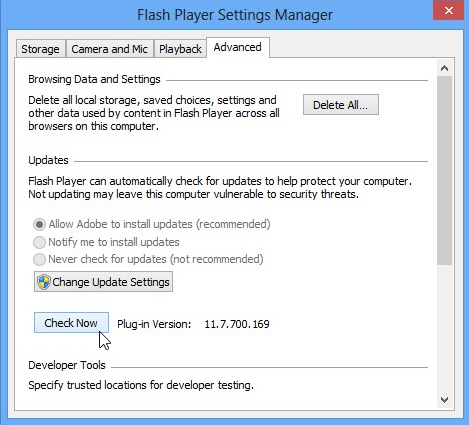
    There’s only one notable change to report in this first stable release of Flash Player 11.7: enhancements to the sandboxing features that allow it to better address application launches in protected mode.

    During the beta testing phase for this release, Adobe warned developers that there could be backwards-compatibility issues as a result of some of the security updates. These should have been resolved in most cases, but be prepared for sites to stop functioning correctly in isolated cases.

    With this release out of the way, Adobe has announced its next major feature will be a new patch update mechanism that it claims will reduce the size of future updates by around 75 per cent. This is currently undergoing testing in the beta channel, and should appear in a future update of Flash Player 11.7. Other unspecified new features are also planned.

    Adobe AIR 3.7 also introduces a number of new iOS-focused features for developers. The first is a new static ‘preventBackup’ property, which prevents local shared object data from being backed up to iCloud. This property is required to comply with recently updated Apple guidelines.

    Also added is the <forceCPURenderModeForDevices> tag that will allow AIR iOS applications to perform on lower end iPads and iPods where memory issues may occur when using GPU render mode. The final iOS-themed development is the addition of an option for developers to host secondary SWF files such as game assets or new levels on an external server, loading them on demand and helping to keep the size of the parent app down.

    Android developers also gain a new feature: captive runtime debugging capability, which allows them to both create and debug captive apps. Finally, the Actionscript Compiler 2.0 has now been integrated into the AIR SDK 3.7, and is no longer available as a separate download.

    Adobe Flash Player for Other Browsers 11.7.700.169 and Adobe AIR 3.7.0 are both available now as a freeware downloads for Windows and Mac. Also available is Adobe Flash Player for Internet Explorer 11.7.700.169 for PCs running Windows 7 or earlier (Windows 8 users are delivered updates through the OS).

  • WhatsApp debunks rumors of possible Google acquisition

    Google WhatsApp Acquisition Rumor Debunk
    Rumors surfaced over the weekend that Google (GOOG) was in the midst of acquisition talks with messaging giant WhatsApp. Such a move would have been a big boost for Google and it reportedly would have given WhatsApp a billion-dollar payday. Unfortunately, the source was unproven and it looks like the rumor was completely false. AllThingsD spoke with WhatsApp’s business development boss and he flat-out denied that any talks had taken place. “Neeraj Arora, WhatsApp’s business development head, told AllThingsDigital today that the company is not holding sales talks with Google,” AllThingsD’s Liz Gannes wrote. The acquisition would certainly have been a big one for Google — WhatsApp recently announced a new milestone, stating that it processed more than 11 billion outbound messages this past New Year’s Eve.

  • Microsoft rolls out Office 2010 SP2 beta

    By now a number of you have probably joined me in moving on to Office 2013, either the desktop version or the new Office 365 Home Premium subscription adaptation of the suite. However, there is nothing wrong with the previous Office 2010 release of the product, and many users and businesses are still running that software.

    For those, there is some good news this morning — Microsoft has released a beta version of Service Pack 2 for Office 2010. The SP2 beta also includes Sharepoint 2010 support as well. In addition, it has improved support for Internet Explorer 10 and Windows 8, updates for system reliability, program compatibility, security and more.

    According to the Microsoft Office Sustained Engineering Team, “As of today, customers can download the beta for Office 2010 and SharePoint 2010 SP2. In addition to updates for the desktop and server apps, this beta also includes full-product SKUs of SharePoint and related server products, updated to install on Windows Server 2012”.

    The download is free, but of course you need a Microsoft account for logging in, and there is the usual terms of service that you must agree to in order to download and install the update. Both 32-bit and 64-bit versions are available. Microsoft does not say how long the beta period will last.

    Photo credit: kurhan/Shutterstock

  • Donuts Adds Financing

    Donuts Inc., a registry for new generic top-level domain names, has sealed Series B financing led by existing investor Generation Partners. Columbia Partners Private Capital also participated. Specific terms of the deals were not disclosed.

    PRESS RELEASE
    Donuts Inc., a registry for new generic top-level domain names (gTLDs) said today it has secured additional funding as new gTLDs approach.

    The financing includes a Series B equity investment led by existing investor Generation Partners, at twice the valuation of the initial Series A round, as well as additional financing from Columbia Partners Private Capital, the latter complementing the company’s existing senior line from Comerica Bank. Specific terms of the deals were not disclosed.

    The added funding follows last June’s announcement that Donuts had secured initial funding of more than $100 million from multi-billion dollar venture capital and private equity funds and a top-tier bank.

    Donuts CEO and co-founder Paul Stahura said the additional capital is targeted toward securing new gTLDs in the coming months, when applicants are slated to resolve “contention sets,” an industry term for multiple applications for the same gTLD.

    “We intended from the beginning to secure the gTLDs for which we applied,” Stahura said. “We enjoy tremendous support from our stockholders and lenders. This was an oversubscribed round that nearly doubles our capacity to compete. Our investors believe as strongly as we do that new gTLDs will bring relevance and specificity to registrants who have few usable choices today for Internet identities. This additional capital supports that belief, and we intend to deploy it to bring new gTLDs to market.”

    “Capital is a critical element of the approaching phase of the new gTLD program,” said Generation Partners Managing Partner John Hawkins. “Donuts applied for more than three times the number of gTLDs as the next largest applicant, and the company’s investors intend for Donuts to have what it needs, or even more than it needs, to continue its leadership position.”

    Stahura confirmed that Donuts has further access to additional capital should the need arise.

    About Donuts Inc.
    Donuts is a domain name registry that is widening competition and choice in Internet identities through hundreds of new top-level domain name choices, securely operated in multiple languages and character sets. Donuts is headquartered in Bellevue, Wash., with offices in Southern California and Washington, D.C. For more information, please visit www.donuts.co.

    About Generation Partners
    Generation Partners is a private equity firm with over $350 million of capital under management with offices in Greenwich, CT, Los Angeles, CA, and Austin, TX. Generation provides equity capital to growth companies and pursues both majority and minority investments. Generation specializes in recurring revenue service businesses concentrated in three industry groups: Business & Information Services, Healthcare Services & Software and Media & Communications. Over the past 25 years, the firm’s principals have invested in more than 50 companies. For more information on Generation Partners, please visit www.generation.com.

    The post Donuts Adds Financing appeared first on peHUB.

  • Ridgemont Equity Partners Backs Simpleview

    Middle-market private equity firm Ridgemont Equity Partners has put an undisclosed amount into Simpleview Inc., a provider of software and digital marketing services to “Destination Marketing Organizations.” Simpleview is based in Tucson, Ariz. Terms were not released.

    PRESS RELEASE

    Ridgemont Equity Partners, a middle market buyout and growth equity investor, today announced the closing of an equity investment in Simpleview, Inc., the leading provider of software and digital marketing services to Destination Marketing Organizations (“DMOs”). The existing management team, led by CEO Ryan George and President Rich Reasons, will continue to run the business and has invested alongside Ridgemont in the transaction. The financial terms of the transaction were not disclosed.

    Headquartered in Tucson, Arizona, Simpleview provides a cloud-based comprehensive technology platform which connects DMOs around the world to travelers, meeting planners, and local businesses. The company’s services include Customer Relationship Management software, Content Management Systems, interactive marketing services and a vertical ad network. DMOs implement Simpleview’s products to attract travelers to their area and drive economic impact through a streamlined sales and marketing process.

    “Simpleview is the clear leader in software and services for the DMO market,” said Kurt Leedy, a Vice President at Ridgemont. “Our team has been highly impressed with the platform Simpleview has created and we share the Company’s vision for its next stage of growth. We look forward to working with the Simpleview management team and its talented group of innovators.”

    “Our partnership with Ridgemont enables Simpleview to grow by scaling our already robust service offering and expanding our customer reach, both nationally and globally,” said Ryan George, CEO of Simpleview. “We are very excited to join forces with this experienced investment team and anticipate an even brighter future for our company, the destinations that we serve, and the tourism industry overall.”

    “Ridgemont’s investment in Simpleview is a natural addition to our fund,” said George Morgan, a Partner at Ridgemont. “Our team has been actively seeking opportunities to invest in vertically-focused software-as-a-service businesses, and the reputation that Simpleview has built as a forward-thinking market leader, coupled with our financial and operational discipline, will be essential elements in the execution of the company’s promising growth plans.”

    ArchPoint Partners served as exclusive financial advisor to Simpleview and Silicon Valley Bank provided financing for the transaction.

    About Simpleview
    Simpleview offers integrated products and services for destination marketing organizations (DMOs), including the industry’s most advanced customer relationship management (CRM) platform and content management system (CMS), forecasting and reporting tools, websites, mobile sites, search engine optimization and interactive marketing services. Simpleview works with more than 200 U.S. and international DMOs. Learn more at www.simpleviewinc.com.

    About Ridgemont Equity Partners
    Ridgemont Equity Partners is a Charlotte-based private equity firm that specializes in middle market buyout and growth equity investments. Since 1993, the principals of Ridgemont have invested over $3 billion in more than 110 companies. The firm focuses on investments of $25 million to $75 million in industries in which it has deep expertise, including basic industries and services, energy, healthcare, and telecommunications/media/technology.

    The post Ridgemont Equity Partners Backs Simpleview appeared first on peHUB.

  • "Actually," She Said, "He Works for Me."

    Let’s agree that gender stereotyping still exists. We may try to suppress the subconscious image of political leaders, doctors, and CEO’s as male, but that’s what pops into our heads when we hear those professions. What’s ironic is that I’m the CEO of an investment company, so, if I struggle with this, I suspect others must too.

    One of the most ubiquitous forms of stereotyping is when someone (whether male or female) assumes that a woman working with a male colleague is working for him. In my case, people of both sexes ask me if I work for David, the partner with whom I co-founded our firm. When Ava, a well known dermatologist in Los Angeles, bought a large practice, most patients assumed that she was working for the selling doctor, who was male. According to Marsha, a top executive at a medical center, the doctors often defer to the male nurse in the operating room, who is often junior to all the female nurses present.

    Does it really matter that this occurs? I think so. Such remarks can be annoying at best, but also, at times, demeaning and confidence-eroding. The literature strongly suggests there is a benefit to explaining to the speaker, whether innocent or intentionally discriminatory, that he or she is mistaken.

    However, even if they want to confront such stereotypes, research shows that most women, regardless of their status in an organization, are reluctant to actually do so.

    We don’t need to over-think this. Whether the person is making an innocent mistake or being actively patronizing, just answer directly about your position — while keeping your tone friendly and open. For instance, when people assume David’s my boss, I usually just say something like, “Actually we co-founded the company together,” and move on. Even for powerful women, there is a cost in antagonizing a client, a prospect, or a peer. Depending on your tone, the response “I’m the boss” or “He works for me” may sound angry or overly defensive. Sue, an accomplished scientist and leader of a well-known research lab, told me, “I don’t make a big deal if they don’t realize it’s my lab, but I correct them, often with a joke, and then move on.”

    You can also make your response less direct — perhaps by using the politician’s strategy of answering a question by referring to something that wasn’t in the original query, such as “we started the company eight years ago when I felt we had the right product.” Or if you prefer to make more of a point, you might say, “You seem like such an open minded person. I would have thought you’d guess right away that I’m the CEO.” (Or “his supervisor,” or “the chief consultant on the job,” or whathaveyou.) This approach appeals to the person’s sense of him or herself as egalitarian, which Leslie Ashburn-Nardo, Kathryn A. Morris, and Stephanie A. Goodwin have described as a very effective strategy in their Academy of Management paper.

    Then there are the times that actions speak louder than words. Laura, a high-ranking attorney, remembers walking into a client meeting to take a deposition, only to be asked for some coffee by the client. Although fuming inwardly, she got the coffee, then sat down to begin the deposition. The client apologized profusely.

  • Carter Validus Buys Data Centers in Boston, Raleigh

    Carter Validus Mission Critical REIT continues to acquire data center properties. On Monday the company said it has paid $12 million to acquire a data center property in Andover, Massachusetts, about 25 miles north of Boston.

    The property is fully leased under a long term, net lease to a leading provider of advanced network communications, including cloud computing and managed services. The purpose-built facility, originally constructed as a build-to-suit for a major telecommunications company, totals 92,700 square feet and has benefited from extensive capital investment by the current tenant.

    “We are pleased to continue to expand our diversified portfolio of mission critical real estate assets throughout key markets across the United States,” said John Carter, CEO of Carter Validus Mission Critical REIT, Inc.

    The announcement follows Carter Validus’ announcement last week that it has purchased the Raleigh Data Center property for $19.5 million. The multi-tenant data center is located near Raleigh-Durham International Airport in Morrisville, NC. The 143,770 square foot property, originally constructed in 1997, is 100 percent leased to four tenants.

    “Given the property’s desirable location and long term leases with high-quality tenants, we believe that the Raleigh Data Center is a great addition to our growing portfolio of mission critical real estate”, said Carter.

    Carter Validus Mission Critical REIT is focused on two sectors, data center and healthcare, citing societal trends that it believes will boost demand for data storage and outpatient healthcare. The company owns properties in Dallas, Atlanta and Philadelphia.

  • Skydog Router Provides Powerful And Simple Cloud-Based Home Wireless Network Management

    Skydog Home Network Package

    Xerox PARC spinout company PowerCloud Systems is debuting a new kind of home networking solution today on Kickstarter, one that in some ways resembles the very successful Almond router, but one that also offers tremendous flexibility and granularity of control over home network access. The Skydog is a home networking tool that allows you complete control over who has access to your network, how much access they have, and what they’re allowed to access, and it can all be controlled remotely, too.

    The Skydog consists of a router with 802.11n networking capabilities and simultaneous dual-band (2.4GHz and 5GHz) operation. But the hardware is just one small part of the equation: it’s the software side that makes things really interesting, thanks to a powerful web-based dashboard that’s designed to be accessed from any Internet-connected PC, smartphone or tablet. The dashboard, unlike the firmware access panels of most routers, is actually a cloud-based service layer that provides simple, easy-to-understand controls for various network settings.

    For instance, using Skydog, you can receive a text-based notification whenever a new device joins your network, complete with that device’s name. Skydog also shows you exactly how much bandwidth is being used by what device, and even lets you meter access by device or group, so you could allocate more bandwidth to a living room TV for video streaming, for instance, or limit the access of guests to prevent them running up your monthly traffic totals.


    Skydog also has extensive parental controls, which allow for content filtering (you can tell it to block websites that fall into broad categories) and time limits on access to specific sites. Lock down Facebook during exam time, for instance, and have Skydog send you a notification when the user with the limit imposed hits their maximum allotted time. And if you need to diagnose a problem, there’s real-time monitoring, complete with remote outage alerts and remote router cycling, so you can spend less time on the phone with your ISP’s tech support department.

    “In general, you can think about what we’ve done as taking enterprise-grade technology and making it usable for consumers,” PowerCloud CEO Jeff Abramowitz explained in an interview. “The idea for Skydog really came from employees of the company, friends and family of the company and even our investors taking our business products home, using them and realizing that they gave a level of visibility and control that no existing products really had.”

    PowerCloud has been providing its CloudCommand technology for businesses, schools, hotels and other enterprise clients for a couple of years now, and the leap to the consumer market made sense in that it addressed a need that wasn’t really being filled by any competing products. Sure, Almond had simplified home networking by making its a process independent of computers, but in general home networking is still just about connecting devices to the Internet; there’s been very little innovation in terms of giving people more control over how and when they connect, which definitely seems like a missed opportunity given the explosion of the number of connected devices in any given home, and the changed role of the web in the lives of both children and adults.


    Skydog is available as a $79 pre-order on Kickstarter, and will retail for $99 when it hits stores. The service it offers will be available free to users, though since it is a cloud service Abramowitz didn’t rule out the possibility of introducing paid premium tiers and features down the road. Asked why they went the Kickstarter route, he said that Skydog was looking for a new way to access the consumer market for this kind of product.

    “Obviously Kickstarter is common for earlier startups, but not necessarily for a company that’s been around for a while,” Abramowitz said. “What we realized is that we’ve got a very disruptive and exciting product, but it really is a very large and mature space, and the existing paths to market are pretty well owned by the incumbents. Getting product on the retail sense is a very resource-intensive proposition.”

    Going the Kickstarter route isn’t just about getting consumer backing, he said, but about promoting the Skydog community. The Skydog platform features a forum and is intended to promote sharing of network management strategies, so that people can exchange templates, tips and tricks for running their own household wireless. Kickstarter not only helps with funding, but gets that seeded early.

    Skydog also works with your existing setup, as you can just plug in an AirPort Express, for instance, and get it running through the dashboard. The intended ship date is May 2013, so early backers won’t have to wait long for the device, which has already been extensively beta tested. If you’ve been looking for a way to make your home network easier to control and monitor, or you want to set your parents up with a networking solution you can manage completely even from across the country, this is a little project that could have a big impact on your lives.

  • New Oil Viscosity Grade Available – SAE 16

    A new oil grade is coming to an auto parts store near you, SAE 16. And yes, the new oil grade is directly related to the ever popular automotive topic – improving fuel economy. Is it a scam or for real?

    Oil Viscosity Grade SAE 16

    Is a new oil viscosity grade good for fuel economy or is it akin to snake oil from automakers?

    The Society of Automotive Engineers has detailed the new grade in a recent post. It says that it was really a consortium of passenger car manufactures who requested the new oil grade below SAE 20. The thought is that the new engines being built are so much more efficient that they need a lower weight oil that reduces friction resulting in better fuel economy.

    “The main driving force for using lower-viscosity oils is to lower hydrodynamic friction, thereby increasing fuel economy,” said Michael Covitch of Lubrizol, Chair of the SAE International Engine Oil Viscosity Classification (EOVC) task force, according to SAE.org.

    But why the 16? Why not 15?

    Currently, the SAE 20 is the lowest high-temperature grade. And other grades are typically seperated by fives. SAE says the problem with that is two reasons. First, their standrad, J300, addresses both high- and low-temperature grades (the latter use “W” to indicate “winter”). Second, going by fives would have caused confusion with the low-temperature grades out there like SAE 10W, SAE 5W or SAE 0W.

    Another big reason?

    “The most compelling reason is that one of the most popular SAE viscosity grades for heavy-duty diesel trucks around the world and diesel passenger cars in Europe is SAE 15W-40,” Covitch said. “Our task force was concerned that adopting SAE 15 might be confusing to consumers familiar with SAE 15W-40 oils and might lead to misapplication of the wrong oil in the wrong vehicle, particularly vehicles not designed to operate on such low-viscosity lubricants.”

    With the name confusion squared away, this new lower grade could be the ticket to improving passenger cars, but what about trucks? This engines typically have a lot more torque than a passenger car and thus the oil demands are different. This new grade will not have a large impact on them, but it wouldn’t surprise anyone if newer trucks with their lighter weight and more efficient gasoline engines start using lighter oils to improve fuel economy. And the fact is that engineers are working on engines that have nano-coatings that lubricate the parts with almost no oil needed. Yet, what impact will these items have on long-term engine durability and reliability?

    What do you think? Are new oil viscosity grades a smart way to improve fuel economy or is the long-term durability and reliably a larger issue?

    Related Posts:

  • New Tundra Owners – Should You Use Synthetic Oil?
  • 2500 Mile Oil Changes Because You’re Running E-85? P-shaw
  • Tundra Oil Filter Review Rates Wix, OEM Filters Best Overall

The post New Oil Viscosity Grade Available – SAE 16 appeared first on Tundra Headquarters Blog.

  • Book review: Former Kindle exec on Kindle flaws, Nook strengths and Google’s future in ebooks

    Jason Merkoski was a founding member of the Amazon team that launched the Kindle. He no longer works at Amazon, and in a new ebook, Burning the Page: The Ebook Revolution and the Future of Reading (Sourcebooks, ebook $9.99) he discussed how the Kindle came to be, the features it (and other e-ink readers) lack, and what he imagines the future of digital reading will look like. While Burning the Page often reads more like a series of rambling blog posts than a well-edited narrative, it offers some interesting thoughts on how technology will change books and reading in the coming years.

    Merkoski ran technology departments for a number of companies and headed e-commerce initiatives at Motorola before joining Amazon as a technology manager in 2005. For the next five years, he served at the company in a number of Kindle-related roles, helping to launch the first two Kindle models and the Kindle DX. “I first joined a team that built the electronic books for Kindle, but I went on from there to do it all,” he wrote. “I invented some of the technology used in ebooks and launched the first few Kindles. I’ve traveled to book fairs in New York and London and Frankfurt to evangelize ebooks. I’ve watched ebooks being made in the Philippines and supervised the assembly of Kindles in China. I’ve talked to the White House, former presidents, and astronauts about ebooks.”

    I found Burning the Page the most interesting when Merkoski discussed his experience at Amazon, working directly for CEO Jeff Bezos. “I worked in a modern version of Gutenberg’s workshop,” he wrote. But he can’t share much:

    • “I believe Jeff [Bezos] wanted Kindle to be his legacy to history. He wanted it to succeed.”
    • “The Kindle organization was in some ways a startup within Amazon and benefited from Jeff Bezos’s venture capital infusions, long-range vision, and full support.”
    • “Jeff originally wanted the Kindle code names to come from Star Trek, since he’s such a Trekkie, but more literate minds prevailed.”

    While Merkoski described himself as “the closest there was to an ebook shaman, a tribal elder who could talk to all the people who joined Amazon after me about the early days of Kindle, provide the inside scoop,” he didn’t (and may be legally unable to) provide any inside scoops in this book. So the next best thing is when he can speak specifically about e-reading platforms — including the advantages of Amazon’s competitors. The development of the Kindle was highly secretive: “No outsiders had seen the Kindle because it was created in a perfect vacuum from the very beginning,” Merkoski wrote. That resulted, in 2007, in a $399 device that sold out in five and a half hours, remained out of stock for months and got a lot of mixed reviews (facts that Merkoski doesn’t mention).

    Kindle’s flaws — and what competitors did better

    Future versions of the Kindle improved on some flaws: Merkoski called the Kindle 2, introduced in 2009, “truly an incredible device.” But “in fits of wakefulness, I thought about how Kindle lacked nuance, style, fonts, and things like multimedia…Kindle’s success made new ideas paradoxically difficult, as if everyone was walking around on stiletto heels on a glass floor, careful not to run, not wanting to take the wrong risks.”

    Kindle competitors, he said, have done better in lots of ways. Take Barnes & Noble: “Out of all the retailers who sell dedicated e-readers, they’re the most innovative. They’re the first to release new book-reading features and to innovate on the hardware side. They were the first to have touch-sensitive e-ink screens…They totally get the social experience of books in the way that it crosses over from the real world to the digital. They can innovate so fast because they’re not burdened with their own R&D group.” Likewise, “companies with more humanistic sensibilities than Amazon will win the e-reader war by making the experience more human, more playful…let’s face it: there’s still something emotionally bereft about a Nook or a Kindle.” The winner on that front, he said, is Apple’s iPad.

    Ultimately, Merkoski believes, “Amazon is winning the ebook revolution, but it may lose the war…Competitors like Barnes & Noble and Apple have successfully blurred the lines and proven that they can provide a great media experience, so Amazon’s brand matters less in the eyes of readers now.” He says “it’s hard to love Amazon…at best, you respect Amazon for its obsession to detail, for its cheap prices, and for how it achieves the promised arrival dates for its products.”

    Oddly, Merkoski didn’t mention the Nook division’s terrible performance these days, or the company’s inability to cut into Amazon’s market share. Nooks, he claims, are “downright futuristic.” And that’s really where he wants to go in this book: How will ebooks, reading and writing change?

    What’s next: High-speed head plugs and a “Facebook for books”?

    Let’s be clear: Merkoski loves books. An endless number of sentences like “Books are priceless,” “Books can inspire us toward greatness,” “Books hold the repository of human knowledge, and then some,” “Reading is an act of bathyspheric descent into the depths of an inky-black ocean,” “For me, it really is about books. They’re not commodities, but soulful voices that actually speak to you” become increasingly irritating as the book goes on and weigh down Merkoski’s interesting and imaginative ideas on what the future of reading could actually look like.

    Once you cut through the platitudes, Merkoski envisioned some specific innovations that are interesting and imaginative. For instance, “the future might hold some sort of high-speed plug that goes into an author’s head, some way of taking an author’s imagination and converting it directly into a digital format. The same high-speed cables will connect you to the author’s original experience.” That sounds horrible to me, but another idea — a screenless e-reader that uses a pico projector to project an ebook onto a blank surface (like a ceiling or the pages of a blank book), pulls ebooks from the cloud and is navigated by voice commands — seems like something that could actually exist in a few years.

    Ultimately, Merkoski believes there will be

    “just one book, a vast book that includes all the others inside it, which I call the Facebook for Books. You’ll be able to start reading from an ebook and naturally segue into a different one, just by following a link. It could be a bibliographic link, or just a link to a book that influenced the author and that’s been annotated as such by a reader like you or me. You will be able to link forward or double-back and keep reading…The more content you get, the more cumulative the connections are between books, and the more intertwined and rich the network becomes.”

    The company best situated to make this dream a reality is not Amazon, Merkoski believes, but Google — thanks to its knowledge of search engines and the vast number of titles it’s scanned for Google book search, “Google has digitized more of human culture than any other retailer or library.”

    For now, rights issues are in the way, and so books–our greatest repository of knowledge and inspiration — aren’t participating in conversations with us online, with the exception of public-domain books that lag by at least ninety years.” It will take “a sea-change in opinion about ebook pricing models,” Merkoski acknowledges, before such a hyperlinked database of books can legally exist — even though we have the technology to put it in place now.

    Related research and analysis from GigaOM Pro:
    Subscriber content. Sign up for a free trial.


  • Texas and New York New Maps Posted

    The release of new maps covering Texas and New York continues the US Topo revisions, updates and product improvement

    The newest sets of US Topo maps cover the states of Texas and New York. The 4,309 quadrangles for Texas and 972 quads covering New York replace the existing US Topo maps for those states, and will be added to the USGS Historical Topographic Map Collection. All of these maps are available for free download from The National Map and the USGS Map Store website.

    Last September the USGS marked the important milestone of completing the initial round of US Topo map production for the 48 contiguous states. The agency is continuing to improve the US Topo map product, moving into the next round of national map revisions. Hawaii is currently in production and Alaska production will start later this year.

    “The US Topo program is a dynamic product and the new maps over Texas and New York demonstrate our commitment to a very aggressive three year revision cycle while at the same time adding new content”, said Mike Cooley, the US Topo Project Manager. “I encourage you to take a look at these maps and drop us a comment on how we are doing via our drop box, as your input is important to us.”

    New feature additions and improvements on the updated US Topo maps include:

    • Woodland tint derived from the National Land Cover Dataset
    • Fire stations
    • Hospitals
    • State and county boundaries
    • Forest service boundaries  
    • Commercial roads in lieu of census roads
    • Forest Service roads and road numbers  

    US Topos are derived from key layers of geographic data found in The National Map, which delivers visible content such as high resolution aerial photography, which was not available on older paper-based topographic maps. The new US Topo maps provide modern technical advantages that support wider and faster public distribution and on-screen geographic analysis tools for users.

    Future enhancements to the US Topo are scheduled to include additional tools and map content such as a shaded relief layer, updated structures, enhanced transportation, additional federal boundaries and Forest Service trails. Wyoming, which was added in the fall of 2012, also featured Public Land Survey System (PLSS). The USGS expects to produce more than 18,500 revised quadrangles annually. US Topo maps are updated every three years.

    The new digital electronic topographic maps are delivered in GeoPDF image software format and may be viewed using Adobe Reader, available as a no cost download.

    For more information, go to: http://nationalmap.gov/ustopo/

  • UCLA researchers find potential link between auto pollution, some childhood cancers

    Scientists from UCLA’s Fielding School of Public Health led by Julia Heck, an assistant researcher in the school’s epidemiology department and a member of UCLA’s Jonsson Comprehensive Cancer Center, have found a possible link between exposure to traffic-related air pollution and several childhood cancers.


    The results of their study — the first to examine air pollution from traffic and a number of rarer childhood cancers — were presented on April 9 in an abstract at the annual meeting of the American Association for Cancer Research in Washington, D.C.


    For the study, the UCLA researchers utilized data on 3,950 children who were enrolled in the California Cancer Registry and who were born in the state between 1998 and 2007. They estimated the amount of local traffic the children had been exposed to using California LINE Source Dispersion Modeling, version 4 (CALINE4).


    Pollution exposure was estimated for the area around each child’s home for each trimester of their mother’s pregnancy and during their first year of life. The estimates included information on gasoline and diesel vehicles within a 1,500-meter radius buffer, traffic volumes, roadway geometry, vehicle emission rates and weather. Cancer risk was estimated using a statistical analysis known as unconditional logistic regression.


    The researchers found that heightened exposure to traffic-related air pollution was associated with increases in three rare types of childhood cancer: acute lymphoblastic leukemia (white blood cell cancer), germ-cell tumors (cancers of the testicles, ovaries and other organs) and retinoblastoma (eye cancer), particularly bilateral retinoblastoma, in which both eyes are affected.


    The pollution-exposure estimates were highly correlated across pregnancy trimesters and the first year of life, meaning that even in areas of high exposure, no particular period stood out as a higher-exposure time. This, the scientists said, made it difficult to determine if one period of exposure was more dangerous than any other.


    “Much less is known about exposure to pollution and childhood cancer than adult cancers,” Heck said. “Our innovation in this study was looking at other, more rare types of childhood cancer, such as retinoblastoma, and their possible connection to traffic-related air pollution.”


    Because these are rare diseases, Heck cautions that the findings need to be replicated in further studies.


    The UCLA Fielding School of Public Health is dedicated to enhancing the public’s health by conducting innovative research; training future leaders and health professionals; translating research into policy and practice; and serving local, national and international communities.


    UCLA’s Jonsson Comprehensive Cancer Center has more than 240 researchers and clinicians engaged in disease research, prevention, detection, control, treatment and education. One of the nation’s largest comprehensive cancer centers, the Jonsson Center is dedicated to promoting research and translating basic science into leading-edge clinical studies. In July 2012, the Jonsson Cancer Center was once again named among the nation’s top 10 cancer centers by U.S. News & World Report, a ranking it has held for 12 of the last 13 years.


    For more news, visit the UCLA Newsroom and follow us on Twitter.

  • Square 1 Bank Provides Financing to SteadyMed Therapeutics

    Square 1 Bank has provided a $3 million term loan to SteadyMed Therapeutics Inc., a specialty pharmaceutical company developing a pre-filled, large volume subcutaneous delivery system. The money will be used for working capital. SteadyMed is backed by KB Partners and Samson Ventures.

    PRESS RELEASE
    Square 1 Bank, the premier banking partner to entrepreneurs and the venture capital community, today announced that it has provided a $3 million term loan to new client, SteadyMed Therapeutics, Inc., a specialty pharmaceutical company developing a pre-filled, large volume subcutaneous delivery system called PatchPump(R) in combination with its drug product to treat Pulmonary Arterial Hypertension (PAH). Proceeds will be used to provide working capital to SteadyMed while it continues to develop its proprietary PatchPump technology and complete clinical trials for FDA Approval.

    Backed by KB Partners and Samson Ventures, SteadyMed operates internationally with offices in the San Francisco Bay Area and Rehovot, Israel. SteadyMed’s sleek user-friendly PatchPump device will enable increased control over the delivery of liquid drugs via a programmable electronic system. SteadyMed also has several ongoing collaborations with Biopharmaceutical companies who are evaluating its PatchPump as the delivery platform for their large volume biologics pipeline.

    President and CEO Jonathan Rigby said, “We are pleased that Square 1 assessed our multinational presence and saw how we are structured for success in our drug product development and licensing activities. They fashioned a great solution that met everyone’s needs.”

    “SteadyMed has been a pleasure to work with,” said Ben Colombo, SVP of Life Sciences in Square 1 Bank’s Silicon Valley office. “When I looked at the teams’ formidable industry backgrounds, the company’s strong investor syndicate, as well as its innovative drug delivery technologies, I was excited for Square 1 to partner with them and assist in their growth.”

    About Square 1 Bank
    Square 1 Bank is a full service commercial bank dedicated exclusively to serving the financial needs of the venture capital community and entrepreneurs in all stages of growth and expansion. Square 1′s expertise, focus and strong capital base provide flexible resources and unmatched support to meet our clients’ needs. The bank offers tailored products and solutions aided by the latest in technological innovations. Square 1 has offices coast to coast in Austin, Boston, Denver, Durham, Los Angeles, New York, San Diego, Seattle, Silicon Valley and Washington, DC. For more information, visit www.square1bank.com.

    About SteadyMed, Inc.
    SteadyMed Therapeutics, Inc., is a private, venture funded drug delivery therapeutics company currently focused on the commercialization of its PatchPump(R) technology; a prefilled, size-efficient and disposable subcutaneous drug delivery system. The company’s range of PatchPumps can be customized to deliver liquid drugs with a wide range of volumes and viscosities, in a consistent and controllable manner. In order to represent the highest value to risk ratios, the company is leveraging the sustainable cost and technological competitive advantages of its PatchPump platform to market a family of products that benefits patients with certain chronic conditions.

    The post Square 1 Bank Provides Financing to SteadyMed Therapeutics appeared first on peHUB.

  • SMPlayer 0.8.4 Review

    SMPlayer is just one of the many media players available on the Linux platform, but it’s also the member of a very exclusive club of applications that distinguish themselves from the rest by providing everything a user might need.

    Just like most players, SMPlayer is actually just a front-end for Mplayer. This doesn’t mean that the developer, Ricardo Villalba, … (read more)