Blog

  • Here’s why HTC is losing the smartphone game (Hint: There’s no One reason)

    Once the darling of the Android smartphone market, HTC experienced yet another quarter of missed expectations, lower revenues and meager sales. As Bloomberg notes, the company posted a first quarter net income of NT$85 million (U.S. $2.8 million); a 98 percent decrease from the year ago quarter. HTC says monthly revenue for March was NT$15.82 million; a boost of 39.69 percent from the prior month but still around half of the revenue from March 2012.

    HTC financials Q1 2013

    The company and media are starting to spin the story a bit, partially blaming the delayed new flagship HTC One handset. But let’s be honest: a few weeks’ delay for the new handset due to case and camera sensor component shortages aren’t what’s been slowly killing HTC’s momentum. The issues have been in the works for nearly two years: being beat by Samsung in the marketing department, investing in questionable technologies and not realizing that while consumers may complain about plastic phones from competitors, they’re still buying those devices.

    HTC OneTo be sure, the smartphone game is one of timing and momentum. So delays of the HTC One aren’t helping the situation. But that device alone won’t instantly turn around a company that’s been free-falling for the past 18 months. The One was introduced on Feb. 19 and due out in mid to late March. Even if the phone did launch on time, it couldn’t save a bad quarter with just two weeks of sales. The next month and quarter could be negatively impacted if delays continue, but faulting delays on the prior quarter doesn’t make sense.

    Here are the real issues for HTC’s challenges

    So what’s the deal with HTC? The company is facing the same problems it has had for several quarters. It doesn’t have the marketing budget of a Samsung, for starters. That means it relies heavily on carriers for support and that’s risky business. Then there was the $300 million investment in Beats Audio; a nice feature that a few crave but not one that’s going to sell phones to the masses. HTC later sold back half of its interest in Beats.

    Lastly, there’s the perception of how much people value well-built Android hardware. I’d argue that HTC designs and makes some of the best Android handsets. They have heft but aren’t too heavy, have few actual hardware issues and are solidly built. And there are many folks that don’t like the “plasticky” cases of competitors’ phones — I’m looking at you, Samsung.

    Air Touch on Galaxy S 4But in the overall Android market, which is quite vast, software trumps hardware. And while I don’t intend to point at one player here, it’s Samsung’s plastic phones that are pushing the envelope faster with software. When people see unique features — think multiple apps on the screen, hovering with a finger, exceptionally good note-taking with a stylus — they can overlook something such as phone case quality.

    That doesn’t mean HTC isn’t making strides in software; they are. But I’d say they’re a half-step behind Samsung’s pace and when you combine that with the other factors involved — a marketing disadvantage and brand awareness, to name a few — it’s easy to see the problem.

    The HTC One will help boost revenues for the company, of that I have no doubt. But this one phone, delayed or not, won’t save or damn the company. Much of the damage has already been done. Now it’s up to HTC to react in a way that convinces people it can turn things around in the long run. For now, it’s Samsung’s galaxy and HTC is just living in it.

    Related research and analysis from GigaOM Pro:
    Subscriber content. Sign up for a free trial.


  • Are you ready? Messenger merges with Skype

    By now you probably already know that Microsoft Messenger is going away in favor of uber-communication app Skype, which Microsoft purchased back in 2011 for a whopping $8.5 billion. The app, released back in 2003, is slowly being merged into Microsoft products. In fact, the latest iteration of Office, 365 Home Premium, comes with free Skype minutes as part of the package.

    Today is that day when Messenger officially merges with Skype. Until now, users had the option, strongly urged by Microsoft, to make this move on their own. That no longer is just an option. The company sent out a warning email back on March 21.

    As you may have heard, starting April 8th, 2013 we are bringing the great features of Messenger and Skype together, including your IM and contact list. (April 8th is the first day that you may be required to upgrade to Skype).

    We know saying goodbye can be hard, but don’t worry. Not only will all your Messenger contacts appear in Skype when you upgrade and sign-in, but you can also redeem a free welcome gift. Follow the instructions below to enjoy calls to landlines and mobiles around the world, group video calling, group screen sharing (and more) absolutely free for a month. We want to thank you for being a Messenger customer and even more, are excited to welcome you to Skype!

    Messenger has had a long run, having been around since 1999, but today the official obituary can be written. This is just one more part of the massive scaling down Microsoft is doing with its Live suite of apps, which are now known simply as Windows Essentials.

    Photo Credit: olly/Shutterstock

  • New frontiers to outpace emerging markets

    Fund managers searching for yield are increasing exposure to frontier markets (FM) as a diversification from emerging markets (EM), as the latter have been offering negative relative returns since January, according to MSCI data.

    Barings Asset Management  said on Monday it plans to launch a frontier markets fund in coming weeks, with a projected 70 percent exposure to frontier markets such as Nigeria, Saudi Arabia, the UAE, Sri Lanka and Ukraine.

    Emerging markets indices posted relative negative returns compared to developed and frontier markets in the first quarter, index compiler MSCI’s 2013 quarterly survey showed. The main emerging benchmark returned a negative 2.14 percent for the quarter, with the BRIC index also posting a loss, though a better performance of Latin American markets offered some promising signs  with a 0.48 percent increase.

    Southeast Asia posted the top returns, with double-digit figures from the MSCI Philippines Index of 17.87 percent growth and Indonesia returning 13.19 percent. That was a stark contrast to the Brazil, Russia, India, China and Korean indices, which delivered negative Q1 results.

    Weak relative performance has turned investors further afield to boost earnings with top performers Kenya, UAE and Bulgaria returning more than 20 percent. In 2012 the Kenyan benchmark rose 54 percent, the data showed.

    Frontier economies have young, growing populations and a strong base for domestic demand and labour, and according to Barings, FM countries hold around 30 percent of global oil resources. FM markets are boosted by strong foreign direct investment trends and generally low levels of government debt.

    Michael Levy, investment manager at Barings, said in a statement:

    “Over the last 20 years, the free float market capitalisation of core emerging markets (MSCI Emerging Markets) has increased 25 fold and we believe that frontier markets are now positioned where emerging markets were 20 years ago, poised to become the next big opportunity in the coming years.”

    Countries included in the MSCI FM index include Kenya, UAE, Bulgaria, Vietnam, Nigeria, Bangladesh and Slovenia. Barings research focuses on Iraq, Ghana, Qatar, Nigeria, Sri Lanka, Bangladesh, Vietnam and Kenya – all with compound annualised GDP growth rate projections above 5 percent from 2010 to 2017, according to IMF and the World Economic Outlook database.

    HSBC, however, points out that FM equity markets overall have performed less well over a four-year time period, but with three countries ( Sri Lanka, Romania and Estonia) outperforming the EM benchmark.

    HSBC analysis shows frontier markets dividend yield is set to rise to 5.5 percent in 2013, compared to 2.9 percent in emerging markets, while return on equity for FM is seen at 20.5 percent versus 13.6 percent for EM.


    “In a low interest rate world, dividend yield is likely to be an increasing focus for  investors – and this clearly plays to the strengths of FMs.”


    Frontier markets take an increasing share in global growth


  • From outsider to IBM Fellow in less than 2 years: Neil Bartlett sets a record

    Neil Bartlett set some sort of land-speed record when he was named an IBM Fellow last week.

    IBM Fellows 2013. Neil Bartlett is at far right.

    IBM Fellows 2013. Neil Bartlett is at far right.

    “I came into IBM a year and a half ago… it’s shocking that IBM would allow someone like me to become a fellow,” Bartlett said in an interview.

    There have been only 246 IBM Fellows in the 50 years since the program launched, and 85 of those are still active out of a total 442,000 IBM employees worldwide. Last week, IBM tapped 8 more, including Bartlett, who became an IBMer when Big Blue bought his company, Algorithmics, in September, 2011.

    IBM’s gonzo over analytics

    Given that IBM (like many other tech powers) has gone ga-ga over analytics, it’s not surprising that Bartlett’s speciality is risk analytics. That’s a specialty which Toronto-based Algorithmics focused on with huge financial services and insurance companies.

    As an IBM Fellow — his other title is director, development & CTO for risk analytics – Bartlett hopes to take what he and IBM have learned about evaluating risk and make it more available to smaller entities. “I’ve worked with big banking organization, large buy-side institutional investors and insurance companies. What I’m hoping to do with IBM in the mix is to do a better job servicing those guys, but also bring what we learned to a much, much larger audience,” Bartlett told me.

    Understanding risk is all about managing uncertainty, and smaller companies face risk and have uncertainty to manage too, he said.

    What can he do as an IBM Fellow that he coudld not do before? For one thing he can get access to the top.  ”I can pick up the phone and say, ‘Ginni, how about this?” Ginni is Virginia “Ginni” Rometty, CEO and chairman of IBM.

    Becoming an IBM fellow is a little bit like being named a MacArthur Fellow, although no-one at the company will talk about what, if any, monetary award might be involved.

    Money or no money, it’s a huge honor and gives the recipient a big platform and access to all of IBM’s tools — yes, even Watson, the technology known for beating human Jeopardy champs. And, like many McCarthur recipients,  Bartlett was surprised that he was tapped. “I was in London when the call came and the number had an unusual series of digits and to be honest I ignored the first two calls but picked up the third,” he said.  ”It was IBM Software GM Steve Mills with the big news.”

    Attacking the opportunity in Brazil

    IBM does expect its Fellows to pull their weight business-wise. Each becomes an ambassador for one of IBM’s targeted “growth markets”. In Bartlett’s case that growth market is Brazil — which is a little odd since Bartlett speaks some French, Italian, German, Spanish, Japanese, Thai and Russian, but not Portuguese.

    Brazil has huge potential as it emerges as a world economic power. “Algorithmics was there for a few years as a private company and there’s a lot of value we can bring to the table, especially in Brazilian banks, as the company grows and changes,” he said.

    According to Bartlett’s IBM biography, he earned a degree in computer science and electronics at the University of St. Andrews. According to the bio:

    ““I had plans of going on for my doctorate until I talked to my bank manager who told me how much it would cost me. I decided I needed to start working,” recalled the eldest son of a London car mechanic.

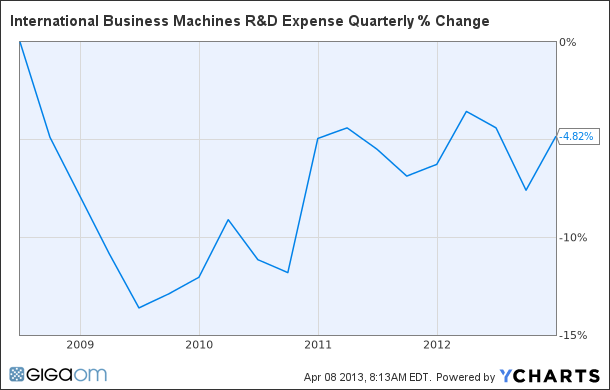
    Last year, USA Today reported that IBM was the sixth largest spender in R&D among U.S. companies — after Microsoft, Pfizer, Intel, Merck, Johnson & Johnson, according to S&P Capital IQ, spending $6.3 billion over the previous year.

    IBM R&D Expense Quarterly Chart

    IBM R&D Expense Quarterly data by YCharts

    Related research and analysis from GigaOM Pro:
    Subscriber content. Sign up for a free trial.


  • Condom Slingshot Gun Takes Applying Protection to the Extreme, Looks to Impress Bill Gates

    Recently, the Bill & Melinda Gates foundation posted a $100,000 grant offering to anyone who can help build a better condom. Why do we need a better condom? Well, increasing condom use around the world is key in the fight against sexually transmitted diseases and unwanted pregnancies.

    Gates acknowledges that the condom is the “most ubiquitous” but “potentially underutilized” products on the planet. And condom technology has been pretty stagnant for nearly five decades.

    Who’s going to step up and make a better condom? Or a better condom packaging? Or a better condom delivery system?

    Enter Joerg Sprave of the Slingshot Channel who today brings to you the contest’s first submission. Yes, it’s a condom slingshot. Yes, it technically improves upon the delivery of the condom. But…yikes?

    “Dear Mr. and Mrs. Gates,” says Sprave, “nothing fascinates male human begins more than guns and sex. So when we combine both, you must see the huge potential this has. So come on, pass over the 100 grand.”

    I know it’s not serious, but let me reiterate.

    Yikes.

    [JoergSprave via reddit]

  • eBay Deal of the Week: 1972 Jensen Interceptor FF

    JensenFF_1

    If you’re familiar with the Jensen Interceptor then you know that it was a grand touring hybrid of sorts. A combination of British style and American power, the Interceptor was one of those rare cars that never really saw the success it deserved. This is an unfortunate thing since Jensen was truly on the forefront of automotive development. What you are looking at here is a 1972 Jensen Interceptor FF, the worlds first four-wheel drive, V8 powered super-sedan. These cars were built in very limited numbers, so finding one in pristine condition is almost impossible. The one you are viewing here is currently up for sale on eBay and is reportedly the last one built in the third series of cars done between 1966-1972. Said to have gone through an extensive $160,000 restoration, this may in fact be one of the best remaining left. Click through to view more photos or click the link below to go directly to the auction.

    Source: eBayMotors.com

    Jensen Interceptor FF

    JensenFF_4

    JensenFF_5

    JensenFF_3

    JensenFF_2

  • Leaked pre-release version of Facebook Home available for download

    Facebook Home Leak
    Everyone who just can’t wait to get their hands on Facebook Home can now download a pre-release version of the software that’s apparently “buggy and incomplete.” MoDaCo has got its hands on a pre-release build of Home APKs — “the main Facebook (FB) app (‘katana’), the now-integrated-with-your-SMS Messenger app (orca) and the Home / Launcher ‘shell’ app (home)” — that will run a decent simulation of what the final build will look like once it’s released on April 12th. MoDaCo says that anyone interested in downloading the APKs needs to have a device with “a maximum resolution of 1280 x 768 and the ability to completely uninstall your existing Facebook app” and notes that anyone installing the APKs does so at their own risk. With the Facebook Home release just four days away, it’s hard to imagine too many people bothering with a bug-ridden early version of the software but it’s still interesting nonetheless.

  • Jenna Jameson Arrested on Battery Charges

    Ex-Porn Star Jenna Jameson is back in the headlines, but not for her movies or book.

    According to a Los Angeles Times report, Jameson was arrested this weekend on charges of misdemeanor battery. According to police, Jameson is accused of hitting an unnamed person at a house in Newport Beach, California on Saturday evening.

    The report states that the person Jameson is accused of hitting made a citizen’s arrest on Jameson and called police. A court date has been set for a hearing on the matter and Jameson was released on her own recognizance.

    This is the second arrest in one year for Jameson, who was arrested in May 2012 on D.U.I charges. In that incident, the former porn star drove into a light pole, fueling numerous “pole” jokes on Twitter.

    Jameson began acting in pornographic movies in the early 90s and quickly became one of the most-recognized porn stars in the world. Following her porn career, Jameson went on to found the website ClubJenna, which manages porn star websites. In 2004 she published an autobiography titled How to Make Love Like a Porn Star: A Cautionary Tale, which covers her early career in porn and became a New York Times best-seller.

    (Image via Twitter)

  • More evidence of the existence of Google Babel appears in string of code and pop-up message

    google_babel_appears_in_google_code

    We have been hearing rumors of a new Google unified messaging system called Babel for a couple of weeks now. As you know, Google has a lot of different services for communicating, and a new unified service could be just what the doctor ordered. We have seen some fake screenshots and some that look plausible,  but no real evidence of its existence.

    Well we have two things to show you today, which include a pop-up message as well as a string of code. The above shot is a string of code that contains references to a Babel app that will unsurprisingly include a video player. The below image is a pop-up message that +Patric Dhawaan got when going through his inbox. Now the only question is when will we see this new service? Perhaps at Google I/O or is this a longer term strategy since Google is looking into buying WhatsApp?

    Google_Babel_Pop-up_message

    sources: +PatricDhawaan / +RogaMoore
    via: PhoneArena

    Come comment on this article: More evidence of the existence of Google Babel appears in string of code and pop-up message

  • The Importance of Intangibles in Cloud TCO Analysis

    Ravi Rajagopal, Vice President at CA Technologies, has led and managed organizations that delivered innovative and practical technical and business solutions for corporations and governments around the globe.

    Ravi_Rajagopal-tnRAVI RAJAGOPAL
    CA Technologies

    In my last post, I discussed how the cloud changes the economic value of IT, and revealed a new model to understanding TCO and ROI. That’s the only way an organization today can make rational decisions about IT investments.

    One of the most popular cases for adopting the cloud is that it promotes organizational agility. Once you go cloud, the argument holds, the organization can now do things it never could do before, or can do established things much faster.

    Cloud Expands Horizons

    As an example, I know a company that recently switched from an on-premise call center to cloud-based solution. Among other things, moving to a cloud service now meant they could hire people all over the world, wherever there was an IP connection. Before, employees had to be on-premise at a limited number of locations.

    They gained access to a much larger labor pool. They could offer more flexible hours to employees, and even let them work from home or while traveling. And they opened up to new geographic markets they couldn’t even dream of servicing before. That’s agility.

    If we’re talking about making rational economic decisions about the cloud, how can we account for the transformative impact it can have? This is hard to quantify beforehand, as are many hidden infrastructure costs in IT. Most organizations remain blissfully ignorant about the full impact of these intangible costs.

    Focus on the Intangibles

    That makes it hard to arrive at a good, hard-dollar decision. But if you don’t focus on the intangibles, you won’t have a complete picture of the hard numbers. Once you have a handle on tangibles, start perimeterizing the intangibles. They might not be core to the decision, but you can get a sense of their boundaries.

    And the more data you have, the better the organization will be at making the decisions. That company that moved to a cloud-based call center? Their move to the cloud was initially close to break-even. Their understanding of the intangibles served to reassure them that they were making the right decision, economically and strategically.

    What are Your Outcomes?

    One way to measure the intangibles is to focus on the outcomes rather than on the inputs. You could, for example, start looking at some of the customer statistics, both in absolute numbers and in overall trending. For that to happen, you need a good baseline. You must also work with the same questions and parameters so you can make a valid before-and-after comparison.

    For example, you have the customer stat baseline that’s set before you made the transition. Once you’ve made the transition, you look again at your customer stat parameters. That will tell you whether you’re moving in the right direction, and how you can optimize your execution.

    Above all, it’s essential you understand your legacy environment, both tangible and intangible, so you can make a fully informed decision beforehand. Then, when you make the transition, you’re in a great position to compare.

    The broader discussion here is that there are substantial benefits to being a data-driven organization, which many organizations are not. Most businesses are measuring some things, but few are measuring everything. If you’re not a data-driven organization, taking a holistic approach to cloud TCO analysis is a great way to get started on becoming one—and the best, and perhaps only way, to really measure the cloud for business value.

    Industry Perspectives is a content channel at Data Center Knowledge highlighting thought leadership in the data center arena. See our guidelines and submission process for information on participating. View previously published Industry Perspectives in our Knowledge Library.

  • Google Fiber Probably Getting Ready For Austin Launch

    It looks like Google is getting ready to launch Google Fiber in Austin, Texas. The news was leaked prematurely, as reports came out that Google was readying what was thought to be a launch event.

    The invitations for the event reportedly said:

    On Tuesday, April 9, at 11 a.m., the City of Austin and Google will make a very important announcement that will have a positive impact on Austinites and the future of the city. We anticipate more than 100 community leaders and elected officials to be in attendance to celebrate this announcement. The event invitation is attached for your convenience. Although we cannot share the details of the announcement with you in advance, we know readers will want to learn more, so we encourage you to join us on Tuesday.

    It appears that Google prematurely posted the news on its blog, before taking it down. Engadget reports (via a tipster) that the news section on the Google Fiber “Cities” page was showing “Google Fiber’s Next Stop: Austin, Texas”.

    That is currently not showing up on the page. The latest Google Fiber news at this point is the April Fools’ joke about Google Fiber Poles.

  • Best of the Data Center Blogs for April 8th

    Here’s a roundup of some interesting items we came across this week in our reading of data center industry blogs.

    Are You Asking the Right Questions: Standards – At the Compass Points blog, Chris Crosby looks at the devolution of industry standards: ” Failure to ask for, and receive, objective evidence of a provider’s adherence to the standards that underlie their performance claims places the customer in the position of having to make their decision based more on the sizzle rather than the steak.”

    Meet DSSD, Andy Bechtolsheim’s secret chip startup – An interesting startup profile from Stacey Higginbotham at GigaOm: “For almost three years many of the creators of Sun’s Zettabyte File System have been slaving away in a Menlo Park, Calif. building trying to build a chip that would improve the performance and reliability of flash memory for high performance computing, newer data analytics and networking. Funded by Andy Bechtolsheim, the startup is called DSSD, and a recent hiring campaign plus the release of several patents offers some clues as to what this stealthy startup is about.”

    5 Ways to Fool-Proof Your Data Backup Strategy – At the RagingWire Enterprise blog, Jerry Gilreath shares tips on backup: “In honor of World Backup Day, I’d like to give you five points, of advice. These are by no means complete. They’re just common-sense notes from the perspective of someone that has been in the thick of it.”

    Honey, I Positively Pressurized the Hot Aisle! – Aisle containment is an extremely effective efficiency strategy. But it pays to get the right expertise, as Data Centers Unclouded notes in looking at a project that didn’t: “The end result was a hi tech-looking pod that looked like a duck, walked like a duck…. but it didn’t quack like a duck.”

    Cutting Confusion over Open System Software in the Data Center – At the Schneider Electric blog, Damien Wells looks at the various meanings of open: “With the use of data center management software and DCIM on the rise, the requirement for applications to be Open System is increasing. However, there has been some confusion in the use of terminology, especially between Open System Software and Open Source Software which has also confused the specific benefits that each type presents for the end user.”

  • It’s Not Women Who Should Lean In; It’s Men Who Should Step Back

    Men should read Lean Inso said friend and fellow HBR writer Nilofer Merchant. Three compelling reasons later, I had myself a copy of the book. While it might have been written as a treatise of what women could be doing to more of to gain more leadership positions in our organizations, and how we would all benefit from that happening, there was something else that stood out for me: it read as a pretty comprehensive list of things that the men have been doing wrong.

    More concerning still — it spent a lot of time encouraging women to copy us.

    There are two broad areas where the book offers advice. The first is how to get ahead in the workplace. Here, Lean In almost always prefaces its advice by first identifying areas where, relative to their male counterparts, women are (for want of a better term) “under-performing.” They aren’t as confident. They aren’t as ambitious. Men are more comfortable taking credit for their achievements, and there’s less cost to them individually when they do so. And so on. The assertions are often backed up with a big body of research.

    The problem comes not in identifying that there are differences between the sexes. The problem is that too often, the book simply asserts or assumes that in there being this difference, women have been doing something wrong.

    Let me give you an example: the relative difference in confidence between the sexes. In exploring this phenomenon, the book cites a research study of students in a surgery rotation; the study found that when asked to evaluate themselves, the female students gave themselves lower scores than the male students, despite faculty evaluations that later showed the women actually outperformed the men. Passed through the lens of Lean In‘s judgment, the ones at fault here are the women, for not being confident enough in themselves. The recommendation that comes later in the chapter: women should “fake it until they make it.”

    But is this really good advice?

    While Lean In might see the scenario as women lacking the confidence of men, there is a pretty glaring alternative hypothesis: it wasn’t the women who were lacking confidence — but it was the men who were too confident. It’s not that much of a stretch to suggest that the men who were more confident in their ability were the ones less likely to do the hard yards in preparation before the surgery rotation. The end result? They didn’t perform as well.

    And that’s the problem that runs throughout the book. Despite spending so much time citing research about the benefits of having women in leadership positions, a lot of its recommendations focus on, to put it bluntly, making women more like men, without proper consideration of whether that would actually be a good thing. As I read, I wondered: why is it the women who should be copying the men? Why can’t it be the men who could be well served by taking a page out of an entirely different book: that of the very women Lean In is advising to change? What it is about women that men could emulate to make our workplaces, our families, and our society in general a better place?

    And it’s not just behaviors in the workplace that Lean In takes this approach — it’s in career management, too. “Women are not less ambitious than men, they insist, but more enlightened with different and more meaningful goals. I do not dismiss or dispute this argument,” writes Sandberg. “There is far more to life than climbing a career ladder, including raising children, seeking personal fulfillment, contributing to society, and improving the lives of others.” And yet, having delivered that paragraph, the book then marches straight past it as if it never happened. In doing so, it takes one of the most important conversations we can have — that about building a career in the context of a life — and, for better or for worse, tips it upside down into a discussion about building a life in the context of a career.

    You don’t have to look very far to find evidence that thinking about life like this can come with serious costs. Clay Christensen, in the HBR article that was the prelude to the book that he, Karen Dillon and I worked on, talked about making it back to his HBS school reunions only to witness an ever-increasing number of his classmates unhappy from thinking about their careers in this way. And it’s far from just high-flying MBAs and executives that suffer from this problem: Bonnie Ware, who for many years worked in palliative care, articulately speaks to the same issue. She asked her patients about their regrets as they neared the end of their lives. Five themes emerged; I encourage you to go and read them. I want to quote just one: “‘I wish I didn’t work so hard.’ This came from every male patient that I nursed. They missed their children’s youth and their partner’s companionship. Women also spoke of this regret. But as most were from an older generation, many of the female patients had not been breadwinners. All of the men I nursed deeply regretted spending so much of their lives on the treadmill of a work existence.”

    The advice that Sandberg dispenses comes with serious costs. Those costs have traditionally been borne by men. But the book never considers that, rather than women not leaning in enough, that it actually might be men who have been leaning in too much. “Women rarely make one big decision to leave the workforce. Instead, they make a lot of small decisions along the way, making accommodations and sacrifices that they believe will be required to have a family.” “When asked to choose between marriage and career, female college students are twice as likely to choose marriage as their male classmates.” The book takes the research, applies its judgment to it, and implores women to change their point of view — because the men have it right. I’m not so sure, and nothing in Lean In convinced me otherwise.

    Early on in the book, Sandberg quotes Judith Rodin, president of the Rockefeller Foundation and one of the first woman to serve as president of an Ivy League university: “My generation fought so hard to give all of you choices. We believe in choices. But choosing to leave the workforce was not the choice we thought so many of you would make.” “So what happened?” asks Sandberg, before listing a number of reasons why it’s still incredibly tough for women to make it to the top. I don’t dispute any of them. But I want to posit that there’s another reason why so many women have chosen alternative paths, and it’s not because it’s difficult: it’s because that in terms of what generates sustained long term happiness in our lives, careers are a long way from the be all and end all, and women have simply done a better job of recognizing it.

    If men have taken the C-suite hostage, then Lean In presents with underlying symptoms of Stockholm syndrome. 50/50 is a worthy goal — both getting women in leadership, and getting men at home — but it’s not just important that it happens, but how it happens, too. That’s what I wish Sandberg had pushed for: not for more leaning in, but more pushing back from the current model.

  • Michael Arrington: Abuse Claims ‘Completely Untrue’

    TechCrunch founder Michael Arrington has finally responded to recent accusations from a former girlfriend and former friends and acquaintances he was physically abusive on numerous occasions.

    Last week, former girlfriend Jenn Allen made the claims on her Facebook page, alleging the Arrington physically and emotionally abused her and even threatened to kill her if she told anyone. She later left additional comment on a Gawker article, reiterating the allegations and also accusing Arrington of rape.

    Later, one of Arrington’s former friends and tech entrepreneur Jason Calacanis came out and said that he’d heard of these sorts of stories for a while. Other people from Arrington’s life surfaced, one claiming that it was the “worst kept rumor in the valley for years,” and that the abuse extended to multiple women.

    Now, Arrington has posted a brief response to the accusations. In it, he calls the allegations “completely untrue,” and says that he has instructed his lawyers to contact the proper authorities.

    Here’s the full response:

    There have been some extremely serious and criminal allegations against me over the last week. All of the allegations are completely untrue, and I’ve hired a law firm to represent me in the legal actions against the offending parties.

    I know this isn’t, for now, much information. I will have a full and complete response to these allegations sometime later this week. My goal will be to direct as much sunlight as possible on the issues so that the absolute truth can be known and I can begin to put my life back together.

    I’ve also asked my attorneys to contact appropriate law enforcement agencies about these false allegations. Given the gravity of the claims, I think it’s important that the police be involved in this now.

  • Water Street Backs CCBR-SYNARC

    Water Street Healthcare Partners has put an undisclosed amount into outsourced clinical services company CCBR- SYNARC. The deal is the first from Water Street Healthcare Partners III, L.P., which it closed last year with $750 million.

    PRESS RELEASE

    Water Street Healthcare Partners, a strategic private equity firm focused exclusively on the health care industry, announced today that it has invested in CCBR- SYNARC. Comprised of two businesses that specialize in outsourced clinical services, CCBR- SYNARC expands Water Street’s global presence in the pharmaceutical services sector. It also marks the health care firm’s first investment from its new fund, Water Street Healthcare Partners III, L.P., which it closed last year after receiving $750 million of investor commitments in less than eight weeks.
    CCBR-SYNARC is a highly specialized provider of clinical services to the world’s largest pharmaceutical and biotechnology companies. The company’s SYNARC business, based in Newark, Calif., specializes in imaging services, consultation and analysis to track progress throughout a clinical trial’s life cycle. Its CCBR business, headquartered in Copenhagen, Denmark, recruits patients from all over the world, and conducts and manages clinical trials in its dedicated clinical centers. Together, the businesses employ more than 500 doctors, nurses and technicians who are located in 29 research centers across Asia, Europe and The Americas. They currently focus their expertise in the musculoskeletal, cardiovascular and neurological therapies.
    “Water Street’s team has consistently demonstrated to us a deep understanding of our businesses since it first approached us about potential ways to work together several years ago,” said Dr. Claus Christiansen, founder and chairman, CCBR-SYNARC. “When we reached a point in our development in which we were ready to expand our capabilities and services, we knew Water Street was our ideal partner. Its experience in the pharmaceutical sector, business development expertise and extensive industry relationships will provide our businesses with the intellectual capital and resources to achieve long-term growth and success.
    The outsourced clinical development market is projected to grow as much as 5 to 10 percent per year over the next five years. With new regulations and global protocols leading to more complex drug development processes, pharmaceutical companies are increasingly turning to specialized providers such as CCBR-SYNARC to support them with particular aspects of their clinical trials.
    — more —
    2
    CCBR’s ability to recruit large patient populations from diverse markets and SYNARC’s high quality imaging capabilities have fueled the company’s growth since its founding in 1998.
    “Recruiting patients to participate in clinical trials can be a significant pain point for pharmaceutical companies and can cause costly delays in their drug development processes,” said Al Heller, an operating partner with Water Street who has more than 30 years of pharmaceutical experience. “CCBR-SYNARC stands out for its proven ability to both quickly recruit patients from targeted geographies and efficiently analyze images to support customers while increasing their clinical trial success rates.”
    CCBR-SYNARC expands Water Street’s group of companies specializing in health care products and services to 12. The firm is also an investor in AAIPharma Services Corp., a provider of pharmaceutical product development services. It sold its oral health pharmaceutical company, OraPharma, to Valeant Pharmaceuticals International, Inc. last year. Since its founding in 2005, Water Street has completed 39 transactions to create and grow a diverse group of market-leading health care companies.

    “We are pleased to build Water Street’s presence in the pharmaceutical sector with our investment in CCBR-SYNARC. The company is highly regarded as a partner that delivers results through its unique combination of scientific acumen, local market knowledge and proprietary technology,” said Peter Strothman, partner, Water Street. “We look forward to working closely with Dr. Christiansen to strategically expand both businesses’ unique capabilities.”
    Water Street has activated its newest fund, Fund III, with its investment in CCBR-SYNARC. The firm is seeking new opportunities to partner with corporations interested in divesting non-core health care businesses, and middle-market companies wanting to accelerate growth. Water Street targets investments ranging from $50 to $500 million in four health care sectors: distribution, medical products, health care services, and pharmaceutical products and services.

    About Water Street
    Water Street is a strategic private equity firm focused exclusively on health care. The firm has a strong record of building market-leading companies across key growth sectors in health care. It has worked with some of the world’s leading health care companies on its investments including Gentiva, Johnson & Johnson, Medtronic and Orthofix. Water Street’s team is comprised of industry executives and private equity professionals with decades of experience investing in and operating global health care businesses. The firm is headquartered in Chicago.

    The post Water Street Backs CCBR-SYNARC appeared first on peHUB.

  • AIQ Closes On $5M

    AIQ Inc. has raised $5 million in new capital, designed to expand the company’s online directory of financial advisors and publisher of syndicated personal finance content and advisor rankings. The Series A equity investors include Penton Media Inc.; Rory Curran, founder and former CEO of UK-based financial advisor software company 1st Software; and Peter Wilson-Smith, a founder of Financial News and efinancialnews.com.

    PRESS RELEASE

    AIQ, Inc. today announced that it has closed a $5 million private capital raise. The financing is designed to provide growth capital to further expand AdviceIQ, a groundbreaking online directory of trusted financial advisors and publisher of syndicated personal finance content and advisor rankings.

    “Our newly closed equity funding permits us to expand upon current investments in sales and marketing, technology enhancements and other aspects of our business,” stated Nicholas W. Stuller, co-founder & CEO of AIQ, Inc. “Deploying this capital to extend the AdviceIQ platform represents a material business opportunity to all of our investors and will ensure we maintain our first-to-market advantage.”

    Currently, over 2,400 financial advisors have passed the unique due diligence that is required in order to participate in AdviceIQ. Each has been certified to have passed the strictest industry regulatory due diligence, ensuring the directory is comprised of only fully vetted financial advisors. Designed to provide consumers with rich personal finance content, AdviceIQ also employs geo-targeting technology so investors can locate financial advisors in their neighborhood who are well matched to each investor’s special needs.

    In addition to profiles, AdviceIQ publishes advisor-contributed articles on wealth management, investing and the advisor/consumer relationship, advisor rankings and original personal finance articles under the direction of Editor-in-Chief Larry Light, formerly Deputy Editor of Personal Finance for The Wall Street Journal. AdviceIQ also syndicates content through media partners. Current partners include Morningstar, The Online Investor, Minyanville, The Motley Fool, National Real Estate Investor, Retail Traffic and Business Insider.

    “Our singular mission is to help individual investors access fully-vetted, trustworthy advisors who can help them take charge of their wealth and financial planning,” says co-founder and CFO Gary Liberman. “Our research and due diligence process reduces consumer exposure to advisors who have violated securities law. With AdviceIQ as a point of validation, listed advisors are effectively positioned to distinguish and locally promote their brands, reinforce client relationships and reach new prospects. We are excited to show investors the virtues, quality and worthiness of the retail financial professional,” Mr. Liberman concluded.

    A growing number of broker-dealers and other advisor platform firms have subscribed to AdviceIQ to vet and showcase their advisors. Participating firms include American Portfolios Financial Services, Money Concepts Capital Corp., Securities Service Network, and well known Registered Investment Adviser firms including Evensky & Katz, Xpyria Investment Advisors and Financial Security Advisory, Inc. The Financial Planning Association has also entered into an agreement with AIQ, Inc. so that its members can avail themselves of AdviceIQ at advantageous subscription rates.

    The Series A equity investors include new and existing investors such as Penton Media, Inc. publisher of WealthManagement.com, Trusts & Estates, and many leading business websites; Rory Curran, founder and former CEO of UK-based financial advisor software company, 1st Software; and Peter Wilson-Smith, a founder of Financial News and efinancialnews.com, now owned by Dow Jones; among other leading senior executives in the financial services, media, and technology industries.

    About AIQ, Inc.:

    AIQ, Inc. publishes the popular Meridian-IQ suite of Financial Advisor directories, licensed by over 500 major fund companies, broker-dealers and insurance companies for industry research and marketing purposes. AIQ is led by a veteran Wall Street team who are subject matter experts on retail financial advisors and investing. Its consumer-facing product, www.AdviceIQ.com, combines daily personal financial journalism with listings and rankings of pre-vetted Advisors that are certified to have passed AdviceIQ’s proprietary Regulatory Compliance Review (RCR(TM)), the strictest industry regulatory due diligence.

    RCR(TM) attests to the quality of an advisor’s compliance history. This due diligence encompasses the entire disciplinary and complaint history of all four major U.S. regulators: Financial Industry Regulatory Authority (FINRA), Securities and Exchange Commission (SEC), State regulators who license Investment Advisor Representatives and State Insurance Commissioners. Investment firms pay an annual subscription fee to have each financial advisor undergo the RCR(TM) screening. Only advisors who successfully pass the vetting process may have their profiles posted on www.adviceiq.com. RCR(TM) prevents advisors with serious infractions from appearing in the published listings and rankings. It also excludes advisors censured by one regulator, who then move to another financial services industry and would otherwise escape scrutiny. AdviceIQ provides investors with access to trustworthy advisors who can help them take charge of their wealth and financial planning.

    The post AIQ Closes On $5M appeared first on peHUB.

  • HTC posts worst-ever earnings in Q1 as profit plummets 98%

    HTC Earnings Q1 2013
    Struggling smartphone vendor HTC (2498) on Monday said that expects to report its lowest quarterly profit on record for the first quarter of 2013 as the full impact of the delayed HTC One launch finally takes shape. The Taiwan-based vendor reported unaudited earnings for Q1 2013, during which net profit totalled just $2.8 million, down a shocking 98% year-over-year, on $1.4 billion in sales. HTC pointed to the delayed release of its flagship HTC One smartphone as the cause of its catastrophic quarter. The company stated earlier that it had trouble sourcing certain components for the phone, resulting in delays. The One will now launch later this month and go head-to-head with Samsung’s (005930) Galaxy S4, sales of which are expected to total 20 million units during the phone’s first two months of availability.

  • Reuters – MISC Bhd Says Petronas Offer Not Fair

    Malaysian shipping group MISC Bhd said a revised $3 billion offer from shareholder Petronas to buy out all remaining stock was not fair, because it was lower than the combined valuation of its different divisions, Reuters wrote. State oil company Petroliam Nasional Bhd, which already owns nearly 63 percent of MISC, on Friday raised its offer to 5.50 ringgit per share from 5.20 ringgit after the Employees Provident Fund, MISC’s other major shareholder with nearly 10 percent, said the original bid was unattractive.

    (Reuters) – Malaysian shipping group MISC Bhd said a revised $3 billion offer from shareholder Petronas to buy out all remaining stock was not fair, because it was lower than the combined valuation of its different divisions.

    State oil company Petroliam Nasional Bhd, which already owns nearly 63 percent of MISC, on Friday raised its offer to 5.50 ringgit per share from 5.20 ringgit after the Employees Provident Fund, MISC’s other major shareholder with nearly 10 percent, said the original bid was unattractive.

    “The revised offer price is not fair as the indicative sum-of-parts valuation of the MISC group is above the revised offer price,” MISC said in a local stock exchange filing on Monday, basing its opinion on recommendations by independent adviser AmInvestment Bank.

    Nevertheless, MISC said it agreed with AmInvestment Bank’s recommendation to shareholders to accept the revised offer, which it said was reasonable in view of the risks and challenges the company faces going forward.

    AmInvestment said the shipping business is facing acute overcapacity, low demand and depressed charter rates. High bunker fuel prices will also continue to put downward pressure on MISC’s profitability.

    Its shares ended the day 1.10 percent lower at 5.40 ringgit per share, while the benchmark stock index fell 0.04 percent. (Reporting By Yantoultra Ngui; editing by Jane Baird)

    The post Reuters – MISC Bhd Says Petronas Offer Not Fair appeared first on peHUB.

  • What next for The Week? The content curator’s plans for the digital domain

    When The Week launched in 2001, the Wall Street Journal asked if its owner was “mad” to take on famous weeklies like Time and Newsweek. Over a decade later, those publications are on the ropes, while the The Week has defied the odds to become profitable both online and in print.

    In a recent interview, CEO Steven Kotok explained how The Week has bucked the fate of the troubled magazine industry, and how the publication plans to stay relevant in the future.

    An American Aggregator

    The idea of a “weekly” news magazine seems quaint in the age of the internet, but The Week has carved out a niche by distilling current events into a smart bundle of excerpts and opinions. It aspires to provide tight writing and snappy headlines that let readers feel in-the-know about news, culture and policy.

    According to Kotok, this style of curation was considered a “weird thing” when The Week launched and the site had to persuade advertisers it was viable. Now, nearly publication does it one form or another  – a situation that would seem to erode The Week’s strategic advantage. But Kotok says the publication is still growing its subscription base by catering to a distinct “psychographic” (read: affluent, educated folks) and by promoting a left-right political discourse.

    “Kids buy it for their parents and vice versa. You might buy it for your conservative uncle or your liberal nice – it’s a way to get the other side in.”The Week Cover

    The pitch appears to be working. The company says it has a rate base of 550,000 readers and annual revenues of about $50 million. It says it has had annual profits of between $4 million and $5 million in each of the last three years.

    Most of that profit is coming from home subscription sales (fewer than 1% of its readers come by way of a newsstand) but, increasingly, The Week is looking to the web to make money.

    Building the digital domain

    With a few exceptions, like the Atlantic, legacy print titles have fared badly online – slow starting and caught between two worlds, they lose to digital natives.

    In the case of The Week, Kotok admits it was late to develop a web strategy, but says its site is now profitable. Citing February comScore numbers of 2.3 million unique visitors, he says The Week has surpassed the Economist in two of the last three months.

    The Week’s website doesn’t reproduce the magazine’s content but instead offers a stream of smart, snackable news bites along with “Guilty Clicks” from around the web (“Do we really need a drone hoodie”, Ke$ha, etc). The online fare is produced by a separate group of writers that represent about half of The Week‘s 29-person editorial team.

    The site earns its keep by selling advertising to major companies like IBM, Xerox and Zurich Insurance but also serves as a vehicle to heavily promote its print cousin. Kotok credits the site with bringing in $1 million a year worth of magazine subscriptions.

    On the tablet front, Kotok says iPad advertising and subscriptions (access is free for print subscribers) are producing almost $1 million in sales but that the Apple relationship is difficult. “It’s hard because we’re used to having a reader relationship but Apple controls that. Sometimes they promote you and sometimes they don’t.”

    The future: commerce not a tin cup

    Having discovered that readers are not put off by price increases — The Week‘s average annual price has risen from $30 to $50 in the last six years — Kotok says he is now focused on revenue rather than subscriber growth. Gift subscriptions, which are a big part of The Week’s business, will be an ongoing source of income but, in the long run, the company still confronts a magazine business that is in wide and permanent decline.

    The Week also faces a more immediate challenge in the Post Office’s plan to end delivery on Saturday (the day the magazine arrives in readers’ mailboxes). Kotok says he can meet the Saturday challenge by shifting production schedules, but that the publication is also focusing on developing other revenue streams – a tactic that is becoming necessary to media outlets of all kinds.

    For now, he says, that will not include a paywall or donations experiment of the sort being conducted by Andrew Sullivan. Instead, The Week is betting on ecommerce to compliment its editorial strategy. “We won’t put out a tin cup. Many of our subscriptions are gifts so our ecommerce will be too,” Kotok says, suggesting that The Week fans will buy each other t-shirts, books and more.

    The Week’s ecommerce experiment will be helped by its 2011 acquisition of Mental Floss magazine, which has an online store that brings in 30% of its $10 million. Items for sale include smart people t-shirts (“Pi Hard,” “Spell Czech”) and quiz books. In its push into retail, the company will be joining the likes of Gawker Media and Thrillist, which are likewise trying to leverage content into ecommerce.

    paidContent Live: April 17, 2013, New York City. Register Now

    Related research and analysis from GigaOM Pro:
    Subscriber content. Sign up for a free trial.


  • DeepFlex Seals PE Investment

    DeepFlex, a manufacturer of unbonded composite flexible pipe used in subsea oil and gas production environments, has sealed investments from Brazilian PE firms Mare Investimentos and Mantiq Investimentos. The company also inked funds from existing investors AEM Capital and Promon International of Brazil and Energy Ventures, Klaveness Marine, and Mobelmagasinet Tvedt of Norway. Details of the investment round were not disclosed.

    PRESS RELEASE
    DeepFlex, the world’s only manufacturer of premium unbonded composite flexible pipe used in challenging subsea oil and gas production environments, announced today that it has entered into a significant funding agreement with funds co-managed by two of Brazil’s leading private equity firms, Mare Investimentos and Mantiq Investimentos. Additional funding is also being provided by existing investors AEM Capital and Promon International of Brazil and Energy Ventures, Klaveness Marine, and Mobelmagasinet Tvedt of Norway.

    The combined equity investment from both new and existing investors will support DeepFlex´s strategic development plan to establish a manufacturing center in Brazil, where the Company recently opened an office staffed by experienced business development and technical personnel. The Brazilian market represents over 65% of the worldwide demand for unbonded flexible pipe used in offshore production and this expansion plan will allow DeepFlex to serve this key market as well as satisfy local content objectives. The use of proceeds will also fund an expansion of the Company’s U.S. manufacturing capability to support existing backlog and an expanding order book.

    Mike Kearney, President and CEO of DeepFlex, said: “As DeepFlex continues to build momentum in the flexible pipe marketplace, we are pleased to secure the funding necessary to expand the Company’s global market reach, in particular, serving the world’s single largest market. The capital transaction we are announcing today will transform DeepFlex into a company with substantial flexible pipe manufacturing capacity and engineering capabilities to serve all major offshore production markets. We appreciate the commitment of our employees, the ongoing support of our current investors and welcome Mare and Mantiq to the DeepFlex team.”

    About DeepFlex:
    With offices in the United States and Brazil, DeepFlex designs and manufactures premium composite flexible pipe for use in the subsea oil and gas production environment. As the world’s only manufacturer of unbonded composite flexible pipe for deepwater applications, the patented DeepFlex products are lighter, less costly to install, and do not suffer the corrosive effects of harsh environment service. In addition, the DeepFlex technical staff assists customers with the design of their subsea production configurations. DeepFlex was established in 2004 and is growing rapidly to meet the needs of oil and gas companies working in the world’s major offshore producing regions. Additional information on the Company can be found at www.deepflex.com.

    About Mare Investimentos:
    Mare Investimentos is a private equity fund manager founded in 2009 by executives with significant experience in oil and gas, natural resources and financial companies, focused on investing in the supply chain of goods and services for the oil and gas business.

    About Mantiq Investimentos:
    Mantiq Investimentos, a subsidiary of Banco Santander Brasil, is a private equity fund manager focused on infrastructure and oil and gas services, with USD 1.2 billion in assets under management. Mantiq is backed by some of the largest Brazilian institutional investors and its portfolio includes investments in renewable power generation, water, sewage, environmental services, and toll roads. Notably, Mantiq manages a large equity stake in Renova Energia, the largest wind power company in Brazil.

    About The Funds:
    Mantiq and Mare co-manage the funds Brasil Petroleo 1 & 2, with aggregated capital commitments of USD 370 million. Its investors are large Brazilian institutions, primarily pension funds, and high net worth individuals. DeepFlex is the first investment of the Brasil Petroleo funds.

    The post DeepFlex Seals PE Investment appeared first on peHUB.