Blog

  • Microsoft’s clueless response to ‘always on’ Xbox

    I should first clarify that the “clueless” response is not an official Microsoft comment, but comes from one employee who took it upon himself to cause the entire company trouble. We have been hearing a lot of rumors regarding the next Xbox that is expected to be announced at the upcoming E3 gaming conference, which kicks off June 5. Much of what has been floating around the internet surrounds anticipation of the “720” being an “always-connected” device. In other words, customers would not be able to game without an internet connection.

    The furor around “always on” is mostly about DRM and the used-game market, but it also means that no game would play if your connection happened to go down. Microsoft has never confirmed this to be the case, though it also has not refuted the possibility.

    Now Adam Orth, the Creative Director at Microsoft Studios, has decided to take to his Twitter account and tackle the rumors and, in the process, insult pretty much everyone who followed him. Part of the exchange that took place is what follows.

    Adam_Orth – Sorry I don’t get the drama around having an “always on” console. Every device now is “always on”. That’s the world we live in. #dealwithit

    Manveerheir – Did you learn nothing from Diablo III or SimCity? You know some people’s internet goes out right? Deal with it is Sh***y response.

    Adam_Orth – Electricity goes out too.

    Manveerheir – You’ve live in LA, SF, Seattle…very connected places. Try living in Janesville, WI or Blacksburg, VA.

    Adam_Oth – Why on earth would I live there?

    Soon after this happened, Orth’s Twitter account was changed to private, meaning nobody who is not following him can read the exchange and all followers must be approved.

    As I previously stated, we really have no idea if the next Xbox will actually ship with this “feature”, though Orth seemed to indicate that it could. In my opinion, it would result in a huge backlash against Microsoft, as if Orth has not already caused the company enough trouble.

    Photo Credit: Denis Belyaevskiy/Shutterstock

  • The BlackBerry Q10 Is Now Available For Pre-Order In The UK

    bbq10-8

    Good news, Steve O’Hear. The physical QWERTY isn’t dead! The BlackBerry Q10 is now available for pre-ordering in the UK and ships at the end of the month.

    BlackBerry’s second BB10 device will be available on Vodafone, O2, Orange, T-Mobile, Three, EE, and TalkMobile. Carphone Warehouse lists the device at £579.95 SIM-free or free on a 2-year, £36-per-month, contract. That’s on par with other devices in the UK market.

    As for other markets, BlackBerry’s blog posting states “we’ll have details on availability to follow soon.” Whatever that means.

    The Q10 is the BlackBerry Bold of the BB10 era. It’s positioned as a top-tier QWERTY device — the best BlackBerry can build. Where the Z10 is a pure touchscreen device, the Q10 is a hybrid, featuring a 3.1-inch touchscreen on top of a QWERTY keypad.

    We spent a bit of time with the Q10 at BB10′s launch in January. It’s a worthy successor of the solid BlackBerry Bold. In fact, BlackBerry power users should be more interested in the Q10 than the Z10. It’s that good. But, if that’s you, it would still be wise to play with one yourself instead of simply pre-ordering.

  • Lotus Exige S: The Ultimate Lotus?

    Lotus Exige S

    If you’re a fan of sports cars then you know unequivocally that the Lotus Exige S is one of the worlds best performers. They’re lightweight, powerful and handle like its tires are made out of glue. Power comes from a 3.5-L supercharged V6 that makes 345 hp and 295 lb.ft. of torque. This equates to a top speed of 170 mph and a 0-60 time of less than 4.0 seconds. It’s the giant killer of the super car world and even though it seems like it’s been around forever, there is no denying that the Exige S continues to impress at every corner.

    Source: Youtube.com

  • Googlers Turn Sergey Brin’s Tesla into a Pink Batmobile for April Fools

    Now this is an April Fool’s Day prank on the boss.

    Apparently, some Google execs decided to mess with co-founder Sergey Brin’s car earlier this week. They proceeded to transform his Tesla Model S into a pink batmobile, complete with headlight eyelashes, batwings, and a giant batman logo.

    Awesome.

    Google search quality analyst Nathan Johns posted a photo of the reconfigured Tesla Model S. Barry Schwartz over at Search Engine Roundtable tracked down a thread on the Tesla Motors Club forums that confirms that the pink batmobile Tesla is most likely Brin’s ride.

    This is funny, and it’s made even funnier when you remember all of that “Sergey Brin is Batman” stuff that started flying around Google HQ a couple of years ago surrounding developments in Google X.

  • Facebook Home: A bigger deal than you think

    Facebook Home Analysis
    Facebook’s (FB) announcement of Facebook Home, coming soon to Android, was perhaps the most impressive thing Facebook has launched since the “like” button. Available initially on the HTC First on AT&T (T), Facebook is trying to increase engagement, and with this new “version” of Facebook, I can definitely see that happening. CEO Mark Zuckerberg said phones have primarily been built around apps, and with Facebook Home, that’s changing. Smartphones are now built around people, as people want to know what’s going on with those around us.

    Continue reading…

  • Watch the complete ‘Building New Experiences with Glass’ presentation from SXSW

    Google_Glass_SXSW_Timothy_Jordan

    Last month we told you about a Google Glass presentation at SXSW in which they showed early stages of popular apps designed for Glass. The presentation was called “Building new experiences with Glass”, and it just became available for all to see. It’s about 50 minutes long so you will want to make sure you set aside some time for this one. The presenter was Timothy Jordan, who is a developer advocate at Google on Glass. He gives a sneak peak at the Google Mirror API, which is what developers will use to build apps for Glass. He walks through the building blocks as well as show early builds of Evernote, The New York Times, Path, and Gmail.

    The concept behind Google Glass is giving you information when you need it, and Timothy said this regarding current tech vs Glass:

    “It feels like tech is often getting in the way more than it needs to and that’s what we are addressing with Project Glass. It’s so that you can still have access to the technology that you love, but it doesn’t take you out of the moment.”

    Hit the break for the full video.

    Click here to view the embedded video.

    More information: +TimothyJordan

    Come comment on this article: Watch the complete ‘Building New Experiences with Glass’ presentation from SXSW

  • Rep. Adam Schiff To Propose Pro-Privacy Amendment To CISPA

    This year’s CISPA is just like last year’s CISPA. That has some privacy groups concerned as the bill makes it easier for companies to share private information with the government while granting them immunity. To help address these concerns, one lawmaker will be introducing an amendment to CISPA next week.

    The Hill reports that Rep. Adam Schiff will be introducing a pro-privacy amendment during the House Intelligence Committee’s markup of CISPA. The amendment would make companies do their damnest to remove personally identifiable information from any data that they share with government.

    Beyond that, the amendment would also allow companies to use automated processes in removing personal information from data. The automated removal of information would serve two purposes – it would make the removal of information more accurate, and it would speed up the process to better counter cybersecurity threats.

    The amendment is a great first step to making sure CISPA protects privacy, but Schiff has indicated that he has yet to reach a consensus with the bill’s authors – Reps. Mike Rogers and Dutch Ruppersberger. Fortunately, Schiff says that the tech industry has yet to raise any objections to his amendment.

    Even with the support of industry, Schiff’s amendment may not make it into CISPA. What’s worse is that we won’t even know what actually happened until after the fact thanks to the committee holding the CISPA markup behind closed doors. Still, there’s a small sliver of hope resting on Schiff’s shoulders as the congressman said that he wouldn’t vote CISPA out of committee unless it had his amendment, or another suitable pro-privacy amendment, tacked on to it.

    Even with these proposed amendments, there’s always the chance that CISPA can worm its way through the House just like it did last year. After that, it will be up to the Senate and White House to make sure that it doesn’t go through without reasonable privacy protections.

  • Target Dress: Apology Issued For “Manatee” Size Tag

    Though a majority of Americans are now overweight and are predicted to get larger in the coming years, those who are overweight still have to contend with body image issues on a daily basis. While the magazine section at the grocery store is well-known to be a place where body issues will be confronted, a department store is generally not expected to criticize people’s weight.

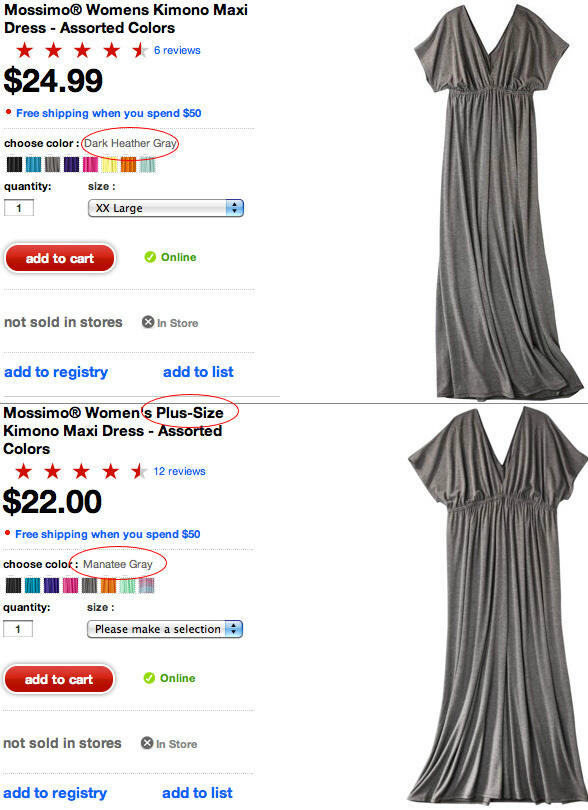
    This week, one Target shopper stumbled onto what seemed to be a tacit criticism of overweight people. Susan Clemens was shopping on Target’s website when she noticed that the color for a plus-size dress was listed as “Manatee Gray.” She checked the non-plus-size version of the dress and found that the same color was listed as “Heather Gray.”

    Clemens tweeted her findings and, as these things tend to do on the internet, it began to spread. The comment sparked debate over whether the garment industry disapproves of overweight people, while also fueling a debate about how women are portrayed in media.

    Within a day Target responded to Clemens, telling her they had a team looking into the matter. The store later told Forbes that “Manatee Gray” is a color used for many different products, and that in this particular case the people responsible for creating the listings had not communicated properly. Though the proper color for both sizes of the dress is “Manatee Gray,” the color is now listed as simply “Gray.”

    Target has issued a direct apology to Clemens via Twitter:

  • Want To Build Something For Google Glass? This Video Is A Good Place To Start

    Google held a developer talk about Google Glass at SXSW last month. Developer advocate Timothy Jordan spoke to developers about the Google Mirror API, which is what they’ll use to build services for Glass. He also gave a demo, and talked about guidelines and examples of new experiences that they’ve been building.

    “Glass is a very ‘right now’ device,” he says. “So when you deliver data to the user, you want to do it in the moment, and keep it up to date.” It should matter to them based on what they’re doing right now, he says.

    Other tips include staying out of the user’s way (it will be interesting to see if Facebook Home makes its way to Glass) and “avoiding the unexpected”.

    He shares something they’ve been working on with the New York Times, which shows headlines over top of photos (actually not unlike status updates on Facebook Home), and lets you click to have the article read aloud.

    He also shares an email exchange.

    Give it a watch:

  • Your Customers Know You’re Watching Them

    As companies use the power of data to develop customer intelligence, there seems to be significant anxiety about not wanting to appear overly invasive to consumers. Executives devote a disproportionate amount of time to ensuring that customers understand that their data collection abides by data-protection standards. They also scratch their heads to come up with new, non-threatening terminology about data collection when speaking to their customers. Contributors to HBR.org have frequently emphasized the need to manage consumers’ perception about data collection, so that they do not feel like the world is quickly turning into an “Orwellian nightmare.”

    Apprehension about gathering customer data is understandable. It is important to respect our customers’ privacy and clearly explain data collection practices. However, this anxiety also reveals a lack of faith in our customers. It begins with the presupposition that customers do not understand the vast benefits of gathering data and the ways that data can directly improve the quality of their lives. This is a false assumption.

    Big data has introduced a cultural shift that goes far beyond the vendor-consumer relationship. Police departments use data in conjunction with geolocation software to ensure that officers are more efficiently deployed to proven crime hot spots. In the field of medicine, data about human behavior allows doctors to make more accurate health care recommendations. Our customers are part of this larger cultural shift. They are slowly beginning to realize that data collection is not inherently nefarious; rather, it has the potential to make our lives safer, healthier and happier.

    Companies need to shift from assuming their customers are afraid of big data to believing that customers understand the benefits that it affords them. For this relationship to work, companies must first focus on establishing a strong relationship with their customers, based on a foundation of trust.

    Of course being open with our customers about which data we are tracking and to what end is an important step towards allowing customers to be in control of the relationship and not in a position to be manipulated.

    But the best way to build trust with customers is to offer them something they value in return for their data.

    At the most basic level, this means using customer data to better anticipate their needs. When a consumer calls a customer care line because they have a problem with a product, for instance, the phone call is much more efficient when there is a record of the customer’s previous interactions with the company. When you are able to communicate that your goal is to make the customer’s experience with your company more pleasant and less time consuming, the prospect of data collection becomes more palatable.

    Consumers are also overwhelmed by the vast amount of email they receive from companies as a result of being asked to share their email address. A recent study by the Radicatti Group reveals that as much as 83% of all email traffic is spam. Reducing that amount of clutter by better targeting communications is another goal the customer can get behind, even if it involves sharing more of their information. Offering your gratitude, such as offering a discount for signing up or access to special “member only” deals, is an even better way to show the customer that you value and respect their data.

    The bottom line: if customer information is valuable to you, make sure you use it to offer them value in return.

    The emergence of big data has resulted in a profound cultural shift and we’re only just coming to terms with it. Our customers put their faith in us on a daily basis by giving us their data. They believe that this data will be used to improve the quality of service they receive. In return, we need to have faith in our customers. We need to trust that they understand the ways in which big data affects them and value how it makes their lives easier.

  • T-Mobile Opens Up iPhone 5 Pre-Orders

    Just under two weeks ago, T-Mobile announced at long last, they were finally going to carry the iPhone 5. At the time, interested customers to pre-register for their device.

    Today, official pre-orders begin. You can access all the iPhones that T-Mobile offers here.

    The 16GB iPhone 5 starts at $99.99, with a monthly payment of $20 per month got 24 months. Without the plan, it’ll cost $579.99 up front. The 32GB iPhone with with run $199.99 with a 2-year plan, $679.99 without. And the 64GB device will cost $299.99 with the plan and $779.99 without.

    The phone will ship on April 12th.

    Also, if you want a cheaper option, T-Mobile is offering the iPhone 4S for $69.99 down and $20 per month for 24 months and the iPhone 4 for $14.99 down and $15 per month for 24 months.

    “This is an important day for people who love their iPhone but can’t stand the pain other carriers put them through to own one,” said John Legere, president and CEO of T-Mobile USA when he announced the addition. “We feel their pain. I’ve felt the pain. So we’re rewriting the rules of wireless to provide a radically simple, affordable iPhone 5 experience — on an extremely powerful network.”

    Speaking of pain, plenty of T-Mobile customers painfully waited for the company to offer the iPhone 5. As you probably know, T-Mobile was the last of the major U.S. carriers to offer the device, trailing AT&T, Verizon, and Sprint.

    Apple’s App Store went down early this morning, but it wasn’t because of the T-Mobile addition. When buying an iPhone via the Apple online Store, T-Mobile has yet to be included as an option.

  • Long-form journalism site Longreads joins The Atlantic’s digital network

    Longreads and The Atlantic have created a partnership that will feature Longreads content across The Atlantic‘s digital properties, the companies announced Friday.

    Longreads, founded by former Time Inc. editor Mark Armstrong in 2009, features daily links to long-form journalism and fiction around the web. It started out as a Twitter hashtag and has grown into a website that includes paid memberships for $3 a month or $30 a year, giving members access to exclusive content.

    Longreads remains an independent company, and Armstrong — who is also the editorial director of consume-it-later service Pocket — will retain control over the content featured on the site. The Atlantic will provide support on the business and operations side and will feature Longreads content across its digital properties — The Atlantic.com, TheAtlanticWire.com and The AtlanticCities.com — as well as on its mobile apps. Armstrong told me that the move is a way for Longreads to build up its membership model and “explore new models for supporting long-form journalism.”

    “I’ve watched with interest as Mark Armstrong and the Longreads team have built a socially engaged community that is passionate about great journalism,” Atlantic president M. Scott Havens said in a statement, “and I’m excited to work with them to bring these kinds of stories to our more than 20 million digital readers.”

    Related research and analysis from GigaOM Pro:
    Subscriber content. Sign up for a free trial.


  • Apple’s iPhone 5 now available for preorder at T-Mobile

    T-Mobile iPhone 5 Preorders
    It took nearly six years but T-Mobile has finally managed to add Apple’s (AAPL) iPhone to its smartphone lineup. Beginning on Friday, T-Mobile subscribers can preorder the iPhone 4, iPhone 4S or iPhone 5 on T-Mobile’s website. With the carrier’s new no-contract policy, the iPhone 5 starts at $579.99 for the 16GB model, which can be paid up front or as a $99 down payment plus 24 monthly installments of $20. The iPhone 4S can be had for $69.99 up front and 24 payments of $20 per month, and the iPhone 4 costs $14.99 up front plus $15 per month for 24 months. T-Mobile notes that the iPhone 4S and iPhone 4 are only available in select markets, while the iPhone 5 is available nationwide.

  • March Madness: Lessons for Networks

    David White is President North America for Ipanema Technologies. White is a senior executive with more than 25 years experience in sales, marketing and business development, with a background in WAN Optimization.

    David-White-smDAVID WHITE
    Ipanema Technologies

    March Madness, the largest NCAA college basketball tournament in the nation has a reputation for impacting work productivity at companies throughout the United States. The annual, month-long single-elimination tournament is in its 75th anniversary and is being broadcast by CBS online. Since the early round games take place during the workday, the bad news for businesses grows past productivity into how their WAN is being used during these days.

    The bandwidth capabilities of company networks have been pressured as many dedicated fans stream the tournament from their office computers throughout the week. While U.S. businesses anticipated a spike in demand for network resources during March Madness, data centers, Wide Area Networks and companies alike also prepared, lest they risk the performance of business critical applications.

    Mad for Networks

    During previous March Madness tournaments, there have been 2.4 million daily unique viewers following the games. The growth of access to the Internet at work will stress U.S. corporate networks like never before. Not only can games be watched on computers, but now mobile devices can stream content. According to a 2012 report, Challenger, Gray & Christmas, an outplacement firm, estimates that more than 2.5 million unique visitors per day each spent an average of 90 minutes watching games.

    What These Challenges Mean

    According to a Harris Interactive poll, 64 percent of Americans watch online video while at work. As the games occur during business hours, employees are highly likely go online to track their favorite teams. So take the stats mentioned above, and imagine the impact it could have on businesses should their employees flock to watch March Madness and their networks not be able to withstand the increase in demand.

    According to a survey by Modis, a global provider of IT staffing and recruiting services, two in five IT professionals report March Madness impacted their network in the past, with about a third reporting system slowdowns or complete crashes. If companies aren’t prepared, their business critical applications will be affected as they compete against YouTube and online video for limited resources. IT departments need to know how to guard against this.

    According to a leading analyst house, application performance problems really matter. Losing a mere 5 minutes per day costs 1 percent of overall productivity! It’s also important to consider that applications are a huge investment, costing roughly an average of $360/employee/month when maintenance and up-front cost is considered. With all this at stake it makes sense to protect that investment.

    Why Bandwidth isn’t the Complete Answer

    There are two solutions: companies can purchase more bandwidth before March Madness (or other known high-interest events) or companies can use what they have more effectively through Application Performance Guarantee solutions, which control and dynamically guarantee critical applications performance across networks.

    Adding more bandwidth isn’t the solution, as more bandwidth is rarely enough. Non-applications are bandwidth hungry and the more bandwidth you have, the more bandwidth they consume. They will systematically cannibalize critical application performance. And the added resources will never guarantee critical application performances.

    Application traffic tries to use up all the available bandwidth. Simply increasing it is like filling a bottomless pit: expensive and never enough to satisfy the ever-growing usage demands. The additional traffic may also hinder the performance of the business critical and often resource thrifty applications.

    It’s Not Size — It’s Sophistication

    The answer lies in having solutions that allow an IT department to control applications as they flow across the network.

    Not deploying an Application Performance Guarantee solution implies uncertain business application performance and control that may involve lost of productivity and end users complaints – Enterprises’ carry on running IT in a reactive mode that is neither optimum for the business nor satisfying for the IT department. Business applications continue to suffer from bad and/or unstable performance while the network is still over-sized. Unsatisfied users and business managers continue to complain. The WAN is unnecessarily upgraded without solving application performance and end-users experience troubles.

    Managing Traffic

    If we think of networks as roads, and applications as cars, an Application Performance Guarantee solution might be a police officer. It can direct cars into appropriate queues. It can slow cars that are less critical to the business (for instance, the YouTube car) and prioritize those that the business depends on (such as the Salesforce or SAP cars). This then allows vehicles to get to their destination in a timely, secure fashion – regardless of the amount of traffic on the ‘road’.

    As March Madness concludes, it is just one example that demonstrates the need for Application Performance Guarantee solutions. These technologies will continue to grow, helping enterprises to face Internet traffic growth challenges in an easy and user-friendly way by authorizing Internet and video traffic, while ensuring business applications perform at their best and that IT costs remain reasonable.

    Industry Perspectives is a content channel at Data Center Knowledge highlighting thought leadership in the data center arena. See our guidelines and submission process for information on participating. View previously published Industry Perspectives in our Knowledge Library.

  • Apple’s iPhone Continues To Show Strong Growth In The U.S., Samsung And Android Adoption Slow

    galaxyiphone

    Apple’s trajectory in the U.S. smartphone market over the past little while has been an upwards one, with the company gaining more and more iPhone subscribers every month. During the three-month period covering November 2012 to February 2013, Apple added 8.9 million new iPhone subscribers according to comScore, while Android as a platform in total added only 2.9 million. That means Apple’s share of the total smartphone subscriber base in the U.S. grew to 38.9 percent from 35 percent, while Android’s dropped from 53.7 to 51.7 percent.

    ComScore’s figures also show that in terms of smartphone manufacturers, Apple also continues to lead the pack. Its share among OEMs rose 3.9 percentage points during the three month period, while Samsung gained only 1 percent percentage point, rising from 20.3 percent of the U.S. market to 21.3 percent. That means Apple and the iPhone continue to enjoy almost double the smartphone manufacturer share of its next closest rival.

    The loser in this case wasn’t either Apple or Samsung, however, both of whom gained subscribers and share, but BlackBerry, which as a platform shed 1.7 million subscribers in the U.S. between November and February. These numbers predate the launch of BB10, however, so we’ll have to watch to see if that helps BlackBerry stem the tide of users leaving.

    Of course, both Google and Samsung stand to reap the benefits of upcoming device launches, which could help swing the pendulum back in their favor over the coming months. Samsung is on the verge of debuting its next-generation flagship smartphone, the Galaxy S4, with pre-orders beginning in just a couple of weeks. The HTC One is also coming to the U.S. market in mid-April, which could give Android as a platform additional firepower in terms of competing with iOS and the iPhone.

    Apple’s success to date has been based on the strong performance of the iPhone 5 since launch, and that device seems to continue to be an attractive choice for U.S. subscribers. There still doesn’t appear to be much in the way of a true race for a third platform, however, with Microsoft and BlackBerry either actively losing share or seeing only insignificant gains. The market is now at a crucial juncture in terms of product releases, but the fight looks likely to continue to remain a two-party affair for the foreseeable future.

  • Milestone Partners Closes Fund with $300M

    Milestone Partners has closed its latest fund, Milestone Partners IV, L.P., with total commitments of $300 million. The fund is a 25% uptick over its previous vehicle. In connection with the new fund, the firm promoted John Nowaczyk to Partner and Dan Ryan to Principal and Head of Business Development.

    PRESS RELEASE
    Milestone Partners (“Milestone”) is pleased to announce the final closing of Milestone Partners IV, L.P. (“Milestone IV”) with total commitments of $300 million, representing a 25% increase over its predecessor fund, Milestone Partners III, L.P. (Milestone III). Milestone is also pleased to announce the promotions of John Nowaczyk to Partner and Dan Ryan to Principal and Head of Business Development.

    Milestone IV’s limited partners include a diverse base of institutional investors, family offices and individuals. Most of the Milestone III limited partners made commitments to Milestone IV and Milestone IV secured new commitments from various domestic, European and Middle Eastern institutions. Capstone Partners served as exclusive global placement agent for Milestone IV and Weil, Gotshal & Manges LLP served as legal counsel.

    During the fundraising period, Milestone IV deployed $71 million (gross), completing four acquisitions, including:

    Machine Laboratory, a Kansas manufacturer of ultra-high precision components;
    Image API, a Florida business services provider to state and local government agencies;
    Martex Fiber, a South Carolina manufacturer of recycled textiles; and
    Southern Management, a South Carolina provider of consumer installment loans.

    John Nowaczyk has been promoted to Partner. He will continue to lead transactions and serve on Milestone’s Investment Committee. Mr. Nowaczyk joined Milestone in 2007, having previously worked at Kidder, Peabody & Co., PaineWebber and Legg Mason Wood Walker.

    Dan Ryan has been promoted to Principal and Head of Business Development. He will continue to lead Milestone’s deal sourcing efforts and will oversee Milestone’s lender relations function. Mr. Ryan joined Milestone in 2008, having previously worked at Susquehanna International Group and Friedman Billings Ramsey & Co.

    Milestone Partners (http://www.milestonepartners.com) is a private equity firm that partners with management to invest in leveraged buyouts and recapitalizations of lower middle market businesses. Milestone pursues successful niche-market leaders that provide high-margin products or services. Milestone’s transactions typically provide liquidity to shareholders of privately-owned businesses, facilitate the transition of ownership to key managers, and allow management to capitalize on growth opportunities, while maintaining the legacy of the founders.

    The post Milestone Partners Closes Fund with $300M appeared first on peHUB.

  • VisibleBrands Closes on $4.6M

    VisibleBrands has raised $4.6 million via the close of a Series A Round of funding and follow-on Series B Convertible Note. The company is developing a cloud-based, in-store, digital promotions network.

    PRESS RELEASE

    VisibleBrands announced today that it’s raised over $4.6 million dollars through the close of a Series A Round of funding and follow-on Series B Convertible Note. The company has now completed the development, initial commercial testing and successful deployment of the first cloud-based, in-store, digital promotions network and is preparing for an expanded regional deployment in the second half of 2013.

    “After a blockbuster show at NRF and meetings with analysts and potential partners”

    “We are thrilled that many early investors are also participating in our Series B round,” says Timothy Morton, VisibleBrands co-founder and CEO. “But we’re even more thrilled by what people are saying about us and where the marketplace is headed. Just a few weeks ago, Steve Frenda, managing director – Strategy and Development, at the Path to Purchase Institute said, ‘VisibleBrands is about unlocking the shelf as a media channel — It’s unlike anything else we’ve seen and it has the potential to be a game-changer.’ And then VentureBeat noted that ‘Indoor location will be the next billion dollar market.’ Well, they’re right. We’re already there using the latest indoor location technology to deliver customized digital offers right to the shelf where shoppers vote with their feet. And our system is driving consumer preference.”

    Unlike other printed, online or mobile phone coupons, VisibleBrands-enabled digital offers require no clipping, no downloading, no mobile phone, and no registration or opting-in. People shop as usual and with a single touch of an in-aisle screen can accept a digital coupon. The offer is “clipped to cloud” using location-based, wireless and cloud technologies, and the savings are credited automatically at checkout.

    Morton sees the entire marketplace shifting away from traditional channels like print towards emerging digital channels. “The legacy print empires that have owned supermarket promotion budgets are being shaken to the core. Companies like Safeway, which have relied very heavily on printed circulars and FSIs, are shifting their budgets towards channels that provide customization and higher relevance to their shoppers while putting an end to price-matching from competitors like Walmart. On top of this, CPGs like Procter and Gamble are focusing less on traditional channels as well. Instead, they’re emphasizing ‘store back’ marketing — figuring out ways to engage shoppers in the store — because that is where decisions are made about whether or not to purchase products. We believe that we’re in a unique position to take advantage of these market shifts.”

    To support a large, regional rollout, the company is now building the capacity to scale through channel and managed service providers such as HP, Microsoft and Zebra Technologies. “After a blockbuster show at NRF and meetings with analysts and potential partners,” says Morton, “we have a healthy mix of companies that are very excited about working with us. They recognize that, unlike most of the 25 or so billion dollar start-ups in Silicon Valley that have to spend tons of money acquiring customers, we have the potential to engage every shopper at the moment of decision at a customer acquisition cost measured in pennies. They understand also that VisibleBrands is not a flash in the pan mobile app, or scrapbooking site, or ‘me too, daily deal coupon start-up,’ but a disruptive, cloud-based media channel that will deliver enormous value to the entire shopper marketing ecosystem — from CPGs to brands to shoppers — that makes up the $300 billion U.S. trade and retail promotions marketing industry.”

    About Visible Brands

    VisibleBrands® is the world’s first cloud-based, in-store, digital promotions network serving coupons, offers and other virtual goods at the Moment of Decision®. Our system leverages location-aware wireless networks, cloud-based computing and data-driven marketing to unlock retail as a plannable media destination for the $300 billion U.S. trade and retail promotions marketing industry (Accenture). Our innovations accelerate the shift to digital and provide advertisers opportunities to close the loop and intelligently engage every shopper with the last impression. Our offers require no mobile phone, downloading, registration or opt-in. And our Platform-as-a-Service (PaaS) model is highly scalable, cost-efficient and engineered to deliver a seamless experience across the web, mobile and in-store display technologies.

    The post VisibleBrands Closes on $4.6M appeared first on peHUB.

  • Top Salespeople Use LinkedIn to Sell More

    I recently interviewed 54 top salespeople about how they use LinkedIn to research accounts, prospect for leads, and generate sales. All of the study participants sell technology-based products to the IT departments of mid to large size companies.

    The study included three types of salespeople: 33% were inside salespeople who sell exclusively over the phone, 41% were outside field reps responsible for acquiring new accounts, and 26% were outside field reps who managed existing client account.

    The results suggest there are four basic LinkedIn user classifications:

    Enthusiasts: Twenty-five percent of the study participants would be classified as “Enthusiast” LinkedIn users. Enthusiasts have fully developed LinkedIn accounts and use LinkedIn continuously during the day. They believe it is an important tool for generating product interest and promoting their company to potential customers. Enthusiasts were more likely to be outside salespeople responsible for acquiring new accounts. The average Enthusiast has around 700 contacts, and one had over 1200. Half of Enthusiasts have paid for an upgraded LinkedIn subscription at their own expense.

    Casual: Forty percent of participants would be classified as “Casual” LinkedIn users who access their account on a regular basis. They consider LinkedIn a useful tool to research and learn more about prospective clients. Casual users have about 250 contacts on average, and all use a free LinkedIn subscription.

    Personal: Fifteen percent of participants would be classified as “Personal” LinkedIn users. Their LinkedIn accounts have ample information about their job history and past accomplishments. Their main purpose for having a LinkedIn account is for job-related networking and they rarely, if ever, use LinkedIn for work-related purposes. Personal users averaged around 300 contacts.

    Non-Participants: Twenty percent of the salespeople were “Non-Participants.” Non-Participants don’t have a LinkedIn account or their profile contains very little personal information and fewer than 20 contacts. They don’t consider LinkedIn a priority and seldom log-in to their account. These people were more likely to be older than Enthusiasts, and the majority worked in the same position or at the same company for many years.

    Here’s how data from the first two groups breaks down:

    How Salespeople Use LinkedIn

    Contact Types

    The composition of contacts varied greatly between Enthusiasts and Casuals. About 30% of Enthusiasts’ contacts were with existing clients, compared to only 5% for Casuals. Over 85% of Enthusiasts indicated they use their LinkedIn account to engage prospective customers during the sales process, while only 20% of Casuals did. Twenty percent of Enthusiasts contacts were prospective customers, on average, whereas it was less than 4% for Casuals. Partners (resellers, consultants, industry influencers, etc.) who affect customer purchasing decisions account for about 28% of contacts for Enthusiasts and roughly 17% of Casuals.

    Customer Research

    Every Enthusiast and nearly half of Casuals use LinkedIn to find out who they should contact in order to secure customer meetings. Over 90% of Enthusiasts and 65% of Casuals use LinkedIn prior to customer meetings to find out more about the people they will meet. Specifically, they are interested in where they have worked in the past and who they might know in common. Both groups also use LinkedIn extensively to verify a person’s title. About 55% of Enthusiasts and 10% of Casuals use LinkedIn to research their competition. In addition, Enthusiasts mentioned they will monitor a prospective customer’s connections to find out which competitors and salespeople are working on the account. Overall, LinkedIn was rated as a research tool (on a scale of one to five with five being highest) by Enthusiasts at 4.1 and 2.5 by Casuals.

    Account Prospecting

    Less than 15% of Enthusiasts and none of the Casuals ever reported making an unsolicited initial customer contact directly through a LinkedIn invitation. Nearly all salespeople commented they were fearful this would be perceived negatively by the prospective client. Instead, over 85% of Enthusiasts and 50% of Casuals indicated they would use LinkedIn to ensure they were contacting the right person but make first contact via email. The majority of both Enthusiasts and Casuals indicated their companies supplied better prospecting tools than LinkedIn. Overall, LinkedIn was rated as a prospecting tool by Enthusiasts at 3.8 and 2.1 by Casuals.

    Use of Groups

    On average, Enthusiasts belong to 12 groups and Casuals to four. Both Enthusiasts and Casuals indicated their main purposes for joining groups was to keep in touch with colleagues they worked with in the past, follow companies of interest, and to improve industry related knowledge or sales-skills. About 40% of Enthusiasts and less than 20% of Casuals responded that they belonged to groups that their prospective customers were part of. No one indicated they had generated an initial customer meeting based upon a group membership.

    Existing Client Communication

    Seventy percent of Enthusiasts and 18% of Casuals reported they had used LinkedIn to keep existing customers informed about their company’s offerings. Those who did used LinkedIn to send short messages that contained links to press releases, white papers, analyst reports, product announcements, and company produced videos. However, both groups overwhelmingly preferred to use e-mail to stay in touch with existing clients. LinkedIn was rated as an existing client communication by Enthusiasts at 2.1 and 1.5 by Casuals.

    LinkedIn Generated Revenue

    Over 40 percent of Enthusiasts indicated they have successfully generated revenue based upon LinkedIn-related efforts. Conversely, less than 20 percent of Casuals successfully generated revenue directly attribute to LinkedIn.

    Overall, 18% of all survey respondents indicated they have generated additional sales as a direct result of their LinkedIn activities. However, this number is deceiving. In order to truly measure LinkedIn’s effectiveness you must take into account how many salespeople are Enthusiasts, Casuals, Personals, or Non-Participants.

  • The World’s Highest Data Center

    alma-wideanlge

    Some of the racks of the ALMA Correlator, one of the most powerful supercomputers in the world, which operates at a remote, high altitude site in the Andes of northern Chile. (Photo Credit: ESO)

    High atop the Chajnantor Plateau in the Chilean Andes, at more than 16,500 feet above sea level, a unique supercomputer brings the heavens into focus. Here, at the world’s highest data center, sits the ALMA Correlator, a powerful system that allows a system of high-altitude antennas separated by up to 16 kilometers to work together as a single giant telescope.

    The ALMA Correlator is a critical component in a radio telescope system that astronomers are already using to make new discoveries about how planets, stars, and galaxies form. Unlike optical telescopes, which observe visible light emitted by stars, ALMA explores a region of the spectrum of invisible light, the millimeter and sub-millimeter wavelength realm.

    How do you operate a supercomputer at 16,500 feet above sea level? It takes some extraordinary engineering and some operational adjustments. The air is so thin that twice the normal airflow is necessary to cool the machine, which draws some 140 kilowatts of power. Computer disk drives won’t work reliably in thin air, so the correlator and its associated computers must be diskless. Seismic activity is common, so the correlator had to be designed to withstand the vibrations associated with earthquakes.

    The thin air high in the Andes also affects human performance. While the ALMA Array Operations Site (AOS) Technical Building is expected to be unmanned during routine operations, it took about 20 weeks of human effort there to unpack and install the correlator. “There are thousands upon thousands of cable connections that we had to make, and every one of our cables is the same color blue, so I’m just glad we devised a good labeling system while at sea-level,” said Rich Lacasse of the National Radio Astronomy Observatory (NRAO), leader of the ALMA Correlator Team.

    ALMA: $1.3 Billion Project

    ALMA is short for Atacama Large Millimeter/sub-millimeter Array, and is operated through an international partnership between North America, Europe, and East Asia in cooperation with the Republic of Chile. The $1.3 billion project was inaugurated last month after several years of construction.

    Why build a complex telescope in the mountains? The extreme elevation and low humidity at the site help minimize the interference caused by water vapor in Earth’s atmosphere. The telescope has already provided unprecedented views of the cosmos with only a portion of its full array.

    The ALMA correlator’s 134 million processors will continually combine and compare faint celestial “signals” received by as many as 50 dish-shaped antennas in the main ALMA array, enabling the antennas to work together as a single, enormous astronomical telescope. In radio telescope arrays, sensitivity and image quality increase with the number of antennas.

    When observing, ALMA’s antennas point at the same celestial object in the sky, gathering faint radio waves. Before astronomers can make detailed images or do other analyses, the information collected by dishes must be extensively processed. The ALMA correlator performs the first critical steps in this data processing. Installation of the correlator was completed in December.

    “The completion and installation of the correlator is a huge milestone toward the fulfillment of North America’s share of the international ALMA construction project,”said Mark McKinnon, North American ALMA Project Director at NRAO. “The technical challenges were enormous, and our team pulled it off,” he added.

    Cutting Cost With Custom Configuration

    One of the challenges facing the correlator design team was cost. “As we confronted this project, we realized that it would have taken, at the time, a billion dollars’ worth of off-the-shelf personal computers to perform the needed calculations,” said John Webber, former head of the NRAO Central Development Laboratory in Charlottesville, Virginia. “We built our own custom machine for about 11 million dollars.”

    ALMA’s European partner, led by the European Southern Observatory (ESO), provided 550 “next-generation” circuit boards that increase the system’s ability to distinguish fine shades of color, or wavelength. With these filters, the light which ALMA sees can be split up into 32 times more wavelength ranges than in the initial design, and each of these ranges can be finely tuned.

    “This vastly improved flexibility is fantastic” – said Alain Baudry, from the University of Bordeaux, the European ALMA correlator team leader- “it lets us ‘slice and dice’ the spectrum of light that ALMA sees, so we can concentrate on the precise wavelengths needed for a given observation, whether it’s mapping the gas molecules in a star-forming cloud, or searching for some of the most distant galaxies in the Universe.”

    For a photo gallery of the worlds highest data center, continue to the next page.

  • Samsung’s hot streak continues in Q1: Record $7.7B profit on $45.9B in sales

    Samsung Earnings Q1 2013
    Samsung Electronics (005930) on Friday posted its earnings guidance for the first quarter of 2013. The world’s No.1 smartphone vendor continued on its warpath last quarter as operating profit climbed more than 50% to approximately $7.7 billion, handily topping analysts’ estimates and setting a new first-quarter record. Revenue for the quarter was also up from roughly $40 billion in the first quarter last year to about $45.9 billion in Q1 2013. Samsung’s audited results will be posted in the coming weeks, and the company’s full press release follows below.

    Continue reading…