Blog

  • Papa John’s Racist Voicemail Came From Trayvon Martin’s Community

    Papa John’s has issued a public apology after a delivery driver accidentally left a racist voicemail for a customer in Sanford, Florida, an area known across the country as the home of Trayvon Martin.

    Somehow, the driver butt-dialed the customer after he left the man’s home and was recorded while complaining about his tip to a co-worker.

    “I guess that’s the only requirement for being a [insert N-word] in Sanford. Yeah, they give me five bucks there — fine outstanding African-American gentleman of the community,” the driver said.

    The driver also made up a tune about the customer and his wife which was laden with expletives and racial slurs. The customer uploaded a video to YouTube chronicling the incident in which you can hear the driver’s message.

    John Schnatter, CEO of Papa John’s, issued an apology on the company’s Facebook page, and both employees have been terminated; as of now, the customer hasn’t had any other comment.

    Friends, I am extremely concerned to learn about the reprehensible language used by two former employees in one of our restaurants. Their thinking and actions defy both my personal and the company’s values, and everything for which this company stands. The employees responsible for this absolutely unacceptable behavior were immediately terminated.

    My heartfelt apology goes out to the customer involved, his family, and our community at large. I am very sorry that anyone would be exposed to these hurtful and painful words by any person involved in any way with our company.

    Thank you for your important comments. I have personally reached out to our customer to share my own thoughts and offer my deepest apology.

    Sincerely,

    John Schnatter

  • Give your Android device a Windows 8-style makeover

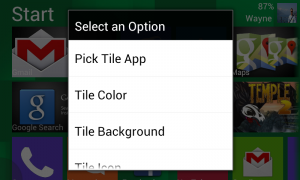
    The Best Windows 8 Launcher, from PRR Apps, is a new app designed to bring the Windows 8 Modern UI experience to Android devices.

    It offers two modes — tablet and mobile — with full screen support and is highly customizable. There are 150 downloadable images of apps you can use as tile backgrounds, as well as 50 Windows 8 style icons, and widget and live wallpaper support.

    Once the app is installed it will take a little while to set up the first tile block as you’ll need to select various apps, such as Settings, Gallery, and SMS, when prompted. You can have a maximum of five blocks with up to 18 tiles in each one.

    You’ll then need to further personalize things by setting your name and profile pic and adjusting the dimensions to suit your device’s screen size. You can also set the titles for the tile blocks and lock your phone into portrait or landscape mode. There’s an optional free tile images pack available to download.

    Tiles can be customized — you can stretch and shrink each one, change the colors and use your own images, if you wish. There’s no obvious way of reordering tiles however, and I’ve found the customize menu, which you call up by long pressing on a tile, sometimes refuses to appear.

    Still, for a first release, The Best Windows 8 Launcher is stable (the only comment so far on Google Play says the app won’t stop closing all the time, but it hasn’t yet crashed once on me) and well-designed. I expect the rough edges will be dealt with in future releases.

    The Best Windows 8 Launcher is available to download from Google Play now priced at $0.99.

  • Hedge fund boss Baha sees gold at $3,000-$5,000

    Christian Baha, the head of Austrian fund firm Superfund and representative of the hedge fund industry in Oliver Stone movie Wall Street 2: Money Never Sleeps, is predicting that the gold price could rise to between $3,000 and $5,000 over the next five to 10 years.

    Baha, who says he has more than half his personal wealth in gold and silver, either physically or in units in Superfund funds denominated in the precious metals, believes that an unprecedented phase of quantitative easing by central banks is driving a bubble in government bonds, but that gold offers real value.

    “Do you think paper money has any intrinsic value? I don’t believe so. Gold has real value,” Baha said in a recent interview.

    “If gold goes down to $1,200 or $1,000 then I’m going to buy more. I really don’t care. They’re just printing new money.”

    Gold fell around 5.2 percent on Friday April 12 and a further 8.4 percent on Monday April 15 – the biggest two day drop in 30 years – as investors fretted over a possible 400 million euro gold sale by debt-laden Cyprus and the possible ending of the U.S. Federal Reserve’s bond-buying stimulus by the end of the year.

    The fall came as a surprise to investors, many of whom had seen the precious metal as a hedge against future inflation induced by ‘quantitative easing’ by central banks.

    Numerous banks, who had been forecasting a higher gold price, were caught out, as were some hedge funds, including billionaire John Paulson, who saw his $700 million gold fund lose 27 percent in April.

    Baha, a former policeman whose cameo in the Gekko sequel came thanks to his friendship with the director, said he bought gold as the price fell, buying on both the Friday and the Monday.

    He added that inflationary pressures set to drive gold higher could also push the yields on 10-year German and French government bonds – currently 1.46 percent and 1.99 percent – to 10, 15 or 20 percent.

    “Governments more and more are being obliged to buy their own government bonds, which means the bubble is even bigger than before, and so the gold price will be driven higher than before,” he said.

    “A gold price of $3,000 to $5,000 in the next 5 to 10 years will be just the start.”

    Of course, others are more cautious. Manny Roman, chief executive of hedge fund firm Man Group, told guests at the recent Financial News Awards in London that the price of gold should fall to $1,000. And chart analysts told Reuters last week that a breach of the April low of $1,322 could set up bigger losses towards levels not seen since mid-2010.

    But Baha was not the only manager trading gold after its fall.

    Patrick Armstrong, CIO at Armstrong Investment Managers, used derivatives to profit from his view that the “loose monetary policies of the West” would support higher gold prices in the medium term although there would be no dramatic rebound in the short-term.

    Armstrong said in a note to clients last month that he used the jump in implied volatility to sell put options – the right to sell – with a strike price of $1,270. Options cost more when volatility is higher.

    He then used some of the proceeds to buy call options with a $1,370 strike price, which let him profit from a rebound in the price of gold. He also sold deep out-of-the-money call options with a $1,480 strike price.

    The strategy has so far proved profitable, with gold briefly rising above $1,480 earlier this month before falling back to $1,381 on Tuesday.

  • iPad shipments expected to decline for first time ever in Q2

    iPad Shipments Q2 2013
    Shipments of Apple’s iPad line may soon see a year-over-year decline for the first time since Apple debuted the iPad in 2010. With Apple’s cheaper iPad mini just 6 months old, demand for Apple’s tablets is already taking a hit from increasingly competitive Android tablets, which now offer user vastly improved user experiences compared to the early days of the media tablet market. Apple is also being undercut on price by a number of 7-inch Android tablets and KGI Securities analyst Ming-Chi Kuo believes that as a result, combined shipments of Apple’s iPad and iPad mini will decline by between 10% and 15% in Q2 2013. AppleInsider reports that Kuo sees Apple selling between 14 million and 15 million tablets to end users during the quarter, and he expects both sales and shipments to pick up in the third quarter once Apple launches its completely redesigned fifth-generation iPad.

  • BuzzFeed partners with CNN, announces LA-based “social video” studio (Update)

    Viral media site BuzzFeed on Tuesday launched a new YouTube channel in partnership with CNN that is aimed at bringing news to young viewers.

    The deal, which was reported by the Wall Street Journal, will see BuzzFeed invest a low “eight figure sum” over the next two years to build up the platform.

    Update: BuzzFeed followed up the CNN news by announcing it will “aggressively expand” its video operations under web video pioneer, Ze Frank, and that it will “build a social video studio, designed to create news and entertainment video content exclusively for YouTube.”

    The first CNN video to appear on the site appeared Tuesday morning and features a mash-up of dramatic or heart-tugging clips drawn from famous rescues that have appeared on TV in recent years — Chilean miners, children in wells and so on:

    The clip, which is hosted on a new BuzzFeed vertical called CNNBuzzFeed, includes ponderous voiceovers extolling the human spirit. It has yet to appear on CNN’s website.

    The partnership appears to be an effort to bring some viral energy to CNN while allowing BuzzFeed to stake out more ground amidst mainstream media outlets. In the last year, the site, which was first known for cat videos, has broken several major news stories and formed partnerships with the likes of the New York Times.

    CNN and BuzzFeed have not described the revenue angles of the deal, though it is worth noting that the conclusion of the “Rescue” video brings up invitations to watch clips other YouTube channels such as the Young Turks.

    Here is how BuzzFeed described the nature of the YouTube partnership:

    Production will be headquartered in a newly constructed social video studio in Los Angeles which will have a coffee shop and store where influencers, thinkers and celebrities will be able create informal videos made for the social web. The team will grow to over 30 people in the coming months. BuzzFeed Video will have a dedicated, prominent placement on the BuzzFeed homepage that will bring new forms of social content to the site’s 60MM unique visitors. Expansion plans include creating new channels, including recreating a video news format that is shareable.

    Related research and analysis from GigaOM Pro:
    Subscriber content. Sign up for a free trial.

    • How Design Can Save the Average Data Center More than $1M

      Peter Panfil is Vice President Global Power Sales, Emerson Network Power. With more than 30 years of experience in embedded controls and power, he leads global market and product development for Emerson’s Liebert AC Power business.

      Peter PanfilPETER PANFIL
      Emerson’s Liebert AC Power

      There are many options to consider in the area of data center power system design, and every choice has an impact on data center efficiency and availability. The data center is directly dependent on the critical power system, and a poorly designed system can result in unplanned downtime, excessive energy consumption and constrained growth.

      When making choices, consider the UPS system configuration, UPS module design and efficiency options, and the design of the power distribution system.

      Show-me-the-money

      Increase Utilization Rate to Improve Efficiency

      Most businesses need to consider having some level of redundancy in their UPS system to mitigate the cost of downtime, eliminate single points of failure and provide for concurrent maintenance.

      A concern often raised in discussions about redundancy is utilization rate. A 2N UPS system that has the highest availability unfortunately offers the lowest utilization. Each bus of a 2N system can only be loaded to 50 percent so that one bus can provide full load in the event the other bus is not available. Many business critical data centers use 40 percent as the peak loading factor on each bus in this configuration to allow for variations in IT power draw and provide a cushion for immediate expansion capability. Customers have expressed concern that they don’t trust all UPS suppliers to be able to support 100 percent load.

      Find a UPS supplier you can trust whose UPS can provide full load across the range of high and low line conditions, temperature to 40C, blocked filter, fan failure and altitude. Potential cost savings to move utilization to 45 percent: $2k/yr

      Don’t Gamble on Availability – Fault Isolation Matters

      Transformers play a critical role in the power system by providing circuit isolation, localized neutral and grounding points for fault current return paths, and voltage transformation.

      Removing the transformers can result in a smaller, lighter footprint that is well suited for installation in the row of racks. Removing the transformers also exposes the UPS system to faults that could reduce the availability or push the critical load over onto utility power more often.

      One very common fault that has this effect is a DC ground fault. Shorting the positive or negative battery terminal to ground in a transformer based system results in an alarm, but the UPS continues to provide protected power. Shorting the positive or negative battery terminal to ground in a transformer-less architecture at best results in a transfer to bypass and the load exposed to unprotected power and at worst, drops the critical load.

      One transformer-less UPS manufacturer even filmed the performance of their transformer-less UPS on a battery ground fault. The UPS output waveform went through severe gyrations, the UPS groaned, cables shook and the UPS transferred to bypass. That manufacturer touted this as robust performance.

      Do you consider transferring to bypass during one of the most common UPS system faults robust? Don’t bet your career on it. Potential Cost Savings of increased availability: $505k per occurrence

      Modern Transformer-Based Topologies + Advanced Energy Optimization = State of the Art Technology

      There is the misperception that transformer-based UPS systems are “old technology”. This myth is spread for the most part by UPS manufacturers who only offer transformer-less UPS. Modern transformer-based UPS systems deploy the latest DSP-based controls and energy optimization features to offer the best availability for business-critical applications, and at efficiencies that meet or exceed transformer-less offerings.

      One such energy optimization mode is Intelligent EcoMode, which provides the majority of the critical bus power through the continuous duty bypass. This technology keeps the inverter active and always ready to assume the load in the event of an outage — a dramatic improvement over energy optimization modes that do not keep the inverter active. These UPS systems that do not deploy the latest active inverter Intelligent Eco-Mode often have a notch in the output waveform going in and out of Eco-Mode. They have to perform an interrupted transfer to turn off the bypass before turning on the inverter. Notch in the output? Interrupted transfer? Gulp! Increased cost savings using Intelligent Eco-Mode: $20,350/yr.

      Weigh Safety Risks and Hidden Costs of Alternative Distribution Voltages

      480V 3-wire distribution is the norm in enterprise data centers. There has been a lot of discussion about going 400/230V 4-wire direct from the UPS to the server. While this configuration looks good on paper it has some significant limitations. Fault current can be much higher in these direct-to-the-server configurations. This poses an equipment and personnel risk. This configuration also strands capacity in the gear, requires higher ampacity buses and can increase wiring costs. Before going to this extreme consult with your data center trusted adviser to understand the costs and risks associated with this architecture. Potential Cost Savings using higher distribution voltages: $3,500/yr

      Do Your Research

      Due diligence on the latest UPS technology and efficiency optimization modes will help you choose improved critical power systems with the highest availability and new levels of utilization and efficiency.

      Industry Perspectives is a content channel at Data Center Knowledge highlighting thought leadership in the data center arena. See our guidelines and submission process for information on participating. View previously published Industry Perspectives in our Knowledge Library.

    • Seeing the Crack Epidemic as a Disruption Story

      Although the 1985 arrival of crack cocaine in large U.S. cities had dire consequences, including a doubling of the homicide rate among black males aged 14 to 17, the epidemic’s social ills subsided after a few years, despite continued high use of the drug, says a team led by Roland G. Fryer Jr. of Harvard. After experiencing severe disruption from this technological innovation, illicit drug markets settled down and crack prices fell sharply, hurting the business’s profitability and reducing competition-related violence among dealers, the researchers say.

    • The Rise of the Mobile-Only User

      “They can just use their desktop computer to do that.”

      One of the most persistent misconceptions about mobile devices is that it’s okay if they offer only a paltry subset of the content available on the desktop. Decision-makers argue that users only need quick, task-focused tools on their mobile devices, because the desktop will always be the preferred choice for more in-depth, information-seeking research.

      But what about people who don’t have a desktop computer? What about people who have access to a PC, but prefer using their mobile device? Those users want and need access to the same information, just presented in a different form factor. The mobile-only user is your customer too.

      Reaching the mobile-only user
      The rise of smartphones means that more and more people are going online from a mobile device. According to Pew Internet, 55 percent of Americans said they’d used a mobile device to access the internet in 2012. A surprisingly large number — 31 percent — of these mobile internet users say that’s the primary way they access the web. This is a large and growing audience whose needs aren’t being met by traditional desktop experiences.

      Some of these users may have access to a traditional PC and a broadband connection at home, work, or school, but these may be shared devices or simply not private. For their personal, always-on connected device, these people choose to rely on their mobile.

      If you’re trying to reach specific audiences, you can’t afford to ignore mobile-only users. As Pew Internet reports:

      • Young adults: 50 percent of teen smartphone owners, aged 12-17, say they use the internet mostly on their cell phone, according to a 2013 Pew Internet report on Teens and Technology. Similarly, 45 percent of young adults aged 18-29 reported in 2012 that they mostly go online with a mobile device.
      • Black and Hispanic adults: 51 percent of black Americans and 42 percent of Hispanic Americans who use a mobile device to access the internet say that’s the primary way they go online — about double the 24 percent of white Americans who say they rely on their mobile devices for access.
      • Low-income adults: People whose household income is less than $30,000 per year and people with less than a college education are also more likely to rely on their mobile devices for access — about 40 percent of people in these groups say they primarily use their cell phone to go online. Healthcare, non-profit, and government institutions which need to reach these populations should be aware that their audience is mobile-only.

      But mobile-only usage isn’t limited to these demographics. Amazon, Wikipedia, and Facebook all see about 20 percent of their traffic from mobile-only users, according to comScore. A whopping 46 percent of shoppers reported they exclusively use their mobile device to conduct pre-purchase research for local products and services. Internal data from some finance, healthcare, and travel providers show similar mobile-only usage. If you’re trying to reach customers who only shop, bank, and socialize on their mobile devices, you’re missing out.

      These numbers are already large enough to require attention — and they’re not going down. With sales of PCs at an all-time low, more and more people will rely on their smartphones and tablets to go online. For this growing population, if your content doesn’t exist on the mobile screen, it doesn’t exist at all. Now’s the time to figure out how to meet their needs.

      Same experience, different device
      Mobile-only users aren’t some strange new breed of customer, signaling their desire for different messages, content, and services through their choice of screen size and form factor. They’re just your customer. You can and should speak to them in same way you address all your other customers. They just want to engage with you on the device that’s most useful and convenient for them.

      Meeting the needs of the mobile-only user doesn’t mean agonizing about “the mobile use case,” trying to determine which subset of content would be most useful to users “on-the-go.” Google reports that 77 percent of searches from mobile devices take place at home or work, only 17 percent on the move. Mobile users should get the same content. It’s frustrating and confusing for them if you only give them a little bit of what you offer on your “real” website. If you try to guess which subset of your content the mobile user needs, you’re going to guess wrong. Deliver the same content as your desktop user sees. (If you think some of your content doesn’t deserve to be on mobile, guess what — it doesn’t deserve to be on the desktop either. Get rid of it.)

      Meeting the needs of the mobile-only user also doesn’t mean sending them to the desktop website on their smartphone. Asking mobile-only users to pinch and zoom their way through a website designed for a monitor five times larger is an ergonomic nightmare — and a cop-out. We can do better for these users than tiny fonts, untappable links, and broken hover states.

      You don’t get to decide which device your customer uses to access the internet. They get to choose. It’s your responsibility to deliver essentially the same experience to them — deliver a good experience to them — whatever device they choose to use.

    • Is Toyota’s Entune System Destined to be Unnecessary?

      For years, automakers have been working on in-car infotainment systems to drive up sales, but are they doomed by a confluence of factors? Will anybody be sad to see them go away?

      Is Toyota's Entune System Destined to be Unnecessary?

      In-car infotainment systems like Entune has serious limitations and competition from smartphones. Are they doomed?

      In-car infotainment systems have long been boasted by car manufactures as the future of in-car entertainment. And in some regards, they are nice systems. Yet, with cell phones becoming more capable, ongoing price concerns and limited abilities, is it just a matter of time until they go away?

      Technology Lags Behind

      One of the biggest issues facing in-car infotainment systems is that they are constantly lagging behind consumer electronics. For example, the MyFordTouch system has a 10GB hard drive for storing songs. That is a good idea (saves battery power) and beats some Toyota vehicles that don’t allow for music storage. Yet 10GB of storage is yesterday’s storage needs. You can literally walk into Walmart and buy a 1TB drive (1,024 GB) for about a $100. Who gets excited about 10GB? Nobody.

      Another issue that had plagued them is the time/effort it took to upgrade the navigation system. In the past, you would need to visit your dealer for upgrades. Now, they have upgraded (in certain vehicles) to inserting a USB drive into a docking bay. Frankly, that way of upgrading is still way behind especially with wireless upgrading on cell phones. A smartphone user can update their phone in a matter of minutes from anywhere. Why spend time/effort to update your in-car navigation system when your smartphone is most likely up-to-date and at times, more accurate?

      Why can’t these systems be upgraded faster and be more conducive to keeping with other consumer electronics? The testing and development time of vehicles is why, according to a story on ComputerWorld.com.

      Building a new car is a multi-year process.

      “The iPhone was introduced in 2007. The cars being sold in 2012 and 2013 were just being planned then,” said Scott Fosgard, a spokesman for infotainment systems at General Motors told ComputerWorld.

      Another thing to consider is the harsh conditions of vehicles.

      “Inside your vehicle, technology has to be able to live from 70 degrees centigrade to minus 40. Your phone and computers don’t have to meet those requirements,” said Jim Buczkowski, a Henry Ford Technical Fellow and director of Electrical and Electronics Systems at Ford Research and Innovation told ComputerWorld.

      Fosgard says that you have to remember that in 2007, infotainment systems were ranked 25th on the wish list for GM customers. Now, it is fourth on the list.

      Our question though is how old is that list? Are consumers still demanding that system or is the growth in smartphones dampening that demand? Seems likely that consumer demand will shrink as more consumers see the limits of in-car infotainment systems.

      Data Usage

      Another big issue for consumers is the increased data usage of their cell phones. With many carriers nowadays limiting data usage, ending unlimited plans and even throttling usage, data plan prices are rising. Many systems like the Entune stream their apps and music through your cell phones data plan. This means that you most likely need to either be more aware of data use or have to increase your cell phone data plan accordingly. This is a real, increased cost to most consumers.

      Imagine if you were buying a new $35k Toyota Tundra. You would need to consider the loan payment, insurance and fuel costs PLUS your cell phone bill.

      Ongoing Subscription Costs

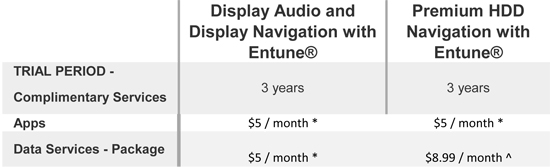
      Toyota likes to boast that the first three years of Entune service is “complimentary.” This is great and all, but with car ownership at around 71.2 months according to R.L. Polk and Company, you will be paying for this system at some point. How much? Depends.

      Toyota Entune Pricing Chart

      Toyota says built-in apps include “Bing™, listen to iHeartRadio, purchase movie tickets through MovieTickets.com, make dinner reservations with OpenTable®, listen to Pandora® and more.” While Data services include “Stocks, Weather, Traffic, Fuel Prices and Sports.” Why would you need to check your stocks while driving is beyond us? But, if you do, would you grab your cell phone or the Entune system?

      Also, who knows what technology we will have or need in three years. It is quite possible by the time the “complimentary” service period ends, the Entune system will be outdated anyway. Would you pay a monthly fee for an outdated system?

      The confluence of these issues will plague in-car infotainment systems for the foreseeable system. As much as automakers try to improve the systems, so do the cell phone makers. With car makers being much slower to adapt to technology changes versus consumer electronics makers, who do you think will have the latest and greatest technology sooner? Pretty easy answer to this one: consumer electronic makers.

      What do you think? Are in-car infotainment systems a waste of time or are they really useful?

      The post Is Toyota’s Entune System Destined to be Unnecessary? appeared first on Tundra Headquarters Blog.

    • What About Dell’s $1 Billion Cloud Buildout?

      Dell-module-ebay-470

      Dell’s use of modular data centers – like this unit deployed for eBay – was a key part of its plans to expand its data center network to host its own public cloud offering, an initiative which was discontinued last week. (Photo: eBay)

      Dell has abandoned its plans to offer its own public cloud, shifting to a partner-focused cloud model instead. Most of the chatter has been around what this means for OpenStack. But what does this mean for Dell’s plan to invest $1 billion in data centers?

      Back in 2011, Dell announced its plans to spend $1 billion on data centers to deliver its public cloud products. The company planned to build 10 data centers in 24 months; an aggressive plan by all accounts. However, with Dell dropping its direct public cloud offering, much of the infrastructure that would have populated these data centers has now disappeared.

      Has Dell held strong to its data center buildout plans? If not, has that plan significantly changed since dropping public cloud? If the company has or will invest this money in infrastructure, what will it be used for? Data Center Knowledge reached out to Dell to ask how its shift in public cloud plans will impact its planned data center expansion, but the company hasn’t responded.

      What We Know: Deployments in Quincy and Slough

      Few public announcements have been made about Dell’s data center expansion. Here’s a look at what we know.

      In late 2011, a UK data center in Slough entered production. It wasn’t a massive amount of space, consisting of 5,000 square feet divided into two sections – a raised-floor area featuring rows of cabinets using hot aisle containment and in-row cooling units, and a second section with IT capacity deployed in Dell Modular Data Centers. The Slough facility, which was developed by retrofitting an existing structure, will meet Tier III reliability standards and a power usage effectiveness (PUE) of about 1.5.

      One of the U.S. data centers announced and built was in Quincy, Washington where Dell purchased 80 acres of land and filed plans to build a 350,000 square foot data center. This was to be a key component of a global data center expansion to support the company’s push into cloud computing services. The first phase of the project was unveiled in February 2012, featuring 40,000 square feet of data center space.

      Last year a Dell executive outlined plans to build 20 data centers in the Asia Pacific region, commencing with one in India. In 2011, CEO Michael Dell stated that the company would build a data center in Australia.

      Dell’s Shift in Strategy

      The plan was to target its cloud offerings to all three tiers of the cloud market, including Infrastructure as a Service (IaaS) offerings for both compute and storage, Platform as a Service (PaaS) for application development and deployment, and an SaaS-level Virtual Desktop as a Service offering atop Microsoft’s Hyper-V virtualization solution.

      A few weeks ago, the company acquired Enstratius, which greatly deepened its capabilities in cloud management. Dropping public cloud makes sense considering the company’s growing play in the enterprise and on the platform level. There’s a lot of competition in terms of public cloud – AWS, Google, Microsoft, Rackspace and OpenStack all come to mind – as well as new players joining the fray everyday (VMWare is a recent example). By offering its own public cloud, Dell threatened to cannibalize its channel somewhat, though the company was positioning its offering as complementary to partners.  Dropping these plans means there’s no longer any potential conflicts of interest and it can supply these partners in a completely complimentary way. But it begs the question – what about the infrastructure?

      The company’s shift to using modular data centers means that it might not have had to make the same capital commitments to cloud as it once pledged. The company does have some initiatives like Workstations that promise or hope to fill up data center space. The company still believes in the growth of the public cloud, it just isn’t supplying it directly out of its data centers anymore.

      “Many Dell customers plan to expand their use of public cloud, but in order to truly reap the benefits, they want a choice of providers, flexibility and interoperability across platforms and models, the ability to compare cloud economics and workload performance, and a cohesive way to manage all of it,” said Nnamdi Orakwue, vice president, Dell Cloud, after dropping the public offering. “The partner approach offers increased value to Dell’s customers, channel partners and shareholders, as part of our comprehensive cloud strategy to deliver market-leading, end-to-end cloud solutions.”

      It’s a sound strategy. However, the earmarked billion dollars now leaves us asking – what happens with the infrastructure?

    • 5 lessons learned from bringing cleantech to China

      One morning it dawned on me that of the nine energy companies in our Venrock portfolio, a third are focused on China – yet none of them planned it upfront. I figured it would be good to understand how other cleantech start-ups have approached the middle kingdom, so I enlisted MIT MBA student (and fluent Mandarin speaker) George Miller to interview a representative sample and collect best practices.

      George spoke confidentially with 15 venture-backed cleantech start-ups that have set up Chinese operations. Every interviewee was either a C-level executive or VP of business/corporate development; the majority were CEOs. Nine of the 15 interviewees entered China primarily to sell into the domestic market, while the balance aimed to export from Chinese manufacturing facilities. The average company is 11 years old and entered China five years ago.

      cleantech in China

      Most of our research findings are confidential to Venrock and the companies interviewed, but some high-level conclusions deserve a broader airing.

      China strategies have been mostly improvised. At all of the companies we spoke with, China is a big, board-level deal, ranking somewhere between “an important growth market” and “our sole focus.” Yet only four firms had a specific China plan at the formation stage, and three initially didn’t plan to enter China at all.

      Cleantech in china

      Nearly all companies partner. The most common engagement model we found was a joint venture (JV) with a Chinese enterprise, represented by eight of the 15 interviewees. Six have set up distribution agreements but not full-blown JVs. Only one has gone it alone in China, with a standalone, wholly foreign-owned entity that manufactures and sells directly.

      china_3

      IP is the big challenge. When we asked about key challenges experienced in China, intellectual property (IP) protection topped the list. This is no surprise – tales of IP leakage in the country are legion, with cleantech’s most glaring example being the outright theft of American Superconductor’s wind turbine software.

      General transparency in business dealings came second, and a cluster of people-related challenges followed. In contrast, interviewees didn’t find market access difficult: We heard that with strong government support and large pools of capital, the risk appetite for capital-intensive projects is greater than in most developing countries.

      china_4

      JVs are the solution. Conventional wisdom says to protect IP by building moats – like splitting manufacturing steps across sites so no one person knows them all, or supplying a key “black box” component from outside China. Our interviewees employ these moat-building tactics, but they think bridge-building works best: The technique rated most effective was forming a joint venture with a large Chinese partner, incentivizing that partner with outsized ownership, and relying on its self-interest to defend the IP. Notably, every interviewee with a JV ranked this tactic the highest.

      china_5

      JVs address secondary problems, too. When we delved into interviewees’ secondary challenges about transparency and people, it turned out that a strong JV partner was effective in resolving them as well. The stories we heard addressed…

      …conflicts of interest: “We had no idea that the largest shareholders in [a potential distributor] are also in the seats of power at [the end customer]. Only once you reach the goal line do they open the kimono.”

      …internal corruption: “One of the executives we hired was marking up purchase orders and taking kickbacks. He didn’t have a bad heart, and that practice is common in China – so instead of ‘firing’ him, we ‘retired’ him.”

      …training: “Because our technology is so unique, we didn’t have trouble attracting and retaining talent. The challenge was educating them on exactly what we do.”

      …workforce management: “It’s not just the government that’s socialist; it’s also the labor force. Financial incentives don’t work well. We used vacation time as a key motivator.”

      It’s self-evident that these challenges can be mitigated by a strong in-country partner that knows the value chain and manages lots of people.

      . . . . .

      Chinese joint ventures are no walk in the park. The average JV in our sample was three and a half years old, had taken longer to get going than expected, and was considered too early to call as a success or failure. Interviewees complained about long government approval processes and culture clashes along the way, and we didn’t hear any silver-bullet tactics for doing it right: The best practices were all things you’d expect, including intensive background checks of partner executives, JV agreements that maintain “face” for both start-up and partner (usually relying on profit-sharing), and experienced domestic legal representation. And clearly, you’ve got to be obsessive about picking a trustworthy partner – American Superconductor’s widely-publicized IP dispute is, in fact, with its former JV partner Sinovel.

      Despite all those caveats, I drew a clear conclusion from this work. Most cleantech innovation is happening in the U.S., but most adoption will be in growth economies building new infrastructure – with China at the top of the list. Chinese incumbents like Wanxiang, Shenhua, and ENN are scouring the west for technologies to pick up. In this environment, a cleantech start-up can either play defense at the barrel of a financial gun (see A123 Systems), or play offense, entering China on its own terms and timeline. If you’re going to do the latter, be prepared to partner up.

      Matthew Nordan (@matthewnordan) is an energy VC investor at Venrockone of the oldest and best-performing VC firms. Earlier, he co-founded and led the energy tech analyst firm Lux Research and forecasted technology futures at Forrester. There’s more where this came from at mnordan.com.

      George Miller is an MBA student focused on energy entrepreneurship at MIT Sloan, where he directed the MIT Clean Energy Prize. Fluent in Mandarin, George has consulted to nuclear energy companies entering China with Dynabond Powertech and supported the president of the Kauffman Foundation in fostering global entrepreneurship. He can be reached at [email protected].

      Related research and analysis from GigaOM Pro:
      Subscriber content. Sign up for a free trial.

    • Apple device maker Hon Hai to launch Firefox tablet

      Hon Hai Firefox OS Tablet
      Reports emerged on Monday suggesting consumer electronics manufacturing giant Foxconn intended to build and launch its own devices as Apple’s growth begins to slow. Now, Reuters follows the report with details on what may be Foxconn parent company Hon Hai’s first new mobile device to launch as part of this effort. Reuters was only able to confirm with its unnamed sources that Hon Hai and Mozilla plan to team up to unveil a device running Firefox OS on June 3rd, but a separate report from Focus Taiwan suggests the device in question will in fact be the first tablet powered by Mozilla’s mobile operating system. No other details about the device are known at this time.

    • Drones Aren’t For Delivering Tacos: UVS Avia Builds Quadcopters For Nuclear Sites, Search-And-Rescue

      Screen Shot 2013-05-28 at 3.32.18 PM

      A wellspring of interest in quadcopters for commercial applications is advancing globally. From Airware’s recent $10.7 million round from Andreessen Horowitz to the launch of AngelPad’s DroneDeploy, quadcopters are one of the hot, hardware trends that founders and VCs are latching onto.

      This experimentation is also happening on the other side of the world. Russia’s UVS Avia is building higher-end microdrones to examine nuclear reactors and waste sites, along with doing search-and-rescue in remote areas.

      They built a quadcopter that weighs about 1 kilogram, can fly above 100 meters and has at least 1 hour of battery life. It costs a hefty $40,000, but that’s because local Russian taxes effectively double the price and because they target government and military clients. Commercial drones for hobbyists cost a few hundred dollars, but often only have about 15 minutes of battery life. So far, UVS Avia has sold a “few dozen” drones.

      It can be equipped with infrared vision, night vision or radiation protection to fly over sites like nuclear reactors or to monitor nuclear waste.

      “Civilian versions weigh about 100 grams, while this is a kilo, which is a lot,” said CIO Maxim Shaposhnikov. “Everything is stronger and better.”

      While the hardware for these drones is being commoditized, Shaposhnikov says the real advantage in the future will come from software.

      “Normally, even for military use, all drones are managed by humans,” he said. “But our idea is to make the drones completely automatic, like maybe they could fly for months and charge automatically.”

      The other thing they want to add is the ability for drones to communicate with each other. He said, you could eventually get 100 or more drones to monitor an entire city in a completely automated process.

      “We think the whole industry is going in the same direction,” he said. “In five years, it will be really cheap to make drones, but the intelligence should be really advanced. New batteries are being developed that will allow a five hours of battery life. Everything is moving ahead, so software will be the key.”

      The company has raised about 3 million euros in funding from private angels.


    • Data Center Jobs: McKinstry

      At the Data Center Jobs Board, we have a new job listing from McKinstry, which is seeking a Senior Data Technician (HVAC Controls/Critical Facility) in Denver, Colorado.

      The Senior Data Technician (HVAC Controls/Critical Facility) is responsible for the successful and timely completion of assigned projects by utilizing appropriate resources effectively and balancing the customer requirements with the agreed upon strategies of the company, the definition of customer project requirements, communicating with other McKinstry Departments to ensure agreements are successfully managed, opportunities are maximized, and customers are satisfied, evaluating industry standards as new standards emerge for best practices, and closely coordinating these potential opportunities with our clients and share all applicable information abroad. To view full details and apply, see job listing details.

      Are you hiring for your data center? You can list your company’s job openings on the Data Center Jobs Board, and also track new openings via our jobs RSS feed.

    • Not all emerging currencies are equal

      The received wisdom is dollar strength = weaker emerging market currencies. See here for my colleague Mike Dolan’s take on this. But as Mike’s article does point out, all emerging markets are not equal. It follows therefore that any waves of dollar strength and higher U.S. yields will hit them to varying degrees.

      ING Bank says in a note sent to clients on Tuesday that emerging currency gains in recent years have been closely tied to foreign investments into domestic bond markets. Recent years have seen a torrent of inflows into local debt, driving down yields on the main GBI-EM index and significantly boosting its market value. Hence, it makes sense to examine how the GBI-EM’s biggest constituents might fare under a scenario of a surging dollar and Treasury yields (In the two years before a Fed tightening cycle commences, 5-year Treasury yields can trade 120-150 basis points higher, ING analysts point out).

      In almost every one of the emerging markets examined by ING, spreads over U.S. Treasuries have tightened dramatically since the start of 2012. Ergo, they are vulnerable to correction.

      But the ING analysts also look at:

      a) correlations between the yield spread and respective currencies’ exchange rates

      b) the magnitude of the inflows.

      They found the Russian rouble and Mexican peso most tightly correlated to their respective bond spreads over Treasuries. The peso notably is free floating while Russia, worried about weak growth, is less likely to intervene to boost the rouble at present. The ING analysts write:

      While the Fed normalising interest rates should not necessarily derail EM investments per se, a disorderly correction in yields probably leaves the Mexican peso most exposed. We are also interested in the rouble’s high positive correlation. A deteriorating ex-energy current account position and the strong dollar story keep us firmly as dollar/rouble buyers on dips.

      The Brazilian real, Turkish lira and Malaysian ringgit had the lowest links with bond yield spreads, ING found. With the Brazilian and Turkish central banks having kept their currencies more or less in strict check, that does not seem surprising.

    • Dear Linux, I’m leaving you — for Windows 8

      Microsoft Windows 8 is the best desktop operating system. Period. No Linux distribution or OS X can compare. I say this as a Linux user and lover.

      When it comes to computing, I have always had a soft spot in my heart for Microsoft Windows. Windows 95 was the operating system of my first-ever computer — we could not afford a computer before then. As time marched on, I found myself dual-booting Windows and Linux on my future computers, with most of my time being spent in Linux. That is, until a few years ago when I exclusively ran various Linux distributions as the sole OS on my computer.

      After trying various Linux distributions and desktop environments, I eventually fell in love with Gnome 3. It was a new way of interfacing with my computer. It enabled me to focus on a task without needing to minimize or resize a window. The overview allowed me to switch programs as I need them. I was pretty much in paradise. This year, I even donated money to the Gnome Foundation as a kudos for its great work.

      However, despite my happiness with Linux and Gnome, I was a bit dismayed at my inexperience with the Modern/Metro UI of Windows 8. I like having knowledge about all operating systems. It seemed to be a very polarizing topic in Windows computing — there was either love or hate. I had tried Windows 8 at Best Buy and generally didn’t like it, but it wasn’t a fair review — just a few minutes while my wife shopped for Blu-Rays. A few weeks ago, Newegg was running a promotion for Windows 8 — $79.99 for the OEM. As a system builder, installing on a self-built computer, the OEM version would be perfect. The price was right, so I ordered it. While waiting for the disc, I remembered that I was eligible to buy Office 2013 Pro Plus for $10 in another promotion and bought that too.

      When Windows 8 arrived, I decided to start from scratch. I formatted my SSD and setup two partitions — NTFS and EXT4. I installed Windows 8 to the NTFS partition. On the other partition, I installed Ubuntu 13.04 Gnome. I then setup GRUB so that Windows 8 was a selectable option at boot. I told myself that Windows 8 was only being installed for educational purposes and that I would continue to use Ubuntu as my main OS. This was true for a little while.

      When I would log in to Windows 8, I found myself really enjoying the experience. In fact, the aspect of the experience that I loved the most was the Start Screen. This is the most controversial part of Windows 8. Many people want the start button back. I think those people are crazy. In my opinion, the entire classic desktop needs to go away and go Modern UI only.

      Modern UI actually reminds me of Gnome 3 in a way. By putting my mouse pointer in the top left corner, I can see all Modern UI apps that are running and then select one. It is very painless to move between two apps when doing it this way. I even discovered some great Modern UI Apps including some alternatives to some classic apps. For instance, instead of mIRC, I found the amazing IRC Explorer. I even did something sacrilege — I tried Internet Explorer 10 and liked it. I liked it so much that I made it my main web browser with Chrome as my secondary browser. The Netfix app in Moden UI is nothing short of exquisite.

      No matter the OS nowadays, the interface is similar in one regard. From iOS, to Android to Ubuntu to OSX to Fedora — you hunt for an icon that represents the program you want and click it to open — yawn. Windows 8 is truly the first OS to really look beyond that. While the tiles are basically icons, they are so much more. They create a way to interact with your installed programs like no other OS. It is so refreshing to see the tiles scroll with updates. IRC Explorer will show me recent channel activity without needing to go in the app. The mail app, which I love, gives me a sneak peek into recent email.

      As I mentioned previously, I was able to get Microsoft Office for very cheap — $10.00. I have long been a proponent of OpenOffice and LibreOffice. While I still think they are fine options for the financially challenged, they are no match for Office 2013. It’s a shame to see how much I was missing by using Office-alternative suites for so many years. Office 2013 is worth the normal price. There may be something to those Scroogled commercials after all. Alternatives like Google Docs just don’t compare.

      So, in conclusion, while I have left Linux as my desktop OS of choice, I am not leaving it entirely. I will still keep Ubuntu in a dual boot as my secondary OS. Linux distributions are still a great desktop OS choice and LibreOffice is very functional. And who knows, maybe one day Linux will be able to produce something better than Windows 8 on the desktop and I will switch back. I will still be using Linux daily when I use my Android phone and tablet or my Chromebook.

      But on the desktop, for the time being, Windows 8 and I are having a great time together.

      Photo Credit: A pyro Design/Shutterstock

    • How car/ride-sharing companies stack up with each other (chart)

      Car and ride sharing are part of a small but growing segment of American transportation, as people particularly in urban areas turn to them for cost and convenience reasons. The RAND Corp. estimates that the pool of Americans that car share will jump from a quarter of a percent to 4.5 percent.

      Last week, Lyft received $60 million in a Series C funding round, making it one of the most well-funded ride-sharing startups around. Meanwhile, one of the original car-sharing services, ZipCar, was bought by Avis at the beginning of this year; it went public in 2011. For this chart, we looked at some of the more well-established car-sharing services—as well as their taxi counterparts—to see how much money they’ve raised and how far they’ve traveled.

      car-sharing-v3

      Related research and analysis from GigaOM Pro:
      Subscriber content. Sign up for a free trial.

    • LG takes the wraps off Nexus 4 White

      The rumors were true! On Tuesday, South Korean manufacturer LG revealed the new Nexus 4 White. The smartphone features the same hardware specifications as its black sibling, which was announced in late-October, and runs Android 4.2 Jelly Bean.

      “Nexus 4 set the standard for Android 4.2 Jelly Bean smartphones”, says LG’s Jong-seok Park. “Nexus 4 White delivers the same Google experience to consumers in a stylish and attractive color option”. The handset follows its predecessor, the Samsung-made Galaxy Nexus, in also sporting a white color trim.

      Specifications for the Nexus 4 White include: 4.7-inch IPS display with a resolution of 768 by 1280 and a 320 ppi (pixels per inch) density; 1.5 GHz quad-core Qualcomm Snapdragon S4 Pro processor; Adreno 320 GPU (Graphics Processing Unit); 2 GB of RAM; 8 MP back-facing camera with 1080p video recording; 1.3 MP shooter on the front; HSPA+ cellular connectivity; Wi-Fi 802.11 a/b/g/n; NFC (Near Field Communication); Bluetooth; wireless charging and 8 GB or 16 GB of internal storage. The Nexus 4 White comes in at 133.9 x 68.7 x 9.1 mm and 139 grams.

      LG revealed that the Nexus 4 White arrives in Hong Kong first, on May 29, followed by select markets in Asia, Europe, Middle East and North America “over the next several weeks”. There is no word yet on pricing or if Google will also offer the smartphone (in white) in its Play store.

    • PeStudio lets you analyse suspicious programs for malware

      If you find a program on your PC which you think might be malware, then checking it with an antivirus tool is a good first step — but it’s not the only option. You could also try “static analysis”, which involves examining the executable file itself to learn more about it. Most static analysis tools are aimed at developers and extremely complex, but the free PeStudio is an interesting exception: it offers plenty of low-level detail, but also has more straightforward features that just about anyone can use.
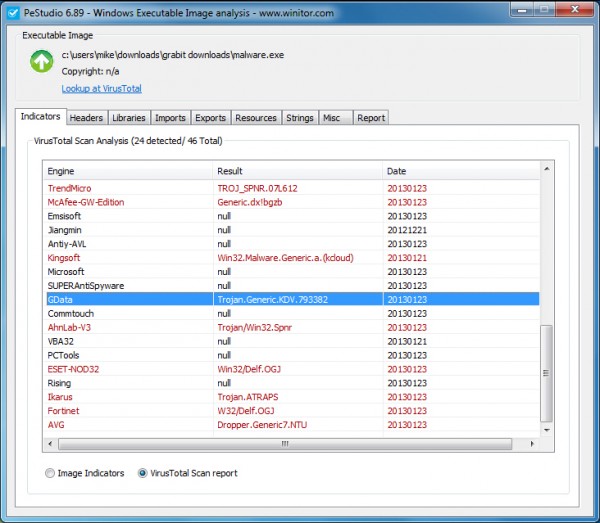
      It’s easy to get started with the program. Just download and unzip it, launch PeStudio.exe, and drag and drop your suspect executable onto the PeStudio window. Wait a few seconds for the program to run its analysis, and a detailed report then appears.

      The first tab, Indicators, gives you some useful information about the target application. Some of this is strictly experts-only, with details on the file’s use of DEP, ASLR, SafeSEH, Thread Local Storage, and so on. But you also get plenty of more generally useful data. Is it 32 or 64-bit, for instance? GUI, or console-based? Does it need administrative permission? Is it digitally signed?

      Clicking the Strings tab will then reveal any embedded text strings in the program — function names, paths, prompts, web addresses, error messages and more — which can be a useful way to figure out what it’s doing. (Malware will usually employ various tricks to hide this kind of information, but it’s still worth a try.)

      The Misc tab (if present) shows you any properties of your mystery executable. This might include file and product names, a description, version number, target language, and so on. Don’t assume any of this is true — malware could provide any details it likes here — but, again, it might help explain what the program is and where it’s come from.

      And if none of this is too conclusive, then clicking Indicators > VirusTotal Scan Report will tell you whether any of the VirusTotal antivirus engines (46, as we write) thinks the executable is malware. Again, don’t take the VirusTotal verdict as guaranteed, it’s possible you’ve encountered something which hasn’t been recognized yet, but it’s still useful to see what the rest of the antivirus world thinks.

      If you know your way around the executable file format then you’ll also appreciate the Libraries and Imports tabs, which reveal the DLLs and other support files required by your program, and the functions it’s using. The Resources tab is another plus, listing structures embedded within your program. While command line support means all this analysis can be automated and used to check a host of files in a single operation.

      You don’t have to delve into these complexities unless you really want to, though — and that’s the major plus here. There’s plenty of low-level information for experts, but all these technicalities don’t get in your way, and even if you’re a PC novice, you’ll still be able to use PeStudio to find out more about any mystery program.

      Photo credit: megainarmy/Shutterstock

    • Emerging corporate debt: still booming

      The corporate bond juggernaut continues apace in emerging markets.

      In a note at the end of last week, analysts at Bank of America/Merrill Lynch estimated that companies from the developing world have sold debt worth $179 billion already this year. Originally, the bank had forecast $268 billion in corporate debt issuance in 2013, a touch below last year’s $290 billion but it is finding itself, like many others, marking up its estimates.

      Oleg Melentyev,  credit strategist at BofA/Merrill, writes that recent bumper bond sales imply quarterly issuance is running at 10-11 percent of market size, well above the past average. Melentyev points out that the first 4.5 months of the year tend to account for 35 percent of full-year total debt sales by EM companies.  If this formula were applied now,  it would imply total 2013 new debt issuance at $420 billion.

      For now, however, the bank expects $316 billion in full year corporate issuance from EM, with Asia accounting for $126 billion of this.

      Clearly, all this doesn’t come without risk. While the drying-up of syndicated loan markets is at least partly responsible for the corporate bond boom, there is no denying that companies are raising more and more money in a market that is only too willing to lend.  That has pushed the  sector past the $1 trillion mark, making it bigger than the U.S. high-yield debt market. Just since the beginning of 2012, the stock of EM corporate hard currency bonds has increased by over $400 billion, JPMorgan said in a note published last week.

      What of investors’ returns? The picture is not as rosy as in past years. Higher yield assumptions on U.S. Treasuries could reduce potential returns this year by 1.0-1.5 percentage points, JPM analysts warn. Year-to-date,  investment grade emerging corporate debt has returned just 1 percent while high-yield has provided 3 percent, BofA/ML said.  That’s well below the 4.1 percent return Thomson Reuters data shows on global high-yield debt.

      But things could yet pick up. JPM recommends staying overweight its CEMBI corporate debt index, reckoning the sector’s relatively high yields will provide some insulation against Treasury upheavals. Melentyev of BofA/Merrill expects 3.7 percent returns on EM corporate debt this year. But speculative-grade EM credits, he reckons, will be returning a healthy 7.8 percent.