Blog

  • Finally, Yahoo does something kind of smart by buying mobile news app Summly

    We’ve beaten up on Yahoo a number of times for the company’s lack of innovation and other weaknesses, including CEO Marissa Mayer’s edict against remote working, so it’s probably fair to point out when the moribund web portal actually does something interesting — and the acquisition of news-reading app Summly arguably falls into that category. This deal isn’t going to magically transform Yahoo into a star, but at least it shows Mayer is serious about pushing the company forward in ways that are becoming increasingly important.

    The most obvious appeal of a purchase like Summly is that Yahoo gets access to a brilliant and charismatic young programmer in founder Nick D’Aloisio, who started the company in Britain when he was just 15. Om met D’Aloisio in Berlin and did an interview with him about the concept behind Summly not long after the teen launched his startup, and described how far ahead he was of many of his much more experienced peers. If nothing else, D’Aloisio might inject some fresh thinking into Yahoo, something it desperately needs.

    Nick D'Aloisio

    Nick D’Aloisio

    It’s not just fresh thinking about content or design either: while it may not be a blockbuster success story like Instagram or SnapChat, part of what made Summly interesting is that it was an attempt to rethink how we consume content on a mobile device. Circa, which is funded by Cheezburger CEO Ben Huh (and is part of our startup showcase at paidContent Live in April) is another startup focused on the same problem: how does news content need to be rethought for mobile?

    Yahoo News may be far from cutting edge, but it still pulls in a fairly large audience — far larger than Google News. If Yahoo can use D’Aloisio and Summly’s algorithms to figure out how to take advantage of that on a mobile device, it could potentially have a winner on its hands. Google has done virtually nothing to optimize its news-reading experience for mobile, and efforts at recommendation or curation apps like Currents have mostly fallen flat.

    According to an All Things Digital report, Yahoo may have paid as much as $30 million — primarily in cash — for Summly. That’s a lot for an app that only racked up about a million downloads and hasn’t really taken off in terms of readership, but for Mayer it theoretically accomplishes two important things: it shows that the company is intent on figuring out how content works on mobile, and it sends a message that Yahoo is willing to make acquisitions and bring in new talent in order to fix itself. Whether those efforts work, of course, remains to be seen.

    Post and thumbnail image courtesy of Getty Images / Chris Jackson

    Related research and analysis from GigaOM Pro:
    Subscriber content. Sign up for a free trial.

  • The Right Tool For The Job

    swissfone

    The mobile phone is today’s PC, but not necessarily in the way you think. Fifteen years ago, the PC was the central hub in one’s interactions with the wider world. This was largely because of the state of miniaturization; our electronics simply weren’t small or efficient enough to make mobile phones and laptops nearly as powerful as desktops.

    So we made do with the PC — it was a jack of most trades, and getting more powerful all the time. Then, cue the proliferation of smaller devices like iPods, feature phones, and pocket GPS units that were fairly powerful and useful. The PC declined in the universality of its application, and while it remains popular to this day (however one defines it), its usefulness has been honed to a finer point — stationary productivity, gaming, storage, and so on.

    Imagine, if you will, a graph with power (roughly speaking, including efficiency and variety of capabilities as well as raw horsepower) on the X axis and intended use cases on the Y. The PC usually ended up in the top right corner, a sort of computing Swiss Army knife that lacked only portability. On the bottom left you have things like calculators. The bottom right, corresponding to high power and few intended use cases, was empty until those new devices took up residence there, using advanced technology to accomplish more narrowly-defined tasks — playing music, finding one’s location, checking email, etc. Keep this graph in mind.

    Fast forward to the present. Smartphones are enjoying their salad days at the moment, as PCs were in the late 90s. We have reached a pleasant plateau hardware-wise (barring any major breakthroughs), and divergence in software is now the word.

    Smorgasbord

    Samsung’s recent press conference, although excruciating in every other respect, was fun for me because of the sheer amount of features being discussed. It reminded me of that trick where a clown pulls scarves or the like from his mouth, and they just keep coming out (it was about as funny, too).

    I don’t blame them for throwing the kitchen sink at us, even if the feature list ends up reading like a Skymall catalogue. They love technology! They love what it can do! We can all be positive about that. And believe it or not, there are millions of people who love gadgets like this. My dad, for instance, would flip over the two-way video thing. And built-in automatic spoken translation? It’s really quite impressive!

    But here’s what interested me about it. Remember that graph from earlier? Let’s tweak it a little bit. If we only include mobile devices, what you find at the top right is almost certainly the latest Galaxy, a “life companion” device meant to be applied to practically every situation you could ever encounter.

    At the lower left is the lowly feature phone, humble in its capabilities and its ambitions. Towards the upper right you have the iPhone, which, despite being advanced and versatile, is not explicitly intended for quite so many uses as the larger, more intense Samsung (witness the extra sensors, larger screen, etc on the latter). In fact, most everything would likely be clustered loosely around a line between the origin and the Galaxy.

    Solve for Y

    Now, if you’ll recall, the lower right was, previously, where the world shifted to as soon as it was possible. What do we see there now?

    Not a lot.

    There are a few, arguably. Wearable devices like the Fitbit or iPod shuffle, for instance, or e-paper devices imitating paper but communicating over 3G. And while wearable devices are indeed an increasingly popular area of development, they don’t quite scratch the itch I’m reaching for here. For one thing, they mostly offload their interfaces and many functions to other devices, and as such act more as an extension of your phone or PC, an extra accelerometer or temperature sensor that’s more convenient to carry or embed than a whole phone.

    What the generation of devices succeeding the PC (back to the first graph, now) added was portability, certainly, but more importantly, they added focus. They took the idea of the PC and redesigned it around a single purpose. This produced some wonderful devices: The original iPod and dedicated GPS units I mentioned were incredibly good at what they did.

    Now we have come full circle: Mobile devices built around the idea of the original PC — Swiss Army knives once more.

    But think about what you do with your phone. The readers of this site probably do a lot more than the average user, but still, most use would fall within the basic categories of calling, written communication, web, imaging, gaming, and location.

    I think we’re going to see devices laser-focused on one or two of these categories fairly soon. Maybe that sounds a little weird, first because there are already devices like that, and second because one might credibly argue that there’s no point to them. But I disagree with both points, thou man of straw.

    Devices like the Galaxy Camera and Xperia Play (and to a certain extent Google Glass) may appear in some ways to be an attempt at a totally refocused mobile device, but let’s be honest: they are grotesque frankengadgets, the modern equivalent of CD-MP3 players, combining the drawbacks of two device classes in one handy package. We haven’t seen, for example, a device that truly marries the accessibility and connectivity of an iPhone with the picture-taking prowess of a DSLR, or a device that revolves entirely around your location while providing the versatility of apps and services, or a device focused specifically on the storing and organization of rich silent media like articles and books. Instead, every device is a compromise rather than a reinvention.

    …When there’s nothing left to take away

    But the iPhone’s camera is great, you say! And you can get apps that provide the functionality you speak of, without removing other functionality from the device!

    This perspective, however, is a by-product of peak multifarity. The more the better! Go Samsung! Ten pages of apps! But good design, which one encounters surprisingly seldom these days in the devices and interfaces we use the most, may be considered the result of subtraction rather than addition. People didn’t stop buying regular knives when Swiss Army knives came out. And of course people didn’t stop buying PCs when BlackBerries, iPods, and GPS units came out. Some things do one thing well, and some do many things adequately. It’s good to be able to choose between them.

    Because you want the right tool for the job, of course. And right now we’re using the same tool for every job — which is a natural thing when we are exploring the capabilities of a technology. The first guy to build a hammer probably didn’t stop banging on things for days. And we’re so enamored of our all-purpose pocket computers that we haven’t thought how we might improve them by reducing their scope rather than increasing it.

    People want focus, and people want to belong to a niche. We gravitate naturally towards these things as reflections of our personality and of our needs. Those needs and, it goes without saying, our personalities, differ widely. One person wants a six-inch screen with LTE and unlimited data so he can watch Netflix on the train. Another wants one with no audio at all, because it’s used entirely for pictures and email. Another (me, in fact) wants an e-ink screen on one side and a solar panel on the other.

    The variety we crave does not exist yet; the variety we have is of the most limited sort. It may take a while, and there will probably be a few false starts, but I think (and hope) that this will be one of the next steps in the evolution and further proliferation of our companion devices.

  • BlackBerry Z10 sales said to have ‘dramatically slowed’ with Galaxy S 4 on the way

    BlackBerry Z10 Sales
    BlackBerry (BBRY) had a very short time to enjoy the spotlight this winter before the Galaxy S 4 tap danced onto the scene and now it seems that the company’s momentum has slowed in the wake of Samsung’s launch extravaganza earlier this month. Barron’s points us to a new research note from Citigroup analyst Jim Suva, who says that BlackBerry Z10 sales have “dramatically slowed” after an initial “honeymoon” and that carriers “have already shifted promotions to other products (Samsung) and moved the Z10 to less favorable in store locations.”

    Continue reading…

  • Why the collision of big data and privacy will require a new realpolitik

    When it comes to protecting privacy in the digital age, anonymization is a terrifically important concept. In the context of the location data collected by so many mobile apps these days, it generally refers to the decoupling of the location data from identifiers such as the user’s name or phone number. Used in this way, anonymization is supposed to allow the collection of huge amounts of information for business purposes while minimizing the risks if, for example, someone were to hack the developer’s database.

    Except, according to research published in Scientific Reports on Monday, people’s day-to-day movement is usually so predictable that even anonymized location data can be linked to individuals with relative ease if correlated with a piece of outside information. Why? Because our movement patterns give us away.

    The paper, entitled Unique in the Crowd: The privacy bounds of human mobility, took an anonymized dataset from an unidentified mobile operator containing call information for around 1.5 million users over 14 months. The purpose of the study was to figure out how many data points — based on time and location — were needed to identify individual users. The answer, for 95 percent of the “anonymous” users logged in that database, was just four.

    From the paper:

    “We showed that the uniqueness of human mobility traces is high, thereby emphasizing the importance of the idiosyncrasy of human movements for individual privacy. Indeed, this uniqueness means that little outside information is needed to re-identify the trace of a targeted individual even in a sparse, large-scale, and coarse mobility dataset. Given the amount of information that can be inferred from mobility data, as well as the potentially large number of simply anonymized mobility datasets available, this is a growing concern.”

    Just because you’re paranoid…

    For those already worrying about the privacy-busting implications of mobile device use, this should come as no surprise. As CIA CTO Ira “Gus” Hunt stressed last week at GigaOM’s Structure:Data conference, mobility and security do not go hand-in-hand. You can be constantly tracked through your mobile device, even when it is switched off. What’s more, those sensors you’re pairing with your device make it ridiculously easy to identify you.

    From Hunt’s speech:

    “You guys know the Fitbit, right? It’s just a simple three-axis accelerometer. We like these things because they don’t have any – well, I won’t go into that [laughter]. What happens is, they discovered that just simply by looking at the data what they can find out is with pretty good accuracy what your gender is, whether you’re tall or you’re short, whether you’re heavy or light, but what’s really most intriguing is that you can be 100 percent guaranteed to be identified by simply your gait – how you walk.”

    One of the explicit purposes of Unique in the Crowd was to raise awareness. As the authors put it: “these findings represent fundamental constraints to an individual’s privacy and have important implications for the design of frameworks and institutions dedicated to protect the privacy of individuals.”

    But this isn’t just about mobility; it’s also about the implications of our big data society. These are effectively two sides of the same coin – mobile devices make it easy to collect data, while big data capabilities make it increasingly trivial to take the resulting mass of supposedly anonymized data and tease out the kind of specificity that the anonymizers were trying to erase.

    This was precisely the sort of problem foreseen by Europe’s cybersecurity agency, ENISA, a few months back when evaluating the continent’s proposed “right to be forgotten”. If a citizen really wants all traces of their personal data removed from the web, ENISA pointed out, that would have to mean removing their data from anonymized datasets as well as from more obvious repositories such as social networks and search indices.

    As ENISA said at the time:

    “Removing forgotten information from all aggregated or derived forms may present a significant technical challenge. On the other hand, not removing such information from aggregated forms is risky, because it may be possible to infer the forgotten raw information by correlating different aggregated forms.”

    Shall we just give up now?

    The Unique in the Crowd authors stressed in a BBC interview that “we really don’t think that we should stop collecting or using this data — there’s way too much to gain for all of us — companies, scientists, and users.” So what can be done?

    Personally speaking, I have been writing about issues around data privacy for many years, and I still cannot see any easy solution to this problem. If it were simply a case of which side of the argument carries more weight, I would have no hesitation in siding with the privacy brigade: selling data to advertisers in order to fund that “free” app does not justify the creation of a surveillance society.

    But it’s just not that simple. That Fitbit is also trying to help you keep fit — the fact that it can identify you by accident doesn’t change that fact. Mobile operators’ datasets help keep their networks running. Location-based services don’t work without location. We even hope big data capabilities will help us fight diseases and socio-economics problems. And, most importantly, despite the fact that most people in the U.S. and European Union insist they want better data privacy, we see time and again that this desire doesn’t translate into action – people still give up their data without much consideration.

    What we need is a new realpolitik for data privacy. We are not going to stop all this data collection, so we need to develop workable guidelines for protecting people. Those developing data-centric products also have to start thinking responsibly – and so do the privacy brigade. Neither camp will entirely get its way: there will be greater regulation of data privacy, one way or another, but the masses will also not be rising up against the data barons anytime soon.

    There needs to be better regulation that works in practice – unlike Europe’s messy cookie law or the “right to be forgotten”. It may be that the restrictions will need to be on the use of data rather than its collection, as proposed in a recent World Economic Forum report. However, regulators tend not to be very proactive, particularly when the risks, while inevitable, remain mostly theoretical.

    I suspect the really useful regulation will come some way down the line, as a reactive measure. I just shudder to think what event will necessitate it.

    Related research and analysis from GigaOM Pro:
    Subscriber content. Sign up for a free trial.

  • Minnesota rallies for telecommuting

    I’ve seen a few articles promoting telecommuting in Minnesota since Best Buy and Yahoo pulled in the reins on telecommuting in their offices. Over the weekend I noticed another vote for telecommuting from Brent Christensen at the Minnesota Telecom Alliance in the Minneapolis Star Tribune

    Today it’s more and more common for a Twin Cities company to employ talented people from throughout the state who do their work from home, taking advantage of the growing rural broadband network that makes the remote workstation a reality in every corner of Minnesota. Rural communities and regional centers — once concerned about a “brain drain” in which talented, educated young people were moving away, often to the metro area, seeking jobs — are now seeing the opposite trend, as Minnesotans who want the pace of a Greater Minnesota lifestyle can often depart the city and the suburbs, and take their good jobs with them.

    It’s that trend that is fueling efforts like eWorkPlace, a Minnesota Department of Transportation initiative designed to facilitate more telecommuting throughout the state. Scientists are not needed to prove that the infrastructure for providing high-speed Internet service throughout Greater Minnesota is far less costly than maintenance of our network of highways. And more people working from home means less traffic, fewer emissions and less-frequent need for road construction.

    From the start of this trend, the state’s telecommunications providers have worked with employers and communities to provide and continually upgrade the state’s communications network, providing the high-speed, high-capacity and reliable broadband Internet that is increasingly in demand. The biggest names in the Internet world, like Google, have even come to Minnesota in the past year for free workshops to help hundreds of the state’s small businesses establish a Web presence and take their operations worldwide.

  • Digg details Reader replacement

    Last week, Digg revealed plans to build a replacement app for Google’s soon-to-be-defunct Reader and compete with other services that have suddenly become popular, like Feedly and The Old Reader. While I wait to someday have my OPML file uploaded to The Old Reader (currently number 3,590 in the queue), I am trying out some other alternatives — I really liked Feedspot, but updating seems spotty.

    In a blog post, Digg says “Google did a lot of things right with its Reader, but based on what we’re hearing from users, there is room for meaningful improvement. We want to build a product that’s clean and flexible, that bends easily and intuitively to the needs of different users. We want to experiment with and add value to the sources of information that are increasingly important, but difficult to surface and organize in most reader applications — like Twitter, Facebook, Tumblr, Reddit, LinkedIn, or Hacker News. We likely won’t get everything we want into v1, but we believe it’s worth exploring”.

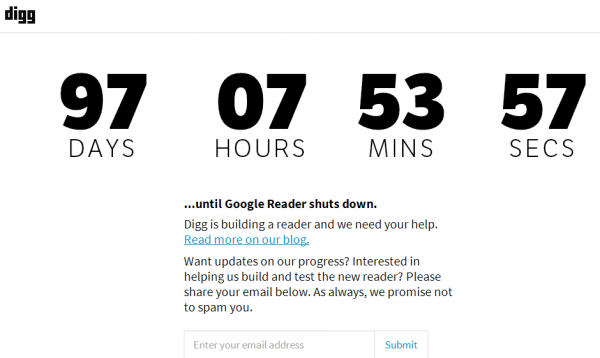
    Sounds good so far, but we will need to wait for an actual app before getting too excited. The company is continuing to gather suggestions from Reader refugees as it builds the app. In fact, it has set up a mailing list for news on the progress and it is complete with a Reader shutdown clock.

  • 2013 VW Beetle Convertible With Sound & Nav: RideLust Review

    2013 VW Beetle Convertible

    Thumbs Up: Better than the last Beetle Convertible in every way

    Thumbs Down: Cloth seats not available, not much rear passenger room

    Buy This Car If: You were there in the 1970s and long for your first Beetle convertible

    It’s probably safe to say that few cars ever sold in North America achieved quite as large a cult following as the original Volkswagen Beetle. Countless numbers of us learned to drive behind the wheel of a Volkswagen Beetle, and those of us in snow-belt states soon learned the advantage of skinny tires and a rear-mounted engine in winter. We also learned about things like snap oversteer on black ice, ejecting windshield wiper blades and a heating system that varied between “primitive” and “nonexistent.”

    2013 VW Beetle Convertible

    Though we can look back fondly on our memories of the VW Beetle, that doesn’t mean we’d want to make the concessions necessary to park an original in our garage. The “New Beetle,” launched in 1998, wasn’t exactly a step in the right direction, either. Essentially just a re-bodied Golf, the New Beetle’s three-arch design and cramped proportions did not age well, yet Volkswagen kept the car in production for some 13 years. Early models quickly earned a reputation for questionable reliability, especially on the used market, giving VW something of a bad name among potential buyers.

    2013 VW Beetle Convertible

    That’s all in the distant past now, and Volkswagen has recently launched a third generation of Beetle, with more emphasis on the original’s design and less focus on the “cute factor.” That’s not to say the new car is overly-retro, since it sports a design fresh enough to appeal to those unfamiliar with the original, while still speaking to first-generation owners. If that’s not crossing demographics, we don’t know what is.

    2013 VW Beetle Convertible

    The Beetle Convertible followed the Beetle to market at the end of 2012, and the new car is longer, lower and wider than the previous generation ragtop Beetle. Increasing the car’s proportions do a lot to up the car’s attitude, and it’s no secret that Volkswagen has gone to great lengths to pitch its latest Beetle, in coupe and convertible forms, to male buyers.

    2013 VW Beetle Convertible

    Though no other current Volkswagen model shares the Beetle’s rounded profile, there’s enough family resemblance to other VW models to keep things familiar. The front bumper, for example, gets the same angular styling as the current Golf, Jetta and Passat, while the rear lower fascia will look familiar to current VW fans as well. We give the German automaker credit for not pulling from the leftover parts bin when it comes to wheels; while the Beetle is available with stylish alloy wheels, it can also be configured with retro-styled alloys sporting chrome wheel covers.

    2013 VW Beetle Convertible

    Inside, the first thing you’ll notice is the outside (color, that is). Like the previous Beetle, the latest version uses body-colored dash and door trim in homage to the original. If you like the outside color of your car (or if you owned an original Beetle), you’ll probably love this nod to the past. Thankfully, the rest of the dash area is trimmed in black plastic and equipped with simple controls. To be honest, the infotainment system display is a bit small by contemporary standards, but we had no trouble with its operation and functionality.

    2013 VW Beetle Convertible

    Instruments are housed in an arched binnacle, centered in the driver’s field of view. The display is dominated by an oversize speedometer, flanked by a tachometer and the largest fuel gauge we’ve ever seen in an automobile. It’s a bit odd, if you ask us, and we wonder why VW didn’t opt to use a smaller fuel readout combined with, say, a temperature gauge. If you’re curious, coolant temperature can be seen in the driver information display (located at the bottom of the speedometer), which can also give the driver readouts on things like range, current fuel economy, average fuel economy, elapsed time and average speed.

    2013 VW Beetle Convertible

    Front seats are wrapped in what Volkswagen calls “V-Tex” synthetic leather. While it looks good enough (especially with the faux-carbon-fiber-patterned trim) and we’re sure it will stand up to years of abuse, it’s not the most comfortable of materials to sit on. It doesn’t breathe particularly well, and its tacky surface makes getting in or out in shorts an unpleasant experience. The front seats are otherwise excellent, but we simply couldn’t live with the V-Tex material in Florida’s summer heat. Please, Volkswagen (and other automakers), go back to offering cloth seats as an alternative to cow-from-a-test-tube.

    2013 VW Beetle Convertible

    Like the front seats, the rears are covered in V-Tex and trimmed with carbon-fiber-look vinyl. Head room isn’t bad with the top in place, but leg room is sub-optimal, even with the front seats pulled forward. Unless your friends are all short of leg, few will voluntarily sign up to spend long periods of time in the second row.

    2013 VW Beetle Convertible

    Like the last Beetle, the current version gets a front-mounted engine and front-wheel drive. Volkswagen serves up three solid engine choices, including a turbocharged 2.0-liter gasoline engine (borrowed from the GTI) and a turbocharged 2.0-liter diesel engine (pulled from the Golf/Jetta/Passat TDI). Our Volkswagen-supplied tester came with the base 2.5-liter five cylinder, which cranks out 170 horsepower and 177 pound-feet of torque. Ours came mated to the six-speed automatic transmission (a single-clutch unit, not VW’s superb DSG), which is the only choice available with the base engine. Opt for either of the turbocharged engines, however, and you can choose between the DSG gearbox and a six-speed manual.

    With the 2.5-liter five cylinder, expect the run from 0-60 mph to take in the neighborhood of nine seconds, while the EPA rates fuel economy at 23 mpg combined (21 mpg city, 27 mpg highway). We saw an indicated 25.5 mpg in an even mix of city and highway driving (including heavy use of the transmission’s Sport mode), so it’s likely that the EPA numbers are on the conservative side.

    2013 VW Beetle Convertible

    The 2013 Volkswagen Beetle Convertible is one of those cars that drives better than the sum of its parts. Though not particularly fast with the base engine, opting for the transmission’s Sport mode does give the car more willingness to run, and its brakes deliver the best feel we’ve seen in a modern Volkswagen. Even the steering feel rises above what you’d expect, making the Beetle Convertible fun to toss around on a winding road in good weather. At highway speeds, cockpit turbulence isn’t bad and Volkswagen offers up an optional wind blocker for those desiring more open-air serenity. Dropping or raising the top is as simple as pressing or pulling a switch, and the lined-fabric top can be deployed or retracted at speeds up to 31 mph (a very handy feature should you mis-time the changing of a traffic light).

    2013 VW Beetle Convertible

    If you owned an original Beetle Convertible (or even an original Beetle), chances are the latest version speaks to you in some subliminal way. Unlike most modern automobiles, the new Beetle manages to pull off a distinct personality, heavy on the retro charm. If you’ve got fond childhood memories tied to the Beetle, we suspect that a single test drive is all it will take to convince you that the newest variant deserves a place in your garage.

    2013 VW Beetle Convertible

    Volkswagen supplied the 2013 Beetle Convertible with Sound and Navigation for the purpose of this review. Total sticker price on our car was $29,290.

    For comparative purposes, a similarly-equipped MINI Cooper Convertible would list for $30,850, while a comparable Chrysler 200 LX Convertible would sticker at $29,875.

  • Evernote Launches Version 5 For Android: New Camera, Document Search And More

    Evernote for Android

    Evernote is a very popular notetaking service and with Google Keep on its heels, has released a major update. Version 5 brings several new features, one of the first being a new camera. Users can now take multiple photos and save them into a single note. With Page Camera, Evernote essentially turns into a scanner by scanning the page for text, removing shadows and improving contrast so an easy to read copy is saved. For Mac users, shortcuts have been added which allow you to quickly jump to frequently accessed notes, notebooks, and tags. You can easily create a new shortcut by swiping from the right edge of the screen and shortcuts will sync across all platforms.

    For Evernote Premium users, advanced Document Search has been introduced. Now when you search your account, any documents or files containing your search terms, will be displayed for easy access. There is also advanced PDF search which makes your scanned PDFs now searchable. Evernote Business users can now utilize Business tags that can be filtered under tag view as well as edited within Business Notebooks. Evernote 5 for Android also brings redesigned note lists, icons, tweaks, and performance improvements.

    QR Code generator
    Play Store Download Link

    Come comment on this article: Evernote Launches Version 5 For Android: New Camera, Document Search And More

  • Mobile apps for Google+ add photo filters, too

    While Google+ might not exactly have reached viral adoption yet, the platform and layout have been popular among the photographer community, and on Monday mobile photographers will get some added features with the launch of updated apps, including photo filters and editing on iOS.

    google+ photo app filters editingWithin the last year, photo filters and editing have become very important for social networks on mobile, with Twitter attempting to challenge Instagram’s dominance by launching its own filters and editing app, and Yahoo pushing its revamped Flickr app around the same time. People just love sharing photos with their social networks, said Facebook CEO Mark Zuckerberg at an event earlier this month, and the competition for photo-hosting has understandably increased.

    Google+ said the editing features coming to the iOS app are from the team at Snapseed, which Google acquired back in September 2012. At the time of the acquisition my colleague Erica Ogg wrote why it was a message on Google’s part to Apple, which really liked Snapseed, and why it could ultimately benefit Google:

    “So as amusing as it is, Google’s purchase of the company behind Snapseed, an Apple staff favorite, is not just Google trolling Apple. It’s several things. It’s Google understanding the necessity of offering high-quality photo editing within its overall ecosystem; aiming to improve its own current offerings like Picasa; and boosting the fast-growing photography community within Google+.”

    Updates to the mobile apps on Monday also include a variety of tweaks and added features like the ability to share your location, improved ability to update communities on the go, and improvements to posts on the Android verison.

    It’s not clear that photo editing and filters will necessarily give much of a boost to Google+ (I still don’t see many photos edited with Twitter’s photo filters showing up in my feed just yet), but it’s interesting to see the fruit of a social media acquisition for Google, as well as the future of Google+.

    Related research and analysis from GigaOM Pro:
    Subscriber content. Sign up for a free trial.

  • Android tethering could be threatened by judge’s patent ruling in favor of Nokia

    nokia_tethering_drawing

    In case you missed it among the seemingly constant back and forth between Samsung and Apple in the world’s courtrooms, there is a patent case about to get underway between HTC and Nokia regarding some alleged patent infringements. The bad news for Android fans is that Judge Thomas Pender has issued a ruling that could negatively impact any Android devices that make a tethering feature available. Nokia has asserted that HTC is infringing on U.S. Patent No 5,884,190 describing a “method for making a data transmission connection from a computer to a mobile communication network for transmission of analog and/or digital signals.” The court case between Nokia and HTC is scheduled to start in a couple months, but this ruling regarding the interpretation of the 190 patent makes it difficult for HTC to deny infringement.

    The case between the two companies involves about 40 patents that Nokia has asserted HTC infringes. Google is involved in the case as a third-party intervenor supporting HTC. Both HTC and Google had hoped to narrow the scope of the 190 patent, but failed to do so. The two companies will now have to somehow prove the patent is invalid, such as due to prior art. Proving the existence of prior art could be a challenge since Nokia obtained the patent in 1995, a time when the web was still in its infancy and mobile devices were closer to bricks than what we have today. If HTC fails to make their case during the trial, they may also try to sway the ITC commission to overrule the judge.

    If Nokia succeeds during the trial in showing HTC has infringed on the 190 patent, one of the likely results will be an import ban on all HTC devices into the U.S. Nokia will also be in a strong position to pursue other Android device manufacturers, much like they have already done against Apple and Blackberry. In the end, most companies will probably opt to pay a royalty to Nokia in order to keep the feature available.

    source: FOSS Patents
    via: PhoneArena

    Come comment on this article: Android tethering could be threatened by judge’s patent ruling in favor of Nokia

  • Blip to publishers: we’re going to monetize your videos, whether you like it or not

    Video hosting site Blip has come up with a new way to make more money with advertising: The site, which has been specializing on web-exclusive serialized content, is going to turn on preroll advertising by default for all of the content hosted on its site in early April. Blip shares its ad revenue 50/50 with publishers.

    Publishers will have an opportunity to opt out of ads for up to five videos in order to keep short clips and trailers ad-free, but after that, all fo their videos will be preceded by preroll ads. The changes were announced a few days ago in an email to producers that read, in part:

    “Blip’s mission is to be the place to discover the best in original web series. We support this mission by selling advertising against the content that you, the Blip Producer community, create and upload. The technology and bandwidth required to deliver your shows to a wide audience is paid for by advertising, similar to television.”

    Blip's previous ad policy: prerolls were entirely voluntary.

    Blip’s previous ad policy: prerolls were entirely voluntary (click for a full-size view).

    That’s a notable change from Blip’s previous take on advertising. The company described its advertising program in the past as “entirely voluntary,” noting on a still-active support page that producers “can use almost all Blip services without accepting advertising.”

    The email now sent out to Blip’s producers tries to quell fears that ads could drive audiences away:

    “We know that for some long-time Blip producers running advertising on your content will be unsettling. Rest assured that all of the available data in the market shows that audiences have become acclimated to pre-roll ads. In many cases, a prominent brand in front of an episode actually increases the perceived value of the show.”

    Blip started out as a video hosting site that competed directly with YouTube, and changed its course two years ago to focus exclusively on serialized content made for the web. The company distributes content to a variety of platforms, and opened a studio in Los Angeles to produce its own content last summer.

    Related research and analysis from GigaOM Pro:
    Subscriber content. Sign up for a free trial.

  • Google+ Apps Updated with Photo Filters, Improvements to Profiles & Communities, and More

    Google has just launched a major update to Google+ for iOS and Android, bringing photo filters, a brand new profile design, new features for communities, and much more.

    First off, the big, flashy new addition Google+ for iOS is photo filtering. It’s part of a photo editing update that also lets you rotate and crop your photos. There are now 9 different filters to choose from, including black & white, warm, cool, and “retrolux.” In this regard, Google+ is catching up to other apps like Facebook and Twitter in capitalizing on the filtering craze spawned by Instagram.

    This is the result of Google’s September, 2012 acquisition of Snapseed.

    Google says that with the new editing software, you’ll be able to “do basic edits like rotate and crop, as well as select filters like Drama and Retrolux; adjust saturation, contrast, brightness and lots more by sliding your fingers up-and-down, then left-and-right; single tap at any time to compare your creation with the original.”

    Google+ photo filters

    Other useful improvements include the ability to control the volume of posts from each of your circles or communities and a new search filtering option that lets you sort by best and most recent.

    The last feature to get retooled in both the iOS and Android apps is Google+ Communities. Now, you can broadcast specific communities to your connections by sharing it of sending them an invite. You also have to ability to re-share posts with specific communities. Also, Google now shows you counts for unread community messages.

    There are also some Android-specific updates for the Google+ app, including some improvements to how you view content in your stream:

    • Posts include more text up front—from the original message, and from comments
    • Tapping video, photo or link attachments takes you directly to a watch page, lightbox or website
    • Image previews are rarely cropped, so you’ll see portrait photos (for instance) in all their glory
    • Key actions like +1, reshare and comment are displayed more prominently in each post
    • You can swipe through photo albums inline

    Profiles on Google+ for Android now have location sharing. If you enable it (via desktop or mobile), you can now show where you currently are on your profile.

    And on Google+ for iOS, you’ll find redesigned user profiles and the notification tray – both of which are cleaner. If you’re new to Google+ for iOS, Google wants to make it easier to get started with a new set-up flow when you launch the app.

    You can snag the update today over at the App Store and Google Play.

  • You CAN use Office 2013 Trial for more than 30 days — how’s 180?

    DiSTANT X has released Office Trial Extender 1.0.0.7, a new build of its tool for legally extending the trial period for Microsoft Office 2010or later to a maximum of 180 days. The new version adds support for the latest Office 2013 release, renames itself Office Trial Extender and ensures all its files are digitally signed.

    The tool works by resetting your Office trial to 30 days, and can be used a maximum of five times, giving you a theoretical maximum trial period of 180 days — with caveats, as we discuss below.

    Now Microsoft is in the process of switching to a subscription system – Office 365 – with its products, it’s important to understand there’s a particular procedure you need to follow should you want to road-test Office 2013 for up to 180 days. The key fact is that you need to obtain a trial product key rather than sign up using your Microsoft Windows ID. Don’t worry, our download link for Office 2013 takes you to the correct part of the Office web site where you can obtain this serial code by email.

    After installing and activating Office, use it as usual until your trial period runs out. When it does, install Office Trial Extender if you haven’t already and launch the program, clicking Yes when prompted to restart it with administrative privileges. Click the Rearm button for your trial version of Office, then read the warning. Make sure all instances of Office aren’t running — any open documents may be corrupted by the process – then click Yes to reset your trial to 30 days.Remember, Office Trial Extender doesn’t add 30 days to your current trial period; instead, it resets it back to 30 days. That means to get a full 30 days extra you need to wait until the trial expires before using it.

    Office Trial Extender can be used up to five times in total to extend the subscription to a maximum of 180 days, which should be ample time enough for you to decide whether or not to purchase the full version, or invest in an Office 365 subscription.

    Office Trial Extender 1.0.0.7 is available now as a freeware download for Windows. Also available are Office 2013 Professional Plus and Office 2010 Professional as free trial downloads.

    Photo Credit: olly/Shutterstock

  • Getting Crazy Ideas Off the Ground

    How you manage the period between when an insight is first generated and when a concept is judged ready for development is the key to getting discontinuous innovation off the ground. These are ideas that don’t fit the existing capabilities or the incumbent business model, don’t have an obvious business case, and carry a high risk.

    In most cases it is an individual who takes the lead in developing a crazy idea, typically the person whose idea it is, usually with little or no direction from the organization. Unfortunately, in the majority of cases, the strong identification of the idea with the person means that it is politically vulnerable; few people have a stake in it and there are no clear processes on how to fund and advance it (unless is a CEO’s idea). In some firms the environment can be so unkind that people simply squash their value-creating insights out of fear.

    Discontinuous innovations, then, are not only fragile but they also have no natural organizational protection and direction. Consequently they tend to die on the vine. How can companies fix this problem? Let’s look at two that seem to have found an answer:

    P&G established a “Corporate Innovation Fund” (CIF) that provides seed capital to ideas that do not have a natural organizational owner. They target the “homeless” ideas within their organization. The CIF also plays a pivotal role in assembling the right team to take charge of the selected ideas. They identify and assemble the right mix of skills, “fishing” across P&G’s units. CIF investments are made independently of the traditional budget cycle, which saves high-risk ideas from competing for funds with more mainstream and easily justifiable projects.

    Samsung Electronics has taken a similar approach. They have established a Value Innovation Program (VIP) Center dedicated to the review of discontinuous innovation ideas at Suwon, Samsung’s main manufacturing site, 20 miles south of Seoul. The Center is open 24 hours a day. It has 20 project rooms, 38 bedrooms, a gym, traditional baths, and ping pong tables.

    Anyone with an idea can pitch it to the VIP Center and on average around 90 projects cycle through each year. If an idea is selected, the VIP provides organizational protection and a home to nourish it in the initial stage. Like P&G’s CIT, the VIP plays a pivotal role in assembling an innovation team composed of engineers, designers and marketers, who are supported part-time by the Center’s Specialists, who are expert in the tools and processes of strategic innovation and customer research.

    A VIP project results in a detailed concept, including the value proposition, design blueprints, and the technical and cost specs. When completed, the project is passed to the standard product development process of divisions for further development. Since its creation, the VIP Center has been credited with generating a series of slick products, including Samsung’s Bordeaux TV, which has been instrumental in making Samsung a category leader in the TV business

    P&G and Samsung found their ways to protect and nourish their individual “homeless” ideas. They have created organizational greenhouses to get them ready for mainstream development. With the risks and opportunities more clearly defined these off-the-wall ideas generally find homes in the product development arms of the various business units at P&G or Samsung and the regular processes can kick in.

  • Prominent Android hacker quits Samsung job, slams TouchWiz on the way out

    Samsung CyanogenMod Hacker
    The founder and lead developer of the popular third-party CyanogenMod software for Android has resigned from his position at Samsung (005930) after only 19 months with the company. Steve Kondik announced on his Google+ page on Monday that he has “decided to do something new.” The hacker was recruited by Samsung to be a software engineer for the company in August of 2011 and continued to work on CyanogenMod as a side project.

    Continue reading…

  • Will NRG Energy be the next ten ton gorilla in solar leases?

    NRG Energy, one of the most aggressive power companies to invest in solar projects, is considering getting into offering leases for solar panel roof systems for home owners and businesses. NRG Energy’s CEO David Crane tells Bloomberg that it is something that they’re “looking at in a very serious way,” and NRG Solar’s CEO Tom Doyle told me last month that the company has been inreasingly talking about financing options for solar roofs and in particular exploring the lease structure.

    NRG Energy already builds solar panel projects for commercial and industrial building owners. Doyle told me that the company has been “heartened” by the amount of Fortune 300 companies that have wanted to install solar panels on their rooftops. Distributed solar panel systems have been gaining momentum, said Doyle, adding that they’ve been delivering higher growth than utility solar systems. In an interesting twist, that puts NRG Energy in grwoing competition directly with utilities, notes Bloomberg.

    The emergence of the solar lease, or other financing options for solar, has helped unlock huge growth in solar panel rooftop installations in recent years. Essentially a third party, like SolarCity or Sungevity, raises a few hundred million dollar fund from a bank or a big company like Google, and uses that money to provide the up front capital for a home roof top system, which can cost tens of thousands of dollars to install. The homeowner doesn’t have to pay that upfront cost, but pays the solar leasing company a monthly bill that is usually lower than its former utility bill. Over time the bank or “the Google” gets paid back with a return that can be around ten to twelve percent.

    As I reported last month, three quarters of the solar panels installed on home roofs in 2012 in California were financed and owned by these solar service companies, and not the home owner. These “third-party owned” solar systems collectively generated $938 million in revenues last year.

    It’s one of the more lucrative businesses in the solar market these days. So why wouldn’t NRG Energy want to be in it. SolarCity, a former startup that has helped pioneer the business, went public in December 2012 at $9.25, saw its stock soar 40 percent on its debut day, and has now more than doubled to $18.57 Monday morning. Other companies that offer solar financing options include Sunrun, and Clean Power Finance.

    The emergence of NRG Energy in the solar leasing business could be a real threat to the companies already operating in it. NRG Energy earned $1.59 billion last year, which was a decline from the previous year, but which is clearly far larger than the fairly new companies like Clean Power Finance and Sungevity.

    Related research and analysis from GigaOM Pro:
    Subscriber content. Sign up for a free trial.

  • Google Updates AdWords Trademark Policy

    Google announced some updates to its AdWords trademark policy. Beginning on April 23, AdWords keywords that were restricted as a result of a trademark investigation will no longer be restricted in China, Hong Kong, Macau, Taiwan, Australia, New Zealand, South Korea and Brazil.

    “While we will not prevent the use of trademarks as keywords in the affected regions, trademark owners will still be able to complain about the use of their trademark in ad text,” Google says, adding, “Google’s goal is to provide our users with the most relevant information, whether from search results or advertisements, and we believe users benefit from having more choice. Our policy aims to balance the interests of users, advertisers and trademark owners, so we will continue to investigate trademark complaints concerning use of trademarks in ad text. In addition, this change means that the AdWords policy on trademarks as keywords is now harmonised throughout the world. A consistent policy and user experience worldwide benefits users, advertisers and trademark owners alike.”

    Google won’t prevent advertisers from selecting a third party’s trademark as a keyword in ads targeting the specified regions. The policy change does not impact the usage of trademarks in ad text. Google will continue to restrict use of trademarks in ad text for those in the affected regions that have already filed existing complaints about keywords and ad text.

    Keywords that were restricted as a result of a trademark investigation may start triggering ads in the affected regions. If you don’t want this to happen, you can remove the keywords from the campaigns or add them as negative keywords.

    You can read the FAQ here.

    The changes bring Google’s policy in the affected regions in line with its policy in the rest of the world.

    Hat tip to Ginny Marvin

  • BioShock Infinite Trailer Reminds You That It Launches Tomorrow

    BioShock Infinite – one of the most anticipated game of 2013 – finally launches tomorrow.. To make sure that you don’t forget, Irrational Games have thrown together one final trailer for the title:

    There’s not much new in the trailer as we’ve already seen pretty much everything that doesn’t fall within spoiler territory. The game still looks incredibly fun though, and the reviews so far are confirming it as the first must-have game of the year.

    BioShock Infinite will be available tomorrow, March 26, for Xbox 360, PS3 and PC. Those who have preordered the game on Steam will be able to start playing it tonight when it unlocks. GameStop is also holding a number of midnight release events across the country for those who can’t wait to start exploring Columbia.

  • Baby Left With Note in Grocery Store Parking Lot

    Shopping with children is certainly high up on the list of stressful activities for parents. The alternative of leaving the baby alone is not a real option, but a woman in New Zealand decided this weekend that it was.

    The New Zealand Herald is reporting that a mother left her baby alone in a car in the parking lot of the Porirua, New Zealand Pak’nSave grocery store. A note was left on the infant, reading,”My mum’s in doing the shopping, call her if I need anything.” The man who found the baby promptly called the number left on the note and summoned the child’s mother to the parking lot.

    Though leaving a child alone in such a way is illegal in New Zealand, no charges were mentioned by the Herald report.

    Leaving a child unattended in a vehicle, especially in hot weather, is dangerous. Children die as a result of the practice on a yearly basis, and some states have laws that allow parents to be prosecuted on manslaughter charges for such deaths.

    (Image courtesy Polly Gillespie on Facebook)

  • Steve Kondik leaves Samsung, shares thoughts on Samsung Galaxy S 4

    steve_kondik

    CyanogenMod founder Steve Kondik started out a Google+ post this morning with this, “I got to spend some quality time with the S4 (final hardware) before I left Samsung.” (emphasis added) The post contained his thoughts on the new Samsung Galaxy S 4 smartphone and what he sees as some strengths and weaknesses. Needless to say, the subtle announcement that he had left his position with Samsung has generated as much interest, if not more, than his thoughts on the Galaxy S 4. In a follow-up comment to the original post, Kondik indicates he thought Samsung was a “great” place to work, but he just decided he was interested in trying something new.

    With regard to the Galaxy S 4, Kondik’s opinion seems to be a bit of a mixed bag. He praises the hardware of the Galaxy S 4, indicating “this device blows the competition out of the water.” A couple unique features he specifically mentions are the “hover”-aware touchscreen and the IR blaster. Kondik also mentions the GPS circuitry seems to be much better than in past devices. On the downside, he thinks Samsung’s TouchWiz UI is a bit of step back despite Samsung’s attempt to clean it up a bit and give it a lighter look. This perception may be attributed to a return to a fully tabbed UI and extensive use of popup windows.

    Kondik indicates the Samsung Hubs are featured more prominently, possibly as part of an effort to distinguish Samsung from the rest of the Android ecosystem. Kondik thinks anyone upgrading from a Galaxy S II will be more than pleased. While Galaxy S III owners will probably like the device as well, though the justification for an immediate upgrade is not as compelling.

    source: +Steve Kondik

    Come comment on this article: Steve Kondik leaves Samsung, shares thoughts on Samsung Galaxy S 4