Blog

  • LIFX Smart Bulb Opens Up Second Batch Of 100K Pre-Orders, Demos Gesture-Based Dimming

    lifx-bulb

    Australian hardware startup and Kickstarter success story LIFX has good news for people who missed out on backing the initial project: it’s opening up a second round of pre-orders, with a new production run of 100,000 units, sold directly through its website. LIFX sold out its pre-order allotment on Kickstarter in just six days, blowing past $1M, which is 10 times its original funding target.

    LIFX’s original ship date was slated for March of 2013, but as of today co-founder Andrew Birt says the first 500 units should be rolling off the line in about four weeks time with a May/June Kickstarter shipping timeframe in mind, which isn’t that much of a delay in Kickstarter time. That’s why the company has now released the video above, which shows the production prototype in action, connecting to Wi-Fi, being controlled by the remote app with light color changing features and a demo of gesture-based dimming in action.

    The new second batch of LIFX bulbs is set for a September 2013 delivery date, so they’ll come after the startup fulfills its Kickstarter pledge pre-orders. All bulb types, including Edison screw, Bayonet and Downlight mounts, start at $79 (just $10 more than the original Kickstarter single-bulb price), and all have price breaks for bulk orders.

    Unlike Philips Hue, LIFX bulbs don’t require a base to connect to your network, and the Edison screw and Bayonet types are rated at 900 lumens on the LIFX (around 80w), while max brightness on the Hue is just 600 lumens (roughly 50w). Philips Hue bulbs cost $20 less per unit, but you also have to buy the starter kit which includes the base to get up and running, a $199 initial investment. Of course, the ultimate test will be in performance, so we’ll have to see how LIFX compares to the generally very positive reviews the Philips Hue is garnering.


  • Google reportedly planning its own Android smartwatch

    Google Smartwatch Android
    Samsung (005930) already confirmed that it is working on a smartwatch to take on Apple’s (AAPL) still mythical “iWatch,” and now a new report suggests that Google (GOOG) is also hard at work on its own wearable Android device. The Financial Times on Thursday evening cited a single unnamed source in claiming that Google has a smartwatch in development. The company’s Android team is reported spearheading the project, which will apparently yield a smartphone companion similar to Samsung and Apple’s efforts rather than a connected device. No launch timing or additional details about the device were reported.

  • iStreamPlanet Raises Series A Round

    iStreamPlanet, a maker of live streaming video technology, has raised an undisclosed amount of Series A financing led by Intel Capital. Juniper Networks has also completed a strategic investment as part of the round. The money will be used for development.

    PRESS RELEASE

    iStreamPlanet, the leader in live streaming video solutions, announced today that Juniper Networks has completed a strategic investment in iStreamPlanet’s Series A funding, which was led by Intel(R) Capital. The investment will be funded by Juniper Networks’ Junos(R) Innovation Fund. iStreamPlanet plans to use the proceeds from its Series A financing to accelerate the development of its live video streaming solutions, including Aventus(R), a cloud-based, live video workflow platform designed to address the challenges of streaming live events and live linear channels online to multiple platforms and devices. One of the key advantages of Aventus is its ability to move the live video workflow from today’s hardware-dependent infrastructure to a software- and cloud-based infrastructure.

    The relationship combines iStreamPlanet’s innovations and experience in providing scalable and cost-effective live video workflow solutions with Juniper’s industry-leading networking and caching technology to provide a reliable, secure, and high-performance platform for content providers. The two companies have worked closely in the past to deliver complex, live video workflows for major live events, including the 2012 London Games.

    “We are developing and bringing to market a next-generation automated video workflow platform, which will help content holders and distributors keep pace with the growing demand for live streaming video and accelerate new business opportunities for broadcasters of all sizes,” said Mio Babic, CEO of iStreamPlanet. “Juniper Networks’ commitment to innovation in networking and caching in the cloud closely aligns with our vision and customer demand, and we are excited to be working with them and leveraging their expertise in this area.”

    “Live streaming media is one of the most demanding networking and caching scenarios, and one of the fastest areas of growth and opportunity,” said Robert Krohn, vice president and general manager, Edge Software Business Unit, Juniper Networks. “Keeping up with customer demand will require solutions with new levels of scalability and automation, and iStreamPlanet and Juniper Networks are now on a fast track to bring this type of solution to market.”

    The Junos Innovation Fund is a venture capital fund, launched in 2010 and backed solely by Juniper Networks, that invests in leading early- and growth-stage technology companies that expand and enhance the Junos ecosystem.

    About iStreamPlanet iStreamPlanet is a premier, multiplatform video-workflow solutions provider committed to bringing high-quality streaming video experiences to connected audiences around the world. With more than a decade of live streaming video experience, iStreamPlanet has built a comprehensive offering of cloud-based video-workflow products and services for live event and live linear streaming channels. iStreamPlanet’s innovative approach has been chosen by the world’s leading sports, entertainment, and technology brands including NBC, Turner Broadcasting, Notre Dame Athletics, AT&T, Pac-12 and Microsoft. Founded in 2000, the privately held company is headquartered in Las Vegas with offices in Redmond, Wash., and London.

    The post iStreamPlanet Raises Series A Round appeared first on peHUB.

  • Carlyle Announced IPO of Broadleaf Co.

    The Carlyle Group announced that its majority-owned portfolio company Broadleaf Co. went public on the Tokyo stock exchange. Carlyle Japan Partners II acquired Broadleaf in November 2009. The Japanese company is an auto after-market software provider.

    PRESS RELEASE
    Global alternative asset manager The Carlyle Group (Japan co-representatives: Tamotsu Adachi/Kazuhiro Yamada; headquarters: Washington, D.C.; hereinafter Carlyle) today announced that its majority-owned company, Broadleaf Co. Ltd. (Tokyo Stock Exchange First Section, stock code 3673, headquarters Tokyo, Japan; President and CEO: Kenji Oyama) has gone public on March 22, 2013, with its shares trading on the first section of the Tokyo Stock Exchange.

    Carlyle sold 16,480,000 (73% of the total number of shares outstanding) of its holdings in Broadleaf and allocated the remaining 2,813,000 shares (13% of the total outstanding) for an over-allotment. Including the over-allotment portion, Carlyle will sell all of its shareholdings. Carlyle Japan Partners II acquired Broadleaf in November 2009.

    Broadleaf is one of the largest auto after-market software providers in Japan, providing IT solutions and services to maintenance and repair shops, body shops, dismantlers and parts distributors. With its proprietary IT systems, auto-part databases and network technologies, Broadleaf provides business applications for streamlining operations to 30,000 clients, helping them improve their operational efficiency and support their business development activities.

    Since its establishment, Broadleaf has expanded its business as a subsidiary of the publicly traded company, ITX. Broadleaf became independent in November 2009 through a management buyout (“MBO“) supported by Carlyle. The purpose of MBO was to focus on the long-term growth strategy of the company, including business model transformation and overseas expansion, in order to cope with the drastic changes in the automotive industry following the global financial crisis. During the MBO period, Broadleaf worked closely with Carlyle to maximize the company’s business value by focusing on network-based transaction fee to drive revenue growth, strengthening its management and sales teams, introducing strategic products, and expanding into overseas markets. Having accomplished the goals of the MBO, Broadleaf has decided to go public and is well-positioned for the next stage of growth.

    Kenji Oyama, President of Broadleaf, said, “Today, I am honored to announce the listing of Broadleaf on the first section of the Tokyo Stock Exchange. Since the MBO in November 2009, Broadleaf has received tremendous support from Carlyle. As a strategic partner with a long-term commitment, Carlyle has helped improve the company’s business structure and develop a sustainable growth strategy. Over the years, we have successfully implemented fundamental strategic initiatives that are instrumental to the growth of the company such as business model changes, organizational reform and overseas expansion. We will continue to accelerate our business growth to meet the expectations of all stakeholders by providing unique IT services that contribute to IT-industrialization of the automobile-related industries.”

    Comment on the initial public offering, Tamotsu Adachi, managing director and Japan co-representative of Carlyle Japan LLC, said, “Since our investment in 2009, Carlyle has worked closely with Broadleaf to enhance its business model and expand its overseas operations. The mutual trust between Carlyle and Broadleaf, coupled with President Kenji Oyama’s strong leadership, and the efforts of its management team and all employees, have contributed to the successful transformation of the company. With quality products and solid industry position, Broadleaf is positioned for continued growth and will make substantial contribution to the society as a public company. ”

    About The Carlyle Group
    The Carlyle Group (NASDAQ: CG) is a global alternative asset manager with $170 billion of assets under management across 113 funds and 67 fund of funds vehicles as of December 31, 2012. Carlyle’s purpose is to invest wisely and create value on behalf of our investors, many of whom are public pensions. Carlyle invests across four segments – Corporate Private Equity, Real Assets, Global Market Strategies and Solutions – in Africa, Asia, Australia, Europe, the Middle East, North America and South America. Carlyle has expertise in various industries, including: aerospace, defense & government services, consumer & retail, energy, financial services, healthcare, industrial, technology & business services, telecommunications & media and transportation. The Carlyle Group employs 1,400 people in 33 offices across six continents.

    The post Carlyle Announced IPO of Broadleaf Co. appeared first on peHUB.

  • Reuters – Buyout Firms Team up On BMC Deal

    Private equity firms are joining forces in the auction of BMC Software Inc, four people familiar with the matter said on Thursday, making it more likely that the business software maker will be taken private in a deal that will top $6 billion, Reuters reported. Shares of BMC jumped as high as 9 percent on the news and were trading up 4.1 percent at $45.71 in early afternoon trading, giving the Houston, Texas-based company a market value of around $6.6 billion. KKR & Co LP and TPG Capital LP have formed a consortium, the people said on condition of anonymity because the process is confidential. Bain Capital LLC and Golden Gate Capital have separately also teamed up for the auction, the people added.

    (Reuters) – Private equity firms are joining forces in the auction of BMC Software Inc, four people familiar with the matter said on Thursday, making it more likely that the business software maker will be taken private in a deal that will top $6 billion.

    Shares of BMC jumped as high as 9 percent on the news and were trading up 4.1 percent at $45.71 in early afternoon trading, giving the Houston, Texas-based company a market value of around $6.6 billion.

    KKR & Co LP and TPG Capital LP have formed a consortium, the people said on condition of anonymity because the process is confidential. Bain Capital LLC and Golden Gate Capital have separately also teamed up for the auction, the people added.

    Thoma Bravo LLC is participating in a third buyout consortium, one of the people said. None of the people disclosed how much the private equity firms would be willing to pay for BMC.

    The process is now past the first rounds of bids and management presentations are taking place, the people said, adding that final bids are expected in the next few weeks.

    A BMC Software spokesman declined to comment. KKR, TPG, Golden Gate, Bain and Thoma Bravo also declined to comment.

    BMC, which competes with Oracle Corp, SAP AG, CA Inc and Compuware, was under pressure from Paul Singer’s activist hedge fund Elliott Management to sell itself last year.

    The company eventually said it had weighed strategic options and had decided to buy back $1 billion in stock.

    BMC executives admitted in 2012 that the company had been “late” to latch onto an industry shift toward Internet-based software, also known as “software-as-a-service”.

    Activist investor Elliott Management argued last year that management was neglecting a huge opportunity to use their large installed base to expand into Internet-based business software, a market then dominated by the likes of Salesforce.com Inc. The world’s largest providers of software for enterprises, including Oracle, SAP and Microsoft, had already begun investing heavily in that market.

    BMC needed a board with a fresh approach in order to keep up, Elliott argued. The investment firm also pointed out significant scope to trim headcount and create a more efficient business.

    Elliott owned 9.6 percent of BMC as of January 30, according to a regulatory filing.

    WHAT’S ITS FUTURE?

    In January, BMC forecast a lower-than-expected profit for 2013 after reporting third-quarter results below Wall Street estimates due to lower license bookings at its two main divisions: enterprise services management and mainframe service management businesses.

    At the end of trading on Wednesday, BMC’s enterprise value stood at 6.2 times its projected 12-month earnings before interest, tax, depreciation and amortization, compared to a 7.1 times average for its peer group, according to Thomson Reuters data.

    “The buyout of BMC is unlikely to happen at a materially higher level from the current (share) price … BMC’s business has been suffering as customers are concerned about its future,” Mizuho Securities USA Inc analysts wrote in a note on Thursday.

    Elliott Management had signed a standstill agreement with BMC last summer that is set to expire on March 23 and prevented the New York-based hedge fund from making a bid or nominating board directors without the target’s prior consent.

    In a regulatory filing on Wednesday, BMC extended by two weeks the time window for shareholders to submit board nominees and items for the annual meeting. The period to submit proposal will now run from April 6 to May 6.

    Rival Compuware Corp, which has rejected a $2.3 billion bid from Elliott, is also exploring a sale and talking to buyout firms to gauge takeover interest, people familiar with the matter said last month.

    Elliott is an investor alongside Golden Gate, Thoma Bravo and Francisco Partners in business software company Attachmate Corporation.

    (Reporting by Greg Roumeliotis, Nadia Damouni and Soyoung Kim in New York; Editing by Maureen Bavdek, Tim Dobbyn, Bernard Orr and Nick Zieminski)

    The post Reuters – Buyout Firms Team up On BMC Deal appeared first on peHUB.

  • Reuters – Big Tech Tests the Waters of the Music Stream

    Technology giants Apple, Google and Amazon are furiously maneuvering for position in the online music business and looking at ways to make streaming profitable, despite the fact that pioneer Pandora has never made a profit, Reuters wrote Friday. It has been more than a decade since the iPod heralded the revival of Apple and presaged the smartphone revolution. Streaming service Pandora is spending freely and racking up losses to expand globally. Even social media stalwarts Facebook and Twitter are jumping on the bandwagon.

    (Reuters) – Technology giants Apple, Google and Amazon are furiously maneuvering for position in the online music business and looking at ways to make streaming profitable, despite the fact that pioneer Pandora has never made a profit.

    It has been more than a decade since the iPod heralded the revival of Apple and presaged the smartphone revolution, even as music-sharing site Napster was showing the disruptive power of the Internet in the music business.

    Now Google, Amazon.com Inc and Apple are among the Silicon Valley powerhouses sounding out top recording industry executives, according to sources with knowledge of talks and media reports. Streaming service Pandora is spending freely and racking up losses to expand globally. Even social media stalwarts Facebook and Twitter are jumping on the bandwagon.

    All of them see a viable music streaming and subscription service as crucial to growing their presence in an exploding mobile environment. For Google and Apple, it is critical in ensuring users remain loyal to their mobile products.

    Music has been integral to the mobile experience since the early days of iTunes, which upended the old models with its 99-cent per song buying approach. Now, as smartphones and tablets supplant PCs and virtual storage replaces songs on devices, mobile players from handset makers to social networks realize they must stake out a place or risk ceding control of one of the largest components of mobile device usage.

    About 48 percent of smartphone users listen to music on their device, making it the fourth most popular media-related activity after social networking, games and news, according to a ComScore survey of mobile behavior released in February. Users ranked a phone’s music and video capability at 7.4 on a scale of 1 to 10, with 10 being most important purchase consideration factor, according to the study.

    “Music is very strategic for the various electronic devices Samsung manufactures,” said Daren Tsui, CEO and co-founder of streaming music service mSpot, which Samsung bought last year to create the Music Hub service now available on Galaxy smartphones in the United States and Europe.

    “By owning it, we can absolutely customize the music experience and leverage the fact that it’s not just a service but there’s also a hardware component.”

    In January, Beats Electronics, the startup co-founded by recording supremo Jimmy Iovine and hip-hop performer-producer Dr. Dre, and backed by Universal and Warner Music, announced a new streaming-subscription service dubbed “Daisy” to take on Pandora and Spotify starting this summer.

    Now, industry insiders expect Apple, Google and other technology titans to jump into the fray. Apple is talking with music labels about tacking a subscription service option onto iTunes, sources have said, while Google is said to be planning a YouTube subscription music service, according to media reports.

    “There are some content creators that think they would benefit from a subscription revenue stream in addition to ads, so we’re looking at that,” a YouTube spokesperson said, but declined to comment on any specific negotiations.

    Apple declined to comment.

    Microsoft is already promoting its Xbox Music service. Their entry promises to catalyze an industry shake-up and propel music streaming further into the mainstream.

    “ITunes was great but it needs a step forward,” Iovine, chairman of Universal Music’s Interscope-Geffen-A&M Records, told the AllThingsD conference in February. “There is an ocean of music out there that people want.”

    MOBILE MUSIC LOVERS

    Music streaming, or playing songs over the Internet, has in recent years begun to come into its own as listeners increasingly choose to stream songs from apps like Pandora via their smartphones, rather than buy and store individual tracks.

    The ad-free subscription model, where consumers pay a flat fee for near-unlimited listening time, is relatively new and quickly gaining popularity.

    Pandora, one of the pioneers, is now trying to convert users of its free ad-supported radio service into subscribers. It says mobile users account for more than two thirds of its music, up from just 5 percent of listener-hours three years earlier.

    Subscription services are expected to have crossed the 10 per cent mark as a share of total digital music revenues in 2012 for the first time, according to a recent report from the International Federation of the Phonographic Industry, which represents the recording industry worldwide.

    Consumers spent $5.6 billion worldwide for digital music in 2012, an increase of 9 percent, offsetting the decline in CDs and other physical ways to provide music. That gave the industry its best growth since 1998, albeit a miniscule 0.3 percent, according to the IFPI.

    Pure buyers “have to spend hundreds of dollars a month on music, which most people can’t afford to do,” Spotify founder and CEO Daniel Ek told Reuters in an interview last week at South-by-Southwest Interactive. “It’s pretty obvious that the access model or the subscription model is a much better proposition for most people.”

    U.S. consumers will stream an estimated 100 billion tracks this year, says David Bakula, senior vice-president for client development and analytics for Nielsen Entertainment.

    “The big question is who has the business model to make it work,” said Bakula, a former executive at Universal Music, one of the four major music labels. “The first ones in the market may not be the winners.”

    Apple CEO Tim Cook recently met with Iovine and other Beats executives to find out more about that business. It is unclear if Apple will join Beats’ Project Daisy.

    SHOW ME THE MONEY

    Making money off music streaming is difficult. Leading players Pandora and Spotify, despite attracting hundreds of millions of dollars in financing and millions of subscribers, have never reported a cent of profit.

    No less a personage than Steve Jobs himself was a skeptic.

    “Never say never, but customers don’t seem to be interested in it,” the late Apple co-founder and online music visionary told Reuters in a 2007 interview. Apple’s current executives have not publicly stated their views on streaming music.

    Pandora, which went public in 2011, now has 67 million monthly listeners worldwide – a 41 percent jump from a year ago – together listening to more than 13 billion hours of music.

    But its losses more than doubled to $38.1 million in the year to January 31, 2013, hurt by the high cost of standard streaming licenses that typically have a per-track royalty model. This has forced Pandora, which relies mainly on advertising for revenue, to cap free mobile listening at 40 hours per month.

    It and other music services such as Clear Channel Communications’ iHeartRadio are now urging lawmakers in the U.S. Congress to pass the “Internet Radio Fairness Act,” which would set royalty rates for subscription music services using the same standard that has so far been applied to other forms of radio.

    But a group of 125 musicians, including Billy Joel and Rihanna, are speaking up against it, arguing that the bill would cut by 85 percent the amount of money an artist receives when his or her songs are played over the Internet.

    The issue of how recording labels and musicians will be paid is one of the biggest roadblocks to growth. Competition will almost certainly force a shakeout, with winners and losers.

    That could accelerate once major technology companies like Amazon and Google flex their marketing muscles, not to mention Apple with its ability to leverage its enormous base of online music buyers. The California gadget giant is unlikely to cede its lead in selling music without a fight.

    While streaming could undercut sales of music tracks, Apple has always maintained that if there is potential for cannibalization of its products, the gadget maker would rather be in charge than let others in on it.

    Finally, Microsoft has a large audience of Windows and Xbox players to whom it can promote Xbox Music Pass, a $9.99 a month service it launched in October. The software giant has declined to talk about its future plans in this area.

    Bring it on, says Ek from Spotify.

    “It’s rare that gigantic companies figure out a new way to do something peripheral,” Ek said. “I don’t believe the world will only be controlled by a Google or an Apple. It will be companies who are great at games like EA, at films like Netflix, or at music like Spotify.”

    (Additional reporting by Gerry Shih in San Francisco; Editing by Claudia Parsons)

    The post Reuters – Big Tech Tests the Waters of the Music Stream appeared first on peHUB.

  • Tapad Inks $6.5M

    Tapad, a provider of “unified cross-device advertising” technology, has raised a Series B round totaling $6.5 million. Investors include Firsthand Technology Value Fund, FirstMark Capital, Avalon Ventures, Metamorphic Ventures, Lerer Ventures. Individual investors in the company include former DoubleClick CEO David Rosenblatt, AppNexus founder Brian O’Kelly, former Huffington Post CEO Eric Hippeau, 24/7 Real Media co-founder Geoff Judge and QUIGO founder and CEO Mike Yavonditte.

    PRESS RELEASE
    Tapad, the leading provider of unified cross-device advertising solutions, today announced the closing of its Series B rounds of funding for $6.5 million, following a record 2012 fiscal year with a 604% year-over-year growth rate.

    Publicly traded venture capital fund Firsthand Technology Value Fund, Inc. SVVC 0.00% joined the company’s impressive roster of investors. Founding investors FirstMark Capital and Avalon Ventures also participated in the round. Other Tapad investors include: Metamorphic Ventures, Lerer Ventures, as well as former DoubleClick CEO David Rosenblatt, AppNexus founder Brian O’Kelly, former Huffington Post CEO Eric Hippeau, 24/7 Real Media co-founder Geoff Judge and QUIGO founder and CEO Mike Yavonditte.

    In addition to its notable 2012 FY, Tapad is currently on pace to achieve a 200% revenue increase for Q1 2013 over Q1 2012. The company’s rapidly expanding client base has grown to include more than 75 brands of Fortune 500 companies, and comprises all four major advertising holding companies in the U.S.

    The financing will be used to maintain Tapad’s pace of growth in the U.S. and further Tapad’s lead as the premier cross-device advertising solution for the world’s leading global brands.

    “This latest investment in Tapad affirms the critical role our company has played in pioneering unified cross-device advertising,” said Founder and CEO Are Traasdahl. “We were the first technology that enabled advertisers to get a unified view across all screens and are delighted that Firsthand and such a distinguished group of investors share our commitment to advancing this field.”

    “Tapad’s innovations have blown the doors open for brands to connect with consumers across screens,” said Kevin Landis, CEO of Firsthand Technology Value Fund, Inc. “We have tremendous confidence in Tapad and its ability to generate real results in a space with such enormous market potential. We are delighted to join forces with the company at such an important stage in their growth.”

    Tapad was founded in 2010 and has tripled in staff size in the last 12 months alone. Tapad opened four new offices in key markets in 2012: Chicago, Los Angeles, San Francisco and Detroit while doubling its NYC office. The company has just opened an office in Miami.

    For more information on Tapad or any of its cross-device advertising solutions, please visit www.tapad.com.

    About TapadTapad Inc., is an ad technology firm renowned for its breakthrough, unified, cross-device advertising solutions. The company offers the largest in-market opportunity for advertisers to address the new and ever-evolving reality of media consumption on smartphones, tablets, home computers and smart TVs. Employed by numerous Fortune 500 brands, Tapad’s proprietary cross-platform audience buying technology provides an accurate, unified view of consumers across all screens. Tapad is backed by major venture firms and “a hell of a list of entrepreneurs who created some of the most valuable online advertising companies of the last decade” (TechCrunch). Tapad is based in New York and has offices in Chicago, Detroit, Los Angeles, Miami and San Francisco.

    About Firsthand Technology Value FundFirsthand Technology Value Fund, Inc. is a publicly traded venture capital fund that invests in technology and cleantech companies. More information about the Fund and its holdings can be found online at www.firsthandtvf.com.

    About FirstMark CapitalBased in New York City, FirstMark Capital is an early stage venture capital firm investing in visionary entrepreneurs who are creating new markets with innovative technology solutions or fundamentally changing existing markets by applying a fresh approach or new business model. FirstMark partners early in a company’s lifecycle, offering deep industry insight, a broad network of relationships and the operational expertise to build lasting businesses. Select historical investments include Riot Games (Acquired by Tencent); Duck Creek Technologies (Acquired by Accenture); Netgear; Boomi (Acquired by Dell); StubHub (Acquired by eBay); Netegrity (Acquired by CA); OutlookSoft (Acquired by SAP); and Navic Networks (Acquired by Microsoft). Current investments include: Pinterest, Knewton, Aereo, SecondMarket, Shopify, Lot18 and Lumosity. For more information, visit: www.firstmarkcap.com.

    About Avalon VenturesAvalon Ventures is a venture capital fund comprised of former entrepreneurs driven by passionate people pursuing disruptive ideas in ever changing market environments. Avalon’s long-standing and successful focus has been on seed and early stage companies, including many it formed in the life science and information technology sectors.

    The post Tapad Inks $6.5M appeared first on peHUB.

  • Reuters – Paltz Builds Stake in PepsiCo, Mondelez

    U.S. activist shareholder Nelson Peltz has in recent weeks been building up stakes in PepsiCo Inc. and Oreo maker Mondelez International Inc, Britain’s Daily Telegraph reported on Friday, citing sources familiar with the matter. The newspaper said the exact size of Peltz’s stakes in the two companies were unclear, but cited one source as saying that Peltz had spent at least $2 billion in a concerted buying spree.

    (Reuters) – U.S. activist shareholder Nelson Peltz has in recent weeks been building up stakes in PepsiCo Inc and Oreo maker Mondelez International Inc, Britain’s Daily Telegraph reported on Friday, citing sources familiar with the matter.

    The newspaper said the exact size of Peltz’s stakes in the two companies were unclear, but cited one source as saying that Peltz had spent at least $2 billion in a concerted buying spree.

    According to a Feb. 14 regulatory filing, Peltz’s Trian Fund Management did not hold any stock in either company as of Dec. 31, 2012.

    PepsiCo and Trian Fund Management were not immediately available for comment.

    A spokesman for Mondelez said he was not aware if Peltz had a stake in the company.

    The post Reuters – Paltz Builds Stake in PepsiCo, Mondelez appeared first on peHUB.

  • CVC Cashes in from $1.3B Offering of Marahari Shares

    CVC Capital Partners and PT Multipolar Tbk raised around $1.3 billion by selling part of their stake in Indonesian retail giant PT Matahari Department Store, Reuters wrote. London-based CVC, which bought a 60 percent stake in Matahari in 2010, is on course to make a return of between seven and eight times its initial investment if it eventually exits its entire stake at the current valuation, according to Reuters calculations. By private equity standards, making two times cash paid is considered a success.

    (Reuters) – CVC Capital Partners and PT Multipolar Tbk raised around $1.3 billion by selling part of their stake in Indonesian retail giant PT Matahari Department Store, sources said, underlining the profit potential for private equity firms in fast-growing Southeast Asian markets.

    London-based CVC, which bought a 60 percent stake in Matahari in 2010, is on course to make a return of between seven and eight times its initial investment if it eventually exits its entire stake at the current valuation, according to Reuters calculations. By private equity standards, making two times cash paid is considered a success.

    The deal is also a timely boost for CVC after it suffered last year Asia’s largest-ever private equity loss of A$1.8 billion ($1.9 billion) on its investment in Australia’s Nine Entertainment.

    “The transaction introduces domestic listings as an additional viable exit route for larger private equity investments in Indonesia, a welcome development for the PE money invested or being lined up to invest in the country,” said Michael Prahl, executive director for INSEAD’s Singapore-based Global Private Equity Initiative.

    “It also shows that large controlling deals can be done in Indonesia, and they can be done outside the commodities space, where most large deals have traditionally taken place,” he said.

    CVC, through one of its subsidiaries, and Multipolar sold 1.167 billion shares in Matahari at 10,850 rupiah each, just above the middle of a marketing range, sources with direct knowledge of the deal told Reuters. That put the total deal at 12.66 trillion rupiah ($1.3 billion), making it the biggest stock sale in Indonesia since 2008.

    The deal values Matahari, Indonesia’s biggest department store operator, at close to $3.3 billion and gives it a price to earnings (P/E) multiple of 27 times for fiscal year 2013, according to separate sources with knowledge of the matter.

    “I think the price is still reasonable given Matahari’s robust growth profile and Indonesia’s consumer potential,” said Jemmy Paul, fund manager at PT Sucorinvest Asset Management.

    “Given its main competitor Ramayana is trading at 22 times PE, then Matahari will trade at a slight premium,” said Paul.

    The offering had initially been marketed in a range of 10,000 to 11,250 rupiah per share, before being narrowed to 10,650 to 10,950 rupiah.

    It was still unclear what percent CVC and Multipolar held in Matahari after the secondary share sale, which was equivalent to a 40 percent stake in the retailer. Prior to the offering, Matahari was owned 71 percent by Asia Color Company, a CVC vehicle in which Singapore’s GIC also has a stake, and 24.9 percent by Multipolar. Their stakes could fall further if an overallotment on the deal is exercised.

    CVC declined comment.

    PROFITS SOAR

    Investors are attracted to Indonesia’s fast-growing economy and expanding middle class, with the country expected to add 90 million people to its consuming class by 2030, according to McKinsey & Co.

    Matahari’s net profit soared 66 percent in 2012 from the previous year to 770.9 billion rupiah, while revenue rose 19.5 percent to 5.62 trillion rupiah over the same period.

    Gross sales at stores opened for at least one calendar year grew 11.1 percent in 2012, 13.6 percent in 2011 and 11.2 percent in 2010, the offering document showed.

    The offering secured about $435 million in cornerstone pledges from a who’s-who of global and regional investors, including BlackRock, Fidelity Investments, Schroders and Goldman Sachs’ GS Investment Strategies.

    The group of 15 investors also includes Government of Singapore Investment Corp and state investor Temasek , and hedge funds Och-Ziff Capital Management Group LLC and Azentus Capital Management Ltd.

    Cornerstone investors in Indonesia are free to sell their shares any time they want, unlike in Hong Kong, where they get guaranteed allocation in exchange for holding the shares for a fixed amount of time, typically three months.

    The sale will also help boost liquidity in the thinly traded stock, with Matahari’s free float rising to about 42 percent after the offering, from less than 2 percent before. If the overallotment is exercised, Matahari’s free float would reach nearly 48 percent, according to the offering document.

    Matahari shares were suspended on Friday at the company’s request to stabilise pricing. The last day the shares changed hands was on March 8, when they closed at 4,200 rupiah.

    CVC acquired a 60 percent stake in Matahari in 2010 through a $790 million buyout, which included around $350 million of leveraged debt. Assuming CVC paid in around $264 million of equity for its stake, the firm is on course to make around seven to eight times that amount if further exits achieve the same valuation, according to Reuters calculations.

    CIMB Bank, Morgan Stanley and UBS were hired as joint global coordinators for the deal. The underwriters stand to earn about $18.2 million, or 1.4 percent of the offering excluding the overallotment option on the sale, according to the offering document. ($1 = 9733.0000 Indonesian rupiahs)($1 = 0.9580 Australian dollars)

    The post CVC Cashes in from $1.3B Offering of Marahari Shares appeared first on peHUB.

  • The rise of development effectiveness

    A few months ago, DFID’s Secretary of State Justine Greening announced the beginning of a new, non-aid based relationship with India focused on trade and the private sector. Around the same time, David Cameron, announced a focus for the UK’s G8 presidency on changing tax, trade and transparency policies inside the UK and other G8 countries to have a positive impact on development. This new focus on “putting our own house in order”, in the Prime Minister’s words, will be the defining feature of this year’s development campaign.

    But these two big announcements were not just about a specific UK mindset. They are part of a broader shift that is taking place globally. It is the shift from “aid effectiveness” to “development effectiveness”, which underpinned the establishment of the new Global Partnership for Effective Development Co-operation just over a year ago in Busan, Korea. The shift can be expressed more simply as a move away from concentrating on aid alone to address poverty reduction. It brings in a new focus on policy – for example trade and investment policy – and its effect on development.

    A sceptical reader might wonder whether this shift is taking place simply because traditional donors such as the UK are under domestic pressure to cut their aid budgets. That pressure certainly exists, but in the UK the aid budget is being maintained. This year, the UK government will meet the 0.7% aid target, an ambition dating back to the 1960s. Meeting 0.7% is critical – because aid has a very necessary role, particularly in fragile and conflict-afflicted states where governments may not even be able to prioritise gathering other sources of finance for development – such as collecting taxes from citizens or business.

    The fact is that the shift needs to take place because of changes in the economics of poverty. Ten years or so ago, reducing poverty was in many ways simpler than it is now. At the time, most of the world’s poorest people lived in low income countries such as Kenya. They lived in rural areas, and aid was one of the largest financial flows globally. Aid was the major tool to help address the needs of the poorest people around the world.

    A decade on this is no longer the case. As Andy Sumner, a development economist at Kings College London, explains in this podcast, the majority of poor people no longer live in low-income countries. They now mostly live in middle income countries. In these countries, aid represents a declining proportion of budgets and overall income. Revenues from internationally traded commodities, such as oil and copper in countries like Nigeria and Zambia, far exceed aid flows. Many developing country governments are collecting more and more personal income and consumption taxes. Kenya’s tax receipts are equivalent to almost 20% of its GDP. Remittances are rising globally. Aid from the UK to Pakistan in 2011 was just over £210m, compared to the £627m sent from migrants in the UK to Pakistan.

    This changed global setting, where all poor people no longer live in the poorest countries, and aid is no longer their main flow of finance, creates the need for a non-aid-based development relationship. But what should this look like? How can it take place?

    Some economists, such as Acemoglu and Robinson, suggest that a non-aid-based development relationship is about ensuring good governance in low and middle-income countries. Others say it’s about ensuring that governments enable the private sector enough to stimulate jobs and entrepreneurship. The latter was a major feature of Greening’s speech at the London Stock Exchange on Monday, 11 March – but both approaches are important.

    But the shift of poverty to middle income countries also brings with it a more direct role for governments such as London. Governments can work to make positive shifts in their domestic policy – in areas such as trade and investment. Though there is a great deal of evidence to gather on this, ultimately, these shifts are likely to be more transformational and sustainable for poverty reduction in a middle-income country such as India than aid, and can complement the good governance and private sector agendas.

    That said, working towards more “development friendly” domestic policies is not an easy agenda. One of my first jobs in government was working on the economic effects that domestic British and EU farming policies had on development. The specific commodities I worked on – sugar, wheat, corn and soya – were critical to the lives of poor people all over the world. Yet years later, the battle over agricultural policy rages on in international forums such as the World Trade Organization. It is very difficult to change the status quo.

    But the more that countries successfully reduce aid dependency, the more the pressure will build for synergistic policy relationships. Concentrating on aid alone will no longer be sufficient for development. And aid itself will have more impact and value for money where, for example, trade, tax and transparency policies are all pushing in the same positive direction.

    The G8 and the new UK-India relationship represent the start of a new strategic agenda for effective development partnerships that reflect the more complex setting we now live in. My hope is that these first steps will be successful and extend to other policy areas as we move into the post-2015 world, including through the post-Busan Global Partnership.

    This blog was first publised on the Guardian Development Professionals Network.

  • Medrobotics Closes on $10M

    Medical robotics company Medrobotics Corporation has closed on up to $10 Million in new debt financing from Hercules Technology III, L.P., an affiliate of Hercules Technology Growth Capital Inc. The money will help fund the company’s commercial launches in Europe and the U.S.

    PRESS RELEASE

    Medrobotics Corporation, an emerging medical robotics company developing the innovative Flex™ Robotic System, announced the recent closing of up to $10 Million in new debt financing from Hercules Technology III, L.P., an affiliate of Hercules Technology Growth Capital, Inc. The financing precedes Medrobotics’ anticipated commercial launches in Europe and the United States.

    About Medrobotics

    Medrobotics Corporation (www.Medrobotics.com) is a privately-held company headquartered in Raynham, Massachusetts that is developing and commercializing the Flex™ Robotic System, a robotic-assist platform that enables surgeons to gain single-site access and visualization to difficult-to-access anatomical locations. The robot provides a precise and stable platform for enhanced visualization and enables two-handed dexterity with compatible third-party instruments having tactile feedback.

    About Hercules Technology Growth Capital

    Hercules Technology Growth Capital, Inc. (NYSE: HTGC) (“Hercules”) (www.HTGC.com) is the leading specialty finance company focused on providing senior secured loans to venture capital-backed companies in technology-related markets, including technology, biotechnology, life science and cleantech industries at all stages of development. Since inception (December 2003), Hercules has committed more than $3.4 billion to over 220 companies and is the lender of choice for entrepreneurs and venture capital firms seeking growth capital financing.

    Hercules’ common stock trades on the New York Stock Exchange (NYSE) under the ticker symbol “HTGC.”

    In addition, Hercules has two outstanding bond issuances of 7.00% Senior Notes due 2019—the April 2019 Notes and September 2019 Notes—which trade on the NYSE under the symbols “HTGZ” and “HTGY,” respectively.

    The post Medrobotics Closes on $10M appeared first on peHUB.

  • After disappointing start to 2013, how will hedge funds catch up?

    Despite the early-year rally in equity markets, some hedge funds seem to have had a disappointing start… yet again.

    JP Morgan notes that the industry’s benchmark HFRI index was up 2.8% by end-February,  well below the 4.6% for MSCI All-Country index.

    Some 4.2 percent of hedge funds suffered losses of at least 5% in the first two months of year, compared with 3.3% in the same period in 2012. Still, this is better than 2008/2009, when losses of this magnitude were seen at more than one in five of hedge funds. According to JP Morgan:

    In all, this performance picture is rather unexciting, raising the chance that hedge funds will add risk near term to chase the current momentum in equity markets. This performance chasing happened in each of the previous two years, with hedge funds raising their betas during March/April of 2011 or 2012.

    Within hedge funds, a strategy mixing long and short positions performed best. Japan long/short strategy returned 7.44 % so far this year, while China long/short and European long/short gained 6.15% and 4.35% respectively, according to Deutsche Bank.

    Still, it seems some investors in the $2-trillion-plus hedge fund industry are not as return ambitious as they used to be. The 2013 survey of hedge funds by Deutsche Bank shows that 79% of institutional investors are targeting returns of 5-10% for their hedge fund portfolios. Back in 2013, more than half of investors surveyed were targeting double-digit returns.

  • Morning Advantage: Long Live Twinkies!

    Meet the Metropoulos brothers. They just bought a portion of near-dead Hostess for $410 million, and plan on revitalizing everyone’s favorite snack cakes, Twinkies. In this Q and A with Time writer Josh Sanburn, the brothers — Evan and Daren — offer some insights into the brand’s future.

    Don’t worry: the brothers don’t plan on messing with the Twinkies recipe, but they do plan on making some changes. For the health-conscious out there, 100 calorie options are in the offing. The brothers also want to tap into the dollar-store market, which should expand the reach of its Ho-Hos and Zingers. Research and development will also be a priority. First on the agenda? Increasing the shelf life of its snack cakes, which — contrary to popular opinion — don’t last forever.

    FREE INTERNET

    The Free Network Foundation takes on Google in Kansas City (The Stream)

    There’s a Wi-Fi battle going on in Kansas City, Missouri. Google cut a deal with K.C. lawmakers to build a high-speed, fiber-optic network in the city. This is good news for most residents. But the Internet costs money to access, and some people are worried that the poor won’t be able to afford it. Enter The Free Network Foundation, whose workers built a free network for the 400 plus residents of a housing project. A local nonprofit pays the bills. Here’s Isaac Wilder, the co-founder of FNP, on the org’s philosophy: “The one clear rule is that the Internet should be treated as a commons, the same way that we treat our sidewalks or our air or our water. Everybody’s got a right to use it on the same terms.”

    CLICHE ALERT

    A Satiric Look at Finding One’s Passion (The Onion)

    This Onion piece is pure satire, but it should strike a nerve with readers who have ever been stuck in a career rut. Here’s the advice most people offer: “Just follow your passion.” If only life were so easy. Learning a new skill — on your own time — can be difficult, especially if your day job is stressful and time-consuming. And whose job isn’t? Sure, life is short. But remember: it’s hard to truly “follow your passion” when work and family commitments take up most of your time. Sad, but true: it’s hard to go all-in when you can only give 10% of yourself to something.

    BONUS BITS:

    Get a New Job?

    A Few Tricks to Fix Your Dysfunctional Boss (Inc.)

    Are Accountants and CFOs Killing Innovation? (INSEAD Knowledge)

    How to Collaborate Better (Kellogg Insight)

  • JumpListsView tracks PC activities

    NirSoft has announced the release of JumpListsView, a new tool that displays details of the jumplist records stored on Windows 7/ 8 PCs.

    And the end result is a detailed report on many of the files and folders opened on your PC, perhaps going back months.

    Simple launch this tiny (80KB) executable and it extracts all jumplist records from the \Users\[User Profile]\AppData\Roaming\Microsoft\Windows\Recent\AutomaticDestinations folder, displaying each file or folder name; path; record, created, modified and accessed times; file attributes, size, entry ID and application ID in the usual NirSoft grid.

    This can be sorted in various ways. If you’re looking for a particular file, say, clicking the “Filename” column header will sort the list into alphabetical order. Or you might sort by “Created Time”, allowing you to see what’s been happening on your PC yesterday, last week, last month, or as far back as the jumplist records allow.

    The program also includes a Find option to help you locate specific file or folder names.

    The full list (or just your selected items) can be saved to a TXT, CSV, HTML or XML report for analysis later.

    And some advanced options allow you to standardise the times to GMT, or import jumplists from another folder.

    You don’t need to worry about the details to find JumpListsView useful, though. Whether you’re trying to remember the name of that podcast you opened yesterday, or just want to get an idea of what your kids were doing on the system last night, the program provides a quick and easy way to find out.

    Photo Credit: olly/Shutterstock

  • Accidental Empires, Part 14 — Software Envy (Chapter 8)

    Fourteenth in a series. We resume Robert X. Cringely’s serialization of his 1991 tech-industry classic Accidental Empires after short repast during a period of rapid-fire news.

    This installment reveals much about copying — a hot topic in lawsuits today — and how copyrights and patents apply to software and why the latter for a long time didn’t.

    Mitch Kapor, the father of Lotus 1-2-3, showed up one day at my house but wouldn’t come inside. “You have a cat in there, don’t you?” he asked.

    Not one cat but two, I confessed. I am a sinner.

    Mitch is allergic to cats. I mean really allergic, with an industrial-strength asthmatic reaction. “It’s only happened a couple of times”, he explained, “but both times I thought I was going to die”.

    People have said they are dying to see me, but Kapor really means it.

    At this point we were still standing in the front yard, next to Kapor’s blue rental car. The guy had just flown cross-country in a Canadair Challenger business jet that costs $3,000 per hour to run, and he was driving a $28.95-per-day compact from Avis. I would have at least popped for a T-Bird.

    We were still standing in the front yard because Mitch Kapor needed to use the bathroom, and his mind was churning out a risk/reward calculation, deciding whether to chance contact with the fierce Lisa and Jeri, our kitty sisters.

    “They are generally sleeping on the clean laundry about this time”, I assured him.

    He decided to take a chance and go for it.

    “You won’t regret it”, I called after him.

    Actually, I think Mitch Kapor has quite a few regrets. Success has placed a heavy burden on Mitch Kapor.

    Mitch is a guy who was in the right place at the right time and saw clearly what had to be done to get very, very rich in record time. Sure enough, the Brooklyn-born former grad student, recreational drug user, disc jockey, Transcendental Meditation teacher, mental ward counselor, and so-so computer programmer today has a $6 million house on 22 acres in Brookline, Massachusetts, the $12 million jet, and probably the world’s foremost collection of vintage Hawaiian shirts. So why isn’t he happy?

    I think Mitch Kapor isn’t happy because he feels like an imposter.

    This imposter thing is a big problem for America, with effects that go far beyond Mitch Kapor. Imposters are people who feel that they haven’t earned their success, haven’t paid their dues — that it was all too easy. It isn’t enough to be smart, we’re taught. We have to be smart, and hard working, and long suffering. We’re supposed to be aggressive and successful, but our success is not supposed to come at the expense of anyone else. Impossible, right?

    We got away from this idea for a while in the 1980s, when Michael Milken and Donald Trump made it okay to be successful on brains and balls alone, but look what’s happened to them. The tide has turned against the easy bucks, even if those bucks are the product of high intelligence craftily applied, as in the case of Kapor and most of the other computer millionaires. We’re in a resurgence of what I call the guilt system, which can be traced back through our educational institutions all the way to the medieval guild system.

    The guild system, with its apprentices, journeymen, and masters, was designed from the start to screen out people, not encourage them. It took six years of apprenticeship to become a journeyman blacksmith. Should it really take six years for a reasonably intelligent person to learn how to forge iron? Of course not. The long apprenticeship period was designed to keep newcomers out of the trade while at the same time rewarding those at the top of the profession by giving them a stream of young helpers who worked practically for free.

    This concept of dues paying and restraint of trade continues in our education system today, where the route to a degree is typically cluttered with requirements and restrictions that have little or nothing to do with what it was we came to study. We grant instant celebrity to the New Kids on the Block but support an educational system that takes an average of eight years to issue each Ph.D.

    The trick is to not put up with the bullshit of the guild system. That’s what Bill Gates did, or he would have stayed at Harvard and become a near-great mathematician. That’s what Kapor did, too, in coming up with 1-2-3, but now he’s lost his nerve and is paying an emotional price. Doe-eyed Mitch Kapor has scruples, and he’s needlessly suffering for them.

    We’re all imposters in a way — I sure am — but poor Mitch feels guilty about it. He knows that it’s not brilliance, just cleverness, that’s the foundation of his fortune. What’s wrong with that? He knows that timing and good luck played a much larger part in the success of 1-2-3 than did technical innovation. He knows that without Dan Bricklin and VisiCalc, 1-2-3 and the Kapor house and the Kapor jet and the Kapor shirt collection would never have happened.

    “Relax and enjoy it”, I say, but Mitch Kapor won’t relax. Instead, he crisscrosses the country in his jet, trying to convince himself and the world that 1-2-3 was not a fluke and that he can do it all again. He’s also trying to convince universities that they ought to promote a new career path called software designer, which is the name he has devised for his proto-technical function. A software designer is a smart person who thinks a lot about software but isn’t a very good programmer. If Kapor is successful in this educational campaign, his career path will be legitimized and be made guilt free but at the cost of others having to pay dues, not knowing that they shouldn’t really have to.

    “Good artists copy”, said Pablo Picasso. “Great artists steal”.

    I like this quotation for a lot of reasons, but mainly I like it because the person who told it to me was Steve Jobs, co-founder of Apple Computer, virtual inventor of the personal computer business as it exists today, and a died-in-the-wool sociopath. Sometimes it takes a guy like Steve to tell things like they really are. And the way things really are in the computer business is that there is a whole lot of copying going on. The truly great ideas are sucked up quickly by competitors, and then spit back on the market in new products that are basically the old products with slight variations added to improve performance and keep within the bounds of legality. Sometimes the difference between one computer or software program and the next seems like the difference between positions 63 and 64 in the Kama Sutra, where 64 is the same as 63 but with pinkies extended.

    The reason for this copying is that there just aren’t very many really great ideas in the computer business — ideas good enough and sweeping enough to build entire new market segments around. Large or small, computers all work pretty much the same way — not much room for earth-shaking changes there. On the software side, there are programs that simulate physical systems, or programs that manipulate numbers (spreadsheets), text and graphics (word processors and drawing programs), or raw data (databases). And that’s about the extent of our genius so far in horizontal applications — programs expected to appeal to nearly every computer user.

    These apparent limits on the range of creativity mean that Dan Bricklin invented the first spreadsheet, but you and I didn’t, and we never can. Despite our massive intelligence and good looks, the best that we can hope to do is invent the next spreadsheet or maybe the best spreadsheet, at least until our product, too, is surpassed. With rare exceptions, what computer software and hardware engineers are doing every day is reinventing things. Reinventing isn’t easy, either, but it can still be very profitable.

    The key to profitable reinvention lies in understanding the relationship between computer hardware and software. We know that computers have to exist before programmers will write software specifically for them. We also know that people usually buy computers to run a single compelling software application. Now we add in longevity — the fact that computers die young but software lives on, nearly forever. It’s always been this way. Books crumble over time, but the words contained in those books — the software — survive as long as readers are still buying and publishers are still printing new editions. Computers don’t crumble — in fact, they don’t even wear out — but the physical boxes are made obsolete by newer generations of hardware long before the programs and data inside have lost their value.

    What software does lose in the transition from one hardware generation to the next is an intimate relationship with that hardware. Writing VisiCalc for the Apple II, Bob Frankston had the Apple hardware clearly in mind at all times and optimized his work to run on that machine by writing in assembly language — the internal language of the Apple II’s MOStek 6502 microprocessor — rather than in some higher-level language like BASIC or[PS5] FORTRAN. When VisiCalc was later translated to run on other types of computers, it lost some of that early intimacy, and performance suffered.

    But even if intimacy is lost, software hangs on because it is so hard to produce and so expensive to change.

    Moore’s Law says that the number of transistors that can be built on a given area of silicon doubles every eighteen months, which means that a new generation of faster computer hardware appears every eighteen months too. Cringely’s Law (I just thought this up) says that people who actually rely on computers in their work won’t tolerate being more than one hardware generation behind the leading edge. So everyone who can afford to buys a new computer when their present computer is three years old. But do all these users get totally new software every time they buy a new computer to run it on? Not usually, because the training costs of learning to use a new application are often higher than the cost of the new computer to run it on.

    Once the accounting firm Ernst & Young, with its 30,000 personal computers, standardizes on an application, it takes an act of God or the IRS to change software.

    Software is more complex than hardware, though most of us don’t see it that way. It seems as if it should be harder to build computers, with their hundreds or thousands of electrical connections, than to write software, where it’s a matter of just saying to the program that a connection exists, right? But that isn’t so. After all, it’s easier to print books than it is to write them.

    Try typing on a computer keyboard. What’s happening in there that makes the letters appear on the screen? Type the words “Cringely’s mom wears army boots” while running a spreadsheet program, then using a word processor, then a different word processor, then a database. The internal workings of each program will handle the words differently — sometimes radically differently — from the others, yet all run on the same hardware and all yield the same army boots.

    Woz designed and built the Apple I all by himself in a couple of months of spare time. Even the prototype IBM PC was slapped together by half a dozen engineers in less than thirty days. Software is harder because it takes the hardware only as a starting point and can branch off in one or many directions, each involving levels of complexity far beyond that of the original machine that just happens to hold the program. Computers are house scaled, while software is building scaled.

    The more complex an application is, the longer it will stay in use. It shouldn’t be that way, but it is. By the time a program grows to a million lines of code, it’s too complex to change because no one person can understand it all. That’s why there are mainframe computer programs still running that are more than 30 years old.

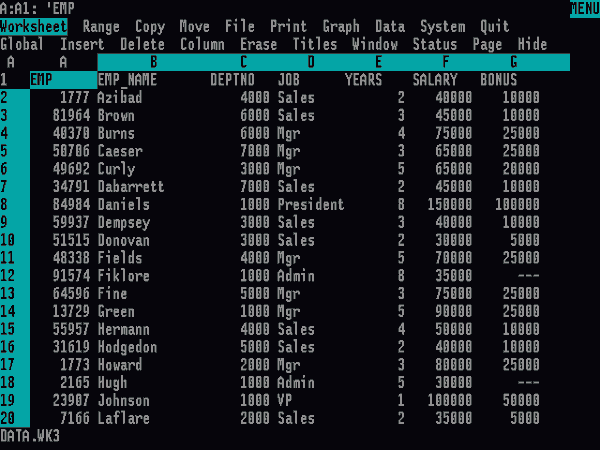
    In software, there are lots of different ways of solving the same problem. VisiCalc, the original spreadsheet, came up with the idea of cells that had row and column addresses. Right from the start, the screen was filled with these empty cells, and without the cells and their addresses, no work could be done. The second spreadsheet program to come along was called T/Maker and was written by Peter Roizen. T/Maker did not use cells at all and started with a blank screen. If you wanted to total three rows of numbers in T/Maker, you put three plus signs down the left-hand side of the screen as you entered the numbers and then put an equal sign at the bottom to indicate that was the place to show a total. T/Maker also included the ability to put blocks of text in the spreadsheet, and it could even run text vertically as well as horizontally. VisiCalc had nothing like that.

    A later spreadsheet, called Framework and written by Robert Carr, replaced cells with what Carr called frames. There were different kinds of frames in Framework, with different properties — like row-oriented frames and column-oriented frames, for example. Put some row-oriented frames inside a single column-oriented frame, and you had a spreadsheet. That spreadsheet could then be put as a nested layer inside another spreadsheet also built of frames. Mix and match your frames differently, and you had a database or a word processor, all without a cell in sight.

    If VisiCalc was an apple, then T/Maker was an orange, and Framework was a rutabaga, yet all three programs could run on identical hardware, and all could produce similar output although through very different means. That’s what I mean by software being more complex than hardware.

    Having gone through the agony of developing an application or operating system, then, software developers have a great incentive to greet the next generation of hardware by translating the present software — “porting” it — to the new environment rather than starting over and developing a whole new version that takes complete advantage of the new hardware features.

    It’s at this intersection of old software and new hardware that the opportunity exists for new applications to take command of the market, offering extra features, combined with higher performance made possible by the fact that the new program was written from scratch for the new computer. This is one of the reasons that WordStar, which once ruled the market for CP/M word processing programs, is only a minor player in today’s MS-DOS world, eclipsed by WordPerfect, a word processing package that was originally designed to run on Data General minicomputers but was completely rewritten for the IBM PC platform.

    In both hardware and software, successful reinvention takes place along the edges of established markets. It’s usually not enough just to make another computer or program like all the others; the new product has to be superior in at least one respect. Reinvented products have to be cheaper, or more powerful, or smaller, or have more features than the more established products with which they are intended to compete. These are all examples of edges. Offer a product that is in no way cheaper, faster, or more versatile—that skirts no edges—and buyers will see no reason to switch from the current best-seller.

    Even the IBM PC skirted the edges by offering both a 16-bit processor and the IBM nameplate, which were two clear points of differentiation.

    Once IBM’s Personal Computer was established as the top-selling microcomputer in America, it not only followed a market edge, it created one. Small, quick-moving companies saw that they had a few months to make enduring places for themselves purely by being the first to build hardware and software add-ons for the IBM PC. The most ambitious of these companies bet their futures on IBM’s success. A hardware company from Cleveland called Tecmar Inc. camped staffers overnight on the doorstep of the Sears Business Center in Chicago to buy the first two IBM PCs ever sold. Within hours, the two PCs were back in Ohio, yielding up their technical secrets to Tecmar’s logic analyzers.

    And on the software side, Lotus Development Corp. in Cambridge, Massachusetts, bet nearly $4 million on IBM and on the idea that Lotus 1-2-3 would become the compelling application that would sell the new PC. A spreadsheet program, 1-2-3 became the single most successful computer application of all.

    Mitch Kapor had a vision, a moment of astounding insight when it became obvious to him how and why he should write a spreadsheet program like 1-2-3. Vision is a popular word in the computer business and one that has never been fully defined — until now. Just what the heck does it mean to have such a vision?

    George Bush called it the “vision thing.” Vision — high-tech executives seem to bathe in it or at least want us to think that they do. They are “technical visionaries,” having their “technical visions” so often, and with such blinding insight, that it’s probably not safe for them to drive by themselves on the freeway. The truth is that technical vision is not such a big deal.

    Dan Bricklin’s figuring out the spreadsheet, that’s a big deal, but it doesn’t fit the usual definition of technical vision, which is the ability to foresee potential in the work of others. Sure, some engineer working in the bowels of IBM may think he’s come up with something terrific, but it takes having his boss’s boss’s boss’s boss think so, too, and say so at some industry pow-wow before we’re into the territory of vision. Dan Bricklin’s inventing the spreadsheet was a bloody miracle, but Mitch Kapor’s squinting at the IBM PC and figuring out that it would soon be the dominant microcomputer hardware platform — that’s vision.

    There, the secret’s out: vision is only seeing neat stuff and recognizing its market potential. It’s reading in the newspaper that a new highway is going to be built and then quickly putting up a gas station or a fast food joint on what is now a stretch of country road but will soon be a freeway exit.

    Most of the so-called visionaries don’t program and don’t design computers — or at least they haven’t done so for many years. The advantages these people have are that they are listened to by others and, because they are listened to by others, all the real technical people who want the world to know about the neat stuff they are working on seek out these visionaries and give them demonstrations. Potential visions are popping out at these folks all the time. All they have to do is sort through the visions and apply some common sense.

    Common sense told Mitch Kapor that IBM would succeed in the personal computer business but that even IBM would require a compelling application — a spreadsheet written from scratch to take advantage of the PC platform — to take off in the market. Kapor, who had a pretty fair idea of what was coming down the tube from most of the major software companies, was amazed that nobody seemed to be working on such a native-mode PC spreadsheet, leaving the field clear for him. Deciding to do 1-2-3 was a “no brainer”.

    When IBM introduced its computer, there were already two spreadsheet programs that could run on it — VisiCalc and Multiplan — both ported from other platforms. Either program could have been the compelling application that IBM’s Don Estridge knew he would need to make the PC successful. But neither VisiCalc nor Multiplan had the performance, the oomph, required to kick IBM PC sales into second gear, though Estridge didn’t know that.

    The PC sure looked successful. In the four months that it was available at the end of 1981, IBM sold about 50,000 personal computers, while Apple sold only 135,000 computers for the entire calendar year. By early 1982, the PC was outselling Apple two-to-one, primarily by attracting first-time buyers who were impressed by the IBM name rather than by a compelling application.

    At the end of 1981, there were 2 million microcomputers in America. Today there are more than 45 million IBM-compatible PCs alone, with another 10 million to 12 million sold each year. It’s this latter level of success, where sales of 50,000 units would go almost unnoticed, that requires a compelling application. That application — Lotus 1-2-3 — didn’t appear until January 26, 1983.

    Dan Bricklin made a big mistake when he didn’t try to get a patent on the spreadsheet. After several software patent cases had gone unsuccessfully as far as the U.S. Supreme Court, the general thinking when VisiCalc appeared in 1979 was that software could not be patented, only copyrighted. Like the words of a book, the individual characters of code could be protected by a copyright, and even the specific commands could be protected, but what couldn’t be protected by a copyright was the literal function performed by the program. There is no way that a copyright could protect the idea of a spreadsheet. Protecting the idea would have required a patent.

    Ideas are strange stuff. Sure, you could draw up a better mousetrap and get a patent on that, as long as the Patent Office saw the trap design as “new, useful, and unobvious”. A spreadsheet, though, had no physical manifestation other than a particular rhythm of flashing electrons inside a microprocessor. It was that specific rhythm, rather than the actual spreadsheet function it performed, that could be covered by a copyright. Where the patent law seemed to give way was in its apparent failure to accept the idea of a spreadsheet as a virtual machine. VisiCalc was performing work there in the computer, just as a mechanical machine would. It was doing things that could have been accomplished, though far more laboriously, by cams, gears, and sprockets.

    In fact, had Dan Bricklin drawn up an idea for a mechanical spreadsheet machine, it would have been patentable, and the patent would have protected not only that particular use for gears and sprockets but also the underlying idea of the spreadsheet. Such a patent would have even protected that idea as it might later be implemented in a computer program. That’s not what Dan Bricklin did, of course, because he was told that software couldn’t be patented. So he got a copyright instead, and the difference to Bricklin between one piece of legal paper and the other was only a matter of several hundred million dollars.

    On May 26, 1981, after seven years of legal struggle, S. Pal Asija, a programmer and patent lawyer, received the first software patent for SwiftAnswer, a data retrieval program that was never heard from again and whose only historical function was to prove that all of the experts were wrong; software could be patented. Asija showed that when the Supreme Court had ruled against previous software patent efforts, it wasn’t saying that software was unpatentable but that those particular programs weren’t patentable. By then it was too late for Dan Bricklin. By the time VisiCalc appeared for the IBM PC, Bricklin and Frankston’s spreadsheet was already available for most of the top-selling microcomputers. The IBM PC version of VisiCalc was, in fact, a port of a port, having been translated from a version for the Radio Shack TRS-80 computer, which had been translated originally from the Apple II. VisiCalc was already two years old and a little tired. Here was the IBM PC, with up to 640K of memory available to hold programs and extra features, yet still VisiCalc ran in 64K, with the same old feature set you could get on an Apple II or on a “Trash-80”. It was no longer compelling to the new users coming into the market. They wanted something new.

    Part of the reason VisiCalc was available on so many microcomputers was that Dan Fylstra’s company, which had been called Personal Software but by this time was called VisiCorp, wanted out of its contract with Dan Bricklin’s company, Software Arts. VisiCorp had outgrown Fylstra’s back bedroom in Massachusetts and was ensconced in fancier digs out in California, where the action was. But in the midst of all that Silicon Valley action, VisiCorp was hemorrhaging under its deal with Software Arts, which still paid Bricklin and Frankston a 37.5 percent royalty on each copy of VisiCalc sold. VisiCalc sales at one point reached a peak of 30,000 copies per month, and the agreement required VisiCorp to pay Software Arts nearly $12 million in 1983 alone—far more than either side had ever expected.

    Fylstra wanted a new deal that would cost his company less, but he had little power to force a change. A deal was a deal, and hackers like Bricklin and Frankston, whose professional lives were based on understanding and following the strict rules of programming, were not inclined to give up their advantage cheaply. The only coercion entitled VisiCorp under the contract, in fact, was its right to demand that Software Arts port VisiCalc to as many different computers as Fylstra liked. So Fylstra made Bricklin port VisiCalc to every microcomputer.

    It was clear to both VisiCorp and Software Arts that the 37.5 percent royalty was too high. Today the usual royalty is around 15 percent. Fylstra wanted to own VisiCalc outright, but in two years of negotiations, the two sides never came to terms.

    VisiCorp had published other products under the same onerous royalty schedule. One of those products was VisiPlot/Visi-Trend, written by Mitch Kapor and Eric Rosenfield. VisiPlot/ VisiTrend was an add-on to VisiCalc; it could import data from VisiCalc and other programs and then plot the data on graphs and apply statistical tests to determine trends from the data. It was a good program for stock market analysis.

    VisiPlot/VisiTrend was derived from an earlier Kapor program written during one of his many stints of graduate work, this time at the Sloan School of Management at MIT. Kapor’s friend Rosenfield was doing his thesis in statistics using an econometric modeling language called TROLL. To help Rosenfield cut his bill for time on the MIT computer system, Kapor wrote a program he called Tiny TROLL, a microcomputer subset of TROLL. Tiny TROLL was later rewritten to read VisiCalc files, which turned the program into VisiPlot/VisiTrend.

    VisiCorp, despite its excessive royalty schedule, was still the most successful microcomputer software company of its time. For its most successful companies, the software business is a license to print money. After the costs of writing applications are covered, profit margins run around 90 percent. VisiPlot/VisiTrend, for example, was a $249.95 product, which was sold to distributors for 60 percent off, or $99.98. Kapor’s royalty was 37.5 percent of that, or $37.49 per copy. VisiCorp kept $62.49, out of which the company paid for manufacturing the floppy disks and manuals (probably around $15) and marketing (perhaps $25), still leaving a profit of $22.49. Kapor and Rosenfield earned about $500,000 in royalties for VisiPlot/Visilrend in 1981 and 1982, which was a lot of money for a product originally intended to save money on the Sloan School time-sharing system but less than a tenth of what Dan Bricklin and Bob Frankston were earning for VisiCalc, VisiCorp’s real cash cow. This earnings disparity was not lost on Mitch Kapor.

    Kapor learned the software business at VisiCorp. He moved to California for five months to work for Fylstra as a product manager, helping to select and market new products. He saw what was both good and bad about the company and also saw the money that could be made with a compelling application like VisiCalc.

    VisiCalc wasn’t the only program that VisiCorp wanted to buy outright in order to get out from under that 37.5 percent royalty. In 1982, Roy Folke, who worked for Fylstra, asked Kapor what it would take to buy VisiPlot/VisiTrend. Kapor first asked for $1 million — that magic number in the minds of most programmers, since it’s what they always seem to ask for. Then Kapor thought again, realizing that there were other mouths to feed from this sale, other programmers who had helped write the code and deserved to be compensated. The final price was $1.2 million, which sent Mitch Kapor home to Massachusetts with $600,000 after taxes. Only three years before, he had been living in a room in Marv Goldschmitt’s house, wondering what to do with his life, and playing with an Apple II he’d hocked his stereo to buy.

    Kapor saw the prototype IBM PC when he was working at VisiCorp. He had a sense that the PC and its PC-DOS operating system would set new standards, creating new edges of opportunity. Back in Boston, he took half his money — $300,000 — and bet it on this one-two punch of the IBM PC and PC-DOS. It was a gutsy move at the time because experts were divided about the prospects for success of both products. Some pundits saw real benefits to PC-DOS but nothing very special about IBM’s hardware.

    Others thought IBM hardware would be successful, though probably with a more established operating system. Even IBM was hedging its bets by arranging for two other operating systems to support the PC—CP/M-86 and the UCSD p-System. But the only operating system that shipped at the same time as the PC, and the only operating system that had IBM’s name on it, was PC-DOS. That wasn’t lost on Mitch Kapor either.

    When riding the edges of technology, there is always a question of how close to the edge to be. By choosing to support only the IBM PC under PC-DOS, Kapor was riding damned close to the edge. If both the computer and its operating system took off, Kapor would be rich beyond anyone’s dreams. If either product failed to become a standard, 1-2-3 would fail; half his fortune and two years of Kapor’s life would have been wasted. Trying to minimize this same risk, other companies adopted more conservative paths. In San Diego, Context Management Systems, for example, was planning an integrated application far more ambitious than Lotus 1-2-3, but just in case IBM and PC-DOS didn’t make it, Context MBA was written under the UCSD p-System.

    That lowercase p stands for pseudo. Developed at the University of California at San Diego, the p-System was an operating system intended to work on a wide variety of microprocessors by creating a pseudomachine inside the computer. Rather than writing a program to run on a specific computer like an IBM PC, the idea was to write for this pseudocomputer that existed only in computer memory and ran identically in a number of different computers. The pseudomachine had the same user interface and command set on every computer, whether it was a PC or even a mainframe. While the user programmed the pseudomachine, the pseudomachine programmed the underlying hardware. At least that was the idea.

    The p-System gave the same look and feel to several otherwise dissimilar computers, though at the expense of the added pseudomachine translation layer, which made the p-System S-L-O-W — slow but safe, to the minds of the programmers writing Context MBA, who were convinced that portability would give them a competitive edge. It didn’t.

    Context MBA had a giant spreadsheet, far more powerful than VisiCalc. The program also offered data management operations, graphics, and word processing, all within the big spreadsheet. Like Mitch Kapor and Lotus, Context had hopes for success beyond that of mere mortals.

    Context MBA appeared six months before 1-2-3 and had more features than the Lotus product. For a while, this worried Kapor and his new partner, Jonathan Sachs, who even made some changes in 1-2-3 after looking at a copy of Context MBA. But their worries were unfounded because the painfully slow performance of Context MBA, with its extended spreadsheet metaphor and p-System overhead, killed both the product and the company. Lotus 1-2-3, on the other hand, was written from the start as a high-performance program optimized strictly for the IBM PC environment.

    Sachs was the programmer for 1-2-3, while Kapor called himself the software designer. A software designer in the Mitch Kapor mold is someone who wears Hawaiian shirts and is intensely interested in the details of a program but not necessarily in the underlying algorithms or code. Kapor stopped being a programmer shortly after the time of Tiny TROLL. The roles of Kapor and Sachs in the development of 1-2-3 generally paralleled those of Dan Bricklin and Bob Frankston in the development of VisiCalc. The basis of 1-2-3 was a spreadsheet program for Data General minicomputers already written by Sachs, who had worked at Data General and before that at MIT. Kapor wanted to offer several functions in one program to make 1-2-3 stand out from its competitors, so they came up with the idea of adding graphics and a word processor to Sachs’s original spreadsheet. This way users could crunch their financial data, prepare graphs and diagrams illustrating the results, and package it all in a report prepared with the word processor. It was the word processor, which was being written by a third programmer, that became a bottleneck, holding up the whole project. Then Sachs played with an early copy of Context MBA and discovered that the word processing module of that product was responsible for much of its poor performance, so they decided to drop the word processor module in 1-2-3 and replace it with a simple database manager, which Sachs wrote, retaining the three modules needed to still call it 1-2-3, as planned.

    Unlike Context MBA, Lotus 1-2-3 was written entirely in 8088 assembly language, which made it very fast. The program beat the shit out of Multiplan and VisiCalc when it appeared. (Bill Gates, ever unrealistic when it came to assessing the performance of his own products, predicted that Microsoft’s Multiplan would be the death of 1-2-3.) The Lotus product worked only on the PC platform, taking advantage of every part of the hardware. And though the first IBM PCs came with only 16K of onboard memory, 1-2-3 required 256K to run — more than any other microcomputer program up to that time.

    Given that Sachs was writing nearly all the 1-2-3 code under the nagging of Kapor, there has to be some question about where all the money was going. Beyond his own $300,000 investment, Kapor collected more than $3 million in venture capital — nearly ten times the amount it took to bring the Apple II computer to market.

    The money went mainly for creating an organization to sell 1-2-3 and for rolling out the product. Even in 1983, there were thousands of microcomputer software products vying for shelf space in computer stores. Kapor and a team of consultants from McKinsey & Co. decided to avoid competitors entirely by selling 1-2-3 directly to large corporations. They ignored computer stores and computer publications, advertising instead in Time and Newsweek. They spent more than $1 million on mass market advertising for the January 1983 roll-out. Their bold objective was to sell up to $4 million worth of 1-2-3 in the first year. As the sellers of a financial planning package, it must have been embarrassing when they outstripped that first-year goal by 1,700 percent. In the first three months that 1-2-3 was on the market, IBM PC sales tripled. Big Blue had found its compelling application, and Mitch Kapor had found his gold mine.

    Lotus sold $53 million worth of 1-2-3 in its first year. By 1984, the company had $157 million in sales and 700 employees. One of the McKinsey consultants, Jim Manzi, took over from Kapor that year as president, developing Lotus even further into a marketing-driven company centered around a sales force four times the size of Microsoft’s, selling direct to Fortune 1000 companies.

    As Lotus grew and the thrill of the start-up turned into the drill of a major corporation, Kapor’s interests began to drift. To avoid the imposter label, Kapor felt that he had to follow spectacular success with spectacular success. If 1-2-3 was a big hit, just think how big the next product would be, and the next. A second product was brought out, Symphony, which added word processing and communications functions to 1-2-3. Despite $8 million in roll-out advertising, Symphony was not as big a success as 1-2-3. This had as much to do with the program’s “everything but the kitchen sink” total of 600 commands as it did with the $695 price. After Symphony, Lotus introduced Jazz, an integrated package for the Apple Macintosh that was a clear market failure. Lotus was still dependent on 1-2-3 for 80 percent of its royalties and Kapor was losing confidence.

    Microsoft made a bid to buy Lotus in 1984. Bill Gates wanted that direct sales force, he wanted 1-2-3, and he wanted once again to be head of the largest microcomputer software company, since the spectacular growth of Lotus had stolen that distinction from Microsoft. Kapor would become Microsoft’s third-largest stockholder.

    “He seemed happy”, said Jon Shirley, who was then president of Microsoft. “We would have made him a ceremonial vice-chairman. Manzi was the one who didn’t like the plan”.

    A merger agreement was reached in principle and then canceled when Manzi, who could see no role for himself in the technically oriented and strong-willed hierarchy of Microsoft, talked Kapor out of it.

    Meanwhile, Software Arts and VisiCorp had beaten each other to a pulp in a flurry of lawsuits and countersuits. Meeting by accident on a flight to Atlanta in the spring of 1985, Kapor and Dan Bricklin made a deal to sell Software Arts to Lotus, after which VisiCalc was quickly put to death. Now there was no first spreadsheet, only the best one.

    Four senior executives left Lotus in 1985, driven out by Manzi and his need to rebuild Lotus in his own image.

    “I’m the nicest person I know”, said Manzi.

    Then, in July 1986, finding that it was no longer easy and no longer fun, Mitch Kapor resigned suddenly as chairman of Lotus, the company that VisiCalc built.


  • Where the money is in cleantech: oil and gas

    An idea that would have seemed blasphemous five years ago is coming into vogue for the battered cleantech sector: rather than displace the fossil fuel industry, embrace them. Increasingly companies selling energy efficiency and clean power technologies are looking to the oil and gas sectors as potential customers, instead of competitors.

    The evidence of that was ample at the Cleantech Forum in San Francisco this week. Through keynote speeches and panel discussions, the conference emphasized opportunities in the traditional energy industry and a growing symbiotic relationship between cleantech developers and big energy companies.

    Behind the trend

    Several forces have emerged in recent years that have been contributing to this trend. First off, venture capitalists have been shying away from investing in cleantech startups in areas like new types of solar panels, or biofuels. Many of the investors have yet to make their money back, due to the long timelines and large capital requirements needed for the companies to mature. It could also be that “righteous investing” gave them blinders to good investments.

    GlassPoint 2

    With the lack of investments from VCs, startups are increasingly looking to corporations to help them with funding. And the companies that tend to be interested in investing in next-generation energy technologies, are — not surprisingly — the traditional energy companies. For example, natural gas provider Encana recently backed thermoelectric tech startup Alphabet Energy, Shell has been hunting for startups through its GameChanger program, and Total has made a variety of investments into cleantech companies over the years, including SunPower.

    Meanwhile, the emergence of abundant and cheap natural gas has changed the energy game in the U.S. It’s providing traditional industry jobs to many states, and has been embraced by the Obama administration as a clean energy opportunity. There will be massive opportunities when it comes to selling next-generation technologies to natural gas firms and helping natural gas providers avoid environmental problems.

    The growth of the renewable electricity sector will be tied to natural gas. Solar and wind generation can’t produce power around the clock, and utilities will have to match clean power with 24/7 energy like natural gas. Natural gas proponents have stepped up efforts to form alliances with renewable energy players, some of whom see the pairing as a practical approach to promote clean power generation.

    Cleaning up fossil fuels

    Energy executives “are all excited about the unconventional oil and gas in North America, and they know it will only take one or two environmental disasters for the game to be over,” said Wal van Lierop, co-founder and CEO of cleantech venture capital firm Chrysalix Energy Venture Capital, when I caught up with him at the Cleantech Forum.

    To gain public confidence, comply with regulations and, in some cases, reduce risks and production costs, oil and gas producers are hunting for technologies that clean up wastes, recycle water and boost production. And if any of these technologies can earn a low-carbon designation and help with public relations, then all the better. The Texas Tribune ran an interesting story this week that looked at oil companies attempts to recycle dirty water from oil production.

    Biofuel_Argonne

    Chrysalix is fond of backing companies that can serve oil and gas, as well as mining, companies. It’s invested in GlassPoint Solar, which designs steam generation equipment to help oil companies boost production; Axine Water Technologies, which offers a way to get pollutants out of wastewater from industrial operations and cities; and Seair, a public wastewater treatment company whose CEO, Ric Charron, spoke about his experience working with oil and gas companies at the cleantech conference.

    While helping oil and gas producers boost production and win public support isn’t the same as saving the planet, van Lierop argued the results are no less worthwhile: “It’s a very important goal to ensure that you clean up traditional energy sources.”

    Fossil fuels not going anywhere

    The oil and gas industry is here to stay for a very long long time. Strong federal support for oil and gas exploration — part of President Obama’s “all of the above energy strategy” — continues to protect entrenched energy players and allows oil and gas companies to continue their grip on transportation and electricity generation. These companies operate at such a massive scale that it’s hard to a tiny startup to compete with them.

    Fossil fuel companies are partly investing in renewable energy sources as a defensive move. It’s a hedge against any quick change in government policy and public sentiment. Chevron made some small investments in renewable energy technologies, and probably was glad it didn’t invest more when it realized later that its investments weren’t as lucrative as it had expected. The growth of the biofuel business, in particular, will require the support of major oil industry players.

    Some venture capital investors maintain that cleantech investing is still a financially viable option — that a cleantech 2.0 investing wave will come some day in the future. But for now, in a year when “cleantech” has become a dirty word, it makes sense for cleantech companies to go make friends with the dirty fossil fuel industry.

    Related research and analysis from GigaOM Pro:
    Subscriber content. Sign up for a free trial.

  • Break you bad web habits by going Cold Turkey

    You’re at the PC, with lots of important work to do. And you’re going to get started on it — once you’ve checked Facebook. And Twitter. Then watched a YouTube clip someone mentioned earlier, checked what’s happening on eBay, and worked your way through a host of other online distractions.



    Sounds familiar? Then you might like Cold Turkey, a simple free tool which can temporarily block access to your favourite web destinations.

    Launch the program and it first asks which sites you’d like to block. You can block some popular sites — Facebook, Twitter, YouTube, eBay and more — just by checking a few boxes, while a Custom Sites dialog lets you enter URLs of your own.

    The next step is decide how long the block will last, which can be anything from 10 minutes to a week.

    Finally, click “Go Cold Turkey”, and after a quick “Are you sure?” check, that’s it — try to visit the sites you’ve specified in any browser and you’ll get a “not found” error.

    Don’t think you can easily get around this, either. Changing your system time won’t help. Closing down the Cold Turkey processes won’t do it. And if you’re thinking the HOSTS file might be involved here, you’re right — but simply editing that alone won’t remove the restrictions (and there’s no “back door” to regain access, either, so you need to be careful in how you use the program). You could keep trying other things, but it’ll probably be easier to get on with the work you should be doing, anyway.

    This isn’t a perfect solution, of course. It can’t stop you browsing sites via a smartphone, tablet, or any other internet-enabled device you might have around.

    If you’re just looking for a quick and easy to selectively block a few web distractions, though, Cold Turkey will get the job done. And if you need more power, check out the Serious Edition ($4.99), which can block sites for up to one month, and prevent you launching specified applications, too.

    Photo Credit: Karen Roach/Shutterstock

  • Bee venom kills HIV cells

    An ancient Chinese medicine protocol known as “apitherapy” appears to be making a resurgence in modern times, as scientists continue to uncover the many amazing healing powers of bees and the substances they produce. And a new study recently published in the journal…
  • Improve your brain with music

    Most people have their own particular styles of music they enjoy. Music is one of the greatest joys of mankind and it is effective at simulating the brain and enhancing learning. Listening to music stimulates the whole brain through diverse neural circuitry that stimulate…
  • Seven bad food habits that shorten your life and accelerate aging

    With all the conveniences of fast foods, processed foods, TV and magazine advertising and even those radio ads plugging yummy stuff in your car, we’re tempted toward “eating bad” even as we drive around. It takes considerable research, reading Natural News, discipline…