Blog

  • Featured Android App Review: Movie Twist [Entertainment]

     Movie_Twist_Splash_Banner

    Have you ever sat down to watch a movie, but you didn’t have a clue what you wanted to watch? Well I have an app that will help you find that perfect movie to watch whether you’re alone, with your significant other, or with the family. All you have to do is grab Movie Twist from the Google Play Store. It was created by Saguru and it’s the first real Artificial Intelligence (AI) powered movie search and exploration app. There are so many ways to search it’s mind boggling.

    For starters, it will find similar movies based on another movie. That’s just the tip of the iceberg. The Explore option will let you find movies based on Loving, Humor, Violence, Thrilling, and Cleverness. Not only that, each category has a slider bar so you can set how much that category should play a role in the results. You can also select from 21 genres to include such as Action, Comedy, Family, Horror, Thriller, etc. Oh there’s still more as you can add a keyword such as an actor’s name and you can control some finer details like Pace, Sex, Drugs, and Ordinary. Last but not least, you can throw in what years you would like the movie to fall into as well as the minimum and maximum run times.

    The app itself it very easy to use. Upon opening the app, you will get a search box so you can quickly type in a movie and get similar results. You will also find a few random movies at the bottom to get things started. You can tap on Search at the top left where you will find the Explore option I mentioned above as well as Movie Concepts that let you pick movies based on your mood, category, or tag. You can also tap Auto Recommend to have Movie Twist give you recommendations based on your favorites and past searches.

    Each movie is listed with its artwork poster so you can get a quick idea of what it is. If you tap on the movie, you will be taken to an information page where you can add it to your favorites or your watch list as well as hide it from future searches. You will even get the description as well as the tags associated with it. Want to see the trailer? Just hit the play icon and the trailer will open in YouTube. Last but not least, there is also an option to find similar movies to refine things even more.

    Movie Twist is absolutely free so give it a shot the next time you and your significant other can’t figure out what to watch. Check out my hands on video below and hit one of the download links to get started. As always, let me know what you think.

    Movie_Twist_01
    Movie_Twist_02
    Movie_Twist_03
    Movie_Twist_04
    Movie_Twist_05
    Movie_Twist_Splash_Banner


    Click here to view the embedded video.

    QR Code generator

    Play Store Download Link

    Come comment on this article: Featured Android App Review: Movie Twist [Entertainment]

  • Google Keep — for notes, memos and ideas best kept in the cloud

    Confession: I’ve never used Evernote, much to the abash of colleague Alan Buckingham (or so he expressed in group chat a little while ago). But I would use Google Keep, which released today. Russell Holly calls Keep “the not-quite Evernote clone” — for anyone making bold comparisons.

    You tell me. Does this sound familiar, Evernote and OneNote users? “With Keep you can quickly jot ideas down when you think of them and even include checklists and photos to keep track of what’s important to you”, Katherine Kuan, Google software engineer, says. “Your notes are safely stored in Google Drive and synced to all your devices so you can always have them at hand”. She adds: “If it’s more convenient to speak than to type that’s fine — Keep transcribes voice memos for you automatically. There’s super-fast search to find what you’re looking for and when you’re finished with a note you can archive or delete it”.

    Other features include color-coding (something geeks seem to like, right), swipe to archive, and note-to-checklist conversion. Users of Android 4.2 or higher also can keep Keep as a homescreen widget — for when the idea is immediate and you need to express it fast or forget.

    Device sync, dictation capabilities and Google Drive integration are the three features that pique my interest. Whether or not I actually keep Keep beyond initial testing is yet to be seen. Evernote didn’t grab me.

    I started writing this post at 4:53 pm EDT, when there was one review of the app on Google Play. Fifteen minutes later there are 179 — 147 of them five stars.

    “Finally!” expresses Galaxy Nexus user Yuriy Melnik: “A native note/to do app is long overdue, a bit surprised to see no Google Tasks sync? This would be nice”.

    Michael Bau gives three stars and expresses disappointment: “This app is just a plain app to take notes. You can record audio notes, include pictures, and write text with your keyboard, and make lists. That’s pretty much it. Other than that I would love to see a way to add deadlines and alerts to notes, and some kind of drawing support. I would love to replace Wunderlist with Keep, but it’s not quite there yet”.

    Aaron Carvalho gives five stars, but asks for more, too: “Simple and neat interface. Easy to use. Very beautiful UI. I just wish it had the option of adding pictures from the gallery as a note. So far only option is to take a picture with the camera. Now let’s just hope it stays live”.

    Nathan Burke and I share similar experience. “I can take a photo, add a list, create a note, but when I try to view anything on Chrome, I just get an error, and it keeps reloading”, he expresses. I have the same problem. What a crock! Error on Chrome. Google’s browser. For shame!

    Matthew Kelly has “Keep on both the Nexus S and Nexus 7 devices is working well on both. Helps to be an Android ‘ecosystem’ user, and I’m eager to see how easily it extends into my Google Drive. Fast sync, easy to add images and quickly type content. Will try the dictation/transcription feature, as it will be a significant addition to the Google cloud toolkit. Excellent application with no issues thanks to its simplicity!”

    Sentiments are a little different elsewhere, if the first comments to the above YouTube video indicate anything.

    Vitruviux: “I don’t want Google Keep, I want Google Reader”. TheTimmant: “Now Google can spy on your notes! Yay!!!”

    And you? Will you do Google Keep, or keep the note app (if any) you already use?

  • Making A News Reader For Android? You’ll Want To Watch This

    Google is killing off Google Reader on July 1. The move opens an opportunity for somebody, maybe Digg, to come up with a news reader of their own. Now the very same company that’s killing the most popular RSS reader on the net is now offering suggestions for developers building their own news readers:

    Join Nick Butcher, Adam Koch and Roman Nurik as they discuss various elements of Android Design. This week, we’ll discuss design ideas for news consumption apps and get into some design math—specifically about various units of measure and common grids for designers.

  • Facebook Tries Pestering You to Post a Status with a Push Notification

    Apparently, Facebook is trying to get people to engage with the network with a new push notification that asks them to post an update.

    “Name, tell friends what’s on your mind. Post an update,” reads the new iOS notification.

    Here’s a screenshot of the new push notification, via Bijan Sabet:

    Facebook confirmed to Mashable that the new push notification is part of a “small test” that they are currently running. If just looking at this annoys the hell out of you, find solace in the fact that Facebook tests tons and tons of features all the time, and only a small percentage of them ever come to fruition.

  • Google Keep now available in the Play Store

    Google_Keep_Splash_Banner

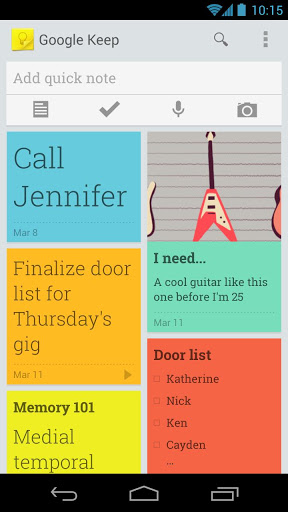
    A couple of days ago, Google Keep was leaked and now it’s an official app in the Play Store. The tag line is “save what’s on your mind.” Google Keep allows you to quickly jot down a note or idea to be saved in your Google Drive account and synced across all your devices. You can even add a checklist or photo. If you can’t type it out, you can say it out loud, and Google will transcribe it. You can prioritize you notes and color code them via the home screen widget, and if you’re running Android 4.2+, you can see your notes via the lock screen widget.

    You can access, edit, and create new notes on your desktop by going to http://drive.google.com/keep, and Google will allow you to do this directly from Google Drive in the coming weeks. Google Keep is available now in the Play Store for devices running Android 4.0 and higher. Hit the break for the video demo and download links.

    Google_Keep_01A
    Google_Keep_02
    Google_Keep_03
    Google_Keep_04
    Google_Keep_05
    Google_Keep_06

    Click here to view the embedded video.

    QR Code generator

    Play Store Download Link


    Come comment on this article: Google Keep now available in the Play Store

  • Next Bond Movie Coming Within Three Years, Says MGM

    James Bond fans may not have to wait long for the next installment in the storied movie franchise.

    Reuters is reporting that MGM teased Bond fans with talk of a new movie during its investor conference call on March 19. During the call, MGM CEO Gary Barber reportedly stated that MGM “hopes” a new Bond movie will be released within three years.

    Barber went on to state that the studio is developing a screenplay for the new Bond movie and that a director for the next Bond movie could be revealed “soon.”

    MGM also revealed in its 2012 fiscal results that last year’s Skyfall was the “biggest” release of a James Bond film ever. The studio reported that its theatrical revenues increased $661 million over its 2011 revenues, in part because of the success of Skyfall and The Hobbit: An Unexpected Journey.

    Bond fans have never had to wait too long for a new installment in the franchise. The longest time gap between Bond movies was between 1989′s Licence to Kill and 1995′s GoldenEye.

    The video below splices together scenes from each Bond movie into a single “movie.” It provides a look at the evolving visual style of the movies, as well as the different writing and directing choices that defined each era of Bond movies.

  • Google launches Google Keep note-taking service

    Google Keep Announced
    Earlier this week, it was revealed that Google (GOOG) was working on a new note-taking application tied to its Drive cloud-storage suite. The company on Wednesday unveiled Google Keep, a tool that allows users to create notes and lists that are synced across all their devices. The service can transcribe voice memos automatically to create notes that are organized with multiple colors or even pictures. Google Keep is available now through the Web and for Android devices running Android 4.0 or higher. A video demonstration of Google Keep follows below.

    Continue reading…

  • Results of trial to determine how to prevent future strokes encouraging

    UCLA RESEARCH ALERT
     
    FINDINGS:
    The results of a major, multicenter clinical trial to determine the best treatment for younger patients who have strokes that are potentially due to a hole in the upper chambers of the heart has provided suggestive but not definitive evidence of the benefit of a new heart hole–closure device.
     
    The trial sought to determine which was the best treatment to prevent further strokes: a combination of closing the hole with a “button” device and anti-clotting medicines, or anti-clotting medicines alone. UCLA was one of the 69 performance sites for the study, called the Recurrent Stroke Comparing PFO Closure to Established Current Standard of Care Treatment (RESPECT).
     
    Over eight years, the study enrolled 980 patients between the ages of 18 and 60 (average age 46). All had experienced a stroke of unknown origin and had a hole in the wall of their heart known as a patent foramen ovaleor, or PFO. Nearly half had large strokes as their qualifying stroke event. In up to 10 percent of strokes in the U.S., a PFO is the only identified potential cause.
     
    Patients were followed for an average of two-and-a-half years. In the main analysis, patients assigned to receive the button device showed a trend toward having fewer recurrent strokes than those receiving standard care with anti-clotting medications (9 percent versus 16 percent), but the difference did not meet statistical tests for being definite. Further analyses conducted in the subset of patients who adhered to their assigned treatments provided additional evidence that the device was beneficial.
     
    IMPACT:
    Closure-device therapy may be a useful strategy for selected patients with a history of cryptogenic stroke and PFO —a population that is generally younger than the average stroke patient and otherwise facing a lifetime of potentially riskier medications, the UCLA researchers said. The authors said that closing the hole in the heart has also been studied as possibly helping with other health issues, such as migraines.
     
    UCLA INVESTIGATORS:
    Dr. Jeffrey Saver, director of the UCLA Stroke Center and a professor of neurology, was one of four national principal investigators of the study. Dr. Jonathan Tobis, director of interventional cardiology and professor of medicine at UCLA, was the RESPECT lead cardiology investigator at the UCLA site.
     
    AUTHORS:
    Dr. Jeffrey Saver was an author on the paper.
     
    JOURNAL:
    The studying findings are published in the March 21 issue of the New England Journal of Medicine.
     
    FUNDING:
    Funding for the study was provided by St. Jude Medical in St. Paul, Minn., maker of the “button” closing device.

  • Little-known Viewster scores big with free movies and TV shows

    There’s a new kid in town, and it’s racking up video views: Zurich-based online video startup Viewster is set to announce Thursday that it managed to break into comScore’s list of the Top 50 U.S. video properties for the first time in February, attracting more unique viewers than Sony’s Crackle and the video sites of both ABC and Fox.

    Altogether, Viewster attracted 8.3 million unique U.S.-based viewers in February, who viewed close to 200 million videos on the site. That’s pretty impressive for a site that lists titles like Mother’s Day Massacre and Saving Flipper as its most popular titles.

    “Clearly, we don’t have the depths of content of a Hulu,” admitted Viewster CEO Kai Henniges during an interview Wednesday. But that hasn’t stopped his company from making inroads with audiences worldwide, thanks to an offering that combines free content with a presence on a wide variety of platforms.

    However, Viewster’s business plan wasn’t always about free content. The company, which was founded in 2008, initially looked to make money with B2B services for other publishers. In 2010, it switched to a consumer-facing offering, with the plan to charge consumers for VOD content. Except, no one wanted to pay.

    Looking back, Henniges says that paid VOD was “a horrible experience for users.” That’s why the company decided to give everything away for free for six months, just to see what happened. Unsurprisingly, consumers loved it. Surprisingly, content owners were up for experimenting with free as well, as long as they still got paid. “We almost stumbled upon the free model,” said Henniges.

    These days, Viewster is still offering paid views for consumers who want to view movies offline on mobile devices, but roughly 90 percent of the company’s views and revenue comes from free, ad-supported content. Viewster offers a total of 6000 titles across its different markets, including fare from Warner Bros. that it licensed last summer for Europe, the Middle East and South-East Asia.

    In a way, Viewsters model is similar to that of companies like Viki that utilize content arbitrage to cheaply license movies and TV shows for out-of market viewing. In the U.S., Viewster is starting to focus on Telenovelas, Japanese Anime and other populate niche content. “Internationally, we can be more bold,” explained Henniges, adding that his company was “in the import-export business of content.”

    Viewster’s special advantage is that it has a very large device footprint, with apps on 20 connected TV platforms as well as Android and iOS. However, getting the viewers to find and actually use these apps has proven to be a challenge. Social discovery simply doesn’t work on a connected TV, where there’s often no way to discover content without browsing through an app. “They are all like islands, these apps,” said Henniges.

    Getting viewers to install mobile apps can be challenging as well, but also very rewarding: Henniges told me that his company is seeing a lot of growth and engagement particularly on tablets. Currently, Viewster gets about 25 percent of its views from mobile, he explained, with only five percent coming from connected devices. But the web is still king, with 70 percent of all views.

    That’s why Viewster plans to double down on its web audience through more curation and personalization this year. The company, which currently employs 35 people, also plans for some moderate headcount increase, but Henniges made it clear that he doesn’t want to go crazy. Viewster raised around $3M in funding from Germany’s Creathor Ventures and used that money conservatively. “We can’t spend our money into the market,” acknowledged Henniges. And, judging from the latest audience numbers, it doesn’t have to.

    Related research and analysis from GigaOM Pro:
    Subscriber content. Sign up for a free trial.

  • Continent by continent, TEDGlobal talks

    TED2013TEDGlobal has been held in Oxford, England; Arusha, Tanzania; Mysore, India; and Edinburgh, Scotland — with speakers from a wide range of other countries. In other words, it’s a global affair. As we prepare for TEDGlobal 2013: “Think Again,” kicking off on June 10, we thought we’d take a closer look.

    Here, go around the world in less than 180 minutes with TEDGlobal talks.

    George Ayittey on Cheetahs vs. HipposGeorge Ayittey on Cheetahs vs. Hippos
    Continent: Africa
    George Ayittey on Cheetahs vs. Hippos
    It’s an often-told story: corruption is rampant in Africa. But there’s another story happening too.  In this talk from TEDGlobal 2007, economist George Ayittey introduces us to the “cheetah generation,” the movers and shakers who are effecting change. He predicts that they will soon overtake the “hippo generation,” those in power now.
    Lee Hotz: Inside an Antarctic time machineLee Hotz: Inside an Antarctic time machine
    Continent: Antarctica
    Lee Hotz: Inside an Antarctic time machine
    How can we get data on how the global climate has changed over the centuries? In this talk from TEDGlobal 2010, Lee Hotz describes a project to drill into 10,000-year-old Antarctic ice to find out more.
    Leslie T. Chang: The voices of China's workersLeslie T. Chang: The voices of China's workers
    Continent: Asia
    Leslie T. Chang: The voices of China’s workers
    Over the past 30 years, a large portion of China’s population lifted out of poverty — in part thanks to jobs in booming factory towns serving new global markets. But journalist Leslie T. Chang finds one voice oddly missing from the debate about globalization. In this talk from TEDGlobal 2012, she shares words from factory workers themselves.
    Elizabeth Murchison: Fighting a contagious cancerElizabeth Murchison: Fighting a contagious cancer
    Continent: Australia
    Elizabeth Murchison: Fighting a contagious cancer
    The Tasmanian devil is an animal only found on the Australian island of Tasmania, and a virulent cancer is killing thousands of them. In this talk from TEDGlobal 2011, Elizabeth Murchison shares with his her fight to save the Taz from this unusual, contagious cancer.
    Mark Pagel: How language transformed humanityMark Pagel: How language transformed humanity
    Continent: Europe
    Mark Pagel: How language transformed humanity
    Mark Pagel is a biologist, and he has a fascinating theory about language — that it’s a technology that evolved to allow for cooperation. As he shares at TEDGlobal 2011, he looks at the example of the European Union—whose 27 members speak 23 languages, requiring translation costs in the excess of $1.45 billion a year.
    Sheena Iyengar: The art of choosingSheena Iyengar: The art of choosing
    Continent: North America
    Sheena Iyengar: The art of choosing
    Coke versus Pepsi. It’s a classic choice consumers in the United States and the rest of North America make on a daily basis. In this talk from TEDGlobal 2010, Sheena Iyengar shares her research on the assumptions Americans make about choices and how they are shaped by background.
    Phil Borges on endangered culturesPhil Borges on endangered cultures
    Continent: South America
    Phil Borges on endangered cultures
    Photographer Phil Borges documents cultures in the world that are in danger of disappearing. In this talk, he shares stunning images of the people living in the jungles of the Ecuadorean Amazon — a part of South America changing quickly following oil discovery in the 1970s.

    Want to attend TEDGlobal 2013? Find out more here »

  • Google launches Google Keep, an app to help you remember things

    Google on Wednesday launched Google Keep, an Android and web app designed to help users remember things and jot down ideas.

    Keep appears to be Google’s answer to Apple’s Notes feature, which rolled out a web version last year. It could also serve as a basic, mobile to-do-list service for people who generally make notes on more complex services like Evernote and Workflowy.

    According to a post on the Google blog:

    With Keep you can quickly jot ideas down when you think of them and even include checklists and photos to keep track of what’s important to you. Your notes are safely stored in Google Drive and synced to all your devices so you can always have them at hand.

    Users can also record voice memos. Those who don’t have Android phones can “access, edit and create new notes on the web at http://drive.google.com/keep and in the coming weeks you’ll be able to do the same directly from Google Drive.”

    Related research and analysis from GigaOM Pro:
    Subscriber content. Sign up for a free trial.

  • Google Keep Arrives (In An Official Capacity)

    Earlier this week, Google Keep was spotted in the wild, and was quickly pulled down from view by the company. Today, Google announced the product.

    “Every day we all see, hear or think of things we need to remember,” says Google software engineer Katherine Kuan. “Usually we grab a pad of sticky-notes, scribble a reminder and put it on the desk, the fridge or the relevant page of a magazine. Unfortunately, if you’re like me you probably often discover that the desk, fridge or magazine wasn’t such a clever place to leave the note after all…it’s rarely where you need it when you need it.”

    “To solve this problem we’ve created Google Keep,” adds Kuan. “With Keep you can quickly jot ideas down when you think of them and even include checklists and photos to keep track of what’s important to you. Your notes are safely stored in Google Drive and synced to all your devices so you can always have them at hand.”

    The app transcribes voice memos for you, and the search is “super-fast” according to the company.

    It’s available in Google Play for devices running Android 4.0 and up. Notes can also be accessed, edited and created from drive.google/keep.

  • How a toothbrush news site can get more visits than the Economist: More on the botnet scam

    A larger picture is emerging about an online advertising scam that is reportedly soaking major brands like McDonald’s and Disney for $6 million a month. The scam, which has rattled publishers and the ad industry, came to light on Tuesday after a London analytics firm revealed that a network of zombie computers tricked the brands into paying to show their ads to robots.

    It has also resulted in “toothbrushing.net,” a little-known site with oral hygiene news, likely racking up more visitors than famous publishers like The Economist.

    Here are some more details, based on sources close to the investigation and other reports, about who is affected  and the scale of the botnet.

    Millions of “readers” for a toothbrush news site

    The “about” section of Toothbrushing.net says the site is dedicated to “toothbrush enthusiasts” and promises the “latest on dental news.” According to a source, the site is displaying 20 million to 25 million ad impressions a month. Since the site shows four ad slots on every webpage, this loosely translates to at least 5 million visitors. Nearly all of these visitors were bots not people but, for marketers, the effect is the same — they pay either way. (The ad slots were empty when I checked today  – see the screenshot Toothbrush siteat right).

    To put the traffic of the toothbrush news site in perspective, consider that a site like the Economist had 1.7 million unique visitors in December and the New Yorker had 3.1 million. These figures refer to unique visitors so it’s not an apples-to-apples comparison but, using this crude calculation, there’s a good chance Toothbrushing.net did better than both of them.

    And it’s not just the toothbrush site. Other obscure sites touched by the bot network, including Sodabottle.com and Techrockstar.com, likewise served up 20 million to 25 million ads in a month. According to Spider, the analytics firm that discovered the scam, there are at least 202 such sites tied to the bot network. Nearly all consist of little more than a smattering of cheap content you could pay a high-school student to write.

    There is also the egregious example of Directorslive.com, an obscure movie site that AdWeek reports enjoys 326 million monthly pageviews. According to a source, the only site on the web to sell more ad impressions is Facebook.

    Who is affected and who is responsible

    The list of advertisers that paid to appear on botnet sites include dozens of major brands, and cover a wide range of sectors such as: retail (Snickers, Ziploc, Petco); finance (Citi, Chase, Amex); telecom (AT&T, Time Warner, Sprint); automotive: (Dodge, Ford, Jaguar); services (Zipcar, Seamless).

    While advertisers are the direct victims of the botnet, major web publishers are also harmed because marketers lose confidence in the integrity of display advertising and prices drop accordingly.

    So who is to blame? An advertising source provided six ad networks it regarded as among those it believed to be “problematic” because their sites received significant traffic from the botnet. Here are their names along with an example of a suspect websites they control:  Alphabird (Driverswhoknow.com); Digimogul (USBuildingDigest.com); Forward Health (Womenshealthbase.com); Precision Media (Toothbrushing.net); HiFi network (Dailyfreshies.com); Relevad Corporation (FFog.net).

    The CEO of Digimogul told AdWeek that allegations of a connection to the bot network were “silly” and that “everything is by the book.” Meanwhile, executives from Alphabird told me that they were surprised by the discovery of the botnet and that they’re working with the London analytics firm to get to the bottom of it.
    I asked the COO of Alphabird, Justin Manes, how a company staffed by a sophisticated technology and marketing team could possibly remain unaware of the suspicious traffic — especially when the traffic delivered a direct financial benefit to them. Manes responded that Alpahbird works with numerous aggregators to buy website visitors and that the corrupted traffic must have slipped in this way; he also declined to say where the company bought the traffic. As for the company’s prospects in light of the botnet scandal, Manes said he hopes that people will come to see Alphaird was duped too; he also hopes the experience will strengthen the company’s ability to sell tagging and tracking tools in the future.

    Fixing the problem: better tools or law enforcement?

    The existence of a bot network that hijacks thousands of American computers to perpetrate millions of dollars in fraud appears to be a serious matter. But is it serious enough for a criminal investigation?

    I called the Cyber-Crimes division of the FBI to ask if it is investigated this type of activity. A spokesperson provided this response:

    “While I cannot comment about the botnet you’re writing about, the FBI’s Cyber Division does investigate botnets. We have had operational successes disrupting botnets used by individuals as well as groups that use malicious advertising as part of their schemes.” The spokesperson also referred to a 2011 investigation known as “Operation Ghostclick” in which the FBI arrested six people for using computers to manipulate the online ad industry.

    It’s unclear at this point if the discovery of the new botnet will lead to any criminal investigations. In the meantime, brands and publishers will likely look to self-help solutions to weed out the fraud. There is some encouraging news on this front, as metrics companies like comScore are developing measurement tools to identify and screen-out what the company calls “non-human traffic.”

    (Image by qvist via Shutterstock)

    Related research and analysis from GigaOM Pro:
    Subscriber content. Sign up for a free trial.

  • Klout Launches Klout For Business

    Klout announced the launch of Klout for Business on Thursday with the tagline, “Find the influencers in your audience.”

    Klout for Business is a set of tools including Klout Perks and audience insights to help businesses get influencers to share stuff about their brands.

    “Initially, Klout for Business will give businesses a complimentary set of analytics with pointed insights into how and where influencers are engaging with their brands in social media,” says Klout’s Matthew Thomson. “Businesses will be able to look at an easy-to-read dashboard that tells you, at-a-glance, whether you are engaging your influencers on the networks where they are most actively exerting their influence and on which Klout Score ranges you could stand to amp up your efforts. Most importantly, Klout can tell you which topics your audience influences others on, helping you maximize your content efforts to drive consideration for your brand.”

    “Klout reaches over 70% of today’s digital influencers and attracts new users every day,” he says. “Klout for Business will continue to develop into a portal where we intend to help brands and agencies streamline their understanding, management and engagement with this important segment of the digital population. Our goal is to help brands and influencers build relationships that transcend the current advertiser-consumer dynamic.”

    You can check out the product here.

  • Hackers Obtain Xbox Live Accounts Owned By Microsoft Employees

    Xbox Live is generally seen as pretty secure – at least more so than others. The service has never been taken down by hackers, but it has seen its fair share of account hacks.

    Ars Technica reports that Xbox Live accounts belonging to former and current Microsoft employees have been hijacked by hackers. It’s suspected that those responsible may belong to a group of hackers going by the name of Team Hype. The group reportedly has a history of obtaining Xbox Live accounts and selling them to other players.

    To Microsoft’s credit, the company confirmed the hijacking with Ars Techinca, and said it is working on a solution:

    “We are aware that a group of attackers are using several stringed social engineering techniques to compromise the accounts of a handful of high-profile Xbox LIVE accounts held by current and former Microsoft employees. We are actively working with law enforcement and other affected companies to disable this current method of attack and prevent its further use.”

    Unfortunately, there may be more account hacks on the horizon as a Microsoft Entertainment Awards Facebook app accidentally revealed account information for nearly 3,000 Xbox Live members. No passwords or other critical information was leaked, but the information that was revealed could be enough to obtain more through social engineering.

    In this case, the best thing you can do is change your Xbox Live account password if you happened to use the Xbox Entertainment Awards app earlier this week. You should also be wary of any messages sent over Xbox Live asking for your password of other personally identifiable information.

  • Beyond the Like button: Putting social networks to work for us

    Your Facebook wall might be filled with photos of Lil Bub and Grumpy Cat, but underneath the hood, social networks actually do a lot of work. And there’s a growing class of social networks being used by companies and organizations that are tapping into machine learning to solve problems, explained Jeffrey Davitz, CEO of social data startup Solariat, and GigaOM’s Structure:Data event in New York on Wednesday.

    These types of networks, called active networks, crunch piles of user data and use artificial intelligence to augment human tasks and goals. In contrast to other AI systems where humans augment algorithms, active networks use machine learning to augment human decisions. “It’s the flip of Watson,” said Davtiz.

    Both Davitz, and fellow panelist David Gutelius, the Chief Social Scientist at Jive Software, previously worked on active networks developed for military applications through the CALO project (Cognitive Assistant that Learns and Organizes), which was one of the largest AI projects in history backed by DARPA. The teams built cyber assistants as part of military social networks that could use data on social interactions to give recommendations, like areas to avoid in a conflict zone, or more effective strategies.

    Active networks could be used for other applications, too, like fending off cyber security threats, and making working groups within a company work more effectively together. The “collective capability” of the digital assistant and humans is new, and the industry is just getting started, said Gutelius. Apple’s Siri was a spinoff of the CALO effort.

    The challenge of designing and building these types of networks is figuring out where the machine learning agent leaves off and the human social networks takes up, said Gutelius. The key to the design is making the technology recede into the background, and make it unobtrusive, said Gutelius, who says he spent six months trying to get a particular social network interface for military offers work.

    While using machine learning over large data sets to serve up ads inside social networks isn’t new, Gutelius and Davitz see an era where social network data can be used to help people and solve important problems.

    Check out the rest of our Structure:Data 2013 coverage here, and a video embed of the session follows below:


    Related research and analysis from GigaOM Pro:
    Subscriber content. Sign up for a free trial.

  • Jawbone brings its UP fitness bracelet to Android, returns to Europe

    Nike might not be interested in making its Fuelband fitness app Android-friendly (for now). But Jawbone isn’t going to leave Android-bearing health tracking enthusiasts in the lurch.

    Four months after releasing its new Jawbone UP fitness band and iOS app, the San Francisco-based company announced on Wednesday that it had launched an app for Android.

    “Everyone wants to improve upon themselves; we’ve found this to be a fundamental human desire, no matter where a person is starting from or what they want to achieve,” Travis Bogard, Jawbone vice president of product management and strategy, said in a statement. “Today marks a big step toward our commitment to help people establish a basis for behavior change by bringing UP to everyone who wants to live better lives.”

    As competition ramps up among companies bringing quantified self-type gadgets to the market, it makes sense that Jawbone doesn’t want to leave Android fans (a sizeable share of smartphone users) without an app of their own. Jawbone’s UP, Nike’s Fuelband, the Misfit Shine, as well as devices from Fitbit (see disclosure below), Striiv and FitBug all promise wannabe fitness enthusiasts different levels of activity tracking and they all would love to be the stewards of the growing mounds of fitness- and health-related data. Neither Jawbone nor Nike has shared the number of people using their fitness bands but about one year after launching, Nike said that 11 million people were a part of the Nike+ community.

    In addition to launching on Android, Jawbone also said that it had returned to Europe (the company offered its initial UP band in the US and Europe as well).

    Disclosure: Fitbit is backed by True Ventures, a venture capital firm that is an investor in the parent company of this blog, Giga Omni Media. Om Malik, founder of Giga Omni Media, is also a venture partner at True.

    Related research and analysis from GigaOM Pro:
    Subscriber content. Sign up for a free trial.

  • Facebook Picks a NCAA Tourney Winner Based on Team Buzz

    There’s no telling who’s going to be left standing in a couple weeks when the NCAA tournament comes to a close. This season has been a showcase of true parity, with a bunch of good teams but no standout dominating presence. This could lead to one of the more exciting tournaments in recent memory.

    We hope.

    Since it’s all up in the air anyway, we might as well look at some alternative methods of choosing our winners. Earlier this week, we told you that LinkedIn had picked its national champion based on a ‘dedication score.’ They chose Gonzaga.

    Now it’s Facebook’s turn. Their bracket is based on they buzz each team received in the weeks leading up to Selection Sunday.

    In the Final Four, Facebook has Duke, Notre Dame, Michigan, and Indiana. From that, Duke and Michigan advance. In the end, the Puke Blue Devils end up taking the title.

    As a UK fan, this whole notion that Duke may win the NCAA tournament can go straight to hell. Anyway, here’s Facebook’s data:

  • How to control a lawn irrigation system with Android and Arduino

    Those crazy Googlers are at it again.

    Two of the company’s engineers created a way to control a lawn irrigation system using a number of technologies, including Android, Ardiuno, Python, Dart and Google App Engine. J.J Barrons and Joe Fernandez demo their custom solution in this brief video, showing the simple Android app that’s used to control the system, along with the hardware required to make it all work.

    The two took things a step further with a web-based, fun interface to sprinkle the lawn; that’s the part that uses Python, Dart and Google App Engine. Best of all: If you have the inclination to put a similar “Irrduino” system together yourself, the two engineers are sharing the source code at the aptly-named web address of http://bit.ly/waterjoeslawn.

    As impressed as I am by the project, I’d love to see the Googlers take it one step further. Perhaps my first addition would be a tie-in to the local weather that automatically disables the sprinkler system in the event of rain or other precipitation.

    Related research and analysis from GigaOM Pro:
    Subscriber content. Sign up for a free trial.

  • Apple’s latest iOS update contains another big security vulnerability

    Apple iOS Vulnerability
    Apple (AAPL) released iOS version 6.1.3 on Tuesday to update its Maps application and fix a security vulnerability. In early February, an iOS bug was discovered that allowed unauthorized users to bypass the lock screen on a passcode-protected iPhone, iPad or iPod touch. While this particular security concern was fixed in Apple’s latest iOS update, a second vulnerability has now been discovered: the passcode security on an iPhone can be bypassed by using the voice control feature to dial a number. If the SIM card is ejected while the phone is dialing, the device will end the call and give unauthorized access to the address book and photos stored on the device. The latest vulnerability was tested on an iPhone 4 running iOS 6.1.3 and a video demonstration follows below.

    Continue reading…