Blog

  • YouTube Redesign Cuts the Chaff, Keeps the Ads [YouTube]

    You may have already noticed YouTube looking a little different this week, but now it’s official: the site’s undergone a major redesign that aims to clear out the clutter.

    YouTube’s new pared-down look is opt-in at the moment, and up and running internationally. It’s a little spartan, but it does make it easier to focus on the video you’re watching—and the advertisements packaged with it. Gone is the five-star rating system, replaced with a gladiatorian thumbs up or down. Information about each clip’s creator is tucked under the video, while you can view a list of their other offerings and choose to subscribe above it. Actions like sharing, saving, and flagging a video have been reduced to buttons, and you can search while continuing to watch whatever’s on your current page.

    On the right-hand side of the screen, the “Next UP” box now incorporates the search that brought you there and takes into account your subscriptions, instead of the previous one-video experience.

    According to YouTube, the move was made to simplify the user experience and to create a video page that could accommodate a wide range of genres. This is good! What would be better—and what’s coming eventually but not available now—is the ability to to customize your viewing page, using this design as a foundation.

    One thing that’s not going anywhere are the number and placement of ads. That’s understandable—it’s a business, after all—but I do wonder, if they were taking such a big axe to the design elements of the page, if there may have been a little room to cut those down as well.

    It sounds as though there’s still room for change, as YouTube monitors and measures user response over the next couple of weeks. But overall, it’s a good clean look for all your Muppet music video needs. [YouTube]


  • IP69K Safety Light Curtain – compact and waterresistent

    The comfortable IP69K solution from CEDES S&A offers a totally new degree of freedom. The small dimensions allow a designer to secure his application even in the tightest available spaces at the highest possible levels of safety. Thus a design can be realised even under the most adverse conditions which has not been considered possible until now.
    With a diameter of just 29 mm, the Safe400 IP1 systems are some of the smallest IP69K light curtains in existence. The advantages of this are not only very clear from a mechanical point of view. The extensive configuration options such as overriding, blanking and muting allow the systems to function optimally in the widest range of applications.
    Safe400 IP1 light curtains from CEDES S&A allow dangerous areas in and around machines to be monitored, which are exposed, for example, to extreme spray water conditions. The small design allows use in applications in the tightest of spaces. This means that new machine concepts or applications can be realised which have not been possible with comparable products.
    When used in combination with the Safe CIS3 safety controller from CEDES S&A, a Safe400 IP1 system can be optimally adapted to the widest range of requirements. In addition to pure safety monitoring, settings can be made very simply for muting, blanking or override applications. The controller also offers the option, at the same time, to monitor an Emergency-Stop or interlock switch.
    This saves material and installation costs. The protective length of a Safe400 IP1 system is offered standard in multiples of 300 mm (up to maximum 1200 mm). With a module length of just 50 mm, the Safe400 IP1 protective field heights can be adapted to individually meet applications.

  • Report: 2011 Acura TSX first in line to get hybrid powertrain

    Filed under: , , ,

    Closely following Honda CEO Takanobu Ito’s admission at the Detroit Auto Show earlier this month that the Acura brand would soon jump head-first into the deep end of the hybrid waters comes a report from Automotive News suggesting that the entry-level TSX sedan would be the first such model from Honda’s luxury brand so equipped.

    AN’s source is an unnamed Acura dealer who says the hybrid technology will grace the TSX’s engine bay starting in 2011. TSX not your cup of tea? Fret not. John Mendel, American Honda Motor Co. executive vice president for auto sales, says that there will be more Acura hybrid models to follow – though, for what it’s worth, there won’t be any V8 engines any time soon.

    Ironically in light of Acura’s recent addition of giant metal beaks, company spokesman Gary Robinson adds, “The idea of the big, bad luxury sedan with the shiniest grille has become a little uncouth.” Robinson adds that Acura isn’t in the business of “making compromises,” insinuating that future cars from the automaker will combine fuel efficiency with appropriate performance and luxury.

    [Source: Automotive News – Sub. Req.]

    Report: 2011 Acura TSX first in line to get hybrid powertrain originally appeared on Autoblog on Thu, 21 Jan 2010 13:59:00 EST. Please see our terms for use of feeds.

    Read | Permalink | Email this | Comments

  • Dodd, DeLauro decry SCOTUS ruling on campaign finance

    In a decision expected to have sweeping reprocussions, a sharply divided Supreme Court on Thursday ruled that the government cannot prohibit corporations and labor unions from spending in political campaigns.

    “What a terrible day for American democracy,” U.S. Sen. Chris Dodd said in a statement. “With this 5-4 decision, a deeply divided Supreme Court has essentially given corporations free rein to drown out the voices of the American people, rejecting the sacred democratic principle of ‘one person, one vote.’ By overturning the century-old cornerstone of our campaign finance laws, they have opened the floodgates of direct corporate spending, allowing our political discourse and the legislative process to be further corrupted by huge corporations.  I intend to pursue every legislative option – including a constitutional amendment to allow Congress and the states to put appropriate limits on campaign spending – to restore the trust and voice of the American people.”

    U.S. Rep. Rosa DeLauro, a Democrat from the 3rd District, echoed his sentiment.

    “With this ill-advised spate of judicial activism, five Supreme Court justices have struck down the distinction between individuals and corporations in election law and opened the floodgates to a hostile corporate takeover of our democratic process,” DeLauro said in a statement.

    “As Justice Stevens eloquently put it in his dissent from this disastrous decision, “While American democracy is imperfect, few outside the majority of this Court would have thought its flaws included a dearth of corporate money in politics.” The ruling by the majority will unleash a raging torrent of corporate cash into our election system, and threatens to undermine and corrode the very functioning of our republic.

    “In order to counter this blatant overreaching on the Court’s part, it now falls upon us in Congress to stem the tide of special interest influence over our political system. I urge my colleagues to pass the Fair Elections Now Act, which would create a voluntary public financing system for congressional elections. And I hope we can work on other ways to make sure that the voices of the people are always heard more strongly in these halls than the dollars of special interests.”

    Read the entire decision here.


  • New Sony VAIO F Series Encountering Buzzing Or High Pitched Whine Issue?


    According to dozens of forum users at Notebookreview.com, apparently owners of the new Sony VAIO F Series VPCF112FX/B, VPCF11JFX/B, VPCF11MFX/B and VPCF1190X CTO are experiencing an odd high pitched whine or buzzing sound (aka whining) while using the laptop. The issue caused several consumers to call Sony for support, but they were unable to provide a fix over the phone – this led to several of the laptops being returned, exchanged, and so forth. However, after observing the forum topic it seems that the problem resides within the microphone built into the laptop itself, and with a few simple clicks this issue can be temporarily resolved. Hopefully Sony will provide a more cohesive fix soon.

    Go to “Start,” then “Control Panel,” and then click on the “Hardware & Sound” category. Then click on the “Sound” category, and then click on the “Recording” tab. Highlight the microphone and go to Properties. Select the “Listen” tab and “Mute” the mic as well as put a check mark where it says “Listen to this device.” That should fix everything. When you want to use the mic or webcam, just undo these settings.

  • Hynes TV ad shows Harold Washington blasting Quinn as ‘completely undisciplined individual’

    Posted by David Heinzmann at 12:58 p.m.; updated at 3:45 p.m.


    Decades-old video of the late Mayor Harold Washington calling Pat Quinn "a totally and completely undisciplined individual," is at the center of Democratic challenger Dan Hynes’ latest attack ad aimed at the sitting governor.

    The television spot released today is the most recent in a series of ads geared toward swaying black voters against Quinn, who faces Hynes, the state’s comptroller, in the Feb. 2 Democratic governor primary election.

    The Quinn campaign responded this afternoon in a statement issued by spokeswoman Elizabeth Austin.

    "The late, great Mayor Harold Washington is spinning in his grave today. It is outrageous that Dan Hynes is now invoking the name of Mayor Harold Washington in a blatant maneuver to mislead voters," she said. "That Dan Hynes would use a 24 year-old news clip of a beloved figure to attack Gov. Quinn shows there is no limit to his negative campaigning.  There also is no limit to his hypocrisy."

    The footage was filmed after Washington, Chicago’s first black mayor, fired Quinn as his revenue director. Washington lambasts Quinn and said appointing him in the first place was a terrible misstep.

    "I was nuts to do it. I must have been blind or staggering," said Washington, who died in 1987. "Pat Quinn is a totally and completely undisciplined individual who thinks this government is nothing but a large easel by which he can do his (public relations) work. He almost created a shambles in that department."

    Quinn’s campaign shot back that the ad is in poor taste coming from Hynes, alleging that the comptroller’s father, 19th Ward power broker Tom Hynes undermined Washington. The elder Hynes ran as a third-party candidate against Washington in his 1987 re-election campaign at a time when racial tensions ran high in Chicago politics

    "Harold Washington is spinning in his grave," said Quinn spokeswoman Elizabeth Austin. "Dan Hynes was featured in ads for his father against Harold Washington."


    The ad hits on two leading themes of the Hynes campaign. First, Hynes repeatedly has tried to paint Quinn as an incompetent manager who is not up to the task of dealing with the state’s perilous $13 billion budget deficit. The assault on Quinn’s ability to run the city revenue department in the mid-1980s is right on message. Second, Hynes is trying to win over African-American voters, a key Democratic constituency. To this point, he has focused on his own ties to President Barack Obama, including a letter he sent the young U.S. Senator in 2006 urging him to run for president.


    Recently, Hynes sent fliers to black neighborhoods discussing public safety issues and invoking the names of slain African-American kids, including Derrion Albert, the Fenger High School student who was beaten to death in an after-school brawl last year.


    Hynes’ latest ad uses the words and image of an icon in the black community to directly condemn Quinn. Washington called appointing Quinn revenue director had been "my greatest mistake in government."

    Meanwhile, Quinn is running a new TV ad blaming Hynes for failing to prevent the Burr Oak cemetery scandal. Hynes’ campaign has scheduled an afternoon news conference to respond to Quinn’s ad.

    Quinn and Hynes are scheduled to be at Southern Illinois University in Carbondale this evening for a debate.

  • Markets in everything: bed-warmer edition

    OUT of work? Has Holiday Inn got the job for you.

    International hotel chain Holiday Inn is offering a trial human bed-warming service at three hotels in Britain this month.

    If requested, a willing staff-member at two of the chain’s London hotels and one in the northern English city of Manchester will dress in an all-in-one fleece sleeper suit before slipping between the sheets.

    The bed-warmer is equipped with a thermometer to measure the bed’s required temperature of 20 degrees Celsius (68 Fahrenheit).

    And because someone is sure to ask:

    Holiday Inn said the warmer would be fully dressed and leave the bed before the guest occupied it. They could not confirm if the warmer would shower first, but said hair would be covered.

    Also:

    Holiday Inn are promoting the service with the help of sleep-expert Chris Idzikowski, director of the Edinburgh Sleep Center, who said the idea could help people sleep.

    Indeed, nothing is more comforting to me when I’m trying to sleep than the idea that only minutes earlier a complete stranger was lying in my bed.

  • Miss Belgique: le scandale !!!

    En France on a failli destituer une Miss pour quelques photos en maillot de bain dans une piscine….mais là, çà dépasse l’entendement.
    http://fr.news.yahoo.com/50/20100121…e-123f68c.html

    L’autre abruti de "nationaliste Flamand" (sic) sur la photo a une belle tête de vainqueur: je lui mettrait bien un coup de boule à ce gugus.

  • BPI Insists UK ISPs Overstating The Cost Of Three Strikes; So Will BPI Pay The Difference If Wrong?

    The UK’s version of the RIAA, BPI, has been a very, very strong supporter of Peter Mandelson’s Digital Economy Bill — a position that has even some of its members resigning in disgust. In the past, BPI has also implied that ISPs already have some sort of legal obligation to stop file sharing and that they rely on unauthorized file sharing to fund their own business model. As the battle over the bill heated up, many ISPs pointed out that the cost of implementing the bill’s requirements would be quite high. On top of that, the UK government did its own study and found that the costs were even higher than the ISPs estimated and the cost of implementing the bill would outstrip even the most ridiculous of BPI’s estimates of “losses” from file sharing.

    Of course, BPI can’t accept those numbers, so its commissioned its own study which (of course!) claims that the cost to ISPs would be tiny. Hell, they’d barely be noticeable at all.

    Well, if BPI is so sure of this, how about it steps up and puts some money behind that claim. I would imagine that ISPs would feel a bit more comfortable about supporting the Digital Economy Bill if BPI promised to pay any of the fees above and beyond what its own estimates are for implementing the plan. According to BPI’s analysis, it would cost ISPs all of £13.85 million ($22.5 million) in the first year, £9 million ($14.6 million) in the second year and just £3.45 million ($5.6 million) in the last year. Hell, if it’s such a small cost, how about BPI pays for the whole thing. Only fair, right? After all, the whole purpose behind the plan is to prop up BPI members’ business models because they’d rather not adapt. Seems only right that they should pay for it.

    Permalink | Comments | Email This Story


  • ECHOS LINE ECHOS HERB Invigorating Lotion for Hair Loss 12 Ampoules

    • ECHOS LINE ECHOS HERB Invigorating Lotion

    Product Description
    ECHOS HERB

    lotion enriched with soya protein, extract of rosemary, extract of nettle and trace elements that carry out a tonifying function for the hair and cooling for the skin. The soya carries out a stimulating action, whereas the extracts of nettle and rosemary are cleansing and balancing and the trace elements have a reintegrating function, adjuvant in preventing hair loss.

    APPLICATION : after washing the hair with S3 stregnthening shampoo, apply the lotion o… More >>

    ECHOS LINE ECHOS HERB Invigorating Lotion for Hair Loss 12 Ampoules

    Possibly related posts: (automatically generated)

  • Skype 2.1 Beta 2 para Linux

    Desde el mes de agosto que estamos con la primer beta de Skype 2.1 mas presisamente la 2.1.0.47 y desde ahora gracias al desarrolo de la gente de skype llegamos a la 2.1.0.81 que ya se encuentra disponible para instalarla en la distribuciones linux mas populares.

    Algunas Mejoras:

    – Pantalla compartida
    – Citar un mensaje en el chat
    – Formatos de tiempo localizado
    – Soporte para estilos de interfaz de usuario
    – Informe sobre abuso

    Si quieren conocer todos los cambios les recomiendo una mirada a la nota de versión, en la que podran apreciar la cantidad de cambios respecto al anterior beta.

    Links de Descarga:

    Ubuntu 8.10 o superior 32-bit
    Ubuntu 8.10 o superior 64-bit
    Debian Lenny
    Fedora 10 o superior
    OpenSUSE 11 o superior
    Dynamic
    Static

  • America’s 75 Worst Commutes

    http://www.thedailybeast.com/blogs-a…commutes/full/

    #1, Hollywood Freeway, Los Angeles
    Weekly hours of bottleneck congestion: 686
    Worst bottleneck: Southbound, Vermont Avenue
    Length of worst bottleneck: .64 mi
    Weekly hours of congestion on worst bottleneck: 77
    Speed of worst bottleneck when congested: 14 mph

    The expert opinion: "I recall they would say things like it’s a 20-minute trip downtown on the Hollywood Freeway,” Metropolitan Transportation Authority chief executive Art Leahy says on traffic when he was growing up in Los Angeles. “No one anticipated the congestion that would emerge."

    #2, Lunalilo Freeway (H-1), Honolulu
    Weekly hours of bottleneck congestion: 347
    Worst bottleneck: Eastbound, S Vineyard Blvd/Ward Ave
    Length of worst bottleneck: .82 mi
    Weekly hours of congestion on worst bottleneck: 36
    Speed of worst bottleneck when congested: 16.4 mph

    The expert opinion: “There are only three lanes in either direction on Lunalilo Freeway through town, making it slow wherever there is a merge,” says KSSK traffic reporter Jason Yotsuda in an email. “Not much can be done there.”

    #3, Capital Beltway, surrounds Washington DC
    Weekly hours of bottleneck congestion: 194
    Worst bottleneck: Southbound, Exit 2A-B
    Length of worst bottleneck: 1.26 mi
    Weekly hours of congestion on worst bottleneck: 31
    Speed of worst bottleneck when congested: 21.2 mph

    The expert opinion: “It’s a rough road,” says Adam Tuss, transportation reporter for WTOP 103.5. “It has lots of twists and turns, people speed on it and it’s got a lot of slow points too. It’s certainly not a freeway without its challenges.”

    #4, I-35, Austin
    Weekly hours of bottleneck congestion: 460
    Worst bottleneck: Northbound, Riverside Dr
    Length of worst bottleneck: .92 mi
    Weekly hours of congestion on worst bottleneck: 47
    Speed of worst bottleneck when congested: 16.2 mph

    The expert opinion: “It’s the most traveled stretch of roadway of Austin and in the state,” says Joe Taylor, traffic reporter for News 8 Austin. “It’s quirky. It was designed for a small town, and we’ve grown into a very large city.”

    #5, James Lick Freeway (US 101), San Francisco
    Weekly hours of bottleneck congestion: 190
    Worst bottleneck: I 80 Northbound, 4th St/5th St
    Length of worst bottleneck: .52 mi
    Weekly hours of congestion on worst bottleneck: 46
    Speed of worst bottleneck when congested: 12.9 mph

    The expert opinion: “I think it’s probably worse in the afternoon than in morning drives,” says Kim Wonderley, traffic reporter at KCBS 740. “There is another stretch of 280 that hits it and from that point up into San Francisco where it ends up joining Interstate 80 it’s a pressure point, no doubt about it.”

    #6, Cross Bronx Expressway, New York City
    Weekly hours of bottleneck congestion: 421
    Worst bottleneck: Southbound, Bronx River Parkway/Exit 4B
    Length of worst bottleneck: .36 mi
    Weekly hours of congestion on worst bottleneck: 94
    Speed of worst bottleneck when congested: 11.2 mph

    The expert opinion: “There’s an old phrase that we used to have: too many cars and not enough roadway, and that fits the Cross Bronx to a T,” says Tom Kaminski, traffic reporter for WCBS 880 in New York City. “There’s no room to expand, there’s no way to throw in an additional lane or an additional shoulder—people have started changing their driving habits whenever they can.”

    #7, I-5, Seattle
    Weekly hours of bottleneck congestion: 256
    Worst bottleneck: Southbound, 45th St/Exit 169
    Length of worst bottleneck: 1.46 mi
    Weekly hours of congestion on worst bottleneck: 34
    Speed of worst bottleneck when congested: 21.3 mph

    The expert opinion: “We have one major problem in downtown Seattle, and that is physical restraints,” says Paul Tosch, traffic reporter for KOMO 1000. “We only have so much room to put more freeway through downtown Seattle because we have water to one side and all the downtown buildings to the other. And I mean we don’t have room for one more lane.”

    #8, I-95, Bridgeport, CT
    Weekly hours of bottleneck congestion: 272
    Worst bottleneck: Northbound, US 1/Connecticut Ave/Exit 14
    Length of worst bottleneck: 1.4 mi
    Weekly hours of congestion on worst bottleneck: 27
    Speed of worst bottleneck when congested: 22.7 mph

    The expert opinion: “If there’s a car crash it can take people forever to get home,” says Tommy Edison, traffic reporter for STAR 99.9. “It can be downright horrible.”

    #9, Kennedy Expressway, Chicago
    Weekly hours of bottleneck congestion: 712
    Worst bottleneck: Westbound, I 90/I 94/Edens Expressway
    Length of worst bottleneck: .2 mi
    Weekly hours of congestion on worst bottleneck: 64
    Speed of worst bottleneck when congested: 17.2 mph

    The expert opinion: “There’s no such thing as rush hour. It’s rush period, rush day,” says Roz Varon, traffic anchor for ABC 7 News This Morning. “With the Kennedy, that thing will stay congested until 10 or 11 a.m. and start backing up again at 1 p.m.”

    #10, Airport Expressway (State Road 112), Miami
    Weekly hours of bottleneck congestion: 183
    Worst bottleneck: Eastbound, 72nd Ave/Milam Dairy Rd
    Length of worst bottleneck: .46 mi
    Weekly hours of congestion on worst bottleneck: 22
    Speed of worst bottleneck when congested: 16.3 mph

    Commuter Buzz: ”Southbound, northbound, eastbound, westbound. It means detours,” state Department of Transportation spokesperson Tish Burgher told the Miami Herald July 14, 2009, after surrounding roadwork was expected to force traffic onto State Road 112.

    #11, Bayshore Freeway (US 101), San Jose
    Weekly hours of bottleneck congestion: 231
    Worst bottleneck: Northbound, Old Middlefield Way
    Length of worst bottleneck: .34 mi
    Weekly hours of congestion on worst bottleneck: 27
    Speed of worst bottleneck when congested: 20.2

    Commuter Buzz: “There are stretches that look like a fault line with jagged edges,” says Mike McPherson.

    #12, Loop 610, surrounds Houston
    Weekly hours of bottleneck congestion: 189
    Worst bottleneck: Southbound, Farm-to-Market Rd 1093/Westheimer Rd/Exit 8
    Length of worst bottleneck: .16 mi
    Weekly hours of congestion on worst bottleneck: 34
    Speed of worst bottleneck when congested: 21.9 mph

    Commuter Buzz: “That is the inner loop that defines for us what the, quote, inner city of Houston is, which is a gigantic space,” says Professor Stephen Klineberg of Rice University.

    #13, I-10, Baton Rouge
    Weekly hours of bottleneck congestion: 93
    Worst bottleneck: Westbound, Bluebonnet Rd/Exit 162
    Length of worst bottleneck: 1.55 mi
    Weekly hours of congestion on worst bottleneck: 19
    Speed of worst bottleneck when congested: 20.6 mph

    Commuter Buzz: “There is a lot of congestion already between Addis and the (Interstate 10 Mississippi River Bridge),” says Louise Crochet. “It makes more sense to spread traffic out.”

    #14, Southeast Expressway, Boston
    Weekly hours of bottleneck congestion: 305
    Worst bottleneck: Northbound, Highway 203/Gallivan Blvd/Exit 12
    Length of worst bottleneck: .98 mi
    Weekly hours of congestion on worst bottleneck: 45
    Speed of worst bottleneck when congested: 18.7 mph

    Commuter Buzz: “You leave the house at 5:40 [a.m.], and you’re still hitting traffic?’’ says Jay McQuaide. “The last year for me, commuting between Andover and Boston, is the worst it’s ever been, much worse than the Big Dig construction years.’’

    #15, Loop 820, surrounds Dallas-Fort Worth
    Weekly hours of bottleneck congestion: 172
    Worst bottleneck: Westbound, Rufe Snow Drive/Exit 20
    Length of worst bottleneck: .85 mi
    Weekly hours of congestion on worst bottleneck: 41
    Speed of worst bottleneck when congested: 20.1 mph

    Commuter Buzz: "Coming back home, 5:30 or 6:00 p.m., it takes a long time to get home if you’re coming 820," says Mark Quintero. "I try to avoid it when I can."

    #16, I-5, Portland, OR
    Weekly hours of bottleneck congestion: 238
    Worst bottleneck: Northbound, Marine Dr/Exit 307
    Length of worst bottleneck: .76 mi
    Weekly hours of congestion on worst bottleneck: 23
    Speed of worst bottleneck when congested: 14.8 mph

    Commuter Buzz: “As anyone who drives on Interstate 5 or listens to the traffic reports knows, I-5 and most of the Portland freeway system is already congested at peak hours,” wrote Gerald Fox. “There are numerous choke points and frequent incidents delaying traffic throughout the region.”

    #17, I-494, Minneapolis-St. Paul
    Weekly hours of bottleneck congestion: 184
    Worst bottleneck: Westbound, Lyndale Ave/Exit 4
    Length of worst bottleneck: .49 mi
    Weekly hours of congestion on worst bottleneck: 32
    Speed of worst bottleneck when congested: 19.8 mph

    Commuter Buzz: In addition to Lyndale Avenue, the I-494/Hwy 169 interchange has, "been a bottleneck for years," says Jim Gates.

    #18, I-264, Virginia Beach
    Weekly hours of bottleneck congestion: 97
    Worst bottleneck: Westbound, City Hall Ave/Exit 10
    Length of worst bottleneck: .15 mi
    Weekly hours of congestion on worst bottleneck: 28
    Speed of worst bottleneck when congested: 8.9 mph

    Commuter Buzz: "We’re the second-largest region in the state by population and we had a year in which there’s no interstate funding—I just didn’t want to set that precedent," Aubrey Layne told the Virginian-Pilot in December 2009, after securing a $7.7 million in state funds for updates to the I-64/264 interchange.

    #19, San Diego Freeway (I-5), San Diego
    Weekly hours of bottleneck congestion: 97
    Worst bottleneck: Southbound, Manchester Ave
    Length of worst bottleneck: .83 mi
    Weekly hours of congestion on worst bottleneck: 14
    Speed of worst bottleneck when congested: 28.4 mph

    Commuter Buzz: "People were jumping the median and stuffing dollar bills in their shirts," Cal Walker told NBC after drug suspects tossed $17,000 onto the freeway last March.

    #20, Schuylkill Expressway, Philadelphia
    Weekly hours of bottleneck congestion: 205
    Worst bottleneck: Eastbound, Montgomery Dr/Exit 341
    Length of worst bottleneck: 1.53 mi
    Weekly hours of congestion on worst bottleneck: 34
    Speed of worst bottleneck when congested: 22.9 mph

    Commuter Buzz: "Frankly, we don’t need any more rain," Gary Szatkowski told the Philadelphia Inquirer, after a 2009 that saw a rain-induced mudslide close part of the Schuylkill.

    ================================================

    What I don’t understand is how Chicago’s Kennedy can log 712 weekly hours of bottleneck congestion, more than any city on the list, and still be 9th.

  • No Audit, No Bernanke

    By John Tate

    Our country’s economic future is in Ben Bernanke’s hands on a daily basis.

    Now his job security is in ours.

    I need you to immediately call your senators with a simple message: “No vote on Bernanke until we get a vote on Audit the Fed.”

    Click here to find contact information for your senators.

    Here’s what’s going on and why you need to act immediately. It’s a little complex, so bear with me.

    Senator Jim DeMint (R-SC) has led the charge to place a “hold” on Bernanke’s nomination to a second term as Fed chairman until the Senate votes on Audit the Fed. This means to get a vote on Bernanke, Harry Reid has to have a vote on “cloture” (just like in the health care battle), and that requires a super-majority of 60 votes.

    Insiders now tell me that Harry Reid is threatening to ram through a cloture vote as early as next week.

    Senator DeMint is joined by David Vitter, Jim Bunning, and Bernie Sanders in his efforts, but these senators cannot succeed alone. But right now, Republicans should stop caving in to Harry Reid’s muscle on behalf of Ben Bernanke and the out of control Federal Reserve, and Democrats are cowering in fear of the popular revolt against out of control spending and the economic wreck it has helped create.

    A strong message from Campaign for Liberty activists like you could start a stampede in the Senate that will make Harry Reid back off of Bernanke and give us a vote on Audit the Fed.

    After all, Harry Reid is already the most vulnerable Democrat up for reelection next year, according to the polls.

    Click here to find contact information for your senators.

    Make sure you let them know that:

    1.) If they are not cosponsoring Audit the Fed, you expect them to sign on in support of finding out what the Fed has done with trillions of our dollars. Tell them you will make sure their constituents know of their action or inaction on this issue.

    2.) They must vote “no” on cloture until after there is a vote on Audit the Fed. No vote should be taken on Ben Bernanke’s confirmation, or the nomination of anyone else for Fed Chairman, until Audit the Fed has received a public, up or down vote. The real issue here is not the Fed chairman himself. It is the need for complete transparency.

    Ben Bernanke’s term as Fed chairman expires on January 31, so Harry Reid is under pressure from Barack Obama to act quickly.

    Which means we must act even faster.

    The Senate has enough on its plate with the fight over health care, so they can ill afford to face yet another tough fight over the leadership’s agenda.

    Time to turn up the pressure.

    Take action today to push for a vote on Audit the Fed, S. 604!

  • Face-Off in Coal Country

    coal conesville tbi

    In an unusual discussion in West Virginia this evening, the environmental lawyer Robert Kennedy Jr. will talk energy with the coal baron Don Blankenship, the chief executive of Massey Energy.

    Continue reading »

    Join the conversation about this story »


  • MUST SEE: Tebbit and Denham on Green Tories – Andrew Neil Daily Politics Show

    Article Tags: Andrew Neil, BBC, Green Tories, Video Link

    article image

    The the next generation of Tory MPs may not share David Cameron’s enthusiasm for all things green and see fighting climate change as the least important priority for a Conservative government, a survey has found.

    Lord Tebbit and John Denham discussed where the Tories stand on green issues and climate change.

    Click source to see Video Link from BBC – “Green Tory” Debate

    Source: news.bbc.co.uk

    Read in full with comments »   


  • Bleeding Edge TV 331: Bing CES 2010 Features

    If you are wondering what exactly makes Bing a decision engine, this video we took at does a good job explaining. Get a look at how Bing can help you with travel planning, purchasing items, and more, using fare predictions and comparisons. We also look at some of the new features in Bing Maps, including apps that let you check out tweets that are happening in any area.

    A big thank you to Bing for sponsoring Gear Live’s CES 2010 coverage.

    Here’s how to get the show:
    Subscribe: iTunes iPod / H.264 | iTunes MPEG-4 | RSS H.264 Feed | RSS MPEG-4 Feed

    |Download| – iPod-formatted H.264
    |Download| – Apple TV High Resolution
    |Download| – MPEG-4

    Tags:
    ,
    ,
    ,
    ,
    ,
    ,
    ,
    ,
    ,

    Bleeding Edge TV 331: Bing CES 2010 Features originally appeared on The Bleeding Edge on Thu, January 21, 2010 – 10:52:55


  • El navegador offline de Nokia gratis: lo que empezó Google ya no tiene vuelta atrás

    Symbian 3

    Con el titular que prácticamente lo decimos todo, Nokia anuncia navegador offline gratis, lo que empezó Google con el Maps Navigation para Android ya no tiene vuelta atrás. En el caso de Nokia será en algunos terminales y a partir de Marzo cuando estos Ovi Maps estén preinstalados (ya están disponibles) con una ventaja competitiva importante respecto a la propuesta de Google: no necesitar conexión de datos para funcionar. La lista y algunos vídeos de ejemplo en Xataka Móvil.

    Hace mucho que Nokia tiene en los mapas y la localización (llegaron a comprar Navteq) uno de los ejes de su apuesta por tener negocio en el mercado de servicios. El movimiento de Google – navegación paso a paso GPS gratis, no sólo localización – da al traste con su modelo de versión gratuita en la que se cobra por esta característica. Sí o sí tendrán que hacer negocio por otras vías – la más inmediata sería la publicidad asociada a la localización – porque hay dos elementos que están sobre la mesa para ellos y todo el sector: Tom Tom y compañía tienen más razones todavía por las que preocuparse si pensamos en la cantidad de móviles Nokia con GPS que hay en el mercado y la lucha en el mercado de las plataformas móviles cobra una nueva dimensión, aquellas que incluyen navegación paso a paso gratis y las que no.

    Relacionada: Nokia ante su laberinto.


  • U.S. feeds one quarter of its grain to cars while hunger is on the rise

    by Lester Brown

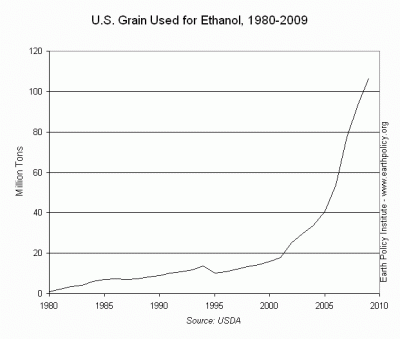
    The 107 million tons of grain that went to U.S. ethanol distilleries in 2009 was enough to feed 330 million people for one year at average world consumption levels. More than a quarter of the total U.S. grain crop was turned into ethanol to fuel cars last year. With 200 ethanol distilleries in the country set up to transform food into fuel, the amount of grain processed has tripled since 2004.

    The United States looms large in the world food economy: it is far and away the world’s leading grain exporter, exporting more than Argentina, Australia, Canada, and Russia combined. In a globalized food economy, increased demand for food to fuel American vehicles puts additional pressure on world food supplies.

    From an agricultural vantage point, the automotive hunger for crop-based fuels is insatiable. The Earth Policy Institute has noted that even if the entire U.S. grain crop were converted to ethanol (leaving no domestic crop to make bread, rice, pasta, or feed the animals from which we get meat, milk, and eggs), it would satisfy at most 18 percent of U.S. automotive fuel needs.

    When the growing demand for corn for ethanol helped to push world grain prices to record highs between late 2006 and 2008, people in low-income grain-importing countries were hit the hardest. The unprecedented spike in food prices drove up the number of hungry people in the world to over 1 billion for the first time in 2009. Though the worst economic crisis since the Great Depression has recently brought food prices down from their peak, they still remain well above their long-term average levels.

    The amount of grain needed to fill the tank of an SUV with ethanol just once can feed one person for an entire year. The average income of the owners of the world’s 940 million automobiles is at least 10 times larger than that of the world’s 2 billion hungriest people. In the competition between cars and hungry people for the world’s harvest, the car is destined to win.

    Continuing to divert more food to fuel, as is now mandated by the U.S. federal government in its Renewable Fuel Standard, will likely only reinforce the disturbing rise in hunger. By subsidizing the production of ethanol, now to the tune of some $6 billion each year, U.S. taxpayers are in effect subsidizing rising food bills at home and around the world.


    For more information on the competition between cars and people for grain, see Chapter 2 in Plan B 4.0: Mobilizing to Save Civilization (New York: W.W. Norton & Company, 2009), on-line for free downloading with supporting datasets.

    Related Links:

    Made in America

    Small cars make it big at Detroit Auto Show [slideshow]

    America’s Century-Long Love Affair with the Car May Be Coming to an End – Data Highlights


  • China’s economy roars ahead

    CHINA’S economy was 10.7% larger in the fourth quarter of 2009 than it was a year earlier, a rate of growth that beat estimates. In December, industrial production grew 18.5% and retail sales increased 17.5%. Based in part on China’s performance, that World Bank revised up its expectations for global growth in 2010, from 2% to 2.7%. And if Chinese growth maintains this pace, China’s economy may surpass Japan’s to become the world’s second largest.

    Of course, the government economic supports that helped produce this recovery haven’t come without some side effects:

    Banks lent out US$14.58 billion in new mortgages in Shanghai in 2009, a 1,600% increase from the previous year, the South China Morning Post reported. Of the total, US$5.7 billion went to buyers of new properties and US$8.88 billion to those buying second-hand properties, according to the People’s Bank of China. Average prices of Shanghai homes rose 68% from 2008.

    The government is aware of the potential problems here, and is beginning to take measures to rein in credit growth. Ultimately, the renminbi will almost certainly rise:

    [T]he overwhelming consensus among analysts is that China is likely to abandon the renminbi’s de facto peg to the dollar as the world emerges from the financial crisis.

    Indeed, over the last month, the futures market has moved from expecting a 1.7 per cent appreciation in the renminbi against the dollar over the next year to forecasting a rise of more than 3 per cent.

    While China’s expansion has clearly boosted world growth and has likely helped developed nation economies on net, the use of RMB appreciation to rein in an overheating economy could potentially be quite beneficial for America. Consider this chart, posted by Menzie Chinn:

    Compare the difference in America’s current account balance given depressed growth with a flat dollar and with stronger foreign growth. That difference represents higher output thanks to better net export performance—essentially, it means that improved exports have picked up the slack from weak consumption. So Americans shouldn’t look at current, rapid Chinese growth as a threat. It’s likely to mean a key source of support for the American economy over the next year, which will be crucial given the impending end of fiscal (and perhaps monetary) stimulus.

  • American Artist Paints 2000 portraits of the fallen

    Ok I nicked this off ARRSE.com as I thought it was really good.

    http://news.bbc.co.uk/1/hi/world/8471873.stm

    ‘Distinctive portraits of British, US and Canadian service personnel killed in Iraq and Afghanistan – created by artist Michael Reagan – have gone on display at Arlington National Cemetery near Washington DC.

    A Vietnam War veteran himself, he has produced more than 2,000 drawings for the soldiers’ families free of charge. He told BBC Radio 4’s PM programme he wants to document all of the Allied troops killed in action.’