Blog

  • The “Next Generation” of Microsoft Phones Making Cameos All Over the Internet [Microsoft]

    Rumors about Microsoft’s mobile plan are evolving, weirdly! Today, we’ve got dueling speculation: from Twitter, evidence of new “Danger” hardware; from Microsoft, mention of “the next generation of Windows Phone.” It’s mystery meat, this stuff, but at least it’s juicy.

    Engadget spent the better part of their morning piecing together a puzzle’s worth of cryptic, oddly tagged tweets from unknown Twitter users. What was so interesting about these Tweets? See if you can tell:

    DANGER. Lots of DANGER. This is the company that made the Sidekick, and that Microsoft absorbed. It’s also the division variously implicated in the exclusive Pink phone documents leaked to us back in September, which may or may not actually represent Microsoft’s next phone play, rather than a straightforward Windows Mobile X evolution. The kicker? Sidekick devices don’t tag their tweets “Danger”, and these tweets have been ramping up very quickly in the past week. So!

    Microsoft’s been giving more direct clues as well, by way of their MIX 10 conference site. MIX is an annual developers’ conference held by Microsoft in March, just after Mobile World Congress, where Microsoft is almost definitely making some kind of mobile announcement. Peek the schedule, and you’ll find this:

    The next generation of Windows Mobile phones. Sounds like a bit of an overstatement for an incremental update like Windows Mobile 6.5.3/6.6/whatever, and why would developers need new guidance for developing on a platform built on the same codebase, anyway? Again: delicious mystery meat.

    The wild, scattershot nature of these rumors is actually what keep them interesting, I think. There’s evidence that we’re soon going to see Pink, and that we’re soon going to see Windows Mobile 7. The obvious conclusion, if not a particularly descriptive one, is that we’re going to see a new thing—a single new thing—that’s the product of all the wild rumors we’ve heard so far, changing nomenclature aside. And, fingers crossed, it may actually be awesome. [Engadget, MobileTechWorld]


  • Samsung, Korea Electric Win Massive Ontario Wind, Solar Contract

    Samsung C&T Corp. and Korea Electric Power Corp. has signed an agreement with the government of Ontario to develop a $7 billion wind and solar project, according to reports.

    The government’s official release is here.

    The 2,500 megawatt project will include 1,000 wind turbines that will provide 80 percent of the power for the project. The project will create 16,000 jobs over six years, according to The Toronto Star.

    Ontario Premier Dalton McGuinty said,

    With this step, Ontario is becoming the place to be for green energy manufacturing in North America.

    Korea Electric will design the transmission system and operate the project, which is tentatively slated for completion by 2016. The first phases of the five-part project will be located in Haldimand County and Chatham Kent.

    Samsung will also receive an “economic development adder” incentive in addition to the feed-in tariff for green energy, which has prompted criticism from McGuinty’s own government that ratepayers will subsidize the consortium.

    Critics also say the consortium will have an unfair advantage over local wind producers.

  • Fortaleza (CE) | Aldeota | Reale Edifício | Cameron

    Localização: Rua Professor Dias da Rocha, 730, Bairo Aldeota.

    Edifício Reale será composto de 02 (Dois) Subsolos, 01 (Um) Pilotis, 17 (Dezessete) Pavimentos Tipo com 2 apartamento por pavimento e 02 (duas) Coberturas Duplex, com a seguinte composição:

    SUBSOLO 02
    – Hall dos Elevadores, 01 (Um) Elevador Social, 01 (Um) Elevador de Serviço, Escada, Antecâmara, Depósito, Cisterna, Rampa de Acesso ao Subsolo 01 e Estacionamento com Vagas de Garagem.

    SUBSOLO 01
    – Hall dos Elevadores, 01 (Um) Elevador Social, 01 (Um) Elevador de Serviço, Escada, Antecâmara, Grupo Gerador, Rampa de Acesso ao Pilotis e ao Subsolo 02, e Estacionamento com Vagas de Garagem.

    PILOTIS
    – Guarita, Acesso Pedestres, Acesso Veículos, Recepção, Fitness, Ducha, Depósito, Wc´s Masculino e Feminino, Salão de Festas, WC Masculino Salão de Festas, WC Feminino Salão de Festas, Playground, Jardins, Piscina, Deck Molhado, Deck Piscina, Churrasqueira Piscina, Quadra de Esportes (Gramado), Hall Social, Hall Serviço, 01 (Um) Elevador Social, 01 (Um) Elevador de Serviço, Escada, Antecâmara, Casa de Gás, Lixeira e Rampa de Acesso ao Subsolo 01.

    PAVIMENTO TIPO
    – Escada, Antecâmara, Hall de Serviço, 01 (Um) Elevador de Serviço, Hall Social, 01 (Um) Elevador Social, 02 (Dois) Apartamentos Tipo, constituídos de Estar/Jantar, Varanda Gourmet, Circulação, Suíte 01, WC Suíte 01, Suíte 02, WC Suíte 02 Reversível, Suíte Casal/Closet, Sacada Suíte Casal, WC Suíte Casal, Cozinha, Área de Serviço, Quarto de Serviço, WC Serviço e Laje Técnica.

    COBERTURAS DUPLEX
    – Escada, Antecâmara, Hall de Serviço, 01 (Um) Elevador de Serviço, Hall Social, 01 (Um) Elevador Social, 02 (Dois) Apartamentos Cobertura Duplex, constituídos no pavimento inferior de Estar/Jantar, Varanda Gourmet, Circulação, Suíte 01, WC Suíte 01, Suíte 02, WC Suíte 02 Reversível, Suíte Casal/Closet, Sacada Suíte Casal, WC Suíte Casal, Cozinha, Área de Serviço, Quarto de Serviço, WC Serviço e Escada de acesso ao pavimento superior, o qual é constituído de Escada de acesso ao pavimento inferior, circulação, WC, Quarto, Laje Técnica, Solarium Gourmet, Bar, Banho e Piscina.

    Implantação:

    Planta APTO TIPO:

    Planta DUPLEX INFERIOR:

    Planta DUPLEX SUPERIOR:

  • You Know Corsair Dominator GTX 2333MHz Is Ridiculously Fast RAM Just By Looking At It [Gaming]

    Corsair’s Dominator GTX 2333MHz is the fastest RAM you can buy that’s Intel XMP-certified, at 2333MHz with latencies of 9-11-9-27. Each 2GB module is individually tested, in case you’re wondering why else it’s $200 a stick. [Hexus]



  • New colorants mean all plastics can be a little more green

    From Green Right Now Reports

    Plastics Color Corporation has launched a new line of color concentrates partially made with post-consumer and industrial plastic content, providing manufacturers with a way to meet recycled material requirements and trim their use of valuable natural resources.

    The recycled colorants are offered in a variety of resin types and wide range of colors. PCC said the recycled content of the concentrate formulations range from 25 percent to 82 percent, depending on the color. The new color concentrates can be used for a variety of applications, including playground equipment, construction material, furniture, pallets, packaging and house wares.

    “The product line was developed in response to customer requests for products that aid in their sustainability initiatives,” Joe Byrne, Plastics Color Corporation’s vice president of sales and marketing, said in a statement. “One of the key elements of sustainability is to reduce the use of products derived from limited resources, such as petroleum. Every pound of post-consumer resin we use helps to reduce consumption of virgin material, therefore minimizing the impact of depleting our limited resources.”

    PCC said Walmart is just one end-user that is driving the creation of more earth-friendly products by requiring its 100,000 global suppliers to quantify their own sustainability programs by completing a survey and tracking their “green” efforts. PCC executives believe that as consumers demand more sustainability in the products they purchase, all manufacturers will be looking for more recycled raw materials and reduced energy usage in production.

  • ICYMI: Schiff’s money

    Republican U.S. Senate candidate Peter Schiff is worth millions of dollars, but unlike one of his rivals, he does not intend to finance the bulk of his campaign. Schiff, a broker, author and financial pundit from Weston, says he has raised a total of close to $1.6 million, almost all of it in small donations from individuals. About $300,000 came in the past month.

    “I don’t mind spending some of my own money on the campaign but I’m running for a cause and I shouldn’t be paying for it all myself,” Schiff said.

    Schiff earned a salary of $17 million and reported dividends, interest and capital gains of at least $1.4 million over a 23-month period ending in mid-December, according to financial disclosure forms filed in connection with his run. Not listed among his assets is the Weston home he bought in December for $2.4 million.

    Schiff’s wealth, while considerable, is overshadowed by the vast fortune of former World Wrestling Entertainment CEO and fellow Republican Linda McMahon, who has said she would spend up to $50 million to fund her own Senate bid.


    Read the rest here.


  • ‘Toronto 18’ member released after pleading guilty to terrorism charges

    [JURIST] Amin Mohamed Durrani, a member of the “Toronto 18”, was released Thursday after pleading guilty in a Canadian court Wednesday to participating in and assisting a terrorist group. Durrani’s plea, which came as a surprise to many, included an apology and a denunciation of terrorism. As part of the plea agreement, Durrani was sentenced to seven-and-a-half years in prison, but was credited with time served since 2006 and was to be released after one additional day. Durrani also received a three-year probationary period, a lifetime ban from owning firearms, and his DNA will be entered into a national registry.
    Also this week, the Ontario Superior Court of Justice sentenced two members of the group, Zakaria Amara and Saad Gaya, to life and 12 years in prison, respectively, for their roles in the plot to blow up key buildings in Toronto. Earlier in January, another member, Shareef Abdelhaleem, pleaded not guilty to charges of participating in a terrorist group and intending to cause an explosion. The first member of the group, an unidentified minor, was convicted in September 2008, and like Durrani, was sentenced to time already served.

  • George Bunn, The Norm Builder [6]

    George Bunn (above, sailing and with son Matt) is one of the founding fathers of nuclear arms control. He was present at the creation of the Arms Control and Disarmament Agency, and served for eight years as ACDA’s first General Counsel. George participated in the negotiation of the Limited Test Ban and Nonproliferation treaties. Fortunately, he took notes during his years of public service, which is evident in Arms Control by Committee, Managing Negotiations with the Russians (1992). George wrote this book to add to the negotiating history of key accords and to suggest lessons learned, using the case study method.

    In his chapter on the test ban, George reveals that ACDA Director William Foster exceeded his negotiating instructions trying to bridge differences on the number of on-site inspections required for a comprehensive treaty. The Politburo finally budged from zero to three OSIs per year; the Kennedy administration wanted seven inspections, but was prepared to fall back to six. Before throwing in the towel, George relates that Foster held up five fingers to his Soviet counterpart, who scowled. A CTBT wasn’t in the cards in 1962-3 for this and other reasons.

    There is still along way to go before the CTBT enters into force, but as George wrote in The Status of Norms Against Nuclear Testing (The Nonproliferation Review, 1999), “there are norms operating against nuclear testing even though the CTBT has not been ratified.” Norm building is a poorly analyzed, alchemical process in which political activism, risk-taking leadership, resolute negotiators, and “mere words” combine to eventually gain the status of customary and then international law. All of the key bulwarks of arms control — the tradition of non-battlefield use of nuclear weapons, the global nonproliferation regime, and constraints on nuclear testing – began as outlandish notions that have become norms. Norms can be broken, of course. So, too, can traffic laws. But we would be much less safe without them.

    Without rules, there are no rule breakers. Norms, George wrote, “are international prescriptions for state conduct. They are principles, standards or rules.” Or as Abe and Antonia Chayes put it, “They are prescriptions for action in situations of choice, carrying a sense of obligation, a sense that ought to be followed.” The states of greatest proliferation concern are outliers, rejecting a widely shared sense of obligation. Norms clarify their outlier status, as well as the steps required for their rehabilitation.

    Norm building was George Bunn’s life work. His handiwork now constrains political choices, and helps promote personal, national, and international security.

  • ComEd Signs Up Silver Spring, Tendril for Smart Grid Pilot

    What will convince people to actually reduce their home energy consumption and engage with new smart meters that are being rolled out? The folks leading ComEd, including the Chicago utility’s President and COO Anne Pramaggiore, want to know. At the Cleantech Investor Summit on Wednesday Pramaggiore said that in April ComEd would be starting a […]


  • Rumor Has It: iPhone OS 4.0 Details Leaked Early

    I’m pretty sure that late January is traditionally that time of the year when the Apple rumor mill starts heating-up in anticipation of the impending iPhone OS update. A young tradition, to be sure, but a tradition nonetheless.

    This year, however, the media frenzy around the mythical-but-completely-certainly-probably-real Tablet seems to be getting all the attention — rather like a new born baby stealing the limelight from its three year old sibling.

    At least BoyGeniusReport — in the past a reasonably accurate source of information on upcoming iPhone OS updates — hasn’t forgotten the tradition and, even though no one is paying the least bit of attention, they resolutely committed to web-page what they think they now know about iPhone 4.0.

    So what’s the latest? From BGR:

    “There will be multi-touch gestures OS-wide. (Would make sense […] as the rumored OS for the iTablet is close if not the same as the iPhone)

    I’m not sure I understand what this means if I’m honest with you. I mean, the few multi-touch gestures we get now in apps like Photos and Safari are sensible enough, (double-tap and pinch zooming are useful in those apps) but do we need multi-touch everywhere? How will the addition of OS-wide gestures make the OS more elegant, more intuitive and easier to use? Now, I’m not suggesting any sort of major calamity; I’m just experiencing something of an imagination-failure here.

    “A few new ways” to run applications in the background — multitasking.”

    So, the elusive Multitasking is coming to iPhone? I’m not convinced. Speaking from my many years of experience using Windows Mobile, it seems to me that Apple’s approach to memory management on the iPhone is pretty much perfect. Sure, it doesn’t multitask — but in almost three years of iPhone ownership, that has never presented an insurmountable problem for me. And the (ahem- late) introduction of Push Notification Services was a very welcome compromise.

    I have since discovered, however, that I don’t need Facebook to notify me about every poke or thrown sheep, and I especially don’t want to be notified of every tweet from my Twitter stream. No thank you.

    Perhaps the “few new ways” refers to a sandboxed memory “space” that runs in the background, sort of like an app for keeping-alive portions of other apps, even when they’re not currently front-and-center. Maybe. Whatever it is, you can be sure there won’t be a task manager.

    “Many graphical and UI changes to make navigating through the OS easier and more efficient. We haven’t had this broken down, but we can only hope for improved notifications, a refreshed homescreen, etc.”

    What do you think? A new, refreshed UI style, perhaps? Or an iPhone version of Exposé? The latter sounds horrid, but still, Soptlight can’t be the only solution to quickly navigating through 10 pages of apps.

    “The update will supposedly be available for only the iPhone 3G and 3GS, but will “put them ahead in the smartphone market because it will make them more like full-fledged computers” more than any other phone to date. Everyone is “really excited.”

    Makes sense. The 3G and 3GS have more memory than the venerable first generation iPhone. Consider how sluggish the latest build of the iPhone OS (3.1.2) can be on first generation iPhones. Apple is so concerned with guaranteeing a consistent, elegant user experience they kept cut & paste out of the OS for years before they felt the solution was good-enough to publish. So they’re hardly going to support their latest and greatest OS on the ageing first-generation iPhone because the experience will be terrible.

    I would wager, too, that core location services have been greatly expanded and even more tightly integrated with the entire OS, making the original location-ignorant iPhone a bit of a silly platform for 4.0. (Don’t forget that patent for a location-aware home screen…)

    “The last piece of information is the most vague, but apparently there will be some brand new syncing ability for the contacts and calendar applications.”

    Since I’m one of the five or six people in this world who pays for a MobileMe subscription I never really think about contacts/calendar syncing. It just happens for me, quietly, no fuss. I’ve never synced any other way, so I have no experience of the perils and pitfalls of syncing via different methods. I’ll leave you to tell me what you think this means and why I should care.

    And Then There’s That Tablet (Again)

    Don’t forget that the established wisdom of the Rumor Mill has it that iPhone OS 4.0 and the Tablet’s operating system are pretty much built upon the same core code — hence the reason for Apple’s delay in seeding the 4.0 build to developers. (Since the code is so similar it’s pretty likely that tablet functionality will be easily discovered by a few minutes spent digging through iPhone OS 4.0’s bundled APIs. Apple has held-back on seeding the next major iPhone OS build for this very reason — they don’t want to give away clues as to what’s in store with the Tablet — that sort of information will leak fast.)

    So while the world’s press salivates over the upcoming tablet and forgets completely about Apple’s other major products, spare a thought for iPhone OS 4.0. It’s likely to be the most important — and impressive — update in the iPhone’s history. And, unless you have your money ready to splash on the Tablet, iPhone OS 4.0 is the most likely next “new thing” you’re going to get from Cupertino.

  • The Smaller and Cheaper Garmin zumo 220 GPS for Bikers

    Garmin announced a new addition to its GPS range, namely the zumo 200, which is reportedly designed to help motorcyclists. The much smaller and affordable motorcycle navigator includes text-to-speech guidance, lane assist, Bluetooth headset compatibility and on-road/off-road travel options.

    The zumo 220 is expected to become available in March 2010 for a suggested retail price of $599.99, including with a motorcycle mount and an automotive mount for an easy transition between bike and car or … (read more)

  • Microsoft Sorta Apologizes For Points System, May Be Moving to Real Money [XBox360]

    One of the most annoying aspects of the Xbox 360 Marketplace is Microsoft Points, a fake currency used to buy games and add-ons that obscures how much real money you’re spending. But that may be on the way out.

    In an interview with G4, Microsoft’s Aaron Greenberg had this to say about the Points system.

    We never intended to ever mislead people. I think we want to be transparent about it, and so it is something that we’re looking at. How can we be more transparent and let people see it in actual dollars?

    This is good news! The Points system is transparently sleazy, with it set up so you can only buy points in chunks that are not easily divided into the amount games and such are sold for. Basically, products are all sold in numbers divisible by 200 (200, 400, 1200 point prices are standard) while you can only buy points in chunks divisible by 500 (500, 1000, 2000 or 5000 points are your only options). This almost always leaves you with an awkward number of points left over that you’re forced to pay for. You then need to add more points to that awkward remainder to buy more, which will probably give you another awkward remainder, and so on and so forth. This is absolutely the only reason Microsoft has for not allowing you to just buy chunks of 400 or 800 points at a time.

    Combine this with the fact that putting a different number value between a product and it’s true dollar value is designed to make you forget you’re spending real money (it’s easier to justify spending 5000 points than $62.50), and you see why this is a pretty anti-consumer system. So it’s good news that Microsoft is considering changing it!

    But don’t think they’re just doing it because they’ve suddenly acquired a conscience. In all likelihood, if Microsoft moves away from the Points system on Xbox Live, it’s because they’re planning on expanding the Zune Marketplace and integrating it more with the Xbox 360. The Zune Marketplace is in dollars (or whatever local currency you’re using), and it’d be much easier to unify the two systems by switching it all to currency than cramming the points system into the Zune Marketplace.

    But whatever motivation Microsoft has, moving away from the points system and into real currency is definitely a good thing. Allowing people to pay for only what they want using the normal currency they use every day is just more honest all around, and you can’t argue with honesty. [G4 via Kotaku]


  • Side Effects Too Serious for New MS Drugs?

    News that there is progress in developing oral drugs for multiple sclerosis, a neurological disease that strips the ability of the nerves to send impulses from the brain, is raising hope so millions of patients with the disease.

    The biggest plus of medications like Cladribine (Merck) and Fingolimod (Novartis) is that they are taken by mouth. Right now, the only medications that could slow iStock_prescriptionpaddown the progress of MS are taken by injection. Cladribine would only be taken for a few days each year, while fingolimod is taken every day. However, researchers are cautioning people about the serious side effects that may come with the drugs.
    It turns out that both medications lower the immune system’s defenses, making patients much more vulnerable to infection. According to news reports, two people in one study died of herpes infections, which likely were allowed to spread because of the body’s inability to keep them in check. Other patients saw latent (dormant) herpes infection come back while on the medications.

    These medications are under study still and there is no long-term data available yet. However, researchers and doctors will continue to monitor the drugs’ effectiveness and safety as more patients take them.

    ~~~

    Image: iStock.com

    Post from: Blisstree

    Side Effects Too Serious for New MS Drugs?

  • EU Leaders Plan Emergency Moves to Prevent Greek Domino Effect

    domino smaller kb

    European Union leaders are now open to the idea of providing a loan of last resort to Greece as a means of stabilizing its deteriorating economy.

    This decision is driven by fear that the IMF might need to bail out Greece if the EU doesn’t, reducing confidence in the economic area and perhaps triggering a potential downgrade of other troubled states’ sovereign debt.

    There are also creeping fears that a Greece debt restructuring could lead to its banks collapsing across the Central Eastern European region. This would affect troubled economies like Romania, which has already had to tap IMF loans to stay above water during the crisis.

    It would work like this. Greek banks, such as Piraeus Bank, Alpha Bank, and Bank of Cyprus that have significant presences in Romania, Bulgaria, and Croatia would be forced to retreat from their forward positions to deal with the difficulties of their own country’s financial crisis.

    Pulling out of those countries would put further pressure on their already flailing governments and expand pressure on consumers and businesses desperate for new lines of credit. This could lead to other CEE states calling for further assistance from the IMF or EU, ratcheting up the pressure and potentially causing further contagion.

    Join the conversation about this story »

    See Also:

  • It looked like hypoglycemia, left like hypoglycemia, but it wasn’t

    I take sylmin before meals. Last night I had for dinner an average size salad consisting of lettuce, cucumbers, peppers and onion. The dressing was low fat and low sugar. Before I go to bed, I take my diabetic medication. At night I take 1 ea Glyb/Metform 2.5/500mg and 2 ea Glumetza 500 mg. I have been on this maintenance for a few years and it works for me. Went to bed at approximately 10:30 PM. Lying in bed I started with what I thought was hypoglycemia. The symptoms were as follows:shakiness, nervousness, dizziness or light-headedness, sleepiness, confusion , anxiety, and weakness. OK I have had it before, I’ll just go out and take my count see it’s in the 70’s and take some soda with sugar and maybe some tablets. Then I’ll calm down, and get some sleep. Took the meter pricked my finger and my count was 235. WOW 45 minutes after take my medication, tried again it was 237. Went back to bed and tried to get to sleep, but my mind was swimming with all kinds of things, from should I go to the emergency room, to what the heck is wrong with me. Got up again in a half hour, after eating a apple, and my count on a different meter, it was 250. OK now I’m freaking out. Finally at a little after 2:00 AM I feel to sleep. I get up at 5:15 AM, so when I awoke this morning I felt better but I was of course tired. This episode scared me to death. Was it something else or did my diabetes have anything to do with it. I am a person that when I get ill, my sugar shoots up to about this stage 225 to 250. I took my sugar this morning and it was 134. A bit high, but the apple didn’t help. Does anyone have any idea what might have happened. Thanks in advance.
  • Supreme Court eases federal ban on corporate campaign donations

    WASHINGTON–The U.S. Supreme Court on Thursday opened the door to federal corporate political donations. “Indeed, to exclude or impede corporate speech is to muzzle the principal agents of the modern free economy. We should celebrate rather than condemn the
    addition of this speech to the public debate,” said the majority in the opinion. Read the entire decision here.

  • Savella Recall Urged by Public Citizen Due to Heart and Suicide Side Effects

    The prominent consumer group Public Citizen has petitioned the FDA to initiate a recall for Savella, saying that the fibromyalgia drug’s heart and suicide risks outweigh its benefits.

    The Savella recall petition was sent to the agency on January 20, calling for the drug’s immediate removal from the market. Public Citizen claims that the benefits of the drug are highly questionable, and note that side effects of Savella could increase the risk of hypertension, heart problems and has been linked to suicidal tendencies.

    Savella (milnacipran) is produced by Cypress Bioscience, Inc. and Forest Laboratories, Inc. It is a selective serotonin and norepinephrine reuptake inhibitor (SNRI) and is similar to many antidepressants currently on the market. The drug is contraindicated for people taking monoamine oxidase inhibitors (MAOIs) and those who have uncontrolled narrow-angle glaucoma.

    It was approved by the FDA for treatment of fibromyalgia in adults on January 14, 2009. While the drug is used as an antidepressant in Europe, the European Medicines Agency (EMEA) refused to approve Savella for fibromyalgia treatment in July 2009, saying that the drug had marginal benefits that failed to outweigh the health risks from Savella side effects.

    Fibromyalgia, or fibromyalgia syndrome, is a condition that manifests as widespread chronic pain and is estimated to affect between 2-4% of the population. However, much of the medical community disputes how to diagnose the syndrome, and many do not believe it is an actual disease because of a lack of objective diagnostic tests and physical abnormalities on examination. While some say it may be a neurological condition, possibly brought on by stress and resulting in oversensitive pain receptors, others say it may be a “non-disease.”

    According to Public Citizen, two randomized clinical trials with Savella found that the drug increased blood pressure, heart rate and suicidal thoughts. Nearly 20 percent of the trial’s participants who were given Savella developed hypertension, compared to 7.2 percent who were given a placebo. Public Citizen said that FDA’s own reviewers determined that Savella could increase the risk of heart problems, such as strokes, heart attacks and sudden death, by as much as 50 percent.

    The group claims that studies have shown Savella increases the risk of seizures, addiction, excessive bleeding, mood disorders, fractures, glaucoma, nausea and vomiting. They also indicate that the drug can put fetuses, newborns and nursing infants at risk when used by pregnant mothers, and can cause reproductive problems in men.

    In addition, Public Citizen says that there is evidence that the drug does not work. Public Citizen claims the director of FDA’s Division of Anesthesia, Analgesia and Rheumatology Products has said that Savella did not relieve pain, the main symptom of fibromyalgia, in clinical trials.

    “Fibromyalgia is a chronic disease, but neither of the drug’s trials showed any statistical effectiveness beyond three months,” Public Citizen said in a press release. “And even within the trials’ three-month duration, more than 90 percent of users in the trial received no benefit from the drug at all.”

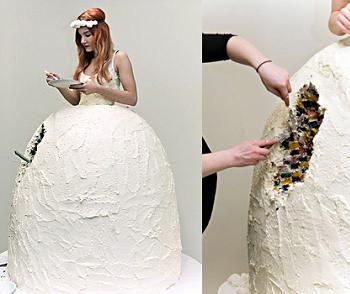
  • Wedding Dress Wedding Cake

    Wedding Dress Wedding Cake

    Weddings are undeniably special occasions and you’ll see some of the most beautiful and most elaborate cakes ever baked on display at wedding receptions. You’ll also see some of the most over-the-top cakes, for better and for worse. One of my favorite instances of this is a life sized wedding cake made to look exactly like the bride herself. It was certainly memorable, down to the matching dress, bouquet and hairstyle of the bride. This wedding cake wedding dress, a designer creation by Lukka Sigurdardottir that is unlikely to be appearing at any real ceremonies in the near future, was built along a similar vein. Instead of making the bride out of cake to wear the cake dress, this gigantic dress-shaped wedding cake has a real woman at the center – “wearing” the dress! Naturally, she can’t move too well in the outfit, but she is in a good position to snack on the rainbow-colored, multi layer cake while she waits to be rolled – since walking is pretty much out of the question – down the aisle.

  • Ventas de automóviles en 2009

    ventas-coches-2009.jpg
    La ACEA (Asociación Europea de Fabricantes de Automóviles) publicó las cifras de ventas de coches nuevos en 2009, resultando unos datos muy halagüeños teniendo en cuenta las malas previsiones que había a comienzos de año. En total, 14.4 millones de coches nuevos frente a los 14.7 millones de 2008, un año malo en ventas y que implica un descenso del 1.6%.

    Si desgranamos los datos un poquito más tenemos que en la Europa de los 15, los países con mejores niveles de renta, las ventas subieron un 0,9%, mientras que en la Europa de los 27 descendieron un 1,3%. Si sumamos a la estadística los países que tienen tratados de libre comercio el descenso se eleva a un 1,6%, nada demasiado escandaloso dado lo fuerte que ha azotado la crisis este año.

    Cabe destacar que los países que han incrementado las ventas son Alemania, con una fuerte subida del 23% (700.000 coches más en total, una auténtica barbaridad) dadas las ayudas del gobierno, Francia, Austria República Checa y Polonia. El resto han bajado o se han mantenido, como el caso de Italia. España en concreto ha caído un 18% pese al plan 2000E.

    En conclusión podemos decir que las cifras mundiales no han sido demasiado alarmantes gracias sobre todo al gobierno alemán, que con su gobierno ha conseguido tirar del carro, como siempre. Si bien las ventas no han caído esperemos que en 2010 las cifras mejoren, no haya tanta inestabilidad en los puestos de trabajo y las noticias sobre el crecimiento del sector inunden nuestra web.

    Vía | Diariomotor


  • Broadband’s Next 100 Million Will Come From Emerging Economies

    The world will reach 500 million fixed-line broadband subscribers sometime this year thanks to growth in developing countries, according to research firm Informa. What’s more, through 2014 the next 100 million broadband subscribers will come from those countries as well. When it comes to wired broadband additions, China, Russia and Mexico are the new stars.

    The developed world has seen slowing rates of fixed-line broadband growth as markets there have become saturated, so in the meantime the focus has moved to the developing world. We talk a lot about mobile broadband being the wave of the future in developing countries, and how many in those places will skip the wireline infrastructure altogether, but when it comes to delivering high speeds necessary for video and even mobile backhaul, wired is the way to go.

    Which means wireline growth will continue even as mobile broadband via 3G and 4G networks expands. The Informa report predicts that most of the wired broadband growth with come from the seven countries seeing the most growth in subscribers: China, Russia, Mexico, India, Brazil, Turkey and Argentina. For a tally of broadband subscriptions as of the end of September, check out Informa’s chart below.

    Image courtesy of Flickr user ground.zero