Blog

  • Quantum Could Supply Q-Drive Components for the Fisker Karma

    Quantum Fuel Systems Technologies Worldwide (QTWW) announced that it has entered into a letter of intent with Fisker Automotive for the exclusive supply of Q-Drive Plug-In Hybrid components and control systems for the Fisker Karma Program. Quantum would also receive a ‘royalty payment’ on each Karma sold that incorporates Quantum’s Q-Drive.

    "We are gearing up for the Karma production phase and are excited about bringing our innovative Q-Drive PHEV control systems to market. Fisker has a… (read more)

  • Donna Inch Appointed Chairman and CEO of Ford Land

    Ford has just announced that Donna Inch was appointed chairman and CEO of Ford Land, "the real estate and wholly owned subsidiary of Ford," as the company said in a release. She will thus take the place of Phil Horlock, who announced his decision to retire in December last year.

    Serving as chairman as CEO of Ford Land will bring Inch several responsibilities, as she’ll be in charge of real estate, construction and facility services for Ford Motor Company, which includes manufacturin… (read more)

  • Holycool.net: My Dysfunctions/ My Humble Opinion Journals

    I’m partial to Moleskines, but I could try these out. :)

  • Holycool.net: The Elevate Kitchen Tools Collection by Joseph and Joseph

    Totally awesome. Perhaps I should replace my current motley crew of utensils with these.

  • A Baldness Update from Histogen; Sequenom Agrees to Settle a Suit; the Life Sciences Job Outlook Improves & More San Diego Life Sciences News

    Denise Gellene wrote:

    There were new developments over the past week in some big ongoing stories.

    Histogen CEO Gail Naughton told Bruce the San Diego-based biotech expects to report results from a one-year follow-up of study of its experimental baldness treatment by the end of this month. Histogen plans additional clinical studies on volunteers with male-pattern baldness—all of them in Asia. (Sorry, guys.)

    — The job market in San Diego’s life sciences industry is showing signs of, well, life. Recruiter Meredith Dow of Proven Inc. told me that layoffs appear to have slowed and some biotech startups are beginning to talk about hiring. Some occupations have a brighter outlook than others, she noted.

    Illumina (NASDAQ: ILMN), the San Diego-based tools company, introduced a machine that can decode an individual’s genome for under $10,000 in a bid to establish the company’s leadership in the gene-sequencing business.

    Sequenom (NASDAQ: SQNM) agreed to pay shareholders $14 million from its insurance proceeds and issue them new shares worth a 9.95 percent stake in the company to settle a class action suit. The settlement, which requires court approval, would resolve one problem related to what the company characterized as the mishandling of data from a clinical trial involving the company’s experimental Down syndrome test.

    Crinetics Pharmaceuticals, a San Diego startup developing biosensors for drug discovery applications, signed a collaboration agreement with the Ferring Research Institute, the peptide research center established in San Diego by Ferring Pharmaceuticals.


  • Arizona trial will bring out the best

    After a strong start to the season, the No. 3 Stanford women’s swimming and diving team (4-0, 0-0 Pacific-10 Conference) faces its stiffest test yet this weekend. No. 2 Arizona (6-0, 3-0 Pac-10) and Arizona State (6-3, 2-2 Pac-10) will visit The Farm on Friday and Saturday respectively.

    Audrie Lin/The Stanford Daily

    Audrie Lin/The Stanford Daily

    The meet against Arizona is the toughest dual meet remaining on the Cardinal’s schedule. Arizona is a perennial powerhouse and Stanford’s annual duel with the Wildcats is usually the most anticipated dual meet on the schedule.
    Last year, the Card defeated the Wildcats by a razor-thin margin, winning 150.5-147.5 in Tucson, Ariz. Stanford was trailing for most of the meet, but with five events remaining the Cardinal stormed back to claim the victory. Junior Liz Smith won the 200-yard breaststroke and the 400-yard individual medley and senior Elaine Breeden won the 100-yard butterfly to bring Stanford close to victory. Senior swimmer and Olympic medalist Julia Smit won the meet by .16 seconds in the final event, the 400-yard freestyle relay.
    Both teams went on to finish the season among the country’s elite programs. At the NCAA Championships, the Wildcats and the Cardinal finished third and fourth, respectively.
    This year’s meet figures to be just as close and exciting.
    “It’s a really tough matchup — their strengths match up with our strengths,” said Stanford head coach Lea Maurer. “We anticipate a meet similar to last year’s. It will come down to who wins the touchouts.”
    The teams enter this weekend separated by just four points in the national rankings and match up well against each other. However, Maurer isn’t really focusing on the rankings table.
    “We don’t really pay attention to them,” she said. “We’ve had a big rivalry [with Arizona] for the past few years — the meets always come within 10 points. We’re worried about the rankings the day after.”
    “We don’t put too much emphasis on rankings heading into meets. I believe your performance in a competition says a lot more about what kind of team you are than the rankings before a meet,” Breeden added.
    While the Cardinal can usually count on Smit, Breeden, Smith and junior Kate Dwelley to deliver a certain number of points in a meet, Arizona’s top swimmers are in similar events. Both teams have strong freestyle relay squads in the 200, 400 and 800-yard distances. Breeden will also face tough competition in her signature event, the 200 fly, from Arizona’s Ana Agy, Whitney Lopus and Erin Campbell.
    “We have some events that we normally pencil in as wins, but their big [swimmers] match up well against ours,” Maurer explained.
    This weekend also marks the start of Pac-10 competition for the team. Arizona, Stanford and Southern California are this year’s top contenders for the Pac-10 crown.
    “I think that the fact that both the Arizona and ASU meets are conference meets signify that we have entered a new phase of the season where the quality of competition increases,” Dwelley said. “We have to be prepared to race with more intensity.”
    While Arizona is the main focus of the weekend, the Cardinal still have to face Arizona State, which is on a three-meet winning streak going into a meet at Berkeley on Friday.
    When asked if Stanford would keep the same intensity as the Arizona match on Saturday, Maurer responded. “The pressure’s on now. We have to race, we have to sharpen our focus and be able to handle the elements.”
    “The focus of these meets is to practice racing and work on the details,” Breeden said.
    While these meets are certainly significant, the main focus remains on the all-important Pac-10 and NCAA tournaments at the end of the season.
    “Leading up to the meet we are not doing anything special to prepare for this meet in particular — we are working hard in preparation for the end of season meets,” Dwelley commented.
    “We always head into dual meets with the goal of winning, but winning dual meets is not as important of a goal to our team as winning at the championship meets,” Breeden added.
    However, the team won’t be distracted during its dual meets.
    “On Friday and Saturday the team will be completely focused on the task at hand . . . racing Arizona and Arizona State,” Dwelley said.

  • Top Tools For Tracking Topics on the Web

    Tracking topics on the Web can be a painful process, due to the amount of noise and difficulty of filtering it. So to help you out, we’ve selected and categorized the leading topic tracking tools. This is based on the discussion that arose from our earlier post about topic feeds, which are RSS feeds for keywords or phrases.

    During the process of analyzing these topic tracking tools, we discovered – to our surprise – that not many of these services output results as RSS. Some of the leading apps in this field require users to visit their service. With that in mind, here is our full list and analysis.

    Sponsor

    Feed and/or Email Services

    These are services which output RSS and/or other formats, such as email notification. We think this type of topic feed tool is the most flexible, particularly when it outputs RSS. With RSS feed output, you can do further filtering or grouping of the feeds inside an RSS Reader like Google Reader or Netvibes.

    The most common such tool is probably Google Alerts. However we were impressed with Topikality and PubSub, which both output RSS. Swamii and Woofeed don’t output RSS (we wish they would), but at least they offer email notifications.

    • Google Alerts
    • PubSub
    • Yahoo Pipes
    • Topikality
    • Swamii (just email, no RSS)
    • Woofeed (just email or mobile, no RSS)

    Destination Services

    These services don’t output RSS or emails for topic searches. That’s not necessarily a bad thing, it just means you have to visit the destination site to see results every day. I’ve been impressed recently with the user interface and features of LazyFeed, Regator and My6Sense – they’re all worth checking out.

    • LazyFeed
    • Regator
    • My6Sense
    • Technorati
    • Ensembli (offers email digests)
    • Guzzle.it
    • Cascaad

    Social Filter

    These services show what is popular or new amongst their respective communities. There are many other such services, so the following is just a sample:

    • Twitter search (e.g. for hashtags)
    • Delicious feeds

    Community Curated

    Similar to Social Filter services, only these have a specific community driving the output of stories. Again the below is a small sample:

    • Digg
    • Reddit
    • Hacker News
    • Slashdot

    People Curated

    Topic-focused blogs (such as ReadWriteWeb!) are great for tracking topics on the Web. In recent times, light blogging services have offered an easy way for individuals or small groups of people to curate information on a given topic.

    • Tumblr
    • Posterous
    • Favit

    Aggregators / Portals

    These services aggregate, or group, news and other stories around a specific topic.

    • Tweetmeme
    • Eqentia
    • Alltop
    • Google Fast-Flip feeds

    Misc

    We couldn’t easily classify these ones, but maybe you can in the comments!

    • Google Trends
    • MashLogic

    We hope this post is a starter for you to explore topic feeds. Let us know what apps we missed in the comments, as well as your thoughts on our categorization.

    Discuss


  • Santander Confirms Pedro de la Rosa Backing

    Although Giancarlo Fisichella was one step ahead of Spanish driver Pedro de la Rosa in signing a racing deal with Sauber F1 Team, it was the latter who eventually won that fight. The former McLaren Mercedes tester was confirmed a few days ago as official driver of the Swiss outfit, and we now know the reasoning behind Peter Sauber’s decision.

    With BMW no longer backing the team and major sponsor Petronas already signed by another team, it wasn’t rocket science to figure out that Sauber will s… (read more)

  • Aston Martin Inaugurates First South American Dealership

    The Brits at Aston Martin have now made officially their way into South America: the company has inaugurated its first dealership there, Aston Martin Santiago, as lefthandnews reports.

    The showroom is located in Santiago, Chile. The company expects in the present year to sell 15 cars in that market.

    According to the aforementioned source, Aston Martin has decided not to create a sales and marketing office for the Santiago dealer. The company’s U.S. head office, located in Irvine, Californ… (read more)

  • Automobile industry in Karnataka

    The automobile industry has slowly increasing its presence in karnataka.Today we have world class automobile manufacturers like toyota and volvo along with one of the best tyre makers of india like JK tyres.

    So this thread will be dedicated for automobile industry related contents of karnataka,

  • AAA Announces State Legislative Priorities for 2010

    The American Automobile Association (AAA) yesterday revealed that it is planning to build on the campaign of traffic safety law improvements that started last year and its is currently working with legislators and other safety advocates in statehouses across the country to draft and pass legislation in 2010 that will make roads safer.

    "Traffic safety improvements should generate special interest in states facing budget challenges.  These laws reduce governments’ medical and emergency res… (read more)

  • Workers Block Access in GM Antwerp Plant

    And here’s how it begins… After hearing that General Motors might shut down the Antwerp production facility, workers at the Belgium plant blocked access to a part of the factory. Obviously, they are disappointed by GM’s intentions and are calling for another decision that would avoid the 2,300 job cut that could occur when shutting down the plant.

    According to a report by Autonews citing an official of the ACV union, Antwerp’s work council will meet today to discuss the matter.

    Basically… (read more)

  • More climate change shenanigans

    I’m not a global warming skeptic — the science on post-industrial CO2 levels and overall global temperature is very clear — but, I have a real problem with the politics of anthropogenic climate change and how science is being regularly twisted into something of a policy battering ram that demands ideological purity and a lack of continued rigor on what is going on. With that, it should go without saying I question the extreme doomsday predictions coming from those ideologically pure AGW cassandras.

    News like this does nothing to make me feel any better about the complete lack of real science behind a lot of AGW claims, and it does nothing to help brush back those idiotic total global warming deniers who point at every record cold temperature and snow storm across the middle of the U.S. to “prove” their point.

    Realistically we have some very bad science and bullying politics on one side, fingers-in-the-ears yahoos on the other, and an actual issue that deserves and needs addressing stuck in the middle. You know, if you think about it the entire AGW debate is a pretty good summation of politics in the U.S. right now.

    From the second link:

    One of the most alarming conclusions from the Intergovernmental Panel on Climate Change (IPCC), a widely respected organization established by the United Nations, is that glaciers in the Himalayas could be gone 25 years from now, eliminating a primary source of water for hundreds of millions of people. But a number of glaciologists have argued that this conclusion is wrong, and now the IPCC admits that the conclusion is largely unsubstantiated, based on news reports rather than published, peer-reviewed scientific studies.

    In a statement released on Wednesday, the IPCC admitted that the Working Group II report, “Impacts, Adaptation and Vulnerability,” published in the IPCC’s Fourth Assessment Report (2007), contains a claim that “refers to poorly substantiated estimates. ” The statement also said “the clear and well-established standards of evidence, required by the IPCC procedure, were not applied properly.” The statement did not quote the error, but it did cite the section of the report that refers to Himalayan glaciers. Christopher Field, director of the Carnegie Institution’s Department of Global Ecology, who is now in charge of Working Group II, confirms that the error was related to the claim that the glaciers could disappear by 2035.

    The disappearance of the glaciers would require temperatures far higher than those predicted in even the most dire global warming scenarios, says Georg Kaser, professor at the Institut für Geographie der Universität, Innsbruck. The Himalayas would have to heat up by 18 degrees Celsius and stay there for the highest glaciers to melt–most climate change scenarios expect only a few degrees of warming over the next century.

  • Change in Franchise length – New Govt plans

    http://www.guardian.co.uk/business/2…port-transport

    Quote:

    New rail franchises will last up to 22 years and penalties on poorly performing companies will be increased under sweeping government changes announced today to improve the railways.

    The government was criticised for not taking tougher action against National Express last year when the company handed back its £1.4bn east coast *franchise after a fall in passenger numbers but only faced a £72m penalty. Transport secretary Andrew Adonis said that the changes, which will apply to the next three new franchises put out to tender this year, would make it harder for companies to walk away. Franchisees would be required to pay larger deposits, known as performance bonds, which they would lose with their franchise. A spokesman for the Department for Transport said ministers were still deciding at what level to set the higher penalties.

    Currently, most franchises are let for eight years but the minimum period will be extended to 10 years. Companies which commit to investing in new track and trains will be awarded contracts lasting for up to 22 years. Having longer franchises reduces the disruption caused when the franchisee changes and transport experts said it would also encourage them to invest more. Tougher performance targets will also be set to weed out companies delivering a poor service and strip them of their franchises, Adonis will say today.

    Consumer watchdog Passenger Focus welcomed the changes but urged the government to hold companies to account to make sure operators maintain service levels to passengers throughout their lifetimes. Anthony Smith, Passenger Focus chief executive, said: "It is also important that franchises are accountable and transparent: we will want to see passenger satisfaction targets included in the contract and detailed data published on punctuality and overcrowding. Additionally, passengers will want to see realistic financial deals made so that train companies do not cut quality or increase charges to reduce their losses."

    The Conservatives pointed out that their rail review last February called for much longer franchises, and claimed that the government’s changes should give more flexibility to rail companies to improve passenger services.

    Shadow transport secretary Theresa Villiers said: "If Labour want to steal Conservative policies they should do it properly. Until they adopt the whole set of reforms we have proposed, passengers will miss out on better *services, better stations and new trains which private sector investment could help to fund."

    Companies compete to bid for the contract to operate a regional network based on the forecast of passenger numbers. The government receives a share of the revenue from the operator.

    Tony Travers, director of the Greater London group at the London School of Economics, said longer contracts risked giving companies get-out clauses, if for example, passenger growth was not as high as expected. "Longer franchises are more likely to have get-out clauses and ways for the operator to renegotiate them." He added: "It’s moving back towards a railway that has slightly more in common with a nationalised railway. In the recent past, there were more operating companies and even shorter franchises."


  • El Dorado Located


    As I have posted on extensively, the creation of terra preta soils permitted dense urbanized Stone Age populations.  Present day clearing activity is now exposing their presence for the archeological record.


    It is noteworthy that these cities show dates only as early as 200 AD.  This is likely a result of limited sampling.  The tool set necessary was already a couple of thousand years old.  This is common though for such dating because most samples come from areas representing the maximization of the culture and likely miss the long early development.


    The late dates support the idea that the whole society was extent when the new world was discovered.  Once again Europeans did not so much as miss these antique civilizations so much as their pathogens got there first and threw these societies down.  The nastiest pathogen was the slave trade of course.


    With out question, these were states and they certainly fit the story of El Dorado.  They most likely decorated buildings with gold and this enhanced the story.  We are not seeing stone structures but we did not see them in Mesopotamia either.  We have mounds and these were certain to hold wood frame structures of the leaders.


    Terra preta made possible an Amazonian population in the tens of millions.  The culture itself most likely prevented it from happening except for locales like this.


    Amazon explorers uncover signs of a real El Dorado


    Satellite technology detects giant mounds over 155 miles, pointing to sophisticated pre-Columbian culture
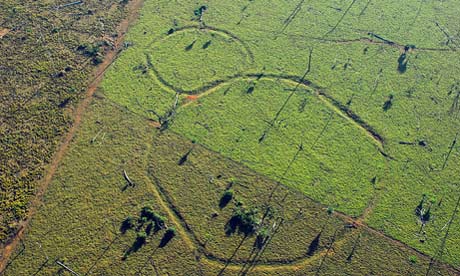
    An aerial picture of traces of earthworks built by a lost Amazonian civilisation dating to 200AD. Photograph: National Geographic
    It is the legend that drew legions of explorers and adventurers to their deaths: an ancient empire of citadels and treasure hidden deep in theAmazon jungle.
    Spanish conquistadores ventured into the rainforest seeking fortune, followed over the centuries by others convinced they would find a lost civilisation to rival the Aztecs and Incas.
    Some seekers called it El Dorado, others the City of Z. But the jungle swallowed them and nothing was found, prompting the rest of the world to call it a myth. The Amazon was too inhospitable, said 20th century scholars, to permit large human settlements.
    Now, however, the doomed dreamers have been proved right: there was a great civilisation. New satellite imagery and fly-overs have revealed more than 200 huge geometric earthworks carved in the upper Amazon basin near Brazil‘s border with Bolivia.
    Spanning 155 miles, the circles, squares and other geometric shapes form a network of avenues, ditches and enclosures built long before Christopher Columbus set foot in the new world. Some date to as early as 200 AD, others to 1283.
    Scientists who have mapped the earthworks believe there may be another 2,000 structures beneath the jungle canopy, vestiges of vanished societies.
    The structures, many of which have been revealed by the clearance of forest for agriculture, point to a “sophisticated pre-Columbian monument-building society”, says the journal Antiquity, which has published the research.
    The article adds: “This hitherto unknown people constructed earthworks of precise geometric plan connected by straight orthogonal roads. The ‘geoglyph culture’ stretches over a region more than 250km across, and exploits both the floodplains and the uplands … we have so far seen no more than a tenth of it.”
    The structures were created by a network of trenches about 36ft (nearly 11 metres) wide and several feet deep, lined by banks up to 3ft high. Some were ringed by low mounds containing ceramics, charcoal and stone tools. It is thought they were used for fortifications, homes and ceremonies, and could have maintained a population of 60,000 – more people than in many medieval European cities.
    The discoveries have demolished ideas that soils in the upper Amazon were too poor to support extensive agriculture, says Denise Schaan, a co-author of the study and anthropologist at the Federal University of Pará, in Belém, Brazil. She told National Geographic: “We found this picture is wrong. And there is a lot more to discover in these places, it’s never-ending. Every week we find new structures.”
    Many of the mounds were symmetrical and slanted to the north, prompting theories that they had astronomical significance.
    Researchers were especially surprised that earthworks in floodplains and uplands were of a similar style, suggesting they were all built by the same culture.
    “In Amazonian archaeology you always have this idea that you find different peoples in different ecosystems,” said Schaan. “So it was odd to have a culture that would take advantage of different ecosystems and expand over such a large region.” The first geometric shapes were spotted in 1999 but it is only now, as satellite imagery and felling reveal sites, that the scale of the settlements is becoming clear. Some anthropologists say the feat, requiring sophisticated engineering, canals and roads, rivals Egypt‘s pyramids.
    The findings follow separate discoveries further south, in the Xingu region, of interconnected villages known as “garden cities”. Dating between 800 and 1600, they included houses, moats and palisades.
    “These revelations are exploding our perceptions of what the Americas really looked liked before the arrival of Christopher Columbus,” said David Grann, author of The Lost City of Z, a book about an attempt in the 1920s to find signs of Amazonian civilizations. “The discoveries are challenging long-held assumptions about the Amazon as a Hobbesian place where only small primitive tribes could ever have existed, and about the limits the environment placed on the rise of early civilisations.”
    They are also vindicating, said Grann, Percy Fawcett, the explorer who partly inspired Conan Doyle’s book The Lost World. Fawcett led an expedition to find the City of Z but the party vanished, bequeathing a mystery.
    Many scientists saw the jungle as too harsh to sustain anything but small nomadic tribes. Now it seems the conquistadores who spoke of “cities that glistened in white” were telling the truth. They, however, probably also introduced the diseases that wiped out the native people, leaving the jungle to claim – and hide – all trace of their civilisation.
    • This article was amended on Wednesday 6 January 2010. Percy Fawcett’s experiences in the Amazon were said to have partly inspired Arthur Conan Doyle’s book The Lost World, but Fawcett’s disappearance did not, contrary to a suggestion in the original article – he vanished after the book was published. This has been corrected.


  • O’Hara and Riley drafted to WPS’s FC Gold Pride

    After four years of playing together on the Stanford women’s soccer team, Kelley O’Hara and Ali Riley will be teammates on the professional level as well — and they won’t even have to leave the Bay Area.

    Chris Seewald/The Stanford Daily

    Chris Seewald/The Stanford Daily

    Both Cardinal stars were selected by FC Gold Pride in the 2010 Women’s Professional Soccer draft. O’Hara, a striker who just won the Hermann Award as the country’s top collegiate player, was selected with the third pick. Riley, a fullback and New Zealand international, was selected 10th overall.

    FCGP, which will move into its new stadium in Hayward, Calif. this season, is already closely connected to the Farm. Stanford alums Nicole Barnhart and Rachel Buehler — a goalkeeper and defender, respectively, on the United States national team — are both on the roster and head coach Albertin Montoya was a volunteer assistant for the team in the 2008 season. Montoya also coached current Stanford players Teresa Noyola and Lindsay Taylor at the club level.

    The Women’s Professional Soccer season will begin in early April and FC Gold Pride’s home opener will be on April 17 against Sky Blue FC.

  • AdMob: Motorola Jumps In Rankings Thanks To Android


    AdMob's December 2009 Worldwide Smartphone Breadown

    Motorola (NYSE: MOT) has made some significant headway in the smartphone market, by betting heavily on the Google (NSDQ: GOOG) Android platform, according to the latest report by AdMob, which analyzes the most popular types of handsets in its ad network.

    AdMob looks at the traffic on its ad network to determine what are the most popular handsets by region. AdMob’s network is only a sampling of the overall market, and it’s hard to say how its been affected since the announcement that Google would purchase the company for $750 million. But putting that aside, its report sheds some light on Motorola, which up until recently had an insignificant presence in the smartphone space. In North America, AdMob found that Motorola had the second most popular handset after the iPhone with the Droid receiving 11.3 percent of ad requests in December. What’s more, the Motorola CLIQ was the sixth most popular handset with 3.4 percent of the ad requests.

    Still,the iPhone continues to dominate in North America, with the popular Apple (NSDQ: AAPL) device requesting nearly half, or about 48.5 percent of ad requests. AdMob said that most of those requests are generated inside applications, and not in the browser.

    Motorola’s successes also signal the strength of the Android operating system. In North America, Android’s share grew throughout the year reaching 27 percent in the fourth quarter, which was by far the highest penetration in any region. Besides Motorola, other well-performing handsets running Android included the HTC Dream, Hero, Magic and Droid Eris and the Samsung Moment. The BlackBerry 8300 and Palm (NSDQ: PALM) Pre also made the top 10 list in North America.

    Worldwide Android’s growth was less dramatic, but still managed to jump from 1 percent In the fourth quarter 2008 to 16 percent in the fourth quarter 2009. While Apple and HTC continued to grow and RIM (NSDQ: RIMM) stayed flat, Nokia (NYSE: NOK) lost ground in 2009. Nokia’s share of requests in the AdMob network declined to 18 percent in the fourth quarter, dropping dramatically from 33 percent in the year-ago period. However, AdMob notes that differences exist between regions as Nokia is still the largest device manufacturer by share of requests in Africa, Asia and Eastern Europe. AdMob’s network includes advertising in iPhone, Android and Palm OS applications, as well as mobile web sites.


  • Fish Memory

    So the take home lesson here is that if fish have a memory, they may learn to associate disturbance with danger.  That possibly gives another reason why one can drop a baited hook near a visible school of fish and be ignored.


    This is of course common sense, disturbed fish certainly do not bite and that surely suggests memories a lot better that three seconds.


    I always had though that I was facing a battle of wits with fish once the river water cleared in the spring.  Perhaps we now know why.  This was really one of those idle questions that had never been deemed worth the trouble of answering along with the idea that earth worms do not feel pain which is also rubbish.


    Fish can remember things for months: Scientists

    LONDON: Australian scientists have claimed that fish can remember things for months, dismissing the myth that the aquatic animal have 
    three-second memory. 

    According to the researchers at the Charles Sturt University, the traditional view that fish lack the brain power to retain memories is “absolute rubbish”. 

    “Fish can remember prey types for months. They can learn to avoid predators after being attacked once and they retain this memory for several months. And carp that have been caught by fishers avoid hooks for at least a year,” lead author Kevin Warburton said. 

    “That fish have only a three second memory is just rubbish but nobody knows where the three-second myth comes from,” Warburton was quoted as saying by The Telegraph. 

    Ashley Ward, a fish biologist at Sydney University, said: “It seems to come from an advert many years ago, but nobody is sure what it was for.” 

    Fish can also learn to improve how to catch food, said Warburton, carry out acts of deception and modify their behaviour, for example, in reef environments cleaner fish who eat parasites off ‘client’ fish act on best behaviour when they spot a larger patron. 

    Warburton said: “What’s fascinating is that they co-operate more with clients when they are being observed by other potential clients. This improves their ‘image’ and their chances of attracting clients”. 

    The team came to this conclusion after studying the behaviour of Australian freshwater fish. 

  • Coulomb ChargePoint Available in Washington

    Washington received its first Coulomb ChargePoint Networked Charging Stations for electric vehicles, after the supplier installed a station at one of The Markets supermarket. The Markets has 21 selling points in Washington state and in the future all will benefit from a charging station.
    "We decided to offer the charging station because of the greater Bellingham community’s interest in green technology and the large number of people who already drive hybrids, Kevin Weatherill, president… (read more)