Blog

  • Connection Between Serotonin and Appetite: How to Suppress Cravings

    Filed under: ,


    Do you find yourself eating mindlessly or shoving cookies into your mouth every chance you get? According to Judith J. Wurtman, author of The Serotonin Power Diet, it doesn’t have to be that way. Here, she offers her opinions and tips on how to eat to turn off your hunger.

    Q: What role does serotonin play in how and what we eat?

    A: It plays an extremely important role. The most important and overlooked thing is that serotonin will shut off your appetite. When it’s working properly, it makes you feel satisfied. You can eat less food than you would like to eat, and you can decrease your portion sizes if you need to lose weight, but triggering serotonin will make you feel full. My co-author, Nina T. Frusztajer, and I use this example all the time: You go to a restaurant for dinner, and you’re very hungry, and while you’re waiting for dinner to be served, you munch on some bread and a little salad. Twenty minutes go by before your dinner arrives and when it finally does you say, “Gee, I’m not hungry anymore.” It’s not from the roll or the bit of lettuce, it’s because once you digested those carbohydrates your brain makes new serotonin and sends a message that you’re not that hungry. It’s a natural appetite suppressant.

    Continue reading Connection Between Serotonin and Appetite: How to Suppress Cravings

    Permalink | Email this | Comments

  • CES 2010: Kodak Easyshare M Cameras Make it a Cinch to Share Photos on Facebook

    _DSC0008Embracing the new online Web 2.0 life we all lead, the new Kodak Easyshare M Digital Camera lineup makes it easier than ever to share your pictures and videos online, on Facebook, on Flickr, and on YouTube with the push of a button. Equipped with Face Recognition, HD photo and video capture capabilities, and the Smart Capture feature, these cameras have all the features you need to share your “KODAK moments.” You can even tag your pictures directly on the camera before sending them out so it saves you all the organization time later when you get back to your computer.

    The Easyshare digital camera series is designed to be easy, and intuitive when it comes to sharing photos online. We think this will compliment the new Kodak PULSE picture frame quite nicely as it comes with an email address of it’s very own. You can take the pictures and send them to your loved one’s PULSE picture frame quickly and easily.

    _DSC0005KODAK EASYSHARE Cameras:

    KODAK EASYSHARE M580 Digital Camera features 14MP, 8X SCHNEIDER-KREUZNACH VARIOGON Optical Zoom Wide Angle Lens, 3-inch Bright LCD with KODAK Color Science technology, HD video capture, built-in HDMI connector, and more. The M580 will be available in silver, light blue, brown, purple and pink for US $199.95 MSRP beginning in April 2010.

    KODAK EASYSHARE M575 Digital Camera features 14MP, 5X SCHNEIDER-KREUZNACH VARIOGON Optical Zoom Wide Angle Lens, 3-inch bright LCD with KODAK Color Science technology, HD video capture, and more. The M575 will be available in red, green, blue, black and brown for US $179.95 MSRP beginning in April 2010.

    KODAK EASYSHARE M550 Digital Camera
    features 12MP, 5X Optical Zoom Wide Angle Lens, 2.7-inch Bright LCD with KODAK Color Science technology, and more. The M550 will be available in dark grey, purple, tan, blue and green for US $149.95 MSRP beginning in March 2010.

    KODAK EASYSHARE M530 Digital Camera features 12MP, 3X Optical Zoom Lens, 2.7-inch bright LCD with KODAK Color Science technology, and more. The M530 will be available in red, green, blue, orange and carbon for US $129.95 MSRP beginning in February 2010.

    KODAK Digital Camera Accessories:

    KODAK Camera Battery Charger K7700 in a slim, sleek design is small enough to take anywhere, features fast one-hour charging for many KODAK Digital Cameras, and is ENERGY STAR® qualified.

    KODAK C-Series Camera Battery Charger K450
    includes two high performance AA Ni-MH rechargeable batteries, which enable consumers to take approximately 300 pictures on a single charge, and is ENERGY STAR® qualified.

     CES 2010: Kodak Easyshare M Cameras Make it a Cinch to Share Photos on Facebook


  • Making the Most of Animals: Part 3 – Beautiful Bones

    [Click on the small pictures in the main story to see larger images]

    In part 1 I talked about the value of offal and in part 2 about the value of fat.

    In both cases these often discarded treasures are much healthier from animals that have lived a happy life; and although organic, free-range meat costs more, eating rather than discarding these parts can compensate for the additional expense.

    In part 3, I am going to tell you about the value of bones. There are three opportunities: making soup from leftover bones, eating what’s inside the bones (marrow) and eating the bones themselves.

    Soup

    This applies to smaller animals that can be roasted in the oven. Theoretically I suppose it applies to any animal but since we lack the facilities to spit roast entire hogs, I have no experience with using bigger carcasses in this way. For us, it applies to duck, chicken, rabbit and other poultry such as pheasant or partridge.

    At the end of the meal, even the most determined carnivore cannot strip the bones of every morsel of goodness. Believe me I have tried – Mrs M sometimes finds me hunched over the dessicated remains of a roast chicken, mouth and lips surrounded by meat and grease, speculatively gnawing in search of some overlooked morsel of meat.

    Here’s what we do. After we’ve used all the easily available meat, we take what’s left – usually a collection of bones or a semi-dismantled carcass – and cook it for several hours. I also include the leftover bones from our plates. This may seem unhygienic given we have been chewing on our respective bones – but they are going to be blitzed for hours, so it really isn’t.

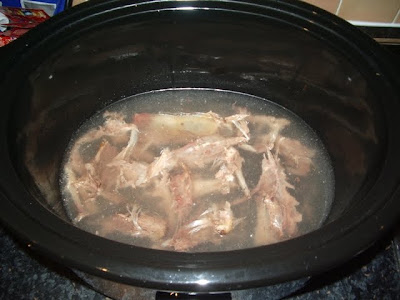
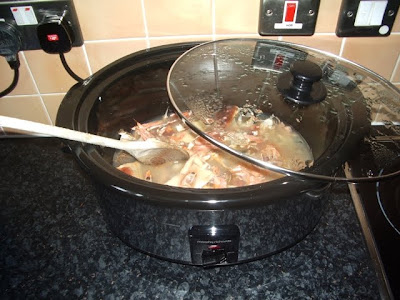
    We break up into smaller parts any pieces that can be, then put them into the slow cooker. The idea is to add just enough water so that the pieces are covered and will remain covered as the water evaporates. We find an extra inch of water is usually enough when we cook overnight.

    You can also simmer the pieces in a pan on the stove – but Mrs M was always nervous about leaving a pan on the stove overnight so using this approach we rarely cooked the bones for more than a few hours before bed. This is not really long enough to fully loosen the meat and (as we will see later) soften the bones. With the slow cooker it is easier to set the heat low enough to make overnight cooking appropriate; and it allays Mrs M’s fears because slow cookers are self-contained and designed to be left in this way.

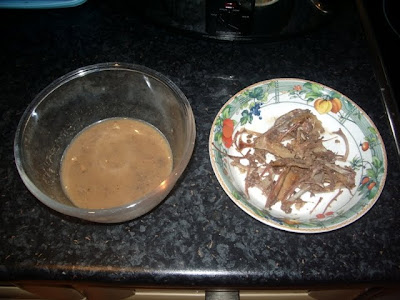
    To make the soup you could simply sieve the hot liquid and make the soup from that – but you’d lose a lot of the good stuff, in my view. Instead, we first let the contents of the pan cool. Then I methodically remove the bones and gristle with my hands, ensuring we get all the little pieces of meat not already separated by stirring. This can be fiddly, but ultimately it’s rewarding. You usually get a few crunchy bits and pieces in the last two spoonfuls of soup, but that’s okay.

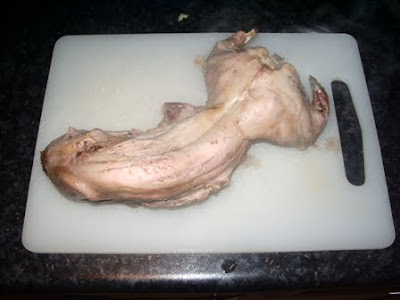
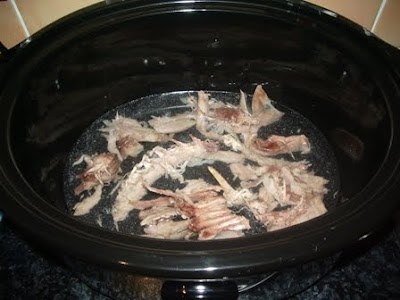
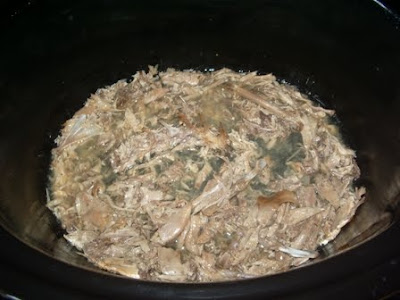
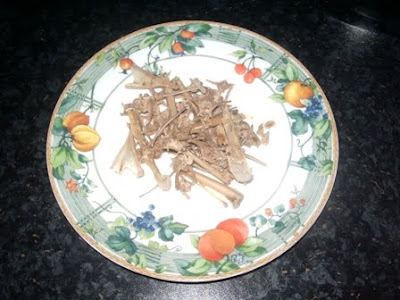
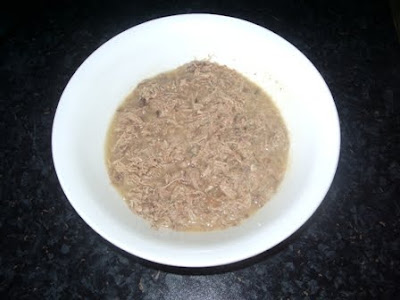
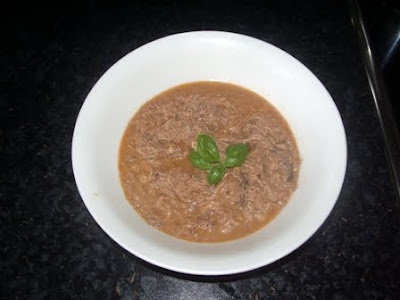
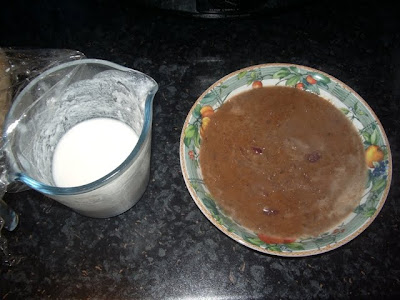
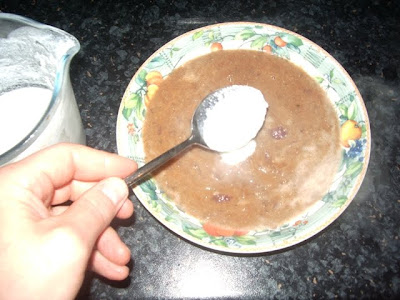
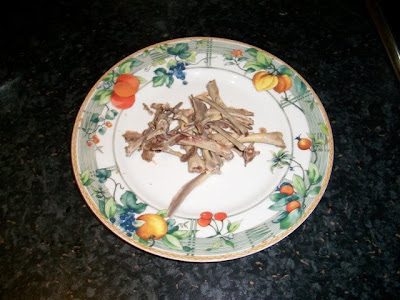
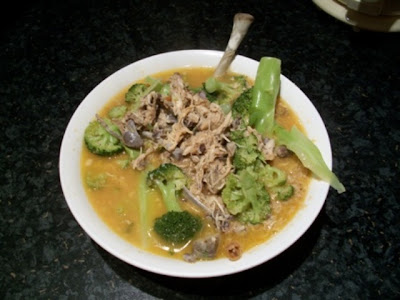
    Here are some photos taken when we made soup from rabbit bones. This was the cooked rabbit: . After the meal, these were the bits left to slow cook , and this was the result after several hours of slow cooking with some stirring to separate the meat from the bones: . These were the bones I picked out and this was what was left . Finally, after some additional ingredients, the soup: . This is how those ingredients are added:

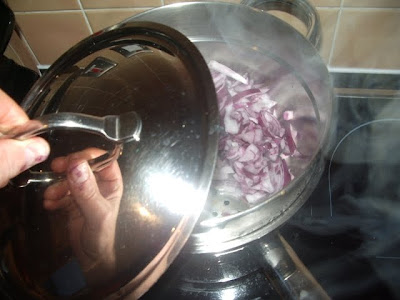
    First, I steam some vegetables. Typically this is celery, onion, mushroom, carrot, parsnip or a combination. Once softened, they are added and blended into the mixture. As well as adding flavour, the vegetables thicken the soup – this is particularly important since thin soups are somehow not satisfying, yet the normal thickening agents like corn flour are not on the menu.

    Next I add one or more of the following:

    • Coconut water (if I’ve just opened one)
    • Coconut cream (from a tin)
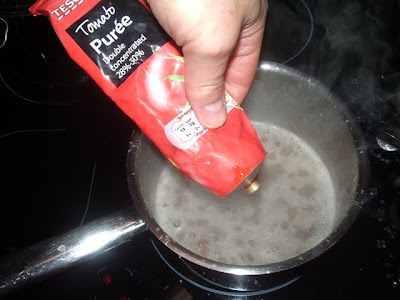
    • Unsalted tomato puree (we almost always add at least some – it’s a good salt substitute)
    • Lime/lemon/orange juice (squeezed from the fresh fruit)

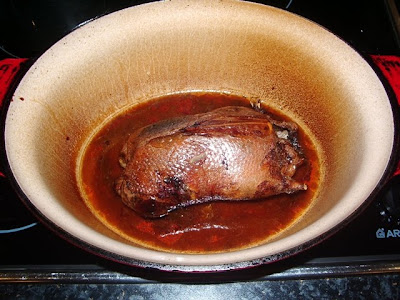
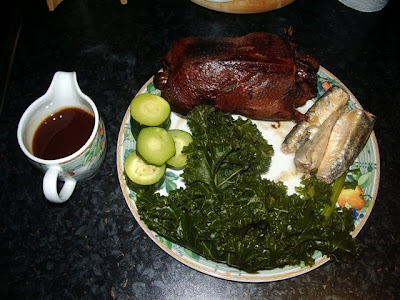
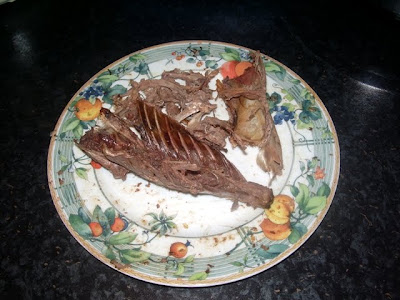
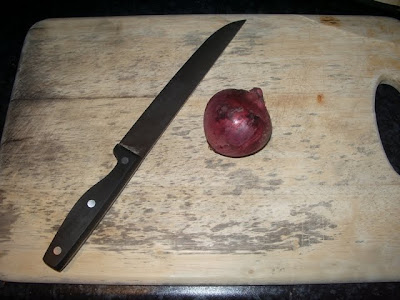
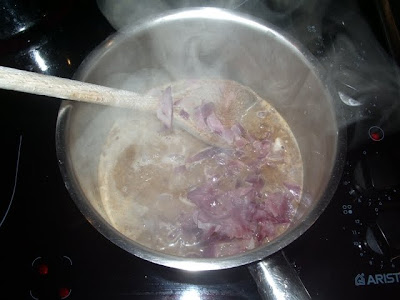
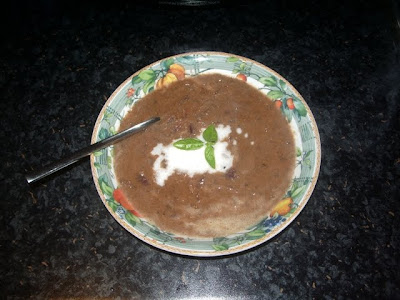
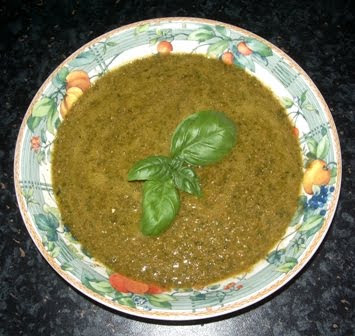
    You can see some of this in action with these photos from a wild duck we ate last year. This was the duck after roasting and this was the meal it made . This was the leftover carcass and these are were broken up pieces in the slow cooker . After slow cooking and manual bone removal, these were the separate components: . The contents of the bowl went into a pan and while that heated up an onion was chopped, steamed and added . This was blended and some tomato puree added . In this case, I added the coconut cream cold , threw on a basil leaf, and it was ready to serve: .

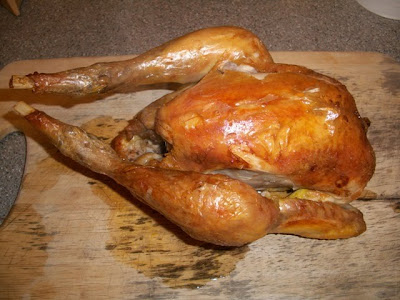
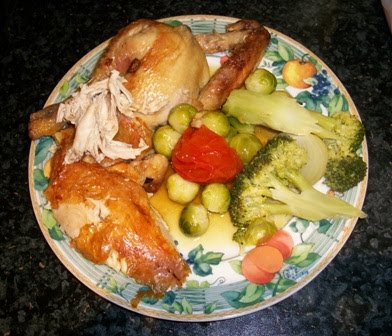
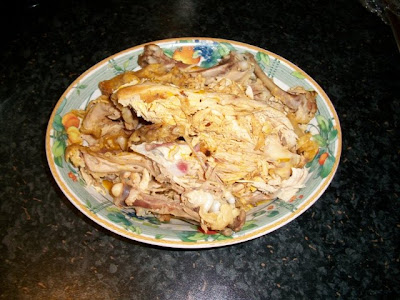
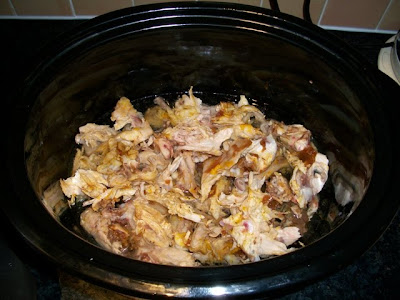
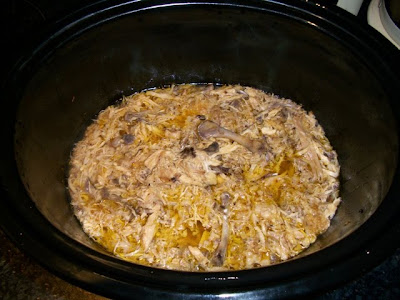
    When we roasted a chicken last year , creating this fine meal , there was this leftover carcass which went into the slow cooker like this , came out like this , and ended up making a couple of bowls of this: . I think we actually used spinach in that case.

    It’s usually me who makes these soups, and as I often remind you, I’m no chef. So the choice of ingredients is usually fairly arbitrary and simplistic. I know duck and orange go together, chicken and mushroom is a familiar combo so these usually get paired. Often it depends on what we have in the fridge at the time.

    The strange thing is that Mrs M always likes the result. Maybe we are easy to please, and obviously our palates are pretty sensitive when we are eating strictly Paleo; but I am convinced that tomato puree and coconut cream, in the right proportions, are a great, simple base for this kind of soup.

    Finally, let’s not forget our old friend, crab soup. Last year I ate a lot of fresh crabs, making soup from the leftover shell pieces. Here is a photo of the pieces in the slow cooker: . The fiddly step where you take out the bits from the slow cooked mixture is especially fiddly for crab shell; but crab soup with bits of crab meat included is much nicer than crab soup without, so again, it’s worth the effort.

    Eat the Marrow

    I have read that bone marrow was prized by hunter gatherers, is high in fat and protein and is extremely good for you. However, I have not been able to unearth any of the links… so please add anything you have to the comments.

    Either way, it’s also very tasty, and often gets overlooked. I have only eaten bone marrow from two sources. First, from lamb leg bones – usually this can be accessed by using a thin fork handle to poke inside the bone, followed by a lot of undignified sucking and banging.

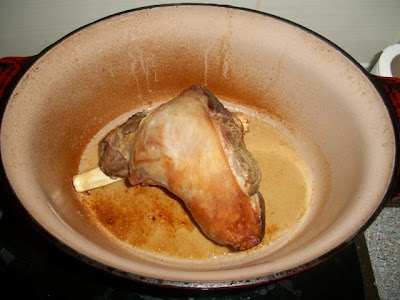
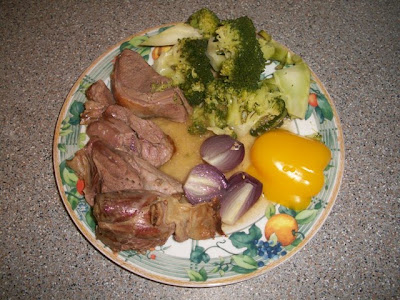
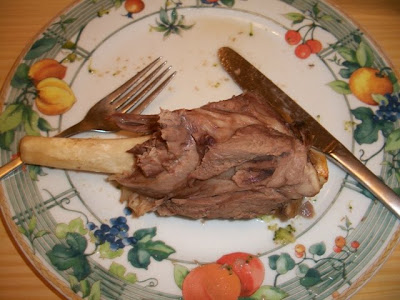
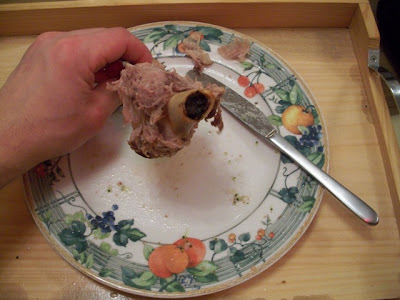
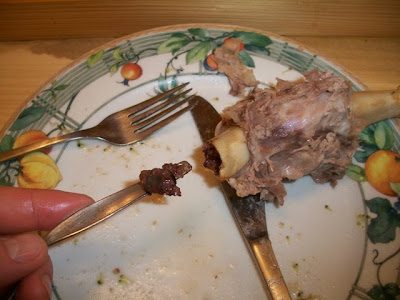
    Here are some photos taken last night. We roasted this leg of lamb to make this meal , after which I set about the bone to eat any remaining meat . You can see the marrow in this shot , then here how I managed to scoop it out with the handle of a spoon. I then spend a while sucking and banging the other end, from which eventually I managed to get the rest of the marrow out.

    Definitely not one for the restaurant; but worth the effort when you’re at home.

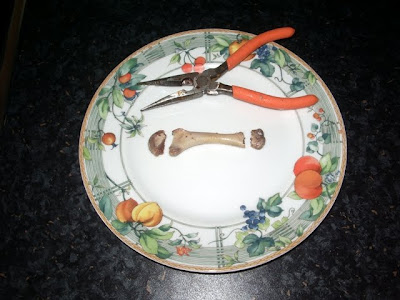
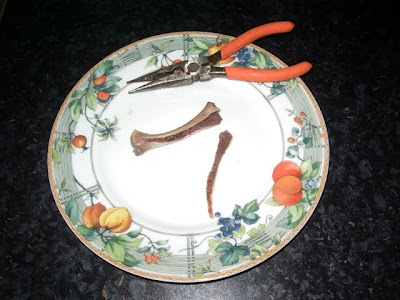
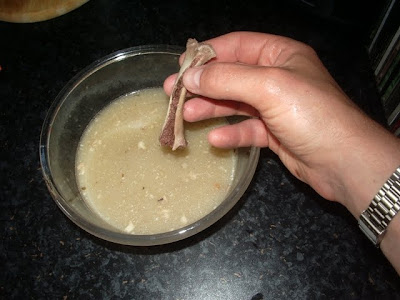
    Second, from chicken leg bones. Having boiled chicken bones to make soup and separated the bone out , I once wondered whether I could increase the nutritional value of the soup by breaking open the bones and squeezing out the marrow into the soup mixture. This I did with the help of some pliers . It was quite an effort.

    Later, I realised this was not necessary because instead I could simply…

    …Eat the Bones

    The arrival of the slow cooker meant we were cooking the bones for 8 hours or more. I noticed that when I was removing bits of meat from the bones with my hands, the bones would sometimes crumble. So I tried eating one – and lo, it was good. The texture was crumbly – rather like the bones in tinned salmon or sardines. It felt fine to eat them.
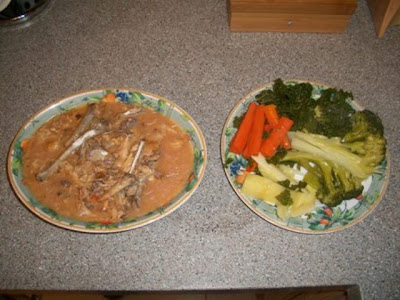
    Here are a couple of fine, recent meals I made of complete slow-cooked chicken carcasses . There was nothing left at the end. The middle parts of the larger bones were a little harder to chew, but this only applied to one or two.

    I’ve only ever eaten chicken bones. It may be equally possible with the other animals we roast but I’ve not tried yet.

    Anyway, you won’t be surprised to learn this is a step too far for Mrs M. However, recently I introduced bones to her diet by stealth, by making…

    …Soup and Bones Together

    When the bones are this soft, you can throw them into the blender. The result is a soup that requires no thickening. With the standard coconut cream and tomato puree base it makes pretty good eating. Depending on your tolerance for crunchy bits, you may wish to do more blending than me. I was happy with a 60-second blast but Mrs M was driven to return hers to the blender for a further three 60-second blasts and was still not entirely happy.

    Feathers?

    I am convinced feathers are coming into fashion any day now. I just need to convince my boss and my social circle of this, then I can truly make the most of poultry 😉

    See Also:
    Making the Most of Animals: Part 1 – Wonderful Offal
    Making the Most of Animals: Part 2 – Glorious Fat

  • Pocketspots Bust Out — Sprint’s Overdrive a Winner at CES

    Looking back, it’s clear we didn’t do justice to Sprint’s introduction of its Overdrive mobile hot spot product — such is the problem of holding a late-night event at CES, when your audience may be distracted from blogging or writing in the moment, as they say.

    Overall, it was a boffo product announcement, hitting all the big-time notes (silly comedian Frank Caliendo, star turn from Microsoft CEO Steve Ballmer, over-the-top after-announcement party food from celebrity chef Mario Batali) but most importantly it delivered a shipping-now, easy to use and understand product in the form of the Overdrive pocketspot from Sierra Wireless, which combines 3G and 4G connectivity into an in-your-pocket package. At $99 for the device and $60 a month for the data plan — same as most standalone 3G aircards — the Overdrive is a no-brainer decision if you are a road warrior who spends any amount of time in Sprint’s already operating 4G markets.

    In our brief bit of hands-on testing at CES (the Sprint folks were kind enough to lend us an Overdrive for evaluation) we found the Overdrive incredibly simple to operate — just push one button and BOOM, as Caliendo would say in his trademark John Madden imitation, your WiMAX-enabled Wi-Fi hotspot was up and running. And even in the challenging airwave atmosphere of the Las Vegas Convention Center, we were able to live-Tweet the FCC chairman’s talk, via the Overdrive sitting in our suit jacket pocket. Nice.

    Not to be outdone, pocketspot veterans Cradlepoint were showing their latest wares in a suite in the Wynn — while not yet available the company’s “Project Tablerock” mobile hotspot with docking station will likely be an extremely attractive choice for Clearwire users, since it features a portable WiMAX modem that becomes your home modem when you drop it into its two-antenna charging/docking station.

    According to Cradlepoint folks who showed us the Tablerock unit, the docking station antennas give the unit a significant reception boost — never a bad thing when it comes to wireless connectivity. Look for the Tablerock and maybe more (!) pocketspot modems for Clearwire and its partners as the first quarter of 2010 comes to a close. (Bad phone-cam picture of Overdrive and Tablerock side by side follows.)

    Sprint’s Overdrive by Sierra Wireless, left, and Cradlepoint’s Tablerock, in the wild at CES.

    P.S.: Our always reliable pal Maggie Reardon covered the Sprint event for C/Net, tapping away at her laptop while everyone else ate Batali’s food.

  • Which will be the first African Country to join the OECD

    Chile has been invited to join, this makes it the first South American country to do so: taken from the Wall Street Journal.

    SANTIAGO (Dow Jones)–Chile received an official invitation Tuesday to become a member of the Organization for Economic Cooperation and Development, Finance Minister Andres Velasco said in Paris.

    To join the OECD, Chile had to modify its legislation in areas such as the exchange of tax information, corporate governance and legal responsibility in bribery cases.

    "We humbly and proudly receive this invitation," Velasco said in a statement. He noted that the 30 OECD members voted unanimously to invite Chile to join.

    Chile is the second OECD member in Latin American, after Mexico.

    Chile’s President Michelle Bachelet, meanwhile, hailed the announcement, noting that Chile’s membership in the organization will boost foreign investment flowing into the country and will also give Chilean companies, both large and small, better access to financing.

    With better financing, more jobs will be created and these will likely be of better quality, Chile’s President said.

    "The country happily receives the good news, which comes at a very opportune moment, as Chile begins to celebrate its bicentennial," she said. In 2010, Chile will celebrate 200 years as an independent nation.

    OECD Secretary-General Angel Gurria said the organization aims to expand its relations with Latin America.

    "For the OECD, the accession of Chile is a great contribution in our drive to expand our global reach and to transform the Organization into a more plural and inclusive institution that will play an increasingly important role in the global economic architecture," Gurria said.

    Velasco said Chile expects to contribute to the organization with its experience in pension reform, bank regulation, counter-cyclical fiscal policy and social equality. Reforming Chile’s pension system was one of the Bachelet administration’s main goals.

    The South American nation must now sign an Accession Agreement to join the organization, which Bachelet will ink on Jan. 11 with Gurria in Santiago. Congress must then ratify the agreement.

    Estonia, Israel, Russia and Slovenia are currently still in the process of applying to join the OECD.

    The last member to be accepted into the OECD was Slovakia in 2001.

  • CES 2010: KODAK PULSE Touchscreen Digital Picture Frame with Wi-fi

    _DSC0019The new Kodak PULSE digital picture frame throws you directly into the Web 2.0 world and helps to keep your pictures fresh and your family and friends closer. Now you don’t have to look at the same old slideshow of pictures as they slide past over and over again. The PULSE digital frame comes equipped with wi-fi capabilities and its very own email address. It can receive pictures that are emailed to it from any web enabled device.

    The PULSE digital frame also connects to your facebook account so that all the latest pictures that you or your friends post on their accounts can be automatically uploaded and proudly displayed. This o course opens the door for all sorts of hilarious shenanigans from friends and family who know their way around Facebook and happen to have embarrassing pictures of you.

    This is also a great gift to give loved ones and family, you can send them up to date pictures of your vacations, adventures, special events, and more. Just set it up and send it updates via a smart phone, laptop, or facebook. Your family can always see what you are up to by glancing at their Kodak PULSE picture frame.

    KODAK PULSE Digital Frame Features:

    • Receive pictures via e-mail from computers and mobile phones
    • Add pictures from your home computer, Facebook, and KODAK Gallery sites with built-in Wi-Fi capability
    • Easy set-up with no software to install
    • Intuitive touchscreen interface for easy interaction with photos
    • Store up to 4,000 pictures** with 512 MB of internal memory
    • Display pictures in brilliant color and crisp detail on the 7-inch high-quality display (800 x 600 pixels) featuring KODAK Color Science and LED backlighting
    • ENERGY STAR® qualified power adapter, mercury-free panel and programmable on-off settings to control power consumption

    The KODAK PULSE Digital Frame will be available for $129.99 beginning in April 2010.

     CES 2010: KODAK PULSE Touchscreen Digital Picture Frame with Wi fi


  • Recent troubles with raising insulin doses

    I’ve definitely been a little distracted by life lately. Anyway, it has resulted in drastic changes for me over the past year.

    I was put on an insulin pump a little over three years ago and things were working out great at first. My A1Cs were dropping, I went from around a 10 to below 7. I was using between 40-50 units a day. Most all of my tests were right where I wanted to be and I really felt good about where I stood.

    Lately I have been up to 80 or 90 units of insulin on my pump per day. My A1C has gone back up to 10.2 last month and I just can’t seem to dose enough insulin. It’s crazy! I admit I have gotten into some bad habits with diet and a little weight gain, and have gone from checking my blood sugar 6 or 7 times a day to sometimes only twice or three times in a day. But It’s almost because I just don’t want to know how bad I’m doing.

    Is this normal? has anyone else had a similar experience? I swear sometimes I could dose 20+ units for a meal and it still isn’t enough. 2 years ago 10 or 12 units would’ve given me enough for half a pizza or something. My endo says my c-peptide shows a reduction in insulin production. but it still is showing a very small amount of insulin being produced. It’s just hard for me to accept dosing 100 units a day. it seems like an insane amount and I keep feeling like I’m overdosing when in reality I guess I am under dosing. Does anyone else use this much insulin? Am I becoming resistant? I have put on a little bit of weight but no more than 15 pounds or so from when I was doing so well.

    Life has been stressful and distracting the past couple of years, got married, bought a house, moved accross the country. I know this has resulted in me not giving my diabetes the attention I should, but I still feel like it doesn’t explain why I am having to dose twice as much for everything. Before it felt like I could do no wrong…every dose was right on the money and two hours after food was close to 100…now I can do no right, everytime I dose, two hours later I am ridiculously high…..any thoughts? I know this is may sound like a rambling mess, I am just at my wits end with this thing right now. I can’t seem for the life of me to get things under control. :confused:

    Any help is greatly appreciated

  • NextEra Wind Plant First In US To Generate VERs – Environmental Leader


    Environmental Leader

    NextEra Wind Plant First In US To Generate VERs
    Environmental Leader
    First Environment validates and verifies the carbon offset credits. NextEra Energy Resources plans to sell the VERs from the Capricorn Ridge project into


  • Grow-Op Cover Up: CBC Marketplace with Mike Holmes – Can your home inspector be trusted? (Please share your Calgary home inspection horror story)

    In the season premiere of CBC Marketplace Grow-Op Cover Up (this episode with Mike Holmes) last Friday, the host Erica Johnson asked the question, “Can you trust home inspector?” The conclusion from the show’s research is sadly an emphatic NO !!!

    You see, Marketplace invited Mike Holmes to inspect a house where he was able to find many obvious telltale signs the house was a former grow-op. And these obvious signs were missed by a home inspector the home owner hired before making their home purchase decision. And when this same house was shown to four randomly chosen house inspectors after Mike identified the problems, the shocking findings were ALL four of these “house inspectors” missed all the obvious signs.

    In the show (you can watch the full episode online), you can see footage of police busting a grow-op and you will realize how easy you can pick up these telltale signs of a house was a grow-op that you wonder why the four randomly chosen home inspectors were so incompetent.

    If you’ve hired a home inspector in Calgary and have some horror home inspection stories (either they found major problems and saved you from buying a bad house or they missed major problems and you are stuck with the problems), please share your horror home inspection stories so other Calgarians can learn something from your experiences.

    Posted in Business, Calgary, Canada, CBC, ethics, Law, Television, Video

  • Cool photos that capture the Consumer Electronics Show experience (photo gallery)

    Here are our photos that capture some of the experience of attending this year’s Consumer Electronics Show in Las Vegas.

    cool photo 1 samsungSamsung’s booth had a spectacular display, made up from many smaller displays. Classical music came from the ceiling and created a cone of beauty amid the noisy show floor.
    cool photo 2 crowdThe crowds were bigger this year. As of Friday night, more than 112,000 people had come through the show at the Las Vegas Convention Center. By the same time a year earlier, only 92,000 had attended, according to Gary Shapiro, chief executive of the Consumer Electronics Association. The official show attendance results will come later.

    cool photo 3 taylor swift Sony trotted out teen superstar Taylor Swift, who sang Love Story at the company’s press conference. Swift will take Sony’s 3-D cameras and shoot her own experiences of life on the concert tour. After Swift left the stage, Sony chief executive Howard Stringer joked to the press, “Maybe you’ll think we’re cool again.”
    cool photo 4 katzenberg
    Jeffrey Katzenberg, chief executive of DreamWorks Animation, and Frederic Rose, CEO of Technicolor, came on stage at Samsung’s press conference to talk about their alliance to advance 3-D viewable movies in the living room.

    cool photo 5 massageTraveling the show floor over the five days of CES is a grueling experience. Dean had more than 40 appointments and events to attend during the week. If he wasn’t so busy writing 52 stories, he might have stopped to get a massage too. Anthony could have used a massage too, after lugging around the equipment needed to stream live video from the conference.

    paro seals
    These robotic seals from Japanese company Paro are supposed to be therapeutic, particularly for patients in living situations where they can’t have pets. The seals are even cuter in person, because they blink, make squealing noises, and respond to your voice.

    cool photo 6 otellini
    Paul Otellini, chief executive of Intel, had a good show. The night before, Microsoft CEO Steve Ballmer had a long delay before his opening keynote, but Otellini’s went off without a hitch. Intel introduced 25 32-nanometer microprocessors, showed off its Intel Wireless Display technology for displaying a PC’s screen on the TV, unveiled Intel’s AppUpStore for creating white label app stores, showed off its Light Peak technology for speeding data transfer, and said that 3-D rendering of movies such as Shrek 4 will be great for processor demand.

    cool photo 7 3d

    Full 3-D on the TV was one of the big trends of the show. This woman got to sit in a chair all day as folks walked by and ogled the many screens surrounding her at the Panasonic booth.
    cool photo 8 3d audience No, these folks are not ogling the woman above. They’re actually in one of the many other booths that showed off 3-D.

    flick truck

    What’s more fun than playing Guitar Hero? How about playing Guitar Hero while using the side of a truck as your screen, courtesy of Flick Truck?
    cool photo 9 car speakersCES’s North Hall is still full of sites like this car at the Pioneer booth, where gigantic speakers in the back of an SUV are not such a rare thing.
    cool photo 10 nokiaOlli-Pekka Kallasvuo, chief executive of Nokia, gave his keynote speech audience a tour of the developing world and how cell phones have become the heart of commerce for farmers in rural countries and just about everywhere else.

    nokia

    Speaking of Nokia, their booth at CES was one of Anthony’s favorites, in terms of visual flair. If only more of Nokia’s phones looked this good.
    cool photo 11 intel boothIntel’s booth had a live demonstration of a new way of looking at photo collections or web sites. You could touch one of them to get a bigger view of the photo and information about it. It’s one example of a way to organize a ton of information that is coming your way in the digital future.
    cool photo 12 laptopsCES has always been a celebration of big screens, especially with TVs. But now companies are bragging about how thin their screens can be. Laptops and netbooks are getting thinner and lighter. Here’s a selection that shows you from an angle just how rail-thin these models are.

    cool photo 13 tablet nvidiaJen-Hsun Huang holds up a model of an upcoming tablet computer. There were scores of these on display at CES. Nvidia’s Tegra 2 will be the brain of some of them, but others will run on chips such as the Intel Atom, Marvell Armada, or the Qualcomm Snapdragon.
    cool photo 14 funny jacketThis guy was getting interviewed on TV. You’ll notice his jacket has a bunch of little LCD screens, each of which was playing a different video. The things some people do to get attention.
    cool photo 15 nbcCES isn’t just about gadgets. It’s about the content you put on them too. NBC’s booth showed off the Vancouver Olympics shows that it will broadcast in high-definition. Some of the content owners are also talking about broadcasting their shows in 3-D as well.

    cisco

    Las Vegas can encourage some unhealthy habits, especially if you’ve got a full conference schedule and don’t have time to sleep or go to the gym. Here, Cisco chief executive John Chambers and another company executive take advantage of Cisco’s TV telepresence services to consult a health advisor. (She told them to get more exercise.)
    cool photo 16 map

    Navigation systems are popular, but that doesn’t mean that the industry is done creating maps. Here’s an example of a better looking map for a navigation system.

    tokina

    We were just drawn by the sight of a cute bug trapped in a stark white prison, but Tokina’s digital imaging box is supposed to be useful for photographers who want to take pictures without shadows.
    cool photo 17 samsungAre these works of art or fashion? Nah, they’re netbooks. But the presentation of these devices in the Samsung booth shows that the company’s designers are thinking about people who want stylistic industrial design.


    Buy This Item: [Click here to buy this item]

    Read Original Article

  • What Watt? Chandelier bids final adieu to incandescent light bulbs

    what watt_2

    Eco Factor: Energy-efficient chandelier made using incandescent light bulbs.

    With the advent of greener alternatives that include LED bulbs and CFLs, the dominance of incandescent light bulbs is expected to end by 2011 by when most of these traditional forms of lighting would have been replaced to save energy. Industrial designer Tim Fishlock is planning to bid adieu with a chandelier created using 1243 suspended bulbs.

    (more…)

  • CES 2010: KODAK’s Slice Touchscreen Digital Camera

    _DSC0009One of the latest additions to the KODAK digital camera lineup is the new KODAK SLICE Touchscreen Camera that was just announced. This premium touchscreen camera lets you take your photo albums and videos with you and share them at a moments notice.

    The device features a 3.5 inch touchscreen so you won’t have to squint to see the pictures. Also an advanced search feature lets you store, locate, and share your photos with ease. You’ll need this search feature since the SLICE camera can store up to 5000 HD photos on its internal memory. The new Face Recognition feature allows you to search through thousands of pictures by person, place, occasion, or date.

    Also the SLICE digital camera has similar features as the EASYSHARE M digital camera series in that it makes it easy and intuitive to share your “KODAK Moments” online on Facebook, YouTube, flickr, or via email with the push of a button. Just plug it in and push the share button, it lets you tag your photos and send them on their way to be viewed online by friends and family.

    KODAK SLICE Touchscreen Camera features:

    • Intuitive 3.5-inch, 16:9 LCD touchscreen with anti-reflective coating
    • KODAK SLICE Search Feature and Face Recognition to easily sort, locate and share pictures
    • Share Button for easy upload to Facebook, KODAK Gallery, Flickr, YouTube sites and e-mail
    • Store up to 5,000 pictures in HD resolution
    • Stunning image quality with a 14MP CCD sensor and 5X SCHNEIDER-KREUZNACH Lens
    • Built-in optical image stabilization
    • 720p/30fps HD video capture
    • Kodak’s exclusive Smart Capture feature, which analyzes scenes and automatically adjusts camera settings to deliver beautiful pictures more often
    • Compatible with PC or APPLE iLife Software
    • Li-Ion rechargeable battery included

    screenshot 09 CES 2010: KODAKs Slice Touchscreen Digital CameraThe KODAK SLICE Touchscreen Camera will be available in black, nickel and radish for US $349.95 MSRP beginning in April 2010. Best Buy will initially be the exclusive retailer for in-store sales. The KODAK SLICE Touchscreen Camera will also be sold online at Amazon.com and Kodak.com.

    Kodak is also introducing a case for the SLICE Camera, which was designed in a competition among accessories students at the Fashion Institute of Technology (FIT) in New York City. The final case design was chosen by celebrated designer Steve Madden and FIT faculty.

    You can preorder the Slice on Amazon now for $349.95.


     CES 2010: KODAKs Slice Touchscreen Digital Camera


  • First Look and Impressions of Google’s Nexus One

    Although it’s only been a few days with the Google Nexus One — and hectic days, at that — here’s a first look at the device along with some basic early impressions. Overall, it’s not a ground-breaking device, although it does use a hot, new processor, the Qualcomm Snapdragon. I’m still getting used to the keyboard, and I’m not thrilled about how much the screen smudges. But the display is gorgeous, the camera is quite good, and I’m very impressed with the integrated voice input.

    More to follow as I fly home from Vegas and get used to the new device!

    Early look and impressions of the Google Nexus One

  • Robbie Bach: Windows Mobile 7 “feels, looks, acts and performs completely different”

    There has been some concern that we will not see Windows Mobile 7 at Mobile World Congress on the 15th February, but rather only versions of Windows Mobile 6.5.x.

    The full transcript of the Financial Analyst Briefing Bach Mount held at CES on the 7th has now been published, and in fact contains quite a bit of info about Windows Mobile 7.

    We have cut out many pages of text related to Xbox and Windows 7, but what’s left over is still many pages long, so sit back, relax and get ready to read. We have also highlighted what we felt was important in italics, but of course left the rest for context.

    It starts off with an analyst refusing to accept “Wait for MWC” as an answer, resulting in quite an exposition by Robbie Bach.

    QUESTION:  So, I apologize a little up front, because clearly there’s a lot of great things going on and we saw that last night.  But, I want to talk about Windows Mobile, since it falls under your remit, too, and I know you have Barcelona coming up next month, yada, yada, yada.  But, the question is —

    ROBBIE BACH:  You already stole my answer. 

    QUESTION:  I’m not taking that as an excuse.  So, on Windows Mobile, clearly it seems like that is the area that is lagging most right now, in terms of what’s happening with the operating system, market share and so on.  So, what do you think strategically are the key levers for you to turn that momentum around and can you give us any kind of sense of timing around Windows Mobile 7?  Could that be more like a Windows 7 event for you, et cetera.

    ROBBIE BACH:  So, I think the number one thing that we have to do on Windows Mobile going forward is about the experience people had with the phone itself.  I don’t think we have a business model problem, per se.  I don’t think we have some specific challenge outside of the fact that our experience is very skewed towards business users, and it’s not as modern as it needs to be.  And I’ll just be as straightforward as that.

    So, the challenge for us as we come into 2010 and we are going to have some new things that will talk about at Mobile World Congress, as we come into that, the first bar people should look at is to say, wow, are they doing a great job with the product.  And when you look at the product, I’m sort of like, I have the luxury of having seen it, to be able to look at it and played with it a little bit, but I’m certainly confident people are going to see it as something that’s differentiated and something that really does move the bar forward, not in an evolutionary way from where we are today, but it’s something that feels, looks, acts and performs completely different.

    So, that’s the first going I think we have to do.  The second thing I’d highlight is our go to market approach has been — we haven’t been as engaged in the go to markets as we need to be going forward, let me just say it that way.  Certainly our operator partners will take the majority of the go to market work when they bring a phone to market.  OEMs participate in that, as well.

    We have not played as big a role in that in the past.  And what we’re seeing happen, particularly with smart phones, is that whether you’re an Apple, or you’re actually producing the hardware, or whether you’re a Google where you’re sometimes sort of producing the hardware, and sometimes not.  They’re participating more heavily in the go to market that’s driving consumer demand.  And what that means is more volume for the products that are getting the marketing spent.  It’s not a crazy idea.

    So, that’s an additional muscle we have to build.  That’s why we launched the Windows Phone brand.  We’ve actually had good success without spending a ton of money.  Raising awareness on Windows Phones in the U.S., and a couple of European markets where we’ve actually spent against it.  Our goal is to enhance that and pick up that momentum.

    So, those would be the two big things.  Once you get past those things, then you get the opportunity to do a lot of other things.  I think there are services opportunities, I think there are search opportunities.  I think there are other opportunities we can build on top of that.  But, those are sort of the ante to be a serious competitor and somebody who people can look at and say, wow, I think these guys are going to build a big business here and it may take them a little bit of time, but these guys are serious.

    QUESTION:  Thank you very much.  Going back to Windows Mobile for a moment, in comparing actually the Xbox world to the smart phone world, right now there are three major platforms out there.  You’re one of them, and at various times in the past there have been four, generally not many more than that, but somewhere between three and five.  As you look at the smart phone world, clearly iPhone seems to be well established.  Android appears to be establishing itself right now.  And then you have Blackberries is sort of there.  We’re not quite sure where they stand.  Windows Mobile is vying to get in there.  How many platforms do you think the smart phone world, after the whole shake out happens in a year or two years, how many can adequately be supported, and do you see similarities between those two worlds, maybe you can port it back and forth.  And how can you ensure that you’d be one of the final survivors in it?

    ROBBIE BACH:  Well, it’s not — the analogy is not quite right, because the way the business model works in the two cases is actually very fundamentally different.  By definition, most consoles tend to be a managed environment where you have a much more vertical structure in the ecosystem.  Microsoft, Sony, and Nintendo all have their own first party publishing capabilities.  We’ve introduced hardware and software service.  So, it’s much more closer actually to Apple, if you want to think about it that way.

    In general, in the mobile space, you have operators and OEMs who have a big say and impact in what goes on in the marketplace.  But, I think it is a little bit different.  With that said, I think everybody would say, there are too many operating systems in the mobile world today.  I’m not talking about the smart phone world necessarily, but if you just look across the million, two million, or billion, two billion, feature phones sold today, I don’t think there’s an operator in the world that wouldn’t tell you that it’s a pain to support all the different operating systems they have, in particular the 17 versions of Linux they have on feature phones, all of which are a little quirky and a little different, require separate network certifications, network product support, and the like that goes along with that.

    So, I think there will be inevitably some trimming of that tree.  I think that’s certainly true.  In the smart phone case, I think you’re going to see two types of things developed.  One, I think you’ll see some people put Apple in this category who will say, hey, I’m going to do operating system, phone, et cetera, all myself.  So you can decide to categorize that by OS, you can also categorize that by hardware and be the same categorization.

    There will be other people like us, perhaps Android.  They can be some place in-between right now who will say.  No, actually, we’re working with a lot of different hardware manufacturers.  So, there will be a hardware market share number that will be a blend of different operating systems for each hardware vendor.  And then there will be an operating system share.

    You know, overall, you look at markets like this, we think over the next three to five years it’s going to be 400 or 500 million smart phones sold a year.  I think there’s a lot of room.  It’s going to quality in term and not capacity.  I think some of the current systems will fall away.  I don’t think that will be because there’s not room for another operating system.  I think it’s because their quality bar won’t stack up.  And they won’t get the scale that they need.  And our job is to make sure we get that scale.  So, I won’t speculate on the number of operating systems you can see.  I certainly think in the feature phone space you’ll see some pruning of the Linux tree, and I don’t think that’s really sustainable.

    I think you’ll see some guys who are doing end-to-end things, who obviously control their own destiny and will either be successful or not.  And then you’ll see some folks like us who are supporting multiple hardware manufacturers. I certainly think we’re going to be in that list of companies that are successful and then maybe there will be a few others.

    QUESTION:  (Off mike.)

    ROBBIE BACH:  That is — that’s beyond a forward-looking statement, don’t you think, Zon?

    ZON ELLIS:  A little bit.

    ROBBIE BACH:  We’re very focused and confident in the work we’re doing right now and while I don’t think, if you looked across the past two years and what we’ve brought to market, we’ve executed as well as we would like.  I think the market data would bear that out.  I’m quite optimistic with the new team we have.  I’m quite optimistic with the new work we’re doing, and I’ll gladly drive for that two-year period and meet you on the other side and feel comfortable we’re going to be in the right place.

    JOHN DIFUCCI:  Hi, Robbie.  John DiFucci from JP Morgan.  I’m sorry to keep going back to mobile and that scenario that you’ve struggled with, but everything else seems to be going so well.

    ROBBIE BACH:  I’ve been waiting for you guys who want to talk about the good stuff for five years.

    JOHN DIFUCCI:  I have a question on mobile.  Last night Steve used the term PC pretty loosely, more loosely than I’ve heard him use it before in describing a lot of different devices, at least maybe I wasn’t listening before, but it seemed to me anyway, he used it pretty loosely.  When I look at your vision of three screens and a cloud, that one screen seems to be the most dynamic when you think about cell phones, PDAs, Blackberries, iPhones, people are talking about tablet.  Is that coming down from PC or coming up from there.  When I look at all that and I think about your struggles in mobile, and I sort of wonder how is all that driving your strategy in mobile and how does Zune play into all this, because you’ve gotten a lot of critical acclaim with Zune, but your adoption probably has been somewhat disappointing.  I know that’s a broad question, but if you can address that?

    ROBBIE BACH:  It’s actually two questions in one, so let me separate out the questions.  Certainly, in terms of the way we think about the segmentation in that marketplace, I think of devices that you put in your pocket and talk on, and I think of devices that you might carry with you as a different class of devices.

    I think of devices that you’re going to want to do, where the user experience has enough real estate, where you can have a rich experience with what I’ll call a Windows 7 class UI as one type of device.  The smaller devices can have a great UI and be very interactive.  But, it’s going to be a different form factor and a different UI.

    So, broadly, when we say three screens, we’re saying small portable screen, that mid-sized screen, and then there’s the big TV screen.  Now, the truth is, those are all going to blend at some level and, in fact, when I say three screens and a cloud I could just as easily be saying many screens and a cloud, because you have more than one PC screen in your household.  You have more than one TV screen in your household.  And actually in our household we have five mobile phones.  So, it’s actually a many-screen strategy.

    Over time the distinction between the screens from the user’s perspective, when am I on my phone versus when am I on my PC, that’s going to blur a little bit.  The service delivery is going to be critical, that’s why our cloud applets are so important.  That’s why I keep talking about cloud delivery, what we’re doing with Windows Live, what we’re doing with Xbox Live, why Azure is so important to us, because it really will enable us to reach all of those different screens.

    Now, your other question was about — I’m getting old.  Zune, so Zune has been critically successful.  And the way Zune is going to be successful for us in the future is you should think of that as our media service across multiple screens.  We’ll continue to have the Zune device screen.  But, we now have Zune on Xbox.  We have Zune on the PC.  There are other places where Zune logically could go that we don’t get to talk about yet.  And I think lots of different screens with that capability can go.

    So, the reason I’m excited about the critical success.  Do I wish we were selling a few more Zunes?  Of course, we always like to sell more.  The product is doing fine.  But, the reason I love the critical success is because we have a great design. We have a great concept.  Now, I’ve got to help build the brand.  I’ve got to move it to get more leverage out on the screen, and as we do that I think we can really take that to a higher level.

    The last thing I’ll say about Zune, you have to decide how you think about Zune.  Is Zune a business of a capability?  In large part, Zune is about delivering video and music.  Video and music has business aspects for us, but the process of being a music distributor is not a fabulous P&L business.  The P&L business is based on selling more phones and more Xboxes, and more PCs, and all those kinds of things.

    So, that’s kind of the way, to give you sort of a general way of thinking about Zune and where we’re going.  That was sort of a general answer to kind of a general question, but hopefully it gives you a little bit of the direction.

    From the above we can conclude that Windows Mobile 7 is almost certainly being announced at Mobile World Congress, it will look nothing like the Windows Mobile we currently know and love, that Zune will be coming to Windows Mobile 7, and that Microsoft intends to be one of the survivors in any mobile OS shake-up, and have good confidence in their new development team.

    Read the full transcript here. (docx)

    Share/Bookmark

  • TRADING MARKETS.COM: DJ CADBURY WATCH: Kraft Bid Worth 764P A Share As Of Jan 8

    NPosted on: Mon, 11 Jan 2010 02:43:49 EST

    Symbols: NSRGF

    Fishpond
    SPONSOR

    LONDON, Jan 11, 2010 U.K. confectioner Cadbury PLC (CBY) Jan. 5 dismissed an altered offer from Kraft Foods Inc. (KFT), after the U.S. food giant offered a greater percentage of cash as part of the GBP10 billion bid.

    “Kraft has once again missed the point,” a Cadbury spokesman said. “Despite this tinkering, the Kraft offer remains unchanged and derisory with less than half the consideration in cash.”

    Following an agreement Kraft reached to sell its U.S. and Canadian frozen pizza business to Nestle S.A. (NESN.VX), the Swiss consumer giant, for $3.7 billion, Kraft said it is going to give Cadbury shareholders a “partial cash alternative” to its existing offer.

    The new bid offers 60 pence per Cadbury share, bringing the cash part of the deal to 360 a share. Kraft did not say how much the stock element of the cash-and-shares bid would reduce by, but insisted that the increased cash element did not represent a “raised offer.” This suggests the stock element of the deal will be cut.

    The previous bid is still the only formal one on the table, offering Cadbury shareholders 300 pence in cash and 0.2589 new Kraft shares for each Cadbury share. It is made up of 60% stock and 40% cash.

    Since the alternative cash-share mix was offered, the E.U. has cleared Kraft to make a bid, Nestle has dropped out of the running for Cadbury, and Warren Buffett said Berkshire Hathaway Inc. (BRKA, BRKB), his holding company, wouldn’t support the issuance of new Kraft shares to pay for a Cadbury deal.

    These developments sent Kraft shares almost 5% higher and Cadbury’s 4% lower, meaning that Cadbury shares slipped to within pennies of Kraft’s offer price.

    Kraft’s stock closed up 0.6% at $28.93 Friday, which means its bid for Cadbury is now worth 764 pence a share and values the U.K. company at GBP10.5 billion, or $16.9 billion. Cadbury shares closed up 0.19% at 778 pence.

    Hershey Co (HSY) and Italy’s Ferrero SpA are now in talks over a possible deal for Cadbury, and an offer could be announced as early as Jan 23.

    (END) Dow Jones Newswires

    01-11-10 0243ET

    For full details on (NSRGF) NSRGF. (NSRGF) has Short Term PowerRatings at TradingMarkets. Details on (NSRGF) Short Term PowerRatings is available at This Link.

    Share Investor Links

    Share Investor Blog – Stockmarket & Business commentary
    Share Investor New Zealand Business News– Get more business news
    Discuss this topic @ Share Investor ForumRegister free
    Share Investor’s Daily Forex Updates

    Recommended Amazon Reading

    Security Analysis: Sixth Edition, Foreword by Warren Buffett (Security Analysis Prior Editions) Security Analysis: Sixth Edition, Foreword by Warren Buffett (Security Analysis Prior Editions) by Benjamin Graham
    Buy new: $47.25 / Used from: $46.96
    Usually ships in 9 to 11 days
    The Four Filters Invention of Warren Buffett and Charlie Munger The Four Filters Invention of Warren Buffett and Charlie Munger by Bud Labitan
    Buy new: $33.25 / Used from: $43.89
    Usually ships in 24 hours


    Bookmark and Share


  • Designer crafts Lamborghini replica from discarded cardboard boxes

    lamborghini_1

    Eco Factor: Artwork created from recycled cardboard boxes.

    While we only use discarded cardboard boxes as containers for stuff that we never use, designer Florian Pugnaire uses similar cardboard boxes for things beyond us. With his effort, Florian has taken cardboard recycling to a whole new level, precisely, to a Lamborghini level.

    (more…)

  • Multiculturalism……..is it a farce?

    In the summer/fall I took a two month cross-country tour and took in all the marvels of our great nation…………..we are truly a fortunate people.
    It took me a little time to get use to one thing…………..how caucasian our country is. All of Atlantic Canada is white except some original blacks fleeing slavery much like Chatham and Windsor.
    QC is completly white and even Montreal wasn’t that cosmoplitan. except for a decent size Haitian and Chinese community which still dedn’t seem that large. All of southern Ontario was predominatly white and any city under 50,000 was completly. Also much of "visual minorities" were Latino or Arabic which both vcan be mistaken for southern Europeans. This is the case in WASPY London were the two largest ethnic groups were Latino and Arabic.
    There is a significant number of Filipinos in Winnipeg and Chinese in Calgary and tyo a lesser extent Edmonton.
    Outside of those cities all the way from Windsor to Chilliwack was Caucasian or Native {who are NOT an ethnic group} but Abbostford has a huge East Indian populace.
    Victoria has a sizable Chinese community but the rest opf the Island is as white as snow. Almost every city under 50,000 looks the same as it would have 50 years ago when the only Asians in town were the ones who ran the Chinese restaurants.
    To me it seems like Tor/Van seem to be the multicultural meccas and some exceptions but overall Canada’s multicultural idntity seems to really only revolve around those two cities with some smaller exceptions as I mentioned and in smaller cities/towns and the countryside this talk of our multicultural makeup seems like a world away.
  • Sungen debuts foldable solar-powered gadget charger at CES

    sungen international

    Eco Factor: Portable charger for electronic devices harvests solar energy.

    Sungen International Limited has been working to make solar energy easy to access and harvest. Recently, the company has unveiled a new range of foldable gadget chargers at CES 2010. The charger comes with solar panels and a built-in battery that charges to full capacity in about 25 hours of sunlight.

    (more…)