Blog
-
Samsung releases second Galaxy S IV teaser [video]
-
Fly Or Die: Skullcandy Crushers

Skullcandy’s Crusher headphones may not be John’s favorite, but I must applaud the headphone maker for stepping outside the box and doing something different with the Crusher headphones.
The Crushers don’t try to fake a bunch of bass with digital signal processing, but rather use two Sensation55 drivers (one in each ear cup) to trigger a vibration system that gives the sensation of head-rattling bass. Plus, there are two REX40 drivers built in to deliver highs and mids.
I was wrong in the video when I said there was a sub in each ear cup, and John was wrong when he said these are awful headphones, so there are our admissions.
Sure, the Crushers use a gimmick to get their message across, but once you strap in that battery and get to listening, you’re sure to enjoy the same reaction that we had at CES.
To be clear, the Crushers wouldn’t get the same kind of endorsement for me if it wasn’t for the $100 price tag slapped on to these bad boys.
For less than you pay for Beats, Sennhesier, or Bose, you can have the sensation of true, club-style bass direct to your ear, with that same Skullcandy style the company has become known for.
These aren’t meant for the audiophile, musician, or DJ. However, anyone who enjoys over-the-ear audio at an affordable price should check these out. They’ll make you feel like your stroll down the street is a part of a Nicki Minaj music video, and who can put a price on that?
The Crushers come in a number of colors and are available in April for $100 at various retailers and Skullcandy.com.
-
Alleged Galaxy S 4 images show Samsung may (smartly) stick with a proven design
A Chinese forum released nearly a dozen pictures of what appears to be the Samsung Galaxy S 4 smartphone, which is expected to officially launch this Thursday. If the images, noted by Sammy Hub, are legitimate, you can expect another Samsung handset made of plastics with a design similar to the company’s current Galaxy S 3 and Galaxy Note 2 models. People may be expecting more, but I don’t think it will hurt sales if these pictures are the real deal.

While many complain about the “plasticy” feel of Samsung’s Galaxy phone lineup, the company is still the top seller of Android phones in the world. The materials used also allow Samsung to make large devices that feel lighter than you’d expect. My Galaxy Note 2 with 5.5-inch display would be much more noticeable in a pocket if it were made with a metal frame.
I noted over the weekend that the new Galaxy S 4 is expected to have a 5-inch, 1080p display, and the leaked images do indeed show a 1920 x 1080 resolution in a settings page on the phone. The alleged device is also shown to run Android 4.2.1., have 2 GB of memory, and a quad-core 1.8 GHz chip although that may vary by market. Here in the U.S., I expect a quad-core chip from Qualcomm inside the Galaxy S4 while it’s possible that other versions could use Samsung’s octo-core Exynos silicon.
Would we all like to see Samsung push the envelope more in terms of design? Probably. And it’s still possible that it has with the Galaxy S 4; there’s no guarantee these leaked images represent what Samsung will introduce later this week. But as long as the company keeps pushing better internal components in the Galaxy line, as well as improves the software experience, it can get away with what some think are bland rehashes of old, yet proven, designs.

Related research and analysis from GigaOM Pro:
Subscriber content. Sign up for a free trial.- What the Google-Motorola deal means for Android, Microsoft and the mobile industry
- The fourth quarter of 2012 in mobile
- What to watch in mobile in 2013


-
Cops Kill Teen Gunman in Brooklyn
The local ABC affiliate in New York City is reporting that a teenager in Brooklyn was gunned down by police after he pulled a gun on two officers in Brooklyn.
The report states that on Saturday, March 9, two plain-clothed officers in an unmarked car who are part of the Brooklyn South anti-crime unit accosted a group of young men on 52nd street. One of the teens then began acting suspicious and the officers approached him. According to police, the 16-year-old then pulled a .38 caliber revolver and pointed it at the officers, who opened fire using their weapons. The teen, identified in the ABC report as Kimani Gray, later died at Kings County Hospital.
The NYPD has not released the names of the officers involved in the shooting, and has said it is continuing to investigate the incident. Police stated that the gun the teen allegedly pointed at police, which was loaded, was recovered at the scene of the incident, but it is unclear whether the teen fired it at the officers.
-
Google Might Be Willing To Let You Use That .Fun Domain You Always Wanted
Early last year, ICANN opened up applications for generic top-level domains. At the end of it all, it was revealed that Google applied for 101 gTLDs. Now more details are starting to emerge on what Google plans to do with them.
CNET reports that Google sent a letter to ICANN last week about its intentions for the gTLDs it had applied for. Most of the letter is spent dispelling the fear that new gTLDs will stifle competition on the Internet by giving Internet giants like Google a distinct advantage on the Web over smaller startups and competitors. The most interesting part of the letter, however, is this one paragraph:
After careful analysis, Google has identified four of our current single registrant applications that we will revise: .app, .blog, .cloud and .search. These terms have been identified by governments (via Early Warning) and others within the community as being potentially valuable and useful to industry as a whole. We also believe that for each of these terms we can create a strong set of user experiences and expectations without restricting the string to use with Google products.
What this means is that Google recognizes some of the gTLDs it applied for would better serve the company if others could use them. In a report from last year, it was presumed that Google would be saving the above gTLDs for its own products, or perhaps leasing them out only to certain partners. This new revelation from Google seems to indicate that the company is willing to open these domains to the public.
Of course, it should be noted that Google does not own these domains yet. Other companies, like Amazon, has also applied for many of these same gTLDs. That being said, Google is planning to do something with these domains if it can obtain them. The question now is what that something is.
Most seem to think that Google will use these domains to enter the lucrative domain registrar business. Such a move would put Google in direct competition with Go Daddy and others offering similar services. With domains like .soy and .fun potentially on offer, who wouldn’t want to register through Google?
-
CubeSensors Extend The Concept Of The Quantified Self To Your Living Space

Sensors are quickly becoming a category of external hardware gadgets unto themselves, and Slovenia-based CubeSensors is creating a set that essentially monitors your living space to provide you with aggregate data about noise, temperature, humidity, light, air quality and more to provide clues about how your environment might be affecting you and those around you.
CubeSensors are small hardware cubes that pack a bevy of sensors within, at just 2-inches long, wide and tall. They’re powered by an internal rechargeable battery, so that they don’t need nasty plugs to work, and they stream their data over Wi-Fi to a cloud-based dashboard to track information and provide it to users in real-time. They can be set to provide alerts, and the data can either be made public or set to private access for keeping it within the household.
The info collected by the CubeSensors, which ship in a starter pack with either two or three devices and a bridge to link them to your home network, can be viewed through a single app that resides on a user’s smartphone. The Cubes can be set to send alarms when certain conditions are met, like when noise or temperature reaches a certain level, and you can view historical data to track the effectiveness of any methods you take to change the influence of environmental factors.
Each sensor includes an accelerometer, a thermometer, a barometer, an air quality meter, and a humidity sensor. They’re being sold with the pre-order model that has become popular for hardware creators, with the MYO armband and Lockitron being two recent similar examples. The difference here is that CubeSensors is asking for $10 up front as a down payment, whether your order the $249 starter pack with two cubes, or the $349 pack that comes with four. CubeSensors CEO Ales Spetic says that $10 is fully refundable, however, and the startup did win the Best Hardware award at this year’s Launch Festival.
This kind of environment monitoring devices aren’t entirely new: Russian startup Lapka offers sensors that contain similar detection capabilities, which we saw at CES this year. But the unobtrusive wireless design, with a system that’s expandable to accommodate a variety of different types of environments is very interesting. There’s also the possibility that the data gathered by the CubeSensors could eventually be made to integrated with other devices and apps, adding to the dream of a sophisticated connected smartphone.
-
Reducing the Storage Footprint & Power Use in Your Data Center
Eric Bassier is Director of product marketing at Quantum. He has over 11 years of experience in the storage industry, with a focus on data protection and archiving.
 ERIC BASSIER
QuantumI was talking with a company based in Manhattan, and they told me that they have maxed out their data center’s power usage. They simply cannot get more power. And because of the constraints of city real estate, they can’t add square footage to their data center – there’s nowhere to grow. Moving their data center off the island is an option (and long-term plan), but clearly reducing the footprint of storage in their data center and minimizing power consumption are important factors, as they would be for any IT investment. Although Manhattan has some unique challenges in this area, IT departments in many metro areas are facing similar problems. Data center floor space requirements and power consumption costs are both increasing and becoming important factors for all of us.
When it comes to storage and data protection, there are a couple of key technologies that can dramatically reduce storage footprint and power consumption.
Deduplication
Deduplication technology is now mainstream, especially as it is applied to backup storage and disaster recovery. Deduplication – especially variable length deduplication – enables users to store 20 to 50 times more data in the same disk space as standard disk storage. As with all industries in IT, deduplication appliances continue to improve their disk density, with some vendors now offering appliances using 3 TB hard drives, which can further reduce storage footprint and reduce power consumption. A purpose-built deduplication appliance using 3 TB drives can reduce power by as much as 50 percent compared to a similar appliance using 2 TB drives.
As power consumption and the amount of spinning disk is reduced, power and cooling costs both decrease as well.
Cloud Storage, Backup, and DR
One of the interesting things about deduplication is that it is a great “engine” for reducing data set sizes before replicating that data over a WAN. This makes deduplication a perfect technology for getting data into the cloud. Some vendors are now offering cloud-based storage, backup and disaster recovery services. Moving storage away from metro areas (with expensive real estate, expensive power and a high cost of living for IT staff) to data centers in different geographic regions will continue to be a driving trend for IT in the future.
Tape
Talking about cloud, many companies continue to use tape the way that many cloud providers are using tape – as the lowest cost storage medium with the lowest power requirements. To many, tape always seems to be on the brink of death, but in reality tape continues to have the lowest acquisition cost, and for long term data storage the power and cooling costs are extremely low.
Just like the disk drive industry, tape densities continue to improve to enable businesses to reduce their data center footprint. The latest generation of tape media, LTO-6, can store over 6 TB of data on a single cartridge not much larger than a smartphone. With advancements in the storage densities of tape libraries, users can store multiple PBs of data on tape in less than a full rack of space.
If reducing data center footprint and power consumption is a concern, consider exploring and investing in these technologies. With the smart management of data storage, my friend may be able to postpone his move from the Big Apple.
Industry Perspectives is a content channel at Data Center Knowledge highlighting thought leadership in the data center arena. See our guidelines and submission process for information on participating. View previously published Industry Perspectives in our Knowledge Library.
-
BlackBerry’s Z10 Will Make Its AT&T Debut On March 22 For $199, Pre-Orders Kick Off Tomorrow

Just days after Bloomberg ran a report claiming that AT&T would release BlackBerry’s long-awaited Z10 smartphone on March 22, AT&T has issued a statement confirming that launch will indeed go forward as reported. Prospective BlackBerry owners will have to shell out $199 for the Canadian company’s new flagship and (for better or worse) sign a two year contract.
In the event that you absolutely need to have one (a sentiment that our own Darrell Etherington didn’t share in his full review), AT&T will kick off the pre-order process starting tomorrow, March 12.
This makes AT&T the second of the three major U.S. wireless carriers to announce availability for the Z10 — T-Mobile announced late last week that its business customers would be able to get their hands on the device starting today, though it remained decidedly mum when it came to general consumer availability. Verizon on the other hand is widely expected to push BlackBerry’s Z10 out the door sometime in April, and Sprint has decided to focus solely on the QWERTY keyboard-packing Q10 (see our hands-on impressions here).
With any luck, BlackBerry will see a surge of U.S. customers joining the fold shortly, but the experience they’ll be treated to upon arrival may not be as complete as they would hope.
There’s no question BlackBerry 10 plays home to some neat concepts and impressive UI flourishes — I’ve grown quite fond of fiddling with the demo Z10 the company graciously handed out en masse at its launch event — the distinct lack of certain popular applications that has forced some developers to take matters into their own hands. The tepid app environment (sideloading notwithstanding) could leave some curious consumers cold on the platform as a whole, and that’s exactly what RIM can’t afford right now. Then again, this just leaves room for upstart developers and entrepreneurs to make their mark by targeting a segment of the smartphone market that’s currently underserved, so BlackBerry 10 may hit its stride soon anyway.
-
Oops! 6Wunderkinder accidentally reveals details of upcoming Wunderlist Pro
Professional users of 6Wunderkinder’s popular Wunderlist task management app look set to get a range of new features, as a “top secret” email to selected customers has revealed.
On Monday the Berlin-based company’s Twitter account briefly spewed out links to a newsletter inviting the intended recipients to sign up early for a Wunderlist Pro account. Judging from the sneaky feature preview allowed by this accident, Wunderlist Pro will give teams more collaborative features – perhaps some of the functionality that was included in the axed Wunderkit project-management product.
According to the newsletter, these are the features to look out for:
- Assign to-dos to specific people on your team to know who is responsible for what
- An unlimited amount of sub-tasks allows you to split your project in smaller steps no matter how big it is
- 8 new backgrounds let you style Wunderlist the way you want it
- Work seamlessly together in teams by sharing lists and tasks with an unlimited amount of people on all devices and platforms
- Get access to latest beta versions and be amongst the first to use new features
A spokeswoman for the company told me that the newsletter was only supposed to reach “a small group of 5,000 users” and that it was sent out to help 6Wunderkinder figure out its pricing strategy for Wunderlist Pro – as it stands, the quoted price in the newsletter I saw was $4.99 per month (others apparently saw $3.99 and other prices, so the team was clearly testing out various options).If all goes well, she added, Pro accounts will become available in April.

Related research and analysis from GigaOM Pro:
Subscriber content. Sign up for a free trial.- What Amazon’s new Kindle line means for Apple, Netflix and online media
- The Internet of Things: What It Is, Why It Matters
- Report: How Mobile Cloud Computing Will Change Tech

-
Ever Wonder How Many Calories You Burn with a Mouse Click?
If you’ve ever wondered just how much of a workout you’re getting at the office everyday by simply clicking your mouse, wonder no more. Someone has calculated it and put it in a publication.
The findings appeared in the recently published Convert Anything to Calories, which calculated the calorie counts in both food and common activities.
The calculation was based on an average human finger volume and weight of 10.8 cubic centimeters and 11.7 grams, respectively.
On average, 16.7 micromoles of ATP (Adenosine triphosphate) are consumed in moving one gram of muscle for one second. So, the total amount of ATP burned to move 11.7 grams of muscle in the index finger is approximately 195 micromoles (11.7g×16.7μ mol/g). There are 7.3 calories in one mole of ATP energy, so the number of calories burned in clicking the mouse equals about 1.42 (7.3/1000) X 195).
So, 1.42 calories every time you click that YouTube video link or send out that tweet. Well, kind of.
“The calculation assumes the muscle contracted completely, so the actual amount of calories used is a little less,” the authors specify. So, unless you’re really clicking your mouse with gusto, you’re probably not burning the full 1.42 calories per click.
So, long story short, you should probably get up and take a stroll around the office. Browsing reddit isn’t going to burn off that Quarter Pounder w/ cheese.
[Yahoo Japan via RocketNews24 via TechCrunch]
-
Givit takes on music videos
 Social sharing and video-editing service Givit gets more musical, in an announcement made during SXSW in Austin today. The Givit app is exclusive to iOS and seeks to be to videos what Instagram is to photos.
 The new focus is all about music videos or setting moments to music, and iPad, iPhone or iPod touch users shooting, editing and sharing the creations — straight from the device. “Anyone can now create an amazing music video or reimagine their favorite moments right from their iPhone, adding new clips, sound or transitions and share socially however they choose”, Givit CEO Greg Kostello says.
Givit’s strength is community, Kostello says, and the approach is similar to Instagram. But there’s something Snapchat-like, too, only without the snipits expiring within 10 seconds. I say that because Givit provides tools for editing while recording, allowing, say, someone to stitch together snippets and share them online. Think instant video creation to share, like Snapchat, but without expiration, and tools for users edit and stitch on the fly. Kostello didn’t say, but I immediately thought about concerts and a tool for fans.
With the update, Givit’s focus is as much, perhaps more, about the artists than fans filming them. Like Instagram provides built-in community for photos, Givit provides something similar to musicians to create profiles, post music videos, provide tour dates and even encourage fan remixes. Givit partners with PledgeMusic, which has a rep for helping new artists get started and funded. Think of it as fan crowdfunding for musicians.
Givit’s music project is ambitious. While SXSW is appropriate venue to launch, I wonder: Is it enough, given the number of other social communities available to artists? That said, Givit also wants to be the tool used to reach Facebook, Twitter and, of course, YouTube, where artists might have existing fan communities.
“Givit empowers artists to supercharge their fan bases with the power of video”, Kostello claims.
I asked Kostello about an Android version of Givit, and there is none coming — at least not anytime soon. Video-editing benefits from hardware acceleration, which Apple makes available to iOS developers on iPhone and iPad.
By contrast, the capability is available on some Android devices but not others. The platform is simply too fragmented — there are too many manufacturers and devices to support — to justify the enormous amount of time and commitment to make Givit work, Kostello says.
So I asked about Windows Phone, which does support hardware acceleration. While sounding open to Givit there, he observes there is much sales volume — and he’s right about that. There were just 6.2 million Windows Phones sold during fourth quarter, according to Gartner. That compares to 43.5 iPhones and 144.7 million Android smartphones.
So for now Givit is an Apple-device exclusive. The service is free, with 5GB cloud storage. Users can expand to 100GB for $29.99 per year.
-
Reduce the size of your music files with MP3 Quality Modifier
 If you’ve built up a large MP3 collection over the years, then fitting everything you’d like onto your phone or MP3 player could now be a challenge. You could just try to be a little more selective in what you transfer, of course, but MP3 Quality Modifier offers another option, quickly changing the quality of your MP3 files to save disk space.
Just as you’d hope from a program designed to save resources, MP3 Quality Modifier is itself very efficient. There’s no adware, no installation required, it’s just a 726KB download which you can unzip and launch immediately.
Your first step is to import whatever files you’d like to work with. The program is able to import individual files or entire folders, and you can then select whatever tracks you’d like to process from that list.
Next, you’ll need to think about your preferred audio quality. There are several presets to choose from — “Best Quality”, “High Quality”, “Portable”, “Compromise”, “Very Low Quality” — but, if you prefer, you can also manually set your bitrate, sample frequency and other key details (MP3 Quality Modifier displays the current bitrate of your imported audio files as a guide).
With that done, tell the program where to save the finished files (you can point it at a folder, ask it to create one, or replace the original MP3s), click Process, and then just watch as each track is tweaked to suit your needs.
 Exactly how much you’ll save will depend on the original file quality and the options you’ve selected, but taking a look at the bitrate of each will give you a good idea. We reduced 10 tracks with a bitrate of 320kbps down to 128kbps, for instance, and the disk space required dropped similarly from 138 to 55.4MB. We thought the sound quality remained acceptable, too, although of course this depends very much on personal taste, the type of music, and the device where you’ll be playing it back.
Still, if you’re looking for an easy way to cut your MP3 disk space requirements then MP3 Quality Modifier is a great way to get the job done. Give it a try.
Photo Credit: ra2studio /Shutterstock
-
Microsoft brings enterprise communication service Lync to Windows Phone 8
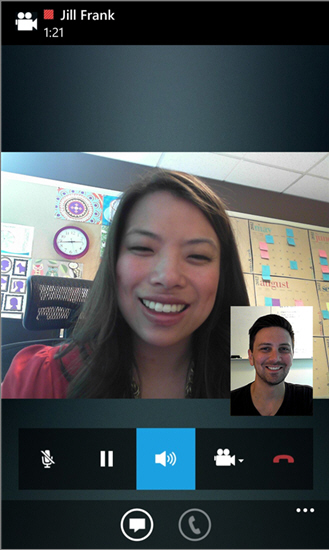 This morning, with no fanfare, Microsoft rolled out its Lync app for Windows Phone. Lync is a Skype-like product that is bundled with some versions of Office, but is geared towards an enterprise audience. Corporations can run a Lync server to keep better control over the service, but users can also communicate with outside people by using Skype from within Lync, as the two services are becoming better integrated.
The new Windows Phone 8 app offers VOIP, messaging and other communication features. Lync had previously been available for Windows Phone, but was not supported in the new Microsoft mobile operating system until today.
According to the announcement: “Lync 2013 for Windows Phone extends the power of Lync to your mobile device — including voice & video over wireless, rich presence, instant messaging, conferencing, and calling features from a single, easy-to-use interface”.
Lync for Windows Phone 8 allows users to view availability in real-time and choose from different communication methods, such as IM, email, voice or video. The app also lets customers connect in a meeting and forward calls. It additionally provides secure connections without the use of a VPN. The Lync for Windows Phone app is free, but requires connectivity to a Lync server or a Microsoft Office 365 plan that includes Lync Online.
-
AT&T confirms March 22nd launch for BlackBerry Z10, preorders begin tomorrow for $199.99

-
The Customer Profile: Your Brand’s Secret Weapon

Today, my Facebook mobile newsfeed showed me a sponsored post for The Hobbit: Kingdoms mobile game even though I’m not a fan of The Hobbit and I would not consider myself a mobile gamer.
I also went to CNN’s mobile site. An activity that I’ve done often for years, yet CNN still hasn’t gotten around to serving up to me targeted content based on my interests and previous reading or browsing history.
Yesterday, I received my weekly SMS mobile coupon from Target even though I haven’t clicked on one in over six months.
Guitar Center continues to email me about their deals on drums and guitars even though I don’t play either instrument and the only purchase that I ever made at Guitar Center was for a gift — three years ago.
Last month, when I tweeted to American Airlines about a delay, no one tweeted back to me and no one realized that the tweet was also from a long-standing AAdvantage Gold member. There was no connection between my two profiles and, as a result, American Airlines showed me no love, no special treatment, not even a sympathetic virtual shoulder to cry on when my flight was delayed.
These brands are missing out by not fully understanding who their customers are. Let’s face it: the signal-to-noise ratio is still fairly low among brands. Aside from a select few companies — like Amazon — most brands still have no unified view of what their customers are saying, doing, or buying on their websites, in retail, and across social media. As a result, instead of better targeting and personalizing brand messages, experiences, and deals, most brands are still embracing the “spray and pray” tactics commonly used during the height of traditional advertising.
But brands already have siloes of data about their consumers. Combined, this information would be enough to create the ultimate 360-degree customer profile, which would allow enhanced targeting and personalization. These siloes include:
- What they’re saying — social CRM. What are your consumers saying about your products and services in social media? Are your consumers’ brand sentiments shifting from positive to negative or vice versa?
- What they’re buying — purchase history. What is the last product a consumer purchased from you? How often does he buy from you? What are her favorite products? Are people making more or fewer purchases?
- What they’re doing — brand interaction history. Are they using your mobile apps? How often are they using them? Are they visiting your website? Are they spending more or less time with your brand?
- What they’re liking — social interest graph. What interests do they share on social media channels, and who is in the network of people who share similar interests?
It may seem simple to combine these discrete data sets into one holistic customer profile, but there are major technology obstacles brands need to get past.
Facebook recently took a step forward in helping to create these profiles through partnerships with data companies Epsilon, Acxiom, and Datalogix. The venture combines the three companies’ records about customers’ offline purchase histories with Facebook’s custom audiences product. As a result, brands can now match shopper loyalty programs with Facebook users based off of their Facebook ID, phone number, or email address.
This type of partnership will ultimately push advertisers down a path where customer profiles are the secret weapon, allowing brands to:
1. More intelligently push content and experiences to their consumers
By mapping out better consumer target segments, brands can push out more personalized experiences and messages on their websites, in social media, on mobile, and in retail. For instance, car dealers will now be able to reach someone who has specifically browsed or liked a certain make/model of car on an advertiser’s website or Facebook property and who has shown behavior that he or she will soon purchase a vehicle.2. Improve their real-time marketing efforts
We saw a ton of real-time marketing recently during the Oscars and Super Bowl where a good majority of the real-time efforts felt like spam. Brands like Kellogg’s, Stella Artois, and U.S. Cellular jumped on the bandwagon, pumping out generic tweets and images about the Oscars and mass broadcasting them via social media. None of it was very interesting, personalized, or targeted to a brand’s high-value customer. Brands that make the leap into real-time marketing and engage with their most influential customers in a personalized way will have a decided advantage over competitors.3. Improve a customer’s lifetime value by better engaging them over the long term and with purpose
As discussed by Bill Lee in “Marketing Is Dead,” in the past, the definition of customer lifetime value (CLV) was based only on a consumer’s purchases. In the future, with the proliferation of social media, a customer’s CLV will have to factor in the influence the customer wields over their social networks and ultimately how much that influence drives others into a transaction with a specific brand. This social factor will be weighted by reach (number of connections in the social graph), frequency (amount of sharing), impact on others (overall or for the category), and individual engagement with the brand. With this updated calculation of CLV, a brand must have a 360-degree view of the customer. Brands will want to spend more time engaging and dialoguing with customers who have a higher CLV.Though digital channels continue to proliferate and consumers continue to distribute their time spent with a brand across this fragmented landscape, most brands are still using outdated tactics to reach the masses. Some advertisers are creating a virtual landfill that makes it difficult for any message to resonate. To surgically cut through the noise, advertisers need to develop richer customer profiles. It’s not the sexiest of topics in advertising, but it’s one that will ultimately allow brands to target and personalize the experiences and messages that consumers deserve.
The Future of Advertising
An HBR Insight Center
-
From the Hole in the Wall to Yale: A Q&A with Arun Chavan

Sugata Mitra carved a hole in a wall in a New Delhi slum—about 3 feet high—and placed a computer in it. When kids asked what it was, he said, “I don’t know,” and walked away. Photo: courtesy of Sugata Mitra.
After his 6-year-old son taught himself to use a computer, 2013 TED Prize winner Sugata Mitra wanted to test the idea that kids can learn on their own, by discovery rather than formal training. So Mitra and his colleagues dug a hole in the wall near a slum in New Delhi, set up an Internet-connected computer there, and abandoned it in 1999. They also set up a hidden camera.
 Sugata Mitra: Build a School in the CloudBefore long, children from the community figured out how to search for information online. They began learning English and other subjects, and started teaching each other. Consequently, Mitra’s “Hole in the Wall” experiment catalyzed his pursuit to advance child-driven learning for thousands of kids around the world.
In his talk from TED2013, Mitra describes repeating the “Hole in the Wall” experiment 300 miles away. He installed a mysterious computer on the side of a road where such machinery was even less familiar than in New Delhi.
12-year-old Arun Chavan was one of the kids who found himself drawn to that computer in Shirgaon, a coastal village in India. Over the next few months, he taught himself to use it. And now, more than a decade later, he lives in the United States and studies at Yale University.
We connected with Chavan to discover how the “Hole in the Wall” impacted his life. Here’s what he’s up to today:
How old are you?
I am 23 now.
And you’re at Yale. What inspires you about your field of study?
I am doing a PhD in Evolutionary Biology. I’m just amazed by the stunning diversity of organisms around us. The excitement of digging into the past to discover how it arose is what keeps me going.
What were your first thoughts when the street-side computer appeared in your community?
I was a kid then, studying in the sixth grade. I had never handled a computer before. I thought it was great to have those computers lying around to play with. I don’t remember being afraid to use them. I think we figured out soon enough that restarting the computer fixes almost every problem!
What was your favorite thing about participating in the “Hole in Wall” program?
I would say mainly three things: First, that there was nobody telling us what to do and not to do. Second, that it wasn’t the same as having a computer to yourself. We learned things as a group. We learned everything empirically, and taught each other what we found. And third, that the computers in the “Hole in the Wall” were connected to the Internet. It was amazing to be able to Google anything, or to chat with my sister who was studying in a different city.
How did your family feel about your participation? Did it affect their lives in any way?
My parents were as excited as I was. A few years later when we got ourselves a computer, the only thing I taught my father to do was to switch it on. In his 40s, he taught himself how to use it, and now he regularly blogs to share his paintings and writings.
Are you still in contact with the kids you studied with using the “Hole in the Wall” computer?
Unfortunately, I am not in contact with many of my friends from that time. Some of us went to different cities to attend college after high school. Most of those who stayed back attended vocational training programs and are working now.
Now that you’re a PhD student, are you teaching? If so, did your experience with the “Hole in the Wall” impact the way you instruct and connect with students?
Only recently have I started teaching. In the discussion sessions I lead, I tend not to intervene unless it is necessary, and I try to let the students understand things from their own discussion and ideas. I don’t know if I borrowed this approach from “Hole in the Wall,” but I find it similar.
What is the most important thing you learned from the “Hole in the Wall” experience?
Sugata Mitra’s “Hole if the Wall” idea is quite radical, I think. But it’s too important to be ignored. I like how he dares to imagine (and also hopes for) a completely different future of education than most of us do.
Along with the “Hole in the Wall,” many other things — interactions with certain people, books, and parents — have impacted my way of thinking. It’s really hard to tease apart what I have learned from the “Hole in the Wall.” I think that you can learn anything if you really want to — this could possibly be a “Hole in the Wall” effect.
What does curiosity mean to you?
A driving force to explore something new, I guess! Curiosity is also exciting for me.
If you could give a TED Talk, what would it be about?
My father writes and directs plays. As a kid, I acted in many of them. These plays have significantly influenced my thinking and have greatly contributed to who I am. If I had to give a TED talk, it would probably be about that experience.

Arun Chavan is now studying for a PhD at Yale. Photo: courtesy of Arun Chavan.
To learn more about the Hole in the Wall, read Sugata Mitra’s TED Book, Beyond the Hole in the Wall: Discover the Power of Self-Organized Learning. And for more on how to inspire self-organized learning wherever you may be, download this toolkit »

-
BlackBerry Messenger adds BBM Voice support to BlackBerry OS 5 devices

Ah, BlackBerry Messenger (BBM) — the much-adored service that keeps the BlackBerry community connected. It changed the way BlackBerry customers communicate through instant messaging, shared groups and calendars, not to mention BBM Voice Chat and, on BlackBerry 10, BBM Video. Today, I’m happy to announce that an update has been made to BBM that adds BBM Voice support to BlackBerry OS 5 devices, so that even more of you can enjoy free voice calls over Wi-Fi via BBM.
For those of you who aren’t familiar with BBM Voice check out this quick video of how it works:
[ YouTube link for mobile viewing ]
So, who’s excited? Old pros who’ve already been using BBM Voice for a while, be sure to welcome BlackBerry OS 5 users to the fold, and share your tips below in the comments.
BBM 7.0.1 is available for download in BlackBerry World — please note that it may take up to 24 hours to appear in the BlackBerry World storefront.

-
Sunshine Week: In Celebration of Open Government
Ed. Note: This post is the first in a Sunshine Week series on whitehouse.gov. Sunshine Week is a national initiative to celebrate and focus on government transparency and open government.
As President Barack Obama has stated, "Openness will strengthen our democracy, and promote efficiency and effectiveness in Government." This week, we celebrate Sunshine Week — an appropriate time to discuss the importance of open government and freedom of information, and to take stock of how far we have come, and think about what more can be done.
Over the last few weeks, we have asked for your feedback on some of our open government efforts, and you have responded, whether in meetings with civil society or via Quora, or a web form on WhiteHouse.gov. We thank you for taking the time to talk to us about this important work, and we hear you – and we will continue to consult with you.
In the spirit of Sunshine Week, the White House will highlight one initiative a day which demonstrates the Obama Administration’s continued commitment to open and accessible government. Today, we will focus on progress made improving the administration of the FOIA. As Justice Louis Brandeis wrote, "sunlight is said to be the best of disinfectants." In our democracy, FOIA, which encourages accountability through transparency, is the most prominent expression of a profound national commitment to ensuring an open government.
-
Don’t Expect To See Firefox On iOS Anytime Soon
Firefox for Android is a great mobile browser, but it’s not exactly popular. Mozilla could make it more popular if it were to release a version of its browser on iOS, but that’s not going to happen anytime soon.
Mozilla’s vice president of products, Jay Sullivan, was on a panel at SXSW talking about the mobile browser wars. On the topic of iOS, he said that Mozilla has no plans to bring Firefox to the platform. He also said that you won’t see Firefox on iOS as long as Apple continues to restrict third-party browsers.
The main issue here is that Mozilla can’t use its Gecko rendering engine on iOS. Apple requires all browsers to use the WebKit rendering engine that’s employed by Safari, Google Chrome and many others. It doesn’t help that Safari is the default Web browser in iOS, and users can’t change that unless they jailbreak their phone.
Mozilla could easily get on iOS if it switched to WebKit, but the company doesn’t appear to be doing that anytime soon. Instead, it will push for Apple, and others, to allow more browser choice on platforms. It’s this choice that makes the Web great according to Sullivan.
Besides, Mozilla can’t focus on iOS right now as it’s currently busy with getting Firefox OS out to market. The new mobile OS poses no threat to Apple, but it’s definitely doing things the Mozilla way – fiercely independent and maybe even a little reckless.
[h/t: CNET]
-
New Batman Mythology is Coming to Comics
The Associated Press is reporting that Batman will be getting some new backstory in an upcoming story arc to be written by Scott Snyder.
Though key elements of Bruce Wayne’s past will not be changed (his parents will still have been murdered) the character’s growth from Bruce Wayne to Batman will receive a makeover. The 11-part story will detail Bruce Wayne’s first encounter with a super villain and show him building the bat cave. It will also reveal a new story on how the character eventually donned the now-famous Batman costume. The story arc will be called “The Zero year.”
THE ZERO YEAR. Next storyline by the great @gregcapullo & me was announced this morning! Been putting everything we have into this one
Snyder told the AP that he and other DC Comics writers “tried to preserve as much of Batman’s history as we could.” He also mentioned that DC is “not going to take apart ‘Year One,” referring to Frank Miller’s 1987 Batman story that recounts Batman’s early crime fighting. Many of the elements from that story were used by Christopher Nolan in the most recent Batman film adaptations, including Batman Begins and The Dark Knight.
“The Zero Year” will begin as Robin, the Boy Wonder, has been killed off in the comic Batman Incorporated. The most current Robin was the son of Bruce Wayne, suggesting that, perhaps, the introspection of “The Zero Year” will shape Batman as a character going forward.
(Image courtesy DC Comics)