
Blog
-
Why Marissa Mayer’s decision to pull Yahoo employees back to the office was likely the right call
-
FCC To Hold First Gigabit Workshop This Month
In late January, the FCC announced the Gigabit City Challenge. The campaign aims to get at least one gigabit network in all 50 states by 2015. To do that, the Commission will be holding a number of workshops to help community and industry leaders get started.
Telecompetitor reports that the first FCC-hosted gigabit workshop will take place in Washington D.C. on March 27. The Commission isn’t saying what will happen at the workshop, but it revealed a rough idea of what the workshops will accomplish in the release:
The goal of this workshop is to explore how current gigabit communities deployed their networks, the economic and social benefits that accrue to gigabit communities, ways communities can aggregate demand in order to make a gigabit network deployment more economically appealing, and how communities can leverage their assets to incent an ultra-fast network.
Here’s hoping not all the workshops take place in D.C. It would be more advantageous for everyone if the FCC were to host a number of workshops in regions around the country so that every state can get in on the action.
Even with these workshops, it will be a daunting task to get a gigabit network in every state. The incumbent ISPs will lobby against any serious competition brought against them while arguing that nobody wants gigabit speeds in the first place. These workshops will hopefully prove once and for all that the majority wants gigabit speeds, and will do anything to get it.
If you want to check out the first workshop, it will be held in the Commission Meeting Room at the FCC headquarters.
-
Stardock ModernMix makes apps as usable as desktop programs on Windows 8 [Preview]
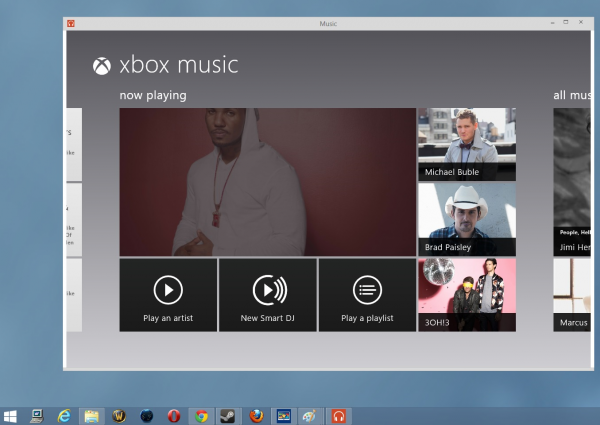
Windows apps that you run on Windows 8 are limited to the Start screen environment by default. Here you can run them in full screen, or attached to a side of the screen so that they use 1/3 or 2/3 of the screen. What you cannot do is run them in windowed mode on the desktop.
Attempts have been made in the past to bring that extra functionality to Windows 8 in the form of third-party applications. One of them, RetroUI Pro does so, but the implementation is fairly limited.
Stardock’s ModernMix for Windows 8 is the first program — to my knowledge — that makes Windows apps as usable as desktop programs that run on the system. The application has been designed so that you can run one or multiple Windows apps that you have downloaded and installed from the built-in store on the desktop just like any other program you may have installed on the system — side-by-side with desktop programs or other apps.
Even better is the fact that it does so in an unobtrusive way. Once you have installed the program on your system you are presented with an options menu where you can select how apps should be opened on the system.
You can modify settings for apps that you launch from the Start screen, and settings for apps that you launch from the desktop. This works in sync with Start menu programs that you may have installed already on your system, which is probably the easiest way to run apps from the desktop.
Your options are to launch apps in full screen like before, in full screen but with window controls, or in windowed mode on the desktop. The latter enables you to manage the app windows like any other program window that is currently open on the desktop. You can resize the window, minimize it to the taskbar or close it easily using the window controls that you used to work with in previous versions of Windows.
The applications retain all of their functionality when you run them on the desktop. You will notice that many become better to work with when you do so. The mail application, for instance, benefits from this greatly. You can now easily copy and paste multiple items into mails, fire up a browser without losing focus of the mail window, or watch a video on YouTube while you are composing an email.
All apps that you launch that way on the desktop get their icon on the taskbar so that you can easily switch between them. App switching was never that easy on Windows 8 before.
The developers have integrated a shortcut — F10 — in to the program that you can use to switch between app states easily. A tap on F10 switches between windowed mode and full screen mode. If you prefer to use the mouse, you can alternatively use the controls at the top right of every full-screen app window to do so. Both options can be disabled in the settings if you prefer so.
The program has one small issue that I encountered during tests. If you try to add an attachment to an email, you are taken to a full screen file browser regardless of app state. That’s not a big issue but I thought I mention it anyway.
If you’d ask me an hour ago which program I’d consider essential for Windows 8, I’d replied with the name of a start menu application for that operating system. This has changed with the release of ModernMix. The program improves the Windows 8 experience significantly by making apps as usable on the desktop as standard desktop programs.
Stardock’s ModernMix is available as a 30 day free trial version. The full program is available as of now for $4.99. It is only compatible with Windows 8 and Windows 8 Pro, but not Windows RT.
-
Interxion Uses Sea Water to Cool Stockholm Data Centers

A cold aisle containment in an Interxion data center, viewed from above. (Photo: Interxion)
European data center provider Interxion is no stranger to innovation. Over the years, the company has been a pioneer in modular design and cold aisle containment, and is now using seawater to cool a Stockholm data center, generating some serious efficiency benefits. Energy costs have been reduced by 80 percent, the company said, slashing enough IT load to allow additional customers to colocate in the facility.
Interxion says the Power usage Effectiveness (PUE) for its Stockholm facility has dropped to 1.09, making it one of the most efficient data centers in Europe. The type of efficiency Interxion is experiencing in Stockholm is most commonly associated with facilities using air economization (free cooling) to leverage the cool environment in cool servers.
“We don’t use outside air. We use chilled water, and we achieve 1.2 from this,” said Lex Coors, VP data center technology for Interxion. “With the sea water we can achieve a PUE of 1.1 because we do not have to cool it over time. With sea water, you can take it in and push it out easily.”
Mother Nature as Your Chiller
Seawater cooling systems pump deep, cold seawater through a data center’s HVAC system. As a result, the air circulating within a facility is cooled, which has the effect of lowering the inside temperature. Although the mechanics of this process are similar to chiller systems, seawater cooling completely eliminates the need to cool water down, which requires high levels of energy.
Interxion’s seawater cooling system is particularly notable because it runs water through multiple data centers multiple times, instead of the conventional strategy to run water through just one facility. This method also reduces operational and environmental costs, as it requires half the amount of water to cool each of the data centers. Interxion also doubles the use of seawater by reusing the warm water to heat local offices and residential buildings before returning it to the sea.
There are a number of techniques to tap external sources of cold water, effectively using Mother Earth as your chiller. But some work better than others, Coors said. He noted the challenges of using deep lake cooling systems versus seawater and aquifers.
“With deep lake and aquifers there is basically a push back on using water,” said Coors. “People are so afraid of legionella that they don’t use water power. We have to look for alternatives. There’s drilling into the ground, but that’s not allowed often. We can use sea water and salt aquifers.”
Coors mentions there are advantages to working in Europe. “In Europe, we do not have to focus on the smart grid pipes, because basically if you are connected to a power grid in Europe, you’re connected to the national and international grid,” he said. “It’s a matter of paying a little bit more and telling them ‘I want this kind of green power.”
So will seawater cooling, and its benefits, become a trend in the US? “Depending on the area, it should be a design trend,” said Coors. “It really helps with the environment. If you have to run a pipe a mile, it’s still very beneficial. The Gulf is a bit hot, but in California there are enough opportunities.”
A Track Record of Innovation
Interxion has a history of innovating; in addition to seawater cooling, the company has been pioneers in phased design and cold aisle containment. The company has been practicing phased construction in its data centers since 1999, a time when most data centers were being built as “barns” with large open floor plans being built in their entirety.
“We had to build data centers in 11 countries and only had a limited amount of capital available,” said Coors. “I can from a ship company and took that idea of shipping containers back to the data centers. I didn’t want to build a bunch of data centers I’d have to upgrade in three to four ears. I did not install the whole infrastructure, nor did I build out the whole data center. Instead, we chopped the building into 4 phases of 10,000 square feet and installed infrastructure to support a limited capacity and over time, adding additional infrastructure to not interrupt operation.”
-
Twitter App Update: Better ‘Old Tweet’ Search Plus Tweet Context for In-App Web Browsing
Twitter has just announced a small update to both its iOS and Android apps, although the iOS app benefits more from it.
Across both apps (as well and mobile.twitter.com), Twitter has tweaked their search function to provide more context for topical tweets. Back in February, Twitter finally allowed users to unearth old tweets within search. Before, users could only pull up tweets up to about a week old, but now they can find tweets from months and month ago. Today’s update puts a “top tweet” at the top of searches for popular topics. Twitter says that this is chosen based on “relevance and engagement.”
You can now view more tweets from around the time period of the top tweets (which is usually older) by tapping “view more from this time.”
Twitter has also made a couple more improvements to the iOS app. The biggest one has to do with adding tweet context to in-app web browsing.
“When you open a link from a Tweet in your timeline, you’ll see that Tweet displayed at the bottom of the app’s built-in web browser. This provides additional context to the page you’re viewing, and makes it easy for you to retweet, favorite or reply to the Tweet as you’re reading an article or watching a video. If you don’t want to see the Tweet, simply tap the page and the Tweet will slide away from view. By pulling up or down on the tray icon, the Tweet will appear or disappear from view,” says Twitter.
They’ve also improved the autocomplete feature in search, added support for traditional Chinese, and removed support for video uploading via Mobypicture, Vodpod and Posterous.
-
What Can Students Do to Protect Themselves?
Ed. note: This post was originally published on the website of the Consumer Financial Protection Bureau, as part of a series for National Consumer Protection Week
Americans owe more than a trillion dollars in student loan debt. That’s more than we owe on credit cards, more than we owe on car loans – and it’s still growing.
So, if you’re going to invest in a college degree, we want you to be able to choose the best deal for your situation. Students are overwhelmed with options and aren’t sure how to compare them. In the absence of apples-to-apples comparisons, they’re left to their own devices when making a choice that will have significant consequences for their financial future.
Here is the suite of tools we’ve developed to help you along the way:
From start to finish, we can help you make informed financial decisions about paying for college.
While we can’t give you advice for your exact situation, we can point you in the right direction.
-
AT&T rumored to launch BlackBerry Z10 on March 15th

-
The Lumio Lamp Looks Like The Most Beautiful Book You’ve Never Read

Sometimes the best Kickstarter projects are the simplest ones. Lumio is a lamp masquerading as a beautiful hardcover book with a wooden finish. To turn the lamp on, you open it up. To turn it off, you close. It’s equal parts simplicity and ingenuity.
Lumio came into being when architect and designer Max Gunawan was trying to design a modular home that could fit inside a compact car. When Max realized he didn’t have enough funds to build a working prototype, he decided to use the his built up expertise somewhere else.
“When I decided to pivot and translate the concept into a folding lamp, it was a natural progression to use the form of the sketchbook as a way to package the lamp,” says Max on his Kickstarter page. “That’s how Lumio was born.”
An LED powers the Lumio, which can last up to 8 hours when fully charged. The cover comes in dark walnut, warm cherry, and blonde maple options and is also embedded with magnets that allows you to easily attach the Lumio to metal surfaces.
Gunawan has raised over $400,000 on his Kickstarter page, shooting well past his original $60K goal. You only have a few more days days to pledge and nab a Lumio for yourself, so if you want one I’d suggest you get going now.
-
Apple holds on to U.S. Smartphone subscriber lead
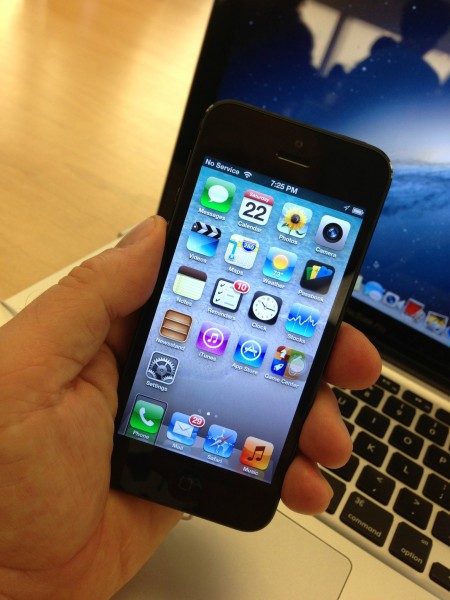 In the highly saturated U.S. smartphone market, Apple’s dominance grew, while iPhone nipped upwards towards Android, for the three months ended in January, according to comScore. The analyst firm, unlike most of its competitors, measures actual subscriber share rather than number of units shipped. Like Gartner’s counting actual sales, comScore gives a clearer view of real-world dynamics.
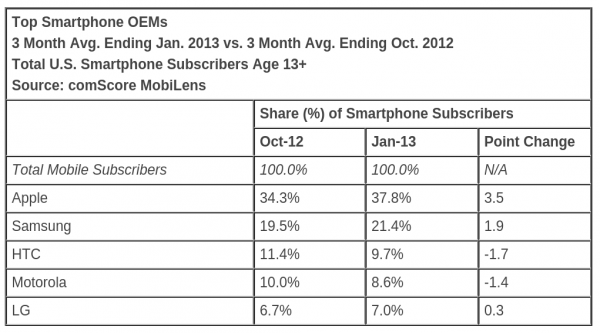
During iPhone 5’s first full three months of sales, Apple’s share reached 37.8 percent — up from 36.3 percent in December and 34.3 percent in October. By comparison, second-place Samsung nudged up to 21.4 percent share, from 21 percent sequentially and 19.5 percent for the same three months. HTC, Motorola and LG followed, with respective shares of 9.7 percent, 8.6 percent and 7 percent. All three lost share from December, with LG up ever-so slightly from October. Motorola’s loses strongly suggest that at Verizon, carrier with the highly-visible Droid line of smartphones, subscribers shift allegiance to other brands. Good thing Moto has a new evangelist.
The numbers, while meaningful, are far from perfect; comScore measures subscribers 13 and older, but counts primary phones only — no secondary devices.
As the day moves along, you’ll read longer versions of stories like this one, which puff Apple’s feathers and lament stupid Wall Street for pulling down the company’s share price. Sigh. Too many American bloggers and journalists have too little perspective about the great, big world outside of the United States — where iPhone often isn’t treasured and where the dominance of Android and Samsung are indisputable. They just don’t get it.
Nor do they recognize, or simply refuse to acknowledge, that this country is no longer the largest market for smartphones, but is one rapidly saturating. For Apple that means Samsung isn’t likely to catch up anytime soon, if ever, and Android will likely maintain a long subscriber share lead over iPhone short of some drastic maneuver — like paying people to buy iPhones.
Don’t snicker or dismiss the idea, because ISPs did just that at the turn of the Century. What? You’re too young to remember free PCs with three-year ISP contracts? That is kind of the telco model today, given 2-year contracts, but is short of actually massively paying people to buy phones. But don’t be surprised if pay-to-buy crops up in the future, as data’s importance over voice as major revenue stream increases and saturation means people stop buying new smartphones every new release or so. If one carrier succeeds paying to purchase, others will follow.
Back to blind-to-the-world American bloggers and journalists, I weary of their ethnocentric arrogance. My perspective isn’t often big enough either, seeing as I don’t live somewhere else and don’t directly see the circumstance in your country. But I try, when writing stories like this one: “Smartphone shipments surge ahead of lesser mobiles — Brazil, China and India lead the way“.
China is now the world’s largest market for smartphones, which account for about two-thirds of new shipments there. In India, 80 percent of cellular mobile uses have feature phones, so there’s nothing but upside selling smartphones — as data infrastructure expands, device features increase and prices come down, according to IDC.
Globally in fourth quarter, based on actual sales, Android share significantly outpaced iPhone — 69.7 percent to 20.7 percent, which is a 2.7 point decline from a year earlier, according to Gartner. The point: It’s a big world, and the United States is a small part of it.
Photo Credit: Joe Wilcox
-
Survey says: People start caring about internet on their TVs, but price trumps everything
Looks like consumer electronics makers may owe Netflix a few favors: Consumers are finally beginning to care about Smart TVs, with 30.7 percent of people in the market for a new TV with internet connectivity, according to the latest IHS Smart TV Consumer Survey. Twelve months ago, that number was still at 18.1 percent.

There is also a significant growth in the interest for 3-D, but it’s still a less important feature than connectivity. A year ago, only 6.6 percent of potential TV buyers were looking to buy a 3-D TV. Now, it’s 18.8 percent.

However, it’s worth pointing out that size is still one of the biggest drivers, and that price matters more than it did just 12 months ago. 53 percent of consumers who want to buy a new TV now say that the price tag is a main purchase driver. That’s up from 27.9 percent 12 months ago, and it also tells you a bit about why internet on TVs and 3-D are getting more popular: Even lower-priced TV sets are now connected, and 3-D isn’t that much of a premium anymore either.
And with falling prices, consumers feel like they should just get Netflix apps and possible 3-D glasses as part of the package, instead of paying through the nose for it. Whether people are actually going to activate those TVs is of course a completely different question.

Related research and analysis from GigaOM Pro:
Subscriber content. Sign up for a free trial.- Connected consumer third-quarter 2012
- Who and what to watch in the new era of the living room
- Connected Consumer Q2: Digital music meets the cloud; e-book growth explodes


-
Demi Divorce Papers Finally Filed
It’s been over one year since Demi Moore and Ashton Kutcher officially ended their relationship, but the divorce process for the two celebrities hasn’t been going smoothly.
Today, the New York Post’s Page Six is reporting that Demi Moore will finally file divorce papers against Kutcher. Citing an unnamed “insider,” the Post goes on to say that Moore is “tired” of settlement talks between the couple, and could bring the divorce to court.
Kutcher has already filed divorce papers, and the Post’s source dropped the words “difficult” and “hostile” in relation to his attitude during settlement proceedings.
From the Post:
“Ashton made a lot of money after marrying Demi – a lot more than she made – but despite him becoming just as famous through her, he believes he doesn’t owe her that much,” the source said,” adding of Demi: “She has had enough.”
The paperwork could be filed as soon as today. If a settlement is not reached by this spring, the source states, it could end up going to trial.
-
Comscore: Android still top US smartphone OS, but iPhone top smartphone and iOS gaining
Despite some handwringing over Apple’s somewhat slowing iPhone growth, its share of smartphone subscribers has continued to rise in its biggest market: the U.S. On Wednesday ComScore published a report taking the temperature of the smartphone market in Apple’s home country and it is at No. 1 with a 37.8 percent share of the market. Samsung, Apple’s biggest rival, is in second place, but isn’t really that close behind with a 21.4 percent share.
Apple’s share represents 3.5 percent growth compared to the last time ComScore issued this report in October 2012. And unless you missed Apple’s earnings results from the December holiday quarter, you won’t be surprised at that growth since Apple sold 48 million iPhones worldwide between October and December.

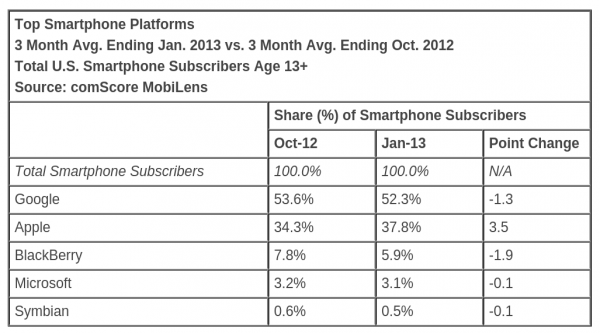
But while the company is leading in hardware sales, iOS is still far behind the Android juggernaut. Even though it fell 1.3 percent between October and December to 52.3 percent share, Android still is the most popular smartphone operating system in the U.S. Apple’s share grew 3.5 percent to a 37.8 percent share of mobile operating systems among smartphone owners, says ComScore.

Still, even in the face of evidence that Apple is doing well now, some people who watch the company and its stock are worried about what comes next and whether the company can continue to post quarterly gains of iPhone sales in established markets like the U.S. as the device nears its sixth birthday.

Related research and analysis from GigaOM Pro:
Subscriber content. Sign up for a free trial.- The future of mobile: a segment analysis by GigaOM Pro
- Mobile Q2: Smartphone growth surges; iPad’s rule continues
- What Google’s Honeycomb Means for Apple and Microsoft

-
Brookside Mezzanine Invests in Longhorn Health
Brookside Mezzanine Partners has invested in Longhorn Health Solutions. Financial terms weren’t announced. Austin-based Longhorn is direct-to-home provider of consumable medical supplies, durable medical equipment, and pharmaceutical prescriptions.
PRESS RELEASE
Brookside Mezzanine Partners is pleased to announce its recent investment in Longhorn Health Solutions, Inc. (“Longhorn”). Headquartered in Austin, Texas, Longhorn is a leading direct-to-home provider of consumable medical supplies, durable medical equipment, and pharmaceutical prescriptions serving the Medicaid, Medicare, and privately insured populations across Texas. Longhorn offers customers a comprehensive range of high quality disposable medical products, including incontinence supplies, enteral nutrition, and diabetic testing supplies.
Brookside Mezzanine Partners provided a unitranche credit facility and preferred equity to support the acquisition of Longhorn by Satori Capital (“Satori”). Satori is a Dallas, Texas-based private equity firm that partners with management teams of companies building significant long-term value through a sustainable approach. “Brookside Mezzanine Partners has served as an outstanding source of intelligent, strategic, flexible, and reliable capital,” said John Grafer, a Satori principal. “They’ve mastered the delicate balance of providing our management teams with the room they need to grow their businesses while protecting and maximizing their investors’ capital. We’ve partnered with Brookside twice, and we look forward to doing so again.”About Brookside Mezzanine Partners
Brookside Mezzanine Partners provides subordinated debt and minority equity to small and mid-sized companies seeking long-term capital to support leveraged buyouts, strategic acquisitions, growth capital and recapitalizations. Target companies generally have trailing twelve month revenue and EBITDA of at least $15 million and $3 million, respectively. Brookside Mezzanine Partners manages $250 million through two mezzanine funds.Please contact us or visit our website at www.brooksidemezzanine.com for additional information. We welcome investment proposals and promise a prompt and confidential response.
The post Brookside Mezzanine Invests in Longhorn Health appeared first on peHUB.
-
Sharing makes the city go ‘round: A Q&A with TED Book essayist Emily Badger

Do city people really like to share more? Emily Badger of The Atlantic Cities suggests a new and fascinating phenomenon in urban areas — that city dwellers are moving toward a culture of shared ownership of everything from cars to power tools.
Badger shares this thought in an essay from the new TED Book City 2.0: The Habitat of the Future and How to Get There, an anthology that suggests bold ideas for how we can create thriving cities. Born out of The City 2.0 TED Prize and produced in partnership with The Atlantic Cities, the book features essays from 12 authors, tackling topics ranging from transportation to food to public art.
Yesterday, we heard from City 2.0 essayist Diana Lind on why cities should be highway-free. Today, we asked Emily Badger to tell us more about her vision of sharing within big cities.
In your essay, you suggest that a culture of sharing has arisen in cities because of limitations of physical space. What’s created this culture?
All over the world, the populations of cities are swelling. This is the acceleration of a long-running transition as societies everywhere become less rural and more urban. So the question then becomes: Where do we put all of these people? And how will they live together? Ideally, we need cities to grow in population without expanding at an equal rate in geographic size. We need urbanization without sprawl. And so this means we need to try to accommodate more people within the footprint of existing cities. That means more people living in apartments instead of detached homes. That means using a car-share instead of individually owning cars. That means using public parks instead of private backyards — all simply because there just won’t be enough space in crowded cities for everyone to individually own all of these things.
Is there also an economic reality causing all this sharing?
A lot of people learned during the recession that it was financially unsustainable to have a 4,000-square-foot house and two or three cars. The “sharing economy” sounds like a nice idea for altruistic people willing to give rides in their cars to strangers. But sharing is also fundamentally a way for people to cover car payments or monthly rent bills. I suspect there are a lot of people on Airbnb who wouldn’t be able to afford their homes if they couldn’t make some money each month renting out a spare bedroom.
Sharing isn’t a new idea. Tell us a little about the history of urban sharing and how we drifted away from it.
We have always shared a lot of things, especially in cities. We share books at the library. We share transportation in a subway car. We share washing machines at a laundromat. Cities in many ways are historically a kind of shared commons. But, particularly in the U.S., we started to move away from that mentality after World War II — and a lot of the rest of the world, especially the developing world, has followed our lead. A lot of people moved out of cities for a more spacious, suburban lifestyle that simply didn’t require us to share assets in the same way. Culturally, we came to prize large private homes over apartments, multiple cars over public transit, and personal appliances over laundries. Now that demographic trends are shifting back into cities, though, this story is starting to change.
What are some of the downsides of sharing?
I don’t want to sound like sharing is awesome in every way! Obviously, we give up some comfort and convenience when we don’t individually own things, and there’s a tradeoff there. I live in an apartment, and sometimes I have to listen to my neighbors through our shared walls and ceilings. If you do Zipcar or have a bike-share membership, it is entirely possible that there may not be a car or a bike waiting for you exactly when and where you need it on short notice. Sharing always implies some kind of risk: that you may not be able to get what you need, that you may not like the person you’re dealing with, that someone may damage your power tool while they’re borrowing it. But for a whole variety of reasons — including financial, environmental and physical-space considerations — we know that more and more people are opting to take this risk with a lot of things no one thought anyone would share 20 years ago.
City 2.0 is available for Kindle and Nook, as well as through the iBookstore. Or download the TED Books app for your iPad or iPhone. A subscription costs $4.99 a month, and is an all-you-can-read buffet.
The City 2.0 is an online forum that showcase stories and projects for urban innovation, and also doled out 10 grants for thinkers with great ideas for cities throughout 2012. Here, meet 8 of the winners and hear their fascinating ideas »

-
BlackBerry World Wednesday – New BlackBerry 10 Apps and Games

In the past, Wednesdays have been dedicated to our favorite apps and games. The tradition continues this week with the latest BlackBerry 10 app launches from the past week. There are so many to mention so we’ve broken them out into categories.
My personal favorites from the list are Pacemaker for BlackBerry Z10 and Tetris (yeah, I’m an old school gamer). Many parents around the BlackBerry office have also let me know that Where’s My Perry? is a hit for kids young and old.
Without further ado, check out the latest BlackBerry Z10 apps in BlackBerry World this week:
Sports & Entertainment:
- NHL GameCenter 2013 (NHL Interactive)
- Cineplex (Cineplex Entertainment)
Published Media
- Press Reader (NewspaperDirect Inc)
Music & Audio:
- Pacemaker for Z10 (Pacemaker Music AB)
- Gaana for BlackBerry 10 (Times Mobile Ltd.)
- Hungama (Hungama Digital Media Entertainment Pvt. Ltd.)
Gaming:
- N.O.V.A. 3 (Gameloft)
- Where’s My Perry? (Disney)
- Eggies (Bitheads)
- RaonDefenders (Marmalade)
- Space Leap (Marmalade)
- Alien Breed (Amiga)
- Zixxby (Marmalade)
- 20 Amiga Games (Amiga, Inc.)
- Tetris (Electronic Arts)
- Flight Control Rocket for BlackBerry 10 (Electronic Arts)
Business & Productivity:
- LexiComp for BlackBerry 10 (Lexi-Comp)
- Unidic (asgatech)
We’ve got even more app news on the way for next week, so be sure to stay tuned to the Inside BlackBerry Blog – and for more BlackBerry 10 apps, games music and video content, head to the BlackBerry World storefront. Let us know which ones you’re going to pick up in the comments below.

-
Research Issues in the Assessment of Birth Settings: Report of a Study
Final Book Now Available
The Institute of Medicine (IOM) of the National Academy of Sciences (NAS) collaborated in this study with the Board on Maternal, Child, and Family Health Research of the Commission on Life Sciences of the National Research Council (NRC) to determine methodologies needed to evaluate current childbirth settings in the United States. Although the proportion of non-hospital births runs as high as 4.4 percent annually in Oregon, insufficient data exist to permit complete evaluation of the various birth settings. The application of good research methods should lead to scientific findings that provide the basis for informed, rational decision making about alternative settings for childbirth.
A committee of 11 experts was appointed to review current knowledge, provide background knowledge, and identify the kinds of research designs useful for assessing such matters as the safety, quality of maternity care, costs, psychological factors, and family satisfaction of different birth settings. The committee was also charged with preparing a report that could be used to solicit, evaluate, and fund proposals for studies on childbirth settings. The committee did not design specific studies to be carried out, but rather attempted to point out issues that should be considered by researchers because it believed that the best proposals would arise from investigator-initiated research. Gaps in research could be filled by requests for proposals developed by agency staff and the agency peer review committee. In addition, IOM staff members and several consultants provided background papers for the committee’s consideration. The research that results from this report will be useful to policymakers and to consumers searching for information to aid in making decisions about birth settings. Research Issues in the Assessment of Birth Settings summarizes the study.
Topics: Health and Medicine
-
PETA Decides to Go After Historical Whaling in a Video Game
In your “dude, seriously?” news of the day, the People for the Ethical Treatment of Animals (PETA) have turned their sights on Ubisoft over some possible content from an yet-to-be-released video game.
PETA is upset that Assassin’s Creed 4: Black Flag may feature some form of whaling inside the game. They have released a statement calling it “disgraceful” to glorify the practice, which continues today.
Whaling – that is, shooting whales with harpoons and leaving them to struggle for an hour or more before they die or are hacked apart while they are still alive—may seem like something out of the history books, but this bloody industry still goes on today in the face of international condemnation, and it’s disgraceful for any game to glorify it. PETA encourages video game companies to create games that celebrate animals—not games that promote hurting and killing them.
The game, set to release on October 29th, will let players “relive the truly explosive events that defined the Golden Age of Pirates” by “captaining and customizing their own ship, searching for lost treasure, hunting rare animals and looting underwater shipwrecks.”
So, outrage.
Ubisoft’s response is pretty good:
History is our playground in Assassin’s Creed. Assassin’s Creed IV Black Flag is a work of fiction that depicts the real events during the Golden Era of Pirates. We do not condone illegal whaling, just as we don’t condone a pirate lifestyle of poor hygiene, plundering, hijacking ships, and over the legal limit drunken debauchery.
Nobody is condoning whaling – but the game hasn’t even hit the shelves yet. C’mon, guys.
-
Time Warner Cable Hacked For Its Support Of Copyright Alert System
Time Warner Cable is one of the five ISPs participating in the “six strikes” Copyright Alert System that went live last week. One group of hackers does not particularly like that fact, and made sure Time Warner knew it last night.
The Daily Dot reports that the Time Warner Cable support Web site was hacked and defaced last night by a group of hackers calling themselves “NullCrew.” The defaced page landing featured the gorilla (pictured above) from the popular “rustled my jimmies” meme. The hack reportedly lasted anywhere between five to eight hours.
Funny enough, it seems that the IT guys at Time Warner Cable never thought to change their admin password from the default “changeme.” Beyond that, a few names and chat logs from the support site were posted, but no confidential information was shared with the public.
To that end, this particular hack was obviously just meant to draw people’s attention to the Copyright Alert System. It’s nothing like the previous defacements and hacks coming from Anonymous as part of #OpLastResort. That particular operation targeted the Federal Reserve and other government agencies.
I wouldn’t be surprised, however, if NullCrew’s exploits inspired more hacks and defacements of the five ISPs participating in the CAS. Anonymous, and related hacking groups, obviously see it as an attack on Internet freedom. It will be interesting to see what happens when the first round of copyright alerts start going out to subscribers.
-
Private Equity And VC Investing In Latin America Hits 5 Year High In 2012
Venture capital and private equity investing rose to a 5-year high across Latin America last year with firms putting $7.9 billion to work, a 21% increase over 2011. The data comes from the Latin American Private Equity and Venture Capital Association, which found that 237 deals were done, an increase of 37% from a year ago.
Brazil was the most active market with 72% of dollars invested and 62% of deals. Across the region, investments in consumer-related sectors were hot, capturing 40% of total capital.
Fundraising for 2012 was down sharply. Firms raised $5.6 billion in 42 closings, compared with $10.3 billion and 35 closings in 2011.
PRESS RELEASE
Private Equity and Venture Capital Firms Generate Record Investments in Latin America in 2012
LAVCA Releases 2012 Data on Private Equity & Venture Capital in Latin America
Private equity and venture capital firms committed $7.9bn to investments in Latin America in 2012, representing a five-year high and a 21% increase over 2011, according to data released today by the Latin American Private Equity and Venture Capital Association (LAVCA).
The $7.9bn total reflects 237 investments, a 37% increase in the number of deals from the previous year. Seven large firms that had raised over $11bn for pan-regional and Brazilian funds in 2010 and 2011 put that money to work in new deals across a range of markets and sectors.
Investments in consumer-related sectors dominated in 2012, capturing 40% of the $7.9bn total. Consumer retail represented $2.2b of investments, with the rest coming from deals in financial services, restaurants, education, fitness, healthcare and consumer goods. IT deals also posted strong growth in 2012, with both the number of IT deals and dollars invested in the sector more than doubling from 2011.
As in previous years, Brazil was the largest market for PE/VC investments in Latin America, accounting for 72% of the total invested and 62% of the total deals. In Mexico, the total number of deals was on par with 2011, but dollars committed increased by 50% over 2011. Activity in the Andean region was driven by an increasing number of cross border deals, with managers in Colombia, Peru in Chile investing across all three markets.
Fundraising for private equity and venture capital in Latin America in 2012 was dominated by smaller funds, with $5.6bn committed to 42 closings. The 2012 fundraising figure represents an important shift from 2010 and 2011, which saw record totals of $8.1bn and $10.3bn respectively, as managers targeted fund sizes under $500m. A total of 40 managers reported 42 partial or final closings in 2012, versus 35 partial or final closings from 28 firms in 2011.
Rather than representing a change in the appetite of international investors to commit capital to Latin America, the decrease shows a fundamental shift in the size of the funds being marketed.
“It was another dynamic year for private equity and venture capital in the region,” said Cate Ambrose, President of LAVCA. “We continue to see international firms moving into Latin America, at the same time that new funds are being formed across Brazil, Mexico, Peru, Colombia, Chile and other smaller markets. Fundraising was much less concentrated, with more firms in the market, as compared to previous years. That, and the record level of deals, point to a deepening and maturing of the investment ecosystem.”
One notable development in 2012 was the continued expansion of venture capital investment in technology companies in Brazil and other markets, with both international and Latin American VC firms raising new funds and backing new start ups. Exit activity in 2012 returned to 2010 levels, following an extraordinary year in 2011 when two to three firms generated over $6bn from strategic sales and two large IPOs. A total of $3.8bn was generated in 44 exits in 2012, driven by a vibrant M&A market across Latin America.
-About LAVCA
The Latin American Private Equity & Venture Capital Association (LAVCA) is a not-for-profit membership organization dedicated to supporting the growth of the private equity and venture capital industry in Latin America and the Caribbean. LAVCA’s membership is comprised of over 150 firms, from leading global investment firms active in the region to local fund managers from Mexico to Argentina. Member firms control assets in excess of $50 billion, directed at capitalizing and growing Latin American businesses.
LAVCA has been collecting proprietary data on PE/VC in Latin America since 2008 when the first LAVCA Industry Data survey was conducted. LAVCA Industry Data is based on a confidential survey of fund managers and secondary sources, creating the first reliable source of data on private equity and venture capital in Latin America. The number of LAVCA member firms and other industry participants reporting investment activity continues to increase year-on-year, reaching nearly 250 in 2012.
The post Private Equity And VC Investing In Latin America Hits 5 Year High In 2012 appeared first on peHUB.
-
iOS gains on Android in January as Windows Phone remains stagnant


