Blog

  • Google celebrates Play store anniversary with special deals

    It is the one year anniversary of Google Play store — or at least the renaming of the Android market. Google loves to celebrate these kinds of occasions with a sale. This one is no exception, as the company has kicked off with deals on music, books, magazines, videos and, of course, apps.

    Jamie Rosenberg, the vice president of Digital Content at Google Play announced the deals today, saying that “since no birthday is complete without presents, we’re celebrating with a bunch of special offers across the store on songs, TV shows, movies and books. We’re even offering a collection of games with some fun birthday surprises created by developers”.

    Of course the Android operating system maker also took a moment to pat itself on the back by letting everyone know that the Play store has more 700,000 apps and deals with all of the major music companies, movie studios and publishers to bring you the music, movies, TV shows, books and magazines.

    The deals include free songs from classic artists like The Velvet Underground, free books like A Quest of Heros, purchase of the movie Kung Fu Panda (ask your kids) for $4.99, a free episode of Breaking Bad and lots more.

    The sale is live right now and UK customers can even pay with their new Google Play gift cards. You can also use a credit card or have your purchase charged to your mobile phone bill. Google will take your money however you wish. Well, except cash.

  • Texas Legislature Introduces Bills To Curtail Warrantless Smartphone Tracking

    Did you know that the federal government can request your smartphone location data without a warrant? It happens quite often, but there’s not been much progress made in the way of legislation curtailing this particular practice. One state has had enough, however, and it intends to put a stop to it.

    Slate reports that both the Texas state Senate and House have introduced bills that would amend the Texas code of criminal procedure to stop what it feels is the warrantless surveillance of its citizens. Both bills would require law enforcement to obtain a warrant before requesting location data from any cellular carrier.

    In even better news, the bills would require any and all carriers that operate in the state to produce annual transparency reports. These reports will detail the number of surveillance requests made, and tell citizens which agencies requested the information. For now, we only know the total number of data requests made so a list of the agencies making the requests would be valuable.

    Under the proposed bills, the government wouldn’t be able to keep court orders for surveillance hidden either. The court would only have 180 days of secrecy before being forced to unseal the order and make it available to the public.

    Some may be concerned over the proposed bills impact on law enforcement, but there are some exemptions in place to keep serious investigations under wraps. For starters, law enforcement can still get a court authorized surveillance order without a warrant if the situation is deemed exceptional. The court order will also remain under wraps if it being made public would hurt the investigation.

    There are similar bills being proposed in Washington, such as Al Franken’s Location Privacy Protection Act of 2012, that would require law enforcement to obtain a warrant when seeking smartphone location data. Unfortunately, the bill died with the old Congress at the end of last year, but Franken will no doubt bring it up again. Even then, it has little chance to pass as too many in Washington feel that the needs of law enforcement to trample on your Fourth Amendment rights take priority over your personal privacy.

    That being said, the states are the next battleground for this important issue. You can expect some opposition to show up, but the Texas legislature has a track record of defying the folks in Washington. We might even see some serious fireworks if the bills progress far enough.

  • Google+ gets a BIG profile makeover

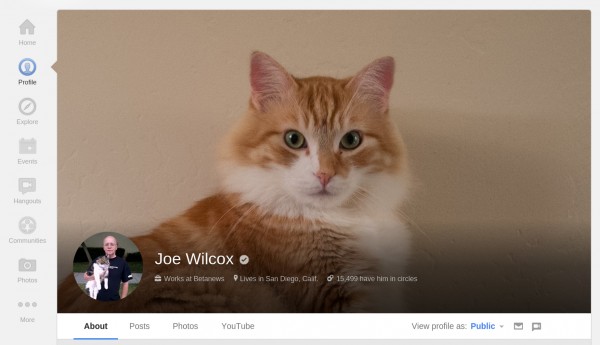
    Funny how little things matter to people. Today Google announced some minor changes to profile pages on its social network, which include much bigger cover photos — up to 2120 by 1192 pixels and displayed in 16:9 format. The search giant is rolling out this and other tweaks, gradually. If you don’t see them already, you will soon.

    Visually, Google+ Profiles lay out information in card-like fashion, which starkly remind of those Google Now presents on smartphones and tablets. The motif is particularly striking in new tab, Reviews, which doesn’t appear in my Profile. Perhaps because I’ve written none.

    “In addition to your photos, +1’s and YouTube videos, there’s now a place for all your Local reviews. Highlight your favorite restaurants, or hide the tab completely via settings — it’s completely up to you”, Sarah McKinley, Google+ product manager, explains. Reviews is checked (by default) in my settings.

    Other changes include “an easier way to edit your info”, she says. “The ‘About’ tab now consists of separate cards (like Story, Places, and Links) — each with its own prominent edit link. As always: you can share specific fields with specific circles, or keep them just for you”. There are few really new features, but rather improvements to the overall appearance. Google+ looks better, and anyone who says visuals don’t matter should stay at cluttered Facebook.

    I’m still exploring all the changes, and there are many nips and tucks to Profile presentation, including a new, more-pleasing, basic-info pop-up box when hovering over anyone’s picture or name in the main stream.

    Google’s challenge expanding and better presenting anything on the social network is daunting. Facebook wasn’t always as complicated to use as it is today. Complication creep is an evil that accompanies new features. So far, Google has done well holding back the clutter. That said, the social network redesigns are rather frequent, particularly on mobile, where the look and feel dramatically changed more than a few times over the last 12 months.

    Reaction is fairly positive. Josh Hurst: “Holy cow, the new cover photos are huge. HUGE, I say”. Thomas Aschemann: “The new profile layout looks awesome!”

    “I love what they’ve done with the profile avatar and adding a new top banner for profiles”, Peg Fitzpatrick says. “They’ve cropped the avatars to a circle. This is what you see at the top in a fixed positive when you are looking at someone’s Google+ personal wall. The avatar resizes to a smaller version”.

    But watch your settings. Rahul Raghavan: “The ‘Show your Google+ communities’ posts on your profile’ setting could have been automatically turned on. Mine was. So, go uncheck it if you want to, because some of you will end up getting embarrassed”. Mine is checked, but I don’t know that it wasn’t before.

    I believe not. I see the option as more benefit than embarrassment. Google+ doesn’t yet provide a utility for posting to the Public stream and to Communities. That’s a feature I would find beneficial, rather than spamming people by posting the same thing both places.

  • Is there really a Jeep Wrangler in there?

    Jeep Wrangler Custom

    Living in California means that seeing raised pickup trucks and Jeeps on the road is very common. There are loads of off-road trails, dunes and deserts here that would satisfy even the freakiest of off-road fantasies. This modified Jeep Wrangler however (seen in Rabat, Morocco) completely takes the cake as far as the most outlandish custom I’ve seen. Apparently owned by a shaikh of the Arab Emirates, this it has an extended wheelbase, what looks to be 42-inch tires and a grille that came off of a Freightliner semi-truck. Is it cool? No, no it’s not. I do however have to give the guy an A+ for effort though.

    Source: Youtube.com

  • This DIY, 3D-Printed Violin Is Nearly Ready To Play Beautiful Music

    IMG104

    Like many complex 3D-printed projects, this violin isn’t entirely made on a 3D printer but it’s interesting nonetheless. It is a violin that costs about $12 to build and uses paper, 3D printed parts, and some cheap wire to make an instrument that, while not pretty to look at, is definitely capable of making some sort of music.

    The project, run by Alex Davies, is definitely in the extreme DIY vein. To make the violin, they 3D printed a mold for the body, laid material over it (in this case, paper) and prepared a neck out of cardboard. Here’s the bill of materials, such as it is:

    Some newspaper, pilfered from the bus stop.

    Flour and water for the wheat paste.

    A 3D printer, and maybe 4 dollars worth of plastic.

    Some picture hanging wire, pilfered from my room mate.

    A drill, with a few drill bits.

    A bottle of chai tea liquor.

    The team even went so far as to make their own strings using a bit of wire and a drill. They used 3D-printed ABS plastic for some of the parts and used papier-mâché for the body, which seems to work fine. It’s obviously no Stradivarius but the fact that it’s even slightly playable is a great bit of luck and, with a bit of refinement I could see this as a real, usable product. In fact, the paper “exceeded expectations” in the sound department.

    The trick with 3D printing is that it can be used to make many things but not everything. Ideally most 3D printing projects should require as little hands-on crafting as possible but this is obviously not always the case. However, the DIY movement has to start somewhere, even if it’s with a poor, beleaguered violinist causing a handmade instrument to yowl in pain. You can read more about the project here.

    via YAxis

  • What to expect at this year’s SXSW: Marketing, makers and shadow events

    Let’s do a quick pre-flight check for the would-be SXSW Interactive visitor heading to Austin. Do you have your ID, your umbrella (we’re expecting some rain on the weekend), your extra phone battery and the snack bars necessary to sustain you through the long concession lines and nosh-free parties?

    Great. Now how about those business cards? Unfortunately, you’re going to need them because I’m pretty sure that — assuming it hasn’t happened already — this will be the year the marketing mavens at SXSW finally overwhelm those who are here to party and play with technology. In other words, expect to meet a lot more hucksters than engineers.

    I won’t make an official call until the event is over, but there are two trends apparent in the session programming decisions and the inbound pitches leading up to the event: 1) there is a ton of corporate money flowing into the official SXSWi that drowns out the exchange of ideas with incessant commercials for a product or app, and 2) there are still a few geeks holding onto the glory from the heydey of SXSWi with unofficial or additional parties in Austin.

    It’s all about the money, honey

    sxswFirst off, a little history for those who may think of SXSWi as some paradise of geekdom; it’s always been an event focused on the bottom line. SXSW Inc. has strictly enforced the use of the SXSW brand, so if you want to have a party at SXSW you have to pay. There are no true unofficial SXSW events, only events that might happen during spring break week in Austin with private guest lists.

    But in the 11 years I’ve attended the show it has grown from a small event with a couple thousand “tech folk” — mostly from the hardware and gaming industries — to a creative festival where graphic designers, gamers and people who were trying to build web sites and online startups shared their hopes and fears about open identity, web fonts, privacy and media in small panels. After hours, they drank hard and modified Roombas to race in the streets. Companies like Twitter got their start here; not because they orchestrated huge splashy launches, but because a high concentration of geeks with a lot of free time were clustered in one place.

    But as technology became an essential part of everyday life for everyone through mobile phones (as opposed to work-oriented PCs), the corporate presence grew larger and the partiers swankier (it’s still hard to find food, but not nearly as hard). The programming still had some fun and far-out topics, but geek panelists were replaced by marketers from big brands.

    Last year I was demoralized when I realized that every other person I met happened to work in business development or marketing for a large corporation outside of the tech world. Yet, there were still pockets of the original SXSW spirit of technology explorers. Encountering a cluster of people trying to connect technology and food was probably the closest I got to those middle years of SXSW, a time when every person I met and every panel and party had me thinking about how tech can change the world — not just get us to buy more soda.

    This year, among the pitches and programming, I don’t see any clusters that strike me as super fun. There are a few panels on toys and technology, several (although not as many as I would have thought) on 3D printing and hardware hacking. There is also a component of that ethos at the SXSWedu conference happening now. It may be that these geekier, more cohesive groups (there’s also a SXSWeco and the upcoming SXSWv2v in Las Vegas) are being pulled out into their own events.

    Making a break for it

    For the hardcore geeks who still want to congregate in one place to discuss their ideas, there is a growing shadow SXSW. It’s no secret that many attendees will never hit a SXSW speech, panel or programmed event. Instead they will attend events programmed by others outside the typical SXSW vote-for-your-favorite-panel method. Maybe it’s a happy hour shared amongst followers of a Facebook page, members of a meetup group, or just recipients of a group email.

    SXSW PartyBut there are several events — including some that attendees pay for on top of their SXSW badge — that have created programming and content for people in town for SXSW. Mobile Saturday is one-day conference focused on all things mobile, while Dave McClure and Eric Reis have pulled together a Lean Startup event during the same day.

    A bunch of groups from Germany are taking over Icenhauer’s for the entire conference and are running German Haus. It has panels, discussions, and parties. Big-name corporations have been doing this for the last few years, taking over lounge space and having presentations, but this year it seems more common and home to the most exciting programming.

    There are also some events happening outside of the conference such as Doing Business in the U.S., Tech Career Expo and the Ideas Are Worthless conference. Some of these have licensed the SXSW name and some have not.

    The point is that even as the core SXSWi event has become overrun with marketers, there are events within the event (or just outside of it) that still retain the spirit of the SXSW of six or seven years ago. Like the web itself, the good stuff is still here; you just have to wade through a lot of crap and marketing before you get there.

    Related research and analysis from GigaOM Pro:
    Subscriber content. Sign up for a free trial.

  • The Internet is a much different place if you are rich

    Internet Targeted Ads
    The Internet is widely regarded as a highway of free information that doesn’t discriminate against color, sexuality or religious beliefs. This is a common misconception, however. Although most people aren’t aware of it, today’s Internet is tailored to your specific needs. Companies like Google (GOOG), Facebook (FB) and others gather detailed information about users and then sell it to advertisers. A company must then decide who to target with its ads. For example, a company like Gucci wouldn’t bother paying to advertise its products to someone who makes an income below a certain threshold, knowing he or she would be less likely to make a purchase. As noted by Michael Fertik of Scientific American, the rich see a very different Internet compared to the rest of us.

    Continue reading…

  • ‘Paul Bearer’ Dies; Wrestling Star Was 58

    Paul Bearer, born as William Moody, has died at the age of 58. Though the cause of Bearer’s death is unknown, TMZ is reporting that he had suffered from health problems related to his obesity and gallbladder for years.

    Bearer made a name for himself in WWE (then WWF) wrestling as the manager of The Undertaker, and sometimes Undertaker’s “brother,” Kane, during the 90s and early 00s. His appearances were accompanied by macabre spectacle, often with coffins, gravestones, his trademark urn, or other death-related props.

    The WWE has issued a statement expressing its condolences:

    WWE is saddened to learn of the passing of William Moody, aka Paul Bearer. Moody made his WWE debut in 1991 as the manager of The Undertaker and went on to become a memorable part of WWE over the course of the next 20 years.

    Our deepest condolences go out to Moody’s family, friends and fans.

    Before joining the WWE, Bearer wrestled in the World Class Champion Wrestling (WCCW). Bearer had also earned a degree in mortuary science, as well as certification as a funeral director, in the early 80s.

  • Groupon’s Next CEO Will Not Come From Within [REPORT]

    Last week, after a poor Q4 earnings report, Groupon finally ousted CEO Andrew Mason after months of speculation.

    Executive Chairman Eric Lefkofsky and Vice Chairman Ted Leonsis were tapped to head the “Office of the Chief Executive” and serve in his place until a replacement is found.

    And it looks like that replacement will come from outside the company.

    Bloomberg quotes two sources close to the matter who say that Groupon’s search for the next CEO is focusing on outside candidates. The board will hire a recruiting firm in the next couple of weeks and expect to have a new CEO in place within 3 to 6 months.

    Only if that search fails to find a suitable replacement will the company’s board consider someone from inside the company, says the report.

    Groupon has already ruled out both Lefkofsky and Leonsis as possible CEOs.

    Just before Groupon announced that Mason was out as CEO, the company reported disappointing earnings. Groupon missed Wall Street estimates, posting a net loss of $81.1 million for Q4 although revenue was up 30%.

    Upon Mason’s departure, Groupon stock rose sharply from $4.53 to as high as $5.10 in after-hours trading. Currently the stock sits as $5.64.

  • Telly’s iPhone app gets private video sharing

    Telly, the San Francisco-based social video aggregation startup formerly known as Twitvid, released version 2.0 of its iPhone app Wednesday. The new app allows users to privately share their video recordings with friends and contacts, regardless of whether these people use Telly or not. The new version also adds some IU tweaks, including a carousel view that recently launched on Telly’s web site as well.

    Telly originally launched as a social video curation service some 9 months ago, but CEO Mo Al Adham told me during an interview Monday that sharing of personal videos has always been an important part of Telly’s mobile experience as well. 5.5 percent of Telly’s iOS users upload at least one video a month to share it with their contacts on Facebook or Twitter, he said.

    Telly private video threadThe company now wants to further encourage this kind of sharing by allowing iPhone users to share their clips with select groups of people. Users can either share videos directly with their contacts on the service, or send links to videos via email or text message to anyone in their address book. Recipients who haven’t signed up for Telly yet can then either watch a video on the web, or download the mobile app to participate in a IM-like conversation about the clip.

    Telly’s new iPhone app UI also includes a coverflow-like video carousel. Telly Head of Product Mike Cieri told me that this UI has been a big hit ever since the company rolled it out on its website earlier this year. “The results have been staggering,” he said, adding that Telly has seen 30 percent engagement growth with the new UI. iPhone users can access the UI by turning their phone to view it in landscape mode. Turned back into portrait mode, the app will automatically switch to a newsfeed view of videos.

    Of course, Telly isn’t the only app that’s trying to facilitate private video sharing. Boxee launched its Cloudee app last summer, and the idea of private sharing of media is pretty much core to Google+, just to name a few. However, Cieri said that the company didn’t see a lot of adoption for any of these services, which is why Telly saw an opportunity to go into this space.

    Cieri added that new apps for the iPad and Android with private video sharing are going to launch in the next couple of months.

    Related research and analysis from GigaOM Pro:
    Subscriber content. Sign up for a free trial.

  • Four Ideas for Creating Mobile Strategy

    Mobile technology presents all marketers with a tantalizing proposition. Mobile devices function like an extension of ourselves, present throughout every moment of our day, an arm’s reach away at night, and panic-inducing when outside our reach. They are globally ubiquitous, and ownership frequently transcends economic and social boundaries.

    The chance to tap into this ever-present and intimate consumer channel at such tremendous scale seems like a no-brainer for marketers. But marketing spend on mobile pales in comparison to time spent there by consumers. The opportunity is clear, but how to seize it is not. For most organizations, successfully engaging consumers via mobile — or even giving the effort a serious try — is still a mirage. The same skepticism that made companies miss the boat on digital is now at risk of keeping companies on the sidelines of mobile instead of making efforts to lead and win in the space.

    The key reason behind this hesitation is the speed at which mobile reached scale, coupled with the unrelenting pace of disruption in the mobile ecosystem. To understand this rapid scaling relative to other landmark consumer electronics, consider this: It took 38 years for the radio to reach an audience of 50 million consumers, 13 years for television, four years for the Internet, but only two years for the iPhone. It’s daunting to keep current with such an in-flux marketplace, not to mention the myriad consumer behavior changes that it drives. Even more challenging, especially for the ROI-driven marketer, is deploying a mobile strategy that moves the needle for the business in the near-term, but also anticipates the future.

    At my company, Mondelēz International, we’re bullish on mobile because it’s so right for our particular business. Here are four ideas we’re embracing as part of our core mobile framework. While many of these strategies apply both within and outside the consumer packaged goods industry, there is no secret sauce and all marketers should ask themselves what their unique mobile framework should be in 2013, and beyond.

    1. Use the power of mobile-at-retail and re-think the impulse purchase

    Since consumers carry them at every moment of the day, mobile phones have the potential to be extremely influential on the path-to-purchase and in-store experience. By using location and behavior-based cues, savvy brands can reach consumers when and where it matters most. This could take the form of a mobile-based deal on gum mapped to a consumer’s daily commute when people are most likely to be chewing gum, or delivering a coupon on candy to a consumer’s phone while they’re in a long check-out line, engrossed in their phone instead of looking up at product displays.

    2. Get in on the ground floor of mobile video
    Globally, there is an increased demand for paid media, particularly TV, which is driving cost inflation and putting pressure on companies year over year to reach the same number of people. The growth of mobile video consumption, particularly around content like music videos and movie trailers, has led to increased mobile video inventory. This inventory not only lives in a sharing-rich environment (the Interactive Advertising Bureau found that over 92 percent of mobile video watchers share the videos they watch), it is also much more cost-effective for the advertiser, just like Google mobile search advertising, where click-through rates are soaring but marketers are still only dipping their toes in the water. . In many markets around the world, companies have the chance to seize a first-mover advantage by investing early in this growing consumer touch point, much in the same way that companies that made early, scaled investments in TV advertising in its youngest years secured long-term cost advantages.

    3. Amplify TV spend through integration
    Like mobile, TV is highly scaled, but market fragmentation, rising costs and changes in consumer viewing behavior are driving down the overall effectiveness of TV advertising relative to other media. But all is not lost: research shows that connecting second-screen extensions to TV spend can actually multiply its ROI. There are a growing number of powerful second-screen technologies, from GetGlue to Viggle. It’s critical to understand the benefits of each and capitalize on them now.

    4. Monetize mobile media

    The monetization of mobile can happen not only through e-commerce and paid apps but also through in-app purchases. More and more brands are seizing the opportunity to create mobile experiences for their consumers. When done properly, these experiences can function as more than marketing — they can actually add to the bottom line. We’ve seen this first-hand with the performance of our app, “Twist, Lick and Dunk,” a mobile game that digitally re-imagines the childhood tradition of how to eat OREOs. Through in-app ads and purchases, where players buy virtual currency to unlock special OREOs, the app is on track to be cash-positive. In its first few months, it was downloaded nearly two million times and has generated over $50,000 in revenue.

    Adapting to changes in the mobile landscape is a requirement for any competitive brand. But, it’s easier to see into the future when you have a stake in building the innovations that shape it. The key to creating your mobile framework is not only staying a few steps ahead, but also influencing where those steps lead.

  • A visit to Ron Finley’s LA garden — plus 5 more TED Talks about growing your own food

    Ron-Finley-garden-main

    In today’s TED Talk, guerilla gardner Ron Finley tells the story of how he was issued a citation, and then a warrant for his arrestRon Finley: A guerilla gardener in South Central LARon Finley: A guerilla gardener in South Central LA, all for planting delicious vegetables in the 150 x 10 foot patch of earth in front of his house in South Central, Los Angeles. It’s a rousing talk — one that will make you want to stand up and cheer … and maybe even plant some kale. As Finley says, “Let’s all become gangster gardeners. We have to flip the script on what a gangster is. If you ain’t a gardener, you ain’t gangster. Let that be your weapon of choice!”

    Yesterday, the day before Finley’s talk made it to the TED.com homepage, TEDActive’s own Nick Weinberg and Sean Gannet stopped by Finley’s gardens in South Central. Above, a view of the strip of no-man’s-land between the sidewalk and the street that Ron planted with leafy green vegetables and flowers. And below, look for more photos: a garden in a swimming pool and a closeup of Ron’s famous red Swiss chard.

    Inspired? Check out these great TED Talks about growing your own food:

    Britta Riley: A garden in my apartmentBritta Riley: A garden in my apartmentBritta Riley: A garden in my apartment
    Britta Riley wanted to grow her own food (in her tiny apartment). So she and her friends developed a system for growing plants in discarded plastic bottles — researching, testing and tweaking the system using social media, trying many variations at once and quickly arriving at the optimal system. Call it distributed DIY. And the results? Delicious.
    Stephen Ritz: A teacher growing green in the South BronxStephen Ritz: A teacher growing green in the South BronxStephen Ritz: A teacher growing green in the South Bronx
    A whirlwind of energy and ideas, Stephen Ritz is a teacher in New York’s tough South Bronx, where he and his kids grow lush gardens for food, greenery — and jobs. Just try to keep up with this New York treasure as he spins through the many, many ways there are to grow hope in a neighborhood many have written off, or in your own.
    Pam Warhurst: How we can eat our landscapesPam Warhurst: How we can eat our landscapesPam Warhurst: How we can eat our landscapes
    What should a community do with its unused land? Plant food, of course. With energy and humor, Pam Warhurst tells at the TEDSalon the story of how she and a growing team of volunteers came together to turn plots of unused land into communal vegetable gardens, and to change the narrative of food in their community.
    Jamie Oliver's TED Prize wish: Teach every child about foodJamie Oliver's TED Prize wish: Teach every child about foodJamie Oliver’s TED Prize wish: Teach every child about food
    Sharing powerful stories from his anti-obesity project in Huntington, West Virginia, TED Prize winner Jamie Oliver makes the case for an all-out assault on our ignorance of food.

    And another great TEDx talk on the subject: Roger Doiron’s My subversive (garden) plot. A vegetable garden can do more than save you money — it can save the world. In this talk, Roger Doiron shows how gardens can re-localize our food and feed our growing population.

    Here, more images of Finley’s amazing gardens.

    In an abandoned swimming pool behind his house, Ron Finley is growing artichokes, brocolli, kale and more, plus succulents and cacti (check out the mini garden behind the blue tiles). The blue barrels are collecting rainwater, and the black bins are for compost. Photo: Nick Weinberg

    In an abandoned swimming pool behind his house, Ron Finley is growing artichokes, brocolli, kale and more, plus succulents and cacti (check out the mini garden behind the blue tiles). The blue barrels are collecting rainwater, and the black bins are for compost. Photo: Nick Weinberg

    Ron-Finley-swiss-chard

    A closeup of Ron’s famous Swiss chard. Easy to grow and delicious to eat. Photo: Nick Weinberg


  • App Security Provider MyPermissions Secures $1M in Funding

    App security provider MyPermissions announced today it has raised $1 million in a round by lool Ventures, 500 Startups and 2B Angels, with participation by Plus Ventures and Israeli tech investor Robby Hilkowitz. The company operates as a personal cloud security company, managing users’ Web and mobile presence and alerts them when new apps gain access to personal information. Dave McClure says this is the first investment by 500 Startups in an Israeli startup, and he says more investments are planned in Israel and other Middle East countries.

    PRESS RELEASE

    MyPermissions Announces Investment Round of $1 Million

    Led By lool Ventures, 500 Startups and 2B Angels, Financing Will Give Consumers More Control Over How Apps Access Personal Data on the Web and Mobile

    Ramat Gan, ISRAEL – March 6, 2013 – MyPermissions, an easy, powerful way to scan, control and clean up applications on Web and mobile accessing personal data, today announced it has raised a financing round of $1 million. Led by lool Ventures, 500 Startups and 2B Angels, with participation by Plus Ventures and Robby Hilkowitz, MyPermissions will use the investment to expand its product offering and accelerate the growth of its user base worldwide.

    MyPermissions protects consumers’ personal information on the Web through two free products – MyPermissions Cleaner, a Web browser extension that lets users manage which applications and websites access their information and alerts users when a new app is accessing user data, as well as its mobile application Permissions, now available on both iOS and Android. By linking directly to application permissions pages for services like Facebook, Twitter and Google, MyPermissions alerts the consumer when an app is accessing their personal data, giving them control over their personal information again.

    “We at lool Ventures are investors and entrepreneurs, but first and most we are citizens of the Web,” said Avichay Nissenbau of lool Ventures. “MyPermissions was born out of a deep concern for the privacy issues that arise from granting app permissions across the Web and mobile.  We are excited to continue to support the growth of MyPermissions and help them fulfill their vision.”

    “500 Startups is excited to be involved in MyPermissions,” said Dave McClure, Founding Partner at 500 Startups. “They are solving a real problem regarding consumer privacy during a time when most of us are participating in social networks. While we have invested in Israeli Founders in the US, this is our first investment in a startup based in Israel. We will be making more investments in Israel and other countries in the Middle East.

    “Applications access personal data such as email, photos, contacts and location in order to make using services like Facebook and Twitter better and more robust, which is great,” said Olivier Amar, CEO of MyPermissions. “However, over time, consumers tend to quickly add up the number of apps constantly accessing their data, and revoking access later can be difficult. We’re excited to be able to build out our product offering, expand our reach globally, and give more consumers the control they deserve over who accesses their personal information.”

    For more information on MyPermissions and to begin protecting your personal data today, please visit https://mypermissions.org.

    About MyPermissions:
    MyPermissions is an easy, powerful way to scan, control and clean up applications across Web and mobile that have permission to access personal data. MyPermissions offers two free products – MyPermissions Cleaner, an extension for Web browsers, and Permissions, a mobile app for iOS and Android, which protect users from unknowingly sharing photos, documents, locations, contacts, emails, work history, political and religious affiliations ever again. Based in Israel, MyPermissions was founded in 2012 and is backed by 2B Angels, 500 Startups, Lool Ventures, Plus Ventures and a consortium of angels. For more information, visit https://mypermissions.org.

    The post App Security Provider MyPermissions Secures $1M in Funding appeared first on peHUB.

  • HTC’s dreadful February shocks even cynics

    HTC Earnings Analysis February 2013
    HTC’s (2498) share price dove 6% yesterday as investors fretted over whether February revenue might drop below NT$12 billion. Well, it did. In fact, it plunged all the way to NT$11.37 billion. This was a -27% decline compared to January… and January revenue was down -28% from December. That January tumble was a pretty normal seasonal drop, but this February decline definitely isn’t. As a sign of that, HTC’s January revenue was down only -7% year-on-year — meanwhile, February sales were down -44%.

    Continue reading…

  • The (Not Very Deep) Meanings of the Dow’s New Record

    You’ve got to admire the staying power of the Dow Jones Industrials Average. It was replaced as the best measure of U.S. stock market performance in 1923, when Standard Statistics Co. unveiled its new stock index, which later became the S&P 500 (the Dow was and is simply the crude average of the prices of 30 subjectively chosen stocks). Within the investing business, both the Dow and the S&P have long since been supplanted by the more focused indexes compiled by the likes of Russell Investments and MSCI.

    Yet it was the Dow’s busting through its all-time record Tuesday that got all the headlines — not the Russell 3000, which surpassed its 2007 peak last month, or the S&P 500, which as I write this is about 15 points short of its record close of 1565.15 on Oct. 9, 2007. (And don’t forget the poor Nasdaq Composite, the glamor index of the late 1990s, which is still miles away away from its March 2000 pinnacle.)

    It’s a remarkable testament to the power of brand, and of habit. (And to having the nation’s leading financial newspaper invested in your success for more than a century — although not so much any more.) It’s also one that would be pedantic to harp on, given that, despite its flaws, the Dow is sending pretty much the same message as the S&P and Russell 3000: the stock market is back!

    Yeah, the comeback is less impressive if you adjust for inflation. But if you factor in dividends, as the Wall Street Journal‘s Justin Lahart points out, all the gains are restored and then some.

    So the stock market is doing great. What exactly does that mean? There are three main ways of explaining stock prices:

    The first is basic economics — a share of stock is worth the present value of the future cash flows associated with it. Put another way, a company’s stock-market value is a function of how much money investors think it will make in the coming months and years. So a rising Dow or S&P 500 means investors think big American companies will be making more money. Which would be great economic news, except for a couple of things. One is that the link between big-company earnings and U.S. prosperity is weaker than it once was (the corporations that make up the S&P 500 get something more than 40% of their revenue from outside the U.S.). The other, even more important, caveat is that stock market investors aren’t reliable oracles. The S&P 500 hit its all-time nominal peak in October 2007, with a global financial unraveling already under way. Investors can miss on the downside, too: “The stock market has predicted nine of the five last recessions,” as economist Paul Samuelson liked to say.

    A second way to think of stock prices is as a reflection of dynamics only tangentially related to economic value. Wall Street Journal co-founder Charles Dow saw “waves on a beach” in the movements of the average he created; subsequent observers saw all sorts of other, more intricate patterns. For a time this chart-reading was dismissed by financial economists as purest hokum, but it has regained some favor in recent years. Academic research has shown that stock prices clearly exhibit momentum — once they’re moving in one direction, they tend to keep moving that way. And when they change direction, they often do so far more sharply than any calmly rational revision of economic forecasts would warrant. So the fact that stock prices are nearing an all-time high could mean that they’ll keep rising. Or it could mean they’re about to collapse.

    Finally, there’s supply and demand. Stock prices go up when more people are buying stocks. This could be because they’re gung ho about corporate earnings prospects (explanation 1), or that they’re mindless trend-followers (explanation 2). But it could also just mean that they have some money and need a place to put it. Right now the main alternative to investing in stocks — fixed-income investments ranging from savings accounts to corporate bonds — is not attractive. Interest rates are infinitesimally low, and because there’s simply no room for them to go much lower, the other way of making money on fixed income — by seeing the value of bonds go up as interest rates fall — isn’t available. Stocks may be volatile and unpredictable, but at least they can go up. So people buy them. And they go up.

    As explanations go, this last one is pretty frustrating: stock prices are going up because people are buying stocks. But it has the virtue of being true, something one can never be sure of with the other two.

  • Objet 3D Printers Create A Functioning Keyboard In One Print Job

    We’ve already seen what Objet’s multi-material 3D printers can do, but it’s always nice to see Objet pushing the boundaries of what its Connex printers can accomplish.

    In today’s demonstration, the Objet Connex 3D printer has created a keyboard replica. The amazing part about this particular print job is that the keys didn’t have to be printed separately and inserted into the keyboard. Everything was created in a single print, further demonstrating the power of Objet’s Connex line of 3D printers.

    Of course, these keyboards can’t actually connect to a PC as they are only plastic prototypes. Real keyboards will have to be produced via traditional means until 3D printers can start creating circuitry. Until then, we’re left with a promising, but currently useless, tech demo of what’s to come in the world of 3D printing.

  • Kate Upton Look-Alike Imitates Swimsuit Cover Pic

    Kate Upton has once again graced the cover of Sports Illustrated’s swimsuit issue, this time wearing a revealing parka and not much else on the 2013 swimsuit issue cover.

    The pic, of course, has been much imitated since it was revealed, with women using their winter coats to “tastefully” show off their cleavage and abs. However, the pic has probably not been recreated as well as by this Russian beauty, who was brave enough to publicly tweet a picture of her attempt to Twitter. The tweet was quickly re-tweeted by Kate Upton herself, making Ania famous overnight.

    Now that Ania has proven she is a dead ringer for the world’s current most popular supermodel, Sports Illustrated took the time to interview the Upton doppelganger. Ania, revealed that she decided to take the photo because she had been told she looks like the model, and because she owned the exact same coat Upton was wearing on the SI cover. It remains to be seen whether Ania can dance the Cat Daddy as well as Upton.

    Kate Upton look-alike

    Ania didn’t expect anyone but her friends to see the photo, but seems ok with the attention she’s drawn. The retweets and comments about her photo were, predictably, about the most prominent (and lighted) part of the pic:

  • Tomb Raider Review (PC)

    Tomb Raider games have earned a loyal following among millions of people many years ago, but recent installments haven’t exactly honored Lara Croft’s legacy, despite the best efforts of developer Crystal Dynamics.

    The studio decided to completely reboot the series some time ago and in the last few years, it’s been hard at work on a new version of Lara Croft and a… (read more)

  • Agreement will lead to grid-friendly electric vehicle charging

    A technology that will allow widespread adoption of plug-in electric vehicles without negatively impacting the electrical grid is the subject of a commercial license agreement between Battelle and AeroVironment, Inc., of Monrovia, Calif. The technology may also ultimately result in lower costs for plug-in electric vehicle owners. 

    Battelle operates the Department of Energy’s Pacific Northwest National Laboratory in Richland, Wash. 

    AeroVironment will use a portion of the licensed technology in a new prototype version of its Level II charging systems.

    While electric vehicles will ultimately reduce the nation’s dependency on oil, some are concerned that millions of electric cars on the road will threaten the stability of the electrical grid. Developed at PNNL, the Grid Friendly EV Charger Controller technology tells the car’s battery charger when to start and stop charging based upon existing conditions on the electrical grid.  Since electric vehicles can now be charged when electricity is most readily available, the technology could translate into lower bills for vehicle owners and a more stable grid.

    AeroVironment’s new prototype EV charging station, incorporating the PNNL technology, will help stabilize the electrical grid by continuously monitoring the grid’s alternating current, or AC, frequency and varying the vehicle charging rate in response. If an unexpected event on the grid causes a rapid drop in the AC frequency, the charging system will stop charging, providing a grid “shock absorber.” Under normal conditions, this stabilizing technology will be particularly important as the power grid is expected to rely more and more on variable renewable resources such as wind and solar technologies. 

    An earlier PNNL study found America’s existing power grid could meet the needs of about 70 percent of all U.S. light-duty vehicles if battery charging was managed to avoid new peaks in electricity demand.  

    “If a million owners plug in their vehicles to recharge after work, it could cause a major strain on the grid,” said PNNL lead engineer Michael Kintner-Meyer. “The Grid Friendly Controller could prevent those peaks in demand from plug-in vehicles and enable our existing grid to be used more evenly. And our studies have shown that those who use the technology could save $150 or more a year on their electricity bill, and they could potentially receive rebates for providing shock-absorbing services to the grid operator,” Kintner-Meyer added.

    “These technologies will result in a triple-win,” said Alec Brooks, chief technology officer of AeroVironment’s EES business segment. “First, reducing the cost of integrating variable renewable generation reduces the electricity costs for all ratepayers. Second, plug-in cars can be powered by renewable generation that might not have been possible to add to the grid without the charging rate flexibility offered by vehicles and this technology. Third, the reduced cost of electricity to plug-in vehicle drivers will further improve on the cost advantage of driving on electricity as compared to gasoline.”

    “Vehicle charging infrastructure is important for the market adoption of electric vehicles and plug-in hybrid electric vehicles,” said Dan Ton, DOE’s program manager of Smart Grid Research and Development. “We need charging stations and we need them to be intelligent in order to work with smart vehicles and smart grid infrastructure to avoid potential strain on the grid and to provide flexible billing transactions for energy purchases and grid services.”

    Prototypes of the new AeroVironment charging system are available for beta testing. The prototypes include Bluetooth wireless connectivity for data streaming and local control functions. For more information, contact AeroVironment at [email protected].

  • Samsung’s Galaxy Note III rumored to feature 5.9-inch display, eight-core processor

    Galaxy Note III Specs Release Date
    Samsung (005930) isn’t afraid to take chances with its Galaxy Note line of smartphones. The company previously introduced 5.2-inch and 5.5-inch models, and may go even bigger with the upcoming Galaxy Note III. According to a report from The Korea Times, Samsung is said to be working on a smartphone with a 5.9-inch display to compete with similar sized devices from Huawei (002502) and ZTE (0763). The handset will reportedly be equipped with a new eight-core Exynos 5 Octa processor and is expected to be released in the second half of the year. The Korea Times notes that due to supply chain constraints, the Galaxy Note III will not feature flexible display technology. The latest report contradicts earlier rumors that suggested Samsung’s next-generation phablet would sport a 6.3-inch display.