Blog

  • Research links aircraft flights with warming

    (BECCA del MONTE/The Stanford Daily)

    (BECCA del MONTE/The Stanford Daily)

    Air travel responsible for 4-8 percent of global climate change, says study

    That flight back to Stanford may have had a bigger impact on climate change than previously thought.

    According to a study by civil and environmental engineering Prof. Mark Jacobson, commercial aircraft flights have contributed four to eight percent of global surface warming since air temperature records began in 1850.

    The first study of its kind analyzing commercial airlines, the results also showed that aircraft flights are responsible for an estimated 15 to 20 percent of warming in the Arctic.

    Jacobson ran simulations using the aircraft emissions data for every commercial flight in the year 2004 and repeated the process for data from 2006. These numbers were entered into a computer model that also analyzed background pollution, clouds and radiation fields to predict how the emitted particles interacted chemically with atmospheric gases and aerosols.

    “It’s a really complex soup of interactions occurring, but in the end it’s pretty relatively organized,” Jacobson said.

    “We can then look at differences between running simulations with and without aircraft to see the changes in temperature and atmospheric composition of the clouds that result,” he added.

    Aircraft engines emit particles that serve as sites on which clouds condense, forming the trail of vapor, known as “contrails,” that are sometimes seen behind planes. These contrails reflect sunlight but also absorb infrared radiation – due to the black carbon found in emitted soot – which changes atmospheric radiation balance.

    Once contrails dissipate they also affect larger-scale cloud formation because the remnants of the contrails serve as nuclei on which other clouds form.

    The impact of these emissions is magnified in the Arctic, where contrails absorb infrared radiation from both direct sunlight and light reflected back upward by the highly reflective snow and ice. Once the edges of the ice melt to reveal the water below, the ocean absorbs even more radiation, accelerating climate change.

    Aircraft emission pollutants are short-lived, but they can still have a significant effect on the environment, Jacobson explained.

    “You can ramp up those temperature changes with short-lived pollutants,” he said. “I mean, you can have that temperature effect due to brief periods of emissions – you don’t need hundred-year emissions to get that temperature change,” he added.

    World airline passenger traffic fell 3.1 percent amid last year’s global financial crisis, the biggest drop in aviation industry history, according to figures from the International Civil Aviation Organization. Even so, black carbon emissions would have to be reduced 20-fold to halt Arctic warming, Jacobson said.

    “There’s a general statement that can be made about all pollution sources – we should take action to reduce all pollution,” Jacobson explained. “All combustion causes some kind of air pollution or climate problem, so we should always be aggressively trying to reduce combustion toward alternatives that don’t combust or combust much cleaner materials.”

    To meet this challenge, airplane manufacturer Boeing recently designed a lighter-weight, more energy efficient plane, according to Jacobson. The company is also developing lower sulfur emission fuels.

    Still, even cleaner-burning fuel is possible, Jacobson said.

    “If you really were to take it to the next level, you would want to go to maybe liquid hydrogen airplanes,” he said.

    Studies from the European Commission have shown that a hydrogen-fueled airplane is possible, but the technology must still undergo rigorous safety tests, Jacobson said. Though hydrogen fuel has been used for the space shuttle, Jacobson predicts that hydrogen-fueled planes are still 10 to 20 years away.

    “We have plenty of examples of hydrogen being used, but it’s a question of whether you can do it at low cost or not,” he said. “There’s also transforming the whole fleet – it’s a long process.”

    Jacobson presented his study at the Geophysical Union’s annual meeting in December. The paper is currently being peer reviewed and is awaiting publication.

  • Senate confirms Warlick ‘78 as U.S. ambassador to Bulgaria

    Stanford alumnus James B. Warlick Jr.’78 has been named the U.S. Ambassador to Bulgaria, as confirmed by the Senate on Dec. 29.

    Warlick had served as principal deputy assistant secretary of state in the Bureau of International Organization Affairs (IO) since 2006, in charge of American foreign policy at the United Nations.

    His appointment comes after a long history of service in the State Department.

    Warlick’s past assignments include stints at U.S. embassies in Moscow, Germany, Bangladesh and the Philippines. For the first half of 2004, he served as principal advisor to Ambassador Paul Bremer in Baghdad, Iraq.

    Later this month, the Senate will vote on the appointment of his wife, Mary Warlick, for the Ambassadorship to Serbia.

  • Cross Border Awareness

    Students Work for Immigration Justice

    Juan Manuel, a burly 31-year-old day worker from Mexico, received the nickname “Conan” during his first week at the Day Worker Center of Mountain View.

    “When I arrived, a coworker said that Conan is the name of a wrestler in Mexico,” Manuel said. “He said, ‘you look like him. Do you mind if I call you that here?’”

    For three years, Manuel has been coming to the Day Worker Center, a central place for laborers to connect with employers who need temporary work in jobs like carpentry and landscaping. Students from the Stanford Immigrant Rights Project (SIRP), an undergraduate organization spreading awareness about immigration justice, have been collaborating with day workers like Manuel each Saturday since last quarter.

    “Day laborers can come here and work out a fair wage,” said SIRP member Lauren Swartz ’11. “Otherwise, there’s the danger that an employer could drop off workers on the street without pay after they’ve been landscaping all day.”

    A group of 15 SIRP members come weekly to offer English as a Second Language (ESL) tutoring and build relationships with the workers.

    “I think we all would like to see our broken immigration system being repaired, as it affects human lives and neighbors in all our communities every day,” said Minh Dan Vuong ’11, one of the founding members.

    The idea of SIRP originated during the popular Alternative Spring Break (ASB) trips last spring quarter. Many of the SIRP volunteers participated in the Arizona or San Diego programs.

    SIRP President Sharada Jambulapati ’12, an Arizona ASB alumna, commented on the great resulting influence of her trip.

    “After our Arizona trip, our group felt really stirred by what we saw at the border in terms of border patrol, vigilantes, human rights issues and in terms of what these immigrants face,” she said. “We had a lot of questions. How do we not make one service trip temporary? How do we make it so that it can contribute to change?”

    Swartz took part in the week-long San Diego trip entitled “Crossing the Line(s): Immigration in San Diego” in which students got a first-hand look at immigrant communities along the border. She, too, noted the impact she felt after directly witnessing border crossing experiences.

    “We learned that people are human beings and shouldn’t die when crossing,” Swartz said.

    Executive Director of the Day Worker Center Maria Marroquín sympathized with the challenges of day workers, having immigrated from Mexico in 1996. The hardships she saw inspired her to create the Center as a resource for the workers.

    “I came here 17 years ago as a former teacher without any English,” she explained. “I had a very hard time finding employment, so I did housecleaning. These day workers have children in universities in Mexico or elsewhere and this is the only way for them to provide for them.”

    SIRP members and other volunteers also offer lunches and workshops on topics like CPR training or computer skills.

    “Conan” Manuel said he comes to the Center every day and signs up on a daily list to get temporary work in the neighboring community.

    “Today there are two lists on the wall with 88 men on one list and 17 women on the other list,” he said in Spanish and English. “It depends who can do a good job and who has experience.”

    When asked what he enjoys about the Center, Manuel said the community aspect was key.

    “I like the family of friends,” he said. “We share the food from 11 to 11:30, and then have ESL classes for three hours. Meanwhile, you wait for work.”

    Marroquín said she appreciates the Center’s relationship with SIRP.

    “I’m very excited honestly about this,” Marroquín said. “It was sort of my dream to have youth involved with the Day Worker Center because I had an assumption that many people in this area really believed life is easy and take many things for granted.”

    Marroquín believes that SIRP students offer a vital perspective in addition to English tutoring and skills training.

    “English is important, but all the different experiences that the students bring are highly appreciated,” she said. “It’s very important to have the workers and students learn about their different cultures from each other.”

    Jambulapati believes the Stanford community can learn from the Center amid prevailing misconceptions about immigration.

    “The media often portrays immigrants as stealing our jobs or wanting economic gains for themselves, but the reality is that they have no options in most of their countries,” she said. “They want to provide for their families and the media doesn’t put a human face on them.”

    Jambulapati and the other SIRP members are planning a number of events to raise awareness about immigrants’ rights issues this year. They have also worked with the Stanford Labor Action Coalition (SLAC) to assure that campus landscaping workers receive fair treatment.

    SIRP member Justine Corella ’11 hopes to bring other student organizations to the Center.

    “Although SIRP is a new group, I feel that it has great potential to raise awareness at Stanford in the future, especially through the outreaches to the Day Worker Center,” she said.

    To foster discussion about immigration issues, SIRP hosted a screening of “Rabbit Proof Fence” about Australian border fences on Nov. 19.

    “I encourage people to [watch it] because border issues are important to immigrant rights,” Jambulapati said. “The movie will open people’s eyes to seeing that fences are not the best solutions since people will risk everything, including their lives, to cross the border. Instead of militarization, we need more policy and humane solutions for the problem.”

  • Constellation eyes 7 renewable energy ventures – Global Nation

    MANILA, Philippines–Constellation Energy Corp. is considering financing and developing seven “potential” renewable energy projects in the country, according to its top official. Jose P. Leviste Jr., president and chair of Constellation Energy …


  • Voy a Neiva, ¿Qué se me ofrece?

    Hola soy el ya conocido O’uitte quien tiene un viaje corto a Neiva del 6 al 9 de este mes (Enero)… Pero no sé NADA de esta ciudad… ALguien me puede decir que puedo encntrar? Adónde debo ir?

    Muchas gracia les digo anticipadamente.

  • Saying Farewell to Pet Promise Food

    I was disappointed to learn that Choco’s beloved Pet Promise cat food is no more. According to a letter on the Pet Promise’s website, they are discontinuing production of their dog and cat food effective January 2010.

    sad-kitty

    The decision to stop making the natural dog and cat food was an economic one. However, they are continuing their Pet Promise shampoos. I liked Pet Promise because they were dedicated to sourcing from America’s family farms and helping to protect our planet. Most of all, I liked it because my cat loves it so. And now, as many of you, I must switch.

    I know all the brands that made Choco vomit, but what I don’t know is what brand will be his next favorite. Since I tend to be a fan of organic products, I may go with Castor and Pollux. They have a certified organic food named Organix which is supposed to be suitable for any age kitty. If that doesn’t work, there are plenty more to try.

    Are you currently feeding Pet Promise cat or dog food? If so, what will you replace it with?

    (Image via stock.xchng)

    Post from: Blisstree

    Saying Farewell to Pet Promise Food

  • Eczema-Diabetes Link

    As some of you know, I’ve been battling a menacing/nasty/sleep depriving/BG spiking/open wound creating/unbearably itchy, skin condition.

    Having been under the care of a thoughtful & thorough Dermatologist for the last month and a half (with little or no relief despite high doses of Prednisone (40mg pd) along with a strong topical and a constant string of Cephlexin (sp?) for the accompanying staph infections, I’ve taken to trying to research this for myself and came across this very interesting article.

    If any of you suffer from something similair, you might be interested in this (I’ll discuss this with him when I see him next week)…
    LiveScience Forums | View topic – Diabetes/Eczema link

  • Really Natural December 2009 Monthly Round Up

    Alternative Energy

    Baby

    Beauty

    Business

    Fair Trade

    Fashion

    Food

    Gifts

    Green Homes

    Health

    Holiday

    Kids

    Product review

    Recycling

    Shopping

    Wildlife

    environment


  • Zuidas en omgeving Schiphol

    1

    2

    3

    4

    5

    6

    7

    8

    9

    10

    11

    12

    13

    14

    15

    16

    17

    18

    19

    20

    21

    22

    23
  • User Experience Matters: What Entrepreneurs Can Learn From Objectified

    Braun's Rams influenced Apple's Ive. Photo courtesy of Gizmodo

    A few months ago, my friend Christian Lindholm, partner at Fjord, a convergence design agency, and father of the Series 60 interface (at Nokia) stopped by for one of our quarterly idea sessions. Our conversation eventually veered towards a topic that’s near and dear to both of us: design. I spend an inordinate amount of time contemplating design and its eventual impact on products and companies. Lindholm’s visit coincidentally was a few days before we launched the redesigned GigaOM. I wanted his opinion. Instead he offered great insight. Most companies (including web startups), he said, are looking to “wow” with their products, when in reality what they should be looking for is an “’of course’ reaction from their users.”

    Puzzled, I looked at him. And then it hit me: Great design means that one look and the end user reacts by knowing what to do with a knob or a button, without as much as even thinking about it. Of course this knob is what turns the volume up, or brings up the home screen, or in case of our own site design, a hypertext link that brings up posts by Stacey or Liz or me.

    This of course factor is at the heart of every great design — from the iPhone to the Braun alarm radio. And it’s an important lesson that every startup and entrepreneur should remember. Whether your company is making a physical product or a web service or mobile application, it’s essential for you to think about design.

    This was brought home to me earlier today when I was watching “Objectified,” a documentary film by director Gary Hustwit, who’s well-known for his last film, “Helvetica.” (Both are available for download on the iTunes Store.) Hustwit explores objects around us, how they’re designed, and what they do. It was the best 75 minutes I’ve spent watching a movie, for it not only educated me about design, but it also helped me understand how great designers such as Marc Newson; Dieter Rams, Braun’s former design chief; and Apple’s Jonathan Ive think of and design products.

    “In my experience users react positively when things are clear and understandable,” Rams told the Filmmaker. Rams, a veteran designer, is well-known for designing iconic products for Braun. He’s said to have been a major influence on Ive, Apple’s senior VP of Industrial Design.

    When talking about the iPhone, Ive told the filmmaker:

    When we are designing a product, we look at the various attributes of a product. Some of those attributes are the materials it is made from and the form that is connected to that material. Other issues is physically how do you connect to the product. For example in iPhone, everything defers to the display.

    A lot of what we seem to be doing in a product like that is getting design out of the way. With that sort of reason, it feels almost inevitable, almost undesigned and it feels almost, like of course it is that way. Why would it be any other way?

    I think this is what Apple’s competitors fail to understand. Many confuse features — aka feeds and speeds — with what really connects with customers: user experiences. (That’s a primary reason why I’m not a fan of Droid, the much ballyhooed Android device. And it’s also the reason why I have growing respect for HTC and what it’s doing with its Sense technology.)

    Explaining Apple’s design philosophy behind MacBook Air, Ive told the filmmaker:

    We push ourselves to ask, can we do the job of those six parts with just one? One part that provides so much functionality that it enables one product. It wasn’t design of the physical thing, but it was figuring out the process. It is about what’s important and what’s not important.

    It is important to remember things that are important and not important and then removing things that are vying for your attention.

    Similarly, all features have to have a reason, Ive explained. He gave the example of the indicator light on a MacBook which simply goes away when the laptop is in use.

    Indicator has a value when it is indicating. So you spend a lot of time making things less obvious, less conspicuous. When indicator comes on, it is not a feature. It is a calm and considered solution and focus on how you are going to use it.

    10 Rules of Good Design by Dieter Rams
    1. Good design should be innovative
    2. Good design should make a product useful
    3. Good design is aesthetic design
    4. Good design will make a product understandable
    5. Good design is honest
    6. Good design is unobtrusive
    7. Good design is long lived
    8. Good design is consistent in every details
    9. Good design should be environmentally friendly
    10. Good design is as little design as possible

    But not everyone thinks like that. “What bothers me today is the arbitrariness and thoughtlessness with which many things are produced and brought to market, not only in the sector of consumer goods, but also in architecture and advertising,” Rams said in the film. “We have too many unnecessary things everywhere.” I completely agree. And when the annual Consumer Electronics Show (CES) kicks off later this week in Las Vegas, we’re going to see a gaudy display of these excesses. The good news is that many of these will never see the light of the day.


    GridRouter by SmartSynch: The communications hub for the Smart Grid

    Buy This Item: [Click here to buy this item]

    Read Original Article

  • Envivio Adds $1 Million For Digital Video Encoding Technology


    Envivio iPhone iLiveTv

    Video encoding technology firm Envivio has raised $1 million in funding, per an SEC filing. This brings the company’s total funding to over $30 million, including a $25 million round in 2008. Envivio’s tech enables high-quality video delivery for mobile TV, IPTV and broadcast platforms; Apple demoed its iLiveTV platform for the iPhone during last year’s Worldwide Developers Conference (WWDC).

    Envivio has gained most of its traction overseas. Customers include GlobeCast and Orange (for mobile), Shanghai Media Group (for IPTV) and Televisa (for broadcast), among others. Founded in 2000, Envivio is based in S.F., with offices in London, France, Beijing and Tokyo.

    Related


  • Power Support Charlotte Ronson Reindeer iPhone Case Lacks Samantha’s Edge

    Tooshies  35 295x3251 240x300 Power Support Charlotte Ronson Reindeer iPhone Case Lacks Samanthas EdgeChristmas may be over but that doesn’t mean you still can’t get a reindeer iPhone case. Power Support has joined forces with several high-end designers and artists to bring about creative cases that will not only protect but look good too. There is the Charlotte Ronson Reindeer, Michael 69 Skull, Shikika Tokyo Butterfly, and several others. Each one retails for $39.95 and each Power Support Jacket comes paired with screen protector films.

    Skull 34 295x325 240x300 Power Support Charlotte Ronson Reindeer iPhone Case Lacks Samanthas EdgeShikica Tokyo 37 295x325 240x300 Power Support Charlotte Ronson Reindeer iPhone Case Lacks Samanthas Edge

     Power Support Charlotte Ronson Reindeer iPhone Case Lacks Samanthas Edge


  • Early Oregonians Database Now Available

    The following news release is directly from the Oregon State Archives website.

    As a legacy to the sesquicentennial of Oregon’s statehood, the Oregon State Archives presents the Early Oregonians Database. The information that can be found in the database is from census, death, probate, and other records to help researchers find relevant information and documents about people who lived in Oregon prior to statehood.

    Archives staff and volunteers began collecting information for this project from the 1850 and 1860 federal censuses for Oregon, in 2004. Volunteers and student interns reviewed the extracted information and combined entries that appeared on both censuses. As later census information became available online, staff searched for individuals who met the Early Oregonian criteria and added additional information and individuals. Various records from the Oregon State Archives such as probate records, death certificates and marriage records were also searched to identify individuals who appeared to meet the criteria. Additional information in the profiles was derived from numerous sources including secondary sources and publications. Family tree data from various websites is also noted.

    Currently there are over 105,500 entries representing these ‘Early Oregonians.’ Because of limits on available records and documentation, the project can only realistically be defined to include people living in Oregon from 1800 to 1860, despite the fact that large populations of Native Americans lived in the Oregon Country prior to 1840. Documentation of our earliest Natives is scant and not readily available. It wasn’t until the first federal decennial census in 1860, that any Native Americans were identified. However, instructions to the census enumerators limited how Natives were to be counted:

    “Indians not taxed are not to be enumerated. The families of Indians who have renounced tribal rule, and who under state or territory laws exercise the rights of citizens, are to be enumerated.”

    The first use of the term “Indian” doesn’t appear until the 1870 census when it became a choice in the column heading for “color.” Neither the 1850 or 1860 census for Oregon included significant numbers of Native Americans. In compiling profiles for this project, staff encountered many mixed race individuals identified as “mulatto.” In most instances these designations were changed to “Indian” unless evidence clearly indicates the individual was of mixed African American descent. Another designation that appears with some frequency is “HB” apparently indicating “half-breed.” There are many inconsistencies in the censuses over time for individuals of mixed Native American descent. Staff relied on the preponderance of evidence to determine race in these cases.

    Project volunteers are beginning to work on the Indian censuses compiled for the various reservations between 1885 and 1940 with the goal of incorporating more information and individuals in the project over time. Published Catholic Church records were used in the project and provide some of the information on Native Americans included in the database. This often included what appeared to be tribal designations, which are included when appropriate and consistent with the available evidence. Standardized names for these tribal designations were used whenever possible, because tribal names were not reported or spelled consistently.

    Volunteers and student interns have done the bulk of the data entry and research for this project. We especially want to recognize the volunteers who have spent more than five years working on this effort. They are Margaret Hoffman, Harriett Miller, Mimi Stang, Daraleen Wade and Betty Winn. Archives Manager Layne Sawyer oversaw this project from concept to publication on the Web. Other members of the Archives staff making significant contributions include Linda Bjornstad, Rhonda Lester and Austin Schulz. Archivist Andrew Needham helped to develop and implement the database on the Web. Archivists Todd Shaffer, Dave Wendell and Gary Halvorson also contributed to the project.

    Because this is a living database, in that it is our goal to add and refine information on individuals as it becomes available, we welcome you to contact us at [email protected] if you have documentation that you would like to make available to us.

    Go to the Early Oregonians Database.

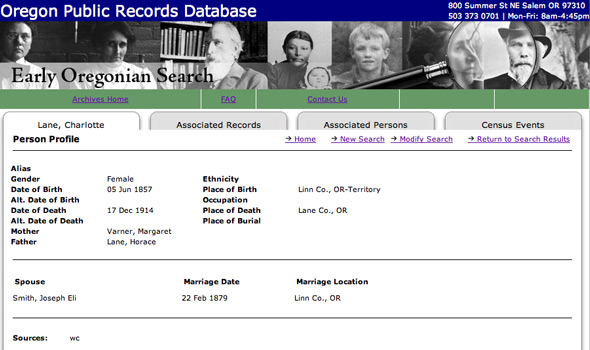
    I did a search on the Lane surname. I got many hits. Clicking on one for Charlotte Lane, I got the following screen. Click on the screen shot to go to the site – and then click on the tabs along the top. Pretty cool info…

    Early Oregonian search for Charlotte Lane

    Search the Early Oregonians Database.

  • Cochin (Kochi) / Ernakulam’s Upcoming Malls!

    Post renders, updates, news and info on new, proposed, approved or under consturction in Kochi and Ernakulam.

    Lets start of with –

    Heera HiLife, Edapally – 3,72,162.0 sq. ft.

  • Is Reality TV Good for Your Kids?

    Apparently a new reality TV season is about to begin. 

    family tv time image: sxc.hu

    family tv time image: sxc.hu

    Families seem to become glued to their television screens during these shows, bemoaning the fact if something takes them away that evening and they can’t watch the moment the show becomes live, even though they can tape for later use.

    What do these shows teach our kids?  Are they displaying back biting, meanness, competition without ethics?  Even when there is team effort, we’re often shown name calling and ugliness, instead of friends and family helping one another.  The nastier the relationships between the contestants, even within families, the higher the ratings. 

    So do you want your children to hold up the participants in these shows as role models?  Do you want them treating siblings, friends and strangers the same way?

    Perhaps  there are some reality shows that point out the goodness in people.  However, in general, it would appear that the current batch of these shows bring out the worst in people and judges.

    What’s your opinion?

    Post from: Blisstree

    Is Reality TV Good for Your Kids?

  • DECE’s Plans for Digital Movie Purchases May Confuse and Anger You [Dece]

    The DECE, or Digital Entertainment Content Ecosystem, is made up of movie studios and tech companies, and is trying to create a way to effectively charge for digital movies. They revealed some future plans today, and they’re, um, interesting.

    The idea is that when you buy a movie, your rights are digitally stored in a “rights locker,” which should theoretically allow you to play your purchased movie on any hardware that supports the DECE standard. Considering that Sony, Microsoft, Cisco, Intel, Best Buy, Nokia, Toshiba, HP and Motorola—but not Disney or Apple—are all on board (and today they added several new members), that could mean a wide range of devices, from set-top boxes to TVs to mobiles—but not iPhones.

    There are a bunch of issues with that idea. First, if given the choice, far more people are going to rent a movie than buy one. Movies are different than music, you guys; you rarely re-watch movies, and the DECE proposal has no room for renting. Second, they’re trying to make our lives easier, but since this standard is unlikely to be adopted in full force immediately, that means lots more problems: Where do you get these particular movies, without one retailer like Amazon or iTunes? On which devices can you play them? Do you have to pick a hotel based on whether it supports DECE, so you can watch Fantastic Mr. Fox again? Do you have to replace all your current equipment?

    And, of course, any solution that’s harder to use than what’s freely available is not likely to stick around. Ripping a DVD (or Blu-ray) is easy, and you can use the file anywhere—why go to this complicated, proprietary version?

    We’ll reserve full judgment until we see exactly what DECE has planned (possibly at CES this week). But for now—just rip your own Blu-rays. Here’s how. [NYTimes]

    Digital Entertainment Content Ecosystem (DECE) Announces Key Milestones

    21 New Members Join Cross-Industry Coalition to Make “Buy Once, Play Anywhere” a Reality for Consumers

    LOS ANGELES —(Business Wire)— Jan 04, 2010 Today the Digital Entertainment Content Ecosystem LLC (DECE LLC), www.decellc.com, a coalition with support from every industry involved in digital entertainment, announced it has reached key milestones toward establishing the first open market for digital content distribution. In addition, DECE announced that 21 companies have joined the group which now includes 48 members across entertainment, software, hardware, retail, infrastructure and delivery.

    The milestones announced today include:

    Agreement on a Common File Format, an open specification for digital entertainment, that will be used by all participating content providers, services and device manufacturers
    Vendor selection for and role of the Digital Rights Locker, a cloud-based authentication service and account management hub that allows consumers rights access to their digital entertainment
    Approval of five Digital Rights Management (DRM) solutions that will be DECE-compatible
    Full technical specifications will be available in the first half of 2010.

    Common File Format

    DECE has agreed on a Common File Format, an industry first in digital distribution. An open specification for digital entertainment, like DVD or Blu-ray, the Common File Format may be licensed by any company to create a DECE consumer offering. Since this format will play on any service or device built to DECE specifications – whether via Internet, Mobile, Cable or IPTV, etc. – it will make “Buy Once, Play Anywhere” a reality.

    The Common File Format optimizes the digital entertainment supply chain, benefiting content providers, Content Delivery Networks (CDNs) and retailers. Content providers only need to encode and encrypt one file type in portable, standard definition and high definition for multiple vendors. CDNs will not have to store different file types to accommodate retailers’ varying needs. Retailers can efficiently deliver content to devices from different manufacturers.

    Digital Rights Locker

    DECE has selected Neustar, Inc. (NYSE:NSR) as the vendor for the Digital Rights Locker, a cloud-based authentication service and account management hub that allows consumers rights access to their digital entertainment. It will authenticate rights to view content from multiple services, with multiple devices as well as manage content and registration of devices in consumer accounts. DECE will provide an open Application Programming Interface (API) that allows any Web-enabled storefront, service or device to integrate access to the Digital Rights Locker into its own consumer offering.

    Approved DRMs

    DECE has approved five DRMs that will be compatible with the Common File Format – Adobe® Flash® Access, CMLA-OMA V2, The Marlin DRM Open Standard, Microsoft PlayReady® and Widevine®. Compatibility with multiple DRMs will ensure that content can be played back via streaming or download on a wide variety of services and devices.

    New Members

    In 2009, 21 companies joined DECE, including: Adobe, Ascent Media Group, Cable Labs, Catch Media, Cox Communications, DivX, DTS, Extend Media, Irdeto, Liberty Global, Motorola, Nagravision, Netflix, Neustar, Nokia, Rovi, Secure Path, SwitchNAP, Tesco, Thomson and Zoran. These companies join DECE’s original members which include world leaders across a wide range of industries.

    “The digital entertainment marketplace is on the cusp of a new era of rapid growth,” said Mitch Singer, President of DECE. “The key to unlocking this potential is giving consumers the ‘Buy Once, Play Anywhere’ experience they want. That’s the goal of DECE and one we’re making rapid progress toward today.”

    About Digital Entertainment Content Ecosystem (DECE) LLC

    The Digital Entertainment Content Ecosystem (DECE) LLC is a cross-industry initiative developing the next generation digital media experience based on open, licensable specifications and designed to create a viable, global digital marketplace. The DECE is currently made up of Adobe, Alcatel-Lucent, Ascent Media Group, Best Buy, Blueprint Digital, Cable Labs, Catch Media, Cisco, Comcast, Cox Communications, Deluxe Digital, DivX, Dolby Laboratorie, DTS, Extend Media, Fox Entertainment Group, HP, Intel, Irdeto, Liberty Global, Lionsgate, Microsoft, MOD Systems, Motorola, Movie Labs, Nagravision, NBC Universal, Netflix, Neustar, Nokia, Panasonic, Paramount Pictures, Philips, RIAA, Rovi, Roxio CinemaNow, Samsung Electronics, Secure Path, Sony, SwitchNAP, Tesco, Thomson, Toshiba, Verimatrix, VeriSign, Warner Bros. Entertainment, Widevine Technologies Inc. and Zoran. This new digital media specification and logo program will enable consumers to purchase digital video content from a choice of online retailers and play it on a variety of devices and platforms from different manufacturers.


  • Pepsi Throwback, Pepsi Throwback Where To Buy

    The Throwbacks were with us for an 8 week run… and then disappeared, much to our dismay. Based on all the comments posted here on BevReview, as well as on Twitter and Facebook, we weren’t alone in that thought! Even the folks at National Public Radio were interested; they interviewed us on the air!

    Thus when Pepsi announced in August that we’d see another limited return of the Throwbacks starting in December, there was much rejoicing! Things got more exciting when we started to see the improved designs that both products featured, making up for the poorly-executed visual design we saw in April. With these new looks, the “new” Throwbacks should stand out in the marketplace more effectively.

    That said, the rereleased Pepsi Throwback is finally here!

    Let’s start by taking a look at the new label design. In Pepsi’s original announcements in August, they mentioned that we’d see the “Same formula, but cooler vintage look!” (Facebook) and “With the same formula, but new awesome vintage look!” (Twitter).
    Long gone is the blue label color that was used in the April release. Instead, we’ve actually gone retro, somewhat in the spirit of the prototype Pepsi Throwback design. The Pepsi logo in the December 2009 version of Throwback seems to be a callback to the 1971 vs. the 1987 version seen on the prototype bottle (note the differences in the “PEPSI” font, especially the way the “E” is crafted).
    Pepsi Throwback Comparison: Prototype, April 2009, & December 2009 Designs
    Pepsi Throwback Comparison: Prototype, April 2009, & December 2009 Designs

    The logo and branding is now set horizontally instead of vertical and sideways, more in line with standard can design, which was more popular back then vs. the 20 oz. bottles which dominate sales today.

    Careful observers will also note a change in the way sugar is described. You’ll recall the April 2009 version of Pepsi Throwback referred to the product as “made with natural sugar”, however now we have a callout to being “made with real sugar” (just likethe prototype originally noted). Of course, the use of this language seems a lot clearer vs. the question of “just what is natural sugar?” If the formula stays the same as has been previously shared, it should still be a combination of cane and beet sugar. Ironically, the use of the “real sugar” line may also prompt potential customers to ask, “so, if this is real sugar, what was the stuff in Pepsi before?” I’m sure the folks over at the Corn Refiners Association would love to answer that question.

    Share/Save/Bookmark

    Related posts:

    1. Lake Champlain Bridge Demolition Video The demolition also was streamed live on the New…
    2. Robin Thicke New Years Celebrations In Las Vegas Thicke’s latest release, Sex Therapy: The Session, dropped on December…
    3. Soundgarden Reunion 2010 SOUNDGARDEN broke up in 1997 after five albums, but rumors…

    Related posts brought to you by Yet Another Related Posts Plugin.

  • The Dark Side of the Late 2009 M&A Surge

    darth-vader-costumeWith the year—and decade—coming to a close, the business press has been awash with stories about just how lousy the ‘00s were. As Paul Krugman details in the New York Times, it was a decade with a tiny amount of job creation, and the first decade on record where private-sector jobs shrunk. The typical family got no economic boost at all. And when the volatility rollercoaster ended there was also no appreciation in home prices and zero gains on stocks.

    That pain was felt by venture capitalists as well. I’ve argued for a while now that once the gains from 1999 and 2000 fall off the ten-year index of VC returns, we’re going to be looking at an industry that has returns at or below the S&P 500. Given we’re coming out of a “decade of zero,” that’s a pretty bad thing. Especially for an asset class that is (supposed to) take huge risks in the name of potentially outsized returns.

    Dow Jones VentureSource is releasing its year-end liquidity numbers for 1999 this morning and no surprise—it’s just another data point nail in the coffin.

    At a high level you can put a good spin on the facts: In the fourth quarter acquisitions rebounded mightily. Public companies snapped up some 86 venture-backed companies for a total of $7.3 billion and three IPOs raised a—let’s be honest—paltry $220 million. And the median amount paid for a company in the fourth quarter was more than $100 million for the first time since 2000.

    MandAsRise

    But as frequently happens in quarter-to-quarter surveys, that $100 million number was skewed greatly by a few large deals, most notably, Zappos’s $1.2 billion purchase by Amazon. Overall, for the year the median acquisition price was just $27 million.

    SmallerReturns

    And the overall rebound in fourth quarter liquidity is only impressive compared to the nine months prior. For the year, the industry produced just $17.1 billion in returns, 34% less than the $26.1 billion generated in 2008. And that wasn’t a particularly good year.

    The surge in M&A and talk of some promising companies waiting in the wings to go public aside, this industry is in as much trouble as ever for three simple reasons. If these reasons don’t get addressed the 2010s may be worse than the ‘00s for the asset class.

    1. The Math Doesn’t Work. An industry that invests roughly $20 billion a year (or even more), can’t survive on returns of roughly $20 billion a year. The basis of a portfolio investing business is that the hits have to make up for the losses—not just pay for themselves. It doesn’t matter how much you believe in innovation, how much you believe in the Valley and how much you believe in venture capital itself—the numbers are now and have for the last decade been hopelessly out of whack. Unless investors can discover an area that can produce many billion-dollar homeruns like the ecommerce, enterprise software and telecom did in decades past, there needs to be dramatically less money investing in early stage firms, period.

    As we speak, many once proud venture firms are having a hard time raising their next funds, and many are turning towards less-desirable limited partners out of necessity. A host of funds were supposed to close in 2009 and haven’t yet. Watch the news in 2010 closely: If firms are taking money from state pension funds, raise an eyebrow. Back in the early 2000s state funds came under pressure from Freedom of Information Act requests to divulge information about underlying portfolio investments and privacy-conscious VCs turned their backs on those pension funds as a result. Anyone going back to them now was likely told no by nearly everyone else. Of course, those firms will still be in business. But not all firms will once their current funds are depleted, and ultimately, that’s a good thing for the industry.

    2. M&As Alone Will Not Sustain VCs. While it’s true that the bulk of exits VCs get are from acquisitions, this is not where the bulk of returns come from. The economics of venture capital are based on homeruns. That’s why some 5% of the industry makes some 95% of the money. And those big hits come from IPOs or in some cases the threat of an IPO that makes a publicly-held competitor pay a huge premium for a startup. This is why M&A values surged so high in the late 1990s. Companies like Cisco had to shell out hundreds of millions or even billions to buy a company because it was so easy for them to go public. That’s not the case today and when you only have a handful of companies out buying, even a Google or Cisco shopping spree can only net so much in returns.

    YearlyLiquidity

    3. The Perilous Ripple Effect. There is a way that venture capital can adjust to a new normal of smaller exits with smaller multiples: Taking less risk and selling early. That means a switch of focus from building companies to building products. This is how much of the world outside Silicon Valley invests now. The benefit is it requires less capital and less risk. If you build something of value, there’s a likelihood you can get $5 million or even $20 million for it. But that’s the cap of what you’re going to get without a business to back that product up. But that’s OK economically, because you have fewer failures since you’re taking less risk.

    Indeed in 2009, Dow Jones found that companies raised a median of just $18 million in venture capital before getting acquired. That’s 18% less than in 2008. And the companies sold faster. It took a median of five years to get an exit, versus six years in 2008.

    A lot of entrepreneurs and angel investors argue there’s nothing wrong with this. With far less capital needed to start a company these days, what’s wrong with a smaller exit? You’re still making money, right? Not every idea has to be a $1 billion one to be worth starting.

    That’s true for a bootstrapped or angel-funded startup, but not for venture backed deals and the Valley at large. That kind of thinking will eventually destroy an ecosystem that is built on a foundation of homeruns paying for all mistakes. Put another way, the reason we are so famously free to fail in the Valley is that a big homerun can economically make up for those failures. That is what has set Silicon Valley apart for decades. If that changes, the output of the Valley will change too.

    And don’t forget: The companies providing these modest exits are the homeruns from previous decades. Without the past big hits of Google, Microsoft, Yahoo and Cisco, who’d be paying $20 million for your Web 2.0 app today? Consider that Facebook—a company that was ridiculed by the press and analysts for not selling for $1 billion or less back in 2006 —has already bid $500 million for Twitter and acquired FriendFeed. Good thing for the Valley Facebook didn’t listen to critics.

    You don’t have to look too far to see what a world where VCs only build-to-flip would look like. It’s largely happened already in lifesciences. The industry that gave birth to Genentech, Amgen and a lot of promise for returns, job creation and cures, has now turned into big pharma’s outsourced R&D lab.

    I’m not blaming investors. Because of the high costs of clinical trials, biotech companies used to go public to fund clinical trials. But in the post-2000, SarbOx chill it became all-but impossible for pre-clinical trial, pre-revenue companies to go public. That meant the work had to get financed another way, and that other way was licensing deals with big pharma. Unfortunately, that means a lot of the value from those breakthroughs goes to big pharma, all but ensuring the next Genentech or Amgen may never be created.

    But tech doesn’t have those costly restrictions. Do we really want to embrace and celebrate an M&A only world of returns anyway?

    Crunch Network: CrunchBase the free database of technology companies, people, and investors


    Buy This Item: [Click here to buy this item]

    Read Original Article

  • AppMakr Transforms App Store Landscape, Enables Anyone To Make Their Own iPhone App

    appmakr-logoEvery once in a while, a startup comes around with a product that we not only cover, but actually want to use ourselves. PointAbout, a Washington, DC-based self-funded startup, has done just that. AppMakr is absolutely ridonkculous. Basically, AppMakr allows you to create your own iPhone app – for $199. You can include feeds from any RSS-enabled website, and the apps are completely native. Your app is published by PointAbout, AppMakr’s parent company, straight to Apple. If you want it published under your own name or Apple’s publishers license, spend $499. It is an extremely simple product and doesn’t help anyone create complex non-RSS-enabled apps, but it seems that PointAbout has democratized app development in a way that hasn’t been done before.

    For any MobileCrunch reader (and readers of our sister and parent blogs), AppMakr is offering 1,000 coupons. Use the code “TECHCRUNCH” to get $150 off the cost of making an app (bringing the price to $49). Visit www.AppMakr.com and use the coupon at checkout.

    I was skeptical when I first tried AppMakr: it’s common for products like this to be clunky, and to provide the user with too many options. Surprisingly, AppMakr was extremely well done and easy to use. The downside, of course, is that you don’t have that many options for what goes into your application, and it really does serve a limited purpose. For a blogger like me, it’s great, but you can’t use it to create even the simplest of games or anything like that.

    AppMakrInterfaceTo build your own app, you go on AppMakr.com and register for an account. Then you title your app (we titled it “MobileCrunch”). It automatically populates a list of suggested RSS feeds for you. It correctly found MobileCrunch’s RSS feed, Twitter feed, YouTube channel and Vimeo channel. You can select whichever ones you want to be in your app. Then, you can custom-make icons, splash-screens and headers. AppMakr searches Google image search to find suggested images for you – or you can upload your own. Finally, you have options for generating revenue (such as advertising via AdMob) through your app.

    It took me just 10 minutes to create my own app, which is impressive. The app is native, too, and doesn’t use Webkit, which is great for user experience because the app stores content on your iPhone for offline reading.

    MobileCrunchAppWhile you are crafting an application via AppMakr, you can also test it on the fly. Every time you make a change, AppMakr.com’s engine shows the change on a mock iPhone on the righthand side of your browser. This lets you test your app and check whether it actually does what you want it to. Furthermore, you can download the app to your iPhone and test it there as well.

    All of the apps are packaged the same way and there is no WYSIWYG interface to move buttons around or change the user experience. This also means all AppMakr-made apps will look the same, which is a bit of a problem if a large number of people start using it.

    AppMakr has been in beta for quite some time, and during their beta, they’ve managed to attract some tech heavyweights as users. Guy Kawasaki has 12 apps on the store via AppMakr [iTunes link], and Seth Godin has made his own app as well [iTunes link].

    AppMakr’s parent company, PointAbout, has been creating custom iPhone apps for companies for 1.5 years, says co-Founder Daniel Odio. They’ve got 15+ employees and are profitable, but felt like there was a huge opportunity to enable anyone to create their own app. As such, they’ve worked hard on developing AppMakr, and even use it for their own custom internal projects. Daniel says that a custom iPhone app can cost anywhere from $50,000-100,000, so they feel that $199 for an iPhone app is a major upgrade.

    PointAbout is based in Washington, DC, and has just opened a new office. They are providing office space for free for entrepreneurs in the DC metro area, so feel free to visit their website to find out more.

    One significant problem with AppMakr is that it only exacerbates the iTunes App overload, and encourages people (notice I no longer have to say “developers”) to flood the App Store. It seems like someone could easily create hundreds of garbage apps and generate a cash cow business on the App Store. Of course, that is again up to the users – the same thing could be said of Blogger enabling anyone to create a garbage website or YouTube letting anyone put up crappy videos.

    The bottom line is: it no longer costs $50,000+ to create an iPhone app, and you don’t need to be a developer to create one. For $199, AppMakr can do it for you. Oh, and if you’re a TechCrunch fan, don’t forget: use the code “TECHCRUNCH” at checkout and the first 1,000 users will spend just $49 creating their own iPhone app.

    Crunch Network: CrunchGear drool over the sexiest new gadgets and hardware.


  • Lenovo launches new line of ThinkPad laptops for small businesses

    thinkpad edgeLenovo is kicking off the new year with a series of new ThinkPad laptops for small businesses, including a number of low-cost options that include chips from Advanced Micro Devices. Lenovo is also offering a first for its business users: the choice of color in a laptop.

    The ThinkPad Edge, debuting at the Consumer Electronics Show, has a new industrial design that brings some of the sexy look of  consumer laptops to small business machines. The Windows 7 machine comes in black and “heat wave red.

    This color option is a big step, since Lenovo has been identified with conservative business designs forever (including the days when ThinkPad belonged to IBM). The company says the machines are still built for performance, productivity, reliability and security.

    But the marketing folks have noticed that people tend to take pride in having cool-looking laptops, whether they’re business people or not, said Charles Sune, worldwide segment manager at Lenovo, in an interview. The whole goal is to re-energize the ThinkPad brand, which some view as strait-laced.

    The choice of AMD Turion X2 and Athlon X2 processors in some of the machines is an important victory for AMD, which needs all of the design wins it can get in its battle with Intel. Lenovo has a lot of market share and it has been an Intel shop on its ThinkPad business line, although it has used AMD chips in consumer models. It shows that Lenovo is paying attention to the price-consciousness of recession-battered small businesses.

    It’s clear why the AMD machines are cheaper. With a four-cell battery, the Edge gets 3.7 hours of battery life with an AMD chip and 5.9 hours with a six-cell battery. With an Intel processor, it gets 5.9 hours with a four-cell and 8.9 hours with a six-cell.

    Lenovo is participating in the AMD Vision Pro branding campaign, which seeks to simplify the selling process for small business owners by classifying the computers into simple usage categories. Prices start at $549.

    The Edge machines also have a choice of high resolution cameras, optional 3G and 4G wireless, Skype for Internet calling and other features. There are four models in the Edge series, including models with 13 inch, 14 inch, and 15 inch screens. The laptops are smaller since Lenovo removed the numbered keypads on the keyboard. The 14-inch and 15-inch models (both available in the second quarter) will come with illuminated keyboards so you can see the keys on a darkened airplane. The 14-inch version will be available at Best Buy, a new channel for Lenovo.

    thinkpad xLenovo is also launching its first entry in the “ultraportable” laptop market, the ThinkPad X100e (right). The company bills the laptop as the first professional-grade ultraportable laptop below $500. It also uses an AMD processor and the AMD Vision Pro branding. Options include AMD Athlon Neo single-core or dual-core processors (cores refer to how many processing brains are on each chip). The laptop is available now and sells for as little as $449.

    The machine can run corporate operating systems such as Microsoft Windows 7 Professional, and it comes with Lenovo’s corporate-focused manageability features. It has an 11.6-inch display, a full-sized keyboard, and a choice of black or heatwave red colors. While it’s small, Lenovo is not calling it a “netbook” because it can run most applications, and it isn’t using Intel’s Atom processors.

    But for those who want the tried and true “classic” ThinkPad, Lenovo is offering four new models. These are the T410s, T410, T510, and the W510 (a mobile workstation). They will use Intel’s newest dual-core microprocessors and are built for performance. The machines weigh under three pounds and have 802.11n Wi-Fi, and optional Bluetooth and 3G.

    The battery life is as high as 22 hours, and the screens include options for multitouch. The 410s is aimed at extremely mobile users; the T410 and T510 are aimed at mainstream business users who want full performance; and the W510 is aimed at professionals in graphics-demanding fields like oil and gas, computer-aided design, and photography.

    It’s worth noting how much thought Lenovo puts into these machines. The company’s research found that average users hit the delete and escape keys up to 700 times a week on average. So the sizes of these keys have been increased on the T410s and T410 models. The models are available on Jan. 7 and are priced as follows: $1,399 for T410s, $999 for T410 and the T510, and $1,599 for the W510.


    Buy This Item: [Click here to buy this item]

    Read Original Article