Blog

  • 10 Deceivingly Quick Modern Sleeper Cars

    2013 Volvo S60 T6 R

    • 2013 Volvo S60 T5 R
    It’s true. Volvo is not generally looked upon as a manufacturer of fast cars. Well built cars yes, but fast cars, no. However all that changed when I slid behind the wheel of this 2013 Volvo S60 T5 R. The smooth running turbocharged inline-6 makes 325 hp and 354 lb.ft. of torque helping this blue Swede hit 60 mph in just a hair over 5-seconds and run the quarter in around 13.6. Hell, the fact that it’s that quick AND a Volvo automatically make it a shoe-in for a sleeper car list.

    2013 Cadillac CTS-V Sport Wagon
    *Image Credit: SeriousWheels.com

    • 2013 Cadillac CTS-V Wagon
    This thing is a beast. At first glance it looks like your standard Cadillac CTS wagon. However take a closer look and you’ll notice things like giant 6-pot Brembo calipers that sit upon 15.0-inch rotors. A massive rear differential cooler and of course, that optional 6-speed manual transmission. The CTS-V wagon is a grocery getter of the highest order. It packs a supercharged V-8 that produces 556 hp and 551 lb-ft of torque, a 0-60 mph time of 4.0 seconds and a top speed of around 190 mph, making it the fastest sleeper in this group.

    2014 Jeep Grand Cherokee SSRT

    • 2014 Jeep Grand Cherokee SRT
    470 hp and 465 lb.ft of torque, an 8-speed automatic transmission, launch control and 295-series tires at all four corners, AND the fact that it can tow up to 7,200 lbs. help to make the new 2014 Jeep Grand Cherokee SRT one of the most versatile vehicles on the market today. This thing is a big hammer, and although it weighs upwards of 5,100 lbs. it does a miraculous job of masking its weight. Combine that with the fact it looks only slightly different from the standard Grand Cherokee and you’ve got a 100% usable vehicle that will pull .90g on the skid-pad, hit 60 mph in under 5.0 seconds and put the hurt on just about anything it goes up against.

    2013 Honda Accord

    • 2013 Honda Accord V6
    There is no question that the 2013 Honda Accord V6 is the most unassuming ride on this list. It’s got plain vanilla looks, a relatively low price tag, and nothing about it that suggests big speed. However mash the gas and be prepared to hit 60 mph in a scant 5.6-seconds and blaze through the quarter mile in just over 14-seconds. This is in part to its robust 24-valve V6 that makes 278 hp / 252 lb-ft of torque. For comparison a 1970 HEMI ‘Cuda would hit 60 mph in just over 6-seconds and run the 1,320 in just under 14-seconds. Not too shabby for a mid-sized Japanese family sedan, right?

    2013 BMW 760Li
    *ImageCredit: BMWUSA.com

    • 2013 BMW 760Li V-12
    This is a 2013 BMW 760Li. It’s 17-feet long, weighs 2.5 tons and will run to 60 in 4.5 seconds. It also looks like you should be chauffeured around in it while reading the Wall Street Journal. Power comes from a massive twin-turbo V12 engine that makes 535 hp and 550 lb.ft. of torque, and while this puppy is also not cheap (base price of $140K), your chauffeur will be smiling from ear-to-ear as he crushes all manner of import and muscle car.

    2013 Ford Taurus SHO
    *Image Credit: MotorTrend.com

    • 2013 Ford Taurus SHO with the Performance Package
    Packing the same twin-turbo EcoBoost V6 that resides under the bonnet of the Ford Flex, the Ford Taurus SHO is yet another ride from the blue oval that has “sleeper” written all over it. It doesn’t evoke thoughts of speed, power or performance. However once unleashed (either in a straight line or on the track) a newly re-tuned chassis and suspension help this chub-chub of a family car hang right in there with some much sportier competition.

    2013 Acura TL
    *Image Credit: MotorTrend.com

    • 2013 Acura TL AWD
    I’ll be honest, I kind of assumed that the 2013 Acura TL AWD was an 8-second 0-60 mph car. However when I learned that it ran it in 5.3-seconds, I was completely blown away as that’s properly quick. A good looking car, the TL falls directly into that “nice Japanese sedan” category, meaning that it’ll probably run forever, but never be too exciting. However now that I know it’s got some stones, AND can be had with a 6-speed manual, I may have to give it another look.

    Be honest, you didn’t think it was that quick either.

    2013 BMW 328XI
    *Image Credit: Driving.ca

    • 2013 BMW 328xi
    When most people see a BMW 328xi on the road they generally assume that the owner settled because they couldn’t afford a 335i. However those that purchase the 328xi are actually the smart ones here. Powered by a twin-turbo inline-4 that makes 240 hp and 255 lb.ft of torque, the 328xi will sprint to 60 mph in just 5.7-seconds and onto a governed top speed of 130 mph. Combine that with the fact that most people will simply shrug it off as the “cheap” BMW, and you’ve got yourself a nice little, fly-under-the-radar hot-rod.

    2012 Chrysler 200 S

    • 2012 Chrysler 200 S
    I don’t care what you put it in, but a 3.6-liter V6 that makes 283 horsepower and 260 lb.ft. of torque will generally mean serious speed. Stuff it in a basic and boring Chrysler 200 though, and well, you’ve got the makings of a car that has the word “SURPRISE” written all over it. 0-60 mph time is in the mid-6′s and mid-range torque is fantastic meaning that you’ll be surprising people during highway roll-on’s every time you hit the gas.

    2013 Ford Flex

    • 2013 Ford Flex
    It goes 0-60 mph in under 6-seconds, is equipped with all-wheel-drive and has a twin-turbo V6 that produces 365-hp / 350-lb-ft of torque. It also looks as though it should be hauling surfboards to the beach. This is the 2013 Ford Flex Ecoboost AWD and it’s probably the best sleeper of the bunch. At $49,790.00 it’s definitely not cheap, but the fact that you’ll be able to school the vast amount of performance sedans in a light-to-light drag race is priceless.

  • Bad Wi-Fi signal? Linkase iPhone 5 case boasts a 50% boost

    Wouldn’t it be great if an iPhone case increased wireless speeds while protecting the phone at the same time? That’s exactly what the Linkase for iPhone claims to do. The case includes a slide-out antenna that looks like it’s part of the case. According to Absolute Technology, the company behind the Linkase, it “is fueled by EMW technology (electromagnetic waveguide) and is designed with an embedded proprietary sliding antenna that dramatically boosts a Wi-Fi signal—by up to 50 percent.”

    Normally when I hear such claims, I raise an eyebrow. But these videos of the case in action have my brow falling back down; at least part-way until I can see the Linkase myself:

    The tests on camera look legitimate, but again, I plan to check out this technology for myself: a Linkase review unit is on the way for my iPhone 5. And I have some definite near-dead-zones in my home to use for testing, even with a new 802.11 a/c router that has generally fixed most of my Wi-Fi coverage and speed issues. Personally, I’d be happy to get a consistent signal — even with minimal speeds — in rooms furthest away from my router.

    For now, there’s no price or availability for the Linkase on the product web page. That information is listed as coming soon. If it works as advertised — offering up to 50 percent boost in Wi-Fi speeds for the iPhone 5, what would you be willing to pay? I’d drop $50 on it for sure as I’ve already spend that much for nice cases that don’t do a thing for my iPhone’s Wi-Fi speeds.

    Related research and analysis from GigaOM Pro:
    Subscriber content. Sign up for a free trial.

  • Microsoft set to demo Windows Embedded 8 Industry this week

    Microsoft has visions of the “intelligent grocery store” and this week the company will put those dreams into motion at the Retail Tech Japan trade show. The show is described as “a vast collection of cutting-edge retail information technology ranging from store systems (e.g., Point-of-Sale registers) to head-office systems, in-store promotion devices, RFID / IC tags, backyard systems and logistics”.

    Today, Microsoft’s John Boladian, marketing director for Asia Pacific and Greater China, announced that the software giant will be running a series of demos showing off Windows Embedded 8 Industry. The new version is set to replace the older Windows Embedded POSReady 7.

    Boladian, who was formerly with the Windows Embedded team, claims that “this year’s RTJ will also see an exciting debut of demos showcasing Windows Embedded 8 Industry, a fixed-platform solution based on Windows 8 that provides specialized devices, particularly in retail, with the requirements they need out of the box”. The demos will take place at Microsoft’s booth # RT1302.

    Boladian goes on to explain that the booth will be “showcasing  streamlined, beautiful line-of-business applications that leverage Multi-Touch, Internet Explorer 10, enhanced power management and  connectivity, and lockdown capabilities”.

    Windows Embedded 8 Industry will be released shortly after the RTJ show. However, customers can already grab a Release Preview version from Microsoft if they wish to begin experimenting and building solutions.

    Photo Credit: Retail Tech Japan

  • What ed tech can learn from health care when it comes to data access

    To hear it from entrepreneurs and technologists in education, new efforts to combine historically siloed sets of student data will pave the way for a new era of personalized and dynamic learning. But to some parents and civil liberties advocates, it’s a privacy nightmare waiting to happen.

    According to a Reuters article on Monday, parents in several states are up in arms about inBloom, a $100 million project funded by the Bill & Melinda Gates Foundation, the Carnegie Corporation and others to create a massive database of student data. In fact, it said that parents in New York and Louisiana, as well as the Massachusetts chapters of the American Civil Liberties Union and Parent-Teacher Association, had written to state officials in protest, citing privacy and security fears.

    But while privacy and security concerns are certainly warranted (information about children is obviously not to be handled lightly), supporters of the project say they believe that by shifting the conversation from risks to benefits, those fears could be assuaged — and some say the health care industry can provide a positive example.

    On a panel Monday at the SXSWedu education technology conference in Austin, Stephen Coller, a senior program officer at the Gates Foundation closely tied to inBloom, said the electronic medical records (EMR) legislation that accompanied the stimulus package played a crucial role in elevating public discussion and action around patient access to their data, and he’d like to see something comparable happen in education.

    Privacy concerns related to health data certainly continue and, he acknowledged, the EMR effort is still in early days. But Coller emphasized that electronic records helped raise public dialogue around patient data and empower people to believe that they should be able to access their data.

    “Unless you give parents access to data and you make them aware that they should have access to data, we’re not going to make fundamental progress on this issue,” he said. “We seem to be heading in the right direction in health care, the debate in education shouldn’t be that different.”

    Right now, the conversation around privacy and student data is full of misinformation and irrationality, he said, and too many schools believe it’s only the vendors, not the parents and schools, who own student data — but by focusing on outcomes he hopes that could change.

    Already, companies like Bellevue, Wash.-based Dreambox Learning are showing how adaptive lessons and real-time reporting can personalize instruction. Startups like Kickboard and Civitas are starting to show schools and parents the value of capturing and analyzing student data. And, at SXSWedu this week, several vendors are demonstrating the applications of inBloom (we’ll have more on that later this week.)

    But Coller raised another interesting idea: a “digital student report card” (which, he said, President Obama once surfaced on the campaign trail in 2008) that, like an EMR, would give parents a digital record of their child’s educational progress.

    “The notion that every student in this country is entitled to a digital report card, to me, seems like a fundamental civic right and strikes me as non-controversial,” he told me after the panel. “To any parent in the system, it would seem like a sensible idea – it’s their child, their school system, their tax dollars. The fact that they don’t have a line of sight into where their students are… has to improve. And I think it begins with putting more power in the hands of parents and caregivers.”

    Related research and analysis from GigaOM Pro:
    Subscriber content. Sign up for a free trial.

  • BBC bringing iPlayer to Windows Phone ‘soon’

    The BBC’s excellent on-demand and catchup TV service iPlayer is available for both iOS and Android devices, although owners of phones and tablets running Google’s mobile OS remaining slightly short-changed when it comes to features compared to their Apple OS counterparts.
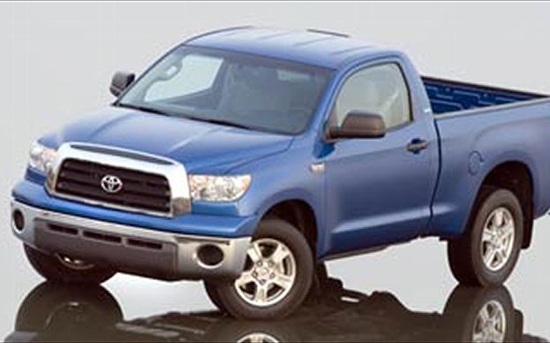
    Windows Phone users must feel perpetually short-changed at the moment I’m sure, but they too will soon be able to get iPlayer. There’s just one catch.

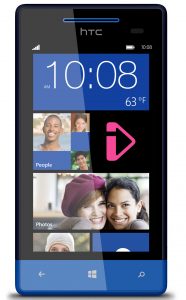
    Instead of releasing a dedicated app for Microsoft’s mobile OS, the BBC will be rolling out a shortcut application that will give users with a Windows Phone 7.5 or Windows Phone 8 handset access to the BBC iPlayer website via a live tile.

    According to Cyrus Saihan, Head of Business Development, BBC Future Media, “This shortcut will wrap the BBC iPlayer mobile website together with our media player. Hopefully these and other developments will help to expand our online reach further. Our latest figures show that over 650 different device types can access BBC iPlayer”.

    A shortcut application is hardly the same as a dedicated app, but it’s the best that Windows Phone owners can hope for. The BBC says it has no plans to create a special version of iPlayer for Microsoft’s platform.

  • 2007-12 Toyota Tundra Rear Rubbing or Grinding Turning Noise – TSB

    Does your 2007-2012 Toyota Tundra have a rubbing or grinding noise from the rear when turning? If so, Toyota has released a technical service bulletin (TSB) to address this issue.

    2007-12 Rubbing or Grinding Rear Noise - TSB

    Does your 2007-12 Toyota Tundra have a rubbing or grinding noise coming from the rear when turning?


    The T-SB-0013-13 addresses a condition where “some 2007 – 2012 model year Tundra vehicles may exhibit a rubbing or grinding noise from the rear when making left or right turns. New parking brake plate sub-assemblies have been developed to address this condition.”

    Like other TSB’s this repair is covered under the Toyota Basic Warranty, 36 months or 36,000 miles whichever occurs first, from the vehicle’s in-service date. And the repair is limited to the condition described.

    The Fix

    1. First, the mechanic will test drive the vehicle to confirm the condition by making left and right turns.
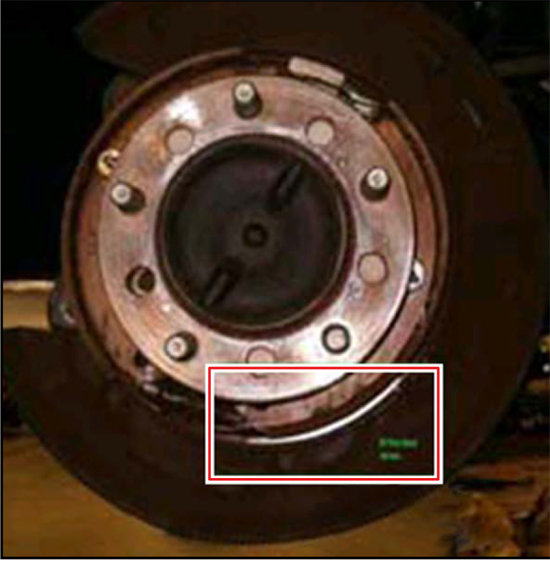
    2. Next, the truck will be raised on a lift and the rear wheels will be removed. Checking over the rear rotors, you should be able to see some irregular contact on the brake plate from the rotors (see picture below).

      2007-12 Rubbing or Grinding Rear Noise - Rotor Pic

      Example of irregular wear and tear on rotor.

    3. If irregular rubbing is present, then you will need to replace the brake parts with a “Special Service Part Bearing Kit.” Contact your local Toyota dealership for a list of the parts.
    4. After replacement of brake parts, take the truck for a drive to settle the parking brake shoe and disc. This is done by driving .25 mile on a level, dry road at approximately 31 mph. While driving, depress the parking brake pedal about 2-3 times. Lastly, stop and depress the parking brake, you should hold this position with 6-9 clicks of travel.
    5. Finally, take the vehicle for one more test drive to confirm the fix.

    With these types of repairs, it is recommended to have your local Toyota dealer perform the repair.

    Although, we hadn’t heard of this issue, have you? Did you get it fixed?

    Related Posts:

    Search terms people used to find this page:

    • toyota hilux 2014
    • 2014 hilux
    • new hilux 2014
    • toyota all new hilux
    • new tundra
    • 2010 toyota tundra rear wheel bearing diagram
    • all new toyota hilux 2014
    • replace rear rotors on tundra getting parking brake noise
    • scraping noise coming from rear wheels on hilux
    • rear parking brakes tundra 2007

    The post 2007-12 Toyota Tundra Rear Rubbing or Grinding Turning Noise – TSB appeared first on Tundra Headquarters Blog.

  • Is That a TV Show or Are You Trying to Sell Me Something?

    Content providers maintain an uneasy alliance with advertisers. Both sides know that ads enjoy greater attention when they are hard to separate from the content that surrounds them. And both sides need the advertising to succeed. But the content people also know their customers will balk if they feel that content has been compromised by paid marketing.

    As consumers’ devices and desires to filter out ads continue to advance, the line of permissible intrusion keeps moving deeper. First there were advertorials and ad copy rendered in a publication’s house font (usually but not always discreetly labeled “Paid Advertising”). The most infamous, of course, was the recent Scientology advertorial that was quickly yanked from The Atlantic’s website. (The publication has since revised its sponsored content policies.)

    Then there was material published by “content marketers” to serve the kinds of information needs typically met by traditional content providers, thus adding value to a customer’s engagement with a brand. And all along we’ve had product placement in films, TV shows, and games.

    A recent campaign shows how far a marketer can now go to make its advertising blend in with the surrounding context. After the retailers Target and Neiman Marcus teamed up on some merchandise, they decided to advertise it on ABC’s drama series Revenge. First they opted for a “takeover” of the program, meaning that every ad in the hour-long segment was theirs. Then, to make the most of that sole sponsorship, they hired the show’s cast to perform in character in five long-form commercials. These were unquestionably ads (the Target-Neiman Marcus line was prominent in them), but by borrowing all the elements viewers had chosen to enjoy and stringing the spots into a “story within a story,” the marketers made them hard to tune out. Here’s a sample of one (pardon the more obvious ad technique that is pre-roll):

    What instantly became clear is that there is a big difference between ads that travel into native territory and ads that “go native.” Clearly, there are major expenses as well as tricky constraints involved when a brand opts to blend in with indigenous content. But there will be enough opportunities, and enough reasons, for marketers to do more of this.Those that discover they can move comfortably in this realm may never go home again.

    This is the seventh in a series of posts from our March issue on the future of advertising. Stay tuned for more “Creative That Cracks the Code” over the coming weeks; topics include Variations on a Meme; Collaborating With the Crowd; The Ad as a Game; Just Enough Humor; A New Social Movement; Apps as the New Ads; Personalized Products; and Ads in the Public Sphere.

    We also want to know which ad campaigns strike you as innovative; tell us below and we could analyze your pick as part of this series.

  • The Hadoop ecosystem: the (welcome) elephant in the room (infographic)

    To say Hadoop has become really big business would be to understate the case. At a broad level, it’s the focal point of a immense big data movement, but Hadoop itself is now a software and services market of its very own. In this graphic, we aim to map out the current ecosystem of Hadoop software and services — application and infrastructure software, as well as open source projects — and where those products fall in terms of use cases and delivery model. Click on a company name for more information about how they are using this technology.

    A couple of points about the methodology might be valuable: The first is that these are products and projects that are built with Hadoop in mind and that aim to either extend its utility in some way or expose its core functions in a new manner. Another is that the “Hadoop Repackaged” category is used to characterize companies that are reselling Hadoop in some way (e.g., in an appliance or as part of their existing product suites) but that haven’t developed their own technology at the Hadoop level and instead rely on existing distribution software from companies such as Hortonworks or Cloudera.

    This is the second installment of our four-part series on the past, present and future of Hadoop. Part I is the history of Hadoop from the people who willed it into existence and took it mainstream. Part III will look into the future of Hadoop and serve as an opening salvo for much of the discussion at our Structure: Data conference March 20-21 in New York. Finally, Part IV will highlight some the best Hadoop applications and seminal moments in Hadoop history, as reported by GigaOM over the years.

    Hadoop-ecosystem-final-2

    Related research and analysis from GigaOM Pro:
    Subscriber content. Sign up for a free trial.

  • Verizon Samsung Galaxy Nexus, meet Android 4.2.2 Jelly Bean

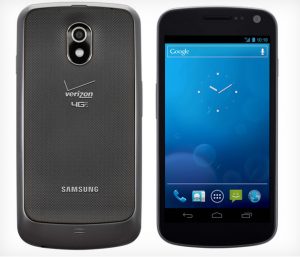
    Little less than a week ago, after replying to tweets from disgruntled users, Verizon revealed that the Galaxy Nexus will “soon” receive a software update. The big red did not provide any specifics and, judging by its past track record, “soon” means “months down the road” as updates usually roll out with the speed of a snail cruising down the highway in rush-hour traffic.

    But great news! Well, sort of. Less than a month after Google rolled out Android 4.2.2 Jelly Bean for the other Nexus devices, the Verizon-branded Galaxy Nexus has also received the latest iteration of the green droid operating system albeit via an OTA (Over-The-Air) update file. The OTA update was uncovered by enthusiasts, but comes straight from Google’s servers which means that it might hit all devices “soon” (as Verizon likes to say).

    As a result, at the time of writing this article, the only way to upgrade to Android 4.2.2 Jelly Bean is to manually flash the OTA update file, which comes in at 88.8MB in size, in the default or a custom Android recovery such as ClockworkMod or TWRP. Galaxy Nexus owners on Verizon will have to wait a tad longer for the big red to deploy the update in the traditional fashion and for Google to post the corresponding factory image.

    For those who only wish to flash the radios there is a zip file available, which includes a new LTE radio version as well as a normal one . For enthusiasts there is also a modded OTA file which will deliver Android 4.2.2 with root, busybox, insecure kernel and init.d support in deodexed and zipaligned trim. . Either of the two has to be installed using a compatible recovery.

  • Smartphones’ malware-free glory days may soon be over

    Smartphone Malware Analysis
    One downside of shifting to a post-PC world is the inevitable development and refinement of post-PC malware. Technology Review this week spoke with security researchers who say that they’re seeing an upgrade in both the quantity and sophistication of mobile malware attacks as hackers try to create a winning formula for distributing malware to mobile devices. At the moment, the researchers say that cybercriminals are experimenting with injecting malware into popular mobile websites and quietly installing it onto users’ devices whenever they visit compromised pages.

    Continue reading…

  • Apple Patents Squeeze Sensitive Device Housings That Could Be Used In Future iPhones And iPads

    Screen Shot 2013-03-05 at 7.38.00 AM

    Apple received a patent from the USPTO today (via AppleInsider) that describes a technology that would allow device casings to employ a combination of pressure and capacitive sensitivity to detect input. At the very least, the tech could be used to map functions like those Apple currently assigns to the home, power and volume buttons to areas of an iPhone or iPad’s bezel.

    Other uses for the patent, which was originally filed in 2009, are described by Apple as a backup or alternate input method for when standard capacitive-based touch interaction either won’t work or is impractical. Capacitive input, the kind used in the iPhone’s touchscreen currently, is much more accurate and responsive than resistive input, but it doesn’t work when wearing gloves, or when there’s sufficient grime on a screen, or when unwanted input signals are coming from a wrist resting on the display and confusing the sensors.

    Apple’s system is proposed as an alternative input mechanism for those kinds of situations. And since it’s not exactly a traditional resistive (pressure-only) resistive input method, it could also use capacitive clues to make it more refined as well as being much more sensitive to changes in pressure than capacitive systems. The combination of both types could guard against accidental input when a device is in a pocket, for example.

    As the system could live right in the housing of a device (the iPhone 5′s metal casing would be pretty perfect for it, in fact), it could greatly alter the way people interact with Apple devices. You could put scroll bars on either side of a smartphone, for instance, so that moving a finger or thumb up or down with differing pressure pages through content faster or slower.

    The company could build context-dependent controls into the back or side housing of all-metal devices with this tech, or even use it to add input to an iWatch housing. The benefits are mainly that it could provide a way to keep the screen clear, which becomes more important as we move to devices with smaller bezels, or smaller displays in the case of an iWatch.

    As with any Apple patent, however, this isn’t a roadmap. But it could be a neat way of adding another dimension of interaction to compete with recent changes from other OEMs, including touch input through gloves and eye movement tracking.

  • Green Throttle turns the Kindle Fire HD into a games console, Samsung Galaxy S III next

    This year is certainly going to be a big one for games consoles, with a new PlayStation and a new Xbox (rumored) to be arriving before Christmas. But it’s Android-based gaming systems that’s the big trend at the moment, with the likes of OUYA and GameStick grabbing their fair share of the headlines.

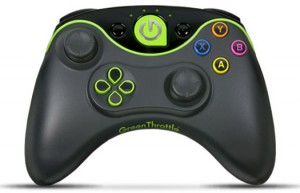
    Green Throttle is another Android games system, but it’s one that doesn’t require you to make space for a dedicated console under the TV. Instead you just need to buy one or more Green Throttle Atlas controllers, download the free Green Throttle Arena app from the Amazon Appstore, and hook up your Android tablet to a TV using a micro HDMI cable.

    At the moment the system only works with Amazon’s Kindle Fire HD, but support for additional devices is coming, and not just tablets. One of the next devices to be supported will be the Samsung Galaxy S III. Provided your device is capable of displaying 1080p at 60fps, it should, in time, be compatible with Green Throttle.

    The controllers connect to your tablet via Bluetooth, and cost $39.95 each, or $89.99 for a two player bundle which also includes a micro HDMI-to-HDMI cable and a micro USB charger. The setup supports up to four controllers, so you can enjoy multi-player games with friends.

    At the moment there aren’t many games available for Green Throttle, but the ones currently on offer are free, and of course there are more in development.

    Does Green Throttle sound like something of interest, or are you more excited by the likes of OUYA, or Microsoft and Sony’s new consoles? Comments below.

  • VMware’s SlideRocket finds a home with ClearSlide

    SlideRocket, the tool that lets marketing pros build slick multi-media presentations that kill PowerPoint ennui, now has a new home with ClearSlide. VMware bought SlideRocket just under 2 years ago but signaled in December that it would offload it, along with other non-core technologies.

    sliderocket

    ClearSlide CEO Al Lieb said that SlideRocket’s content creation technology — which targets marketing departments that need to churn out eye-grabbing presentations — fits nicely with ClearSlide’s more sales-oriented technologies that sell into enterprises.

    SlideRocket lets you start with either a blank template or a PowerPoint presentation and then add web animation, video and other perks, Lieb said in an interview. He said that most of the SlideRocket team will join ClearSlide — both are based in San Francisco.

    ClearSlide co-founders Al Lieb (right) and Jim Benton.

    ClearSlide co-founders Al Lieb (right) and Jim Benton.

    SlideRocket claims 1 million individual users while ClearSlide, which sees itself as a more modern and mobile-device-friendly rival to Cisco’s Webex conferencing service,  sells at the corporate level and claims thousands of users. ClearSlide netted $28 million in Series B funding last August.

    When VMware bought SlideRocket, it positioned the product as a complement to Zimbra, the email and collaboration software VMware purchased from Yahoo in early 2010. So this deal begs the question: What’s next for Zimbra?

    Related research and analysis from GigaOM Pro:
    Subscriber content. Sign up for a free trial.

  • Opera launches WebKit-based browser beta for Android

    Three weeks ago, Norwegian browser maker Opera Software announced a major change in the company’s philosophy, moving from the in-house Presto rendering engine to the open-source WebKit for all future Opera releases. The transition will be gradual but on Tuesday Opera took the first steps towards a Presto-free era.
    The developer demoed a preview version at Mobile World Congress (MWC) in Barcelona in late-February, and days after the convention finished Opera browser beta (not a very catchy name) made its way onto Google Play rocking that shiny WebKit engine. Judging by initial user feedback, the company appears to have hit a home run, as the app now has more than 190 five-star ratings out of a total of 275 and an average mark of 4.5. Not bad for an early-development build.

    Opera browser beta claims a more intimate and powerful connection with the user. Opera Software calls the WebKit-powered iteration its “fastest browser for Android”, capable of loading webpages “almost instantly”.

    In order to ensure decent browsing speeds in areas without 3G or 4G coverage, Opera browser beta sports an Off-Road Mode which compresses the webpage content in order to require as little bandwidth as possible (like Turbo Mode in the desktop browser). This should also help with lowering the cost of cellular data over time.

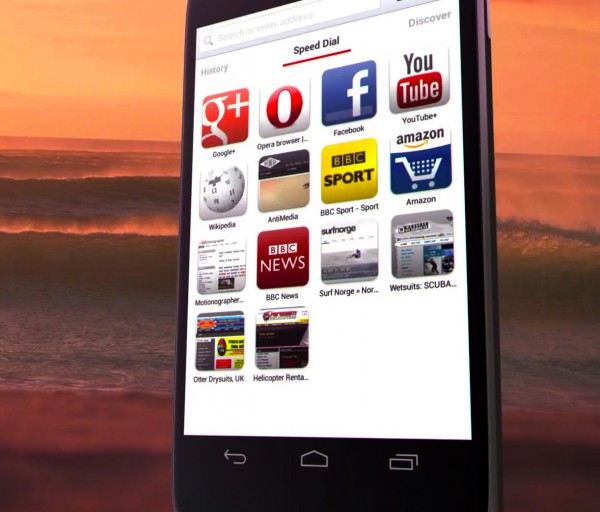
    The browser also comes with a Discover feature which is designed to “find out what’s happening” through personal news feeds. Users can use Speed Dial for easy-access to websites straight from the start, and take advantage of playback controls — start, stop and resume — and a download manager which allows for saving and renaming media files.

    Interestingly enough, with the transition from Presto to WebKit, Opera now also touts “a whole new level of site compatibility” and a native UI (User Interface) which “delivers a superior user experience” on smartphones.

    Users, however, continue to report some bugs but the general first-impressions appear to favor Opera browser beta. Have you given it a go?

  • Check your network details with NirSoft’s NetworkInterfacesView

    When you’re troubleshooting a network problem then it often makes sense to take a look at your network adapters, and all their associated details. But Windows doesn’t make this nearly as easy as it should. The information is available, but very fragmented, so you’ll probably have to browse various Control Panel applets and run a few command line tools to get the details you need.
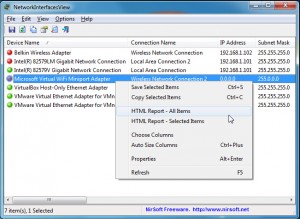
    Fortunately there now an easier way, though, in the shape of a new tool from NirSoft, NetworkInterfacesView.

    Just launch the program and it immediately list all your network interfaces, both active and inactive, along with all their basic details: the device and connection name, IP address, default gateway, name servers and MAC address.(“USB\VID_050D&PID_2103\00E04C000001” is a typical example) but can still provide helpful information. Physical adapters built into your PC will probably begin with PCI\; removable USB adapters start with USB\, while virtual (software-based) interfaces typically begin ROOT\.

    There are also details like the adapter’s DHCP server (if appropriate), interface GUID and MTU value.

    And the program also includes interesting items such as “Registry Time”, which presumably relates to the time when an interface Registry key was last written or modified. Although as we’re not sure which keys, or what might cause these to be written or modified, this information is tricky to interpret.

    That’s just the start, though. NetworkInterfacesView also provides an Instance ID, which looks cryptic Still, even without these extras, NetworkInterfacesView does provide a great deal of data which could be very helpful when you’re troubleshooting network issues. As usual with NirSoft tools, these details can be exported as a report for analysis later. And the program itself is a tiny (56KB) portable executable which should run on any edition of Windows, from 2000 through to 8 (and both 32 and 64-bit).
    Photo credit: Vladru/shutterstock

  • CyanogenMod 10.1 M2 — second monthly release — is available

    We’ve had to wait a tad longer than expected, but it’s finally here. The team behind the popular custom Android distribution CyanogenMod unveiled the second monthly release based on Android 4.2 Jelly Bean, more than a month after the last build.

    Like it usually happens with monthly builds, with CyanogenMod 10.1 M2 the focus is on stability improvements rather than introducing numerous new features that have yet to pass rigorous testing. As a result some of the latest features found in nightly builds may be left behind for future monthly releases in order to provide a custom Android distribution suited for daily-driver use.

    Furthermore, the team behind the project has not rushed into supporting all possible devices, only making CyanogenMod 10.1 M2, which is now based on Android 4.2.2 Jelly Bean, available for a select number of smartphones and tablets.

    The second monthly build currently supports the Google Nexus lineup (Nexus S, Galaxy NexusNexus 7 including the HSPA+ variantNexus 4Nexus 10 as well as the now-forgotten Nexus Q), the US variants of the Samsung Galaxy S III (codename “d2att”, “d2cri”, “d2mtr”, “d2spr”, “d2tmo”, “d2vzw”), the Samsung Galaxy S (codename “captivatemtd”, “epicmtd”, “galaxysmtd” and “galaxysbmtd”), the Samsung Galaxy Note (codename “quincytmo” and “quincyatt”) the Samsung Galaxy Tab 2 7.0 (versions P3100 and P3110), the Samsung Galaxy Tab 10.1 (versions P5100 and P5110), as well as other devices such as the Acer Iconia A700, the HTC One S (codename “ville”) and the HTC One X (codename “evita”).

    The team behind the project has also announced that bug reports for nightly builds “will get summarily dismissed”. The same measure does not, however, apply to monthly releases, for which submitting bug reports is still encouraged and welcomed.

    In the upcoming period CyanogenMod 10.1 M2 will be available for the Amazon Kindle Fire, recently-supported Motorola devices, and the Samsung Galaxy R when “they are ready”.

    The CyanogenMod 10.1 M2 builds can be downloaded from the CyanogenMod downloads page.

  • Transferwise’s ‘peer-to-peer’ international money transfer system just got easier to use

    London-based Transferwise is potentially one of the most disruptive financial tech startups out there – the company offers cross-border money transfers with extremely low charges by exploiting a P2P-esque network of local payments – but its mechanism has always been a bit clunky to use. That’s changing, though, as the company has just enabled debit card payments.

    That may sound like a small change, but it’s pretty fundamental to Transferwise’s future. Here’s why.

    The previous system involved three steps (or, from the customer’s perspective, two). An example: a British customer would go to Transferwise’s website and say that they wanted to send £100 ($151), for example, from the UK to Germany. They would then need to visit their own UK bank’s online banking facility to transfer the £100 to Transferwise’s UK account. The startup would then take the euro equivalent out of its German funds – stocked up by users in that country – and make a local payment in Germany to the intended recipient.

    The introduction of debit card payments removes that second step, meaning the customer can now do everything they need to do in one go on Transferwise’s website. This removes a major source of friction, and I would be surprised if it didn’t accelerate the company’s growth quite quickly (Transferwise did £10 million in currency traffic in its first year, up until the end of February 2012, and by the end of 2012 it had done £50 million).

    “We made it simpler and faster for our customers,” CEO Taavet Hinrikus, who was once Skype’s first employee, told me.

    According to Hinrikus, Transferwise’s customer base largely consists of individuals and small businesses, and the average transfer amount is around £1,300. The company offers savings of up to 85 percent on standard international transfer rates, levying a £1 charge on transfers up to £200 and typically just 0.5 percent on larger transfers. Exchange rates are taken straight from the interbank market without any fiddling of the going rate (as happens with some banks and wire transfer companies).

    There are limits to what Transferwise can do, though, and regulation is unsurprisingly (and understandably) the limiting factor. Within Europe, if you’re a financial services company and you’re given the all-clear by one national financial regulator (the UK’s Financial Services Authority or FSA, in Transferwise’s case) then you’re fine to operate anywhere on the continent. However, the company does not have regulatory clearance in other parts of the world, such as the U.S.

    For that reason, although Transferwise can handle transfers from Europe to the U.S., paying out in U.S. dollars, it can’t handle the reverse transaction. The same will apply to Canadian dollars, which the platform will start supporting in a week or so. You may be wondering how that works if Transferwise can’t actually have customers in the U.S. or Canada — according to Hinrikus, the company uses “large corporate peers” on that side of the Atlantic, including large companies sending money to Europe, other trading platforms and “financial markets”.

    Related research and analysis from GigaOM Pro:
    Subscriber content. Sign up for a free trial.

  • Morning Advantage: The Most Anticipated Commencement Speakers of 2013

    As U.S. colleges gear up for graduation day, many are announcing who their esteemed commencement speakers will be. Esther Zuckerman at The Atlantic gives us the rundown of some of the more intriguing speakers lined up. A few notables: President Obama will be speaking at Ohio State, Morehouse, and the U.S. Naval Academy. The Dalai Lama will deliver Tulane’s address. University of Virginia students can count on some big laughs with speaker Stephen Colbert. Toni Morrison will grace the Vanderbilt campus. Michael Bloomberg will speak at Stanford, Cory Booker at Yale, and Steve Wozniak at U.C. Berkeley. And Harvard landed Oprah. For a preview of what Harvard grads might expect, see the embedded video from Oprah’s 2008 Stanford commencement speech, where she reflects on harnessing passion, finding meaningful work, giving back, and what we can all learn from failure. Her best advice for gaining a competitive edge in the business world? Trust your gut.

    IT TAKES A STEADY HAND

    Tattoo Studio’s Brilliant Help-Wanted Ad Makes Applicants Carefully Fill In a QR Code (AdWeek)

    A tattoo studio in Turkey found an innovative way to use QR codes in job ads. They printed a newspaper ad seeking tattoo artists, which had a faintly-visible QR code. In order to begin the interview process, potential applicants had to first fill in the QR code — very carefully. Those who were skilled enough to complete the task with precision could then scan it to receive the official application form by e-mail. Those who couldn’t? They screened themselves out of the running.

    BABY STEPS

    Before You Brainstorm, Take Care of the “Front End” of Innovation (Innovation Excellence)

    Most organizations don’t appreciate the amount of discovery, learning, and thinking that are necessary for real innovation. As a consequence, they don’t allocate the time for these tasks, don’t assign the right people, and don’t establish the corporate expectations and culture that will help people innovate successfully. This neglect of the “front end” of innovation is one reason why companies have such a hard time creating truly new, non-incremental ideas. Jeffrey Phillips shows why it’s critical for companies to ask a lot of questions about customers and markets before trying to come up with new product ideas. — Andy O’Connell

    BONUS BITS:

    Julia, Charlie and John: You’re Going to Yale

    Infographic: Here are the Names That Get You Into Yale — Or Keep You Out (Gawker)
    Fraud or apathy: What is academia’s biggest threat? (Freeky Business)
    Stop Requiring College Degrees (HBR)

  • Opera’s new Android beta is out, and it includes some pretty big changes

    Opera has released the first public version of its new mobile browser, initially on Android. The beta is notable for a variety of reasons, not least because it is the first fruit of the company’s under-the-hood shift to WebKit and other new technologies, but also because it represents a major revamp on the front-end.

    For a start, the URL and search bars are now one, much as is the case in Chrome. The startup screen has also been significantly overhauled, adding a curated content discovery feature that is slightly reminiscent of Google Currents, and a history page that is easier to access than before. Private browsing is now an option, as it is in rival mobile browsers these days.

    On top of that, the Opera team has decided to tweak the Speed Dial concept: Speed Dial links are a narrow selection of favorite pages that show up on new tabs, and now Opera treats them like the bookmarks they are by allowed the user to organize them in folders.

    Beyond these changes, the browser still includes the features that already make Opera popular with a subset of users, such as optional server-side compression to cut down on data usage and speed up page loads, and the ability to save pages for offline reading,

    This was a much-needed overhaul. Opera’s problem has always been that it looked very different – that was because the company tried to do things differently, and they did succeed in introducing new concepts that others picked up on (Speed Dial was one and, at the risk of enraging Firefox fans, tabbed browsing was arguably another). This iteration has a very native-Android look, though not so much as to appear like a me-too browser. Features such as the combined URL/search bar may be unoriginal, but they were worth copying.

    The start screen, meanwhile, is in my opinion now leaps ahead of the competition, being more intuitive, more feature-rich and perhaps even more attractive than that offered by Chrome. Bearing in mind that this is the first of the new Opera browsers to come out – expect revamps across the board – it’s a good omen of things to come.


    Related research and analysis from GigaOM Pro:
    Subscriber content. Sign up for a free trial.

  • Exclusive: Startup AnsibleWorks pitches open-source IT configuration, deployment tool

    A couple of former Red Hat veterans think there’s an easier way to configure, deploy and manage IT across an organization and founded AnsibleWorks to attack that problem.

    Ansible co-founder Said Ziouani.

    Ansible co-founder Said Ziouani.

    Systems administrators and developers want one tool for deployment, configuration and management — they don’t want to deal with agents and add-ons, said Said Siouani, CEO of Santa Barbara, Calif.-based AnsibleWorks.

    No doubt Ansible’s orchestration engine will face off against popular configuration tools like Opscode Chef and Puppet Labs’ Puppet (see disclosure). Siouani characterized Ansible as a more “holistic” solution than what is on the market now in that it focuses on configuration management and actual deployment.

    Ansible co-founder Michael DeHaan.

    Ansible co-founder Michael DeHaan.

    Ansible itself is an open-source project kicked off a year ago by Michael DeHaan, one of the Red Hat vets who also spent time at Puppet Labs (see disclosure) and was also the force behind Cobbler, a popular Linux server installation tool.

    In the ensuing year, Ansible has drawn some name-brand users including Aerospike, AppDynamics, Basho Technologies, Care.com and Gawker Media. And, as of Tuesday, AnsibleWorks will provide maintenance and service subscriptions for that toolset.

    “We’re coming into this fresh with an all-open source solution that is flexible enough to configure all your systems — physical, virtual and which uses a text-based language, not scripting, which makes it easy to learn to use,” said Siouani, who spent 10 years at Red Hat and was most recently executive vice president of sales at Eucalyptus.

    Disclosure: Puppet Labs is backed by True Ventures, a venture capital firm that is an investor in the parent company of this blog, Giga Omni Media. Om Malik, founder of Giga Omni Media, is also a venture partner at True.

    Related research and analysis from GigaOM Pro:
    Subscriber content. Sign up for a free trial.