
Blog
-
Notebook PC shipments to finally rebound in Q2
-
IDC: Smartphone shipments to top feature phone shipments for first time ever in 2013
-
Samsung apologizes for fatal gas leak at semiconductor plant

-
Twitter kills Tweetdeck apps for iPhone and Android in favor of web apps
Twitter announced Monday afternoon that it would be shutting down older Tweetdeck apps for iPhone and Android, as well as Tweetdeck AIR and discontinuing Facebook support, in an effort to get people using Tweetdeck apps for web.
The shift for Tweetdeck users comes as Twitter continues to focus on monetization and has shut down third-party app experiences that haven’t fit with the company’s goals. However, after the company acquired Tweetdeck it continued to improve the Twitter web app experience, having just announced updates in February, which gave some users hope that it wasn’t going to shut down Tweetdeck entirely.
The company explained the update that will shift users to web apps over the older mobile apps in a blog post:
“TweetDeck is the most powerful Twitter tool for tracking real-time conversations. Its flexibility and customizable layout let you keep up with what’s happening on Twitter, across multiple topics and accounts, in real time. To continue to offer a great product that addresses your unique needs, we’re going to focus our development efforts on our modern, web-based versions of TweetDeck. To that end, we are discontinuing support for our older apps: TweetDeck AIR, TweetDeck for Android and TweetDeck for iPhone. They will be removed from their respective app stores in early May and will stop functioning shortly thereafter. We’ll also discontinue support for our Facebook integration.
Over the past 18 months, we’ve been focused on building a fast and feature-richweb application for modern browsers, and a Chrome app, which offers some unique features like notifications. We’ve recently introduced many enhancements to these apps –– a new look and feel, tools like search term autocomplete and search filtersto help you find what you’re looking for more quickly, and automatically-updating Tweet streams so you immediately see the most recent Tweets. Our weekly web releases have been possible because we’ve nearly doubled the size of the TweetDeck team over the past six months (and we’re still hiring).”

Related research and analysis from GigaOM Pro:
Subscriber content. Sign up for a free trial.- How consumer media will change in 2013
- Readers weigh in: future prospects for Twitter
- Connected world: the consumer technology revolution


-
Google puts is data-crunching powers to use mapping white spaces spectrum
Google on Monday began trialing a new kind of database. This one isn’t tallying ad impressions or tracking websites. Instead this database is cataloging white spaces spectrum, the unused airwaves in between TV channels that one day could be used for wireless and even mobile broadband links.
The reason such a database is key is because the TV spectrum in question has to be allocated dynamically. When a broadcaster or other licensed user is present, nobody else can touch it. Such databases, which have been or are being developed by Ericsson, Microsoft, NeuStar Spectrum Bridge (see disclosure) and several others, would create central repositories detailing which airwaves are available for white space broadband use at any given moment or location. Devices capable of transmitting in the white spaces airwaves would check those databases on a regular basis and pick their transmission channels accordingly.
Google is building its database – which is currently being tested by the FCC — as you would expect Google to build any data tool, as a browser-based app that allows anyone to search the white spaces in their area. Here’s what the channel map in my neck of the woods, Chicago, looks like:

The different colors represent the concentration of broadcasters in different airwaves. As you can imagine, Chicago is a pretty cluttered market when it comes to TV stations. But as you move outside of the cities, more channels clear up, which is one of the reasons a principle focus of white spaces broadband is on rural underserved areas. This search centered on Rockford, Ill., shows that contrast between Chicago’s and Milwaukee’s crowded airwaves and the large swathes of white spaces in rural Illinois, Wisconsin and Iowa:

Google may have more interest in white spaces than becoming a simple database administrator. Lately Google has sought permission to conduct a bunch of wireless technology trials using mysterious gear that hasn’t yet made it into any commercial network. I’ve postulated that Google is experimenting with the idea of a heterogeneous network, or HetNet, that combines advanced Wi-Fi, super-dense cellular clusters and largely unlicensed airwaves. If that proves to be true, then white spaces could be a key component of its strategy.
Disclosure: Spectrum Bridge is backed by True Ventures, a venture capital firm that is an investor in the parent company of this blog, Giga Omni Media. Om Malik, founder of Giga Omni Media, is also a venture partner at True.

Related research and analysis from GigaOM Pro:
Subscriber content. Sign up for a free trial.- A look back at mobile in Q1
- 2012: Data, spectrum and the race to LTE
- Consumer privacy in the mobile advertising era

-
Video: Why you shouldn’t care about securing the Internet of things just yet
Does thinking about privacy and security at the developing states of the internet of things hinder innovators’ ability to build an open system? That’s one of several questions that Usman Haque of Cosm asks in his presentation from the GigaOM internet of things meetup we did last week in San Francisco.
In his presentation Haque notes that we tend to think about the internet of things as already here, but just because something is connected to the internet, doesn’t mean it’s truly part of an internet of things with all of the openness and opportunity that might connote. Instead he presents some fears about what might derail the opportunity the internet of things represents. It’s a funny and thought-provoking talk that imagines a business model for the internet of things that relies on sharing revenue and open data.
We’ll be running videos of the other presenters from our San Francisco IoT Meetup all week long, so grab a snack and take a break from email to check out some smart people discussing the Internet of things. And if you want to check one of these out in person, come to our Boulder, Colo. meetup on March 13.

Related research and analysis from GigaOM Pro:
Subscriber content. Sign up for a free trial.- Analyzing the wearable computing market
- Connected world: the consumer technology revolution
- Siri: Say hello to the coming “invisible interface”

-
Hanging Out with First Lady Michelle Obama
Ed. note: This post was originally published on the official Let's Move! website.
Earlier today, First Lady Michelle Obama joined her first ever Google+ Hangout live from the Blue Room of the White House. Continuing our series of “Fireside Hangouts” on Google+, Mrs. Obama participated in a virtual conversation about Let’s Move!, her initiative to ensure our nation’s kids grow up healthy and reach their full potential.
During the Hangout, the First Lady discussed the new Let’s Move! Active Schools program designed to bring physical activity back to schools, the importance of family dinner, steps to get healthier lunches into schools – and favorite dance moves (of course, it’s the dougie. And yes, everyone in the hangout dougied together.) Watch the full video:

First Lady Michelle Obama participates in the “Let’s Move!” Google+ Hangout in the Blue Room of the White House.
March 4, 2013.
(Official White House Photo by Chuck Kennedy)
-
Sony aims for third place in global smartphone market

-
The White House agrees — you should be able to unlock your phone
 You asked and, this time at least, the government listened. Back in January, the legality of unlocking one’s cell phone was rolled back after the Library of Congress failed to renew a 2006 ruling, letting it to expire. The outcry could be heard round the world, as the saying goes.
These days, though, Americans have an outlet for their distaste — the government’s own “We the People site”. And citizens visited that site in droves — 114,322 of you demanded that the White House re-evaluate this ridiculous (my word, not the carriers’) law. The petition laid out the gripe in plain words — “Consumers will be forced to pay exorbitant roaming fees to make calls while traveling abroad. It reduces consumer choice, and decreases the resale value of devices that consumers have paid for in full”.
Today those voices were heard. White House spokesman R. David Edelman announces that “If you have paid for your mobile device, and aren’t bound by a service agreement or other obligation, you should be able to use it on another network”. Edelman even went so far to describe it as “common sense, crucial for protecting consumer choice, and important for ensuring we continue to have the vibrant, competitive wireless market that delivers innovative products and solid service to meet consumers’ needs”.
This does not entirely fix the problem, though the White House obviously carries a lot weight. There is still the matter of the Librarian of Congress and that little DMCA problem that the country has. However, the Edelman statement is fairly clear, while attempting to be gentle to the LOC.
So, what do all of you think? Is this a basic right that should be protected? Could any of you possibly be against this and, if so, why?
Photo Credits: Slavoljub Pantelic/Shutterstock
-
Remember, Facebook isn’t a platform for you to use — you are a platform for Facebook to use
Facebook seems to be making users upset and/or confused again with the way it handles its news feed. A few months ago, it was actor George Takei and billionaire Mark Cuban who were upset with what they saw as changes to the Facebook algorithm that made their content less visible, and this time around it’s New York Times writer Nick Bilton, who complained that his posts haven’t been getting as many likes or shares as they used to. The assumption is that Facebook wants you to pay to get this kind of reach, but regardless of whether that’s what is happening, it still sends a valuable message: you are not in control — Facebook is.
Bilton described in a piece for the Bits section of the Times how his posts used to get as many as 50 or even a hundred likes and shares, from users of Facebook who had signed up to get his feed using the network’s relatively new Subscribe feature. But even though the number of users who subscribe has soared from just 25,000 after the feature was launched to almost half a million now, Bilton said that he gets far fewer responses to his posts — sometimes as little as 10 or 15 likes and shares. After paying Facebook to promote his posts, however, that number increased by almost 1,000 percent.
Facebook denies it is tuning users out
I’ve noticed the same kind of phenomenon as Bilton has with my own feed, albeit on a somewhat smaller scale. While Bilton has almost half a million subscribers, I have about 75,000 — but I’ve also found that the content I post is getting a lot less interaction than in the early days of the feature. I haven’t experimented with paying Facebook to promote my posts, but I have no doubt I would see the same kind of increase in activity if I did. That’s kind of the whole point.

The conclusion that everyone seems to be jumping to is the same one that Mark Cuban arrived at when he complained in November about the increasing difficult of reaching his fans on the network: namely, that Facebook is deliberately tuning out (or at least turning down) the signal coming from some users so that it can convince them to use promotional tools like ads and “sponsored stories.” Cuban said he was so irritated by the move that he was diverting almost all of the marketing budget from his various brands away from Facebook to Twitter and other platforms.
Facebook gave much the same response then that it has made to Bilton’s column (as reported by my GigaOM colleague Eliza Kern): it said that it tweaks its ranking algorithms all the time, in order to try and decrease spam and increase the visibility of content that users like, and that this is not an attempt to market its other services such as advertising or various promotional features. An official post on the Facebook site entitled “Fact Check” says:
“Our goal with News Feed is always to show each individual the most relevant blend of stories that maximizes engagement and interest. There have been recent claims suggesting that our News Feed algorithm suppresses organic distribution of posts in favor of paid posts in order to increase our revenue. This is not true.”
Like Google, Facebook is a black box
It’s worth noting that former YouTube executive-turned-venture-capitalist Hunter Walk came up with some alternate theories about why Bilton and others might have seen a dropoff in their likes and shares, including the fact that some of the followers and subscribers that boosted those numbers were spam accounts or bots who have lost interest. I certainly noticed after the “Subscribe” feature launched that I got a lot of spammy responses as well as likes and shares, and those have died down as well. In that sense, decreasing the amount of activity would actually qualify as a good thing.

Zach Seward of Quartz had another theory that I also think has a lot of merit: in a comment on Walk’s post, he noted that Facebook often devotes a substantial amount of energy to promoting its new features — such as the subscription offering, as well as the “social newsreader” offerings that were launched by a number of newspapers such as The Guardian and the Washington Post. But after a certain time, the network almost always tweaks the ranking algorithm so that these new features are downplayed relative to when they were launched, which often causes problems for those who relied on them.
The bottom line, of course, is that there is no real way for anyone to know why Facebook’s algorithm behaves the way it does, any more than it’s possible for us to know why certain pages rank high in Google. They are both a black box, and the way they function is a mystery. As I tried to point out to Cuban, Facebook is entitled to do whatever it wants with your news feed, including using it to convince you to pay for promotional tools, because it owns your news feed — not you. It’s good to be reminded of that sometimes.
Post and thumbnail images courtesy of Fickr user balakov and Flickr user Pew Center

Related research and analysis from GigaOM Pro:
Subscriber content. Sign up for a free trial.- Social third-quarter 2012: analysis and outlook
- Social media in Q1: commerce and discovery dominated
- Web startups: How to guard against security breaches

-
Verizon executive thinks carriers can slash smartphone subsidies without hurting consumers

-
Facebook responds to criticisms of newsfeed, says it’s algorithms are designed to keep users happy
Are you more likely to see posts surfacing in your newsfeed if the author pays to promote them? NYTimes writer Nick Bilton wrote this weekend that he’s seen engagement on his posts drop recently, but Facebook has come back to refute some of his arguments.
Bilton’s column pointed to a drop in likes and shares from his subscribers (an option for public figures to allow non-friends to follow their updates), and the immediate jump he saw once he paid $7 to promote the post. Bilton questioned how Facebook surfaces items in the newsfeed, asking if advertising and promoted posts will push out posts that users share but don’t pay to promote.
But Facebook came back Monday with a blog post titled “Fact Check” that warns users not to take one person’s anecdotes too seriously, and explain how the algorithims come to be, saying the tweaks the company administers to the newsfeed formula are meant to give users a better experience on Facebook:
“There have been recent claims suggesting that our News Feed algorithm suppresses organic distribution of posts in favor of paid posts in order to increase our revenue. This is not true. We want to clear up any misconceptions by explaining how the News Feed algorithm works.
First, in aggregate, engagement – likes, comments, shares – has gone up for most people who have turned the Follow feature on. In fact, overall engagement on posts from people with followers has gone up 34% year over year.
Second, a few data points should not be taken as representative of what actually is happening overall. There are numerous factors that may affect distribution, including quality and number of posts.
News Feed shows the most relevant stories from your friends, people you follow and Pages you are connected to. In fact, the News Feed algorithm is separate from the advertising algorithm in that we don’t replace the most engaging posts in News Feed with sponsored ones.”
The post goes on to explain that the company has tweaked how much of public figures’ content is shared out to their subscribers, and arguing that you can’t compare interaction with posts from one year to the next, calling it an “apples to oranges” comparison.
It’s a little unclear why user interaction on a post from year to year would be an unfair comparison, but Facebook has explained the algorithms behind its newsfeed before, noting that it does change the formula quite frequently and relies on negative feedback to figure out what users don’t like. The question is, how does the company’s desire to promote paid posts work its way into the algorithms.
The company explained in November that the three most important factors that determine whether you’ll see a post in your feed are how you’ve reacted to the publisher in the past, how other people have reacted to the publisher’s story, and how you’ve reacted to similar stories before. So it’s reasonable to assume that if users stopped engaging with Bilton or other public figures posts, they might start popping up less frequently in the newsfeed.
“We make changes to the algorithim all the time, at least weekly,” Cathcart said in November. “We work all the time to say, ‘Can we better predict what people are looking at? Can we better predict what people won’t want to see or are less likely to interact with?’”


Related research and analysis from GigaOM Pro:
Subscriber content. Sign up for a free trial.- How consumer media will change in 2013
- Social 2013: The enterprise strikes back
- Examining the rise of crowd labor platforms in 2012

-
BlackBerry Sponsors Haxe NME for Cross-Platform 2D Games
Flash developers will find this interesting: BlackBerry is currently sponsoring the Haxe NME (Neko Media Engine) project on Github. NME allows developers to build cross-platform 2D games or apps. The platform allows developers to deploy to Windows, Mac, Linux, iOS, Android and BlackBerry, while also supporting Flash Player and HTML5. According to the About section:
“NME mirrors the traditional Flash API, so developers can leverage their existing experience to target new platforms, with better results. Developers with experience in ActionScript 3, Java or C++ can quickly learn to use NME without a long on-ramp.”

Check out the open source project on BlackBerry’s GitHub page at this link.
-
PC shipments go from worse to, well, you don’t want to know

IDC sure knows how to ruin a Monday. The analyst firm released final personal computer shipment tabulations for fourth quarter and all 2012 and made a dismal forecast for this year. If you’re as tired of reading “PC is dead” stories as I am writing them, cover your eyes. Read no further. The horrors ahead are unbearable.
Global shipments will decline for the second year in a row in 2013, with Windows 8 giving no perceptual lift at all. Holidays were a bust, as will be the year. You can’t fault Microsoft for trying, but there is only so much water you can throw off a sinking ship with buckets before it plunges beneath the waves. Perhaps only the rumored Windows Blue can save the PC now, but Win8 was supposed to do that — and look what happened. When an analyst firm uses “underwhelming reception” to describe a Microsoft operating system, it’s time to abandon ship.
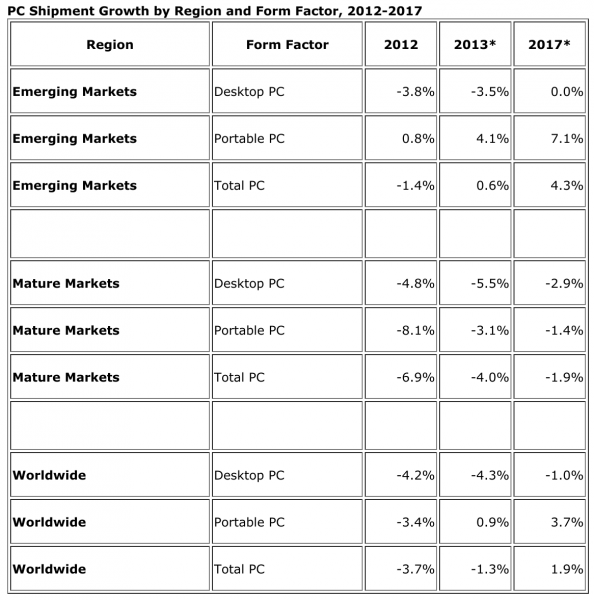
Global PC shipments fell a stunning 8.2 percent during Q4, when Windows 8 launched, for the steepest holiday quarter decline ever. Shipments fell 3.7 percent for the year, and IDC predicts 1.2 percent dip in 2013. Remember: this year’s fall back comes from an already weak comparable.
“The PC market is still looking for updated models to gain traction and demonstrate sufficient appeal to drive growth in a very competitive market”, Loren Loverde, IDC program vice president. Competition comes from you know where — tablets, which shipments will surpass notebooks this year, according to NPD DisplaySearch.
For about eight quarters now, analysts promised some respite would come from either Windows 8 or emerging markets. They’re not buying either. Smartphones and tablets are only a little less likely to pull away sales there, too. Overall PC shipments to emerging markets fell 1.4 percent in 2012; IDC predicts tepid, 0.6 percent growth this year.
“Growth in emerging regions has slowed considerably, and we continue to see constrained PC demand as buyers favor other devices for their mobility and convenience features”, Loverde says. (What’s that music? Do I hear a band playing “Nearer My God to Thee?”) “We still don’t see tablets — with limited local storage, file system, lesser focus on traditional productivity, etc. — as functional competitors to PCs, but they are winning consumer dollars with mobility and consumer appeal nevertheless”.
I keep hearing analysts say tablets aren’t good enough, but consumers continue not to listen. That says how much for how long most people primarily use a computer to consume content — and smartphones and tablets are good enough for that. The real content most people create — emails, IMs, photo shares or social network posts — are easily done on mobile devices.
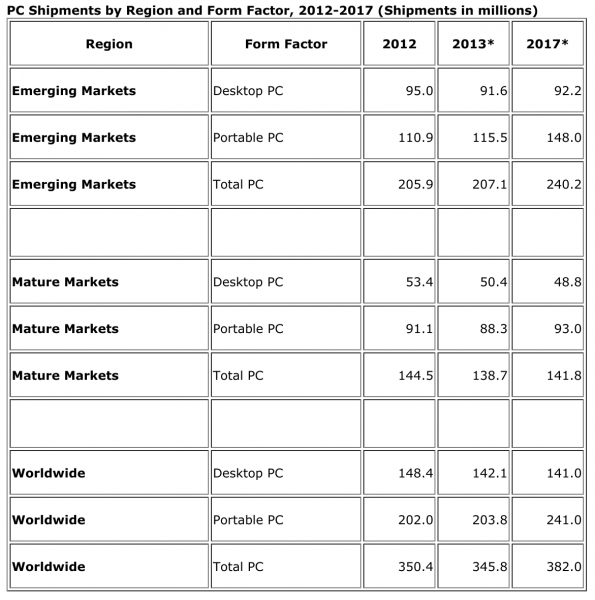
As for mature markets, shipments fell by 6.9 percent last year and are forecast to decline 4 percent this year. Shipments of laptops, which compete most directly with tablets, fell 8.1 percent in 2012. IDC predicts only 3.1 percent drop this year. What a recovery!
Here at home (hey, I live in the United States), the “PC market struggled in 2012, culminating with a 6.5 percent year-on-year decrease in the fourth quarter and -7.6 percent growth for the full year”, Rajani Singh, IDC research analyst, says. “Market saturation, a tough economic environment and weakness across the board, and lack of momentum for Windows 8, which led to 2012 contraction, are expected to persist at least during the first half of 2013”.
Yikes! Did someone say “Man the lifeboats!” The ship isn’t lost yet.
“IDC expects the second half of 2013 to regain some marginal momentum partly as a rubber band effect from 2012, and largely thanks to the outcome of industry restructuring, better channel involvement, and potentially greater acceptance of Windows 8”, Singh says. “We also anticipate a new refresh cycle momentum in the commercial segment driven by the end of Window XP life support”.
Microsoft’s mainstream support ended four years ago next month, and the company will finally pull the plug on extended support in 13 months. Cute. In the “notes” section in the XP lifecycle support page table, someone at Microsoft put “Upgrade to Windows 8 now!” next to Home and Pro.
That’s good advice for Microsoft Windows 8 license sales. As for helping new PCs — damn, the lifeboats are all gone.
-
Now on Kickstarter: a new kind of spinning energy storage device
Will Kickstarter prove to be a good source for some of the geekier next-gen energy technologies? Well, crowdfunding has certainly emerged as an interesting new opportunity for solar roofs. On Monday entrepreneur Bill Gray launched a Kickstarter campaign to raise funds for his energy storage technology startup Velkess.
Gray has spent the last six years at Velkess developing a new type of flywheel, which is traditionally an energy storage device that uses large spinning discs inside a vacuum. The rotation of the discs is stored as kinetic energy (or movement), and flywheels are used like batteries, usually as backup power for data centers. Research firm Lux Research estimated that flywheels and ultracapacitors could make up 10 percent of the datacenter backup power market market by 2016. Gray is excited about the possibilities of using his flywheels for enabling the addition of more clean power to the grid and combined with solar roofs.
Traditional flywheels, made by companies like Beacon Power, use rigid materials like steel, and are made with ultra precision engineering and manufacturing. That makes them pretty expensive. Velkess’ technology, in contrast, is made with fiber glass and is much more flexible, and thus much more low cost. “Think about it as a jet engine versus a cowboy lasso,” explained Gray in an interview recently.
Picture the material used for shower doors, or fishing rods or tennis rackets, but without an underlying matrix or frame. Velkess is using that type of material almost like a rope or flexible hoop, said Gray. While Gray didn’t share many specific numbers, he said by using this type of material, the Velkess flywheel could be cheaper than using lead acid batteries for backup power over ten years.
Gray is looking to raise $54,000 to help him build a large 750-pound prototype of the flywheel. To date he’s bootstrapped the company, but he says he needs those tens of thousands of dollars to buy the next level of magnets needed for the large model. He says he’s been working with contractors in San Jose on testing technologies, and has made 50 prototypes, but with these funds he’ll build the first close-to-scale prototype product.
Gray is excited about the possibility of crowdfunding as he says it gives entrepreneurs like him — that don’t come from a university, don’t have government backing and don’t go the venture capital route — an opportunity to raise money from a community. Backers of the Velkess flywheel can get incentives like a Velkess sweatshirt or a mini toy prototype.
Manufacturing flywheels at scale, like most capital intensive energy technologies, has proved to be difficult at times. Flywheel maker Beacon Power was awarded a Department of Energy loan guarantee but then later went bankrupt and was sold to a private equity firm. Financing for cleantech innovations have dried up significantly in recent years, with venture capitalists putting a third less funding into cleantech startups in 2012. Government funding will also likely be constrained in 2013.

Related research and analysis from GigaOM Pro:
Subscriber content. Sign up for a free trial.- Report: Cleantech’s Third-Quarter Growing Pains
- GigaOM Research highs and lows from CES 2013
- The fourth quarter of 2012 in cleantech

-
Next major Windows Phone release due this holiday season

-
Galaxy S IV Gets The Pre-Launch Benchmark Treatment, Complete With Leaked Specs

The Galaxy S IV, Samsung’s next big flagship smartphone, is only around a week from its public introduction, and it’s getting mighty leaky. Today, the NYT reported that Samsung will be including an eye scrolling feature in the GS IV’s software, and now a set of benchmarks have emerged that supposedly lay bare the smartphone’s complete hardware profile.
Italian site HDBlog.it received word of a record of an Antutu benchmark from the device, which was later also found by SamMobile, and which details the specs associated with the Galaxy S IV supposedly tested. The test results reveal that the smartphone has an Exynos 5410 1.8GHz processor, with an ARM PowerVR SGX 544MP GPU. It was running Android 4.2, had a screen just under 5-inches with a resolution of 1920×1080, and featured a 13-megapixel rear camera, along with Bluetooth 4.0 and capacity of either 16 or 32GB. The display stats line up with what we’ve heard earlier about the Galaxy S IV’s screen, as do the processor details, the amount of on-board memory and camera information.
The chipset supports GSM/WCDMA/LTE networks, which means that unlike previous Galaxy smartphones, this one will be a true worldphone, if these specs prove to be the real deal. The performance results on the GS IV should reassure any users who might have been expecting a less-than-impressive hardware release, following the NYT’s report earlier that the launch event March 14 will focus mostly on software: it easily beats current category leading devices like the Optimus G and Nexus 4, as well as the Galaxy Note II and Galaxy S III.
-
Counting down to SimCity

The new SimCity is coming to town tomorrow. I can’t wait to play it (though it seems like we Mac people have to wait a little while longer.) I admit I am not much of a gamer – SimCity and Age of Empires are my two gaming weaknesses, so it makes sense that I have been waiting for this brand new sequel for a very long time. I used to look at the blank grid of my unbuilt dream city and then take a long walk imaging the best possible city I could create based on the landscape. I often pondered decisions for hours and hours. I loved the windmills and big boulevards – explained by my love for Paris, Lyuten’s Delhi and Scandinavian sensibilities towards the environment.SimCity attuned me to the need for balance and refinement. I am and will always be a SimCity geek. There are many reasons to get excited about this version of the game and Josh Dzieza at the Daily Beast makes a great case for it. He writes:
The game’s most salient message, though, is that cities are extremely complex. You have to deal with power, water, housing, transportation, pollution, even sewage.
Magical words to my ears! So much so, I might have to install Windows just to play the game if the Mac version doesn’t come to market soon.

On the SimCity blog, senior producer Kip Katsarelis writes:
This is a new SimCity that offers a deeper, richer game than ever before, with the new GlassBox engine driving the most authentic simulation you will ever see. We have created a model-like world that makes you want to reach in, poke, prod, tinker and destroy. We have put the simulation right in front of you so you can see the consequences of your actions and really dig in to see how the systems work. This new SimCity has been built from the ground up to be an online experience with a new Multi-City feature, which adds an epic scale to city planning, as your decisions impact both your city and your region.
Here is a little taste of the game. Enjoy!

Related research and analysis from GigaOM Pro:
Subscriber content. Sign up for a free trial.- Connected Consumer Q2: Digital music meets the cloud; e-book growth explodes
- GigaOM Research highs and lows from CES 2013
- How HR can make the case for workforce analytics

-
This Wooden Spoon Doubles as a Stylus
In products that are so simple that they’re kind of genius news, I’m probably going to spend a few bucks and grab this new wooden spoon/stylus for my kitchen.
As sites like CHOW, Food 52, and even All Recipes as well as apps like Epicurious continue to replace traditional recipe books for many home cooks, sticky, contaminated iPads and other touchscreen devices become more and more of a problem.
For $7, you can avoid most of this hassle. Meet the ispoon kitchen stylus, a wooden spoon that doubles as a stylus for your in-kitchen touchscreen-using needs.
Just imagine: You grab a handful of ground beef and throw it in the skillet. You grab your wooden spoon to start breaking it up. Oh crap, how much cumin was I supposed to put in there? Now you can either wash your hands, or you can just flip over your spoon and tap your screen to find your answer. Hooray! No more E. coli on your iPad!
Sure, you could wash or wipe your hands between contacting your cooking ingredients and checking the recipe on your iPad. In this regard, this isn’t an essential product. But damnit, it’s cool and I want it.
-
Hindenburg Mystery Solved After 76 Years
Over the years, may hypotheses about how the fire aboard the Hindenburg started have been proposed. One of the more popular theories in conspiracy theory circles is that the airship was sabotaged, by anyone from communists to Adolf Hitler. This week, a new documentary on the disaster will endorse one of the more mainstream explanations for the explosion.
According to a report by The Independent, the new documentary, to air Thursday on the U.K.’s Channel 4, states that static electricity may have set the zeppelin ablaze. In this scenario, an electrical storm had charged the airship while gas had somehow leaked into the Hindenburg’s ventilation shafts. Crew members who took up the zeppelin’s landing ropes may have grounded the ship’s frame, but not its skin, causing the spark that set off the fire at the tail end of the ship.
According to the Independent, a group of experts led by aeronautical engineer Jem Stansfield set fire to quite a few scale models of the Hindenburg before reaching this conclusion. The research team recreated different scenarios for the disaster using the replicas, and tested multiple theories, including sabotage.
The Hindenburg, a German passenger airship, caught fire on May 6, 1937 over an airfield at the Lakehurst Naval Airstation in New Jersey. The blaze took down the airship in under 20 seconds, causing the deaths of 35 of the 97 people on board the ship. Newsreel footage of the disaster, featuring commentary from radio reporter Herbert Morrison, has become famous and is the origin of the popularization of the phrase, “oh the humanity!”


